SIXTH WEEK'S JOURNEY
Reading edition
A WEEK OF AGONY
Monday, October 23rd.
We left Pateley Bridge at seven o'clock in the morning, and after walking about two miles on the Ripley Road, turned off to the left along a by-lane to find the wonderful Brimham rocks, of which we had been told. We heard thrashing going on at a farm, which set us wondering whether we were on the same road along which Chantrey the famous sculptor walked when visiting these same rocks. His visit probably would not have been known had not the friend who accompanied him kept a diary in which he recorded the following incident.
They were walking towards the rocks when they, like ourselves, heard the sound of thrashing in a barn, which started an argument between them on their relative abilities in the handling of the flail. As they could not settle the matter by words, they resolved to do so by blows; so they made their way to the farm and requested the farmer to allow them to try their hand at thrashing corn, and to judge which of them shaped the better. The farmer readily consented, and accompanied them to the barn, where, stopping the two men who were at work, he placed Chantrey and his friend in their proper places. They stripped for the fight, each taking a flail, while the farmer and his men watched the duel with smiling faces. It soon became evident that Chantrey was the better of the two. The unequal contest was stopped, much to the chagrin of the keeper of the diary, by the judge giving his verdict in favour of the great sculptor. This happened about seventy years before our visit, but even now the old-fashioned method of thrashing corn had not yet been ousted by steam machinery, and the sound of the flails as they were swung down upon the barn floors was still one of the commonest and noisiest that, during the late autumn and winter months, met our ears in country villages.
When the time came for the corn to be thrashed, the sheaves were placed on the barn floor with their heads all in the same direction, the binders which held them together loosened, and the corn spread out. Two men were generally employed in this occupation, one standing opposite the other, and the corn was separated from the straw and chaff by knocking the heads with sticks. These sticks, or flails, were divided into two parts, the longer of which was about the size of a broom-handle, but made of a much stronger kind of wood, while the other, which was about half its length, was fastened to the top by a hinge made of strong leather, so that the flail was formed into the shape of a whip, except that the lash would not bend, and was as thick as the handle. The staff was held with both hands, one to guide and the other to strike, and as the thrashers were both practically aiming at the same place, it was necessary, in order to prevent their flails colliding, that one lash should be up in the air at the same moment that the other was down on the floor, so that it required some practice in order to become a proficient thrasher. The flails descended on the barn floors with the regularity of the ticking of a clock, or the rhythmic and measured footsteps of a man walking in a pair of clogs at a quickstep speed over the hard surface of a cobbled road. We knew that this mediæval method of thrashing corn would be doomed in the future, and that the old-fashioned flail would become a thing of the past, only to be found in some museum as a relic of antiquity, so we recorded this description of Chantrey's contest with the happy memories of the days when we ourselves went a-thrashing corn a long time ago!
GENERAL VIEW OF BRIMHAM ROCKS.
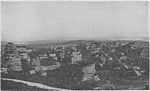
What Chantrey thought of those marvellous rocks at Brimham was not recorded, but, as they covered quite fifty acres of land, his friend, like ourselves, would find it impossible to give any lengthy description of them, and might, like the auctioneers, dismiss them with the well-known phrase, "too numerous to mention."
To our great advantage we were the only visitors at the rocks, and for that reason enjoyed the uninterrupted services of the official guide, an elderly man whose heart was in his work, and a born poet withal.
THE DANCING-BEAR ROCK.
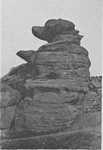
The first thing we had to do was to purchase his book of poems, which, as a matter of course, was full of poetical descriptions of the wonderful rocks he had to show us—and thoroughly and conscientiously he did his duty. As we came to each rock, whether we had to stand below or above it, he poured out his poetry with a rapidity that quite bewildered and astonished us. He could not, of course, tell us whether the rocks had been worn into their strange forms by the action of the sea washing against them at some remote period, or whether they had been shaped in the course of ages by the action of the wind and rain; but we have appealed to our geological friend, who states, in that emphatic way which scientific people adopt, that these irregular crags are made of millstone grit, and that the fantastic shapes are due to long exposure to weather and the unequal hardness of the rock. Our guide accompanied us first to the top of a great rock, which he called Mount Pisgah, from which we could see on one side a wilderness of bare moors and mountains, and on the other a fertile valley, interspersed with towns and villages as far as the eye could reach. Here the guide told my brother that he could imagine himself to be like Moses of old, who from Pisgah's lofty height viewed the Promised Land of Canaan on one side, and the wilderness on the other! But we were more interested in the astonishing number of rocks around us than in the distant view, and when our guide described them as the "finest freak of nature of the rock kind in England," we thoroughly endorsed his remarks. We had left our luggage at the caretaker's house, which had been built near the centre of this great mass of stones in the year 1792, by Lord Grantley, to whom the property belonged, from the front door of which, we were told, could be seen, on a clear day, York Minster, a distance of twenty-eight miles as the crow flies. As may be imagined, it was no small task for the guide to take us over fifty acres of ground and to recite verses about every object of interest he showed us, some of them from his book and some from memory. But as we were without our burdens we could follow him quickly, while he was able to take us at once to the exact position where the different shapes could be seen to the best advantage. How long it would have taken that gentleman we met near Loch Lomond in Scotland who tried to show us "the cobbler and his wife," on the top of Ben Arthur, from a point from which it could not be seen, we could not guess, but it was astonishing how soon we got through the work, and were again on our way to find "fresh fields and pastures new."
THE HIGH ROCK.
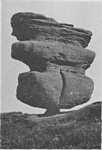
We saw the "Bulls of Nineveh," the "Tortoise," the "Gorilla," and the "Druids' Temple"—also the "Druids' Reading-desk," the "Druids' Oven," and the "Druid's Head." Then there was the "Idol," where a great stone, said to weigh over two hundred tons, was firmly balanced on a base measuring only two feet by ten inches. There was the usual Lovers' Leap, and quite a number of rocking stones, some of which, although they were many tons in weight, could easily be rocked with one hand. The largest stone of all was estimated to weigh over one hundred tons, though it was only discovered to be movable in the year 1786. The "Cannon Rock" was thirty feet long, and, as it was perforated with holes, was supposed to have been used as an oracle by the Ancients, a question asked down a hole at one end being answered by the gods through the priest or priestess hidden from view at the other. The different recesses, our guide informed us, were used as lovers' seats and wishing stones. The "Frog and the Porpoise," the "Oyster Rock," the "Porpoise's Head," the "Sphinx," the "Elephant and Yoke of Oxen," and the "Hippopotamus's Head" were all clearly defined. The "Dancing Bear" was a splendidly shaped specimen, and then there was a "Boat Rock," with bow and stern complete. But on the "Mount Delectable," as our guide called it, there was a very romantic courting and kissing chair, which, although there was only room for one person to sit in it at a time, he assured us was, in summer time, the best patronised seat in the lot.
We remunerated him handsomely, for he had worked hard and, as "England expects," he had done his duty. He directed us to go along a by-lane through Sawley or Sawley Moor, as being the nearest way to reach Fountains Abbey: but of course we lost our way as usual. The Brimham Rocks were about 1,000 feet above sea-level, and from them we could see Harrogate, which was, even then, a fashionable and rising inland watering-place. Our guide, when he showed us its position in the distance, did not venture to make any poetry about it, so we quote a verse written by another poet about the visitors who went there:
Some go for the sake of the waters— Well, they are the old-fashioned elves— And some to dispose of their daughters, And some to dispose of themselves.
But there must be many visitors who go there to search in its bracing air for the health they have lost during many years of toil and anxiety, and to whom the words of an unknown poet would more aptly apply:
We squander Health in search of Wealth, We scheme, and toil, and save; Then squander Wealth in search of Health, And only find a Grave. We live! and boast of what we own! We die! and only get a STONE!
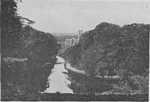
FOUNTAINS AND THE RIVER SKELL.
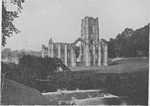
FOUNTAINS ABBEY. "How grand the fine old ruin appeared, calmly reposing in the peaceful valley below."
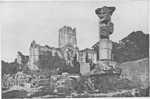
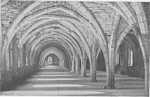
THE CLOISTERS, FOUNTAINS ABBEY. "Many great warriors were buried beneath the peaceful shade of Fountains Abbey."
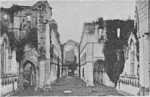
THE NAVE
Fortunately we happened to meet with a gentleman who was going part of the way towards Fountains Abbey, and him we accompanied for some distance. He told us that the abbey was the most perfect ruin in England, and when we parted he gave us clear instructions about the way to reach it. We were walking on, keeping a sharp look out for the abbey through the openings in the trees that partially covered our way, when suddenly we became conscious of looking at a picture without realising what it was, for our thoughts and attention had been fixed upon the horizon on the opposite hill, where for some undefined reason we expected the abbey to appear. Lo and behold, there was the abbey in the valley below, which we might have seen sooner had we been looking down instead of up. The effect of the view coming so suddenly was quite electrical, and after our first exclamation of surprise we stood there silently gazing upon the beautiful scene before us; and how grand the fine old ruin appeared calmly reposing in the beautiful valley below! It was impossible to forget the picture! Why we had expected to find the abbey in the position of a city set upon a hill which could not be hid we could not imagine, for we knew that the abbeys in the olden times had to be hidden from view as far as possible as one means of protecting them from warlike marauders who had no sympathy either with the learned monks or their wonderful books. Further they required a stream of water near them for fish and other purposes, and a kaleyard or level patch of ground for the growth of vegetables, as well as a forest—using the word in the Roman sense, to mean stretches of woodland divided by open spaces—to supply them with logs and with deer for venison, for there was no doubt that, as time went on, the monks, to use a modern phrase, "did themselves well." All these conditions existed near the magnificent position on which the great abbey had been built. The river which ran alongside was named the Skell, a name probably derived from the Norse word Keld, signifying a spring or fountain, and hence the name Fountains, for the place was noted for its springs and wells, as—
From the streams and springs which Nature here contrives, The name of Fountains this sweet place derives.
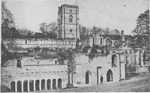
THE GREAT TOWER
The history of the abbey stated that it was founded by thirteen monks who, wishing to lead a holier and a stricter life than then prevailed in that monastery, seceded from the Cistercian Abbey of St. Mary's at York. With the Archbishop's sanction they retired to this desolate spot to imitate the sanctity and discipline of the Cistercians in the Abbey of Rieval. They had no house to shelter them, but in the depth of the valley there grew a great elm tree, amongst the branches of which they twisted straw, thus forming a roof beneath which they might dwell. When the winter came on, they left the shelter of the elm and came under that of seven yew-trees of extraordinary size. With the waters of the River Skell they quenched their thirst, the Archbishop occasionally sent them bread, and when spring came they built a wooden chapel. Others joined them, but their accession increased their privations, and they often had no food except leaves of trees and wild herbs. Even now these herbs and wild flowers of the monks grew here and there amongst the old ruins. Rosemary, lavender, hyssop, rue, silver and bronze lichens, pale rosy feather pink, a rare flower, yellow mullein, bee and fly orchis, and even the deadly nightshade, which was once so common at Furness Abbey. One day their provisions consisted of only two and a half loaves of bread, and a stranger passing by asked for a morsel. "Give him a loaf," said the Abbot; "the Lord will provide,"—and so they did. Marvellous to relate, says the chronicle, immediately afterwards a cart appeared bringing a present of food from Sir Eustace Fitz-John, the lord of the neighbouring castle of Knaresborough, until then an unfriendly personage to the monks.
"BENEATH WHOSE PEACEFUL SHADES GREAT WARRIORS REST"
Before long the monks prospered: Hugh, the Dean of York, left them his fortune, and in 1203 they began to build the abbey. Other helpers came forward, and in course of time Fountains became one of the richest monasteries in Yorkshire. The seven yew trees were long remembered as the "Seven Sisters," but only one of them now remains. Many great warriors were buried beneath the peaceful shade of Fountains Abbey, and many members of the Percy family, including Lord Henry de Percy, who, after deeds of daring and valour on many a hard-fought field as he followed the banner of King Edward I all through the wilds of Scotland, prayed that his body might find a resting-place within the walls of Fountains Abbey. Lands were given to the abbey, until there were 60,000 acres attached to it and enclosed in a ring fence. One of the monks from Fountains went to live as a hermit in a secluded spot adjoining the River Nidd, a short distance from Knaresborough, where he became known as St. Robert the Hermit. He lived in a cave hewn out of the rock on one side of the river, where the banks were precipitous and covered with trees. One day the lord of the forest was hunting, and saw smoke rising above the trees. On making inquiries, he was told it came from the cave of St. Robert. His lordship was angry, and, as he did not know who the hermit was, ordered him to be sent away and his dwelling destroyed. These orders were in process of being carried out, and the front part of the cave, which was only a small one, had in fact been broken down, when his lordship heard what a good man St. Robert the Hermit was. He ordered him to be reinstated, and his cave reformed, and he gave him some land. When the saint died, the monks of Fountains Abbey—anxious, like most of their order, to possess the remains of any saint likely to be popular among the religious-minded—came for his body, so that they might bury it in their own monastery, and would have taken it away had not a number of armed men arrived from Knaresborough Castle. So St. Robert was buried in the church at Knaresborough.
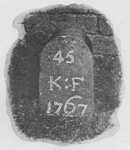
THE BOUNDARY STONE KNARESBOROUGH FOREST.
St. Robert the Hermit was born in 1160, and died in 1218, so that he lived and died in the days of the Crusades to the Holy Land. Although his name was still kept in remembrance, his Cave and Chapel had long been deserted and overgrown with bushes and weeds, while the overhanging trees hid it completely from view. But after a lapse of hundreds of years St. Robert's Cave was destined to come into greater prominence than ever, because of the sensational discovery of the remains of the victim of Eugene Aram, which was accidentally brought to light after long years, when the crime had been almost forgotten and the murderer had vanished from the scene of his awful deed.
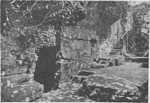
The tragedy enacted in St. Robert's Cave has been immortalised in poetry and in story: by Lord Lytton in his story of "Eugene Aram" and by Tom Hood in "The Dream of Eugene Aram." Aram was a man of considerable attainments, for he knew Latin, Greek, Hebrew, and other languages, and was also a good mathematician as well as an antiquarian. He settled in Knaresborough in the year 1734, and among his acquaintances were one Daniel Clark and another, John Houseman, and these three were often together until suddenly Daniel Clark disappeared. No one knew what had become of him, and no intelligence could be obtained from his two companions. Aram shortly afterwards left the town, and it was noticed that Houseman never left his home after dark, so they were suspected of being connected in some way with the disappearance of Clark. It afterwards transpired that Aram had induced Clark to give a great supper, and to invite all the principal people in the town, borrowing all the silver vessels he could from them, on the pretence that he was short. The plot was to pretend that robbers had got in the house and stolen the silver. Clark fell in with this plot, and gave the supper, borrowing all the silver he could. After all was over, they were to meet at Clark's house, put the silver in a sack, and proceed to St. Robert's Cave, which at that time was in ruins, where the treasure was to be hidden until matters had quieted down, after which they would sell it and divide the money; Clark was to take a spade and a pick, while the other two carried the bag in turns. Clark began to dig the trench within the secluded and bush-covered cave which proved to be his own grave, and when he had nearly finished the trench, Aram came behind and with one of the tools gave him a tremendous blow on the head which killed him instantly, and the two men buried him there.
ST. ROBERT'S AND EUGENE ARAM'S CAVE.
Clark's disappearance caused a great sensation, every one thinking he had run away with the borrowed silver. Years passed away, and the matter was considered as a thing of the past and forgotten, until it was again brought to recollection by some workmen, who had been digging on the opposite side of the river to St. Robert's Cave, finding a skeleton of some person buried there. As the intelligence was spread about Knaresborough, the people at once came to the conclusion that the skeleton was that of Daniel Clark, who had disappeared fourteen years before. Although Aram had left the neighbourhood soon after Clark disappeared, and no one knew where he had gone, Houseman was still in the town, and when the news of the finding of the skeleton reached him, he was drinking in one of the public-houses, and, being partly drunk, his only remark was, "It's no more Dan Clark's skeleton than it's mine." Immediately he was accused of being concerned in the disappearance of Clark, and ultimately confessed that Aram had killed Clark, and that together they had buried his dead body in St. Robert's Cave. Search was made there, and Clark's bones were found. One day a traveller came to the town who said he had seen Aram at Lynn in Norfolk, where he had a school. Officers were at once sent there to apprehend Aram, and the same night—
Two stern-faced men set out from Lynn, Through the cold and heavy mist; And Eugene Aram walked between With gyves upon his wrist.
Aram was brought up for trial, and made a fine speech in defending himself; but it was of no avail, for Houseman turned "King's Evidence" against him, telling all he knew on condition that he himself was pardoned. The verdict was "Guilty," and Aram was hanged at York in the year 1759.
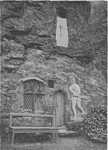
ST. ROBERTS CHAPEL.
Fountains Abbey in its prime must have been one of the noblest and stateliest sanctuaries in the kingdom. The great tower was 167 feet high, and the nave about 400 feet long, while the cloisters—still almost complete, for we walked under their superb arches several times from one end to the other —were marvellous to see. One of the wells at Fountains Abbey was named Robin Hood's Well, for in the time of that famous outlaw the approach to the Abbey was defended by a very powerful and brave monk who kept quite a number of dogs, on which account he was named the Cur-tail Friar. Robin Hood and Little John were trying their skill and strength in archery on the deer in the forest when, in the words of the old ballad:
Little John killed a Hart of Greece Five hundred feet him fro,
and Robin was so proud of his friend that he said he would ride a hundred miles to find such another, a remark—
That caused Will Shadlocke to laugh. He laughed full heartily; There lives a curtail fryer in Fountains Abbey Will beate bothe him and thee. The curtell fryer, in Fountains Abbey, Well can a strong bow draw; He will beate you and your yeomen. Set them all in a row.
ROBIN HOOD'S WELL, FOUNTAINS ABBEY.
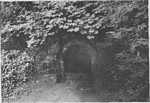
So Robin, taking up his weapons and putting on his armour, went to seek the friar, and found him near the River Skell which skirted the abbey. Robin arranged with the friar that as a trial of strength they should carry each other across the river. After this had been accomplished successfully Robin asked to be carried over a second time. But the friar only carried him part way and then threw him into the deepest part of the river, or, in the words of the ballad:
And coming to the middle streame There he threw Robin in; "And chuse thee, chuse thee, fine fellow, Whether thou wilt sink or swim."
Robin evidently did not care to sink, so he swam to a willow bush and, gaining dry land, took one of his best arrows and shot at the friar. The arrow glanced off the monk's steel armour, and he invited Robin to shoot on, which he did, but with no greater success. Then they took their swords and "fought with might and maine":
From ten o' th' clock that very day Till four i' th' afternoon. Then Robin came to his knee Of the fryer to beg a boone. "A boone, a boone, thou curtail fryer, I beg it on my knee; Give me leave to set my horn to my mouth And to blow blastes three."
The friar consented contemptuously, for he had got the better of the fight; so Robin blew his "blastes three," and presently fifty of his yeomen made their appearance. It was now the friar's turn to ask a favour.
"A boone, a boone," said the curtail fryer, "The like I gave to thee: Give me leave to set my fist to my mouth And to whute whues three."
and as Robin readily agreed to this, he sounded his "whues three," and immediately—
Halfe a hundred good band-dogs Came running o'er the lee. "Here's for every man a dog And I myself for thee." "Nay, by my faith," said Robin Hood, "Fryer, that may not be." Two dogs at once to Robin Hood did goe. The one behinde, the other before; Robin Hood's mantle of Lincoln greene Offe from his backe they tore. And whether his men shot east or west. Or they shot north or south, The curtail dogs, so taught they were, They kept the arrows in their mouth. "Take up the dogs," said Little John; "Fryer, at my bidding be." "Whose man art thou," said the curtail fryer, "Come here to prate to me!" "I'm Little John, Robin Hood's man. Fryer, I will not lie. If thou tak'st not up thy dogs, I'll take them up for thee." Little John had a bowe in his hands. He shot with mighte and maine; Soon half a score of the fryer's dogs Lay dead upon the plaine. "Hold thy hand, good fellow," said the curtail fryer. "Thy master and I will agree, And we will have new order ta'en With all the haste may be."
Then Robin Hood said to the friar:
"If thou wilt forsake fair Fountains Dale And Fountains Abbey free, Every Sunday throughout the yeare A noble shall be thy fee. "And every holiday throughout the yeare Changed shall thy garment be If thou wilt go to fair Nottinghame And there remaine with me." This curtail fryer had kept Fountains Dale Seven long years and more; There was neither knight, lord or earle Could make him yield before.
According to tradition, the friar accepted Robin's offer and became the famous Friar Tuck of the outlaw's company of Merrie Men whom in Ivanhoe Scott describes as exchanging blows in a trial of strength with Richard Coeur de Lion. It was said that when Robin Hood died, his bow and arrows were hung up in Fountains Abbey, where they remained for centuries.
We procured some refreshments near the abbey, and then walked on to Ripon, through the fine park and grounds of Studley Royal, belonging to the Marquis of Ripon, and we esteemed it a great privilege to be allowed to do so. The fine trees and gardens and the beautiful waters, with some lovely swans floating on them, their white plumage lit up with the rays of the sun, which that day shone out in all its glory, formed such a contrast to the dull and deserted moors, that we thought the people of Ripon, like ourselves, ought to be thankful that they were allowed to have access to these beautiful grounds.
The town of Ripon, like many others in the north of England, had suffered much in the time of the wars, and had had an eventful history, for after being burnt by the Danes it was restored by Alfred the Great in the year 860, only to be destroyed once more by William the Conqueror in his ruthless march through the northern counties. A survival of Alfred's wise government still existed in the "Wake-man," whose duty it was to blow a horn at nine o'clock each night as a warning against thieves. If a robbery occurred during the night, the inhabitants were taxed with the amount stolen. A horn was still blown, three blasts being given at nine o'clock at the Market Cross and three immediately afterwards at the Mayor's door by the official horn-blower, during which performances the seventh bell in the cathedral was tolled. The ancient motto of the town was:
EXCEPT Ye LORD KEEP Ye CITTIE Ye WAKEMAN WAKETH IN VAIN.
In 1680 the silver badges that adorned the horn were stolen by thieves, but they had long since been replaced, and the horn was now quite a grand affair, the gold chain purchased for it in 1859 costing £250.
The town was again burnt by Robert Bruce in 1319, when the north of England was being devastated after the disastrous Battle of Bannockburn; but it soon revived in importance, and in 1405 Henry IV and his court retired thither to escape the plague which at that time was raging in London.
In the time of the Civil War Charles I was brought to Ripon by his captors, and lodged for two nights in a house where he was sumptuously entertained, and was so well pleased with the way he had been treated that his ghost was said to have visited the house after his death. The good old lady who lived there in those troubled times was the very essence of loyalty and was a great admirer of the murdered monarch. In spite of Cromwell she kept a well-furnished wine-cellar, where bottles were continually being found emptied of their contents and turned upside down. But when she examined her servants about this strange phenomenon, she was always told that whenever the ghost of King Charles appeared, the rats twisted their tails round the corks of the bottles and extracted them as cleverly as the lady's experienced butler could have done himself, and that they presented their generous contents in brimming goblets to the parched lips of His Majesty, who had been so cruelly murdered. This reply was always considered satisfactory and no further investigation was made! "Let me suffer loss," said the old lady, "rather than be thought a rebel and add to the calamities of a murdered king! King Charles is quite welcome!"
RIPON MINSTER.
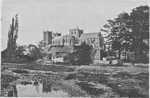
Eugene Aram, we were informed, spent some years of his life in Ripon at a house in Bond-Gate.
St. Wilfrid was the patron saint of Ripon, where he was born. Legend states that at his birth a strange supernatural light shone over the house, and when he died, those who were in the death chamber claimed that they could hear the rustling of the angels' wings who had come to bear his spirit away. As we saw some figures relating to him in the cathedral we presumed that he must have been its patron saint. We found afterwards it was dedicated to St. Peter and St. Wilfrid. St. Wilfrid was an enthusiast in support of the Church control of Rome. One sympathises with the poor king, who had to decide between the claims of Rome and the Celtic Church, whether priests should have their hair cut this way or that, and if the date of Easter should be decided by the moon or by some other way. He seems to have been a simple-minded fellow, and his decision was very practical. "I am told that Christ gave Peter the keys of heaven to keep, and none can get in without his permission. Is that so?" to which Wilfrid quickly answered "Yes." "Has your saint any power like that?" he asked Oswin, who could but say "No." "Then," said the king, "I vote for the side with the greater power," and decided in favour of Wilfrid. Like other cathedrals, Ripon had suffered much in the wars, but there were many ancient things still to be seen there. Near the font was a tomb covered with a slab of grey marble, on which were carved the figures of a man and a huge lion, both standing amongst some small trees. It was supposed to have covered the body of an Irish prince who died at Ripon on his way home from the Holy War, in Palestine, and who brought back with him a lion that followed him about just like a dog. In the cathedral yard there was an epitaph to a fisherman:
Here lies poor but honest Bryan Tunstall. He was a most expert angler until Death, envious of his merit, threw out his line, and landed him here 21st day of April, 1790.
RIPON MINSTER, WEST FRONT
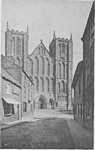
We left Ripon by the Boroughbridge road, and when about a mile from the town we met one of the dignitaries of the cathedral, who from his dress might have been anything from an archdeacon upwards. We asked him if he could tell us of any objects of interest on our farther way. He told us of Aldborough, with its Roman remains and the Devil's Arrows, of which we had never heard before; and he questioned us about our long tramp, the idea of which quite delighted him. We told him that we had thrown our mackintoshes away, and why we had done so, and had bought umbrellas instead; and he said, "You are now standing before a man who would give fifty pounds if he had never worn a mackintosh, for they have given me the rheumatism!"
The church at Kirkby Hill had just been restored. We saw an epitaph in the churchyard similar to one which we found in a graveyard later on, farther south:
Whence I came it matters not. To whom related or by whom begot; A heap of dust is all that remains of me, 'Tis all I am, and all the proud shall be.
THE DEVIL'S ARROWS.
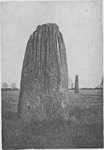
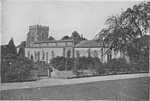
We soon reached the famous Boroughbridge, one of the most historical places in all England, the borough meaning Aldborough, the ISUER of the Brigantes and the ISURIUM of the Romans. Here we crossed the bridge spanning the Yorkshire River Ouse, which almost adjoined Aldborough, and were directed for lodgings to the house of a widowed lady quite near the church. It was nearly dark then, the moon, though almost at the full that night, not having yet risen. We decided to wait until after a substantial meal before visiting the Devil's Arrows a short distance away. There were only three of them left—two in a field on one side of the road, and one in a field opposite. The stones were standing upright, and were, owing to their immense size, easily found. We had inspected the two, and were just jumping over the gate to cross the narrow lane to see the other in the next field, when we startled a man who was returning, not quite sober, from the fair at Boroughbridge. As we had our sticks in our hands, he evidently thought we were robbers and meant mischief, for he begged us not to molest him, saying he had only threepence in his pocket, to which we were welcome. We were highly amused, and the man was very pleased when he found he could keep the coppers, "to pay," as he said, "for another pint." The stones, weighing about 36 tons each, were 20 to 30 feet high, and as no one knew who placed them there, their origin was ascribed to the Devil; hence their name, "the Devil's Arrows." Possibly, as supposed in other similar cases, he had shot them out of his bow from some great hill far away, and they had stuck in the earth here. There was fairly authentic evidence that twelve was the original number, and the bulk of opinion favoured an origin concerned with the worship of the sun, one of the earliest forms known. Others, however, ascribe them to the Romans, who erected boundary stones, of which several are known, on the hills farther south. We returned to our lodgings, but not to sleep, for our sleeping apartment was within a few feet of the church clock, on the side of a very low steeple. As we were obliged to keep our window open for fresh air, we could hear every vibration of the pendulum, and the sound of the ponderous bell kept us awake until after it struck the hour of twelve. Then, worn out with fatigue, we heard nothing more until we awoke early in the morning.
ALDBOROUGH CHURCH, BOROUGHBRIDGE.
(Distance walked twenty miles.)
Tuesday, October 24th.
The history of Aldborough, the old burh or fortified Saxon settlement, in spite of its Saxon name, could clearly be traced back to the time of the Brigantes, the ancient Britons, who inhabited the territory between the Tweed and the Humber. A Celtic city existed there long before Romulus and Remus founded the city of Rome, and it was at this city of ISUER, between the small River Tut and its larger neighbour the Yore, that their queen resided. Her name, in Gaelic, was Cathair-ys-maen-ddu ("Queen of stones black"), rather a long name even for a queen, and meaning in English the Queen of the City of the Black Stones, the remaining three, out of the original twelve, being those, now known as the Devil's Arrows, which we had seen the preceding night.
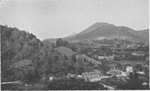
CAER CARADOC HILL, CHURCH STRETTON.
The Romans, however, when they invaded Britain, called her Cartismunda, her city ISURIUM, and the Brigantes' country they named Brigantia. But as the Brigantes made a determined resistance, their invasion of this part of England, begun in A.D. 47, was not completed until A.D. 70.
Queen Cartismunda was related to the King of Siluria, which then embraced the counties of Hereford and Monmouth, besides part of South Wales. He was one of the greatest of the British chieftains, named Caradoc by the Britons and Caractacus by the Romans. He fought for the independence of Britain, and held the armies of the most famous Roman generals at bay for a period of about nine years. But eventually, in A.D. 50, he was defeated by the Roman general Ostorius Scapula, in the hilly region near Church Stretton, in Shropshire, not far from a hill still known as Caer Caradoc, his wife and daughters being taken prisoners in the cave known as Caradoc's Cave. He himself escaped to the Isle of Mona, afterwards named Anglesey, with the object of rallying the British tribes there.
It so happened that some connection existed between Queen Cartismunda and the Romans who had defeated Caradoc, and after that event Ostorius Scapula turned his army towards the north, where he soon reached the border of Brigantia.
As soon as the queen, of whose morals even the Britons held no high opinion, heard of his arrival, she and her daughters hastened to meet the conqueror to make terms. If beauty had any influence in the settlement, she seems to have had everything in her favour, as, if we are to believe the description of one of the Romans, who began his letter with the words "Brigantes faemina dulce," the Brigantes ladies must have been very sweet and beautiful.
A most objectional part of the bargain was that Caractacus should be delivered up to the Roman general. So the queen sent some relatives to Mona to invite him to come and see her at Isuer, and, dreaming nothing of treachery, he came; but as soon as he crossed the border into the queen's country he was seized, bound and handed over to Ostorius, who sent him to Rome, together with his already captured wife and daughters.
On arrival at Rome Caractacus was imprisoned with some of his countrymen and in course of time brought before the Emperor Claudius. The brave and fearless speech he made before the Emperor on that occasion is one of the most famous recorded in history, and has been immortalised both in prose and poetry.
"Now I have spoken, do thy will; Be life or death my lot. Since Britain's throne no more I fill, To me it matters not. My fame is clear; but on my fate Thy glory or thy shame must wait." He ceased: from all around upsprung A murmur of applause; For well had truth and freedom's tongue Maintained their holy cause. The conqueror was the captive then— He bade the slave be free again.
Tradition states that one of his companions in the prison in Rome was St. Paul, who converted him to the Christian faith, with two of his fellow-countrymen, Linus and Claudia, who are mentioned in St. Paul's second Epistle to Timothy (iv. 21).
Descendants of Caradoc are still to be traced in England in the family of Craddock, whose shield to this day is emblazoned with the words: "Betrayed! Not conquered."
We awoke quite early in the morning—a fact which we attributed to the church clock, although we could not remember hearing it strike. My brother started the theory that we might have been wakened by some supernatural being coming through the open window, from the greensward beneath, where "lay the bones of the dead." Aldborough church was dedicated to St. Andrew, and the register dated from the year 1538—practically from the time when registers came into being. It contained a curious record of a little girl, a veritable "Nobody's child," who, as a foundling, was brought to the church and baptized in 1573 as "Elizabeth Nobody, of Nobody."
KNARESBOROUGH CASTLE.
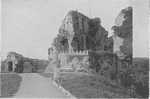
Oliver Cromwell, about whom we were to hear so much in our further travels, was here described in the church book as "an impious Arch-Rebel," but this we afterwards found was open to doubt. He fought one of his great battles quite near Aldborough, and afterwards besieged Knaresborough Castle, about eight miles away. He lodged at an old-fashioned house in that town. In those days fireplaces in bedrooms were not very common, and even where they existed were seldom used, as the beds were warmed with flat-bottomed circular pans of copper or brass, called "warming-pans," in which were placed red-hot cinders of peat, wood, or coal. A long, round wooden handle, like a broomstick, was attached to the pan, by means of which it was passed repeatedly up and down the bed, under the bedclothes, until they became quite warm, both above and below. As this service was performed just before the people retired to rest, they found a warm bed waiting for them instead of a cold one. But of course this was in the "good old times." Afterwards, when people became more civilised (!), they got into bed between linen sheets that were icy cold, and after warming them with the heat of their bodies, if they chanced to move an inch or two during the night they were either awakened, or dreamed about icebergs or of being lost in the snow!
The young daughter of the house where Oliver Cromwell lodged at Knaresborough had the task of warming Oliver's bed for him, and in after years when she had grown up she wrote a letter in which she said: "When Cromwell came to lodge at our house I was then but a young girl, and having heard so much talk about the man, I looked at him with wonder. Being ordered to take a pan of coals and 'aire' his bed, I could not forbear peeping over my shoulders to see this extraordinary man, who was seated at the far side of the room untying his garters. Having aired the bed I went out, and shutting the door after me, I peeped through the keyhole, when I saw him rise from his seat, advance to the bed, and fall on his knees, in which attitude I left him for some time. When returning I found him still at prayer—-and this was his custom every night as long as he stayed at our house—I concluded he must be a good man, and this opinion I always maintained, though I heard him blamed and exceedingly abused."
Aldborough was walled round in the time of the Romans, and portions of the walls were still to be seen. So many Roman relics had been found here that Aldborough had earned the title of the Yorkshire Pompeii. So interested were we in its antiquities that we felt very thankful to the clerical dignitary at Ripon for having advised us to be sure to visit this ancient borough.
TESSELLATED ROMAN PAVEMENT UNEARTHED AT ALDBOROUGH.
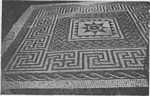
We now wended our way to one of the village inns, where we had been told to ask permission from the landlord to see the Roman tessellated pavement in his back garden. We were conducted to a building, which had been roofed over to cover it. Our attendant unlocked the door, and after the sawdust which covered the floor had been carefully brushed aside, there was revealed to our gaze a beautifully executed floor, in which the colours of the small tiles were as bright as if they had been recently put there. We could scarcely realise that the work we were looking at was well-nigh two thousand years old: it looked more like the work of yesterday. It had been accidentally discovered by a man who was digging in the garden, at about two feet below the surface of the soil; it was supposed to have formed the floor of a dwelling belonging to some highly placed Roman officer. We were speculating about the depth of soil and the difference in levels between the Roman Period and the present, but we found afterwards that the preservation of this beautiful work, and of others, was due not to any natural accumulations during the intervening centuries, but to the fact that the devastating Danes had burnt the town of Aldborough, along with many others, in the year 870, and the increased depth of the soil was due to the decomposition of the burnt ruins and debris. When we noted any event or object dating from 1771, we described it as "one hundred years before our visit," but here we had an event to record that had happened one thousand years before. Neither the attendant nor the landlord would accept any remuneration for their services, and to our cordial thanks replied, "You are quite welcome." We now went to see the cottage museum, which was well filled with Roman relics of all kinds, arranged in such fashion as would have done credit to a very much larger collection. The Roman remains stored here were described as "one of the most comprehensive collections of Roman relics in England," and included ornaments and articles in glass, iron, and bronze. There was also much pottery and tiles; also coins, images, and all kinds of useful and ornamental articles of the time of the Roman Occupation in Britain. Besides self-coloured tiles, there were some that were ornamented, one representing the "Capitoli Wolf," a strange-looking, long-legged animal, with its face inclined towards the spectator, while between its fore and hind legs could be seen in the distance the figures of Romulus and Remus, the founders of the city of Rome, who, tradition states, were suckled in their infancy by a wolf.
But my brother reminded me that none of these things were fit to eat, and that our breakfast would now be ready, so away we sped to our lodgings to get our breakfast and to pay our bill, and bid good-bye to our landlady, who was a worthy, willing old soul. Just across the river, about a mile away, was the site of the "White Battle," fought on October 12th, 1319—one of the strangest and most unequal battles ever fought. It occurred after the English had been defeated at Bannockburn, and when the Scots were devastating the North of England. The Scots had burnt and plundered Boroughbridge in 1318 under Sir James Douglas, commonly known, on account perhaps of his cruelty, as the "Black Douglas." Even the children were afraid when his name was mentioned, for when they were naughty they were frightened with the threat that if they were not good the Black Douglas would be coming; even the very small children were familiar with his name, for a nursery song or lullaby of that period was—
Hush ye, hush ye, little pet ye, Hush ye, hush ye, do not fret ye, The Black Douglas shall not get ye.
Just before the "White Battle" the English Queen Isabel, wife of Edward II, had taken up her abode with a small retinue in the country near York, when an effort was made by the Scots to capture her; they nearly succeeded, for she only just managed to get inside the walls of York when the Scots appeared and demanded admittance. This was refused by the aged Archbishop Melton, who had the bulwarks manned and the fortifications repaired and defended. The Scots were enraged, as York was strongly fortified, and they shouted all manner of epithets to the people behind the walls; one of them actually rode up to the Micklegate Bar and accused the queen of all manner of immoralities, challenging any man to come forth and clear her fame. The Archbishop in a stirring appeal called upon every man and youth to attack the invaders. His eloquence was irresistible, and although there were not more than fifty trained soldiers in the city, they attacked the Scots, who retreated. The Archbishop's army was utterly unskilled in the arts of war, and carried all kinds of weapons, many of them obsolete. The Bishop of Ely, Lord High Chancellor of England, rode alongside the Archbishop, and behind them rode the Lord Mayor, followed by a multitude of clergy in white surplices, with monks, canons, friars, and other ecclesiastics, all fully dressed in the uniform of their offices. But only one result was possible, for they were opposed to 16,000 of Robert Bruce's best-trained soldiers. Meantime the Scots did not know the character of the foe before whom they were retreating, but, crossing the River Swale near the point where it meets the Yore, they set fire to a number of haystacks, with the result that the smoke blew into the faces of the Archbishop and his followers, as the wind was blowing in their direction. They, however, pressed bravely forward, but the Scots attacked them both in front and rear, and in less than an hour four thousand men and youths, their white robes stained with blood, were lying dead on the field of battle, while many were drowned in the river. The sight of so many surpliced clergy struck terror into the heart of the Earl of Murray and his men, who, instead of pursuing farther the retreating army, amongst whom were the aged Archbishop and his prelates—the Lord Mayor had been killed—retired northwards.
Through the long hours of that night women, children, and sweethearts gazed anxiously from the walls of York, watching and waiting for those who would never return, and for many a long year seats were vacant in the sacred buildings of York. Thus ended the "Battle of the White," so named from the great number of surpliced clergy who took part therein. The old Archbishop escaped death, and one of the aged monks wrote that—
The triumphal standard of the Archbishop also was saved by the cross-bearer, who, mounted on a swift horse, plunged across the river, and leaving his horse, hid the standard in a dense thicket, and escaped in the twilight. The pike was of silver, and on the top was fixed the gilded image of our Lord Jesus Christ. Near where it was hidden a poor man was also hiding, and he twisted some bands of hay round it, and kept it in his cottage, and then returned it to the Bishop.
About this time England was like a house divided against itself, for the barons had revolted against King Edward II. A battle was again fought at Boroughbridge on June 22nd, 1322, between the rebel army led by the Earls of Lancaster and Hereford, and the King's forces who were pursuing them. They were obliged to retreat over the bridge, which at that time was built of wood; but when they reached it, they found another part of the King's army of whose presence they were unaware, so they had to fight for the possession of the bridge. During the fight a Welshman, armed with a long spear, and who was hidden somewhere beneath the bridge, contrived to thrust his spear through an opening in the timbers right into the bowels of Humphrey de Bohun, the Earl of Hereford, who fell forward mortally wounded. Thus died one of the most renowned warriors in England. The Earl of Lancaster made a final effort to cross the bridge, but his troops gave way and fled, the Earl taking refuge in the old chapel of Boroughbridge, from which he was dragged, stripped of his armour, and taken to York. Thence he was conveyed to his own castle at Pontefract, and lowered into a deep dungeon, into which, we were told, when we visited that castle later, he had himself lowered others, and soon afterwards he was condemned to death by the revengeful Edward, who had not forgotten the Earl's share in the death of his favourite, Piers Gaveston. Mounted on a miserable-looking horse, amidst the gibes and insults of the populace, he was led to the block, and thus died another of England's famous warriors.
OLIVER CROMWELL, THE GREAT PARLIAMENTARIAN.
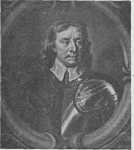
Needless to relate, we had decided to visit York Minster as our next great object of interest after Fountains Abbey, and by accident rather than design we had in our journey to and from York to pass over two battle-fields of first importance as decisive factors in the history of England—viz., Marston Moor and Towton Field. Marston Moor lay along our direct road from Aldborough to York, a distance of about sixteen miles. Here the first decisive battle was fought between the forces of King Charles I and those of the Parliament. His victory at Marston Moor gave Cromwell great prestige and his party an improved status in all future operations in the Civil War. Nearly all the other battles whose sites we had visited had been fought for reasons such as the crushing of a rebellion of ambitious and discontented nobles, or perhaps to repel a provoked invasion, and often for a mere change of rulers. Men had fought and shed their blood for persons from whom they could receive no benefit, and for objects in which they had no interest, and the country had been convulsed and torn to pieces for the gratification of the privileged few. But in the Battle of Marston Moor a great principle was involved which depended en the issue. It was here that King and People contended—the one for unlimited and absolute power, and the other for justice and liberty. The iron grasp and liberty-crushing rule of the Tudors was succeeded by the disgraceful and degrading reign of the Stuarts. The Divine Right of Kings was preached everywhere, while in Charles I's corrupt and servile Court the worst crimes on earth were practised. Charles had inherited from his father his presumptuous notions of prerogative and Divine Right, and was bent upon being an absolute and uncontrolled sovereign. He had married Henrietta, the daughter of the King of France, who, though possessed of great wit and beauty, was of a haughty spirit, and influenced Charles to favour the Roman Catholic Church as against the Puritans, then very numerous in Britain, who "through the Bishop's courts were fined, whipt, pilloried, and imprisoned, so that death was almost better than life."
JOHN HAMPDEN.
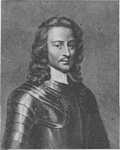
A crisis had to come, and either one man must yield or a whole nation must submit to slavery. The tax named "Ship Money," originally levied in the eleventh century to provide ships for the Navy, was reintroduced by Charles in 1634 in a very burdensome form, and the crisis came which resulted in the Civil War, when Hampden, who resided in the neighbourhood of the Chiltern Hills, one of the five members of Parliament impeached by Charles, refused to pay the tax on the ground that it was illegal, not having been sanctioned by Parliament. He lost his case, but the nation was aroused and determined to vindicate its power. Hampden was killed in a small preliminary engagement in the early stages of the war. The King was supported by the bulk of the nobility, proud of their ancient lineage and equipments of martial pomp, and by their tenants and friends; while the strength of the Parliamentary Army lay in the town population and the middle classes and independent yeomanry: prerogative and despotic power on the one hand, and liberty and privilege on the other. The Royal Standard was raised at Nottingham and the din of arms rang through the kingdom. The fortress of Hull had been twice besieged and bravely defended, and the drawn Battle of Edgehill had been fought. In the early part of 1644 both parties began the war in earnest. A Scottish army had been raised, but its advance had been hindered by the Marquis of Newcastle, the King's commander in the north. In order to direct the attention of Newcastle elsewhere, Lord Fernando Fairfax and Sir Thomas his son, who had been commissioned by Parliament to raise forces, attacked Bellasis, the King's Yorkshire Commander, and Governor of York, who was at Selby with 2,000 men, and defeated them with great loss, capturing Bellasis himself, many of his men, and all his ordnance. Newcastle, dismayed by the news, hastened to York and entered the city, leaving the Scots free to join Fairfax at Netherby, their united forces numbering 16,000 foot and 4,000 horse. These partially blockaded York, but Newcastle had a strong force and was an experienced commander, and with a bridge across the River Ouse, and a strong body of horse, he could operate on both sides of the stream; so Crawford, Lindsey, and Fairfax sent messengers to the Earl of Manchester, who was in Lincolnshire, inviting him to join them. He brought with him 6,000 foot and 3,000 horse, of the last of which Oliver Cromwell was lieutenant-general. Even then they could not invest the city completely; but Newcastle was beginning to lose men and horses, and a scarcity of provisions prevailed, so he wrote to the King that he must surrender unless the city could be relieved. Charles then wrote to Prince Rupert, and said that to lose York would be equivalent to losing his crown, and ordered him to go to the relief of York forthwith.
PRINCE RUPERT.
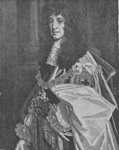
Rupert, the son of Frederick V, Elector of Bavaria, and a nephew of Charles I, was one of the most dashing cavalry officers in Europe. He lost no time in carrying out his commission, and in a few days Newcastle received a letter saying that he was stabling his horses that same night at Knaresborough, and that he would be at York the following day, Rupert's own horse being stabled that same night in the church at Boroughbridge. The news was received with great rejoicings by the besieged garrison and the people in York, but spread dismay amongst the besiegers, who thought York was about to capitulate. To stay in their present position was to court disaster, so they raised the siege and encamped on Hessey Moor, about six miles away, in a position which commanded the road along which Rupert was expected to travel. But by exercise of great military skill he crossed the river at an unexpected point and entered York on the opposite side. The Prince, as may be imagined, was received with great rejoicings; bells were rung, bonfires lighted, and guns fired, and the citizens went wild with triumphant excitement. Difficulties arose, however, between Newcastle, who was a thoughtful and experienced commander, and Rupert, who, having relieved the city, wanted to fight the enemy at once. As he scornfully refused advice, Newcastle retired, and went with the army as a volunteer only, Meantime there were dissensions among the Parliamentary generals, who were divided in their opinions—the English wishing to fight, and the Scots wishing to retreat. They were all on their way to Tadcaster, in search of a stronger position, when suddenly the vanguard of Rupert reached the rearguard of the other army at the village of Long Marston. This division of the retreating army included their best soldiers, and was commanded by Leslie and two other brave men, Sir Thomas Fairfax and Oliver Cromwell. Their rearguard halted, and, seeing the plain covered with pursuers, they sent word to the generals who had gone on in front, asking them to return and take possession of the dry land of the Moor, which was higher than that occupied by the Royalist army. Oliver Cromwell had already risen in the opinion of the army by his conduct in Lincolnshire, and he was dreaded by the Royalists, for he had already shown his ability to command. Stalwart and clumsy in frame, he had an iron constitution, and was a bold and good rider and a perfect master of the broadsword then in use. He had also a deep knowledge of human nature, and selected his troopers almost entirely from the sons of respectable farmers and yeomen, filled with physical daring and religious convictions, while his own religious enthusiasm, and his superiority in all military virtues, gave him unbounded power as a leader:
What heroes from the woodland sprung When through the fresh awakened land The thrilling cry of freedom rung. And to the work of warfare strung The Yeoman's iron hand.
The generals who had gone on in front now returned with their men to the assistance of their rearguard, and the whole army was brought into position on the high ground in the middle of the day, July 2nd, 1644. The position was a good one, sloping down gradually towards the enemy. The Royalist army numbered about 23,500 men, and that of the Parliament slightly more. It must have been a wonderful sight to see these 50,000 of the best and bravest men the kingdom could produce, ready to wound and kill each other. The war-cry of the Royalists was "God and the King," and that of the others was "God with us"—both sides believing they were fighting for the cause of religion. There were curses on one side and prayers on the other, each captain of the Parliament prayed at the head of his company and each soldier carried a Bible bearing the title "The Souldier's Pocket Bible, issued for use in the Commonwealth Army in 1643." It only consisted of fifteen pages of special passages that referred particularly to the soldier's life and temptations. Cromwell stood on the highest point of the field—the exact position, locally know as "Cromwell's Gap," was pointed out to us—but at the time of the great battle it was covered with a clump of trees, of which now only a few remained. The battle, once begun, raged with the greatest fury; but Cromwell and his "Ironsides" (a name given to them because of their iron resolution) were irresistible, and swept through the enemy like an avalanche; nothing could withstand them—and the weight of their onset bore down all before it. Their spirit could not be subdued or wearied, for verily they believed they were fighting the battles of the Lord, and that death was only a passport to a crown of glory. Newcastle's "White Coats," a regiment of thoroughly trained soldiers from the borders of Cheshire and Wales, who would not retreat, were almost annihilated, and Prince Rupert himself only escaped through the superior speed of his horse, and retired into Lancashire with the remains of his army, while Newcastle and about eighty others fled to Scarborough, and sailed to Antwerp, leaving Sir Thomas Glemham, the Governor of York, to defend that city. But as most of his artillery had been lost at Marston Moor, and the victors continued the siege, he was soon obliged to surrender. He made a very favourable agreement with the generals of the Parliamentarian forces, by the terms of which, consisting of thirteen clauses, they undertook to protect the property and persons of all in the city, not plunder or deface any churches or other buildings, and to give a safe conduct to officers and men—who were to march out with what were practically the honours of war—as far as Skipton.
The agreement having been signed by both parties on July 16th, 1644, Sir Thomas Glemham, with his officers and men, marched out of the city of York with their arms, and "with drums beating, colours flying, match lighted, bullet in mouth, bag and baggage," made for Skipton, where they arrived safely. The Battle of Marston Moor was a shock to the Royalist cause from which it never recovered.
YORK MINSTER.
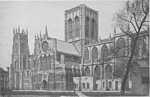
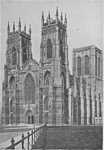
From Marston Moor we continued along the valley of the River Ouse until we arrived at the city of York, which Cromwell entered a fortnight after the battle; but we did not meet with any resistance as we passed through one of its ancient gateways, or "bars." We were very much impressed with the immense size and grandeur of the great Minster, with its three towers rising over two hundred feet in height. We were too late to see the whole of the interior of this splendid old building, but gazed with a feeling of wonder and awe on one of the largest stained-glass windows in the world, about seventy feet high, and probably also the oldest, as it dated back about five hundred years. The different scenes depicted in the beautiful colours of the ancient glass panels represented every important Biblical event from the Creation downwards. We were surprised to find the window so perfect, as the stained-glass windows we had seen elsewhere had been badly damaged. But the verger explained that when the Minster was surrendered to the army of the Commonwealth in the Civil War, it was on condition that the interior should not be damaged nor any of the stained glass broken. We could not explore the city further that afternoon, as the weather again became very bad, so we retreated to our inn, and as our sorely-tried shoes required soling and heeling, we arranged with the "boots" of the inn to induce a shoemaker friend of his in the city to work at them during the night and return them thoroughly repaired to the hotel by six o'clock the following morning. During the interval we wrote our letters and read some history, but our room was soon invaded by customers of the inn, who were brought in one by one to see the strange characters who had walked all the way from John o' Groat's and were on their way to the Land's End, so much so that we began to wonder if it would end in our being exhibited in some show in the ancient market-place, which we had already seen and greatly admired, approached as it was then by so many narrow streets and avenues lined with overhanging houses of great antiquity. We were, however, very pleased with the interest shown both in ourselves and the object of our walk, and one elderly gentleman seemed inclined to claim some sort of relationship with us, on the strength of his having a daughter who was a schoolmistress at Rainford village, in Lancashire. He was quite a jovial old man, and typical of "a real old English gentleman, one of the olden time." He told us he was a Wesleyan local preacher, but had developed a weakness for "a pipe of tobacco and a good glass of ale." He said that when Dick Turpin rode from London to York, his famous horse, "Black Bess," fell down dead when within sight of the towers of the Minster, but the exact spot he had not been able to ascertain, as the towers could be seen from so long a distance. York, he said, was an older city than London, the See of York being even older than that of Canterbury, and a Lord Mayor existed at York long before there was one in London. He described the grand old Minster as one of the "Wonders of the World." He was very intelligent, and we enjoyed his company immensely.
YORK MINSTER.
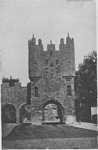
MICKLEGATE BAR, YORK.
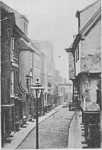
STONE GATE, YORK.
York was the "Caer Ebranc" of the Brigantes, where Septimus Severus, the Roman Emperor, died in A.D. 211, and another Emperor, Constantius, in 306. The latter's son, who was born at York, was there proclaimed Emperor on the death of his father, to become better known afterwards as Constantine the Great. In A.D. 521 King Arthur was said to have spent Christmas at York in company with his courtiers and the famous Knights of the Round Table; but Geoffrey of Monmouth, who recorded this, was said to have a lively imagination in the way of dates and perhaps of persons as well. It is, however, certain that William the Conqueror built a castle there in 1068, and Robert de Clifford a large tower.
(Distance walked sixteen miles.)
Wednesday, October 25th.
The boots awoke us early in the morning, only to say that he had sent a messenger unsuccessfully into the town for our shoes; all the consolation he got was that as soon as they were finished, his friend the shoemaker would send them down to the hotel. It was quite an hour after the time specified when they arrived, but still early enough to admit of our walking before breakfast round the city walls, which we found did not encircle the town as completely as those of our county town of Chester. Where practicable we explored them, and saw many ancient buildings, including Clifford's Tower and the beautiful ruins of St. Mary's Abbey. We also paid a second visit to the ancient market-place, with its quaint and picturesque surroundings, before returning to our inn, where we did ample justice to the good breakfast awaiting our arrival.
MONK BAR, YORK.
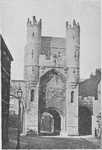
We left the City of York by the same arched gateway through which we had entered on the previous day, and, after walking for about a mile on the Roman road leading to Tadcaster, the CALCARIA of the Romans and our next stage, we arrived at the racecourse, which now appeared on our left. Here we entered into conversation with one of the officials, who happened to be standing there, and he pointed out the place where in former years culprits were hanged. From what he told us we gathered that the people of York had a quick and simple way of disposing of their criminals, for when a man was sentenced to be hanged, he was taken to the prison, and after a short interval was placed in a cart, to which a horse was attached, and taken straightway to the gallows. Here a rope was suspended, with a noose, or running knot, at the end, which was placed round the culprit's neck, and after other preliminaries the hangman saw to it that the man's hands were securely handcuffed and the noose carefully adjusted. At a given signal from him the cart was drawn from under the man's feet, leaving him swinging and struggling for breath in the air, where he remained till life was extinct. The judge when passing the death-sentence always forewarned the prisoner what would happen to him, and that he would be taken from there to the prison, and thence to the place of execution, "where you will be hanged by the neck until you are dead, dead, dead." Why he repeated the last word over and over again we could not explain. It was spoken very solemnly, and after the first time he used it there was a pause, and after the second, a longer pause, and then came the third in an almost sepulchral tone of voice, while a death-like silence pervaded the court, each word sounding like an echo of the one before it: dead!—dead!!—dead!!! Perhaps, like the Trinity, it gave a sense of completion.
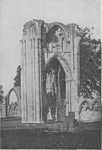
ST. MARY'S ABBEY, YORK.
The executions in those days were public, and many people attended them as they would a fair or the races; and when held outside the towns, as at York, a riotous mob had it in its power either to lynch or rescue the prisoner. But hangings were afterwards arranged to take place on a scaffold outside the prison wall, to which the prisoner could walk from the inside of the prison. The only one we ever went to see was outside the county gaol, but the character of the crowd of sightseers convinced us we were in the wrong company, and we went away without seeing the culprit hanged! There must have been a great crowd of people on the York racecourse when Eugene Aram was hanged, for the groans and yells of execration filled his ears from the time he left the prison until he reached the gallows and the cart was drawn from under him, adding to the agony of the moment and the remorse he had felt ever since the foul crime for which he suffered. As we stood there we thought what an awful thing it must be to be hanged on the gallows.[Footnote: In later years we were quite horrified to receive a letter from a gentleman in Yorkshire who lived in the neighbouring of Knaresborough in which he wrote: "I always feel convinced in my own mind that Eugene Aram was innocent. Note these beautiful lines he wrote the night before his execution:
"Come, pleasing rest! eternal slumber fall, Seal mine, that once must seal the eyes of all; Calm and composed, my soul her journey takes, No guilt that troubles, and no heart that aches! Adieu, thou sun! all bright like her arise; Adieu, fair friends! and all that's good and wise.
"I could give you," he added, "the most recent thoughts and opinions about the tragedy, and they prove beyond doubt his innocence!"]
But, like other dismal thoughts, we got rid of it as soon as possible by thinking how thankful we should be that, instead of being hanged, we were walking through the level country towards Tadcaster, a Roman station in the time of Agricola.
From some cause or other we were not in our usual good spirits that day, which we accounted for by the depression arising from the dull autumnal weather and the awful histories of the wars he had been reading the previous night. But we afterwards attributed it to a presentiment of evil, for we were very unfortunate during the remainder of the week. Perhaps it is as well so; the human race would suffer much in anticipation, did not the Almighty hide futurity from His creatures.
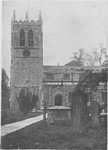
OLD GOTHIC CHURCH, TADCASTER.
Just before reaching Tadcaster we crossed the River Wharfe, which we had seen higher up the country, much nearer its source. Here we turned to the left to visit Pontefract, for the sole reason, for aught we knew, that we had heard that liquorice was manufactured there, an article that we had often swallowed in our early youth, without concerning ourselves where or how that mysterious product was made. It was quite a change to find ourselves walking through a level country and on a level road, and presently we crossed the River Cock, a small tributary of the Wharfe, close by the finely wooded park of Grimstone, where Grim the Viking, or Sea Pirate, settled in distant ages, and gave his name to the place; he was also known as "the man with the helmet." We then came to the small hamlet of Towton, where on the lonely heath was fought the Battle of Towton Field, one of the most bloody battles recorded in English history. This great and decisive battle was fought in the Wars of the Roses, between the rival Houses of York and Lancaster, for the possession of the English Crown—a rivalry which began in the reign of Henry VI and terminated with the death of Richard III at the Battle of Bosworth Field. It has been computed that during the thirty years these wars lasted, 100,000 of the gentry and common people, 200 nobles, and 12 princes of the Royal Blood were killed, all this carnage taking place under the emblems of love and purity, for the emblem or badge of the House of Lancaster was the red rose, and that of York the white. The rivalry between the two Houses only came to an end when Henry VII, the Lancastrian, married the Princess Elizabeth, the daughter of Edward IV, the Yorkist. The Battle of Towton, like many others both before and since, was fought on a Sunday, which happened to be Palm Sunday in the year 1461, and the historian relates that on that day the "heavens were overcast, and a strong March wind brought with it a blinding snowstorm, right against the faces of the Lancastrians as they advanced to meet the Yorkists, who quickly took advantage of the storm to send many furious showers of arrows from their strong bows right into the faces of the Lancastrians, causing fearful havoc amongst them at the very outset of the battle. These arrows came as it were from an unknown foe, and when the Lancastrians shot their arrows away, they could not see that they were falling short of the enemy, who kept advancing and retreating, and who actually shot at the Lancastrians with their own arrows, which had fallen harmlessly on the ground in front of the Yorkists. When the Lancastrians had nearly emptied their quivers, their leaders hurried their men forward to fight the enemy, and, discarding their bows, they continued the battle with sword, pike, battle-axe, and bill. Thus for nearly the whole of that Sabbath day the battle raged, the huge struggling mass of humanity fighting like demons, and many times during that fatal day did the fortune of war waver in the balance: sometimes the White Rose trembling and then the Red, while men fought each other as if they were contending for the Gate of Paradise! For ten hours, with uncertain result, the conflict raged, which Shakespeare compared to "the tide of a mighty sea contending with a strong opposing wind," but the arrival of 5,000 fresh men on the side of the Yorkists turned the scale against the Lancastrians, who began to retreat, slowly at first, but afterwards in a disorderly flight. The Lancastrians had never anticipated a retreat, and had not provided for it, for they felt as sure of victory as the great Duke of Wellington at Waterloo, who, when he was asked by a military expert what provision he had made for retreat in the event of losing the battle, simply answered, "None!" The Lancastrians were obliged to cross the small River Cock in their retreat, and it seemed almost impossible to us that a small stream like that could have been the cause of the loss of thousands upon thousands of the finest and bravest soldiers in England. But so it happened. There was only one small bridge over the stream, which was swollen and ran swiftly in flood. This bridge was soon broken down with the rush of men and horses trying to cross it, and although an active man to-day could easily jump over the stream, it was a death-trap for men weighted with heavy armour and wearied with exertion, the land for a considerable distance on each side the river being very boggy. As those in front sank in the bog, those from behind walked over them, and as row after row disappeared, their bodies formed the road for others to walk over. The carnage was terrible, for King Edward had ordered that no quarter must be given and no prisoners taken. It was estimated that 28,000 of the Lancastrians were slaughtered in this battle and in the pursuit which followed, and that 37,776 men in all were killed on that dreadful day.
In some parts of Yorkshire the wild roses were very beautiful, ranging in colour from pure white to the deepest red, almost every shade being represented; the variation in colour was attributed to the difference in the soil or strata in which they grew. But over this battle-field and the enormous pits in which the dead were buried there grew after the battle a dwarf variety of wild rose which it was said would not grow elsewhere, and which the country people thought emblematical of the warriors who had fallen there, as the white petals were slightly tinged with red, while the older leaves of the bushes were of a dull bloody hue; but pilgrims carried many of the plants away before our time, and the cultivation of the heath had destroyed most of the remainder. In the great Battle of Towton Field many noblemen had perished, but they appeared to have been buried with the rank and file in the big pits dug out for the burial of the dead, as only a very few could be traced in the local churchyards. The Earl of Westmorland, however, had been buried in Saxton church and Lord Dacres in Saxton churchyard, where his remains rested under a great stone slab, 7 feet long, 4-1/2 feet wide, and 7 inches thick, the Latin inscription on which, in old English characters, was rapidly fading away:
HIC JACET RANULPHUS D.S. DE DAKREET—MILES ET OCCISUS ERAT IN BELLO PRINCIPE HENRICO VIe ANNO DOM 1461.—29 DIE MARTII VIDELICET DOMICA DIE PALMARUM—CUJUS ANIME PROPITIETUR DEUS.
—AMEN.
The local poet, in giving an account of the battle, has written:—
The Lord Dacres Was slain at Nor acres,
for his lordship had been killed in a field known as the North Acres. He had removed his gorget, a piece of armour which protected the throat, for the purpose, it was supposed, of getting a drink to quench his thirst, when he was struck in the throat by a bolt, or headless arrow, shot from a cross-bow by a boy who was hiding in a bur-tree or elder bush. The boy-archer must have been a good shot to hit a warrior clothed from head to foot in armour in the only vulnerable point exposed, but in those days boys were trained to shoot with bows and arrows from the early age of six years, their weapons, being increased in size and strength as they grew older; their education was not considered complete until they could use that terrible weapon known as the English long-bow, and hit the smallest object with their arrows. Lord Dacres was buried in an upright position, and his horse was buried with him; for many years the horse's jaw-bone and teeth were preserved at the vicarage, One of his lordship's ancestors, who died fighting on Flodden Field, had been buried in a fine tomb in Lanercrost Abbey.
Lord Clifford was another brave but cruel warrior who was killed in a similar way. He had removed his helmet from some unexplained cause—possibly to relieve the pressure on his head—when a random arrow pierced his throat; but his death was to many a cause of rejoicing, for owing to his cruel deeds at the Battle of Wakenfield, he had earned the sobriquet of "the Butcher." While that battle was raging, the Duke of York's son, the Earl of Rutland, a youth only seventeen years of age, described as "a fair gentleman and maiden-like person," was brought by his tutor, a priest, from the battle-field to shelter in the town. Here he was perceived by Clifford, who asked who he was. The boy, too much afraid to speak, fell on his knees imploring for mercy, "both by holding up his hands and making dolorous countenance, for his speech was gone from fear." "Save him," said the tutor, "for he is a prince's son and, peradventure, might do you good hereafter." With that word Clifford marked him, and said, "By God's blood thy father slew mine, and so will I thee, and all thy kin," and, saying this, he struck the Earl to the heart with his dagger, and bade the tutor bear word to his mother and brothers what he had said and done. Not content with this, when he came to the body of the Duke, the child's father, he caused the head to be cut off and a paper crown to be placed on it; then, fixing it on a pole, he presented it to the Queen, saying, "Madame, your war is done—here is your King's ransom." The head was placed over the gates of York by the side of that of the Earl of Salisbury, whom Queen Margaret had ordered to be beheaded.
For some little time we had been walking through what was known as the "Kingdom of Elmet," but whether this was associated with the helmet of Grim we were unable to ascertain, though we shrewdly suspected it was an old Celtic word. We arrived at the village of Sherburn-in-Elmet, an important place in ancient times, where once stood the palace of Athelstan, the grandson of Alfred the Great, the first ruler of all England, who was crowned King of England in the year 925. In celebration of his great victory over the combined army of the Danes and Scots at Brunnanburgh, King Athelstan presented his palace here, along with other portions of the Kingdom of Elmet, to the See of York, and it remained the Archbishop of York's Palace for over three hundred years. But when the See of York was removed to Cawick, a more convenient centre, the Sherburn Palace was pulled down, and at the time of our visit only the site and a portion of the moat remained. We were much interested in the church, as the historian related that "within the walls now existing the voices of the last Saxon archbishop and the first Norman archbishop have sounded, and in the old church of Sherburn has been witnessed the consummation of the highest ambition of chivalric enterprise, and all the pomp attending the great victory of Athelstan at Brunnanburgh."
Here in the time of Edward II, in 1321, "a secret conclave was held, attended by the Archbishop, the Bishops of Durham and Carlisle, and Abbots from far and near, the Earls of Lancaster and Hereford, and many Barons, Baronets, and Knights. To this assembly Sir John de Bek, a belted Knight, read out the Articles which Lancaster and his adherents intended to insist upon." But what interested us most in the church was the "Janus Cross" The Romans dedicated the month of January to Janus, who was always pictured with two faces, as January could look back to the past year and forwards towards the present. The Janus Cross here had a curious history; it had been found in the ruins of an ancient chapel in the churchyard dedicated to the "Honour of St. Mary and the Holy Angels." One of the two churchwardens thought it would do to adorn the walls of his residence, but another parishioner thought it would do to adorn his own, and the dispute was settled by some local Solomon, who suggested that they should cut it in two and each take one half. So it was sawn vertically in two parts, one half being awarded to each. In course of time the parts were again united and restored to the church.
ST. JANUS CROSS, SHERBURN-IN-ELMERT CHURCH.
Arriving at Ferry Bridge, we crossed the River Aire, which we had seen at its source, but which here claimed to have become one of the most useful rivers in Yorkshire, for its waters were valuable for navigation and for the manufacturing towns near which they passed.
My foot, which had pained me ever since leaving York, so that I had been limping for some time, now became so painful that I could scarcely walk at all. Still, we were obliged to reach Pontefract in order to procure lodgings for the night, so my brother relieved me of all my luggage excepting the stick, in order that I might hobble along to that town. It was with great difficulty that I climbed up the hill to the inn, which was in the upper part of the town, and there I was painfully relieved by the removal of my boot, and found that my ankle was seriously swollen and inflamed. It might, of course, have arisen through over-exertion, but we came to the conclusion that it was caused through the repair of my boots at York. Before arriving there the heels were badly worn down at one side, and as I had been practically walking on the sides of my feet, the sudden reversion to the flat or natural position had brought on the disaster that very nearly prevented us from continuing our walk. We applied all the remedies that both our hostess and ourselves could think of, but our slumbers that night were much disturbed, and not nearly so continuous as usual.
(Distance walked twenty-three and a half miles.)
Thursday, October 26th.
The great object of interest at Pontefract was the castle, the ruins of which were very extensive. Standing on the only hill we encountered in our walk of the previous day, it was formerly one of the largest and strongest castles in England, and had been associated with many stirring historical events. It was here that King Richard II was murdered in the year 1399, and the remains of the dismal chamber where this tragedy took place still existed. During the Wars of the Roses, when in 1461 Queen Margaret appeared in the north of Yorkshire with an army of 60,000 men, the newly appointed King, Edward IV, sent the first portion of his army to meet her in charge of his most influential supporter, the Earl of Warwick, the "King Maker." The King followed him to Pontefract with the remainder of his army, and the old castle must have witnessed a wonderful sight when that army, to the number of 40,660 men, was marshalled in the plains below.
THE OLD CHURCH, PONTEFRACT.
But it was in the Civil War that this castle attained its greatest recorded notoriety, for it was besieged three times by the forces of the Parliament. Sir Thomas Fairfax was in charge of the first siege, and took possession of the town in 1644, driving the garrison into the castle. He had a narrow escape from death on that occasion, as a cannon-ball passed between him and Colonel Forbes so close that the wind caused by its passage knocked both of them down to the ground, Forbes losing the sight of one of his eyes. The castle was strongly defended, but just as one of the towers collapsed, a shot from the castle struck a match, and the spark, falling into Fairfax's powder stores, caused a tremendous explosion which killed twenty-seven of his men. In January 1645 Forbes sent a drum to the castle to beat a parley, but the Governor, Colonel Lowther, and his brave garrison said they would go on with the defence to the last extremity. The besiegers then began to lay mines, but these were met by counter-mines driven by the garrison, who now began to suffer from want of food. At this critical moment a Royalist force of 2,000 horse arrived under Sir Marmaduke Langdale, who had made a forced march from Oxford to relieve the garrison. He drove off the besiegers, first to Ferry Bridge, and afterwards to Sherburn and Tadcaster, inflicting severe loss, and so the garrison was revictualled. The Parliamentary forces, however, soon made their appearance again, and on March 21st, 1645, the second siege began. They again took possession of the town, and after four months of incessant cannonading the garrison capitulated and the castle was garrisoned by the other side.
The war continued in other parts of the country, and towards the end of it a conspiracy was formed by the Royalists to recover possession of the castle, which through the treachery of a Colonel Maurice was successful. Many of the garrison at that time lived outside the walls of the castle, and Maurice persuaded the Governor, Cotterel, to order them to move their homes inside, to which he assented, issuing an order in the country for beds to be provided on a certain day. Taking advantage of this, Maurice and another conspirator dressed themselves as country gentlemen, with swords by their sides, and with nine others, disguised as constables, made their appearance at the castle entrance early in the morning, so as to appear like a convoy guarding the safe passage of the goods. The Governor, who kept the keys, was still in bed, and the soldier on guard at the inside of the gates, who was in league with Maurice, went to inform him the beds had arrived. He handed over the keys, and, not suspecting treachery, remained in bed with his sword at his side as usual. The remainder of the conspirators then drew their swords, and the garrison, on condition that their lives should be spared, surrendered, and were put into one of the prison dungeons. The conspirators then went to the room of the Governor, who, hearing a noise, jumped out of bed and defended himself, but was soon wounded, disarmed, and placed in the dungeon along with the rest, while the Royalists took possession of the castle. This happened in June 1648.
The dungeons in the castle, which were still to be seen, were of the most awful description, for, sunk deep down into the solid rock, it was scarcely necessary to write over them—
Abandon Hope, all ye who enter here.
There was one dungeon under the Round Tower, which was reached by passing down some winding steps, into which no ray of light ever entered, as dark and dismal a place as could be imagined. Here Earl Rivers and his fellow peers were incarcerated, praying for their execution to end their misery. There was also a cellar for the storage of food and drink, sunk some forty or fifty feet in the solid rock, and capable of holding two or three hundred men, and this too was used as a dungeon by the Royalists. Here the prisoners taken by the Royalist army were confined, and many of their names appeared cut in the walls of solid rock. The history of these places, if it could be written, would form a chapter of horrors of the most dreadful character, as in olden times prisoners were often forgotten by their captors, and left in the dungeons to perish.
It was not without a tinge of satisfaction that we heard that the Earl of Lancaster, to whom the castle belonged, was himself placed in one of these dungeons after the Battle of Boroughbridge in 1322, and after being imprisoned there a short time, where he had so often imprisoned others, was led out to execution.
The third siege of Pontefract Castle happened in the autumn of 1648, for after the Parliamentarians had gained the upper hand, the castles that still held out against them were besieged and taken, but the turn of Pontefract Castle came last of all. Oliver Cromwell himself undertook to superintend the operations, and General Lambert, one of the ablest of Cromwell's generals, born at Kirkby Malham, a Yorkshire village through which we had passed some days before, was appointed Commander-in-Chief of the forces. He arrived before the castle on December 4th, 1648, but such was the strength of the position that though he had a large number of soldiers and a great service of artillery, it was not until March 25th, 1649, when scarcely one hundred men were left to defend the walls, that the garrison capitulated. Meantime the tremendous effect of the artillery brought to bear against them had shattered the walls, and finally Parliament ordered the castle to be dismantled. With the surrender of this castle the Civil War came to an end, but not before King Charles I had been beheaded.