FOURTH WEEK'S JOURNEY (continued 2)
Reading edition
How different it must have appeared when the stage-coaches were passing up and down that valley, now deserted, for even the railway, which supplanted them, had passed it by on the other side! In imagination we could hear the sound of the horn, echoing in the mountains, heralding the approach of the stage-coach, with its great lamp in front, and could see a light in almost every window in the hotel. We could picture mine host and his wife standing at the open door ready to receive their visitors, expectant guests assembled behind them in the hall and expectant servants both indoors and out; then staying for the night, refreshing ourselves with the good things provided for supper, and afterwards relating our adventures to a friendly and appreciative audience, finally sinking our weary limbs in the good old-fashioned feather-beds!
But these visions passed away almost as quickly as they appeared, so we left the dark and dreary mansion whose glory had departed, and marched on our way, expecting to find at Langholm that which we so badly needed—food and rest.
The old inn at Mosspaul, where the stage-coaches stopped to change horses, was built at the junction of the counties of Dumfries and Roxburgh, and was very extensive with accommodation for many horses, but fell to ruin after the stage-coaches ceased running. Many notable visitors had patronised it, among others Dorothy Wordsworth, who visited it with her brother the poet in September 1803, and described it in the following graphic terms:
The scene, with this single dwelling, was melancholy and wild, but not dreary, though there was no tree nor shrub: the small streamlet glittered, the hills were populous with sheep, but the gentle bending of the valley, and the correspondent softness in the forms of the hills were of themselves enough to delight the eye.
A good story is told of one of the Armstrongs and the inn:
Once when Lord Kames went for the first time on the Circuit as Advocate-depute, Armstrong of Sorbie inquired of Lord Minto in a whisper "What long black, dour-looking Chiel" that was that they had broc'ht with them?
"That," said his lordship, "is a man come to hang a' the Armstrongs."
"Then," was the dry retort, "it's time the Elliots were ridin'."[Footnote: Elliot was the family name of Lord Minto.]
The effusions of one of the local poets whose district we had passed through had raised our expectations in the following lines:
There's a wee toon on the Borders That my heart sair langs to see, Where in youthful days I wander'd, Knowing every bank and brae; O'er the hills and through the valleys, Thro' the woodlands wild and free, Thro' the narrow straits and loanings, There my heart sair langs to be.
THE COMMON RIDING, LANGHOLM.
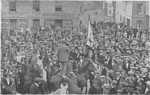
There was also an old saying, "Out of the world and into Langholm," which seemed very applicable to ourselves, for after a walk of thirty-two and a half miles through a lonely and hilly country, without a solitary house of call for twenty-three, our hungry and weary condition may be imagined when we entered Langholm just on the stroke of eleven o'clock at night.
We went to the Temperance Hotel, but were informed they were full. We called at the other four inns with the same result. Next we appealed to the solitary police officer, who told us curtly that the inns closed at eleven and the lodgings at ten, and marched away without another word. The disappointment and feeling of agony at having to walk farther cannot be described, but there was no help for it, so we shook the dust, or mud, off our feet and turned dejectedly along the Carlisle road.
Just at the end of the town we met a gentleman wearing a top-hat and a frock-coat, so we appealed to him. The hour was too late to find us lodgings, but he said, if we wished to do so, we could shelter in his distillery, which we should come to a little farther on our way. His men would all be in bed, but there was one door that was unlocked and we should find some of the rooms very warm. We thanked him for his kindness and found the door, as he had described, opening into a dark room. We had never been in a distillery before, so we were naturally rather nervous, and as we could not see a yard before us, we lighted one of our candles. We were about to go in search of one of the warmer rooms when the thought occurred to us that our light might attract the attention of some outsider, and in the absence of any written authority from the owner might cause us temporary trouble, while to explore the distillery without a light was out of the question, for we might fall through some trap-door or into a vat, besides which, we could hear a great rush of water in the rear of the premises, so we decided to stay where we were.
The book we had obtained at Hawick contained the following description of the Langholm "Common Riding," which was held each year on July 17th when the people gathered together to feast on barley bannock and red herring, of course washed down with plenteous supplies of the indispensable whisky. The Riding began with the following proclamation in the marketplace, given by a man standing upright on horseback, in the presence of thousands of people:
Gentlemen,—The first thing that I am going to acquaint you with are the names of the Portioners' Grounds of Langholm:—
Now, Gentlemen, we're gan' frae the Toun, An' first of a' the Kil Green we gang roun', It is an ancient place where Clay is got, And it belangs to us by Right and Lot, And then frae here the Lang-Wood we gang throu' Where every ane may breckons out an' pu', An' last of a' oor Marches they be clear, An' when unto the Castle Craigs we come, I'll cry the Langholm Fair and then we'll beat the drum.
Now, Gentlemen. What you have heard this day concerning going round our Marches, it is expected that every one who has occasion for Peats, Breckons, Flacks, Stanes, or Clay, will go out in defence of their Property, and they shall hear the Proclamation of the Langholm Fair upon the Castle Craigs.
Now, Gentlemen, we have gane roun our hill, So now I think it's right we had oor fill Of guid strang punch—'twould make us a' to sing. Because this day we have dune a guid thing; For gangin' roun' oor hill we think nae shame, Because frae it oor peats and flacks come hame; So now I will conclude and say nae mair. An' if ye're pleased I'll cry the Langholm Fair. Hoys, yes! that's ae time! Hoys, yes! that's twae times!! Hoys, yes! that's the third and the last time!!!
This is to Give Notice,
That there is a muckle Fair to be hadden in the muckle Toun o' the Langholm, on the 15th day of July, auld style, upon his Grace the Duke of Buccleuch's Merk Land, for the space of eight days and upwards; and a' land-loupers, and dub-scoupers, and gae-by-the-gate-swingers, that come here to breed hurdums or durdums, huliments or buliments, haggle-ments or braggle-ments, or to molest this public Fair, they shall be ta'en by order of the Bailie and Toun Council, and their lugs be nailed to the Tron wi' a twal-penny nail, and they shall sit doun on their bare knees and pray seven times for the King, and thrice for the Mickle Laird o' Ralton, and pay a groat to me, Jemmy Ferguson, Bailie o' the aforesaid Manor, and I'll awa' hame and ha'e a bannock and a saut herrin'.
HUZZA! HUZZAH!! HUZZAH!!!
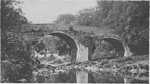
GILNOCKIE BRIDGE, LANGHOLM.
The monument on the top of Whita Hill was erected in memory of one of the famous four Knights of Langholm, the sons of Malcolm of Burn Foot, whose Christian names were James, Pulteney, John, and Charles, all of whom became distinguished men. Sir James was made a K.C.B, and a Colonel in the Royal Marines. He served on board the Canopus at the Battle of San Domingo, taking a prominent part in the American War of 1812. He died at Milnholm, near Langholm, at the age of eighty-two. Pulteney Malcolm rose to the rank of Admiral and served under Lord Nelson, but as his ship was refitting at Gibraltar he missed taking part in the Battle of Trafalgar, though he arrived just in time to capture the Spanish 120-gun ship El Kago. He became intimately acquainted with Napoleon Bonaparte, as he had the command of the British worships that guarded him during his captivity at St. Helena. Sir John Malcolm was a distinguished Indian statesman, and it was to him that the monument on Whita Hill had been erected. The monument, which was visible for many miles, was 100 feet high, and the hill itself 1,162 feet above sea-level. Sir Charles Malcolm, the youngest of the four brothers, after seeing much active service, rose to be Vice-Admiral of the Fleet.
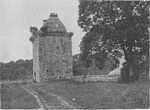
GILNOCKIE TOWER
If the great fair-day had been on when we reached Langholm we should not have been surprised at being unable to find lodgings, but as it was we could only attribute our failure to arriving at that town so late in the evening, nearly an hour after the authorised closing time of the inns. We found we could not stay very long in the distillery without a fire, for a sharp frost had now developed, and we began to feel the effect of the lower temperature; we therefore decided, after a short rest, to continue our walk on the Carlisle road. Turning over the bridge that crossed the rapidly running stream of the River Esk—the cause of the rush of water we heard in the distillery—we followed the river on its downward course for some miles. It was a splendid starlight, frosty night, but, as we were very tired and hungry, we could only proceed slowly—in fact scarcely quickly enough to maintain our circulation. Being also very sleepy, we had to do something desperate to keep ourselves awake, so we amused ourselves by knocking with our heavy oaken sticks at the doors or window-shutters of the houses we passed on our way. It was a mild revenge we took for the town's inhospitality, and we pictured to ourselves how the story of two highwaymen being about the roads during the midnight hours would be circulated along the countryside during the following day, but we could not get any one to come beyond the keyhole of the door or the panes of the shuttered windows. We were, however, becoming quite desperate, as we were now nearly famished, and, when we came to a small shop, the sounds from our sticks on the door quickly aroused the mistress, who asked us what we wanted. My brother entered into his usual explanation that we were pedestrian tourists on a walking expedition, and offered her a substantial sum for some bread or something to eat; but it was of no use, as the only answer we got was, "I ha' not a bit till th' baker coomes ith' morn'."
This reply, and the tone of voice in which it was spoken, for the woman "snaffled," was too much for us, and, tired as we were, we both roared with laughter; absurd though it may seem, it was astonishing how this little incident cheered us on our way.
It was a lovely country through which we were travelling, and our road, as well as the river alongside, was in many places overhung by the foliage of the fine trees, through which the brilliant lustre of the stars appeared overhead; in fact we heard afterwards that this length of road was said to include the finest landscapes along the whole of the stage-coach road between London and Edinburgh. The bridge by which we recrossed the river had been partially built with stones from the ruins of Gilnockie Tower, once the stronghold of the famous freebooter Johnnie Armstrong, of whom we had heard higher up the country.
COCKBURN'S GRAVE.
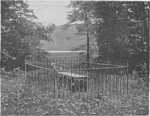
Sir Walter Scott tells us that King James V resolved to take very serious measures against the Border Warriors, and under pretence of coming to hunt the deer in those desolate regions he assembled an army, and suddenly appeared at the Castle of Piers Cockburn of Henderland, near where we had been further north. He ordered that baron to be seized and executed in spite of the fact that he was preparing a great feast of welcome. Adam Scott of Tushielaw, known as the King of the Border, met with the same fate, but an event of greater importance was the fate of John Armstrong. This free-booting chief had risen to such consequence, that the whole neighbouring district of England paid him "black-mail," a sort of regular tribute in consideration of which he forbore to plunder them. He had a high idea of his own importance, and seems to have been unconscious of having merited any severe usage at the king's hands. On the contrary, he went to meet his sovereign at Carlingrigg Chapel, richly dressed, and having twenty-four gentlemen, his constant retinue, as well attired as himself. The king, incensed to see a freebooter so gentlemanly equipped, commanded him instantly to be led to execution, saying, "What wants this knave save a crown to be as magnificent as a king?" John Armstrong made great offers for his life, offering to maintain himself, with forty men, to serve the king at a moment's notice, at his own expense, engaging never to hurt or injure any Scottish subject, as indeed had never been his practice, and undertaking that there was not a man in England, of whatever degree, duke, earl, lord, or baron, but he would engage, within a short time, to present him to the king, dead or alive. But when the king would listen to none of his oilers, the robber chief said very proudly, "I am but a fool to ask grace at a graceless face; but had I guessed you would have used me thus, I would have kept the Border-side in spite of the King of England and you, both, for I well know that the King Henry would give the weight of my best horse in gold to know that I am sentenced to die this day."
John Armstrong was led to execution, with all his men, and hanged without mercy. The people of the inland countries were glad to get rid of him; but on the Borders he was both missed and mourned, as a brave warrior, and a stout man-of-arms against England.
But to return to Gilnockie Bridge! After crossing it we struggled on for another mile or two, and when about six miles from Langholm we reached another bridge where our road again crossed the river. Here we stopped in mute despair, leaning against the battlements, and listening to the water in the river as it rushed under the bridge. We must have been half asleep, when we were suddenly aroused by the sound of heavy footsteps approaching in the distance. Whoever could it be? I suggested one of the Border freebooters; but my brother, who could laugh when everybody else cried, said it sounded more like a free-clogger. We listened again, and sure enough it was the clattering of a heavy pair of clogs on the partly frozen surface of the road. We could not be mistaken, for we were too well accustomed to the sound of clogs in Lancashire; but who could be the wearer! We had not long to wait before a man appeared, as much surprised to see us as we were to see him. We told him of our long walk the day before, how we had been disappointed in not getting lodgings, and asked him how far we were away from an inn. He told us we were quite near one, but it was no use going there, as "they wouldn't get up for the Queen of England." He further told us he was going to the two o'clock "shift" at the colliery. "Colliery!" my brother ejaculated; "but surely there isn't a coal-pit in a pretty place like this?" He assured us that there was, and, seeing we were both shivering with cold, kindly invited us to go with him and he would put us near to a good fire that was burning there. "How far is it?" we asked anxiously. "Oh, only about half a mile," said the collier. So we went with him, and walked what seemed to be the longest half-mile we ever walked in all our lives, as we followed him along a fearfully rough road, partly on the tramlines of the Canonbie Collieries belonging to the Duke of Buccleuch, where two or three hundred men were employed.
We each handed him a silver coin as he landed us in front of a large open fire which was blazing furiously near the mouth of the pit, and, bidding us "good morning," he placed a lighted lamp in front of his cap and disappeared down the shaft to the regions below. He was rather late owing to his having slackened his pace to our own, which was naturally slower than his, since walking along colliery sidings at night was difficult for strangers. We had taken of our boots to warm and ease our feet, when a man emerged from the darkness and asked us to put them on again, saying we should be more comfortable in the engine-house. If we stayed there we should be sure to catch a cold, as a result of being roasted on one side and frozen on the other. He kindly volunteered to accompany us there, so we thankfully accepted his invitation. We had some difficulty in following him owing to the darkness and obstructions in the way, but we reached the engine-room in safety, round the inside of which was a wooden seat, or bench, and acting upon his instructions we lay down on this to sleep, with a promise that he would waken us when he went off duty at six o'clock in the morning. We found it more comfortable here than on the windy pit bank, for there was an even and sleepy temperature. We were soon embosomed in the arms of nature's great refresher, notwithstanding the occasional working of the winding engines, sleeping as soundly on those wooden benches as ever we did on the best feather-bed we patronised on our journey.
(Distance walked thirty-nine miles.)
Thursday, October 12th.
We were roused at six o'clock a.m. by the engine-driver, who had taken good care of us while we slept, and as we had had nothing to eat since our lunch at Hawick the day before, except the fruit purchased from the toll-keeper there, which we had consumed long before reaching Langholm, we were frightfully hungry. The engine-man told us there was a shop close by the colliery gate kept by a young man, where, if he happened to be in, we should be able to get some refreshments. He accompanied us to the place, and, after knocking loudly at the shop door, we were delighted to see the head of the shopkeeper appear through the window above. He was evidently well known to the engineer, who told him what we wanted, and he promised to "be down directly."
It seemed a long time to us before the shop door was opened, and every minute appeared more like five than one; but we were soon comfortably seated in the shop, in the midst of all sorts of good things fit to eat. We should have liked to begin to eat them immediately, but the fire had to be lit and the kettle boiled, so we assisted with these operations while the young man cut into a fresh loaf of bread, broke open a pot of plum jam, opened a tin of biscuits, and, with the addition of a large slice of cheese and four fresh eggs, we had a really good breakfast, which we thoroughly enjoyed. He said it was a wonder we found him there, for it was very seldom he slept at the shop. His mother lived at a farm about a mile and a half away, where he nearly always slept; that night, however, he had been sleeping with his dog, which was to run in a race that day, and he spent the night with it lest it should be tampered with. He called the dog downstairs, and, though we knew very little about dogs, we could see it was a very fine-looking animal. Our friend said he would not take £50 for it, a price we thought exorbitant for any dog. When we had finished our enormous breakfast, we assisted the shopkeeper to clear the table, and as it was now his turn, we helped him to get his own breakfast ready, waiting upon him as he had waited upon us, while we conversed chiefly about colliers and dogs and our approaching visit to Gretna Green, which, as neither of us was married, was naturally our next great object of interest.
PENTON BRIDGE, CANONBIE.
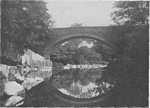
After our long walk the previous day, with very little sleep at the end of it, and the heavy breakfast we had just eaten, we felt uncommonly lazy and disinclined to walk very far that day. So, after wishing our friend good luck at the races, we bade him good-bye, and idly retraced our steps along the colliery road until we reached the bridge where we had met the collier so early in the morning. We had now time to admire the scenery, and regretted having passed through that beautiful part of the country during our weary tramp in the dark, and that we had missed so much of it, including the Border Towers on the River Esk.
Riddel Water, with its fine scenery, was on our left as we came from the colliery, where it formed the boundary between Scotland and England, emptying itself into the River Esk about two miles from Canonbie Bridge, which we now crossed, and soon arrived at the "Cross Keys Inn," of which we had heard but failed to reach the previous night. The landlord of the inn, who was standing at the door, was formerly the driver of the Royal Mail Stagecoach "Engineer" which ran daily between Hawick and Carlisle on the Edinburgh to London main road. A good-looking and healthy man of over fifty years of age, his real name was Elder, but he was popularly known as Mr. Sandy or Sandy Elder. The coach, the last stage-coach that ever ran on that road, was drawn in ordinary weather by three horses, which were changed every seven or eight miles, the "Cross Keys" at Canonbie being one of the stopping-places.
"CROSS KEYS INN."
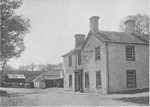
Mr. Elder had many tales to tell of stage-coach days; one adventure, however, seemed more prominent in his thoughts than the others. It happened many years ago, when on one cold day the passengers had, with the solitary exception of one woman, who was sitting on the back seat of the coach, gone into the "Cross Keys Inn" for refreshments while the horses were being changed. The fresh set of horses had been put in, and the stablemen had gone to the hotel to say all was ready, when, without a minute's warning, the fresh horses started off at full gallop along the turnpike road towards Carlisle. Great was the consternation at the inn, and Sandy immediately saddled a horse and rode after them at full speed. Meantime the woman, who Mr. Sandy said must have been as brave a woman as ever lived, crawled over the luggage on the top of the coach and on to the footboard in front. Kneeling down while holding on with one hand, she stretched the other to the horses' backs and secured the reins, which had slipped down and were urging the horses forward. By this time the runaway horses had nearly covered the two miles between the inn and the tollgates, which were standing open, as the mail coach was expected, whose progress nothing must delay. Fortunately the keeper of the first gate was on the look-out, and he was horrified when he saw the horses coming at their usual great speed without Sandy the driver; he immediately closed the gate, and, with the aid of the brave woman, who had recovered the reins, the horses were brought to a dead stop at the gate, Mr. Sandy arriving a few minutes afterwards. The last run of this coach was in 1862, about nine years before our visit, and there was rather a pathetic scene on that occasion. We afterwards obtained from one of Mr. Elder's ten children a cutting from an old newspaper she had carefully preserved, a copy of which is as follows:
Mr. Elder, the Landlord of the "Cross Keys Hotel," was the last of the Border Royal Mail Coach Drivers and was familiarly known as "Sandy," and for ten years was known as the driver of the coach between Hawick and Carlisle. When the railway started and gave the death-blow to his calling, he left the seat of the stage coach, and invested his savings in the cosy hostelry of the road-side type immortalised by Scott in his "Young Lochinvar." He told of the time when he did duty on the stage coach for Dukes, Earls, and Lords, and aided run-a-way couples to reach the "blacksmith" at Gretna Green. He told of the days when he manipulated the ribbons from the box of the famous coach "Engineer" when he dashed along with foaming horses as if the fate of a nation depended upon his reaching his stage at a given time. He could remember Mosspaul Inn at the zenith of its fame under the reigning sovereign Mr. Gownlock—whose tact and management made his Hotel famous. He had frequently to carry large sums of money from the Border banks and although these were the days of footpads and highwaymen, and coaches were "held up" in other parts, Sandy's Coach was never molested, although he had been blocked with his four-in-hand in the snow. He gave a graphic description of the running of the last mail coach from Hawick to Merrie Carlisle in 1862. Willie Crozier the noted driver was mounted on the box, and the horses were all decked out for the occasion. Jemmie Ferguson the old strapper, whose occupation like that of Othello's was all gone, saw it start with a heavy heart, and crowds turned out to bid it good-bye. When the valleys rang with the cheery notes of the well-blown horn, and the rumbling sound of the wheels and the clattering hoofs of the horses echoed along the way, rich and poor everywhere came to view the end of a system which had so long kept them in touch with civilisation. The "Engineer" guards and drivers with scarlet coats, white hats, and overflowing boots, and all the coaching paraphernalia so minutely described by Dickens, then passed away, and the solitary remnant of these good old times was "Sandy" Elder the old Landlord of the "Cross Keys" on Canonbie Lea.
Soon after leaving the "Cross Keys" we came to a wood where we saw a "Warning to Trespassers" headed "Dangerous," followed by the words "Beware of fox-traps and spears in these plantations." This, we supposed, was intended for the colliers, for in some districts they were noted as expert poachers. Soon afterwards we reached what was called the Scotch Dyke, the name given to a mound of earth, or "dyke," as it was called locally, some four miles long and erected in the year 1552 between the rivers Esk and Sark to mark the boundary between England and Scotland. We expected to find a range of hills or some substantial monument or noble ruin to mark the boundary between the two countries, and were rather disappointed to find only an ordinary dry dyke and a plantation, while a solitary milestone informed us that it was eighty-one and a half miles to Edinburgh. We were now between the two tollbars, one in Scotland and the other in England, with a space of only about fifty yards between them, and as we crossed the centre we gave three tremendous cheers which brought out the whole population of the two tollhouses to see what was the matter. We felt very silly, and wondered why we had done so, since we had spent five weeks in Scotland and had nothing but praise both for the inhabitants and the scenery. It was exactly 9.50 a.m. when we crossed the boundary, and my brother on reflection recovered his self-respect and said he was sure we could have got absolution from Sir Walter Scott for making all that noise, for had he not written:
Breathes there the man, with soul so dead, Who never to himself hath said, This is my own, my native land! Whose heart hath ne'er within him burn'd, As home his footsteps he hath turn'd.
NETHERBY HALL.
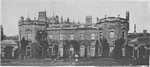
As the morning was beautifully fine, we soon forsook the highway and walked along the grassy banks of the Esk, a charming river whose waters appeared at this point as if they were running up hill. We were very idle, and stayed to wash our feet in its crystal waters, dressing them with common soap, which we had always found very beneficial as a salve. We sauntered past Kirkandrew's Tower; across the river was the mansion of Netherby, the home of the Graham family, with its beautiful surroundings, immortalised by Sir Walter Scott in his "Young Lochinvar," who came out of the West, and—
One touch to her hand, and one word in her ear, When they reached the hall-door, and the charger stood near; So light to the croupe the fair lady he swung, So light to the saddle before her he spran! "She is won! we are gone, over bank, bush, and scaur; They'll have fleet steeds that follow," quoth young Lochinvar. There was mounting 'mong Græmes of the Netherby clan; Forsters, Fenwicks, and Musgraves, they rode and they ran: There was racing and chasing on Cannobie Lee, But the lost bride of Netherby ne'er did they see. So daring in love, and so dauntless in war, Have ye e'er heard of gallant like young Lochinvar?
We were far more inclined to think and talk than to walk, and as we sat on the peaceful banks of the river we thought what a blessing it was that those Border wars were banished for ever, for they appeared to have been practically continuous from the time of the Romans down to the end of the sixteenth century, when the two countries were united under one king, and we thought of that verse so often quoted:
The Nations in the present day Preserve the good old plan, That all shall take who have the power And all shall keep who can.
We were not far from the narrowest point of the kingdom from east to west, or from one sea to the other, where the Roman Emperor, Hadrian, built his boundary wall; but since that time, if we may credit the words of another poet who described the warriors and their origin, other nationalities have waged war on the Borders—
From the worst scoundrel race that ever lived A horrid crowd of rambling thieves and drones, Who ransacked Kingdoms and dispeopled towns, The Pict, the painted Briton, treacherous Scot By hunger, theft, and rapine, hither brought Norwegian Pirates—buccaneering Danes, Whose red-haired offspring everywhere remains; Who, joined with Norman French, compound the breed, From whence you time-born Bordermen proceed.
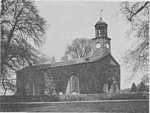
How long we should have loitered on the bank of the river if the pangs of hunger had not again made themselves felt we could not say, but we resolved at last to walk to Longtown for some refreshments, and arrived there by noon, determined to make amends for our shortcomings after lunch, for, incredible though it seemed, we had only walked six miles! But we landed in a little cosy temperance house, one of those places where comfort prevailed to a much greater extent than in many more brilliant establishments. It was kept by one Forster, a gentleman of distinction, possessing a remarkable temperament and following numerous avocations. He informed us he was the parish clerk, and that the Lord Bishop was holding a Confirmation Service in the church at 3 p.m. We had intended only to stay for lunch and then resume our journey, but the mention of a much less important person than the Lord Bishop would have made us stay until tea-time, and travel on afterwards, so we decided to remain for the service. Punctually at three o'clock, escorted by the son of our landlord, we entered the Arthuret Church, the Parish Church of Longtown, about half a mile away from the town. It was built in 1609 and dedicated to St. Michael, but had recently been restored and a handsome stained-glass window placed at the east end in memory of the late Sir James Graham, whose burial-place we observed marked by a plain stone slab as we entered the churchyard. In consequence of a domestic bereavement the organist was absent, and as he had forgotten to leave the key the harmonium was useless. Our friend the parish clerk, however, was quite equal to the occasion, for as the Psalm commencing "All people that on earth do dwell" was given out, he stepped out into the aisle and led off with the good old tune the "Old Hundredth," so admirably adapted for congregational use, and afterwards followed with the hymn beginning "Before Jehovah's awful throne," completing the choral part of the service to the tune of "Duke Street"; we often wondered where that street was, and who the duke was that it was named after. Our admiration of the parish clerk increased when we found he could start the singing of Psalms and on the correct note in the presence of a Lord Bishop, and we contemplated what might have been the result had he started the singing in a higher or a lower key. We rejoiced that the responsibility rested upon him and not on ourselves. The Candidates for Confirmation were now requested to stand while the remainder of the congregation remained seated. The Bishop, Dr. Goodwin, delivered a homely, solemn, and impressive address. His lordship did not take any text, but spoke extempore, and we were well pleased with his address, so appropriate was it to the occasion; the language was easy and suited to the capacities of those for whom the service was specially held. As sympathisers with the temperance movement we thoroughly coincided with the Bishop's observations when he affectionately warned his hearers against evil habits, amongst which he catalogued that of indulgence in intoxicating drinks, and warned the young men not to frequent public-houses, however much they might be ridiculed or thought mean for not doing so. The candidates came from three parishes, the girls dressed very plainly and as usual outnumbering the boys. The general congregation was numerically small, and we were surprised that there was no collection! Service over, we returned to our lodgings for tea, intending to resume our walk immediately afterwards. We were so comfortable, however, and the experiences of the previous day and night so fresh in our minds, and bodies, that we decided to rest our still weary limbs here for the night, even though we had that day only walked six miles, the shortest walk in all our journey.
KIRKANDREWS CHURCH.
Our host, Mr. Forster, was moreover a very entertaining and remarkable man. He had been parish clerk for many years, a Freemason for upwards of thirty years, letter-carrier or postman for fourteen years, and recently he and his wife had joined the Good Templars! He had many interesting stories of the runaway marriages at Gretna Green, a piece of Borderland neither in Scotland nor England, and he claimed to have suggested the Act of Parliament brought in by Lord Brougham to abolish these so-called "Scotch" marriages by a clause which required twenty-one days' residence before the marriage could be solemnised, so that although the Act was called Lord Brougham's Act, he said it was really his. Its effects were clearly demonstrated in a letter he had written, which appeared in the Registrar-General's Report, of which he showed us a copy, stating that while in the year 1856, the year of the passing of Lord Brougham's Act, there were 757 marriages celebrated in the district of Gretna Green, thirty-nine entered as taking place in one day, November 8th, in the following year there were only thirty and in the next forty-one, showing conclusively that the Act had been effectual. We could have listened longer to our host's stories, but we had to rise early next morning to make up for our loss of mileage, and retired early to make up for our loss of sleep on the previous night.
(Distance walked six miles.)
Friday, October 13th.
We left Longtown at 7.30 a.m. by the long and wide thoroughfare which gives rise to its name, and followed the Carlisle road until we turned to the right for Gretna Green. Our road lay between Solway Moss and the River Esk, to both of which some historic events were attached. Solway Moss is about seven miles in circumference, and is covered with grass and rushes, but it shakes under the least pressure, and will swallow up nearly anything. In 1776, after heavy rains, it burst, and, as in Ireland, streams of black peaty mud began to creep over the plain and to overwhelm the houses. It was the scene of a battle fought on November 24th, 1542, when the English Army under Sir Thomas Wharton defeated a Scottish Army of 10,000 men, who were either killed, drowned, or taken prisoners. One of the unfortunates was unearthed in later times by peat-diggers, a man on his horse, who had sunk in the bog. The skeletons were well preserved, and the different parts of the armour easily recognisable. The disastrous result of this battle so affected James V, King of Scotland, that he is said to have died of a broken heart. Personally, we thought he deserved a greater punishment for the murder of Johnnie Armstrong and his followers twelve years before this event, for Armstrong was just the man who could and would have protected the Borders.
The River Esk was associated with Prince Charlie, who, with his soldiers, had to cross it when retreating before the army of the Duke of Cumberland. It was a difficult operation to carry out, as the usually shallow ford had been converted by the melting snow into a swift-flowing current four feet deep. The cavalry were drawn up in two lines across the stream, one to break the current and the other to prevent any of the foot-soldiers being washed away as they crossed the river between the two lines of cavalry. Lower down the river still were Prince Charlie and his officers, who were better mounted than the others. The foot-soldiers walked arm-in-arm, with their heads barely above the water, making the space between the cavalry lines to look as if it were set with paving-stones. One poor soldier lost his hold on his comrade and was washed down the river, and would certainly have been drowned had not the Prince seized him by the hair, and, shouting in Gaelic for help, held on until both of them were rescued. After being hunted in the Highland glens for months with a ransom of £30,000 placed on his head—not a Celt betraying his whereabouts—by the help of Flora Macdonald Prince Charlie escaped to Brittany, and finally died at Rome in the arms of the Master of Nairn in 1788. In 1794 the Beds of Esk, a large sandbank where the tide meets the stream, presented an unusual spectacle, and a striking tribute to the dangerous character of the river especially when in flood. Collected together on the beach were a varied assortment of animals and human beings, consisting of no less than 9 black cattle, 3 horses, 1,040 sheep, 45 dogs, 180 hares, many smaller animals, and 3 human beings, all of whom had been cut off by the rapidly advancing tide.
Many other events have happened in this neighbourhood, one of the most sensational perhaps being the death of King Edward I, "The Hammer of the Scots," also nicknamed "Longshanks," from the length of his lower limbs, who died in 1307 on these marshes, requesting his effeminate son, the Prince of Wales, as he bade him farewell, not to bury his body until the Scots were utterly subdued, but this wish was prevented by the defeat at the Battle of Bannockburn.
We passed by some large peat-fields, and, crossing the River Sark, were once more in Scotland, notwithstanding the fact that we had so recently given three cheers as we passed out of it. We traversed the length of Springfield, a stone-built village of whitewashed, one-storied cottages, in which we could see handloom weavers at work, nearly fifty of them being employed in that industry. Formerly, we were told, the villagers carried on an illicit commerce in whisky and salt, on which there were heavy duties in England, but none on whisky in Scotland. The position here being so close to the borders, it was a very favourable one for smuggling both these articles into England, and we heard various exciting stories of the means they devised for eluding the vigilance of the excise officers. As we passed through the neighbourhood at a quick rate, the villagers turned out to have a look at us, evidently thinking something important was going on.
We saw many workers in the fields, who called out to us hinting about the nature of our journey, as we travelled towards Gretna Green. Some of the women went so far as to ask us if we wanted any company. The most conspicuous objects in the village were the church and the remarkably high gravestones standing like sentinels in the churchyard. Bonnie Prince Charlie arrived here on the afternoon of his birthday in 1745, stabling his horse in the church, while the vicar fled from what he described in the church book as "the Rebels." A small cottage—said to be the oldest in Gretna—is shown in which Prince Charlie slept. The village green appeared to us as if it had been fenced in and made into a garden, and a lady pointed out an ancient-looking building, which she said was the hall where the original "Blacksmith" who married the runaway couples resided, but which was now occupied by a gentleman from Edinburgh. She explained the ceremony as being a very simple one, and performed expeditiously: often in the road, almost in sight of the pursuers of the runaway pair. All sorts and conditions of men and women were united there, some of them from far-off lands, black people amongst the rest, and she added with a sigh, "There's been many an unhappy job here," which we quite believed. There were other people beside the gentleman at the hall who made great profit by marrying people, both at Springfield and Gretna, and a list of operators, dated from the year 1720, included a soldier, shoemaker, weaver, poacher, innkeeper, toll-keeper, fisherman, pedlar, and other tradesmen. But the only blacksmith who acted in that capacity was a man named Joe Paisley, who died in 1811 aged seventy-nine years. His motto was, "Strike while the iron's hot," and he boasted that he could weld the parties together as firmly as he could one piece of iron to another.
JOSEPH PAISLEY, The Celebrated Gretna-Green Parson Dec'd January 9, 1811, aged 79. The first great "priest" of Gretna Green.
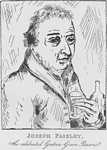
Joe was a man of prodigious strength; he could bend a strong iron poker over his arm, and had frequently straightened an ordinary horse-shoe in its cold state with his hands. He could also squeeze the blood from the finger ends of any one who incurred his anger. He was an habitual drunkard, his greatest boast being that he had once been "teetotal" for a whole forenoon. When he died he was an overgrown mass of superfluous fat, weighing at least twenty-five stone. He was said to have earned quite a thousand pounds per year by his encroachments into the province of the cleric, and when on his deathbed he heard three carriages arrive, he consented to marry the three wealthy couples they contained, and found himself two or three hundred pounds richer than before. He also boasted that the marriage business had been in his family for quite one hundred years, and that his uncle, the old soldier Gordon, used to marry couples in the full uniform of his regiment, the British Grenadiers. He gave a form of certificate that the persons had declared themselves to be single, that they were married by the form of the Kirk of Scotland, and agreeably to that of the Church of England.
GRETNA GREEN.
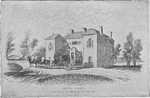
One of the most celebrated elopements to Gretna was that of the Earl of Westmorland and Miss Child, the daughter of the great London banker. The earl had asked for the hand of Sarah, and had been refused, the banker remarking, "Your blood is good enough, but my money is better," so the two young people made it up to elope and get married at Gretna Green. The earl made arrangements beforehand at the different stages where they had to change horses, but the banker, finding that his daughter had gone, pursued them in hot haste. All went well with the runaway couple until they arrived at Shap, in Westmorland, where they became aware they were being pursued. Here the earl hired all the available horses, so as to delay the irate banker's progress. The banker's "money was good," however, and the runaways were overtaken between Penrith and Carlisle. Hero the earl's "blood was good," for, taking deliberate aim at the little star of white on the forehead of the banker's leading horse, he fired successfully, and so delayed the pursuit that the fugitives arrived at Gretna first; and when the bride's father drove up, purple with rage and almost choking from sheer exasperation, he found them safely locked in what was called the bridal chamber! The affair created a great sensation in London, where the parties were well known, heavy bets being made as to which party would win the race. At the close of the market it stood at two to one on the earl and the girl.
In those days "postboys" were employed to drive the runaways from the hotels at Carlisle to Gretna, one of the most noted of whom was Jock Ainslie, on the staff of the "Bush Inn" at Carlisle. On one occasion he was commissioned to drive a runaway couple, who had just arrived by the coach from London, to Gretna, but when they got as far as Longtown they insisted they were tired and must stay for dinner before going forward, so they sent Jock back. He returned to Carlisle rather reluctantly, advising the runaways to lose no time. But when he got back to the "Bush Inn" he saw the mother of the lady whom he had left at Longtown drive up to the hotel door accompanied by a Bow Street officer. While they were changing horses, Jock went to the stable, saddled a horse, rode off to Longtown, and told his patrons what he had seen. They immediately hurried into a chaise, but had not gone far before they heard the carriage wheels of their pursuers. Jock Ainslie was quite equal to the occasion, and drove the chaise behind a thick bush, whence the pair had the satisfaction of seeing "Mamma" hurry past at full speed in pursuit. While she was continuing her search on the Annan Road, Jock quietly drove into Springfield and had his patrons "hitched up" without further delay, and doubtless was well rewarded for his services.
WILLIE LANG The last of the "Lang" line of priests.
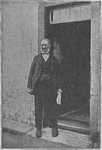
It seemed a strange thing that Lord Brougham, who brought in the famous Act, should himself have taken advantage of a "Scotch" marriage, and that two other Lord Chancellors, both celebrated men, should have acted in the same manner; Lord Eldon, the originator of the proverb—
New brooms sweep clean,
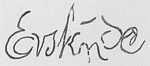
was married at Gretna, and Lord Erskine at Springfield. Marriage in this part of Scotland had not the same religious significance as elsewhere, being looked upon as more in the nature of a civil contract than a religious ceremony. The form of marriage was almost entirely a secular matter, and if a man and woman made a declaration before two witnesses that they were single persons and had resided twenty-one days in Scotland, they were considered as being man and wife. At the point where the Black Esk and White Esk Rivers join, a remarkable custom called "Handfasting" prevailed hundreds of years ago. Here, at a place known as Handfasting Hough, young men and women assembled in great numbers and made matrimonial engagements by joining hands. The marriage was only binding for one year, but if both parties were then satisfied, the "handfasting" was continued for life. King Robert II of Scotland, it was said, was one of those who was "hand-fasted" there.
(Facsimile of Lord Erskine's signature.)
SPRINGFIELD TOLL.
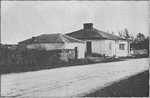
We now left Gretna, still single, for Carlisle, nine and a half miles away, the distance to Glasgow in the opposite direction being eighty-five miles. We recrossed the River Sark, the boundary here between Scotland and England, the famous tollbar through which eloping couples had to hurry before they could reach Gretna Green. In those days gangs of men were ever on the watch to levy blackmail both on the pursued and their pursuers, and the heaviest purse generally won when the race was a close one. We saw a new hotel on the English side of the river which had been built by a Mr. Murray specially for the accommodation of the runaways while the "Blacksmith" was sent for to join them together on the other side of the boundary, but it had only just been finished when Lord Brougham's Act rendered it practically useless, and made it a bad speculation for Mr. Murray. Passing through the tollgate we overtook a man with half a dozen fine greyhounds, in which, after our conversation with the owner of the racing dog at Canonbie Collieries, we had become quite interested; and we listened to his description of each as if we were the most ardent dog-fanciers on the road. One of the dogs had taken a first prize at Lytham and another a second at Stranraer. We passed through a country where there were immense beds of peat, hurrying through Todhilis without even calling at the "Highland Laddie" or the "Jovial Butcher" at Kingstown, and we crossed the River Eden as we entered the Border city of Carlisle, sometimes called "Merrie Carlisle," or, as the Romans had it, Lugovalum.
An elderly gentleman whom we overtook, and of whom we inquired concerning the objects of interest to be seen, appeared to take more interest in business matters than in those of an antiquarian nature, for he told us that "Carr's Biscuit Manufactory" with its machinery was a far finer sight than either the cathedral or the castle. Perhaps he was right, but our thoughts were more in the direction of bygone ages, with the exception of the letters that were waiting for us at the post office, and for which we did not forget to call. Merrie Carlisle, we were informed, was the chief residence of King Arthur, whose supposed ghostly abode and that of his famous knights, or one of them, we had passed earlier in the week. We were now told that near Penrith, a town to the south of Carlisle, there was still to be seen a large circle surrounded by a mound of earth called "Arthur's Round Table," and that in the churchyard were the giants' graves.
In the very old ballad on the "Lothely Lady" King Arthur was described as returning after a long journey to his Queen Guenevere, in a very sad mood:
And there came to him his cozen, Sir Gawain, Y' was a courteous Knight; Why sigh you soe sore, Unkle Arthur, he said, Or who hath done thee unright?
Arthur told him he had been taken prisoner by a fierce, gigantic chief, who had only released him and spared his life on condition that he would return and pay his ransom on New Year's Day, the ransom being that he must tell the giant "that which all women most desire." When the morning of the day arrived, Arthur was in great despair, for nearly all the women he had asked had given him different answers, but he was in honour bound to give himself up; and as he rode over the moors he saw a lady dressed in scarlet, sitting between an oak and a green holly. Glancing at her, Arthur saw the most hideous woman he had ever seen.
Then there as shold have stood her mouth, Then there was sett her e'e, The other was in her forhead fast, The way that she might see. Her nose was crooked, and turned outward, Her mouth stood foul awry; A worse formed lady than she was, Never man saw with his eye.
King Arthur rode on and pretended not to see her, but she called him back and said she could help him with his ransom. The King answered, "If you can release me from my bond, lady, I shall be grateful, and you shall marry my nephew Gawain, with a gold ring." Then the lothely lady told Arthur that the thing all women desired was "to have their own way." The answer proved to be correct, and Arthur was released; but the "gentle Gawain" was now bound by his uncle's promise, and the "lothely lady" came to Carlisle and was wedded in the church to Gawain. When they were alone after the ceremony she told him she could be ugly by day and lovely by night, or vice versa, as he pleased, and for her sake, as she had to appear amongst all the fine ladies at the Court, he begged her to appear lovely by day. Then she begged him to kiss her, which with a shudder he did, and immediately the spell cast over her by a witch-step mother was broken, and Gawain beheld a young and lovely maiden. She was presented to Arthur and Guenevere, and was no longer a "lothely" lady. Then the ballad goes on:
King Arthur beheld the lady faire, That was soe faire and bright; He thanked Christ in Trinity, For Sir Gawain, that gentle Knight.
King Arthur's table was supposed to have been made round for the same reason that John o' Groat's was made octagonal—to avoid jealousy amongst his followers.
CARLISLE CATHEDRAL.
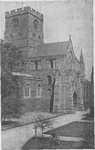
We visited the cathedral, which had suffered much in the wars, but in the fine east window some very old stained glass remained, while parts of the building exhibit the massive columns and circular arches typical of the Norman architect. Here, in the presence of King Edward I and his Parliament, Robert the Bruce, King of Scotland, was excommunicated by the Papal Legate for the murder of the Red Comyn in the Church of the Minorite Friars in Dumfries. Here, too, Sir Walter Scott was married to Charlotte Carpenter in the presence of Jane Nicholson and John Bird on December 29th, 1797. Sir Walter was touring in the Lake District in July of that year, and while staying at Gilsland Wells he first saw a fascinating and elegant young lady, the daughter of Jean Charpentier of Lyons, then under the charge of the Rev. John Bird, a Minor Canon of Carlisle Cathedral. She was described, possibly by Sir Walter himself, as being rich in personal attractions, with a form fashioned as light as a fairy's, a complexion of the clearest and finest Italian brown, and a profusion of silken tresses as black as the raven's wing. A humorous savant wrote the following critique on this description of the beauty of Sir Walter's fiancée:
It is just possible the rascal had been reading some of the old Welsh stories collected in the twelfth century and known as the Mabinogion stories. In one Oliven is described so—
"More yellow was her head than the yellow of the broom, and her skin was whiter than the foam of the wave, and fairer were her hands and her fingers than the blossoms of the wood anemone amidst the sprays of the meadow fountain. The eye of the trained hawk, the glance of the three-mewed falcon was not brighter than hers. Her bosom was more snowed than the heart of the white swan; her cheek was redder than the reddest roses."
THE "POPPING STONE," GILSLAND.
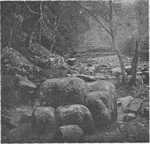
Or again, both of the love-stricken swains may have dipped, into the Arabian Nights, where imagination and picture painting runs riot.
There was no doubt that Scott fell deeply in love with her, so much so that a friend whom he visited in 1797 wrote that "Scott was 'sair' beside himself about Miss Carpenter and that they toasted her twenty times over and raved about her until one o'clock in the morning." Sir Walter seemed to have acted in his courtship on the old north-country adage, "Happy is the wooing that is not long a-doing," for he was married to her three months afterwards. The whole details are carefully preserved in local tradition. The River Irthing runs through Gilsland, and at the foot of the cliffs, which rise go feet above the river, were the Sulphur Wells. Near these, on the bank of the river, was a large stone named the "Popping Stone," where it was said that Sir Walter Scott "popped the question," and all who can get a piece of this stone, which, by the way, is of a very hard nature, and place it under the pillow at night, will dream of their future partners. The hotel people tell a good story of a gentleman, an entire stranger to the district, who went in company with a lady who knew the neighbourhood to see the famous stone. After walking for some distance they were passing a stone, when the gentleman asked, "Is this the popping stone?" "No," answered his fair companion, "but any large stone will do."
Near the stone there was a bush called the "Kissing Bush," where Sir Walter was said to have sealed the sweet compact when the temperature was only "two in the shade."
Oh happy love! where Love like this is found! Oh heartfelt raptures! Bliss beyond compare! I've paced much this weary mortal round, If Heaven a draught of Heavenly pleasure spare, One cordial in this melancholy vale, 'Tis when a youthful loving modest pair In other's arms breathe out the tender tale Beneath the "Kissing Bush" that scents the evening gale.
CARLISLE CASTLE
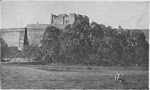
John Wesley visited Carlisle and preached there on several occasions. Rabbie Burns, too, after the publication of the first edition of his poems, visited it in 1786, patronising the "Malt Shovel Inn," where, as he wrote, "he made a night of it."
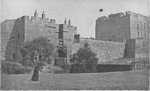
We paid a hurried visit to the castle on the summit of a sharp aclivity overlooking the River Eden, in whose dungeons many brave men have been incarcerated, where we saw a dripping-or dropping-stone worn smooth, it was said, by the tongues of thirsty prisoners to whom water was denied. The dropping was incessant, and we were told a story which seems the refinement of cruelty, in which the water was allowed to drop on a prisoner's head until it killed him. From the castle mound we could see the country for a long distance, and there must have been a good view of the Roman wall in ancient times, as the little church of Stanwix we had passed before crossing the River Eden was built on the site of a Roman station on Hadrian's Wall, which there crossed the river on low arches. The wall was intended to form the boundary between England and Scotland, and extended for seventy miles, from Bowness-on-the-Solway to Wallsend-on-the-Tyne, thus crossing the kingdom at its narrowest part.
We left Carlisle at a speed of four miles per hour, and within the hour we had our first near view of the Cumberland Hills, Scawfell being the most conspicuous. We decided to go to Maryport, however, as we heard that a great number of Roman altars had recently been discovered there. We were now once more in England, with its old-fashioned villages, and at eleven miles from Carlisle we reached Wigton, whose streets and footpaths were paved with boulders and cobble-stones; here we stayed for refreshments. A further eight-miles' walk, some portion of it in the dark, brought us to Aspatria, but in the interval we had passed Brayton Hall, the residence of Sir Wilfrid Lawson, Bart., M.P., the leader of the Legislative Temperance Movement for the abolition of the Liquor Traffic, and who, at a later date, was said to be the wittiest member of the House of Commons. As Chairman of the United Kingdom Alliance, that held its annual gatherings in the great Free Trade Hall in Manchester, a building capable of seating 5,000 persons, so great was his popularity that the immense building, including the large platform, was packed with people long before the proceedings were timed to begin, there being left only sufficient space for the chairman and the speakers. The interval before the arrival of these gentlemen was whiled away by the audience in singing well-known hymns and songs, and on one occasion, when Sankey and Moody's hymns had become popular, just as the people were singing vociferously the second line of the verse—
See the mighty host advancing, Satan leading on!
CARLISLE CASTLE
Sir Wilfrid appeared on the platform followed by the speakers. His ready wit seized the humour of the situation, and it is said that he was so deeply affected by this amusing incident that it took him a whole week to recover! As a speaker he never failed to secure the attention and respect of his audience, and even of those in it who did not altogether agree with his principles. As an advocate of the total suppression of the Liquor Traffic, on every occasion his peroration was listened to with almost breathless attention, and concluded in an earnest and impressive manner which left a never-to-be-forgotten impression upon those who heard it, the almost magic spell by which he had held the vast audience being suddenly broken, as if by an electric shock, into thunders of applause when he recited his favourite verse. We can hear his voice still repeating the lines:
Slowly moves the march of ages, Slowly grows the forest king, Slowly to perfection cometh Every great and glorious thing!
It was 8 p.m. as we entered Aspatria, where we found lodgings for the night at Isaac Tomlinson's. We expected Aspatria, from its name, to have had some connection with the Romans, but it appeared to have been so called after Aspatrick, or Gospatrick, the first Lord of Allerdale, and the church was dedicated to St. Kentigern. The Beacon Hill near the town was explored in 1799, and a vault discovered containing the skeleton of a gigantic warrior seven feet long, who had been buried with his sword, dagger, gold bracelet, horse's bit, and other accoutrements dating from the sixth century.
We had passed a small village near our road named Bromfield, which was said to possess strong claims to have been the site of the Battle of Brunanburch, fought in the year 937, when Anlaf, King of Dublin, formed a huge confederacy with the King of the Scots, the King of Strathclyde, and Owen, King of Cumbria, against Athelstan, King of England, by whom, however, they were signally defeated; but we afterwards came to a place a long way further south which also claimed to have been the site of that famous battle.
According to the following record, however, our native county of Chester appeared to have the strongest claim to that distinction:
It is not actually certain where the Battle of Brunanburch was fought, but it is by all historians said to have taken place in the Wirral Peninsula about the site where Bromborough is now situated. The Battle took place in 937 A.D., and it was here that Athelstan defeated the united forces of Scotland, Cumberland, and the British and Danish Chiefs, which is recorded in the Saxon Chronicle in a great war song. The name given in the Chronicle is Brunesburgh, but at the time of the Conquest it was called Brunburgh.
The fleet set sail from Dublin under the command of the Danish King Anlaf or Olaf to invade England. He had as his father-in-law, Constantine, King of the Scots, and many Welsh Chieftains supported him. They made good their landing but were completely routed by King Athelstan, Grandson of Alfred, as stated above.
It is more than probable that Anlaf sailing from Dublin would come over to England by the usual route to the havens opposite, near the great roadstead of the Dee estuary.
One must not forget that the sea has made great ravages upon this coast, destroying much ground between Wallasey and West Kirby, though compensating for it in some measure by depositing the material in the estuary itself in the shape of banks of mud and sand. Nor must one overlook the existence of the old forest of Wirral, which stretched, as the old saying ran—
From Blacon Point to Hilbre Squirrels in search of food Might then jump straight from tree to tree. So thick the forest stood!
Chester was held by the king, for the warlike daughter of Alfred, Ethelfleda, had rebuilt it as a fort after it had been lying in waste for generations, and had established another at Runcofan, or Runcorn. It was natural, therefore, for Anlaf to avoid the waters protected by Athelstan's fleet and seek a landing perhaps at the old Roman landing-place of Dove Point, near Hoylake, or in the inlet now carved into the Timber Float at Birkenhead. Norse pirates had made a settlement here beforehand, as the place names, Kirby, Calby, Greasby, and Thorstaston, seem to indicate.
Bromborough would be just the spot for a strategist like Athelstan to meet the invader, trying to force a way between the forest and the marshes about Port Sunlight. This old port at Dove Point has been washed away, though many wonderful relics of Roman and earlier times have been found there, and are safely housed in the Chester Museum. Once again it was used for the embarking of the army under William III, when he sailed for Ireland to meet the late king, James II, in battle.
When Chester began to lose its trade through the silting up of its harbour, about the reigns of the Lancastrian kings, it became necessary to sail from lower down the estuary, Parkgate being in the best position and possessing a quay, while Dawpool was also frequently used. But a good port was necessary, because Ireland was frequently in rebellion, and troops were usually passed over the channel from this region.
Parkgate was most prosperous in the eighteenth century, but the construction of the great Irish road through Llangollen to Holyhead, and of a good coach road from Warrington to Liverpool, and the later development of railways caused its decline, until in our time it was only known for its shrimps and as the headquarters of a small coast fleet of fishing-boats.
It was to Dawport, or Darport, that Dean Swift usually sailed from Dublin at the beginning of the eighteenth century for his frequent visits to his brother wits, Addison and Steele. It was strange how many common sayings of to-day were his in origin such as, "There is none so blind as they that won't see," and, "A penny for your thoughts." Like many witty people, he must needs have his little joke. He was made Dean of St. Patrick's, Dublin, in 1713, and was accustomed to preach there each Sunday afternoon, and was said to have preached on the same subject on sixteen consecutive occasions. On making his seventeenth appearance he asked the congregation if they knew what he was going to preach about. Most of them answered "Yes," while others replied "No." "Some of you say Yes," said the Dean, "and some of you say No. Those who know, tell those who don't know," and he immediately pronounced the benediction and left the pulpit!
At Chester he was accustomed to stay at the "Yacht Inn" in Watergate Street, the old street of Roman origin, which led westwards to the river beneath the River Gate. A dean is a dean, and his dignity must be preserved in a Cathedral city. Of a Dean of Chester of the early nineteenth century it is recounted that he would never go to service at the Cathedral except in stately dignity, within his stage coach with postillions and outriders, and would never even take his wife with him inside. Dean Swift probably announced his arrival to his brother of Chester as one king announces his approach to another king. But the story goes that a great cathedral function was on and no one came to welcome the great man. Perhaps there was a little excuse, for most likely they had suffered from his tongue. But, however much they might have suffered, they would have hurried to see him had they foreseen his revenge. And perhaps a poor dinner had contributed to the acidity of his mind when he scratched on one of the windows the following verse:
Rotten without and mouldering within. This place and its clergy are all near akin!
It is a far cry from the battle of Brunanburch to Dean Swift, but the thought of Anlaf took us back to Ireland, and Ireland and Chester were closely connected in trade for many centuries.
So it was with thoughts of our homeland that we retired for the night after adding another long day's walk to our tour.
(Distance walked thirty-two and a half miles.)
Saturday, October 14th.
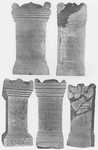
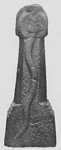
The long, straggling street of Aspatria was lit up with gas as we passed along it in the early morning on the road towards Maryport, and we marched through a level and rather uninteresting country, staying for slight boot repairs at a village on our way. We found Maryport to be quite a modern looking seaport town, with some collieries in the neighbourhood. We were told that the place had taken its name from Mary Queen of Scots; but we found this was not correct, as the name was given to it about the year 1756, after Mary the wife of Humphrey Senhouse, the Lord of the Manor at that period, the first house there apart from the old posting-house, having been built in the year 1748. For centuries there had been a small fishing-village at the mouth of the river, which in the time of Edward I was named Ellenfoot, while the river itself was named the Alne, now corrupted into Ellen. Maryport was of some importance in the time of the Romans, and their camp, about five acres in extent, still overlooked the sea. It was probably founded by Agricola about A.D. 79, and in A.D. 120 was the station of the Roman Fleet under Marcus Menaeius Agrippa, Admiral of the Roman Fleet in British Waters, and a personal friend of Hadrian. The Roman name of the station was probably Glanoventa, though other names have been suggested. The North-east Gateway was more distinct than other portions of the camp, the ruts made by the chariot wheels of the Romans being still visible inside the threshold. The Roman village in those days covered the four fields on the north-east side of the camp, and since the seventeenth century about forty Roman altars had been found, seventeen of them having been discovered in 1870, the year before our visit. They had been carefully buried about 300 yards east of the camp, and were discovered through a plough striking against one of them. Among them were altars to Jupiter, Mars, Virtue, Vulcan, Neptune, Belatucadrus, Eternal Rome, Gods and Goddesses, Victory, and to the Genius of the Place Fortune, Rome. In addition there were twelve small or household altars, querns, Roman millstones, cup and ring stones, a large, so-called, serpent stone, and several sepulchral slabs, sculptures, etc. There were also large quantities of Samian and other pottery, and articles in glass, bronze, lead, and iron, with about 140 coins, many of these remains being unique. This wonderful discovery proved that the Romans were resident here right up to the end of their occupation of Britain, as the coins bore the names of thirty-two Roman Emperors. The altars themselves were buried where they were found probably before A.D. 200. It is well known that their soldiers were drafted from many other nations, and there is distinct evidence that amongst others the first cohort of Spaniards appeared to have been prominent, while the Legionary Stones were of the Second and Twentieth Legions, the latter being stationed for a long time at Chester and moved to the north of England in the latter half of the fourth century.
ALTAR STONES. "Roman remains found at Maryport, and dating probably about or before A.D. 200."
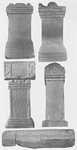
ALTAR STONES. "Among them were altars to Jupiter, Mars, Vulcan, household altars, and legionary stones."
THE SERPENT STONE.
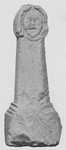
The Roman ships carried stores here from Deva, their station on the Dee, now known as Chester, for the use of the builders of Hadrian's Wall, so that Maryport ought to be a happy hunting-ground for antiquaries. After the departure of the Romans, Maryport must have been left to decay for over a thousand years, and it seemed even now to be a place that very few tourists visited. Netherhall, where most of the antiquities were carefully stored, was originally a Peel Tower, and up to the year 1528 was the home of the Eaglesfields and the reputed birthplace of Robert Eaglesfield, the founder of Queen's College, Oxford; it was now in possession of the Senhouse family. There was also the Mote Hill, overlooking the river and surrounded by a deep ditch, under the protection of which the Roman galleys anchored.
A romantic legend of the period of the Roman occupation still clings to the neighbourhood, called the Legend of the Golden Coffin:
The daughter of one of the Roman officers was loved by a young warrior from the other side of the Solway. Their trysting-place was discovered by the girl's father, who had a number of soldiers with him, and in spite of the entreaties of the girl, her lover was killed. With his death the maiden had no desire to live; night after night she made her way to the fatal spot, where she was eventually found, having died of a broken heart. The father prepared a wonderful funeral for her. Her body was arranged in silken garments, and then placed in a golden coffin and buried in a deep grave just outside the camp, where her spirit was still supposed to haunt the place at midnight.
On the sea coast a sunken forest existed, while the shore was covered with granite boulders of many sizes and shapes, and large numbers of similar stones were ploughed up in the fields, all apparently ice-borne, and having been carried mostly from Criffel on the Scottish coast, and the following legend was told here to explain their presence on the English side of the Solway.
There once lived a giant on Criffel which was on the opposite coast of the Solway Firth, while another giant lived on Skiddaw, one of the highest mountains in Cumberland. For a time they lived in peace and quietness, but an occasion came when they quarrelled. Then they took up stones and hurled them at each other; but many of them fell short, and hence they are now widely scattered.
WORDSWORTH'S BIRTHPLACE, COCKERMOUTH.
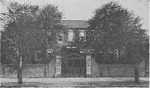
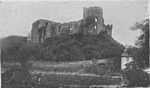
We now returned towards the hills and followed what was once a Roman road through a level country to Cockermouth, passing on our way through the colliery village of Dearham, a name meaning the "home of wild animals"; but we saw nothing wilder than a few colliers. The church here was built in 1130, while the tower was built in the fourteenth century for defence against the Scotch marauders. There were many old stones and crosses in the churchyard. Cockermouth, as its name implies, is situated at the mouth of the River Cocker, which here joins its larger neighbour the River Derwent, and has been called the Western Gate of the Lake District. Here also were Roman, Saxon, and Norman remains. The castle, standing in a strong position between the two rivers, was rebuilt in the reign of Edward I, and in Edward II's time his haughty favourite, Piers Gaveston, resided in it for a short period. It was held for the king during the Civil War, but was left in ruins after an attack by the Parliamentarians in 1648. The Gateway Tower displayed many coats of arms, and there was the usual dungeon, or subterranean chamber, while the habitable portion of the castle formed the residence of Lord Leconfield. The poet, William Wordsworth, was born at Cockermouth on April 7th, 1770, about a hundred years before we visited it, and one of his itinerary poems of 1833 was an address from the Spirit of Cockermouth Castle:
Thou look'st upon me, and dost fondly think, Poet! that, stricken as both are by years, We, differing once so much, are now compeers, Prepared, when each has stood his time, to sink Into the dust. Erewhile a sterner link United us; when thou in boyish play, Entered my dungeon, did'st become a prey To soul-appalling darkness. Not a blink Of light was there; and thus did I, thy Tutor, Make thy young thoughts acquainted with the grave; While thou wert chasing the winged butterfly Through my green courts; or climbing, a bold suitor, Up to the flowers whose golden progeny Still round my shattered brow in beauty wave.
COCKERMOUTH CASTLE
Mary Queen of Scots stayed at Cockermouth on the night of May 17th, 1568—after the defeat of her army at Langside—at the house of Henry Fletcher, a merchant, who gave her thirteen ells of rich crimson velvet to make a robe she badly needed.
PORTINSCALE.
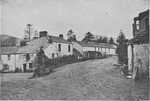
The weather turned out wet in the afternoon, so we stayed for tea at one of the inns in the town, and noted with curiosity that the number of the inhabitants in Cockermouth was 7,700 at one census, and exactly the same number at the next, which followed ten years afterwards. The new moon was now due, and had brought with it a change in the weather, our long spell of fine weather having given place to rain. We did not altogether agree with our agricultural friends in Cheshire that it was the moon that changed the weather, but it would be difficult to persuade the farmers there to the contrary, since the changes in the weather almost invariably came with the phases in the moon; so, without venturing to say that the moon changed the weather or that the weather changed the moon, we will hazard the opinion that the same influences might simultaneously affect both, and the knowledge that we were approaching the most rainy district in all England warned us to prepare for the worst. The scenery improved as we journeyed towards Keswick, the "City of the Lakes," but not the weather, which continued dull and rainy, until by the time we reached the British stronghold known as Peel Wyke it was nearly dark. Here we reached Bassenthwaite Lake, four miles long and one mile broad, and had it not been for the rain and the darkness we might have had a good view across the lake of Skiddaw Mountain, 3,054 feet above sea-level and towards the right, and of Helvellyn, a still higher mountain, rising above Derwent Water, immediately in front of us. We had seen both of these peaks in the distance, but as the rain came on their summits became enveloped in the clouds. We walked about three miles along the edge of Bassenthwaite Lake, passing the villages of Thornthwaite and Braithwaite, where lead and zinc were mined. On arriving at Portinscale we crossed the bridge over the River Derwent which connects that lake (Derwent Water) with Bassenthwaite Lake through which it flows, and thence, past Cockermouth, to the sea at Workington. Soon after leaving Portinscale we arrived at Keswick, where we were comfortably housed until Monday morning at the Skiddaw Hotel, formerly a licensed house, but since converted into a first-class temperance house by Miss Lawson, the sister of Sir Wilfrid Lawson, Bart., M.P.
(Distance walked twenty-eight miles.)
Sunday, October 15th.
Rain had fallen heavily during the night, but the weather cleared up a little as we wended our way to morning service at Crosthwaite Church, dedicated to St. Kentigern, a Bishop of Glasgow, in the sixth century, and doing duty, we supposed, as the parish church of Keswick. The font there dated from the year 1390, and bore the arms of Edward III, with inscriptions on each of its eight sides which we could not decipher. In the chancel stood an alabaster tomb and effigy of Sir John Radcliffe and his wife, ancestors of the Earl of Derwentwater. The church also contained a monument to Southey the poet, erected at a cost of £1,100, and bearing the following epitaph written by the poet Wordsworth:
The vales and hills whose beauty hither drew The poet's steps, and fixed him here, on you His eyes have closed! And ye, lov'd books, no more Shall Southey feed upon your precious lore, To works that ne'er shall forfeit their renown. Adding immortal labours of his own— Whether he traced historic truth, with zeal For the State's guidance, and the Church's weal Or fancy, disciplined by studious art, Inform'd his pen, or wisdom of the heart. Or judgements sanctioned in the Patriot's mind By reverence for the rights of all mankind. Wide were his aims, yet in no human breast Could private feelings meet for holier rest. His joys, his griefs, have vanished like a cloud From Skiddaw's top; but he to heaven was vowed. Through his industrious life, and Christian faith Calmed in his soul the fear of change and death.
We attended the same church in the afternoon, and both the sermons were preached by the curate, his texts being Deut. vi. 5 in the morning and Hebrews iv. 3 in the afternoon. We were surprised to see such large congregations on a wet day, but concluded that the people were so accustomed to rain in that part of the country that they looked upon it as a matter of course. The people of Keswick evidently had other views as regards church-going than is expressed in the following lines by an author whose name we do not remember:
No pelting rain can make us stay When we have tickets for the play; But let one drop the side-walk smirch. And it's too wet to go to church.
At the morning service we sat in a pew in the rear of the church, and at one point in the service when it was usual in that part of the country for the congregation to sit down, one gentleman only remained standing. We could scarcely believe our own eyes when we recognised in this solitary figure the commanding form of Colonel Greenall of the Warrington Volunteers, a gentleman whom we know full well, for his brother was the rector of Grappenhall, our native village, where the Colonel himself formerly resided.
He was a great stickler for a due recognition of that pleasing but old-fashioned custom now fallen out of use, of the boys giving the rector, the squire, or any other prominent member of their families a respectful recognition when meeting them in the village or on their walks abroad. On one occasion the boys had forgotten their usual obeisance when meeting some relatives of the Colonel. He was highly indignant at this sin of omission, and took the earliest opportunity to bring the matter forcibly before his Sunday-school class, of which my brother was a member. The Colonel spoke long and feelingly to the boys on the subject of ordering themselves lowly and reverently before all their "betters," including governors, teachers, spiritual pastors and masters, and to all those who were put in authority over them, and wound up his peroration with these words, which my brother never forgot, "And now, boys, whenever you meet ME, or any of MY FAMILY, mind you always touch your HATS!"
CROSTHWAITE CHURCH, KESWICK.
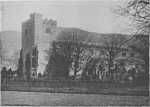
We did not stop to speak to the Colonel, as he was at the other end of the church and passed out through another door, but we were recognised by one of his men, who told us the Colonel had only just removed to that neighbourhood. He had liked his summer's experiences there, but did not know how he would go on in the winter. The Colonel and his man were the only persons we saw on the whole of our journey that we knew.
To return to our boyish experiences and to the Colonel, the subject of his Sunday-school lesson was taken from the Summary of the Ten Commandments in the Church of England Prayer Book, where they were divided into two parts, the first four relating to our duty to God, and the remaining six to our duty towards our neighbour. It was surprising how these questions and answers learned in the days of our youth dwelt in our memories, and being Sunday, we each wrote them down from memory with the same result, and we again record them for the benefit of any of our friends who wish to "read, mark, learn, and inwardly digest."
"Question.—What is thy duty towards God?
"Answer.—My duty towards God, is to believe in Him, to fear Him, and to love Him with all my heart, with all my mind, with all my soul, and with all my strength; to worship Him, to give Him thanks, to put my whole trust in Him, to call upon Him, to honour His holy Name and His Word, and to serve Him truly all the days of my life.
"Question.—What is thy duty towards thy Neighbour?
"Answer.—My duty towards my Neighbour, is to love him as myself, and to do unto all men, as I would they should do unto me: To love, honour, and succour my father and mother: To honour and obey the Queen, and all that are put in authority under her: To submit myself to all my governors, teachers, spiritual pastors and masters: To order myself lowly and reverently to all my betters: To hurt no body by word nor deed: To be true and just in all my dealing: To bear no malice nor hatred in my heart: To keep my hands from picking and stealing, and my tongue from evil-speaking, lying, and slandering: To keep my body in temperance, soberness, and chastity: Not to covet nor desire other men's goods; but to learn and labour truly to get mine own living, and to do my duty in that state of life, unto which it shall please God to call me."
The word "duty" in the last paragraph of the explanation of one's duty to one's neighbour must have been in the thoughts of both Nelson and his men at the Battle of Trafalgar when he signalled, "England expects that every man this day will do his duty." Although objections may be raised to clauses in the summary, we always thought that our country could be none the worse, but all the better, if every one learned and tried to act up to the principles contained in these summaries of the Ten Commandments.
In the evening we attended St. John's Church, where the Vicar officiated and preached from Isaiah lxvii. 7 to a large congregation, and after the service we returned to our hotel.
Keswick was a great resort of tourists and holiday people, and we were not without company at the hotel, from whom we obtained plenty of advice concerning our route on the morrow. We were strongly recommended to see the Druidical Circle and to climb Skiddaw, whose summit was over 3,000 feet above sea-level, from which we should have a view scarcely surpassed in the whole of Europe, and a scene that would baffle the attempts of ordinary men to describe, having taxed even the powers of Southey and Wordsworth. These recommendations and others were all qualified with the words "if fine." But, oh that little word "if"—so small that we scarcely notice it, yet how much does it portend! At any rate we could not arrive at a satisfactory decision that night, owing to the unfavourable state of the weather.