SIXTH WEEK'S JOURNEY (continued 2)
Reading edition
THE GATE AND KEEP, PONTEFRACT CASTLE.
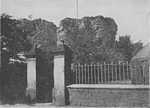
Last year, before we began our walk from London to Lancashire, we visited Whitehall and saw the window in the Banqueting-hall through which, on January 30th, 1649, about two months before Pontefract Castle surrendered, he passed on his way to the scaffold outside.
In its prime Pontefract Castle was an immense and magnificent fortification, and from its ruins we had a fine view on all sides of the country it had dominated for about six hundred years.
We were now journeying towards the more populous parts of the country, and the greater the mileage of our walk, the greater became the interest taken both in us and our adventures. Several persons interviewed us in our hotel at Pontefract, and much sympathy was extended towards myself, as my foot was still very painful in spite of the remedies which had been applied to it; but we decided not to give in, my brother kindly consenting to carry all the luggage, for we were very anxious not to jeopardise our twenty-five miles' daily average beyond recovery. My boot was eased and thoroughly oiled; if liquorice could have done it any good, we could have applied it in addition to the other remedies, as we had bought some both for our own use and for our friends to eat when we reached home. All we had learned about it was that it was made from the root of a plant containing a sweet juice, and that the Greek name of it was glykyr-rhiza, from glykys, sweet, and rhiza, root. After making a note of this formidable word, I did not expect my brother to eat any more liquorice; but his special aversion was not Greek, but Latin, as he said both his mind and body had been associated with that language through the medium of the cane of his schoolmaster, who believed in the famous couplet:
'Tis Education forms the common mind. And with the cane we drive it in behind!
He was always suspicious of the Latin words attached to plants, and especially when quoted by gardeners, which I attributed to jealousy of their superior knowledge of that language; but it appeared that it was founded on incidents that occurred many years ago.
He was acquainted with two young gardeners who were learning their business by working under the head gardener at a hall in Cheshire, the owner of which was proud of his greenhouses and hothouses as well as of the grounds outside. As a matter of course everything appeared up to date, and his establishment became one of the show-places in the neighbourhood. The gardener, an elderly man, was quite a character. He was an Irishman and an Orangeman as well, and had naturally what was known in those parts as "the gift of the gab." The squire's wife was also proud of her plants, and amongst the visitors to the gardens were many ladies, who often asked the gardener the name of a plant that was strange to them. As no doubt he considered it infra dig. to say he did not know, and being an Irishman, he was never at a loss when asked, "What do you call this plant?" he would reply, "Oh, that, mum, is the Hibertia Canadensus, mum!" and a further inquiry would be answered in a similar manner—"That, mum, is the Catanansus Rulia, mum!" and again the lady would thank him and walk on apparently quite pleased and happy, probably forgetting the name of the plant before she had gone through the gardens. The young men were often at work in the houses while the visitors were going through, and of course they were too deeply engaged in their work either to see the visitors or to hear all the conversation that was going on, but they told my brother that they could always tell when the gardener did not know the real name of a plant by his invariably using these two names on such occasions, regardless of the family or species of the plant in question.
Pomfret was the local abbreviation of Pontefract, the name of the town, and "Pomfret Liquorice" claimed not only to be a sweetmeat, but a throat remedy as well, and was considered beneficial to the consumer. The sample we purchased was the only sweet we had on our journey, for in those days men and women did not eat sweets so much as in later times, they being considered the special delicacies of the children. The sight of a man or woman eating a sweet would have caused roars of ridicule. Nor were there any shops devoted solely to the sale of sweets in the country; they were sold by grocers to the children, though in nothing like the variety and quantity that appeared in later years. The most common sweet in those days was known as "treacle toffy," which was sold in long sticks wrapped from end to end in white paper, to protect the children's fingers when eating it, in spite of which it was no unusual sight to see both hands and faces covered with treacle marks, and thus arose the name of "treacle chops," as applied to boys whose cheeks were smeared with treacle. There was also toffy that was sold by weight, of which Everton toffee was the chief favourite. My brother could remember a little visitor, a cousin of ours, who could not speak very plainly, and who always called a cup a "tup," being sent to the village shop for a pound of coffee, and his delight when he returned laden with a pound of toffy, which was of course well-nigh devoured before the mistake was found out!
By this day we were ready for anything except walking as we crawled out of the town to find our way to Doncaster, and our speed, as might be imagined, was not excessive; for, including stoppages, which were necessarily numerous, we only averaged one mile per hour! There was a great bazaar being held in Pontefract that day, to be opened by Lord Houghton, and we met several carriages on their way to it. After we had walked some distance, we were told—for we stopped to talk to nearly every one we met—that we were now passing through Barnsdale Forest. We could not see many trees, even though this was formerly the abode of Robin Hood and Little John, as well as Will Scarlett.
It was in this forest that Robin, hearing of the approach of the Bishop of Hereford, ordered his men to kill a good fat deer, and to make a repast of it by the side of the highway on which the Bishop was travelling. Robin dressed himself and six of his men in the garb of shepherds, and they took their stand by the fire at which the venison was being roasted. When the Bishop came up, with his retinue, he asked the men why they had killed the King's deer, and said he should let the King know about it, and would take them with him to see the King.
"Oh pardon, oh pardon," said bold Robin Hood, "Oh pardon, I thee pray. For it becomes not your Lordship's coat To take so many lives away." "No pardon, no pardon," said the Bishop, "No pardon I thee owe; Therefore make haste and come along with me, For before the King ye shall go."
Then Robin pulled his bugle horn from beneath his coat and blew a long blast, and threescore and ten of his followers quickly appeared—
All making obeysance to Robin Hood, 'Twas a comely sight to see; "What is the matter, master?" said Little John, "That you blow so heartily?"
Robin replied that the Bishop of Hereford refused all pardon for slaying the deer, and had said they must at once accompany him to the King. Little John then suggested that they should cut off the Bishop's head and throw him in a grave; but the Bishop craved pardon of the outlaw for his interference, and declared that had he known who was on the road, "he would have gone some other way."
"No pardon, no pardon," said bold Robin Hood, "No pardon I thee owe; Therefore make haste and come along with me, For to merry Barnsdale you shall go."
So thither they led the Bishop, and made him sup with them right merrily and royally.
"Call in a reckoning," said the Bishop, "For methinks it grows wondrous high;" "Lend me your purse, master," said Little John, "And I'll tell you by and bye!" Little John took the Bishop's cloak And spread it upon the ground. And out of the Bishop's portmanteau He told three hundred pound. "Here's money enough, master," said Little John, "And a comely sight to see; It makes me in charity with the Bishop, Though he heartily loveth not me." Robin took the Bishop by the hand, And he caused the music to play; And he made the Bishop to dance in his boots. And glad he could get away!
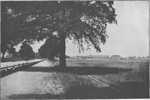
DONCASTER RACECOURSE. "We had walked for five days over the broad acres of Yorkshire and had seen many fine horses, for horse-breeding was a leading feature of that big county, and horses a frequent subject of conversation."
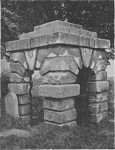
We heard all sorts of stories from the roadmen, some of which might not be true; but in any case about seven miles from Doncaster we reached Robin Hood's Well, at the side of the road. It was quite a substantial structure, built of soft limestone, and arched over, with a seat inside—on which doubtless many a weary wayfarer had rested before us. The interior was nearly covered with inscriptions, one dated 1720 and some farther back than that. We had a drink of water from the well, but afterwards, when sitting on the seat, saw at the bottom of the well a great black toad, which we had not noticed when drinking the water. The sight of it gave us a slight attack of the horrors, for we had a particular dread of toads. We saw at the side of the road a large house which was formerly an inn rejoicing in the sign of "Robin Hood and Little John," one of the oldest inns between York and London. We called at a cottage for tea, and here we heard for the first time of the Yorkshireman's coat-of-arms, which the lady of the house told us every Yorkshireman was entitled to place on his carriage free of tax! It consisted of a flea, and a fly, a flitch of bacon, and a magpie, which we thought was a curious combination. The meaning, however, was forthcoming, and we give the following interpretation as given to us:
A flea will bite! and so will a Yorkshireman; A fly will drink out of anybody's cup! and so will a Yorkshireman; A magpie will chatter! and so will a Yorkshireman: And a flitch of bacon looks best when it's hung! and so does a Yorkshireman.
We fancied a Lancashire man must have written that ditty.
ROBIN HOOD'S WELL.
The moon was shining brightly as we left the cottage, and a man we met, when he saw me limping so badly, stopped us to inquire what was the matter. He was returning from Doncaster, and cheered us up by pointing to the moon, saying we should have the "parish lantern" to light us on our way. This appeared to remind him of his parish church, where a harvest thanksgiving had just been held, with a collection on behalf of the hospital and infirmary. He and seven of his fellow servants had given a shilling each, but, although there were "a lot of gentry" at the service, the total amount of the collection was only one pound odd. The minister had told them he could scarcely for shame carry it in, as it was miserably small for an opulent parish like that!
We arrived at Doncaster at 8.30 p.m., and stayed at the temperance hotel in West Laith Street. The landlord seemed rather reluctant about letting us in, but he told us afterwards he thought we were "racing characters," which greatly amused us since we had never attended a race-meeting in our lives!
(Distance walked fourteen miles.)
Friday, October 27th.
Our host at Doncaster took a great interest in us, and, in spite of my sprained ankle, we had a good laugh at breakfast-time at his mistaking us for "racing characters." My brother related to him his experiences on the only two occasions he ever rode on the back of a horse unassisted. The first of these was when, as quite a young boy, he went to visit his uncle who resided near Preston in Lancashire, and who thought it a favourable opportunity to teach him to ride. He was therefore placed on the back of a quiet horse, a groom riding behind him on another horse, with orders not to go beyond a walking pace; but when they came near the barracks, and were riding on the grass at the side of the road, a detachment of soldiers came marching out through the entrance, headed by their military band, which struck up a quickstep just before meeting the horses. My brother's horse suddenly reared up on its hind legs, and threw him off its back on to the grass below, or, as he explained it, while the horse reared up he reared down! He was more frightened than hurt, but the groom could not persuade him to ride on the horse's back any farther, so he had to lead the horses home again, a distance of two miles, while my brother walked on the footpath.
It was years before he attempted to ride on horseback again, but this time he was mounted upon an old horse white with age, and very quiet, which preferred walking to running; this second attempt also ended disastrously. It was a very hot day, and he had ridden some miles into the country when he came to a large pit, on the opposite side of the road to a farmhouse, when, without any warning, and almost before my brother realised what was happening, the horse walked straight into this pit, and, in bending its head to drink at the water, snatched the bridle out of his hands. He had narrowly escaped drowning on several occasions, and was terrified at the thought of falling into the water, so, clutching hold of the horse's mane with both hands, he yelled out with all his might for help—which only served to make the horse move into a deeper part of the pit, as if to have a bathe as well as a drink. His cries attracted the attention of some Irish labourers who were at work in a field, and they ran to his assistance. One of them plunged into the water, which reached half way up his body, and, taking hold of my brother, carried him to the road and then returned for the horse. He was rewarded handsomely for his services, for my brother verily believed he had saved him from being drowned. He was much more afraid of the water than of the horse, which was, perhaps, the reason why he had never learned to swim, but he never attempted to ride on horseback again. On the wall in front of the farmhouse an old-fashioned sundial was extended, on the face of which were the words:
Time that is past will never return,
and on the opposite corner were the Latin words Tempus fugit (Time flies). My brother seemed to have been greatly impressed by these proverbs, and thought of them as he led the white horse on his three-mile walk towards home; they seemed engraven upon his memory, for he often quoted them on our journey.
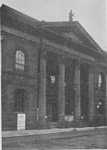
THE GUILDHALL, DONCASTER.
My ankle seemed to be a shade easier, and, after the usual remedies had again been applied, we started on another miserable walk, or limp, for we only walked twelve miles in twelve hours, following the advice of our host to take it easy, and give the ankle time to recover. We rested many times on the road, stopped to talk to many people, got to know all about the country we were passing through, read papers and books, called for refreshments oftener than we needed them, wrote letters to our friends, and made copious entries in our diaries—-in fact did everything except walk. The country was very populous, and we attracted almost universal sympathy: myself for my misfortune, and my brother for having to carry all the luggage.
Doncaster takes its name from the River Don, on which it is situated, and it was the only town in England, after London and York, that possessed a "Mansion House." We had walked for five days over the broad acres of Yorkshire and had seen many fine horses, for horse-breeding, we found, was a leading feature in that big county, and horses a frequent subject of conversation. Doncaster was no exception to the rule, as the Doncaster Races were famous all over England, and perhaps in other countries beyond the seas. We were too late in the year for the great St. Leger race, which was held in the month of September, and was always patronised by Royalty. On that occasion almost every mansion in the county was filled with visitors "invited down" for the races, and there was no doubt that agricultural Yorkshire owed much of its prosperity to the breeding of its fine horses. The racecourse was situated on a moor a little way out of the town, the property of the Corporation, and it was said that the profit made by the races was so great that the Doncaster people paid no rates. This might of course be an exaggeration, but there could be no doubt that the profit made by the Corporation out of the moor on which the races were held would largely reduce the rates of the town.
Doncaster races owed their origin to a famous Arab horse named Rasel-Fedawi (or the "Headstrong"), which was purchased from the Anazeh tribe of Arabs by a Mr. Darley, an Englishman who at that time resided at Aleppo, a Turkish trading centre in Northern Syria. This gentleman sent the horse to his brother at Aldby Park in Yorkshire, and what are now known as "thoroughbreds" have descended from him. His immediate descendants have been credited with some wonderful performances, and the "Flying Childers," a chestnut horse with a white nose and four white legs, bred from a mare born in 1715, named "Betty Leedes," and owned by Leonard Childers of Doncaster, was never beaten. All sorts of tales were told of his wonderful performances: he was said to have covered 25 feet at each bound, and to have run the round course at Newmarket, 3 miles 6 furlongs, in six minutes and forty seconds. After him came another famous horse named "Eclipse" which could, it was said, run a mile a minute. When he died in 1789 his heart was found to weigh 14 pounds, which accounted for his wonderful speed and courage. Admiral Rous records that in the year 1700 the English racehorse was fifteen hands high, but after the Darley Arabian, the average height rose to over sixteen hands. It was said that there were races at Doncaster in the seventeenth century, but the great St. Leger was founded by General St. Leger in 1778, and the grand stand was built in the following year. The Yorkshire gentlemen and farmers were naturally all sportsmen, and were credited with keeping "both good stables and good tables." The invitation to "have a bite and a sup" was proverbial, especially in the wold or moorland districts, where hospitality was said to be unbounded.
A learned man wrote on one occasion that "an honest walk is better than a skilled physician. It stimulates heart, brain, and muscles alike, sweeping cobwebs from the mind and heaviness from the heart." But this was probably not intended to apply to a man with a sore foot, and it was difficult to understand why the ankle failure had come so suddenly. We could only attribute it to some defect in the mending of the boot at York, but then came the mystery why the other ankle had not been similarly affected. The day was beautifully fine, but the surroundings became more smoky as we were passing through a mining and manufacturing district, and it was very provoking that we could not walk through it quickly. However, we had to make the best of it, imagining we were treading where the saints had trod, or at any rate the Romans, for this was one of their roads to the city of York upon which their legions must have marched; but while we crossed the rivers over bridges, the Romans crossed them by paved fords laid in the bed of the streams, traces of which were still to be seen.
We made a long stay at Comsborough, and saw the scanty remains of the castle, to which Oliver Cromwell had paid special attention, as, in the words of the historian, "he blew the top off," which had never been replaced. And yet it had a very long history, for at the beginning of the fourth century it was the Burgh of Conan, Earl of Kent, who with Maximian made an expedition to Armorica (now Brittany), where he was eventually made king, which caused him to forsake his old Burgh in England. Maximian was a nephew of King Coel, or Cole, the hero of the nursery rhyme, of which there are many versions:
Old King Cole was a jolly old soul, And a jolly old soul was he; He called for his ale, and he called for his beer, And he called for his fiddle-diddle-dee.
But he seemed to have been a jolly old sinner as well, for he formed the brilliant idea of supplying his soldiers with British wives, and arranged with his father-in-law, the Duke of Cornwall, to send him several shiploads from the "old country," for British women were famous for their beauty. His request was complied with, but a great storm came on, and some of the ships foundered, while others were blown out of their course, as far as Germany, where the women landed amongst savages, and many of them committed suicide rather than pass into slavery. Who has not heard of St. Ursula and her thousand British virgins, whose bones were said to be enshrined at Cologne Cathedral, until a prying medico reported that many of them were only dogs' bones—for which heresy he was expelled the city as a dangerous malignant.
CONISBOROUGH CASTLE.
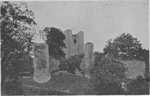
Troublesome times afterwards arose in England, and on the Yorkshire side, Briton and Saxon, and Pict and Scot, were mixed up in endless fights and struggles for existence. It was about this period that Vortigern, the British King, invited Hengist and Horsa, the Saxon Princes, to lend their assistance against the Picts and the Scots, which they did for a time; and when Hengist asked for a residence in his country, the King gave him Conan's Burgh, which was then vacant. Conan was never again seen in England, but in 489 his great-grandson Aurelius Ambrosius became King of the Britons. In the meantime the Saxons had so increased in numbers that they determined to fight for the possession of the country, and, headed by Hengist, who had turned traitor, fought a great battle, in the course of which Eldol, Duke of Gloucester, encountered Hengist in single combat, and, seizing him by the helmet, dragged him into the British ranks shouting that God had given his side the victory. The Saxons were dismayed, and fled in all directions, and Hengist was imprisoned in his own fortress of Conisborough, where a council of war was held to decide what should be his fate. Some were against his being executed, but Eldol's brother Eldad, Bishop of Gloucester, "a man of great wisdom and piety," compared him to King Agag, whom the prophet "hewed to pieces," and so Hengist was led through the postern gate of the castle to a neighbouring hill, and beheaded. Here Aurelius commanded him to be buried and a heap of earth to be raised over him, because "he was so good a knight." A lady generally appeared in these old histories as the cause of the mischief, and it was said that one reason why King Vortigern was so friendly with Hengist was that Hengist had a very pretty daughter named Rowena, whom the King greatly admired: a road in Conisborough still bears her name.
Aurelius then went to Wales, but found that Vortigern had shut himself up in a castle into which Aurelius was unable to force an entrance, so he burnt the castle and the King together; and in a wild place on the rocky coast of Carnarvonshire, Vortigern's Valley can still be seen. Sir Walter Scott, who was an adept in selecting old ruins for the materials of his novels, has immortalised Conisborough in his novel of Ivanhoe as the residence, about the year 1198, of the noble Athelstane or Athelstone, who frightened his servants out of their wits by demanding his supper when he was supposed to be dead.
Yorkshire feasts were famous, and corresponded to the "wakes" in Lancashire and Cheshire. There was a record of a feast at Conisborough on the "Morrow of the Exaltation of the Holy Cross," September 15th, 1320, in the "14th year of King Edward, son of King Edward," which was carried out by Sir Ralph de Beeston, one of our Cheshire knights, and Sir Simon de Baldiston (Stewards of the Earl of Lancaster), to which the following verse applied:
They ate as though for many a day They had not ate before. And eke as though they all should fear That they should eat no more. And when the decks were fairly cleared And not a remnant nigh, They drank as if their mighty thirst Would drain the ocean dry.
A curious old legend was attached to the town well in Wellgate, which formerly supplied most of the inhabitants of Conisborough with water; for once upon a time, when the town was suffering from a great drought, and the people feared a water famine, they consulted an old man known by the name of St. Francis, who was very wise and very holy. He told the people to follow him singing psalms and hymns to the Willow Vale, on the Low Road. There he cut a wand from a willow tree, and stuck it into the ground, and forthwith a copious supply of water appeared which had flowed steadily ever since. The wand had been so firmly and deeply stuck into the ground by St. Francis that it took root and grew into a large tree.
In 1863 there was a great flood in Sheffield, which did a lot of damage, and amongst the debris that floated down the river was noticed a cradle containing a little baby. It was rescued with some difficulty, and was still alive when we passed through the town, being then eight years old.
ROCHE ABBEY.
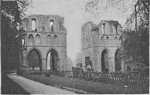
After leaving Conisborough we lost sight of the River Don, which runs through Mexborough; but we came in touch with it again where it was joined by the River Rother, at Rotherham. Here we crossed over it by the bridge, in the centre of which stood the decayed Chapel of our Lady. On our way we had passed to our right Sprotborough, where in 664 King Wulfhere when out hunting came to a cave at the side of the river where a hermit named St. Ceadde or St. Chad dwelt, the country at that time being "among sheep and distant mountains which looked more like lurking-places for robbers and dens of wild beasts than dwellings of men." There were many objects of interest on each side of our road, including, a few miles to the left, Roche Abbey, the seat of the Earl of Scarborough, and to the right Wentworth House, one of the largest private houses in England, and the seat of Earl Fitzwilliam, the owner of the far-famed Wharncliffe Crags, which are skirted by the waters of the River Don.
It was in Wharncliffe Forest that Friar Tuck, the jolly chaplain of Robin Hood, had his abode; and below the crags, in the bed of the River Don, there was a rock that appeared to be worn by the friction of some cylindrical body coiled about it. This was supposed to be the famous Dragon of Wantley, an old name for Wharncliffe. It was here that the monster was attacked and slain by Guy, the famous Earl of Warwick. Near the top of the crag, which was formerly a hunting-seat, stood a lodge where an inscription on a stone in the floor of the back kitchen stated that "Geoffrey de Wortley, Knight of the body to the Kings Richard III, Henry VII, and Henry VIII, built this Lodge for his pleasure, so that he might hear the red deer bray." In the lodge too was a most ponderous boot said to have been worn by Oliver Cromwell at the Battle of Marston Moor. We stayed at Rotherham for the night.
(Distance walked twelve miles.)
Saturday, October 28th.
The inn where we stayed the night had not been very satisfactory, as, although the cooking was good, the upper apartments were below the average. We took to the road again as early as possible, especially as a decided improvement showed itself in the condition of my swollen foot, and we were able to make a little better progress. For some days we had been walking through a comparatively level country, but from the appearance of the hills to our right as well as before us, we anticipated a stiff climb. It was not until we approached Sheffield that the tug of war began, and, strange to say, I found it easier to walk uphill than on a level surface. Meantime we continued through a level and busy country, and were in no danger of losing our way, for there were many people to inquire of in case of necessity. At one time it had been a wild and lonely place, known as Attercliffe Common, and we were told that Dick Turpin had been gibbeted there. We had often heard of Turpin, and knew that he was hanged, but did not remember where, so we were anxious to see the exact spot where that famous "knight of the road" ended his existence. We made inquiries from quite a number of people, but could get no satisfactory information, until we met with an elderly gentleman, who informed us that it was not Dick Turpin who was gibbeted there, but a "gentleman" in the same profession, whose name was Spence Broughton, the only trace of him now being a lane that bore his name. As far as he knew, Dick Turpin had never been nearer Sheffield than Maltby, a village five miles away, and that was on his ride from London to York. He was hanged at Tyburn.
The hills we could see were those of the Pennine range, with which we must have formed acquaintance unconsciously when farther north, as although the high hills in the Lake District, through which we had passed, were not included in the range, some of the others must have been, since the Pennines were bounded on one side by Cumberland, Westmorland, and Lancashire, and on the other by Northumberland, Durham, and Yorkshire, attaining an elevation of 3,000 feet in the north and 2,000 feet in the south. The Pennines here were described to us as the "backbone of England," for they were looked upon as being in the centre, equidistant from the east and west coasts, and hereabouts thirty miles in breadth. The district verging upon Sheffield was well known to the Romans as producing the best iron in the world, the ore or iron-stones being obtained in their time by digging up the earth, which was left in great heaps after the iron-stones had been thrown out; many of these excavations were still to be seen. In manufacturing the iron they took advantage of the great forests around them to provide the fuel for smelting the ore, for it was a great convenience to have the two elements so near at hand, as it saved carriage from one to the other. Forests still existed thereabouts in the time of Robin Hood, and were well known to him and his band of "merrie men," while his jovial chaplain, Friar Tuck, had his hermitage amongst their deep recesses. Many woods round Sheffield still remained in the time of Mary Queen of Scots, who passed some portion of her imprisonment at the old Manor House, which was then a castellated mansion. Visitors were now conducted up a narrow flight of stairs to a flat roof covered with lead, from which that unfortunate Queen had looked out over the hills and forests, and breathed the pure air as it passed over them. But now all appeared to be fire and smoke, and the great works which belched them forth seemed a strange and marvellous sight to us after walking so long through such lonely districts.
THE SMOKE OF SHEFFIELD. "The district verging upon Sheffield was well known to the Romans as producing the best iron in the world."
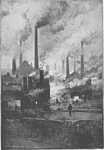
Sheffield has a world-wide reputation for its cutlery and for its other productions in brass, iron, and steel, for the manufacture of which pure water of a particular variety was essential. The town was well provided in that respect, for no less than five rivers flowed towards Sheffield from the Pennine range above. From the finest steel all sorts of things were made, ranging from the smallest needle or steel pen up to the largest-sized gun or armour-plate. It would no doubt have interested us greatly to look through one of the works, but such as we passed were labelled "No admittance except on business," which we interpreted to mean that no strangers were allowed to enter, lest they might carry away with them the secrets of the business, so we walked slowly onward in the hope of reaching, before nightfall, our next great object of interest, "The Great Cavern and Castle of Peveril of the Peak." Passing along the Ecclesall Road, we saw, in nicely wooded enclosures, many of the houses of manufacturers and merchants, who, like ourselves in after life, left their men to sleep in the smoke while they themselves went to breathe the purer air above, for Ecclesall was at a fair elevation above the town. But one gentleman whom we saw assured us that, in spite of the heavy clouds of smoke we had seen, the town was very healthy, and there was more sunshine at Sheffield than in any other town in England.
Shortly afterwards we came to a finger-post where a road turned off towards Norton and Beauchief Abbey. Norton was the village where the sculptor Chantrey, of whom, and his works, we had heard so much, was born, and the monument to his memory in the old church there was an attraction to visitors. Chantrey was a man of whom it might safely be said "his works do follow," for my brother, who always explored the wild corners of the country when he had the opportunity, was once travelling in Wales, and told a gentleman he met that he intended to stay the night at the inn at the Devil's Bridge. This was not the Devil's Bridge we had crossed so recently at Kirkby Lonsdale, but a much more picturesque one, which to visit at that time involved a walk of about thirteen miles in the mountainous region behind Aberystwyth.
"Have you ever seen that fine monument by Chantrey there?" asked the gentleman.
"No," said my brother in astonishment, knowing the wild nature of the country thereabouts.
"Well," he said, "mind you go and see it! Here is my card, and when you have seen it, write me whether you have seen a finer monument in all your life."
My brother found the monument in a small church about three miles from the hotel in the hills above. He was very much astonished and deeply impressed by the sculpture, acknowledging in his promised letter that it was by far the finest he had seen. The origin of it was as follows:
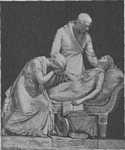
The owner of the estate had an only child, a daughter, lovely, clever, and accomplished, but slightly deformed in her back. When she was twenty-one years old she was taken by her parents to London to have her back straightened, but never recovered from the operation. The statuary represented the daughter lying on a couch, her father standing at the head looking down into the eyes of his dying daughter, while her mother is kneeling at the foot in an attitude of prayer. The daughter's instruments of music and painting, with her books, appear under the couch, while every small detail, from the embroidery on the couch to the creases in the pillow, are beautifully sculptured.
This great work of art cost £6,000, and was exhibited in London for some time before it was placed in the small church of Hafod. It was said to have made Chantrey's fortune.
THE CHANTREY MONUMENT IN HAFOD CHURCH.
Beauchief Abbey, we were informed, was built by the murderers of Thomas a Becket in expiation of their sin, but only a few fragments of the buildings now remained. We halted for rest and refreshments at the "Fox House Inn," which stood at a junction of roads and was formerly the hunting-box of the Duke of Rutland.
We had by this time left the county of York and penetrated about four miles into Derbyshire, a county we may safely describe as being peculiar to itself, for limestone abounded in the greater part of its area. Even the roads were made with it, and the glare of their white surfaces under a brilliant sun, together with the accumulation of a white dust which rose with the wind, or the dangerous slippery mud which formed on them after rain or snow or frost, were all alike disagreeable to wayfarers. But in later times, if the worthy writer who ventured into that county on one occasion, had placed his fashionable length on the limy road when in a more favourable condition than that of wet limy mud, he might have written Derbyshire up instead of writing it down, and describing it as the county beginning with a "Big D."
THE PLAGUE COTTAGES, EYAM.
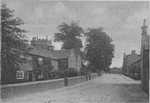
The colour of the green fields which lined the roads contrasted finely in the distance with the white surface of the roads, both fields and roads alike were neatly fenced in with stone walls. We wondered many times where all these stones could have come from, and at the immense amount of labour involved in getting them there and placing them in position. Their purpose in breaking the force of the wind was clear, for the greater part of the county consisted of moors, some portions of which were being cultivated, and although they were almost entirely devoid of trees, there were plenty of trees to be seen in the valleys, the Dales of Derbyshire being noted for their beauty. The River Derwent ran along the valley opposite the inn, and on the other side was the village of Eyam, which became famous in the time of the Great Plague of London in 1665. It seemed almost impossible that a remote village like that could be affected by a plague in London, but it so happened that a parcel arrived by coach from London addressed to a tailor in Eyam, who opened it with the result that he contracted the disease and died; in the same month five others died also, making a total of six for September, which was followed by 23 deaths in October, 7 in November, and 9 in December. Then came a hard frost, and it was thought that the germs would all be killed, but it broke out again in the following June with 19 deaths, July 56, August 77, September 24, and October 14, and then the plague died out—possibly because there were very few people left. During all this time Eyam had been isolated from the rest of the world, for if a villager tried to get away he was at once driven back, and for any one to go there was almost certain death. The Earl of Devonshire, who nobly remained at Chatsworth all the time, sent provisions periodically to a certain point where no one was allowed to pass either inwards or outwards. At this time even the coins of the realm were considered to be infectious, and large stones hollowed out like basins, which probably contained some disinfectant, were placed between Eyam and the villages which traded with them. Meantime the rector of Eyam, whose name was Mompesson, stood his ground like a true hero, ministering to his parishioners; and, although his wife contracted the disease and died, and though he referred to himself as "a dying man," yet was he mercifully preserved; so too was the Rev. Thomas Stanley, who had been ejected from the rectory after eighteen years' service because he would not subscribe to the Corporation Act of 1661. He stood by Mompesson and did his duty quite as nobly; and some years afterwards, when some small-minded people appealed to the Duke of Devonshire as Lord Lieutenant of the county to have Stanley removed, he indignantly refused and rebuked the petitioners very strongly.
William and Mary Howitt wrote a long poem entitled "The Desolation of Hyam," and described the village as—
Among the verdant mountains of the Peak There lies a quiet hamlet, where the slope Of pleasant uplands wards the north winds bleak: Below, wild dells romantic pathways ope: Around, above it, spreads a shadowy cope Of forest trees: flower, foliage and clear rill Wave from the cliffs, or down ravines elope: It seems a place charmed from the power of ill By sainted words of old:—so lovely, lone and still.
William Wood wrote the Plague Chronicle, and on his gravestone was inscribed:
Men like visions are; Time all doth claim; He lives who dies and leaves A lasting name.
We had often read the wonderful epitaphs on the tombs of the nobility, but we had been warned that in former times these were often written by professional men who were well paid for their services, and the greater the number of heavenly virtues attributed to the deceased, the greater of course the fee; but those written by the poetical curate of Eyam were beyond suspicion if we may judge from the couplet he wrote to be placed on the gravestone of a parishioner:
Since life is short and death is always nigh, On many years to come do not rely.
We were now passing through Little John's country, and we heard more about him in this neighbourhood than of his master, Robin Hood, for Little John's Well was not far away, and Hathersage, our next stage, was where he was buried. We were very much interested in Robin Hood and Little John, as my name was Robert, and my brother's name was John. He always said that Little John was his greatest ancestor, for in the old story-books his name appeared as John Nailer. But whether we could claim much credit or no from the relationship was doubtful, as the stanza in the old ballad ran:
Robin Hood did little good And Little John did less.
In later times the name had been altered to Naylor, in order, we supposed, to hide its humble though honourable origin; for there was no doubt that it was a Nailer who fastened the boards on Noah's Ark, and legend stated that when he came to nail the door on, he nailed it from the inside!
The stanza, he explained, might have been written by the Bishop of Hereford or one of Robin Hood's other clients, whom he and Little John had relieved of his belongings; but the name Naylor was a common one in South Yorkshire, and, although our branch of the family were natives of South Lancashire, their characteristics showed they were of the same stock, since, like Little John, they were credited with having good appetites and with being able to eat and retain any kind of food and in almost any quantity. On one occasion we happened to meet with a gentleman named Taylor, and, after remarking there was only one letter different between his name and ours, my brother said, "But we are much the older family," and then named the Noah's Ark incident; when the gentleman quietly remarked, "I can beat you." "Surely not," said my brother. "Yes, I can," replied Mr. Taylor, "for my ancestor made the tails for Adam's coat! He was a Tailer." My brother collapsed!
But the greatest blow he received in that direction was when he found a much more modern story of "Robin Hood and Little John," which gave Little John's real name as John Little, saying that his name was changed to Little John because he was such a big man. My brother was greatly annoyed at this until he discovered that this version was a comparatively modern innovation, dating from the time of Sir Walter Scott's Talisman, published in 1825, and inserted there because the proper name would not have suited Sir Walter's rhyme:
"This infant was called 'John Little,' quoth he; "Which name shall be changed anon. The words we'll transpose, so wherever he goes His name shall be called Little John."
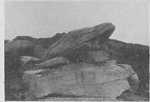
On our way from the "Fox House Inn" to Hathersage we passed some strange-looking rocks which were said to resemble the mouth of a huge toad; but as we had not studied the anatomy of that strange creature, and had no desire to do so, a casual glance as we walked along a down gradient into Hathersage was sufficient. As we entered the village we saw a party of men descending a road on our right, from whom we inquired the way to Little John's grave, which they told us they had just been to visit themselves. They directed us to go up the road that they had just come down, and one of them advised us to call at the small inn which we should find at the top of the hill, while another man shouted after us, "Aye! and ther's a mon theere 'ats getten 'is gun!" We found the inn, but did not ask to see the gun, being more interested at the time in bows and arrows, so we called at the inn and ordered tea. It was only a cottage inn, but the back of it served as a portion of the churchyard wall, and the mistress told us that when Little John lay on his deathbed in the room above our heads, he asked for his bow and arrow, and, shooting through the window which we would see from the churchyard at the back of the inn, desired his men to bury him on the spot where they found his arrow.
THE TOAD'S MOUTH.
We went to see the grave while our tea was being prepared, and found it only a few yards from the inn, so presumably Little John was very weak when he shot the arrow. The grave stood between two yew trees, with a stone at the head and another at the foot, the distance between them being ten feet.
The church was a very old one, dating from the early part of the fourteenth century. It was said that a search for Little John's skeleton had been made in 1784, when only a thigh-bone had been found; but as this measured twenty-nine and a half inches, a very big man must have been buried there.
On our right across the moor rose sharply what seemed to be a high, continuous cliff, which we were told was the "edge" of one of the thick, hard beds of millstone grit, and as we proceeded the edge seemed to be gradually closing in upon us.
After tea we walked slowly on to Castleton, where we selected a clean and respectable-looking private house to stay and rest over the week-end, until Monday morning.
(Distance walked twenty-two miles.)
Sunday, October 29th.
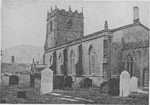
We were very comfortable in our apartments at Castleton, our host and hostess and their worthy son paying us every possible attention. They were members of the Wesleyan Church, and we arranged with the young man that if he would go with us to the Parish Church in the morning, we would go to the Wesleyan Chapel in the evening with him. So in the morning we all went to church, where we had a good old-fashioned service, and saw a monument to the memory of a former vicar, a Mr. Bagshawe, who was Vicar of Castleton from 1723 to 1769; the epitaph on it described him as—
A man whose chief delight was in the service of his Master—a sound scholar—a tender and affectionate husband—a kind and indulgent parent—and a lover of peace and quietness, who is gone to that place where he now enjoys the due reward of his labours.
This Vicar had kept a diary, or journal, from which it appeared that he began life in a good position, but lost his money in the "South Sea Bubble," an idea floated in the year 1710 as a financial speculation to clear off the National Debt, the Company contracting to redeem the whole debt in twenty-six years on condition that they were granted a monopoly of the South Sea Trade. This sounded all right, and a rush was made for the shares, which soon ran up in value from £100 to £1,000, fabulous profits being made. Sir Robert Walpole, who was then Chancellor of the Exchequer, and afterwards Prime Minister for the long period of twenty-two years, was strongly opposed to the South Sea Scheme, and when, ten years later, he exposed it, the bubble burst and the whole thing collapsed, thousands of people, including the worthy Vicar of Castleton, being ruined.
CASTLETON CHURCH.
It also appeared from the diary that, like the vicar Goldsmith describes, he was "passing rich on forty pounds a year," for he never received more than £40 per year for his services. The prices he paid for goods for himself and his household in the year 1748 formed very interesting reading, as it enabled us to compare the past with the present.
Bohea Tea was 8s. per pound; chickens, threepence each; tobacco, one penny per ounce; a shoulder of mutton cost him fifteen-pence, while the forequarter of a lamb was eighteen-pence, which was also the price of a "Cod's Head from Sheffield."
He also recorded matters concerning his family. He had a son named Harry whom he apprenticed to a tradesman in Leeds. On one occasion it appeared that the Vicar's wife made up a parcel "of four tongues and four pots of potted beef" as a present for Hal's master. One of the most pleasing entries in the diary was that which showed that Harry had not forgotten his mother, for one day a parcel arrived at the Vicarage from Leeds which was found to contain "a blue China cotton gown," a present from Hal to his mother.
Who fed me from her gentle breast. And hush'd me in her arms to rest, And on my cheeks sweet kisses prest? My Mother. Who sat and watched my infant head When sleeping on my cradle bed. And tears of sweet affection shed? My Mother. Who ran to help me when I fell, And would some pretty story tell, Or kiss the place to make it well? My Mother. Who taught my infant lips to pray. And love God's holy Book and day. And walk in Wisdom's pleasant way? My Mother. And can I ever cease to be Affectionate and kind to thee, Who wast so very kind to me? My Mother. Ah! no, the thought I cannot bear, And if God please my life to spare, I hope I shall reward thy care. My Mother. When thou art feeble, old, and grey. My healthy arm shall be thy stay, And I will soothe thy pains away, My Mother.
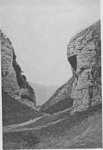
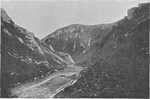
After dinner we decided to visit the Castle of Peveril of the Peak, and as the afternoon was very fine we were able to do so, under the guidance of our friend. We were obliged to proceed slowly owing to my partially disabled foot, and it took us a long time to reach the castle, the road being very narrow and steep towards the top—in fact, it was so difficult of approach that a handful of men could have defeated hundreds of the enemy. We managed to reach the ruins, and there we reposed on the grass to view the wild scenery around us and the curious split in the limestone rocks through which led the path known as the "Winnats," a shortened form of Wind Gates, owing to the force of the wind at this spot. The castle was not a large one, and there were higher elevations quite near; but deep chasms intervened, and somewhere beneath us was the largest cave in England. While we were resting our friend related the history of the castle, which had been built by William Peverell in 1068, and rebuilt by Henry II in 1176-7 after he had received here the submission of Malcolm, King of Scotland. Peverell was a natural son of William the Conqueror, who had distinguished himself at the Battle of Hastings, for which William had bestowed upon him many manors in Derbyshire. What was known as the Peak of Derbyshire we found was not one single rock, as we supposed, but a huge tableland with rising heights here and there. Our friend, whose name was William, told us a legend connected with the Peverell family. Pain Peverell, the Lord of Whittington, in Shropshire, had two daughters, the elder of whom was very beautiful, and had so many admirers that she could not decide which of them to accept. So she consulted her father on the matter, who advised her to accept only the "Bravest of the Brave," or the one who could prove himself to excel all others in martial skill. Her father therefore proclaimed a tournament, which was to take place, in the words of an ancient writer, at "Peverell's Place in the Peke," inviting all young men of noble birth to compete for the hand of the beautiful "Mellet," whose dowry was to be Whittington Castle. The contest, as might be supposed, was a severe one, and was won by a knight bearing a maiden shield of silver with a peacock for his crest, who vanquished, amongst others, a Knight of Burgundy and a Prince of Scotland. He proved to be Fitzwarren, and the Castle of Whittington passed to him together with his young bride.
CASTLETON ROCKS.
Our friend was surprised when we told him we knew that castle and the neighbourhood very well, and also a cottage there where Dick Whittington was born, who afterwards became Sir Richard de Whittington, Lord Mayor of London. We again discussed the question of the desirability of returning home, as we were now much nearer than when at Furness Abbey, where we had nearly succumbed to home-sickness before; but my brother said he should continue the journey alone if I gave in, and as he kindly consented again to carry all the luggage, I agreed to complete the journey with him.
THE WINNATS, CASTLETON.
I walked down the hill supported by my brother on one side and our friend on the other, and returned to the latter's home for tea, after which our host showed us some remarkable spar stones—dog-tooth spar we were told was their name—found in the lead mines, whose white crystals glistened in the light, and I could see by the covetous look in my brother's eyes that he was thinking of the rockeries at home. His look was also seen by our worthy host, for he subsequently presented him with the stones, which my brother afterwards declared were given to him as a punishment for coveting his neighbour's goods. It was now time to fulfil our engagement to accompany our friend to the Wesleyan Chapel and to go through what proved one of the most extraordinary services we ever attended. Our host and hostess went with us, but they sat in a pew, while we three sat on a form. We remained for the "Prayer Meeting," which the minister announced would be held after the usual service. We had read that the "Amens" of the early Christians could be heard at long distances, but we never attended a meeting where the ejaculations were so loud and fervent as they were here. Each man seemed to vie with his neighbour as to which could shout the louder, and every one appeared to be in great earnest. The exclamations were not always "Amens," for we heard one man shout "Aye!" at exactly the same moment as another man shouted "Now!" and if the Leader had not been possessed of a stentorian voice he would not at times have been able to make himself heard. The primitive custom of conducting prayer meetings was evidently kept up at Castleton, as might perhaps have been expected in a place which before the appearance of the railway was so remote and inaccessible, but it was difficult to realise that "yes" and "no," or "aye" and "now," could have the same meaning when ejaculated at the same moment. Still, it might have been so in this case. Who knows!
In travelling through the country we had noticed that in the neighbourhood of great mountains the religious element was more pronounced than elsewhere, and the people's voices seemed stronger. At the close of this second service, for which nearly the whole of the congregation stayed, the conductor gave out one of Isaac Watts's well-known hymns, and the congregation sang it with heart and voice that almost made the rafters in the roof of the chapel vibrate as if even they were joining in the praises of the Lord! These were the first two verses:
Jesus shall reign where'er the sun Doth his successive journeys run; His Kingdom stretch from shore to shore, Till moons shall wax and wane no more. People and realms of every tongue Dwell on His love with sweetest song, And infant voices shall proclaim Their early blessing on His Name.
We must say we joined as heartily as any of the others, for it was sung to one of the good old Methodist tunes common to all the Churches in the days of Wesley. As we walked back through the village we felt all the better for having attended the full service, and later, when we watched the nearly full moon rise in the clear night air above the hills, our thoughts turned instinctively towards the Great Almighty, the Father and Maker and Giver of All!