EIGHTH WEEK'S JOURNEY
Reading edition
Monday, November 6th.
We had been very comfortable at our hotel, where I had spent a very pleasant birthday at Oxford, and was sorry that we could not stay another day. But the winter was within measurable distance, with its short days and long dark nights, and we could no longer rely upon the moon to lighten our way, for it had already reached its last quarter. We therefore left Oxford early in the morning by the Abingdon Road, and soon reached the southern entrance to the city, where in former days stood the famous tower from which Roger Bacon, who died in 1292, and who was one of the great pioneers in science and philosophy, was said to have studied the heavens; it was shown to visitors as "Friar Bacon's study."
FRIAR BACON'S STUDY, FOLLEY BRIDGE, OXFORD.
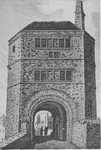
A strange story was told relating to that wonderful man, from which it appeared he had formed the acquaintance of a spirit, who told him that if he could make a head of brass in one month, so that it could speak during the next month, he would be able to surround England with a wall of brass, and thus protect his country from her enemies. Roger Bacon, on hearing this, at once set to work, and with the aid of another philosopher and a demon the head was made; but as it was uncertain at what time during the next month it would speak, it was necessary to watch it. The two philosophers, therefore, watched it night and day for three weeks, and then, getting tired, Bacon ordered his man Myles to watch, and waken him when it spoke. About half an hour after they had retired the head spoke, and said, "Time is," but Myles thought it was too early to tell his master, as he could not have had sleep enough. In another half-hour the head spoke again, and said, "Time was," but as everybody knew that, he still did not think fit to waken his master, and then half an hour afterwards the head said, "Time is past," and fell down with a tremendous crash that woke the philosophers: but it was now too late! What happened afterwards, and what became of Myles, we did not know.
In the neighbouring village of North Hinksey, about a mile across the meadows, stands the Witches' Elm. Of the Haunted House beside which it stood hardly even a trace remained, its origin, like its legend, stretching so far back into the "mists of antiquity" that only the slenderest threads remained. Most of the villages were owned by the monks of Abingdon Abbey under a grant of the Saxon King Caedwalla, and confirmed to them by Caenwulf and Edwig. The Haunted House, like the Church of Cumnor, was built by the pious monks, and remained in their possession till the dissolution of the monastery, then passing into the hands of the Earls of Abingdon.
THE WITCHES' ELM.
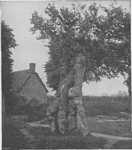
The last tenant of the old house was one Mark Scraggs, or Scroggs, a solitary miser who, the story goes, sold himself to the Devil, one of the features of the compact being that he should provide for the wants of three wise women, or witches, who on their part were to assist him in carrying out his schemes and make them successful. In everything he seemed to prosper, and accumulated great hoards of wealth, but he had not a soul in the world to leave it to or to regret his leaving in spite of his wealth.
At length the time approached when his terrible master would claim him body and soul, but Scraggs worked out a scheme for evading his bond, and for a time successfully kept Satan at bay and disposed of the three witches by imprisoning them in a hollow tree close by, on which he cast a spell which prevented them from communicating with their master the evil one, or enabling him to find them. This spell was so successful that Scraggs soon felt himself secure, but one day, venturing beyond the charmed circle, he was immediately seized by the Devil, who attempted to carry him off by way of the chimney, but failed, as the shaft was not sufficiently wide for the passage of the man's body. In the struggle the chimney was twisted in the upper part, and remained so till its total destruction, while Satan, rinding he could not carry off his body, tore him asunder, and carried off his soul, dashing the mutilated remains of the miser upon the hearth beneath. The death of Scraggs dissolved the spell which bound the witches, and their release split the tree in which they were confined from the ground to the topmost branch.
The great uproar of this Satanic struggle aroused the neighbourhood, and the miser's body, when it was discovered, was buried beneath the wall of the church—neither inside nor outside the sacred edifice. Ever afterwards the house was haunted by the apparition of old Scraggs searching for his lost soul with groans and hideous cries, until at last the old mansion was pulled down and its very stones were removed.
The old shattered and knarled elm alone remained to keep alive the legend of this evil compact. The story, improbable as it may appear, no doubt contained, as most of these stories do, the element of fact. Possibly the old man was a miser who possessed wealth enough to become the source of envy by some interested relations. Perhaps he was brutally murdered, perhaps, too, the night of the deed may have been wild with thunder and lightning raging in the sky. Probably the weird story, with all its improbable trappings, was circulated by some one who knew the truth, but who was interested in concealing it. Who knows?
THINKSEY, AN OXFORDSHIRE VILLAGE IN WHICH THE ROAD WAS CONSTRUCTED BY RUSKIN AND A BAND OF OXFORD STUDENTS.
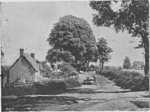
We were now passing through scenes and pastures, quiet fields and farms, of which many of Oxford's famous students and scholars had written and sung. Matthew Arnold had painted these fields and villages, hills and gliding, reedy streams in some of his poems, and they were the objective of many of his Rambles:
Hills where Arnold wander'd and all sweet June meadows, from the troubling world withdrawn.
Here too in one of these small hamlets through which we passed Ruskin with a gang of his pupils in flannels started roadmaking, and for days and weeks were to be seen at their arduous task of digging and excavation, toiling and moiling with pick, spade, and barrow, while Ruskin stood by, applauding and encouraging them in their task of making and beautifying the roads of these villages which he loved so well.
THE SCENE OF THE DIGGING OPERATIONS.
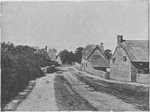
This experiment was undertaken by Ruskin as a practical piece of serviceable manual labour, for Ruskin taught in his lectures that the Fine Arts required, as a necessary condition of their perfection, a happy country life with manual labour as an equally necessary part of a completely healthy and rounded human existence, and in this experiment he practised what he preached. The experiment caused no little stir in Oxford, and even the London newspapers had their gibe at the "Amateur Navvies of Oxford"; to walk over to Hinksey and laugh at the diggers was a fashionable afternoon amusement.
The "Hinksey diggings," as they were humorously called, were taken up with an enthusiasm which burned so fiercely that it soon expended itself, and its last flickering embers were soon extinguished by the ironic chaff and banter to which these gilded youths were subjected.
The owner of the estate sent his surveyor to report the condition of the road as they had left it, and it is said that in his report he wrote: "The young men have done no mischief to speak of."
The River Thames, over which we now crossed, is known in Oxford as the "Isis," the name of an Egyptian goddess—though in reality only an abbreviated form of the Latin name Tamesis. As the Thames here forms the boundary of Oxfordshire, we were in Berkshire immediately we crossed the bridge. We followed the course of the river until we reached Kennington, where it divides and encloses an island named the Rose Isle, a favourite resort of boating parties from Oxford and elsewhere. It was quite a lovely neighbourhood, and we had a nice walk through Bagley Woods, to the pretty village of Sunningwell, where we again heard of Roger Bacon, for he occasionally used the church tower there for his astronomical and astrological observations. He must have been an enormously clever man, and on that account was known as an alchemist and a sorcerer; he was credited with the invention of gunpowder, and the air-pump, and with being acquainted with the principle of the telescope. In the time of Queen Mary, Dr. Jewel was the rector of Sunningwell, but had to vacate it to escape persecution; while in the time of the Civil War Dr. Samuel Fell, then Dean of Christ Church, and father of John Fell, was rector. He died from shock in 1649 when told the news that his old master, King Charles, had been executed. He was succeeded as Dean by John Fell, his son.
SUNNINGWELL CHURCH.
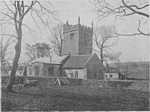
SUNNINGWELL, BISHOP JEWELL'S PORCH.
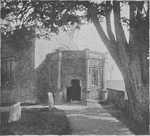
ABBEY GATE, ABINGDON, SHOWING ALL THAT NOW REMAINS OF THE ABBEY.
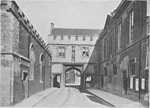
We soon arrived at Abingdon, and were delighted with the view of the town, with its church spire overlooking it as we approached to the side of the Thames, which now appeared as a good-sized river. As we stopped a minute or two on the bridge, my brother got a distant view of some pleasure boats, and suggested we should stay there for the rest of the day, to explore the town, and row up and down the river! He had evidently fallen in love with Abingdon, but I reminded him that our travelling orders were not to ride in any kind of conveyance during the whole of our journey, and that, if we got drowned, we should never get to the Land's End, "besides," I added, "we have not had our breakfast." This finished him off altogether, and the pleasure-boat scheme vanished immediately we entered the portals of a fine old hostelry, where the smell of bacon and eggs recalled him from his day dreams. We handed our luggage to the boots to take care of, and walked into the coffee-room, where to our surprise we found breakfast set for two, and the waitress standing beside it. When we told her how glad we were to find she had anticipated our arrival, she said that the bacon and eggs on the table were not prepared for us, but for two other visitors who had not come downstairs at the appointed time. She seemed rather vexed, as the breakfast was getting cold, and said we had better sit down to it, and she would order another lot to be got ready and run the risk. So we began operations at once, but felt rather guilty on the appearance of a lady and gentleman when very little of the bacon and eggs intended for them remained. The waitress had, however, relieved the situation by setting some empty crockery on another table. Having satisfied our requirements, we tipped the waitress handsomely while paying the bill, and vanished to explore the town. We were captivated with the appearance of Abingdon, which had quite a different look from many of the towns we had visited elsewhere; but perhaps our good opinion had been enhanced by the substantial breakfast we had disposed of, and the splendid appetites which enabled us to enjoy it. There were other good old-fashioned inns in the town, and a man named William Honey had at one time been the landlord of one of the smaller ones, where he had adopted as his sign a bee-hive, on which he had left the following record:
Within this Hive we're all alive, Good Liquor makes us funny; If you are dry, step in and try The flavour of our Honey.
The early history of Abingdon-on-Thames appeared, like others, to have begun with that of a lady who built a nunnery. Cilia was the name of this particular lady, and afterwards Hean, her brother, built a monastery, or an abbey, the most substantial remains of which appeared to be the abbey gateway; but as the abbey had existed in one form or another from the year 675 down to the time of Henry VIII, when it was dissolved, in 1538, Abingdon must have been a place of considerable antiquity. St. Nicholas's Church was mentioned in documents connected with the abbey as early as 1189, and some of its windows contained old stained glass formerly belonging to it, and said to represent the patron saint of the church restoring to life some children who had been mutilated and pickled by the devil. There was also a fine old tomb which contained the remains of John Blacknall and Jane his wife, who appeared to have died simultaneously, or, as recorded, "at one instant time at the house within the site of the dissolved monastery of the Blessed Virgin Marie, of Abingdon, whereof he was owner." The following was the curious inscription on the tomb:
Here rest in assurance of a joyful resurrection the Bodies of John Blacknall, Esquire, and his wife, who both of them finished an happy course upon earth and ended their days in peace on the 21st day of August in the year of our Lord 1625. He was a bountiful benefactor of this Church—gave many benevolencies to the poor—to the Glory of God—to the example of future ages:
When once they liv'd on earth one bed did hold Their Bodies, which one minute turned to mould; Being dead, one Grave is trusted with the prize, Until that trump doth sound and all must rise; Here death's stroke even did not part this pair, But by this stroke they more united were; And what left they behind you plainly see, An only daughter, and their charitie. And though the first by death's command did leave us, The second we are sure will ne'er deceive us.
This church, however, was very small compared with its larger neighbour dedicated to St. Helen, which claims to be one of the four churches in England possessing five aisles, probably accounting for the fact that its breadth exceeded its length by about eleven feet. The oldest aisle dates from the year 1182, and the church contains many fine brasses and tombs, including one dated 1571, of John Roysse, citizen and mercer of London, who founded the Abingdon Grammar School. There is also a stone altar-tomb in memory of Richard Curtaine, who died in 1643, and who was described as "principalle magistrate of this Corpe"; on the tomb was this charming verse in old English lettering:
Our Curtaine in this lower press. Rests folded up in nature's dress; His dust P.fumes his urne, and hee This towne with liberalitee.
Abingdon is fortunate in having so many benefactors, who seem to have vied with each other in the extent of their gifts; even the church itself is almost surrounded with almshouses, which, owing to their quaint architectural beauty, form a great attraction to visitors. It is doubtful whether any town in England of equal size possesses so many almshouses as Abingdon. Those near this church were built in the year 1446 by the Fraternity or Guild of the Holy Cross, and the fine old hospital which adjoined them, with its ancient wooden cloisters and gabled doorways and porch, was a sight well worth seeing. The hall or chapel was hung with painted portraits of its benefactors, including that of King Edward VI, who granted the Charter for the hospital. This Guild of the Holy Cross assisted to build the bridges and set up in the market-place the famous Abingdon Cross, which was 45 feet high. Standing upon eight steps, this cross had "eight panels in the first storey and six in the second; of stone, gilt and garnished, adorned with statuary and coats of arms, a mightily goodly cross of stone with fair degrees and imagerie." The design of the Abingdon Cross had been copied for other crosses, including, it was said, portions of those of Coventry and Canterbury; and it must have been of extraordinary beauty, for Elias Ashmole, who was likely to know, declared that it was not inferior in workmanship and design to any other in England. The cross was restored in 1605, but when the army of the Parliament occupied the town in 1644, it was "sawed down" by General Waller as "a superstitious edifice." The Chamberlain's Accounts for that year contained an entry of money paid "to Edward Hucks for carrying away the stones from the cross."
MARKET CROSS, ABINGDON. From an old print.
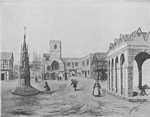
The records in these old towns in the south, which had been kept by churchwardens and constables for hundreds of years, were extremely interesting; and there was much information in those at Abingdon that gave a good idea of what was to be found in a market-place in "ye olden time," for in addition to the great cross there were the May pole, the cryer's pulpit, the shambles, the stocks, the pillory, the cage, the ducking-stool, and the whipping-post.
In the year 1641, just before the Civil War, Abingdon possessed a Sergeant-at-Mace in the person of Mr. John Richardson, who also appears to have been a poet, as he dedicated what he described as a poem "of harmless and homespun verse to the Mayor, Bayliffs, Burgesses, and others," in which are portrayed the proceedings at the celebration of the peace between the King and the Scots. Early in the morning the inhabitants were roused by "Old Helen's trowling bells," which were answered by the "Low Bells of honest Nick," meaning the bells of the two churches:
To Helen's Courts (ith'morne) at seven oth' clock, Our congregation in great numbers flock; Where we 'till Twelve our Orisons did send To him, that did our kingdom's Quarrels end. And these two Sermons two Divines did preach, And most divinely gratitude did teach.
After these five hours of service, the congregation again returned to church from two till four, and then proceeded to the cross in the market-place.
And thus we march'd: First with my golden Mace I pac'd along, and after followed mee The Burgesses by senioritee. Our Praetour first (let me not misse my Text), I think the Clergie-men came marching next; Then came our Justice, with him a Burger sage, Both marched together, in due equipage. The rest oth' Burgers, with a comely grace, Walked two and two along to th' market-place.
And when the procession arrived at the steps of the cross—
The Clerk was call'd, and he a Bible took, The hundred and sixt Psalme he out did look; Two thousand Quoristers their notes did raise And warbled out the Great Creator's praise!
After this came bonfires and wine and beer, and then the musketeers with rattling drums and fifes and colours flying, under the "skilfull Sergeant Corderoy," who fired off a barrel of powder before the well-known "Antelope Inn."
Abingdon was rather roughly handled during the Civil War, for, in addition to the "sawing off" of the cross, the horses of the Parliamentary Army were stabled in St. Helen's Church, an entry being afterwards made in the churchwardens' book of a sum paid "for nailes and mending the seats that the soldiers had toorne." The fines recorded during the Commonwealth were: "For swearing one oath, 3s. 4d.; for drawing Beere on the Sabboth Day, 10s. 0d.; a Gent for travelling on the Sabboth, 10s. 0d." Our journey might have been devised on a plan to evade all such fines, for we did not swear, or drink beer, or travel on Sundays. We might, however, have fallen into the hands of highway robbers, for many were about the roads in that neighbourhood then, and many stage-coaches had been held up and the passengers robbed.
There was a rather imposing County Hall at Abingdon, built towards the close of the seventeenth century, at which an ancient custom was performed on the coronation of a king. The mayor and corporation on those occasions threw buns from the roof of the market-house, and a thousand penny cakes were thus disposed of at the coronation of George IV, and again at the accession of William IV and of Queen Victoria.
An apprentice of a cordwainer in the town ran away in 1764, or, as it was worded on the police notice, "did elope from service." He was described as a "lusty young fellow, wearing a light-coloured surtout coat, a snuff-coloured undercoat, a straw-coloured waistcoat, newish leather breeches, and wears his own dark brown hair tied behind," so it appeared to us that he had not left his best clothes at home when he "did elope," and would be easily recognised by his smart appearance. We also noticed that about the same period "Florists' Feasts" were held at Abingdon, perhaps the forerunners of the "Flower Shows" held at a later period. In those days the flowers exhibited were chiefly "whole-blowing carnations," while the important things were the dinners which followed the exhibitions, and which were served at the principal inns.
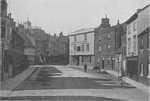
THE "CROWN AND THISTLE INN," ABINGDON.
But we must not leave Abingdon without giving an account of another benefactor to the town, though rather on different lines, of whom a detailed account was given in Jackson's Oxford Journal of November, 1767, from which it appeared that State lotteries were in vogue at that time in England. The story chiefly related to a Mr. Alder, a cooper by trade, who kept a "little public house" called the "Mitre." His wife had handed him £22 to pay the brewer, but instead of doing so he only paid him £10, and with the other twelve bought a ticket for the lottery, the number of which was 3379. The following precise account, copied from the Journal, will give the result, and show how events were described in newspapers in those days, the punctuation being carefully attended to, a more extensive use made of capital letters to distinguish the more important words, and some words written separately which now are joined together:
Last Friday about one o'clock in the morning a Messenger in a Post Chaise and Four arrived Express at the Crown and Thistle in Abingdon, Berks., from the Office where his Ticket was sold and registered, to give Mr. Alder the owner of it, the most early Advice of his good Fortune, upon which Mr. Powell immediately went with the Messenger to carry this important Intelligence. Mr. Alder was in Bed, but upon being called jumped out, and opened the Window; when Mr. Powell told him he had brought good News, for his Ticket was come up a Prize. Mr. Alder replied that he knew very well it was only a Joke, but nevertheless he would come down and drink with him, with all his Heart. This Point being settled, both Mr. Alder and his Wife came down; when the Prize still continued to be the Subject of Conversation whilst the Glass went round, and it was magnified by Degrees, till at length Mr. Alder was seriously informed that this Ticket was the Day before drawn a Prize for Twenty Thousand Pounds, and that the Gentleman then present was the Messenger of his Success. Though the utmost Precaution had been used, it is natural to suppose that so sudden and unexpected an Acquisition must produce very extra ordinary Emotions: Mr. Alder, however, supported him with great Decency, but almost immediately slipped out into the Yard behind his House, where he staid some little Time, probably to drop a joyful Tear, as well as to offer an Ejaculation for these Blessings of Providence; but at his Return into the House, we are told, he manifested a most open and generous Heart: He was immediately for doing good, as well as rewarding every one who had in any wise been instrumental in the Advancement of his Fortune. Mr. Powell was welcome to the Use of Half the Money without Interest; his Son, and all his Neighbours were called; he kept open House, set the Bells a'ringing, and came to the following Resolutions, viz.: That the Messenger that came down, and the two Blue-coat Boys who drew the Prize, should be handsomely rewarded; that he would give Mr. Blewitt, Owner of the Abingdon Machine, at least a New Body for his Stage, on which should be painted the Cooper's Arms, together with the Number of his Ticket, 3m379; that he would clothe all the Necessitous of his own Parish; and likewise give a Couple of the finest fat Oxen he could purchase to the Poor of Abingdon in general, and lay out the price of these Oxen in Bread, to be distributed at the same time. To the Ringers, in Number, fourteen, he gave Liquor in Plenty, and a Guinea each; and calling for a wet Mop, rubbed out all the Ale Scores in his Kitchen. In a Word he displayed a noble Liberality, made every Body welcome; and what is highly to be applauded, showed a charitable Disposition towards the Relief of the Poor.
We could imagine the joviality of Mr. Alder's customers when they found their ale scores so generously cancelled, which must have been fairly extensive, seeing that it required a "mop" to remove them from the inside of his kitchen door. We had often seen these "scores" at country inns behind the doors of the rooms where the poorer customers were served. It was a simple method of "book-keeping," as the customers' initials were placed at the head of a line of straight strokes marked by the landlord with white chalk, each figure "one" representing a pint of beer served to his customer during the week, and the money for the "pints" had to be paid at the week's end, for Saturday was the day when wages were invariably paid to working men in the country; as scarcely one of them could write his own name, it was a simple method of keeping accounts that appealed to them, and one that could easily be understood, for all they had to do, besides paying the money, was to count the number of strokes opposite their names. In some places it was the custom to place P. for pint and Q. for quart, which accounted for the origin of the phrase, Mind your p's and q's, so that the phrase, becoming a general warning to "look out," was originally used as a warning to the drinker to look at the score of p's and q's against him. We once heard of a landlord, however, whose first name was Daniel, and who was dishonest. When a customer got "half-seas over" and could not see straight, he used a piece of chalk with a nick cut in it, so that when he marked "one" on the door the chalk marked two; but he was soon found out, and lost most of his trade, besides being nicknamed "Dan Double-chalk." The custom of keeping ale scores in this way was referred to in the poem of "Richard Bell," who was—
As plodding a man, so his neighbours tell, as ever a chisel wielded.
Richard's fault was that he spent too much money at a public-house named the "Jolly Kings," and—
One night, 'twas pay night! Richard's score Reach'd half across the Parlour door. His "Pints" had been so many And when at length the bill was paid, All that was left, he found, dismay'd, Was but a single penny!
If Mr. Alder's customers had spent their money as freely as Richard had spent his, we could imagine their feelings of joy when they found their ale scores wiped out by Mr. Alder's wet mop!
But during all the Jollity occasioned by this Event (the Journal continued), it seems Mrs. Alder was in no wise elated, but rather thought the having such a great deal of Money a Misfortune; and seemed of Opinion that it would have been better to have had only enough to pay the Brewer, and a few Pounds to spare; for it would now certainly be their Ruin, as she knew well her Husband would give away all they had in the World, and indeed that it was presumptuous in him at first to buy the Ticket. The Presumption alluded to by Mrs. Alder, we find, is that she had made up the Sum of 22l. for the Brewer, which her Husband took from her for that Purpose, but he having a strong Propensity to put himself in Fortune's Way, only paid 10l., and with the other Twelve purchased the Ticket.
On Thursday last Mr. Alder set out for London, with Mr. Bowles of Abingdon, Attorney-at-Law; in order to Cheque His Ticket with the Commissioners Books, and take the Steps necessary for claiming and securing his Property.
Subsequent reports in the Journal described Mr. Alder as clothing the poor and distributing bread and beef throughout the whole place, and of being elected a churchwarden of St. Helen's, a result, we supposed, of his having become possessed of the £20,000.
THE ROMAN WAY: WHITE HORSE HILL IN THE DISTANCE.
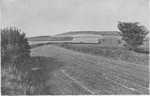
We now bade farewell to Abingdon and walked in the direction of Salisbury Plain, for our next great object of interest was the Druidical circles of Stonehenge, many miles distant. As we had to cross the Berkshire Downs, we travelled across the widest part of the Vale of the White Horse, in order to reach Wantage, a town at the foot of those lonely uplands. We had the great White Horse pointed out to us on our way, but we could not see the whole of it, although the hill on which it stood was the highest on the downs, which there terminated abruptly, forming a precipitous descent to the vale below. The gigantic figure of the horse had been cut out of the green turf to the depth of two or three feet, until the pure white chalk underneath the turf had been reached. The head, neck, and body were cut out in one waving line, while the legs were cut out separately, and detached, so that the distant view showed the horse as if it were galloping wildly. It was 374 feet long, and covered an acre of land, and was supposed to have been cut out originally by the army of King Alfred to celebrate his great victory over the Danes at the Battle of Ashdown, about three miles distant. It was, however, held by some people that the origin of the horse was far beyond the time of King Alfred, as the shape strongly resembled the image of the horse found on early British coins. Certainly there was a British camp quite near it, as well as a magnificent Roman camp, with gates and ditch and mounds still as complete as when the Romans left it. It was, moreover, close to the Icknield Way, 856 feet above sea-level, from which portions of eleven counties could be seen. On a clear day a view of the horse could be obtained from places many miles distant, its white form showing clearly against the green turf surrounding it.
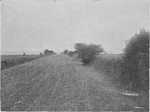
THE ICKNIELD WAY, LOOKING FROM THE WHITE HORSE.
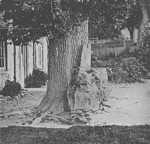
"BLOWING STONE": ALFRED'S BUGLE HORN.
Occasionally the outline had been obscured by the growth of turf and weeds, and then the lord of the manor had requisitioned the services of the inhabitants of several of the pretty villages near the downs, who climbed up to the horse at the appointed time and, armed with picks, spades, and brushes, "scoured" the horse until it was quite white again, and its proportions clearly shown. After their work was done a round of merry-making followed, the occasion being celebrated by eating and drinking to the health of his lordship at his expense. The first verse in the "White Horse Ballad," written in the local dialect, was:
The ould White Horse wants zettin' to rights. And the Squire has promised good cheer; Zo we'll gee un a scrape to kip' un in shape, And a'll last for many a year.
A Roman road skirted the foot of the White Horse Hill, and on the side of this road was a strangely shaped sarsen-stone called the "Blowing Stone." It was quite a large stone, in which holes had been formed by nature, running through it in every direction like a sponge. It was said to have been used by King Alfred to summon his troops, as by blowing down one of the holes a booing sound was produced from the other holes in the stone. On a later occasion my brother tried to make it sound, and failed to do so, because he did not know the "knack," but a yeoman's wife who was standing near, and who was quite amused at his efforts to produce a sound, said, "Let me try," and astonished him by blowing a loud and prolonged blast of a deep moaning sound that could have been heard far away. The third verse in the ballad referred to it as:
The Blewin Stun, in days gone by, Wur King Alfred's bugle harn, And the tharn tree you med plainly zee. As is called King Alfred's tharn!
The thorn tree marked the spot where the rival armies met—the pagans posted on the hill, and the Christians meeting them from below—it was through the great victory won on that occasion that England became a Christian nation.
We were now in "King Alfred's country," for he was born at Wantage in 849, but his palace, if ever he had one, and the thorn tree were things of the past, and what traces there were of him in the town were very scant. There were King Arthur's Well and King Arthur's Bath; the most substantial building bearing his name was the "King Alfred's Head Inn," where we called for light refreshments, and where in former years the stage-coaches plying between Oxford and London stopped to change horses. Wantage must have been a place of some importance in ancient times, as a Witenagemote was held there in the year 990 in the time of Ethelred, at which the tolls were fixed for boats sailing along the Thames for Billingsgate Market in London.
WANTAGE MARKET-PLACE.
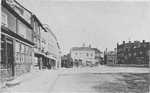
There were several old inns in the town, and many of the streets were paved with cobble-stones. Tanning at one time had been the staple industry, a curious relic of which was left in the shape of a small pavement composed of knuckle-bones. Early in the century the town had an evil reputation as the abode of coiners, and when a man was "wanted" by the police in London, the Bow Street runners always came to search for him at Wantage.
We had now to climb to the top of the downs, and after about two miles, nearly all uphill, reached the fine old Roman camp of Segsbury, where we crossed the Icknield Way, known locally as the Rudge or the Ridge-way—possibly because it followed the ridge or summit of the downs. It had every appearance of having been a military road from one camp to another, for it continued straight from Segsbury Camp to the Roman camp on the White Horse Hill, about six miles distant. The "Rudge" was now covered with turf, and would have been a pleasant road to walk along; but our way lay in another direction along a very lonely road, where we saw very few people and still fewer houses.
It was quite dark when we crossed the small River Lambourn at the village of West Shefford, and after a further walk of about six miles we arrived at the town of Hungerford, where we stayed the night. What a strange effect these lonely walks had upon us when they extended from one centre of population to another! We could remember the persons and places at either end, but the intervening space seemed like a dream or as if we had been out of the world for the time being, and only recovered consciousness when we arrived at our destination and again heard the sounds of human voices other than our own.
The origin of the name Hungerford appeared to have been lost in obscurity. According to one gentleman, whose interesting record we afterwards saw, it "has been an etymological puzzle to the topographer and local antiquarian, who have left the matter in the same uncertainty in which they found it"; but if he had accompanied us in our walk that day across those desolate downs, and felt the pangs of hunger as we did, mile after mile in the dark, he would have sought for no other derivation of the name Hungerford, and could have found ample corroboration by following us into the coffee-room of the "Bear Hotel" that night. We were very hungry.
(Distance walked thirty miles.)
Tuesday, November 7th.
The "Bear Inn" at Hungerford, standing as it did on the great coach road from London to the West, had been associated with stirring scenes. It was there that a gentleman who had fallen ill while travelling by the stage-coach had died, and was buried in the churchyard at Hungerford, with the following inscription on his gravestone:
Here are deposited the remains of William Greatrake, Esqr., native of Ireland, who on his way from Bristol to London, died in this town in the 52nd year of his age, on the 2nd August 1781 Stat nominis umbra
In the year 1769, some remarkably able and vigorous political letters signed "Junius" appeared in the London Public Advertiser. They were so cleverly written that all who read them wanted to know the author, but failed to find out who he was. Afterwards they were published in book form, entitled The Letters of Junius: in our early days the author of these letters was still unknown, and even at the time of our walk the matter was one of the mysteries of the literary world. The authorship of The Letters of Junius was one of the romances of literature. Whoever he was, he must have been in communication with the leading political people of his day, and further, he must have been aware of the search that was being made for him, for he wrote in one of his letters, "If I am a vain man, my gratification lies within a narrow circle. I am the sole depository of my own secret; and it shall perish with me." Controversy was still going on about the Letters of Junius, for early in the year of our walk, 1871, a book was published entitled The Handwriting of Junius Professionally Investigated by Mr. Charles Chabot, Expert, the object being to prove that Sir Phillip Francis was the author of the famous Letters. The publication of this book, however, caused an article to be written in the Times of May 22nd, 1871, to show that the case was "not proven" by Mr. Chabot, for William Pitt, the great Prime Minister, told Lord Aberdeen that he knew who wrote the Junius Letters, and that it was not Francis; and Lady Grenville sent a letter to the editor of Diaries of a Lady of Quality to the same effect.
While Mr. Greatrake was lying ill at the "Bear Inn" he was visited by many political contemporaries, including the notorious John Wilkes, who, born in 1729, had been expelled three times from the House of Commons when Member for Middlesex; but so popular was he with the common people, whose cause he had espoused, that they re-elected him each time. So "the powers that be" had to give way, and he was elected Alderman, then Sheriff, and then Lord Mayor of London, and when he died, in 1797, was Chamberlain of London. Mr. Greatrake was born in County Cork, Ireland, about the year 1725, and was a great friend of Lord Sherburn, who afterwards became Prime Minister, in which capacity he had to acknowledge the independence of the United States, and was eventually created Marquis of Lansdowne. Mr. Greatrake was known to have been an inmate of his lordship's house when the letters were being published, and the motto on them was Stat nominis umbra—the words which appeared on the tomb of Mr. Greatrake; and his autograph bore a stronger resemblance than any other to that of Junius; so what was a secret in his lifetime was probably revealed in that indirect way after his death.
The old church of Hungerford had fallen down, and a new one was built, and opened in the year 1816, the ancient monument of the founder, Sir Robert de Hungerford, being transferred to the new church—though, as usual, in a damaged condition. It dated from 1325, and had been somewhat mutilated in the time of the Civil War. The inscription over it in Norman-French almost amounted to an absolution or remission of sins, for it promised, on the word of fourteen bishops, that whoever should pray for the soul of Sir Robert de Hungerford should have during his life, and for his soul after his death, 550 days of pardon.
The list of the vicars of Hungerford showed that most of them for some reason or other—my brother suggested hunger—had served for very short periods, but there was one notable exception—the Rev. William Cookson, son of William Cookson of Tomsett, Norfolk, doctor, who held the living for the long term of forty-eight years (1818-1866).
The constables of Hungerford were elected annually, and the extracts from their accounts were very interesting, as references were made to instruments of torture: "Cucking stoole, Pilliry, Stocks, and a Whippinge Post," the last-named having been most extensively used, for the constables had to whip all wandering tramps and vagrants "by stripping them naked from the middle upwards, and causing them to be lashed until their bodies be bloody, in the presence of the Minister of the Parish, or some other inhabitant, and then to send them away to place of birth!" Women were stripped as well as men, and in 1692 the town Serjeant had even to whip a poor blind woman. The whipping of females was stopped by statute in 1791. As Hungerford was on one of the main roads, many people passed through there, and in 1678 the whippings were so numerous that John Savidge, the town Serjeant, was given a special honorarium of five shillings "for his extraordinary paines this year and whippinge of severall persons."
Prince William with his Dutch troops halted at Hungerford on December 8th, 1688, on his way from Torbay to London, where, three days afterwards, he was proclaimed King William III. He was armed on his back and breast, and wore a white plume, and rode on a white charger, surrounded by nobles bearing his banner, on which were the words:
THE PROTESTANT RELIGION AND THE LIBERTY OF ENGLAND.
We were now practically at the end of Berkshire, and perhaps the River Kennett, over which we passed, and on which John o' Gaunt of Lancaster had given free fishery rights to Hungerford town, might have formed the boundary between that county and Wiltshire. We could not hear of any direct road to Stonehenge, so we left Hungerford by the Marlborough road with the intention of passing through Savernake Forest—-said to be the finest forest in England, and to contain an avenue of fine beech trees, in the shape of a Gothic archway, five miles long. The forest was about sixteen miles in circumference, and in the centre was a point from which eight roads diverged. We had walked about a mile on our way when we came to some men working on the roads, who knew the country well, and strongly advised us not to cross the forest, but to walk over the downs instead. We decided to follow their advice, for the difficulty that first occurred to us was that when we got to the eight roads there might be no one there to direct us on our further way; and we quite saw the force of the remark of one of the men when he said it was far better to get lost on the down, where we could see for miles, than amongst the bushes and trees in the forest. They could only give us general information about the best way to get to Stonehenge, for it was a long way off, but when we got to the downs we must keep the big hill well to the left, and we should find plenty of roads leading across them. We travelled as directed, and found that the "big hill" was the Inkpen Beacon, over a thousand feet above sea-level, and the highest chalk down cliff in England; while the "plenty of roads" were more in the nature of unfenced tracks; still, we were fortunate in finding one leading in the right direction for Stonehenge and almost straight.
The Marlborough Downs which adjoined Salisbury Plain are very extensive, occupying together three-fifths of the county of Wilts, being accurately described as "ranges of undulating chalk cliffs almost devoid of trees, and devoted almost exclusively to the pasturage of sheep from remote ages." These animals, our only companions for miles, can live almost without water, which is naturally very scarce on chalk formations, since the rain when it falls is absorbed almost immediately. Very few shepherds were visible, but there must have been some about, for every now and then their dogs paid us rather more attention than we cared for, especially my brother, who when a small boy had been bitten by one, since which time not much love had been lost between him and dogs. As there were no fences to the roads, we walked on the grass, which was only about an inch deep. Sheep had been pastured on it from time immemorial, and the constant biting of the surface had encouraged the side, or undergrowth, which made our walking easy and pleasant; for it was like walking on a heavy Turkey carpet though much more springy. The absence of trees and bushes enabled us to distinguish the presence of ancient earth-works, but whether they were prehistoric, Roman, Dane, or Saxon we did not know. Occasionally we came to sections of the downs that were being brought under cultivation, the farms appearing very large. In one place we saw four ploughs at work each with three horses, while the farmer was riding about on horseback. We inquired about the wages from one of the farm hands, who told us the men got about 9s. per week, and the women who worked in the fields were paid eightpence per day. Possibly they got some perquisites in addition, as it seemed a very small amount, scarcely sufficient to make both ends meet.
We had been walking quickly for more than four hours without encountering a single village, and were becoming famished for want of food; but the farmer's man told us we should come to one where there was a public-house when we reached the River Avon by following the directions he gave us. At Milston, therefore, we called for the refreshments which we so badly needed, and quite astonished our caterers, accustomed even as they were to country appetites, by our gastronomical performances on that occasion.
We were very much surprised when we learned that the small but pretty village of Milston, where we were now being entertained, was the birthplace of Joseph Addison, the distinguished essayist and politician, who, with his friend Steele, founded the Spectator, and contributed largely to the Tatler, and whose tragedy Cato aroused such enthusiasm that it held the boards of Drury Lane for thirty-five nights—a great achievement in his time. As an essayist Addison had no equal in English literature, and to his writings may be attributed all that is sound and healthy in modern English thought. In our long walk we met with him first at Lichfield, where at the Grammar School he received part of his early education, and where, on one occasion, he had barred out the schoolmaster. In the cathedral we saw his father's monument—he was Dean of Lichfield Cathedral—and at Magdalen College, Oxford, where he completed his education, we again encountered remembrances of him—we saw a delightful retreat called after him, "Addison's Walk." On our journey farther south, when we passed through Lostwithiel, we were reminded that he was also a politician, for he represented that place in parliament. His father was Rector of Milston when Joseph was born, in 1672. He was chiefly remembered in our minds, however, for his Divine Poems, published in 1728, for we had sung some of these in our early childhood, until we knew them off by heart, and could still recall his beautiful hymn on gratitude beginning:
When all Thy mercies, oh my God, My rising soul surveys, Transported with the view, I'm lost In wonder, love, and praise.
Some of his hymns, which were of more than ordinary merit, were said to have been inspired by his youthful surroundings. Salisbury Plain, with its shepherds and their sheep, must have constantly appeared before him then, as they were immediately before us now, and would no doubt be in his mind when he wrote:
The Lord my pasture shall prepare, And feed me with a shepherd's care; His presence shall my wants supply, And guard me with a watchful eye; My noonday walks He shall attend, And all my midnight hours defend.
And then there was his magnificent paraphrase of the nineteenth Psalm:
The spacious firmament on high, With all the blue ethereal sky, And spangled heavens—a shining frame— Their great Original proclaim. Th' unwearied sun from day to day. Doth his Creator's power display. And publishes to every land The work of an Almighty hand. Soon as the evening shades prevail. The Moon takes up the wondrous tale, And nightly to the listening Earth Repeats the story of her birth; Whilst all the stars that round her burn, And all the planets in their turn, Confirm the tidings as they roll. And spread the truth from pole to pole. What though in solemn silence all Move round the dark terrestrial ball; What though no real voice nor sound Amidst their radiant orbs be found? In Reason's ear they all rejoice, And utter forth a glorious voice; For ever singing as they shine, "The Hand that made us is divine."
After resting a short time and carefully writing down the instructions given us as to how to reach Stonehenge, and the way thence to Amesbury, we resumed our journey; and near the place where we crossed the River Avon we had the first indication of our proximity to Stonehenge by the sight of an enormous stone lying in the bed of the stream, which we were told was like those we should find at Stonehenge. It was said to be one that the Druids could not get across the stream owing to its great size and weight, and so they had to leave it in the river. The country became still more lonely as we walked across Salisbury Plain, and on a dark wet night it might quite come up to the description given of it by Barham in the Ingoldsby Legends in "The Dead Drummer, a Legend of Salisbury Plain," the first verse of which runs:
Oh, Salisbury Plain is bleak and bare, At least so I've heard many people declare, For I fairly confess I never was there;— Not a shrub nor a tree, not a bush can you see; No hedges, no ditches, no gates, no stiles, Much less a house, or a cottage for miles;— It's a very sad thing to be caught in the rain When night's coming on upon Salisbury Plain.
Cruikshank's illustration of the legend represents a finger-post on the Plain without a bush or a tree or a house being visible, one finger of the post being marked "Lavington" and the other "Devizes." The Dead Drummer is leaning against the post, with two men nervously approaching him in the dark, while a flash of lightning betrays the bare plain and the whole scene to the terrified men.
Hannah More, who was born in 1745, wrote a large number of stories chiefly of a religious character, and was said to have earned £30,000 by her writings, amongst them a religious tract bearing the title of "The Shepherd of Salisbury Plain." We found he was not a mythical being, for David Saunders, the shepherd referred to, was a real character, noted for his homely wisdom and practical piety, and, as Mrs. More described him, was quite a Christian Hero. He resided at Great Cherwell, near Lavington, where his house was still pointed out to visitors. A typical shepherd of Salisbury Plain was afterwards pictured by another lady, and described as "wearing a long black cloak falling from neck to heels, a round felt hat, like a Hermes cap without the wings to it, and sometimes a blue milk-wort or a yellow hawk-weed in the brim, and walking with his plume-tailed dog in front leading his sheep, as was customary in the East and as described in the Scriptures—"the sheep follow him, for they know his voice."
We did not see one answering to that description as we crossed the Plain, but no doubt there were such shepherds to be found.
The sky had been overcast that day, and it was gloomy and cloudy when we reached Stonehenge. Without a house or human being in sight, the utter loneliness of the situation seemed to add to our feelings of wonder and awe, as we gazed upon these gigantic stones, the remains of prehistoric ages in England. We had passed through the circles of stones known as the "Standing Stones of Stenness" when we were crossing the mainland of the Orkney Islands on our way to John o' Groat's, but the stones we now saw before us were much larger. There had been two circles of stones at Stonehenge, one inside the other, and there was a stone that was supposed to have been the sacrificial stone, with a narrow channel in it to carry off the blood of the human victims slain by the Druids. In that desolate solitude we could almost imagine we could see the priests as they had been described, robed in white, with oak crowns on their heads, and the egg of a mythical serpent round their necks; we could hear the cries and groans of the victims as they were offered up in sacrifice to the serpent, and to Bel (the sun). Tacitus said they held it right to stain their altars with the blood of prisoners taken in war, and to seek to know the mind of the gods from the fibres of human victims. One very large stone outside the circles was called the "Friar's Heel," the legend stating that when the devil was busy erecting Stonehenge he made the observation to himself that no one would ever know how it had been done. This remark was overheard by a friar who was hiding amongst the stones, and he replied in the Wiltshire dialect, "That's more than thee can tell," at which the devil took up a big stone to throw at him, but he ran away as fast as he could, so that the stone only just grazed his heel, at the place where it now stands.
DRUIDICAL REMAINS, STONEHENGE.
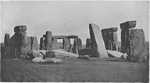
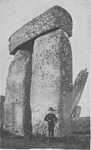
We walked about these great stones wondering how they could have been raised upright in those remote times, and how the large stones could have been got into position, laid flat on the tops of the others. Many of the stones had fallen down, and others were leaning over, but when complete they must have looked like a circle of open doorways. The larger stones, we afterwards learned, were Sarsen Stones or Grey Wethers, of a siliceous sandstone, and were natural to the district, but the smaller ones, which were named the blue stones, were quite of a different character, and must have been brought from a considerable distance. If the ancient Welsh story could be believed, the blue stones were brought over in ships from Ireland after an invasion of that country under the direction of Merlin the Wizard, and were supposed to be mystical stones with a medicinal value. As to the time of the erection of these stones, we both agreed to relegate the matter to the mists of antiquity. Some thought that because Vespasian's Camp was on Amesbury Hill, Stonehenge might have been built by the Romans in the time of Agricola, but others, judging perhaps from the ancient tombs in the neighbourhood, thought it might date backwards as far as 2,000 years B.C. Nearly all agreed that it was a temple of the worshippers of the sun and might even have been erected by the Phoenicians, who must have known how the Egyptians raised much heavier stones than these. By some Stonehenge was regarded as the Round Temple to Apollo in the land of the Hyperboreans, mentioned by Hecatoens in the sixth century B.C., and after the Phoenicians it was supposed to have been used by the Greeks, who followed them as traders with the British tin mines. According to this theory, the Inner Ellipse or Horseshoe of Blue Stone was made by them, the Druids adopting it as their temple at a much later date.
STONEHENGE.
"Amongst the ruling races of prehistoric times the father sun-god was the god on the grey white horse, the clouds, and it was this white horse—the sun-god of the limestone, flint, and chalk country—-which was the god of Stonehenge, the ruins of which describe the complete ritual of this primeval worship. The worshippers of the sun-god who built this Temple must, it was thought, have belonged to the Bronze Age, which theory was supposed to have been confirmed by the number of round barrow tombs in the neighbourhood. It was also noted that the white sun-horse was still worshipped and fed daily at Kobé, in Japan."
Stonehenge had been visited by Pepys, who described the stones in his Diary as being "as prodigious as any tales as I had ever heard of them, and worth going this journey to see"; and King Charles II had counted them over several times, but could not bring them twice to the same number, which circumstance probably gave rise to the legend that no two people ever counted the number alike, so of course we did not attempt to count them. But the king's head must have been uneasy at the time he counted them, as it was after the Battle of Worcester, when he was a fugitive, retreating across the country in disguise and hidden by his friends until he could reach the sea-coast of Sussex, and escape by ship from England. One of his hiding-places was Heale House, about four miles from Stonehenge, where the lady of the house had hidden him in what was known as the "Priest's Hole," arrangements having been made for some friends to meet him at Stonehenge, and accompany him a stage farther towards the south. His friends, however, had been delayed a little on their way, so they did not reach Stonehenge at the appointed hour; and Charles whiled away the time by counting and recounting the stones.
Cheshire was formerly noted for the great number of landowners of the same name as the parishes in which they resided, such as Leigh of Leigh, Dutton of Dutton, Antrobus of Antrobus. The last-named squire had left Antrobus and gone to reside at Amesbury in Wiltshire, letting his mansion in Cheshire and the land attached to it, as a farm, to a tenant named Wright. This Mr. Wright was an uncle of ours, whom we had often visited at Antrobus. The elder of his two sons, who followed him as tenant of the farm, told us a story connected with the old Hall there. He and his brother when they were boys slept in the same bed, and one morning they were having a pushing match, each trying, back to back, to push the other out of bed. He was getting the worst of the encounter when he resolved to make one more great effort, and placed his feet against the wall which was near his side of the bed; but instead of pushing his brother out, he and his brother together pushed part of the wall out, and immediately he found himself sitting on a beam with his legs hanging outside over the moat or garden, having narrowly escaped following the panel. The stability of these old timber-built halls, which were so common in Cheshire, depended upon the strong beams with which they were built, the panels being only filled in with light material such as osiers plastered over with mud; and it was one of these that had been pushed out. The old mansion was shortly afterwards taken down and replaced by an ordinary red-brick building. We had often wondered what sort of a place Amesbury was, where the Squire of Antrobus had gone to reside, and had decided to go there, although it was rather out of our way for Salisbury, our next stage. We found that Stonehenge was included in his estate as well as Amesbury Abbey, where he lived, and Vespasian's Hill. When we came in sight of the abbey, we were quite surprised to find it so large and fine a mansion, without any visible trace of the ancient abbey which once existed there, and we considered that the lines of Sir Edmund Antrobus, Bart., had fallen in pleasant places when he removed here from the damper atmosphere of Cheshire, and that he had adopted the wisest course as far as health was concerned. We had thought of calling at the abbey, but as it was forty-nine years since he had left our neighbourhood and he had died in the year 1830, we could not muster up sufficient courage to do so. We might too have seen a fine portrait of the old gentleman, which we heard was hanging up in one of the rooms in the abbey, painted by Sir Thomas Lawrence, a friend of George IV, and President of the Royal Academy, who had also painted the portraits of most of the sovereigns of Europe reigning in his time, and who died in the same year as Sir Edmund.
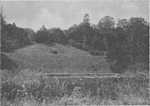
Amesbury Abbey formerly belonged to the Duke of Queensberry, who made great additions to it from the plans of the celebrated architect Inigo Jones, who designed the famous Banqueting Hall at Whitehall in London and the fine gateway of St. Mary's, Oxford. He was known as "the English Palladio" because he adopted the style of Andrea Palladio, a celebrated Italian architect of the sixteenth century. He was responsible for the two Palladian pillars attached to the quaint and pretty entrance gates to the Abbey Park, and for the lovely Palladian bridge that spanned the River Avon, which flowed through the grounds, forming a favourite resort for wild ducks, kingfishers, herons, and other birds. Inigo Jones was a staunch Royalist, who suffered severely during the Civil War, and died in 1652. The park was not a very large one, but was very pretty, and contained the famous Amesbury Hill, which was covered with fine trees on the slope towards the river; some of which had been arranged in the form of a diamond, partly concealing a cave now known as the Diamond Cave, but formerly belonging to the Druids, as all the sunrises would be visible before the intervening trees were planted. This cave was the favourite resort of John Gay, the poet, who loved to write there. He was a great friend of the Duke and Duchess of Queensberry, who then owned the Amesbury estate, was the author of the Beggar's Opera, published in 1727, and lies buried in Westminster Abbey.
THE CAVE IN THE DIAMOND.
The church had been heavily restored in 1853, and one of its former vicars had been a famous man in his day according to the following account from the Gentleman's Magazine, 1789.
INVENTOR OF THE WATER PUMP
Until the year 1853, a slab before the Communion Table in Amesbury Church bore the following inscription
In memory of the Revd. Thomas Holland, who was for half a century Minister of this Parish, a small living yet he never solicited for a greater nor improved to his own advantage his marvellous talents in applying the powers of nature to the useful purposes of life, the most curious and complete engine which the world now enjoys for raising water being invented by him.
He departed the 11th day of May in the year of our Lord 1730, Aged 84 years.
During his term of office the register was kept in a very careful manner and excellent handwriting, a contrast to later efforts by his successors.
OLD SARUM: THE MAIN GATE OF THE CASTLE FROM WITHIN.
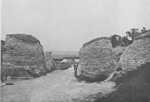
The evening was now coming on, and we had yet to walk eight miles into Salisbury by what was called the "Upper Road," which crossed a tract of bleak and rather uninteresting downs; but the road was well defined and the daylight, such as it was, remained with us longer than if we had gone by the more picturesque road along the tree-lined banks of the River Avon. Amesbury was but a small place, and the only industry that we could hear of that ever existed there was the manufacture of tobacco pipes branded with a gauntlet, the name of the maker. We had a lonely walk, and about two miles from Salisbury saw to the right the outline of a small hill which turned out to be Old Sarum, a name that figured on the mileposts for many miles round Salisbury, being the ancient and Roman name for that city. Old cities tend to be on hills, for defence, but modern equivalents occur in the valley below, representative of peace conditions and easy travelling for commercial purposes. It was now, however, only a lofty grass mound, conical in shape and about a hundred feet high. It was of great antiquity, for round about it stood at one time one of the most important cities in the south of England, after the prehistoric age the Sorbiodunum of the Romans, and the Sarisberie of the Domesday Book. Cynric captured it by a victory over the Britons in 552, and in 960 Edgar held a Council there. Sweyn and the Danes pillaged and burnt it in 1003, and afterwards Editha, the Queen of Edward the Confessor, established a convent of nuns there. It was made an Episcopal See in 1072, and twenty years afterwards Bishop Osmond, a kinsman of William the Conqueror, completed the building of the cathedral. It was in 1076 that William, as the closing act of his Conquest, reviewed his victorious army in the plain below; and in 1086, a year before his death, he assembled there all the chief landowners in the realm to swear that "whose men soever they were they would be faithful to him against all other men," by which "England was ever afterwards an individual kingdom." In course of time the population increased to such an extent round the old mound that they were short of room, and the soldiers and the priests began to quarrel, or, as an old writer described it, "the souldiers of the Castell and chanons of Old Sarum fell at odds, inasmuch that often after brawles they fell at last to sadde blowes and the Cleargie feared any more to gang their boundes. Hereupon the people missing their belly-chere, for they were wont to have banketing at every station, a thing practised by the religious in old tyme, they conceived forthwith a deadly hatred against the Castellans." The quarrel ended in the removal of the cathedral to the plain below, where Salisbury now stands, and the glory of Old Sarum departed. As far back as the time of Henry VIII the place became utterly desolate, and it was interesting to read what visitors in after times had written about it.
OLD SARUM: BASE OF THE LOOK-OUT TOWER.
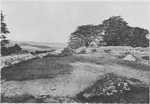
John Leland, who was born in 1506 and was chaplain to Henry VIII, made a tour of the kingdom, and wrote in his well-known Itinerary, "Their is not one house, neither within or without Old Saresbyri inhabited. Much notable minus building of the Castell yet remayneth. The diche that envirined the old town was a very deepe and strong thynge." Samuel Pepys, who was born in 1632, and who was secretary to the Admiralty during the reigns of Charles II and James II, describes in his famous Diary many interesting incidents in the life of that period. He wrote of Old Sarum: "I saw a great fortification and there light, and to it and in it, and find it so prodigious as to frighten one to be in it at all alone at that time of night." It would probably be at an earlier hour of a lighter night when Mr. Pepys visited it, than when we passed it on this occasion, for the hill now was enveloped in black darkness "deserted and drear," and we should scarcely have been able to find the entrance "to it and in it," and, moreover, we might not have been able to get out again, for since his time an underground passage had been opened, and who knows what or who might have been lurking there! Dr. Adam Clark visited Old Sarum in 1806, and wrote: "We found here the remains of a very ancient city and fortress, surrounded by a deep trench, which still bears a most noble appearance. On the top of the hill the castle or citadel stood, and several remains of a very thick wall built all of flint stone, cemented together with a kind of everlasting mortar. What is remarkable is that these ruins are still considered in the British constitution as an inhabited city, and send two members to Parliament. Within the breadth of a field from this noble hill there is a small public-house, the only dwelling within a very great space, and containing a very few persons, who, excepting the crows, hens, and magpies, are the only beings which the worthy members have to represent in the British Senate."
We were glad when we reached Salisbury and found a comfortable refuge for the night in one of the old inns in the town. It was astonishing how cosy the low rooms in these old-fashioned inns appeared, now that the "back end" of the year was upon us and the nights becoming longer, darker, and colder. The blazing fire, the ingle nook, the pleasant company, such as it was, the great interest taken in our long walk—for people knew what heavy walking meant in those days—all tended to make us feel comfortable and at home. True, we did not care much for the dialect in these southern counties, and should much have preferred "a bit o' gradely Lankyshur," so as a rule we listened rather than joined in the conversation; but we were greatly interested in the story of the Wiltshire Moonrakers, which, as we were strangers, was apparently given for our benefit by one of the older members of the rather jovial company. It carried us back to the time when smuggling was prevalent, and an occasion when the landlord of a country inn near the sea-coast sent two men with a pony and trap to bring back from the smugglers' den two kegs of brandy, on which, of course, duty had not been paid, with strict orders to keep a sharp look-out on their return for the exciseman, who must be avoided at all costs. The road on the return journey was lonely, for most people had gone to bed, but as the moon was full and shining brightly, all went well until the pony suddenly took fright at a shadow on the road, and bolted. The men, taken by surprise, lost control of the reins, which fell down on the pony and made matters worse, for he fairly flew along the road until he reached a point where it turned over a canal bridge. Here the trap came in contact with the battlement of the bridge, causing the pony to fall down, and the two men fell on top of him. Fortunately this saved them from being seriously injured, but the pony was bruised, and one of the shafts of the trap broken, while the kegs rolled down the embankment into the canal. With some difficulty they managed to get the pony and broken trap into a farm building near the bridge, but when they went to look for the kegs they saw them floating in the middle of the canal where they could not reach them. They went back to the farm building, and found two hay-rakes, and were just trying to reach the kegs, the tops of which they could plainly see in the light of the full moon, when a horseman rode up, whom, to their horror, they recognised as the exciseman himself. When he asked "What's the matter?" the men pretended to be drunk, and one of them said in a tipsy tone of voice, "Can't you see, guv'nor? We're trying to get that cheese out o' th' water!" The exciseman couldn't see any cheese, but he could see the image of the full moon on the surface of the canal, and, bursting into a roar of laughter at the silliness of the men, he rode off on his way home. But it was now the rustics' turn to laugh as they hauled the kegs out of the canal and carried them away in triumph on their shoulders. The gentleman who told the story fairly "brought down the house" when he added, "So you see, gentlemen, they were not so silly after all."
HIGH STREET GATE, SALISBURY.
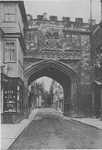
One of the company asked my brother if he had heard that story before, and when he said "No, but I have heard one something like it in Yorkshire," he at once stood up and called for "Silence," announcing that there was a gentleman present who could tell a story about the Yorkshire Moonrakers. My brother was rather taken aback, but he could always rise to the occasion when necessary, so he began in his usual manner. "Once upon a time" there were two men living in a village in Yorkshire, who went out one day to work in the fields amongst the hay, taking their rakes with them. They were good workers, but as the day turned out to be rather hot they paid too much attention to the large bottle of beer in the harvest field, with the consequence that before night came on the bottle was empty; so they went to the inn, and stayed there drinking until it was nearly "closing time." By that time they were quite merry, and decided to go home by the nearest way, leading along the towing-path of one of the canals, which in the north are wider and deeper than those farther south. As it was almost as light as day, the moon being at its full, they got along all right until one of them suddenly startled his mate by telling him that the moon had fallen into the canal! They both stood still for a moment, thinking what an awful thing had happened, but there seemed to be no doubt about it, whatever, for there was the moon lying in the middle of the canal. It would never do to leave it there, but what could they do to get it out? Their first thought was the rakes they were carrying home on their shoulders, and they decided to rake the moon to the side of the canal, where they would reach it with their hands. They set to work—but although their rakes were of the largest size, and their arms long and strong, the canal was too wide to enable them to reach the moon. They were, however, agreed that they must get it out some way or other, for it would be a pity if it got drowned. At last they decided that they would both get into the canal, and fetch the moon out themselves. They pulled off their coats, therefore, and, laying them on the path, got into the water, only to find it much deeper than they had expected; their feet sank into the mud at the bottom, and the water came nearly up to their necks at once, and as it was deeper towards the middle, they found it impossible to carry out their task. But the worst feature was that neither of the men could swim, and, being too deeply immersed in the water to reach high enough on the canal bank to pull themselves out again, they were in great danger of drowning. Fortunately, however, a boat was coming along the canal, and when the man who was driving the horses attached to the boat heard their cries, he ran forward, and, stopping where he found the coats on the towing-path, was horrified to see the two men holding on to the stones that lined the canal. They were fast losing consciousness, but with the assistance of the other men on the boat he got them out on the bank, and when they had recovered a little, assisted them home, for they both had drunk too much beer. The incident created a great sensation at the time, but as "all's well that ends well," it was afterwards looked upon as a great joke—though the two men were ever afterwards known as the Moonrakers, a nickname that was eventually applied to all the inhabitants of that village.
The story was well received, but not quite so loudly applauded as that which preceded it, until one gentleman in the company rose and asked my brother if he could name the village in Yorkshire where the incident occurred. "Certainly, sir," he replied; "the place was called Sloyit."
"Sloyit! Sloyit!" murmured the gentleman; and then he said, "How do you spell it?" and, taking out his notebook and adjusting his gold-rimmed spectacles, he prepared to record the name of the place as my brother gave out each letter. And then followed one of the most extraordinary scenes we had witnessed on our journey, for just at that moment some one in the rear made a witty remark which apparently was aimed at the searcher after knowledge, who was now on his feet, and which caused general laughter amongst those who heard it. The gentleman was evidently a man of some importance in the city, and his notebook was apparently known to the company almost as well as himself, but perhaps not looked upon as favourably, for its production under the present circumstances seemed to have caused this unwonted amusement.
ST. ANN'S GATE, SALISBURY.
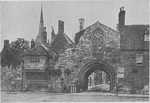
My brother could not proceed until he could make himself heard, and it was difficult to restore order at that late hour of the evening; but when the laughter had subsided, he called to the gentleman in a loud voice, "Are you ready, sir?" and when he said "I am, sir!" he proceeded to call out each letter slowly and distinctly, so that all the company could hear, the gentleman as he entered them in his book repeating the letters in a minor key which sounded exactly like the echo.
"S," shouted my brother, "s," echoed the gentleman; "L," said my brother, "L" softly responded the gentleman slowly; and then followed A, a letter which the gentleman did not expect, as he said, "Did you say 'A,' sir?" "I did, sir," he replied, repeating the letter, which was repeated doubtfully as the listener entered it in his book. The next letters were "I" and "T," which were followed by the letter "H." These were inserted without comment, beyond the usual repetition in a subdued tone, but when my brother followed with "W," it became evident that the gentleman thought that there was "something wrong somewhere," and that he had a strong suspicion that he was being led astray. When my brother assured him it was quite correct, he rather reluctantly entered it in his book; but now there was a slight pause, as the space originally allotted for the name had been fully occupied, and the remainder of the word had to be continued on another page, much to the annoyance of the writer.
The company had by this time become greatly interested in the proceedings; but the fact was that the name of the place was not sounded as it was spelled, and it was amusing to watch the expressions on their faces as my brother proceeded to call out the remainder of the letters. I could see they were enjoying the discomfiture of the old gentleman, and that a suspicion was gaining ground that all the other letters of the alphabet might yet be included! When the gentleman had selected the corner in his note-book to record the remaining letters, and my brother began with the letter "A," he remonstrated that he had given him that letter previously, and a strong assurance from my brother was necessary in order to ensure the entry of the letter in the notebook; but when it was followed by "I" and "T" and including the "A" in exactly the same order as he had recorded them before, his patience was quite exhausted, and his previous suspicions confirmed that he was being hoaxed. The remainder of the party amidst their hardly suppressed laughter insisted upon their being entered, and when my brother called out the final letter "E," and repeated the whole of the letters
SLAITHWAITE
and pronounced the word "Slawit" or "Sloyt," the hitherto suppressed amusement burst in a perfect roar of laughter, the company evidently thinking that the gentleman who had asked the question had got his answer! Taking advantage of the general hilarity, we quietly and quickly retreated to another and less noisy room upstairs, for the night.
(Distance walked twenty-eight and a half miles.)
Wednesday, November 8th.
It must have been a great work to remove the City of Old Sarum and to rebuild it in another position a mile or two away from its ancient site. The removal began in 1219, and was continued during about 120 years; Royal consent had to be obtained, as well as that of the Pope, Honorius III. The reason then given for its removal was that Old Sarum was too much exposed to the weather, and that there was also a scarcity of water there—in fact "too much wind and too little water." There was some difficulty in deciding the position on which the new cathedral should be built, but this was solved by the Bishop shooting an arrow from the top of the Castle of Old Sarum; wherever the arrow alighted the new cathedral was to be built. The arrow fell very conveniently in the meadows where four rivers ran—the Avon, Bourne, Nadder, and Wylye—and amongst these the magnificent cathedral of Salisbury was built. The rivers, which added to the picturesque beauty of the place, were fed by open canals which ran through the main streets of the city, causing Salisbury to be named at that time the "English Venice."
Nearly every King and Queen of England, from the time of Henry III, who granted its first Charter in 1227, had visited Salisbury, and over twenty of their portraits hung in the Council Chamber. Two Parliaments were held in Salisbury, one in 1328 and another in 1384; and it was in the market-place there, that Buckingham had his head cut off in 1483 by order of his kinsman, Richard III, for promoting an insurrection in the West of England. Henry VIII visited the city on two occasions, once with Catherine of Aragon, and again with Anna Boleyn. James I too came to Salisbury in 1611, and Charles II with his queen in 1665—on both these occasions to escape the plagues then raging in London. Sir Walter Raleigh was in the city in 1618, writing his Apology for the Voyage to Guiana, before his last sad visit to London, where he was beheaded. James II passed through the town in 1688 to oppose the landing of William of Orange, but, hearing he had already landed at Torbay, he returned to London, and William arrived here ten days later, occupying the same apartments at the palace.
But the chief object of interest in Salisbury was the fine cathedral, with its magnificent Decorated Spire, the highest and finest in England, and perhaps one of the finest in Europe, for it is 404 feet high, forty feet higher, we were informed, than the cross on the top of St. Paul's Cathedral in London. This information rather staggered my brother, for he had an exalted opinion of the height of St. Paul's, which he had visited when he went to the Great Exhibition in London in 1862.
On that occasion he had ascended the dome of St. Paul's Cathedral from the inside by means of the rickety stairs and ladders provided for that purpose, and had reached the golden ball which supported the cross on the top, when he found it already occupied by two gentlemen smoking cigars, who had arrived there before him, and who kindly assisted him into the ball, which, although it only appeared about the size of a football when seen from the city below, was big enough to hold four men. They also very kindly offered him a cigar, which he was obliged to decline with thanks, for he did not smoke; but when they told him they came from Scotland, he was not surprised to find them there, as Scotsmen even in those days were proverbial for working their way to the top not only of the cathedrals, but almost everywhere else besides. The "brither Scots" were working to a previously arranged programme, the present item being to smoke a cigar in the golden ball on the top of St. Paul's Cathedral. When my brother began the descent, he experienced one of the most horrible sensations of his life, for hundreds of feet below him he could see the floor of the cathedral with apparently nothing whatever in the way to break a fall; so that a single false step might have landed him in eternity, for if he had fallen he must have been dashed into atoms on the floor so far below. The gentlemen saw he was nervous, and advised him as he descended the ladder backwards not to look down into the abyss below, but to keep his eyes fixed above, and following this excellent advice, he got down safely. He always looked back on that adventure in the light of a most horrible nightmare and with justification, for in later years the Cathedral authorities made the Whispering Gallery the highest point to which visitors were allowed to ascend.
We did not of course attempt to climb the Salisbury spire, although there were quite a number of staircases inside the cathedral, and after climbing these, adventurous visitors might ascend by ladders through the timber framework to a door near the top; from that point, however, the cross and the vane could only be reached by steeple-jacks. Like other lofty spires, that of Salisbury had been a source of anxiety and expense from time to time, but the timber used in the building of it had been allowed to remain inside, which had so strengthened it that it was then only a few inches out of the perpendicular. When a new vane was put on in 1762 a small box was discovered in the ball to which the vane was fixed. This box was made of wood, but inside it was another box made of lead, and enclosed in that was found a piece of very old silk—a relic, it was supposed, of the robe of the Virgin Mary, to whom the cathedral was dedicated, and placed there to guard the spire from danger. The casket was carefully resealed and placed in its former position under the ball.
A very large number of tombs stood in the cathedral, including many of former bishops, and we were surprised to find them in such good condition, for they did not appear to have suffered materially in the Civil War. The very oldest were those that had been removed from Old Sarum, but the finest tomb was that of Bishop Giles de Bridport, the Bishop when the new cathedral was completed and consecrated. He died in 1262, and eight carvings on the stone spandrel above him represented the same number of scenes in his career, beginning with his birth and ending with the ascent of his soul into heaven. The figure of a boy in full episcopal robes, found under the seating of the choir in 1680, and named the "Boy Bishop," was an object of special interest, but whether it was a miniature of one of the bishops or intended to represent a "choral bishop," formerly elected annually by the choir, was unknown.
There were also tombs and effigies to the first and second Earls of Salisbury, the first, who died in 1226, being the son of Henry II and Fair Rosamond, of whom we had heard at Woodstock. He was represented in chain armour, on which some of the beautiful ornaments in gold and colour still remained. His son, the second Earl, who went twice to the Holy Land as a Crusader under St. Louis, was also represented in chain armour and cross-legged.
Near this was the tomb of Sir John Cheney, a man of extraordinary size and strength, his thigh-bone measuring 21 inches, whose great armour we had seen in Sir Walter Scott's house at Abbotsford. He was bodyguard to Henry of Richmond at the Battle of Bosworth Field, near which we passed at Atherstone. Sir William Brandon was Richmond's standard-bearer, and was cut down by King Richard himself, who tore his standard from him and, flinging it aside, rode at Sir John Cheney and hurled him from his horse just before he met his own fate.
SALISBURY CATHEDRAL. "The fine Cathedral, with its magnificent Decorated spire, the highest and finest in England—perhaps the finest in Europe, for it is forty feet higher than the Dome of St. Paul's in London."
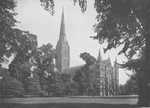
There are a large number of pillars and windows in Salisbury Cathedral, but as we had no time to stay and count them, we accepted the numbers given by the local poet as being correct, when he wrote:
As many days as in one year there be, So many windows in this Church we see; As many marble pillars here appear As there are hours throughout the fleeting year; (8760) As many gates as moons one year does view. Strange tale to tell; yet not more strange than true.
The Cathedral Close at Salisbury was the finest we had seen both for extent and beauty, the half-mile area of grass and the fine trees giving an inexpressible charm both to the cathedral and its immediate surroundings. The great advantage of this wide open space to us was that we could obtain a magnificent view of the whole cathedral. We had passed many fine cathedrals and other buildings on our walk whose proportions were hidden by the dingy property which closely surrounded them, but Salisbury was quite an exception. True, there were houses in and around the close, but these stood at a respectful distance from the cathedral, and as they had formerly been the town houses of the aristocracy, they contained fine old staircases and panelled rooms with decorated ceilings, which with their beautiful and artistic wrought-iron gates were all well worth seeing. The close was surrounded by battlemented stone walls on three sides and by the River Avon on the fourth, permission having been granted in 1327 by Edward III for the stones from Old Sarum to be used for building the walls of the close at Salisbury; hence numbers of carved Norman stones, fragments of the old cathedral there, could be seen embedded in the masonry. Several gate-houses led into the close, the gates in them being locked regularly every night in accordance with ancient custom. In a niche over one of these, known as the High Street Gate, there was a statue which originally represented James I, but when he died it was made to do duty for Charles I by taking off the head of James and substituting that of Charles, his successor to the throne, with the odd result that the body of James carried the head of Charles!
There were many old buildings in the city, but we had not time to explore them thoroughly. Still there was one known as the Poultry Cross nobody could fail to see whether walking or driving through Salisbury. Although by no means a large erection, it formed one of the most striking objects in the city, and a more beautiful piece of Gothic architecture it would be difficult to imagine. It was formerly called the Yarn Market, and was said to have been erected about the year 1378 by Sir Lawrence de St. Martin as a penance for some breach of ecclesiastical law. It consisted of six arches forming an open hexagon, supported by six columns on heavy foundations, with a central pillar square at the bottom and six-sided at the top—the whole highly ornamented and finished off with an elaborate turret surmounted by a cross. It was mentioned in a deed dated November 2nd, 1335, and formed a feature of great archaeological interest.
POULTRY CROSS, SALISBURY.
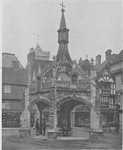
The old portion of St. Nicholas' was in existence in 1227, and in the Chorister's Square was a school established and endowed as far back as the year 1314, to support fourteen choristers and a master to teach them. Their costumes must have been rather picturesque, for they were ordered to be dressed in knee-breeches and claret-coloured coats, with frills at the neck instead of collars.
Quite a number of ancient inns in Salisbury were connected with the old city life, Buckingham being beheaded in the yard of the "Blue Boar Inn" in the market-place, where a new scaffold was provided for the occasion. In 1838 a headless skeleton, believed to be that of Buckingham, was dug out from below the kitchen floor of the inn.
The "King's Arms" was another of the old posting-houses where, when King Charles was hiding on Salisbury Plain in the time of the Civil War, after the Battle of Worcester, a meeting was held under the guidance of Lord Wilmot, at which plans were made to charter a vessel for the conveyance of the King from Southampton to some place on the Continent. Here we saw a curiosity in the shape of a large window on the first floor, from which travellers formerly stepped on and off the top of the stage-coaches, probably because the archway into the yard was too low for the outside passengers to pass under safely. There was also the "Queen's Arms," with its quaint porch in the shape of a shell over the doorway, and the "Haunch of Venison," and others; but in the time of the Commonwealth we might have indulged in the luxury of staying at the Bishop's Palace, for it was sold at that time, and used as an inn. It must have had rough visitors, for when the ecclesiastical authorities regained possession it was in a very dilapidated condition.