ILLUSTRATIONS
Reading edition
The author On the beach at Waikiki Our Kaneohe cottage "Grub is ready; get your gang together" The Steerage Trio The Gaylord, the only drag-bucket dredger in existence A restaurant where nothing but "grub" is served Bound for Japan Taisuke Murakami, our host at Nagoya The picture that caused our arrest A group of our Korean friends Every day is wash-day in Korea Provincial officials attending China's first track meet The author in Chinese garb A pagoda bridge in the Forbidden City Country boys of North China Sample of an irrigation system Crossing a Chinese country bridge The inn where Richardson put up for a night An old church in Manila The house in which Richardson lived during his employ at the prison The foreign business section of Singapore The village drummer summoning the people on our arrival A jutka or "jitney" used in Central India Washing clothes in the Ganges A single tree—a banyan The Sphinx The Mount of Olives Our start for Nazareth The port of Dedeagatch A market in Constantinople The Temple of Theseus The Roman Forum—a "vacant lot" of Rome St. John's Church, Needham Market The author's home in Tromso Tromso in summer-time Pack ice in Ice Fjord Twenty miles from land The first load for shore The ice pack from the crow's nest The Munroe alongside the ice—60 miles from land Longyear City, Spitzenbergen—700 miles from the North Pole Norwegian wireless station in Ice Fjord
FROM JOB TO JOB AROUND THE WORLD
CHAPTER I
TWO WORLD-BEATERS
"What's the trouble? Are you seasick or homesick?" cordially inquired Richardson, approaching a stranger who was hanging over the side of a ship bound for Honolulu.
"Neither, my friend," I replied with a smile.
These were the initial sentences of a dialogue which was happily destined to continue for three years.
It was about an hour after the S.S. Alameda had left San Francisco for Honolulu, while leaning against the rail of the ship gazing at the receding city and turning over in my pocket a five-dollar gold piece, that I was hailed by Richardson. This gold piece was all the money I had in the world and I soon learned that the few loose coins my new friend possessed fell a little short of this amount.
After exchanging a few ideas each of us discovered that we were starting out on a similar expedition—a trip around the world. Richardson had made arrangements with another fellow for such a tour and he had backed out. I also had planned for a companion—who disappointed me at the last moment. With our partners failing us we both set out alone and by a happy coincidence took the same boat and met the first morning out of port. We liked one another's looks and decided to hook up, then and there.
A combined wealth of less than ten dollars and the wide, wide world in front of us! We agreed not to make any definite plans; we mapped out no itinerary, except the general one of around the world; we had no elaborate scheme of travel nor ideas of how we were to make our way, but decided to resign ourselves to chance and bang around, taking whatever came along. My idea was to explore the earth before I was anchored by matrimony, and Richardson wanted to see all of this world before he went to the next. We set out not as tourists—that familiar species of humanity—but as two refined American tramps.
As a young boy I had vague notions of how I was some day going to "beat" my way around the world. I always pictured myself going as a vagrant. My career as a world-beater had now begun.
To make the break was the difficult thing. To leave a good position against the advice of friends and start out on an expedition which seemed the height of folly to many people was not an easy step. I had heard of men beating their way amid a continual round of hardships. I thought it possible to travel in such a manner and do so with a fair degree of comfort. It was our plan to look for good jobs and to get around in the middle course between the wealthy tourist on one hand and the ignorant, homeless tramp on the other.
With our fares paid to Honolulu, by money we had saved, we had no cares, and mingled with the miscellaneous types of passengers on the ship. Forty school teachers, ranging in age from twenty to sixty, were returning to their insular positions; pious missionaries were on their way to their posts after a sojourn in the States; sugar planters and pineapple growers spent hours on the promenade deck boosting the islands to the handful of tourists and others on the water for the first time. Seated at our table in the saloon was a Roman Catholic priest, a lean, kindly old man who was only able to eat about one meal in ten. Accompanying him were two monks, a fat one and a thin one, going to the islands to resume their labours. The amount of food the fat one could surround was not only a source of amazement and anxiety to his fellow-eaters but was the cause for great alarm on the part of the ship's commissary—for fear the supply of provisions would be exhausted before port was reached. If he had taken vows to deny himself many of the pleasures of this world he more than squared himself by the quantity of food he would devour at one sitting.
The six days it takes to go to Honolulu from San Francisco were spent as such days are usually spent at sea, talking and reading in the morning, shuffle-board and other games in the afternoon, singing and spooning in the evening—on the whole a civilised trip. On the morning of the seventh day we arrived in the harbour of Honolulu. After being amused by a group of native boys diving for coins thrown by all passengers except ourselves—who felt inclined to strip and join the divers—the ship was soon alongside and in a short time we were mingling with the cosmopolitan inhabitants on the streets of Honolulu.
The next day found each of us enrolled on the teaching staff of two different schools. We became school teachers! There is something rather distasteful about a man teaching in the grammar grades. It is too ladylike. I would rather be caught operating an electric runabout. But when one realises that his last meal is not far away, any occupation is acceptable, and school teaching proved to be one of the most attractive vocations which we pursued during the trip.
Richardson affiliated himself with Mills Institute, a school under the control of the Hawaiian Board of the Congregational Church Missionary organisation. The total enrolment of this institution was about two hundred students, three-fourths of whom were Chinese and the rest Japanese and Koreans. It graduated pupils of high school standing and it was in the upper division that Richardson was to work. He was instructor in algebra, geometry, Latin and English at sixty dollars a month and board. His work consisted of the routine duties of any ordinary teacher and, except that the school was quarantined for three weeks on account of diphtheria, nothing eventful occurred during his connection with the place.
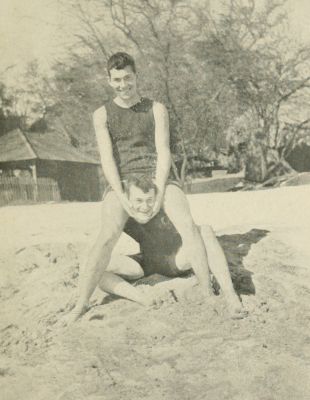
On the beach at Waikiki
I assumed the duties of teacher of the fourth and fifth grades in Iolani School, a parochial institution connected with Saint Andrew's Cathedral, at the mere pittance of thirty dollars a month and board. Hawaiian schools are in many respects similar to those on the mainland and differ chiefly in the fact that the personnel of the pupils is much more cosmopolitan. In these two grades there were about sixty boys made up of Hawaiians, Chinese, Japanese, Koreans, Portuguese and but two Americans. At the end of two months under my instruction one of the American boys ran away and the other poor chap went insane—a tough commentary on the pedagogic ability of their teacher.
One of the masterpieces of literature that came to my attention is too good to let fade into obscurity. It is a letter from a number of Chinese and Japanese pupils asking me for their report cards. It follows:
"Dear Mr. A.C.B. Fletcher:
Our objection in writing this letter to you that we don't want our report cards on last examination and you promise to us that you will sent out the cards on Monday, but the cards has not yet reached us. We shall be obliged if you will sent us the report cards when you have accept this letter.
Hoping to receive the cards early,
Your disobedient pupils, H. Ah Chau, Instead of pupil." Mr. Ah Chew Mr. Ah Soy Mr. Jay Yet Mr. Jock Chay Mr. T. Murakami Mr. Lo Lee
No one could resist this touching plea, so I spent one whole night correcting papers and had the report cards ready to deliver the following day.
"The loveliest fleet of islands that lie anchored in any ocean," were the words in which Mark Twain once described the Hawaiian group, and the time we spent in the "Paradise of the Pacific" proved to be one of the most enjoyable periods of the trip.
I have been surprised on many occasions at the ignorance displayed by people in the United States, and especially in the East, concerning the Territory of Hawaii. They imagine that the natives are a half-clad race recently descended from cannibals, that Honolulu is a semi-civilised village of Hawaiian huts and that modern conveniences have not yet found their way to the islands. Honolulu is a city of fifty thousand people, of whom a large number are Orientals and but a few thousand are Americans. The Americans, although in the minority, dominate the city. Honolulu is one of the most beautiful and up-to-date cities of its size under the American flag. It has a good electric car service, hundreds of paved streets, first-class shops, three modern hotels and countless beautiful homes. There were one hundred and fifty automobiles lined up on the water front to meet the S.S. Cleveland when she docked at Honolulu with seven hundred passengers on her around-the-world trip. There are hundreds of miles of excellent roads for motoring throughout the islands and the number of automobiles, per capita of Americans, greatly exceeds the ratio of any city on the mainland. Honolulu is a park from one end to the other. It combines all the attractive features of the tropics with the climate of the temperate zone and possesses a charm all its own.
It was in this paradise that Richardson and I began our wanderings. During the recesses we had from our school duties we explored the island of Oahu, upon which Honolulu is situated, and became as familiar with it as the average man is with his own back yard. We learned to ride the surf at Waikiki—the finest bathing beach in all the world. We climbed all the hills in the vicinity of Honolulu. We visited Diamond Head and its fortifications. We took a dip in the Kalihi swimming hole, and we explored the island from one end to the other.
Through the kindness of an American friend, we had at our disposal a summer cottage at Kaneohe, about twelve miles from Honolulu on the northern shore of the island. This little house was completely equipped with cooking and eating appliances, beds and provisions. It was situated on the beach of Kaneohe Bay. We had the use of a sail boat, two row boats and fishing tackle. At this ideal spot we spent many week-ends and, the whole time, we would go about clad in only a pair of trunks and devote the pleasant hours under the semi-tropical sun to swimming, boating and fishing. Many a time since, I have longed for another few days' stay at this little resort—to bathe in its sunshine and enjoy its outdoor pleasures undisturbed by the noise and bustle of civilisation.
We concluded that teaching stipends would never get us around the world. Especially true was this in my case, for I was making an effort to pay twenty dollars a month to a California real estate firm for several lots I had purchased some years before. We therefore decided to give up our schools and to rustle a more remunerative line of labour. Hearing that the United States Navy Department needed inspectors for its operations in connection with the construction of the naval base at Pearl Harbour, about twelve miles from Honolulu, I wandered into the navy headquarters one morning and bluntly addressed the first man I saw.
"My name is Fletcher and I am looking for a job." The lieutenant in charge, who was dressed precisely in the white uniform of the tropics, resenting my abrupt manner, replied by asking sarcastically:
"Have you been to high school?"
"Yes," I said.
"Are you a university graduate?" the officer continued, beginning to realise that he had somewhat misjudged the applicant.
"I was graduated from the University of California in 1907."
"Well, then," said the lieutenant, assuming a dignified attitude, "an examination is to be held on Wednesday of next week for several positions as sub-inspectors of dredging, and if you will fill out an application you can take it." I filled out the document, which contained the regular useless and characteristic red tape required to get within approaching distance of a government position.
"What does the examination cover?" I enquired.
"It is contrary to the rules to answer such a question," was the navy man's reply.
"But a man ought to have some line on what he is going up against. For all I know the questions may be on theology," I said with a smile. "Can't you give me a general idea what the test will cover?"
The officer then informed me that the examination would include several questions on dredges, blasting and explosives and the use of a sextant and a protractor, and would test the applicant's knowledge of geometry and arithmetic. After expressing my gratitude for the information I wandered out into the street with my hopes somewhat shattered. As I aimlessly sauntered along the water front leading from the Naval Station, I began to ponder over the various items to be included in the examination. The more I reflected the lower my hopes descended. I couldn't tell a sextant from a churn, a protractor was as strange a device to me as a doctor's forceps, and I knew no more about a stick of dynamite than a turtle does about music.
But in spite of this apparently insurmountable wall of ignorance, we both agreed to take a chance at the examination, and I was designated to gather the information. I borrowed a sextant from the skipper of a ship lying in the harbour and practised with the instrument in the vacant lots of the city. I made several trips to Pearl Harbour and studied the different types of dredges at work in the channel, drawing diagrams and taking notes on each. I obtained a book on explosives and among other volumes I came across a publication entitled "Inspector's Handbook," which contained most of the information we desired in concise form.
While I was busy gathering data for the approaching examination, Richardson was earning two dollars a day on a job he had picked up from the Honolulu Telephone Company. His tedious duties consisted of installing a switch-board in the company's new building, and he spent his ten long hours a day in the monotonous task of connecting an endless number of small metallic fibres. At the close of his second day on the job he struck his boss for a lay-off.
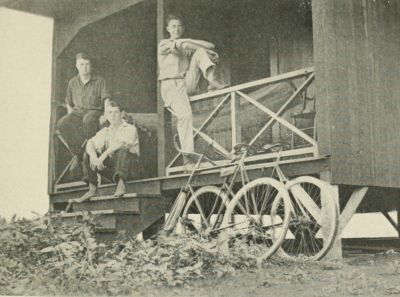
Our Kaneohe Cottage
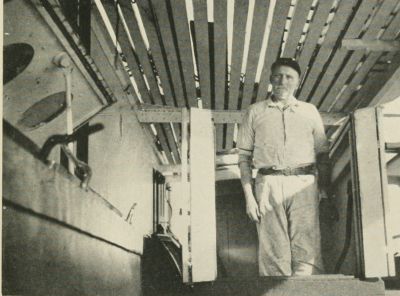
"Grub is Ready. Get Your Gang Together"
"You have only worked two days and now you ask for time off. What do you want it for?" asked the oily-looking foreman.
"I am scheduled to take a civil service examination to-morrow," was Richardson's reply.
"A civil service examination! Going to quit me, Eh? Not if I know anything about it. You're fired. Come and get your time right now," exclaimed the enraged telephone boss.
"That suits me all right," said Richardson in an indifferent tone. He received his four dollars and walked unconcernedly out of the place.
That evening Richardson, four dollars richer, spent several hours under my instruction, and I made an effort to prime him full of the information I had collected for the examination. Promptly at nine o'clock the next morning we were both on hand at the Naval Station, equipped with a banana each for lunch, to take the six-hour test. There were seven other aspirants representing seven types of the human species, from a shabbily dressed stevedore to a foppishly attired bank clerk, and each had little or no knowledge of the nature of the test which was about to begin. After the examination had been in progress about an hour, Richardson and I were the only ones left—the other poor beggars had given up in despair. With our coats off, we answered the nine questions in the required time and afterwards retired to the lawn, where we were asked to demonstrate our practical knowledge of a sextant. We were instructed to measure off four red flags, which were so arranged that they formed a circle with the point on which we stood as a pivot. We were given ten minutes to perform this feat. Richardson handled the instrument like a veteran. I was unable to locate the final flag through the lense of the sextant on account of a multitude of red banners flying from a man-of-war lying alongside of a dock near-by. After fumbling around in a vain effort to find the right red flag in the maze of the ship's signals, and realising that my ten minutes were fast fading away, I decided to take a long shot and do a little guess work. I took my vernier reading from the biggest flag I could see. It turned out to be a good guess, for I learned afterwards that my entire circle read three hundred and sixty degrees, one second.
The next day we were both notified that we had passed the examination—Richardson, the student, receiving a mark of eighty-six per cent.—and myself, the instructor, eighty-five per cent. We were now in line for appointments as sub-inspectors of dredging on the Pearl Harbour Naval Base, in the employ of the United States Navy Department at $3.60 a day and board—with double pay on Sunday. This made an average of one hundred and ten dollars clear money a month.
CHAPTER II
HAWAII BY STEERAGE
Passing the examination was only part of the procedure through which we had to go to obtain positions as sub-inspectors of dredging on the construction of the Pearl Harbour Naval Base. The next step was to get an appointment from Washington which was not to be had until there was a vacancy at the harbour. The naval authorities in Honolulu could give us no assurance when an opening would occur, so we decided to visit some of the other islands while awaiting developments. We wished to see Kilauea, the only active volcano in the Hawaiian archipelago, on the island of Hawaii, about one hundred and twenty-five miles south of Honolulu. We also wished to see Haleakala, the largest extinct crater in the world on the island of Maui.
We sailed on the S.S. Wilhelmina for Hawaii, accompanied by a fellow school teacher by the name of Hammond. Richardson went as a member of the crew while Hammond and I were steerage passengers at three dollars a head—as we supposed. No one came to collect our fares, so I reluctantly offered the money to the purser who refused it—for he knew we were poor men. We returned under similar good fortune, making a total of two hundred and fifty miles of travel, including meals, for nothing. Richardson's duties consisted of bucking around one-hundred-and-fifty-pound sugar sacks, and he received little sympathy from his two travelling companions who sat leisurely by and made fun of him. He proved to be a very poor workman, for after the ship was well under way he shirked his duties to such an extent that he enjoyed all the comforts and leisure of steerage travel.
We were the most aristocratic steerage passengers that this ship or any other ever had. Instead of conducting ourselves like cattle, as fourth-class passengers sometimes do, we mingled with the pretty girls of the first-class, took deck chairs which usually retail at a dollar a trip, explored the boat beyond the steerage line and when the steward emerged from the lower deck and in the presence of all the passengers shouted, "Grub is ready, get your gang together," the three of us dropped down the hole and lined up alongside of the trough and proceeded to place away the food which was served in wholesale quantities on tinware. Our iron-piped bunks were free from bed-bugs and other inhabitants, but the hairy blankets were tormentors all night long. It was a rough trip and it was fortunate that none of us was seasick. It would have been extremely awkward, for no provision was made for receptacles of any kind which are necessary under such circumstances. Our bunks were ten feet from the port holes, which were twelve feet from the deck, and in order to do the usual thing through one of these apertures it would have been necessary to procure a ladder, and even then we should have run the risk of getting our heads caught in the port holes and of being unable to draw them out. One's imagination can picture the steerage steward being greeted in the morning by three bums hanging lifelessly by their heads from three successive port holes, with their legs dangling in the air.
Richardson was determined to break in on two attractive girls on the first-class promenade deck. One of them was seated in front of her stateroom looking like an unlaundered towel and doing her best to hold down a recently devoured meal. Richardson prinked before the steerage mirror and walked briskly along the deck to the point where the young lady was sitting. He stopped short and bluntly asked,
"Are you seasick?"
"Don't I look it?" she replied with a smile.
This was the entering wedge and soon Richardson introduced his fellow travellers. The steerage quarters were immediately deserted and we spent the rest of the trip on the promenade deck with the women. One of them proved to be the daughter of an high official of the Oceanic Steamship Company, which at that time was contemplating placing on a line of steamers from San Francisco to Australia. We met her father who, on hearing of the plans of our trip, which we enthusiastically related, said that in the event the new line was put on he would see that we got to Australia for nothing. Unfortunately for us, our time to depart came before this line was inaugurated.
We landed at Hilo on the island of Hawaii early in the morning, and bought a third-class round-trip ticket for $1.60 to Glenwood, twenty-two miles distant. From Glenwood we walked the remaining nine miles to the Volcano House in two hours and fifteen minutes, rising two thousand feet and beating the stage by twenty minutes. The road was a good thoroughfare through tropical forests of tree ferns, twenty feet in height; of ohia lehua, a tree belonging to the same family as the eucalyptus; koa or Hawaiian mahogany; wild bananas; papaia, water lemons, palms and wild roses. On arriving at the Volcano House we had something to eat and then set out across the lava beds for three miles to Halemaumau—the active pit of the volcano—where we spent the night in a shack perched on its edge.
Kilauea is one of the "seven wonders" of America. It is situated on the slopes of Mauna Loa, a barren mountain rising gradually from the sea to a height of thirteen thousand five hundred feet. The Volcano House, or tourist hotel on the hillside, commands an excellent view of the crater with its desert of lava, of the swirling smoke of the pit and of Mauna Loa, rising majestically in the distance to its dome-like summit.
Vesuvius is a large broken cone on the top of a mountain. Kilauea is an enormous cavity about seven miles in circumference and several hundred feet deep on the side of a mountain. The crater is a large lava bed cooled in peculiar and fantastic formations and it is about four miles in diameter. Across this dreary desert is a winding trail which leads from the Volcano House to the pit. Along this path there are immense fissures in the lava from which constantly rise volumes of sulphur smoke oozing out from the very bowels of the earth. As one approaches the pit the enormous column of smoke, which rises from it, is always present as a guide to his destination and at night it is a tower of light which spreads its rays for miles.
Halemaumau, the pit where the molten lava is raging, is about four hundred feet in diameter and at the time of our visit the level of the liquid fire was about six hundred feet below the floor of the crater. There is a pit within a pit, the top of the inner forming a shelf within the outer; and it was on this ledge that Mark Twain had the thrilling experience of rescuing a companion who had fallen through the lava. His account of this adventure is given in "Roughing It," and he relates in detail the difficulty with which he emerged from his perilous situation after wandering blindly about amidst the fumes of sulphur in search of a path to safety. To-day none but the fool-hardy venture below, as it is very dangerous. Richardson, Hammond and I explored the whole region, and we sat for hours on the edge of the precipice and watched this lake of molten lava—splashing, surging, tossing, gurgling, flowing—ever restless and ever beautiful.
This mass of writhing fluid looks like hell as pictured by the old-time fire and brimstone preachers. It appears to be flowing in a continuous current, coming from one side and disappearing at another. As floating pieces of lava cool and crack, a series of red hot fountains bursts through them, rising to a height of twenty or thirty feet. In the midst of this restless mass of Satanic fluid is a large stationary rock which reposes in its infernal position as peacefully as a cow in a pasture. Out of this awful chasm there arise clouds of sulphur smoke which conceal the bed to a great extent, but as there is always a strong constantly changing wind we were able to get good views of the whole scene.
It is extremely fascinating to sit on the edge of this pit and watch the incessant dashing and splashing of the glowing lava. It impressed even such homeless tramps as ourselves. One's thoughts drift back to the time, a century ago, when Mrs. Pele—the Hawaiian Goddess of volcanoes—was misbehaving to her full capacity, when the present outer crater with its cold and peaceful lava beds was one living mass of furious fire, when its rays were so brilliant at night that it illuminated the sky and sea for a radius of four hundred miles and the lava flowed at will down the mountain-side to the sea and extended the coast of this volcanic island.
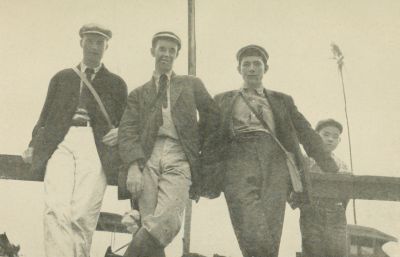
The Steerage Trio
An interesting story is told by the natives. Several years ago when Kilauea was unusually active there was great fear that the lava would flow down the mountain-side and bury the town of Hilo. The Hawaiians in their frenzied fright appealed to Princess Ruth for help. She, accompanied by the ladies and gentlemen of the court, proceeded to the volcano and with great ceremony, this portly and corpulent woman (it is said that she weighed three hundred pounds) stood on the edge of the pit and threw a live and disgusted pig into the midst of the burning cauldron, whereupon the boiling lava immediately subsided and the village of Hilo was saved.
The regular tourist rate from Honolulu to Kilauea is $59.50, which includes round-trip by boat, railroad fare from Hilo to Glenwood, stage charges to the Volcano House and board and room while there. Admitting that we missed a considerable degree of comfort, nevertheless, we saw all that the average tourist sees and at a cash outlay of only $2.10 each.
Huddled in the steerage of the Mauna Kea (one of the small steamers of the Inter-Island Steam Navigation Company) with a score of Chinese, Japanese and Hawaiians, we left Honolulu for McGregor's Landing on the island of Maui to see the extinct volcano Haleakala. The trip was a night's journey and, as no sleeping accommodations are provided in the third-class of Hawaiian steamers, we bunked on the soft side of a coil of rope.
The ship arrived at McGregor's Landing about five o'clock in the morning and we went ashore feeling anything but rested after a most wearisome night. We made a bargain with a Chinese hack driver to carry us to Kahului, eight miles across the island. After breakfast we boarded a little narrow gauge train for Paia, a sugar plantation village a short distance up the coast on the slopes of Haleakala. We purchased a supply of provisions at the plantation store and were soon started on the twenty-mile climb to the top of the mountain. Haleakala is just over ten thousand feet in elevation and the trail to the summit ascends on an average of five hundred feet to the mile. A trip up Haleakala proved to be far from a pleasure jaunt.
The first part of our walk from Paia past the huge sugar factory lay through the great cane fields of the Maui Agricultural Company, the second largest plantation in the Hawaiian Islands. The cane was being harvested and the Japanese cutters were as busy as bees all about us.
About ten o'clock we reached the four-thousand-foot level. The cane fields began to disappear and our path wound its way among banana farms and taro patches. We helped ourselves to mangoes, papaias and guavas along the way. We ate our lunch at a Chinese store. The real climb began after midday. We left fertile fields and were soon following the trail across the middle slopes of the mountain. There were few trees and the sun shone down from a cloudless sky. Our gait was easily under the speed limit, only about two miles an hour. It was a hard stony road over which we had to travel.
As we ascended the view began to widen out on every side. We could look back over the cane fields to the Pacific and see the breakers rolling ashore. Above us towered the mountain, the summit now and again lost in a fleecy cloud. We almost forgot the hardships of the climb with such a picture before us.
Although the ascent from Paia to the top can be made in a single day, we decided to break the journey about half way, spend the night and start out refreshed for the last stretch. We stopped at Idlewilde and put up in the summer home of a Kahului friend. We made an early start. The trail was plainly marked with guide posts, each tenth of a mile. Idlewilde is eight miles by trail from the summit and the ascent from this point is over five thousand feet—seven hundred to the mile. The first three or four miles were comparatively easy, for we were fresh and the footing was good. About the fifth mile the real work began. The trail became steeper and steeper until it seemed straight up. We began to strike loose, volcanic dirt and sand. We passed the timber line and the stubby bushes with which the side of the mountain is covered afforded no protection from the sun. It was real mountain climbing—or just plain unadulterated work. The high altitude made frequent stops necessary for breathing spells. Our progress was slow. The last three miles took over three hours.
The view was magnificent. Forty miles of the Maui coast were spread out at our feet. To the south the island of Molokai loomed out of the sea. Two or three steamers were making their way through the Maui-Molokai channel towards Honolulu. The air was clear, almost Rocky Mountain clearness—an unusual condition for Hawaii.
A mile from the top we collected a large bunch of fire wood for use during the night. The wood probably weighed one hundred pounds—fifty pounds each. In a half an hour it had increased to four hundred pounds. We began to lighten our packs. We reached the summit with five pounds each. The last half mile took one hour. The air was rarefied and we had to stop every few hundred feet for breath. The trail, beside being much steeper than heretofore—if such a thing were possible—was covered with sand, causing us to slip back a foot for nearly every step we took.
Suddenly the view of the great crater burst upon us. It is a sight I shall never forget. We had reached the top of the trail and were walking along a low wall of rock towards the mountain house. We came to a break in the rock and in an instant Haleakala appeared before us.
Imagine a hole in the top of a mountain. Let this hole be twenty-seven miles around and from two to three thousand feet deep, the sides abruptly sloping. Scattered over the level floor of this hole, picture twenty extinct volcanic cones or craters, the smallest forty feet in height, the largest about a thousand. This, in brief, is Haleakala. The sight is a grand one to-day, with all the craters extinct. What must it have been a thousand years ago when, according to geologists, Haleakala was active and the great crater was one mass of flame and liquid rock?
We spent the night in the mountain rest house. This small stone cabin is provided for visitors to the summit. We curled up in our blankets—but not to sleep. The fireplace balked and the smoke went everywhere but up the chimney. We stood it as long as we could and then concluded that we would rather freeze than be smoked to death. We threw the fire outdoors and spent the rest of the night in a cold but smokeless cabin. A bucket of water in the room was frozen over with ice a half inch thick. We didn't sleep a wink.
In the morning we saw the greatest of all sunrises—a Haleakala Sunrise. The great crater had filled with clouds during the night. In the grey morning light one could imagine that he was looking over an immense body of water. Clouds had settled around the mountain so that the view of the ocean was shut off. We seemed to be standing on an island with clouds all about us. The first rays of the sun were caught up by the mass of mist in the crater. In an instant the great pit was turned into a sea of fire. Back and forth flashed the light as it was reflected through the abyss of fog. In three minutes it was all over. As the sun rose the clouds began to take flight, like giant birds, and in a few minutes the crater was empty.
We rolled rocks over the edge and watched them go bounding down the two thousand foot slope to the floor of the crater. When a boulder in its flight struck another, imbedded in the side of the mountain, pieces dashed up like a fountain and the noise was like the muffled discharge of a cannon.
It only took us a little over four hours to make the twenty miles back to Paia. We scarcely felt tired that evening, but the following morning I thought I was a hundred years old. The constant pounding of our heels on the hard trail affected the muscles in the back of our legs and for two or three days we could hardly walk. If human beings ever have springhalt, we surely had it.
We returned to Honolulu by the Mauna Kea. All went well in the steerage and we arrived in the morning. Instead of going to the wharf, the ship anchored at the quarantine station. We thought this was something unusual and one of us asked an officer the cause. Bubonic plague, one of the most feared of all diseases, had appeared on Maui—only two cases—and all the steerage passengers were to be landed at quarantine and inspected by the port doctor before being allowed to go ashore.
We were steerage by environment but not by heredity. Within two minutes we had business in the engine room. We tarried there a brief moment and went on deck—the first-class deck. Every one was in a rush and our appearance was not even noticed. We knew several of the passengers and at once entered into conversation with them.
Soon the ship's boats were lowered and the first-class passengers—and two steerage—were landed at the wharf. In ten minutes we were on shore, two travel-stained, tired and lame, but cheerful looking tramps. Haleakala was a wonder. It was worth travelling steerage to see—even worth taking a chance on the plague.
CHAPTER III
GOVERNMENT INSPECTORS AT PEARL HARBOUR
On our return to Honolulu there still was no word from the Naval authorities as to appointments at Pearl Harbour. We decided to stand by a few weeks longer in the hope that an opening would soon occur. As our money was running low it was necessary for us to obtain temporary jobs to insure that we would get food each day and have a place to rest our heads at night. Richardson soon fell into the berth of sales-clerk in a photograph shop on the main street of Honolulu, selling kodak supplies and fixtures at twelve dollars a week. I was not so fortunate. I scoured the town for days for something that paid a living wage. I applied to the City Health Department, hoping to get a position as mosquito inspector, ambling about town with a can of oil on my back, pouring the liquid on the various duck ponds which are operated by Chinese and Japanese and which are prolific incubators for this tropical pest. I sought work as a checker of sugar as it is loaded on ships in the harbour. I made application to the three newspapers in the hope of being taken on as a reporter and I canvassed all the houses in the wholesale district. No one would have me. However, I knew one job I could get but I was standing it off as long as there might be prospects of obtaining something else. But finally I had to take it. A re-enforced concrete jail was under construction on the water front and one afternoon, after several hours of searching in vain for work, I sauntered around to this structure. I found the Irish foreman, assumed an empty appearance and said, "I am hungry." The good man immediately agreed to take me on as a labourer at $1.50 a day.
I appeared the next morning attired in suitable raiment for the work I was about to take up and was assigned to my post. The building had been in course of construction several months and had reached the point where the concrete had set and the forms were ready to be dismantled. Equipped with a pinch bar, I worked on a scaffolding with a dozen native Hawaiians and a score of Portuguese, removing the forms from the walls and ceilings. After several days of this fascinating pastime I was placed on the end of a shovel mixing concrete on the roof and propelling a wheelbarrow laden with cement. Pushing two hundred pounds of concrete in a primitive wheelbarrow on the top of an Hawaiian jail under the glaring and penetrating rays of the tropical sun with school teacher's hands was no joke. Blisters the size of nickels arose on my hands; my back became lame, my feet swollen and every muscle in my body as tender as a baby's. To reach the apex of misfortune I ran a rusty nail through the sole of my shoe into my foot. This was a fat load of discomfort to carry for a meagre $1.50 a day. But I had to eat.
In the meantime a vacancy occurred at Pearl Harbour and Richardson received an appointment. After swearing that he would support the Constitution of the United States, the laws of the territory of Hawaii, the Ten Commandments and what not, he was duly authorised to exercise the duties of sub-inspector of dredging. Richardson's one per cent. better mark in the examination put him on the dredging job three weeks in advance of myself and during this period he earned seventy-five dollars—a costly one per cent. for me.
After several weeks as a hod-carrier, I also received my Pearl Harbour appointment, which had been cabled from Washington, and I at once abandoned the concrete business and—from hard labour—joined Richardson in a life of leisure as a government inspector.
The United States Government was spending several million dollars in developing Pearl Harbour, a beautiful land-locked bay on the island of Oahu about ten miles from Honolulu. Under the supervision of the United States Navy Department a dry dock was being constructed, a naval station was to be built with shops, barracks, parade grounds, marine hospital, etc. In order to make this natural harbour accessible the government was having the channel dredged to a width of six hundred feet and to a depth of thirty-five feet. The work was under contract to the Hawaiian Dredging Company, who employed, at this time, about six hundred men. The task was being performed by six dredgers, each of a different type,—a clam-shell, a dipper, a converted schooner, an electric hydraulic, a steam hydraulic and a drag-bucket. These machines were superintended by experienced men from America, but the general run of their crews was recruited from the riff-raff of the earth. Drunken sailors, bums and tramps, good-for-nothing Europeans, worthless hulks, swearing Britishers and high sea wanderers blew into the camp and were taken on—to remain but a few days—when new recruits would come along or men would be enlisted from the patrons of the waterfront saloons of Honolulu. As deck hands, launch men and any sort of unskilled labour they were set to work, only to be replaced in a few days by a bunch equally as worthless and degraded. It was common occurrence for the whole outfit on a dredge to quit at midnight and be replaced in a few hours by a crowd obtained from the drunken ranks of the low-down dives of Honolulu. They would arrive at the dredge, laden to the shoulders with booze, howling drunk, some of them fighting mad, and before they were all landed from the launch it was an unusual thing if two or three had not fallen overboard and had to be fished out. However, beneath the uncouth externals of many of these men was a heart as big as a fortune, an unselfishness one would hardly surmise and a disposition which it would be difficult to duplicate.
The headquarters for the camp were located in Watertown, a little settlement at the mouth of the harbour, whose inhabitants, numbering about five hundred souls, were made up of Hawaiians, Japanese, Russians, Chinese, Portuguese and a score of Americans. This small camp contained one store and fifty or more houses where the employés of the dry-dock, machinists, launch hands, labourers and native fishermen lived.
According to its regular custom, the Government employed inspectors to see that the work was done properly. Call them what you will—spies, loafers or parasites—each name characterises some phase of the job. Such appellations are no reflection on the personnel of the force, however. There were fifteen of them and it would be hard to find a more interesting set of men grouped together in one spot. The several epithets by which they have just been designated are not due to any failing of theirs, but to the nature of the job, whose chief demands on the inspectors were to look intelligent, maintain the dignity of the Government, and draw pay. There were among these fifteen inspectors an ex-dentist of Honolulu, one of the finest fellows on this earth; an ex-lawyer, a brilliant and sterling man; an ex-doctor, whose Irish wit was of the rare and clever variety; an ex-professor of Whittier College, California; an ex-sailor and several nondescripts. Besides upholding the dignity of the Government each inspector was supposed to have a thorough knowledge of the channel, its width and depth, to inspect the dredging, to supervise the dumping of the dredged material and to submit a daily report to the head inspector.
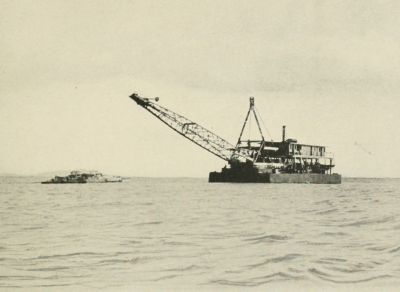
The Gaylord, the only Drag-bucket Dredger in Existence
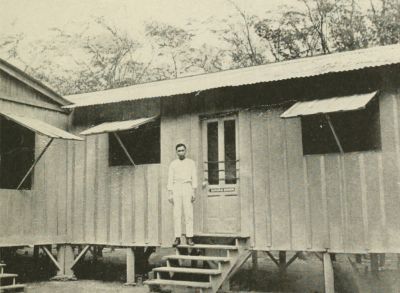
A Restaurant Where Nothing but "Grub" is Served
This was the lay-out with which Richardson and I had decided to cast our lot for several months. With our wages averaging one hundred and ten dollars a month, we figured that in a short time we would have a fair amount of coin laid aside which would enable us to go on to the Orient and bring us safely to another point where we could search for work.
When off duty the inspectors lived at Watertown in quarters provided for them by the Hawaiian Dredging Company and ate their meals at a restaurant conducted by Chinese. While on duty they slept and ate on the dredges which were located from one-half to two miles from shore in the channel. On each dredge there was set aside a room for inspectors' quarters. These compartments on most of the dredges were furnished with two iron bunks for beds, several dynamite boxes for chairs and a greasy deck of cards for amusement. The occupant was never lonesome nor idle, for when he had nothing to do, which was most of the time, he could spend the weary hours reducing the number of rapidly multiplying bed-bugs. These dredges were literally alive with this human pest and as soon as we would reduce the flock to the point of comfort a new bunch of recruits would be ushered in with the arrival of a new crew of men from the waterfront of Honolulu. The mess rooms with crude tables covered with oilcloth, with tin ware and lack of service, could exhibit at meal time the most unappetising display of food ever placed before any man. Stewed tripe—weeks old—lamb stew, clam-chowder, bread apparently made of cement, butter with a stench so strong that it outclassed the odours of the other provisions, fermented tomato catsup and hot cakes with the consistency of horse pads, greeted the unwashed eaters three times a day. The eaters themselves were a curious exhibition of mankind. The men employed on the dredges slept and ate their meals aboard and when they gathered in the mess room, as well as at all other times, the language and stories that wafted across the board were fit to hypnotise the devil.
One morning as Richardson, somewhat late, was seating himself for breakfast the Chinese waiter, approaching the table, inquired automatically and in an interrogative tone,
"Mush?"
"Yes," said Richardson.
"No mush," was the Chink's reply.
This is a sample of the mental capacity of the Oriental servants on the dredges. How could individuals with such brains cook anything fit for a white man to eat? These Chinese cooks and flunkeys were a greasy, unsanitary set and always wore aprons which looked more like those of a blacksmith than those of a kitchen artisan.
The inspectors' time was so arranged that every second day we had thirty-two hours off and these we used to devote to various forms of recreation. In addition to renovating an old sail boat which we resurrected out of the mud flats of the harbour of Honolulu, we went swimming off the pontoon lines of the dredges, hunted on the Government reserve or attended native luaus on the beach. The most interesting diversion was shark fishing. We always had a line out from each dredge in quest of both the hammer-head and man-eating sharks. On one occasion one of the crew observing that one of our lines was being jerked uttered a cry of "shark!" and in a moment we were all on deck pulling in the rope to land our catch. On the end of the line was a ten-foot man-eating shark and as we got the monster alongside the dredge one of the Hawaiians, an expert swimmer, dived off the deck and proceeded to tie a rope around the body of the fish to enable us to hoist him aboard. The shark struggled and whipped about with his tail to such an extent that the native was unable to manipulate the rope with one hand, his other being employed in an effort to restrain the movements of the big creature. After several vain attempts to tie on the rope, the Hawaiian held the tail of the shark between his teeth and thus, with the use of both hands, placed the line around the shark's belly and he was raised on deck. We at once set to and stripped the fish of all its flesh and in the course of a few hours the captain of the dredge was the proud possessor of a walking stick made from the circular bones of the spinal column of the shark. Such a cane is a novelty and a beauty.
My roommate was an inspector who had originally come from the back country of the State of Oregon. Each time as he returned from Honolulu I observed, as Smith—for that was his name—removed his coat, a revolver strapped over his left shoulder.
"What is the pistol for?" I asked him one day.
"I need it in my business," was Smith's reply.
"What business are you in?" I enquired, a little curious.
"I am travelling with another man's wife," said Smith.
"That's rather dangerous business, isn't it?" I ventured, refraining from offering any advice to a man older than myself and one whom I knew but slightly.
"The man is on my trail and I am ready for him," said Smith. I dismissed the incident as the boasting prank of a youth. Some months afterwards, however, the city of Honolulu was awakened from its daily routine by a shooting scrape which took place on one of the main streets at nine o'clock in the morning. Smith's talk was not mere youthful boasting. His assailant fired five shots at him, one catching him in the hip, and Smith replied with a generous bestowal of lead, firing several shots, one of which lodged in his opponent's lung. The first report was that Smith had killed his man. This was not true, however, and the two were taken to the hospital for treatment.
Sentiment in Honolulu ebbed high against Smith and, when he recovered sufficiently to leave the hospital, it was impossible for him to obtain the three thousand dollars' bail for the charge of "assault with a deadly weapon with the intent to commit murder" which was lodged against him. He spent one night in jail and his fellow inspectors finally came to his rescue. Although not approving of his actions, we felt that now was the time to help the man when he was down and especially as Smith appeared very regretful. Richardson and I put up two hundred and fifty dollars each of the bail. The case dragged on for months and was not settled until after our departure from the Islands. Sometime later we learned that Smith was fined one thousand dollars and dismissed from the service of the Government. Such was my roommate. He may have been foolish, but no one could accuse him of being a coward. He was a likeable fellow and had a world of good qualities.
After a couple of months on the job as inspectors Richardson and I had a few dollars in our pockets and, feeling rather reckless one day, decided to purchase some sugar stock in the hope of making a stake and thus being enabled to continue the trip in comparative luxury. We each bought ten shares of the Oahu Sugar Company's stock at thirty dollars a share. In order to do this we had to borrow one hundred and fifty dollars each from a Honolulu bank. While we were building castles in the air concerning the big pile we were going to make, the slump in the market, usual when amateurs begin meddling with stocks, occurred and our shares dropped six points. With the drop of our stocks came a drop in our hopes and we could picture our earnings of the past months vanishing as we stood helplessly by. We concluded that if there was no other way out of our financial difficulties we could at least stay on the job and earn what we had lost. In addition to our bail money for Smith and our loss on our high finance I had, either out of the goodness of my heart or because I was an easy mark, loaned out over two hundred dollars to acquaintances of mine who had put up tales of hard luck. With our finances in this state our trip for the present began to look somewhat dubious. However, everything turned out all right and we climbed out of our financial tangle with profit. The last week of our stay in Hawaii we were both released from Smith's bail, our sugar stocks had gradually risen to two points higher than the figure at which we purchased them and I collected every cent of my loans.
We had now been at Pearl Harbour several months and were anxious to be moving, so we started a vigorous campaign to make a getaway. Honolulu is simply a port of call and crews are not made up there and for this reason it is a poor place in which to be stranded, for it is next to impossible to sign on as a sailor on any ship. When off duty at Pearl Harbour we went to Honolulu and canvassed all the likely looking vessels for passage to either Australia or the Orient. The reception we received at the hands of the captains and stewards varied from the painfully courteous to the hardest of treatment. The skipper of a United States Army transport took us into his cabin, told us stories, gave us a drink but, true to his duty, refused to give us a lift across the Pacific. The steward of a Pacific Mail liner, whom we unfortunately caught ten minutes before the boat sailed—a busy time for a commissary chief,—disposed of us in short order. Seeing a man who filled the description given us, I hailed a greasy looking fellow as he was hurriedly ascending the gangway and asked him,
"Are you the steward?"
"Yep; what do you want?"
"May I have a minute of your time?"
"No, sir, only a half a minute." Our case looked hopeless.
"What are the chances for two of us to get a job?"
"None. I have had enough of fellows like you. Get off the gangway before I have you kicked off," shouted the chief cook as he beckoned to several deck hands to enforce his threat. There being nothing else to do, the two of us withdrew amid the laughter of the people on the pier who witnessed the dialogue. We retired to the opposite side of the wharf where we sat down, smoked a cigarette and talked the matter over. We felt pretty much subdued.
We were novices at the game of procuring maritime jobs and the old sea dogs with whom we had to deal knew it, but we concluded that the only way to get experience was to persevere. We started the trip as tramps and now, for the first time, we realised that we actually were tramps; but we always clung to the idea that we were of the refined variety.
Our next attempt towards obtaining passage was on a British tramp coal steamer plying between Honolulu and Australia. I was especially eager to go to Sydney because a friend of mine, touring the southern continent, had procured a job for me with a draying company in that city. The British tramp was to be painted on her return to Australia and as men were needed Richardson and I were signed on and our duties outlined. They consisted of knocking off the old paint on the side of the ship for twenty-one days. The skipper informed us that the boat was to get under way the following afternoon and that we ought to report for duty in the morning. We were on hand the next day but only to be disappointed, for there was no ship to be found. We learned that it had received orders to sail at once for Seattle and had left at midnight.
We were now left in the lurch. We had tendered our resignations to the Secretary of the Navy and had severed our connections with the Pearl Harbour operations. To diminish our chances for passage to the Orient there was nothing going our way upon which there was the remotest chance of getting a job. Although we felt rather opulent after several months' work as inspectors we were reluctant to look up the rates to Yokohama on the regular liners—but decided to do so. We found that on the following day the Asia, an intermediate steamer of the Pacific Mail Steamship Company, was due from San Francisco en route to Japan and that the fare was seventy-five dollars. This was a huge sum to part with at one blow, but when compared with the regular first class fare of one hundred and fifty dollars on the larger boats looked like a saving. We also figured that by the time we had spent several months floundering around Australia, in spite of the money saved getting there, we should arrive in Manila several hundred dollars out. With these considerations we decided to take the Asia to Yokohama.
We had spent a number of weeks in getting our baggage together and had reduced it to a scientific minimum. We agreed only to take a suit case and a small hand bag each. In addition to these Richardson was to bring his camera. Our baggage consisted of the following wearing apparel and fixtures: two suits of clothes each (one on our backs), one pair of heavy shoes, a cap, six soft shirts, two flannel shirts, a pair of overalls, a dozen socks, six sets of underwear, a dozen handkerchiefs, a rain coat, a few toilet articles, diaries and some stationery. The trip was not to be a dress affair and all hard-boiled shirts, linen collars and evening clothes were dismissed from the start. Even with our wardrobes reduced to this half civilised minimum, it required systematic packing and almost superhuman strength to close our suit cases.
We closed up our affairs in Honolulu, put our money into American Bankers' Travelers' checks, ate a few farewell meals, drank a few final toasts and were in readiness to depart. The Asia was scheduled to leave at five in the afternoon. I was on the pier a few minutes before the appointed time, but there was no sign of Richardson. Five minutes to five—and Richardson had not arrived; four, three, two and one minute to five—and Richardson was nowhere to be found. Five o'clock—and no Richardson. The lines of the ship were being loosened from the pier. I was on board; after having made arrangements with some navy men to have the government launch bring Richardson out to the Asia while she was turning in the stream or to tell him to meet me in Yokohama. At two minutes after five o'clock—just as the ship was getting under way—Richardson came running down the wharf armed with a suit case, a small leather bag, a camera, a rain coat, a hair brush extending from one pocket, a bottle of tooth powder from another and a half a dozen small bundles hanging from any place where they could stick. The gangplank was lowered and he came aboard, while a handful of friends placed several Hawaiian leis about his perspiring neck.
The Royal Hawaiian Band played Aloha Oe, the ship got under way and we began the second leg of our trip with seven hundred dollars each in our pockets.
CHAPTER IV
LIVING AS JAPANESE IN JAPAN
The Asia proved to be a good ship and lazily ploughed her way across the Pacific in a manner to indicate that this trip was simply one in the cycle of many more to come. But this was her last, for on her return from Manila, she encountered a heavy fog off the coast of China and went head on into a large rock and anchored herself securely with her nose in the air and her stern submerged in the sea. Her passengers and crew were all saved and, after being pillaged by Chinese pirates, she was whipped off by the waves and sank into the water, a total wreck.
Ten days of ocean travel spent with educated Japanese returning home, with United States Government employés bound for Manila and other human beings of assorted sizes and miscellaneous occupations, and we reached the shores of Japan.
From one of the Japanese on board we obtained a prospective itinerary. We made arrangements with Mr. A. Miyawaki, a young American-educated Japanese, who was returning to his native land after an absence of eight years, to accompany us for ten days. Miyawaki was a charming little fellow and had been assistant in dairying at the Kansas State Agricultural Experiment Station. We figured that with him as a travelling companion we had acquired a valuable guide. Although Japan was nearly as strange to him as it was to us—for he left when a boy—he knew the language, the lack of which knowledge we soon found to be a great obstacle.
There are two ways to travel—one in luxury as a tourist, the other in discomfort as a tramp. What on earth is there so vulgar as the affluent, loud-voiced, inquisitive, lazy, coin-displaying American tourist? He splashes through Europe or the Orient with a Baedeker in one hand and a ten dollar bill or its equivalent in the other, glances at the cathedrals and temples, eats a near-native meal especially arranged by Thomas Cook and Son, puts up at the expensive European or American hotels and flits from country to country—and imagines that he has seen all there is to see. Nearly every tourist on arriving in Japan goes directly to an Occidental hotel where he lives in Western fashion and luxury at Western prices and seldom, if ever, comes in contact with the natives.
Richardson and I were not tourists but refined tramps. We decided to religiously avoid the American and European hotels for two reasons—first, for economy, and second, for the interesting things we would see and learn. The man is fortunate who can get off without paying eight yen (four dollars) a day at the average Western hotel in an Oriental city, while around the corner at a Japanese inn it is possible to get a room and two meals for from one to three yen a day. There is not the same amount of comfort and luxury as is offered by the Occidental hotel, but there is a thousand times more interest.
The Asia arrived in Tokyo Bay and the city of Yokohama loomed up before us. After a short customs examination, through which I managed to smuggle some American tobacco—for I had learned something of the inferior qualities of this commodity in Japan—we took a rickshaw each, from among the hundred or more that were waiting at the pier, and were off up the street.
Miyawaki, our Japanese friend, accompanied us. Our rickshaws drew up to a Japanese inn and Miyawaki soon made arrangements for our rooms. We sat down on the little porch and took off our shoes, leaving them on the sidewalk along with a score of others, and put on a pair of slippers. After we were robed in kimonos, a dainty little maid pattered in with a tray load of provisions. She knelt down and spread before us the evening meal. Rice represented the bulk of the food and there were raw fish, a bowl of soup with one egg in it, a dish of boiled bamboo shoots, a plate of sweetened beans and a little receptacle containing some black flavouring sauce. The meal was concluded with several small bowls of tea. Richardson and I flew to this assortment almost like animals, we were so hungry. The little maid was much amused at our awkward efforts to manipulate the chop sticks. Rice was especially hard to handle with these two strips of wood.
Richardson and I became so fond of rice before we had lived long on that staple that we thought we could never again eat a meal without it. The Japanese understand how to prepare it and cook it in such a way that each grain is dry and separate from the others. The average dish of rice in America tastes and looks like a mass of Library paste.
Life in a Japanese hotel is a continual round of novelties and interesting experiences to the uninitiated Western traveller. Before entering the guest must remove his shoes—a more sensible custom than that of the Occident of removing the hat—for which tracks in the dirt? With a pair of house slippers to replace his shoes, the guest is ushered into his room, a compartment without any furniture except a Japanese screen and a picture or two. In winter there may be a stove, which consists of a small circular receptacle resembling a jardinière and containing ashes—in the centre of which are a few live pieces of charcoal. As soon as the guest is in his room the proprietor enters with a blank form which is to be filled out and which gives a complete record of the new arrival—his age, occupation, home, reasons for being away from home, destination, etc. This information is turned over by the inn-keeper to the chief of police and thus a close tab is kept on every visitor to a Japanese city. After this formality, the maid enters the room with a kimono and if you give her a chance will completely disrobe you. There are no chairs; nothing but a little mat upon which you coil in tailor fashion. There are no beds; retiring appliances consisting of a thin mattress and quilts which are spread out on the floor at bed-time each night and taken up again in the morning to be placed in compartments in the wall of the room. There is no dining table but in its place is a little tray, sometimes elevated on legs, brought in from the kitchen at meal times. There are no knives, forks and spoons, nor plates. In fact, everything that one would expect to find in an hotel is missing and some other device is in its place. Probably the most unusual feature to the western traveller is the accommodation for taking a bath. This generally consists of a fair-sized room in which are a dozen or more little round wooden tubs where men, women and children all gather at the same time and perform their daily ablutions.
This, briefly, is the lay-out which a traveller finds when he stays at a Japanese hotel. As much of a novelty as it was for Richardson and me to experience the sensations of this kind of inn, it was an equal novelty for the Japanese to have us as guests. We often encountered considerable difficulty in convincing the proprietor that we really wished to stay at his hotel. In addition to the handicap of carrying on a conversation without the use of a language, for we knew nothing of Japanese, we frequently had to overcome the hotel man's notion that we were trying to play a joke on him. Once in the hotel we were constantly the centre of attraction and source of interest not only to those employed about the place but also to the other guests.
In our first Japanese hotel we acted as awkwardly as a cow on a polished floor. When it came time to go to bed Richardson became greatly embarrassed as the pretty little Jap maid in a conscientious effort to perform her duty began to disrobe him. She first removed his coat, at which he gave no indications of disapproval. She then began releasing his shirt and, as she proceeded, Rich's brow began to colour. He didn't murmur until she commenced to separate him from his trousers, which so startled the modest young man that he exploded with such a blast-like tone, "Whoa, Bill," that the poor girl, frightened nearly to death, took refuge in flight. Richardson continued the remainder of his disrobing without assistance.
Privacy is unknown in Japan. Everybody knows every other person's business and little or no attempt is made towards secrecy. The walls of a Japanese house are built of heavy paper or very thin wood and the intimate conversation in one room can be heard in the next. From an American point of view the Japanese are immodest. In some ways they are more modest than we are. They think no more of exposing their bodies entirely nude than Europeans do of displaying their ungloved hands to a crowd. But this is not necessarily immodesty. Modesty is a mental attitude and not the conforming to a certain code of rules.
The bath-room in a Japanese hotel is often the most public part of the building. Especially is this the case in the country districts where western influence has had little or no effect. Although it is now a national regulation that the opposite sexes are not allowed to bathe together, this law is not enforced in the country towns and even in some of the cities. Japan is a nation of bathers. There are said to be thirty thousand public bath-houses in the city of Tokyo alone and at five o'clock each evening thousands of people can be seen with towels over their arms wending their way for their daily wash. It is at this time that all the guests—men, women and children in the hotel—gather in the bath-room and splash about like a lot of youngsters, laughing and enjoying themselves.
If we wanted to be clean we had to cast aside our provincial American ways and bathe in Japanese fashion. Richardson rather objected to this. On one occasion he went to the bath-room and returned almost immediately.
"Have you finished your bath already?" I asked.
"No, there are a lot of women in the tub," he replied, disgusted.
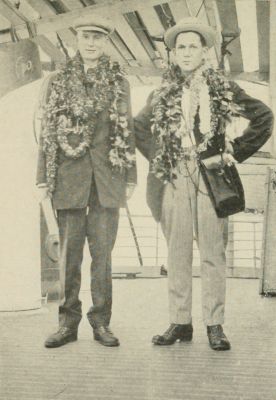
Bound for Japan
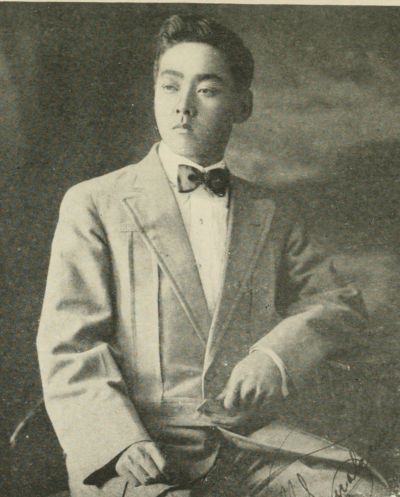
Taisuke Murakami, our Host at Nagoya
"Why let them bother you? If they stand in your way you will not get a bath as long as you are in Japan. If the women don't object I am sure I don't," and, saying this, I went down stairs to the bath-room, where I performed my toilet with half a dozen men and women, in true Japanese style.
Yokohama is the seaport of Tokyo and possesses little of interest except the novelty of being the first Japanese city in which the traveller lands. We spent a day in Kamakura, a sea-side resort about twenty miles away, where we saw the Daibutsu, a bronze statue of the Great Buddha.
Tokyo is but a few hours' ride from Yokohama. We arrived at the busy Shimbashi station and in a few moments were lodged in our second Japanese hotel. It was in this hotel that I upset all the social regulations by using soap in the bath-tub. As the same tub of water is often used by all the guests in the hotel, it is considered a great breach of etiquette to climb into the bath and soap one's body in a civilised manner. This soaping process is supposed to be carried on before getting into the tub and the body is to be thoroughly rinsed off by means of dippers or basins before entering the bath for a final soak. I was not aware of these minute details of Japanese bath procedure and went at this cleansing operation in the Saturday night fashion customary in rural America. The result was that all the succeeding bathers had to wash in soap-suddy water. I was completely ostracised.
We were fortunate to visit Japan during the season of the year when the cherry blossoms were in full bloom. Ueno Park, probably the most popular resort in Tokyo, was a forest of these trees, laden with millions of sweet-scented flowers. Thousands of people gathered each afternoon in this public park to rest and enjoy the beauty of the blossoms for which Japan is famous.
It was in this park that I decided to give up smoking. I had paused on one of the walks and was rolling a cigarette with some "Bull Durham" I had smuggled in the country, when a Japanese policeman came up to me and, with a few words which I did not understand, unceremoniously took the "makings" from me. I stood half stunned with surprise. I soon realised that I had exposed my tobacco to confiscation, disregarding a warning given me by a Japanese passenger on our steamer across the Pacific. I had previously tried the cigarettes sold in the native shops but couldn't become accustomed to them. Relieved of my American supply I decided to give up smoking altogether—for a time. Tobacco is a government monopoly in Japan and there is a prohibitive duty on all foreign importations of it.
One evening we visited the Yoshiwara, described in the guide books as the most famous tenderloin section in the world. It is a considerable distance from the business portion of the city and consists of about one hundred houses. There are nearly two thousand women in the district and during the evening they sit behind iron barred windows, similar to an American dry goods display window. Seated in a row, in front of several elaborately decorated screens, eight or more tastily dressed women of each establishment spend their time smoking or painting their faces, while the curious crowds flock by and look them over. What struck me more forcibly than anything else was the character of the sightseers. I saw a middle-aged man with his eighteen-year-old daughter leisurely spending an hour in this section. Two mothers with infants on their backs were interestedly going the rounds and a young married couple was a pair that came to my notice. Thousands of people flowed to and fro on the narrow streets and for a moment I thought the whole of Tokyo had congregated in this place for the evening. I was told that the Yoshiwara was at one time operated by the municipal government of Tokyo but that now, due to the influence of the British and American Salvation Army representatives, it is carried on independently but is closely watched and regulated by city officials.
Japan is a land of beautiful memorials to her dead heroes. At Nikko to the north of Tokyo we spent a delightful week, where, resting among the cryptomeria on the hill side, are the bodies of Ieyasu and Iyemitsu, two Shoguns of the Tokugawa Dynasty. These two tombs are the objective points for thousands of pilgrims each year. In addition to the natural beauty of the spot and the mausoleums of these rulers of mediæval Japan, there are a dozen or more interesting buildings and temples dedicated to various saints and containing collections of relics and Buddhist scriptures. These edifices represent the best in Japanese art.
Richardson and I walked to Lake Chuzenji, which lies in the hills, about ten miles beyond Nikko. We started early on a bitterly cold morning and ascended the beautiful mountain side by a wandering and picturesque path. The lake was nearly entirely frozen over. There was, however, an open space near the shore and prompted by a notion to do something to startle the simple people who lived in the village on the bank of the lake, we disrobed and took a dip in the icy water. It was impossible for two human beings to take such a cold plunge and do so in silence. The temperature of the water was indicated by the shrieks we made as we splashed about. These calls attracted the attention of the people near-by and in a few moments two score or more of men, women and children assembled to see two insane foreigners dabbling about like idiots in water that was several degrees below.
Japanese trains are very similar to those of America. If I were asked to state the most striking difference between them I would say—the politeness of the officials and the train crews. We were on our way from Tokyo to Nagoya and were seated on one of the two long benches which run lengthwise in the car. I had made the acquaintance of the native passenger next to me. Presently there appeared at one end of the coach a man in uniform whom I recognised as the conductor. He called out and then made three deep bows, at the same time making the sucking sound of etiquette common in Japan. All the passengers responded to the conductor's courtesy by bending their heads, and making this peculiar hissing noise. I thought everybody had suddenly begun to eat soup. This painful and rather disgusting performance continued for nearly two minutes. Finally, every one sat at attention. The conductor in a clear and reverent voice said something, bowed and departed. My curiosity was aroused and I asked my native acquaintance what had happened. He informed me that the conductor had announced that the next station was Toyohashi. What a contrast, I thought, to the American brakeman who brushes his way through a crowded day coach, shoving people aside and treading on their feet, and with a rasping voice announces the next station in such a way that no one can understand him.
At first we found the language a big obstacle and it required much patience and often over an hour to make our hotel arrangements. On account of our association with the natives, however, we soon picked up a small vocabulary and this we acquired scientifically. Richardson had about one hundred words in his head and I had an equal number, and in neither set were there duplications. This is a case of applying the principles of efficiency. Richardson learned to count to one hundred and was the financial conversationalist, while I confined my knowledge to brief and snappy literary efforts. We would enter a shop and select an article, and I would then inquire the price of it in Japanese and Richardson would interpret the shop-keeper's reply. By this team work we were able to navigate in a language which takes years to master.
A characteristic impracticability of most Oriental languages, and as much so of the Japanese as any, is the large number of words and phrases necessary to make a brief statement or convey a simple idea. There is a great deal of formality, set phrases and polite sayings, which must be complied with, before the speaker gets down to the point. What an American can say in half a dozen words will require as many sentences in Japan. We were continually confronted with this. On one occasion we wished to ascertain where a certain street was and Mikawaki inquired of a passer-by. After talking to him for nearly ten minutes, only stopping when Richardson suggested that he knock off, he translated the conversation to mean "The next street."
At Nagoya I looked up Taisuke Murakami, a young Japanese who had been one of my pupils in Iolani School in Honolulu and who had since returned to Japan. He was attending a military academy in Nagoya. Richardson and I visited this institution and were received with much consideration and respect. Through Murakami we were given a good entrée and were curiously inspected as samples of American pedagogues.
We spent the evening at a motion picture theatre where an American reel illustrated the uninteresting details of an American love story. When it came time to settle our hotel bill I found that my friend Murakami had paid for both Richardson and myself. I didn't like him to do this, for I knew he couldn't afford it. It was a sample of Japanese hospitality.
This trait of the Oriental compels me to sermonise. Occidentals, and especially Americans, consider that they are superior to the rest of the world. We often feel that our ways are the only ways, that our customs are right and that those of other peoples are wrong. After one has visited many Oriental countries and has had time to get their point of view and to understand their ways he begins to doubt the reasonableness and feasibility of many of our American customs. He certainly gets over that feeble notion that our way of doing things is the only way.
The Japanese have their faults, but no one can accuse them of being prudes, of having false modesty. They are a more modest race of people than Americans. They have no foolish notions about concealing the human body, but their average of morals is every whit as high as that in America. We talk a great deal among ourselves of our wonderful hospitality, but when compared to this quality in the Japanese we don't possess the first principles of this virtue. Our hospitality is of a collective variety. Our cities will entertain most lavishly and we will give them our support as long as we don't have to come in contact with the recipients. In our homes we only entertain our friends or persons with worthless pedigrees. But the supreme test of hospitality is when one is willing and glad to take in the total stranger, a foreigner perhaps, and house and feed him as a member of the family. Imagine an American family taking into their household a pair of strange Japanese who were travelling through their city. It is futile to consider it. But this is exactly what the Japanese did to Richardson and myself in many instances. Absolute strangers to us—and we to them—they extended to us the most cordial invitations to come to their homes and enjoy their hospitality indefinitely. Many of these we accepted and always departed full of amazement at the wonderful exhibitions of kindness and hospitality.
Kyoto is the prize of Japan. It is a city of six hundred thousand inhabitants, only fifty of whom are foreigners and these mostly missionaries. The result of this small number of Occidentals is that Kyoto still retains its Japanese charm and has very few of the vulgar and commercialised features of the West.
The city was celebrating the seven hundredth anniversary of the Jodo sect of the Buddhist religion and its streets were crowded with thousands of people from the surrounding small towns and country districts. All the places of worship were thronged with pilgrims and the huge Hongwanji Temple, the largest in Kyoto, was a bee-hive of peasants who flowed in and out to bestow their gifts and offer up a prayer.
Kissing seems to be largely a western custom, for such a means of showing affection is not used in the Orient except by a mother to her child. It was in Kyoto that Richardson and I thought it would be a good idea to introduce the practice into Japan. While buying provisions each day in the bakery, grocery and fruit shops, we would slyly creep up and place our lips to the rosy cheek of the shop-keeper's wife or daughter. They hardly knew how to take us. None of them was offended. Some looked at us with pity, thinking that we must have some affliction like the St. Vitus' dance, which took the form of flying towards women's faces every few minutes. Even the husbands of these women took our advances in a matter-of-fact way and considered our osculations simply one of our many idiosyncrasies.
While in Kyoto Richardson and I put up at the native Y.M.C.A. building which had just been completed. We occupied an unfurnished room which was placed at our disposal, free of charge, by the advisory secretary, an American. We slept on the floor and were well used to the absence of furniture.
One morning Richardson casually remarked that the American secretary had offered him a teaching job in China and that he had turned it down.
"Why did you do that?" I enquired.
"Because I did not want to separate from you," was Richardson's reply.
"Nonsense," I said, "we are not married, and if we wait until we get comfortable berths together in the same town we shall never get anywhere. Open up the matter again and land the job if you can."
Although we each still had plenty of the money which we had accumulated in Hawaii, we were willing to stop off and work for a short time and become better acquainted with a city and its people. So Richardson took up the matter again with the Y.M. C.A. secretary and received the position. It was to teach in a middle or high school in Tientsin at a salary of seventy dollars a month.
I agreed to accompany him to Tientsin and from there go on through China alone and meet him several months later in Manila. Before leaving Japan we got into serious trouble.
CHAPTER V
ARRESTED AS SPIES IN JAPAN
For two weeks we led an indolent life in Kyoto. Then the craving for the trail struck us again and with the help of an American, who had long resided in Japan, we mapped out an itinerary that would carry us into a remote country, penetrated by less than half a dozen foreigners. In the early morning we set out from Kyoto on foot, and we did not know that we were plunging headlong into an adventure which would reverberate clear into the Department of State at Washington before we again mingled in the bustling crowds of Kyoto.
On the shore of Lake Biwa we boarded a steamer and sailed fifty miles to the village of Imasu. A night in a Japanese inn, and we walked twenty-five miles, the following day, to Obama on the Sea of Japan. We passed through an endless chain of picturesque villages. Our entrance to these small towns was a great source of interest to the inhabitants, who rushed to the doors or windows of their shops and houses, or poured into the streets to look us over. They scanned our clothes with the frankest sort of curiosity. They were especially impressed with our heavy leather shoes which they examined carefully, usually turning away to hide their smiles. In village after village we caused a cessation of business and household duties until we were out of sight. Our advent and departure were probably the main topic of discussion the rest of the day.
At Obama we devoted a full hour to vigorous gesticulation with our hands before we could convey the idea into the head of an inn proprietor that we wanted a bed.
That night we slept on the footstool of adventure.
At dawn we sailed out of the narrow cove into the Sea of Japan. The coast on this run is a beautiful panorama of bays and inlets supported in the background by richly wooded hills. Green and pretty villages stud the shore.
Richardson was taken with the beauty of these villages. He unslung his camera and snapped a picture of one of them from the steamer deck. The kodak was barely back in its case before a deck hand skipped to the captain's cabin and made a report. The captain summoned Richardson posthaste. The whole ship bristled with excitement.
It developed that we were in Maisuru Bay, the chief naval base of Japan, and therefore one of the zones in which it is unlawful to take pictures. Richardson refused to get excited. He gave the captain the roll of films, together with his Kyoto address, requested him to have it developed, destroy the illegal picture and return the others. The captain said he would. We thought the incident was closed.
But it wasn't. It had just begun. In a few minutes our steamer was at the dock and we went down the gangway to board a train for our return trip to Kyoto. I had sunk comfortably down into my seat and opened a book when a Japanese in uniform rushed up waving his hands and shouting at me in his native language.
"Beat it," I said. I thought he was crazy. The excited officer stood moving his hands in a manner which would indicate in a western country that he wanted me to remain where I was. The impatient man finally left the car. Richardson came in.
"What in blazes is the matter with that Jap? He must be drunk," I said.
"He's a cop. We are both under arrest for that picture," said Richardson. "The captain reported it to the police."
The officer in uniform came back twisting his hands in the air like an insane man. I didn't realise that these movements were equivalent to the American beckoning sign, so I remained seated. He lurched over and gripped my shoulder. Richardson had gone out. I got up and in three seconds found myself with him in the midst of two hundred incensed natives.
Other police and a couple of military officers had come up. Richardson's camera had been taken from him. We stood in the midst of this gathering while the uniformed officers held a conference. We couldn't understand a word. They finally led us away. For an hour Richardson and I, accompanied by two policemen, marched abreast. We concluded that they had decided to walk us to death. At last we arrived at an edifice from which a Japanese flag was flying, and in front of which two sentinels stood on duty. This was the military police court and prison. We were ushered in and were greeted by half-a-dozen officers in uniforms who bowed and bobbed around with as much ceremony as though we were two caliphs of Bagdad. They were the politest lot of policemen we ever saw.
The military judge was on the bench and we were taken into his presence with many smiles and salaams. We tried to tell the judge that we loved the Japanese people very dearly and we wanted to go back to Kyoto. He couldn't understand a word. No one else could. We had nothing to do but wait for an interpreter, whom one of the clerks of the court was sent out to obtain. The Japanese were very serious. We were not impressed and made irreverent remarks about the judge and the court officials.
We waited until noon and as we were hungry we made this fact known by means of writing, for one of the clerks could read English, after a fashion, but could not speak it. Permission was granted us to dine. Richardson asked the court to pay the bill. The request, after an half-hour conference, was refused. We set out with two policemen to a Japanese hotel where we ate a fifteen-minute meal in an hour and a half while the two officers remained on guard at the door.
In the afternoon the "interpreter" came. We expected to see an American or, at least, some one who understood the English language. Instead there stood before us a little Jap who looked like a miniature pugilist and knew about as much English as a two-year-old child. He started his cross-examination by the regular preliminary bows and genuflections and kept at this performance for so long a time that when he began to speak we expected a masterpiece. His first utterance was,
"I am sorry the e-vent has happened."
"So are we, old top," put in Richardson. "But cut out this nonsense. We have a date in Kyoto." Richardson might as well have been talking to a parsnip.
The cross-examination finally got under way and proceeded laboriously. We were asked every conceivable question,—our names, ages, nationalities, occupations, parents' names and their occupations, our reasons for being away from home, the length of time we had been away from the United States, where were we going and why, had we ever been convicted of any crime in America, our reason for taking the picture, our domicile and acquaintances in Kyoto. These and many more questions were asked us extending over a period of six hours.
Under the heading of occupation, we stated that we were school teachers, being the first and most harmless vocation we could think of. Right here, the court found a huge inconsistency. This vocation did not compare with the records received from the hotel registers. Every guest, on arrival at an hotel, is required to give his occupation when registering and this is turned over to the police with the other information. Richardson and I, not having any definite vocation, signed up under different callings in each hotel. We dug up all the antiquated and unusual means of earning a living that our imaginations could muster. The list included ventriloquist, crutch-maker, chiropodist, clairvoyant, boilermaker, hypnotist and wig-maker. The judge confronted us with this array of honourable vocations, which he had obtained from the police records, and demanded an explanation. Richardson rose to the occasion. In a short time he had us out of the trap. He explained that English was very flexible; that it was a language replete with synonyms; and that it contained numerous words which meant the same thing. He went into a lengthy dissertation in which he thoroughly convinced the judge that crutch-maker, chiropodist, etc., all meant school teacher and that each simply emphasised a different phase of the vocation.
The questioning convinced the court that it had little hold on me except as an accomplice of Richardson. The latter was the man caught in the act. On my suggestion they allowed me to return to Kyoto accompanied by an officer. Richardson was held all night for further examination.
I arrived in Kyoto about midnight and immediately retired. In the morning I met the advisory secretary of the Y.M.C.A. who had heard of our trouble by telegraph, as the Maisuru authorities had referred our story to him for verification. The news of the incident had spread throughout Japan. Great crowds gathered in front of the Kyoto newspaper offices where bulletins announced that two American spies had been arrested at Maisuru and that in their possession were found pictures of battleships, sketches of harbours and plans of forts. The newspaper accounts described us as poor men, due to the fact that Richardson, expecting he would have to put up a bond, said he had but twelve yen, when asked the amount of money he had. The report that we were poverty stricken was also due to the fact that we wore blue flannel shirts, the proper attire for walking—but not one in which the Japanese are accustomed to see Americans. The press reports also referred to us as suspicious looking characters and stated that we did not take the matter seriously, as we jested in the courtroom.