ILLUSTRATIONS (continued 4)
Reading edition
There is not a finer group of people in the world. They are among the most hospitable we have ever met. Every one of them, from the several babes in arms to the fine old men, was an excellent type of American manhood and womanhood. They are known far and wide in the Near East and are spoken of everywhere in the highest terms.
The entire colony lives as one community in a group of substantial stone buildings. There is a common purse, a common table and sitting room. The whole institution is thoroughly systematised and is very efficient. Each member of the household has his or her duties to perform. Some of the women look after the kitchen and dining room; others work in the bakery and a number take care of the bed rooms. There is a school to which all the children are sent for daily instruction. The men devote most of their time to a curio store conducted by the colony in the business section of Jerusalem. This is a well-known store and the best pictures of Palestine, Syria, Egypt and even India are the work of the photographers of the American Colony.
This was the home Richardson and I found and where we spent two of the most interesting and enjoyable weeks of our lives. The hospitality of some people is marvellous. The kindness of the members of the American Colony will stay in our memories forever.
Christmas afternoon Richardson and I walked to Bethlehem, a distance of six miles. It was bitterly cold and a hard wind was blowing. On leaving Jerusalem we descended into the valley of Gihon. We saw the tomb of Rachel which was erected over the place of her death and which is revered by Christians and Moslems as well as Jews.
Bethlehem is a hillside town of eight thousand people. Its houses are built of stone and mud and are huddled close together. Its cobblestoned streets are narrow and steep and are the picturesque scenes of many small markets. We went to the Church of the Nativity, the most interesting place in the village. It is a fine building, but poorly kept. It contains four rows of marble columns, some of the stones of which are said to have once formed a part of the Temple of Jerusalem. The roof is of beams of rough cedar from Lebanon. The nave is the oldest monument of Christian architecture in the world—the sole remaining portion of the grand Basilica erected by the Empress Helena in 327 A.D. In the grotto, or chapel of the Nativity, a silver star in the pavement marks the spot where Christ was born. Fifteen silver lamps are perpetually burning in this chapel.
The Church of the Nativity is under the control of the Turkish government. The edifice has been turned over to the Greek Church which has the main altar, to the Armenians and Copts who have a side altar and to the Latins—as the Roman Catholics are known—who have built an addition to the church for their several altars. This is a unique arrangement—three churches in the same building. The grotto or Nativity chapel is also divided among them. This unity in one building has a sensible sound. It is only apparent unity, however. There were several Turkish soldiers on hand and I was told that they were stationed there day and night throughout the year. They stood within a few feet of the altars with their guns over their shoulders to see that the priests of the various churches do not fight and kill one another as they have done on previous occasions. Christ came as the Prince of Peace—and His representatives stand fighting at His very birthplace!
That evening Richardson and I spent in the living room of the American Colony. These good people were having their Christmas tree celebration. There was an elaborate programme arranged which took place before the distribution of presents. The young women gave a very pretty colonial dance; the little children delivered recitations and there were a number of good vocal and instrumental selections. One of the old men read a portion of the Bible and explained to the children the significance of the Christmas festival. Then the gifts were distributed. The gathering was like a huge family. The five-year-old girl called the white-haired man of eighty "brother" and he called her "sister." It was a very joyous occasion.
Many people are disappointed in Jerusalem. They expect to find a modern city with large hotels, electric lights, telephones and every convenience. Their ideals are harshly shattered when they find themselves in an unsanitary, backward and poorly kept city. It has a population of about eighty thousand people made up of Jews, Bedouins and peasants from the countries that border on the Mediterranean. The city is thronged with lazy priests, who hang about the sacred spots. These shrines are based on tradition and many of them are so far from reason that they are ridiculous. The holy places are not kept clean, the interior decorations of the churches are tawdry and Turkish soldiers are stationed in the buildings to preserve order among the various sects of Christians. These are not attractive features.
Our Chicago gas merchant friend was one of the disappointed ones. He went to Jerusalem expecting too much. I suppose that he thought he would find streets of gold studded with jewels and every human being in it an angel or a saint. He confused the old Jerusalem with the new. He was a staunch Roman Catholic. His disappointment was so keen that his faith in Christianity was nearly shaken.
The American Colony sent one of their number with us to act as our guide in the city. We entered Saint Stephen's Gate and walked along the Via Dolorosa to the Church of the Holy Sepulchre. This is a large impressive building, but all the sacred association is at once killed in a person's mind by the ridiculous and petty things under its roof. When an intelligent man is shown the tomb in which Adam is buried and where his skull was discovered he can do nothing but smile. Where is evolution? To point out a spot about six inches in diameter as the centre of the earth may be appropriate information for an ignorant peasant but it is folly to tell such rubbish to an educated man. If this church was simply over the tomb of Christ that would be sufficient, but when so many varied and silly events are commemorated under the same roof an enlightened person naturally shrinks from the whole thing. He is impressed by the ignorance and superstition of the poor pilgrims who crowd in and out of the sacred places by the thousands. He thinks that all these things may be all right for them but he with his knowledge has to reject them.
Richardson and I made the rounds of the many sacred spots and shrines. But these were not of so much interest to us. The city itself, the people, their customs and daily round of life took up our attention. There are no wheeled vehicles in the walled city of Jerusalem. In fact there are none in the whole of Palestine, with the exception of a few cabs about the station in Jerusalem. All freight is carried on the backs of camels or donkeys. The narrow streets of the city, often roofed over like tunnels, are sometimes an endless chain of donkeys carrying heavy loads of grain or other provisions. These thoroughfares are so narrow that we often had to step into the cave-like shops to let a donkey pass. These tunneled streets look like large cement water pipes. At intervals of a few yards there are openings or sky lights through which the sun casts its rays and fresh air circulates.
The Kubbet-es-Sakhra, popularly known as the Mosque of Omar, is the most conspicuous building in Jerusalem. It was erected in the seventh century and is said to stand on the site of Solomon's Temple. Under the dome of the Mosque is the sacred rock upon which a thousand things have happened, if one believes all he hears about it. It contains a foot-print of Mohammed. Beneath this ordinary cobblestone, the like of which Arizona has by the thousands, the waters of the Flood are supposed to roar. Abraham attempted to sacrifice Isaac here. Numerous other things happened in, on and under this boulder—but I didn't have time to listen to them.
Richardson and I were hemmed in at Jerusalem. The sea was so rough at Jaffa that it was impossible for passengers to get to the steamers. The wind and the rain made an overland trip very disagreeable. These conditions delayed us a couple of days. We asked for our bill at the American Colony for our two-weeks' stay. They said we owed them nothing. We wouldn't hear of such a thing, and insisted on making a payment. They suggested that we make a donation, as that was the custom. Richardson gave an amount which was the equivalent of seventy-five cents each a day. It was the finest board and room we ever received for such a price.
Early one morning we set out with a pack mule and a guide to see Palestine by horseback. We were bound for Nazareth.
CHAPTER XIV
WANDERING IN THE NEAR EAST
Palestine is the most barren, desolate and forsaken country—outside of a desert—that I have ever seen. Many people, in their religious enthusiasm, work themselves into a state where they imagine that its stony hills are thickly wooded; that its arid valleys are spots of beauty and its dull plains are fertile fields. I have heard tourists indulge in a series of platitudes in praise of some dreary hillside and vale which, in America, would not be fit for even post-holes. To speak in such a way about the Holy Land may seem sacrilegious. However, I would rather write the truth and run the chance of profaning this sacred country.
With our pack-mule and guide Richardson and I slowly crawled away from Jerusalem and our horses picked their course over the dismal plains towards the north. We drew near to the little village of Sha'fat, the ancient Nob. Not a soul was stirring. The place looked like a group of deserted and decrepit tombs. Bethel, the scene of many events recorded in the Old Testament, stood before us on a hill. Every village stands on a hill, is surrounded by cactus and stones and is inhabited by a lot of poor unfortunates who have sore eyes and are filthy and ignorant. A dozen loathsome and mangy dogs usually received us with their sickly-sounding barks. The simple people congregated and shouted bakshish. We rode through the rubbish-ridden streets, along the vile-smelling alleys and out into the open again. We didn't stop.
Along the road-side we saw occasional olive trees, two thousand years old,—if one was to believe what was said about them and if their appearance indicated anything. Sometimes a number of women and children would be gathering the fruit. In the plains a flock of sheep would be grazing. What they found to eat—unless it was the cobble stones—was a puzzle to me. We would pass a man on a donkey with his wife strutting along a few paces behind on foot. Or again we would be startled by actually seeing a live tree on the hillside.
Our destination for the first night was Nablus, the ancient Shechem and at one time the capital of Palestine. We came to Jacob's well, one of the most venerated spots in the Holy Land, and in a few minutes were in the town, an enterprising community of Jews, Moslems and a handful of Christians. Richardson, with grim inversion, described the place as the town where the dogs throw stones at you and the boys bite you in the leg. We were met at the city's gates by the usual reception committee of barking and snapping dogs and a score of Moslem youngsters who greeted the vile Christians by pelting us with rocks. To be the recipient of a cloud of precious stones from the skilful arms of youths who daily indulge in such a pastime was anything but comfortable. One lad planted a huge board with all his might across the tail of my horse. This sudden and violent stroke, together with the hailstorm of boulders, put a streak of life into an animal which had been practically dead ever since I had made his acquaintance.
We rode up to a French monastery, conducted by the Latin Church, and there we put up for the night. Richardson and I sat at the long dining table with a dozen monks and ate a simple but good meal and drank our share of wine. It was almost impossible to incite these old fellows to speech and our dinner was as silent as a religious retreat. Our bedroom was as well furnished and as comfortable as in an American home.
We made an early start in the morning. We soon came to Samaria, which is now nothing but a small unsanitary village surrounded by a cactus hedge and half in ruins. We reached the summit of a hill and, before us, stretched the Plain of Esdraelon, and the mountains of Tabor and Carmel stood in the distance like huge monuments. There was nothing beautiful about the scene.
Riding along quietly we were startled by the sudden appearance over a hill of two Bedouins on horseback. These men, with their head-dress of white cloth and a double coil of goat's hair, their hard faces and guns over their shoulders, were a treacherous-looking pair. They stared at us, exchanged a few words with our guide and passed on. Many a Christian has been robbed and killed by Bedouins in the vicinity of the River Jordan. Our guide must have told them that we were poor men, for we were never disturbed.
Our stopping place for the second night was a small settlement called Jenin. We obtained accommodations in a tiny hotel. On leaving we had a row with the proprietor who demanded more money than he had agreed upon the evening before. We refused to pay and he followed us for a mile out of the town, wrangling with us over the matter.
We spent the morning crawling across the Plain of Esdraelon and, about noon, began ascending the hill to Nazareth. It was a long winding climb over a road which had never seen a grader. Nazareth is situated on a sort of plateau. It is a town of about ten thousand people and has several substantial school buildings and hospitals erected by various churches. Here are found many places venerated for their Biblical associations. The Church of the Annunciation is supposed to be erected on the site of Mary's house and the scene of the annunciation. In the Moslem quarter of the town the Latin Church has possession of the "Workshop of Joseph" and the "Table of Christ" upon which he dined with his disciples before and after the resurrection. The Mount of Precipitation, where the people sought to cast Christ down, is plainly visible from Nazareth and on its summit is a Latin church.
We left Nazareth at four o'clock in the morning. We recrossed the Plain of Esdraelon and arrived at Afuleh where we missed our train—the only one that day—for Damascus. Turkish trains run on peculiar schedules. This train is supposed to leave Haifa for Damascus each day at sun rise. Occasionally the conductor—or some one—decides to start an hour or more earlier. This is done without any notice to the public. Such was evidently the case on the morning we tried to catch the train, for we arrived on time at Afuleh only to find that we were too late.
We dismissed our guide, who returned to Jerusalem with the two horses and pack-mule. It looked as though we were doomed to spend a day and a night at Afuleh, a station and a native shop—and nothing more. A Syrian lace merchant and a young New York Jew, a commercial traveller, were also left behind. We telegraphed the director of the railroad and obtained his permission to go by freight train to Damascus. We declined this route, however, when the freight conductor consigned us to an open car exposed to a steady down-pour of rain.
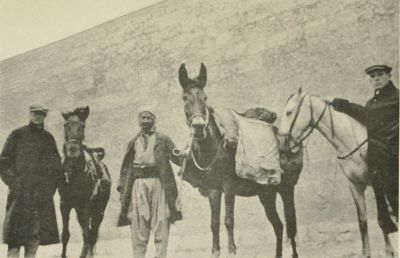
Our Start for Nazareth
We spent the day walking the ties in front of the station and went to Haifa for the night on the train from Damascus late in the afternoon. We had landed in Haifa when we first arrived in Palestine, and our second coming completed a small circuit. The next day we took the train that leaves at sun rise for Damascus. The only thing a Turkish train has in the way of accommodation is plenty of time. It hasn't a single convenience I can think of. I actually saw one train stop to allow two ducks to cross the track. One conductor threatened to beat me up because I made fun of his little engine and cars by running backwards beside his train and winning the race into the station.
The Sea of Galilee is a glassy, stagnant-looking body of water, and when we saw it was as calm as a plate of soup. It was so peaceful that one could hardly realise that it was capable of the storms described in the Bible. I was told that these storms take place on it to-day. Tiberias, the most vermin-ridden settlement in the world, stands on its shores. The River Jordan, which looks like a Southern California "wash" in winter, has its source in the sea. Richardson and I walked down to the banks of this mad-rushing little stream and filled a bottle with a sample of its water. This fluid looks and tastes like that of any water company in America. I have done nothing but give portions of my sample away ever since.
Beyond the Jordan the railroad crosses a vast plain which produces nothing but rocks. I don't think I ever saw so many boulders before. I didn't see a suggestion of vegetation or a sign of life in the entire distance from the Jordan to Damascus. We travelled across this weary expanse of nothing with a Greek priest, who spoke English, and a female missionary of the Church of England who had spent many years of her life converting natives in a village east of the Jordan.
Damascus is the oldest city in the world. It is the city in which Saint Paul became a Christian. It is larger than Pittsburgh, having over half a million inhabitants. It is famous for its picturesque markets and bazaars, which are the focal point for all the products of the interior of Syria.
Richardson and I took in the sights of this city without a guide, as was our custom. The Reverend Mr. Hanamar, of the English Church, told us how to get about most profitably. He is an authority on the Holy Land and Syria and had the task of revising Thomas Cook and Son's Handbook on Palestine and Syria. We walked the length of the "Street Called Straight." If it were not for the fact that every one who sees this street makes the same remark, I would here state that it is not straight. However, it is an interesting thoroughfare. With its wooden roof, its hundreds of picturesque shops and its hordes of humanity it is unique among the streets of the world.
The Great Mosque, which at one time was a Christian Church, is said to contain the head of Saint John the Baptist. I understand that a half dozen churches throughout Europe also claim this distinction. At any rate, it is interesting to note—and strange to think—that the Moslems have allowed the following inscription on the walls of the Great Mosque to remain: "Thy Kingdom, O Christ, is a kingdom of all ages, and Thy dominion lasts throughout all generations."
Our train from Damascus to Beirut travelled at the rate of six miles an hour. A man can nearly beat this walking. But out of justice to this train I should say that in a distance of eighty miles we had to rise three thousand feet to the ridge of the Lebanon Mountains. From the summit of these mountains a beautiful picture was suddenly spread before us. Directly beneath us was Beirut—its houses crowded in among the jungle of trees—and stretching out beyond to the horizon was the expanse of the blue and white-capped Mediterranean. Bobbing up and down on the waves was a small steamer flying the Stars and Stripes. It was the first American flag Richardson and I had seen since we left Manila. We decided to investigate it on our arrival in Beirut.
We were the guests of Professor and Mrs. Brown, who were connected with the Syrian Protestant College, one of the leading institutions of learning in the Near East. Beirut is a great educational centre, having forty schools for boys and twenty-five for girls.
The Syrian lace merchant, whom we met at Afuleh while waiting for our train, entertained us at dinner. After the meal we drank several cups of muddy-looking Turkish coffee with its inch of sediment in the bottom of the cup, and smoked a narghile, or hubble-bubble pipe. From our Syrian friend we learned that the little steamer with the American flag was the Virginia of the Archipelago-American Steamship Company. This concern was incorporated under the laws of the United States and carried the Stars and Stripes, although its capital and management were largely Greek. This arrangement was to serve as a means of protection against Turkey.
Richardson and I concluded that here was our chance for a free ride. We would go to the steamship company's office, announce that we were Americans, act important and demand passage to Constantinople.
"When does the Virginia leave for Constantinople?" I asked a man in the company's office after introducing Richardson and myself.
"In a few days, as soon as her cargo is loaded. She doesn't run on any schedule," was his reply.
"Mr. Richardson and I are studying conditions in Syria for an American newspaper syndicate and we want to get passage on your boat to Constantinople. We are paying special attention to the commerce and shipping of this section of the world and we wish to make a favourable report. We noticed that your steamer flies the American flag." There had been considerable criticism of the policy of permitting foreign concerns such as the Archipelago-American Steamship Company to fly American colours on their ships. The officials of this company were aware of this and when we gave the newspaper talk they imagined that we might make it a point to use their company as an example in our write-ups.
"But the Virginia is only a freight boat. She hasn't any accommodations for passengers. But——"
"We can put up with the crew," interrupted Richardson. "In fact we would rather travel in that way. We can get the sailor's point of view."
"Can you drop in again this afternoon? I will see what I can do," the man concluded after a moment's reflection.
"Rich, if we don't land that boat to Constantinople I will walk there," I said, as we sauntered along the waterfront from the steamship office.
Two nights later we were nicely settled in a stateroom on the Virginia adjoining the captain's. It was one of the most comfortable cabins we had been in. Across the way was a young Greek governess, a friend of the skipper's. She was also getting a free ride to Constantinople.
The scheduled time for the regular passenger steamers from Beirut to Constantinople is three days. The little Virginia see-sawed up and down the coast of Asia Minor, discharging and taking on freight, for two weeks. Richardson and I didn't care if it took six months for the journey or if she went to South America for a cargo.
We anchored off the shore of Tripoli but were unable to land on account of the city's being under quarantine for cholera. The little steamer continued on to Alexandretta. Richardson and I went ashore here and wandered in and out among the markets. It is a town of thirty thousand people and possesses nothing of extraordinary interest. The Virginia received orders to go to Bayas, a small port to the north, for several thousand boxes of oranges to be brought to Alexandretta.
Morning found us off the coast of Bayas. During the day a number of Greeks with their wives and daughters came on board. They were orange growers of Syria. Their presence meant jam for breakfast, a delicacy we didn't otherwise get. Richardson nearly disgraced America by the amount he ate. The steamer returned to Alexandretta that evening and discharged her cargo of fruit.
Mersina, a city of about fifty thousand people, was the next place on our itinerary. The night's trip proved a rough one. A strong wind stirred up a very heavy sea. The little boat was tossed about as though it had no weight. The waves broke over the ship and water mysteriously came in our cabin in spite of the fact that the portholes were securely closed. It was one of the wettest nights of my life. It seemed as though some one was emptying a tub of water in our room every minute. Everything was literally swimming in water. It was foot deep in our stateroom in the morning. Richardson and I waded out of the cabin as wet as two oysters and dressed in the saloon.
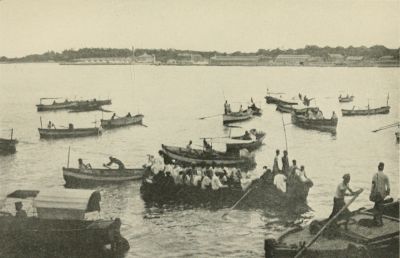
The Port of Dedeagatch
The night had been a wet one and a long one to us. But to the poor Greek governess in the adjoining stateroom it was one of continual distress. The gruesome and appalling shrieks and groans which emanated from this unfortunate creature indicated that she was in the last stages of sea-sickness. I have seen thousands of people suffering with this ailment but I never heard one perform as this young Greek did. All night she gasped for breath, coughed and choked. She gave vent to the most heart-rending whoops which penetrated to all parts of the ship. We thought the poor girl would strangle to death.
During the following night the steamer put into Rhodes. Much to our regret we were off before morning and there was no opportunity to land. A short stop was made at Khios, a small town on an island of the same name off the coast of Asia Minor.
We steamed into the beautiful bay of Smyrna with the city clinging snugly to a hundred hills clothed in a garment of evergreen. Every section of the world seems to have its Paris, and Smyrna has this distinction for the Near East. There are many French people among its half million inhabitants and the city is gay with cafés, theatres and places of amusement. We only had a short time to go about while the steamer discharged a small consignment of freight.
Two hundred Turks were driven up the gangway to go as deck passengers to Dedeagatch, a little seaport in Southern Bulgaria. It was a motley crowd of human freight that huddled in bunches on the forward deck. The men with red fezzes or soiled turbans and unkempt straggly beards were an unattractive lot. The women with their black dresses covering shapeless figures and with their veiled faces didn't look like human beings. They had the appearance of walking pyramids.
As Richardson and I wandered about the deck to look them over, the women would turn their faces or quickly veil themselves. It was immodest to expose this part of their anatomy to a man and especially to a foreigner. What a strange thing custom is! The women of America go clothed to the limit except in the ballroom, on the stage or in the water. The women of Japan are indifferent as to when or where they disrobe. The women of Turkey hide their faces on the approach of man. I was told that when Milady of Turkey is caught unaware in the bath she makes haste to cover only her face. Some of the faces I chanced to see look better behind their black curtains. It might be wise to introduce such facial disguises in America. I know instances where they would serve a laudable purpose.
Life on the Virginia was getting monotonous. The food had taken a slump from its fairly good beginning. We had little to do and time began to drag. We had read all the books on board. The steamer didn't remain at the various ports long enough for us to acquaint ourselves with the towns and cities—still less with the commerce and shipping interests of the country. We looked forward to Constantinople and some diversity.
We only remained at Dedeagatch a sufficient time to dump the human cargo of Turks, and then set out for Constantinople. We sailed through the Hellespont, passed the small town of Dardanelles, steamed across the Sea of Marmora and entered the Bosporus.
CHAPTER XV
GREECE AND ROME FROM A THIRD-CLASS COACH
Two weeks of the Greek freighter were enough, and Richardson and I rejoiced to see the picturesque sky-line of Constantinople come into view. We made short work of getting ashore as soon as the anchor was dropped and in a few minutes were on a local steamer going up the Bosporus on our way to Roberts College, the famous American institution of the Near East, where we were to be the guests of friends of Richardson's. Here we received a real welcome and once more began living the civilised life—as true Americans can when given a chance.
It had now been many months since we had left Manila and a job; and our exchequers, in spite of the economical methods of travel we had pursued, were being slowly depleted. However, as near as can be recalled, we had about two hundred and fifty dollars each and, although this sum is a mere joke when compared with the distance we were from home, still a man is not broke until he is broke. We concluded that if it was possible we would get jobs in Constantinople and at least break even financially during our stay there.
Looking for work in Europe is a very different thing from such a quest in the Orient. Indeed, we soon found that as a whole travel in Europe was far different and in many ways less interesting than in the Far East. Europe is the beaten path where the inhabitants of each country are organised and lie in wait to separate the American tourist from his coin. The paths are all cut and dried and everything is carried on along the lines of the personally-conducted sight-seeing tours. Jobs are scarce, and the few obtainable pay very small wages. The thrifty native can do the work as well as, and oftentimes better than, the transient American. The conventional character of European travel strips this pastime of two-thirds of its charm. Experiences, which one is daily encountering in the more or less primitive countries of the Orient, are not to be found in Europe. Civilisation, with its comforts and conveniences, eliminates the possibilities of adventure and the traveller, whether rich or poor, usually deteriorates into a bored and bleary-eyed sight-seeing machine.
After a couple of days' rest we set out to find jobs. We invaded Stamboul, Galata, Pera and Scutari, the three sections of Constantinople, and called on the American Consul, several large foreign mercantile houses, and a number of educational institutions. In nearly every instance we were dismissed with a laugh. Roberts College came to our rescue. Richardson received a position, if it could be elevated to such dignity by the appellation, which consisted of doing electric wiring in one of the college buildings at two dollars a day. Out of this he was to board and room himself. The best I could do was to become assistant instructor in physical culture in the gymnasium at thirty-five dollars a month and from this princely sum I was to pay for my board and clothe and shelter myself—in addition to providing for the many and sundry wants of an American in a strange land.
Richardson decided to accept and I to reject the respective posts. I concluded that I would rather starve moving than while stationary. We agreed to separate—Richardson to remain in Constantinople for a couple of months and I to continue on alone,—to meet later in London. Before our separation we made a systematic and tourist-like conquest of beautiful Constantinople. We went up the Bosporus and travelled in circles on the Black Sea. We explained the interesting but backward city itself. We made our way among the quaint bazaars and finally came to the Mosque of San Sophia. Here I took leave of Richardson and we planned to meet in London in a few months to cross the Atlantic to America together.
I did not have any itinerary. My plan was simply to go through Europe. I decided to go from Constantinople to Greece. The first-class fare to Athens was eighty francs. At this rate my supply of coin would not last long. I knew I could beat that. I visited several steamship offices along the waterfront in search of cheap passage.
Accompanied by a Greek, as an interpreter, I entered a dingy little office.
"When does the next boat leave for Piræus?" I inquired of a moon-faced man in uniform behind a counter.
"To-morrow morning at nine o'clock," was the reply by way of the interpreter.
"What is the fare?" I asked.
"Thirty francs," was the response.
"That's too much," I said, starting to walk away.
"What will you give?" asked the steamship company official.
"Five francs," I uttered, smothering a smile at the smallness of the amount.
"All right," agreed the officer—and I bought my ticket at once. I was so astonished that I could hardly dig up the money fast enough. As I left the little office I concluded that my luck had not left me on setting foot in Europe. I shipped my suit case direct to England, deciding to travel with only a small hand bag.
As my boat did not leave until morning, I now had the evening in which to stir up some excitement. I wandered along the streets of Constantinople ready to welcome any one or anything that came my way. Presently a sign "American Bar" greeted my eyes and in I immediately went, thinking that there the English or American language would be spoken and I might find a companion of some sort. I found that French was the only means of communication. Shortly, however, a man entered the place who knew a little English.
"Where can I find a bit of excitement this evening?" I asked.
"There is nothing going on to-night except at the Paris Café," replied the man.
"What takes place there?"
"Music, theatre, pretty women and plenty to eat and drink."
"Where is this café and how do I get there?" I asked, determined to investigate the establishment.
"The proprietor will be here in a moment and you can go with him."
In a few minutes a sleek-looking Frenchman arrived and was introduced, and in a second I was off with him in a closed carriage for the Paris Café. We rode on for an hour. It was nine o'clock in the evening. The Frenchman didn't speak a word of English. I began to think that I was up against a knockdown and drag-out game. I decided to stick, however, and see what this Paris Café was. We rode on. Finally, the carriage came to a stop and we alighted in front of a small house, brightly illuminated, from which was emanating the maudlin laughter of male and female voices. There was not another house to be seen. We might have been in the midst of an American prairie from the appearance of the darkened landscape. My French companion and I entered the house. I reluctantly paid the equivalent of one dollar admittance. On entering, the Frenchman was lost in the crowd and I was left to find my own way. An inebriated gathering of French life greeted my vision. I seated myself at a table in one end of the large room, ordered a drink and in a careless manner took in what was about me. A dozen or more tables with six or eight people at each occupied half of the hall, a highly-polished floor for dancing took up the other half and at one end was a stage on which a succession of scantily-clad French women of tender age executed a series of sensuous dances while the maudlin crowd cheered and applauded.
I sat at my table unnoticed for fully an hour. At last, an ill-shapen feminine individual advanced and, in broken English supplemented with portions of French, asked me to join her crowd in an adjacent room in some refreshments. I accepted. I considered that I was not a fool and could take care of myself, and decided that I would investigate the place to the limit. I joined this select party of eight. Liquid began to flow freely and all were very solicitous that I should drink my fill. Being suspicious of the whole proceeding I decided to drink nothing. I had fears of being drugged, robbed and thrown out in an alley to spend the night. My fears were well founded. The gang became more and more intoxicated. They reached the point where they evidently thought that I was ripe to pluck, and two of them ventured to separate me from my money. It would have been a fruitless effort, if it had been allowed to proceed to its consummation, for I had left all my coin, with the exception of a small amount, in my hand bag at the steamship office. My assailants plunged towards me like huge tigers. They were so drunk that they were helpless. I handled them like a pair of twin punching bags and left the room and the Paris Café with one man stretched out so flat that he looked like an inlaid design on the floor, while his co-partner was so completely pasted against the side of the room as to be hardly distinguishable from a figure on the wall paper. After this clean-up I calmly walked out of the joint, ordered a hack, drove to town, put up at a little Greek hotel and had a good night's sleep.
In the morning I boarded the Greek steamer ΙΣΜΗΝΗ. My bunk consisted of nothing more than a niche in the side of the ship—similar bunks being occupied by a score of Greeks—and my food was a supply of tinned goods I had purchased in Constantinople. The next day at sunrise we were off the shore of the Dardanelles, and here we spent most of the morning waiting for the sea to subside in order to land a herd of cattle and a small flock of unhealthy-looking sheep. The sea continued to rage and it was not long before our common sleeping compartment presented a most distressing scene, with a Greek chorus which so affected me that I nearly joined the regurgitating throng myself.
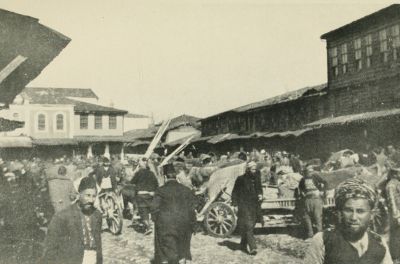
A Market in Constantinople
Early the third day the Greek ship arrived at Piræus, the port of Athens, and without stopping I betook myself by electric car to the capital. I went directly to the "American School of Classical Studies" where I presented a letter of introduction to Dr. Clyde Phaar. This gentleman—for he surely was one—conducted me about the city of Athens and I spent two most interesting days visiting the Acropolis, the Olympieion, the Theatre of Dionysis and many other ancient structures.
On leaving Dr. Phaar I returned to my old level and picked up a couple of Greek peasants who led me to their various haunts. One evening, after a seven-cent meal (consisting of stewed liver, kidney and other entrails) in the most unsanitary restaurant I ever saw, I left Athens for Patras, laden with many introductory letters from my Athenian friends to Grecian fruit vendors and candy fabricants in New York City.
After travelling all day, with an hour's delay at Corinth, due to a defective engine—which time I utilised by sight-seeing—I arrived at Patras in the evening. I was besieged by an army of hotel men as I was leaving the station and nearly landed in jail, instead of an hotel, for beating up an especially persistent hawker. However, I managed to find an hotel and I spread myself to the extent of eating a first-class dinner, the first food for the day. With this meal safely placed away I strolled up the street. I was ambling aimlessly along; my thoughts had drifted to America, when I was attracted by a Greek of about thirty years, who called to me from across the street, addressing me as "Charlie." As there was nothing on the calendar, I responded to my new name and crossed over to see what the native wanted.
"Where are you going, Charlie?" he asked.
"No place," answered Charlie.
"Come along with me then," said the Greek in good English.
"Where are you going?" I enquired, preferring to know something of my destination.
"To call on some of my relatives and friends." My boat for Brindisi did not leave until midnight and I had plenty of time to learn something.
We strolled along a winding road lined on each side with little native houses. Our first call was on the Greek's aged aunt, a peasant woman, whose husband had been killed, a few days before, in a duel with a neighbour. The house in which this simple and grief-stricken woman lived was a low thatch-roofed adobe structure with the earth for its floors. It was a near-to-nature residence and I was impressed by its almost spotless cleanliness and neatness. We remained in this little home for nearly an hour while the poor woman poured out her troubles to her nephew, who later informed me that he had assumed the responsibility of her support since her husband's death. We next called on the Greek's older sister. This Grecian peasant home was also an interesting place and was as immaculate as its predecessor. With this second visit completed, my companion evidently had performed all his obligations and he now felt at liberty to call on some of his girls. Our last visit was at the home of a travelling butcher, who saunters about the town pushing a one-wheeled vehicle, resembling a wheelbarrow, laden with carcasses of cows and sheep, from which he hacks off a chunk whenever he finds a customer. The walls of this modest mud house were literally plastered with calendars, newspaper pictures and display advertisements. It was inhabited by a most interesting set of human beings. There was the mother with her three youngest huddling around her skirt like little chicks around the proud old hen; there were twin girls of about twelve years, who spent their energies giggling at the idiosyncrasies of the American guest and there were two young women of some twenty-one summers. There was also a boy of about sixteen and from the accounts of his mother he must have been the tough lad of the neighbourhood.
The two young ladies, whose names were Miss Vaseleki Caetina and Miss Caraperpara Caetina, were bright, healthy creatures in spite of the fact that they worked fourteen hours a day, one in a stocking factory and the other as a dressmaker.
My visit was considered a great distinction and my presence was soon noised about the neighbourhood and an endless file of proud mothers came to exhibit their offsprings to me as I handed out compliments and passed comments on them by means of my Greek companion. The Misses Caetina became so infatuated with the sample American, in spite of my travel-worn and trampish appearance, that they insisted on their mother's inviting me to dinner. What they would have done to a regular American one can only surmise. I was enjoying the affair to the limit of my capacity and if I had been invited to a suicide I would have accepted.
The meal was served in the most informal way in what might be termed the parlour. Informal is hardly the word. Jam came straight from the jar to the eater's mouth. One spoon did service for the entire gathering, each one using it in turn without any cleansing process intervening. Still having some ideas of hygiene in spite of my unsanitary experiences, I considered myself fortunate in being the guest and, therefore, getting the first fling at the much-worked spoon. Greek wine was poured out in lavish quantities and, not being acquainted with the inebriating efficiency of this liquid, I partook of it cautiously. Strips of dried meat, squares of bread and walnuts completed the repast.
The evening was an entertaining one and I took my leave while the young Grecian maidens danced with joy as I wrote down their names and promised I would drop them post cards from Italy. This promise I fulfilled.
I now turned my thoughts towards Italy. A much-travelled man once advised me that if I had but six months in which to tour Europe to spend four of them in Italy. Although I do not agree with his ratio, I do thoroughly believe that four months is much too short a time to even get a start in this wonderful land, rich in everything that interests an intelligent human being. But lack of funds haunted me with the necessity for speed and, much as I regretted it, I had to keep moving on.
A sea trip of two nights and one day brought me to Brindisi. I took the first train to Naples where I arrived after a delightful route through green fields, prosperous farms and orchards and a country radiant with the bloom of youth, for it was the early spring-time. I put up at a small rooming house with eating arrangements connected, which I discovered near the station.
Italy proved to be a land of little adventure. The traveller has nothing to do but go sight-seeing and about the only way in which to encounter an unusual experience would be to go out in the street and deliberately insult some one. Not having any desire to do this I became a simple and ordinary tourist, and the following sample from my diary concerning my activities in Naples very clearly illustrates this:
"Saturday:—I nearly walked my crimson head off to-day. Armed with a Baedeker, I went after Naples with the persistence and energy of an American book agent. I managed to get about very satisfactorily without a guide or even the disbursing of a single tip.
"In the morning early, after carefully studying the Baedeker map, I went to the Villa Nazionale, a public garden next the sea, with many trees and marble statues. The 'fashionable' world flit to and fro in their automobiles on the broad Via Caracciolo along the water, while the scum and tramps, like myself, get out of their way in the best manner we can or are run down and trampled into eternity. In the Villa Nazionale is the famous Aquarium, which I will visit to-morrow—as on Sundays the admission is one franc instead of two.
"From this park I went to the English church, a fine large building, with a tasteful interior, quite in contrast to the churches of the Papal obedience which I have seen. I wandered through busy, noisy streets,—the inhabitants of Naples are the noisiest people I think I ever heard—and came to the large church of San Francesco di Paola—a modern edifice—having been constructed in 1817-31. In the interior are superb marble columns, modern statues and pictures and a high altar inlaid with jasper. It impressed me more favourably than other churches of Naples because time had not filled it with a lot of gaudy fixtures.
"Passing the Plazzo Real and the Theatre of San Carlo, I went in the Galleria Umberto Primo, a beautiful arcade containing many high-class shops. I walked by the Municipio, a large square structure used for city offices, as its name suggests, and came into the Via Roma or Toledo, the main street of Naples. Jostling along this thoroughfare for awhile, I turned off on a side street and spent some little time in the Jesuit church of Gesu Nuovo. Near-by I visited the Church of Santa Chiara, built in the fourteenth century and richly but tastelessly decorated. It contains numerous altars and many paintings, and the ceiling is a solid mass of gilding. Referring to the map in Baedeker I directed my course to the Church of San Domenico Maggiore, erected in 1289 and restored several times. My guide book states that some of the great families (great because of inherited wealth, I suppose!) of Naples have their chapels here.
"I next found my way in some mysterious manner through the narrow foul-smelling alleys of the slums to the Cathedral of San Gennaro. This church is in the French-Gothic style and is not especially attractive. It contains a shrine called the Chapel of Saint Januarius. In the tabernacle of the chief altar of this chapel there are two vessels containing the blood of Saint Januarius, Bishop of Benevento, who suffered martyrdom in the fourth century. The liquefaction of the blood, which, according to the legend, took place for the first time when the body was brought to Naples, occurs three times a year on several successive days. On the occasion of this liquefaction thousands of the faithful make pilgrimages to this shrine for prayers and offerings, for by means of this liquefying a forecast can be made of the prosperity of the land.
"From the Cathedral I went to the Castel Capuano, once the residence of the Hohenstaufen, later of the Angevin kings and, since 1540, the seat of the law-courts. Close by is the Porta Capuano, one of the finest existing Renaissance gateways.
"In the afternoon I walked along the Via Tossa, a winding street which ascends the hill behind Naples and which passes many beautiful buildings and from which good views of the city and bay of Naples may be had. I took a cable car lift and went up to and around the Castel Sant' Elmo, fortified with huge walls and now used as a military prison. Near this castle I visited the Church of San Martino. This church seems to be deserted so far as religious purposes are concerned, and has been turned into a money-making institution. In the Tesoro, a room beyond a sacristy, is a "DESCENT FROM THE CROSS" by Ribera and on the ceiling "JUDITH" by Luca Giordana—who is said to have painted it in forty-eight hours, when in his seventy-second year. This sounds like a California fish story.
"Adjoining the church is the museum, which contains many sculptures, paintings and ecclesiastical vestments. From the Belvedere, a spacious balcony, is an excellent view of the city and of Vesuvius beyond.
"Sunday:—I spent two hours this morning (admission free on Sundays) in the Museo Nationale. It contains a fine collection of marble and bronze sculptures, most of them from Herculaneum and a few from Pompeii—the bronze exhibition consisting mostly of household utensils and affording an admirable insight into the domestic life of antiquity. The museum also contains a gallery with many beautiful and masterful pictures and also an unrivalled collection of vases.
"Later in the day I visited the Aquarium, which was very interesting, although not so large as the one in Honolulu. The sea life it contains is of a different species, being from other waters, but there are not so many varieties as in Hawaii.
"The shops, streets, and tenement sections of Naples are unique. Noise, congestion and colour are their most predominant features. Every man who is not a priest is engaged in ravenously devouring a greasy string of macaroni, while the women are shouting inhuman shrieks in the effort to sell a bottle of red wine."
The feeling of loneliness, which seizes us all at one time or another, is probably more acute, when—travelling alone—one enters a large city in a foreign land where he doesn't understand the language and doesn't know a single soul. Especially is this the case when the traveller is making his way on a sum which is so small that rigid economy has to be practised every minute of the day.
Never was I more impressed with this feeling of loneliness than when I arrived in Rome at midnight. It is a simple thing for the opulent traveller to alight from his first-class train and take a carriage to the leading hotel, but it is a very different matter for the lone and coin-depleted tramp to find board and lodging commensurate with his meagre funds and, especially so, during the middle of the night. The greatness of Rome, its magnificent history and its position in the world to-day made me feel as insignificant as when one gazes into the heavens on a moonless night and beholds the stars. I swung off a third-class coach, made my way through the crowds in the station, elbowed the hotel hawkers aside and reached a street corner, where I stood for a moment's reflection. I might as well have been in a jungle so far as knowing where to go next. I finally set out in search of an hotel, and for two hours I hunted in vain. I inquired for a room at every establishment over the door of which was printed the word "portier." My hotel in Naples had displayed this sign and I concluded that all places with such a label were hotels. Working under this delusion I canvassed every building which bore the inscription. No one would take me in and I couldn't make any one understand me. I began to wonder if there was something about my appearance which made me an outcast and caused the portiers to regard me with suspicion. Some of the supposed hotel-keepers laughed at me, others nearly threw me out, while still others seemed to regard me with pity. I became discouraged. It was now two o'clock in the morning. Was I to pace streets all night, luggage in hand, in search of a place to sleep? Tired and disgusted I decided to retire in the first vacant lot I came to, if Rome had such things. Presently I came across a large open space which appeared in the darkness to be some sort of an ancient excavation or ruin. This was good enough, I thought, and I scrambled down the decomposed steps and in a few minutes was sound asleep in a secluded corner of this deserted square.
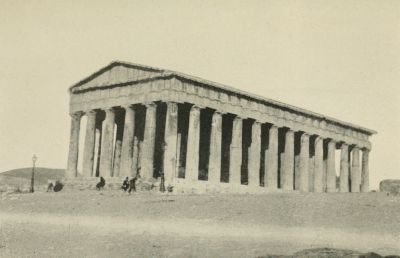
The Temple of Theseus
I awakened early to recognise that my bedroom was no less than the Roman Forum. A smile rippled over my unshaven face and my thoughts were shifted years back to the time when I studied in school of the ruined Roman Forum and how at that time I little realised that the day was coming when I would wake up, like a tramp, and find myself surrounded by its huge and stately old columns.
I explored the venerable place at once and, although it was six o'clock in the morning and I had not eaten, I opened my Baedeker and spent two hours reading and becoming familiar with this ancient seat of oratory and modern domicile for hoboes.
Later in the day I found a modest little hotel whose proprietor spoke English quite fluently. He explained to me that the reason I was unable to get a room on the preceding night was that I probably did not inquire at a single hotel. He informed me that many buildings in Rome had a porter or caretaker and usually had the sign "portier" over the door. I had been trying, in the early hours of the morning, to force myself into wholesale houses, department stores, private homes and what not. In each instance I had, unknowingly, applied to the watchman whose duty it was to keep off all intruders and burglars. It is a wonder that I wasn't shot down.
Probably the first point to which the traveller in Rome directs his steps is Saint Peter's and I was no exception. I took a car to this wonderful church and spent the entire day drinking in its marvels. From the lantern on the dome (where I poked my crimson head—five hundred and eighty-three feet above the ground—and took in the amazing panorama of the Eternal City) to the main floor, I left little unseen. I was quite content to be a spectator and took no active part in the customary devotions of the average pilgrim. As I watched the long line of the faithful file by the large bronze statue of Saint Peter and osculate his big toe—which has been worn down, through the centuries, nearly half an inch by this unsanitary process—I decided to give these poor peasants a lesson in hygiene, but the play was taken away from me by a high dignitary of the Church. A well-fed clean-shaven man, dressed in a red cassock, was approaching the statue, accompanied by another ecclesiastic in purple. At once I recognised them as a cardinal and a bishop. They were going to kiss the toe of the saint. I forced my way through the crowd to see how they would act. The cardinal drew a white handkerchief from his cassock and diligently set to work to give the toe of the huge figure of Saint Peter a vigorous scrubbing. He was so adept at these menial movements that I concluded he must be one of the peasant prelates of whom we hear so frequently in America. The respectful pilgrims were much interested in the cleansing which the cardinal was giving Saint Peter's toe, but the example was of no avail. When he was satisfied that the member was sufficiently sterilised, the church official stooped and brushed it with his lips. He was followed by the bishop. Then the thousand or more ignorant pilgrims passed by and performed this act of devotion without a thought of a microbe. I can image the activity that would be exhibited on this toe under the lens of a microscope after such an army of the unwashed had filed by.
The next day I returned to Saint Peter's and took up as companions an American Methodist preacher and his wife, who were en route to India to resume their missionary duties. This unrefined and prejudiced pair of representatives of our Great Middle West performed their sight-seeing obligations in a thoroughly bigoted Protestant manner. The Pope and all his adherents were denounced every time a new picture came to their notice and as they watched the priests of Rome chanting the ancient liturgy. They were not very pleasant companions but I concluded that they were better than none at all.
Each day during my stay in Rome the three of us would meet in the morning, map out our itinerary and follow it closely. We visited the Vatican—that atrocious piece of architecture; we spent some time in the Sistine Chapel with the usual horde of tourists; we drove to the Coliseum and the Pantheon and saw hundreds of churches in all parts of the city.
We hired a carriage, with meter and driver, and rode, along the Appian Way to the Catacombs of Saint Callixtus. As we alighted at our destination I took down, in my note-book, the figure that the meter registered, having a suspicion that the cab driver might cheat us. My suspicion was well-founded for, on our return, the gauge indicated that an additional six miles had been rung up. The fare was cheap enough and we had little objection to the amount our bill was approaching. However, I remonstrated with the driver to let him know that our eyes were open and that he had not tricked us without our knowledge. The climax of this incident was reached at the end of our journey when, in exacting our bill, the driver with a sudden jerk of the meter forced it up five points more and then insisted on money for the last dishonestly acquired mileage. We, of course, refused and paid him only for the distance we had travelled, plus the increase registered while visiting the Catacombs. As we walked down the street he followed with his carriage loudly demanding more money. Finally an Italian policeman intervened and we were brought to the first police station. Here the magistrate heard both sides of the tale and on giving the matter a few minutes' consideration told us to go on our way and placed the poor cab driver under arrest for fraud.
For a city with a distinctive atmosphere I recommend Florence. To walk its various streets is a rest for the weary. After the teeming millions of oriental cities, the repose and quietness of this attractive town is most restful. Florence is worth a visit if one only sits in its beautiful cathedral and thinks. Its identity as the birthplace of Dante, of Petrarch, of Boccaccio, of Galileo, of Michael Angelo, of Leonardo da Vinci, of Andrea del Sarto and a host of other great minds is sufficient to stamp it with a character which none but the dumb brute would fail to discern.
With the contents of my pocketbook approaching the vanishing point I could only visit the large cities of Italy and had to give up all idea of seeing the countless small towns and villages with their wealth of historical association and present-day charm. However, even a tramp would not think of touring Italy without spending a few days in Venice. Its unique situation, if not its rich past, would be sufficient incentive to have it included in the itinerary of the most humble traveller.
Venice is a city without a wheeled vehicle, without trees, without sidewalks and without many of the ordinary appliances found in a modern community. Situated as it is on a cluster of seventy-two small islands, each inch of space is utilised and there is no subdividing of large tracts of land into fifty-foot lots. Its streets are a regular maze and the only way to get about, in the event one does not hire a guide, is to follow the crowd and trust to luck. This was my method, which at times proved very interesting. In this manner I wandered aimlessly along and, after a couple of hours' walking, the beautiful Piazzo of San Marco burst upon me. It was a scene I shall never forget. Several thousand people were assembled for a band concert and I was shortly lost in the crowd and had nothing to do but take in the many interesting things about me. The stately and oriental-looking church of Saint Mark at one end; the imposing Campanile, the ornate Palace of the Doges and the old government buildings now converted into stores and cafés, presented a picture for beauty and symmetry of design which is probably unequalled.
In the middle of the square a man drove a donkey hitched to a small cart, and the novelty of the conveyance aroused the curiosity of not only the children but of the grown people as well.
Midnight seemed to be the hour at which I was destined to make my advent into nearly all European cities. It was at this hour that my train pulled into Milan. Finding cheap hotels had almost become second nature to me and, with little difficulty, I located a comfortable domicile and was soon enjoying the rest which no one but a weary traveller can truly appreciate. Most of my brief stay in this city was devoted to the famous cathedral. This church, the second largest in Europe, stands alone from an architectural standpoint. It is richly decorated with statues and sculptured pinnacles—more than two thousand in number—which from the street look like countless inverted icicles.
CHAPTER XVI
EUROPE ON A VANISHING BANK-ROLL
My journey through Europe was a foot-race. I was trying to beat a bank-roll which was rapidly diminishing and which I feared would be totally exhausted before I reached England, where I hoped to get work. If my money had been rubber I could not have stretched it over a greater distance.
From Milan to Zurich is a big jump in Europe and especially is this true when one considers the perfect Paradise of things there are to see. But with my depleted financial condition always confronting me I had to press on and to content myself with a train-window view of the beautiful Italian "lake country" and the rugged scenery of Switzerland.
Why I went to Zurich, I don't exactly know, but I suppose it must have been the cheapest trip open to me. Aside from scenery Zurich possesses little of interest. After a few hours there, during which I visited the Ton-halle, the cathedral in which Zwingli—the Swiss reformer—set forth his peculiar doctrines and made an excursion of the town, I went on my way to Munich.
My train journey was broken by a trip on a little steamer across Lake Constance. This small body of water is on the boundary line between Switzerland and Germany and, on landing, I was received by a German policeman who evidently sized me up for a spy. I took him for a baggageman and when he spoke to me told him to "beat it." He resented my tone and manner and pressed his solicitations with a little more severity. At last it dawned on me that he was an officer and I decided that for my general welfare it would be well to treat him more courteously. I soon learned from him that he wanted my passport. I had that document in my possession but knew that it was not necessary for an American citizen to present such an instrument in Germany so I declined to produce it. I was able to satisfy the inquisitiveness of the gentleman by answering a few questions, and he allowed me to go on my way.
In my diary I find the following entry concerning Munich:—"Munich is celebrated for two things, its art and its beer. I spent little time on the art but confined myself to the beer. I sampled it thoroughly and can say that it is a high-class liquid. For the equivalent of two cents one gets a large glass, and for five cents a toilet pitcher sufficiently large to drown a ten-pound baby.
"There are no saloons in Germany or on the continent of Europe, liquor being sold in restaurants and cafés, all respectable places frequented by women as well as men. I once knew a good American Baptist woman who was as strict an abstainer as ever lived, but she could not withstand the temptation to partake of beer in Munich during her sojourn there. I understand that many staunch prohibitionists temporarily fall off the wagon in this manner.
"In Italy every one drinks vino, but in Germany men, women and children drink beer. For an Italian to eat a meal without wine or a German without beer would be considered in these countries as extraordinary as if a man should bathe his feet with his shoes on. It is a common enough thing to see a pretty German girl of eighteen calmly drinking a schooner of beer instead of the afternoon cup of tea of her American sister. Absolute prohibition has no more chance in Europe than the snowball of the classic simile, and one might as well talk to a turtle on the subject as to these liquor-drinking but temperate peoples."
From Munich to Vienna is about a day's journey and the third-class accommodations are the poorest I encountered in Europe. I sat in one of these compartments with three Austrians for the entire distance without saying a word, assuming that none of them spoke English. As our train was drawing into Vienna I unthinkingly enquired the time of the man opposite me. He replied in excellent English and we both smiled to think that all day we had sat in silence although communication would have been possible if we had only known it.
"You are an American, are you not?" he asked.
"Yes," I replied.
"What are you doing away over here?"
"Just knocking around the country," I informed him. "Do you know where I can find a cheap hotel in Vienna?"
He said that he did and, when we arrived at the station, very kindly conducted me to a clean and modest hostelry.
"What are your plans for the evening?" he enquired.
"I have none," I said.
"I expect to meet a couple of my friends and should be very glad to have you come along," he added cordially.
I cheerfully accepted this opportunity of making some acquaintances in a city the size of Vienna. We boarded a street car, received a transfer about the dimensions of an American Sunday newspaper, changed to another line and were soon at a café, where I was introduced to his two friends.
These three Austrians were clean-cut chaps of the middle class. During the evening I learned that their occupations were respectively piano-tuner, barber and window-trimmer. To add an American tramp to this trio made, I thought, a rather extraordinary assortment of vocations. The prospects for a lively evening looked very gloomy, for the combined wealth of such an aggregation was naturally small. We dined at a big restaurant and then set out to see the town.
First we lodged ourselves in one of Vienna's large cafés, where we remained for two hours watching the fascinating crowds and listening to the music. During this time we had but one glass each of the delicious Vienna coffee and when I suggested that it was only right that we should continue to buy while sitting at a table and enjoying ourselves my companions assured me that it was all right to spend a whole evening in a café with the purchase of but one drink, for every one did it. As an American this seemed strange to me, to say the least. I confess that I felt rather sheepish about it.
The barber and the piano-tuner bade us farewell and the window-trimmer and I started out to see Vienna by moonlight. I shortly discovered that the party was to be at my expense for, as poor as I was, I was a rich man compared to my Austrian companion who from his vocation received a salary of twenty dollars a month. However, I was willing to carry him for a while as he was not only good company but served as an excellent guide.
The places we left unseen in the night life of Vienna do not exist. My window-trimmer friend certainly knew the town and led me into all the cafés and joints he could find. We were ready for anything and after a general round of the more respectable places we heard of a large public ball which was being held in the opposite side of the city, and thither we decided to go. The late Hinky Dink's dances in Chicago or the "Chickens' Ball" given in honour of an ex-pugilist in San Francisco might be considered the last word in refinement compared with this Vienna function. It would be indiscreet to go into a detailed description of this "social" affair for fear of infringing on the American postal laws. The immense hall was crowded with representatives of Vienna's underworld. The women were attired in short skirts, tights and one-piece bathing suits. Liquor was so plentiful that it rose and fell like the ocean tide. The rag, the turkey trot and other modern dances of America, which are the subject of so much criticism, would look like devotional exercises alongside of the steps that were executed at this four-in-the-morning function.
The daytime I spent by myself seeing the more ennobling sights of the city, while my Viennese pal arranged neckties, collars, shirts and pajamas in the windows of a large clothing store. With the aid of Baedeker I made as thorough an investigation of the daylight sights of the city as I had made of those of the night.
Each evening I met my native friend. One night we went for dinner to a quiet little restaurant, where we made the acquaintance of a floorwalker in one of the large department stores of the metropolis and his elderly fiancée, who were seated at the same table with us. They were an interesting pair. It was a mystery to the woman why I should have wanted to come to Austria when America was such a fine country. "You must be very rich to be able to travel around the world," was a remark she made—a remark I had heard probably five hundred times during my trip.
On the way to the café the window-trimmer and I were approached by a street vendor who was selling plaster of paris busts of the famous men of Austria.
"How much are they?" I enquired.
"Two dollars each," he replied.
"I will give you a nickel for one," I said as a joke.
"All right, sir," he exclaimed in an instant, and half dazed with the sudden reduction in his price I bought two of the images, giving one to my friend. The other I purposely let fall on the cement sidewalk and the bust of Francis Joseph, whose likeness it was, went into a thousand pieces at the feet of the vendor—who was much disgusted at my wilful extravagance. The Austrian drew the bust of a two-year-old baby, purporting to represent one of Austria's illustrious sons at that tender age, and this ungainly toy he presented very formally to the café keeper's wife, who presided at the till. She received the piece of bric-a-brac in a most gracious manner and with much amusement. The baby was perched on the top of the till and there remained the rest of the evening.
Late that night I was the guest of the window-trimmer in the room in which he lived. He had prepared a supper of rye bread, cheese and beer. The repast consumed, he entertained me by playing a few simple tunes on his cheap and shabby-looking violin. About midnight we separated and as I was leaving Vienna in the morning we said our last farewell—among the most touching of my trip.
On my way to Budapest I made the acquaintance of a Serbian fisherman, an Hungarian blacksmith and a plumber. They all spoke English, for they had lived in America, and when they were not talking to me they were expounding the fine points of that nation to their countrymen in the third-class coach of the train. A Roumanian who was aboard, becoming interested in my travels, invited me to be his guest on a three weeks' horseback trip through the mountains of the Balkan States. He said that we could put up at farmhouses for nothing and that my only expense would be the hire of the saddle and the horse. This was a very alluring invitation but the state of my finances made it impossible for me to accept.
Baedeker states that only the "lower orders," whatever that means, use third-class coaches in Europe. He should travel in this manner for a while and he would change his mind. The German third-class is good enough for any human being, and the passengers whom I met looked very civilised and had all the appearance of taking at least a weekly bath and of wearing underclothes. The Austrian third-class is an exception and carries a lower grade of humanity, representatives of the Great Unwashed, who comprise about eighty per cent. of this earth's inhabitants.
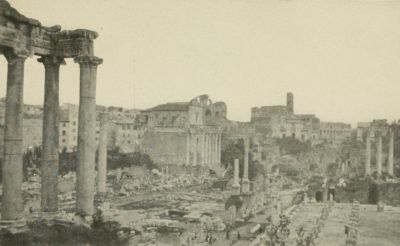
The Roman Forum—A "Vacant Lot" of Rome
I mingled with the bustling crowds on the streets of Budapest for three days and then became a second-class passenger en route to Paris, there being no through third-class coach. This journey through the beautiful Austrian and Swiss Alps was uneventful. I was only entertained by a German, who had returned from America where he held a position as cook in a short-order restaurant in Butte, and a French couple who fed their two-year-old baby large quantities of beer. This infant had a capacity that would make many an American undergraduate envious.
Alighting from my train at midnight I walked through the crowded station and in a minute was making my way along a deserted street of Paris. I intended to locate an hotel as soon as possible. I had hardly gone a block when a heavy down-pour of rain set in and I foresaw that I was in for a thorough drenching unless I sought shelter at once. At that moment a man appeared out of the darkness and enquired if I wanted an hotel. It had been my custom to decline all street hotel hawkers but, in view of the heavy rain, I decided to accept the services of the man and to find out what kind of an establishment he had. He took my hand bag and started back towards the station with me close behind him. We turned to the right and walked along the railroad tracks while the rain continued to come down in torrents. Three blocks in this direction and my guide crossed the tracks and proceeded down a dark street. Suspicions began to arise within me as to where the Frenchman was leading me. My knowledge of French was so limited that I could not find out anything but that I was going to an hotel. I decided to continue. I had heard stories of how innocent travellers are sometimes trapped by the thugs of European cities, drugged and robbed. This thought came to my mind but did not weaken my determination to go ahead and get under cover as soon as possible. We continued along this dark thoroughfare. We seemed to be in the wholesale district and there was not a human being in sight. Finally we turned down a narrow alley, at the end of which was a decrepit stairway. Up this rickety flight we ascended and at the top turned into a room dimly lighted by the intermittent flicker of a candle, which was resting on a high desk. Behind this desk I could see a bearded Frenchman who peered over his spectacles as the two of us entered. My guide and the old fellow exchanged a few words and I was conducted down the hall to my room. This compartment contained a wash-stand and a heavy wooden bed. Inside, my suspicions began to increase as to the safety of my place of abode. There seemed to be an atmosphere of mystery and I thought that I might expect anything. I listened at the door for strange sounds but heard nothing but a creaking noise which seemed to come from the back end of the building. Before retiring I decided to take every precaution and made up my mind that if any Frenchman attempted to disturb my rest with the intention of relieving me of my money he was going to be welcomed with at least the best fight he ever encountered. I first locked the door with a pass key I had in my possession. Then I placed the back of the bed against the door and wedged the wash-stand in between it and the wall. The room was so small that the stand made a tight fit in the space left for it. Armed with a piece of pipe I found in one of the drawers of the wash-stand I threw myself on the bed, clothes and all, and shortly was as sound asleep as if guarded by a regiment.
My suspicions may have been nothing but a bubble to explode in the morning. However, I am sure that I was in the proper place to be stripped of my coin by any means necessary. I evidently was not worth plucking. I was awakened in the morning by the moving trains in the yards near-by and without any delay grabbed my bag and in a minute was out of the joint on my way to a more civilised part of the city. I learned from a French shop-keeper a few days later that in this very lodging house in which I feared foul play, two Englishmen had been gagged, robbed and dumped into an alley for the rest of the night.
My experience in this hotel netted me two things: scabies and influenza. The bed clothes were so filthy that I was infected by a germ which penetrates the skin and causes no end of trouble. It was fully three months later that I mastered this disease, known by the euphonious name of scabies, and only after prolonged treatment by a doctor. My exposure to the rain and cold gave me an attack of influenza which, with its accompanying fever, pains and aches, was poor equipment with which to see Paris.
In spite of this malady I kept moving and succeeded in finding a clean and comfortable room at one franc a day on the fifth floor of a small hotel. The main objection to this place was the absence of an elevator and it was a most fatiguing effort for a sick man to climb these five flights several times a day. Later I learned that I had not much improved upon my neighbourhood of the first night, for I was now located in Monte Mart.
To spend a few days in Paris without company except a case of influenza was anything but a cheerful outlook. I went to a drug store and told one of the clerks my symptoms. He put up a prescription which I took conscientiously, at the same time exerting my will power not to let the disease get sufficient hold on my constitution to force me to bed and make me a public charge of the municipal authorities. Each day I arose, hoping that my fever would subside, and dragged myself about the city. On the Rue de Turbigo in the vicinity of the Halles Centrales, I fainted away and fell to the sidewalk. When I recovered consciousness I was speeding at a rapid rate in an ambulance for the municipal hospital. A glass of water was being choked down my throat. This resuscitated me. Accompanied by one of the ambulance attendants I returned to my hotel.
The average visitor to Paris places himself in the hands of a guide connected with one of the large hotels and is thus relieved of all the routine and detail of systematically and profitably seeing the city. A guide is a luxury never meant for a poor man. I never entertained the thought of hiring such an individual. A map of the streets, a Baedeker and some intelligence was all I had. With this outfit I explored Paris. Sometimes I would go about sight-seeing methodically, and again I would simply drift. To drift is the more interesting. Down the Boulevard Magneta I found my way to the Halles Centralles, the central and largest market of Paris. I wandered through the interesting pavillons which cover twenty-two acres. I jostled along the narrow streets, covered with hay, decayed vegetables and other refuse, and mingled with the natives. I little realised what was in store for me. I crossed the Seine and visited the Hotel des Invalides, under the dome of which repose the ashes of Napoleon I. I moved on to the Pantheon where I attached myself to a group of American tourists conducted by a Cook's guide. This harmless gathering surely could not lead me into any trouble. I stood in their midst and listened to the mumbling speech of the guide as though I were a regular member of the party and had paid my fee. We were taken to the vaults in which are located the tombs of Victor Hugo, Mirabeau, Rousseau, Voltaire and others. An attendant of the Pantheon went in advance of our little procession and unlocked the heavy doors which led into the various tombs and the curious looking crowd would draw together while the guide grew eloquent on the life of some reclining corpse. When we surrounded the tomb of Voltaire I became so engrossed by the fact that I was in the presence of the remains of this master mind of the past that I failed to leave with the party and remained a minute, rather stupefied. When I returned to my senses I found that the porter had locked the door of the vault and I was incarcerated in the gruesome abode of a dead man. The Thomas Cook and Son party had returned to the main floor and I was the sole living creature in the crypt of the building. To add to my ghastly situation the lights were turned off, for it was nearly night-fall. My prospects for immediate freedom were rapidly diminishing. I decided to call out in the hope that I would attract the attention of one of the porters on the main floor. I gave a shriek which sent shivers down my spine and nearly frightened me to death. I at once saw that it was useless to shout as a means of being rescued, for the echoes of my call resounded in such confusion from the walls of the small vault that they sounded like a bedlam of bass drums turned loose. If I shrieked again I was afraid that I might awake Voltaire. I had heard ghost stories in which the main character, on a dare, voluntarily entered the tomb of a dead man; but I never thought that I should play this rôle against my will in the heart of Paris. There was nothing left for me to do but wait until some one came to liberate me. The prospect of this event's happening before morning was very remote. I therefore resigned myself to my confinement and concluded to spend the night communing with the spirit of Voltaire. I hope that the august gentleman enjoyed my company. I know that I didn't enjoy his. On previous occasions in my life I have, under trying circumstances, spent lengthy and wearisome nights, but as I recall them, they were mere flashes of time compared to the long, ghostly and dark hours I slept with Voltaire. It was about six o'clock in the evening and I estimated that it would be at least nine in the morning before another party of travellers would be conducted into the vaults of the Pantheon. I made up my mind to spend most of this time in sleep, if such a thing were possible. I stretched out on the cold pavement, alongside of my bed-mate, closed my eyes and tried to imagine that I was in a warm couch and thus hypnotise myself into sleep. My mind refused to transform the hard slab under me into a comfortable mattress. The corpse of Voltaire was haunting my brain and the stillness of the tomb nearly drove me insane. The long hours wore away while I lay awake, my mind full of hideous thoughts and imaginations. About midnight I dozed off from pure mental exhaustion and spent the rest of the night the victim of the most gruesome and ghastly dreams any man ever had. I awoke at six o'clock, only to spend three more hours in this fearful prison cell. I was literally buried alive. Shortly after nine I heard the clump of feet and chatter of voices and I knew a group of tourists was approaching. My spirits were immediately transformed. In a minute the tourists stood before my tomb. The door was unlocked and I rushed out like a wild beast. The attendant stood speechless. The sightseers drew away in fright. A living man leaping from a tomb of the dead! I did not wait to give any explanation or receive congratulations on obtaining my freedom, but bounded down the crypt to the stairs, up to the main floor and out of the Pantheon into the fresh air. Those fifteen hours with Voltaire seemed like a century, and I sauntered down the street with the feeling that Rip van Winkle had nothing on me.
CHAPTER XVII
FROM LUXURY TO HUNGER
Recollections of a jail sentence in the Pantheon were enough to make any man leave town. The next morning I was riding through northern France gazing at the beautiful fields and gently rolling hills from the window of a third-class coach. I was bound for London. At Calais I filed by the immigration officials with the rest of the third-class passengers before I was allowed on board the ship sailing for Dover. This is an indignity which the American tourist who travels first- or second-class does not have to undergo.
The soft outline of England's shore appeared through the mist of the channel, and as I stood on the deck of the steamer I turned over in my mind the fact that my trip would soon be over. A few weeks' roaming in the British Isles and I thought I would be on my way across the Atlantic. But with a foot-loose traveller anything is likely to happen—and England proved no exception in having a surprise for me which upset my vague plans and entirely changed my course.
It is only a few hours from Dover to London and the road passes through picturesque country scenery. The green fields and meadows, the fat, wholesome sheep, peaceably grazing, the quaint windmills and zig-zag fences and the substantial village houses all made me fall in love with England at once. At dusk I was one of London's seven million. I was now in a land where the people speak a language I had not used very much for some time, and where I would be able to make myself understood without using my hands. I could also eat in almost true American style. England is the only country in Europe where one can get a real breakfast. It was certainly a pleasure to sit down to a bowl of porridge, bacon and eggs and even pancakes after the monotonous rolls and coffee, and occasional jam, of the continent.
That evening I sat in a comfortable arm-chair before a cheerful fire, in a cozy dormitory study of Lincoln College, Oxford. I was the guest of a California friend, an undergraduate of the University. It was a bit of luxury that I thought I had well earned and I looked forward with pleasure to a week of rest and comfort, which I badly needed after my illness in Paris. I felt that such a rest would put me in proper physical trim for resuming my travels.
For seven days I led the life of a plutocrat. I could hardly believe it. I arose each morning at nine o'clock and climbed into a tub of hot water, prepared by a servant; then (among other articles) into a pair of shoes polished by the same individual. After breakfast, served in my room, I would take a stroll about the college grounds with an English cap on my head, a brier pipe in my mouth and a walking stick in my hand.
Oxford is an ideal place in which to take the rest cure. Beside its academic atmosphere, which one feels immediately, the historic buildings of the several colleges with their graceful spires and sacred associations, the miles of green turf fields for sport and the winding river languidly pursuing its course among the drooping elms, made a scene to which it is easy to become passionately attached, and one in which I lost myself, or rather found myself, completely. Such environment would cure the most helpless invalid. It made a new being of me.
In the afternoon I would watch a game of football, hockey or tennis. I was much impressed by the universality of sport in England, and especially at Oxford. All the students take part in some form of athletics, and the University has provided dozens of hockey, cricket and football fields in addition to many boat houses and facilities for rowing and water sports. I attended the four hundredth meeting of the Davenant Society, a literary organisation of Lincoln College undergraduates, and heard a paper read by the Rev. Dr. Carlyle on William Morris. The members of the society took part in a free discussion of the subject afterwards and many admirable impromptu speeches were made. I heard a debate on Socialism in the Oxford Union, one of the speakers for the negative being a Hindu student. It was the close of the University term and several of the students were giving celebrations in their rooms. I was a guest at one of these at which the most striking feature was—to me—the large number of empty bottles that were lined up in rows on the centre-table at the close of the function. I was told that this room had been occupied by John Wesley, founder of the Methodist Society, when he was an Oxford undergraduate!
In the chapel of Magdalen College I heard the famous male choir, probably the best in England. I called, one afternoon, on the Cowley fathers—or Society of Saint John the Evangelist, a monastic order of the Church of England—at their mother house in Cowley, a suburb of Oxford. I visited the village of Iffley and saw the ancient church of Saint Mary the Virgin. This edifice is one of the few Norman churches in England, and is a typical example of the twelfth-century village church. I got an insight into English home life by making a trip to Shipton-under-Wychwood to visit relatives of a friend in America. Shipton-under-Wychwood is a representative English village of about eight hundred souls, with an ancient parish church, squire's court and park, and many quaint old English homes. My host lived in a substantial old house with the proper quota of servants. Everything was carried on with, what seemed to an American, an undue amount of ceremony. These good people shunned all modern conveniences, such as telephones, electric lights, and up-to-date plumbing appliances, considering them vulgar and commonplace.
My high living continued. My Oxford friend accompanied me to London and we both registered at the Inns of Court on Holborn street. This hotel, facing Lincoln Inn Fields, was a pleasant, moderate-priced establishment, and was the only hostelry in which I had stayed which could be ranked as first-class. Of course, I was living beyond my means, but it was out of the question for me to drag my Oxford friend down to my usual plane of living.
I once came across an American from the Middle West travelling in Europe and asked him if he had been to London. He replied that he had, and when I enquired how he liked the National Gallery he looked at me with the intelligence of a cow. I then ventured a query about Saint Paul's Cathedral—and he told me that he had not seen it. I thought I was on a safe footing when I asked for his impressions of Westminster Abbey and Houses of Parliament. He had missed these also.
"What did you see?" I asked.