ILLUSTRATIONS (continued 5)
Reading edition
"Oh, I spent about an hour walking up and down the main street, looking in the store windows."
If this was all there is to "seeing" a European city, why not stay at home on the farm?
My collegiate friend and I had our hands full with the many places we mapped out, and we were far from satisfied when we had leisurely taken them all in. The National, Tate and Wallace Galleries were on our list. We spent hours in the British Museum. We visited both the Abbey and Saint Paul's several times, as well as countless other churches. We saw the Tower of London, Buckingham Palace, Westminster Cathedral, Hyde Park and so forth. At night we visited the various halls and theatres and on Sundays went to church in the morning and evening, and in the afternoon attended the concerts given under the auspices of the Sunday Concert Society by the Queen's Hall Orchestra.
My money was getting low. Something had to happen—and happen soon. My Oxonian friend left for St. Malo, in northern France, to spend a month studying French. I decided to take stock and find how much money I had. Counting all my cash I found that I had but thirty-five dollars. Over five thousand miles from home, out of work, with no friends and only thirty-five dollars—it meant I was broke. Work in England under normal conditions would be hardly profitable, for I could at best earn only about twenty shillings a week. At this time work was impossible. A great coal strike was on and every line of business was in a very disorganised state, due to the consequent fuel famine. Trains were running intermittently. Factories were closed and the country was full of the starving and the unemployed. I had in mind purchasing a steerage ticket for America or obtaining a job as waiter or deckhand on a trans-Atlantic liner.
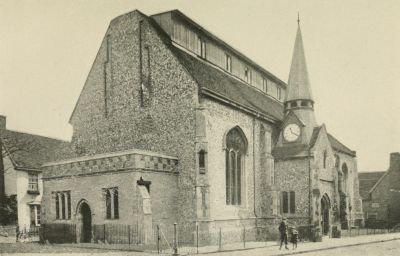
St. John's Church, Needham Market
I drifted with the crowds along the Strand. I continued down Holborn Street and came to Ludgate Circus, where I went into the office of Thomas Cook and Son. There I found a letter from Norway. It was from Mr. Scott Turner, manager of the Arctic Coal Company, offering me a position in Tromso, Norway, and on the island of West Spitzbergen, at one hundred dollars a month and expenses.
This letter was the opening sentence in a volume of adventure.
I had foreseen that my funds would soon run out, and, while in Italy, had written several letters to a number of business concerns asking for work. One of these was to Mr. Scott Turner, whom I had known years ago in Seattle and of whose whereabouts I had lost track. On receipt of Turner's address from my brother in America, I wrote him for a job, telling him that I was working my way around the world, and that being a poor man there was little luxury in it. In his reply he said that he thought he could make use of a man of about my size and shape, and he outlined a most bewildering list of duties. I was to spend two months in Tromso arranging the company's files, running errands and doing general office work. On the first of June I was to sail for Spitzbergen at the expense of the company, where I was to have charge of the mine office, operate the store, look after the supplies in four warehouses and have charge of the commissary department, which fed two hundred and fifty men. Turner stated that these duties would take up about fifteen hours each day, and that if I was not needed in the mine I could have the rest of the time to myself.
After reading Turner's letter I at once looked up Tromso and Spitzbergen on a map. Tromso I found to be three hundred miles north of the Arctic Circle, or four hundred miles farther north than Nome; while Spitzbergen was about one thousand miles from the North Pole. The Arctic Coal Company was an American corporation mining coal on the island of West Spitzbergen and its purchasing office was in Tromso.
Fifteen minutes after reading this letter I was on my way to the Arctic Circle—in a third-class coach going to Newcastle. En route I stopped off for a few days' visit with an uncle of mine, the vicar of the English church in a small village called Needham Market. He had not seen me since I was an infant in Canada, and I suppose that he was curious to see what sort of a specimen his tramp nephew would prove to be. I was, at the same time, anxious to make a good impression on the old gentleman, whom I knew to be full of aristocratic British ideas.
England turned out to be a land in which I was destined to live in luxury. That evening I sat at the vicarage dining table and put away a thoroughly good meal, which included wine and which was served with all the ceremony that an English household could muster. I had no evening clothes. My uncle thoughtfully dispensed with such garments himself out of consideration for me. I found him to be a high Churchman, a staunch Conservative and a man who gave the impression that he disliked everything American. He considered us a crude lot, with a few virtues but somewhat vulgar and best tolerated at a distance. The Monroe Doctrine was to him like a red rag to a bull. He argued that the population of America was made up of half castes through inter-marriage with negroes, and that our climate was so hot that it produced a lazy race of people. I laughed at such statements and tried to accept his hospitality in as gracious a manner as I could.
He lent me his bicycle and I rode to the neighbouring village of Stowmarket. Here I visited the parish church, obtaining the key of the edifice from the bar-keeper across the road. This obliging person was very courteous and kindly. He conducted me through the church, discoursing on its points of interest and displaying great pride in the building. On the walls of his saloon, behind the bar, were pictures of the church choir and building. He gave me a notice with a list of Lenten services. I bought a drink.
Upon leaving my uncle's he very kindly offered me some money to help defray the expenses of my trip. I did not, however, accept this well-intended assistance.
The road passes through many interesting places from Needham to Newcastle, and I regretted very much that I was compelled to get nothing but a train-window glimpse of the great cathedrals at Ely, Lincoln, York and Durham. After lodging at Newcastle in a cheap hotel I sailed for Norway as a steerage passenger on the Jupiter, a small steamer belonging to a Norwegian company with the overpowering name of Det Nordenfjeldske Dampskilsselskab. My steerage ticket cost me twenty-five dollars, which left but three dollars to see me through to my destination. I soon discovered that the price of this ticket did not include meals. The journey from Newcastle to Tromso requires seven days, and I was therefore confronted with the problem of stretching three dollars over a period of one week. With this sum I had to buy food from the steerage steward. When it gave out I had to fast.
There are few attractive features connected with Norwegian steerage accommodations, which rival those of Italian ships in their lack of conveniences. But ups and downs were a part of the game, and I recalled with pleasure—and regret—the good meals and beds I had enjoyed during my sojourn in England.
The first morning out, Stavenger, on the coast of southern Norway, hove in sight amid a cluster of snow-clad hills. We had little time for this small town, and after an hour's stop the Jupiter turned her nose towards the north and resumed her journey. At Bergen I tramped down the gangway with my fellow passengers of the steerage and spent a few hours, during the time our ship was in the harbour, roaming the streets. I found my way in and out among the alleys of the fishy-smelling fish markets and ate some food which I bought, taking advantage of land prices. In Trondhjem I made my way through a snow storm to the Cathedral, returning to the ship by way of the main street, where I laid in a supply of cheese and bread.
The trip along the Norwegian coast is a beautiful one, and our boat slowly wound through the maze of narrow channels and picturesque fjords. For a few hours we would be hemmed in by an endless number of little snow-covered isles on one side, with the abrupt and rugged cliffs of the Norwegian mainland on the other. In a short time we would steam out into the open ocean. The first morning out from Trondhjem we crossed the Arctic Circle. A feeling of intense loneliness came over me and I almost imagined that I was going to another world. The snow-covered mountains and islands, the sharpness of the cold, the absence of any habitations along the coast, the incessant and silent plunging of the ship, the dreary surroundings of the steerage and the emptiness of my stomach, all filled me with the most lonely and forlorn thoughts. Where was I going and what put it into my head to wander to this out-of-the-way corner of the earth?
The problem of food had become a serious one. My money had given out and the supply of provisions I had laid in at Trondhjem had all been eaten. The steerage steward had taken a dislike to me, for I had rebelled at the small portions he dealt out in the beginning of the trip, when I had money with which to pay. I tried to make up to him in the hope of a "handout," but instead I nearly got a "kick-out." There was nothing to do but fast until I reached my journey's end.
Late one afternoon, couched in the centre of a vast desert of snow, a small village appeared. Our boat directed her nose towards this dreary and lonesome-looking settlement, and in a short time was alongside the pier. It was Tromso. How glad I was! As soon as the lines were tied and the ship made fast I descended the gangway and set out to find my friend Turner. I didn't have a cent of money and hadn't eaten for two days.
CHAPTER XVIII
A RESIDENT OF THE ARCTIC ZONE
On alighting from the ship I took a deep breath of the fishy atmosphere and proceeded up the street lugging my two bags. I was now three hundred miles north of the Arctic Circle, and the island town of Tromso was buried in eight feet of snow. I had walked barely ten yards when my feet flew out from under me and I came down with a fearful thud. My two grips fell from my hands and slid about on the slippery snow of the packed street like drops of quicksilver. I gathered my meagre belongings together and started again. Ten yards more—and I fell in the same undignified manner. I thought the eight thousand inhabitants of Tromso were gazing at me, as the crowds on the sidewalks congregated to see the drunken foreigner perform. I tried again to make some progress, but it seemed impossible for me to keep my equilibrium. I nearly became discouraged. A waxed floor is a ploughed field compared to the winter smoothness of a Tromso street.
I found Turner in his room at the Grand Hotel and we were very glad to see one another, for we had not seen each other for four years. To meet up here in the frozen north made a reunion of two Americans especially cordial.
A Mr. Gilson of Pennsylvania, superintendent of the Arctic Coal Company, was Turner's roommate, and, with my advent, the foreign population of Tromso was raised to three. This scarcity of aliens made us conspicuous members of the community and a great source of curiosity. We three comprised the American staff of the company; and we all lived at the Grand Hotel. The hotel was a three-story frame building buried up to the window sills of the first floor in snow. It was conducted on purely Norwegian lines.
The average inhabitant of Tromso lives on an incessant diet of fish and boiled potatoes, with an occasional piece of cheese or canned "salt horse." Breakfast is almost an unknown meal, and when it does take place it is seldom held earlier than ten o'clock. Dinner follows at two-thirty in the afternoon and supper at nine in the evening. This is a most distressing schedule when one wishes to keep office hours and accomplish some work during the day. By a special arrangement with the proprietor of the hotel we were able to have our breakfast served in our rooms each morning at half-past eight. Cheese and bread being the usual diet, we could not expect any great variety of food at this meal. On their arrival several months ago, Turner had expressed a wish for soft boiled eggs and Gilson for fried eggs, and these, accompanied with bread and coffee, had been the menu of the initial meal of the day ever since. When I arrived there must have been great confusion in the kitchen among the cooks and waiters to determine what odd notions I might have about eating. However, without consulting me, the maid appeared on my first morning with one soft boiled egg and one fried egg, and this was my assortment for breakfast every day of my month's stay in the hotel.
Bath-tubs seem to be a rarity in Norway, and the town of Tromso had the distinction of possessing one bath house. Our hotel and all private houses, with few exceptions, did not contain a tub. To add to this scarcity, the one bath house only opened its doors to bathers on one day of the week. We American residents were three of its most regular patrons. Bathing in a wash-basin is an unsatisfactory process as well as an extremely awkward one. However, we were forced to this means of cleansing ourselves during the interval that the bath-tubs of the village reposed behind closed doors.
The morning after my arrival I reported for work at the company's office. I was at first assigned to arranging and card indexing a tangled pile of machinery catalogues and supply hand-books. I next prepared a systematic card index of all the articles of merchandise that the company had purchased during the previous years of its existence. I finally became sufficiently familiar with the business to assist in the buying of the food and mining supplies for the summer season at the mine.
The office was a crowded little space on the ground floor of a frame building on the main street of Tromso, and consisted of three small rooms. In addition to the three Americans the staff included a chief clerk and an office boy. The chief clerk was a Norwegian who had served as an American soldier in the Philippines and who spoke excellent English. He was an invaluable man and acted as the channel through which all business of the office was transacted, for the Americans, not knowing Norwegian, had to have him translate all letters and contracts and interpret all conversations. The office boy was a young native who had acquired a fair smattering of English. Although an industrious lad he was frequently drawn from his work in amazement at what he considered the outlandish and freakish mannerisms of the Americans.
The office was busy buying supplies for the summer and coming winter seasons at the mine on Spitzbergen, making contracts for the sale of coal, chartering ships and hiring men as miners and labourers.
Spitzbergen is entirely frozen in eight months of the year, and the mine had an open season, or time when the coal could be shipped out, of four months. It was necessary to have a winter crew and a summer crew. The winter men, who numbered about one hundred, were now on the island and were out of touch with the world, with the exception of communication by means of a wireless station operated by the Norwegian government. This crew did nothing but mine, and the coal was placed in a stock pile alongside of the wharf. A new force of two hundred men was taken to the mine at the opening of the summer season and the huge task of shipping out the coal mined during the winter was undertaken.
The company chartered all its eight boats with the exception of one, the William D. Munroe, which it owned. This ship was in dry-dock undergoing a thorough and expensive overhauling under the numerous and many unnecessary instructions from officials and inspectors of the Norwegian government. The company chartered the other seven tramp steamers at the rate of one hundred and twenty-five dollars a day, procuring them through ship brokers in London and Newcastle.
The coal mined was bituminous with a low percentage of ash and was considered exceptionally good fuel for steamers. The demand for it much exceeded the supply, the production at this time being only twenty-five thousand tons a year, and there was a good market for it at five and six dollars a ton delivered. The larger part of the output was sold to Norwegian steamship companies, most of it being consigned to Christiania, Christiansund, Bergen and Trondhjem. Several cargoes were despatched to Archangel, on the White Sea, for a Russian concern.
Aside from business I found much time to devote to the social life of Tromso. On the second evening after my arrival I received an invitation to attend a ski-ing party of young men and women. It was the plan to ski over the hills of the island back of Tromso to a small cabin about five miles distant, and there cook a meal over a log fire. I knew nothing about ski-ing and had never seen a pair of ski. When one of my Norwegian acquaintances offered to lend me a pair I was puzzled to know how any one could get over the snow with such fence rails strapped to his feet. I was perfectly willing to learn. I donned the two unfamiliar slats and, assisted by two pretty Norwegian women, who did not understand English, started out on the five-mile trip to the cabin. Ten miles was a long distance for a novice. The party numbered about twenty boys and girls, and they were soon far in the lead while my two female aides tussled with me in the rear. We proceeded smoothly enough (the arms of the two girls around my waist and mine, of course, around theirs) until we came to the first hill. This incline looked about a thousand miles long and almost vertically steep. My escorts were expert at the sport, but they did not have sufficient strength to prevent my causing a catastrophe. We started down the hill and in a few seconds were going at the speed of an express train. I never expected to reach the bottom in anything approaching a dignified position. About fifty yards of such travelling was all I could stand, and then the spill took place. I wasn't man enough to fall by myself, but had to drag the poor girls down with me. The three of us rolled down the hill together and landed, half buried in the snow, in the most undignified pile I ever was in. The party ahead returned to untangle and dig us out. It was a most intimate affair. One young woman was almost completely concealed, being half submerged in the snow, while I was so irregularly sprawled out on top of her that she had no possible means of being resurrected until I was removed. I, in turn, was pinned down—for the other young woman had one of her nether limbs so securely entwined around my neck that I felt roped to the earth. She, at the same time, was struggling in a vain effort to dislodge one of her ski from the snow where it had penetrated several feet. The three of us were securely anchored, and if we had tried to attain our relative positions by a deliberate plan we could not have been so successful.
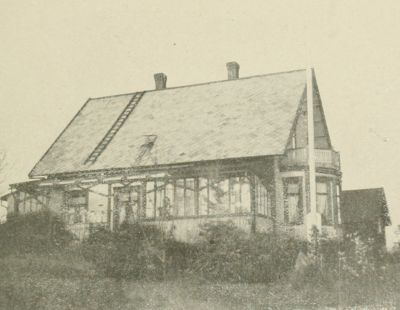
The Author's Home in Tromso
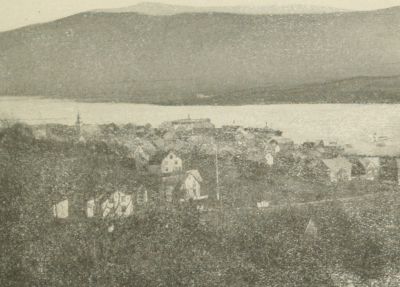
Tromso in Summer-time
With the assistance of the rest of the party we were finally unravelled. I arose only to repeat the performance, not with the same resultant intimacy and proximity as in my first experience, however, for the young women arranged to keep at a certain distance and I was allowed to navigate by myself. My courage was not much slackened by the first unhappy incident, for I tackled each hill as it came, although I knew that I should come to grief in the shape of a tangled mass at the bottom. I made a jolly good fool of myself, I know, and at each attempt swept everything before me, dragging down Norwegian widows, massage artists, fishermen's daughters—and all within arms' reach as I swooped by. This performance continued until we arrived at the cabin.
Soon we were all refreshed by coffee and sandwiches which the girls prepared and we sat around the big log fire singing and smoking. Everybody smoked, women and all, for it is a common thing for the fair sex to use cigarettes in Norway. I dreaded to see the time approach for us to depart, for I knew that our return home would be a repetition of our eventful journey to the cabin. It was two o'clock in the morning and the sun was rising on the distant horizon—and I thought I might show signs of improvement when assisted by daylight. We started back, the leaders of the party very judiciously selecting a course which was not so hilly and which portended a more peaceful journey. It is a rather simple matter to glide along on the level, and the way we returned didn't prove nearly so disastrous as the way we came. I managed to conduct myself fairly well, for the time being.
When we reached the edge of the town, where the hard packed road which led down hill to the main street begins, we all took off our ski and converted them into small sleds by sitting on them and riding into the village. I decided to try this new method. We all strung out at intervals of about twenty feet and started from the summit on a mile shoot into the heart of the town. I managed to begin all right. I had only gone a few yards, however, when the ski beneath me became unmanageable and I could not steer them. We had all acquired a terrific speed. I was sandwiched in between two young women, one sliding a few feet in front of me and the other several paces in the rear, I reached a curve in the road! I lost my ski and continued sliding down the cold and hard road on the seat of my trousers. The next minute over I turned and grabbed the first object with which I came in contact. It was the girl behind me who had overtaken me. I clung to her like a leech and the two of us rolled over for several yards and finally landed in a heap on the side of the road. Another intimate pile. She had lost her ski; her skirts were clustered around her neck; my hat had disappeared—and we lay in the gutter like two pairs of scissors. My feminine associate had her feet extended towards the summit of the hill and mine were pointing towards the town below. We unwound. I got up and assisted her to her feet. We walked the rest of the way to the village.
To be the cause of so much human wreckage was enough to discourage me. However, I made up my mind to persist, for ski-ing was the only outdoor sport in this part of the world. One of the young women condoled with me when she learned that ski-ing was not in vogue in my country, for she thought it was a pity that we had no outdoor sports. During two-thirds of the year there is not a wheeled vehicle to be seen in Tromso, all transportation being conducted on sleds and the majority of the inhabitants spending much of their time on ski. Even the five-year-olds are expert at this method of locomotion. I, therefore, decided to learn, in spite of all my reverses, and in a few weeks became so proficient that I welcomed hills and often complained because they were not steep enough.
The company bought a house on the hill and we three Americans moved out of the hotel into a home of our own. Norwegian houses are often arranged in a most inconvenient manner. The second floor seldom contains a hallway, and in order to go from one bed room to another, it is necessary to pass through the private apartment of another member of the household. Very frequently the maid's room is situated in one end of the house, and in order to reach her bed-chamber she has to walk through all the bedrooms. Between all rooms there is a sort of sill about two inches high running the width of the opening upon which the door swings. One would think that the occupants of such houses would become accustomed to these obstructions and learn to step over them. But this is not the case, for Norwegians are continually falling over the sills. On one occasion an officer in the Norwegian army, who had just completed a call on us, was making his ceremonious and prolonged farewell. With each deep bow he would step back towards the door. He receded until he toppled over backwards on one of these senseless sills. The poor chap gathered himself together and left without saying a word. He was the most embarrassed man I ever saw.
Our house was destitute of furniture, and, as there was not much of a line of this commodity in town, we spent many evenings as carpenters and painters, making tables, beds and chairs with lumber we purchased from a local merchant. Now that we were in our own home we re-arranged our mode of living by changing our hours of eating and sleeping. We adopted a menu which conformed more nearly to what Americans usually eat. We also did a little entertaining. We decorated the walls of our house with pictures we cut from the covers of American magazines and hung up curtains which we imported from England.
The most elaborate social function I had the pleasure of attending was a house dance given at the home of one of the doctors of the town. My two American friends and I arrived at the party at about nine o'clock. The other guests were all present. As we entered the host and hostess were introducing each one in turn to the others who were lined up in a row at one end of the room. It is the custom to address a man by prefixing his vocation to his name, and this manner of designating each one was used during the introductions. Engineer Hansen, Coppersmith Johnsen and Fisherman Olsen were all introduced in this way. The three Americans were simply addressed as "Mister."
It was remarkable to notice the number of people who could speak good English in Tromso. A few of them had acquired their knowledge by visits to England, but the majority had learned the language in the schools of the town. I met one woman who had never been south of the Arctic Circle who spoke English almost perfectly. There were a number at the doctor's dance who spoke the language fluently.
After every one was thoroughly introduced, folding doors were opened, and on tables in the adjoining room stood the most sumptuous supper any man ever saw. The food was served in buffet fashion, and each one was requested to help himself to the endless variety of eatables spread before us. Chicken, fish, sandwiches, salads, cakes and fruits were piled on this table in such abundance that it looked like the assemblage of a dozen Christmas dinners. Liquid cheer was so plentiful that one almost believed all the booze in town was concentrated in this one room. Every conceivable form of liquor was on exhibition, and it would be a most fastidious drinker who could not find something to suit his taste. Beer, several kinds of wine, punch, whiskey and even gin were arrayed before us like the choice liquors in a millionaire brewer's cellar.
The sight of this bountiful feast nearly paralysed me. I at first thought it was a dream, and it took several minutes before I was aware that it was real food and drink. To come up from the steerage to such a grand meal as this was nothing short of a miracle. I dived in and—with the rest of the guests—ate heartily.
The Norwegians confine themselves to square dances, somewhat similar to the Lancers, and to the waltz. This last dance is very much like the American step, with much more of a hop to it and a larger interval between the man and his partner. I insisted on teaching several of the women to two-step. They were very pleased with it, but had difficulty in becoming accustomed to such proximity to their partner. One woman became very fond of this near feature, but insisted on my resuming a distant position as we passed her husband, who was seated at one end of the room. Those who didn't care to dance played cards and smoked. The dainty way in which the women handled their cigarettes killed any prejudice I had nourished about the feminine use of tobacco.
One meal during an evening is evidently not considered sufficient in Norway, for at four in the morning the same folding doors were opened and another array of refreshments lay spread before us. The second assortment was by no means the scraps of the previous meal. It was an entirely new lot of a different variety, and consisted of pudding, cake and coffee. All the participants had danced so diligently that they had acquired new appetites, and the food was all consumed as though it were the only lot of refreshments served at the party. This second feast was the customary conclusion of Tromso social functions. Farewells followed, and the guests departed. We Americans arrived home at six o'clock, changed our clothes, concluded that it was useless to go to bed and went directly to the office for the day's work. The dancing party was a great success, and I could easily have imagined it a New York affair instead of an Arctic Zone function.
It was now only a couple of weeks before the company's boat, Munroe, was scheduled to make its initial trip to the mine on Spitzbergen. The office staff had an immense amount of work to dispose of in this time. Men from all parts of Norway were slowly drifting into Tromso to sign contracts for summer employment. Supplies were being rushed in. A new propeller shaft for the Munroe was en route from England. Cabin fixtures were being installed and many matters were being adjusted to comply with the maritime regulations of the Norwegian government before the ship would be permitted to leave port.
The last week several American engineers and their wives began to arrive. Turner had made arrangements for these experienced men, and they had signed contracts with the company for a period of two years. A score of English miners, who had been engaged through a British labour bureau, also arrived.
With the influx of Norwegian miners and labourers the streets of Tromso were thronged with drunken, fishy and rough-looking men, and the sailing of the Munroe for the far North was the most discussed topic in town.
Two days before the scheduled time for her departure the Munroe was launched from the dry-dock and crews were kept busy loading her with supplies of provisions and other merchandise. Twenty men were put to work building bunks in the hatchways for the miners, and the final touches were rushed to completion.
At midnight on the 25th of May everything was ready. About one hundred Norwegian peasants filed up the gangway and boarded the ship. They were the most forlorn set of adults I ever saw. I should have said one hundred drunks—for I don't believe that there was one entirely sober man among them. Some were completely out as the result of a week's intoxication and had to be packed aboard like sacks of bran. Fifty were conducted from the town jail by several policemen, assisted by Superintendent Gilson and myself. They had been locked up on account of disorderly conduct and had been in prison awaiting the departure of the Munroe.
At four o'clock in the morning every one was aboard, and the little ship, loaded to her water line and carrying a hundred helpless inebriates, turned her bow towards the North Pole and started on her way.
CHAPTER XIX
MINING UNDER THE MIDNIGHT SUN
The steamer Munroe was the first boat this year to penetrate the frozen north, and her departure was looked upon as an event of great importance, for an early season trip was one full of uncertainties. The condition of the sea in the vicinity of North Cape and Spitzbergen was unknown until reported by the first vessel in. A severe winter would mean a difficult voyage, while a mild season would render the passage comparatively easy. The trip from Tromso to Advent Bay, where the company's mines are located, had varied in length, in past years, from three days to five weeks, depending on the amount of ice surrounding the island of West Spitzbergen. We had sailed, therefore, fully provided with supplies for the limit of the time required to make the journey. The Munroe was completely equipped for Arctic Ocean travel, and had been built to meet all conditions encountered in the seas of the Far North. She was a small steamer, being only about two hundred feet long, and resting very low in the water—her stern deck being but four feet above the surface when loaded to her full capacity. She had been especially designed for navigation in the icy seas of this region. Attached to her main mast was a "crow's nest," a sort of barrel-shaped device which looked like a preacher's pulpit. From this point one of the crew constantly kept watch for icebergs and pieces of float ice. Her bow was re-enforced with a solid mass of hard oak, fourteen feet thick, which was covered with a heavy band of steel. By reason of this solid bow she was equipped so that she could ram the ice and loosen large chunks which would float away. Her crew comprised experienced Arctic sailors and her captain was a kind-hearted old Norwegian who had served as skipper on ships of the northern seas for twenty years. In addition the steamer was well provided with sixteen large life-saving boats, each with a capacity of fifteen passengers.
It was bitterly cold the morning we left Tromso, and the trip through the narrow fjords leading to the open sea was calm and peaceful. The early morning hours seemed to lend a stillness to our departure which made one feel as though he were attending a funeral. At noon we were well out to sea, travelling directly north, and, with the exception of the intense cold, there was nothing to indicate that we were not on an ordinary ocean voyage in the temperate zone.
Towards evening the drunken miners down the forward hatch began to sober up and gradually come on deck. With their appearance there was a demand for heavy socks, boots, underwear, shirts, wind-proof coats and trousers. As the handling of these articles belonged to my department I was kept busy for several hours, assisted by my Norwegian clerks, dealing out wearing apparel to the men. The upper deck of the ship was transformed into a temporary store, and as each man filed by he was given what articles he needed, together with a store tag, a duplicate of which was retained in order to charge the amount of the purchase against his account—to be deducted from his first pay-check.
The second morning we sighted Bear Island, a lonely, uninhabited piece of land rising abruptly out of the ocean about midway between Norway and Spitzbergen. We saw an occasional chunk of float ice which had broken loose from the ice pack farther north and was drifting carelessly towards the south only to melt away when it came in contact with the Gulf Stream. We were awakened the next morning by the crashing of the bow of the ship against the ice. I went up on the bridge and as far as my eye could reach I could see nothing but countless pieces of float ice, varying in area from a few feet to the size of an acre lot. It was an inspiring sight—both fore and aft an endless expanse of white broken here and there by the irregular streaks of the blue water. For two days the patient ship ploughed her way through this creaking and cracking mass. Occasionally she would sail into a space of open sea, and in a few minutes would again be completely surrounded by an ocean of ice which rubbed and knocked against her sides with the wheezing sound of the ice-man's saw.
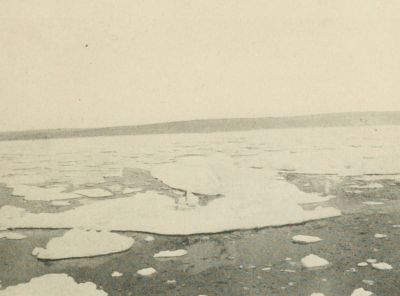
Pack Ice in Ice Fjord
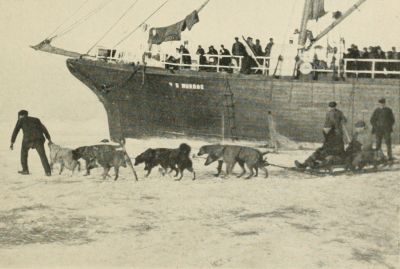
Twenty Miles from Land
The captain said that we were making fine progress, and if nothing unforeseen occurred should arrive in Ice Fjord in the morning. All on board were aroused early by the fearful charging of the ship. We were now well within the fjord alongside of the fast ice. The boat would get up steam, proceed ahead at full speed, plunge into the ice, draw back and plunge again at a little distance away. By this process a large piece of ice would be loosened and would slowly drift off. All the morning the Munroe battered the ice in this manner. Finally we reached a point where the captain considered that the ice was secure enough to tie to. Stakes were driven, lines extended and the ship made fast.
We were now about twenty miles from shore. The little black ship was nestled in a bed of snowy down. Ice Fjord was a solid mass of ice. The steep and snow-clad mountains of Spitzbergen surrounded us like a cluster of marble cathedral spires, and the glacier-choked valleys looked like frozen and motionless rivers. It was a dream in snow. At first there appeared to be no signs of life, and the death-like silence made one sure that it was a new world. In the midst of this dreary expanse of ice and snow the little veteran ship of the Arctic, hugging its frozen wharf, stood like a messenger from another planet, bearing greetings to the bleak and uninhabited land around us. The first signs of life shortly came into sight. Here and there, at irregular intervals, we saw seals and sea lions dotting the ice like flies on a white ceiling. A flock of geese flew overhead and as soon as our advent had been heralded to the inhabitants of the air, droves of reaper hovered about the ship to welcome us to their frigid home. Thousands of these fearless birds, to whom the report of a gun was unknown, gathered about us and formed a sea of blackness in the open space at the stern of the ship.
There was no time to lose, and once the ship was made fast two men were detailed to proceed to the mine and notify the winter superintendent of our arrival. The hundred and fifty men were getting their belongings together for their march to the camp. In a short time one could see this small army of men creeping like a huge caterpillar over the twenty-mile stretch of ice to the mine. Superintendent Gilson and I remained with the ship, making preparations for the unloading of the cargo and awaiting the arrival of the sleds from the camp.
We couldn't resist the temptation, and towards evening we went hunting. From the deck of the ship we landed a goodly bag of reaper for our evening meal. We would shoot into the black mass of these trim little ducks that clustered about the boat, and with each shot the innocent creatures would momentarily flutter and then close up the gap. Every time we fired we killed half-a-dozen birds and shortly we had a sufficient number to feed the ship's crew. It was like slaying little babes, and as soon as we had enough for dinner we stopped the heartless slaughter.
There are no barbers on Spitzbergen. Seated on a stool on the stern of the ship I allowed Superintendent Gilson to shingle my rustry locks with a pair of clippers provided by the company. I didn't realise how intensely cold it was until the sharp currents of the Arctic began to circulate around my ears in the paths made by the moving hand of the superintendent. One complete run of the clippers up the back of my head was all I could stand at one time, and in I would run to warm myself by the stove in the mess-room. In a minute I would return to let the work continue, only to speed back to the stove again. Dinner was on the table and the little mess-room could not be turned into a barber-shop. After half an hour the job was finished. It was Gilson's first attempt at anything in the tonsorial line. On gazing into the mirror to inspect the work I concluded that he should have been a winding stair-maker. The most skilled mechanic could not have made a more perfect set of steps.
In the morning half-a-dozen sleds drawn by horses could be seen making their way towards the ship. Occasionally one of the horses would step on a soft or melted spot in the ice and sink in for several feet. Finally one of the poor animals disappeared beneath the ice and was completely submerged in the freezing water. After a twenty-minute struggle, aided by its team-mate which had been hitched in such a manner as to render assistance, the brave beast was brought to the surface of the ice.
The sleds reached the ship and the place became a scene of great activity, discharging the cargo and loading it again for transportation across the ice to the mine.
Gilson and I left the work in charge of the captain and about noon set out across the ice to the camp. Gilson went in the lead a few paces to select the way and avoid the soft and treacherous-looking water holes. Distance on the ice was very deceiving. We had walked for two hours, and the mountains seemed to be as far away as ever. We proceeded on for two hours more and still our destination seemed no nearer. However, we knew we were making progress, for the Munroe, in the rear, looked like a small row boat and became smaller and smaller as we continued until she disappeared from view. We tramped on over this vast expanse of ice. At eight o'clock in the evening we reached the shore. We walked over the hill about a mile, and in a few minutes were in the little camp. Turner and the other members of the American staff had arrived the day before and had prepared a big dinner for us. Gilson and I sat down at the table in the little cottage which served as headquarters for the Americans, and ate one of the finest meals of our lives. Roast reindeer, killed by a member of the camp the day before, made a great filling for two hungry and frozen men.
The Spitzbergen archipelago is another "No-Man's Land." It belongs to no country. The Arctic Coal Company, incorporated under the laws of Massachusetts, owns about forty-five thousand acres on the island of West Spitzbergen, which it acquired by staking out claims and which it holds by the moral protection of the United States. A British company has several thousand acres of coal lands on the same island which it abandoned a number of years ago. There is a marble quarry on the east coast operated by an English concern. At Green Harbour, near the entrance of Ice Fjord, the Norwegian government conducts a wireless plant, and near by there is a Swedish whaling station. There are no native inhabitants of Spitzbergen, and its population, numbering about three hundred and fifty in the summer season and two hundred in the winter, is made up of those engaged at the several places I have enumerated.
The islands of Spitzbergen are coveted by the three Scandinavian countries of Norway, Sweden and Denmark. Russia is also desirous of adding them to her vast domain. Each year a council, made up of representatives from each of these nations, meets in Stockholm, Christiania or Copenhagen and discusses ways and means to settle the question of their disposal. Nothing definite has ever been accomplished, and without the approval of Great Britain and America, whose properties make them big factors, the problem bids fair to remain undecided for some time. As a result of this situation Spitzbergen does not possess a local government of any kind. It is a land where might is right. There are no laws, no police and no means to enforce order. Manager Turner was the ruler and executive in our part of the island, and any regulations that existed had been instituted by him.
Eight months of the year the islands are entirely frozen in; their steep mountains are covered with snow, their valleys filled with immense glaciers and their interior is one endless waste of ice. During the summer months the fjords and bays of the southern part are freed of ice, the mountains shed their white mantles and the hillsides burst forth with the bloom of millions of little wild flowers of many varieties, which, with the abundant fresh green grass, present a most beautiful picture. I once read a booklet descriptive of Spitzbergen in which the trees were stated to be only two inches high. This is literally true. None of the vegetation attains a greater height than two inches, but it is doubtful whether these miniature plants should be dignified to the extent of being called trees.
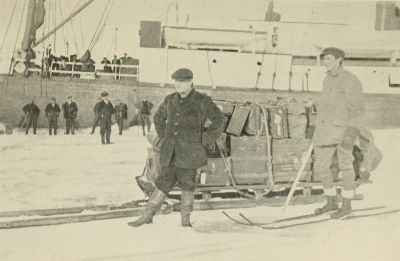
The First Load for Shore
Advent Bay, on whose shores the camp of the company is situated, is a small body of water and is on the northeastern side of Ice Fjord, of which it is a part. The company has a wharf with coal bunkers which is not accessible for steamers until the ice breaks and flows out—about the first of July each year. The camp consists of a store, a mess pavilion, a power plant, four warehouses, the manager's cottage and about a dozen bunk-houses for the men. This little settlement is called Longyear City, being named after the president of the company, and its inhabitants proudly boast that it is the most northerly city in the world, thus cold-heartedly snatching this distinction from Hammerfest, on the northern coast of Norway. Hammerfest is a town of five thousand people and is described in tourist literature as being the nearest municipality to the North Pole. Longyear City is seven hundred and twenty-five miles from the Pole, and therefore has Hammerfest beaten for the honour by nearly a thousand miles!
Twenty small frame buildings comprised the total number of dwellings that the little snow-clad village could muster, and these were all the property of the Arctic Coal Company. On the sides of the small houses were nailed the hides of polar bears, killed by the miners during the winter, and the walls inside were decorated with the skins of the white fox, an animal whose fur is as white as snow and as soft as a baby's cheek. The mine was about fifteen hundred feet above the camp on the side of a hill and was connected from below by a zig-zag trail. The coal was conveyed to the stock pile on the shore of the bay by means of an aerial tramway about one mile in length. Supplies were transported from the store to the mine by an incline. The mine was simply a horizontal hole in the ground, about two thousand seven hundred feet long, and an elevator was an unknown device to this dark tunnel. The roofs of the drifts were frozen and numerous icicles hung down in such a manner that the huge cavern looked like a grotto in fairy land.
On the arrival of the summer crew the winter superintendent turned the direction of the camp over to Manager Turner. The one hundred men who had spent the eight months of the winter at the mine immediately started across the ice to the Munroe, which, the following day, was to take them back to Norway. There was no end of work to be done. I organised the office, instructed the German bookkeeper to open a set of accounts and started the "Mulligan" to feed the two hundred and fifty men. My biggest job was taking an inventory of all supplies in the camp. The stock in the store had to be listed first, and this task was begun and completed the night of my arrival; in the morning we were open for business. This little mercantile establishment was a grocery store, hardware store, butcher shop, dry goods store, boot shop and haberdashery all in one. Everything was displayed on its shelves, from a needle to a miner's drill. Hairpins and cheese, socks and salmon, nails and raisins, boots and bacon, leather vests and condensed milk, shovels and cold storage eggs, were all piled together like an assortment in an American junk shop. The morning its doors opened nearly the whole camp of two hundred and fifty men made a run on the place, crowding before its counter and scrambling to be waited on by the two Norwegian clerks. Each man wanted to outfit himself so that he could go to work the next day. Much confusion resulted because of the many duplications of names, and many accounts were charged to the wrong man. There were a score of Ole Olesens, a dozen Johan Jensens, a half-dozen Johan Johnsens and several each of Johnsons, Johannesens and what not. We finally had to rename each man whose customary designation caused confusion with those of his fellow workers.
The inventory of the supplies in the four warehouses was the big task. Before we could even get possession of the articles to tabulate and price them we were compelled to dig them out of the ice with picks and shovels. I had a crew working for nearly a week excavating dynamos, engines, barrels of oil, mine implements and so forth, before it was possible to know what we had in stock. Then there were supplies in the mine, transformer houses with electrical appliances, powder sheds and three dynamite houses, which all had to be listed and priced. The new supplies, as they arrived from Tromso, had to be inventoried and placed away. With the fresh fish and meat which the company's boats brought from Norway, the fifty mine cars from America, the hundreds of steel rails for new tracks about the camp, the thousands of feet of lumber for construction of buildings, the fixtures for the wireless plant the company was to install, the hundreds of packages of cheese, sacks of flour, beans, potatoes, canned goods and other provisions—my assistants and I were kept busy from six o'clock in the morning until eleven each evening. We were installing a new warehouse card system, and each article in the camp had to be entered and priced. We took no time off at noon except to eat; we worked Sundays, and only laid off for a half hour on the Fourth of July to play baseball.
The miners were paid six kroner a day, and from this amount a krone and a half was deducted for their board. One krone is equal to twenty-seven cents of American money. These wages were nearly double what they were accustomed to receiving in Norway for the same sort of work. However, this comparatively generous pay did not satisfy them, and at the end of the first week they all went on a strike. A walk-out was a serious thing. The company was under contract to deliver coal to several concerns in Norway, and it was paying one hundred and twenty-five dollars a day rental for each of its seven ships and could not afford to permit any of them to be idle. Advent Bay was now clear of ice, and there were three chartered steamers at anchor taking on coal for transportation to Norwegian ports.
The miners demanded that they be paid six kroner a day and free board. After a day's conference with two representatives from the men, the management agreed to the raise on the condition that they would be satisfied for the rest of the summer season. The men accepted these terms and returned to work.
The Munroe arrived on her second trip from Tromso, bringing the remainder of the summer crew. This lot of men consisted of about seventy-five Norwegians, several Russians, Laplanders and Finns. Among the Finns were three labour agitators. These men immediately set to work to stir up trouble and in a short time were successful in again causing dissatisfaction among the miners. The result was a second strike, in which the men demanded a raise of two kroner a day. This would bring their wages up to eight kroner and board. Such an advance was out of the question. The management absolutely refused the demands and discharged every striker in the camp. A complete walk-out followed.
The next three days were exciting ones. The manager instructed me to have the office prepare the accounts of all the men and issue them pay checks which they were to present to the Tromso office for their money. It was his plan to ship the whole crowd back to Norway. There was not a ship in the harbour, and it would be several days before one returned from Norway. In the meantime the work of the accounts went on. The German bookkeeper and I, assisted by two Americans, worked forty-eight hours without a wink of sleep.
Manager Turner expected violence, and each one of the eight Americans was provided with a pistol. There being no policemen on the island, each man had to become an officer. Watches were formed and two men remained up all night to see that no trouble was started. One man was assigned to guard a batch of supplies down the coast about five miles, where they had been unloaded from the Munroe, and another was delegated to keep an eye on the several dynamite houses. The two hundred and fifty Norwegians, Swedes, Russians, Laplanders and Finns gathered in groups about the camp or paraded up and down the main road carrying red flags, shouting and jeering. The little camp was in a state of high tension, and we eight Americans didn't know when the minute might arrive that would force us to battle for our lives.
The company each year took precautions for such an uprising, and it was a regulation that no firearms be allowed on the island. The men were searched as they boarded the steamer at Tromso. But in spite of this inspection a number of pistols were always smuggled in by the miners. It was not the fear of the guns that caused the Americans so much apprehension, but the thought that the strikers might storm the dynamite sheds. With each man armed with a twenty-five pound box of nitro-glycerine, they could attack the staff house and blow us all into eternity in one minute, swear themselves to secrecy and the world would never know a thing about it.
The strikers would gather about the manager's cottage, and it would seem that the crisis was about to take place. From a staff on the cottage an American flag was flying, and this was a continual source of temptation to the miners. Turner had decided, in case they pulled down the Stars and Stripes, to go quietly out in their midst and calmly hoist it up again. In the event of their insulting it the second time he would instruct the Americans to fight—and it would have been a fight to the death.
Three days under such circumstances seemed like three years. All day the demonstrations on the part of the men kept our little band ready for any emergency. The wives of two of the Americans were in camp on a short visit from Tromso, and they confined themselves to the staff house, where they no doubt served as an element restraining the strikers from violence.
One night I stood at the door of the office along towards twelve o'clock, and by the misty light of the midnight sun I could see several pairs of the miners skulking up the valley towards the giant glacier; others were sneaking quietly along in the vicinity of the mine, and still others were walking slowly along the docks. The strikers were organised and had their night watches as well as the Americans.
The third morning of the strike the accounts were completed. Each man came into the office for his pay-check. In this way we had an opportunity to talk to them apart from their fellow workmen. Fully two-thirds of them stated that they were not in sympathy with the strike, but were afraid to rebel for fear of being injured or killed by the leaders. The strikers kept two men at the office door checking each man as he went in and out. Several of the miners had not worked long enough for their wages to offset their purchases at the store and owed the company money. This, of course, was lost.
Late in the afternoon of the third day of the strike two of the chartered ships arrived in the bay from Norway. Orders were issued for them to get in readiness to transport the whole gang of miners back to Tromso that evening. The crews built bunks in the hatchways and supplies were put on board. By dusk the ships were ready for their unruly passengers.
Before going aboard the strikers paraded about the camp, scouring the place for deserters. They were determined to make a clean-up of every labourer of any kind, and in this way tie us up completely. They threatened to kill one man who attempted to hide himself in the power house. To save this man's life the captain of one of the ships locked him up in a cabin. The strikers finally boarded the two boats. The whistles blew and they were off for Tromso. The camp was almost deserted. Under my instructions the cooks had hidden up the valley in the vicinity of the glacier, and thus the culinary department was kept intact—which was something.
With the strikers shipped out, a feeling of relief descended upon us. The manager had a tremendous burden taken from his shoulders and each man displayed a tired but smiling face instead of the worried expression of the three past days. All the office hands turned to and became miners, rushing the work to load the incoming ships.
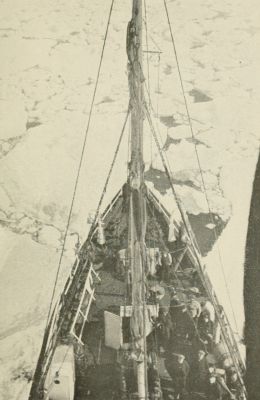
The Ice Pack from the Crow's Nest
If the management had complied with the demands of the strikers the report would have circulated through Norway that the Arctic Coal Company was an easy mark, and the mine would have become the rendezvous for all the labour agitators and riff-raff miners in the country. The day after the departure of the strikers Turner sent a wireless message to the Tromso office advising the Norwegian in charge of the strike and informing him that the whole crew was on its way to Norway to be paid off. Turner anticipated that the advent of this gang might cause a disturbance in Tromso, and that they might raid the company's office. He therefore made arrangements with the government to close the samlag, or federal liquor house, and to have the militia in readiness for trouble. He cabled a list of the names of the men who owed the company money for store purchases with instructions to attach their personal possessions and place them under arrest.
The Norwegian in charge of the Tromso office had a difficult situation to handle. However, he carried out Turner's instructions to the letter. The two ships with the strikers arrived in Tromso; twenty of the men were immediately arrested; the militia was on hand to maintain order and the samlag was closed and there was no booze.
Two Norwegian clerks were despatched to Norway to go into the country villages and engage another crew of miners. In two weeks a new set of men began to arrive at the mine, and at the end of a month a complete force was on hand and the work was proceeding as though nothing had happened.
The company's little store occasionally had distinguished customers. I found the Norwegian clerk selling a large consignment of goods one afternoon to two Englishmen. They engaged me in conversation and asked me many questions about the mine and the camp. They were curious to know what brought me to this far-away land, and our talk naturally drifted around to my world trip. They became interested at once.
They were out on a hunting expedition in the vicinity of Spitzbergen. One of the blades of the propeller of their steam yacht had been broken on a piece of float ice and they had come into Advent Bay to get it repaired at the company's machine shop. I invited them to dinner at the staff house. They declined, as the repairs to their boat were nearly complete and they wanted to get under way as soon as possible. They valued my invitation, and as they took their leave asked me to be their guest in England on my return trip to America. They presented me with their cards. "Sir Philip L. Brocklehurst, Swythamley Park, Macclesfield, The Bath Club," was the inscription on one and Sir Something Mitford on the other. I was mingling with two of England's noblemen, young fellows who had acquired their titles by inheritance. The rest of my stay on the island I was known as the "King."
I had now been with the Arctic Coal Company four months and had four hundred dollars saved. I hoped to meet my father in Toronto, Canada, in a few weeks and go with him to California. One morning about four o'clock I boarded one of the company's coal freighters and started for Norway.
CHAPTER XX
TO AMERICA AS AN IMMIGRANT
The company's coal steamer brought me safely to Tromso. What a wonderful transformation had taken place during my two months' absence. Tromso had discarded her dreary winter garments and was now arrayed in a mantle of summer gladness. Her gentle slopes were covered with green grass and myriads of little wild flowers literally danced as they thrust their tiny faces towards the deep blue sky. Trees were in leaf, the air was crisp and clear and birds were singing. The atmosphere rang with the joy of summer time and the snow-bound village of the winter was a glorious symphony of beauty and happiness. I wanted to remain there the rest of my life.
But I was now homeward bound. My whole object was to reach Toronto, where I was to meet my father, by the quickest and cheapest route.
It was my plan to go by train through Sweden to Stockholm. My steamer for Narvik, the beginning of the railroad, did not leave for a day, during which I remained in Tromso. That evening I spent with several of my Norwegian friends at the Grand Hotel eating, drinking and making merry. In the midst of our good time, about ten o'clock, one of the bell boys presented me with a note. This little communication was from one of Norway's many Mr. Ole Olesens. This particular Ole Olesen was one of Tromso's butchers, from whom the company had purchased most of the meat for the mine. He was showing me a courtesy by asking me to go fishing with him about midnight. To engage in such a pastime at such an hour struck me as an odd thing to do. With the assistance of one of my native friends I wrote Mr. Olesen a cordial note—declining.
Anyway, I had another engagement for the rest of the evening. I called on the wife of a Norwegian army captain and a woman companion of hers. Her husband was in Christiania, two thousands miles away. On a previous occasion the captain's wife had told me through an interpreter that I was the finest man she ever knew. This sort of flummery was new stuff to me. Making love through an interpreter is a very unsatisfactory process, even if it is to another man's wife.
Whatever admiration this woman may have had for me was completely dispelled, I thought, by the displeasure she manifested on the occasion of this call. I had some difficulty in ascertaining what her grievance was, but finally learned that she was provoked at the method I had pursued in entering her house. I couldn't find the gate in front of her residence, so I climbed over the fence. My object was to get in and I had no time to spend searching for gates if such entrances were not in the places they should be. To climb over a fence at eleven o'clock at night in the light of the midnight sun was a fearful breach of Norwegian good form. What would the neighbours say to see a man entering her house in this strange manner at such an hour, when her husband was away? I left her house, disgraced.
I was on board the steamer for Narvik. The boat was swinging away from the Tromso pier. My displeased friend of the night before came running down the street to bid me farewell. By the time she reached the wharf I was beyond speaking distance—my boat was out in the stream. We could do nothing but wave handkerchiefs. I waved until my arms were tired and the lady was out of sight. I borrowed a pair of field glasses, and as long as I could see the poor woman continued waving. She may be waving yet. She had forgiven me for the fence episode. Hers was the first broken heart I had left behind me on the whole trip.
A dreary journey in a third-class compartment of a Swedish train brought me from Narvik to Stockholm. I saw this beautiful city as a real tourist. I was a comparatively rich man with the money I had earned in Tromso and Spitzbergen, and I lavished it rather extravagantly in an effort to crowd the interesting points of Stockholm into a short time.
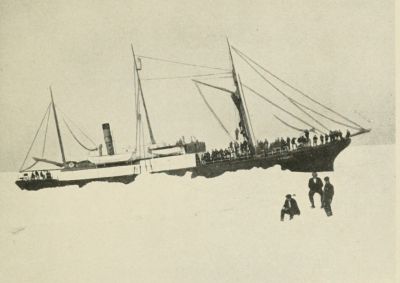
The Munroe Alongside the Ice—60 Miles from Land
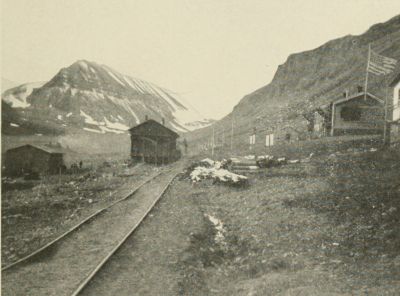
Longyear City, Spitzenbergen—700 Miles from the North Pole
I sailed from Gottenborg for Hull as an honest passenger of the steerage. My fellow travellers were Swedish, Danish and Norwegian immigrants bound for America. Being the only member of the steerage without a through ticket to New York, I was called before the captain of the ship, the second day out, for a cross-examination. He asked me several personal questions. I feigned that I was not used to such humiliation, and the generous-looking skipper said that he would leave my case to the English authorities.
When the ship docked at Hull, the cattle of the steerage were instructed to congregate in the mess-room for inspection. Presently a group of five British immigration officials entered the room. They were all dressed in blue uniforms with brass buttons, and these brass buttons seemed the biggest thing about them to me.
"Where is the tramp from Sweden?" gruffly asked one of them, directing his question to the captain of the ship.
"I presume I am the man for whom you are looking," I volunteered in as excellent English as I could command. I was standing beside the officer and he seemed somewhat perplexed when a response to his question came in the words of his own language from an unshaved tramp. The Swedish authorities had cabled to the immigration headquarters at Hull that I was on the boat, and I was thus assured of a reception.
"Are you a Swede?" was the officer's next question as he turned his eyes on me.
"Do I look like one?" was my flippant reply.
"What nationality are you, then?" he enquired sternly.
"I am an American."
"Where are you going?"
"I am going to America as fast as I can get there."
"How much money have you in your possession?"
"I have enough."
"I want to know the actual amount," said the officer impatiently.
"About sixty pounds."
The officer conducted me into an adjoining cabin and there I had to dig into my pockets, pull out my money (which I had converted into English coin in Stockholm) and prove to his satisfaction that I had some real wealth in my possession.
"I think this thing has gone about far enough," I said. "I am not a pauper and am well able to take care of myself. There is no need to suspect that I will become a public charge. This sixty pounds is as much as any one of you makes in a whole year. I realise that you are simply carrying out the immigration regulations and doing your duty, but why can't you exercise a little discretion and let a man, who is well able to take care of himself, go on his way without all this nonsense?" This complaint of mine seemed to bring the Britisher to his senses and with a few remarks in conclusion I was allowed to land; not, however, until I had promised to go directly across to Liverpool and take the first steamer for America.
In five minutes I was going towards London at sixty miles an hour. The first boat from Liverpool to Quebec did not leave for a couple of days, and I decided to spend this time in the metropolis in spite of the instructions of the immigration officials.
Nearly three years of travel had reduced my wardrobe to a shabby lot of garments, and I was afraid of being arrested for vagrancy. I wandered into a men's furnishing store on Holborn Street and purchased a complete new outfit, including a Scotch tweed suit and two English caps. I was now equipped to travel to California with my father properly dressed.
That evening I put on all my new clothes, hopped into a taxicab and was off to make a call. I alighted at Fulham Palace and presented to the servant at the door a card of introduction to the Bishop of London, which I had received from the chaplain of the British legation in Peking. In a minute the servant informed me that Bishop Ingram was absent from the city and was not expected for two weeks. I was sorry. I wished to end up by interviewing a Lord Bishop.
I cabled my father in California that I would meet him in Toronto on August 17th, and left from Paddington station for Liverpool. I bought a through ticket from London to Liverpool by rail, thence to Quebec by steamer and finally to Toronto on a colonial train—all for six pounds.
At Liverpool I boarded the Tunisian of the Allan line and in a few minutes was lost in the hold of the ship among the two thousand English and Irish emigrants. My three cabin-mates were East End cockneys and they might as well have been Comanche Indians—for I was unable to understand their peculiar twang for a couple of days. The food was a substantial sort of stuff but was served as though the eaters were animals. And, as a matter of fact, the eaters were quite capable of playing the rôle of any trough-fed beast. "Pass the bloody jam" and "shoot the bleeding bread" were the customary phrases employed in asking for food. Profane and obscene expressions, which are not fit for print, although considered proper for the ears of the women of the steerage, were used at the table as so many platitudes. Seamstresses, Irish mill hands, English servants, cobblers, mechanics, barbers and an endless assortment of skilled and unskilled labourers of Great Britain were on their way to Canada to begin life over again.
After the first two days of sea-sickness were over, the fun on board ship began. Restraint and feminine modesty were cast to the winds, and the man who wasn't good enough to get a lover wasn't worth taking along. The women "fell" for anybody. "Down the bloody hatches" and on the "bleeding deck" and in every nook and corner were lovers. It was probably the most brazen exhibition of spooning I ever saw. It was a case of wrestle and osculate from morning until night regardless of how many curious and amused spectators were in the audience. The jesting and jeering of the onlookers seemed to act only as an incentive to the love-sick sea-farers, who were bent on having a big fling now that they were free from the restraint of home surroundings.
I spent most of the time as a spectator, frequently engaging in conversation with my fellow passengers to learn their ideas of this world and the next. I occasionally dropped into the first-class kitchen and made a friend of the chief cook, a good man to know when travelling steerage and living on its dessertless menu. I soon was the daily recipient of hand-outs and I very gratefully devoured the samples of cake, pudding and tarts which were prepared for the first-class passengers of the ship.
The Tunisian's schedule from Liverpool to Quebec was nine days but, owing to the dense fogs, we were compelled to anchor for three days off the Newfoundland coast to avoid any chance of colliding with an iceberg. When the fog lifted there was no end of these huge monsters of ice in our immediate vicinity. On one side of the ship I counted sixty-five icebergs, and there were as many on the other side.
The twelfth day we pulled into Quebec and the two thousand steerage passengers were quartered in the immigration sheds awaiting inspection by the Canadian officials. I again encountered difficulty in proving that I was not a Norwegian cut-throat or a Swedish crook but finally obtained my inspection card which permitted me to go on my way.
I took a colonist train to Toronto, where I met my father, who had come from California to meet me. He had wished me Godspeed three years before from San Francisco, and he was now to cross the continent with me and help me complete the circuit. Our meeting was a joyful one. He didn't shy at my travel-worn appearance. I was dressed in an old suit which was spotted and covered with dust; I had a two-weeks' growth on my face and I needed a hair-cut and a bath. While my father waited in the station I sought the first barber shop I could find, and after an hour of cleansing at an expense of $1.55, I was ready to travel with civilised people.
Toronto was my native city and I had not visited it since I was an infant. My father and I, therefore, spent several weeks looking up friends and relatives before starting west. En route to St. Louis, I took leave of my dad, and went to visit Richardson at his home in Fairmont, Minnesota. He had returned to America four months before and we had not seen one another for nearly nine months—since we separated in Constantinople.
During my two days' visit we each outlined where we had been since parting and related to one another our different experiences. Richardson remained in Constantinople two months holding down his job of electric wiring for Roberts College. In that time he made many trips about Constantinople and its environs and became very familiar with the Turkish capital. He made a journey into the country districts and got a glimpse of village life in Turkey.
His course through Europe was somewhat similar to mine and included Greece, Italy, Switzerland, Germany, France, England and Scotland. He did not visit Austria-Hungary but spent several weeks in Germany, stopping at Munich, Nürnberg, Dresden, Leipsic and Berlin. From London he took a trip to Edinburgh, returning to Liverpool whence he crossed the Atlantic steerage to Boston. He arrived in America without a cent. Fortunately there was a letter for him at Thomas Cook and Son's office from his mother, in which was enclosed a money order for twenty-four dollars with which to buy tableclothes. He cashed the order and with the money bought a cheap ticket to Fairmont. Again broke, he arrived home after being away two years and eight months. At the time of my visit he had a position with the New York Life Insurance Company.
I joined my father in St. Louis, where I spent three days visiting a married sister, and we then continued our journey to California. My return to San Francisco was the occasion of the following article in the Examiner:
U. OF C. STUDENT GIRDLES GLOBE ON $3.85
Alfred C.B. Fletcher Travels Three Years as Teacher, Sailor and Adventurer
"Three years of adventure and 30,000 miles of travel through the seven seas ended yesterday when Alfred C.B. Fletcher, university graduate, journalist, school teacher, Government official, sailor and miner, returned to California with a Kiplingesque stock of personal experiences and jingling a silver surplus over the $3.85 with which he left San Francisco.
Fletcher was arrested as a spy in Japan, battled with pirates on a Chinese junk in the Chinese sea, visited Bethlehem on Christmas Day, attended the Durbar in India, toiled in a mine of Norway and has returned from the rough and tumble of world adventure to study theology for Orders in the Episcopal Church.
LEADER IN UNIVERSITY
In 1907 Fletcher graduated from the University of California, where he was a leading figure on the campus. He was editor of the Daily Californian, prominent in other affairs, and a member of the Golden Bear and Winged Helmet honour societies and the Psi Upsilon fraternity.
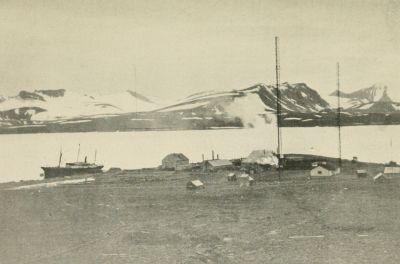
Norwegian Wireless Station in Ice Fjord
Three years ago he decided to take a graduate course in the school of hard knocks and see the world on his nerve and native hardihood. He bought a steamer ticket to Honolulu and waved good-bye to his friends at the pier with a promise that he would not return until he had swung around the belt of the Globe.
At Honolulu he halted for lack of funds to get him further transportation and entered the business of school teaching. Between school periods he took examinations for work as a Government official on the Pearl Harbour project, more from curiosity than a desire to quit school teaching. His examination marks were high and he was appointed.
TRAVELS ON EARNINGS
Several months of Pearl Harbour work got him money enough to go on, and he travelled for several months on the earnings. On this leg of the journey he was accompanied by a young Dartmouth graduate whose method of travel was akin to his own.
While in Japan they snapshotted pictures of Japanese fortifications and were arrested and thrown into prison. The services of the Secretary of State were secured before the two young college travellers were liberated. For the rest of their visit in Japan they were shadowed by agents of the Japanese Government, and they found the pursuit so uncomfortable that they shortened their stay.
In China Fletcher became instructor in a Peking school of engineering. He travelled leisurely down the coast to Hongkong, making inland trips and long stays in all the great ports of China.
By the time he reached Hongkong his finances were low and a trip across the China sea to Manila was made in a junk. On the voyage a typhoon struck the rickety craft, and the Chinese, believing they were lost, flocked around the images of their gods with shrieks of terror. Fletcher rushed to the deck, saw the danger to the unmanned ship, and compelled the Oriental sailors to return to their posts.
MORAL FORCE NECESSARY
For several months he remained in Manila, serving most of the time as an official of the Territorial Government in its department of education. From there he journeyed on to India and witnessed the Durbar spectacle.
His travel was broken by spells of work on land. Frequently he signed on steamers as sailor or deckhand. A long stay was made in Palestine. From the eastern Mediterranean he went up into France and England and, for the first time in years, looked into familiar faces. Many of his former college friends were travelling in Paris, London and studying at Oxford.
The experience in Europe took his last cent and he worked his way to Spitzbergen, Norway, where a friend of college days is superintendent of a mine. There he spent several months and gathered sufficient funds to insure his return to California.
Fletcher is visiting his brother, John D. Fletcher, at 2320 Le Conte Street, Berkeley. For a few days he will renew old associations around the university and after a visit to his home at Covina in the southern part of the state he will leave for New York to enter a theological seminary."
Three days in the vicinity of San Francisco, and I went to my home in Southern California. When in Toronto I had bought a ticket to Los Angeles and return, for I had planned to go to New York City to enter a theological seminary. I might state parenthetically that after six months of study for the ministry, I came to the conclusion I was in the wrong pew and gave it up. The change from a tramp to an embryo parson was too sudden, I suppose. The price of the round-trip ticket from Toronto and my expenses to California had taken the last of my Norwegian earnings and I arrived home broke. I had been away three years, had circled the globe and had travelled over sixty thousand miles.
THE END