ILLUSTRATIONS (continued 2)
Reading edition
The following account under the heading, "The Spy Scare—American Photographers Arrested," was taken from an English paper in Kobe and is a translation of an article which appeared in a Japanese journal:
"We learn from a Maisuru despatch to the Asahi that two foreign passengers of the Daiichi Hashidate-maru, which arrived at Maisuru at 9:20 A.M. on the 21st from Obama, photographed the first section of the Maisuru Naval Station when the steamer approached the entrance to the harbour of Shin-Maisuru. They took over ten pictures, which distinctly showed even the warships in the harbour. The action was observed by some members of the crew of the steamer and, upon arrival at Maisuru, they reported the matter to the Maisuru gendarmerie station through the Maisuru Water Police. Gendarmes immediately appeared on board the steamer and arrested the foreigners and conducted them to the gendarmerie station. Upon examination they were found to be two Americans from California named Richardson (aged 24) and Fletcher (aged 26). Mr. Richardson, continues the despatch, is the son of a doctor, and was teaching at a school in Honolulu. In October he left Honolulu with Mr. Fletcher for a tour around the world, and they arrived at Yokohama on the 1st instant. Proceeding to Kyoto, they took up their quarters at the Christian Institute at Sanjo-dori, and on the 19th instant left Kyoto for a tour in the interior. They took a steamer at Otsu and proceeded to Imasu and Obama. They spent two days at the latter place and left there on the morning of the 21st by the Hashidate-maru for Maisuru. They stated that they had no ulterior motives in photographing the Naval Station, but, concludes the despatch, their behaviour when they took the photographs was suspicious. The fact that the two foreigners were not very well dressed, and had no more than twelve yen in their possession, appears to have aroused suspicion. Eventually they were handed over to the Procurator's office, where they are now being examined by Procurator Ogata."
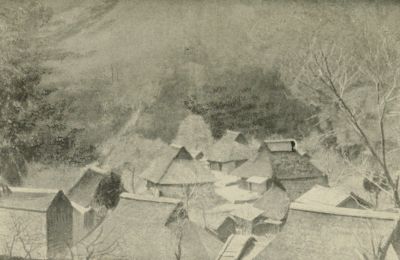
The Picture that Caused our Arrest
On the morning after my arrival in Kyoto I was interviewed by the Chief of Police of that city, assisted by an interpreter. During the examination the door opened and outside stood Richardson who had been escorted from Maisuru by an officer. We, however, were not allowed to get together and discuss the matter for fear we would frame up a story. The Chief of Police first finished with me and then called Richardson in for a session.
We were advised by the American secretary of the Y.M.C.A. not to volunteer the statement that we had been in the employ of the United States Navy Department in Hawaii. He said if the Japanese authorities got this information, it would be very difficult for us to prove that we were not spies and in that event the case would have to be handled by the American Embassy. This, he thought, would mean our detention in the country for a couple of months. Fortunately, a question of this nature was not asked us.
Accounts of the affair were printed in all the leading papers of the Far East, including Japan, Korea, China and the Philippines. The Associated Press obtained the news and the dailies of the Pacific Coast in America displayed several columns of distorted accounts. A Honolulu journal considered it of sufficient importance to give it the following full front page headline: "Honolulu Men Languish in a Japanese Jail."
This was not all. The news had found its way to Washington, and our little incident of Maisuru Bay set the wheels of diplomacy of two nations in motion. My brother, reading the Associated Press reports in the San Francisco papers and imagining that we were being subjected to Oriental tortures in a Japanese jail, telegraphed the State Department at Washington. He received the following reply from Mr. Huntington Wilson, Acting Secretary of State at that time, under President Taft: "Department telegraphed Embassy at Tokyo to-day to ascertain facts and endeavour to secure your brother's release." The ambassador in Tokyo got in touch with the situation and replied that Richardson and I were being well treated and that as soon as proved innocent would be liberated. This information was sent to my brother by the State Department.
In the meantime we were battling with the Japanese authorities in Kyoto. We wanted to get back our camera. It was a regulation to confiscate all cameras which had been used in taking illegal pictures. We finally convinced the police that we had no ulterior motives and, after promising to leave Japan at once and giving an itinerary of our route out of the country, we were released. The Kyoto Chief of Police returned the camera, with an impressive speech, and the two of us retired from the courtroom without ceremony, while the numerous officials nearly broke their backs bowing. By a mistake the objectionable picture was left in the camera and we departed with the film of the little Maisuru Bay village in our possession.
Nor did the incident end here. We left immediately for Kobe, and from there took the Inland Sea trip as far south as Miajima. We had supposed that all the nonsense over our arrest had ended and that we were free from the pest of Japanese police. But there was more to come. We spent a day at Miajima, undisturbed by officials, the first time in several days, for the reason that we omitted to put this place on the itinerary. From Miajima we went by train to Chimeneseki and thence across by boat to Fusan in Korea. Being still in Japanese territory we were greeted by two policemen, who had received a cable to watch out for a couple of Americans and keep them moving. After a few hours in Fusan, under competent guards, we went on to Seoul.
We arrived after dark, and as our train was pulling into the station we saw two policemen on the right hand side of the track. We stole a march on these officers of the law by getting out on the left side. We scrambled around the rear of the train and were soon in rickshaws and in a few minutes were registered guests of a Japanese hotel. The proprietor sent the usual records to the police station, but before the officers were detailed on our trail we were up and out at an early hour the next morning. We went to the Y.M.C.A. where we were the guests of two young Koreans.
The police spent the day looking for us and did not locate us until evening, when they found us dining at an American private home. They had evidently been given instructions to watch every movement we made, for during the rest of our week's stay in Seoul we were each accompanied by an officer.
To add to our reputation as undesirable citizens, a Japanese guide, travelling with a Thomas Cook and Son party on our train into Seoul, reported to the police that there were two suspicious looking characters on board. This information, coupled with our already unsavoury reputation, made the officers exceptionally vigilant. What we could do to harm the innocent inhabitants of Seoul or damage their meagre possessions is a mystery.
Day and night these little fellows kept watch. They marched by our side as we took in the sights of the city and at night two of them were stationed on the steps of the Y.M.C.A. building to see that we didn't make a midnight getaway and shoot up the town. They went so far as to regulate our engagements. We were invited to be guests of a prominent Japanese family during our stay in Seoul but the police issued an order that we could not accept. They gave as their reasons that we were moving about too much and that it would be embarrassing for a respected household to entertain two criminals.
I had received an invitation to dine with some English friends and had accepted, determined to keep this engagement even if doing so caused international complications. While the policemen were at their posts on the front steps of the Y.M.C.A. I left the house by the back door, climbed over the fence, jumped into a rickshaw and was on my way. After a good meal and a pleasant evening I returned to the Y.M.C.A. about eleven o'clock and walked up the front steps between the two officers. From a semi-doze they were instantly transformed into two of the most excited and enraged men I have ever seen. The characteristic etiquette of the Far East was forgotten and they bestowed upon me numerous epithets which, if translated, would probably have taught me all the profanity in the Japanese language. I left them on the steps and went to bed.
This incident made the police especially watchful next day, but in spite of their precautions we played horse with them. We had had enough of this nonsense and decided to leave Seoul without notifying our escorts. We framed up a scheme for our escape which we carried out in such a manner that it appeared as though we were experienced crooks.
Through an American we made arrangements to ship our baggage to Chemulpo and, relieved of our belongings, we thought we could make short work of the police. It was about ten o'clock on a dark night. We were in a native shop buying fruit. The police stood at the entrance engrossed in conversation.
"Now is the time to make our getaway," I said.
"I am ready," said Richardson. "What's your plan?"
Our train would not leave for an hour. In a few hurried words I suggested that we slip out the back door, light out separately for the station and meet as soon as we could.
"All right," said Richardson, "if we can't outrun these short-legged pests we are no good."
We stole out into the alley and made a dash, each in an opposite direction. The shop-keeper called to the police but our flight had been too sudden for them. They stood petrified. The moment's hesitation was all we needed. By the time they had come to a conclusion that they should pursue us, we were out of sight. We ran down alleys, hurdling fences and seeking the dark streets. Richardson plunged through some one's private yard, mutilating the flower beds, tearing his trousers on the garden fence and before long was at the station. I completed the home-stretch of my escape by grabbing a rickshaw, placing the coolie in the seat, giving him my hat and playing the part of horse myself. It took ten minutes' persuasion and five yen to induce the man to agree to such an arrangement. A coolie will do anything for money. In this way I sauntered down the street, unnoticed, pulling an Oriental overcome with amazement. Two blocks from the station I discharged the rickshaw and walked towards the freight yards. In three-quarters of an hour we found one another and crawled into a box-car to wait for the departure of our train.
The police had lost the scent and we were free. We spent a few hours in Chemulpo, the first real freedom we had enjoyed for weeks. From Chemulpo we took a steamer and after a day at Dairen in Southern Manchuria, en route, we turned our attentions to China and forgot our Japanese troubles.
CHAPTER VI
A PROFESSOR IN A CHINESE COLLEGE
China proved to be a land of surprise. As we began our travels in this vast empire we little realised that we were on the eve of an interesting chain of experiences. I intended to press on and, as a simple tourist, see the country. I had no idea of searching for a job. My tentative plans were to be upset and I didn't have the remotest notion what the next few months had in store for me.
We landed at Taku, a small seacoast town and port of Tientsin. We were soon passed through the customs officials and started for the railroad station a half-mile distant.
Several Chinese coolies solicited the job of carrying our two suitcases. We turned them over to an old fellow who tied them together with a rope and swung them over his shoulder and walked along a few paces behind us. When we reached the station we purchased two third-class tickets to Tientsin. This expenditure took all our loose money except a small Korean coin, an American ten-dollar gold piece and our bankers' checks. The coolie turned over our bags with his hand extended for his compensation. We did the best we could and offered him the Korean coin, worth about two American cents. He refused it. The only other coin we had, the American ten-dollar gold piece, was too much for two tramps to separate themselves from for such a small service. However, we offered the coolie this money. The coin was strange to him and he refused it also. We then made an effort to exchange the gold piece for Chinese currency but there were no money changers about. Our coolie friend could not understand our failure to pay our debts. We had done everything we could think of in the line of money, so we opened our bags and offered him pieces of wearing apparel, articles from our limited toilet sets and steamship time-tables. He refused them all. There was nothing for us to do now but to stand by and wait for our train which was due in about an hour. The patience of the coolie became exhausted and he exploded in an unintelligible wrangle of Chinese. We could not understand him nor could we explain matters to the poor fellow. He finally called a policeman. This gentleman arrived and began quietly and deliberately pouring out the musical chatter of his native tongue, and seeing no response from us in the way of coin he, too, blossomed into an excited oration. The station master came out and joined the chorus and in a short time we were surrounded by a score or more celestials whose denunciations became more and more frantic. We were helpless. The climax was rapidly approaching when our train pulled into the station. We hurried aboard our car and started off for Tientsin, leaving the poor coolie unpaid with his madly shouting compatriots who collectively made such a disturbance as the little village of Taku has probably never witnessed before or since.
At Tientsin we went directly to the Y.M.C.A. where Richardson reported for his school teaching position. We met the man in charge who informed Richardson of his duties, which were to begin in a few days and which consisted of teaching physics at seventy dollars a month in a middle or high school.
While at lunch we met a clean-cut, jovial Chinese by the name of Samuel Sung Young. He spoke excellent English and I soon learned from him that he was a graduate of the University of California with the class of 1904, I having graduated in 1907. This placed us on an intimate footing at once. Young was curious to know what we were doing so far away from home. I explained that we were out seeing the earth and in a joking way asked him if he knew of any loose jobs. He replied in the negative but asked for my address in Peking where I expected to be the next two weeks. I little thought that my question was the beginning of one of the most interesting experiences of the trip.
Young was in Tientsin on business from Tangshan, a small town about two hundred miles to the north, where he was president of the Tangshan Engineering College, one of the Chinese Imperial Government's Schools.
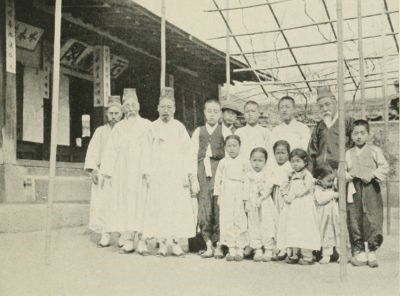
A Group of our Korean Friends
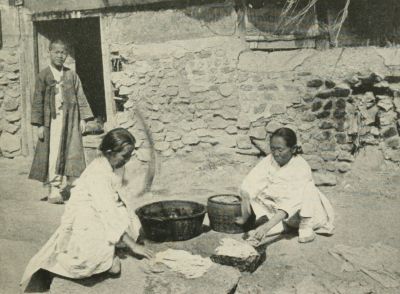
Every Day is Wash-day in Korea
The Tientsin Middle School, in which Richardson was to teach, proved to be a large modern brick building, its class rooms and laboratories fairly well equipped with the latest western appliances. One of the requirements for entrance into this school was a speaking knowledge of the English language. Otherwise Richardson would have been more useless than he was. Physics was an almost unknown science to him, but he concluded that if he could not bluff it out that he was an authority on the subject he was willing to take the consequences.
During the time that Richardson was connected with this institution the first annual track meet of the schools of North China was held on its athletic grounds. The contest was planned and supervised largely by Americans and the Chinese took a great interest in it. Many schools in the northern part of the Empire sent teams, and several thousand people attended the meet. Among the distinguished spectators, who occupied a box, was the Viceroy of Chili Province with a score of attendants. Richardson worried the old fellow almost to death by taking several pictures of him and his cortége. Richardson was ordered to stop. The Viceroy was more worried, however, by the report of the starter's pistol and when the first shot was fired all his attendants gathered closely about him. Even after it had been explained to him that the cartridges were blank he issued instructions forbidding the use of the weapon altogether. The poor old gentleman was afraid that some one was going to take a shot at him. The following week he sent an order to all the schools in his province prohibiting track meets in the future. Imagine the Governor of New York issuing such an order. He would be hooted out of the state.
Richardson's duties started on a Monday and I took my leave, intending to spend a couple of months travelling through China and meet my side-partner in Manila. I went to Peking where I put up at the Y.M.C.A. for one dollar a day. I spent two weeks in this very fascinating city doing the rounds in a most tourist-like fashion. While sitting one afternoon on the great altar of the Temple of Heaven, reflecting on the fact that I was a lonely tramp wandering aimlessly through a land of strange people, I was approached by a slight male figure with a missionary caste of countenance. The man sat down and began to talk to me. He had one of those piping voices which always excite in me the desire to fight. This person, with the unfortunate and aggravating voice, was a Baptist preacher of the hardest shell variety. We spent the rest of the day together sight-seeing and at evening we agreed to meet the following day. For two weeks the Baptist and I trudged about the interesting city of Peking, visiting the Temple of Heaven, the Temple of Confucius, the Legation quarters and all the places of importance in the Tartar, Imperial and Chinese cities. The old fellow proved to be an interesting character in spite of his voice and my inclination to swing on him changed to a feeling of respect and admiration.
From Peking to Hankow but one fast train runs a week. This train makes the trip in a day and a half, running both day and night. The other trains travel only in the daytime, stopping on a siding at night, and require three days for the journey. I was at the station ready to leave in a few minutes on the fast train when I heard what I thought was my name being shouted about the depot. This startled me for, outside of the Baptist preacher and a few men I met at the Y.M.C.A., I knew no one. The name was shouted again and, seeing that a Chinese boy was the source from which it was emerging, I went to the lad to ascertain what it was all about. The boy handed me a telegram which read, "Chance for teaching till summer can you stay over wire reply." This message was from Samuel Sung Young, the President of the Tangshan Engineering College, whom I had met in Tientsin. The telegram didn't mean very much and I had only five minutes in which to make up my mind before the train departed. "Chance for teaching"—teaching what? I came to the conclusion that if I could not teach Chinese youths Hebrew or anatomy or anything else, I was no good. "Till summer"—what did that mean? Summer in China might not begin for six months. I decided to take a chance on that. The most serious difficulty, however, was that there was no mention in the telegram about pay. While I was reflecting on these matters the train whistle blew and it was time to act. I decided to wait over and investigate the position. I wired Young, "Teach what and how much?" The next day I received a reply which read, "Taels two hundred reply." I was as much at sea as ever. How much was two hundred taels? I soon learned on inquiring that it was the equivalent to one hundred and twenty-five dollars gold. But was that amount to be paid monthly or for the period lasting "till summer"? No mention was made of the subject I was to teach and the whole affair was an uncertain proposition. I rather liked this uncertain feature, so wired my acceptance and took the next train for Tangshan.
Shortly after night-fall I swung off my car at Tangshan and was greeted by President Young and Professor Shen Yen Jee, one of the instructors in the college. Jee, a Cantonese, was a graduate of the University of California in my class and we had been good friends. To meet him was a great surprise. It was nearly like coming home.
The welcome I received was as enthusiastic and cordial as any one ever had and the hospitality extended has never been surpassed and seldom equalled on this earth. We hopped into rickshaws and were off to the college grounds. President Young's mansion was a fine two-story brick building. I was introduced to Mrs. Young, a charming little Chinese woman, who spoke good English which she had learned at a Church of England school in Hongkong. I was also introduced to Miss May Wu, Mrs. Young's sister and a bright young girl of fifteen. Miss Young, the president's sister, and a very fine woman, was also present. But probably the finest of all were Mrs. Young's two dear little boys—one two years old and the other a three-months' old baby.
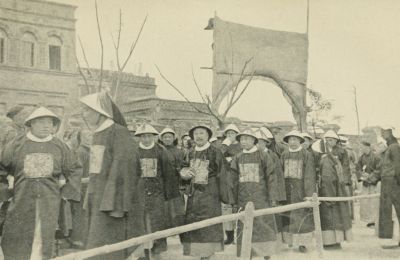
Provincial Officials Attending China's First Track Meet
The situation was a great novelty to me and such enjoyable and interesting things came in such rapid succession that it all seemed like a beautiful dream. We soon sat down to dinner and the many good but odd dishes which were served nearly baffled me. The chop-sticks, the sole appliances for conveying the food to one's mouth, unless one employed one's hands—which would be a greater breach of etiquette in China than in America—were handled by me with a certain degree of facility, for I had acquired considerable dexterity with these implements in Japan. Jee and I talked of old acquaintances at college and we all had an enjoyable evening before retiring.
The Tangshan Engineering College is the leading Imperial Government scientific school in China. Its ten or more buildings are of red brick and are thoroughly equipped with the latest classroom fixtures and laboratory supplies. There was an undergraduate enrolment of two hundred and fifty boys and a cleaner or finer set of young fellows cannot be found anywhere. The faculty number thirty, one-half of whom were Chinese and the other English or Scotch. President Young's house, which was part of the college plan, was enclosed in a compound of its own. In front were a pretty garden and a first-class tennis court. The interior was furnished in Chinese fashion with a strong American tinge to it, for Young had been educated in America. There were a half dozen servants and the household was conducted in a manner in keeping with the dignity of the president of a college. My bedroom was a large well-ventilated apartment containing a Chinese bed, upon which had been thoughtfully placed a pillow and bed clothes common to the West.
All the members of the household were dressed in Chinese costume. This Oriental apparel is very picturesque and demands the utmost care and taste on the part of those who wear it, both men and women, to be in style. The intricacies of Chinese dress are more complicated and require more attention, time and skill to be in accordance with the dictates of fashion than do those of the American woman with her manifold garments and her ornate headgear.
The meals were purely Chinese and I soon became accustomed to rice as the main food-stuff and almost forgot that such articles as bread or butter ever existed. The most monotonous meal of the day was breakfast. This repast consisted of rice and meat—a sort of stew, one day, and the next we would sit down to bowls containing endless strings of a substance somewhat similar to macaroni. This alternating diet was a poor substitute for the usual fresh eggs, coffee and pancakes of the day's initial meal in the West. The noon and evening meals furnished a much larger variety and there was a more favourable chance for an American to hook nourishing food out of the assortment. Such delicacies as fish eyes, shark fins, bird's nest soup, lime-cured eggs, finely chopped and highly-seasoned chicken, vegetables and rice—in numerous forms—comprised the bulk of the menu. Novel and interesting as all this was to me, I was quite ready, after a month's stay in Tangshan, for a porterhouse steak, some bread and butter and a piece of pie.
I learned my duties the day after my arrival. I was to be substitute professor in English, History and Economics, have charge of the college gymnasium and assist in the library, in place of one of the regular teachers who was absent on leave for a month. No new light was thrown on the subject of salary and this matter remained obscure until the time came for my departure. The classroom work was interesting and Chinese pupils are about the same as the general run of such creatures in any American city. One of the requirements for admission to the college was that each student should have a speaking knowledge of English. This knowledge on their part was not very profound, however, and I would talk along at times with such rapidity that the poor chaps could not understand a word.
When off duty I spent many an interesting hour talking to Mrs. Young about (to me) the peculiar ways of the Chinese—their marriage customs, their family life and social ideas. I frequently made visits to the village of Tangshan where I wandered in and out of the quaint markets, ate in Chinese restaurants or attended a religious ceremony at one of the many temples. I occasionally dropped into a theatre where the custom prevailed of entering without paying admission, the cost of the show being collected after one had been present a few minutes making up his mind whether the performance was worth seeing or not.
A Chinese play sometimes lasts for weeks and its claim to a continuous performance beats that of the American picture show. Some of the audience sit on the stage. The orchestra is also on the stage and produces the most unearthly collection of discordant sounds conceivable. The actors, dressed in the most hideous combination of colours, shriek and yelp in tones ranging in variety from the mellow voice of a female Quaker to the gruesome calls of a coyote. Most interesting among the features of the theatres were the conveniences furnished by the proprietors for their patrons. There was a continual shower of wet towels hurled through the air over the heads of the people—by a man on the stage—to boys stationed in various parts of the theatre. One of these moistened rags was passed along each row of seats and the perspiring occupants swabbed off their faces and naked bodies. The facility and skill with which these towels were thrown and caught and the utter disregard of all rules of hygiene on the part of the crowd in the common use of the fabric were marvellous.
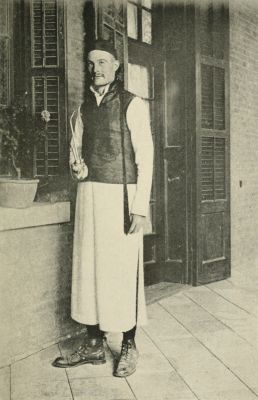
The Author in Chinese Garb
Many of the Chinese instructors connected with the college had had their queues amputated. Mo—one of the proctors, however, took pride in his greasy pig-tail and refused to part with it. I suggested to him one time that if he did not cut it off I would do so myself. One evening when Mo was playing Chinese dominoes at President Young's house I determined to tie a tin can to his queue. It required some patience and a little time to carry this out so as not to give Mo any idea as to what was taking place. The rest of the Chinese were in on the joke and gave me what assistance they could, while continuing to play their game. After an hour's work the feat was accomplished and on the end of a heavy cord attached to the proctor's queue was a rusty old Standard Oil can. The Chinese usually play at their games until very late and as I wished to go to bed early I had to hasten the climax. I did this by having a servant announce a hurry call for Mo. The proctor, thinking there was trouble in the boys' dormitory, made a dash towards the door with the oil can dangling behind him. The instant he discovered the can he realised that the servant's call was a sham and in a rage turned on me whom he at once suspected of the mischief. I thought my last day had come and that I was to be mauled to pieces by the frantic handling of an enraged Oriental. He plunged towards me like a huge tiger. Fortunately for me the rest of the company appreciated the joke and came to my rescue. The angry man was calmed and a tragedy was prevented.
It was about this time that I received the following letter from Richardson in Peking: "The job in Tientsin has gone up in a balloon. Particulars later. Let it suffice to say that my Honolulu discipline got the boys on their ear and in the absence of the principal they struck. To avoid complications I beat it. No tears." This is the only information that I received concerning Richardson's sudden flight from Tientsin until I reached Manila some time later. I then forced him into the admission that he was virtually fired. Chinese students have the habit, when their teachers do not suit them, of going on a strike. It seems that Richardson tried to inaugurate a civilised system of discipline which proved to be such a sudden and revolutionary change to the laxity that had prevailed in the class room, up to the time of his advent, that the students rose up in a body and rebelled. They all went on a strike and proceeded to the acting principal of the institution and issued an ultimatum that either Richardson had to leave or they themselves would quit the school. Their decision was final and the acting head of the school informed Richardson that under the circumstances he would have to go. Richardson said that such an arrangement suited him, and that afternoon he resumed his journey.
One of the most delightful Chinese that I met during my stay in Tangshan was Mr. Sze Ping Tze, who was a graduate of Cornell University and at this time Locomotive Superintendent of the Imperial Railways of North China. He was also an high official of the Kaiping Coal Mines. Several years ago he was private secretary to Yuan Shi-Kai, later President of the Chinese Republic. I spent many pleasant evenings with Mr. Sze and became well acquainted with him. On one occasion I said to him,
"Give me a job as conductor on one of your trains running from Peking to Hankow."
"Why do you want it?" he asked.
"When I get to Hankow I will quit and I shall then be several hundred miles farther along on my trip—at your expense," I replied with a smile.
Sze thought this was a great joke and, laughing, said, "Why, I can do better than that for you; I will give you a pass."
"All right," I said, "I won't forget that and when the time comes for me to leave Tangshan I will remind you of it."
"What's more," continued Sze, "I will give you a letter of introduction to my brother in Hankow. He is vice-president of the Chinese Steamship and Navigation Company and I am sure he will give you a pass on the Yangtsze River from Hankow to Shanghai."
"Fine business; and maybe I will be able to get a lift there from some one that will shoot me through to Manila," I concluded, feeling that the conversation had been a very profitable one.
When the time came for my departure from Tangshan Sze was true to his word. President Young gave me a railroad pass from Tangshan to Peking, distance of two hundred miles; Sze's pass from Peking to Hankow was over nine hundred miles and the letter to his brother brought the third pass down the Yangtsze River to Shanghai, a distance of nine hundred miles more. As a result I obtained free passage for two thousand miles in China—and all first-class. If all the circumstances were reversed, what chance would a young Chinese, working his way in America, have of teaching in the University of California, living with the president of the college, getting a pass from an high official of the Southern Pacific from San Francisco to St. Louis and thence down the Mississippi to New Orleans?
For my services as substitute professor in the college I received one hundred and twenty-five dollars (gold) plus my room and board and this, together with the railway and steamship passes I obtained, made the month I spent in Tangshan a very profitable one. I prized more highly, however, the unique experience of living with a high-class Chinese family and the insight I had of Chinese home life. But above all I value the good and loyal Chinese friends I made.
CHAPTER VII
ADRIFT IN THE CHINESE EMPIRE
President Young accompanied me from Tangshan to Peking, to which latter city he made frequent trips in connection with his position as member of the Imperial Government Boards of Education and Transportation. I had planned to take the slow train from Peking to Hankow, which runs only in the day time and goes on a siding for the night. This train would leave at eight the following morning and, as we arrived in Peking in the afternoon, I had the evening to spend there.
All American-educated Chinese are known as "returned students" and about a dozen of these fellows were guests of President Young at dinner at the Wagon Lits Hotel to meet me. As they were all graduates of American colleges and spoke English they employed this language exclusively, when they were together, in order to keep in practice and also to cement this common bond which existed amongst them. Mr. Ponson Chu, one of the number, displayed a Psi Upsilon Fraternity pin on the breast of his Oriental costume and this emblem immediately attracted my attention, for I was a member of the same society. Chu was from the Yale chapter with the class of 1909 and he and I became brothers at once.
After dinner we rented rickshaws for the evening and the Chinese started out to "show me the town." This was a rare opportunity; for it gave me access to places of which, alone, I should not have known the existence. We hopped into our rickshaws and were on our way. We passed the Legation compounds, went through the massive and imposing Chien-Mien Gate and in a few minutes were lost in the swarms of roving humanity in the Chinese City. We found our way through the narrow streets crowded with vendors, wrangling merchants, camels and what not. Finally we came to our first stop, a bohemian café—to describe the place in western parlance. This café, which represented the best thing of its kind in the capital, was a quaint old building composed of several rooms in each of which were a few tables. We seated ourselves at three of these tables and ordered refreshments—which consisted of tea and dried watermelon seeds. Shortly, a bevy of young Chinese girls, employed by the institution, came in and sat with us, partook of the food and engaged in the conversation so far as their limited mentalities would permit. These dainty little creatures, ranging in age from twelve to sixteen years, were neatly dressed in tight pajama-like garments. Their hair was greased and cut in such fantastic designs and they were so mentally deficient and so bashful that it was hard for me to realise they were human beings. One of our number put in an order for a Chinese orchestra and in a few minutes an old fellow appeared with an instrument somewhat similar to a violin. This musical contrivance had but one string. The sounds it emitted, after its operator got into action, were enough to drive the most placid man insane. To complete the musical bedlam a confusion of discordant tones was added by the voices of several female singers who rendered a number of selections at the request of one of our party.
We visited several establishments of this sort and in one of them I was treated to the sight of seeing two Manchu Princesses accompanied by their eunuchs. These women entered with their male attendants, hanging languidly on their arms. The women were tall, graceful creatures—each smoking a cigarette, and were dressed in beautiful one-piece robes of rich blue colour. Their hair was done up in the characteristic Manchu fashion on a framework extending from the rear of the head. They were beautiful women.
The following morning I was at the station ready to board the slow train through China to Hankow. As there were no dining arrangements on these trains I came fully provided with provisions. Extending from each coat pocket was a loaf of French bread; canned goods disfigured the symmetry of my trousers in front and two bottles of beer added to my unshapely appearance in the rear. Foreigners very seldom take this slow train and the passenger list consists exclusively of natives who are making short trips.
I had just seated myself in my compartment when an Englishman entered and asked if I would mind if a Russian shared quarters with me. I had no objections and the Russian came in. The train pulled out and as soon as my new travelling companion had his luggage adjusted I attempted to engage him in conversation. The man could not speak a word of English and I knew nothing of Russian. I was in for three days of silence, I thought. We resorted to gestures and drawing pictures. In this way, I learned that my new friend was an artist and, I informed him by the same means, of my purposes in life.
To confine myself to the truth it must be stated that the Russian knew two words of the English language and these were, "President Taft." I discovered this when he took from his little travelling trunk two small glasses and a bottle of Benedictine. He poured out the liquor, handed a glass to me and, drinking a toast, said, "President Taft." I would not be outdone so I returned the compliment by toasting a name which I thought ought to be the Russian for Nicholas. The artist recognised it and his face was one radiant smile as he drank his glass. These were the only words which passed between us during our three days together and they were made coherent with the bottle as a welcome interpreter.
The painter had, among his belongings, a large pamphlet with Russian phrases on one page and the English equivalent on the other. By means of this booklet we were able to exchange ideas. Sometimes, however, it would require almost an hour to put across a simple thought.
The first night we stopped at Tchang Te Fou and I made arrangements with the station master for the Russian and myself to sleep in the car. Most of the interior cities of China are surrounded by a wall and the railway stations are usually outside of this wall and often a couple of miles away. Before retiring the Russian and I had agreed, by means of the English-Russian pamphlet, to enter the walls of Tchang Te Fou and see the town and at the same time get something to drink, as the water on the train was very poor. We walked the two miles from the station to the city, entered the big gate and were soon wandering up the main street. We were at once a source of curiosity as our advent was, no doubt, the chief event of the year.
This city is seldom, if ever, visited by foreigners and we learned afterwards that there were only two in residence, these being missionaries. Consequently we were the main feature of interest to the simple but treacherous-looking inhabitants. As we proceeded up the street in the hope of finding a soda fountain or a saloon we accumulated a long train of curious citizens, beggars, naked children and nondescripts, who followed us and examined us with child-like simplicity. We finally came to a shop which had the appearance of a drug store. We looked over its stock for some thirst-quenching liquid. By this time our train of natives had increased to two hundred and they stood at the entrance of the shop while the proprietor restrained them from coming in. I spied two bottles of some unknown make of American beer perched on a shelf amidst Chinese medical concoctions and bought them. The Russian and I then made our way through the crowd at the door and started down the street to the train. The gang of Chinese tacked on and a solid procession of half the population of China, so it seemed to us, marched behind us. It was beginning to get dark and, as it was no uncommon thing for foreigners to enter some Chinese cities and never be heard of again, I became somewhat alarmed when several of the hangers-on began to beg for money and, when none was forthcoming, to pull at our coats and molest us. Two of the Chinese were especially persistent, one jerking the Russian's coat and the other making an effort to get his hands in my pockets. What a situation! It looked as though two speechless companions in danger would have to clean out the whole crowd of several hundred Chinese. The Russian gave me a look which I interpreted to mean that there was nothing to do but fight. The mere suggestion of such a thing unconsciously made me act and in a flash I swung on one of my assailants. I connected with his chin and floored him. Ideas go in and out of a man's brain in rapid succession in such moments, and I thought that the Russian and I would now have to fight the whole mob. I was mistaken. I didn't know my men, for the blow that ruined my opponent dispersed the entire crowd and they fled in all directions like chaff before the wind. A crisis had been passed and the Russian and I made haste to the station where we safely spent the night in the train.
The next day we had more trouble. This time it was with the railway police. I was showing a number of photographs of Chinese to my Russian friend when a policeman came along and asked in French if he could see them. I acquiesced, thinking the officer was simply interested. He wanted to show them to some of his friends in another car. I gave my consent with a nod of my head. As he had not returned at the end of an hour, I went through the train to find him. He was showing them to a score of his countrymen and said that he would bring them back in a few minutes. I returned to my car. Shortly the policeman appeared and gave me all the pictures except two. These he said he wanted to keep. I protested with him in French, for this was the language used by the employés of this railroad. He became so angry that he attempted to take back the photographs he had returned. The Russian came to my assistance and we threw the policeman out of our compartment into the aisle of the car. I took his number and told him that I would report him to Mr. Tze, the official of the railroad company who had given me my pass. The policeman recognised Tze's name and at once calmed down and said that he would return the missing pictures immediately. He did not return and I went after him again only to learn that he had got off the train at the last station. The man was now beyond reach and I was out two of my photographs. Why he wanted them, I don't know. It is hard to diagnose the workings of some people's brains and this policeman was one of them.
The second night our train went on a siding at Tchu Me Tien, a small isolated village. The station master would not grant us permission to sleep in the car, so we had to put up at a Chinese inn. A Japanese hotel is a model of cleanliness. A Chinese hotel is usually the reverse. This inn at Tchu Me Tien was the essence of filth, discomfort and heat. It is a safe statement to make that it was one of the most unsanitary, dilapidated and uncomfortable domiciles on this earth. The building was alive with naked and unwashed Chinese; our bedroom was occupied by a dozen hop-head coolies; the beds were made from the hardest wood obtainable; the unsanitary toilet was only a few feet away; the thermometer was hovering about the boiling point; and mosquitoes were as numerous as raindrops in Oregon and as large as bats. With all these inconveniences and pests, coupled with the fear of being robbed during the night by the proprietor of the hotel assisted by his guests, neither the Russian nor myself—who rested on the same plank together—got a wink of sleep.
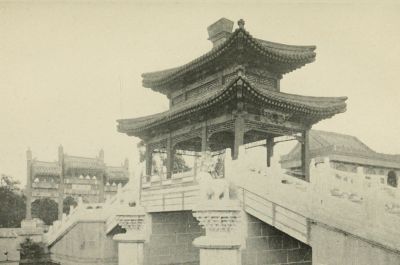
A Pagoda Bridge in the Forbidden City (Photograph taken by Mr. Sze Ping Tze)
I left the Russian at Hankow and began rambling again by myself. I found an hotel in the Japanese concession of the city and there I put up during my week's stay in Hankow. I deteriorated into a simple tourist. I "did" Hankow, and I "did" Wu-Chang and Han Yang, the cities on the opposite banks of the Yangtsze River. Before leaving Hankow I presented my letter of introduction to Mr. Tze and obtained my steamship passage down the river. I sailed on the steamer Hsin Chang.
Three days and three nights on the picturesque Yangtsze as a first-class passenger, and the Hsin Chang pulled into Nanking. Although my pass was good to Shanghai I concluded to leave the ship at Nanking and go on to the coast by train. I therefore landed, hailed a rickshaw and gave instructions to the coolie to haul me to a Japanese hotel.
American and European hotels were impossible for me on account of their high rates and the Chinese hotels were out of the question because of their filth. There are many Japanese in China and each large city has at least one of their hotels, which are always clean and cheap.
The Nanking Japanese hotel proved to be a difficult institution to find for, after dragging me about two-thirds of the streets of the town, the coolie admitted that he didn't know where it was. At last I saw the Japanese consul's house and directed my rickshaw man to it. From the consul I learned where the Japanese hotel was. In five minutes I was a properly registered guest of the place.
I retained the service of the rickshaw coolie and with a map set out to see Nanking. I passed through the ruins of the old Imperial City where a few Manchus still reside and out of the walls to the Ming tombs. The rickshaw slowly conveyed me along the avenue of hideous monuments erected over the graves of the late members of the Ming dynasty. When I came to the end I alighted and ascended to the summit of the huge structure built over the supposed remains of Woo Hung, the first emperor of the Ming line, who died some six hundred years ago. I sat down and gazed over the distant walls to the city of Nanking nestled in the mist. There I remained in deep reflection. My thoughts had floated across the Pacific to places where I had friends and relatives. Just at this lonesome moment a neatly dressed Scotchman came along and sat down beside me.
"What are you doing, old chap?" he enquired.
"Just knocking about the country," I replied.
"Are you going to Shanghai?"
"Yes, I shall probably go down to-morrow afternoon."
"Where do you intend to stay while there?"
"Oh, I suppose that I shall put up at some hotel."
"I live in Shanghai and am going there in the morning. Can't you come and stay with me?"
I thanked him but declined, giving as an excuse the fact that I had some friends whom I expected to meet. The Scotchman persisted.
"I should be very pleased to entertain you. If you are unable to find your friends be sure and look me up," he said.
I am not of a suspicious nature but, when the Scotchman extended such an urgent invitation on so short acquaintance, I immediately thought that he was a bunko man of some sort and that he intended to "shanghai" me.
"Thanks," I concluded, "if I can't find my friends I shall look you up." Shanghai is a city of a million and a half people and, as the Scotchman—who didn't give his name—left, I dismissed the incident from my mind, never expecting to see him again.
I returned to my rickshaw and was soon again within the city walls where I spent the remainder of the afternoon visiting the Gung Yuam or old Examination Hall.
This hall was one of the most interesting institutions in my Chinese travels. It was the place where the students from many provinces came to take the government examinations in the Chinese classics. It consisted of rows of cells where the students were sealed in for several days to write their essays. There were twenty-five thousand of these cells, sufficient to accommodate that many students at one time, and the whole institution covered several acres. In addition to the cells there were many buildings which were used by the government officials and examiners. The place was last used in 1904 and since that time has rapidly decayed and through neglect, characteristic of the Chinese, was in a poor state of preservation. It was the only one still remaining in China and it is a pity that it is soon to be destroyed.
My companion on the train to Shanghai was a Japanese. With the smattering of English he knew, coupled with the fragments of the Japanese language I had picked up in Japan, we carried on a fairly intelligent conversation. From him I learned the address of a Japanese hotel in Shanghai and he kindly offered to accompany me to it. We arrived in the big city and in a moment were lost in the tremendous tides of humanity. I thought I had never seen so many people before. The Japanese conducted me to the hotel. The proprietor consigned us to the same room. I didn't object. I was only surprised.
Shanghai was in holiday attire and throngs of people were celebrating the coronation of King George V of Great Britain. I walked the streets and watched the happy crowds. A feeling came over me that I was out of it, that my stay in the city would be a wearisome one and that while every one else would be enjoying the celebration I could not take part in it. As I was thus musing, I heard a shout from the street.
"Did you find your friends?" It was the Scotchman whom I had met in Nanking.
"No," I shouted back, at once making up my mind to accept the stranger's invitation. I concluded that I had never been drugged or "shanghaied" and I was willing to take the chance. If any one made a suspicious move I would swing on him first and put up a good fight while the affair lasted.
"Come on with me, then," said the Scotchman.
"All right," I replied.
I returned to the Japanese hotel, checked out and immediately moved into the Scotchman's apartments.
This mysterious man whom I held in such suspicion and to whom I attributed such unworthy motives was Mr. John E. Hall, a prominent importer of steel rails, and one of the most respected citizens of Shanghai. I entered Hall's spacious apartments, was introduced to several of his friends and was soon seated at the dinner table putting away one of the finest meals any mortal ever ate. Everything in the line of good food and good liquor graced Hall's table, and every convenience and comfort from bath-room to billiard table was to be found in his residence.
I was given a guest card to the Shanghai Club, the finest in the Far East. I had a ticket to the Coronation service at the Cathedral. I sat in a reserved seat and viewed the parade. I was taken to all the points of interest in the city, both by day and by night, and if there was anything on the map too good for me, I didn't know it. This was a sample of hospitality hard to beat.
During my wanderings about Shanghai with Hall, I was taken, in the early hours of the morning, after the electrical parade which took place as a part of the coronation celebration, to the Carlton Café—a bohemian resort. As I entered this café, in company with a dozen of Hall's friends, I was startled to hear my name called out from the midst of the huge throng of midnight merrymakers. Here I was five thousand miles from home, and, so far as I was aware, there was not a soul I knew in the city. My name rang through the air again. I looked about and at last recognised a woman, who was standing on a table, as the source of the call. I soon discovered that she was inebriated and in a second I recalled that I had met her on the steamer Asia crossing the Pacific. I immediately went over to her, shook hands with her and exchanged the usual platitudes which are employed when people meet.
My friends wanted to know where I had met the lady, and informed me that she was one of the most notorious women of the Shanghai underworld. On the steamer she had given her name as Mrs. Davis and there was nothing in her demeanour during the voyage to indicate that she was not a respectable woman. It was on this basis that I had met her. Presently she came over to our table and asked if I would come and have tiffin with her the next day. I accepted.
"Where shall I come?" I enquired.
"Sixteen Soo Chow Road," she said. "Are you surprised?"
Either way I might have answered this question would have given offence, so I evaded it with an assurance that I would be on hand for tiffin the next day.
Sixteen Soo Chow Road was guarded by two policemen. They took no notice of me and I walked straight in and asked for Mrs. Davis. No one in the house knew her by that name. In a few minutes I found her and was cordially received. The place was in a great state of excitement, for one of the women had taken four shots at a prominent merchant of Shanghai early in the morning in one of the city's cafés. The woman was under arrest and this accounted for the presence of the policemen at the entrance. I did not like the idea of being about for fear I would be called as a witness and become mixed up in a nasty scrape which I knew nothing about. However, I decided to be a man and see the meal out. Tiffin was brought in and Mrs. Davis, for she was still Mrs. Davis to me, entertained me as would the hostess of the most respectable home in the world. After a good meal and a pleasant call I took my leave. I was somewhat wiser from my study of human nature. I also had made another friend in this world.
I made arrangements with the skipper of a British tramp steamer to take me to Hongkong and before long I found myself on the shores of this beautiful island ready for new experiences. Hongkong proved to be a poor field for adventure and after seeing the sights I went up the river to Canton. In both places I put up at Japanese hotels where I thrived on Japanese diet at Japanese prices. I returned to Hongkong and after a few days along the waterfront I sailed for Manila on a British tramp.
Before the ship got under way a United States Quarantine officer made a cursory examination of the crew before she would be allowed to leave for the Philippines. As he passed me he said, without stopping, that I had malaria. This was cheerful news, for a Hankow doctor had told me that I had a touch of dry pleurisy and a Canton physician had prescribed a mixture for dysentery. I said to myself when the American Quarantine doctor made his lightning-speed diagnosis, "That is a delightful thought; I must have all the diseases under the sun." I hadn't been feeling very well, which I attributed to the long period I had lived on Japanese and Chinese food and the irregular life I had been leading, so I discounted the contradictory statements of all my physicians and concluded that with good food and regular hours in Manila I would soon be in normal shape.
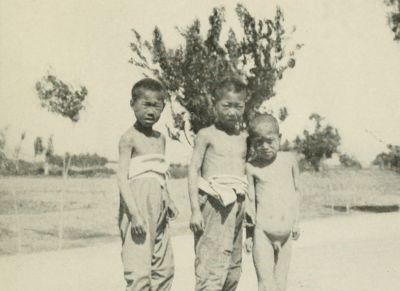
Country Boys of North China
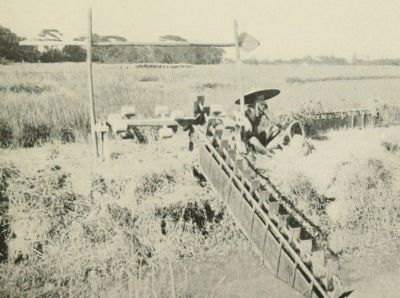
Sample of an Irrigation System
However, I had no time to think of ailments, for the second day out found the ship in the roughest sea I had ever experienced. The captain informed me that we were on the outskirts of a typhoon and that he had changed the course of the ship in order to run away from it. Typhoons, which are common to the China Sea during the fall of the year, are tremendous whirlwinds which are often several hundred miles in circumference and, when the weather prophets know of their existence, all ships are not allowed to leave port. Our ship, however, got under way before any indications of the typhoon were evident. If a boat encounters one of these terrific storms its chances for getting out are about one in a hundred.
I was sitting on the deck talking to the ship's doctor when the boat gave a lurch which threw us both headlong against the railing. Before we could find something to hold to the ship pitched in the opposite direction and we were thrown like rag dolls through the open hatchway upon a pile of cargo. From this point we gradually found our way to the mess-room. This was the first indication that we were in the vicinity of a typhoon. The boat was a freighter and did not carry regular passengers and, besides the crew, the extra travellers consisted of a dozen Chinese coolies, a United States cable ship officer and myself.
The sea became rougher and rougher and if this was only the rim of a typhoon what on earth would the centre of it be? All night the ship pounded, swayed and lurched and the wind blew at a terrific rate. The skipper remained on the bridge and had what little he ate served to him there. In the morning the sea, instead of being calmer, as we had all hoped, was ten-fold worse and the captain announced that we were in the middle of the typhoon, and when asked what our chances were he simply shook his head. When the experienced skipper looked worried and considered that our prospects for reaching shore were small, unless something extraordinary occurred, I philosophically—as did all the others on board—resigned myself to the fact that I only had a day or two at most to live. We were as helpless as babes.
The waves ran thirty and forty feet high and constantly broke over the ship at the two hatchways. Fifteen feet of water dashed and redashed across the deck in a mad torrent. Occasionally a wave would break over the top of the mess-room, which was perched high upon the stem of the boat, and the force of its blow seem to promise that one more would cave in the sides of the ship and end it all. It was impossible to serve meals and we all munched at pieces of bread or chunks of meat—or any food we could get our hands on.
I had never imagined that the ocean could become so terrific and a ship so helpless. Each time I saw the tremendous mountains of water rush towards the vessel I would think it was all over. The ship would cringe, dip and twist and in some mysterious way, half submerged, ride the treacherous monster and, having got safely by, would instantly be confronted with another equally as treacherous and terrible. To survive these waves was a miracle.
With the heavy sea and the fearful wind the ship's engines were powerless and the boat was swept about like a cork. To add to our perilous situation the engine room was becoming flooded, although four pumps were frantically sucking out the water. Thus we battled with the sea for three days, not knowing when the end would come, but always living in the hope that the extraordinary thing would occur which the captain longed for.
Thank God, it did occur. During the third night the wind changed and it began to rain. I never saw rain in such quantities before nor do I ever expect to see it again. But every drop was a blessing, for it did its share to quiet the waves, and it was only a few hours before the sea had abated to a point where comparative safety was reached and the ship was able to make some headway. A more thankful and happy crowd could not be found at that moment on land or sea than the few men on that ship. The first meal after the subsiding of the waves was as happy a reunion and joyous occasion as any Christmas gathering I ever attended.
The next day the sea had calmed down to almost normal and the captain discovered that we had been driven five hundred miles out of our course. He headed the bow of his ship towards Manila and, on the morning of the sixth day, we pulled into port. We were all intact, but the faithful ship was a dismantled wreck. The Manila authorities had given us up as lost and our experiences took up a column on the front page of each of the daily papers.
CHAPTER VIII
RURAL CHINA BY CART
Richardson was en route to Peking as a third-class passenger. He had just been discharged—with thanks—from his position of physics teacher at the Tientsin Middle School. After his dismissal it took him about ten minutes to gather his meagre belongings together and get out of town.
In the Chinese capital he stayed at the native Y.M.C.A. which was conducted by Americans and where his travelling comrade had put up a few weeks before. His bill was one dollar, Chinese money, a day. The Young Men's Christian Association is found in nearly every large city in the Orient. Many of its plants are housed in substantial and well-equipped buildings and it does a most valuable work. The men in charge of these institutions are a fine lot and are representative of the best type of Americans. Without exception, they received us with the greatest cordiality possible and the recollection of their hospitality will long remain with us. The many secretaries we met were often invaluable to us for the advice they gave us, their suggestions and the courtesies they extended to us, and we were always welcomed to their accommodations at very reasonable prices.
In many ways Peking was the most interesting and fascinating city of our travels. It is different from any other place in the world. Richardson circled this oriental capital on foot. He walked along the top of the twelve miles of huge walls which surround it. Peking has a population of over a million people and is divided into four cities, viz.: The Tartar City, inhabited by the middle classes; the Imperial City, within the Tartar City, where reside most of the government officials; the Forbidden City, in the centre of the Imperial City, in which the Emperors lived and where the President of the Republic of China now has his residence; and the Chinese City where the lower classes live. Surrounding the entire metropolis is a great wall forty feet high and sixty-two feet wide at the base.
The Imperial City occupies a space of nearly two square miles and is enclosed by a wall twenty feet high. There are four spacious entrances, each with three gateways, the middle one being opened only for the Emperor or President. The Forbidden City is laid out on a grand scale and is surrounded by massive pink-tinted walls thirty feet high and thirty feet thick. Within are many palaces, private residences, apartments for visitors and government officials and the necessary quarters for an enormous retinue of domestics of various rank. Foreigners without permits or the Chinese, except high officials, are not allowed in this city.
Connecting the Tartar and Chinese cities is the immense and imposing Chien-Mien Gate with its four oriental towers. The view from the top of this gate is one of the most wonderful metropolitan pictures in the world. Directly before one's eyes are the yellow-tiled palaces of the Forbidden City, whose roofs look like sheets of glittering gold under the rays of the oriental sun. To the right are the costly and substantial houses of the Legation Quarter. Far to the left the Bell and Drum Towers loom up like western skyscrapers. In a remote corner of the Chinese City the stately Temple of Heaven with its rich blue roof rests in the haze of the oriental atmosphere. Beneath one is a bee-hive of human beings. Tens of thousands pass through the Chien-Mien Gate each day. Nearly every means of conveyance that one can imagine, except roller skates and submarines, can be seen creeping through the arched openings of the huge gate. Camels, donkeys, rickshaws, the elaborate equipages of officials, carts, men, women and children on foot, form an endless stream from the time the gates are opened at six in the morning until they close at midnight. A touch of the West is added by the roar of trains whose tracks pierce the walls of the Chinese capital with their numerous tunnels.
Travelling at the third-class mountain rate of two-thirds of a cent a mile, Richardson was sharing his small compartment on a Chinese train with a dozen coolies—on his way to Tai Yuam Fu. From Peking he had made a trip to the Ming tombs and had also visited the Great Wall with a party of American tourists. He was now on his way into the interior of Shansi Province to visit some college friends who were missionaries at a small town called Fen Chow Fu. The mission station was conducted by the American Board of the Congregational Church. Richardson went from Peking to Tchang Te Fou, a distance of one hundred and seventy miles, by train. This city was where the Russian artist and I had our trouble with the Chinese beggars. From this place Richardson took a branch line to Tai Yuan Fu, about two hundred miles west, where he spent the night as the guest of a young Britisher who was a Cambridge University graduate and was then doing medical missionary work. Tai Yuan Fu was the terminal of the railroad and Richardson had to complete his journey to the mission station by cart. This Chinese vehicle had been sent to meet him by his missionary friends.
In giving me an account of this eighty-mile Chinese cart trip, which required three days, Richardson told me that in order to appreciate his experiences I must keep in mind four facts. These were: first, a Chinese cart has neither springs nor cushions; second, Chinese country roads are simply two deep parallel ruts or grooves, made by the wheels of carts (these roads are never graded and in places the ruts are two or three feet deep); third, the portion of the road between the ruts was lined with rocks and boulders of every description and size; and fourth, it rained steadily the three days of his journey. He stated that, by putting these facts together and adding a liberal allowance of imagination, I could get some idea of a cart trip in China.
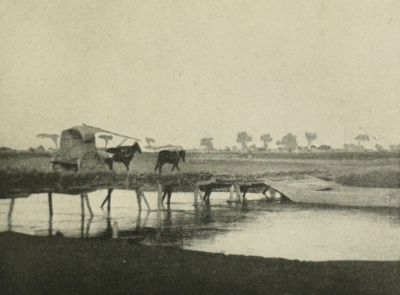
Crossing a Chinese Country Bridge
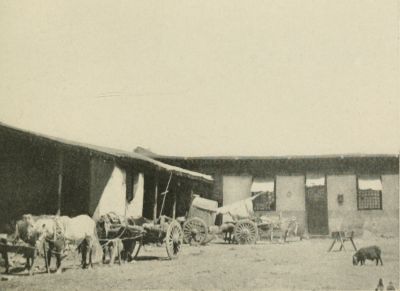
The Inn Where Richardson Put up for a Night
This uncomfortable vehicle was drawn by two mules, hitched tandem, and not once during the eighty miles did they get off a walk. An Arkansas train was a comet in comparison. Richardson's attendants were a driver and a servant, whom the mission station had sent. They could not speak English. For three days my friend was slowly hauled over hills and valleys in this primitive conveyance. At times he thought his insides would be shaken to a hopeless mass; his head was snapped about until there was grave doubt in his mind as to whether it would stay on throughout the journey and he was so roughly tossed about that he thought he would be lame for the rest of his life. He would ride a couple of hours, about as long as he could stand it at one time, and then get out and walk in the rain for an equal period.
At night and at noon-time he stopped at Chinese inns. "Inn" is a misnomer, however. The Chinese country inn is a stable-yard filled with mules, donkeys, dogs, pigs, chickens, babies and smells. This yard is surrounded by a long one-story building in which are the sleeping rooms, kitchens and eating compartments. All the rooms in an inn open on the yard and with their doorless entrances extend a hearty welcome to the numerous odours. Chinese hotels can be located by their characteristic odour.
A bedroom in one of these inns has no conveniences. There is a "thing" to sit on and a "thing" upon which to place food, but it requires a great deal of intuition to know that they are respectively a chair and a table. There is a brick platform in one corner of the room for a bed. This is called a kong in Shansi Province. Beneath these kongs a fire is built on cold nights. It was at Tai Yuam Hsien, where he spent the second night, that Richardson, while sleeping soundly on a kong, was awakened about two A.M. by being nearly baked. The coolie who was acting as stoker, had replenished the oven so generously with fuel that the bed resembled a crematory.
For two and a half days he didn't see a foreigner or meet a Chinese who could speak English. He communicated with his servant by means of signs. As he entered each village he at once became the chief object of interest. At the inns the scene on his arrival resembled a circus procession. All the youngsters, beggars and cripples followed him into the yard and watched the "animal" eat. At Tai Yuam Hsien they became so numerous and so persistent in their pleas for cash that Richardson had to flash his pistol to instil some fear into them and impress them with the fact that he was a dangerous man.
This three days' journey was filled with inconveniences, but gave Richardson an excellent opportunity to get a glimpse of Chinese rural life. The country through which he passed was green and the farms along the way gave a Mississippi Valley aspect to the scenery. The methods of farming were somewhat different, however. To see hundreds of acres of wheat planted in rows like radishes and hoed by hand was hardly American. There were no cows or horses but, instead, thousands of goats and sheep flocked the hills and valleys while mules and camels were the beasts of burden. The country was largely agricultural and there were but few walled cities, his course taking him through scores of little villages.
In each of the first two days the Chinese cart made thirty miles and the third day twenty. Richardson drove into Fen Chow Fu about six o'clock on the third evening and received a very cordial welcome from the members of the American mission station. Fen Chow Fu proved to be a walled town of about fifty thousand people and the score or more missionaries were the only foreigners. They entertained Richardson in real American fashion. The members of this little far away colony were mostly graduates of Carlton College, Minnesota, where Richardson had taken his freshman and sophomore years before going to Dartmouth.
After ten days as a guest of his friends, Richardson returned to the railroad at Tai Yuan Fu by Chinese cart. Three more uncomfortable days over the eighty-mile course with the same experiences as the inward trip and he arrived at the railroad without mishap. He took the first train and the following day was in Hankow. In this city he spent a comfortable week at the native Y.M.C.A.
It was at this time that one of the dreadful Chinese famines was ravaging the country a few miles distant from Hankow and thousands of people were dying of starvation. Large numbers of these homeless, naked and wretched creatures flocked to the city and roamed its narrow streets as beggars. They hardly had the strength to walk and they presented a sad sight with their fleshless bones, visible ribs and sunken faces. Real poverty was more in evidence in this section than in any part of the world we visited. Human beings were huddled in tiny huts built of rusty Standard Oil cans and located in a swamp. A whole family of six or eight would crawl in on their hands and knees to get a night's shelter from the cold and rain. During the day they would beg or attempt to sell some worthless trinkets or pieces of junk. I have seen a stock of goods spread out on the sidewalk which contained nothing but what would be consigned to the ash barrel in an American community. Rusty nails, pieces of glass, old newspapers, rags and wornout soles of shoes were on display. In some unaccountable way the vendor frequently found a purchaser.
It was in this poverty-stricken district that Richardson played the rôle of philanthropist. He bought an American dollar's worth of cash—small Chinese coins with a square hole in the centre which are sold on long strings. As soon as he began giving these away a hundred or more of these poor unfortunates gathered about him and piteously begged for some of the money. Starved creatures—ragged women, half-clad and shivering children, blind boys, men on all fours, paralytics and lepers—thronged about him and pleaded for some of his charity. He divided the money equally among the multitude, counting out the coins as he gave them away. He found that for his American dollar he had received twenty-seven hundred pieces of cash.
Richardson was the guest of some friends who were on the faculty of Boone's College in Wu Chang on the opposite bank of the Yangtsze River from Hankow. This school is under the auspices of the American Episcopal Church Mission and is one of the leading institutions of learning in the Empire. Here he spent several days in luxury, sleeping in a warm and comfortable room and enjoying American meals.
Riding below the water line on an oriental steamer with Chinese coolies as fellow passengers is the antithesis of the comfort of an American Mission school. This was the sort of transportation Richardson enjoyed down the Yangtsze to Shanghai. Three days in the midst of unsanitary surroundings and curious and simple coolies were enough to make the ordinary American quit the trip and buy a first-class ticket home. Richardson was not that kind. He was anything but a quitter and although he enjoyed a good bed, clean food and intelligent companions as well as any one I ever knew, he could stand hardship and discomfort without a murmur. He often appeared to like them. In the face of the most discouraging environment he would simply smile and play the part of a philosopher.
He trooped down the gangway at Shanghai with his fellow passengers and in a few days trooped up another gangway on his way south. This time, however, he had obtained a rather luxurious berth. For ten dollars he was to be landed in the city of Victoria, on the island of Hongkong, by the Scotch captain of a British tramp steamer. He occupied a cabin on the upper deck, had the freedom of the ship and dined with the skipper in the main saloon. The voyage was a quiet one and he had plenty of time for reading undisturbed.
Richardson had tried Chinese steerage travel and found it very rough. He decided to make a change. From Hongkong he sailed in the hold of a Japanese steamer for Manila. According to his own statement it was the lowest stratum he had ever reached. The Japanese in the third-class quarters were an unintelligent and inferior lot. They acted like animals; the food was coarse and half cooked; the bunks were hard and full of vermin; the quarters were poorly ventilated; toilet conveniences did not exist; the sea was rough and nearly all the passengers were sick. Aside from this, the boat was very comfortable and it was a pleasant trip.
CHAPTER IX
ASSORTED JOBS IN THE PHILIPPINES
The Philippines proved to be a prolific field for jobs. It was our plan to settle in the Islands for several months and add to our exchequers before going on to India and Europe. Richardson held down three jobs during our three months' stay and for a few days drew pay from them all at the same time. I filled one position and declined two others. The American who couldn't get work in Manila at the time of our visit deserved to starve to death.
Many of the old Spanish laws are still in force and, before I could transact any business, I had to comply with the insular regulations and get a cedular or license. This certificate costs two pesos and must be held before carrying on any financial negotiations.
I was now ready to look for a job. The first day I had a chance to sign on as a government teamster caring for and driving a pair of mules at sixty dollars a month. I did not accept this position, but held it in reserve in case I couldn't land anything better. The second day, the city editor of the Cable-News American said that he had an opening as a reporter at eighty dollars a month. At last I got in touch with the Bureau of Education which I learned wanted a man in its industrial department. Four others had been under consideration for several days for the position when I arrived on the scene. I interviewed the director, Mr. Frank E. White, a charming man who has since died and, as I made a favourable impression, he asked me to call again.
My application was considered for a week and I conversed with several of the authorities of the Bureau. I didn't like the long time employed in coming to a conclusion on my case, for I expected to remain in Manila only a few months—a fact which I had to keep a secret to have any one hire me.
One afternoon during these negotiations I was on the Luneta attending the daily concert of the Philippine Constabulary Band, when I was startled by a war-whoop. I looked up to see a sturdy figure dressed in the white of the tropics bounding towards me. It was Richardson who had just arrived in Manila from China. It was the first we had seen or heard of one another for three months. That evening we spent several hours relating our experiences since we separated.
The next interview with the Bureau of Education was the final one. My qualifications evidently satisfied the authorities for Mr. White opened the conversation by saying:
"Well, we have decided to take you on, Mr. Fletcher—on one condition."
"What is that?" I asked.
"That you will remain permanently," responded Mr. White.
After all the days of negotiation the job now hung in the balance, for I intended to stay only three months at most and I wanted to be free to leave at any time. I couldn't afford to let this information loose or all would be lost.
"I can't agree to anything like that, Mr. White. I assume that you reserve the right to discharge me if my services are not satisfactory and I want the same privilege to quit if I find that I don't like the work or can't get along with you or your assistants," I said.
"Of course we take such matters into consideration," replied Mr. White. "You may go to work at once if you wish."
"There is one little matter which has not been mentioned yet," I added.
"What is that?" enquired the director.
"Compensation," I smiled.
"Two hundred pesos a month," said Mr. White with a laugh. This amount is equivalent to one hundred dollars.
"That is satisfactory," I concluded and was conducted into the department where I was to work. Now that I had the job I at once began to figure out how to get rid of it when the time came. A few minutes before I had been wondering how I was going to get it.
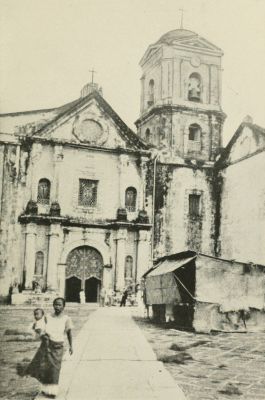
An Old Church in Manila
The Bureau of Education is one of the main divisions of the Insular Government and employs nearly two thousand men and women, the large majority of whom are scattered throughout the Islands as teachers. The head office in Manila has about one hundred and twenty on its staff, and these are divided among several departments. The Division of Publications and Industrial Information was the title of the department in which I was to work and my duties consisted of issuing bulletins, editing text-books, publishing the Philippine Craftsman (a monthly magazine of the Bureau) and preparing the annual report. This last embodied about fifty financial and statistical tables and twenty or more graphic charts showing the work accomplished by the Bureau during the year. This annual report turned out to be the main part of my duties and I was assisted by eight Filipinos who compiled most of the tables under my supervision. As the Governor-General of the Islands put in a rush order for this report my assistants and I were compelled to work until eleven o'clock each evening for about a month.
Immediately on his arrival in Manila Richardson started to look for a job. The first day, he met a friend from the Hawaiian Islands who was in the Philippines representing the Honolulu Planters' Association in obtaining Filipino labourers for the sugar plantations in Hawaii. This man said he would have a position open in a few weeks. Richardson informed him that he could not wait and would have to get something at once. The Hawaiian planter then agreed to take an option on his time at thirty dollars a week until a vacancy occurred. Richardson accepted this and remained in Manila to await developments.
The duties of the job for which Richardson was slated consisted of visiting several of the islands in a small steamer, manned by a Spanish captain and crew, and gathering labourers who would be taken to Manila and thence shipped to Honolulu. He was to have a motion picture apparatus, with an operator and lecturer who would accompany him in his visits to the small villages and towns and after showing the natives the wonders and advantages of life in Hawaii sign them on and ship them out.
During his wait in Manila Richardson was afflicted with the common tropical malady of dengue and was confined to his bed for ten days. Dengue is a sort of tropical grippe which is conveyed by mosquitoes and attacks its victims by means of a fever, rash and sore bones in every part of the body. Probably its most aggravating features are its after-effects, for a severe case often leaves the patient in such shape that it requires several months to recover normal health. Fortunately Richardson, due to his rugged constitution and to the fact that his attack was comparatively light, was soon convalescent and recovered without the usual lingering after effects.
Richardson soon received word from his Honolulu planter friend that he was to report in Cebu, a town on the island of the same name about five hundred miles south of Manila. He took an inter-island steamer and in a few days reached his destination and was ready for duty. He expected to go to work at once. But the man in charge at Cebu informed him that he was not needed and instructed him to return to Manila. There was a hitch some place. After some difficulty about expense money, which the Cebu man refused to pay and which was adjusted satisfactorily to Richardson by wiring to the Honolulu representative in Manila, he returned north, arriving on a Wednesday morning. He was paid off until the end of the week, which made a total period of one month at thirty dollars a week with no work and an interesting trip with all expenses to Cebu and back.
He began, Wednesday afternoon, to look for another job and by evening he had obtained a position as shipping clerk for a wholesale grocery house at one hundred dollars a month. He went to work the next morning—Thursday. That evening, after dinner, he received a letter from the Bureau of Public Works, to which he had made application the afternoon before, which stated that he was wanted to go to the island of Mindanao, a thousand miles south of Manila, and take charge of the construction of several concrete bridges at a salary of one hundred and twenty dollars a month and expenses. This offer was especially tempting, not only for the increase in salary but for the opportunity it offered him to see more of the Islands—the motive for which he was travelling. The position called—so the man at the Bureau of Public Works stated—for a knowledge of structural engineering, cement work and drafting. Richardson was not an engineer and knew nothing about such subjects.
"What, do you think of my accepting this job?" asked Richardson of his travelling companion when he had finished reading his letter aloud.
"Take it," I said.
"But I don't know anything about structural engineering," he replied.
"What difference does that make? All jobs sound harder than they really are. Suppose you accept it and they find in a couple of weeks that you are no good and fire you, what do you care? You will be a thousand miles farther along on the trip at their expense," I said rather emphatically.
"All right," said Richardson. "To-morrow I will notify the grocery people that I intend to quit in the evening and I will sail for Mindanao on Saturday."
Richardson severed his connections with the wholesale grocery house the following night and began making preparations for his departure south. It will be remembered that the salary from his first position continued until the end of the week. He received pay from the grocery store for Thursday and Friday and his wages from the Bureau of Public Works began on Friday morning. He therefore drew pay from all three jobs on Friday.
Richardson didn't know a transit from a trombone and he knew no more about cement than a hair-dresser but, provided with a technical hand-book, he sailed, certain that he would be a competent engineer by the time he arrived at Zamboango on the island of Mindanao—in about a week. I saw him off and interestedly awaited word from him as to how matters would turn out.
I had rented a large room in the Imperial Hotel, one of the quaint old adobe Spanish buildings with iron-barred windows and folding doors, in the Intramuros or walled city. I had been living in this room for a few weeks when the proprietor, evidently thinking that it was too large for one person to occupy, placed another man in it without consulting me. As the new arrival appeared a good fellow, and also because I received a reduction in my rental, I made no objection. My new roommate was a man about thirty years of age by the name of Edwards. He had been a second-class yeoman in the United States Navy and, after serving several years, had bought his way out. According to his own statement he had enjoyed the reputation of having been the biggest drunkard in the Asiatic Squadron and in this contention he was upheld by members of the navy who knew him. He now, however, had been on the water wagon for six months and intended to remain there.
It was only a few days after the advent of Edwards that the proprietor, evidently still considering that the room was too large to be wasted on two persons, intruded a third. This man's name was Lakebank, and since (as in the first case) he appeared to be a decent sort of chap and the proprietor again reduced the rental, we concluded to allow him to remain. We all, however, agreed that he was to be the last. Lakebank was a rough, uncouth fellow with one of the finest dispositions in the universe and a heart as big as the ocean. He was chauffeur for one of the high officials of the Insular Government. The three of us got along very well together.
One evening as Edwards and I were eating the eternal chicken dinner of Manila, Lakebank arrived with a most disturbed look in his face. His eyes were nearly popping out of his head. I at once saw that something was wrong and enquired what the trouble was but received only a wink in reply. I took the hint and put the matter off until after dinner. Lakebank, who was very nervous and excited, then informed me that he had seen a man on the street, that afternoon, whom he recognised as his sister's husband and who, nine years ago in the United States, had left her on the night of the birth of their little girl. Later it was discovered that he had gambled away all her savings. He had never been seen or heard from, and was supposed to be dead, until Lakebank came face to face with him on a calle of Manila. Lakebank learned that his brother-in-law was going under the assumed name of Polly.
We discussed the matter for some time and I offered a number of suggestions as to how to handle the situation. The next day, Lakebank, acting on our conclusions, went to the office of Mr. Polly, who had a good position with the Insular Government, and stated that he wished to speak to him alone.
"Go right ahead. Everything my stenographer hears is confidential," said Mr. Polly.
"No, I want her out of the room," insisted Lakebank, "for I have something of a very serious nature to say to you."
"Don't mind her," repeated the man, "I assure you that everything you say will be kept a secret."
"All right then," and looking him squarely in the face Lakebank said, "I am James Lakebank, your brother-in-law. Your name is Ham, not Polly."
"Yes, yes, you are right; no one should be present," muttered Ham nervously and, as he staggered towards the door, he added, "Come with me." The two men left the office and wandered out on the street, both in silence, until they came to a secluded spot in an adjacent lumber yard where, sheltered from view, they sat speechless.
"What are you going to do about it?" Lakebank finally asked. Ham then opened his heart and in tears stated that he had never spent such remorseful years in his life as those which had elapsed since the night he left his wife. He explained that he went directly to Chicago, enlisted in the army and was detailed to Manila, where he had been ever since. He said that if his wife were willing he would join her again and to show his good faith, would give Lakebank five hundred dollars to send her so that she could come to San Francisco and meet him there. If she did not want to see him, she could keep the money for whatever purpose she wished. He enquired affectionately about the little girl who was born the night he deserted and whom he had never seen. He stated that he had saved several thousand dollars and that, if it was his wife's wish, he would return to America, resume his right name, join her and begin life all over again.
Lakebank did not know whether his sister would forgive Ham, or not, but informed him that he would write her of their meeting. The case interested me and I was eager to know the outcome. It would take several months for letters to be exchanged between Lakebank and his sister and the matter would not be settled until nearly a year after my departure from the Islands. Many months afterwards I heard from Lakebank. Ham returned to America, met his wife and little girl in San Francisco, were reunited and were happily situated in the States.
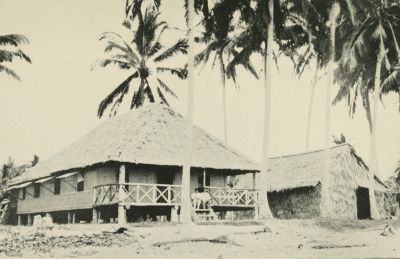
The House in Which Richardson Lived During His Employ at the Prison
One evening I was much surprised to see Richardson come bounding into my room.
"Where did you drop from?" I enquired, astonished.