LESSON XXXVII.
Reading edition
SOMETHING ABOUT SQUIRRELS.
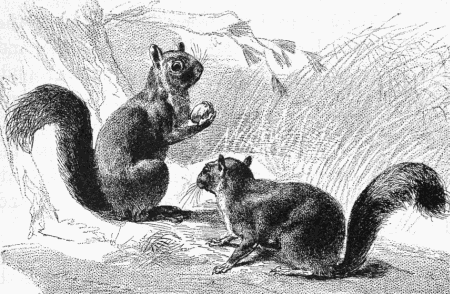
1. Here comes the squirrel—the little fellow that frisks and gambols so prettily over trees and hedges, and that chatters to us as we take a walk in the woods or fields. He is afraid to let us touch him; but he will let us come quite near, as he knows he can easily get away.
2. As we see him scampering along on the fences or trees, the first thing that we notice is his long bushy tail, which he coils up over his back.
3. But we will find one in a cage, and then we will take a closer look. We find that he has chisel-teeth, like the rat and rabbit, and then we know that Mr. Squirrel eats something that he must gnaw.
4. His toes are not strong, like those of the rat or rabbit, but they are long and slender, and we know that he does not dig holes in the ground. The nails are not strong enough to catch prey, but are long, thin, sharp, and bent at their tips.
5. Then we find that the squirrel can turn all his toes around so that the nails point backward, and we see that he is made for running up and down trees, where he has his home.
6. Now we see what he does with his sharp cutting-teeth. He lives upon nuts, and his teeth are for gnawing through the hard shell, to get at the kernel inside.
7. The ears of the squirrel are of moderate size. The rabbit and hare live upon the ground, and, if they did not have large ears and sharp hearing, they would be killed by dogs and other enemies. But the squirrel has his home in trees, out of reach of animals that can not climb; so it does not need such sharp hearing to save itself.
8. When in his home in the trees, the squirrel feels safe; so he curls his tail over his body and head to keep warm, and goes to sleep.