LESSON XII.
Reading edition
DOVES AND PIGEONS.
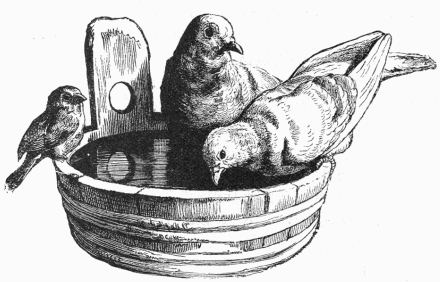
The Bath.
1. Everybody likes the dove; it is such a pretty bird, and is always so clean. It flies all about the yard, the garden, and the street. Even the rudest boys do not often disturb it.
2. It is about the size of a half-grown chicken, and looks more like a chicken than any of the other birds we have studied.
3. The doves about our houses are usually white, or a bluish gray. They live in pairs, each pair having its own nest, or home; but where doves are kept, many pairs live in the same house or dove-cote.
4. They have a short, pointed bill, like a chicken, and strong legs and toes, so that they can walk and scratch easily.
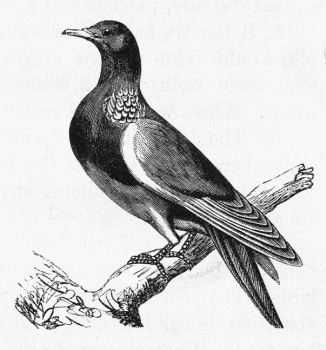
5. The mother dove lays but two eggs before sitting, and then her mate sits on the nest half of the time until the eggs are hatched. The young doves, called squabs, are covered with down like chickens, but, unlike chickens, the old ones must feed them a week or two before they are able to go about by themselves.
6. Both the father and mother dove feed the young ones with a kind of milky curd which comes from their own crops.
7. When the chicken drinks, it sips its bill full, and then raises its head and swallows; but the dove does not raise its head until it has drank enough.
8. The pigeon—which is another name for the dove—has very strong wings, and can fly far and fast without tiring. When taken from their home a great distance, pigeons will fly straight back.
9. Before we had railroads and telegraphs, people would take pigeons away from home, and send them back with a letter tied under their wings. These were called carrier-pigeons.
10. The doves in each home are very fond of each other. We can hear the father dove softly cooing to his mate at almost any time when they are about.
11. One day a farmer shot a male dove, and tied the body to a stake to scare away other birds. The poor widow was in great distress. She first tried to call him away, and then she brought him food. When she saw he did not eat, her cries were pitiable.
12. She would not leave the body, but day after day she continued to walk about the stake, until she had worn a beaten track around it. The farmer's wife took pity on her, and took away the dead bird, and then she went back to the dove-cote.