LESSON XI.
Reading edition
ABOUT SWANS.
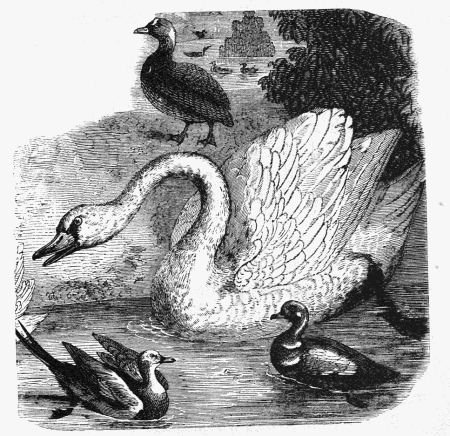
1. Here we have the picture of the swan, the largest bird of the goose kind. It is not often seen in this country, but is found in the Central Park, New York, and in a few other places.
2. It has short, stout legs, and webbed feet, like the duck, and it waddles along on the land in a slow and awkward way. It is clothed with feathers of a fine quality, like the goose, and those we see in this country are pure white. Black swans are found in some countries.
3. Its neck is much longer than that of the goose, and when it swims, sitting high in the water, with its long neck arched, it is one of the most graceful birds in the world. It has strong wings, and wild swans can fly a long distance without tiring. Tame swans do not fly far.
4. The bill of the swan is broad, and pointed like that of the goose, but a little longer. Below the eyes, and at the base of the bill, a narrow band of black extends across the front of the head.
5. The swans run in pairs. The mother swan lays from five to eight eggs, and hatches them in six weeks. The young swans are called cygnets. They are covered with down, and are able to walk and swim when first out of the shell.
6. The father swan watches the nest, and helps take care of the young ones. He will fly at anything that comes near, and he is able to strike terrible blows with his wings. He can drive away any bird, even the eagle.
7. Swans usually build nests of a few coarse sticks, and a lining of grass or straw. They have a curious habit, however, of raising their nests higher, and of raising the eggs at the same time.
8. At times they seem to know that some danger threatens them, and then they turn their instinct for raising their nests to some purpose. A person who observed all the facts tells this story:
9. For many years an old swan had built her nest on the border of a park, by the river-side. From time to time she had raised her nest, but never more than a few inches.
10. Once, when there had been no rain for a long time, and the river was very low, she began to gather sticks and grasses to raise her nest, and she would scarcely stop long enough to eat.
11. She seemed so anxious to get materials for nest-building that she attracted the attention of the family living near by, and a load of straw was carried to her. This she worked all into her nest, and never stopped until the eggs had been raised two and a half feet.
12. In the night a heavy rain fell, the river flowed over its banks, and the water came over the spot where the eggs had been; but it did not quite come up to the top of the new nest, and so the swan saved them.