LESSON XXXVI.
Reading edition
HOW THE HARE LIVES.
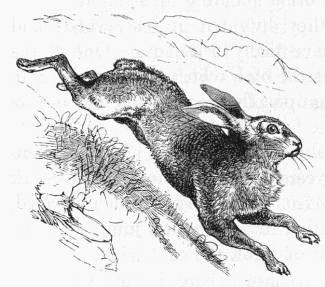
1. The hare looks very much like a large rabbit. It has the same kind of teeth, and eats the same kind of food. Its legs are longer than those of the rabbit, and it runs in the same way, only faster.
2. It does not burrow in the ground nor crawl into holes, but it makes its home in tufts of long grass. As it lies in the same place for a long time, it makes a little hollow, which is called its form.
3. It has larger ears than the rabbit, and seems always listening. It is very timid, and, when it hears any strange sound, away it goes like the wind, running with long leaps.
4. When at rest in its form, it folds its legs under its body, lays its ears back flat on its neck; and, as it is of the color of dried grass, a person may pass by within a few feet of it and not see it.
5. Its upper lip is divided in the middle, as is also that of the rabbit. It sometimes will fight, and then it hits hard blows with its fore feet, and strikes so fast that its blows sound like the roll of a drum.
6. When the snow falls, the hare sits in its form, and is covered up. But its fur keeps it warm, and the heat of its body melts the snow next to its skin, so that it sits in a kind of snow-cave, the snow keeping off the cold wind.
7. When dogs chase a hare, it runs very fast until the dogs are close to it, when it stops suddenly. This it can do, as it runs by leaping with its long hind legs.
8. The dogs can not stop so quickly, and run past. The hare then starts off in another direction, or doubles, as we say, and so gains upon the dog. In this way it often escapes, and then it goes back to its form.
9. The hare is sometimes tamed, and it soon learns to know its friends; but it is a troublesome pet, as it gnaws the legs of the chairs and tables, and destroys the trees in the yard by gnawing off the bark near the roots.