Trees of Illinois
Reading edition
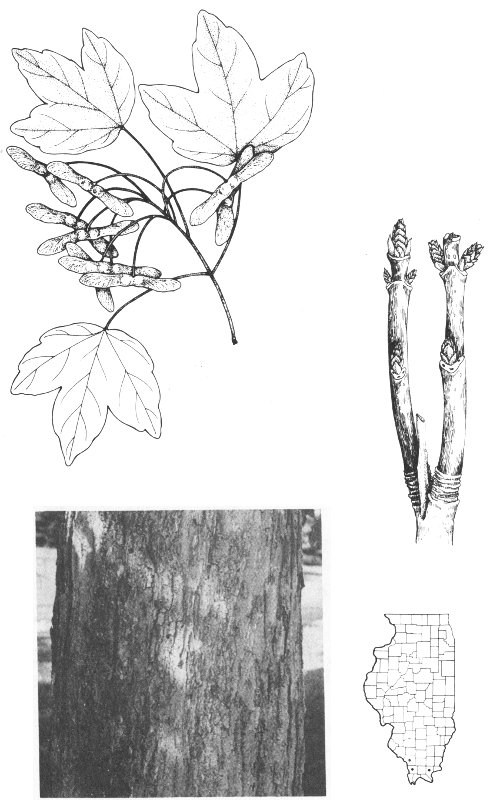
SOUTHERN SUGAR MAPLE Acer barbatum Michx.
Growth Form: Medium tree up to 60 feet tall; trunk diameter up to 2 feet; crown rounded.
Bark: Smooth and pale brown at first, becoming darker and furrowed when old.
Twigs: Slender, brown, smooth or hairy, usually with pale lenticels; leaf scars opposite, U-shaped, with 3-7 bundle traces.
Buds: Rounded, reddish-brown, hairy, up to ¼ inch long.
Leaves: Opposite, simple; blades up to 4 inches long, nearly as broad, palmately 3- to 5-lobed, drooping on the sides, the edges sparsely and coarsely toothed, green and smooth or a little hairy on the upper surface, paler and much hairier on the lower surface; leaf-stalks up to 3 inches long, very hairy. The leaves turn yellow or orange in the autumn.
Flowers: Staminate and pistillate borne separately, but sometimes on the same tree, in dense clusters, yellowish-green, appearing as the leaves unfold.
Fruit: Borne in pairs, composed of a wing with a seed at the base, greenish, up to 1 inch long.
Wood: Heavy, strong, coarse-grained, light brown.
Uses: Furniture, interior finishing, cabinets.
Habitat: Woodlands.
Range: Virginia across southern Illinois to southeastern Oklahoma, south to Texas, east to Florida.
Distinguishing Features: The Southern Sugar Maple resembles the Black Maple because of its drooping leaves, but differs by its smaller, thicker leaves.
39
40
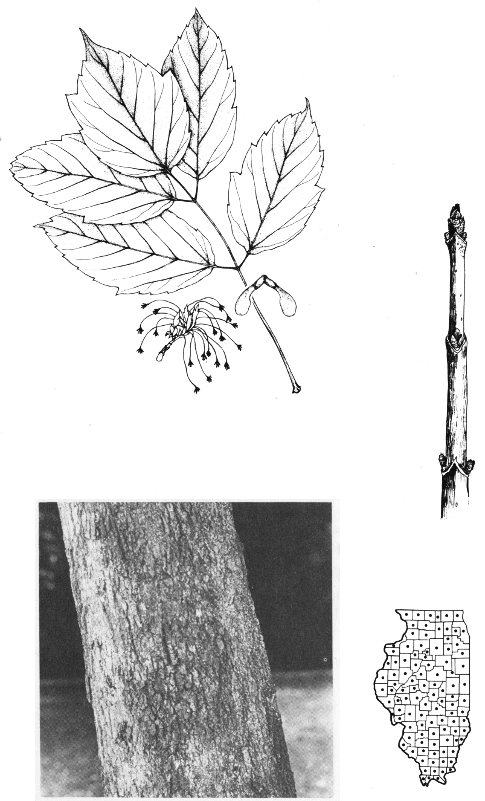
BOX ELDER Acer negundo L.
Other Name: Ash-leaved Maple.
Growth Form: Medium tree up to 60 feet tall; trunk diameter up to 4 feet; crown wide-spreading.
Bark: Light brown, ridged when young, becoming deeply furrowed with age.
Twigs: Smooth, green, glaucous, or rarely purplish, shiny, usually with white lenticels; leaf scars opposite, U-shaped, with 5-9 bundle traces.
Buds: Rounded, white-hairy, up to ⅛ inch long.
Leaves: Opposite, pinnately compound, with 3-7 leaflets; leaflets elliptic to ovate, up to 4 inches long, about half as broad, pointed at the tip, tapering or rounded at the sometimes asymmetrical base, smooth or usually coarsely toothed along the edges or even shallowly lobed, light green and smooth on the upper surface, paler and smooth or hairy on the lower surface.
Flowers: Staminate and pistillate borne on separate trees, several in a cluster, greenish-yellow, appearing as the leaves begin to unfold.
Fruit: Borne in pairs, in drooping clusters, composed of a curved wing with a seed at the base, greenish-yellow, up to 2 inches long.
Wood: Light weight, soft, close-grained, white.
Uses: Paper pulp, interior finishing, furniture.
Habitat: Moist woods.
Range: Vermont across to Saskatchewan, south to Texas, east to Florida.
Distinguishing Features: The Box Elder most nearly resembles ashes, but differs by its green or glaucous twigs and its paired fruits.
41
42
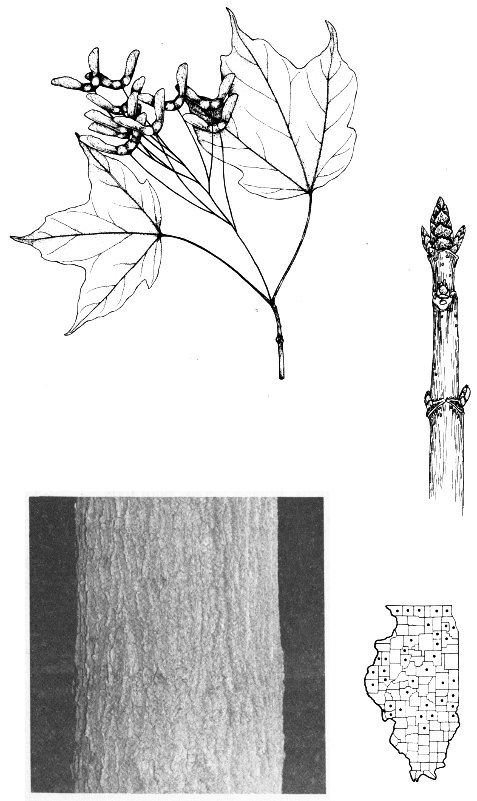
BLACK MAPLE Acer nigrum Michx.
Growth Form: Medium tree up to 65 feet tall; trunk diameter up to 2½ feet; crown broad, with several upright branches.
Bark: Dark brown to black, smooth when young, soon becoming furrowed and scaly.
Twigs: Slender, brown, smooth, often with pale lenticels; leaf scars opposite, U-shaped, with 3-7 bundle traces.
Buds: Pointed, dark brown, finely hairy, up to one-fourth inch long.
Leaves: Opposite, simple; blades up to 6 inches long and nearly as broad, palmately 3- to 5-lobed, drooping on the sides, the edges of the leaves sparsely and coarsely toothed, green and smooth on the upper surface, yellow-green and smooth or hairy on the veins on the lower surface; leafstalks up to 5 inches long, smooth or hairy. The leaves turn yellow in the autumn.
Flowers: Staminate and pistillate borne separately, but sometimes on the same tree, in dense clusters, yellowish, appearing as the leaves unfold.
Fruit: Borne in pairs, composed of a wing with a seed at the base, reddish-brown to greenish, up to 1 inch long.
Wood: Heavy, strong, coarse-grained, brown.
Uses: Furniture, cabinets.
Habitat: Rich woodlands.
Range: New Hampshire across to Minnesota and South Dakota, south to Louisiana, east to Georgia.
Distinguishing Features: The Black Maple is distinguished from the Sugar Maple by its drooping leaves. It differs from the Southern Sugar Maple, which also has drooping leaves, by its larger, thinner leaves.
43
44
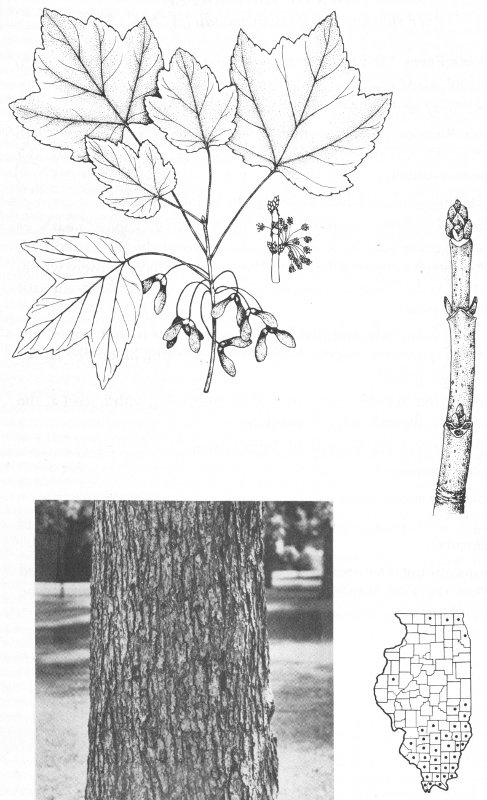
RED MAPLE Acer rubrum L.
Growth Form: Medium tree up to 70 feet tall; trunk diameter up to 3 feet; crown oval or rounded.
Bark: Gray and smooth when young, becoming darker and scaly.
Twigs: Slender, mostly smooth, more or less reddish, usually with pale lenticels; leaf scars opposite, U-shaped, with 3-7 bundle traces.
Buds: Rounded, reddish, usually hairy, up to ¼ inch long.
Leaves: Opposite, simple; blades up to 6 inches long, nearly as broad, palmately 3- to 5-lobed, the edges of the leaves sharply toothed to nearly toothless, pale green and smooth on the upper surface, white or gray and either smooth or hairy on the lower surface; leafstalks smooth or finely hairy, up to 4 inches long.
Flowers: Staminate and pistillate borne separately, but sometimes on the same tree, in dense clusters, bright red or yellow, opening in February and March before the leaves begin to unfold.
Fruit: Borne in pairs, composed of an erect wing with a seed at the base, red or yellow, up to 1 inch long.
Wood: Heavy, close-grained, light brown.
Uses: Furniture, gun-stocks.
Habitat: Swamps, low woods, upland slopes, bluff tops.
Range: Newfoundland across to Ontario, south to eastern Texas, east to Florida.
Distinguishing Features: The Red Maple is characterized by its white lower leaf surfaces and its shallowly lobed leaves. The similar Silver Maple has very deeply lobed leaves.
45
46
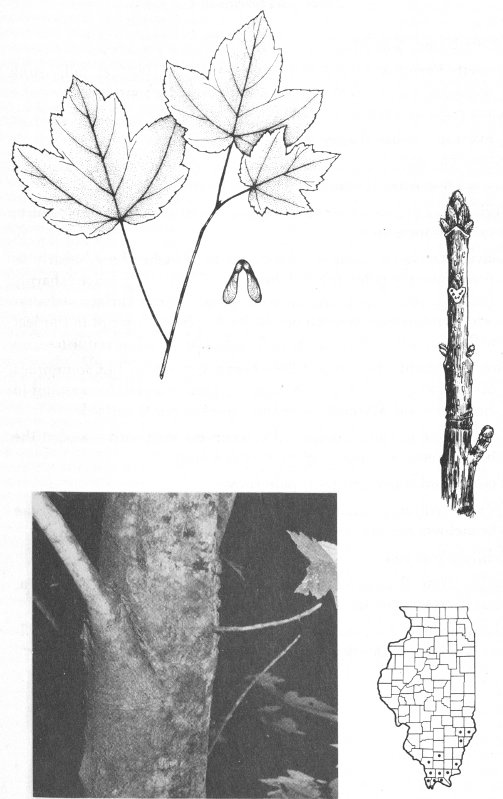
SWAMP RED MAPLE rubrum L. var. drummondii (H. & A.) Sarg.
Growth Form: Medium tree up to 40 feet tall; trunk diameter up to 1 foot; crown narrow.
Bark: Gray and smooth when young, becoming darker and scaly.
Twigs: Slender, white-hairy when young, usually becoming smooth or nearly so, reddish; leaf scars opposite, U-shaped, with 3-7 bundle traces.
Buds: Rounded, reddish, hairy, up to ¼ inch long.
Leaves: Opposite, simple; blades up to 6 inches long, nearly as broad, palmately 3- to 5-lobed, the edges of the leaves toothed, green and somewhat hairy on the upper surface, densely white-hairy on the lower surface; leafstalks stout, densely hairy, up to 4 inches long.
Flowers: Staminate and pistillate borne separately, but sometimes on the same tree, in dense red clusters, opening before the leaves begin to unfold.
Fruit: Borne in pairs, composed of an erect wing with a seed at the base, bright red, over 1 inch long.
Wood: Heavy, coarse-grained, light brown.
Use: Furniture.
Habitat: Wooded swamps.
Range: New Jersey across to Missouri, south to Texas, east to Florida.
Distinguishing Features: The Swamp Red Maple is distinguished from the Red Maple by the dense coat of white hairs on the undersurface of the leaves and by the longer fruits.
47
48
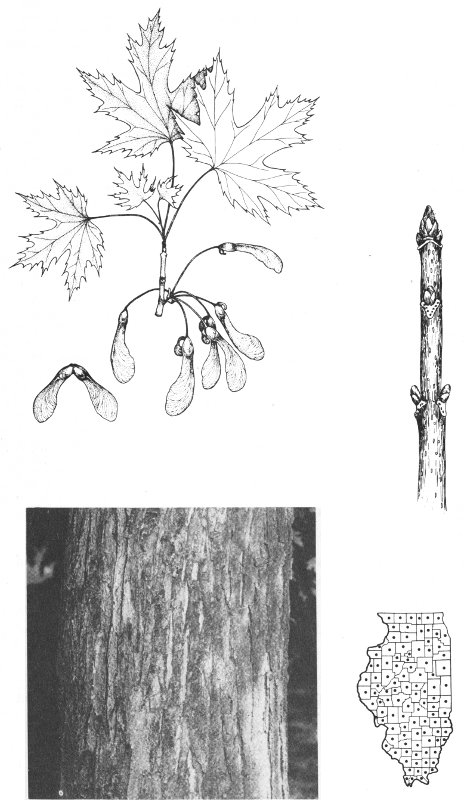
SILVER MAPLE Acer saccharinum L.
Other Name: Soft Maple.
Growth Form: Medium to large tree up to 100 feet tall; trunk diameter up to 5 feet; crown usually broadly rounded.
Bark: Gray or silvery, smooth at first, becoming loose and scaly or even somewhat shaggy when old.
Twigs: Slender, reddish-brown, smooth, often curving upward; leaf scars opposite, U-shaped, with 3-7 bundle traces.
Buds: More or less rounded, reddish-brown, smooth to finely hairy, up to ⅛ inch long.
Leaves: Opposite, simple; blades up to 8 inches long, nearly as broad, deeply palmately 5-lobed, the edges of the leaves sharply toothed, pale green and smooth on the upper surface, silvery-white and usually smooth on the lower surface, except in the leaf axils; leafstalks smooth, up to 5 inches long, often reddish.
Flowers: Staminate and pistillate borne separately, but sometimes on the same tree, in dense clusters, greenish-yellow, opening in February and March before the leaves begin to unfold.
Fruit: Borne in pairs, composed of a curved wing with a seed at the base, green or yellow, up to 3 inches long.
Wood: Hard, close-grained, pale brown.
Uses: Furniture; sometimes grown as an ornamental, but the branchlets are brittle.
Habitat: Wet soil.
Range: New Brunswick across to Minnesota and South Dakota, south to Oklahoma, Texas, east to northern Florida.
Distinguishing Features: The deeply lobed leaves which are silvery-white on the flower surface best distinguish this tree.
49
50
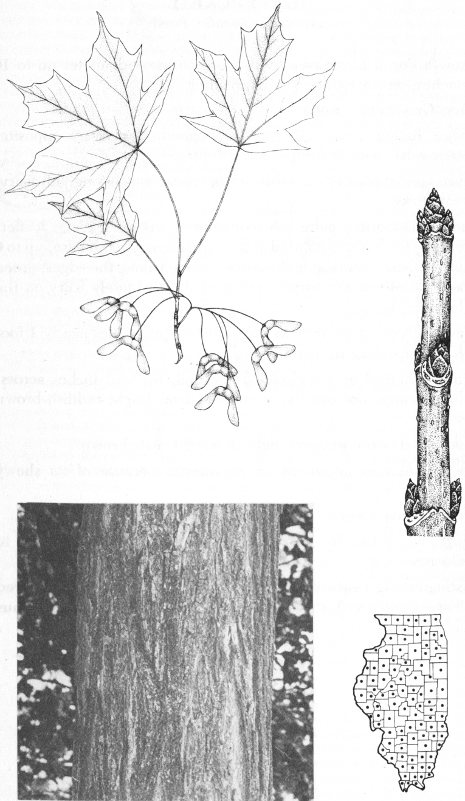
SUGAR MAPLE Acer saccharum Marsh.
Other Name: Hard Maple.
Growth Form: Medium to large tree up to 80 feet tall; trunk diameter up to 3 feet; crown broadly rounded, with many branches.
Bark: Gray to dark brown to black, becoming furrowed and scaly.
Twigs: Slender, smooth, brown, often with pale lenticels; leaf scars opposite, U-shaped, with 3-7 bundle traces.
Buds: Pointed, dark brown, smooth or a little hairy, shiny, up to ¼ inch long.
Leaves: Opposite, simple; blades up to 5 inches long, nearly as broad or a little broader, palmately 3- to 5-lobed, the edges of the leaves sparsely and coarsely toothed, dark green and smooth on the upper surface, green or paler on the lower surface and usually smooth, or sometimes hairy on the veins; leafstalks up to 3 inches long, smooth and sometimes hairy. The leaves turn brilliant shades of yellow and orange in the autumn.
Flowers: Staminate and pistillate borne separately, but sometimes on the same tree, in dense clusters, greenish-yellow, appearing as the leaves begin to unfold.
Fruit: Borne in pairs, composed of a wing with a seed at the base, greenish-yellow to brownish, up to 1 inch long.
Wood: Heavy, strong, close-grained, light brown.
Uses: Furniture, interior finishing, cabinets; maple sugar is derived from the sap; frequently grown as an ornamental.
Habitat: Moist woods.
Range: Newfoundland across to Manitoba, south to eastern Texas, east to northern Florida.
Distinguishing Features: Leaves of the Sugar Maple differ from those of the Black Maple and the Southern Sugar Maple by being flat, rather than drooping along the edges. {Sap differs from the Norway Maple, Acer platanoides, by being clear rather than milky.}
51
52
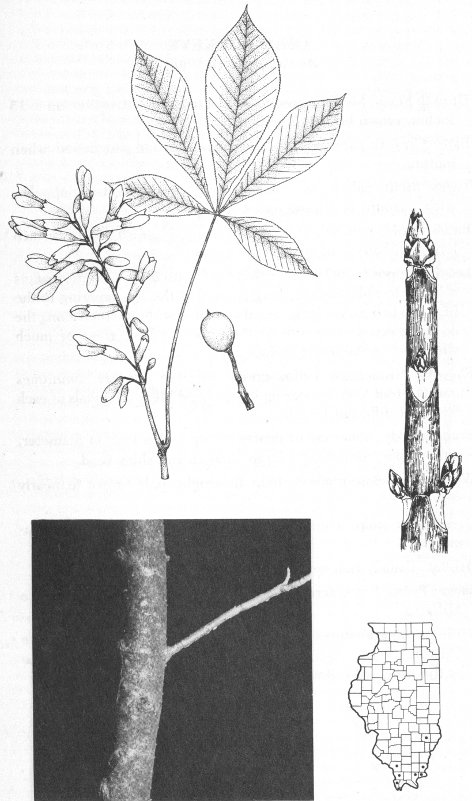
RED BUCKEYE Aesculus discolor Pursh
Growth Form: Small tree to 25 feet tall; trunk diameter up to 10 inches; crown rounded and spreading.
Bark: Gray to tan, smooth.
Twigs: Rather stout, gray to tan, smooth; leaf scars opposite, triangular, with 3 groups of bundle traces.
Buds: Ovoid, pointed, reddish-brown, up to ½ inch long, not hairy, not sticky.
Leaves: Opposite, palmately compound, with 5 leaflets; leaflets elliptic to obovate, pointed at the tip, tapering to the base, up to 6 inches long, less than half as wide, toothed along the edges, green and smooth on the upper surface, paler and finely hairy on the lower surface.
Flowers: Numerous, red, in large clusters sometimes nearly 1 foot long, appearing in April.
Fruit: Spherical or punching-bag shaped, up to 2 inches across, light brown, not prickly, containing 1 or 2 light reddish-brown seeds.
Wood: Soft, close-grained, light in weight, pale brown.
Use: Sometimes grown as an ornamental because of its showy flowers.
Habitat: Rich woods.
Range: North Carolina across to Missouri, south to Texas, east to Georgia.
Distinguishing Features: The smooth fruits and the beautiful red flowers distinguish this species from other members of the genus in Illinois.
53
54
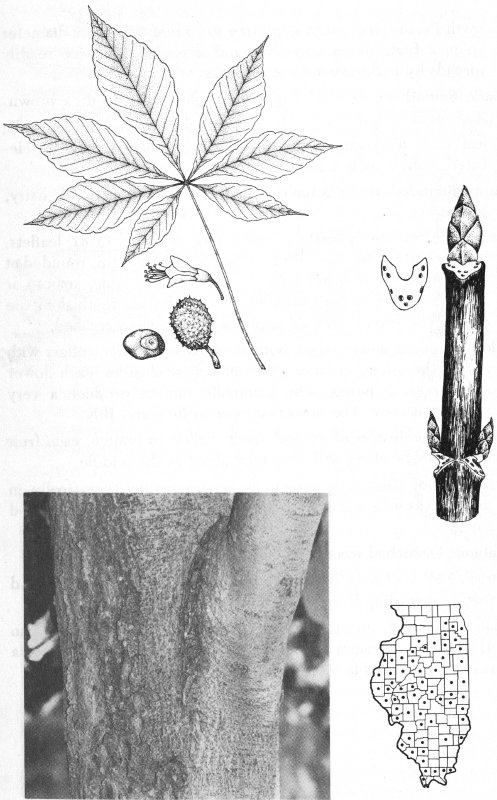
OHIO BUCKEYE Aesculus glabra Willd.
Growth Form: Medium tree to 55 feet tall; trunk diameter up to 15 inches; crown broadly rounded.
Bark: Gray to pale gray, deeply furrowed and roughened when mature.
Twigs: Stout, pale brown, smooth; leaf scars opposite, triangular, with 3 groups of bundle traces.
Buds: Ovoid, pointed, reddish-brown to yellowish, up to ⅔ inch long, not hairy, not sticky.
Leaves: Opposite, palmately compound, with 5 or 7 leaflets; leaflets obovate to oblanceolate, long-pointed at the tip, tapering to the base, up to 6 inches long, less than half as wide, toothed along the edges, green and smooth on the upper surface, green or much whitened on the lower surface.
Flowers: Numerous, yellow-green, in large clusters sometimes nearly 1 foot long, appearing in April and May, the petals of each flower of different lengths.
Fruit: Prickly, spherical or nearly so, up to 1½ inch in diameter, pale brown, containing 1 large, smooth and shiny seed.
Wood: Soft, close-grained, light in weight, pale brown to nearly white.
Uses: Paper pulp. The tree is also sometimes grown as an ornamental.
Habitat: Usually rich woods.
Range: Pennsylvania across to Nebraska, south to Oklahoma, east to Alabama.
Distinguishing Features: The Ohio Buckeye differs from the Horse Chestnut {Aesculus hippocastanum} by its non-sticky buds. It differs from the Red Buckeye by the greenish-yellow flowers and prickly fruits.
55
56
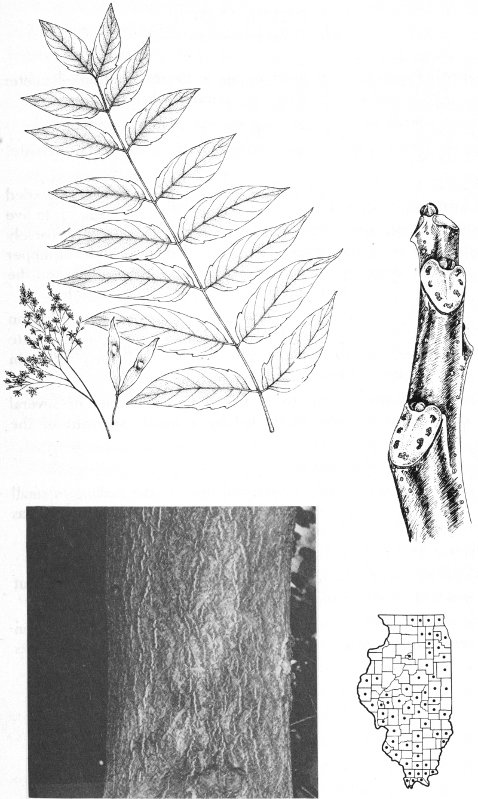
TREE-OF-HEAVEN Ailanthus altissima (Mill.) Swingle
Growth Form: Medium to large tree to 75 feet tall; trunk diameter up to 2 feet; crown spreading and irregular. The tree readily spreads by underground root-suckers.
Bark: Smooth or slightly roughened, light brown to dark brown.
Twigs: Stout, angular, smooth, gray to light brown, with lenticels; leaf scars alternate, large, broadly heart-shaped, slightly elevated, with usually 9 bundle traces.
Buds: Rounded, up to ⅛ inch in diameter, smooth or a little hairy, brown.
Leaves: Alternate, pinnately compound, with up to 41 leaflets; leaflets lanceolate, tapering to a long point at the tip, rounded at the base, up to 6 inches long, less than half as wide, smooth or somewhat hairy on both surfaces, often with some teeth along the edges. The leaves have an unpleasant odor when crushed.
Flowers: Some flowers with both stamens and pistils, others with one or the other, in large green or yellow clusters, each flower small, with 5 petals. The staminate flowers produce a very unpleasant odor. The flowers appear in June and July.
Fruit: Large clusters of winged seeds, yellow or orange, each fruit up to 2 inches long with one seed about in the middle.
Use: Tree-of-Heaven is grown as an ornamental, principally in urban areas where it is able to withstand considerable smoke and smog.
Habitat: Disturbed woods; readily adapts to urban conditions.
Range: Native of Asia; frequently planted in the United States and readily spreading from cultivation.
Distinguishing Features: The pinnately compound leaves with up to 41 leaflets, unpleasantly scented when crushed, make this a readily recognizable species.
57
58
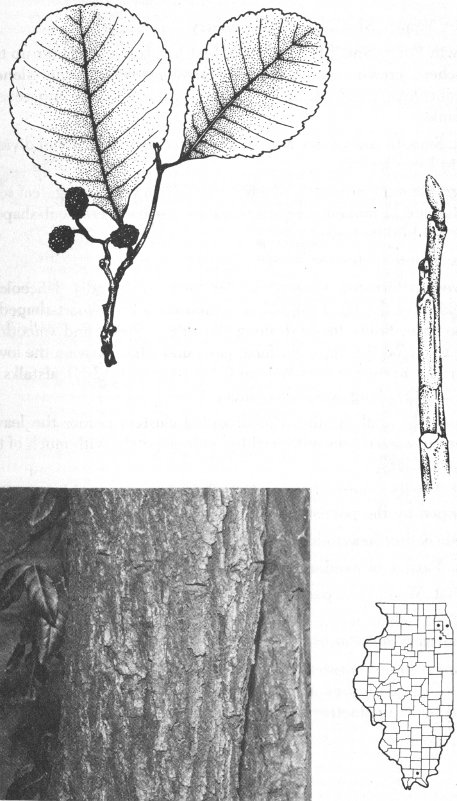
BLACK ALDER Alnus glutinosa (L.) Gaertn.
Growth Form: Small or medium tree to 45 feet tall; trunk diameter up to 12 inches; crown broadly rounded when mature.
Bark: Smooth at first, becoming shallowly fissured with age.
Twigs: Slender, gray or gray-brown, smooth; leaf scars alternate, with 3 bundle traces.
Leaves: Alternate, simple; blades nearly round or obovate, rounded at the tip, rounded or somewhat tapering to the base, up to five inches long, often nearly as broad, irregularly and rather coarsely toothed along the edges, dark green and smooth on the upper surface, green and smooth beneath, or sometimes hairy on the veins; leafstalks stout, up to 1 inch long, usually smooth.
Flowers: Staminate and pistillate flowers borne separately but on the same tree, appearing before the leaves unfold, the staminate in slender, drooping catkins up to 3 inches long, the pistillate in erect, oblong “cones” less than 1 inch long.
Fruit: Cone-shaped, up to ¾ inch long, composed of several nut-like seeds, each subtended by a woody segment of the “cone.”
Wood: Soft, straight-grained.
Uses: The wood is easily carved and used in the making of small wooden objects. It is also used for charcoal and fuel. The bark has reputed medicinal properties.
Habitat: Moist, disturbed areas.
Range: Native of Europe, Asia, and Africa; naturalized throughout much of northeastern North America.
Distinguishing Features: The small, woody “cones” and the often orbicular, irregularly toothed leaves are the distinguishing marks of this species.
59
60
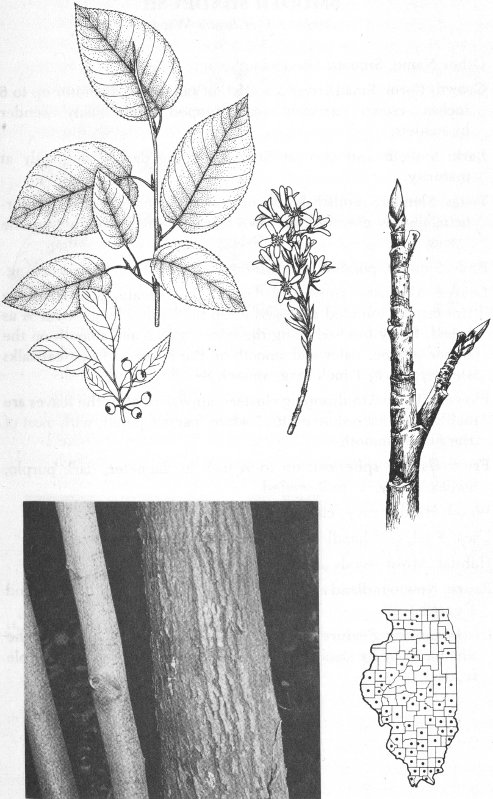
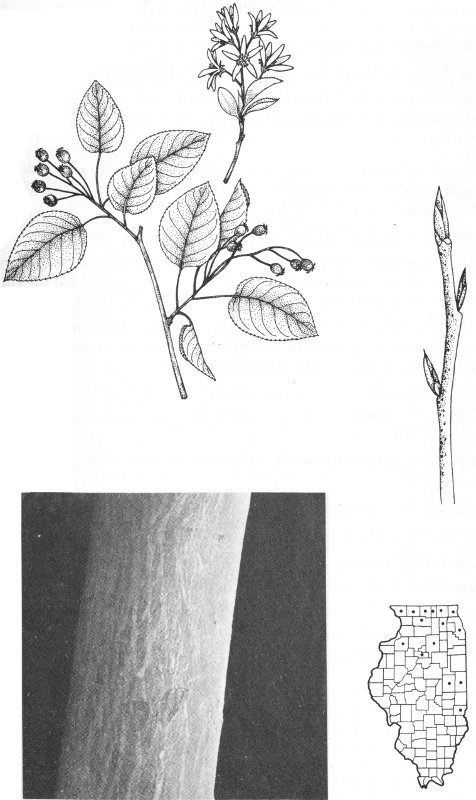
SHADBUSH Amelanchier arborea (Michx. f.) Fern.
Other Names: Shadblow; Serviceberry.
Growth Form: Small tree up to 20 feet tall; trunk diameter up to 8 inches; crown rounded and spreading with many slender branchlets; trunk straight, slender, often divided into several trunks.
Bark: Smooth and silvery at first, later becoming darker and divided into loose scales.
Twigs: Slender, brown, with a few hairs when very young; leaf scars alternate, 2-ranked, slightly elevated, narrowly crescent-shaped, with 3 bundle traces.
Buds: Pointed, slender, brown, up to ½ inch long.
Leaves: Alternate, simple; blades oval to broadly lanceolate, pointed at the tip, rounded or sometimes a little heart-shaped at the base, finely toothed along the edges, green and smooth or nearly so on the upper surface, paler and often hairy on the lower surface, up to 4 inches long and about half as broad; leafstalks up to 2 inches long, smooth or hairy.
Flowers: Several produced in drooping clusters before the leaves appear, each showy with 5 white, oblong petals, with much of the flower hairy.
Fruit: Mostly spherical, up to ¼ inch in diameter, reddish-purple, capped by the persistent calyx, dry, 1- to 2-seeded.
Wood: Rather heavy, hard, close-grained, reddish-brown.
Uses: Fuel, tool handles; the fruit is edible.
Habitat: Wooded slopes; edge of cliffs.
Range: Quebec across to Minnesota, south to Nebraska, east to Louisiana and Florida.
Distinguishing Features: The Shadbush is recognized by its alternate, simple leaves which are usually heart-shaped at the base, and by its distinctive white flowers.
61
62
SMOOTH SHADBUSH Amelanchier laevis Wieg.
Other Name: Smooth Serviceberry.
Growth Form: Small tree up to 15 feet tall; trunk diameter up to 6 inches; crown narrowly round-topped, with many slender branchlets.
Bark: Smooth and gray at first, becoming darker and scaly at maturity.
Twigs: Slender, reddish-brown or grayish, smooth; leaf scars alternate, slightly elevated, narrowly crescent-shaped, with 3 bundle traces.
Buds: Slender, pointed, reddish-brown, smooth, up to ¾ inch long.
Leaves: Alternate, simple; blades elliptic to ovate, pointed at the tip, usually rounded at the base, up to 3 inches long, about ½ as broad, finely toothed along the edges, green and smooth on the upper surface, paler and smooth on the lower surface; leafstalks slender, up to 1 inch long, smooth.
Flowers: Up to 6 in drooping clusters, appearing after the leaves are half grown, each showy with 5 white, narrow petals, with most of the flower smooth.
Fruit: Usually spherical, up to ¼ inch in diameter, dark purple, sweet, fleshy, 1- to 2-seeded.
Wood: Hard, heavy, close-grained, dark brown.
Uses: Fuel, tool handles; the fruits are edible.
Habitat: Moist woods and slopes.
Range: Newfoundland across to Ontario, south to Iowa, Illinois, and Georgia.
Distinguishing Features: The Smooth Shadbush differs from the Shadbush by its smooth leafstalks and juicy, edible, dark purple fruits.
63
64
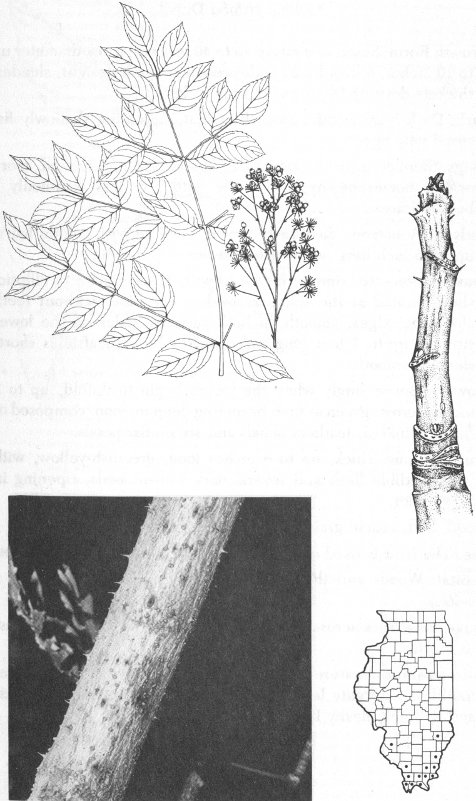
HERCULES’ CLUB Aralia spinosa L.
Other Name: Devil’s Walking-stick.
Growth Form: Small tree to 30 feet tall; trunk diameter up to 6 inches; crown widely spreading.
Bark: Dark brown, roughened, shallowly furrowed, with short, hard prickles.
Twigs: Stout, pale brown or gray, smooth except for many short, hard prickles; leaf scars alternate, broadly U-shaped, with about 15 bundle traces.
Buds: Cone-shaped, brown, smooth, up to ½ inch long.
Leaves: Alternate, doubly or triply pinnately compound, with very numerous leaflets; leaflets ovate to lance-ovate, pointed at the tip, tapering to rounded at the base, up to 3 inches long, about half as wide, coarsely toothed along the edges, green and smooth on the upper surface, paler and smooth on the lower surface, except usually for a few prickles along the veins.
Flowers: Numerous, in many umbrella-shaped clusters, appearing during late June and July, each with 5 small white petals and purple stalks.
Fruit: Black, spherical berries up to ⅛ inch in diameter, containing 2-5 seeds.
Wood: Light in weight, soft, brittle, close-grained, pale brown.
Use: Hercules’ Club is sometimes grown as an ornamental.
Habitat: Rich woods.
Range: New Jersey across to Iowa, south to Texas, east to Florida.
Distinguishing Features: The clusters of flowers and the leaves each may be as much as 4 feet long. The short, sharp prickles of the twigs are distinctive.
65
66
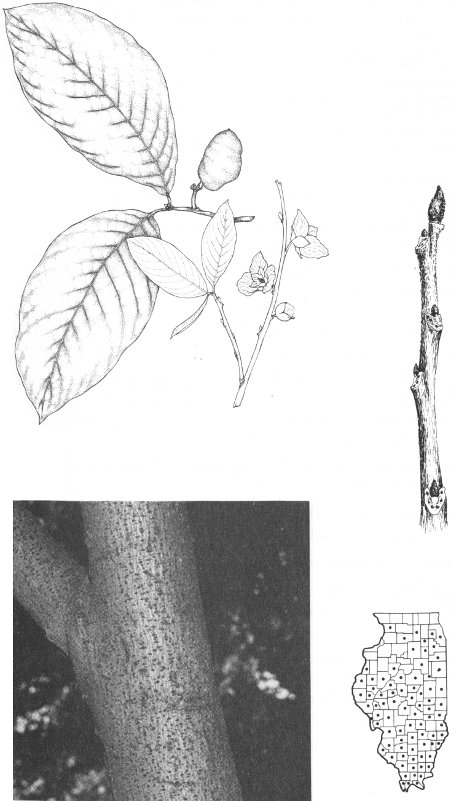
PAWPAW Asimina triloba Dunal.
Growth Form: Small tree rarely up to 40 feet tall; trunk diameter up to 10 inches; crown broad and spreading; trunk straight, slender; thickets develop by means of root suckers.
Bark: Dark brown, thin, smooth at first, becoming shallowly fissured with age.
Twigs: Slender, smooth, gray; leaf scars alternate, 2-ranked, more or less horseshoe-shaped, usually with 5 or less commonly 7 bundle traces.
Buds: Very narrow, dark rusty-brown, covered with golden hairs, up to ⅔ inch long, without bud scales.
Leaves: Alternate, simple; blades broadly lance-shaped to elliptic, short-pointed at the tip, narrowed to the base, without teeth along the edges, smooth on both surfaces, paler on the lower surface, up to 1 foot long and 6 inches broad; leafstalks short, slender, smooth.
Flowers: Borne singly when the leaves begin to unfold, up to 2 inches across, green at first, becoming deep maroon, composed of three wrinkled, leathery sepals and six similar petals.
Fruit: Oblong, thick, up to 6 inches long, greenish-yellow, with yellow edible flesh and several dark brown seeds, ripening in September.
Wood: Soft, coarse-grained, light in weight, greenish-yellow.
Use: The fruit is used as a source of food; the wood has few uses.
Habitat: Woods and thickets, often many growing together in a colony.
Range: New York across to Michigan and Iowa, south to Texas, east to Florida.
Distinguishing Features: Pawpaw is distinguished by its large, toothless, alternate leaves, its slender buds without bud scales, and its thick, fleshy fruits.
67
68
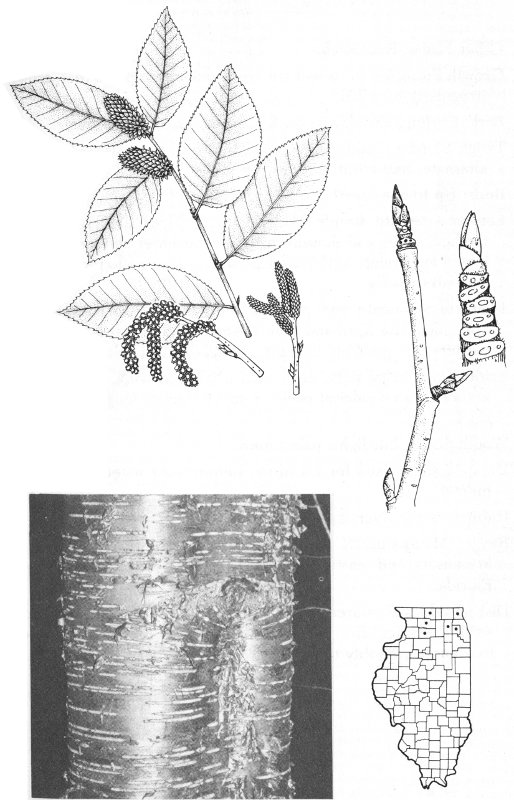
YELLOW BIRCH Betula lutea Michx.
Other Name: Gray Birch.
Growth Form: Moderate tree up to 50 feet tall; trunk diameter up to 1½ feet; crown broadly rounded, with small branches.
Bark: Smooth and silvery or grayish, curling into strips, very rough when old.
Twigs: Slender, greenish-brown, smooth, with numerous lenticels; leaf scars alternate, half-elliptical, with 3 bundle traces.
Buds: Pointed, brown, usually somewhat hairy, up to ⅙ inch long.
Leaves: Alternate, simple; blades ovate, pointed at the tip, more or less rounded at the somewhat asymmetrical base, up to 5 inches long, and nearly half as wide, double-toothed, dark green and nearly smooth on the upper surface, paler and usually somewhat hairy on the lower surface; leafstalks yellow, hairy, up to one inch long. The leaves turn yellow in the autumn.
Flowers: Staminate and pistillate flowers borne separately but on the same tree, the staminate crowded in elongated clusters, the pistillate crowded in shorter, thicker clusters, appearing after the leaves have begun to unfold.
Fruit: Several winged nuts, crowded together in erect “cones” up to 1½ inches long.
Wood: Heavy, hard, strong, pale brown.
Uses: Furniture, flooring, boxes.
Habitat: Wooded slopes.
Range: Newfoundland across to Manitoba, south to Iowa, northern Illinois, northern Indiana, Ohio, and Delaware; also in the Appalachian Mountains to Georgia.
Distinguishing Features: The Yellow Birch differs from all other birches in Illinois by its silvery or grayish bark and its ovate leaves. The bark has the faint fragrance of wintergreen.
69
70
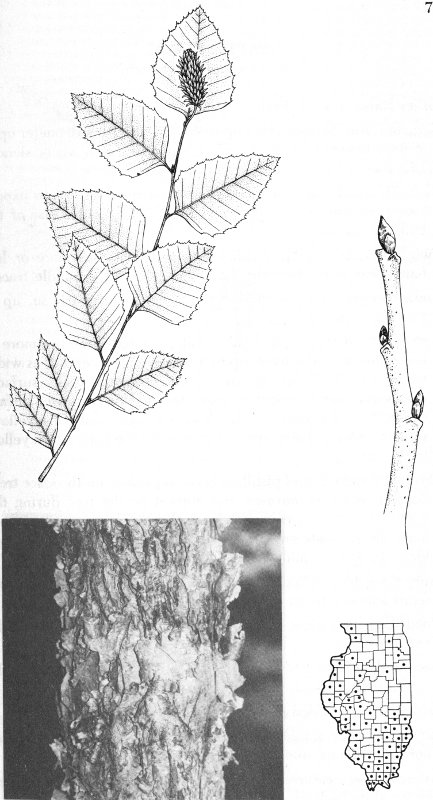
RIVER BIRCH Betula nigra L.
Other Name: Red Birch.
Growth Form: Up to 75 feet tall; trunk diameter up to 2 feet; crown irregularly rounded.
Bark: Curling, shredding, brownish-pink to reddish-brown.
Twigs: Slender, reddish-brown, with several short hairs; leaf scars alternate, half-elliptical, with 3 bundle traces.
Buds: Up to one-fourth inch long, pointed, hairy.
Leaves: Alternate, simple; blades rhombic to ovate, coarsely doubly toothed, paler and densely hairy on the lower surface, up to 3 inches long, acute at the tip, truncate or tapering to the base, the leafstalks woolly.
Flowers: Staminate and pistillate on same tree, inconspicuous, opening in late April and May, the staminate in slender drooping clusters, the pistillate in short, conelike, woolly clusters.
Fruit: Tiny, hairy nuts, each with a 3-lobed wing, crowded together in a cylindrical cone up to 1½ inches long and ½ inch thick.
Wood: Strong but light, pale brown.
Uses: Wood is used for furniture; sometimes planted as an ornamental.
Habitat: Along rivers and streams; bottomland woods.
Range: Massachusetts and New Hampshire across to southern Minnesota and eastern Kansas, south to eastern Texas and Florida.
Distinguishing Features: The shaggy, peeling reddish-brown bark readily distinguishes this tree from any other in Illinois, as does its rhombic, doubly toothed leaves.
71
72
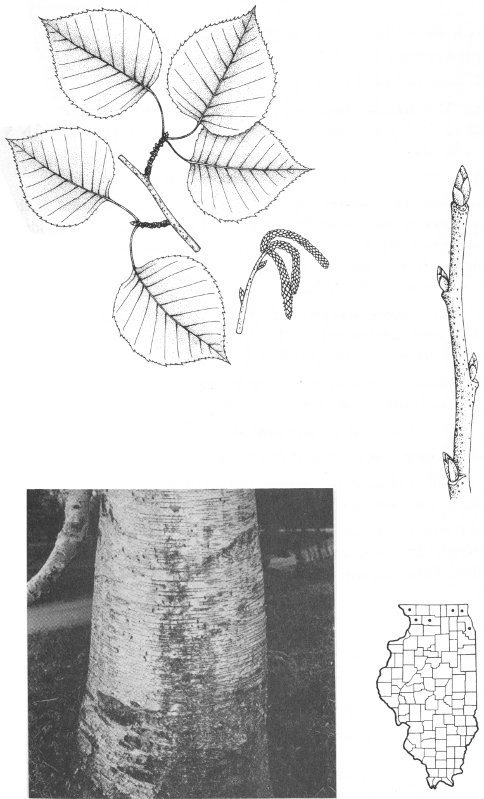
PAPER BIRCH Betula papyrifera Marsh.
Other Name: Canoe Birch.
Growth Form: Medium tree up to 70 feet tall; trunk diameter up to 2 feet; crown broadly rounded, irregular, with many slender branches.
Bark: Thin and white or creamy, splitting at maturity into papery layers, becoming very dark and furrowed near the base of the trunk at maturity.
Twigs: Slender, zigzag, reddish-brown to blackish, more or less hairy; leaf scars alternate, half-elliptical, with 3 bundle traces.
Buds: Slender, pointed, dark brown, smooth or nearly so, up to one-fourth inch long.
Leaves: Alternate, simple; blades ovate, pointed at the tip, more or less rounded at the base, up to 3 inches long, over half as wide, coarsely toothed, dark green and smooth on the upper surface, yellow-green and smooth or somewhat hairy on the lower surface and with black dots on the lower surface; leafstalks yellow, smooth or finely hairy, up to 1 inch long. The leaves turn yellow in the autumn.
Flowers: Staminate and pistillate borne separately on the same tree, developing in the autumn and present on the tree during the winter, the staminate crowded into slender spikes up to 4 inches long, the pistillate crowded into thicker spikes up to 1¼ inches long, the flowers minute, without petals.
Fruit: Cone-like, cylindrical, drooping, composed of many minute seeds attached to 3-lobed wings.
Wood: Light in weight, hard, strong, durable, close-grained, light reddish-brown.
Uses: Bark used to cover canoes; wood used for pulp, fuel, toothpicks, and spools; sometimes grown as an ornamental.
Habitat: Rich, wooded slopes and stream banks.
Range: Labrador across to Alaska, south to Montana, Colorado, northern Illinois, and West Virginia.
Distinguishing Features: The Paper Birch is readily distinguished by its white bark which peels off into thin, papery layers.
73
74
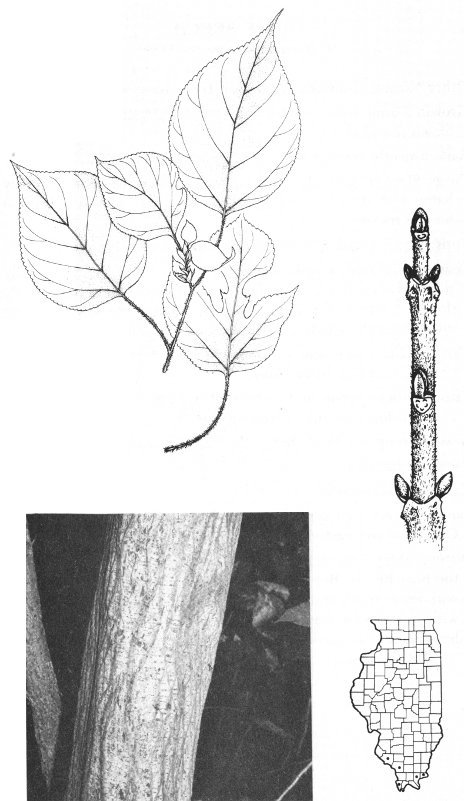
PAPER MULBERRY Broussonetia papyrifera (L.) Vent.
Growth Form: Small tree to 20 feet tall; trunk diameter up to 8 inches; crown rounded.
Bark: Gray or light brown, smooth.
Twigs: Moderately stout, greenish-gray, smooth or finely hairy, zigzag; leaf scars alternate, nearly spherical, elevated, with 5 bundle traces.
Buds: Cone-shaped, more or less smooth, up to 3 mm long.
Leaves: Alternate, simple; blades ovate, tapering to a point at the tip, more or less heart-shaped at the base, up to 8 inches long, sometimes nearly as broad, toothed, sometimes 2- or 3-lobed, usually rough-hairy on both surfaces; leafstalks up to 2 inches long, smooth or finely hairy.
Flowers: Staminate and pistillate flowers borne separately, on separate trees, appearing as the leaves unfold, the staminate in pendulous catkins, the pistillate in dense, hairy, spherical heads.
Fruit: Spherical, semi-fleshy, orange, up to 1 inch in diameter, with red fruits projecting.
Use: Often planted as an ornamental.
Habitat: Along roads, around old homes.
Range: Native of Asia; occasionally found along roads and in fencerows in the eastern United States.
Distinguishing Features: The leaves, some of which are 2- or 3-lobed, are very reminiscent of mulberry leaves. Mulberry leaves, however, are not densely rough-hairy.
75
76
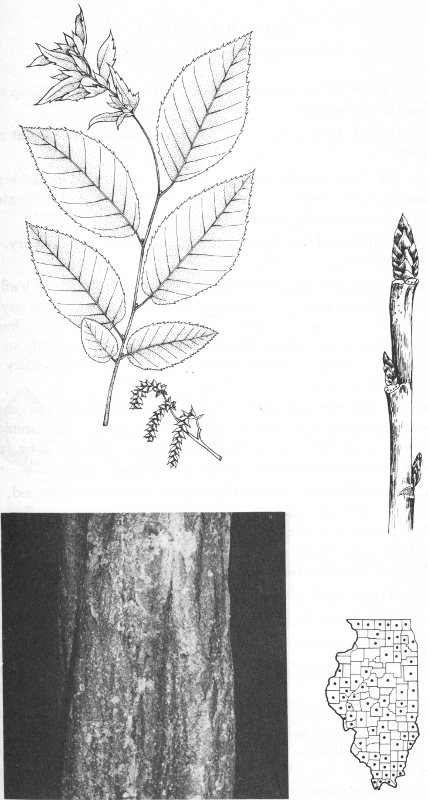
BLUE BEECH Carpinus caroliniana Walt.
Other Names: Ironwood; American Hornbeam; Musclewood.
Growth Form: Up to 30 feet tall; trunk diameter up to 1½ feet; crown rounded.
Bark: Smooth, blue-gray, ridged, appearing “muscular.”
Twigs: Slender, difficult to break, reddish-brown, smooth or finely hairy; leaf scars alternate, crescent-shaped, elevated, with 3 bundle traces.
Buds: Small, angular, tapering to a short point.
Leaves: Alternate, simple; blades thin, pointed at the tip, usually rounded at the base, 2-4 inches long and about half as wide, finely doubly toothed, the upper surface smooth, the lower surface either smooth or hairy; leafstalks up to ½ inch long, hairy.
Flowers: Staminate and pistillate on same tree but in different catkins, opening during May.
Fruit: Nutlets borne at the base of a three-lobed green “leaf,” crowded together into a fruiting cluster.
Wood: Strong and hard, hence the name Ironwood.
Use: Tool handles.
Habitat: Moist woods.
Range: Nova Scotia across to central Minnesota, south to eastern Oklahoma and eastern Texas, east to central Florida.
Distinguishing Features: Several other trees may be confused with the Blue Beech. Beech, which has smooth gray bark, has leaves with fewer teeth and twigs with pointed buds. Hop Hornbeam, with very similar leaves, has a flaky bark. The elms, which also have somewhat similar leaves, usually have the leaves asymmetrical at the base.
77
78
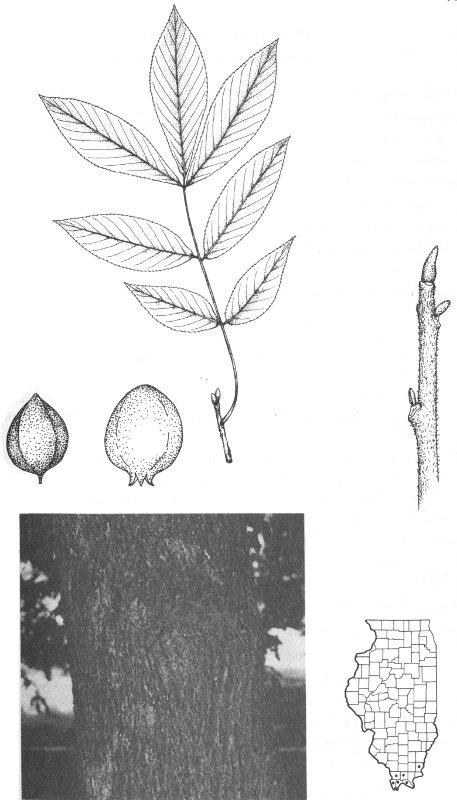
WATER HICKORY Carya aquatica (Michx. f.) Nutt.
Growth Form: Medium tree to 75 feet tall; trunk diameter up to 2 feet; crown narrow.
Bark: Reddish-brown, furrowed, becoming somewhat scaly at maturity.
Twigs: Slender, reddish-brown or gray, smooth or occasionally slightly hairy; leaf scars alternate, 3-lobed, scarcely elevated, with several bundle traces.
Buds: Pointed, reddish-brown with yellow scales, usually hairy, up to ¼ inch long.
Leaves: Alternate, pinnately compound, with 7-17 leaflets; leaflets lance-shaped, curved, pointed at the tip, tapering to the asymmetrical base, up to 5 inches long, up to 2 inches wide, finely toothed along the edges, dark green and smooth or nearly so on the upper surface, brownish and smooth or somewhat hairy on the lower surface.
Flowers: Staminate and pistillate borne separately, but on the same tree, appearing when the leaves are partly grown, the staminate several in slender, drooping catkins up to 3 inches long, the pistillate fewer, in shorter spikes, neither type with petals.
Fruit: Short-ellipsoid, usually tapering to either end, flattened, up to 1½ inches long and two-thirds as broad, the husk 4-winged, dark brown but with yellow scales, thin, splitting only about halfway to the base, the nut flattened, 4-angled, reddish-brown, the shell thin, the seed bitter.
Wood: Heavy, hard, strong, close-grained, dark brown.
Uses: Fence posts, fuel.
Habitat: Swampy woods and drained floodplains.
Range: Virginia across to southeastern Missouri, south to Texas, east to Florida.
Distinguishing Features: Water Hickory is similar to Pecan and Bitternut Hickory in having 7 or more leaflets per leaf. However, it lacks the yellow buds of the Bitternut Hickory and the slender, edible nut of the Pecan. The leaves are generally hairier than those of the Pecan.
79
80
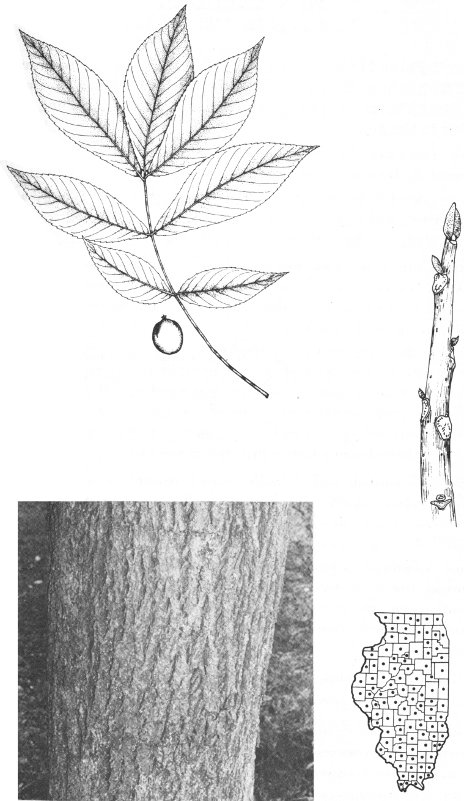
BITTERNUT HICKORY Carya cordiformis (Wang.) K. Koch
Other Name: Yellow-bud Hickory.
Growth Form: Medium tree up to 75 feet tall; trunk diameter up to 2½ feet; crown broadly rounded and often irregular; trunk straight, columnar.
Bark: Brown, thin, separating into small, platy scales or shallow ridges and fissures.
Twigs: Slender, grayish or orange-brown, smooth, usually with lenticels; leaf scars alternate, shield-shaped, scarcely elevated, with usually several bundle traces.
Buds: Narrow, slender, pointed, covered by a dense, bright yellow coat of glandular dots and small hairs, up to ¾ inch long.
Leaves: Alternate, pinnately compound, with usually 7-9 leaflets; leaflets lance-shaped, usually curved, long-pointed at the tip, tapering or rounded at the base, toothed along the edges, yellow-green and smooth on the upper surface, somewhat lighter and usually hairy on the lower surface, up to 6 inches long and usually less than half as wide.
Flowers: Staminate and pistillate borne separately, but on the same tree, appearing after the leaves have begun to unfold, minute, without petals, the staminate in slender, drooping catkins, the pistillate in groups of 1 or 2.
Fruit: More or less spherical, up to 1¼ inches in diameter, the husk thin, yellowish, with 4 distinct ridges extending about halfway down, the nut somewhat flattened, the seed very bitter.
Wood: Heavy, hard, strong, dark brown.
Uses: Fuel, fence posts.
Habitat: Bottomland woods; dry hills; along roads.
Range: Southern Ontario across to central Minnesota, south to eastern Texas, east to north-central Florida.
Distinguishing Features: Bitternut Hickory is easily recognized by its slender, mustard-yellow buds. It differs further from the Water Hickory by its rounded fruits.
81
82
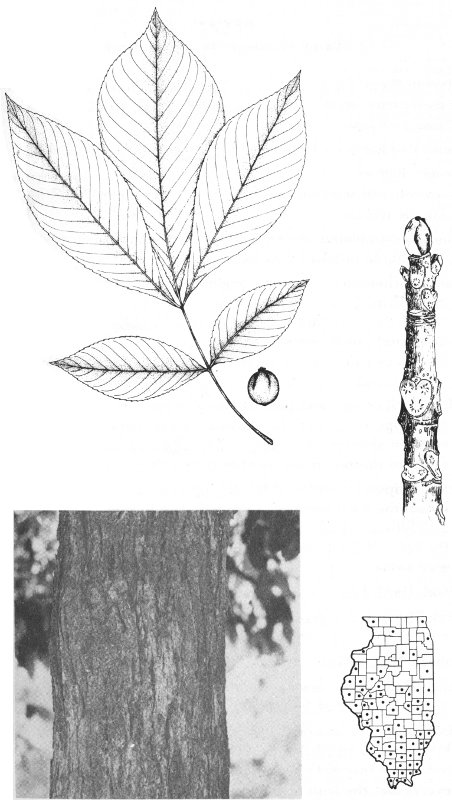
PIGNUT HICKORY Carya glabra (Mill.) Sweet
Growth Form: Medium tree up to 75 feet tall; trunk diameter up to 2 feet; crown oblong or obovoid, with many small, spreading branchlets; trunk straight, columnar, sometimes branching fairly low to the ground.
Bark: Light gray to black, not scaly or peeling off into shreds, at maturity furrowed and ridged.
Twigs: Slender, brown or gray, shiny, smooth, tough, usually with lenticels; leaf scars alternate, shield-shaped or 3-lobed, scarcely elevated, usually with several bundle traces.
Buds: More or less rounded but coming to a short point at the tip, tan or grayish, the outermost scales tipped with a few small hairs, never with small yellow dots, the inner scales hairy all along the edges, up to ½ inch long.
Leaves: Alternate, pinnately compound, with usually 5, sometimes 7 leaflets; leaflets lance-shaped, pointed at the tip, tapering at the bottom, toothed along the edges, green and smooth on the upper surface, green and smooth or sometimes hairy on the veins on the lower surface, up to 5 inches long and up to 2 inches broad, the upper three leaflets larger than the lower two.
Flowers: Staminate and pistillate borne separately, but on the same tree, appearing after the leaves have begun to expand, minute, without petals, the staminate in slender, drooping catkins, the pistillate in groups of 1-3.
Fruit: Spherical to pear-shaped, up to 1 inch long, not quite as broad, the husks thin, greenish, usually not splitting all the way to the base, the nut somewhat compressed and with a very hard shell, the seed sweet. Occasional trees have fruits up to 2 inches long.
Wood: Heavy, strong, hard, brown.
Uses: Fuel, fence posts, tool handles.
Habitat: Wooded slopes and ridges.
Range: Vermont across to southern Michigan and northern Illinois, south across Missouri to eastern Texas, east to central Florida.
Distinguishing Features: Pignut Hickory is best recognized by its rather small leaflets which usually are five in number, the tight bark, and the characteristic pear-shaped fruits.
83
84
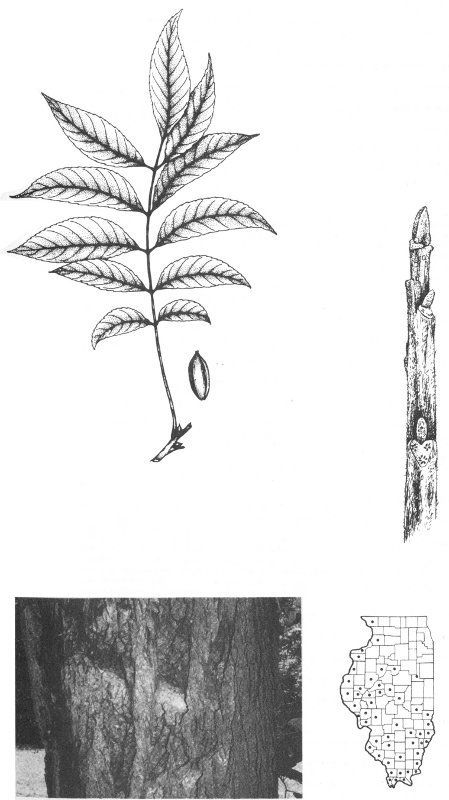
PECAN Carya illinoensis (Wang.) K. Koch
Growth Form: Large tree up to 150 feet tall; trunk diameter up to 3 feet; crown widely spreading and rounded; trunk rather short, stout, straight.
Bark: Reddish-brown, becoming roughened into platy scales.
Twigs: Rather stout, brown, hairy when young, but becoming smooth; leaf scars alternate, 3-lobed, scarcely elevated, with 3-18 bundle traces.
Buds: Long-pointed, covered with yellow glandular dots and fine hairs, up to one-half inch long.
Leaves: Alternate, pinnately compound, with 9-19 leaflets; leaflets lance-shaped, curved, long-pointed at the tip, rounded or tapering to the asymmetrical base, finely doubly-toothed, yellow-green and usually smooth on the upper surface, paler and either smooth or hairy on the lower surface, up to 8 inches long and 3 inches broad.
Flowers: Staminate and pistillate borne separately, but on the same tree, appearing when the leaves are partly grown, the staminate many in slender, drooping, yellow-green catkins, the pistillate fewer in shorter spikes, neither type with petals.
Fruit: Ellipsoid, pointed at the tip, up to 2 inches long and 1 inch broad, the husk narrowly 4-winged, dark brown but with yellow scales, thin, usually splitting nearly to the base, the nut pointed at the tip, reddish-brown with black markings, the shell thin, the seed sweet.
Wood: Hard, heavy, coarse-grained, light reddish-brown.
Uses: The nuts are prized for their tastiness; the wood is used for interior finishing, furniture, fuel, and tool handles.
Habitat: Moist woods, particularly along rivers.
Range: Indiana to Iowa, south through southeastern Kansas to eastern Texas, east to Alabama; Mexico.
Distinguishing Features: The Pecan differs from all other hickories by its greater number of leaflets. The Black Walnut and Butternut, which may have as many leaflets, have a partitioned pith. In every case, the fruit of the Pecan is distinctive.
85
86
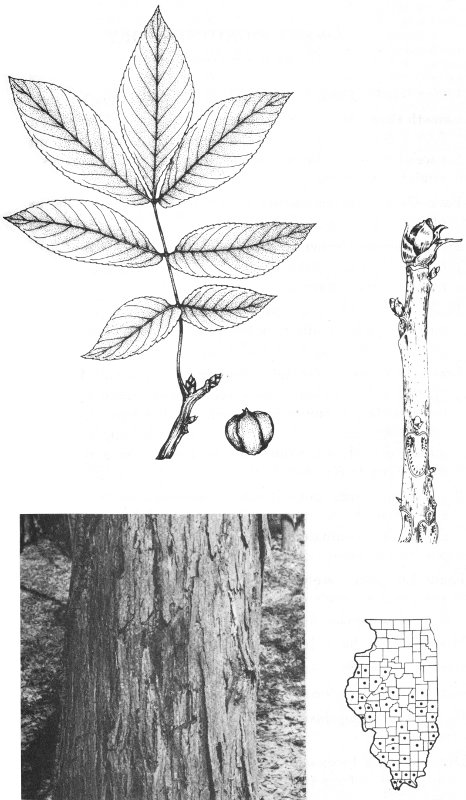
KINGNUT HICKORY Carya laciniosa (Michx. f.) Loud.
Other Names: Big Shellbark Hickory; Riverbank Hickory.
Growth Form: Large tree up to 100 feet tall; trunk diameter up to 3 feet; crown oblong to ovoid, with drooping lower branches; trunk straight, columnar, stout.
Bark: Light gray, soon separating into long, thick, vertical plates which curve away from the trunk.
Twigs: Stout, gray or brown, conspicuously dotted with orange lenticels; leaf scars alternate, shield-shaped or 3-lobed, not elevated, usually with several bundle traces.
Buds: Elongated, dark brown, hairy, up to ¾ inch long, the outer scales with a long, stiff point.
Leaves: Alternate, pinnately compound, with 5-9 leaflets; leaflets lance-shaped to ovate, pointed at the tip, tapering or rounded at the base, finely toothed along the edges, dark green and mostly smooth on the upper surface, paler and softly hairy on the lower surface, up to 10 inches long and up to half as wide.
Flowers: Staminate and pistillate borne separately, but on the same tree, appearing after the leaves have begun to unfold, minute, without petals, the staminate in slender, drooping catkins, the pistillate in clusters of 2-5.
Fruit: Spherical, often depressed at the top, up to 2¼ inches across, the husk divided all the way to the base into four sections, minutely orange-speckled and sometimes hairy, the nut with conspicuous ridges, the seed very sweet.
Wood: Heavy, hard, close-grained, dark brown.
Uses: Wood is used for tool handles and fuel; nuts are sold commercially because of their edible qualities.
Habitat: Rich bottomlands.
Range: Southwestern Pennsylvania and southern Michigan across to central Illinois and southern Iowa, south to northeastern Oklahoma, Arkansas, and eastern Tennessee; also in scattered areas of New York, Virginia, North Carolina, Georgia, Alabama, and Mississippi.
Distinguishing Features: The shaggy bark and large leaflets resemble those of the Shagbark Hickory, but the Kingnut Hickory has orange-dotted twigs and usually seven leaflets which lack minute tufts of hairs at the tip of each tooth.
87
88
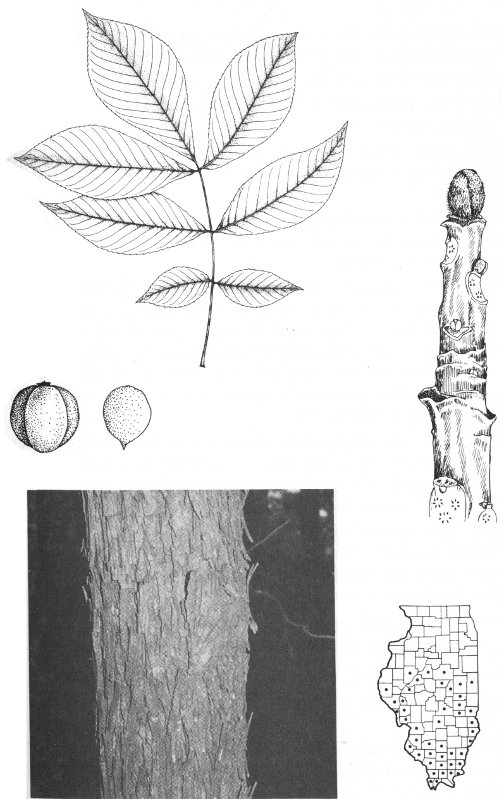
SWEET PIGNUT HICKORY Carya ovalis (Wang.) Sarg.
Other Names: False Shagbark Hickory; Small-fruited Hickory.
Growth Form: Medium to large tree up to 80 feet tall; trunk up to 2 feet in diameter; crown oblong or broadly rounded, with upright, spreading upper branches and drooping lower branches; trunk straight, columnar.
Bark: Gray, tight and rather smooth when young, usually peeling off into narrow plates at maturity.
Twigs: Slender, brown or gray, tough, smooth, usually with lenticels; leaf scars alternate, 3-lobed, not elevated, usually with several bundle traces.
Buds: More or less rounded but coming to a short point at the tip, tan or grayish, usually minutely yellow-dotted, the scales hairy all along the edges up to ⅔ inch long.
Leaves: Alternate, pinnately compound, with usually 7, sometimes 5, leaflets; leaflets lance-shaped sometimes curved, pointed at the tip, tapering or somewhat rounded at the base, finely toothed along the edges, green and smooth on the upper surface, minutely dotted and sometimes with some hairs on the lower surface, up to 6 inches long, up to 2 inches broad.
Flowers: Staminate and pistillate borne separately, but on the same tree, after the leaves have begun to unfold, minute, without petals, the staminate crowded in slender, drooping catkins, the pistillate in groups of 1-2.
Fruit: Ellipsoid, rarely spherical, up to 1¼ inch long, the husk green and minutely warty, thin, splitting all the way to the base, the nut somewhat 4-angled, the seed sweet.
Wood: Heavy, hard, brown.
Uses: Tool handles, fuel.
Habitat: Wooded slopes.
Range: New Hampshire across to Wisconsin, south to Arkansas, east to Georgia.
Distinguishing Features: This Hickory cannot always be reliably distinguished from the Pignut Hickory. However, it usually has a somewhat scaly bark, seven leaflets, minutely yellow-dotted buds, and fruits which split all the way to the base.
89
90
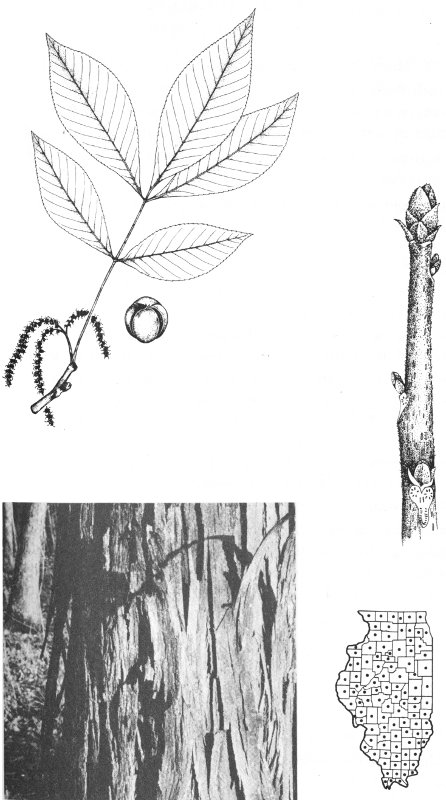
SHAGBARK HICKORY Carya ovata (Mill.) K. Koch
Growth Form: Medium to large tree up to 80 feet tall; trunk diameter up to 3½ feet; crown rounded, with some of the branches often hanging.
Bark: Gray, separating into long, shreddy scales giving the trunk a shaggy appearance.
Twigs: Stout, reddish-brown to gray, smooth or somewhat hairy; leaf scars alternate, 3-lobed, not elevated, with several bundle traces.
Buds: Ovoid, rounded or short-pointed at the tip, up to 1 inch long, hairy, the scales conspicuously yellow-green or reddish as they unfold in the spring.
Leaves: Alternate, pinnately compound, with 5-7 leaflets; leaflets ovate, obovate, or less commonly lance-shaped, usually short-pointed at the tip, tapering to the base, up to 10 inches long, up to 5 inches wide, finely toothed along the edges, with the tip of each tooth with a minute tuft of hairs, green or yellow-green and smooth on the upper surface, paler and smooth or somewhat hairy on the lower surface.
Flowers: Staminate and pistillate borne separately, but on the same tree, appearing after the leaves have begun to unfold, minute, without petals, the staminate crowded in slender, drooping catkins, the pistillate in groups of 2-5.
Fruit: Spherical or occasionally punching-bag shaped, up to 2 inches across, the husk yellow-green to reddish-brown, up to ½ inch thick, splitting all the way to the base, the nut 4-angled, nearly white, the seed sweet.
Wood: Heavy, hard, light brown, close-grained.
Uses: Tool handles, fuel; the nuts are tasty.
Habitat: Low, shaded woods.
Range: Maine across to Minnesota, south to eastern Texas, east to Florida.
Distinguishing Features: The Shagbark Hickory is distinguished by its shaggy bark, its usually 5 large leaflets, and its large winter buds.
91
92
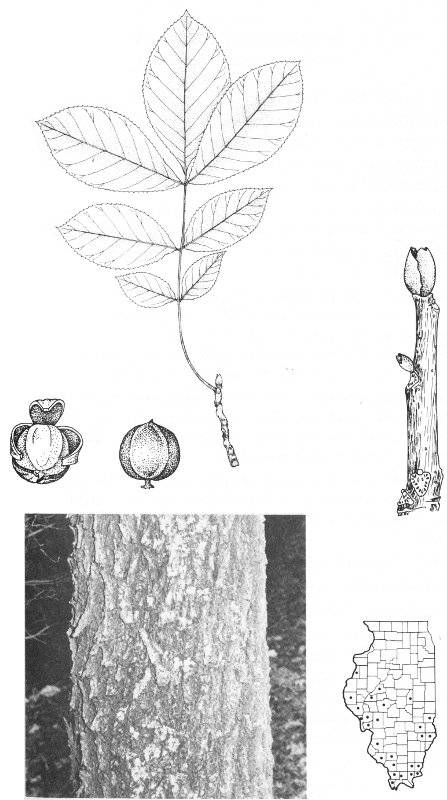
BLACK HICKORY Carya texana Buckl.
Other Names: Red Hickory; Texas Hickory; Buckley’s Hickory.
Growth Form: Small tree up to 25 feet tall; trunk diameter up to 1 foot; crown oblong to rounded, with numerous, small branchlets; trunk straight or somewhat crooked, slender but sturdy.
Bark: Brown to black, not scaly or peeling off into shreds, becoming somewhat furrowed and ridged at maturity.
Twigs: Slender, gray, tough, almost always smooth; leaf scars alternate, three-lobed, not elevated, usually with several bundle traces.
Buds: Ovoid, short-pointed, up to ½ inch long, covered by shiny silvery-golden scales and tipped with a small tuft of hairs.
Leaves: Alternate, pinnately compound, with 5-7 leaflets; leaflets lance-shaped, pointed at the tip, tapering to the base, finely toothed along the edges, dark green and smooth or sometimes hairy on the upper surface, paler and smooth or hairy on the lower surface, up to 6 inches long, less than half as wide, the stalks covered with reddish and yellowish scales and hairs.
Flowers: Staminate and pistillate borne separately, but on the same tree, appearing after the leaves have begun to unfold, minute, without petals, the staminate crowded in slender, drooping catkins, the pistillate in groups of 1-2.
Fruit: Spherical to ellipsoid, up to 1½ inches across, the husk yellow-green, thin, minutely hairy or scaly, splitting nearly to the base, the nut 4-angled, the seed sweet.
Wood: Heavy, hard, brown.
Uses: Fuel, fence posts.
Habitat: Dry ridges and cliffs.
Range: Southern Indiana across to Kansas, south to Texas and Louisiana.
Distinguishing Features: The Black Hickory differs from the somewhat similar Pignut and Sweet Pignut Hickories by the yellow scales along the leafstalks.
93
94
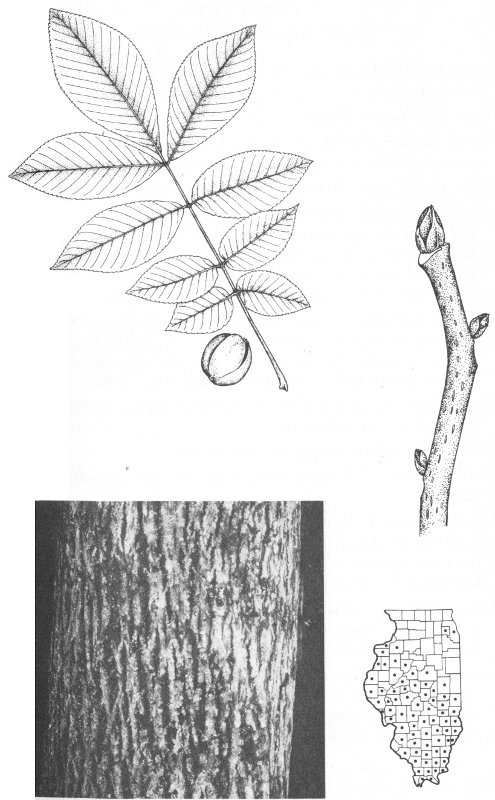
MOCKERNUT HICKORY Carya tomentosa (Poir.) Nutt.
Other Name: White Hickory.
Growth Form: Medium or tall tree to 90 feet tall; trunk diameter up to 3 feet; crown rounded, the branchlets either erect or hanging.
Bark: Dark gray, shallowly furrowed, not scaly, often with a diamond-shaped pattern.
Twigs: Slender or relatively stout, usually hairy, gray; leaf scars alternate, 3-lobed, not elevated, with several bundle traces.
Buds: Ovoid, rounded or pointed at the tip, up to nearly 1 inch long, reddish-brown, hairy.
Leaves: Alternate, pinnately compound, with 5-9 leaflets; leaflets broadly lanceolate to oblanceolate, pointed at the tip, rounded or tapering to the base, up to 8 inches long, about half as wide, finely toothed along the edge, yellow-green and hairy on the upper surface, paler and hairy on the lower surface.
Flowers: Staminate and pistillate borne separately, but on the same tree, appearing after the leaves have begun to unfold, minute, without petals, the staminate crowded in slender, drooping catkins, the pistillate in groups of 2-5.
Fruit: Ellipsoid or obovoid or spherical, up to 2 inches across, the husk reddish-brown, up to ¼ inch thick, smooth or slightly hairy, the nut sometimes 4-angled, reddish-brown, the seed sweet but small.
Wood: Heavy, hard, strong, coarse-grained, dark brown.
Uses: Tool handles, fuel, fence posts.
Habitat: Dry wooded slopes; shaded woods.
Range: Massachusetts across to southern Ontario, south to eastern Texas, east to Florida.
Distinguishing Features: Mockernut Hickory is distinguished from all other Illinois hickories by its usually 7 or 9 hairy leaflets with hairy leafstalks and hairy twigs. The large fruits with the small seeds within, which may account for the common name, are also distinctive.
95
96
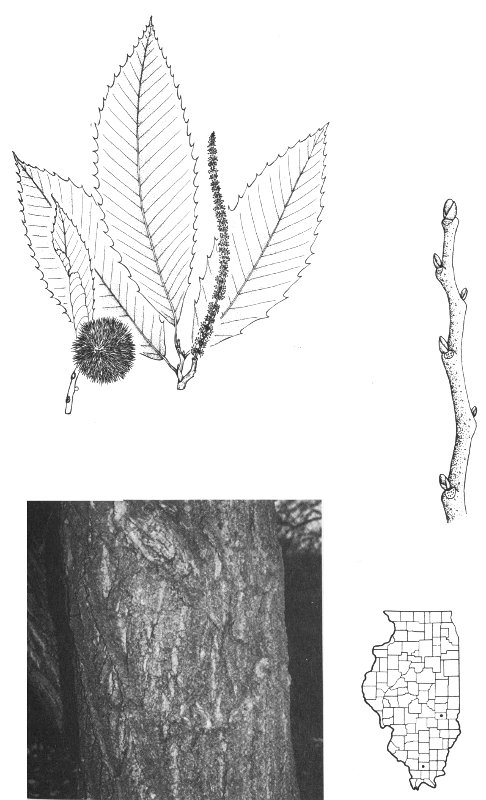
CHESTNUT Castanea dentata (Marsh.) Borkh.
Growth Form: Large tree, formerly attaining a height of 100 feet; trunk diameter up to 3 feet; crown broadly rounded.
Bark: Dark brown, shallowly furrowed.
Twigs: Slender, reddish-brown, angular, glabrous or nearly so; leaf scars alternate, half-round, elevated, with several bundle traces.
Buds: Ovoid, pointed, up to ⅓ inch long, dark brown, smooth.
Leaves: Alternate, simple; blades lanceolate to oblong-lanceolate, pointed at the tip, tapering to the base, up to 8 inches long and less than half as broad, coarsely toothed along the edges, yellow-green and smooth on the upper surface, paler and smooth on the lower surface; leafstalks up to ½ inch long, usually finely hairy.
Flowers: Staminate and pistillate borne separately, but on the same tree, appearing in June after the leaves are fully grown, without petals, greenish or yellowish, the staminate many in elongated catkins up to 8 inches long, the pistillate 1-3 together.
Fruit: Spiny bur up to 2 inches in diameter, brown, splitting open to reveal 3 flattened nutlets.
Wood: Soft, light in weight, reddish-brown.
Uses: Furniture, interior finishing, fuel. The nuts are edible delicacies.
Habitat: Formerly in rocky woods, once occupying several acres near Olmstead in Pulaski County. Now virtually extinct, except for a few sprouts, due to a disease of the bark. A tree about 40 feet tall still exists near Little Grassy Lake in Williamson County.
Range: Maine to southern Ontario and southern Minnesota, south to Delaware, Kentucky, and southern Illinois, and in the mountains to central Alabama.
Distinguishing Features: In addition to its large, spiny fruits, the Chestnut can be distinguished by its sharply toothed leaves. Yellow Chestnut Oak may sometimes have similar leaves, but the pith of the oak is star-shaped.
97
98
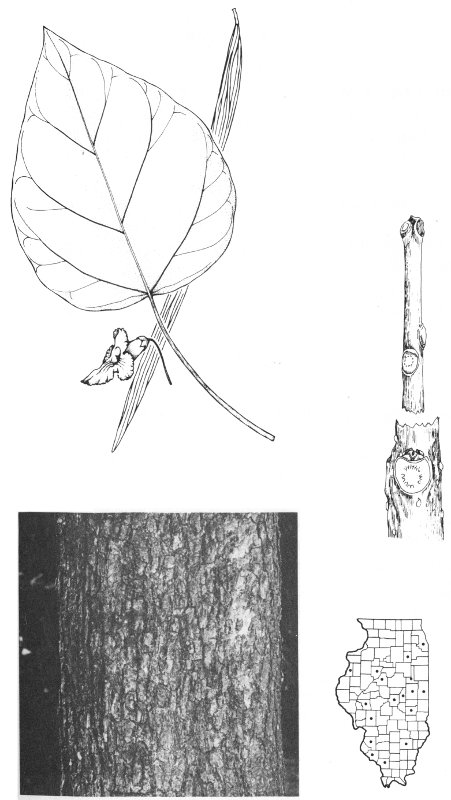
COMMON CATALPA Catalpa bignonioides Walt.
Other Names: Lady Cigar Tree; Indian Bean.
Growth Form: Short to medium tree up to 40 feet tall; trunk diameter up to 1 foot; crown broadly rounded.
Bark: Light brown, with thin, platy scales.
Twigs: Stout, smooth or slightly hairy, orange-brown to grayish, with conspicuous lenticels; leaf scars in whorls of 3, round-elliptic, elevated, with 12 or more bundle traces.
Buds: Round, reddish-brown, slightly hairy, very small.
Leaves: Whorled, simple; blades ovate, short-pointed at the tip, heart-shaped at the base, up to 8 inches long and about as broad, smooth along the edges, yellow-green and smooth on the upper surface, paler and finely hairy on the lower surface; leafstalks stout, smooth, up to 6 inches long.
Flowers: Large, showy, several in a large cluster, appearing in May and June, the clusters usually more than 6 inches long, each flower up to 2 inches long, the petals white and spotted with purple.
Fruit: Elongated capsules up to 1½ feet long and ½ inch thick, brown, splitting into 2 parts to reveal several winged, hairy seeds about 1 inch long.
Wood: Light in weight, soft, coarse-grained, pale brown.
Uses: Fence posts, railroad ties; ornamental.
Habitat: Along railroads, streams, in fields; planted elsewhere.
Range: Native from Texas to Georgia and Florida; widely planted elsewhere.
Distinguishing Features: The leaves of this species, when crushed, give off a very unpleasant aroma.
99
100
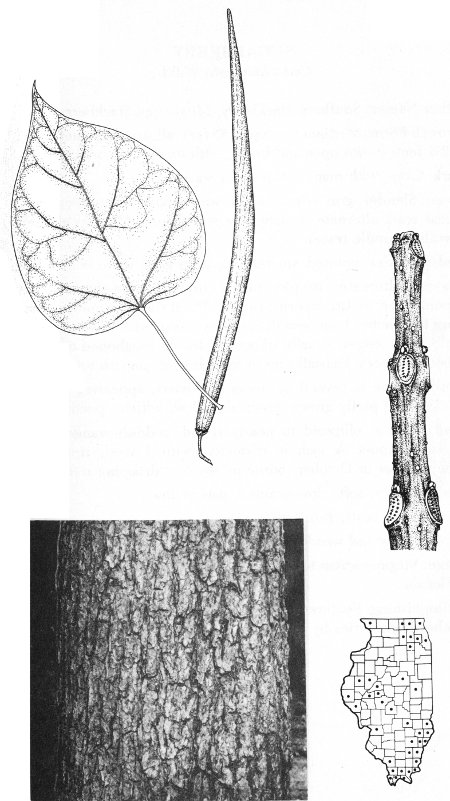
CATALPA Catalpa speciosa Engelm.
Other Names: Western Catalpa; Lady Cigar Tree; Indian Bean.
Growth Form: Medium tree up to 60 feet tall; trunk diameter up to 3 feet; crown broad, widely spreading.
Bark: Light brown, dark brown, or black, usually with rather deep furrows.
Twigs: Stout, smooth, brown, with conspicuous lenticels; leaf scars in whorls of 3, with one of the 3 scars smaller than the other 2, round-elliptic, elevated, with 12 or more bundle traces.
Buds: Round, brown to black, smooth, very small.
Leaves: Whorled, simple; blades ovate, long-pointed at the tip, heart-shaped at the base, up to 1 foot long and about ⅔ as broad, smooth along the edges, dark green and smooth or sparsely hairy on the upper surface, soft hairy on the lower surface; leafstalks stout, up to 6 inches long.
Flowers: Large, showy, several in an elongated cluster, appearing in May and June, the clusters up to six inches long, each flower up to 2½ inches long, the petals white and lined with purple.
Fruit: Elongated capsules up to 1½ feet long and ¾ inch thick, brown, splitting into 2 parts to reveal several winged, hairy seeds about 1 inch long.
Wood: Light in weight, soft, coarse-grained, pale brown.
Uses: Fence posts, interior finishing, railroad ties.
Habitat: Low woods; often planted in a variety of habitats.
Range: Southern Indiana, southern Illinois, and southern Missouri, south to Texas, Arkansas and Tennessee; commonly planted elsewhere.
Distinguishing Features: The two Catalpas in Illinois are hard to tell apart. This one usually has deeply furrowed bark, shorter clusters of flowers, petals merely lined with purple rather than spotted, and leaves which are not unpleasantly scented when crushed.
101
102
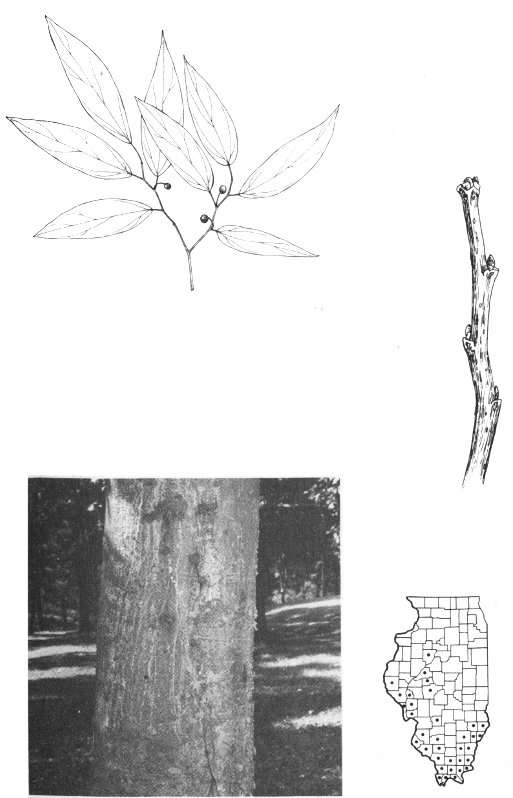
SUGARBERRY Celtis laevigata Willd.
Other Names: Southern Hackberry; Mississippi Hackberry.
Growth Form: Medium tree up to 75 feet tall; trunk diameter up to 2½ feet; crown open and broad, with drooping branches.
Bark: Gray, with many conspicuous warts.
Twigs: Slender, gray or reddish-brown, smooth, sometimes zigzag; leaf scars alternate, usually crescent-shaped, slightly elevated, with 3 bundle traces.
Buds: Slender, pointed, smooth, brown or gray, up to ⅛ inch long.
Leaves: Alternate, simple; blades usually lance-shaped, long-pointed at the tip, tapering or rounded at the asymmetrical base, up to 6 inches long, less than half as broad, with few or no teeth along the edges, usually smooth or barely roughened on one or both surfaces; leafstalks up to ½ inch long, smooth or hairy.
Flowers: One to several in drooping clusters, appearing after the leaves are partly grown, greenish-yellow, without petals.
Fruit: Fleshy, ellipsoid to nearly round, reddish-orange to yellowish, about ¼ inch in diameter, with 1 seed, ripening in September or October, borne on slender, drooping stalks.
Wood: Heavy, soft, close-grained, pale yellow.
Uses: Fence posts, furniture.
Habitat: Lowland woods to dry hilltops.
Range: Virginia across to southern Missouri, south to Texas, east to Florida.
Distinguishing Features: The Sugarberry differs generally from other hackberries by its narrower, mostly toothless leaves.
103
104
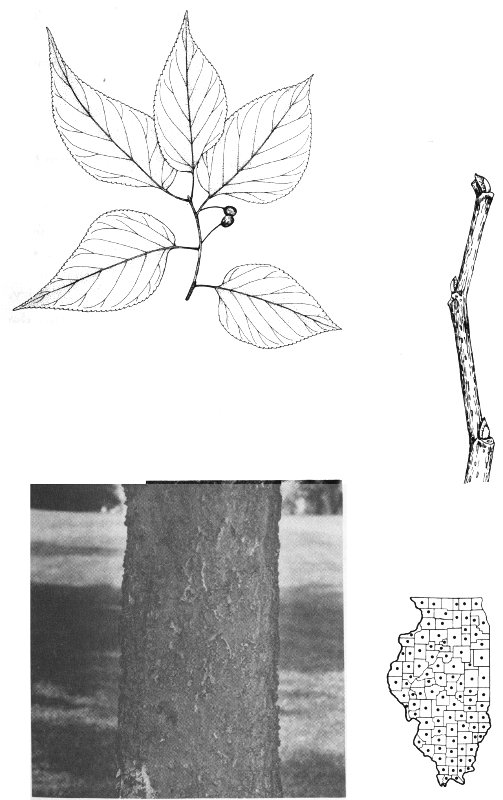
HACKBERRY Celtis occidentalis L.
Other Name: Sugarberry.
Growth Form: Medium or large tree up to 80 feet tall; trunk diameter up to 5 feet; crown usually oblong, with many small branchlets.
Bark: Gray, smooth on young trees and soon bearing “warts,” becoming rough and scaly on old trees.
Twigs: Slender, gray to reddish-brown, smooth, sometimes zigzag; leaf scars alternate, usually crescent-shaped, with 3 bundle traces.
Buds: Slender, oval, pointed, brown or gray, finely hairy, about ¼ inch long.
Leaves: Alternate, simple; blades ovate or broadly lance-shaped, long-pointed at the tip, rounded or tapering at the asymmetrical base, up to 6 inches long and up to half as broad, usually coarsely toothed along the edges except sometimes near the base, smooth or more often rough-hairy on one or both surfaces; leafstalks up to 1 inch long, smooth or hairy.
Flowers: Arranged in drooping clusters, or sometimes solitary, appearing after the leaves are partly grown, greenish-yellow, without petals.
Fruit: Fleshy, nearly round, dark purple, about ⅓ inch in diameter, with 1 seed, ripening in September and October, borne on slender, drooping stalks.
Wood: Heavy, soft, close-grained, pale yellow.
Uses: Fence posts, furniture.
Habitat: Low woodlands.
Range: Massachusetts across to Manitoba and South Dakota, southern Oklahoma, Alabama, and Virginia.
Distinguishing Features: Hackberry leaves resemble those of some elms, but have 3 main veins arising from the base of the blade. This Hackberry differs from other hackberries in Illinois by its larger, usually coarsely toothed leaves and its larger, dark purple fruits.
105
106
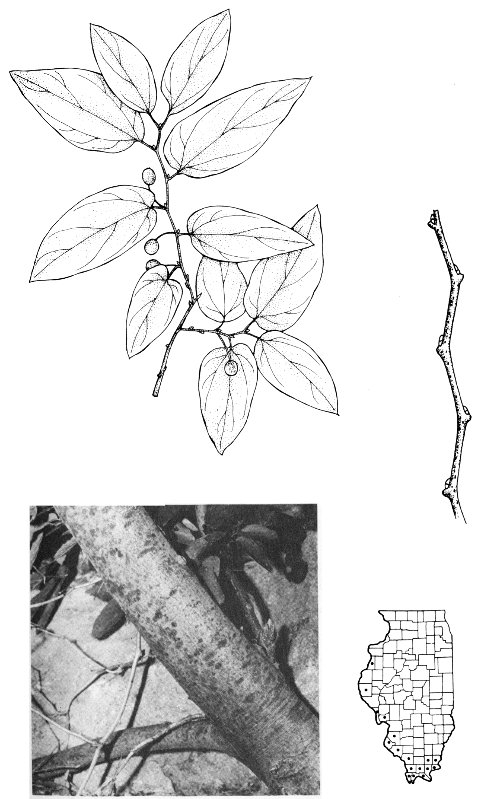
DWARF HACKBERRY Celtis tenuifolia Nutt.
Growth Form: Small tree to 25 feet tall; trunk diameter up to 10 inches; crown irregular, with numerous slender branchlets.
Bark: Gray, smooth on young trees and soon bearing “warts,” becoming rough and scaly on old trees.
Twigs: Slender, green to reddish-brown, smooth at maturity; leaf scars alternate, crescent-shaped, with 3 bundle traces.
Buds: Slender, oval, pointed, grayish-brown, finely hairy, up to ⅛ inch long.
Leaves: Alternate, simple; blades ovate, pointed at the tip, rounded or somewhat heart-shaped at the base, up to 3 inches long, often at least half as broad, with a few coarse teeth along the edges, or sometimes lacking teeth, often leathery, smooth or hairy on one or both surfaces; leafstalks up to ½ inch long, smooth or hairy.
Flowers: One or a few in drooping clusters, appearing after the leaves are partly grown, finely hairy, greenish-yellow, without petals.
Fruit: Fleshy, spherical, reddish-purple, up to ½ inch in diameter, 1-seeded, ripening September and October.
Wood: Heavy, close-grained, yellowish.
Use: Fence posts.
Habitat: Edge of bluffs, woods.
Range: New Jersey across to Illinois and Kansas, south to Oklahoma, Louisiana, and northern Florida.
Distinguishing Features: This small tree is extremely variable in that its leaves may or may not have teeth, they may or may not be hairy, and they may or may not be leathery. It differs from the Sugarberry primarily by its broader leaves and from the Common Hackberry by its smaller fruits and usually less-toothed leaves.
107
108
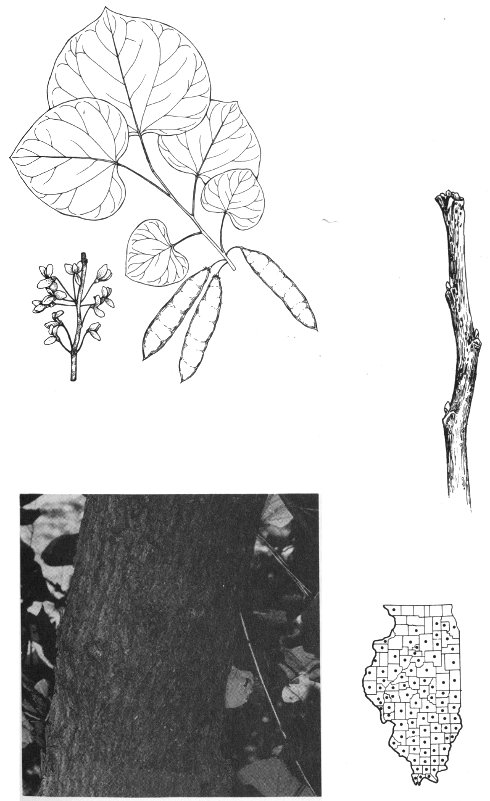
REDBUD Cercis canadensis L.
Growth Form: Small tree to 35 feet tall; trunk diameter up to 1 foot; crown usually broad and flattened.
Bark: Reddish-brown, separating into long plates and thin scales.
Twigs: Slender, zigzag, smooth, angular, brown; leaf scars alternate, somewhat elevated, triangular, hairy across the top, with 3 bundle traces.
Buds: Small, rounded, chestnut-brown, smooth or nearly so.
Leaves: Alternate, simple; blades heart-shaped, contracted to a short point at the tip, up to 6 inches long and nearly as broad, smooth on the upper surface, smooth or with some hairs on the lower surface, without teeth along the edges; leafstalks slender, up to 5 inches long, usually smooth.
Flowers: In small clusters on last year’s branches or on the trunks, rose-purple, each pea-shaped, about ½ inch long, appearing when the leaves are first beginning to unfold.
Fruit: Legumes up to 4 inches long and ½ inch broad, flat, smooth, brown at maturity, with several seeds.
Wood: Hard, heavy, close-grained, dark reddish-brown.
Use: The major importance of this small tree lies in its value as an ornamental, because of its spectacular appearance when in flower.
Habitat: Rich woods.
Range: Connecticut across to southern Wisconsin, south to Texas, east to northern Florida; also Mexico.
Distinguishing Features: The heart-shaped, toothless leaves easily identify this tree.
109
110
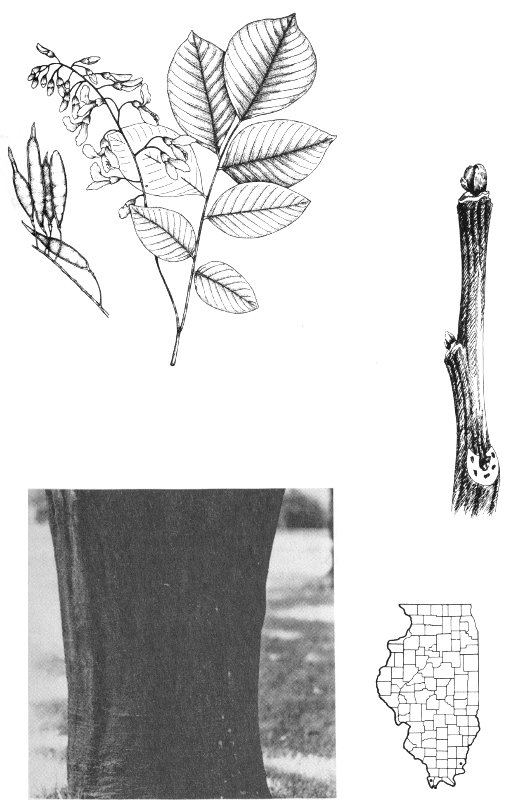
YELLOWWOOD Cladrastis lutea (Michx. f.) K. Koch
Growth Form: Small to medium tree to 45 feet tall; trunk diameter up to 14 inches; crown widely spreading.
Bark: Gray, smooth.
Twigs: Slender, reddish-brown, with some lenticels, somewhat zigzag; leaf scars alternate, narrow and completely encircling the bud, with 3-7 bundle traces.
Buds: Three or four crowded together, resembling at first a single bud, hairy, without scales, covered at first by the hollow base of the leafstalk.
Leaves: Alternate, pinnately compound, with 7-11 leaflets; leaflets oval, pointed at the tip, tapering to the base, up to 4 inches long and up to half as wide, smooth on both surfaces, toothless along the edges. The leaflets turn yellow in the autumn.
Flowers: In long, drooping clusters up to 1 foot long, white, slightly fragrant, appearing during June.
Fruit: Legumes up to 4 inches long and about ½ inch wide, flat, smooth, pale brown, with 4-6 seeds.
Wood: Hard, heavy, strong, close-grained, yellow to light brown.
Uses: Fuel. In olden days, a yellow dye was extracted from this tree.
Habitat: Rich, wooded slopes.
Range: North Carolina across to southern Missouri and Arkansas, south to northern Alabama and northern Georgia.
Distinguishing Features: The large, pinnately compound leaflets and the smooth, gray trunk distinguish this tree.
111
112
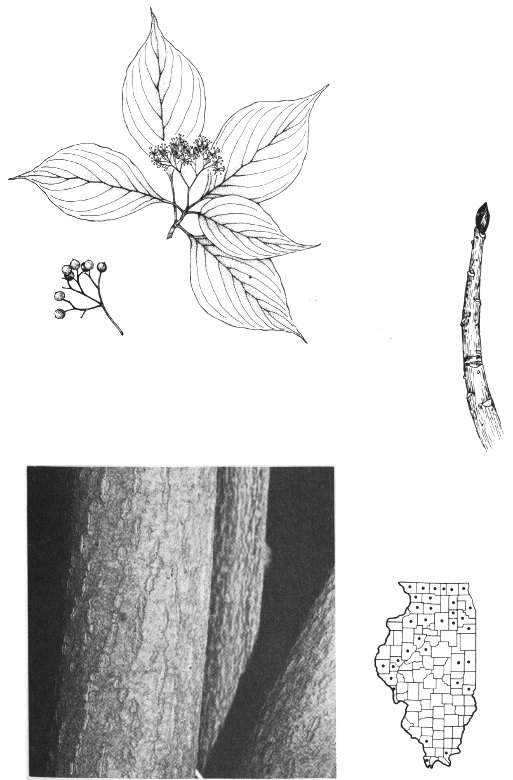
ALTERNATE-LEAVED DOGWOOD Cornus alternifolia L.
Growth Form: Small tree to 20 feet tall; trunk diameter up to 3 inches; crown flattened.
Bark: Brown, slightly roughened, with shallow furrows.
Twigs: Slender, reddish-brown or greenish, smooth; leaf scars alternate, crescent-shaped, somewhat elevated, with 3 bundle traces.
Buds: Narrowly ovoid, pointed, smooth, up to ¼ inch long.
Leaves: Alternate, although often clustered toward the tip of the twig, simple; blades oval to ovate, pointed at the tip, tapering or rounded at the base, up to 5 inches long, about half as broad, the edges smooth or finely round-toothed, green and mostly smooth on the upper surface, paler and frequently hairy on the lower surface; leafstalks up to 2 inches long, usually finely hairy.
Flowers: Several in crowded round-topped clusters, appearing in May and June, each flower white, with 4 narrow petals.
Fruit: Blue, spherical berries up to ⅓ inch in diameter, borne on a red stalk.
Wood: Heavy, hard, close-grained, brown.
Use: Tool handles.
Habitat: Rich woods.
Range: Newfoundland across to southern Ontario and Minnesota, south to Missouri, Alabama, and Georgia.
Distinguishing Features: This is the only American dogwood with the leaves arranged in an alternate manner.
113
114
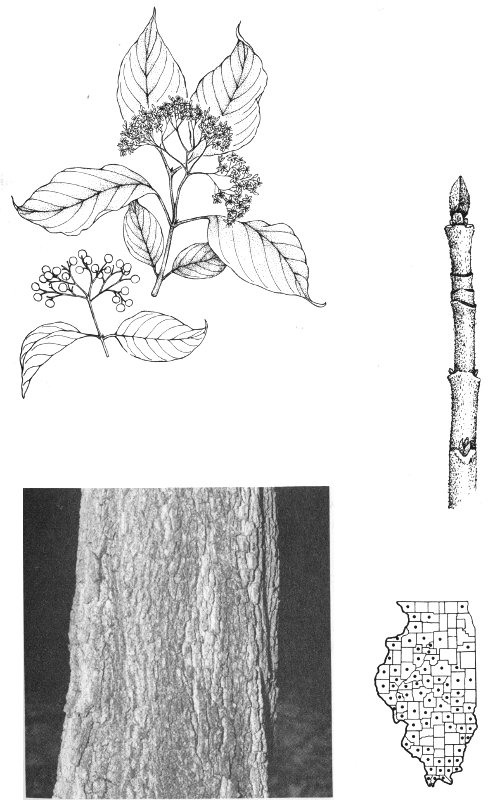
ROUGH-LEAVED DOGWOOD Cornus drummondii Meyer
Growth Form: Small tree to 30 feet tall; trunk diameter up to 3 inches; crown open and irregular.
Bark: Reddish-brown, scaly, shallowly furrowed.
Twigs: Slender, pale brown, purplish, or gray, smooth or slightly hairy; leaf scars opposite, crescent-shaped, slightly elevated, with 3 bundle traces.
Buds: Slender, flattened, pointed, finely hairy, up to ⅛ inch long.
Leaves: Opposite, simple; blades elliptic to narrowly ovate, pointed at the tip, tapering to rounded at the base, up to 4 inches long, up to half as wide, smooth along the edges, green and with short hairs on the upper surface, paler and hairy on lower surface; leafstalks up to ½ inch long, hairy.
Flowers: Several in round-topped clusters, appearing in May and June, each flower white, with 4 narrow petals.
Fruit: White, spherical berries up to ¼ inch in diameter, borne on red stalks.
Wood: Hard, heavy, close-grained, brown.
Use: Tool handles.
Habitat: Woods; edges of prairies.
Range: New York across to Minnesota, south to Nebraska and Texas, east to Florida.
Distinguishing Features: This is the only dogwood in Illinois that is rough-hairy on the upper surface of the leaves.
115
116
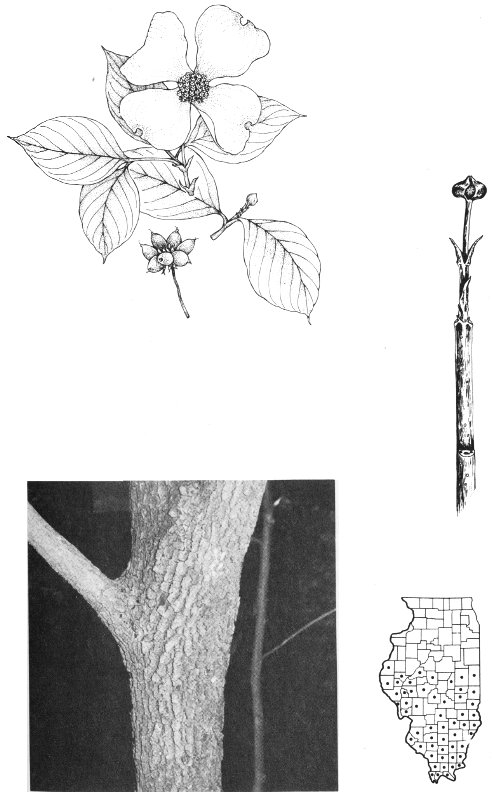
FLOWERING DOGWOOD Cornus florida L.
Growth Form: Small to medium tree to 40 feet tall; trunk diameter rarely more than 2 feet; crown rounded.
Bark: Brown, divided into squarish plates.
Twigs: Slender, greenish to light brown, smooth, often curving upward at the tip; leaf scars opposite, crescent-shaped, elevated, with 3 bundle traces.
Buds: Of two kinds, the leaf buds slender, pointed, the flower buds flat and biscuit-shaped.
Leaves: Opposite, simple; blades elliptic to ovate, pointed at the tip, tapering or rounded at the base, up to 6 inches long, less than half as broad, the veins deeply impressed, the edges without teeth, green and smooth or sparsely hairy on the upper surface, pale and finely hairy or sometimes smooth on the lower surface; leafstalks up to ¾ inch long, smooth or finely hairy.
Flowers: Several crowded together in a yellow-green cluster, each cluster subtended by 4 large white petal-like bracts, appearing in late April and May.
Fruit: Red, ovoid berries up to ½ inch long, shiny, with mealy flesh and 1 or 2 seeds.
Wood: Hard, strong, heavy, close-grained, brown.
Uses: The wood is used in the making of tool handles, although the real value of the Flowering Dogwood is its ornamental potential.
Habitat: Woods.
Range: Maine across to Kansas, south to Texas, east to Florida; also in Mexico.
Distinguishing Features: The opposite, toothless leaves with deeply impressed veins distinguish this species.
117
118
OTHER DOGWOODS
Several other dogwoods, most of them rarely if ever attaining the stature of small trees, occur in Illinois.
Gray Dogwood (Cornus racemosa Lam.). This plant rarely exceeds a height of 10 feet. It is distinguished by its slender gray twigs, its small white flowers borne in clusters about as broad as high, and its white berries about ¼ inch in diameter. The Racemose Dogwood occurs in a variety of habitats, including prairies and woods.
Stiff Dogwood (Cornus foemina Mill.). This small dogwood has brownish twigs with white pith and bluish fruits. Its leaves usually are smooth on both surfaces. It occurs in low, wet woods.
Round-leaved Dogwood (Cornus rugosa Lam.). As the name implies, this shrubby dogwood has roundish leaves which are woolly on the lower surface. The greenish twigs have white pith. The berries are pale blue. The Round-leaved Dogwood grows in dry, rocky woods.
Red Osier (Cornus stolonifera Michx.). Red Osier has dark red twigs with white pith. The leaves are pale and somewhat hairy on the lower surface. The berries are white or grayish. Red Osier usually grows along shores, often forming thickets.
Silky Dogwood (Cornus obliqua Raf.). This plant is usually a shrub, but may get as much as 15 feet tall. It has twigs with pale brown pith. The leaves are pale on the lower surface, and usually have white, appressed hairs. The berries are blue. Silky Dogwood grows in low ground.
Willow Dogwood (Cornus amomum Mill.). The Willow Dogwood rarely exceeds a height of 10 feet. Like the Silky Dogwood, it has twigs with pale brown pith. The leaves usually have reddish-colored hairs on the lower surface. The berries are pale blue. Willow Dogwood grows in low ground.
119
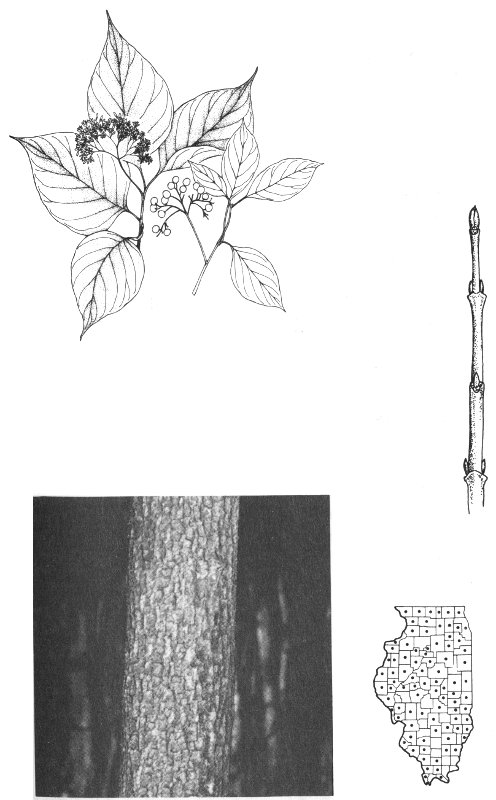
Gray Dogwood
120
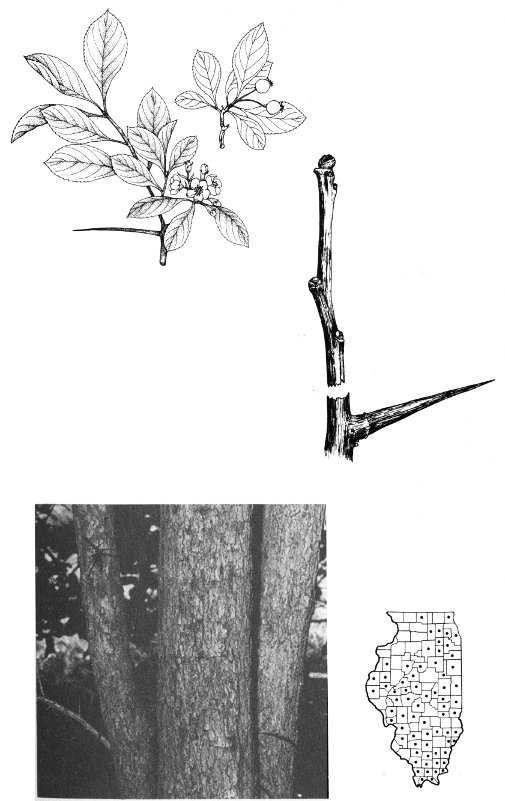
COCK-SPUR THORN Crataegus crus-galli L.
Growth Form: Small tree to 20 feet tall; trunk diameter up to 8 inches; crown broadly rounded.
Bark: Dark brown, scaly.
Twigs: Moderately stout, light brown, smooth, usually with sharp spines up to 4 inches long; leaf scars alternate, crescent-shaped, slightly elevated, with 3 bundle traces.
Buds: Rounded, up to ¼ inch in diameter, reddish-brown, usually smooth.
Leaves: Alternate, simple; blades broadest above the middle, rounded or short-pointed at the tip, tapering to the base, up to 4 inches long, up to 1½ inches broad, leathery, toothed along the edges, at least in the upper half of the leaf, dark green, smooth, shiny on the upper surface, paler and smooth on the lower surface; leafstalks stout, up to 1 inch long, smooth.
Flowers: Showy, several in a cluster, appearing in May and June, each up to ¾ inch across, with 5 white petals.
Fruit: Spherical or nearly so, up to ½ inch in diameter, red, fleshy but dry, with 1-2 nutlets.
Wood: Heavy, hard, close-grained, brown.
Use: Sometimes grown as an ornamental.
Habitat: Wooded slopes, thickets.
Range: Southern Ontario across to Minnesota, south to Texas, east to South Carolina.
Distinguishing Features: Cock-spur Thorn differs from most other hawthorns in Illinois by its leathery, shiny leaves which are broadest above the middle.
121
122
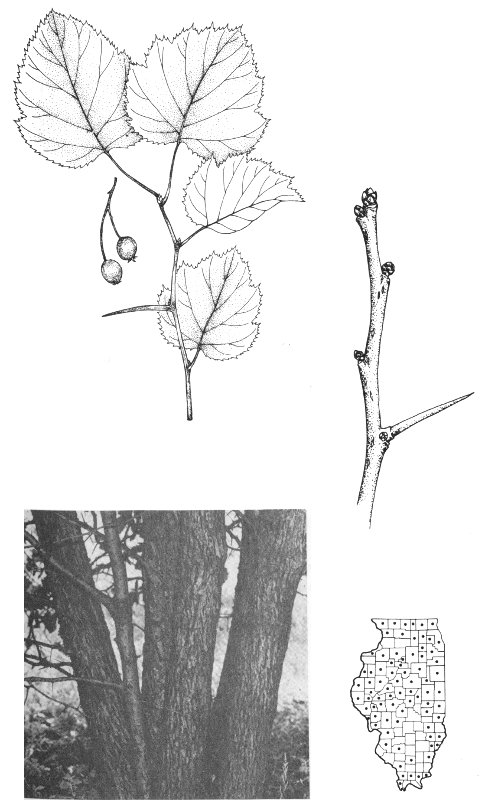
RED HAW Crataegus mollis (Torr. & Gray) Scheele
Growth Form: Small tree to 25 feet tall; trunk diameter up to 14 inches; crown widely spreading.
Bark: Gray-brown, scaly, deeply furrowed.
Twigs: Moderately stout, gray or brown, smooth or slightly hairy, rarely with spines; leaf scars alternate, crescent-shaped, slightly elevated, with 3 bundle traces.
Buds: Rounded, up to ¼ inch in diameter, reddish-brown, usually hairy.
Leaves: Alternate, simple; blades ovate, broadest near the base, short-pointed at the tip, rounded at the base, up to 4 inches long and nearly as broad, coarsely toothed along the edges, occasionally with shallow lobes, yellow-green and hairy on the upper surface, paler and hairy on the lower surface; leafstalks stout, up to 1 inch long, hairy.
Flowers: Showy, several in a cluster, appearing in April and May, each up to 1 inch across, with 5 white petals.
Fruit: Spherical or nearly so, up to 1 inch in diameter, red, fleshy but dry, with 4-5 nutlets.
Wood: Heavy, hard, close-grained, brown.
Habitat: Moist woods.
Range: Southern Ontario across to Minnesota, south to Oklahoma, east to Alabama.
Distinguishing Features: The Red Haw is distinguished by its densely hairy, ovate leaves which are often shallowly lobed.
123
124
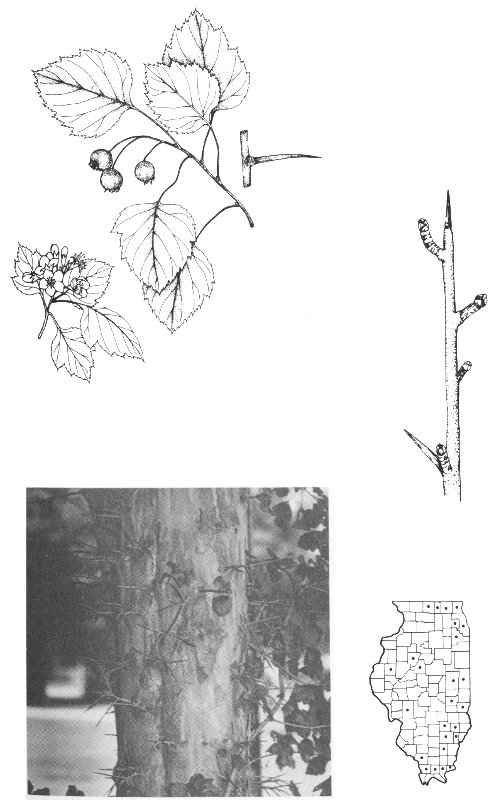
PRUINOSE HAW Crataegus pruinosa (Wendl.) K. Koch
Growth Form: Small tree to 15 feet tall; trunk diameter up to 8 inches; crown broad and irregular.
Bark: Dark gray, scaly, furrowed.
Twigs: Slender, reddish-brown, smooth, with spines up to 2 inches long; leaf scars alternate, crescent-shaped, slightly elevated, with 3 bundle traces.
Buds: Rounded, up to ⅛ inch in diameter, reddish-brown, smooth or nearly so.
Leaves: Alternate, simple; blades mostly ovate, broadest below the middle, pointed at the tip, rounded at the base, up to 3 inches long and about ⅔ as broad, coarsely toothed along the edges and frequently shallowly lobed, bluish-green and smooth on the upper surface, paler and smooth on the lower surface; leafstalks stout, up to 1 inch long, smooth or somewhat hairy.
Flowers: Showy, several in a cluster, appearing in May and early June, each up to 1 inch across, with 5 white petals.
Fruit: Spherical or nearly so, up to ¾ inch in diameter, dark red to purple, fleshy but dry, with 5 nutlets.
Wood: Heavy, hard, close-grained, brown.
Habitat: Woods and thickets.
Range: Newfoundland to southern Ontario, south to Arkansas, east to North Carolina.
Distinguishing Features: The Pruinose Haw is distinguished by its bluish-green leaves which are widest just below the middle.
125
126
OTHER HAWTHORNS
Many other hawthorns occur in Illinois. Several of them have been found only a very few times. Most of them are difficult to distinguish unless leaves, flowers, and fruits are available. A few of the hawthorns which are likely to be encountered are described on this and the following page.
Scarlet Hawthorn (Crataegus coccinioides Ashe). This hawthorn grows to a height of 15 feet and has very scaly brown bark. The slender gray twigs have many stout, sharp spines up to 2 inches long. The ovate leaves are coarsely toothed and usually shallowly lobed. There are some hairs on both surfaces of the leaves. The spherical fruits, when mature, are deep red speckled with several pale dots. There are usually 5 nutlets inside each fruit. The Scarlet Hawthorn is found primarily on rocky hills.
Urn-shaped Hawthorn (Crataegus calpodendron (Ehrh.) Medic.) The Urn-shaped Hawthorn is named for the shape of its fruit, which is usually about ½ inch long, red, with sweet flesh and 2-3 nutlets inside. This small tree only grows to a height of about 15 feet. The leaves are usually ovate and are coarsely toothed and often shallowly lobed. They have a greenish-yellow color and are hairy, at least on the underneath surface. This hawthorn frequently grows along rocky streams.
127
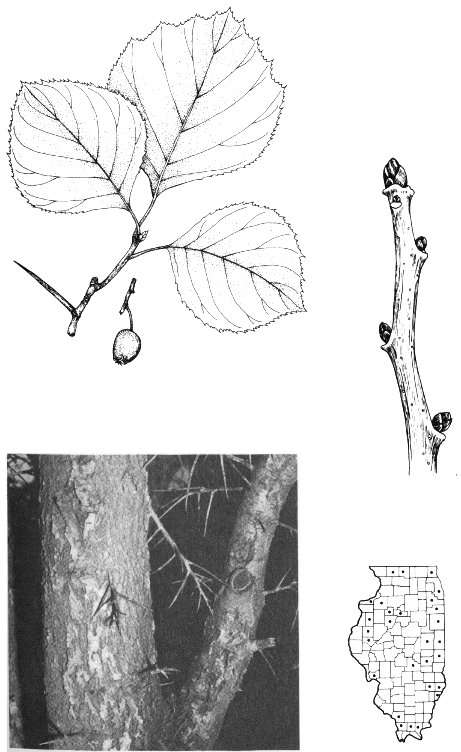
Urn-Shaped Hawthorn
128
Green Haw (Crataegus viridis L.). The Green Haw is primarily a tree of low, wet woods, where it grows to a height of nearly 30 feet and has a gray, scaly bark. The rather variable leaves range from elliptic to elliptic-ovate and toothed to occasionally shallowly lobed. The leaves are thin and smooth on both surfaces, except for some tufts of hair along the axils of the veins on the lower surface. The orange-red fruits are spherical and about ⅓ inch in diameter. There are 5 nutlets embedded in the rather sweet flesh.
Dotted Haw (Crataegus punctata Jacq.). This hawthorn grows to a height of about 20 feet and has many stout thorns on its twigs. The leaves generally are broadest above the middle and are obovate. The edges of the leaves are usually toothed from the middle to the tip. Sometimes lobes are formed. The leaves have a relatively thick texture and are hairy on the veins of the under surface of the leaves. The usually spherical fruit is about ¾ inch in diameter and contains 3 or 5 nutlets. The Dotted Thorn often forms thickets along the edges of woods or in rocky fields.
129
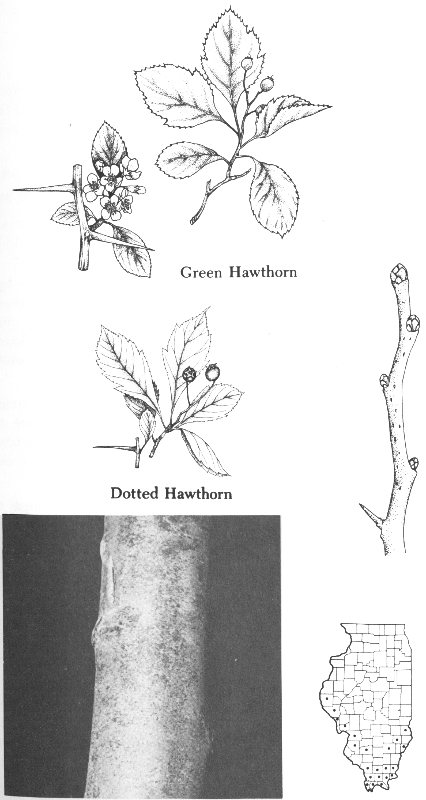
Green Hawthorn Dotted Hawthorn
130
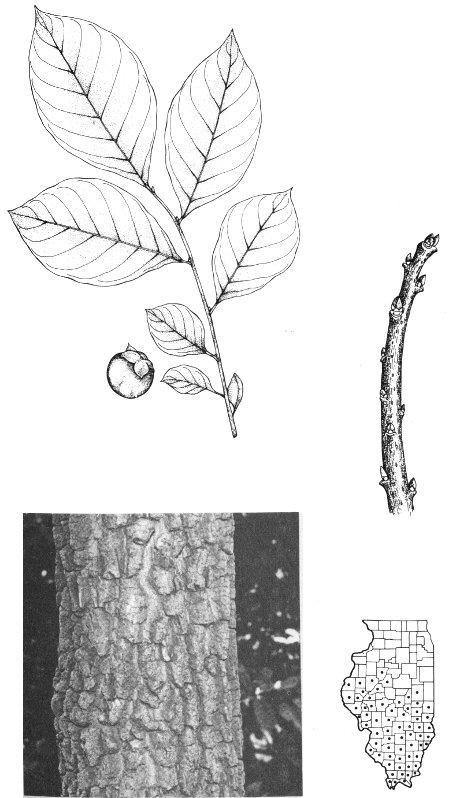
PERSIMMON Diospyros virginiana L.
Growth Form: Medium tree up to 50 feet tall; trunk diameter up to 1 foot; crown broad and rounded or flattened. (At one time in the Wabash Valley, Persimmon trees nearly 3 feet in diameter were known.)
Bark: Dark gray to black, broken at maturity into squarish blocks.
Twigs: Slender, brown, smooth or hairy, usually with lenticels; leaf scars alternate, half-elliptic, with 1 bundle trace.
Buds: More or less rounded, smooth, dark reddish-brown, up to ⅛ inch long.
Leaves: Alternate, simple; blades elliptic to oval, pointed at the tip, tapering or rounded at the base, up to 5 inches long and about half as broad, smooth along the edges, dark green, smooth, and shiny on the upper surface, paler and smooth on the lower surface; leafstalks stout, up to 1 inch long, smooth or sparsely hairy.
Flowers: Staminate and pistillate usually borne on separate trees, appearing after the leaves are half grown, the staminate in clusters of 2-3, tubular, up to ½ inch long, the pistillate solitary, ½ to ¾ inch long. Sometimes flowers with both stamens and pistils can be found.
Fruit: Fleshy, spherical, but with the greenish calyx persistent at one end, yellow-orange to orange (rarely blue), up to 2 inches in diameter, sweet when ripe, few-seeded.
Wood: Heavy, hard, the heartwood nearly black.
Uses: Golf club heads, billiard cues.
Habitat: Dry woods, rich bottomland woods, edge of fields, fence rows.
Range: Connecticut across to southern Iowa and eastern Kansas, south to eastern Texas, east to Florida.
Distinguishing Features: The leaves of the Persimmon are most often confused with those of the Sour Gum, but usually the tip is not as abruptly pointed in the Persimmon. The pith of the Persimmon also lacks the distinct partitions found in the Sour Gum.
131
132
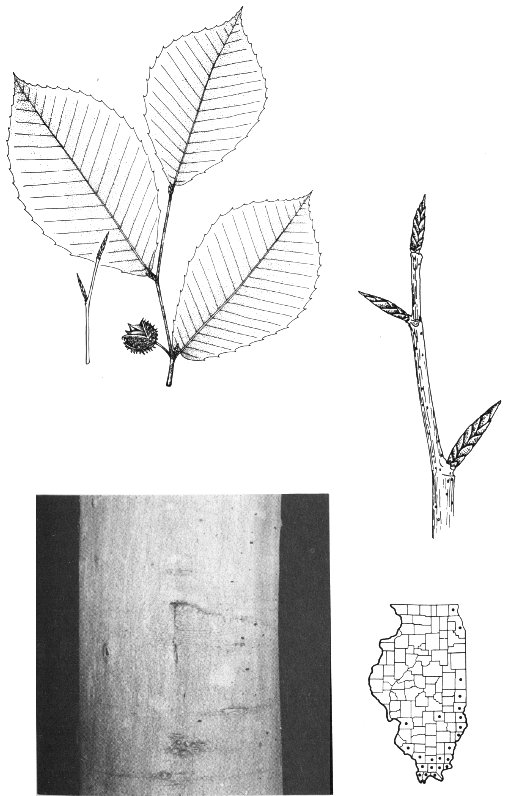
BEECH Fagus grandifolia Ehrh.
Growth Form: Large tree to nearly 100 feet tall; trunk diameter up to 4 feet; crown widely spreading, usually rounded.
Bark: Smooth, gray, thin, often marred by human carving.
Twigs: Gray or yellowish, slender, smooth, more or less zigzag; leaf scars alternate, half-round, with 3 bundle traces.
Buds: Slender, narrow, long-pointed, smooth, reddish-brown, up to ¾ inch long.
Leaves: Alternate, simple; blades up to 4 inches long and 2½ inches broad, oblong, pointed at the tip, rounded or tapering to the somewhat asymmetrical base, coarsely toothed along the edges, blue-green to yellow-green, smooth and shiny on the upper surface, smooth or finely hairy on the lower surface; leaf stalk very short, sometimes hairy.
Flowers: Staminate and pistillate borne separately on the same tree, appearing after the leaves have unfolded, the staminate numerous in small spherical heads, the pistillate in groups of 2.
Fruit: Spiny burs up to ¾ inch long, prickly, reddish-brown, containing 1-3 triangular nuts.
Wood: Hard, strong, close-grained, deep reddish-brown.
Uses: Fuel, chairs, tool handles.
Habitat: Rich woods.
Range: Nova Scotia across to Ontario, south to eastern Texas, east to northern Florida.
Distinguishing Features: The stately Beech is recognized by its smooth gray bark and its long, pointed winter buds.
133
134
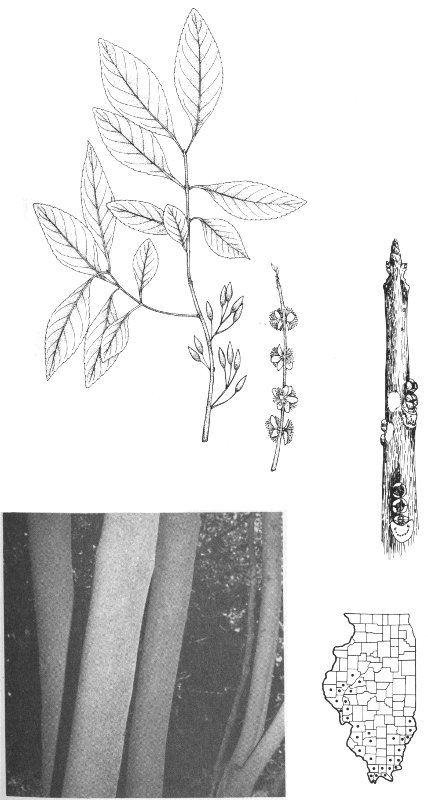
SWAMP PRIVET Forestiera acuminata (Michx.) Poir.
Growth Form: Small tree to 30 feet tall; trunk diameter up to 5 inches; crown spreading, irregular.
Bark: Brown, shallowly furrowed or nearly smooth.
Twigs: Slender, brown, warty or smooth; leaf scars opposite, shield-shaped, with 1 bundle trace.
Buds: Spherical, up to ⅛ inch in diameter, smooth.
Leaves: Opposite, simple; blades elliptic, pointed at the tip, tapering to the base, up to 4 inches long, up to 1½ inches broad, finely toothed along part of the edges, yellow-green and nearly smooth on the upper surface, paler and smooth on the lower surface; leafstalks slender, usually smooth, up to ½ inch long.
Flowers: Staminate and pistillate borne separately on different trees, appearing before the leaves begin to unfold; staminate many in rounded clusters, yellow, without petals; pistillate several in branched clusters, yellowish, without petals.
Fruit: Slender, oblong, slightly curved, dark purple, about 1 inch long, up to ¼ inch wide, fleshy but dry, containing 1 seed.
Use: Occasionally planted as an ornamental.
Habitat: Swamps, along rivers.
Range: South Carolina across to Kansas, south to Texas, east to Florida.
Distinguishing Features: Swamp Privet is distinguished by its opposite, pointed leaves which are finely toothed along the edges.
135
136
WHITE ASH Fraxinus americana L.
Growth Form: Large tree up to 100 feet tall; trunk diameter up to 4 feet; crown pyramidal or ovoid, with slender branches; trunk straight, columnar.
Bark: Light or dark gray, with diamond-shaped furrows between flat-topped, sometimes scaly, ridges.
Twigs: Slender, gray or brown, sometimes with a few hairs; leaf scars opposite, horseshoe-shaped, with several bundle traces forming a half-moon.
Buds: Rounded, dark brown, finely hairy, up to ½ inch long.
Leaves: Opposite, pinnately compound, with 5-9 leaflets; leaflets lance-shaped to lance-ovate, often curved, pointed at the tip, rounded or tapering to the base, up to 5 inches long and about half as broad, shallowly toothed along the edges, green and smooth on the upper surface, paler and smooth or hairy on the lower surface.
Flowers: Staminate and pistillate borne on separate trees before the leaves begin to expand, minute, without petals, purplish, in crowded clusters, soon becoming elongated and less crowded.
Fruit: Paddle-shaped, winged, up to 2½ inches long and ¼ inch wide, several in a cluster, 1-seeded at the base.
Wood: Heavy, strong, hard, coarse-grained, brown.
Uses: Furniture, baseball bats, tool handles, interior finishing.
Habitat: Bottomlands and wooded slopes.
Range: Nova Scotia across to Minnesota, south to Texas and Florida.
Distinguishing Features: White Ash differs from Green Ash in having distinctly paler lower leaf surfaces. Plants with hairy leaves resemble Red Ash, but the fruits do not have the wing extending down beyond the seed in the White Ash.
137
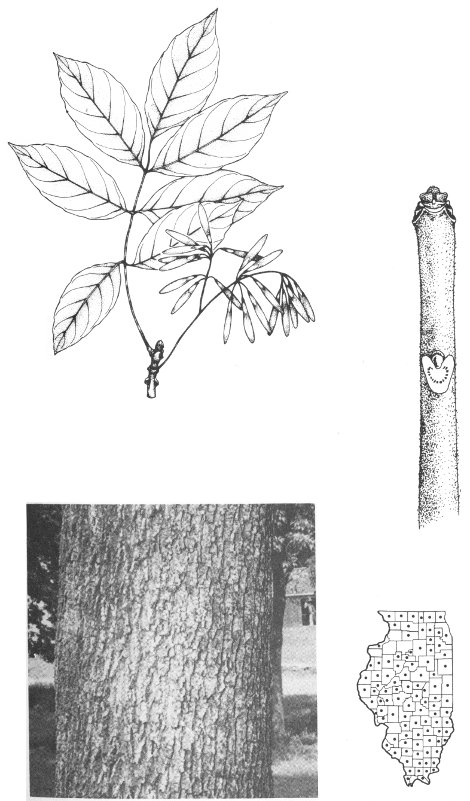
138
BLACK ASH Fraxinus nigra Marsh.
Growth Form: Medium tree up to 70 feet tall; trunk diameter up to 2 feet; crown broadly rounded, with many stout, straight branches.
Bark: Light gray, scaly, without diamond-shaped furrows.
Twigs: Stout, gray or brown, smooth; leaf scars elliptic or oval, with several bundle traces arranged in a half moon.
Buds: Conical, blue-black, finely hairy, about one-fourth inch long.
Leaves: Opposite, pinnately compound, with 7-11 leaflets; leaflets without stalks, lance-shaped, long-pointed at the tip, tapering or rounded at the sometimes asymmetrical base, up to 6 inches long, less than one-half as wide, toothed along the edges, dark green and smooth on the upper surface, paler and with rusty hairs along the veins on the lower surface. The leaflets turn reddish-brown in the autumn.
Flowers: Small, in elongated clusters, appearing before the leaves begin to unfold, purplish, without any petals, some with both stamens and pistils, others only with stamens, others only with pistils.
Fruit: Oblong, winged fruits, barely notched at the tip, up to 1½ inches long, up to one-half inch broad, with a single seed at the base.
Wood: Soft, heavy, dark brown.
Uses: Cabinets, baskets, fence posts.
Habitat: Swampy woods.
Range: Newfoundland across to Manitoba, south to Iowa, central Illinois, West Virginia, and Delaware.
Distinguishing Features: This is the only ash in Illinois where none of the leaflets has stalks.
139
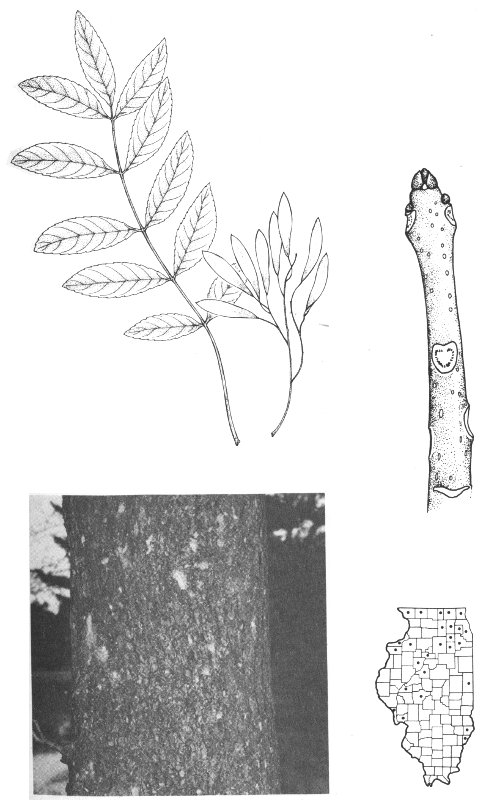
140
RED ASH Fraxinus pennsylvanica Marsh.
Growth Form: Medium tree up to 60 feet tall; trunk diameter up to 2 feet; crown usually pyramidal; trunk straight, rather stout, sometimes slightly buttressed at base.
Bark: Light or dark gray, with diamond-shaped furrows between flat-topped, sometimes scaly ridges.
Twigs: Slender to rather stout, gray or brown, covered by velvety hairs, leaf scars opposite, half-round and straight across the top, with several bundle traces forming a half-moon.
Buds: Rounded, dark brown, finely hairy, about ¼ inch long.
Leaves: Opposite, pinnately compound, with 7-9 leaflets; leaflets elliptic to elliptic-ovate, pointed at the tip, tapering to the base, up to 6 inches long, about ⅓ as wide, sparsely toothed along the edges, hairy on both surfaces.
Flowers: Staminate and pistillate on separate trees, appearing after the leaves have begun to open, minute, crowded in purplish or greenish dense clusters.
Fruit: A cluster of paddle-shaped fruits, each fruit up to 2½ inches long and less than ½ inch broad, with a single seed at one end.
Wood: Hard, strong, heavy, coarse-grained, pale brown.
Uses: Tool handles, interior finishing, furniture.
Habitat: Bottomland forests.
Range: Nova Scotia across to North Dakota, south to Kansas, east to Louisiana and northern Florida.
Distinguishing Features: Red Ash is characterized by its hairy leaf stalks and its narrow wings along the stalks between the leaflets.
141
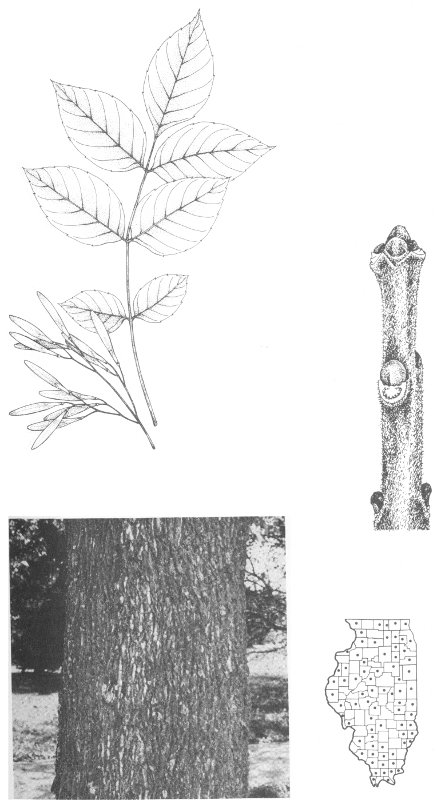
142
GREEN ASH Fraxinus pennsylvanica Marsh var. subintegerrima (Vahl) Fern.
Growth Form: Medium tree up to 60 feet tall; trunk diameter up to 2½ feet; crown broadly rounded, with slender, spreading branches.
Bark: Light or dark gray, with diamond-shaped furrows between flat-topped, sometimes scaly, ridges.
Twigs: Slender to rather stout, gray or brown, smooth; leaf scars half-round and straight across the top, with several bundle traces forming a half-moon.
Buds: Rounded, dark brown, finely hairy, up to one-fourth inch long.
Leaves: Opposite, pinnately compound, with 7-9 leaflets; leaflets lance-shaped to elliptic, long-pointed at the tip, tapering to the base, up to 6 inches long and one-and-one-half inches wide, toothed along the edges, green and smooth on both surfaces. The leaflets turn reddish-brown or yellowish in the autumn.
Flowers: Staminate and pistillate flowers borne on separate trees, in branched clusters, appearing as the leaves begin to unfold, small, purplish, without petals.
Fruit: Lance-shaped or reversely lance-shaped, winged fruits, usually rounded at the tip, up to 2½ inches long and less than one-third inch broad, with a single seed at the base.
Wood: Hard, heavy, strong, light brown.
Uses: Interior finishing, tool handles, baseball bats; sometimes grown as an ornamental.
Habitat: Bottomland forests.
Range: Maine across to Saskatchewan and Minnesota, south to Texas, east to Florida.
Distinguishing Features: The Green Ash has leaflets which are green on both surfaces.
143
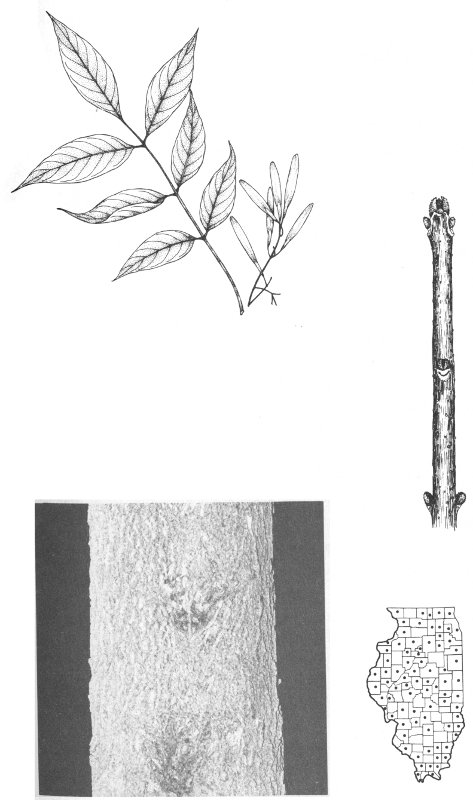
144
BLUE ASH Fraxinus quadrangulata Michx.
Other Name: Square-stemmed Ash.
Growth Form: Moderate tree to seventy feet tall; trunk diameter up to 3 feet; crown irregular, with many short, sturdy branches.
Bark: Gray, scaly, without diamond-shaped furrows.
Twigs: Stout, square, gray or brown, smooth; leaf scars half-round and concave across the top, with several bundle traces forming a half-moon.
Buds: Rounded, gray, finely hairy, up to one-half inch long.
Leaves: Opposite, pinnately compound, with 5-11 leaflets; leaflets lance-shaped, long-pointed at the tip tapering to the sometimes asymmetrical base, up to 6 inches long, less than half as wide, coarsely toothed along the edges, yellowish-green and smooth on the upper surface, paler and usually with tufts of hairs along the veins on the lower surface. The leaflets turn yellow in the autumn.
Flowers: Small, in branched clusters, appearing as the leaves begin to unfold, purplish, without any petals.
Fruit: Oblong, winged fruits, notched at the tip, up to 2 inches long and one-half inch broad, with a single seed near the bottom.
Wood: Hard, heavy, yellow-brown.
Uses: Flooring; the inner bark produces a blue dye when placed in water.
Habitat: Wooded slopes, limestone cliffs.
Range: Western Pennsylvania across Wisconsin to Iowa, south to Oklahoma, Arkansas, and Alabama; southern Ontario.
Distinguishing Features: The square stems immediately distinguish this tree from any other ash in Illinois.
145
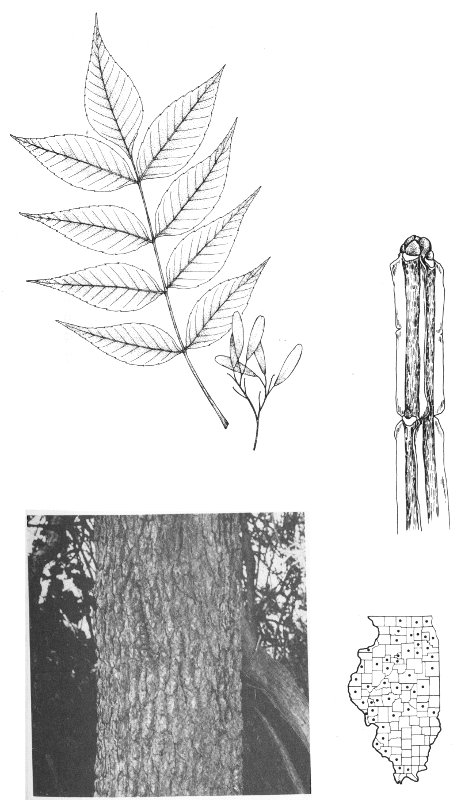
146
PUMPKIN ASH Fraxinus tomentosa Michx. f.
Growth Form: Large tree sometimes nearly 100 feet tall; trunk diameter up to 3 feet; crown broadly rounded, with stout spreading branches.
Bark: Gray, becoming scaly.
Twigs: Stout, gray or brown, usually velvety; leaf scars opposite, horseshoe-shaped, with several bundle traces arranged in a half-moon.
Buds: More or less conical, brown, hairy, about one-fourth inch long.
Leaves: Opposite, compound, with 7-9 leaflets; leaflets lance-shaped to elliptic, pointed at the tip, rounded or tapering at the slightly asymmetrical base, up to 10 inches long and about half as wide, smooth or finely toothed along the edges, yellow-green and smooth on the upper surface, paler and velvety-hairy on the lower surface. The leaves turn yellow in the autumn.
Flowers: Staminate and pistillate flowers borne on separate trees, in elongated clusters, appearing before the leaves, small, greenish-purple, without any petals.
Fruit: Oblong, winged fruits, usually rounded at the tip, up to 3 inches long and one-half inch broad, with a single seed near the bottom.
Wood: Heavy, strong, hard, close-grained, brown.
Uses: Boxes, paper pulp, fuel.
Habitat: Floodplains, swamps.
Range: New York across Ohio to southern Illinois and southern Missouri, south to Louisiana, east to Florida.
Distinguishing Features: The Pumpkin Ash is the only ash in Illinois with velvety-hairy twigs and usually toothless leaves.
147
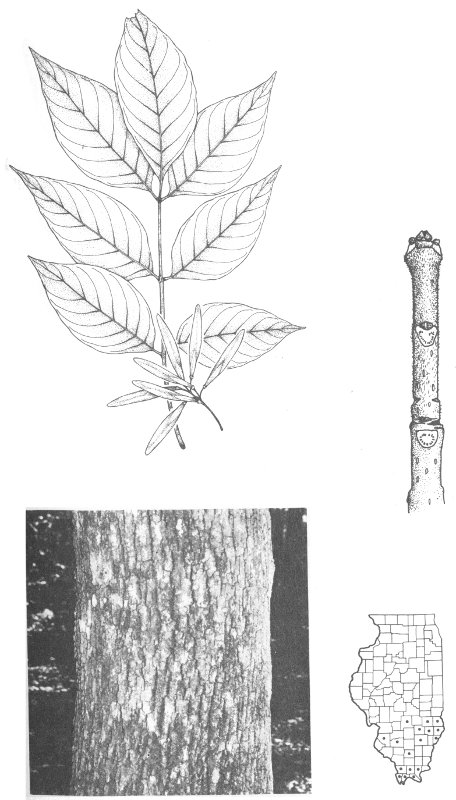
148
WATER LOCUST Gleditsia aquatica Marsh.
Growth Form: Small to medium tree to 60 feet tall; trunk diameter up to 2 feet; crown widely but irregularly spreading; trunk short and stout.
Bark: Dark gray or dark brown, shallowly furrowed.
Twigs: Slender, gray or brown, smooth, usually with unbranched thorns; leaf scars alternate, more or less 3-lobed, with 3 bundle traces.
Buds: Rounded, nearly hidden beneath the leaf scars, dark brown, smooth, up to ⅛ inch long.
Leaves: Alternate, both singly and doubly pinnately compound on the same tree, with many leaflets; leaflets oblong to oblong-ovate, rounded or slightly pointed at the tip, rounded at the slightly asymmetrical base, toothless or minutely toothed along the edges, smooth except for some hairs along the veins, up to 1 inch long, about half as wide.
Flowers: Some flowers with both stamens and pistils, others with only one or the other, in elongated clusters up to 4 inches long, greenish, small, appearing in May and June.
Fruit: Short, pointed legumes up to 2 inches long and 1 inch broad, borne several in a drooping cluster, chestnut-brown, smooth, with 1 or 2 seeds and no pulp.
Wood: Hard, heavy, coarse-grained, reddish-brown.
Uses: Fence posts, coarse construction.
Habitat: Swampy woods.
Range: North Carolina across to southern Missouri, south to Texas, east to Florida.
Distinguishing Features: The short, 1- or 2-seeded legume without pulp differentiates this locust from the Honey Locust.
149
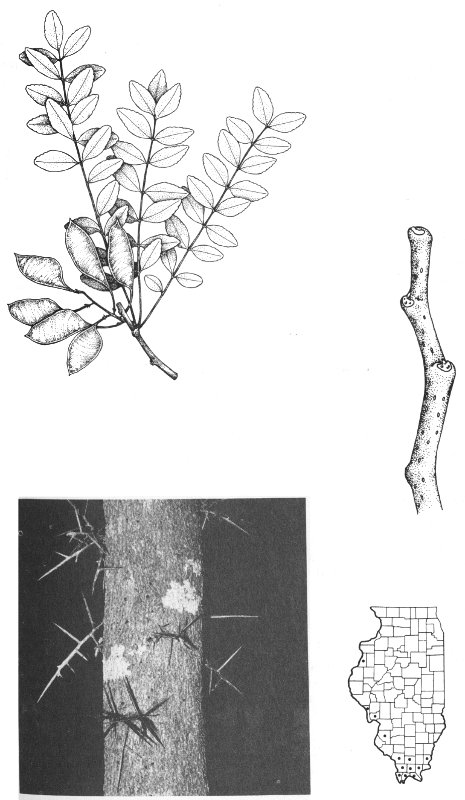
150
HONEY LOCUST Gleditsia triacanthos L.
Growth Form: Medium tree to 70 feet tall; trunk diameter up to 3 feet; crown broadly rounded, often with dropping outer branches; trunk straight, rather stout, usually with large, purple-brown, 3-parted thorns.
Bark: Dark brown, deeply furrowed and scaly at maturity.
Twigs: Slender, angular, reddish-brown, smooth, zigzag, with 3-parted or unbranched thorns; leaf scars alternate, more or less 3-lobed, with 3 bundle traces.
Buds: Rounded, nearly hidden beneath the leaf scars, dark brown, smooth, up to ⅛ inch long.
Leaves: Alternate, often doubly pinnately compound, with many leaflets; leaflets oblong to oblong-lanceolate, rounded or slightly pointed at the tip, rounded at the slightly asymmetrical base, minutely toothed along the edges, smooth except for some hairs along the veins, up to 1½ inches long, less than half as wide.
Flowers: Some flowers with both stamens and pistils, others with only one or the other, in elongated clusters up to 3 inches long, yellowish, small, appearing in May and June.
Fruit: Elongated legumes up to 1½ feet long and up to 2 inches wide, flat, often twisted or curved, purple-brown, containing several seeds embedded in a thick pulp.
Wood: Hard, strong, coarse-grained, reddish-brown.
Uses: Fence posts, coarse construction; a spineless form sometimes cultivated.
Habitat: Moist, wooded ravines, thickets, along roads.
Range: New York across to South Dakota, south to Texas, east to Florida.
Distinguishing Features: Honey Locust has more leaflets than any other kind of tree in Illinois. The large 3-parted spines and the long fruits are also distinctive.
151
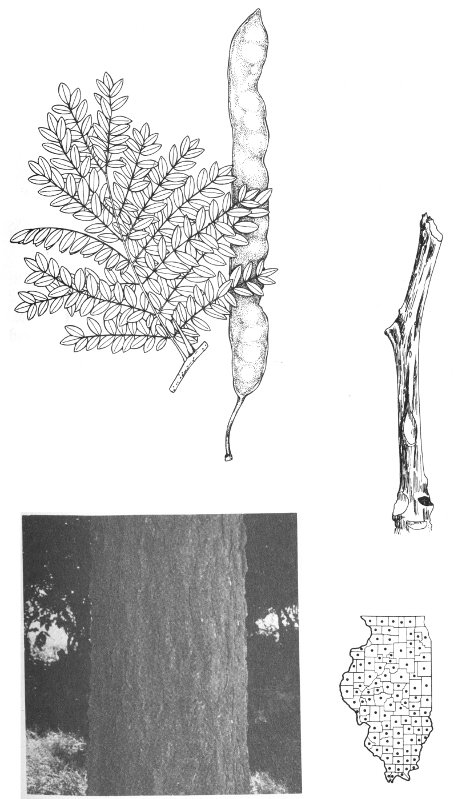
152
KENTUCKY COFFEE TREE Gymnocladus dioicus (L.) K. Koch
Growth Form: Medium to large tree to 85 feet tall; trunk diameter up to 2½ feet; crown with a narrow, rounded top; trunk stout, usually branching a few feet above the ground.
Bark: Dark gray, deeply furrowed and scaly at maturity.
Twigs: Stout, dark brown with orange lenticels, slightly hairy; leaf scars alternate, heart-shaped, with 3 or 5 bundle traces; pith chocolate-colored.
Buds: Tiny, sunken in hairy cavities immediately above each leaf scar.
Leaves: Alternate, doubly pinnately compound, with many leaflets; leaflets ovate, pointed at the tip, rounded at the base, up to 2 inches long and about half as broad, without teeth along the edge, dark green and smooth on the upper surface, yellow-green and smooth or hairy on the veins on the lower surface.
Flowers: Staminate and pistillate borne separately on separate trees, in more or less elongated, greenish clusters, appearing after the leaves have unfolded, each flower with 5 oblong, hairy petals.
Fruit: Short, thick legumes up to 10 inches long and up to 2 inches wide, dark brown, leathery, smooth, containing several large seeds embedded in a thick, sweet pulp.
Wood: Heavy, strong, durable, coarse-grained, reddish-brown.
Uses: Fence posts, fuel, rough construction. The seeds can be used as a substitute for coffee.
Habitat: Rich, often bottomland, woods.
Range: New York across to South Dakota, south to Oklahoma, east to Tennessee.
Distinguishing Features: The doubly compound leaves with large leaflets, the short, thick legumes, and the thick twigs with sunken buds readily distinguish this tree. It is one of the last trees to put forth its leaves in the spring.
153
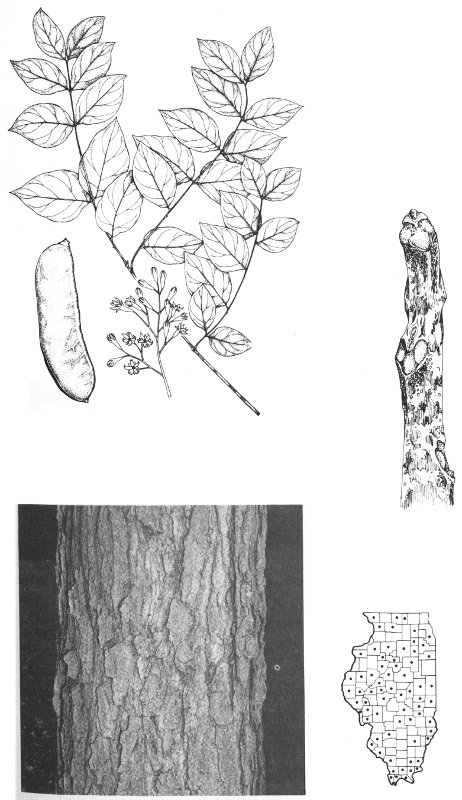
154
SILVER BELL Halesia carolina L.
Growth Form: Small tree to 30 feet tall; trunk diameter up to 8 inches; crown widely spreading.
Bark: Reddish-brown, with whitish stripes, somewhat scaly.
Twigs: Slender, reddish-brown, usually smooth; leaf scars alternate, half-round, with a cluster of bundle scars.
Buds: Ovoid, pointed, reddish-brown, somewhat hairy, up to ⅛ inch long.
Leaves: Alternate, simple; blades oval to elliptic, pointed at the tip, tapering to rounded at the base, up to 6 inches long, about half as broad, finely toothed along the edges, dark green and usually smooth on the upper surface, paler and smooth or slightly hairy on the lower surface; leafstalks slender, smooth or finely hairy, up to ½ inch long.
Flowers: Few in hanging clusters, showy, white, each bell-shaped and up to one inch long, appearing in April.
Fruit: 4-winged, dry, brown, up to 2 inches long, containing 1 seed.
Wood: Light in weight, soft, close-grained, brown.
Use: Occasionally grown as an ornamental.
Habitat: Rich woods.
Range: Virginia across southern Illinois to Oklahoma, south to Texas, east to Florida.
Distinguishing Features: The bell-shaped white flowers and the 4-winged fruits readily distinguish this handsome tree.
155
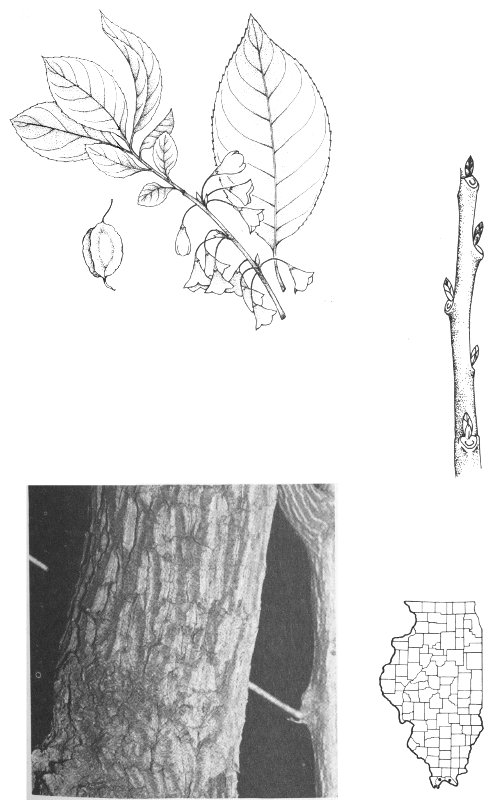
156
WITCH HAZEL Hamamelis virginiana L.
Growth Form: Small tree to 25 feet tall; trunk diameter up to 10 inches; crown broadly rounded.
Bark: Light brown, eventually broken into small scales.
Twigs: Slender, flexible, brown, hairy at first but becoming smooth; leaf scars alternate, half-round, with 3 bundle traces.
Buds: Narrow, pointed, finely hairy, orange-brown, up to ½ inch long.
Leaves: Alternate, simple; blades obovate, rounded or short-pointed at the tip, rounded or sometimes tapering to the base, up to 6 inches long, sometimes nearly half as broad, usually with several low, rounded teeth, dark green and usually somewhat hairy on the upper surface, paler and hairy on the lower surface; leafstalks up to ¾ inch long, slightly hairy.
Flowers: Blooming from September to November, several in a cluster, each with 4 bright yellow, strap-shaped petals up to ⅔ inch long.
Fruit: Capsules up to ½ long, brown, hairy, splitting open during the following autumn to liberate several small, shiny seeds.
Wood: Hard, heavy, close-grained, light brown.
Uses: Planted as an ornamental. The astringent witch hazel is derived from this plant.
Habitat: Woodlands.
Range: Southern Quebec across to Minnesota, south to Missouri, Tennessee, and Georgia.
Distinguishing Features: The late-flowering period and the obovate leaves with shallow, rounded teeth characterize the Witch Hazel.
157
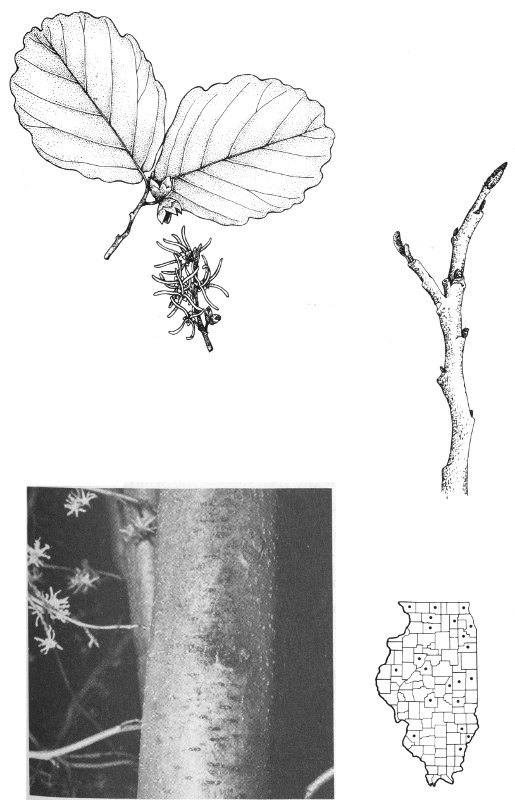
158
SWAMP HOLLY Ilex decidua Walt.
Other Name: Possum Haw; Deciduous Holly.
Growth Form: Small tree up to 20 feet tall; trunk diameter up to 3 inches; crown spreading.
Bark: Light brown, more or less warty.
Twigs: Slender, gray, smooth or slightly hairy, often with short spurs; leaf scars alternate, crescent-shaped, slightly elevated, with 1 bundle trace.
Buds: Rounded, gray, up to ⅛ inch in diameter.
Leaves: Alternate, simple, sometimes clustered at the tips of the short spur-like twigs; blades narrowly oblong to elliptic, short-pointed or rounded at the tip, tapering to the base, up to 3 inches long, less than ½ as broad, sparsely and finely toothed along the edges, green and smooth on the upper surface, paler and slightly hairy on the lower surface; leafstalks slender, hairy, up to ¼ inch long.
Flowers: Staminate and pistillate borne separately on different trees, appearing in April and May; both types of flowers in few-flowered clusters, greenish or whitish, with usually 4 small petals.
Fruit: Red or rarely orange berries, spherical, up to ¼ inch in diameter, remaining on the tree during the winter.
Wood: Hard, heavy, close-grained, whitish.
Use: The handsome berries make this species an attractive ornamental.
Habitat: Bottomland woods.
Range: Maryland across to eastern Kansas, south to Texas, east to Florida.
Distinguishing Features: Swamp Holly is distinguished by its alternate, remotely toothed leaves clustered at the ends of spur-like shoots, and by its red berries.
159
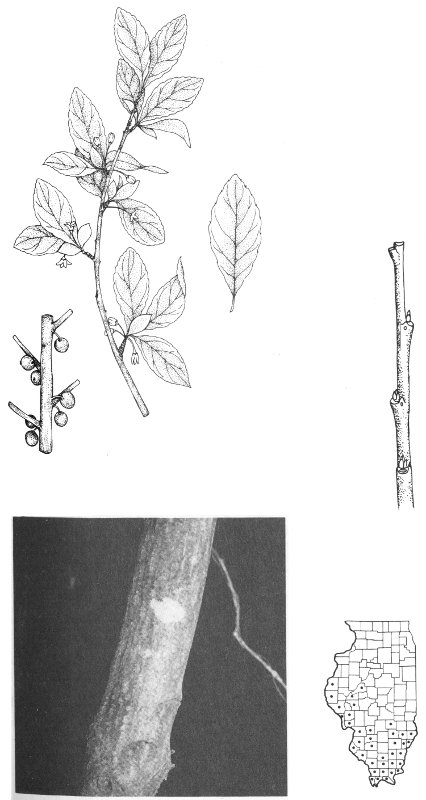
160
BUTTERNUT Juglans cinerea L.
Other Name: White Walnut.
Growth Form: Medium tree up to 90 feet tall; trunk diameter up to 3 feet; crown flat to broadly rounded; trunk straight, columnar, not buttressed.
Bark: Light gray, divided by deep furrows into broad scaly ridges.
Twigs: Stout, greenish or orange-brown to gray, smooth or hairy, usually shiny, with white lenticels; pith chocolate-colored, divided by partitions; leaf scars alternate, shield-shaped, elevated, with 3 bundle traces.
Buds: Blunt at the tip, whitish, hairy, soft, up to ½ inch long.
Leaves: Alternate, pinnately compound, with up to 17 leaflets; leaflets up to 3 inches long and 2 inches wide, broadly lance-shaped, pointed at the tip, rounded at the asymmetrical base, finely toothed along the edges, yellow-green on the upper surface, paler on the lower surface, softly hairy and sometimes sticky.
Flowers: Borne separately but on the same tree, appearing when the leaves are partly grown, the staminate several in thick, yellow-green catkins, the pistillate much fewer in spikes, neither of them with petals.
Fruit: In groups of 2-5, ovoid-oblong, up to 2½ inches long, sticky-hairy, the husk thick, the nut pointed at one end and with well-developed wings, pale brown, the seed sweet.
Wood: Soft, light in weight, coarse-grained, pale brown.
Uses: Furniture, interior finishing; the nut is sought after as a delicacy.
Habitat: Bottomland woods.
Range: New Brunswick across to Minnesota, south to Arkansas, east to Georgia.
Distinguishing Features: The Butternut is distinguished by its bark pattern, its chocolate-colored, partitioned pith, and its distinctive fruits.
161
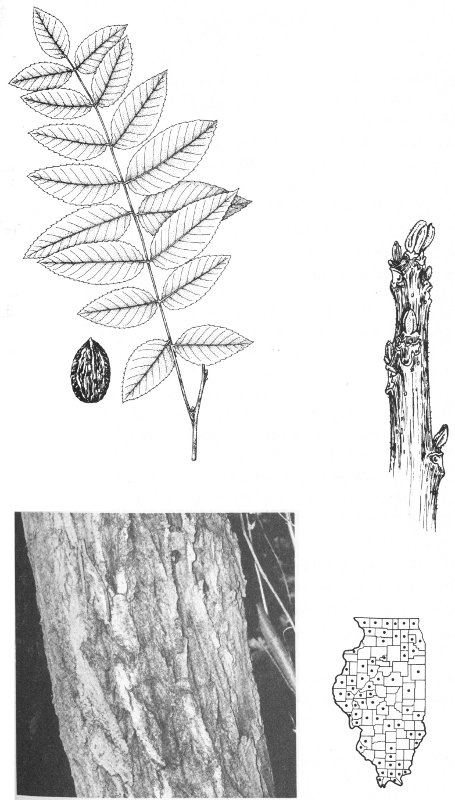
162
BLACK WALNUT Juglans nigra L.
Growth Form: Large tree up to 150 feet tall; trunk diameter up to 5 feet; crown broadly rounded; trunk straight, columnar, not buttressed at the base.
Bark: Black, thick, deeply furrowed.
Twigs: Stout, greenish or orange-brown, hairy, smooth and gray; pith brown, divided by partitions; leaf scars alternate, shield-shaped, elevated, with 3 bundle traces.
Buds: More or less rounded at the tip, pale brown, soft, hairy, up to ½ inch long.
Leaves: Alternate, pinnately compound, with 15-23 leaflets; leaflets up to 3½ inches long and 1½ inches wide, broadly lance-shaped, pointed at the tip, rounded at the asymmetrical base, toothed along the edges, yellow-green and smooth on the upper surface, paler and hairy on the lower surface, turning yellow in the autumn.
Flowers: Borne separately but on the same tree, appearing when the leaves are partly grown, the staminate several in thick, yellow-green, hairy catkins, the pistillate much fewer in small spikes, neither of them with petals.
Fruit: In groups of 1 or 2, spherical, up to 2 inches in diameter, green or yellow-green, slightly roughened, the husk thick, the nut very hard, oval, dark brown, deeply ridged, the seed sweet.
Wood: Hard, heavy, coarse-grained, dark brown.
Uses: The wood is used for furniture, interior finishing, cabinets; the nuts are edible.
Habitat: Rich woodlands.
Range: Massachusetts across to Minnesota, south to Texas, east to Florida.
Distinguishing Features: The Black Walnut is recognized by its characteristic buds, its chambered pith, and its fruits.
163
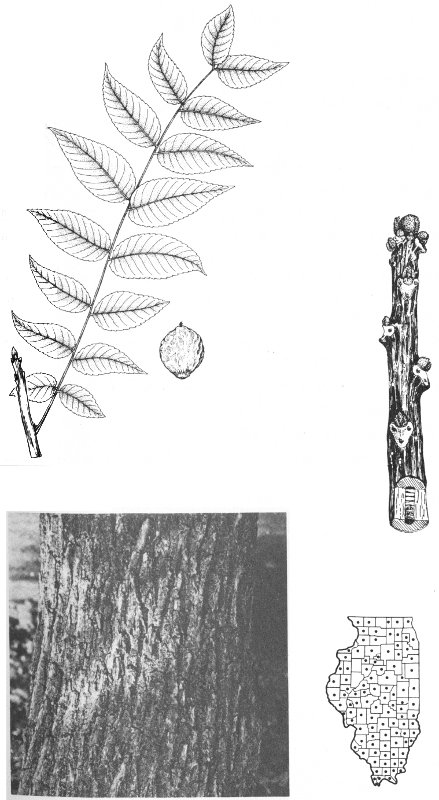
164
RED CEDAR Juniperus virginiana L.
Other Names: Juniper; Eastern Red Cedar.
Growth Form: Medium tree to 90 feet tall, usually much smaller; trunk diameter up to 3 feet; crown narrowly pyramidal or broad and rounded.
Bark: Reddish-brown, splitting into long shreds.
Twigs: Slender, brown.
Leaves: Of 2 types, either flat, triangular, opposite, and up to ¹/₁₆ inch long, or short and needle-like, up to ¾ inch long, blue-green to green to yellow-green.
Flowers: Staminate and pistillate on different trees, the staminate in small, narrow yellowish spikes, the pistillate in small, ovoid, purplish clusters.
Fruit: Berry-like, spherical, up to ¼ inch in diameter, dark blue with a whitish covering, with sweet flesh and 1-2 seeds.
Wood: Durable, light in weight, close-grained, red, fragrant.
Uses: Clothing chests, pencils, fence posts.
Habitat: Fields, dry woods, cliffs.
Range: New Brunswick across to North Dakota, south to Texas, east to Florida.
Distinguishing Features: The 2 kinds of leaves readily distinguish this species.
165
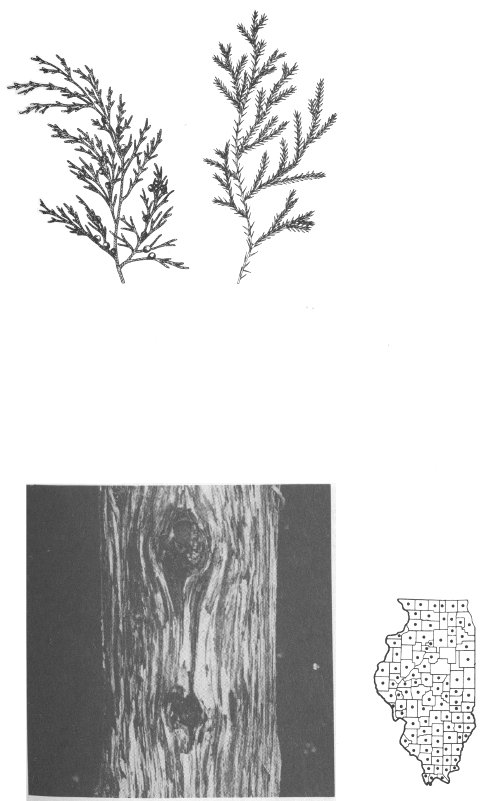
166
EUROPEAN LARCH Larix decidua Mill.
Growth Form: Medium tree to 50 feet tall; trunk diameter up to 15 inches; crown straight and more or less columnar.
Bark: Light brown, scaly.
Twigs: Moderately stout, yellowish, with numerous conspicuous leaf scars or, when older, with short lateral spurs.
Leaves: Needles borne many in clusters from short spurs, or borne singly on new branchlets, soft, yellow-green, up to about one inch long, somewhat triangular, falling from the tree in the autumn.
Flowers: Staminate and pistillate borne separately, but on the same tree, appearing as the new leaves begin to appear, the staminate in nearly round, yellow heads, the pistillate in oblong, bright red “cones.”
Fruit: Cones oblong, upright, up to 1¼ inches long, containing numerous small, winged seeds.
Wood: Hard, heavy, strong, orange-brown.
Use: This tree is sometimes planted as an ornamental.
Habitat: Around homes where it has persisted from cultivation.
Range: Native of Europe; infrequently escaped from cultivation in northeastern North America.
Distinguishing Features: The European Larch differs from the American Larch by its slightly longer cones, its yellow-green needles, and its yellower twigs.
167
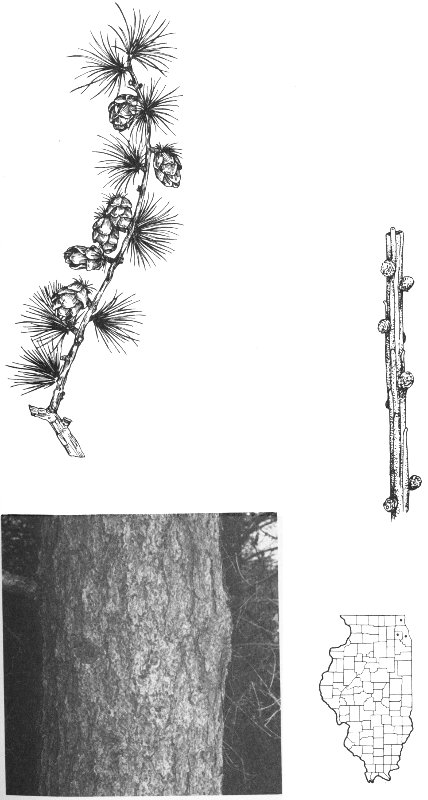
168
AMERICAN LARCH Larix laricina (DuRoi) Koch
Other Name: Tamarack.
Growth Form: Medium to large tree to 100 feet tall; trunk diameter up to 1½ feet; crown narrowly pyramidal.
Bark: Reddish-brown, broken into scales.
Twigs: Slender, light brown or orange, smooth; leaf scars alternate, elevated, borne on spurs, with 1 bundle trace.
Buds: Spherical, reddish-brown, up to ⅛ inch in diameter.
Leaves: Needles numerous in clusters, soft, up to about 1 inch long, light green, falling away during the autumn.
Flowers: Staminate spherical, yellow, usually not subtended by leaves; pistillate oblong, rose-colored, usually subtended by leaves.
Fruit: Cones oblong, up to ½ inch long, chestnut-brown.
Wood: Heavy, hard, durable, close-grained, orange-brown.
Uses: Fence posts, railroad ties, interior finishing; sometimes grown as an ornamental.
Habitat: Bogs and swamps.
Range: Labrador to Alaska, south to Minnesota, northern Illinois, and West Virginia.
Distinguishing Features: American Larch is distinguished by its short, pale green needles borne many in a cluster or singly on long shoots.
169
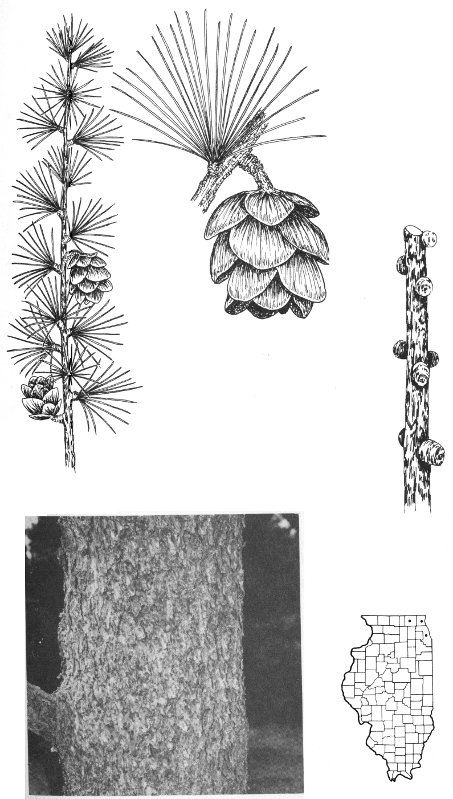
170
SWEET GUM Liquidambar styraciflua L.
Other Name: Red Gum.
Growth Form: Up to 100 feet tall; trunk diameter sometimes more than 3 feet; crown usually pyramidal.
Bark: Usually dark gray and broken into scaly ridges.
Twigs: Stout, often bordered by corky wings; leaf scars alternate, half-elliptical, slightly elevated, with 3 bundle traces.
Buds: Large, shiny, pointed, sometimes sticky to the touch.
Leaves: Alternate, simple; blades shaped like 5- to 7-pointed stars, each point toothed along the edge, as much as six inches long and nearly as broad. In the autumn, the leaves turn a variety of colors, from red to yellow to purple.
Flowers: Staminate and pistillate on same tree crowded together in rounded clusters, opening at about the same time as the leaves unfold.
Fruit: Dry “ball” about one inch in diameter, covered by numerous short, often sharp projections, with many seeds, most of which are incapable of germinating.
Wood: Hard, strong, durable.
Uses: Lumber, furniture, flooring. The attractive leaves make this tree a handsome ornamental.
Habitat: Bottomland woods.
Range: Southwestern Connecticut across southern Illinois to eastern Oklahoma and eastern Texas, east to central Florida.