Illustrated Glossary
Reading edition
In order to distinguish one kind of tree from another, it is necessary to learn the major characteristics which the forest trees of Illinois may possess. Illustrated below are several of the most commonly encountered characteristics of leaves and twigs. A thorough understanding of these structures will insure a quicker and more accurate identification.
On the pages following the illustrated glossary are keys to the trees of Illinois. A key is a botanical device which enables the user, through proper selection of a series of choices, to identify a specimen at hand. Separate keys are provided for trees during the spring, summer, and autumn seasons and during the winter season. Begin at the first pair of number 1’s, choose the statement that best fits the unknown specimen, and then go to the next pair of statements beneath. Continue this same procedure until the name of the plant is reached.
7
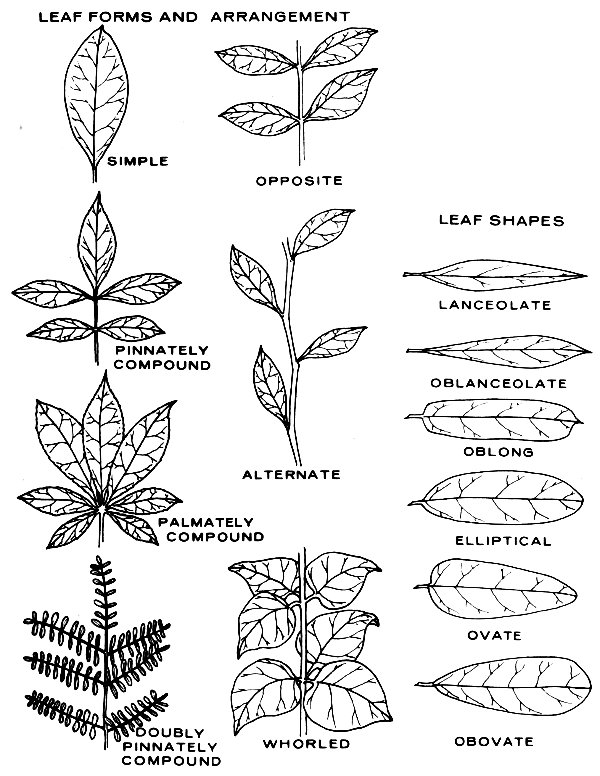
LEAF FORMS AND ARRANGEMENT
SIMPLE
PINNATELY COMPOUND
PALMATELY COMPOUND
DOUBLY PINNATELY COMPOUND
OPPOSITE
ALTERNATE
WHORLED
LEAF SHAPES
LANCEOLATE
OBLANCEOLATE
OBLONG
ELLIPTICAL
OVATE
OBOVATE
8
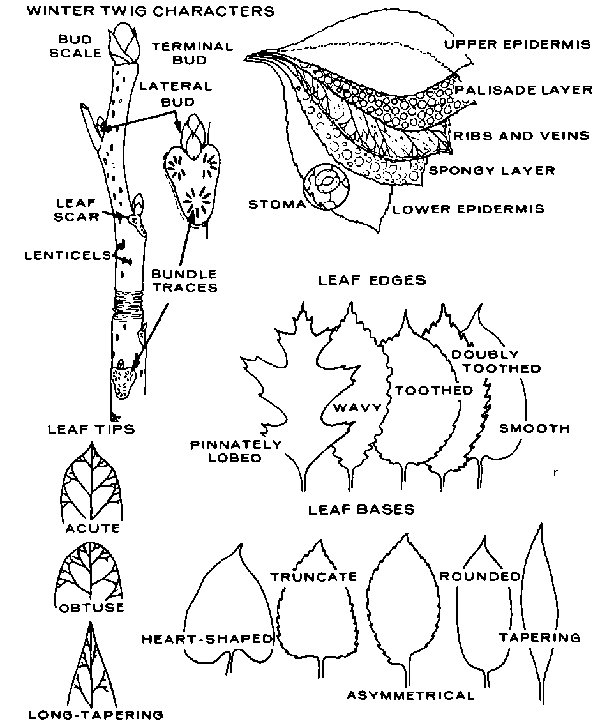
WINTER TWIG CHARACTERS
WINTER TWIG CHARACTERS
BUD SCALE
TERMINAL BUD
LATERAL BUD
LEAF SCAR
LENTICELS
BUNDLE TRACES
{LEAF LAYERS}
UPPER EPIDERMIS
PALISADE LAYER
RIBS AND VEINS
SPONGY LAYER
STOMA
LOWER EPIDERMIS
LEAF TIPS
ACUTE
OBTUSE
LONG-TAPERING
LEAF EDGES
PINNATELY LOBED
WAVY
TOOTHED
DOUBLY TOOTHED
SMOOTH
LEAF BASES
HEART-SHAPED
TRUNCATE
ASYMMETRICAL
ROUNDED
TAPERING
9