Trees of Illinois (continued 2)
Reading edition
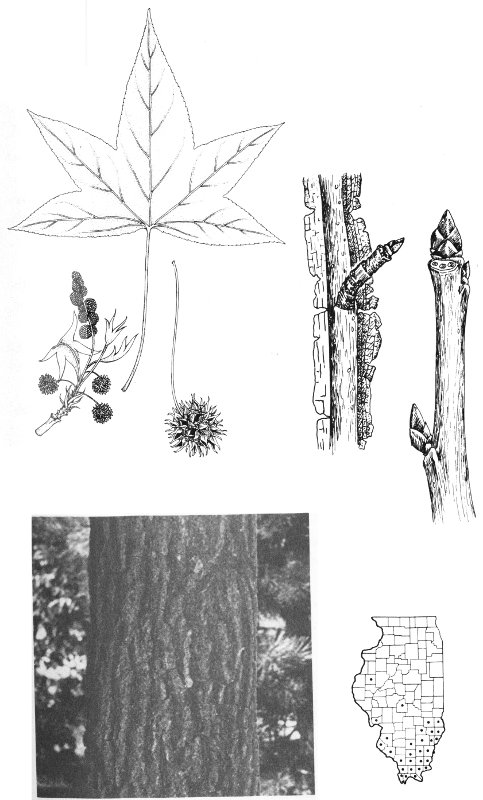
Distinguishing Features: The star-shaped leaves readily distinguish this tree.
171
172
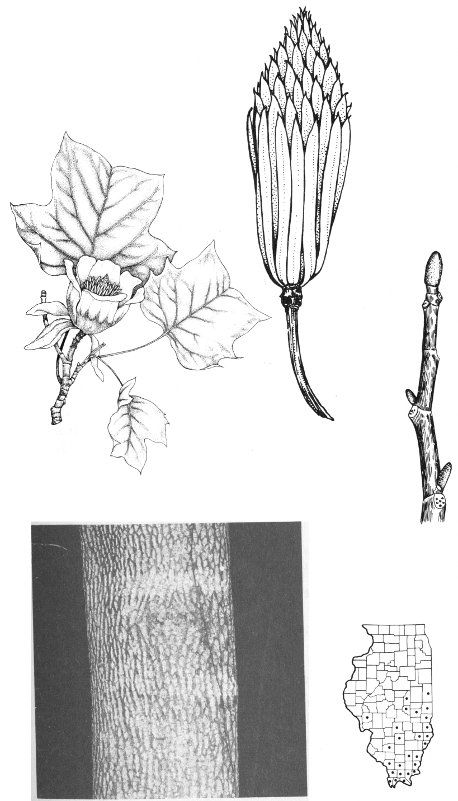
TULIP TREE Liriodendron tulipifera L.
Other Names: Yellow Poplar; Tulip Poplar.
Growth Form: Stately tree up to 100 feet tall; trunk diameter up to 4 feet; crown oblong or pyramidal from a long, columnar trunk.
Bark: Grayish, becoming deeply furrowed at maturity; furrows often whitish within.
Twigs: Smooth, reddish-brown; leaf scars alternate, nearly spherical, with several bundle traces, with stipule scars encircling the twig.
Buds: Flattened, up to 1 inch long, resembling duckbills.
Leaves: Alternate, simple; blades divided into four broad lobes, the upper two lobes usually with a conspicuous notch between them, bright green, averaging 4 to 6 inches long and broad.
Flowers: About two inches long, cup-shaped, with six yellow-green petals with an orange base surrounding a cone-shaped cluster of pistils; opening in May.
Fruit: Dry “cones” about 2½ inches long, composed of several winged seeds.
Wood: Soft, durable.
Uses: Lumber, veneer cores to which other wood can be glued, canoes, frames.
Habitat: Rich soil.
Range: Connecticut and Vermont across to southern Michigan, southwestward across Illinois to Louisiana, east to Central Florida.
Distinguishing Features: The shape of the leaf is unlike that of any other tree in Illinois.
173
174
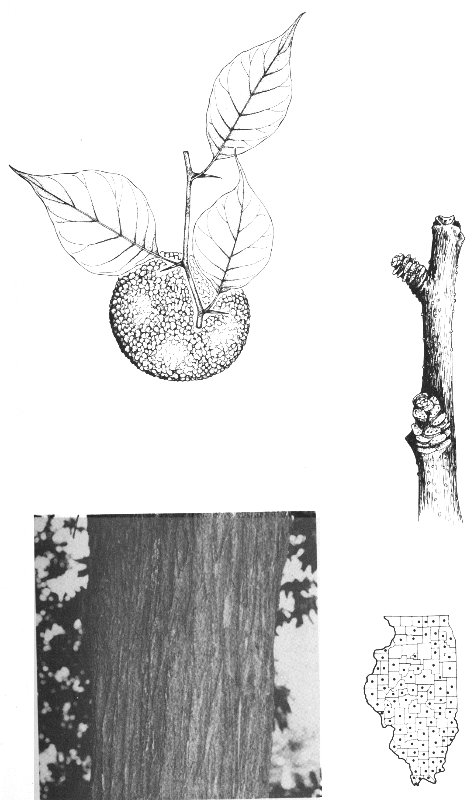
OSAGE ORANGE Maclura pomifera Schneid.
Other Names: Hedge Apple; Bow Wood.
Growth Form: Medium tree to 40 feet tall; trunk diameter up to 1 foot; crown rounded or dome-shaped, with several rather stout, spreading branches.
Bark: Light gray-brown tinged with orange, separating into shaggy strips.
Twigs: Dull orange-brown, smooth, zigzag, with short, sharp, axillary spines; leaf scars alternate, half-round, elevated, with usually 3 groups of bundle traces.
Buds: Round, reddish-brown, smooth, very tiny.
Leaves: Alternate, simple; blades ovate or ovate-lanceolate, long-pointed at the tip, narrowed or a little bit heart-shaped at the base, up to 5 inches long and 3½ inches broad, smooth along the edges, green and smooth on both surfaces; leafstalks smooth, up to 2 inches long.
Flowers: Staminate and pistillate borne on separate trees, yellow-green, very tiny, the staminate crowded in short clusters on stalks up to 4 inches long, the pistillate crowded into spherical heads on short, stout stalks.
Fruit: Large, spherical, greenish-yellow compound fruit up to 6 inches in diameter, containing many seeds, succulent flesh, and milky sap.
Wood: Heavy, hard, flexible, durable, coarse-grained, orange when first cut, becoming brown.
Uses: Bows, fence posts, railroad ties, tool handles; often planted as a windbreak.
Habitat: Hedge-rows, woods.
Range: Native only in Arkansas, Oklahoma, and Texas; commonly planted elsewhere and often escaped from cultivation.
Distinguishing Features: The Osage Orange is distinguished by its spiny branches, its long-pointed, toothless leaves, its milky sap, and its large, spherical, yellow-green fruits.
175
176
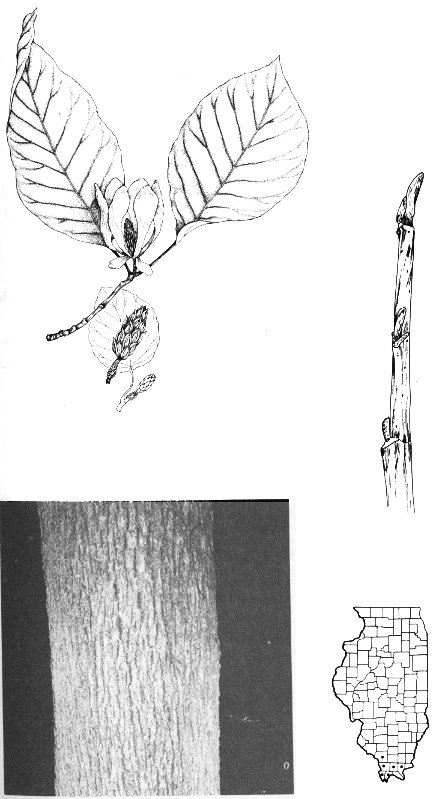
CUCUMBER MAGNOLIA Magnolia acuminata L.
Other Name: Cucumber Tree.
Growth Form: Medium tree up to 75 feet tall; trunk diameter up to 3 feet; crown broadly rounded or pyramidal.
Bark: Gray or brown, with shallow furrows when older.
Twigs: Rather stout, reddish-brown, smooth; leaf scars alternate, U-shaped, with several scattered bundle traces.
Buds: Silvery-white, hairy, up to nearly 1 inch long, with a single bud scale.
Leaves: Alternate, simple; blades usually elliptic, short-pointed at the apex, rounded or tapering to the base, up to 10 inches long and more than half as broad, entire along the edges, yellow-green and smooth on the upper surface, paler and sometimes hairy on the lower surface.
Flowers: Greenish-yellow, up to 3 inches long, with usually 6 elongated, pointed petals, appearing in April.
Fruit: Oblong fruits up to 3 inches long, deep red, with several seeds. Young fruits look like small cucumbers, thus accounting for the common name. The fruits ripen from late August to October.
Wood: Light weight, soft, pale brown.
Uses: Cabinets, flooring.
Habitat: Rich woodlands.
Range: New York to southern Illinois and Oklahoma, south to Louisiana and Georgia, also southern Ontario.
Distinguishing Features: The large toothless leaves are distinctive from leaves of all other Illinois trees except the Tupelo Gum, a tree of swamps which usually had 1-3 coarse teeth along the edges of each leaf. The silvery buds are also distinctive, as are the flowers and fruits.
177
178
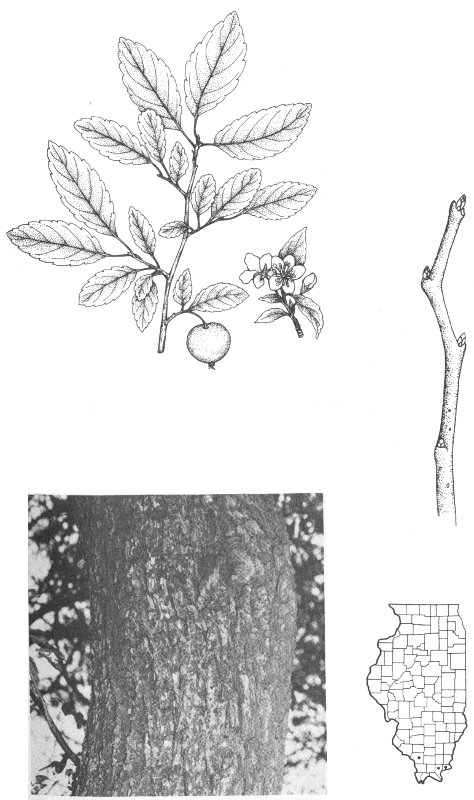
NARROW-LEAVED CRAB APPLE Malus angustifolia (Ait.) Michx.
Growth Form: Small tree to 20 feet tall; trunk diameter up to 9 inches; crown spreading.
Bark: Reddish-brown, deeply furrowed, scaly.
Twigs: Slender, reddish-brown or pale brown, smooth, sometimes spur-like; leaf scars alternate, narrow, curved, with 3 bundle traces.
Buds: Rounded, brown, up to ¹/₁₆ inch in diameter, finely hairy.
Leaves: Alternate, simple; blades elliptic to oblong, rounded or pointed at the tip, narrowed to the base, to 2 inches long, less than half as broad, toothed along the edges, seldom shallowly lobed, green and smooth on the upper surface, a little paler and smooth or sparsely hairy on the lower surface; leafstalks slender, up to 1 inch long, smooth or hairy.
Flowers: Showy, up to 1 inch across, on long stalks, usually 3 or more in a cluster, with 5 narrow, rose petals, appearing during May and June.
Fruit: Apples up to 1 inch across, yellow-green, edible.
Wood: Heavy, close-grained, brown.
Use: The fruit is used in making jelly.
Habitat: Rather moist woods.
Range: Maryland across to southern Missouri, south to Louisiana, east to Florida.
Distinguishing Features: This crab apple is distinguished by its narrow leaves which are usually unlobed.
179
180
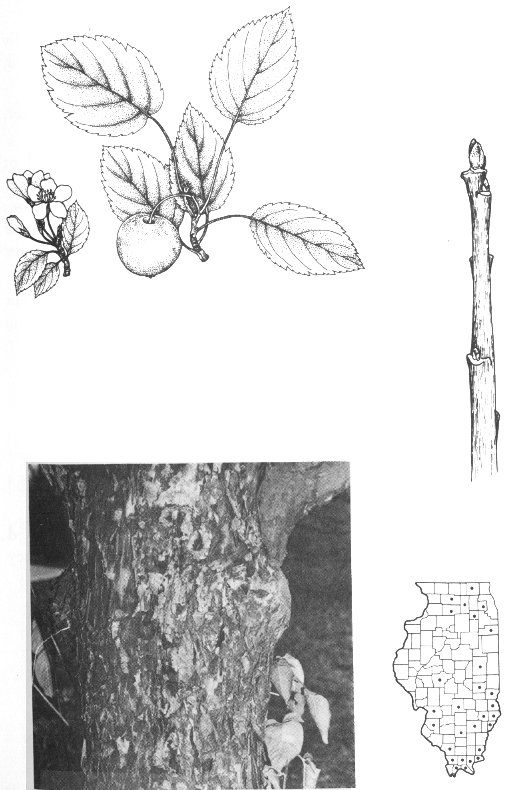
PRAIRIE CRAB APPLE Malus coronaria (L.) Mill.
Growth Form: Small tree to 25 feet tall; trunk diameter up to 1 foot; crown widely spreading.
Bark: Gray-brown to red-brown, with rather deep furrows between the scales.
Twigs: Moderately stout, reddish-brown, often spurlike, sometimes spiny, usually smooth at maturity; leaf scars alternate, narrow, curved, with 3 bundle traces.
Buds: Rounded, reddish, about ¼ inch in diameter, smooth or nearly so.
Leaves: Alternate, simple; blades oval, rounded to short-pointed at the tip, rounded or tapering to the base, up to 3 inches long, about half as broad, toothed along the edges and sometimes slightly lobed, yellow-green and smooth on the upper surface, paler on the lower surface; leafstalks stout, up to 2 inches long, smooth or hairy.
Flowers: Showy, up to 1½ inches across, on long stalks, usually 3 or more in a cluster, with 5 rounded, white or pinkish petals, appearing during May and June.
Fruit: Apples up to 1 inch across, yellow-green, edible.
Wood: Heavy, close-grained, reddish-brown.
Uses: Wood is used for tool handles; crab apples used in making jelly.
Habitat: Woods; edge of fields; edge of prairies.
Range: New York and southern Ontario across to Wisconsin, south to Kansas, Tennessee, and North Carolina.
Distinguishing Features: The Prairie Crab Apple differs from the Narrow-leaved Crab Apple by its broader leaves and from the Iowa Crab Apple by its usually less-lobed leaves and smooth flowers.
181
182
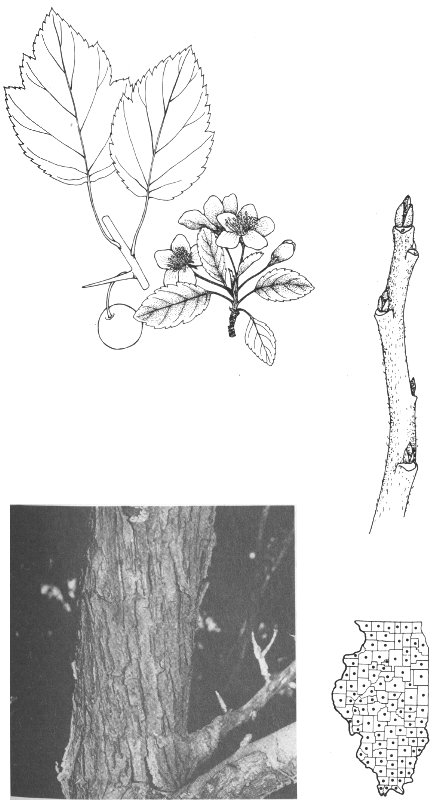
IOWA CRAB APPLE Malus ioensis (Wood) Britt.
Growth Form: Small tree to 25 feet tall; trunk diameter up to 1 foot; crown spreading.
Bark: Reddish-brown, scaly.
Twigs: Moderately stout, reddish-brown, sometimes spiny, usually somewhat hairy at maturity; leaf scars alternate, narrow, curved, with 3 bundle traces.
Buds: Rounded, reddish-brown, less than ⅛ inch in diameter, finely hairy.
Leaves: Alternate, simple; blades elliptic to oval, rounded or pointed at the tip, rounded or tapering to the base, up to 4½ inches long and less than half as broad, toothed along the edges and often shallowly lobed, dark green and smooth on the upper surface, yellow-green and usually somewhat hairy on the lower surface; leafstalks stout, up to 1 inch long, hairy.
Flowers: Showy, up to 2 inches across, on long stalks, usually 3 or more in a cluster, with 5 rounded, white or rose petals, appearing during May and June.
Fruit: Apples up to 1¾ inches across, yellow-green, edible.
Wood: Heavy, close-grained, brown.
Use: The fruit is used in making jelly.
Habitat: Edges of prairies and fields.
Range: Wisconsin and Minnesota, south to Nebraska, Texas, and Louisiana.
Distinguishing Features: The Iowa Crab Apple is distinguished from the other crab apples in the state by the greater frequency of lobed leaves and by its hairy flowers.
183
184
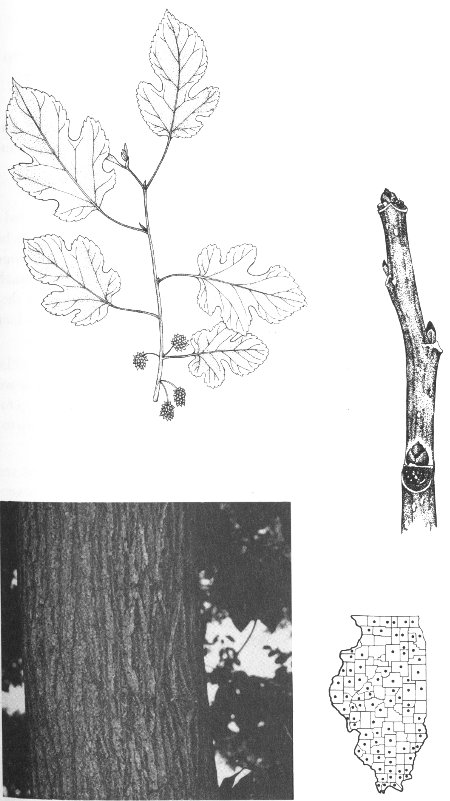
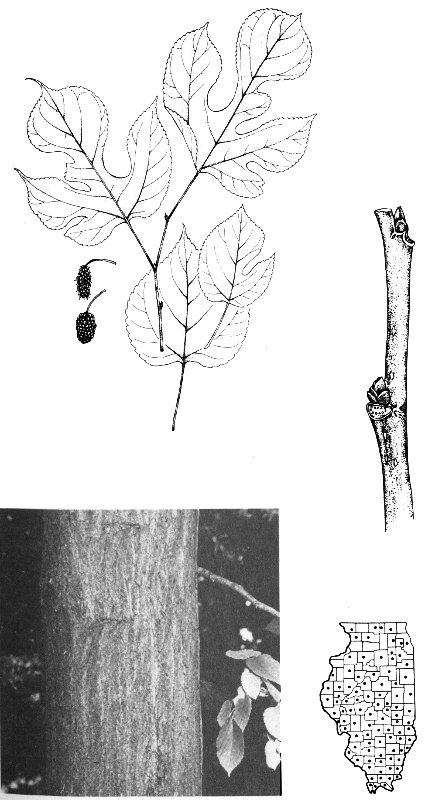
WHITE MULBERRY Morus alba L.
Growth Form: Medium tree up to 50 feet tall; trunk diameter up to 2 feet; crown broadly rounded, with many short branchlets.
Bark: Light brown, sometimes tinted with orange, divided into long, scaly plates.
Twigs: Slender, yellowish, smooth or sometimes hairy, more or less zigzag; leaf scars alternate, half-round, elevated, with numerous bundle traces.
Buds: Pointed, reddish-brown, smooth, about ⅙ inch long.
Leaves: Alternate, simple; blades ovate, short-pointed at the tip, rounded or cut straight across at the base, up to 5 inches long and nearly as broad, coarsely round-toothed, sometimes 2-lobed, sometimes 3-lobed, sometimes deeply several-lobed, sometimes unlobed, green and smooth to the touch on the upper surface, paler and smooth on the lower surface, except for a few hairs sometimes on the veins; leafstalks up to 2 inches long, smooth.
Flowers: Staminate and pistillate flowers borne separately, either on the same tree or on different trees, appearing as the leaves unfold, the staminate crowded into narrow green clusters up to 2 inches long, the pistillate crowded into short, thick spikes up to 1 inch long.
Fruit: A cluster of tiny drupes up to 1¼ inches long, white or pinkish, more rarely red or purple, sweet, juicy.
Wood: Light in weight, soft, coarse-grained, orange-brown.
Uses: Fence posts; the fruit is edible.
Habitat: Woods, along roads, in disturbed areas.
Range: Native of Asia; naturalized from Maine to Minnesota, south to Texas, east to Georgia.
Distinguishing Features: The White Mulberry lacks hairs on the lower surface of the leaves (except sometimes along the veins), thus differing from the Red Mulberry.
185
186
RED MULBERRY Morus rubra L.
Growth Form: Medium tree up to 50 feet tall; trunk diameter up to 2 feet; crown broadly rounded, with many short branchlets.
Bark: Dark brown, divided into long, scaly plates.
Twigs: Slender, smooth or sometimes hairy, reddish-brown to dark brown, more or less zigzag; leaf scars alternate, half-round, elevated, with numerous bundle traces.
Buds: Pointed, brown, smooth, up to ¼ inch long.
Leaves: Alternate, simple; blades mostly ovate, abruptly pointed at the apex, more or less heart-shaped at the base, up to 6 inches long and sometimes nearly as broad, coarsely toothed, sometimes 2-lobed, sometimes 3-lobed, often unlobed, green and usually rough to the touch on the upper surface, paler and with short white hairs on the lower surface; leafstalks up to 1½ inches long, smooth at maturity. The leaves turn yellow in the autumn.
Flowers: Staminate and pistillate flowers borne separately, either on the same tree or on different trees, appearing as the leaves unfold, the staminate crowded into narrow, green clusters up to 2 inches long, the pistillate crowded into short, thick spikes up to 1 inch long.
Fruit: A cluster of tiny drupes up to 1½ inches long, at first red, becoming purple or nearly black, rarely remaining pale, sweet, juicy.
Wood: Light in weight, soft, durable, coarse-grained, orange-brown.
Uses: Fence posts and barrels; the fruit is edible.
Habitat: Woods, particularly along streams.
Range: Vermont across to Minnesota and South Dakota, south to Texas, east to Florida.
Distinguishing Features: Red Mulberry differs from White Mulberry in the presence of some hairs on the lower surface of the leaves.
187
188
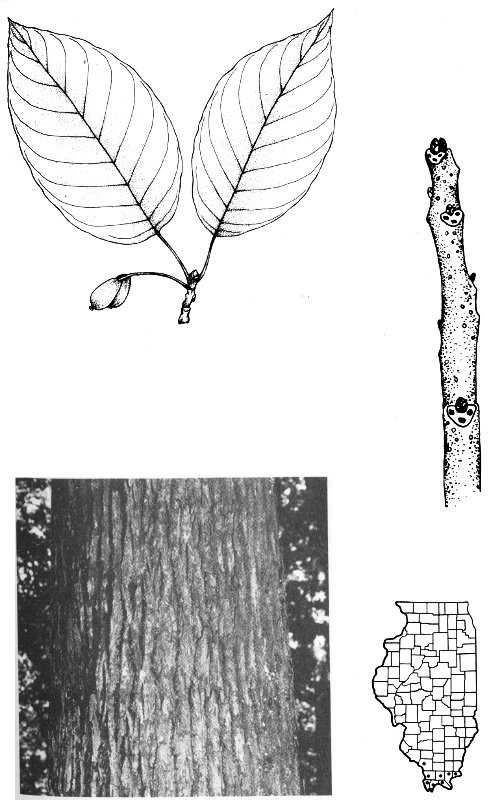
TUPELO GUM Nyssa aquatica L.
Other Names: Swamp Tupelo; Water Tupelo; Cotton Gum.
Growth Form: Large tree up to 85 feet tall; trunk diameter up to 4 feet, often swollen at the base; crown spreading, with numerous branchlets.
Bark: Light gray to dark gray to brown, broken into thin scales.
Twigs: Stout, more or less angular, gray or brown, smooth; leaf scars alternate, broadly U-shaped, with 3 bundle traces.
Buds: Rounded, smooth, about ⅛ inch long.
Leaves: Alternate, simple; blades oblong to somewhat ovate, pointed at the tip, tapering to rounded to even heart-shaped at the base, up to 8 inches long and about half as broad, the edges smooth or with a few coarse teeth, dark green, shiny, smooth or somewhat hairy on the upper surface, paler and soft-hairy on the lower surface; leafstalks stout, up to 3 inches long, hairy.
Flowers: Staminate and pistillate borne on separate trees, appearing as the leaves begin to unfold, greenish, small, the staminate several in spherical clusters, the pistillate solitary on long stalks arising from the leaf axils.
Fruit: Fleshy, oblong, dark purple with pale speckles, up to 1 inch long, bitter, 1-seeded, ripening in September.
Wood: Light in weight, soft, close-grained, pale brown.
Uses: Paper pulp, broom handles, floors.
Habitat: Swamps and low woods.
Range: Virginia to southern Missouri, south to Texas, east to Florida.
Distinguishing Features: The Tupelo Gum is characterized by its large, irregularly toothed leaves and its oblong, purple fruits.
189
190
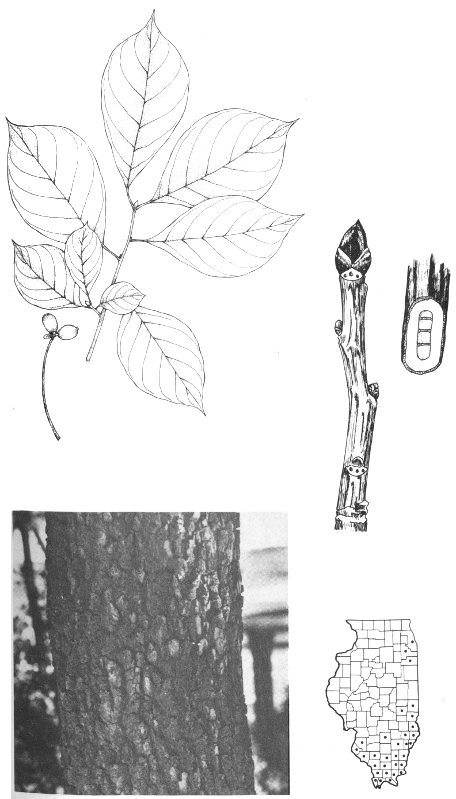
SOUR GUM Nyssa sylvatica Marsh.
Other Name: Black Gum.
Growth Form: Medium to large tree to 75 feet tall; trunk diameter up to 3 feet; crown rounded, often with many small, drooping branchlets.
Bark: Brown to black, often broken up into squarish blocks.
Twigs: Rather stout, reddish-brown, smooth, sometimes zigzag; leaf scars alternate, crescent-shaped, with 3 bundle traces. The pith is continuous but marked with distinct partitions.
Buds: Short-pointed, yellowish or reddish, smooth, about ⅛ inch long.
Leaves: Alternate, simple; blades abruptly pointed at the tip, tapering or rounded at the base, up to 6 inches long and usually about half as wide, smooth or with a few coarse teeth along the edges, dark green, shiny, and usually smooth on the upper surface, paler and usually somewhat hairy on the lower surface; leafstalks up to 1½ inches long, smooth or sparsely hairy. The leaves turn scarlet in the autumn.
Flowers: Staminate and pistillate borne on separate trees, appearing after the leaves begin to unfold, greenish, very small, the staminate several in spherical clusters, the pistillate 2-several on long stalks arising from the leaf axils.
Fruit: Fleshy, oval, dark blue, up to ⅔ inch long, bitter, 1-seeded, ripening in October.
Wood: Heavy, strong, soft, not durable, pale yellow.
Uses: Pulpwood, gun-stocks, flooring; sometimes used as an ornamental.
Habitat: Dry wooded slopes, low woods.
Range: Maine across to Michigan and Wisconsin, south to Missouri and Texas, east to Florida.
Distinguishing Features: Sour Gum is easily confused with Persimmon, but differs by its leaves which are abruptly short-pointed at the tip, and by its twigs which have continuous pith marked by distinct partitions.
191
192
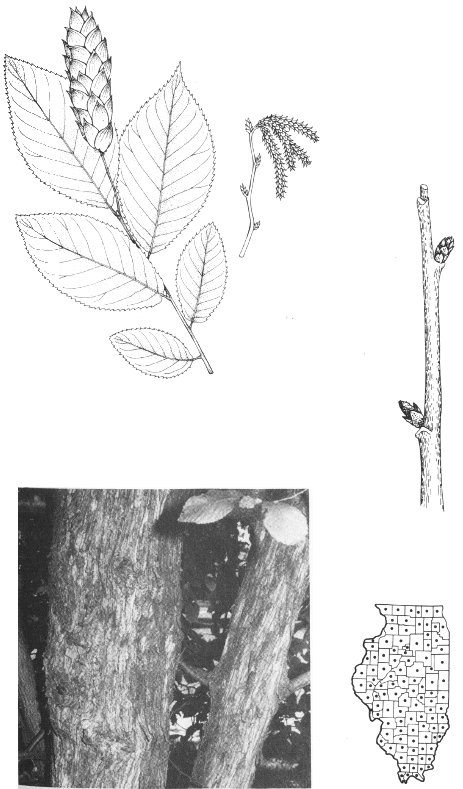
HOP HORNBEAM Ostrya virginiana (Mill.) K. Koch
Other Name: Ironwood.
Growth Form: Small tree up to 35 feet tall; trunk diameter up to 1 foot; crown usually rounded.
Bark: Brown and scaly at maturity.
Twigs: Slender, reddish-brown, sometimes hairy, tough to break; leaf scars alternate, crescent-shaped, slightly elevated, with 3 bundle traces.
Buds: Small, pointed at the tip.
Leaves: Alternate, simple; blades elliptic to ovate, pointed at the tip, rounded or tapering to the base, up to 5 inches long, finely doubly toothed, green and usually smooth on the upper surface, paler and usually slightly hairy on the lower surface; leafstalks up to ¼ inch long, hairy.
Flowers: Staminate and pistillate borne separately but on the same tree. The staminate catkins are on the tree through the winter before opening in late April or May.
Fruit: Nutlets enclosed by an inflated bladder, crowded together in a cluster resembling hops.
Wood: Hard, strong, durable.
Use: Tool handles.
Habitat: Upland woods; rocky slopes; along streams.
Range: Nova Scotia across to Manitoba and northeastern Wyoming, south to eastern Texas and northern Florida.
Distinguishing Features: The Blue Beech, with similar leaves, differs by its scaly bark. Elms, which also have somewhat similar leaves, usually have their leaves asymmetrical at the base.
193
194
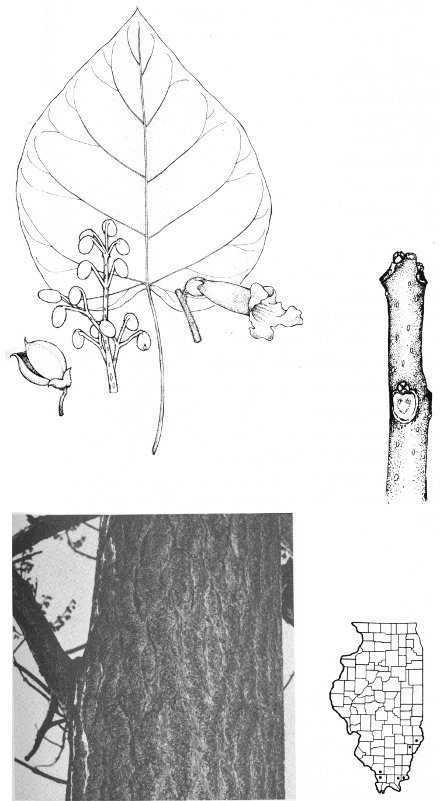
PRINCESS TREE Paulownia tomentosa (Thunb.) Steud.
Other Name: Paulownia.
Growth Form: Small to medium tree to 45 feet tall; trunk diameter up to 1½ feet; crown rounded.
Bark: Gray, more or less smooth.
Twigs: Stout, grayish, finely hairy; leaf scars opposite, nearly spherical but with a notch at the top, with many bundle traces in a ring.
Buds: Half-round, minutely hairy.
Leaves: Opposite, simple; blades mostly heart-shaped, tapering to a short point at the tip, up to about 10 inches long and nearly as broad, smooth along the edges, minutely hairy on both surfaces.
Flowers: Large, showy, fragrant, several in a large cluster, appearing in late April or early May, the clusters sometimes a foot long, each flower up to 2 inches long, the petals violet with yellow stripes.
Fruit: Ovoid capsules up to 1½ inches long, pointed at the tip, brown, containing numerous winged seeds.
Use: Popular as an ornamental because of its handsome flowers.
Habitat: Along roads, around home sites.
Range: Native of Asia; occasionally escaped in the eastern United States.
Distinguishing Features: The leaves of the Princess Tree resemble those of the Catalpa, but they are always opposite and never in whorls. The violet flowers and the short, ovid capsules further distinguish the Princess Tree.
195
196
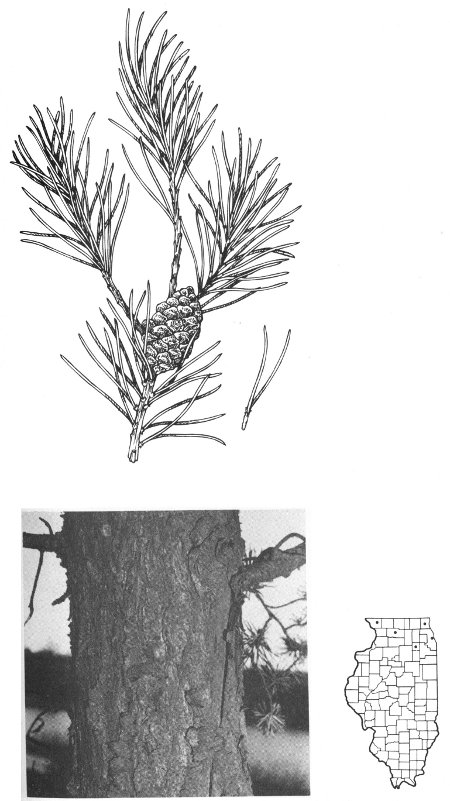
JACK PINE Pinus banksiana Lamb.
Other Names: Gray Pine; Scrub Pine.
Growth Form: Medium tree to 75 feet tall in some parts of the United States; trunk diameter up to 2½ feet; crown open but often irregular.
Bark: Reddish-brown, rough and scaly.
Twigs: Slender, dark brown, becoming roughened.
Leaves: Needles in clusters of 2, stiff, curved, up to 1½ inches long, dark green.
Flowers: Staminate crowded into several yellow spikes up to ½ inch long; pistillate crowded into few to several purple clusters.
Fruit: Cones oblong, curved, upright, up to 2 inches long, each scale comprising the cone bearing a small curved prickle; seeds triangular, up to ¹/₁₂ inch long, with a wing up to ⅓ inch long.
Wood: Light in weight, soft, reddish-brown.
Uses: Railroad ties, fence posts, fuel, pulpwood.
Habitat: Rocky woods.
Range: Quebec across to Yukon, south to Minnesota, northern Illinois, and New York, Nova Scotia.
Distinguishing Features: The Jack Pine is distinguished by its short, stiff, curved needles in clusters of 2 and by its short, curved cones.
197
198
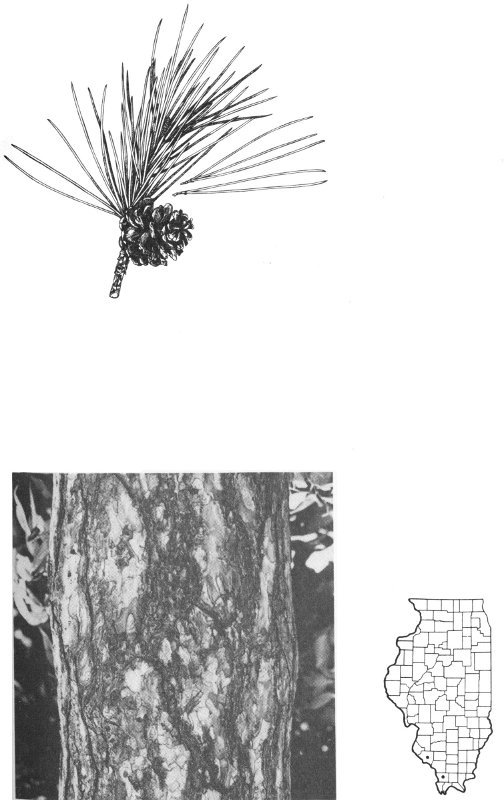
SHORTLEAF PINE Pinus echinata Mill.
Other Name: Yellow Pine.
Growth Form: Large tree to 80 feet tall; trunk diameter up to 2 feet; crown pyramidal or rounded.
Bark: Reddish-brown, broken into large plates.
Twigs: Slender, reddish-brown, becoming shreddy.
Leaves: Needles in clusters of both 2 and 3 on the same tree, flexible, up to 5 inches long, dark green.
Flowers: Staminate crowded into several pale purple spikes up to ¾ inch long; pistillate in groups of 1-3, rose-colored.
Fruit: Cones 1-3 in a group, ovoid, up to 2½ inches long, each scale comprising the cone often bearing a small sharp prickle on the back; seeds triangular; less than ¼ inch long, with an asymmetrical curved wing up to ½ inch long.
Wood: Hard, heavy, coarse-grained, reddish-brown.
Uses: Interior finishing, paper pulp, construction.
Habitat: Dry, rocky slopes; widely planted in a variety of sites.
Range: Southern New York across Pennsylvania and southern Illinois to Oklahoma, south to Texas, east to northern Florida.
Distinguishing Features: Shortleaf Pine is distinguished by its needles which may be in clusters of 2 and 3 on the same tree.
199
200
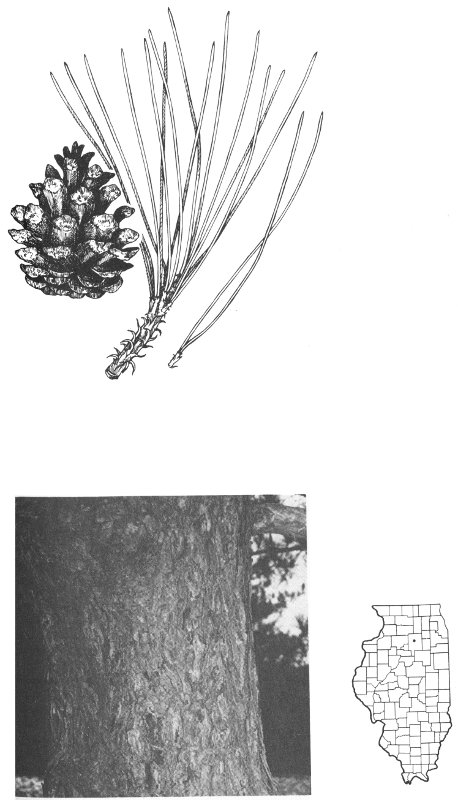
RED PINE Pinus resinosa Ait.
Growth Form: Medium to large tree to 150 feet tall; trunk diameter up to 3 feet; crown pyramidal.
Bark: Reddish-brown, divided irregularly into plates.
Twigs: Stout, reddish-brown, becoming roughened.
Leaves: Needles in clusters of 2, flexible, up to 6 inches long, dark green.
Flowers: Staminate crowded into several purple spikes up to ½ inch long; pistillate crowded into fewer scarlet clusters.
Fruit: Cones ovoid, mostly straight, up to 2 inches long, each scale comprising the cone without any prickles; seeds triangular, up to ⅛ inch long, with a wing up to ¾ inch long.
Wood: Rather hard, heavy, close-grained, reddish-brown.
Uses: Ships, bridges, general construction.
Habitat: Dry, rocky woods.
Range: Newfoundland across to Manitoba, south to Minnesota, Michigan, Pennsylvania, and New Jersey; also north-central Illinois and West Virginia.
Distinguishing Features: The Red Pine is distinguished by its dark green needles usually clustered near the tips of the twigs.
201
202
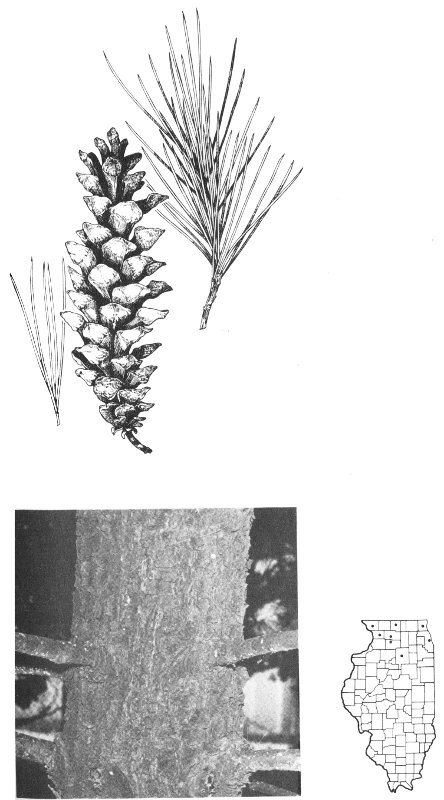
WHITE PINE Pinus strobus L.
Growth Form: Tall tree well over 100 feet tall in some regions of the United States; trunk diameter sometimes in excess of 3 feet; crown pyramidal.
Bark: Brown, divided into broad ridges by shallow fissures.
Twigs: Slender, orange-brown, smooth or slightly hairy.
Leaves: Needles in clusters of 5, very flexible, up to 5 inches long, blue-green.
Flowers: Staminate crowded into several yellow spikes up to ⅓ inch long; pistillate crowded into fewer groups, pink to purple.
Fruit: Cones oblong, curved, drooping, up to 8 inches long, each scale comprising the cone lacking any prickles; seeds narrowly oblong, up to ¼ inch long, with a wing up to ¾ inch long.
Wood: Light in weight, soft, light brown.
Uses: Interior finishing, construction.
Habitat: Moist woods, wooded slopes.
Range: Newfoundland across to Manitoba, south to Iowa, northern Illinois, and in the Appalachian Mountains to northern Georgia.
Distinguishing Features: The soft, blue-green needles in clusters of 5 readily distinguish the White Pine.
203
204
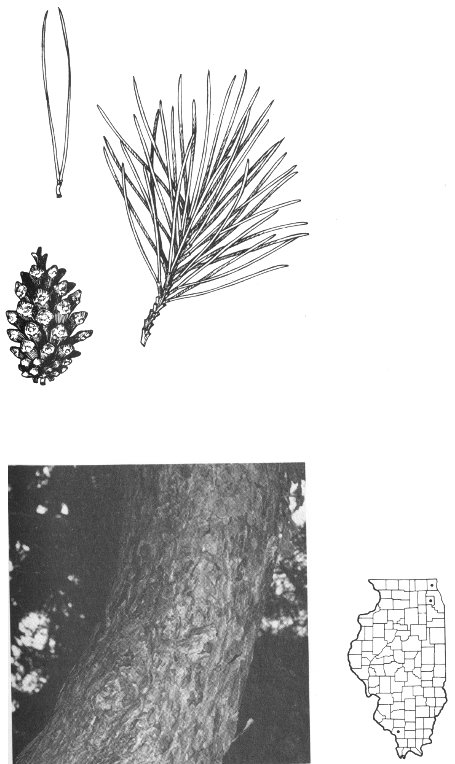
SCOTCH PINE Pinus sylvestris L.
Growth Form: Medium tree to 65 feet tall; trunk diameter up to 2 feet; crown irregular.
Bark: Large branches reddish-brown, broken into plates.
Twigs: Slender, brown, roughened.
Leaves: Needles in clusters of 2, stiff, to 3 inches long, gray-green.
Flowers: Staminate crowded into several yellow spikes up to ½ inch long; pistillate crowded into 1 to several clusters.
Fruit: Cones narrowly ovoid, to 2½ inches long, each scale comprising the cone without any prickles.
Uses: Often planted as an ornamental, Christmas trees.
Habitat: Planted in plantations in Illinois, rarely escaped.
Range: Native of Europe; widely planted in the eastern United States.
Distinguishing Features: The rather short, stiff, gray-green needles in clusters of 2 distinguish this pine.
205
206
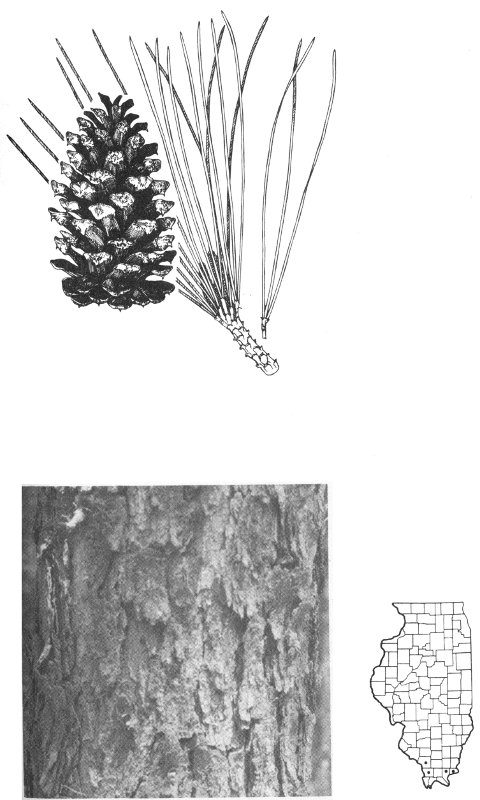
LOBLOLLY PINE Pinus taeda L.
Other Name: Old-field Pine.
Growth Form: Large tree sometimes over 125 feet tall; trunk diameter up to 2 feet; crown rounded.
Bark: Reddish-brown, divided into irregular plates.
Twigs: Slender, brown, becoming roughened.
Leaves: Needles in clusters of 3 or occasionally 2, stiff, up to 9 inches long, light green.
Flowers: Staminate crowded into several yellow spikes up to ½ inch long; pistillate crowded into 1 to several yellow clusters.
Fruit: Cones ovoid to oblong, mostly straight, up to 6 inches long, each scale comprising the cone with a short, sharp prickle; seeds rounded, up to ¼ inch long, with a wing up to 1 inch long.
Wood: Weak, brittle, coarse-grained, yellow-brown.
Uses: Pulpwood, construction.
Habitat: Planted in plantations in Illinois, rarely escaped.
Range: New Jersey to Tennessee, south across Arkansas to eastern Texas, east to central Florida; not native in Illinois.
Distinguishing Features: The Loblolly Pine is distinguished by its stiff, long needles usually in clusters of 3 and by its long cones. It is similar to Shortleaf Pine but has longer needles and cones.
207
208
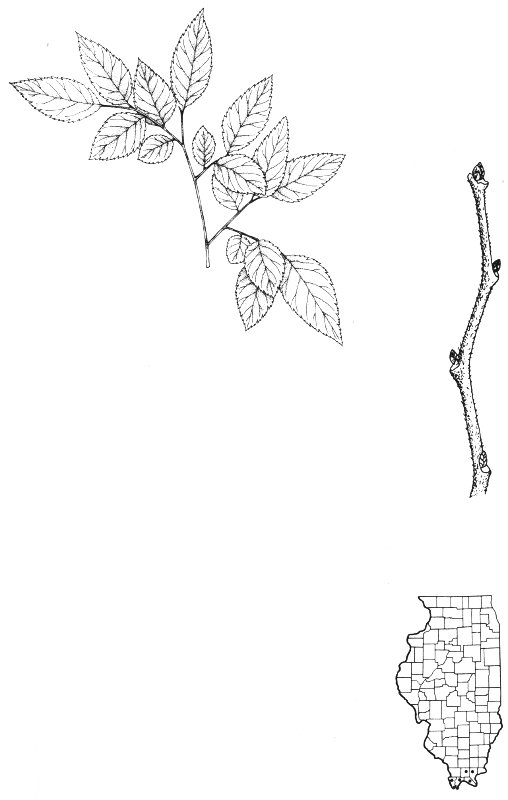
WATER ELM Planera aquatica Gmel.
Other Name: Planer-tree.
Growth Form: Small tree to 30 feet tall; trunk diameter up to 10 inches; crown broadly rounded, with slender branchlets.
Bark: Gray or pale brown, smooth at first but later splitting into large scales.
Twigs: Slender, reddish-brown to gray, usually smooth; leaf scars alternate, nearly circular, each with 3 bundle traces.
Buds: Slender, pointed, brownish, smooth or somewhat hairy, up to ¼ inch long.
Leaves: Alternate, simple; blades lance-ovate, rounded or somewhat pointed at the tip, tapering to the usually asymmetrical base, up to 3 inches long, less than half as broad, regularly coarsely toothed, smooth or a little roughened on the upper surface at maturity, smooth or hairy on the lower surface; leafstalks up to ½ inch long, finely hairy.
Flowers: Of three kinds, all on the same tree, appearing after the leaves have begun to expand, greenish-yellow, without petals, the staminate in several small clusters, the pistillate and perfect in drooping clusters of 1-3 flowers.
Fruit: Oblong, fleshy, up to ½ inch long, with warts irregularly scattered over the surface, pale brown.
Wood: Soft, light in weight, close-grained, pale brown.
Uses: Fence posts, fuel.
Habitat: Swampy areas.
Range: North Carolina across southern Illinois to southeastern Missouri, south to Texas, east to Florida.
Distinguishing Features: The Water Elm resembles other native elms in Illinois, but has only single-toothed leaves. The warty fruits are also distinctive.
209
210
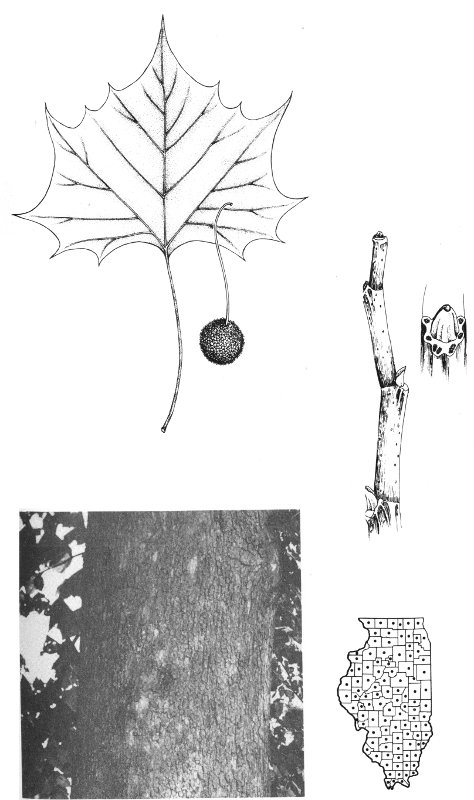
SYCAMORE Platanus occidentalis L.
Other Names: Buttonwood; Plane-tree.
Growth Form: Large tree sometimes more than 100 feet tall; trunk diameter up to 8 feet; crown broad, often irregular.
Bark: Reddish-brown when young, quickly breaking into thin, flat scales, falling away in sections to expose large patches of whitish or greenish inner bark.
Twigs: Smooth, light brown, somewhat zigzag; leaf scars alternate, encircling the buds, somewhat elevated, with 5-7 bundle traces.
Buds: Light brown, pointed, about one-fourth inch long, entirely covered by the base of the leafstalk. When the leaves fall off, exposing the buds, they leave a scar which surrounds the base of each bud.
Leaves: Alternate, simple; blades circular in outline but divided into 3 or 5 shallow, sharp-pointed lobes, heart-shaped or cut straight across at the base, up to 7 inches long (longer on vigorous shoots) and often as broad, bright green and smooth on the upper surface, paler and smooth on the lower surface except for the sparsely hairy veins; leafstalks to 5 inches long, slightly hairy; stipules, resembling the leaves but only about an inch long, often persist near the base of the leafstalks.
Flowers: Staminate and pistillate flowers borne separately but on the same tree, minute, crowded together in dense, round heads.
Fruit: Round light brown heads, about one inch in diameter, on long drooping stalks, containing many small seeds surrounded by hairs.
Wood: Hard and strong.
Uses: Furniture, interior finishing. Sometimes planted as an ornamental because of its rapid growth and unusual bark.
Habitat: Bottomlands, along streams, around lakes and ponds.
Range: Maine across southern Wisconsin to eastern Nebraska, south to eastern Texas, east to northern Florida.
Distinguishing Features: The large palmately lobed leaves and the brown and gray mottled bark readily distinguish this tree.
211
212
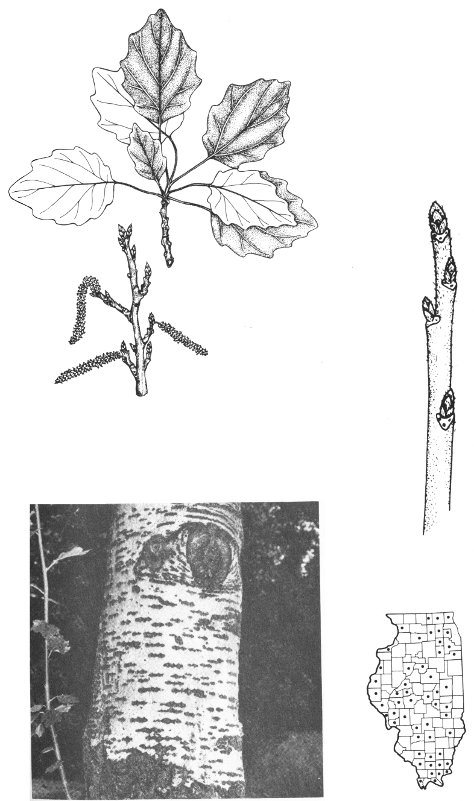
WHITE POPLAR Populus alba L.
Other Names: Silver-leaved Poplar; Abele.
Growth Form: Moderate tree to 50 feet tall; trunk diameter up to 2 feet; crown broadly rounded but often irregular.
Bark: Grayish to whitish, at first smooth, later becoming deeply fissured and very dark gray to nearly black.
Twigs: Greenish-gray, white-hairy at least when young; leaf scars alternate, crescent-shaped, each with 3 bundle traces.
Buds: Ovoid, pointed, hairy, up to ⅛ inch long.
Leaves: Alternate, simple; blades usually ovate, with a few broad teeth along the edges, bluntly pointed at the tip, cut straight across or a little heart-shaped at the base, up to 4 inches long, dark green on the upper surface, silvery-hairy or white-wooly on the lower surface; leafstalks up to 3 inches long, densely hairy, not flat.
Flowers: Staminate and pistillate borne on separate trees, crowded together in catkins, appearing when the leaves unfold.
Fruit: Often curved, flask-shaped capsules, greenish, hairy, up to ¼ inch long, containing many seeds with cottony hairs attached.
Wood: Light weight, soft.
Use: Grown as an ornamental because of its silvery leaves.
Habitat: Along roads, around old homesteads.
Range: Native of Europe and Asia; frequently planted and escaped from cultivation in the United States.
Distinguishing Features: The leaves, with their silvery or white-wooly under-surface and their few broad teeth, provided the best means of identifying this tree.
213
214
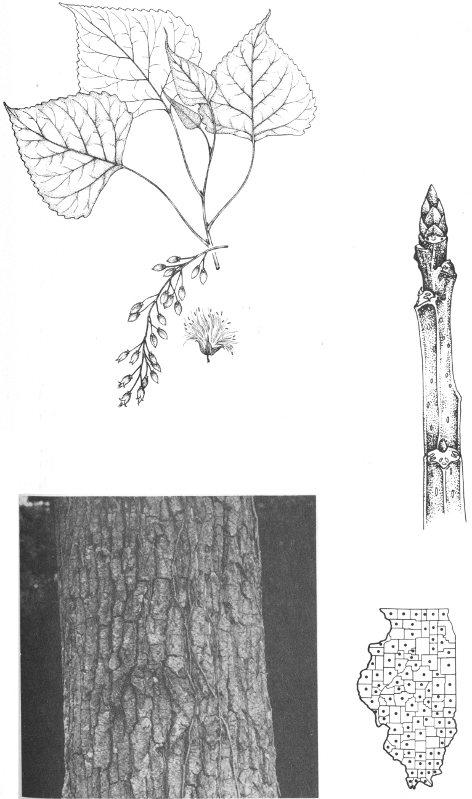
COTTONWOOD Populus deltoides Marsh.
Growth Form: Large rapidly growing tree up to 100 feet tall; trunk diameter up to eight feet; crown spreading or broadly rounded, with some drooping branches. The largest tree in Illinois, in Grundy County, is a Cottonwood measuring twenty-eight feet six inches in circumference.
Bark: Smooth and gray when young, becoming furrowed at maturity.
Twigs: Yellow-green, gray, or tan, smooth, moderately stout, with numerous pale “dots”; leaf scars alternate, triangular, with 3 large bundle traces.
Buds: Lance-shaped, long-pointed, up to ½ inch long, sticky, chestnut-colored.
Leaves: Alternate, simple; blades to 5 inches long and often nearly as broad, triangular, abruptly pointed at the tip, cut straight across or even slightly heart-shaped at the base, with coarse rounded teeth along the edges, green, smooth, and shiny on the upper surface, paler on the lower surface; leafstalks to 4 inches long, smooth, often yellow, flat.
Flowers: Staminate and pistillate borne on separate trees, the staminate crowded in rather thick, reddish catkins, the pistillate crowded in narrower, greenish-yellow catkins, both sexes appearing before the leaves begin to unfold.
Fruit: Elliptic, greenish-brown capsules up to ¼ inch long, grouped in elongated clusters, containing numerous seeds with cottony hairs attached.
Wood: Light weight, soft, readily warping.
Uses: Pulpwood, fuel.
Habitat: Bottomland woods, along streams.
Range: New Hampshire across to southeastern North Dakota, south central Texas, east to northern Florida.
Distinguishing Features: The Cottonwood is easily recognized by its triangular leaves with flattened leafstalks. The cottony seeds, when the fruits are mature, are also distinctive.
215
216
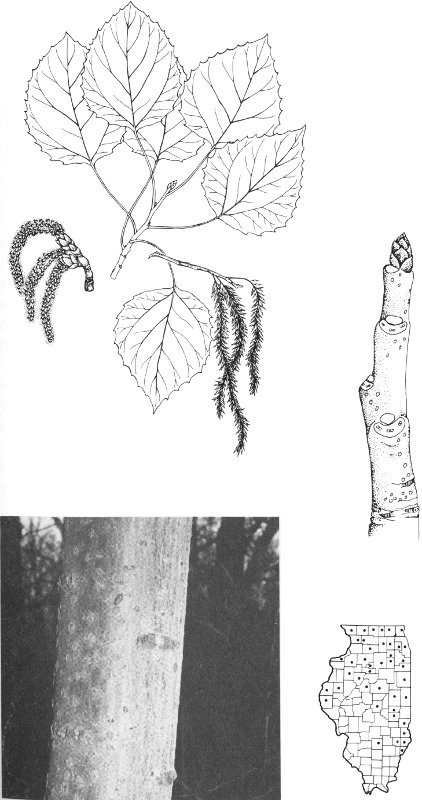
BIG-TOOTH ASPEN Populus grandidentata Michx.
Other Name: Large-tooth Aspen.
Growth Form: Medium tree to 60 feet tall; trunk diameter up to 1½ feet; crown rounded.
Bark: Grayish-green, smooth at first, becoming shallowly fissured and broken up into thin scales.
Twigs: Grayish-green, with numerous orange “dots,” hairy when young but becoming smooth; leaf scars alternate, raised, 3-lobed, each with 3 bundle traces.
Buds: Ovoid, pointed, chestnut-brown, somewhat hairy, up to one-eighth inch long.
Leaves: Alternate, simple; blades nearly circular in outline, short-pointed at the tip, rounded at the base, up to 5 inches long, nearly as broad, with several rather coarse teeth along the edges, green on the upper surface, paler on the lower surface, smooth when mature; leafstalks up to 3 inches long, flat, enabling the leaf to rustle even in gentle breezes.
Flowers: Staminate and pistillate borne on separate trees, crowded together in catkins up to 5 inches long, appearing as the leaves unfold.
Fruit: Long, narrow, flask-shaped, green, slightly hairy capsules, grouped in elongated clusters, containing many seeds with cottony hairs attached.
Wood: Light weight, soft, pale brown.
Use: Pulpwood.
Habitat: Wooded slopes, edges of woods.
Range: Quebec across to Manitoba, south to central Illinois, east to Maryland; Kentucky and north-central Tennessee east to western North Carolina.
Distinguishing Features: The coarsely toothed, tremoring leaves and the grayish-green trunks combine to make this a tree easy to recognize.
217
218
SWAMP COTTONWOOD Populus heterophylla L.
Other Name: Swamp Poplar.
Growth Form: Up to 90 feet tall; trunk diameter up to 2 feet; crown very irregular, with a few, large, upright branches.
Bark: Gray or brown, smooth when young, becoming scaly ridged at maturity.
Twigs: Rather stout, smooth or hairy, reddish; leaf scars alternate, 3-lobed, each with 3 bundle traces; pith 5-angled.
Buds: Ovoid, pointed, dark brown, sticky, up to one-half inch long.
Leaves: Alternate, simple; blades ovate, rounded or bluntly pointed at the tip, heart-shaped at the base, up to 8 inches long, up to 6 inches broad, with rounded teeth along the edges, green on the upper surface, paler on the lower surface, densely white-woolly when young, becoming essentially smooth at maturity; leafstalks to 4 inches long, smooth or sparsely hairy, not flattened.
Flowers: Staminate and pistillate borne on separate trees, the staminate crowded in thick catkins up to 4 inches long, the pistillate in slender catkins up to 6 inches long, both appearing before the leaves begin to unfold.
Fruit: Ovoid, reddish-brown capsules up to ½ inch long, grouped in elongated clusters, containing numerous seeds with cottony hairs attached.
Wood: Light weight, soft, pale brown.
Uses: Pulpwood, fuel, interior finishing.
Habitat: Swamps, low woods.
Range: Connecticut to southern Michigan, southwestward across southern Illinois to central Louisiana, east to northern Florida.
Distinguishing Features: The broad, heart-shaped, toothed leaves readily distinguish the Swamp Cottonwood from other trees in Illinois.
219
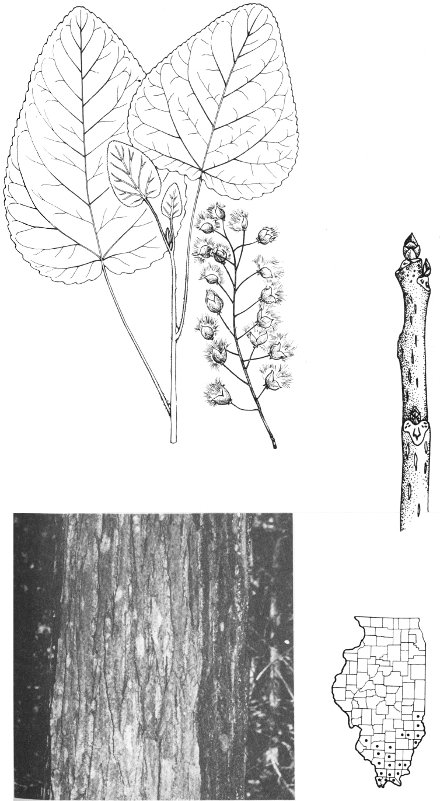
220
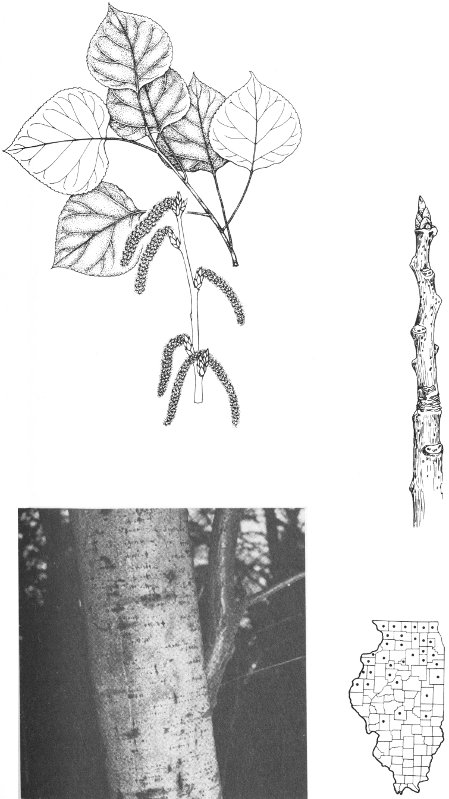
QUAKING ASPEN Populus tremuloides Michx.
Growth Form: Medium tree up to 50 feet tall; trunk diameter up to 2 feet; crown rounded or occasionally spreading.
Bark: Pale yellow-green or white, becoming grayish and divided into dark scaly ridges at maturity.
Twigs: Pale yellow-green or white, slender, smooth; leaf scars alternate, crescent-shaped, each with 3 bundle traces.
Buds: Lance-shaped, short-pointed, smooth, sticky, up to ⅓ inch long.
Leaves: Alternate, simple; blades ovate to nearly round, short-pointed at the apex, rounded at the base, up to 4 inches long, nearly as broad, with many small round teeth along the edges, green, smooth, and shiny on the upper surface, not shiny on the lower surface; leafstalks to 3 inches long, smooth, flat. The flat leafstalks allow for the leaves to tremor at the slightest wind.
Flowers: Staminate and pistillate borne on separate trees, the staminate crowded in catkins up to 4 inches long, the pistillate crowded in catkins up to 6 inches long.
Fruit: Narrow, flask-shaped, green capsules up to ¼ inch long, grouped in elongated clusters, containing numerous seeds with cottony hairs attached.
Wood: Light weight, soft, pale brown.
Use: Pulpwood.
Habitat: Edge of woods, thickets.
Range: Newfoundland to Alaska, south to California and New Mexico and Texas, east across Missouri and Tennessee to New Jersey.
Distinguishing Features: The whitish trunk and the ovate, trembling leaves serve to distinguish this species.
221
222
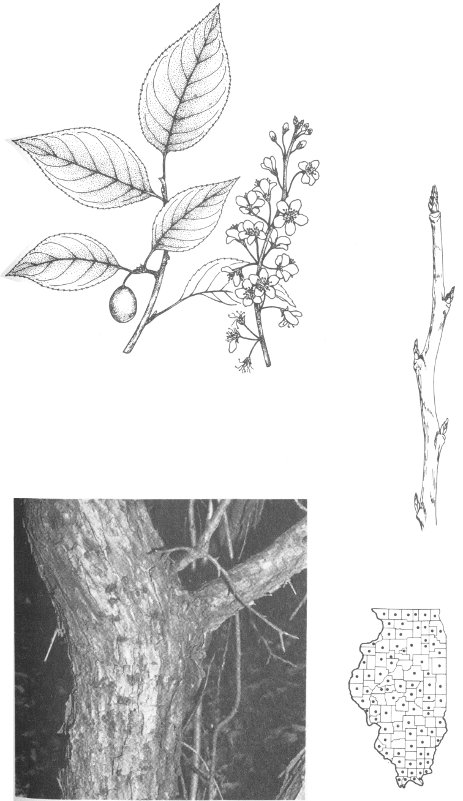
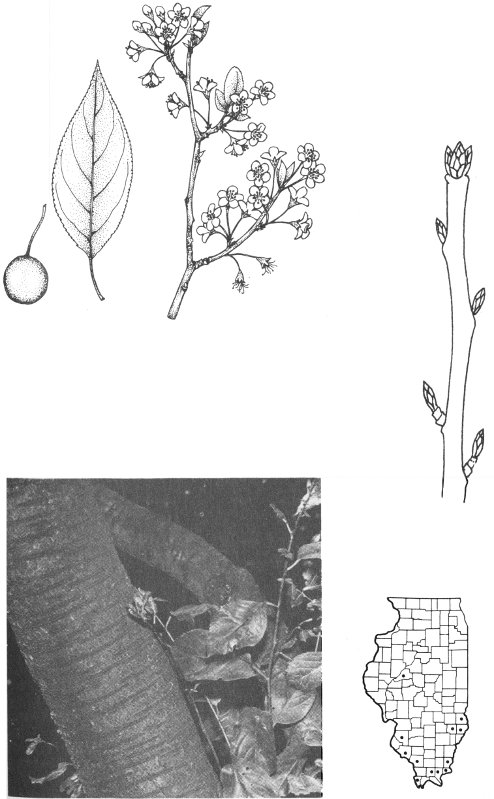
WILD PLUM Prunus americana Marsh.
Other Name: American Plum.
Growth Form: Small tree to 20 feet tall; trunk diameter up to 8 inches; crown broad, often irregular.
Bark: Dark gray to brown, rough and scaly.
Twigs: Slender, brown, speckled with many dots, smooth or hairy; leaf scars alternate, half-round, elevated, with 3 bundle traces.
Buds: Ovoid, pointed, reddish-brown, smooth or hairy, up to ¼ inch long.
Leaves: Alternate, simple; blades oval to ovate, pointed at the tip, rounded or tapering to the base, up to 4 inches long and less than half as broad, finely toothed along the edges, the teeth not glandular, green and smooth or hairy on the upper surface, paler and smooth or hairy on the lower surface; leafstalks slender, up to 1 inch long, sometimes with 1 or 2 glands near the upper end, smooth or hairy.
Flowers: Showy, several in a cluster, up to 1 inch across, with 5 white or pinkish petals, appearing before or as the leaves begin to unfold.
Fruit: Spherical or nearly so, up to 1 inch in diameter, red or covered with a whitish wax, juicy, sweet, 1-seeded.
Wood: Hard, close-grained, brown.
Uses: The fruits are used in making jelly and preserves.
Habitat: Woods, thickets.
Range: Southern Ontario to Manitoba, south to New Mexico, east to Florida.
Distinguishing Features: The Wild Plum differs from other plums in Illinois by the absence of glands on the teeth of the leaves. The Wild Plum may have either smooth or hairy leaves and twigs.
223
224
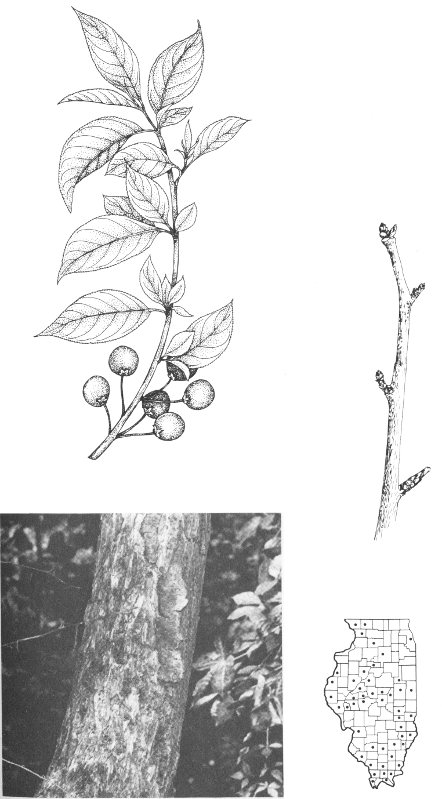
WILD GOOSE PLUM Prunus hortulana Bailey
Growth Form: Small tree to 20 feet tall; trunk diameter up to 8 inches; crown broad and rounded.
Bark: Gray or brown, becoming scaly at maturity.
Twigs: Slender, reddish-brown, smooth; leaf scars alternate, half-round, elevated, with 3 bundle traces.
Buds: Ovoid, rounded at the tip, reddish-brown, smooth, up to ¼ inch long.
Leaves: Alternate, simple; blades oblong to oval, pointed at the tip, rounded or tapering to the base, up to 6 inches long and about ⅓ as broad, finely toothed along the edge, the teeth gland-tipped, green and usually smooth on the upper surface, paler and sometimes hairy on the lower surface; leafstalks slender, up to 1 inch long, with 1-several glands, smooth or sparsely hairy.
Flowers: Showy, several in a cluster, up to 1 inch across, with 5 white petals, appearing after the leaves are partly grown.
Fruit: Spherical or nearly so, up to 1 inch in diameter, red or rarely yellowish, fleshy but hard, bitter, 1-seeded.
Wood: Hard, close-grained, brown.
Habitat: Edges of woods, thickets.
Range: Indiana to Iowa, south to Oklahoma, east to Alabama.
Distinguishing Features: Wild Goose Plum flowers when its leaves are partly grown, thereby distinguishing it from the Wild Plum which blooms before or as the leaves begin to unfold.
225
226
OTHER WILD PLUMS
Two other wild plums are occasionally encountered in Illinois.
Munson’s Wild Plum (Prunus munsoniana Wight & Hedrick). Munson’s Wild Plum is a small tree rarely more than 15 feet tall and often forming thickets. It has gray or brown scaly bark, smooth brownish twigs, and small, ovoid buds. The leaves are oval and up to 6 inches long and up to 2 inches wide. The edges of the leaves are finely toothed, with each tooth gland-tipped. The upper surface of the leaf is smooth, while the lower surface usually has some hairs. The showy white flowers appear while the leaves are developing. The fruits are spherical or slightly oblong red plums with sweet, juicy flesh. Munson’s Wild Plum is found only in the midwestern states.
Narrow-leaved Plum (Prunus angustifolia Marsh.). Also known as Chickasaw Plum, this is a small tree up to about 15 feet tall, usually forming thickets. The smooth, brownish twigs usually have several sharp spines. Most of the leaves are lance-shaped and up to 2 inches long, and conspicuously folded lengthwise. The flowers begin to bloom just as the leaves start to unfold. The red, nearly spherical plum has tart, juicy flesh. The Narrow-leaved Plum is found mostly in the southeastern United States.
227
228
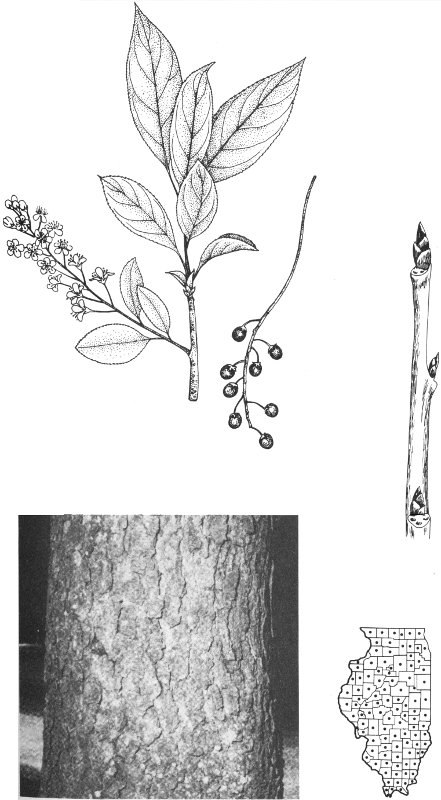
WILD BLACK CHERRY Prunus serotina Ehrh.
Growth Form: Medium tree up to 75 feet tall; trunk diameter up to 3 feet; crown rounded, with rigid branches.
Bark: Thin, smooth, reddish-brown at first, becoming deeply furrowed and black.
Twigs: Slender, smooth, dark brown; leaf scars half-round, each with 3 bundle traces.
Buds: Ovoid, sharp-pointed, dark brown, smooth, up to one-fourth inch long.
Leaves: Alternate, simple; blades oblong or oval, short-pointed at the tip, tapering to the base, up to 6 inches long and about ⅓ as broad, finely toothed along the edges, green, smooth, and shiny on the upper surface, paler and smooth on the lower surface except for rusty hairs along the veins; leafstalks slender, slightly less than 1 inch long, smooth, with 1 or more reddish glands near the tip.
Flowers: Crowded in showy, drooping, elongated clusters up to 6 inches long, appearing when the leaves are partly grown, each flower about ¼ inch across, with 5 white petals.
Fruit: Fleshy, juicy, spherical, dark purple, up to ½ inch in diameter.
Wood: Light weight, hard, strong, close-grained, light reddish-brown.
Uses: Cabinets, interior finishing.
Habitat: Roadsides, fencerows, edge of woods.
Range: Nova Scotia across to Ontario, south to Texas, east to Florida.
Distinguishing Features: The Wild Black Cherry is similar to the Choke Cherry but usually is a larger tree with thicker leaves and with the teeth tending to curve inward.
229
230
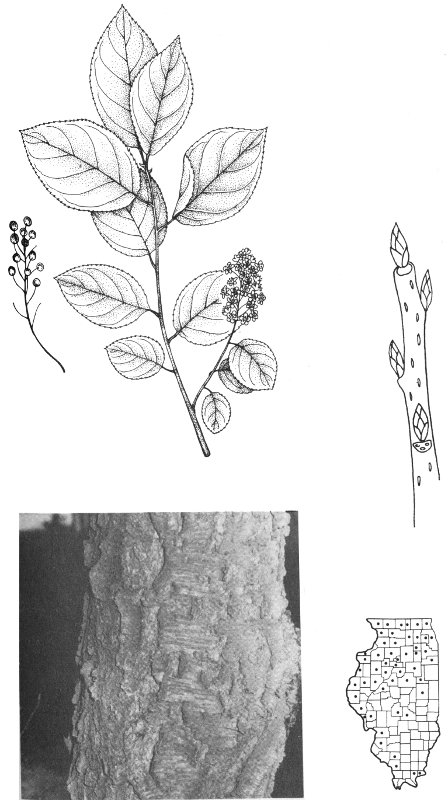
CHOKE CHERRY Prunus virginiana L.
Growth Form: Small tree to 20 feet tall, often only a shrub; trunk diameter up to 5 inches; crown irregular.
Bark: Thin, smooth and reddish-brown at first, becoming furrowed and darkened.
Twigs: Slender, smooth, reddish-brown with pale lenticels; leaf scars alternate, half-round, each with 3 bundle traces.
Buds: Ovoid, pointed, brown, more or less smooth, up to ¼ inch long.
Leaves: Alternate, simple; blades oblong or oval, short-pointed at the tip, tapering to the base, up to 4 inches long and about half as broad, finely and sharply toothed along the edges, green, smooth and shiny on the upper surface, paler and smooth or with a few hairs on the lower surface; leafstalks slender, up to 1 inch long, smooth, with 2 glands near the tip.
Flowers: Crowded in showy, drooping, elongated clusters up to 6 inches long, appearing when the leaves are partly grown, each flower up to ½ inch across, with 5 white petals.
Fruit: Fleshy, juicy, spherical, up to ⅓ inch in diameter, red at first, becoming deep purple at maturity.
Wood: Heavy, hard, not strong, close-grained, pale-brown.
Uses: Fuel, some interior finishing.
Habitat: Woods, along streams.
Range: Newfoundland across to Saskatchewan, south to Kansas, east to North Carolina.
Distinguishing Features: Choke Cherry resembles Wild Black Cherry, differing by its more pointed teeth along the edges of the leaves.
231
232
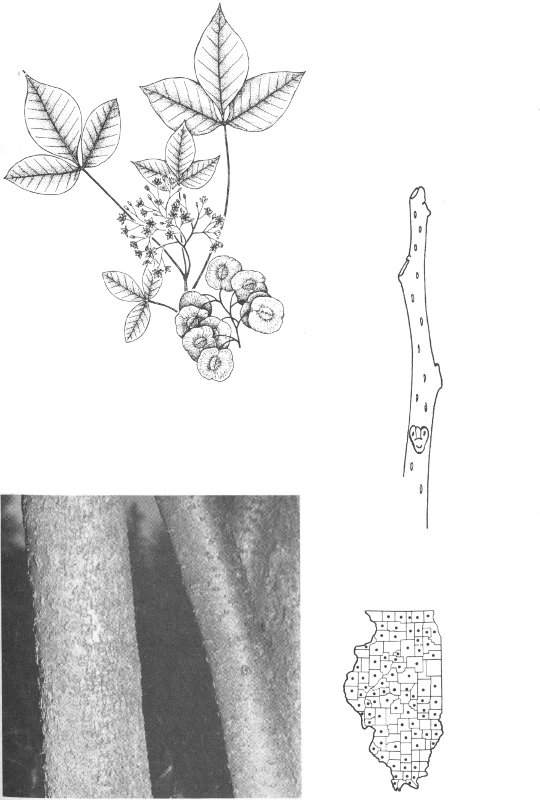
WAFER ASH Ptelea trifoliata L.
Other Name: Hop-tree.
Growth Form: Small tree or shrub up to 20 feet tall; trunk diameter up to 5 inches; crown rounded.
Bark: Brown, somewhat roughened.
Twigs: Slender, dark brown, often with small “warts”; leaf scars alternate, large, horseshoe-shaped, slightly elevated, with 3 bundle traces.
Buds: Spherical, pale brown, hairy.
Leaves: Alternate, divided into 3 leaflets; leaflets mostly ovate, long-pointed at the tip, rounded or tapering to the base, up to 5 inches long, up to half as wide, smooth or with fine teeth along the edges, dark green and smooth on the upper surface, paler and smooth on the lower surface; leaflets without individual stalks.
Flowers: Staminate and pistillate flowers borne separately but usually in the same cluster, appearing in late May and June, with 3-5 obscure, greenish-white petals.
Fruit: Thin, flat, nearly spherical winged seed up to 1 inch across.
Wood: Hard, heavy, close-grained, yellow-brown.
Use: The fruit at one time was used as a substitute for hops in brewing.
Habitat: Rocky, wooded slopes.
Range: Quebec across Michigan to Iowa, south to eastern Texas, east to Florida.
Distinguishing Features: The Wafer Ash is distinguished by its 3-parted alternate leaves and its flat, spherical, winged seeds.
233
234
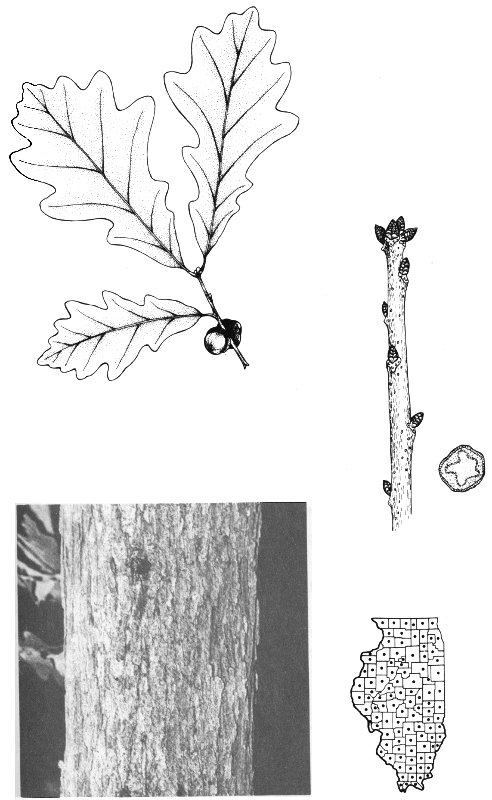
WHITE OAK Quercus alba L.
Growth Form: Large tree up to 100 feet tall; trunk diameter up to 3 feet; crown very broad, with stiff, horizontal branches; trunk relatively short and rather thick.
Bark: Gray or whitish with gray patches, shallowly furrowed.
Twigs: Slender, smooth, somewhat shiny, gray, whitish, or even purplish; pith star-shaped in cross-section; leaf scars alternate but crowded near the tip of the twig, half-round, slightly elevated, with several bundle traces.
Buds: Nearly round, reddish-brown or gray, up to ⅛ inch long.
Leaves: Alternate, simple; blades usually with 7 or 9 lobes, the lobes rounded and not bristle-tipped, the sinuses varying from shallow to deep, the upper surface green and smooth, the lower surface paler and smooth, up to 10 inches long, up to half as wide, turning red in the autumn; leafstalks up to 1 inch long, rather stout, smooth. Leaves on the same tree may vary considerably.
Flowers: Staminate and pistillate borne separately, but on the same tree, appearing when the leaves begin to unfold, minute, without petals, the staminate many in drooping, yellow catkins, the pistillate few in a group, red.
Fruit: Acorns borne 1 or 2 together, with or without a stalk, the nut oblong, up to ¾ inch long, green to greenish-brown, shiny, the cup covering up to ¼ of the nut, yellow-brown, often minutely hairy.
Wood: Heavy, hard, strong, durable, coarse-grained, pale brown.
Uses: Interior finishing, cabinets, general construction, fence posts, fuel, tight cooperage.
Habitat: Moist woods; wooded slopes; dry woods.
Range: Maine across to Minnesota, south to eastern Texas, east to northern Florida.
Distinguishing Features: White Oak is recognized by its grayish bark and its 5-7 round-lobed, smooth leaves which are usually whitish on the lower surface. Its oblong, greenish-brown, shiny acorns are also distinctive.
235
236
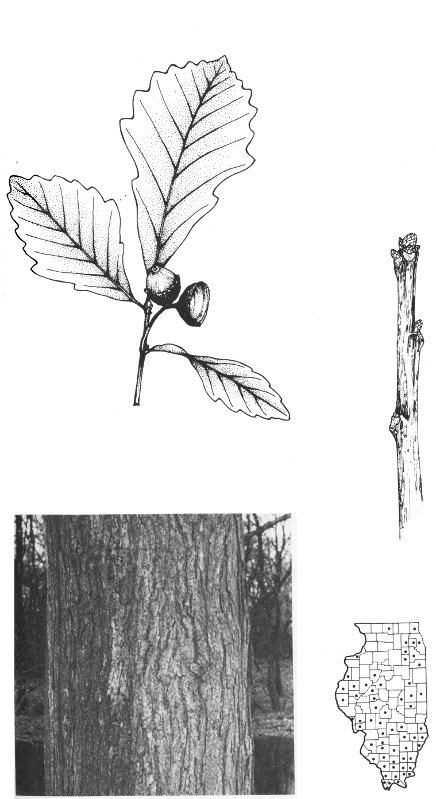
SWAMP WHITE OAK Quercus bicolor Willd.
Growth Form: Medium tree to 70 feet tall; trunk diameter up to 3 feet; crown rounded and broad.
Bark: Grayish-brown, deeply furrowed, becoming flaky.
Twigs: Stout, grayish-brown to yellowish-brown; leaf scars alternate, half-round, slightly elevated, with several bundle traces; pith star-shaped in cross-section.
Buds: Clustered at the tips of the twigs, ellipsoid to spherical, up to ⅛ inch long, yellow-brown, smooth or with a few hairs at the tip.
Leaves: Alternate, simple; blades usually broadest above the middle, up to 6 inches long and 4 inches broad, coarsely round-toothed or sometimes with a few shallow lobes, smooth or somewhat hairy on the upper surface, white and softly hairy on the lower surface; leafstalks nearly an inch long, smooth or slightly hairy.
Flowers: Staminate and pistillate borne separately, but on the same tree, appearing when the leaves begin to unfold, minute, without petals, the staminate in slender, drooping catkins, the pistillate in groups of 2-4.
Fruit: Acorns in pairs, on stalks 1 inch long or longer, the nut ovoid, pale brown, 1-1½ inches long, enclosed about ⅓ its length by the cup, the cup thick, light brown, hairy, roughened.
Wood: Hard, heavy, strong, pale brown.
Uses: Interior finishing, cabinets, fuel, fence posts.
Habitat: Bottomland woods.
Range: Maine and southern Quebec across to southern Minnesota, south to Oklahoma, east to Georgia.
Distinguishing Features: The Swamp White Oak is distinguished by its leaves which are coarsely round-toothed and softly white hairy on the lower surface of the leaves.
237
238
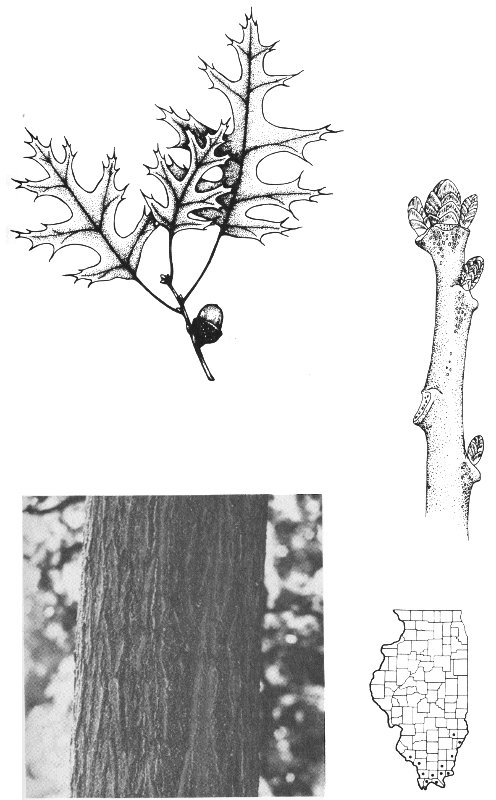
SCARLET OAK Quercus coccinea Muench.
Growth Form: Medium tree to 70 feet tall; trunk diameter up to 2½ feet; crown narrow but open.
Bark: Reddish-brown, shallowly fissured when mature.
Twigs: Slender, brown, smooth; leaf scars alternate, but crowded near the tip, half-round, slightly elevated, with several bundle traces; pith star-shaped in cross-section.
Buds: Pointed, reddish-brown, hairy at the tip, up to ¼ inch long.
Leaves: Alternate, simple; blades divided more than half-way to the middle into 5-7 bristle-tipped lobes, bright green, shiny and smooth on the upper surface, paler and with tufts of hairs along the veins on the lower surface, up to 6½ inches long and 4 inches broad; leafstalks up to 2½ inches long, slender, usually smooth.
Flowers: Staminate and pistillate borne separately, but on the same tree, appearing when the leaves begin to unfold, minute, without petals, the staminate in slender, drooping catkins, the pistillate in groups of 1 or 2.
Fruit: Acorns solitary or paired, with or without stalks, the nut oval or hemispherical, up to ¾ inch across, reddish-brown with occasional darker rings around it, enclosed up to ½ its length by the cup, the cup thin, top-shaped, reddish-brown, finely hairy.
Wood: Hard, heavy, coarse-grained, pale brown.
Uses: Fuel, fence posts, coarse construction.
Habitat: Dry woods.
Range: Maine to southern Ontario, south to Oklahoma, east to Georgia.
Distinguishing Features: Scarlet Oak looks very much like Pin Oak, but differs in habitat and structure of the acorn cup. It sometimes resembles Black Oak but has shorter, less hairy buds and acorns without loosely arranged scales on the cup.
239
240
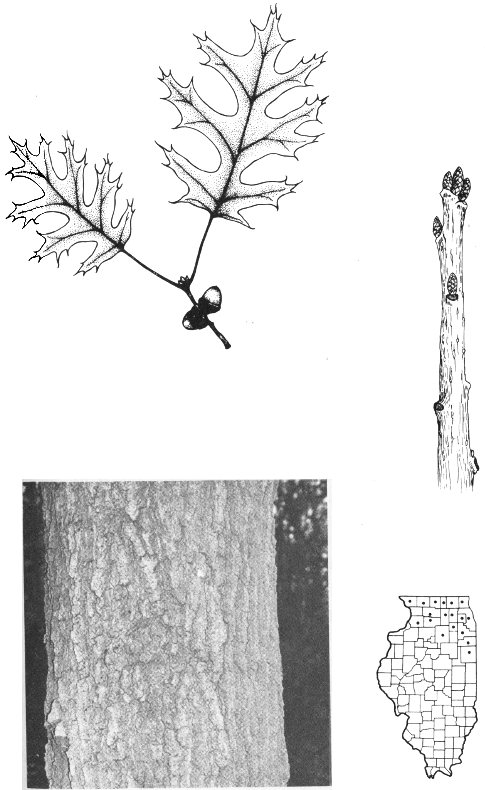
HILL’S OAK Quercus ellipsoidalis E. J. Hill
Other Name: Northern Pin Oak.
Growth Form: Moderate tree to about 75 feet tall; trunk diameter up to 2 feet; crown rounded, with the drooping lowermost branches often reaching nearly to the ground.
Bark: Gray-black, rather smooth to shallowly fissured.
Twigs: Rather slender, smooth at maturity, grayish-brown to reddish-brown; pith star-shaped in cross-section; leaf scars alternate, but clustered near the tip of the twig, half-round, slightly elevated, with several bundle traces.
Buds: Nearly smooth, one-fourth inch long, ovoid, reddish-brown.
Leaves: Alternate, simple; blades 3-9 inches long, slightly tapering or usually cut nearly straight across at the base, with 2-4 pairs of bristle-tipped lobes usually cut over half-way to the mid-vein, deep green and shiny on the upper surface at maturity; leafstalks smooth, up to 3 inches long.
Flowers: Staminate and pistillate on same tree, appearing as the leaves unfold, inconspicuous, the staminate crowded in a catkin, the pistillate solitary or 2-3 together.
Fruit: Ripening in October of the second year, on very short stalks; acorns longer than broad, short-pointed at the base, about ½ inch across, the cup bowl-shaped covering ⅓ to ½ of the acorn.
Wood: Heavy, hard, strong, pale brown.
Uses: Shingles and interior finishings.
Habitat: Dry upland woods, often where Black Oak occurs.
Range: Northwestern Ohio and central Michigan to southeastern Minnesota, south to eastern Iowa and north-central Illinois.
Distinguishing Features: The elongated acorn of the Hill’s Oak distinguishes it from pin oak, which it closely resembles.
241
242
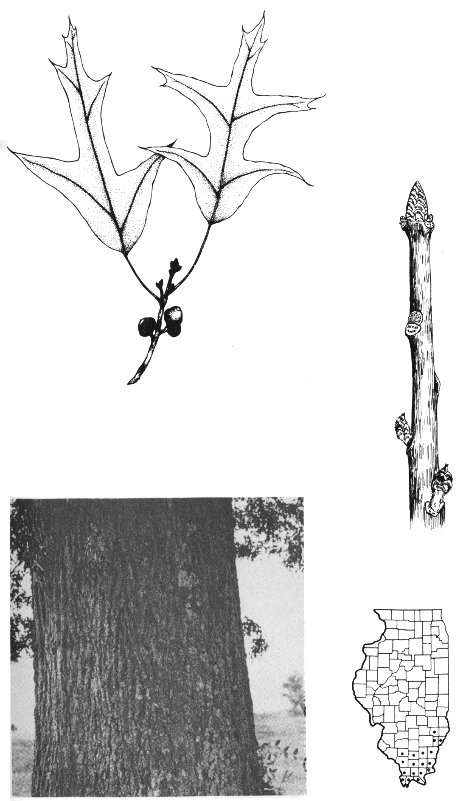
SPANISH OAK Quercus falcata Michx.
Other Name: Southern Red Oak.
Growth Form: Large tree up to 80 feet tall; trunk diameter up to 4 feet; crown broadly rounded, with stiff, stout, spreading branchlets; trunk straight, rather stout.
Bark: Dark brown to nearly black, shallowly furrowed.
Twigs: Reddish-brown to gray, smooth or nearly so at maturity; pith star-shaped in cross-section; leaf scars alternate but clustered near the tip, half-round, slightly elevated, with several bundle traces.
Buds: Ovoid, pointed, chestnut-brown, hairy, up to ¼ inch long.
Leaves: Alternate, simple; blades broadly rounded at the base, 3- to 5-lobed, the terminal lobe usually long, narrow, and strongly curved, all lobes bristle-tipped, up to 8 inches long, up to 6 inches wide, green on the upper surface, pale and densely soft-hairy on the lower surface; leaf stalk up to 2½ inches long, slender, usually hairy.
Flowers: Staminate and pistillate borne separately, but on the same tree, appearing when the leaves begin to unfold, minute, without petals, the staminate in slender, drooping, densely hairy catkins, the pistillate few in a rusty-hairy cluster, with dark red stigmas.
Fruit: Acorn usually solitary, with or without a short stalk, the nut spherical or ellipsoid, up to ½ inch long, orange-brown, the cup covering only up to ⅓ of the nut, with hairy, reddish-brown scales.
Wood: Heavy, hard, strong, coarse-grained, reddish-brown.
Uses: Fence posts, fuel, general construction.
Habitat: Dry and usually poor upland soil; occasionally in bottomlands.
Range: Central New Jersey south to central Florida, across to eastern Texas, up the Mississippi Basin to central Missouri, south-central Illinois, southeastern Indiana, western Kentucky, and western Tennessee.
Distinguishing Features: The Spanish Oak is the only bristle-tipped oak in Illinois in which the lower leaf surface is covered with a mat of fine hairs.
243
244
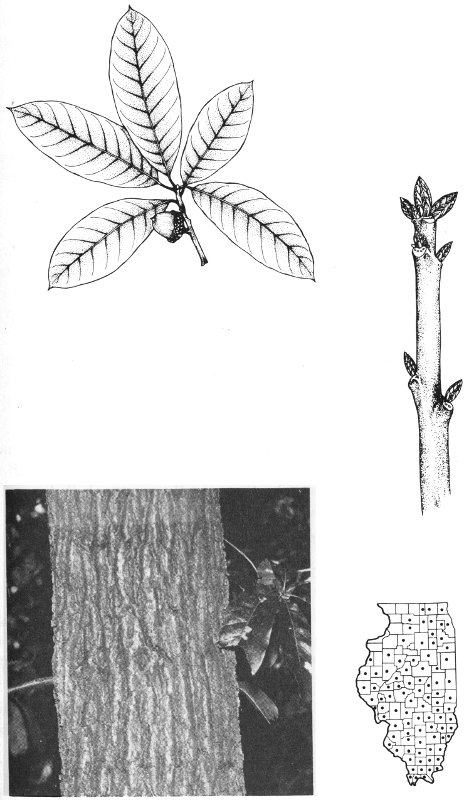
SHINGLE OAK Quercus imbricaria Michx.
Growth Form: Medium tree up to 70 feet tall; trunk diameter up to 3 feet; crown rounded or oblong, with many branches; trunk straight, columnar.
Bark: Dark brown, deeply furrowed between flat, tight plates.
Twigs: Slender, smooth, reddish-brown; pith star-shaped in cross-sections; leaf scars alternate but crowded near the tip of the twigs, half-round, slightly elevated, with several bundle traces.
Buds: Ovoid, pointed, brown, smooth, up to ⅛ inch long.
Leaves: Alternate, simple; blades without lobes or teeth, lanceolate to oblong, with a bristle tip, narrowed to the base, up to 6 inches long, up to 2 inches wide, dark green, smooth and shiny on the upper surface, paler and hairy on the lower surface; leafstalks up to ½ inch long, stout, hairy.
Flowers: Staminate and pistillate borne separately, but on the same tree, appearing as the leaves begin to unfold, minute, without petals, the staminate in slender, yellow, drooping catkins, the pistillate few in a cluster.
Fruit: Acorns solitary or 2 together, stalked, the nut nearly spherical, dark brown, less than half enclosed by the cup, the cup reddish-brown and slightly hairy.
Wood: Hard, heavy, coarse-grained, light reddish-brown.
Uses: Shingles, general construction.
Habitat: Moist soil along streams or in woods; occasionally on dry, exposed sandstone cliffs.
Range: New Jersey across to Wisconsin, Iowa, and Nebraska, south to Kansas, east to Arkansas and South Carolina.
Distinguishing Features: Only the Shingle Oak and the Willow Oak, among all the oaks, have leaves without any teeth or lobes. The Shingle Oak generally has broader leaves than does the Willow Oak. The Shingle Oak can be told from Magnolias by its star-shaped pith and the formation of acorns.
245
246
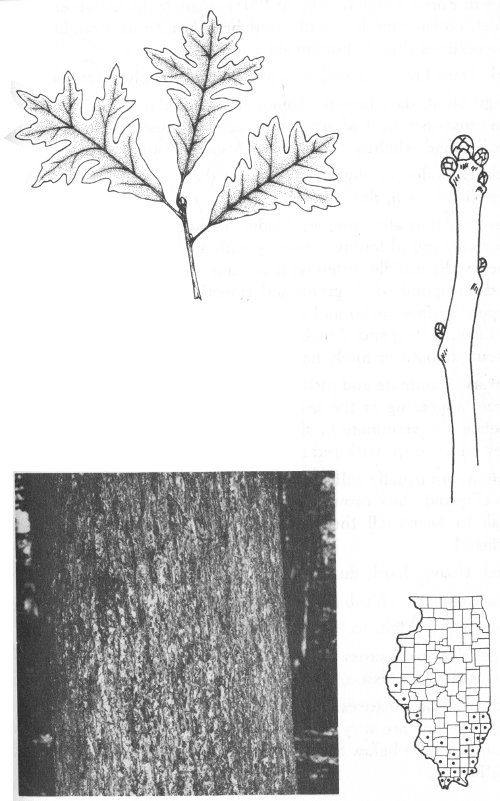
OVERCUP OAK Quercus lyrata Walt.
Growth Form: Medium to large tree up to 80 feet tall; trunk diameter up to 3 feet; crown rounded to oblong, with several branches, the lowermost often drooping; trunk straight, columnar.
Bark: Gray or grayish-brown, divided into flat, sometimes squarish, plates.
Twigs: Slender, smooth, buff-colored; pith star-shaped in cross-section; leaf scars alternate, but clustered near the tip of the twig, half-round, slightly elevated, with several bundle traces.
Buds: Nearly round, smooth, pale brown, up to ⅛ inch long.
Leaves: Alternate, simple; blades divided into 5-7 rounded lobes, the sinuses shallow to deep, up to 10 inches long, up to 4½ inches broad, dark green and smooth on the upper surface, pale and softly hairy to nearly smooth on the lower surface; leafstalk up to 1 inch long, smooth or hairy.
Flowers: Staminate and pistillate borne separately, but on the same plant, appearing when the leaves begin to unfold, minute, without petals, the staminate in slender, yellow, drooping catkins, the pistillate few in a group.
Fruit: Acorns solitary or 2 together, with or without a stalk, the nut nearly spherical, up to 1 inch in diameter, pale brown, often nearly entirely enclosed by the cup, the cup finely hairy, with some of the scales forming a ragged rim near the base.
Wood: Hard, heavy, strong, dark brown.
Uses: Interior finishing, cabinets, fuel, fence posts.
Habitat: Bottomland woods; swamps.
Range: Southern Virginia across to eastern Texas, north up the Mississippi Valley to southern Missouri, southern Illinois, and southern Indiana; also in Delaware, Maryland, and New Jersey; southward to Florida.
Distinguishing Features: The best identifying characteristic of this plant is the acorn in which the nut often is nearly enclosed by the cup.
247
248
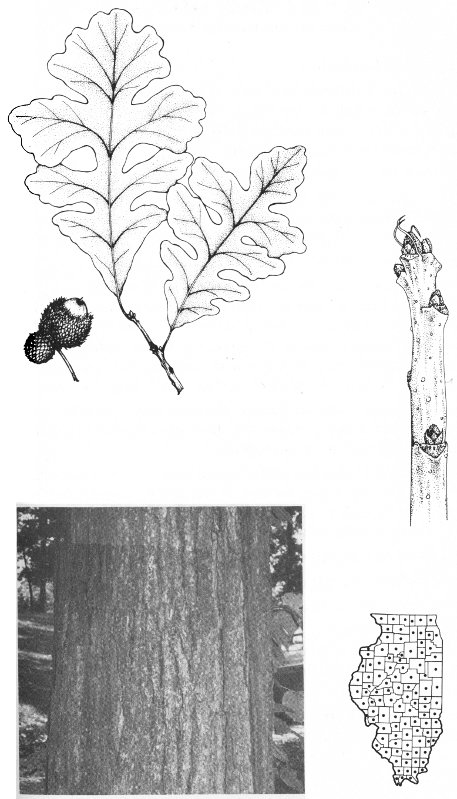
BUR OAK Quercus macrocarpa Michx.
Other Name: Mossy-cup Oak.
Growth Form: Large tree up to 120 feet tall; trunk diameter up to 5 feet; crown rounded, with stout branches; trunk straight, stout, sometimes slightly buttressed at the base.
Bark: Dark brown or yellow-brown, rather deeply furrowed.
Twigs: Stout, dark brown, often with corky ridges; pith star-shaped in cross-section; leaf scars alternate but clustered near the tip, half-round, slightly elevated, with several bundle traces.
Buds: Rounded or slightly pointed at the tip, yellowish-brown to reddish-brown, finely hairy.
Leaves: Alternate, simple; blades broader at the upper end, coarsely round-toothed, usually with a pair of deep sinuses just below the middle, often with as many as 5-7 lobes, the lobes not bristle-tipped, dark green and smooth or slightly hairy on the upper surface, paler and softly hairy on the lower surface, up to 14 inches long and 7 inches wide; leaf stalks up to 1 inch long, stout, smooth or finely hairy.
Flowers: Staminate and pistillate borne separately, but on the same tree, appearing as the leaves begin to unfold, minute, without petals, the staminate in slender, drooping catkins, the pistillate few in a group, with red stigmas.
Fruit: Acorn usually solitary, with or without a stalk, the nut ovoid to ellipsoid, dark brown, up to 1¾ inches long, the cup covering half to nearly all the nut, hairy, the lowermost scales long-fringed.
Wood: Heavy, hard, durable, close-grained, brown.
Uses: Cabinets, ship-building, fenceposts, fuel, tight cooperage.
Habitat: Dry ridges to bottomland woods.
Range: Vermont across to North Dakota, south to Texas, east to Arkansas, Tennessee, and Maryland.
Distinguishing Features: The leaves of the Bur Oak are distinctive because they are very broad in the upper half with a pair of deep sinuses a little below the middle. The large, fringed cups are also distinctive.
249
250
BLACKJACK OAK Quercus marilandica Muench.
Other Name: Scrub Oak.
Growth Form: Relatively small tree, at most attaining a height of 50 feet, usually much shorter and often very gnarled; trunk diameter up to 1½ feet; crown exceedingly round-topped, with numerous lower branches hanging downward.
Bark: Dark brown, shallowly ridged.
Twigs: Moderately stout, brown, more or less hairy; pith star-shaped in cross-section; leaf scars alternate but clustered near the top, half-round, slightly elevated, with several bundle traces.
Buds: Angular, from ¼-½ inch long, somewhat hairy.
Leaves: Alternate, simple; blades about 4-8 inches long, leathery, very much broader near the apex than the base, mostly rounded or even somewhat heart shaped at the base, more or less 3-lobed and bristle-tipped nearer the apex, the upper surface hairy at first, becoming shiny dark green at maturity, the lower surface permanently hairy; leafstalks less than 1 inch long.
Flowers: Staminate and pistillate on the same tree, appearing as the leaves unfold, inconspicuous, the staminate crowded in a catkin, the pistillate solitary or 2-3 together.
Fruit: Ripening in October of the second year, on very short stalks, or the stalks sometimes lacking; acorns nearly round, usually at most only ½ inch in diameter, the cup enclosing ½ the acorn, with rather loosely arranged scales.
Wood: Hard, strong, heavy, dark brown.
Uses: Excellent as a source of charcoal and fuel.
Habitat: Poor soil, particularly on dry, exposed rocky cliffs.
Range: New York across to Pennsylvania, Ohio, Indiana, Illinois, and southern Iowa to southeastern Nebraska, south into eastern Kansas, eastern Oklahoma, and eastern Texas, then east to northern Florida.
Distinguishing Features: The 3-lobed leaf, much broader at the apex, is the most distinctive characteristic of this oak.
251
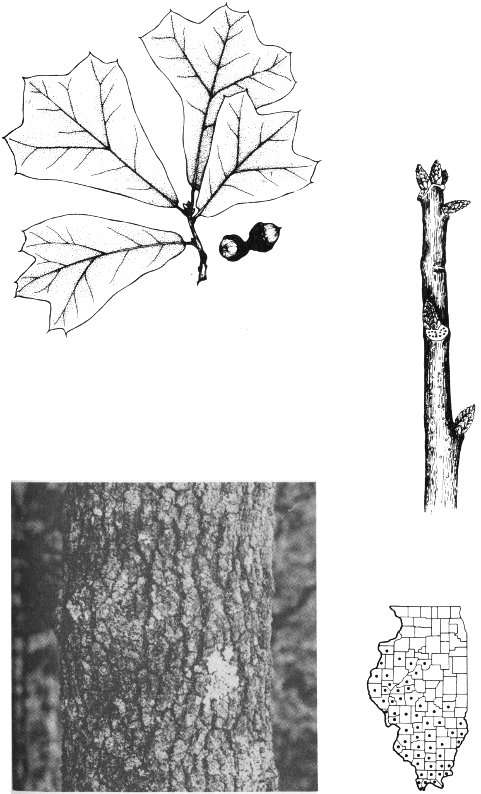
252
SWAMP CHESTNUT OAK Quercus michauxii Nutt.
Other Names: Basket Oak; Cow Oak.
Growth Form: Medium to large tree up to nearly 100 feet tall; trunk diameter up to 6 feet; crown rounded.
Bark: Gray or silvery-white, scaly.
Twigs: Stout, reddish-brown to gray, smooth or nearly so; leaf scars alternate but crowded near the tip, half-round, slightly elevated, with several bundle traces; pith star-shaped in cross-section.
Buds: Pointed, finely hairy, reddish-brown, up to ¼ inch long.
Leaves: Alternate, simple; blades obovate, pointed at the tip, rounded or tapering to the base, up to 10 inches long and 6 inches broad, coarsely scalloped along the edges, thick, green and sparsely hairy on the upper surface, whitish and densely hairy on the lower surface; leafstalk up to 1½ inches long, hairy.
Flowers: Borne separately but on the same tree, minute, without petals, the staminate crowded into long, slender catkins, the pistillate few in a cluster.
Fruit: Acorns solitary or paired, with or without short stalks, the nut ovoid to ellipsoid, brown, up to 1½ inches long, enclosed about ⅓ its length by the cup, the cup thick, cup-shaped, hairy, short-fringed along the rim.
Wood: Hard, heavy, strong, close-grained, pale brown.
Uses: General construction, fuel, fence posts.
Habitat: Low woods.
Range: New Jersey across to southern Missouri, south to Texas, east to Florida.
Distinguishing Features: The Swamp Chestnut Oak is distinguished from other coarsely toothed oaks by the densely hairy, whitish lower leaf surfaces and its short-stalked acorns.
253
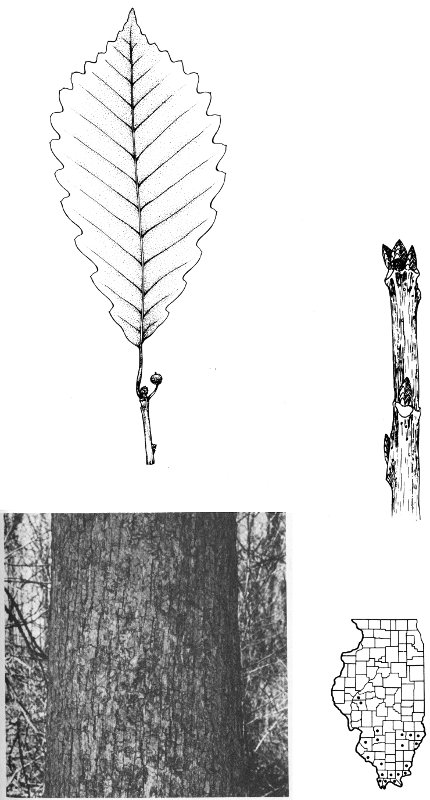
254
YELLOW CHESTNUT OAK Quercus muhlenbergii Engelm.
Other Names: Chinquapin; Chinquapin Oak.
Growth Form: Large tree up to 100 feet tall; trunk diameter up to 4 feet; crown oblong or rounded, with many branches; trunk straight, columnar, buttressed at the base.
Bark: Pale gray, with scaly ridges.
Twigs: Slender, yellow-brown or reddish-brown; pith star-shaped in cross-section; leaf scars alternate but clustered near the tip, half-round, with several bundle traces; pith star-shaped in cross-section.
Buds: Pointed, smooth, chestnut-brown, up to ¼ inch long.
Leaves: Alternate, simple; blades narrowly to broadly lanceolate, pointed at the tip, narrowed or rounded at the base, coarsely toothed along the edges, smooth and yellow-green on the upper surface, paler and usually finely hairy on the lower surface, up to 8 inches long and 5 inches broad; leafstalk up to 1½ inches long, slender, usually smooth.
Flowers: Staminate and pistillate borne separately, but on the same tree, minute, without petals, the staminate crowded into long, slender catkins, the pistillate few in a group, with red stigmas.
Fruit: Acorns borne in groups of 1 or 2, usually on a short stalk, the nut ovoid, chestnut-colored, up to ¾ inch long, the cup covering about ½ the nut, the scales of the cup hairy and usually with a short fringe.
Wood: Heavy, strong, durable, close-grained.
Uses: Fence posts, fuel, railroad ties.
Habitat: Low rich slopes; wooded hillsides; dry cliffs.
Range: Vermont across to southern Minnesota, south to eastern Nebraska and eastern Texas, east to northern Florida.
Distinguishing Features: The Yellow Chestnut Oak is distinguished from the other coarsely toothed oaks by its usually sharper pointed teeth and by the size and shape of its acorns.
255
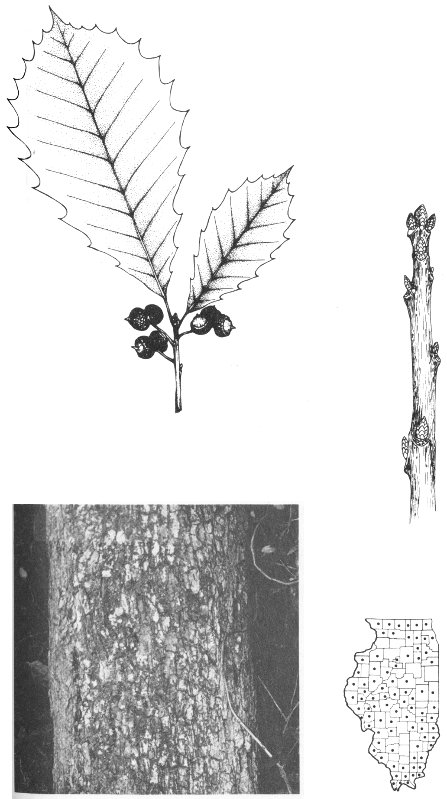
256
CHERRYBARK OAK Quercus pagodaefolia Ell.
Other Name: Swamp Spanish Oak.
Growth Form: Large tree up to 100 feet tall; trunk diameter up to 4 feet; crown broadly rounded; trunk straight, columnar.
Bark: Dark gray, broken by narrow ridges into small scales.
Twigs: Rather stout, reddish-brown or gray, usually hairy when young, becoming smooth; pith star-shaped in cross-section; leaf scars alternate but clustered near tip of the twigs, half-round, slightly elevated, with several bundle traces.
Buds: Ovoid, pointed, angular, hairy, chestnut-brown, up to ¼ inch long.
Leaves: Alternate, simple; blades divided into 5-11 pointed lobes, the sinuses cut about half-way to the midvein, up to 10 inches long, up to 7 inches wide, dark green, smooth and shiny on the upper surface, pale and hairy on the lower surface; leafstalks up to 2 inches long, stout, hairy.
Flowers: Staminate and pistillate borne separately, but on the same plant, appearing when the leaves begin to unfold, minute, without petals, the staminate in slender, drooping catkins, the pistillate few together.
Fruit: Acorns solitary or 2 together, with or without a stalk, the nut ellipsoid, about ½ inch long, brown, enclosed for less than ⅓ its length by the cup, the cup finely hairy.
Wood: Strong, hard, coarse-grained, light reddish-brown.
Uses: Interior finishing, furniture, cabinets.
Habitat: Bottomlands and river banks.
Range: Southeastern Virginia to southeastern Missouri, south to Texas, east to Florida.
Distinguishing Features: The shape of the leaf is distinctive for this oak.
257
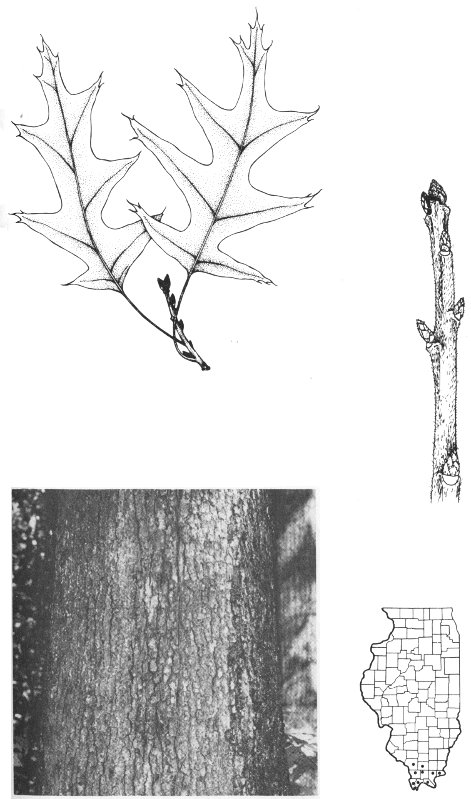
258
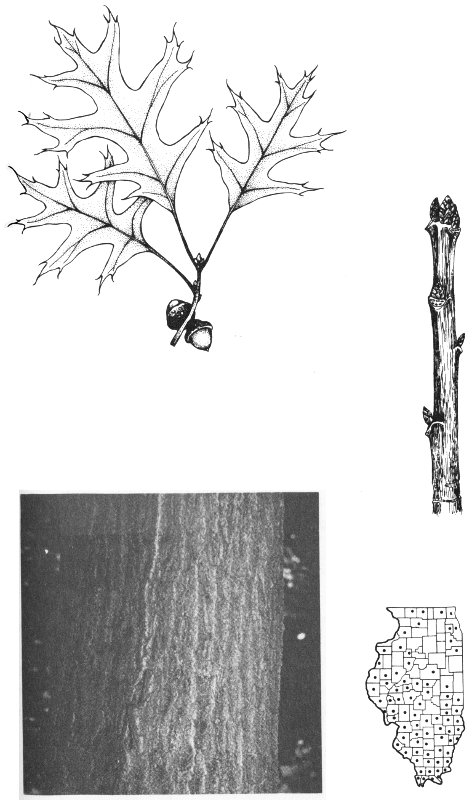
PIN OAK Quercus palustris Muench.
Growth Form: Medium tree up to 75 feet tall; trunk diameter usually less than 3 feet; crown narrowly rounded or oblong, but with the lower branches drooping; trunk straight, with pin-like stubs developing rather low on the trunk.
Bark: Light brown or dark brown, scarcely furrowed.
Twigs: Slender, smooth, reddish-brown to dark gray; pith star-shaped in cross-section; leaf scars alternate but crowded near the tip, half-round, usually slightly elevated, with several bundle traces.
Buds: Pointed, reddish-brown or dark gray, smooth, up to ⅛ inch long.
Leaves: Alternate, simple; blades divided more than half-way to the middle into 5-7 bristle-tipped lobes, dark green, shiny and more or less smooth on the upper surface, paler and with tufts of hairs along the veins on the lower surface, up to 7 inches long and 4 inches broad; leafstalk up to 2 inches long, slender, usually smooth.
Flowers: Staminate and pistillate borne separately, but on the same tree, appearing when the leaves begin to unfold, minute, without petals, the staminate in slender, drooping catkins, the pistillate in groups of 1-3.
Fruit: Acorns 1-4 together, with or without stalks, the nut hemispherical, up to ½ inch across, pale brown, frequently with darker lines, enclosed less than ¼ by the cup, the cup thin, saucer-shaped, reddish-brown, finely hairy.
Wood: Hard, heavy, coarse-grained, pale brown.
Uses: General construction, fuel, fence posts, ornamental.
Habitat: Moist soil; in floodplain woods; along streams; edges of swamps and ponds.
Range: Massachusetts across to southeastern Iowa, south to northeastern Oklahoma, east to northern Virginia.
Distinguishing Features: Pin Oak is recognized by its drooping lower branches and its small acorns.
259
260
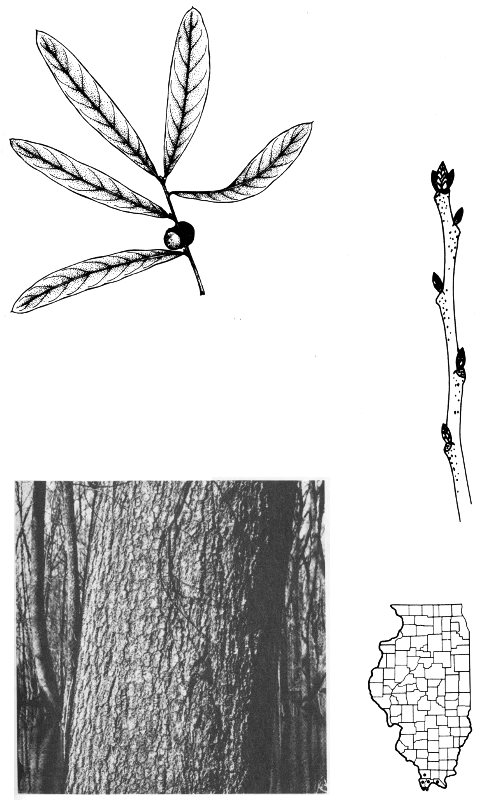
WILLOW OAK Quercus phellos L.
Growth Form: Medium tree to 75 feet tall; trunk diameter up to 3 feet; crown narrowly round-topped.
Bark: Reddish-brown, smooth at first, becoming irregularly and shallowly furrowed with age.
Twigs: Slender, smooth, reddish-brown; pith star-shaped in cross-section; leaf scars alternate but crowded near the tip of the twigs, half-round, slightly elevated, with several bundle traces.
Buds: Ovoid, pointed, smooth, up to ⅛ inch long.
Leaves: Alternate, simple; blades without lobes or teeth, narrowly lanceolate to narrowly oblong, with a bristle tip, narrowed to the base, up to 5 inches long, up to 1 inch broad, light green and smooth on the upper surface, usually smooth and paler on the lower surface; leafstalks up to ½ inch long, smooth or slightly hairy.
Flowers: Staminate and pistillate borne separately, but on the same tree, appearing as the leaves begin to unfold, minute, without petals, the staminate in slender, drooping catkins, the pistillate few in a cluster.
Fruit: Acorns solitary or 2 together, with or without a short stalk, the nut more or less spherical, pale yellow-brown, enclosed less than ¼ its length by the cup, the cup reddish-brown, finely hairy.
Wood: Heavy, rather soft, strong, coarse-grained, pale reddish-brown.
Use: General construction.
Habitat: Swampy woods.
Range: New York across to southern Illinois and eastern Oklahoma, south to Texas, east to Florida.
Distinguishing Features: This and the Shingle Oak are the only oaks in Illinois with unlobed, untoothed leaves. The leaves of the Willow Oak are usually much narrower than those of the Shingle Oak.
261
262
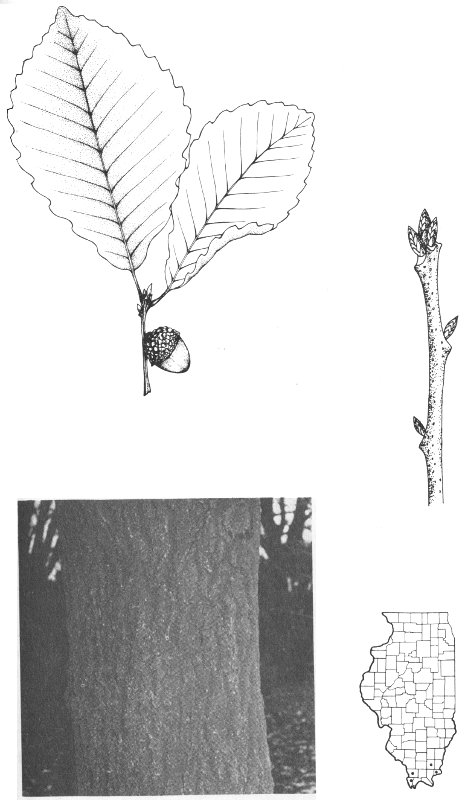
ROCK CHESTNUT OAK Quercus prinus L.
Other Name: Chestnut Oak.
Growth Form: Medium tree up to 55 feet tall; trunk diameter up to 2½ feet; crown broad but irregular.
Bark: Dark brown, with conspicuous furrows between the rounded ridges.
Twigs: Rather stout, reddish-brown, smooth or nearly so; leaf scars alternate, but clustered near the tip of the twig, half-round, with several bundle traces; pith star-shaped in cross-section.
Buds: Pointed, brown, somewhat hairy, up to ½ inch long.
Leaves: Alternate, simple; blades obovate to broadly lanceolate, pointed at the tip, narrowed to the base, thick and leathery, coarsely round-toothed along the edges, smooth, shiny, and yellow-green on the upper surface, finely hairy over all the lower surface, up to 9 inches long and up to 4 inches broad; leafstalk up to 1 inch long, smooth or slightly hairy.
Flowers: Staminate and pistillate borne separately, but on the same tree, minute, without petals, the staminate crowded into long, slender catkins, the pistillate few in a group.
Fruit: Acorns borne in groups of 1 or 2, usually on a short stalk, the nut ovoid to ellipsoid, chestnut-colored, up to 1½ inches long, the cup covering about ½ the nut or less, the scales of the cup reddish-brown and warty.
Wood: Hard, heavy, strong, close-grained.
Uses: Fence posts, railroad ties, fuel.
Habitat: Dry, rocky, wooded slopes.
Range: Maine across to southern Illinois, south to Mississippi and Georgia.
Distinguishing Features: The acorns of the Rock Chestnut Oak are about twice the size as those of the Yellow Chestnut Oak. The teeth of the leaves of the Rock Chestnut Oak tend to be more rounded than the pointed teeth of the Yellow Chestnut Oak.
263
264
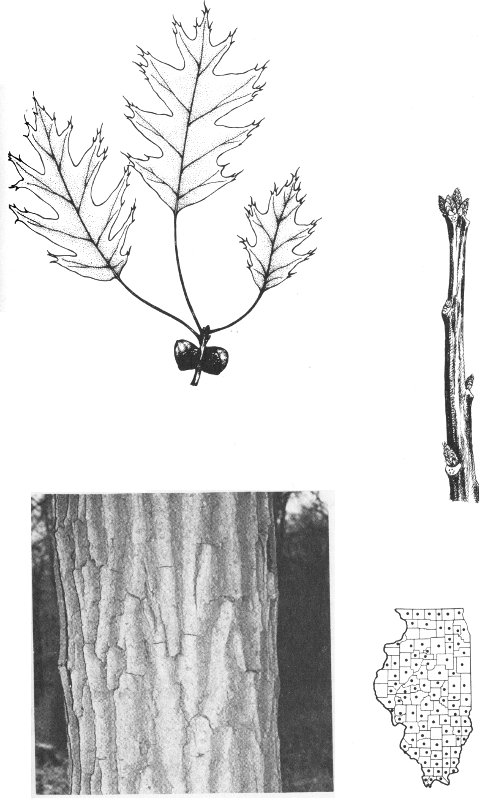
NORTHERN RED OAK Quercus rubra L.
Other Name: Red Oak.
Growth Form: Medium to tall tree to 80 feet tall; trunk diameter up to 3 feet; crown broadly rounded, with large spreading branches; trunk straight, columnar, often buttressed at the base.
Bark: Grayish-brown, reddish-brown, blackish, or gray, with dark stripes.
Twigs: Slender, smooth, reddish-brown; pith star-shaped in cross-section; leaf scars alternate, but clustered near the tip of the twig, half-round, slightly elevated, with several bundle traces.
Buds: Pointed, smooth, reddish-brown, shiny, up to ¼ inch long.
Leaves: Alternate, simple; blades rather shallowly 7- to 11-lobed, the lobes bristle-tipped, dark green and smooth or somewhat hairy on the upper surface, paler and smooth or often with hairs along the veins on the lower surface, up to 10 inches long, up to 6 inches broad; leafstalks up to 2 inches long, stout, usually smooth.
Flowers: Staminate and pistillate borne separately, but on the same tree, appearing as the leaves begin to unfold, minute, without petals, the staminate in slender, drooping catkins, the pistillate in groups of 1-3.
Fruit: Acorns solitary or 2 together, with or without stalks, the nut ovoid, up to 1½ inches long, pale brown, covered less than ¼ by the cup, the cup reddish-brown, with tight scales.
Wood: Hard, heavy, close-grained, light brown.
Uses: Interior finishing, furniture, fuel, fence posts.
Habitat: Rich, upland woods; along river banks; on well-drained slopes.
Range: New Brunswick, across southern Quebec and Ontario, to northcentral Minnesota, south to eastern Kansas, east across Missouri, Illinois, Kentucky, and in the mountains of eastern Tennessee and northeastern Georgia.
Distinguishing Features: The acorn with its very shallow, saucer-shaped cap is the best identifying characteristic for the Red Oak. The leaves are generally more shallowly lobed than those of the Black Oak, Southern Red Oak, and Scarlet Oak.
265
266
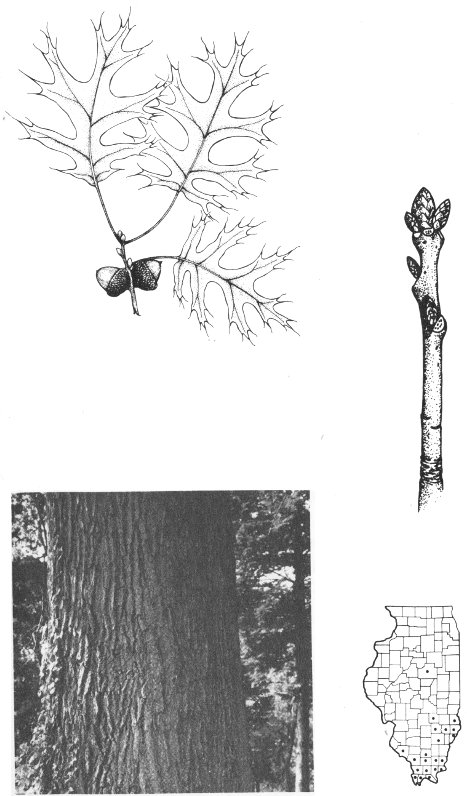
SHUMARD’S OAK Quercus shumardii Buckl.
Other Names: Southern Red Oak; Schneck’s Oak.
Growth Form: Up to 120 feet tall; trunk up to 5 feet in diameter; crown broad and open, with wide-spreading branches.
Bark: Firmly ridged and dark brownish-black.
Twigs: Generally stouter than those of the Red Oak, smooth; pith star-shaped in cross-section; leaf scars alternate, but clustered near the tip of the twig, half-round, slightly elevated, with several bundle traces.
Buds: Smooth, red-brown, about one-third inch long.
Leaves: Alternate, simple; blades up to 8 inches long, straight across or somewhat wedge-shaped at the base, with 2-4 pairs of lobes divided over ⅔’s the way to the mid-nerve, each lobe toothed and bristle-pointed at the tips, the sinuses broadly rounded, dark green and shiny above, with white tufts of hair in the vein axils beneath; leafstalks slender, smooth, up to 2½ inches long.
Flowers: Staminate and pistillate on the same tree, appearing as the leaves unfold, inconspicuous, the staminate crowded in a catkin, the pistillate solitary or 2-3 together.
Fruit: Ripening in October of the second year, on stalks less than ¼ inch long, usually produced singly; acorns broadly egg-shaped, short-pointed at the base and flat at the top, up to 1¼ inches long and about ¾ as broad, light brown; cup shallow, about ¼-⅓ covering the acorn, with closely appressed, densely short-woolly scales.
Wood: Light, strong, durable; not distinguished commercially from Red Oak.
Uses: Interior finishing and furniture.
Habitat: Bottomland woods and stream banks.
Range: Most abundant in the Mississippi basin, but known from Florida and Texas, north to Maryland, Pennsylvania, eastcentral Kentucky, Indiana, central Illinois, the eastern half of Iowa, and southeastern Kansas. The largest known Shumard’s Oak in the country occurs at Beall Woods in Wabash County, Illinois.
Distinguishing Features: Deeply lobed, shiny leaves with broadly rounded sinuses.
267
268
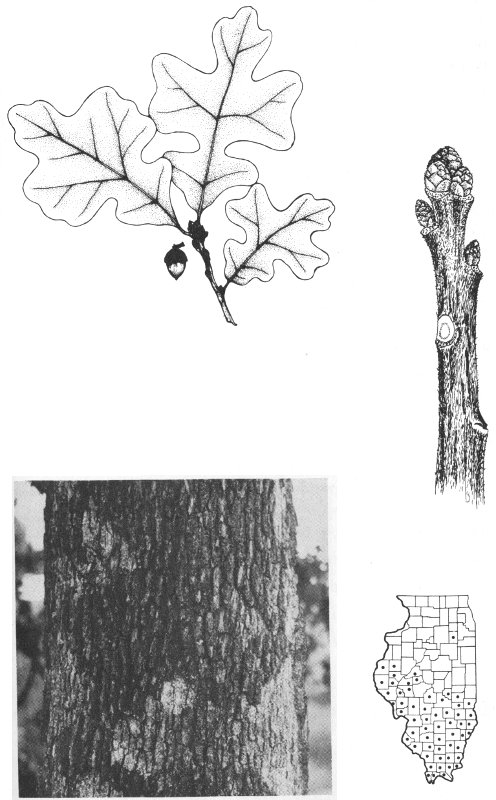
POST OAK Quercus stellata Wang.
Growth Form: Small to medium tree up to 60 feet tall; trunk diameter up to 3 feet; crown rounded or obovoid, with rather stout branches; trunk gnarled or straight, usually not buttressed.
Bark: Gray or light brown, divided into flat, sometimes squarish, plates.
Twigs: Stout, brownish, covered when young by a tawny-colored fuzziness; pith star-shaped in cross-section; leaf scars alternate but densely clustered toward the tip, half-round, usually slightly elevated, with several bundle traces.
Buds: Spherical but often short-pointed, reddish-brown, up to ⅛ inch long.
Leaves: Alternate, simple; blades thick, 5-lobed, the upper three lobes squarish, separated from the lowest pair of lobes by a deep sinus, up to 6 inches long, up to 4½ inches wide, dark green and hairy on the upper surface, paler and hairy on the lower surface; leafstalks up to 1 inch long, stout, hairy.
Flowers: Staminate and pistillate borne separately, but on the same tree, appearing when the leaves begin to unfold, minute, without petals, the staminate in slender, yellow, drooping catkins, the pistillate few in a cluster.
Fruit: Acorns solitary or 2 together, with or without a short stalk, the nut oval to oblong, up to 1 inch long, pale brown, less than half enclosed by the cup, the cup reddish-brown, hairy.
Wood: Hard, heavy, close-grained, brown.
Uses: Fence posts, fuel, general construction.
Habitat: Dry woods; dry bluffs.
Range: Massachusetts across to Kansas, south to Texas, east to Florida.
Distinguishing Features: The 3 squarish lobes at the upper end of the thick leaves distinguish the Post Oak.
269
270
BLACK OAK Quercus velutina Lam.
Other Name: Yellow-bark Oak.
Growth Form: Large tree up to 80 feet tall; trunk diameter up to 3½ feet; crown broadly rounded or oblong, with spreading branches; trunk straight, columnar, scarcely buttressed at the base.
Bark: Black, with a yellow or orange inner bark, deeply furrowed.
Twigs: Slender or rather stout, reddish-brown to dark brown; pith star-shaped in cross-section; leaf scars alternate but clustered near the tip, half-round, slightly elevated, with several bundle traces.
Buds: Pointed, angular, gray or reddish-brown, hairy, up to ½ inch long.
Leaves: Alternate, simple; blades deeply to shallowly 7- to 9-lobed, the lobes bristle-tipped, dark green, shiny and usually smooth on the upper surface, smooth, finely hairy, or hairy only along the veins on the lower surface, up to 10 inches long and 8 inches wide; leaf stalk up to 5 inches long, stout, smooth or finely hairy.
Flowers: Staminate and pistillate borne separately, but on the same tree, appearing when the leaves begin to unfold, minute, without petals, the staminate in slender, drooping clusters, the pistillate in groups of 1-4.
Fruit: Acorns solitary or 2 together, with or without a short stalk, the nut ovoid or ellipsoid, up to ¾ inch long, reddish-brown, not more than ½ enclosed by the cup, the cup with scales not appressed at the tip, thus appearing ragged.
Wood: Hard, heavy, coarse-grained, reddish-brown.
Uses: General construction, fuel, fence posts.
Habitat: Mostly upland woods.
Range: Maine across to south-central Minnesota, south to eastern Texas, east to northern Florida.
Distinguishing Features: Black Oak is easily distinguished by its large, angular, gray-hairy buds and its acorns with their ragged-edged cup.
271
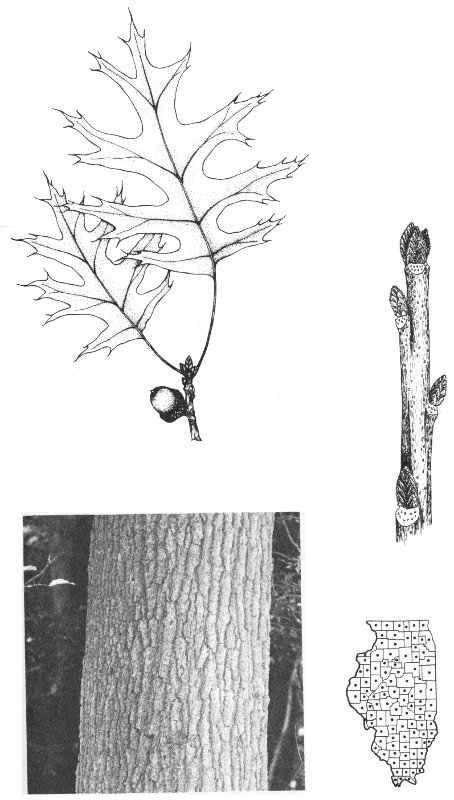
272
CAROLINA BUCKTHORN Rhamnus caroliniana Walt.
Growth Form: Small tree to 30 feet tall; trunk diameter up to 6 inches; crown spreading.
Bark: Gray, somewhat roughened.
Twigs: Slender, gray or pale brown, smooth or somewhat hairy; leaf scars alternate, crescent-shaped, with 3 bundle traces.
Buds: Lance-shaped, pointed, up to ¼ inch long, very hairy.
Leaves: Alternate, simple; blades elliptic, short-pointed at the tip, tapering or somewhat rounded at the base, up to 6 inches long, up to 2 inches broad, finely toothed or toothless along the edges, dark green, smooth, and glossy on the upper surface, paler and smooth or finely hairy on the lower surface; leafstalks finely hairy, up to 1 inch long.
Flowers: Few in umbrella-like clusters, inconspicuous, appearing when the leaves are nearly grown, each flower with 5 small petals.
Fruit: Spherical berries, up to ⅓ inch in diameter, red and shiny, containing 2-4 seeds.
Wood: Hard, light in weight, close-grained, light brown.
Use: Fuel.
Habitat: Rocky woods and along streams.
Range: Virginia across to Kansas, south to Texas, east to Florida.
Distinguishing Features: The Carolina Buckthorn is distinguished by its shiny, elliptical leaves, its red berries, and its small stature.
273
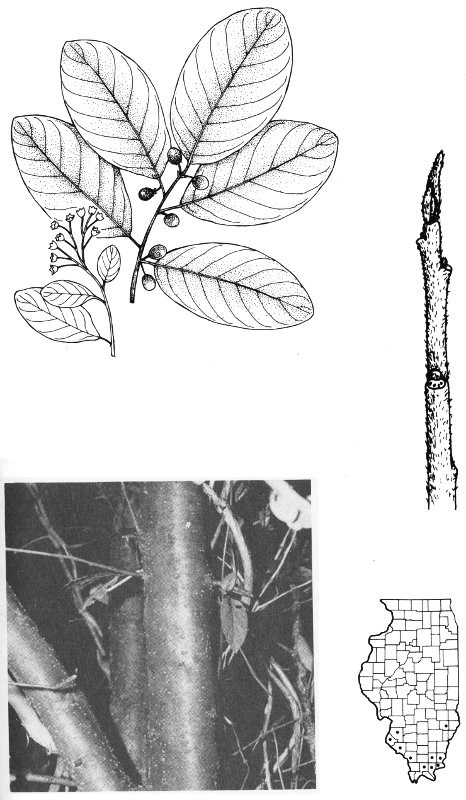
274
COMMON BUCKTHORN Rhamnus cathartica L.
Growth Form: Small tree to 25 feet tall, often branching from near the base; trunk diameter up to 10 inches; crown spreading and irregular.
Bark: Gray to brown, roughened when mature.
Twigs: Gray to brown, usually smooth, some of them usually ending in a spine; leaf scars opposite to nearly so, narrow, with 3 bundle traces.
Buds: Lanceolate, brown, smooth, up to ¼ inch long.
Leaves: Broadly elliptic to ovate to nearly orbicular, rounded to pointed at the tip, usually rounded at the base, up to 2½ inches long and up to 1½ inches wide, finely toothed along the edges, smooth on both surfaces, the veins prominent; leafstalks slender, smooth, up to 1 inch long.
Flowers: Borne in clusters from the axils of the leaves, during May and June, some of them either only staminate or only pistillate, some of them with both stamens and pistils, each flower with 4 small petals.
Fruit: Nearly round, fleshy, black, up to ¼ inch in diameter, bitter, containing 3 or 4 seeds.
Wood: Heavy, hard, durable, yellowish, fine-grained.
Uses: This tree is sometimes planted as an ornamental hedge. The wood is used in making such things as tool handles. The fruits serve as a powerful purging agent.
Habitat: Thickets.
Range: Native of Europe and Asia; naturalized throughout much of northeastern North America.
Distinguishing Features: The spine-tipped twigs, nearly opposite leaves, and small black fruits readily distinguish this species.
275
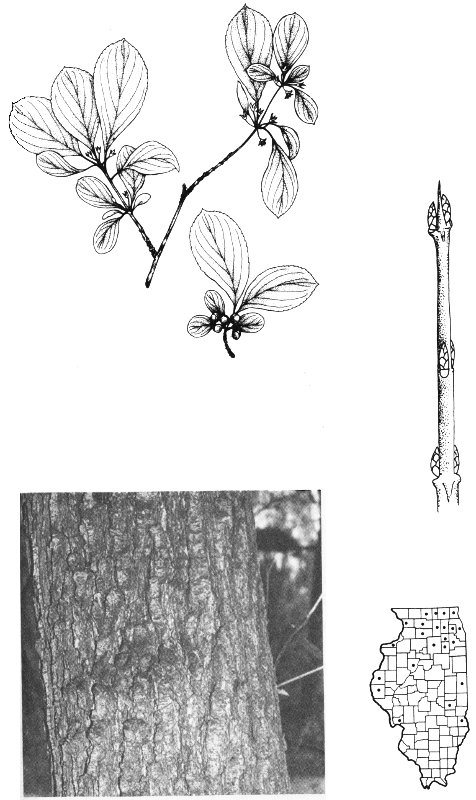
276
SHINING SUMAC Rhus copallina L.
Other Names: Dwarf Sumac; Winged Sumac.
Growth Form: Small tree to 35 feet tall; trunk diameter up to 6 inches; crown widely spreading.
Bark: Dark brown, roughened.
Twigs: Rather stout, gray-brown to reddish-brown, sometimes hairy, with conspicuous red lenticels; leaf scars alternate, U-shaped, elevated with 6-9 bundle traces.
Buds: More or less rounded, rusty-hairy, about ⅛ inch long.
Leaves: Alternate, pinnately compound, with as many as 21 leaflets; leaflets oblong to elliptic, up to 3 inches long and 1 inch broad, sharp pointed at the apex, tapering or rounded at the sometimes asymmetrical base, smooth or with low teeth along the edges, dark green, smooth and shiny on the upper surface, paler and hairy on the lower surface, all leaflets attached to a winged stalk. The leaves turn a deep red or wine color in the autumn.
Flowers: Staminate and pistillate sometimes borne on separate plants, sometimes on the same plant, sometimes in the same flower, numerous in much branched clusters, appearing from late May to mid-August, each flower greenish-yellow, small.
Fruit: Cluster of red berries, each berry round, finely hairy, up to ⅛ inch in diameter, containing a single orange seed.
Wood: Light in weight, soft, coarse-grained, pale brown.
Use: Sometimes grown as an ornamental.
Habitat: Dry hills, fields.
Range: Maine across southern Michigan to eastern Nebraska, south to Texas, east to Florida.
Distinguishing Features: The Shining Sumac is readily distinguished by the winged stalk to which the leaflets are attached.
277
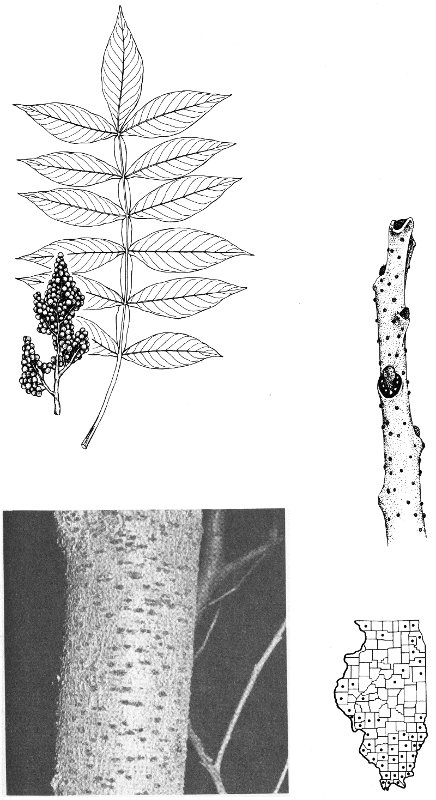
278
SMOOTH SUMAC Rhus glabra L.
Growth Form: Small tree up to 20 feet tall; trunk diameter up to 8 inches; crown widely spreading.
Bark: Light brown, smooth on young plants, becoming somewhat rough at maturity.
Twigs: Stout, angular, smooth, reddish-brown or greenish-brown and covered by a whitish coat which can be wiped off, leaf scars alternate, nearly encircling the bud, elevated, with 6-9 bundle traces.
Buds: More or less rounded, smooth, about ⅛ inch long.
Leaves: Alternate, pinnately compound, with up to 31 leaflets; leaflets lance-shaped, up to 4 inches long, less than 2 inches broad, sharp pointed at the apex, tapering or rounded at the often asymmetrical base, toothed along the edges, green and smooth on the upper surface, nearly white and smooth on the lower surface. The leaves turn red in the autumn.
Flowers: Staminate and pistillate sometimes borne on separate plants, sometimes on the same plant, sometimes in the same flower, numerous in much branched clusters, appearing from late May to mid-August, each flower greenish-yellow, small.
Fruit: Cluster of red berries, each berry round, smooth, up to ⅛ inch in diameter, containing a single brown seed.
Wood: Light in weight, soft, pale.
Use: Sometimes grown as an ornamental.
Habitat: Woods, fields, disturbed areas.
Range: Nova Scotia across to Manitoba and North Dakota, south to Texas, east to Florida; also in Mexico.
Distinguishing Features: This species lacks the winged leaf stalks of the Shining Sumac and lacks the velvety twigs of the Staghorn Sumac.
279
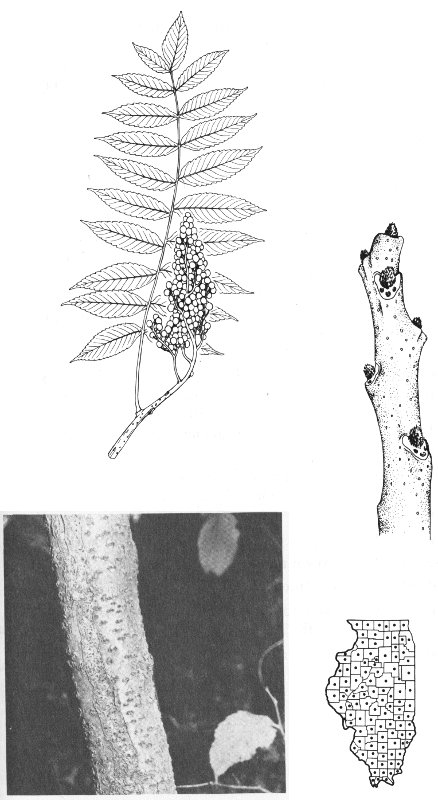
280
STAGHORN SUMAC Rhus typhina L.
Growth Form: Small to medium tree up to 40 feet tall; trunk diameter up to 15 inches; crown broadly rounded or sometimes flat.
Bark: Dark brown, smooth at first, becoming scaly in age.
Twigs: Stout, dark brown, covered by velvety hairs; leaf scars nearly encircling the twigs, with 6-9 bundle traces.
Buds: More or less rounded, hairy, about ⅛ inch long.
Leaves: Alternate, pinnately compound, with up to 31 leaflets; leaflets lance-shaped, up to 5 inches long, less than 2 inches broad, pointed at the tip, tapering or rounded at the usually asymmetrical base, toothed along the edges, dark green and smooth on the upper surface, paler and smooth except for the hairy veins on the lower surface. The leaves turn purple to red to orange in the autumn.
Flowers: Staminate and pistillate sometimes borne on separate plants, sometimes on the same plant, sometimes in the same flower, numerous in much branched clusters, appearing from June to August, each flower greenish, greenish-yellow, or reddish.
Fruit: Dense cluster of red berries, each berry round, conspicuously hairy, up to ⅛ inch in diameter, containing a single brown seed.
Wood: Light in weight, soft, coarse-grained, orange.
Use: Sometimes grown as an ornamental.
Habitat: Woods and thickets.
Range: Nova Scotia across to Minnesota, south to Iowa and Kentucky, east to North Carolina.
Distinguishing Features: The densely velvety twigs are distinctive for this species.
281
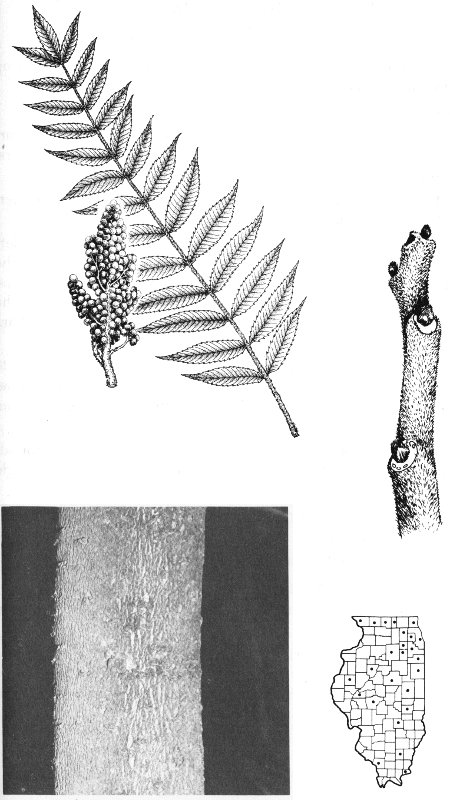
282
POISON SUMAC Rhus vernix L.
Growth Form: Small tree or shrub to 20 feet tall; trunk diameter up to 5 inches; crown narrowly rounded.
Bark: Gray, smooth.
Twigs: Rather stout, smooth, orange-brown to gray; leaf scars alternate, rounded except for where the bud is, with several bundle traces.
Buds: Rounded or somewhat pointed, about ¼ inch in diameter, except for the larger, terminal one, hairy, often purplish.
Leaves: Alternate, pinnately compound, with 7-13 leaflets; leaflets elliptic to obovate, pointed at the tip, rounded or tapering to the base, up to 4 inches long, up to half as wide, dark green and smooth on the upper surface, paler and usually smooth on the lower surface, the edges without teeth. The leaves turn a brilliant scarlet in the autumn.
Flowers: Staminate and pistillate sometimes borne on separate plants, sometimes on the same plant, sometimes in the same flower, numerous in much branched clusters, appearing from May to July, each flower greenish-yellow, small.
Fruit: Cluster of white or creamy berries, each berry round, smooth, shiny, up to ½ inch in diameter, containing a single yellow seed.
Wood: Soft, light in weight, coarse-grained, yellow-brown.
Use: Little used because of the extremely poisonous nature of most parts of the plant to the touch.
Habitat: Bogs and swampy woods.
Range: Maine across southern Ontario to Minnesota, south to Texas, east to Florida.
Distinguishing Features: This species differs from other sumacs with numerous leaflets by the absence of teeth along the edges of the leaves and by the absence of a winged stalk between the leaflets.
283
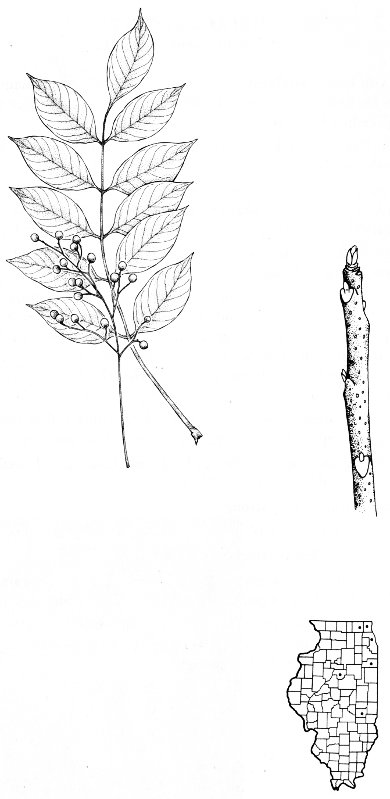
284
BLACK LOCUST Robinia pseudoacacia L.
Growth Form: Moderate tree up to 70 feet tall; trunk diameter up to 2½ feet; crown narrowly oblong, with irregularly ascending or spreading branches.
Bark: Gray or black, deeply furrowed, with numerous, elevated, scaly ridges.
Twigs: Slender but strong, angular, often zigzag, reddish-brown, with a pair of short, sharp thorns where each leaf is attached; leaf scars alternate, three-lobed, with 3 bundle traces per lobe.
Buds: Sunken in the twigs, dark brown, without bud scales, up to one-eighth inch long.
Leaves: Alternate, pinnately compound, with 7-21 leaflets; leaflets oval, rounded at both ends but usually with a short point at the tip, without teeth, blue-green and smooth on the upper surface, paler and smooth on the lower surface except for the veins, up to two inches long and nearly half as wide. The leaflets turn yellow in the autumn.
Flowers: In long, drooping clusters, white with a yellow spot, very fragrant, up to 1 inch long, appearing in May and June.
Fruit: Legumes up to 4 inches long and about ½ inch wide, flat, smooth, reddish-brown, with 4-8 seeds.
Wood: Hard, heavy, strong, brown.
Uses: Fence posts, tool handles; often planted as an ornamental.
Habitat: Woodlands, thickets, roadsides.
Range: Pennsylvania across to Oklahoma, east to Georgia; often planted in other regions of the eastern United States.
Distinguishing Features: The pinnately compound leaves with up to 21 oval, smooth-edged leaflets, together with the pairs of spines, serve to distinguish this species.
285
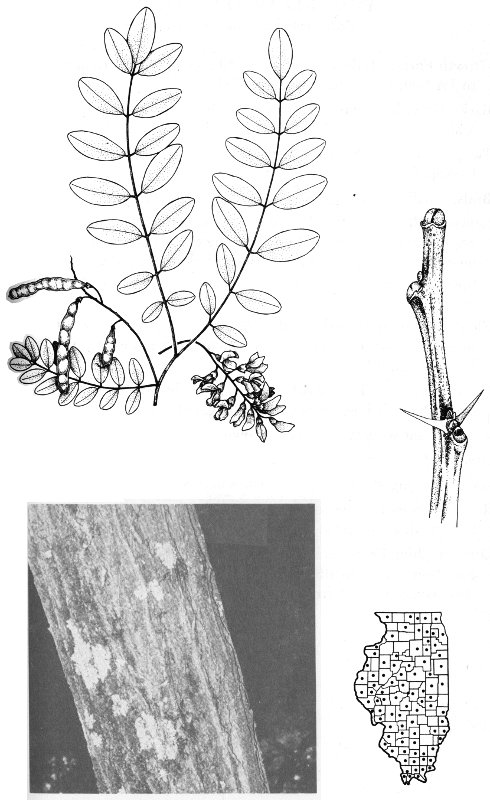
286
PEACH-LEAVED WILLOW Salix amygdaloides Anders.
Growth Form: Moderate tree up to 60 feet tall; trunk diameter up to 1½ feet; crown narrowly rounded.
Bark: Grayish-brown, shallowly furrowed, becoming somewhat scaly.
Twigs: Slender, pale brown to grayish, smooth; leaf scars alternate, U-shaped, with 3 bundle traces.
Buds: Small, oblong, brown, up to one-sixth inch long.
Leaves: Alternate, simple; blades broadly lance-shaped, long-pointed at the tip, rounded or tapering to the base, up to 5 inches long, finely toothed along the edges, dark green and shiny on the upper surface, pale on the lower surface; leaf stalks up to ½ inch long.
Flowers: Staminate and pistillate flowers borne on separate trees, minute, crowded into elongated catkins, appearing as the leaves begin to unfold.
Fruit: Several rather broad, flask-shaped, brown capsules up to one-sixth inch long, crowded in elongated clusters.
Wood: Light weight, soft, pale brown.
Use: Fuel.
Habitat: Along streams, around lakes and ponds.
Range: Vermont across southern Ontario to British Columbia, south to New Mexico, east across southern Illinois to central New York.
Distinguishing Features: This willow has broader leaves than almost any other willow in Illinois. The pale lower surface of the leaves also distinguishes it from the Black Willow.
287
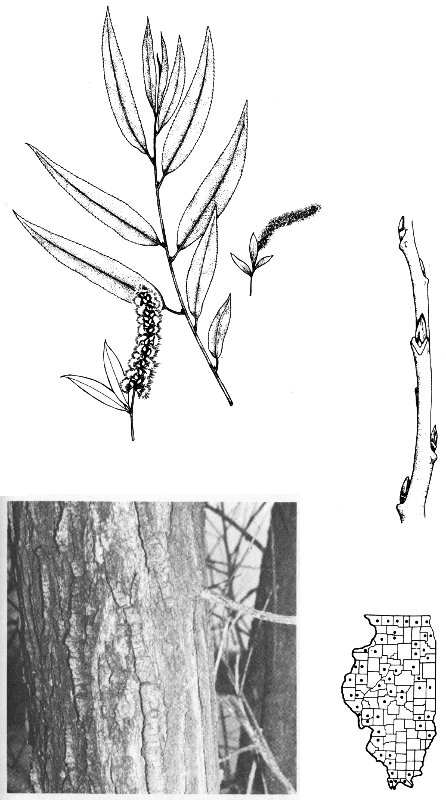
288
CAROLINA WILLOW Salix caroliniana Michx.
Other Name: Ward’s Willow.
Growth Form: Medium tree to 40 feet tall; trunk diameter up to 1 foot; crown widely spreading, often irregular.
Bark: Dark brown to gray to black, scaly and ridged.
Twigs: Slender, brown, usually finely hairy; leaf scars alternate, U-shaped, with 3 bundle traces.
Buds: Small, oblong, reddish-brown, smooth, up to one-eighth inch long.
Leaves: Alternate, simple; blades lanceolate, long-pointed at the tip, tapering to the base, up to 5 inches long and up to 1 inch broad, finely toothed along the edges, green and smooth on the upper surface, whitish and smooth on the lower surface; stipules conspicuous; leafstalks up to ½ inch long, hairy.
Flowers: Staminate and pistillate flowers borne on separate trees, appearing as the leaves begin to unfold, crowded in elongated, yellowish, hairy catkins.
Fruit: Several narrow, flask-shaped, brownish capsules up to ¼ inch long, crowded in elongated clusters.
Wood: Light weight, soft, not strong.
Use: Fuel.
Habitat: Moist woods, along streams.
Range: Maryland across southern Illinois to Kansas, south to Texas and Florida.
Distinguishing Features: The leaves of the Carolina Willow are shaped similarly to those of the Black Willow, but differ by being whitened on the lower surface.
289
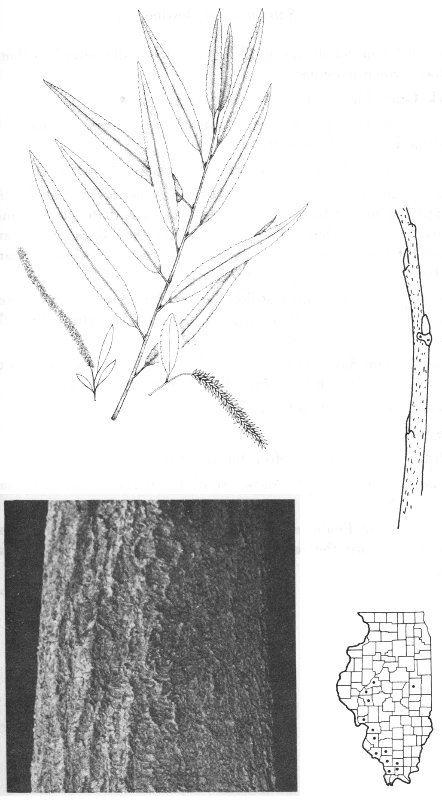
290
SANDBAR WILLOW Salix interior Rowlee
Growth Form: Small tree to 25 feet tall; trunk diameter less than 1 foot; crown irregular.
Bark: Gray, furrowed, broken into rough scales.
Twigs: Slender, grayish-green, smooth; leaf scars alternate, U-shaped, with 3 bundle traces.
Buds: Small, oblong, pale brown, up to one-sixth inch long.
Leaves: Alternate, simple; blades very narrow, pointed at the tip, tapering to the base, to 4 inches long, less than one-half inch broad, with widely spaced teeth along the edges, green and usually smooth on both surfaces when mature; leafstalks nearly absent.
Flowers: Staminate and pistillate flowers borne on separate trees, minute, crowded into elongated catkins, appearing when the leaves are partly grown.
Fruit: Several flask-shaped, brownish, smooth or silky capsules up to one-eighth inch long, crowded in elongated clusters.
Wood: Light weight, soft, weak.
Use: Fuel.
Habitat: Along streams, often forming thickets.
Range: Quebec across to Alaska, south to Oklahoma and Arkansas, east to Maryland.
Distinguishing Features: The best characteristics to identify this small tree are the narrow leaves with the teeth relatively far apart.
291
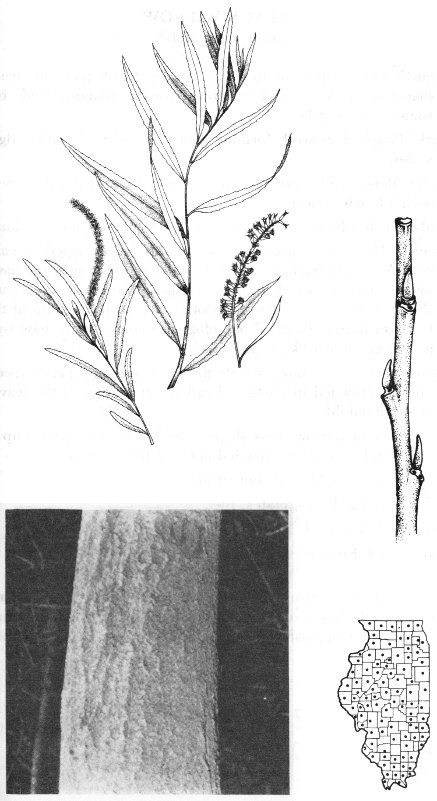
292
BLACK WILLOW Salix nigra Marsh.
Growth Form: Medium to large tree up to 90 feet tall; trunk diameter up to three feet; crown usually round-topped, but sometimes irregular.
Bark: Rough, furrowed, forming elongated, vertical, rather tight scales.
Twigs: Slender, olive-green, smooth; leaf scars alternate, U-shaped, with 3 bundle traces.
Buds: Small, oblong, reddish-brown, up to one-eighth inch long.
Leaves: Alternate, simple; blades narrowly lance-shaped, usually curved, long-pointed at the tip, rounded or tapering at the base, up to 6 inches long, finely toothed along the edges, green and shiny on the upper surface, smooth or hairy on the veins of the lower surface; leafstalks short, often surrounded at the base by a pair of green leaf-like stipules.
Flowers: Staminate and pistillate flowers borne on separate trees, minute, crowded in elongated catkins, appearing as the leaves begin to unfold.
Fruit: Several narrow, flask-shaped, reddish-brown capsules up to one-eighth inch long, crowded in elongated clusters.
Wood: Light weight, soft, not strong.
Uses: Flooring, boxes, crates, fuel.
Habitat: Wet ground, frequently along rivers and streams.
Range: New Brunswick across to Ontario, south to Texas, east to Florida.
Distinguishing Features: The narrow lance-shaped leaves which are green on the lower surface and which have many fine teeth along the edges distinguish this willow from other willows in Illinois.
293
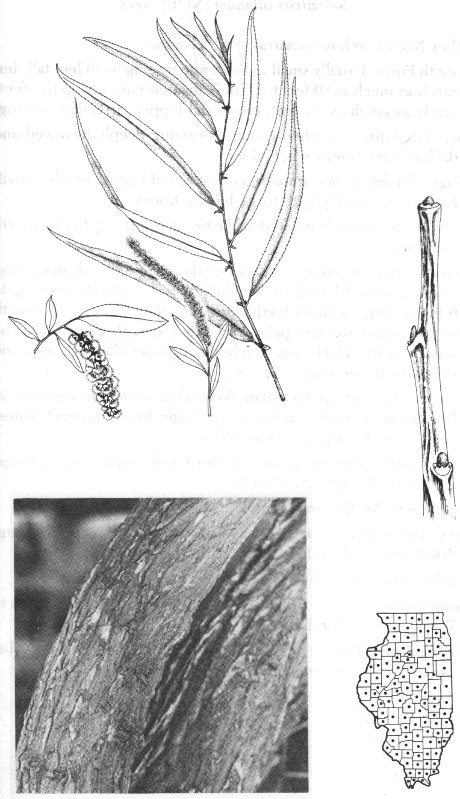
294
SASSAFRAS Sassafras albidum (Nutt.) Nees
Other Names: White Sassafras; Red Sassafras.
Growth Form: Usually small to moderate tree up to 40 feet tall, but rarely as much as 80 feet tall; trunk diameter usually up to 2 feet, rarely as much as six feet; crown flat-topped, irregular, oblong.
Bark: Greenish-gray when young, becoming deeply furrowed and dark reddish-brown when older.
Twigs: Slender, green, smooth, aromatic; leaf scars alternate, small, half-round, usually with three bundle traces.
Buds: Ovoid, scarcely pointed at the tip, greenish, up to one-fourth inch long.
Leaves: Alternate, simple; blades of three different shapes, some 3-lobed, some 2-lobed, some unlobed, tapering to the base, up to 6 inches long, without teeth along the edges, green and smooth on the upper surface, paler and either smooth or hairy on the lower surface. The leaves turn brilliant shades of orange, red, and yellow in the autumn.
Flowers: Staminate and pistillate flowers borne on separate trees, in few-flowered clusters as the leaves begin to unfold, each flower about ⅓ inch long, greenish-yellow.
Fruit: Dark blue berries about one-third inch long in deep red cups and on stalks up to 2 inches long.
Wood: Soft, brittle, orange-brown.
Uses: Fence posts; the roots are strongly aromatic and are dug, dried, and used in the making of sassafras tea.
Habitat: Roadsides, old fields, woods.
Range: Maine across to Michigan and (formerly) Wisconsin, south to Texas, east to Florida.
Distinguishing Features: The Sassafras is distinguished by its distinctively shaped, aromatic leaves and its green twigs.
295
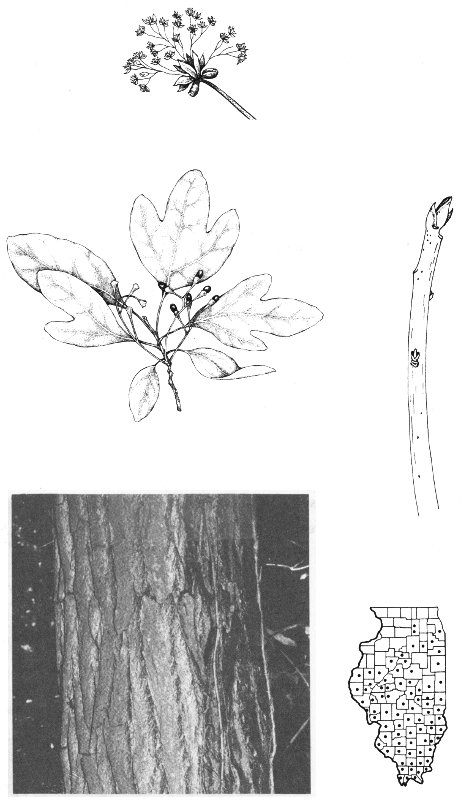
296
BALD CYPRESS Taxodium distichum (L.) Rich.
Growth Form: Large tree to over 100 feet tall; trunk diameter up to 8 feet; crown open and spreading to pyramidal; base of trunk often swollen; “knees” usually produced if tree is growing in water.
Bark: Pale reddish-brown, broken into numerous thin scales, becoming fibrous.
Twigs: Slender, reddish-brown; leaf scars absent.
Buds: Spherical, up to ⅛ inch in diameter, pale brown.
Leaves: Needles borne singly, pointed at the tip, up to ¾ inch long, yellow-green, falling away during the autumn.
Flowers: Staminate borne in branched clusters up to 5 inches long, purplish; pistillate few to several near the ends of the twigs, spherical.
Fruit: Cones nearly spherical, up to 1 inch in diameter, green to brown, wrinkled in appearance.
Wood: Soft, durable, light in weight, brown.
Uses: Railroad ties, fence posts, barrels, bridges; often planted as an ornamental.
Habitat: Swamps and low, wet woods.
Range: New Jersey across to southern Illinois and southern Missouri to eastern Texas, east to Florida.
Distinguishing Features: Bald Cypress is distinguished by the feathery appearance of its leaves and by its spherical, wrinkled cones.
297
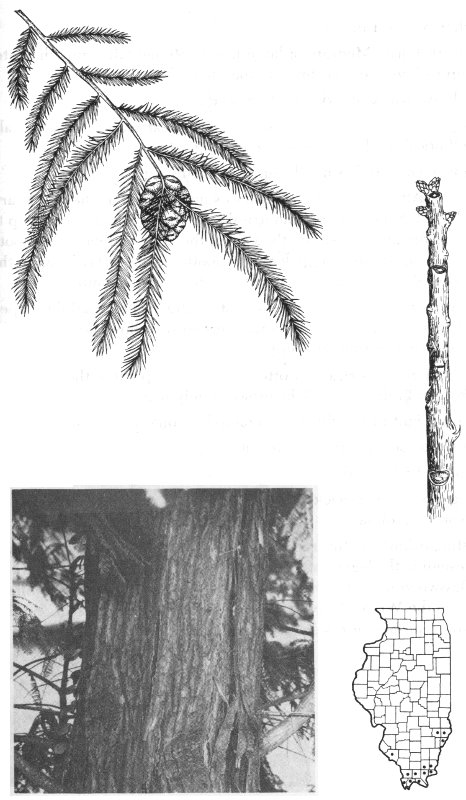
298
BASSWOOD Tilia americana L.
Other Name: Linden.
Growth Form: Medium or large tree to 80 feet tall; trunk diameter up to 2 feet; crown broadly rounded.
Bark: Brown, scaly, deeply furrowed.
Twigs: Slender, gray or brown, smooth; leaf scars alternate, half-elliptical, with 3 to several bundle traces.
Buds: Ovoid, red, smooth, up to ¼ inch long.
Leaves: Alternate, simple; blades ovate, pointed at the tip, heart-shaped at the very asymmetrical base, up to 8 inches long, up to ⅔ as broad, coarsely toothed along the edges, green and smooth on the upper surface, paler and smooth or with tufts of hair on the lower surface; leafstalks up to 2 inches long, smooth.
Flowers: Few in clusters on a long stalk attached to a paddle-shaped structure, each flower fragrant, greenish-yellow, with 5 petals, appearing in June and July.
Fruit: Hard, spherical but often with a short point at the tip, up to ⅓ inch in diameter, light brown, finely hairy.
Wood: Light in weight, close-grained, strong, not durable.
Uses: Coarse construction, furniture, paper pulp, fuel.
Habitat: Rich woods.
Range: New Brunswick across to Manitoba, south to Texas, east to North Carolina.
Distinguishing Features: The large, heart-shaped leaves sometimes resemble the leaves of the Red Mulberry, but the leafstalks of the Basswood do not have milky sap in them. The Basswood differs from the White Basswood by the virtual absence of hairs on the lower surface of the leaves.
299
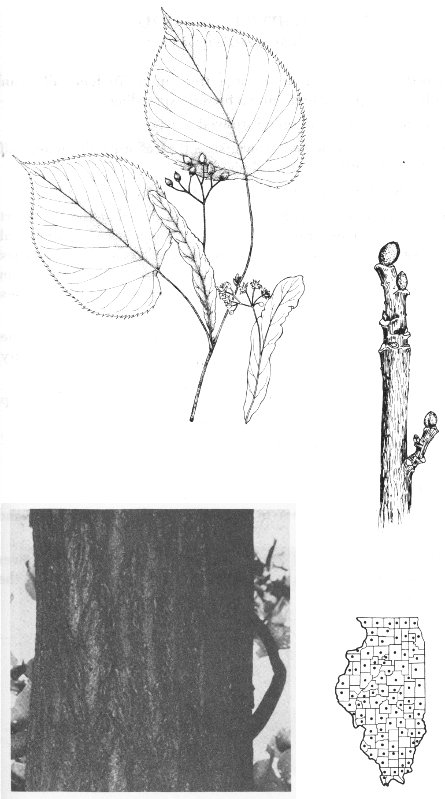
300
WHITE BASSWOOD Tilia heterophylla Vent.
Growth Form: Medium to large tree up to 70 feet tall; trunk diameter up to 2 feet; crown broadly spreading.
Bark: Brown, scaly, deeply furrowed.
Twigs: Slender, pale red-brown, smooth; leaf scars alternate, half-elliptical, with 3 to several bundle traces.
Buds: Ovoid, red, usually smooth, up to ¼ inch long.
Leaves: Alternate, simple; blades ovate, pointed at the tip, heart-shaped at the asymmetrical base, up to 6 inches long, about half as wide, coarsely toothed along the edges, green and more or less smooth on the upper surface, densely covered with white hairs on the lower surface; leafstalks up to 2 inches long, more or less smooth.
Flowers: Several in clusters on a long stalk attached to a paddle-shaped structure, each flower fragrant, greenish-yellow, hairy, with 5 petals, appearing in June and July.
Fruit: Hard, more or less spherical, somewhat pointed at the tip, up to ⅓ inch in diameter, reddish-brown, finely hairy.
Wood: Light in weight, close-grained, strong, not durable.
Uses: Paper pulp, fuel.
Habitat: Low, moist woods.
Range: New York across to Missouri, south to Mississippi and Georgia.
Distinguishing Features: The dense coat of white hairs on the lower surface of the leaves distinguishes the White Basswood from the Basswood.
301
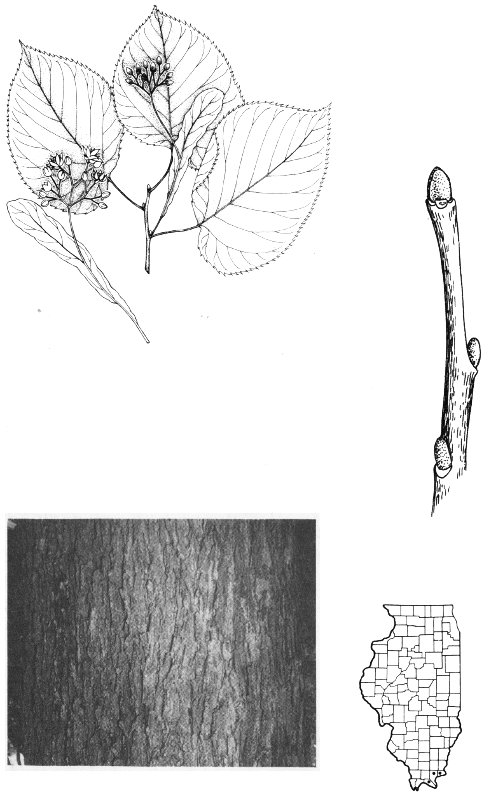
302
WINGED ELM Ulmus alata Michx.
Other Name: Wahoo Elm.
Growth Form: Small or moderate tree to 60 feet tall; trunk diameter up to 2 feet, but usually much smaller; crown oblong and relatively narrow.
Bark: Dark gray, with shallow furrows.
Twigs: Slender, gray or brown, more or less zigzag, smooth, often with corky wings; leaf scars alternate, half-round, each with 3 bundle traces.
Buds: Narrow, pointed, brown, smooth or slightly hairy, up to one-fourth inch long.
Leaves: Alternate, simple; blades elliptic to oblong-lanceolate, pointed at the tip, rounded at the slightly asymmetrical base, up to three inches long, doubly toothed along the edges, green and smooth or slightly roughened on the upper surface, paler and hairy on the lower surface; leafstalks short, stout, hairy.
Flowers: In drooping clusters of 2-7, appearing before the leaves unfold, greenish, hairy, small.
Fruit: Oblong, winged, up to one-third inch long, hairy along the edges, each wing notched at the top and surrounding a single central seed.
Wood: Heavy, hard, pale brown.
Uses: Tool handles, small wooden articles.
Habitat: Dry cliffs, wooded slopes, rarely low woods.
Range: Virginia across to Missouri, south to Texas, east to Florida.
Distinguishing Features: The corky wings identify the Winged Elm from all other Illinois elms except the Rock Elm. It differs from the Rock Elm by its shorter, hairy leaf stalks and its usually smaller leaves.
303
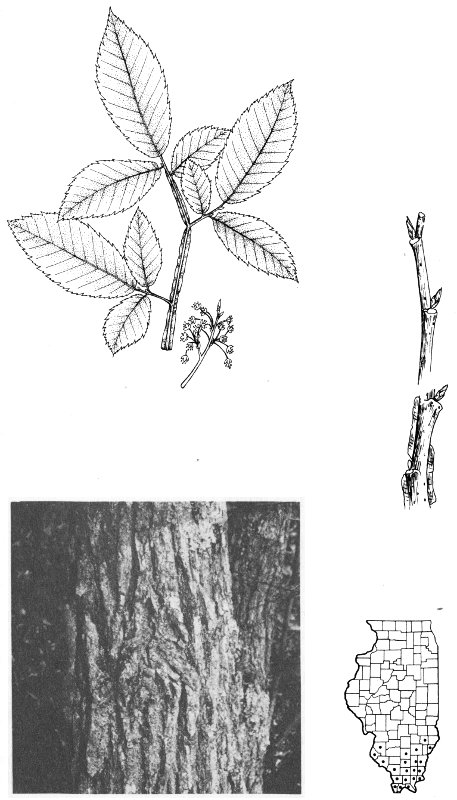
304
AMERICAN ELM Ulmus americana L.
Other Name: White Elm.
Growth Form: Large tree up to 80 feet tall; trunk diameter up to 4 feet; crown broadly rounded or sometimes flat-topped, usually with drooping branchlets.
Bark: Light or dark gray, furrowed, at maturity breaking into thin plates.
Twigs: Brown, slender, smooth or sparsely hairy, often zigzag; leaf scars alternate, half-round, each with 3 bundle traces.
Buds: Broadly ovoid, reddish-brown, smooth or sparsely hairy, up to one-fourth inch long.
Leaves: Alternate, simple; blades oval to elliptic, pointed at the tip, strongly asymmetrical at the base, up to 6 inches long and about half as wide, coarsely doubly toothed along the edges, the upper surface dark green and smooth, the lower surface pale and either softly hairy or smooth; leafstalks very short, usually yellow.
Flowers: In drooping clusters of 3-4, appearing before the leaves unfold, greenish-red, hairy, small.
Fruit: Oval, winged fruits up to one-half inch long, hairy along the edges, each wing notched at the top and surrounding a single central seed.
Wood: Heavy, strong, pale brown.
Uses: Flooring, farm implements, shipbuilding; frequently planted as an ornamental and as a shade tree, but greatly diminished in number by the Dutch Elm disease and phloem necrosis.