DESCRIPTIONS OF LUMBERING OPERATIONS ON THE VARIOUS RIVERS OF MAINE AND NEW BRUNSWICK.
Reading edition
BY JOHN S. SPRINGER.
NEW YORK: HARPER & BROTHERS, PUBLISHERS, 82 CLIFF STREET.
1851.
Entered, according to Act of Congress, in the year one thousand eight hundred and fifty-one, by
Harper & Brothers,
in the Clerk's Office of the District Court of the Southern District of New York.
PREFACE.
The writer of the following pages was reared among the Pine forests of Maine, and has spent several of the most pleasant years of his life in active participation in many of the scenes here delineated.
The incidents he has related are real, and in no case is the truth sacrificed to fancy or embellishment.
When the author commenced writing, his motive was to indulge somewhat in pleasant reminiscences of the past, and to live over again that portion of his life which, in general, was so pleasantly spent among the wild mountains, forests, lakes, and rivers of Maine. It was during this retrospective exercise with his pen that the idea of writing a book, embracing his own experience and observations during the time in which he participated in the lumberman's life, suggested itself.
Recollecting that, while the life, habits, and adventures of many classes of men had engaged the attention of the reading community, and that, among the multitude of narratives issued from the press, nothing of interest or importance had been put forth exemplifying the life and adventures of a very large class of persons known as lumbermen, he naturally became possessed with a desire to entertain others with some relation of what appeared to him to afford sufficient material for a book of some interest, and chiefly because the matter it might embrace had never been presented in a connected detail.
Suggesting the substance of what has already been said to several intelligent lumbermen, an interest was at once awakened in their feelings upon the subject, accompanied with an urgent request that the plan should be prosecuted, and that a work should be prepared which might make their pursuits, adventures, and hardships more generally known. To many of these friends the author is also indebted for some assistance in furnishing statistical matter.
In incorporating the somewhat lengthy notice of Forest Trees, forming the first part of this volume, the author has ventured to make his own taste and feelings the criterion by which he has been guided in his selections and observations for the reader, and although they may not hold a strict relation to the narrative, he hopes that they may not be deemed inappropriate or uninteresting.
This volume makes no pretensions to literary merit; sooner would it, indeed, claim kindred with the wild and uncultivated scenes of which it is but a simple relation.
In justice to the gentlemen whom he has quoted in arranging the statistical portion of this volume, as well as to himself, the author would state that the material was procured some four years ago. The statement of this fact may account for any discrepancy which may appear from more recent accounts of the lumbering interests, should they be found to vary from the representations here made.
The Author.
PART I. TREES OF AMERICA.
PART II. THE PINE-TREE, OR FOREST LIFE.
PART III. RIVER LIFE.
CONTENTS.
PART I.
TREES OF AMERICA.
CHAPTER I.
Trees, how regarded by Lumbermen.—Cedars of Lebanon.—Oldest Tree on Record.—Napoleon's Regard for it.—Dimensions.—Durability of the Cedar, how accounted for.—The Oak.—Religious Veneration in which it was held by the Druids.—The Uses to which their Shade was appropriated.—Curious Valuation of Oak Forests by the Ancient Saxons.—The Number of Species.—Its Value.—Remarkable old Oak in Brighton.—Charter Oak.—Button-wood Tree.—Remarkable Rapidity of its Growth.—Remarkable Size of one measured by Washington.—by Michaux.—Disease in 1842, '43, and '44.—The Oriental Plane-tree —Great Favorite with the Ancients.—Cimon's Effort to gratify the Athenians.—Pliny's Account of its Transportation.—The Privilege of its Shade a Tax.—Used as an Ornament.—Nourished with Wine.—Hortensius and Cicero.—Pliny's curious Account of one of remarkable Size 13
CHAPTER II.
The Elm.—English Elm.—Scotch Elm.—Slippery Elm.—American Elm.—Superiority of latter.—Different Shapes, how accounted for.—Great Elm on Boston Common.—Rapidity of Growth.—The Riding Stick.—Remarkable Dimensions of noted Trees.—Boston Elm again.— Its Age.—By whom set out.—Washington Elm, why so named.—"Trees of Peace," a Tribute of Respect.—English Elm in England and America.—Uses in France.—In Russia.—Birch Family.—Its Variety and Uses.—The Maple Family.—Number of Species.—Red Maple.—Unrivaled Beauty of American Forests.—Rock Maple.—Amount of Wood cut from one in Blandford.—Curious method of distinguishing it from the River Maple.—Amount and Value of the Sugar in Massachusetts.—Great Product from one Tree.—Sugar Maple in the State of Maine.—Dr. Jackson's Reports, &c. 19
CHAPTER III.
Beech-trees.—Purity, Size, Fruit.—Efforts of Bears after the Nut.—The Uses to which its Leaves are appropriated.—Mr. Lauder's Testimony, &c.—Use of Wood.—Singular Exemption.—The novel Appearance of the Leaves of a Species in Germany.—Chestnut-tree —Remarkable one on Mount Ætna.—Balm of Gilead.—Willow.—Ash.— Basswood, or Tiel-tree.—The Poplar.—The Hemlock.—Beauties of its Foliage.—Uses.—Hickory.—The Fir-tree.—Spruce-tree.—Its conical Form.—Uses.—American Larch.—Success of the Dukes of Athol in planting it on the Highlands of Scotland 28
PART II.
THE PINE-TREE, OR FOREST LIFE.
CHAPTER I.
The Pines.—White Pines: rank claimed for this Variety.—Predilections. —Comparison instituted.—Pitch and Norway Pines.—White Pine.— Magnitude.—New York Pines.—Lambert's Pine on Northwest Coast.— Varieties.—Its Rank.—Great variety of purposes to which it is devoted.—Great Pine near Jackson Lake.—Capital Invested.—Hands employed on the Penobscot 37
CHAPTER II.
The Pine twenty-five Years ago.—Its rapid Disappearance.—Explorations.—Outfit.—Up-river Journeying.—Its Distance.—Mode of Nightly Encampment.—Cooking.—Disturbed Slumbers. —Ludicrous Fright.—Deer.—Encounter with Bears.—Mode of Exploring. —Forest Observatory.—Climbing Trees.—The Emotions excited by the View.—Necessity of Compass.—Nature's Compass.—The Return.— Annoyances from mischievous Bears.—Stumpage.—Permits.—Outfit and Return.—Crossing Carrying-places.—A Strong Man.—Skill of Boatmen.—Item of personal Experience.—Blind Path.—A Family in the Wilderness.—Things to be considered in locating Camps 44
CHAPTER III.
Method of constructing Camp and Hovel.—Timber.—Covering.—Arrangement of Interior.—The Bed.— Deacon Seat.—Ingenious Method of making a Seat.—Cooking: superior Method of Baking.—The nightly Camp Fire.—Liabilities from taking Fire.—A Camp consumed.—Men burned to Death.—Enjoyment.—The new Camp: Dedication.—A Song.—A Story.—New Order in Architecture.— Ox Hovel.—Substitute for Lime.—The Devotedness of the Teamster. —Fat and lean Cattle.—Swamping Roads.—Clumps of Pine.—The points of Interest in a Logging Road.—The Teamster's Path.—Regret.—The peculiar Enjoyment of Men thus engaged 65
CHAPTER IV.
Tokens of Winter.—The Anticipation.—Introduction of Team.— Difficulties attending it.—Uncomfortable Boating.—The Contrast. —Method of crossing Streams and Rivers.—The Docility of the Ox. —Facilities of Turnpikes.—Stopping-places.—Arrival.—An Adventure.—Ten Oxen in the Ice.—Method of taking them Out.—An uncomfortable Night.—The midnight Excursion.—Oxen running at large in the Wilderness.—Developments of Memory.—Logging.—Division of Labor.—How to manage in the absence of a Cook.—"Uncle Nat."— Anecdote.—Felling Pines.—Ingenuity of Choppers.—Preparatory Arrangements.—The Bob-sled.—Method of Operation described.— The Excitement.—Comparison.—Immediate Length of Pine-trees. —Conclusion 83
CHAPTER V.
The Skill and Enterprise of Lumbermen.—Method of taking Logs down Hills and Mountains.—Dry Sluice.—Stern Anchor.—Giant Mountain Steps.—Alpine Lumbering.—Warping a Team down Steeps.—Trial of Skill and Strength.—The rival Load.—Danger and Inconvenience of Hills in Logging Roads.—A distressing Accident.—Solemn Conclusion of a Winter's Work.—Some of the Perils attendant upon Lumbering.— A fearful Wound.—Narrow Escape.—The buried Cap.—The safest Way of Retreat.—A Sabbath in the Logging Camp.—Sunday Morning Naps.—Domestic Camp Duties.—Letter Writing.—Recreations.—Sable Traps.—Deer and Moose.—Bear Meat.—A rare Joke.—Moose Hunt.— Bewildered Hunters.—Extraordinary Encounter.—Conclusion of Sabbath in the Woods 100
CHAPTER VI.
Camp Life.—Winter Evenings.—An Evening in Camp.—Characters.— Card-playing.—A Song.—Collision with wild Beasts.—The unknown Animal in a Dilemma.—"Indian Devil."—The Aborigines' Terror.—A shocking Encounter.—The Discovery and Pursuit.—The Bear as an Antagonist.—Their thieving Propensities.—A thrilling Scene in the Night.—A desperate Encounter with three Bears 129
CHAPTER VII.
Provision Teams.—Liabilities.—A Night in the Woods.—Traveling on Ice.—A Span of Horses lost.—Pat's Adventure.—Drogers' Caravan. —Horses in the Water.—Recovery of a sunken Load.—Returning Volunteers from Aroostook.—Description of a Log Tavern.—Perils on Lakes in Snow-storms.—Camping at Night.—Rude Ferry-boats 142
PART III.
RIVER LIFE.
CHAPTER I.
"Breaking Up."—Grotesque Parading down River.—Rum and Intemperance. —Religious Rites profaned.—River-driving on Temperance Principles. —The first Experiment.—A spiritual Song 149
CHAPTER II.
Log-landing.—Laborious Exposure.—Damming Streams.—Exciting Scenes.—Log-riding.—Fun.—Breaking a Dry-landing.—A sudden Death.—Thrilling Scenes on the "Nesourdnehunk."—Lake-driving.— Steam Tow-boat.—Remarks on Lake Navigation.—Driving the main River.—Union of Crews.—Substantial Jokes.—Log Marks.—Dangers of River-driving.—Sad Feelings over the Grave of a River-driver. —Singular Substitute for a Coffin.—Burial of a River-driver.— A Log Jam.—Great Excitement.—A Boat swamped.—A Man drowned.— Narrow Escape.—Mode of Living on the River.—Wangun.—Antidote for Asthma.—The Wangun swamped.—An awful Struggle.—The miraculous Escape.—Driving among the Islands.—Amusing Exertions at identifying.—Consummation of Driving.—The Claims of lumbering Business for greater Prominence.—The Boom 155
CHAPTER III.
Observations on the St. Croix River.—Boundary Line.—Pine Timber. —Agriculture in the Interior.—Youthful Associations with Grand Lake.—Traditionary Name of Grand Lake.—Lake Che-pet-na-cook.— Rise of Eastern Branch St. Croix.—Lumbering Prospects.—Hemlock. —Reciprocal Relations of the Lumber Trade between Americans and Provincials.—The Machias Rivers.—Origin of Name.—Character of Soil.—Lumber Resources and Statistics.—West Machias.—Narraguagues River, curious Definition of.—Capacity of Stream.—Statistics.— Union River.—Observations on its Lumbering Interests.—Mills in Franklin 176
CHAPTER IV.
Penobscot River.—Its various Names.—Character of the Country through which it flows.—Its Length.—The vast Extent of Territory which it drains.—Its Multitude of Lakes.—Mount Ktaadn.—Indian Legend.— Elevation of the Mountain.—Overwhelming Prospect.—A Sabbath in the Wilderness.—Moose in the Lake.—An uncomfortable Night.—Dr. Jackson's Narrative.—New Lumber Resources.—The interesting Origin of this new Resource.—John Bull outwitted.—Freshets on the Penobscot.—Freshet of 1846, cause of it.—Sudden Rise of Water. —Bangor submerged.—Bowlders of Ice.—Destruction of Property.— Narrow Escape of Ferry-boat.—Peril of Boys.—Editorial Observations. —Lumber Statistics.—Where the Lumber finds a Market.—Speculations on future Prospects of Lumbering Interests.—Anticipations of the Future.—Bangor 186
CHAPTER V.
Length of Kennebeck.—Moose-head Lake.—Its peculiar Shape.—Its Islands.—Burned Jacket.—Interesting Deposit.—Mount Kineo.—The Prospect from its Summit.—Moose River.—Old Indian.—The Banks of the Kennebeck.—Beauties of the Country, &c.—Lumber on Dead River. —Falls at Waterville.—Skowhegan Falls.—Arnold's Encampment.— Nau-lau-chu-wak.—Caritunk Falls.—Lumber.—Statistics.—Author's Acknowledgments.—Androscoggin.—Course and other Peculiarities. —A question of Rivalry.—Water Power.—Original Indications.— Interesting Sketch of Rumford Falls.—Estimated Water Power.— Lumber Statistics.—Droughts and Freshets.—Umbagog Lake.—The serpentine Megalloway.—Granite Mountains.—Beautiful Foliage.— Romantic Falls.—Character of Country.—Manner of Life in Log-cutting, &c.—Statistics, &c.—Presumpscot River, great Water-powers of.—Warmth of Water.—Statistical Remarks.—Saco River 227
CHAPTER VI. NEW BRUNSWICK.
Object of the Chapter.—Description of St. John's River.—First Falls.—Contiguous Country.—"Mars Hill."—Prospect.—Grand Falls. —The Acadians, curious Facts respecting them.—The Mirimachi River.—Immense amount of Timber shipped.—Riots.—State of Morals.—The great Mirimachi Fire.—Hurricane.—Destruction of Human Life.—Area of the Fire.—Vessels in Harbor.—Painfully disgusting Sights.—-Destruction among Fish.—Fire, rapidity of Progress.—Curious instance of Escape.—Ristigouche River, its Length.—Capacious Harbor.—Appearance of the Country.—High Banks.—Groves of Pine.—A Statistical Table 244
LIST OF ENGRAVINGS.
Frontispiece—Moose Deer.
Shooting Deer—Black Bear 49
Winter Quarters of Lumbermen 69
Log Hauling—Process of Loading Logs 95
The Common Wolf 113
Log Tavern in the Wilderness 146
River Drivers Breaking a Jam 165
A Coaster ascending the Penobscot for Lumber 187
View of the Penobscot—Forests and Lakes northeast from Ktaadn 189
Northeast View of Mount Ktaadn, from the west Branch of the Penobscot 199
Godfrey's Falls, on the Seboois River 208
Chase's Mountain, as seen from Sugar-loaf Mountain 211
Sugar-loaf Mountain, on the Seboois River 225
View of Lily Bay, on Moose-head Lake 228
Skowhegan Falls, on the Kennebeck 231
Rumford Falls, on the Androscoggin 235
View of Umbagog Lake—Source of the Androscoggin 237
Frye's Falls, on a Tributary of Ellis River 238
Rumford Bridge, Androscoggin River 239
Aroostook Falls 250
FOREST LIFE AND FOREST TREES.
PART I.
CHAPTER I.
Trees, how regarded by Lumbermen.—Cedars of Lebanon.—Oldest Tree on Record.—Napoleon's Regard for it.—Dimensions.—Durability of the Cedar, how accounted for.—The Oak.—Religious Veneration in which it was held by the Druids.—The Uses to which their Shade was appropriated.—Curious Valuation of Oak Forests by the Ancient Saxons.—The Number of Species.—Its Value.—Remarkable old Oak in Brighton.—Charter Oak.—Button-wood Tree.—Remarkable Rapidity of its Growth.—Remarkable Size of one measured by Washington.—by Michaux.—Disease in 1842, '43, and '44.—The Oriental Plane-tree. —Great Favorite with the Ancients.—Cimon's Effort to gratify the Athenians.—Pliny's Account of its Transportation.—The Privilege of its Shade a Tax.—Used as an Ornament.—Nourished with Wine.— Hortensius and Cicero.—Pliny's curious Account of one of remarkable Size.
Lumbermen are accustomed to classify and rate forest trees by the lower, middle, and higher grades, just as animals are classified, from the muscle, through the intermediate grades, up to man, the crowning master-piece of the Creator's skill. But while man is universally recognized as first in the scale of animated nature, there is less uniformity of sentiment in respect to trees, as to which is entitled to hold the first rank in the vegetable kingdom. In the days of King David and Solomon, the noble Cedars of Lebanon held the pre-eminence, and were celebrated in verse as emblems of beauty, grandeur, and especially of durability; but "with the moderns the Cedar is emblematical of sadness and mourning":
"Dark tree! still sad when others' grief is fled— The only constant mourner of the dead."—Byron.
"Perhaps the oldest tree on record is the Cypress of Somma, in Lombardy. It is supposed to have been planted in the year of the birth of Christ, and on that account is looked upon with reverence by the inhabitants; but an ancient chronicle at Milan is said to prove that it was a tree in the time of Julius Cæsar, B.C. 42. It is one hundred and twenty-three feet high, and twenty-three feet in circumference at one foot from the ground. Napoleon, when laying down the plan for his great road over the Simplon, diverged from a straight line to avoid injuring this tree." [1]
"The Cedar was styled the glory of Lebanon. The Temple of Solomon and that of Diana at Ephesus were built of this wood. The number of these trees is now greatly diminished. They were often of vast size, sometimes girting thirty-six feet, perfectly sound, with a lofty height, whose spreading branches extended one hundred and ten feet." The durability of the Cedar is said to be attributable to two qualities: "1st, the bitterness of the wood, which protects it from the depredations of worms; and, 2dly, its resin, which preserves it from the injuries of the weather."
To the Oak some assign the first rank. It is celebrated in the East, and by many of the ancients was regarded with religious veneration. In the West, and by moderns, it is employed more as an emblem of the strength, compactness, and durability of the state.
"The religious veneration paid to this tree by the original natives of Britain, in the time of the Druids, is well known to every reader of British history." The patriarch Abraham resided under an Oak, or a grove of Oaks; and it is believed that he planted a grove of this tree. "In fact, since, in hot countries, nothing is more desirable than shade—nothing more refreshing than the shade of a tree—we may easily suppose the inhabitants would resort for such enjoyment to
"Where'er the Oak's thick branches spread A deeper, darker shade."
Oaks, and groves of Oaks, were esteemed proper places for religious services; so that while the Methodist denomination may not claim originality in holding grove or camp-meetings, they may, at least, plead the usages of antiquity in their defense. Altars were set up under them; affairs of state were discussed and ratified under their ample shade.
"Abimelech was made king under an Oak." "Absalom rode upon a mule which went under the thick boughs of a great Oak, and his head caught hold of the Oak, and he was taken up between the heaven and the earth," and, while there suspended, was slain by Joab and his armor-bearers.
"In England, whose Oak forests are now one of the sources of national wealth and naval supremacy, the tree was once prized only for the acorns, which were the chief support of those large herds of swine whose flesh formed so considerable a part of the food of the Saxons. Woods of old, says Burnett, were valued according to the number of hogs they could fatten; and so rigidly were the forest lands surveyed, that, in ancient records, such as the Doomsday-book, woods are mentioned of a single hog. The right of feeding hogs in woods, called pannage, formed, some centuries ago, one of the most valuable kinds of property. With this right monasteries were endowed, and it often constituted the dowry of the daughters of the Saxon kings." [2]
Of the Oak some naturalists have enumerated twenty-four species. The wood of the White Oak is distinguished by three properties, which give to it its great value: hardness, toughness, and durability. The great variety of purposes to which it is appropriated shows it to be a tree of great value. For ship and carriage building, and in the manufacture of implements of husbandry, it is very valuable. This tree also holds rank on account of its size. In the "Report on the Trees and Shrubs of Massachusetts," notice is given of one still standing in Brighton. "In October, 1845, it measured twenty-five feet and nine inches in circumference at the surface. At three feet, it is twenty-two feet four inches; at six feet, fifteen feet two inches. It tapers gradually to the height of about twenty-five feet, where the stump of its ancient top is visible, below which point four or five branches are thrown out, which rise twenty or thirty feet higher. Below, the places of many former limbs are covered over by immense gnarled and bossed protuberances. The trunk is hollow at the base, with a large opening on the southwest, through which boys and men may easily enter. It had probably passed its prime centuries before the first English voice was heard on the shores of Massachusetts Bay. It is still clad with abundant foliage, and, if respected as its venerable age deserves, it may stand an object of admiration for centuries to come."
The Charter Oak, in Hartford, Connecticut, is said to measure at the ground thirty-six feet; and in the smallest place above it is eight feet four inches in diameter.
THE BUTTON-WOOD TREE.
This tree is "remarkable for the rapidity of its growth, especially when standing near water. Loudon mentions one which, standing near a pond, had in twenty years attained the height of eighty feet, with a trunk eight feet in circumference at three feet from the ground, and a head of the diameter of forty-eight feet." "Nowhere is this tree more vigorous than along the rivers of Pennsylvania and Virginia, and especially on the Ohio and its tributaries." 'General Washington measured a Button-wood growing on an island in the Ohio, and found its girth, at five feet from the ground, about forty feet.' "In 1802, the younger Michaux and his companions found a large tree of this kind on the right bank of the Ohio, thirty-six miles from Marietta. Its base was swollen in an extraordinary manner, but, at four feet from the ground, its circumference was found to be forty-seven feet," or fifteen feet and eight inches in diameter. It is said that "it may be propagated with more ease than any tree of the forest." "It is valuable stove fuel." S. W. Pomeroy, Esq., a writer in the New England Farmer, expresses the opinion that, on land possessing the same fertility, this tree will furnish fuel which will give the greatest amount of caloric to the acre, except the locust on dry soil.
It will be remembered that in 1842, '43, and '44, this tree appeared to be under the influence of a general blight throughout the Eastern States. Various opinions were entertained respecting the cause of the malady which occasioned so much regret. "By most persons it was considered the effect of frost, supposing the tree not to have matured its wood, viz., the new shoots, during the previous summer, so that it was incapable of resisting the effect of frost." Others ascribed it to the action of some insect or worm, and others believed it to be some unaccountable disease, while others regarded the phenomenon as a providential token of the approach of some important event unknown and unanticipated. The tree has now pretty generally recovered from its malady.
"The Oriental Plane-tree holds the same place on the Eastern continent which our Button-wood does on this." "It was the greatest favorite among the ancients." "Cimon sought to gratify the Athenians by planting a public walk with them." "It was considered the finest shade tree in Europe." "Pliny tells the story of its having been brought across the Ionian Sea, to shade the tomb of Diomedes, in the island of the hero. From thence it was taken to Sicily, then to Italy; from Italy to Spain, and even into the most remote parts of the then barbarous France, where the natives were made to pay for the privilege of sitting under its shade.
"No tree was ever so great a favorite with the Romans. They ornamented their villas with it, valuing it above all other trees for the depth of its salutary shade, &c. They nourished it with pure wine; and Hortensius is related to have begged of his rival, Cicero, to exchange turns with him in a cause in which they were engaged, that he might himself do this office for a tree he had planted in his Tusculanum."
"Pliny describes some of the most remarkable planes. In the walks of the Academy at Athens were trees whose trunks were about forty-eight feet from the ground to the branches. In his own time there was one in Lycia, near a cool fountain by the road side, with a cavity of eighty-one feet circuit within its trunk, and a forest-like head, and arms like trees overshadowing broad fields. Within this apartment, made by moss-covered stones, to resemble a grotto, Licinius Mucianus thought it a fact worthy of history, that he dined with nineteen companions, and slept there too, not regretting splendid marbles, pictures, and golden-fretted roofs, and missing only the sound of rain drops pattering on the leaves." [3]
CHAPTER II.
The Elm.—English Elm.—Scotch Elm.—Slippery Elm.—American Elm. —Superiority of latter.—Different Shapes, how accounted for.— Great Elm on Boston Common.—Rapidity of Growth.—The Riding Stick.—Remarkable Dimensions of noted Trees.—Boston Elm again.— Its Age.—By whom set out.—Washington Elm, why so named.—"Trees of Peace," a Tribute of Respect.—English Elm in England and America.—Uses in France.—In Russia.—Birch Family.—Its Variety and Uses.—The Maple Family.—Number of Species.—Red Maple.—Unrivaled Beauty of American Forests.—Rock Maple.—Amount of Wood cut from one in Blandford.—Curious method of distinguishing it from the River Maple.—Amount and Value of the Sugar in Massachusetts.—Great Product from one Tree.—Sugar Maple in the State of Maine.—Dr. Jackson's Reports, &c.
THE ELM-TREE.
Of this family there are several varieties. The American, the English, the Scotch, and Slippery Elm. Of this enumeration, the American Elm stands first in point of ornament, while the timber of the English Elm is esteemed more highly on account of the toughness of the wood.
It has been well said that the Elm is a tree deservedly esteemed for its ornament and shade. "The American Elm assumes many different shapes, and all of them beautiful. Of these, three are most striking and distinct. The tall Etruscan vase is formed by four or five limbs separating at twenty or thirty feet from the ground, going up with a gradual divergency to sixty or seventy, and then bending rapidly outward, forming a flat top with a pendent border." "Transplanting the Elm, it is said, often produces in it a character akin to that of the Oak. It is then a broad, round-headed tree." "Of this kind is the 'Great Elm' on Boston Common."
Few trees of other species are to be found standing near the abodes of civilized life which have attained the vast dimensions of the Elm. Whatever may have been the peculiar properties of other trees, they have disappeared. Upturned by the passing hurricane, or leveled by the woodman's ax, they have passed away, while the Elm stands at our doors associated with the history and memory of the different generations which, like its autumnal sheddings, have long time ago mingled with the dust.
The Elm grows with great rapidity, which, in addition to its beauty as an ornament, secures for it the favor of man. "I once heard," says the author of Massachusetts Reports, &c., an old man, standing under the shade of a tree nearly two feet in diameter, which towered above all around it, say, "This tree, after I had been many years successful in business, and in a change of fortune had retired to this farm, with a little that remained, I stuck into the ground after I had used it as a stick in a ride of eight miles from P."
"From its having been so long a favorite, it has been more frequently spared, and oftener transplanted than any other tree. There are, in all parts of the state, many fine old trees standing." "In Springfield, in a field a few rods north of the hotel, is an Elm which was twenty-five feet and nine inches in circumference at three feet from the ground." The great Elm on Boston Common measures, at the same distance from the ground, seventeen feet eleven inches in circumference. "It is said to have been planted about the year 1670, by Captain Daniel Henchman, an ancestor of Governor Hancock. It is, therefore, more than one hundred and seventy-five years old." "There is an Elm in Hatfield, near the town-house, which measures at the ground forty-one feet; at three and one half feet from the ground it measures twenty-seven feet in circumference. The smallest place in the trunk is seven feet four inches in diameter. The top spreads over an area of one hundred and eight feet in diameter, making a circle of three hundred and twenty-four feet, covering a surface of over seven thousand five hundred square feet." "The Washington Elm, in Cambridge—so called because beneath its shade, or near it, General Washington is said to have first drawn his sword on taking the command of the American army—measured, in 1842, fifteen feet two inches at one foot, thirteen feet two at three feet from the ground. The celebrated Whitfield preached under the shade of this tree in 1744." "Two Elms were set out by the Indians in front of the house of the Rev. Oliver Peabody, who succeeded, in 1722, to the venerable Eliot, the Indian apostle, in the same truly Christian ministry, in Natick," Massachusetts. "This voluntary offering of the grateful savages they called Trees of Peace."
There is an Elm standing in front of Mr. J. Chickering's house, Westford, Massachusetts, which I recently measured eighteen inches from the ground. Its circumference was twenty feet, and its spurs were not prominent, as will be inferred from the fact that at four feet from the ground it measured eighteen feet in circumference. Seven and a half feet from the ground it divides into two branches, each of itself a very large trunk, the largest of which would measure three feet and a half in diameter. Seven or eight feet from the first division, at short intervals, the main branch, which grew on the west side next the house, divides into eight more branches, all nearly equal in size, and averaging a circumference of four and a half feet. About forty feet from the base of the tree these eight branches subdivide into twenty-one other branches, and so on indefinitely to the terminating twigs. The east main branch was divided into four principals, equal in size to the corresponding ones on the other side, and were subdivided also in the same manner as the one described.
In height it is about seventy feet, vase-topped, with a pendent border. The extent of the spreading branches, northwest and southeast, was one hundred and five feet; those corresponding with the exact opposite points of the compass extended ninety-five feet, giving an area of three hundred feet in circumference. Some of the pendent branches, which drooped within a few feet of the ground, I judged to be forty feet in length. These, stretched to a horizontal position, would give a breadth of one hundred and eighty feet to the top. Various opinions obtain respecting the number of solid feet it contains, ranging from nine to eleven hundred.
An old gentleman residing in the immediate vicinity, now eighty years old, told us that he could very well remember it when but a small tree, from which we infer its age to be about one hundred years. It appears to be perfectly sound, and now thrives as vigorously as a young sapling. It is a magnificent specimen of the vegetable kingdom, majestically imposing, awakening in the spectator a feeling of veneration in spite of himself. So ample is its wide-spreading Etruscan-shaped top, that at fifty rods' distance (were the trunk hid) one might mistake it for a group of twenty good-sized trees.
"The Slippery Elm has a strong resemblance to the common Elm. It has less of the drooping appearance, and is commonly a much smaller tree." "The inner bark of this Elm contains a great quantity of mucilage. Flour prepared from the bark, by drying perfectly and grinding, and mixed with milk, like arrowroot, is a wholesome and nutritious food for infants and invalids." "Dr. Darlington says that, in the last war with Great Britain, the soldiers on the Canada frontier found this, in times of scarcity of forage, a grateful and nutritious food for their horses."
'The English Elm is said to have been introduced by importation, and planted by a wheel-wright for his own use in making hubs for wheels, for which purpose they are probably superior to any other wood known.' In its appearance it is said to have 'less grace than the American Elm, but more stateliness and grandeur.' 'It is distinguished from the American Elm, also, by the rough, broken character of its bark, which is darker, and also by having one principal stem, which soars upward to a great height, and the boldness and abruptness with which it throws out its branches. The leaves are of a darker color, smaller, and closer.'
'The largest dimensions given of the English Elm on the Continent is sixty feet high, and twenty feet in circumference at the ground, containing two hundred and sixty-eight feet of timber.' "The Crawley Elm stands in the village of Crawley, on the high road from London to Brighton. Its trunk measures sixty-one feet in circumference at the ground, and thirty-five feet round the inside at two feet from the base. This tree is not so large as would seem from this account, as it diminishes very rapidly upward."
"The noblest and most beautiful English Elms in this country are found in Roxbury, the largest of which measures fifteen feet five inches five feet from the ground; it holds its size fully to the height of twenty or twenty-five feet, where it divides into three large branches, the main central one of which rises upward to a height much above one hundred feet." "As among the ancient Romans, so in France at the present day, the leaves and shoots are used to feed cattle. In Russia, the leaves of a species of the Elm are used as a substitute for tea. The inner bark is in some places made into mats, and in Norway they kiln-dry it, and grind it with corn as an ingredient in bread."
THE BIRCH.
Of the Birch family there are several varieties, called the Black, Yellow, Red, Canoe, the Gray, and the Dwarf. Of these the Yellow and Canoe Birches are the most interesting and useful. The general outlines of the Yellow Birch often resemble the Elm, the root-spurs rise high up the trunk, protruding much beyond the regular circle of its shaft. It is very firmly rooted, capable of withstanding a violent blast. It attains to the height of seventy or eighty feet, and often measures from nine to ten feet in circumference three and four feet from the ground. Its wood is very useful for cabinet purposes, and is excellent for fuel.
The White or Canoe Birch is most remarkable for the beautiful thin sheets of bark which it affords, from which the Indian canoe is constructed. It also makes excellent covering for a tent. In some parts of the northern regions it is said to attain a diameter of six or seven feet.
The White Birch possesses "in an eminent degree the lightness and airiness of the Birch family, spreading out its glistening leaves on the ends of a very slender and often pencil spray, with an indescribable softness. So that Coleridge might have called it as he did the corresponding European species,
"Most beautiful Of forest trees—the lady of the woods."
THE MAPLE-TREE.
This family is very numerous. "Nearly forty species are known, of which ten belong to the United States." 'The climate of New England is peculiarly favorable to their growth, as is shown by the perfection to which several of the most valuable species attain.' The Red Maple is most remarkable for the varying color of its leaves, which greatly beautify forest scenery. The leaves begin to turn in the latter part of summer and during the earlier part of autumn, from green to a deep crimson or scarlet. The forests of no other country present so beautiful a variety of coloring as our own; 'even corresponding climates with the same families bear no comparison.' The difference is said to depend "on the greater transparency of our atmosphere, and consequently greater intensity of the light; for the same cause which renders a much larger number of stars visible by night, and which clothes our flowering plants with more numerous flowers, and those of deeper, richer tints, gives somewhat of tropical splendor to our really colder parallels of latitude."
Of the Maple family we may briefly notice only one more, the Rock Maple, "which in all respects is the most remarkable tree of the family." While young, it is justly admired for its ornamental beauties as a shrub. When in a state of maturity, "for the purposes of art, no native wood possesses more beauty or a greater variety of appearance."
"In the forest the Rock Maple often attains great height, and produces a large quantity of timber. A tree in Blandford, which was four feet through at base and one hundred and eight feet high, yielded seven cords and a half of wood." It is said that the wood of this tree may be easily distinguished from the Red, or the River Maple, by pouring a few drops of sulphate of iron upon it. This wood turns greenish; that of the two former turns to a deep blue.
"In Massachusetts, between five and six hundred thousand pounds of sugar are annually made from the juice of the Rock Maple, valued at about eight cents a pound," yielding a revenue of about forty-four to fifty thousand dollars per annum. Of the sap, "the average quantity to a tree is from twelve to twenty-four gallons each season. In some instances it is much greater. A tree in Bernardstown, about six feet in diameter, favorably situated, produced in one instance a barrel of sap in twenty-four hours." "Dr. Rush cites an instance of twenty pounds and one ounce of sugar having been made within nine days, in 1789, from a single tree in Montgomery county, New York." In another instance, thirty-three pounds are said to have been produced from one tree in one season. A gentleman from Leverett informs me that in one season he obtained from one tree one hundred and seventy-five gallons of sap, which, if of average strength, would have made forty-three pounds of sugar.
The following remarks upon the Sugar Maple of Maine, from the "Third Annual Report" of Dr. Jackson's geological surveys in this state, will be read with interest, suggesting profitable hints to some. "The Acer Saccharinum, or Sugar Maple, is one of the most luxuriant and beautiful native forest trees in Maine, and abounds wherever the soil is of good quality. Its ascending sap is very rich in sugar, which is very readily obtained by means of a tap, bored with an augur half an inch in diameter, into the sap-wood of the tree, the sap being collected in the spring of the year, when it first begins to ascend, and before the foliage puts forth. It is customary to heap snow around the roots or stumps of the trees, to prevent their putting forth their leaves so soon as they otherwise would, for the juices of the tree begin to be elaborated as soon as the foliage is developed, and will not run.
"After obtaining a quantity of Maple sap, it is poured into large iron or tinned copper kettles, and boiled down to a thick sirup; and after ascertaining that it is sufficiently concentrated to crystallize or grain, it is thrown into casks or vats, and when the sugar has formed, the molasses is drained off through a plug-hole slightly obstructed by tow. But little art is used in clarifying the sirup, and the chemist would regard the operations as very rude and clumsy; yet a very pleasant sugar, with a slightly acid taste, is made, and the molasses is of excellent flavor, and is largely used during the summer for making sweetened water, which is a wholesome and delicious beverage.
"The sugar frequently contains oxide of iron, which it dissolves from the rusty potash kettles in which it is commonly boiled down, and hence it turns tea black. A neat manufacturer will always take care to scour out his kettles with vinegar and sand, so that the sugar may be white. He will also take care not to burn the sirup by urging the fire toward the end of the operation. If his sirup is acid, a little clear lime-water will saturate it, and the lime will principally separate with the molasses or with the scum. The sirup should be skimmed carefully during the operation. It is not worth while, perhaps, to describe the process of refining sugar; but it is perfectly easy to make Maple sugar as white as the best double-refined loaf-sugar of commerce. It would, however, lose its peculiar acid flavor, which now distinguishes it from ordinary cane sugar.
"Were it generally known how productive are the groves of Sugar Maples, we should, I doubt not, be more careful, and not exterminate them from the forest, as is now too frequently done. It is, however, difficult to spare any forest trees in clearing a farm by fire; but groves in which they abound might be spared from the unrelenting ax of the woodman. Maple-trees may also be cultivated, and will become productive in twenty or thirty years; and it would certainly be one of our most beautiful pledges of regard for posterity to plant groups of Maples in convenient situations upon our lands, and to line the road sides with them. I am sure that such a plan, if carried into effect, would please public taste in more ways than one, and we might be in part disfranchised from dependence on the cane plantations of the West Indies.
"The following statistics will serve as an example of the products of the Sugar Maple in Maine; and it will also be noted that the whole work of making Maple sugar is completed in three or four weeks from the commencement of operations.
Lbs. sugar.
At the Forks of the Kennebeck, twelve persons made 3,650
On No. 1, 2d Range, one man and a boy made 1,000
In Farmington, Mr. Titcomb made 1,500
In Moscow, thirty families made 10,500
In Bingham, twenty families made 9,000
In Concord, thirty families made 11,000
36,650
"This, at twelve and a half cents a pound, would be worth $4,581.
"It must be also remarked, that the manufacture of Maple sugar is carried on at a season of the year when there is little else to be done; and if properly-shaped evaporating vessels were used, a much larger quantity of sugar could be made in the season."
CHAPTER III.
Beech-trees.—Purity, Size, Fruit.—Efforts of Bears after the Nut.—The Uses to which its Leaves are appropriated.—Mr. Lauder's Testimony, &c.—Use of Wood.—Singular Exemption.—The novel Appearance of the Leaves of a Species in Germany.—Chestnut-tree. —Remarkable one on Mount Ætna.—Balm of Gilead.—Willow.—Ash. —Basswood, or Tiel-tree.—The Poplar.—The Hemlock.—Beauties of its Foliage.—Uses.—Hickory.—The Fir-tree.—Spruce-tree.— Its conical Form.—Uses.—American Larch.—Success of the Dukes of Athol in planting it on the Highlands of Scotland.
The Beech is a tree of no ordinary interest; first, as being more free from impurities than any tree with which we are acquainted. The bark is very clean and smooth, of a light lead color, sprinkled with fine dots of black, so that it has a grayish appearance. It attains the height of sixty to eighty feet. The lower branches are thrown out in a horizontal attitude, while the upper ones assume somewhat of an erect position. The leaves are of graceful proportions, and profuse, forming a dense shade. Some seasons this tree produces an abundance of nuts, which grow in round, prickly burrs, very similar to chestnuts. The nuts are triangular in shape, and supply the pigeon, partridge, squirrels, bears, and other animals with food. The squirrel will hoard up in his little burrow many quarts of these nuts, where he eats them at his leisure during the seasons of winter and spring. It is quite amusing to see the little fellows repeat their visits to their underground habitations, or leap from branch to branch, with their cheeks stuffed nearly to bursting with the precious Beech-nut. The Beech does not dispense its fruit until after severe frosts occur, when the burr either opens or drops from the limb where it grew; in the former case, after a smart frost at night, the early morning breeze shakes them from their elevated position, when they come rattling down upon the dry leaves like showers of hail. Impelled by hunger, bears often climb and gather the nut before it is ripe. I have frequently seen, during my backwoods excursions, the topmost limbs broken off and pulled in toward the trunk of the tree, some of them three inches in diameter, until the whole of the top branches were furled in, forming a tufted circle fifty feet in air.
Burned and cracked, the Beech-nut makes a very good substitute for coffee. "The leaves were formerly used in Britain, and are to this day in some parts of Europe, for filling beds." Evelyn says that "its very leaves, which form a natural and most agreeable canopy all the summer, being gathered about the fall, and somewhat before they are much frost-bitten, afford the best and the easiest mattresses in the world to lay under our quilts instead of straw; because, besides their tenderness and loose lying together, they continue sweet for seven or eight years long; before which time straw becomes musty and hard. They are used by divers persons of quality in Dauphine, and in Switzerland I have sometimes lain on them to my very great refreshment. So as of this tree it may properly be said,
"'The woods a house, the leaves a bed.'"
"We can," says Sir Thomas Dick Lauder, "from our own experience, bear testimony to the truth of what Evelyn says here as to the excellence of Beech leaves for mattresses. We used always to think that the most luxurious and refreshing bed was that which prevails universally in Italy, and which consists of an absolute pile of mattresses filled with the elastic spathe of the Indian corn—which beds have the advantage of being soft as well as elastic—and we have always found the sleep enjoyed on them to be peculiarly sound and restorative. But the beds made of Beech leaves are really not a whit behind them in these qualities, while the fragrant smell of green tea which the leaves retain is most gratifying."
"The wood of the Beech is preferred to all other wood for plane stocks, saw handles, and cylinders used in polishing glass.
"Botanists are unable to find more than one kind of Beech, believing that the distinctions of 'white' and 'red' Beech in common use among the people describes but one species.
"The Beech is said never to be struck by lightning. In traveling through a forest country, many trees of a different species, such as the Oak, and, more commonly than any tree within my observation, the Hemlock, may be seen riven by lightning, but never the Beech.
"A most remarkable species of the Beech is said to have been discovered by accident in Germany. In early spring, when the leaves of the purple Beech are agitated by the wind, during bright sunshine, their clear red gives the tree the appearance of being on fire: an effect, Bosc observes, so truly magical, that it is scarcely credible by those who have not seen it."—Loudon.
THE CHESTNUT-TREE.
This tree is distinguished by the rapidity of its growth and the excellence of its wood for posts and rails—the latter lasting half a century—the good quality of the nut it bears, and the age and size to which it attains.
"Some of the most remarkable trees of Europe are Chestnut-trees. On Mount Ætna is the famous Castagno di cento cavalli, so called from its having sheltered a hundred mounted cavaliers. Brydon found this, in 1770, two hundred and four feet in circumference, and it had the appearance of five distinct trees. A century before, when seen by Kircher, they were united, so that probably it had been one tree. The Forworth Chestnut, in England, was fifty-two feet in girth in 1820, when measured by Strutt. Near Sanserre, in France, is a tree of more than ten feet in diameter at six feet from the ground. It is supposed to be a thousand years old."
The largest measurements given of the Chestnut in this country are of one in Bolton, with an erect, undivided trunk forty or fifty feet; three feet from the ground it measured seventeen feet in circumference.
"Southeast of Monument Mountain, near the road leading to Sheffield, in a pasture, an old Chestnut measured, in September, 1844, 'at the ground, thirty feet two inches in circumference; at four feet, twenty-one feet in circumference: the branches extended sixty feet.'"
The Balm of Gilead, the Willow, of which there are twenty-one species, the Ash and Basswood, the Poplar and Hemlock, all afford specimens of great magnitude, as well as possess properties of much value; to which list we may add the Hickory, chiefly for the great variety of valuable purposes to which the wood is appropriated. "Few trees contribute so much to the beauty of woods in autumn; the colors of all at that season are rich, and each species has its own. The fruit of some of the species in its wild state vies with the best of foreign nuts."
THE FIR-TREE.
"In its native forests the Fir-tree varies from two to ten feet in diameter, and from one hundred to one hundred and eighty feet in height. A stump is mentioned as still found on the Columbia River, which measures forty-eight feet in circumference at three feet from the ground, exclusive of its very thick bark."
THE SPRUCE-TREE.
This tree presents a tapering trunk, with a top of mathematical exactness, a regular cone. They attain to the height of seventy or one hundred feet, measuring at the base—the largest I have ever seen—about eight feet in circumference. Lightness, strength, and elasticity are the distinguishing qualities of this wood; and, owing to this, it is extensively used in ship-building, and the frame-work of houses.
The Hemlock is a large tree, often measuring fifteen feet in circumference at the base; the column rises to an elevation of from seventy to one hundred feet; it holds its size remarkably until it reaches the principal limbs, two thirds its height, when it tapers rapidly to the extremity. Its foliage is beautiful for its softness, and forms the principal ingredient in the bed of lumbermen. The use of the boughs for brooms is known to the good country people throughout New England. By persons of classical taste, it is considered the most beautiful of the evergreens.
The author of Massachusetts Reports on Trees, &c., to whom I am much indebted for many of the preceding observations, remarks of the young Hemlock, "that in the beginning of summer each twig is terminated with a tuft of yellowish-green, recent leaves, surmounting the darker green of the former year; the effect, as an object of beauty, is equaled by very few flowering shrubs, and far surpasses that produced by any other tree." The bark is valuable in tanning leather, and makes excellent fuel. This tree grows in immense quantities in the northeast part of Maine, often occupying acres of ground, to the exclusion of nearly all other trees. Its wood is more valued for boards than formerly; its close grain and hardness fit it peculiarly for flooring. "It is much used in the large Atlantic cities as a substitute for stone in the pavement of streets, for which purpose it is sawn into hexagonal (six-sided) blocks of eight inches in thickness, and eight, ten, or eighteen inches in breadth."
"The American Larch, known very generally in New England by the aboriginal name of Hackmatack, is sometimes known to attain an elevation of seventy feet, but does not usually exceed forty or fifty feet." It has crowded tufts of leaves, not unlike those of the Spruce or Pine, much shorter than those of the latter, and more slender and graceful than those of the former, and of lighter green, so disposed on the ends of the branches as to make the foliage of the tree the lightest of all the forest trees, especially when compared with the great strength of the tree itself. "Late in autumn they turn to a soft, leather-yellow color, and in the first days of November fall." "It has a straight, erect, rapidly-tapering trunk, clothed with a bluish-gray bark, rather rough, with small roundish scales." The branches are numerous, and most firmly attached to the stem, shooting out at apparently measured distances from each other, generally in a horizontal position, which makes its ascent quite as convenient as a ladder; and, as it grows mostly on open or meadow land, it is often climbed by timber-hunters, affording a good prospect of the forest on the opposite side of the meadow or intervales.
The wood of the Hackmatack is distinguished by the following qualities: "Close-grained, compact, of reddish color, remarkable for its great weight, strength, and durability," the latter even being greater than the Oak. "On these accounts it is preferred before all other woods for knees, beams, and top timbers in ship-building."
The Larch is extensively cultivated in Europe, particularly in Scotland. Though in America it is most generally found in low meadow land, where is depth of soil and plenty of moisture, it has nevertheless "the property of flourishing on surfaces almost without soil, thickly strewn with fragments of rocks, on the high, bleak sides and tops of hills, where vegetation scarcely exists."
The following account of the experiments made by the Dukes of Athol, on the Highlands of Scotland, is so encouraging and deeply interesting, that, although long, I insert it, hoping the example may be followed in appropriate positions in this country:
"The estates of the Dukes of Athol are in the north of Scotland, in the latitude of nearly 50° north. Between 1740 and 1750, James, duke of Athol, planted more than twelve hundred Larch-trees in various situations and elevations, for the purpose of trying a species of tree then new in Scotland. In 1759 he planted seven hundred Larches over a space of twenty-nine Scotch acres, intermixed with other kinds of forest trees, with the view of trying the value of the Larch as a timber tree. This plantation extended up the face of a hill from two hundred to four hundred feet above the level of the sea. The rocky ground of which it was composed was covered with loose and crumbling masses of mica slate, and was not worth above £3 a year altogether. Before he died, in 1764, he was satisfied of the superiority of the Larch as a timber over other firs, even in trees only eighteen or nineteen years old. His successor, John, duke of Athol, first conceived the idea of planting Larch by itself as a forest tree, and of planting the sides of the hills about Dunkeld. He planted three acres with Larches alone, at an elevation of five or six hundred feet above the level of the sea, on a soil not worth a shilling an acre. He also planted over four hundred acres on the sides of hills before his death, in 1774. His son, Duke John, continuing the execution of his father's plans, had planted in 1783 279,000 trees. Observing the rapid growth and hardy nature of the Larch, he determined to cover with it the steep acclivities of mountains of greater altitude than any that had yet been tried. He therefore inclosed a space of twenty-nine acres on the rigid summit of Craig-y-barns, and planted a strip entirely with Larches among the crevices and hollows of the rocks, where the least soil could be found. At this elevation none of the larger kinds of natural plants grew, so that the grounds required no previous preparation of clearing. This plantation was formed in 1785 and 1786. Between that year and 1791 he planted six hundred and eighty acres with 500,000 Larches, the greater part only sprinkled over the surface, on account of the difficulty of procuring a sufficient number of plants. Besides a plantation of seventy acres for the purpose of embellishment, he had, in 1799, extended his plantations of Larches over an additional space of eight hundred acres, six hundred of which were planted entirely, though thinly, with Larch. These took 800,000 plants.
"Observing, with satisfaction and admiration, the luxuriant growth of the Larch in all situations, and its hardihood even in the most exposed regions, the duke resolved on pushing entire Larch plantations still further to the summit of the highest hills.
"He therefore determined to cover with Larch sixteen hundred Scotch acres, situated from nine hundred to twelve hundred feet above the level of the sea. Its soil, presenting the most barren aspect, was strewed over thickly with fragments of rock, and vegetation of any kind scarcely existed upon it. 'To endeavor to grow ship-timber," writes the duke, "among rocks and shivered fragments of schist, such as I have described, would have appeared to a stranger extreme folly, and money thrown away; but, in the year 1800, I had for more than twenty-five years so watched and admired the hardihood and the strong vegetative powers of the Larch, in many situations as barren and as rugged as any part of this range, though not so elevated, as quite satisfied me that I ought, having so fair an opportunity, to seize it.'
"Having now no doubt whatever of the successful growth of the Larch in very elevated situations, the duke still further pursued his object of covering all his mountainous regions with that valuable wood. Accordingly, a space to the northward of the one last described, containing two thousand nine hundred and fifty-nine Scotch acres, was immediately inclosed, and planted entirely with Larch.
"This tract, lying generally above the region of broom, furze, juniper, and long heath, required no artificial clearing. An improved mode of planting was employed here, that of using young plants only, two or three years' seedlings, put into the ground by means of an instrument invented by the duke instead of the common spade.
"In 1824, the growth of the Larch in this last tract, called Loch Ordie Forest, having greatly exceeded the sanguine hopes and expectations of the duke, he determined on adding to it an extensive adjoining tract, consisting of two thousand two hundred and thirty-one Scotch acres, denominated Loch Hoishnie. The preparations of fencing, clearing (where that was necessary), making roads, and procuring plants from different nurserymen, occupied the time till October, 1825, when the planting commenced, and was carried on in such good earnest that the whole was finished by December, 1826.
"The planting of this forest appears to have terminated the labors of the duke in planting. He and his predecessors had planted more than fourteen millions of Larch plants, occupying over ten thousand English acres. It has been estimated that the whole forest on mountain ground, planted entirely with Larch, about six thousand five hundred Scotch acres, will, in seventy-two years from the time of planting, be a forest of timber fit for building the largest ships. Before being cut down for this purpose, it will have been thinned to about four hundred trees to an acre. Supposing each tree to yield fifty cubic feet of timber, its value, at a shilling a foot (one half the present value), will give £1,000 an acre, or, in all, a sum of £6,500,000 sterling." [4]
THE PINE-TREE, OR FOREST LIFE.
PART II.
CHAPTER I.
The Pines.—White Pines: rank claimed for this Variety.— Predilections.—Comparison instituted.—Pitch and Norway Pines. —White Pine.—Magnitude.—New York Pines.—Lambert's Pine on Northwest Coast.—Varieties.—Its Rank.—Great variety of purposes to which it is devoted.—Great Pine near Jackson Lake.—Capital Invested.—Hands employed on the Penobscot.
After the foregoing brief notice of some of the most interesting trees, we come at length to consider that species which constitutes the theme of the following pages.
The Pine has been appropriately called the Monarch of the Forest. Taken all in all, it is the crowning master-piece of all woody plants. This avowal is made in full view of what has been said respecting other specimens of the vegetable kingdom. From early education, we are accustomed to regard some things as before others in point of merit, whether truth in the case would support our notions or not.
For trees we have our preferences. There is much of interest in every development of nature—much to admire, especially in the grandeur, the picturesque beauty, and sublimity of large forest trees. These things are so clearly defined in the mind of the botanist—so many excellencies does he discover in each genus, and every species of the respective families, that each succeeding description seems to place the last before every preceding one.
Mankind, pretty generally, are disposed to place the Oak at the head of the vegetable kingdom, and it is crowned monarch of the forest.
I was reared among the noble Pines of Maine, nestled in my cradle beneath their giant forms, and often has the sighing wind made music that has calmed me to repose as it gently played through their tasseled boughs. Often have I been filled with awe as I gazed upon their massive trunks and raised my eye to their cloud-swept tops.
When a child, even, I could never read the following eulogy on the Oak without a fit of jealousy:
"The Oak for grandeur, strength, and noble size Excels all trees which in the forest grow."
Of the truth of this sentiment I could never feel persuaded; in fact, in only one particular is this true. In strength the Oak excels, but in towering grandeur and massive diameter the Pine far exceeds the Oak, and indeed all other North American trees. Properly there are but three species of the Pine. 1. The White Pine. 2. Pitch Pine. 3. The Norway, or Red Pine, as it is sometimes called. [5] The Red Pine is remarkable for its tall trunk; it sometimes rises eighty feet before it puts out a limb. I recollect cutting one on the Mattawamkeag River, which disembogues into the Penobscot, eighty-two feet before reaching a limb. They are sometimes found one hundred feet in height and four feet in diameter.
The Pitch Pine is inferior to the red in size. The largest measurements I have ever seen give to one a diameter of two and a half feet, and ninety feet height; to another a girth of seven feet at the ground, and eighty feet height. This Pine is chiefly valued for the excellence of its fuel; and for generating steam in working engines it is preferable to any other wood. [6] Formerly, in some parts of the country, it was found much larger than it now is. "Men are living in Massachusetts and Maine who remember that it was not uncommon to find them of more than a hundred feet in height and four or five feet in diameter."
At present the White Pine is altogether the most important of the species. In New England, particularly in the northern part, it is often found to measure one hundred and fifty feet in height.
It is said that not many years since pines were found in the eastern part of New York which measured two hundred and forty feet in height. "Lambert's Pine, on the Northwest Coast, is found growing to the height of two hundred and thirty feet, and Douglas's Pine, in the same region, the loftiest tree known, has been said to exceed three hundred feet." The traveler quoted above describes one of the following dimensions: "One specimen, which had been blown down by the wind—and this was certainly not the largest which I saw—was of the following dimensions: its entire length was two hundred and fifteen feet; its circumference, three feet from the ground, was fifty-seven feet nine inches (nineteen feet three inches in diameter); and at one hundred and thirty-four feet from the ground it was seventeen feet five inches" in circumference, or about six feet in diameter. [7]
In Doctor Dwight's Travels we have an account of a tree in Lancaster, New Hampshire, which measured two hundred and sixty-four feet in length. "Fifty years ago, several trees growing on rather dry land in Blandford, measured, after they were felled, more than thirteen rods and a half, or two hundred and twenty-three feet in length."
I have worked in the forests among this timber several years, have cut many hundreds of trees, and seen many thousands, but have never found one larger than the one I felled on a little stream which emptied into Jackson Lake, near the head of Baskahegan stream, in the eastern part of Maine. This was a "Pumpkin" Pine; its trunk was as straight and handsomely grown as a molded candle, and measured six feet in diameter four feet from the ground, without the aid of spur roots. It was about nine rods in length, or one hundred and forty-four feet, about sixty-five feet of which was free of limbs, and retained its diameter remarkably well. I was employed about one hour and a quarter in felling it. The afternoon was beautiful; every thing was calm, and to me the circumstances were deeply interesting. After chopping an hour or so, the mighty giant, the growth of centuries, which had withstood the hurricane, and raised itself in peerless majesty above all around, began to tremble under the strokes of a mere insect, as I might appear in comparison with it. My heart palpitated as I occasionally raised my eye to its pinnacle to catch the first indications of its fall. It came down at length with a crash which seemed to shake a hundred acres, while the loud echo rang through the forest, dying away among the distant hills. It had a hollow in the butt about the size of a barrel, and the surface of the stump was sufficiently capacious to allow a yoke of oxen to stand upon it. It made five logs, and loaded a six-ox team three times. The butt log was so large that the stream did not float it in the spring, and when the drive was taken down we were obliged to leave it behind, much to our regret and loss. At the boom that log would have been worth fifty dollars.
Of the White Pine there are varieties, which by some are attributed to peculiar characteristics of the various locations in which they grow. That variety called sapling Pine, bull sapling, &c., usually grows on high, hard-wood land, or a mixture of evergreens and deciduous trees; particularly on the boundaries which mark damp, low forests and the lower border of ridges. The pumpkin Pine is generally found on flat land and in ravines; also on abrupt ridges, called horsebacks, where the forest is dense.
The sap or outside of the sapling Pine is much thicker than that of the pumpkin Pine. I have seen it more than six inches thick on the former, and less than half an inch on the latter. This difference is accounted for by the rapidity with which the sapling grows, and the tardiness with which the swamp Pine matures, which, as before intimated, is to be attributed to the difference in their location.
Of course, we must yield to the opinions of learned botanists; but while they maintain that these two are simply varieties of the same species, the proof seems insufficient to convince many whose daily occupation renders them most familiar with forest trees. If the difference is only attributable to soil and position, then we may reply that we have found the sapling in all possible locations. Besides, there are marked distinctions. The general contour differs much. The size, number, and position of the branches, the shape of the trunk, the toughness of the wood in the sapling, and the softness of that of the pumpkin Pine, all indicate a specific and essential difference. We have seen whole groves of saplings on low, swampy land. The same number of saplings are generally much sounder than an equal number of soft Pine.
The soft Pine-tree holds its diameter to a much greater length than the sapling. I have seen a log of the former twenty feet long, differing not more than an inch and a half in diameter at either end. In a sapling log of the same length there would be a difference of several inches.
There is one circumstance in the habits of this Pine worthy of note. As a general thing, they grow in clusters or communities. Indeed, this is a common characteristic of the Hemlock, the Cedar, and the Hackmatack.
But there is, however, a sort of nationality in the local attitude of the latter. While the Pines, growing in clusters, seem to constitute the aristocracy—families of nobility—the rest of the forest seems to make up the populace; and I may add, that backwoodsmen are accustomed to pay them the same deferential regard above other gentlemen foresters which is awarded to superiors in human society. Indeed, the Pine has claims upon our regard, not only on account of its unequaled dimensions, but "from the importance of its products in naval, and especially in civil and domestic architecture, in many of the arts, and in some instances in medicine."
"As it affords timber and boards of a greater size than any other soft-wooded tree, and is lighter and more free from knots, it is used in preference for the masts of ships, for the large beams, posts, and covering of wooden buildings, and for the frame-work of houses and bridges, as well as for clap-boards and shingles. The clearness, softness, and beauty of this wood recommend it for the panels and frames of doors, for wainscotings, for the frames of windows, for cornices and moldings, and for all the uses of the joiner. As it receives paint perfectly, it is employed for floors which are to be painted. Varnished without paint, it gradually takes a yellowish or light reddish color, and has considerable beauty. It is excellent for the carver in wood, and is used for the figure-heads of vessels; and as it takes gilding well, it is preferred for the frames of looking-glasses and pictures."
Its importance may be estimated, also, from the vast amount of employment it furnishes and the revenue it produces. Its history is full of interest from the hour it leaves the stump in the forest, through the various processes it passes until taken from the hold of the ship and piled away upon our market piers. The amount of employment it furnishes to lumbermen, mill-men, rafters, coasters, truckmen, merchants, and mechanics, exceeds that furnished by any other single product in Maine or the province of New Brunswick. On the Penobscot alone there are said to be ten thousand men engaged in lumbering.
CHAPTER II.
The Pine twenty-five Years ago.—Its rapid Disappearance.—Explorations. —Outfit.—Up-river Journeying.—Its Distance.—Mode of Nightly Encampment.—Cooking.—Disturbed Slumbers.—Ludicrous Fright.—Deer. —Encounter with Bears.—Mode of Exploring.—Forest Observatory.— Climbing Trees.—The Emotions excited by the View.—Necessity of Compass.—Nature's Compass.—The Return.—Annoyances from mischievous Bears.—Stumpage.—Permits.—Outfit and Return.—Crossing Carrying-places.—A Strong Man.—Skill of Boatmen.—Item of personal Experience.—Blind Path.—A Family in the Wilderness.—Things to be considered in locating Camps.
Allusion has been made to the peculiarity of the Pine-tree in associating together in clusters or families. It is now a rare thing to find a sufficient quantity of timber in one of those clusters to meet the demands of a team during the usual period of hauling, which is about three months.
Twenty-five or thirty years ago, large tracts of country were covered principally with Pine-trees. Those tracks seemed purposely located in the vicinity of lakes, large streams, and rivers; a winter's work could then be made contiguous to improved portions of the country, which rendered little previous exploration necessary. But the woodman's ax, together with the destructive fires which have swept over large districts from time to time, have, so to speak, driven this tree far back into the interior wilderness. In fact, the Pine seems doomed, by the avarice and enterprise of the white man, gradually to disappear from the borders of civilization, as have the Aborigines of this country before the onward march of the Saxon race.
The diminished size and number of these Pine communities, near the borders of civil and agricultural abodes, added to the fact that this tree has been pursued to wild and unknown forest regions, renders exploring expeditions previous to the commencement of a winter's campaign absolutely indispensable, at least to insure success. This labor is performed, more or less, at all periods of the year; but, perhaps, the more general and appropriate time is found to be during the earlier part of autumn. The work of exploring is often performed during the winter, while the crews are on the ground, in camp. The difficulty of traveling through deep snows is overcome by the use of the snow-shoe, which enables the wearer to walk upon the surface of the untrodden snow. This shoe is about three feet long by sixteen inches wide, oval before and tapering to a point behind. It is simply a flat net-work, made from thongs of green hide, surrounded by a slender frame or bow of wood. This net-work is fastened, near the middle, to the bottom of the boot, and the woodman, throwing himself along, one side at a time, with a lengthened pace-like stride, passes over the ground at a rapid rate.
When the business of timber-hunting is deferred until autumn, the following method is practiced: Two or three men accustomed to the business take the necessary provisions, which usually consists of ship-bread, salt pork, tea, sugar, or molasses; for cooking utensils, a coffee-pot or light tea-kettle, a tin dipper, sometimes a frying-pan, a woolen blanket or two for bed-clothes, and an ax, with gun and ammunition; all of which are put on board a skiff, if the exploration is to be on the St. Croix, or on a bateau if on the Penobscot River, with two sets of propellers, setting-poles for rapids, and paddles to be used on dead water.
With these slight preparations, away we start; now making our way up the main river, then shooting along up the less capacious branches; sometimes performing a journey of two hundred miles far into the interior, in those solitudes which never before, perhaps, echoed with the tones of the white man's voice. The location for our nightly encampments are selected in time to make the necessary arrangements for refreshment and repose, before the darkness shuts down over the dense wilderness that surrounds us. Selecting a proper site near some gushing spring, or where a murmuring streamlet plays along its romantic little channel, we pitch our tent, which formerly consisted of a slender frame of little poles, slightly covered on the top and at each end with long boughs, the front entirely open, before which burns the watch-fire, by whose light the deep darkness of a forest night is rendered more solemn and palpable.
In some instances a large blanket is spread over the frame; and when there are good reasons to expect rain, we haul our boat up, turn it bottom side up, and crawl beneath it, this proving a sure protection from the falling rain or dew. Of late, small portable tent-coverings are used, which prove very convenient.
Next the evening meal is prepared. Here the tea is thoroughly boiled, in the coffee-pot or tea-kettle, over the little fire. A thin slice of salt pork is cut, and, running a sharp stick through it, it is held over the fire and roasted, being withdrawn occasionally to catch the drippings on a cake of pilot or ship bread. This is a good substitute for buttered toast, the roasted pork making an excellent rasher. Sometimes we ate the pork raw, dipping it in molasses, which some relish; and though the recital may cause, in delicate and pampered stomachs, some qualms, yet we can assure the uninitiated that, from these gross simples, the hungry woodsman makes many a delicious meal. After pipe devotions (for little else ascends from forest altars, though we have sometimes heard the voice of prayer even in the logging swamps), we throw our weary limbs upon our boughy couches to seek repose in the slumbers of night.
Sometimes our slumbers are disturbed by the shrill whooping of the owl, whose residence is chosen in those lonely solitudes of dense woodlands, where this ghostly watchman of the night makes the wild wood reverberate with the echo of his whoo-ho-ho-whah-whoo! which is enough, as one has observed, to frighten a garrison of soldiers. Few sounds, I am certain, so really harmless in themselves, awaken such a thrill of terror, as it breaks suddenly upon the ear during the stillness and loneliness of the midnight hour.
As I lay one night encamped upon the banks of a small stream which contributed its mite to the accumulating waters of the Penobscot River, an opportunity presented itself of testing the strength of my nerves. It was during the midnight hour, when even the trees seemed to sleep profoundly. Not a zephyr moved a twig, and the silence which reigned was painful. Rendered somewhat restless from the combined circumstances of the previous day's labor and a hard bed, I lay musing upon an account which I had formerly read of a midnight attack upon a company of militia, during the sanguinary struggles of the Revolution, by a party of savages. In the midst of my revery, I fancied that I could almost hear the stealthy footsteps of the wily Indian, when a sudden scream from a tree-top, nearly over the spot where I lay, brought me upon my feet at a bound. Seizing my gun, I looked aloft to see if I could discover the author of my sudden fright. By the light of the fire which still burned in the front of the tent, I discovered a pair of large eyes, resembling those of a cat. In an instant the woods echoed with the sharp report of my gun, when down came his owlship with a summerset to the ground. I have often listened to the quaint old figure, "I was not brought up in the woods to be scared by an owl," yet I think few can listen to the whooping of this solitary bird in the solemnity and stillness of midnight without being conscious of their susceptibility to emotions of fear, even though the judgment is assured of the absence of all that could harm.
Sometimes the tramping of timid deer, attracted by the waning light of our watch-fire, or some roving beast of prey, attracted by the savory vapors of our evening meal, startle us from our slumbers. "Once, while on a timber-hunting excursion," said a mess-mate, "on the east branch of the Penobscot, the night being very mild, and feeling too much fatigued to make the usual preparations for security, we built our fire near the trunk of a large prostrate tree. When we laid down our heads were near the fallen tree, which protected us somewhat from the current of air, but we were without covering, except the spreading branches of the trees. We had not lain long before we heard a heavy tramping some little way off. It approached nearer and nearer, until the animal seemed directly upon us.
"As I lay upon my back, I turned my eyes upward, when they met the full gaze of a large bear, which stood with its fore paws on the log directly over my head. In an instant I sprang upon my feet, and, seizing a brand from the fire, I hurled it after him, at the same instant making the woods tremble with the echo of my voice.
"Alarmed at my sudden motions, and more than all at the fiery messenger, which emitted thousands of sparks as it whizzed along after him, glancing from tree to tree in its course, at each concussion emitting new volleys of fiery particles, without stopping to apologize for his intrusion upon our sleeping apartment, he plunged into the forest at full speed. By the rustling of dry leaves and the cracking of fallen limbs, we could hear him a long way off, with unabated energy fleeing from the object of his terror. Next morning we came across an old she-bear and her cubs. We had a spirited little dog with us, who instantly encountered the bear; but one blow from her paw completely disabled him, and his injuries proved so serious that we were obliged to kill the little fellow, much to our regret, for, of all places in the world, the companionship of a good dog is most valued in the woods. One of our men caught a cub; it struggled and whined, which soon attracted the attention of the old one. She at once rushed after him, and he was soon glad to drop his prize, but not until the old dam had nearly torn his clothes from his back.
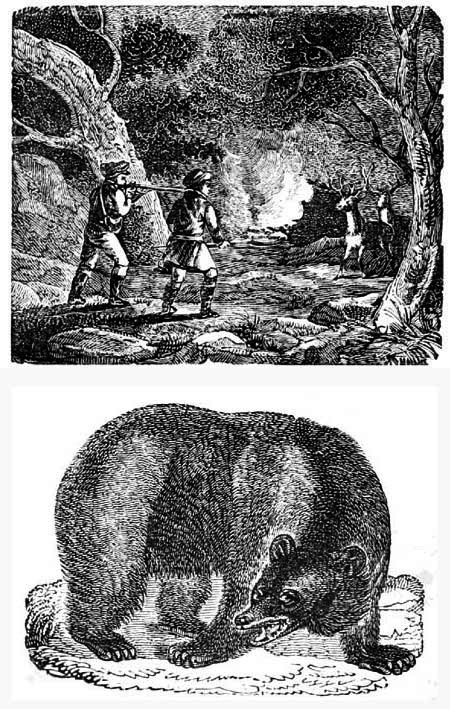
Shooting Deer. ——Black Bear.
"Arriving at length upon or near the territory to be explored, we haul our bateau safely on shore, and turn it bottom upward. Then, dividing our luggage into parcels, and making use of our blankets for knapsacks, we begin to traverse the wild forests, unfrequented except by the stately moose, the timid deer, the roaming black bear, and other wild animals of less note, whom we frequently disturb in their solitary haunts.
"The uneven surface of the country, together with the density of the forest, circumscribe the range of vision. To overcome this impediment, we ascend into the top of some lofty tree. Sometimes extensive views of the surrounding forest are obtained from the side of abrupt ridges, and from the top of a Horseback. This latter is an "extremely curious ridge, and consists of sand and gravel, built up exactly like the embankments for rail-roads, the slope on either side being about 30°, while it rises above the surrounding low lands" from thirty to ninety feet. Dr. Jackson speaks of one in particular, between Weston and Houlton, in the northeastern part of Maine, "the top of which is perfectly level, and wide enough for two carriages to pass abreast."
"Its surface was originally covered with Maple, Birch, and hard Pine-trees, while the low lands on either side are covered with a dense growth of Cedars. I could not help thinking, as I looked upon this natural embankment, that it would be easy for an antiquarian to mistake this ridge for a work of art, and to suppose that some of the aboriginal inhabitants of our country knew how to annihilate distance by rail-roads. My first impression respecting the geological origin of this embankment was that it was alluvial, and formed the bank on intervening shores of two lakes which existed in the low tracts, now covered with Cedars; but, on examining the nature of the materials of which it is composed, I became satisfied that it belonged to the formation of transported clay, sand, gravel, and bowlders, which is called diluvium, consisting of the loose fragments of rocks that were transported by a mighty current of water the last time the waters prevailed over the land. The occurrence of similar embankments at Houlton served to confirm this opinion, for there they had the same north and south direction, a coincidence so remarkable that it could not be the result of chance. The Horsebacks of New Limerick and Houlton are much more elevated" (as indeed they are on the banks or a little removed from the shores of the Mattawamkeag River), "and some of them are said to rise to the height of ninety feet." "I can not stop to speculate on the causes of this transportation of loose materials, but I may say that there are abundant proofs, on the whole face of this continent, that there has been a mighty rush of waters over its surface from the north and northwest, and that such a current has swept over the highest mountains of Massachusetts."
When it is necessary to obtain views from low lands, the obstructions are overcome by ascending the highest trees. When an ascent is to be made, the Spruce-tree is generally selected, principally for the superior facilities which its numerous limbs afford the climber. To gain the first limbs of this tree, which are from twenty to forty feet from the ground, a smaller tree is undercut and lodged against it, clambering up which the top of the Spruce is reached. In some cases, when a very elevated position is desired, the Spruce-tree is lodged against the trunk of some lofty Pine, up which we ascend to a height twice that of the surrounding forest.
From such a tree-top, like a mariner at the mast-head upon the "look-out" for whales (for indeed the Pine is the whale of the forest), large "clumps" and "veins" of Pine are discovered, whose towering tops may be seen for miles around. Such views fill the bosom of timber-hunters with an intense interest. They are the object of his search, his treasure, his El Dorado, and they are beheld with peculiar and thrilling emotions. To detail the process more minutely, we should observe that the man in the tree-top points out the direction in which the Pines are seen; or, if hid from the view of those below by the surrounding foliage, he breaks a small limb, and throws it in the direction in which they appear, while a man at the base marks the direction indicated by the falling limb by a compass which he holds in his hand, the compass being quite as necessary in the wilderness as on the pathless ocean.
In fair weather the sun serves as an important guide; and in cloudy weather the close observation of an experienced woodsman will enable him to steer a tolerably correct course by the moss which grows on the trunks of most hard-wood trees, the north side of which are covered with a much larger share than the other portions of the trunk. This Indian compass, however, is not very convenient nor safe, particularly in passing through swampy lands, which are of frequent occurrence.
After spending several days in scouring the wilderness in search of the Pines, minutely examining their quality (for an experienced lumberman can determine this with surprising certainty), calculating the distance the logs may have to be hauled, and noting the surface of the land through which the logging roads are to be cut, &c., we retrace our steps to the landing, where the bateau has been left. Once more our frail bark floats upon the dancing current of the stream, gliding onward as if stimulated with the very joyousness of the "homeward bound" voyagers. After several days' exploration on foot, the boat ride is particularly welcome. In the realization of this, however, we are sometimes sadly, even provokingly disappointed.
It is known to those versed in the habits of the black bear, that late in the fall of the year they manifest an uncommon fondness for pitch or resinous substances. In the course of my travels through the forest, I have often seen Fir-trees which contained large quantities of balsam, with their bark entirely stripped from the trunk by these craving depredators. Under the impulses of this peculiar appetite, they sometimes tear even our bateau to pieces for the tar with which it is besmeared. If injured beyond the means of repair, we are compelled to pursue our journey down on foot. Perchance we may fortunately meet some Indian trapper with his frail canoe, which we charter for a portion of the journey, until another boat, or means of conveyance, can be secured. Were any of my readers ever on board the Indian's bark canoe? Some, doubtless, have been, and such will bear me out in the declaration that the voyager experiences emotions peculiarly agreeable. As a conveyance, it seems to occupy a space between riding and flying; not in respect to its speed, although this is considerable when the paddle is vigorously applied, but its fairy-like buoyancy quite dissipates the idea of one's gravity.
Having determined, during the exploration, upon the territory from which we wish to cut and haul our logs, we proceed to obtain permits from the state or proprietors, which secure the exclusive right to cut timber within the bounds of the grant for a stipulated price; so much per thousand feet, board-measure, which varies from one to eight dollars per M., according to the quality of the timber and its convenient location to the lake, river, or stream upon which it is to be floated to market. Among other preliminaries which anticipate the winter operations of lumbermen is the "putting up" of large quantities of meadow hay.
Skirting the stagnant sections of rivers and streams, extensive strips of meadow land spread back to the border of "uplands," whose outlines are distinctly defined by immense forests which hem in these large areas, sometimes embracing many thousands of acres. This intervale is covered with a heavy growth of meadow grass. By this remarkable arrangement, Nature has anticipated, as it would appear, the wants of lumbermen in locating, and in preserving from the encroachments of the forest, a plentiful supply of subsistence for the teams employed in procuring lumber in its immediate vicinity, and far from the haunts of civilized man.
To these wild and solemn retreats, where the dismal hooting of the night-owl breaks upon the ear, and the sighing winds, as they pass through the tall, waving grass, waft the distant howl of the wolf, large crews of men resort, with the usual haying implements, provisions, &c., for making and stacking the hay to be used during the ensuing winter.
In the latter part of autumn these meadows are covered with water, which finally freezes. It is therefore necessary to erect temporary scaffolds, called more generally "staddles," upon which the hay is to be piled in large stacks. These staddles are made of poles laid upon cross-stakes or crutches, sufficiently high to protect the hay from the water beneath. From these the hay is removed, sometimes in boats before the waters freeze, and afterward upon sleds on the ice. When the former method of transportation is adopted, two bateaus or skiffs are placed side by side, small poles being thrown across them; the hay is then loaded on this platform, and carried to the most convenient landing, where it is reloaded and hauled on ox-sleds to the camp. If the hay is removed upon the ice, the stacks are hauled away whole. The mode of loading is simple; the central part of the scaffolding is cut away, the sled shoved underneath, when the remaining props are cut away, and the whole stack settles on to the sled, and is thus moved off to the place of destination. This expeditious method of loading is particularly convenient and desirable, as may be imagined when one takes into consideration the biting winter winds which sweep across these wide meadow fields.
Since agricultural interests have invited men far into the interior in the vicinity of lumber berths, where large tracts of land have been cleared up, less value is attached to, and less use made of meadow hay than formerly, as English grass becomes more plenty, is more available, and is much better in its quality.
A distinguishing characteristic of this kind of business is the unceasing encounter by our lumbermen with the blood-thirsty millions of flies who swarm and triumph over these sanguinary fields. In the use of fire-arms these unvanquishable hosts are not skilled, to be sure, but in a charge they are invincible. No amount of slaughter will intimidate them. Though the sweeping hand of destruction annihilates them by thousands, still, with full ranks, the contest is carried on with unabated vigor, a respite only being afforded in rainy weather, or when high winds prevail; then they retire from the field.
At night the musquito lancers take up the action—the Indian tribes of the insect species—and all night they keep up their ceaseless war-whoop, as they repeat their sallies upon the weary, disturbed sleeper. No coat of mail is proof against the attacks of one species of fly commonly called the midget, which is so small as to be almost imperceptible to the naked eye. The black fly and the musquito can only reach the exposed parts of the body, but to the midget every portion is accessible. He insinuates himself under the collar, the wristband, and through the texture of the garments, and the whole region between the shirt and the skin is a field for his operations.
In one process of the haying operations, in particular, they are very annoying. The hay, when cut, is carried in small cocks upon two poles by two men to the scaffolding, for the purpose of being stacked. While thus employed, with both hands engaged, millions of these little invisibles insinuate themselves under the garments, and, whatever interest or ambition may fail to do, by way of producing energetic motion, the irritating smart of their bite abundantly makes up. Nolens volens, the men thus employed dance to the tune of "Midget's meadow-hay jig;" and when no longer able to resist the earnest invitation to rub and scratch, which their irritating bite holds out, down drop the poles, hay and all! Ah! let him who has experienced the irritation, and the relief of furious friction, think—I'm sure he may not pen it.
But, notwithstanding the labor and annoyances of meadow life, there are pastimes and adventures to be met with. A shot now and then at some stray deer who may chance to stroll upon the meadow to graze; the hooking of beautiful trout, pickerel, and other delicious pan-fish, afford agreeable relief from ennui; while the spoils of the forest and the brook afford most agreeable changes of diet. Here, also, very frequently are skirmishes had with the common black bear. If Bruin is not intentionally pugnacious, he is really meddlesome; nay, more, a downright trespasser—a regular thief—an out-and-out "no-government" animal, who, though neither profane nor yet immoral, still, without apostolical piety, would have "all things common." These peculiar traits of character secure to him the especial attention of mankind, and ever make him the object of attack. Though formidable as an enemy, it is hard to allow him to pass, even if he be civilly inclined, without direct assault. On one occasion, while two men were crossing a small lake in a skiff, on their return from the meadows, where they had been putting up hay, they discovered a bear swimming from a point of land for the opposite shore. As usual in such cases, temptation silenced prudential remonstrance; so, changing their course, they gave chase. The craft being light, they gained fast upon the bear, who exerted himself to the utmost to gain the shore. But, finding himself an unequal match in the race, he turned upon his pursuers and swam to meet them. One of the men, a short, thick-set, dare-devil sort of a fellow, seized an ax, and the moment the bear came up, inflicted a blow upon his head which seemed to make but a slight impression. Before a second could be repeated, the bear clambered into the boat; he instantly grappled the man who struck him, firmly setting his teeth in the man's thigh; then settling back upon his haunches, he raised his victim in the air, and shook him as a dog would a wood-chuck. The man at the helm stood for a moment in amazement, without knowing how to act, and fearing that the bear might spring overboard and drown his companion; but, recollecting the effect of a blow upon the end of a bear's snout, he struck him with a short setting-pole. The bear dropped his victim into the bottom of the boat, sallied and fell overboard, and swam again for the shore. The man bled freely from the bite, and as the wound proved too serious to allow a renewal of the encounter, they made for the shore. Medical aid was procured as soon as possible, and in the course of six weeks the man recovered from the effects of the bite. But one thing saved them from being upset; the water proved sufficiently shoal to admit of the bear's getting bottom, from which he sprang into the boat. Had the water been deep, the boat must inevitably have been upset, in which case the consequences might have been more serious.
It was on one of these haying occasions that a more startling but harmless encounter with the elements was experienced. One afternoon, about two o'clock, while several men were making their way up a small stream on a branch of the Penobscot, their attention was suddenly arrested by a sound which resembled distant thunder. Each moment the noise grew more distinct, accompanied with a tremulous motion of the earth. Still nearer and yet nearer it approached, with a rushing sound, intermingled with loud reports. Between our boatmen and the forest at the southwest spread an area of meadow land. Looking in this direction, a dense column, rising high in the heavens, was seen whirling in the distance, and approaching with incredible velocity. They barely effected a landing when it came upon them. In an instant their boat was hurled into the tops of the trees over their heads, while they were able to retain their position by holding on to the small undergrowth, and escaped unhurt. The hurricane, in its passage across the meadow, seemed to lose its force, so that by the time it reached the opposite side of the meadow its power was broken, and its career of destruction ended. In its passage it laid a strip of forest level some seventy rods wide and thirty miles long. No tree within this limit withstood its fury. The toughest and stateliest mingled in wildest confusion with blanched trunks, yielding sapling, and slender undergrowth.
At the proper time, which varies in different localities, but generally during the early part of fall, a more extensive outfit is made for another up-river expedition, for the purpose of erecting winter camps, clearing the main roads, and attending to such other preliminaries as may be deemed necessary.
Several years ago the whole distance from our homes to the interior was traveled by water, on which occasions heavy-laden boats were taken up these rivers and streams, and across the lakes, an operation which was both hazardous and laborious, particularly where the swift current of rapids was to be overcome, and when it became necessary to carry the boat and cargo around impassable falls—a frequent occurrence, the river in some places being nothing but one continuous succession of rapids for miles. In some places, to save the labor of "carrying by," attempts are made to shove the boats up fearful rapids, where a single mistake or false maneuver would swamp them. A lively little incident of this kind is quoted below, from Doctor Jackson's account of an excursion up the Penobscot on the business of a geological survey of the state.