DESCRIPTIONS OF LUMBERING OPERATIONS ON THE VARIOUS RIVERS OF MAINE AND NEW BRUNSWICK. (continued 4)
Reading edition
In many cases logs are hauled on to the ice of the lakes, streams, and rivers, instead of being left upon the banks or landing-places. When hauled on to the lakes, they are laid together as compactly as possible, and inclosed in a "boom," which is made by fastening the ends of the trunks of long trees, so as to prevent them from scattering over the lake on the breaking up of the ice. A strong bulk-head or raft is constructed of the logs, with a capstan or windlass for the purpose of warping the whole forward in a calm, or when the wind is ahead. In this operation, two or three men take an anchor into the boat, to which, of course, the warp is attached, when they row out to the extent of the rope, let go the anchor, and haul up by working the windlass. Sometimes a tempest breaks up the boom, and the logs are scattered, which gives much trouble, and not unfrequently causes a delay of one year before they reach the mills.
On Moose-head Lake, at the head of the Kennebeck, a steam tow-boat has recently been built, which has proved very serviceable to lumbermen in towing rafts to the outlet. Probably the time will come when the business of other large lakes in Maine will require the services of similar boats. Had the same degree of knowledge and interest existed twenty years ago in regard to the application of steam to the various purposes of life that is now manifested, the crystal waters of the beautiful Grand Lake, at the head of the St. Croix, would have been plowed by the prow of some little steamer long ago. But now one great leading motive for such an undertaking is irrecoverably past; the White Pines have been mowed by the woodmen's ax; they have disappeared forever, at least in any considerable quantity. Still, other interests may arise and create a demand sufficiently promising, in a remunerative point of view, to induce an individual, or joint investment, for the construction of such a boat as may be needed. The Grand Lake is some twenty-five miles in length from north to south, and from six to eight miles wide at its greatest breadth. An imaginary line, passing lengthwise, constitutes the boundary between Maine and New Brunswick, the eastern shore being within the limits of her majesty's dominions. Settlements to a large extent have already been made on the American side; and when, in the course of time, the other side shall spring into importance, some little commerce may be opened between the two ports, a custom-house be established, &c., so that the places here sketched may constitute a miniature likeness of the two countries, with the broad Atlantic between them. However, in reference to the realization of what is here said of steamboats and commerce, we will say with the Dutchman, when he spoke prospectively of other matters, "Vell, vell, ve shall see vat ve shall see!"
From lakes and tributary streams, the various parcels of logs cut and drove by different companies issue forth, and form one grand drive on the main river, where the separate crews unite, and make common cause in the driving operation. In other instances one drive may precede another, making the river for miles one general scene of logs and river-drivers. Sometimes the foremost logs of one drive, unobstructed, pass on and mingle with what is called the "tail end" of the preceding drive. Under such circumstances, if there be any grudge to gratify by the foremost crew, or a substantial joke to be put, such truant logs are run aground, into creeks, in meadow land, among the bushes, and on the shore. A crew of thirty or forty men will take a log belonging to another crew and run it up high and dry on to the land, stand it on end, prop it up, and leave it in that position. The rear crew, on coming up, stimulated by the prank, knock away the props, and throw it down; a score of pikes pierce its sides, when they shove it upon the run perhaps twenty rods to the river again, amid the most vociferous hurrahs and whooping, enough to give one quite an idea of the Indian war-whoop. Some, perhaps, who may trace these lines may be curious to know how the logs of one party can be distinguished from those of another. The answer is, precisely as one farmer distinguishes his sheep from those of his neighbor by the particular mark they bear, each differing in some particular from every other. A representation of these marks, which are cut in the side of the log, would remind one of the letters or characters of the Chinese.
No employment that I am aware of threatens the life and health more than river-driving. Many a poor fellow finds his last resting-place on the bank of some wild stream, in whose stifling depths his last struggle for life was spent; where the wild wood skirts its margin—where, too, the lonely owl hoots his midnight requiem. I have visited many spots that were, from facts called up by retrospection, lonely and painfully silent, but have never been so spell-bound, so extremely oppressed with a feeling of sadness, as while standing over the little mound which marked the resting-place of a river-driver on the banks of a lonely stream, far away from the hearth of his childhood and the permanent abodes of civilization. The silent ripple of the now quiet stream (for the spring floods were past), the sighing of the winds among the branches of trees which waved in silence over the unconscious sleeper, rendered the position too painful for one predisposed to melancholy. When in those wild regions we have the misfortune to lose one of our number, after the body is recovered, we place it in a coffin composed of two empty flour barrels. One is passed over the head and shoulders, the other receives the lower extremities, when the two are brought together and fastened, his grave-clothes generally being some of his common wearing apparel. Seldom, if ever, does the voice of prayer rise over their bier under these circumstances; in silence the corpse is committed to its rude burial, while now and then a half-suppressed sigh is heard, and the unbidden tears steal down the sunburned cheeks of his manly associates. Events of this kind generally come suddenly, though, when in dangerous circumstances, are often anticipated. After such an occurrence, an air of sobriety pervades the company; jokes are dispensed with, the voice of song is hushed, and for several days the deportment of the men is characterized with a degree of cautiousness unusual, except when reminded by some such impressive example of the frailty and uncertainty of human life. But with most the impression soon wears off, and their accustomed cheerfulness is regained; their exertions marked with the same daring as before the accident, or as though a life had never been lost in the business. Lower down the river, in the vicinity of new settlements, the usual ceremonies on funeral occasions are practiced when an itinerant clergyman chances to pass that way. The following notice of such an occurrence was cut from the Bangor Courier: "Passing into the town of Passadumkeag late one evening during the past summer, a crowd had gathered in the street. It proved to be the funeral of a river-driver. His body had been taken from the water and shrouded in the open air. Many of the sympathetic villagers were there; and a pious elder, who chanced that way, breathed a prayer over his remains before they were borne to their final place of rest."
BURIAL OF A RIVER-DRIVER. "They drew him from his watery bed, And shrouded him with kindly care; At ev'n his humble bier was spread, And o'er it rose the voice of pray'r; His only pall night's sable damp, The stars of heav'n his funeral lamp. They bore away that youthful form, And laid it in the humid grave, That yestermorn with life was warm, And launch'd upon the dancing wave With jocund voice, and hopes as bright As stirr'd beneath that morning's light. His oar with nervous arm he plied, Nor shrank from dangers gath'ring fast, Struggling against that treacherous tide, His stout heart braves it to the last; Till, spent his strength, and dim his eye, His oar and skiff float idly by. Far distant lies the home he left, And side by side an aged pair, Unconscious of their hopes bereft, Breathe now his cherish'd name in pray'r; Their eyes with watchfulness grow dim: Oh! vainly will they wait for him! A fair young maid, with pensive face, Looks forth upon the silent night, Her heart sweet memories doth trace, Till future years glow in their light. Alas! for life's all changeful scene, How soon must perish that fond dream For him on whom her thoughts doth pore; His hopes and schemes of earth are o'er!"
Brook-drives are, as has before been remarked, usually distinct parcels of logs belonging to an individual or company. These various parcels are often thrown together in one mass on the ample current of the main river, to the number of twelve or thirteen thousand pieces; in which case the different crews unite and make common cause. As the water rises suddenly, and falls as rapidly on the river, by which, in the first instance, many logs run upon intervale and meadow land, or upon high rocks and ledges, and, in the other case, from the rapid decline of water, there is necessarily much activity called for to clear such logs from the position in which they are placed, else they must be left behind, or require great physical exertion to disengage and bring them on with the rest. A steady current or pitch of water is preferable to one either rising or diminishing, as, when rising rapidly, the water at the middle of the river is considerably higher than at the shores—so much so as to be distinctly perceived by the eye of a spectator on the banks, presenting an appearance like a turnpike road. The lumber, therefore, is always sure to incline from the center of the channel toward either shore. On the falls, and the more difficult portions of the river, sometimes immense jams form. In the commencement, some unlucky log swings across the narrow chasm, striking some protruding portions of the ledge, and stops fast; others come on, and, meeting this obstruction, stick fast also, until thousands upon thousands form one dense breast-work, against and through which a boiling, leaping river rushes with terrible force. Who that is unaccustomed to such scenes, on viewing that pile of massive logs, now densely packed, cross-piled, and interwoven in every conceivable position in a deep chasm with overhanging cliffs, with a mighty column of rushing water, which, like the heavy pressure upon an arch, confines the whole more closely, would decide otherwise than that the mass must lay in its present position, either to decay or be moved by some extraordinary convulsion. Tens of thousands of dollars' worth lay in this wild and unpromising position. The property involved, together with the exploits of daring and feats of skill to be performed in breaking that "jam," invest the whole with a degree of interest not common to the ordinary pursuits of life, and but little realized by many who are even familiar with the terms lumber and river-driving. In some cases many obstructing logs are to be removed singly. Days and weeks sometimes are thus expended before the channel is cleared. In other cases a single point only is to be touched, and the whole jam is in motion. To hit upon the most vulnerable point is the first object; the best means of effecting it next claims attention; then the consummation brings into requisition all the physical force, activity, and courage of the men, more especially those engaged at the dangerous points.
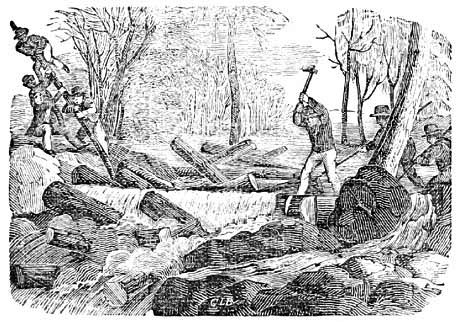
River Drivers Breaking a Jam
From the neighboring precipice, overhanging the scene of operation, a man is suspended by a rope round his body, and lowered near to the spot where a breach is to be made, which is always selected at the lower edge of the jam. The point may be treacherous, and yield to a feeble touch, or it may require much strength to move it. In the latter case, the operator fastens a long rope to a log, the end of which is taken down stream by a portion of the crew, who are to give a long pull and strong pull when all is ready. He then commences prying while they are pulling. If the jam starts, or any part of it, or if there be even an indication of its starting, he is drawn suddenly up by those stationed above; and, in their excitement and apprehensions for his safety, this is frequently done with such haste as to subject him to bruises and scratches upon the sharp-pointed ledges or bushes in the way. It may be thought best to cut off the key-log, or that which appears to be, the principal barrier. Accordingly, he is let down on to the jam, and as the place to be operated upon may in some cases be a little removed from the shore, he either walks to the place with the rope attached to his body, or, untying it, leaves it where he can readily grasp it in time to be drawn from his perilous position. Often, where the pressure is direct, a few blows only are given with the ax, when the log snaps in an instant with a loud report, followed suddenly by the violent motion of the "jam;" and, ere our bold river-driver is jerked half way to the top of the cliff, scores of logs, in wildest confusion, rush beneath his feet while he yet dangles in air, above the rushing, tumbling mass. If that rope, on which life and hope hang thus suspended, should part, worn by the sharp point of some jutting rock, death, certain and quick, would be inevitable.
The deafening noise when such a jam breaks, produced by the concussion of moving logs whirled about like mere straws, the crash and breaking of some of the largest, which part apparently as easily as a reed is severed, together with the roar of waters, may be heard for miles; and nothing can exceed the enthusiasm of the river-drivers on such occasions, jumping, hurraing, and yelling with joyous excitement.
Such places and scenes as are thus sketched may be found and witnessed on most rivers where lumber is driven. Referring to an item of experience on a drive down the Mattawamkeag, says a logger, "Our drive consisted of about thirteen thousand pieces, with a crew of thirty-two men, all vigorous and in the prime of life. Out of such a number, exposed as we were to the perils attendant upon the business, it was a question which we sometimes inwardly pondered, Who of our party may conclude the scenes of mortal life on this drive?
"We commenced about the 25th of March to drive, while snow, and ice, and cold weather were yet in the ascendant. The logs were cleared from the lake and stream of Baskahegan in fifty days, which brought us into the Mattawamkeag. Twelve miles down this river, below the junction of Baskahegan, we came to Slugundy Falls. There the water passes through a gorge about fifty feet wide, with a ledge on either side, making a tremendous plunge, and in immediate proximity a very large rock stands a little detached from its ledgy banks. There the whole body of our logs formed an immense jam, and such a mass of confusion as then presented itself beggars description. Logs of every size were interwoven and tangled together like heaps of straw in 'winnow,' while the water rushed through and over them with a power which seemed equal to the upturning of the very ledges which bound it. We paused to survey the work before us, calculating the chances of success, of life and death. We knew the dangers attending the operation; that life had on former occasions been sacrificed there, and that the graves of the brave men who had fallen were not far distant; and we remembered that we too might make with them our final resting-place. The work was, however, commenced; and after five days incessant application, mutually sharing the dangers incurred, we made a clean sweep of this immense jam without accident. A short distance below are Gordon Falls, at which place there is a contraction of the channel, with high ledges on either hand, a straight but rapid run, with a very rough bottom, at once difficult and dangerous to navigate or drive. Here logs to a greater or less extent always jam, the number varying according to the height of the freshet. This place we soon passed successfully. Logs, 'wangun' and all, were soon over, excepting one empty boat, which two brothers, our best men, in attempting to run, 'swamped' and capsized; in a moment they both mounted upon her bottom, and were swiftly passing along the dashing river, when the boat struck a hidden rock, and the foremost one plunged headlong into the boiling waves. Being an active man, and an expert swimmer, we expected to see him rise and struggle with the tide which bore them onward; but, to our amazement and sorrow, we saw no more of him until four days after, when his corpse was discovered some distance below the place of this sad accident. At the foot of the falls a small jam of logs made out into the channel; several of the men ran out upon this to rescue the other, who had also lost his footing on the boat. He passed close to the jam under water, when one of the crew suddenly thrust his arm down and seized him by the hair of his head, and drew him to land. On recovering from the shock which he had sustained in his perilous passage, and learning that his brother was drowned, he blamed the crew for not permitting him to share the same fate, and attempted to plunge again into the river, but was restrained by force till reason once more resumed her sway. The body of the other received the humble attentions usual upon such interments, as soon as a coffin could be procured. Not two hours previous to this accident, this individual, taking one of the crew with him, visited the grave of a fellow-laborer near by; left the spot, launched his frail boat, and lay down the next hour in a river-driver's grave."
Fourteen days from this time we drove our logs to the boom, having passed a distance of only one hundred and thirty miles in ninety days.
The mode of living on these driving excursions is altogether "itinerant," and really comfortless, for the most part. A temporary shelter where night overtakes them is a luxury not always enjoyed. Often nothing is above them but the forest's canopy, and beneath them the cold earth, it may be snow, with a slight bed of coarse boughs, over which a blanket is spread, and generally a large fire is kept burning through the night. Days and nights, without intermission, are often passed without a dry shred to the back. This is being "packed;" and, if not a "water cure," it is being water-soaked in earnest.
It would not be surprising if rheumatism were entailed upon the river-driver as a consequence of such exposure; yet I have known men to enjoy better health under these circumstances than under almost any other. As an instance, I have seen a man passing sleepless nights with asthma at home, now on the bed, then on the floor or reclining on a chair, struggling for a free respiration until his very eyes would start from their sockets. I have known such a man exchange his position for the exposures peculiar to log-driving, and never for once suffer from this distressing complaint during the whole campaign, but, on returning to the comforts of home, experience an immediate relapse.
From the foregoing account, which is really believed to come short of the reality, the reader will be enabled to form some estimate of the dangers, hardships, and deaths encountered by thousands in the lumbering operations—a business which is hardly supposed to possess any peculiarities of incident or adventure above the most common pursuits of life. How little are the generality of mankind disposed to consider as they should, that for much which contributes to their comfort and ease, many a hardship has been endured and multitudes of individuals have been sacrificed.
The camping utensils for river-driving, with provisions, are moved along day by day, according to the progress made by the drive, so that for the most part each night presents a new location, with the usual preparations. The boats appropriated for the removal of the whole company, apparatus, and provisions, when loaded, are called "wanguns," an Indian word signifying bait, and, when thus appropriated, means bait or provision boats.
Among the dangers to be incurred, where both life and property are hazarded, is that of "running the wangun"—a phrase perfectly understood on the river, but which the uninitiated will better understand when I say that it means the act of taking these loaded bateaux down river from station to station, particularly down quick water. This is a business generally committed to experienced watermen, especially when a dangerous place is to be passed, as to "swamp the wangun" is often attended with not only the loss of provisions and utensils, but also life. From this fact, the circumstance is always regarded with interest by all hands, who watch the navigators in their perilous passage with no ordinary or unnecessary solicitude.
On one occasion two active young men put off from the shore with the "wangun," to make the passage of some quick water just at the head of a fearful fall, where, as was customary, the whole party were to be carried by. In passing a rock, where the water formed a large whirlpool, the boat, on striking it, instantly capsized. One of the men, being an expert swimmer, told his comrade to take hold of the back of his vest, and he could swim with him to the shore; but the current carried them so swiftly toward the falls that it became necessary for the swimmer to disengage himself from his companion, who clung to him with a death-grasp. His efforts to effect a separation were unsuccessful, and every moment they were carried nearer to the fatal falls. Suddenly sinking in the water, the swimmer contrived to turn round and face his drowning friend. Drawing up his legs, and bracing his feet against his companion, he gave a sudden and powerful kick, which disengaged him. Then rising to the surface, after this most painful act, to which he was impelled from dire necessity, he struck for the shore, and barely reached it in time to save himself from the sad fate that awaited his unfortunate associate, who, poor fellow, still clinging with a death-grasp to the shred of garment which was rent from his companion in the struggle, was carried over the falls, and then, passing under a jam of logs, floated down the river several miles, where his body was found, and interred on the banks of the Penobscot.
I have often passed the spot where he sleeps. The green grass waves in silence over his grave, and now the plow of the husbandman turns the greensward at his side, where once the forest trees majestically waved over his rude bier.
The following instance of the remarkable escape of a river-driver was related by one who witnessed the affair. I think it happened on the Androscoggin. Among the crew there and then engaged was a young man who prided himself upon his fearlessness of danger; and, to maintain the character he thus arrogated to himself, would unnecessarily encounter perils which the prudent would shun. His frequent boastings rendered his society not a little unpleasant, at times, to the less pretending; and although this dislike was not so great as to lead them to rejoice in seeing him suffer, yet an event which might be likely to cool his courage would not have been unwelcome to the crew. On one occasion he ventured upon a jam of logs just above a rolling dam, over which the spring freshets poured one vast sheet of water, plunging several feet perpendicularly into a boiling cauldron. The jam started so suddenly that he was precipitated with the logs over this fearful place, where not only the fall and under-tow threatened instant death, but the peril was imminent of being crushed by the tumbling logs. No one really expected to see him come out alive, but, to our surprise, he came up like a porpoise, and swam for the shore; but the swift current swept him down, and carried him under a jam of logs which formed below the dam. From previous exertion and exhaustion, we thought this must finish the poor fellow, and we really began to forget his faults, and call to remembrance whatever of virtue he had manifested. Soon a dark object was seen to rise to the surface immediately below the jam. It was our hero, who, elevating his head and striking forward with his arms, swam with a buoyant stroke to a small island just below, where he landed in safety, having sustained no injury, and without having experienced any abatement of his former daring. Seemingly there was not one chance in a thousand for the life of a man making such a fearful voyage. This circumstance brings to mind a poetical sentiment I have somewhere read on the ways of Providence in the disposal of human life:
"An earthquake may be bid to spare The man that's strangled by a hair."
Men often lose their lives where we have least reason to expect it, and are as often spared, perhaps, where we see no grounds of hope for them. Thus physicians may sometimes be censured as unskillful when they lose a patient, while in fact God has fixed the bounds of mortal life; or be praised for skill when their success is but apparent, while to the Creator's purposes alone are we to look and give credit for such deliverances.
River-drivers usually eat four times a day—at least this practice obtains on the Penobscot—viz.: at five and ten o'clock A.M., and at two and eight P.M. After the two o'clock meal, when the drive on the main river is under successful headway, the camp-ground is forsaken, the tent struck, and the wangun is run as far down river as it is thought the drive will reach by night, where arrangements are made, as usual, for the crew, by the cook and "cookee," as his assistant is called. It may happen that the drive does not progress according to the calculations of the cook, and a short row down river is necessary to reach the wangun.
Between the mouth of the Piscataquis and Oldtown, a distance of twenty or twenty-five miles, are numerous beautiful islands, some of them large, and generally covered with a heavy growth of hard-wood, among which the Elm abounds. When the logs arrive at this point, many of the encampments are fixed upon these islands. As the sun sinks behind the western hills, the lengthened shadows of the beautiful island forests shoot across the mirrored river, casting a deep shade, which soon disappears amid the denser curtain of an advanced evening, with which they blend. The roar of rushing waters is over, and the current glides smoothly on. No sound is heard but the echo of the merry boatmen's laugh, and of voices here and there on the river, with now and then the shred of a song, and the creaking and plashing of oars. While thus passing down, as the boats turn a sudden bend in the river, a dozen lights gleam from the islands, throwing their lengthened scintillations over the water. Now the question goes round, "Which is our light?" "There's one on the east side!" "Yes, and there's another on Sugar Island!" "And there's one on Hemlock!" says a third. "Why the d—l hadn't they gone to Bangor, and done with it?" "Wangun No. 1, ahoy!" shouts the helmsman, a little exasperated with fatigue and hunger. Now, while all the rest of the cooks remain silent, No. 1 cook responds in turn. Another calls out the name of their particular log-mark: "Blaze Belt, ahoy!" "Where in thunder are you?" "Blaze Belt, this way, this way!" comes echoing from Hemlock Island, and away the Blaze Belt bateau rows with its merry-making crew. Thus each crew, in turn, is finally conducted to its respective camp-fire.
The prospect of a release from the arduous labors on the drive at this point of progress raises the thermometer of feeling, which imparts a right merry interest to every thing. Like sailors "homeward bound," after a three or nine months' cruise, and within one day's sail of port, relaxation and pastimes only are thought and talked of.
The mine of song and story is opened, and the rarest specimens of match songs and "stretched" stories are coined and made current by the members of the different crews. The "smartest team," "chopper," "barker," "the largest tree," "the biggest log," "the greatest day's work," bear or moose story, the merits of crews, teamsters, "bosses," cooks, and swampers, falls and rapids, streams and rivers, all, all come up as themes of converse, song, and story. There is less hurrying in the morning now than in the former part of the driving; let the water rise or fall, it is all the same thing at this point, for the driver has reached the ample channel of the river, where neither falls or rapids occur. A day, and the work is consummated—'tis done! The crews are disbanded: they disperse, some to their homes and farms; some to idleness and recreation; some to hire in the mills to saw the logs thus run; others to take rafts of boards to the head of tide navigation, where hundreds of vessels are in waiting to distribute the precious results of the lumberman's toil to the thousand ports of the Atlantic and Pacific coasts, where the sound of saws, planes, and hammers of a million house-wrights, cabinet-makers, carpenters, coopers, and jobbers make the air vocal with the music of cheerful labor, giving bread to the millions, wealth to thousands, and comfort and convenience to all.
For this branch of human industry we set up a claim, in point of rank, not yet awarded to it by the world. We claim for it greater prominence as a source of wealth—greater respect on the ground of the talent and skill concentrated by the prime operators—greater deference for it as a business—for the endurance, energy, and courage of the thousands of hardy freemen who engage in it, and greater interest from the amount of substantial romance and adventure in the "Life among the Loggers."
While it is the professed object of this volume faithfully to portray all the points alluded to, I am nevertheless impressed with the idea that no point which I have treated comes so far short of the reality as the attempt to picture the romance of the business.
The boom, which constitutes the general receptacle of all logs, is worthy a few lines of observation.
On the Penobscot it stretches up the side of the river in the vicinity of numerous islands, whose location is peculiarly favorable; the boom-sticks run from one island to another, and, where the distance is too great, a pier is sunk—a square frame of stout timber filled with stones. These piers sometimes span the whole river, united by the boom-sticks. This is true of the main boom on the St. Croix. On the Penobscot it stretches up the river about two miles; at the upper end there being a shear boom, which swings out to intercept and turn the logs floating down the river into its ample embrace.
The Boom Corporation, on the Penobscot, is regulated by legislative enactments, and all logs running into it, or within the limits of its charter, are subject to its laws and regulations. Its bounds embrace a section of the river six miles in length, and to the care of all logs coming within its limits the agent is obligated to give his attention, and the company responsible. It is the duty of the boom-master, with the men under him, to raft the logs of each individual in parcels by themselves previous to their delivery for the mills, guided in his selection by the particular marks cut on the logs, for which service and safe-keeping the owner or owners of the boom receive thirty-three cents per M. feet, board measure, which makes the property of the boom very valuable. In addition to this, every log found in the boom without a mark is a "prize log."
Among other duties devolving on the boom agent is to inspect, personally, every raft of logs, setting down the number and mark in a memorandum kept for the purpose. This course of management protects each log-owner's property from plunder, as, in case any and all persons were indiscriminately allowed to raft out logs, the temptation might prove too strong, in some cases, to regard with due honesty logs bearing marks of a different character. Besides these main booms, there are many lesser ones, up and down the river, subject to no special legislation or law except the will of the owner.
These observations relate chiefly to the Penobscot and St. Croix Rivers. Of the rules and regulations of similar corporations on other rivers I am uninformed, but it is to be presumed that they are much the same, in general.
CHAPTER III.
Observations on the St. Croix River.—Boundary Line.—Pine Timber. —Agriculture in the Interior.—Youthful Associations with Grand Lake.—Traditionary Name of Grand Lake.—Lake Che-pet-na-cook.— Rise of Eastern Branch St. Croix.—Lumbering Prospects.—Hemlock. —Reciprocal Relations of the Lumber Trade between Americans and Provincials.—The Machias Rivers.—Origin of Name.—Character of Soil.—Lumber Resources and Statistics.—West Machias.—Narraguagues River, curious Definition of.—Capacity of Stream.—Statistics.— Union River.—Observations on its Lumbering Interests.—Mills in Franklin.
Having in the foregoing pages given brief sketches of some of the most interesting trees known to us, devoting considerable attention to the White Pine, and the life and adventures of lumbermen, the concluding pages of this book will consist of brief sketches of the rivers of Maine and New Brunswick, and such statistics as to the extent of the lumbering operations on each river as may interest the curious in such matters.
The Mschoodiac, more generally known as the St. Croix, constitutes the first link in the boundary between Maine and the province of New Brunswick.
The name by which this river is more generally known is St. Croix, which is probably of French origin. The original and Indian name is Mschoodiac. An intelligent Indian, belonging to the Penobscot tribe, to whom I am indebted for the signification of the original names which our rivers bear, informed me that the signification of Mschoodiac was, "Burned land river," "Open space," or "Wide prospect river," thus deriving its name from some peculiarity in the country along its borders.
Probably, at some period anterior to the white man's knowledge of our Western World, a section of forest adjacent to some part of the river was destroyed by fire, originating perhaps in the torch of some invading tribe as they laid waste the wigwams of their discomfited enemies, or from the embers of the little fire kindled by the hungry hunter to cook his hurried meal. In process of time, the principal part of a forest, withered and destroyed by such a devastating scourge, would fall to the ground, opening wide prospects where densely-compacted forest trees once completely circumscribed the view. But the river may have derived its name from a circumstance of still earlier date, viz., the existence of immense fields of meadow land, which abound more or less in the whole region lying about the St. Croix, often affording the voyager an unobstructed view for miles up and down the stream. In former years vast quantities of this wild grass were cut by lumbermen for the subsistence of oxen and horses during their winter operations.
The St. Croix has two branches, the east and west; the latter, at its source, is contiguous to the head waters of the Machias River in the west, while the former, being of more importance and greater magnitude, stretches far to the north to the lakes, whence is its source. Of these bodies of water mention may be made of Grand Lake in particular, which is about twenty-five miles long by eight wide at its greatest extent, romantically diversified in the northern part with beautiful islands, deep coves, and far-reaching points of land, covered with dense and rather undersized trees. The shores, east and west, are composed for the most part of immense granite rocks, rising very abruptly on the southwest to a considerable elevation, covered with a heavy growth of majestic Pine, Hemlock, and Spruce-trees.
Beautiful white sand beaches, which run outward with a very gradual descent for many rods into the lake, afford a most luxurious bathing-ground, where probably the young savages of former generations gamboled and indulged in aquatic sports.
Not many years since, an unbroken forest stretched abroad over a vast area of country, of which this lake formed a central point. The pervading silence, which rested like night over this vast wilderness, was only broken by the voice of the savage, and the discordant howlings of wild beasts. But within a few years the ax of the pioneer has leveled large tracts of forest, and thus opened the virgin soil to the sun's germinating rays, so that now may be seen skirting the shores of the lake, north and northwest, cultivated fields, relieving the solitude which once reigned there. The gray-haired red man of past generations knew this lake by the name Madongamook, which signified "Great grandsires," and owes its origin to the following circumstance: From time immemorial it is said that some of the aborigines made the immediate vicinity of this lake's outlet a permanent annual "setting-down place," or head-quarters. Here their ancestors gathered around the council-fire for uncounted generations. Hence this sheet of water was called Great-great-grandsire's Lake, of which Grand Lake is an abridgment.
The author entertains many pleasant reminiscences of former visits to this lake. To use the language of the red man, he has spent many pleasant "moons" on the shores of Madongamook, paddled with the Indian hunter in his tiny birch over its silver waters, chased wild game through its forest confines, and flung from its transparent depths the delicious trout. Indians affirm that there is in these waters a great fish, "all one big as canoe," a sort of fresh-water whale.
But it is time to proceed on our down-river trip. So, leaving the outlet of Grand Lake, and passing south about two miles across a "carrying-place," we strike the head of another lake, called Che-pet-na-cook, into which the surplus waters of the former lake pass. The name by which this lake is designated is said to signify hilly pond or lake. In form it is long and narrow, resembling a deep, massive river. That peculiarity from which its name is derived is strikingly prominent. A range of abrupt and elevated ridges rises suddenly from its western shore, covered with a close, heavy growth of trees, principally Spruce. One peak of the ridge rises several hundred feet from the surface of the lake, which is called "Spruce Mountain." After mid-day, a section of this mountain ridge, so dense and frowning as to resemble a thunder-cloud, casts a cavernous shade, like a misty pall, over the surface of its waters, which seem to lay with prostrate fear at its base, imparting an oppressive solemnity over the scenery.
At the foot of this lake, which is between twenty and thirty miles long, the east branch of the St. Croix takes its rise. From this point it passes through a rocky channel for the most part, occasionally flowing through a section of meadow or intervale land until it reaches Baring, a distance of some fifty miles, where for the first time it meets with a formidable barrier to its hitherto wild and unrestrained progress in the character of a "dam." Passing this through its various avenues, it flows on to Milltown, which occupies both sides of the river, and includes both the English and American villages. Between this place and the head of ship navigation, some two miles distant, the channel is dammed several times on a succession of falls, where are numerous saw-mills; and, finally, after having leaped a thousand rocky precipices above, and struggled through as many gates and sluice-ways below, it quietly flows on to the Passamaquoddy Bay, where its restless waters find repose in the bosom of the Atlantic Ocean.
In regard to the lumbering resources on this river, I believe it is generally admitted that the supply of Pine is comparatively small, the principal part having already been brought to market; and although the territory belonging to this river is large, still its resources are curtailed by the proximity of the head waters of the St. John, Penobscot, and Machias Rivers.
The comparative scarcity of Pine timber has induced the manufacture of a much larger proportion of Spruce than formerly; still it is presumed that the same amount of Pine lumber now annually cut may continue to be for years to come. Should Hemlock come into more general use, the resources of the lumbermen will be greatly augmented, as timber of this kind abounds on the St. Croix. And why may not this be the case? For many purposes Hemlock lumber is preferred to Pine. A gentleman in Bangor informed the writer that he had, from choice, made use of Hemlock boards for nice floors to a residence recently built for himself, esteeming it richer in color, less liable to indentation, and of greater durability. With the exception of Pine, the resources for lumber on this river are still very considerable, and must continue to be for many years, unless sweeping fires shall blacken and wither the beautiful forests which now adorn the interior. Vast tracts of timber land have already been destroyed by fire on the territory belonging to this river, as the blanched trunks of standing trees, and barren hill country surrounding Baileyville, Baring, Calais, and St. Stephen's, most painfully indicate, greatly marring the beautiful scenery which once adorned the valley through which the river flows.
Lumber manufactured on this river may be considered as both English and American products; still, by common concurrence, and not strictly in accordance with revenue regulations, it is shipped indiscriminately. The manufacture of the English side of the river is received on board American vessels and shipped to the States, and the lumber manufactured on the American side shipped on board English vessels and taken to the English markets duty free.
For the most part, the firms who conduct the lumbering business on the St. Croix are of great respectability; several of them are very wealthy.
The following table [12] of estimates has been gathered from the most reliable sources; and, although mathematical exactness is not pretended, still it is believed that the calculations here presented approach the truth sufficiently near to give the reader a very satisfactory view of the extent of the lumbering operations on the boundary river:
No. of Saw-mills No. of Lath Machines English. 42 American. 33=75 60 Average price per M.
Amount of Long Lumber 65,000,000 $ 7.50.
Amount of Laths 90,000,000. 1.00.
Amount of Shingles 21,000,000. 2.50.
Amount of Pickets 2,165,000. 3.50.
Amount of Clap-boards 200,000. 18.00.
No. of Juniper Knees 8,300. 1.40 each.
No. of Men employed, directly and indirectly 1,200 to 1,500.
No. of Oxen and Horses, do 1,000.
Leaving the St. Croix, and traveling westward about forty miles, we come to East Machias River, to the west of which, six miles distant, is another river called West Machias. The name Machias originated in some obstruction in the way of the Indian traveler, either in the river itself or upon its banks, whether natural or accidental I am not aware.
The eastern stream is about fifty miles long, including the small lake, which constitutes its chief source, and is navigable only about six miles for large vessels, at which point the village, bearing the same name as the river, is located, and also the mills. As the lake which feeds the river is fed principally by springs, it affords a good supply of water the year round. The land in the immediate vicinity of the stream is quite good for agricultural purposes; but, as we recede from the river, the soil appears poor, presenting a desolate and forbidding aspect. Once a flourishing forest covered it, but now blackened, decayed, and decaying trunks of trees, scorched by fire, some prostrate, others still standing, limbless, naked, and desolate, intermingle with a small, dwarfish, and sparse second growth, and mantel the sterile plain and rocky hill side. Indeed, this is but too true a portrait of immense tracts of land all along the coast of Maine, from the St. Croix to the Penobscot, and still further westward. It is wonderful that these desert regions, whose sterility scarcely gives existence to the wild grass and stinted shrubs which grow there, once supported a dense and majestic forest.
At East Machias village there are seventeen saws in operation, and eleven lath machines; the latter, for the most part, are situated in the base of the saw-mills, and manufacture laths from the slabs made in the mill. At this place the saws cut, on an average, about six hundred thousand feet, board measure, to a saw, one half of this lumber being sawed from Pine, and the other from Spruce logs. The same quality of lumber brings fifty cents more per thousand here than on the St. Croix. In answer to the question, Why is this so? the reply was, "We saw nearly all our lumber to order, and of prescribed dimensions."
The resources for lumber are still quite abundant. The West Machias stream is about the same size as the East, both being quite small; it has more numerous water privileges, and is more liable to be affected by droughts. Here the lumbering operations are carried on more vigorously than on the other river, cutting some two hundred thousand more to a saw. The greatest distance that lumber has been cut from the village is about sixty miles. Opinions the most reliable encourage the belief of the existence of sufficient timber to meet the demands of this market for years to come. This stream is also navigable for vessels up to the mills, being carried at flood-tide quite near the mill slips, where they receive their cargoes. Both rivers empty into Machias Bay at points quite approximate, through which float the cargoes of industrial wealth to the broad Atlantic and to the various ports of destination.
Annexed is a table showing at a glance the state of the lumber trade per annum on each river: [13]
East Machias
Average price per M. Total.
No. of Saw-mills 17.
No. of Lath Machines 11.
Amount of Long Lumber 10,200,000. $8.00. $81,600.
No. of Laths 13,200,000. 1.00. 13,200.
$94,800.
No. of Men Employed 450.
No. of Oxen and Horses, do. 380.
West Machias
Average price per M. Total.
No. of Saw-mills 20.
No. of Lath Machines 14.
Amount of Long Lumber 18,000,000. $8.00. $144,000.
No. of Laths 16,800,000. 1.00. 16,800.
$160,800.
No. of Men Employed 475.
No. of Oxen and Horses, do. 400.
The next river worthy of note, for the lumber it produces, is the Narraguagues, whose waters disembogue into a small bay bearing the same name, thirty miles beyond the West Machias, its course being nearly parallel with the latter.
The true Indian orthography is said to be Na-la-gua-gwees, and signifies palate, stream, or river. To use the precise language of my Indian interpreter, opening his mouth wide and thrusting his finger down his throat, "It means all one, jes if I open my mouth and river run down my throat into mine belly." Whether there is any peculiarity about the river, or the form of the bay into which it falls, to originate such a name, I am unaware.
This stream, for water power, is about equal in its capacity to either of the Machias rivers. The mills are principally located at Cherryfield, where are fifteen saw and eight lath mills, three shingle and one clap-board machine. The saw-mills are said to produce about nine millions of long lumber per annum, worth eight dollars per M. on an average. The lath mills produce six million four hundred thousand pieces, worth one dollar per M. Nine hundred thousand shingles are annually turned out, at two dollars and fifty cents per M. The clap-board machine may be credited with one hundred thousand pieces during the sawing season; of their quality I am not informed. In general they range from fifteen to thirty dollars per M.
Computing the value of the foregoing products, we have presented the annual product:
Long Lumber $72,000
Laths 6,400
Shingles 2,250
Clap-boards 2,000
Total $82,650
Sixty teams are said to be employed on this river during the hauling season, and about three hundred men. The resources for lumber were reported by the most intelligent operators as equal to those of any lumber district in the state of equal size.
In the adjoining town of Franklin five saw-mills were reported, situated on small streams, doing a large business. These mills are said to manufacture about three million feet, worth eight dollars per M., giving twenty-four thousand dollars.
About half way between the Narraguagues and the Penobscot Rivers, and upon an almost exact parallel with the latter, runs Union River, which disembogues into an arm of Frenchman's Bay. On the banks of this river, near its mouth, stands the village of Ellsworth, which is decidedly one of the most beautiful places in Maine, and in the immediate vicinity of which the mills are principally located; in all, about twenty-five.
The annual amount of long lumber manufactured here is about sixteen million feet, worth some hundred and twelve thousand dollars; the aggregate amount of the various kinds of short lumber annually produced is worth some sixteen thousand dollars more.
From four to five hundred men, and about the same number of oxen and horses, are employed in the lumbering business. Logs are driven from two to forty miles. The territory through which this stream flows is well timbered, and affords an abundant supply of logs.
CHAPTER IV.
class="hang" Penobscot River.—Its various Names.—Character of the Country through which it flows.—Its Length.—The vast Extent of Territory which it drains.—Its Multitude of Lakes.—Mount Ktaadn.—Indian Legend.—Elevation of the Mountain.—Overwhelming Prospect.—A Sabbath in the Wilderness.—Moose in the Lake.—An uncomfortable Night.—Dr. Jackson's Narrative.—New Lumber Resources.—The interesting Origin of this new Resource.—John Bull outwitted.—Freshets on the Penobscot. —Freshet of 1846, cause of it.—Sudden Rise of Water.—Bangor submerged.—Bowlders of Ice.—Destruction of Property.—Narrow Escape of Ferry-boat.—Peril of Boys.—Editorial Observations. —Lumber Statistics.—Where the Lumber finds a Market.— Speculations on future Prospects of Lumbering Interests.— Anticipations of the Future.—Bangor.
Passing westward in a direct line about twenty miles, we come to the noble and interesting Penobscot. Although Penobscot is now the name of the entire river, it was originally the name of only a section of the main channel, from the head of tide-water to a short distance above Oldtown. Penobscot is the Indian name, and signifies stony or rocky river, as it certainly is within the above limits, being nothing less than a continuous fall before the dams were built.
From the head of tide-water, at the city of Bangor, to the mouth of the river, a distance of about thirty miles, it was known to the Indians by the name of Baam-tu-guai-took, which means broad river, sheet of water, or, more literally, all waters united. Another section of the river is called Gim-sit-i-cook, signifying smooth or dead water.
Unlike the Kennebeck, and similar to the St. Croix, the Penobscot flows chiefly through a wilderness country. The time is yet distant when its banks shall exhibit the same advances in agricultural industry and wealth which now beautify, enrich, and enliven the banks of the Kennebeck.
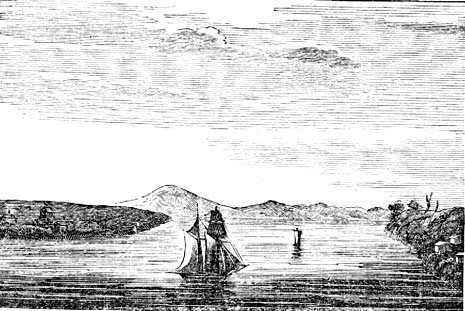
A Coaster ascending the Penobscot for Lumber.
This river, on many accounts, is the most important in Maine, and at present, from its vast lumbering resources and operations, the most noted. It is three hundred and fifty miles long, with numerous, and, in some instances, copious branches, which drain an immense uncultivated territory, embracing a region of country from east to west about one hundred and fifty miles in breadth, spanning the whole of the northern portion of the state, running round and cutting off the head waters of the St. Croix on the east, and of the Kennebeck on the west, interlacing its numerous branches with those of the St. John's River in the north, which brings within its embrace about one third the entire wilderness territory of Maine.
The scenery in some sections of this territory, about the head waters, is grand and picturesque. Its numerous water-falls, some of which are fearful to contemplate, much more for the river-driver to work upon; its swelling hills, and, in some instances, towering mountains, from whose tops may be counted an almost endless number of lakes, and the vast groves of towering pines here and there scattered over millions of acres of forest land, make it altogether one of the wildest and most romantic portions of country.
One of the most attractive features in the interior is Mount "Ktaadn," which, from its isolated position, height, and sublime grandeur as the "birth-place of storms," surrounded with a beautiful, rich, and luxuriant forest, with streams and lakes, is worthy of special attention.
The following sketch of a visit to this mountain by a party of gentlemen may be esteemed worthy of a perusal:
Our travelers, after having made the ascent of the river to the proper point, and made the necessary arrangements for their journey up the mountain, "entered the slide at eight o'clock" A.M., in the early part of September, and found its ascent quite steep, "though not difficult or dangerous at all, when one takes time."
On almost all sides of the mountain there is a short, tangled growth of alders and white birch coming up between the rocks. These, being kept down by the winds, grow into an almost impassable bramble. At a distance it has a beautiful, smooth appearance, like a green, grassy hill, or what one of the company called a 'piece of oats.' The slide serves as a path up through all this tangle, reaching to the top of the southeastern ridge of the mountain, which is above all timber growth, making about one third of the whole perpendicular height of Ktaadn, to which the ascent of the brook below would add another third.
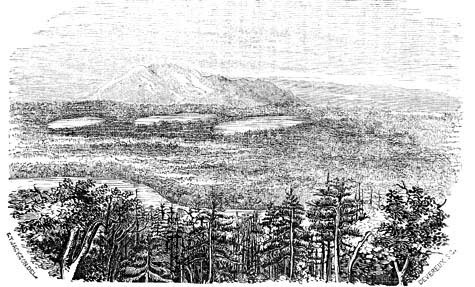
View of the Penobscot—Forests and Lakes N.E. from Ktaadn.
"Although it was hard climbing, we ascended pretty fast, and the clear morning air gave an indescribable beauty to the prospect below. The most pleasing was the constant change and variety caused by our rapid ascent. It was known that the mountain, at this season of the year, is frequented by bears in pursuit of cranberries, but we did not see any, though our gunner had enjoined silence in hopes of obtaining a shot. I remained with the rear, to see all up safe. The most zealous 'went ahead,' and were soon out of sight, until, near the head of the slide, we heard them from the distant topmost peaks calling out, 'Come on, ye brave!' At this distance they looked very small in stature. From the head of the slide we turned to the left, and ascended northwest to the first and most eastern peak; by this time our comrades had reached the most western. We here paused to view our position. It is perhaps the most favorable spot for surveying the whole structure. From thence the principal peaks are in a curved line, going southwest, then west and northwest. The second peak, called by us the 'Chimney,' is near the first, but separated by a sharp cut one hundred and fifty or two hundred feet deep, and nearly square in its form. We had seen one of our comrades upon its summit, else we might not have attempted the ascent. His zeal seemed to blind him to danger, for, when questioned on our return, he could neither tell when or how he ascended. Our first plan was to pass around the base without going over the top; but this we found impossible, and were about to give up, when one pointed out a diagonal course, where, by taking a few pretty long steps, he thought we could ascend. I tried first, and succeeded, and all followed but two. From the 'Chimney' we went from one hammock to another, making, on the whole, a gradual ascent, till we reached the middle of the principal peaks, a distance of nearly half a mile. There we met our comrades on their return from the western peak, and all sat down to rest. Here we found a monument that had been erected by some former visitor, but was overgrown with moss, appearing lonely, as if it had seen no relations for years. On the first and most eastern peak, all the monuments which I had made the year previous looked new and fresh. It is not easy to decide which of the two (the western and middle peaks) is highest. Judgment was given in favor of the middle one.
"While sitting on the south side of the monument at twelve o'clock, we put the thermometer in a favorable place, and it went up to 84°. At the same time, on the north side, and six feet from us, water was freezing, and the snow dry and crusty. Near by the monument a rock stood in its natural position, having a sharp peak in the top. This was the highest one of the kind. Of this about four inches were broken off, and one of the company carried it home with the conviction that we had lowered the height of Ktaadn to that amount. About two P.M. we returned to the eastern peak. It may be well to pause here and take a re-survey of the scene thus far presented, and as much more as can be viewed from this point.
"From this eastern peak a spur makes out eastward one mile. Half a mile down, however, it divides, and a branch runs to the northeast the same distance. On the southwest, across the cut, is the 'Chimney.' From this the line of peaks and hammocks curves to the west till it reaches the middle and highest peak. From one hammock to the other there are, in all, thirty rods of narrow passes. Some of them are so narrow that a man could drop a stone from either hand, and it would go to unknown depths below. In some places the only possible way is over the top, and only one foot wide. For a great part of the time the wind blows across these passes so violently that the stones themselves have to be firmly fixed to keep their places. It seemed remarkable, as if for our convenience, that the day of our visit was still and quiet. From the middle peak the line curves to the northwest, to the further monument. From this point a branch makes down to the southwest, having on it some extensive table-lands, while the top ridge or curve turns directly north with the 'sag.' At the bottom of the 'sag' we come upon a wide flat, which runs north half a mile, and stretches out to a considerable width. At the northern extremity of the flat the ridge curves to the east, and rises to a peak about equal in height to the eastern peak of the northern wing. This is probably the highest of the northern peaks, from which a spur makes down, a little south of east, to within one quarter of a mile from the one that comes from the southern wing. All this nearly includes a deep basin, with walls almost perpendicular, and in some places apparently two thousand feet high.
"To survey the bottom of this basin I have since made a separate journey. It contains perhaps two hundred acres, covered with large square blocks of granite that seem to have come from the surrounding walls. There are in all six lakes and ponds, varying in size from two to ten acres. One of them I crossed on ice the 15th of October.
"From its outlet inward to the southwest is about a mile, where there is a small lake of clear water which has no visible outlet. So far as I can learn, I was the first human visitor to this fabled residence of the Indians' Pamolah. It is not strange that a superstitious people should have many traditions of his wonderful pranks, and be kept away from close engagement with such a foe. When we reach the lake on our way to Ktaadn, it is easy to see the origin of those fears which the Indians are said to have respecting the mountain as the residence of Pamolah or Big Devil. Clouds form in the basin, and are seen whirling out in all directions. Tradition tells a 'long yarn' about a 'handsome squaw' among the Penobscots, who once did a great business in slaying her thousands among the young chiefs of her nation, but was finally taken by Pamolah to Ktaadn, where he now protects himself and his prize from approaching Indians with all his artillery of thunder and hail.
"The Indian says that it is 'sartin true, 'cause handsome squaw always ketch em deble;' whether this be true or not, the basin is the birth-place of storms, and I have myself heard the roar of its winds for several miles. But on the 15th of October, when I entered it and went to the upper lake, all was still as the house of nymphs, except when we ourselves spoke, and then the thousand echoes were like the response of fairies bidding us welcome. In this way the music of our voices would find itself in the midst of a numerous choir singing a 'round.'
"The upper lake, which I visited and went around, has an inlet, a white pearly brook, coming out nearly under the chimney, and running a short distance through alders and meadow grass. It has no visible outlet; but on the north side it seems to ooze out among the rocks. We can trace this water-course curving to the east of north till it reaches the lower and largest lake, from which flows a brook sufficiently large for trout to run up. This brook curves to the south, running into West Branch, and is called Roaring Brook. The mountain around this basin is in the form of a horse-shoe, opening to the northeast. From the peak on the northern wing there is another deep gorge, partly encircled with a curving ridge, which some would call another basin. On the north side of this gorge there is a peak nearly equal in height to the one on the south of it, but considerably further east, making this northern basin or gorge open to the southeast. These two basins, from some points of view, seem to be one. From the last-mentioned peak the mountain slopes off from one peak or shoulder to another, perhaps three miles, before it reaches the timber growth. Some of the branches of the Wassataquoik come from this northern part, but some of them from the basin or southern part of Ktaadn.
"Rough granite, moss-covered rocks are spread over its whole surface from the short growth upward. Blueberries and cranberries grow far up the sides. At the time of our visit considerable snow lay on its summits and lined the walls of the great basin. The party, of course, found plenty of drink. The Avalanche Brook, having its source about the middle of the slide, furnished water pure as crystal. The ascent was attended with some danger and fatigue. But what a view when the utmost heights are gained! What a magnificent panorama of forests, lakes, and distant mountains! The surface of the earth, with its many-tinted verdure, resembled, in form and smoothness, the swelling sea. In the course of the forenoon, light fogs from all the lakes ascended, and, coming to Ktaadn, intertwined themselves most fantastically above our heads, then settled down and dispersed. But what can be fitly said about the vast expanse of the heavens, to be seen from such an elevation, especially when the sun goes down, and the glowing stars appear in silent majesty? All the gorgeous, artificial brilliancy of man's invention is more than lost in the comparison. Language has no power to describe a scene of this nature. The height of Ktaadn above the level of the sea is five thousand three hundred feet. Its position is isolated, and its structure an immense curiosity. From its summit very few populous places are visible, so extensive is the intervening wilderness. On its sides the growth of wood is beautiful, presenting a regular variation in altitude and size all the way up to the point where it ceases.
"The great basin described by Mr. Keep was to none of us an inferior object of interest. Want of time and strength prevented our descent into it. It is open to general inspection from all the heights around it. The day being quiet, the view was divested of much of its terror; but we could readily believe it the abode of all the furies in a storm, and where the polar monarch has his chief residence in Maine. We called to each other across the basin, and echo answered 'Where!' in earnest. The air was exhilarating, as may be supposed, but the effect not as sensible as we anticipated.
"The whole party returned to the head of the slide at three P.M., and engaged in picking cranberries. These grow on all parts of the mountain above the timber region, and no doubt annually yield many thousand bushels. 'They grow on vines among the rocks, and are commonly called the mountain or highland cranberry. They are smaller than the meadow cranberry, but of a better flavor.'
"At four o'clock six of the party went down to the camp to prepare fuel for the Sabbath. Our guide and the gunner remained at the head of the slide all night, and kept a fire with old roots; yet it was presumed that they had now and then a little cold comfort. The result of their stay is thus set forth by Mr. Keep:
"'On Sabbath morning the eastern horizon was clear of clouds, and we looked anxiously for the sun. Just before it came up, a bright streak appeared of silver whiteness, like the reflected light of the moon. We could see the further outline of land quite plain, and for a short distance beyond was this silvery streak. Soon a small arc of the sun appeared above this bright line. I was hardly able to control my emotions while the whole came in sight. On Saturday night, about sundown, our view of the country around was more distinct and enchanting—a boundless wilderness in all directions, much of the view being south of the lakes. Of the latter, not far from two hundred are to be seen dotting the landscape. In one of them we can count one hundred islands. Soon after sunrise on Sabbath morning we went down to the camp to spend the day with the company.'
"That holy morning found us refreshed, and somewhat prepared to appreciate our peculiar circumstances. The weather was charming. The air resounded with the pleasing murmur of the Avalanche Brook, as it flowed down over its bed of rocks; nor was the song of birds denied us. Gentle breezes stirred the beautiful foliage of the circling woods. Impressive stillness reigned, and the whole scene was adapted to awaken happy and exuberant emotions.
"Early we mounted some rocks on the bank of the stream toward the rising sun, and overlooking a vast region of country, and there poured forth sacred melody to our heart's content. The echo was glorious. Verily we thought our 'feet were set in a large place;' and we could readily imagine that the wide creation had found a tongue with which our own exulted in unison.
"At the hour appointed we assembled in the camp, and engaged in the exercises of a religious conference. It was good to be there. The scene finds its portraiture in the words of Cowper:
"'The calm retreat, the silent shade, With pray'r and praise agree, And seem by thy sweet bounty made For those who follow thee. Then, if thy spirit touch the soul, And grace her mean abode, O! with what peace, and joy, and love She there communes with God.'
"It is not too much to say that we enjoyed a measure of such experience. The day—the place—the topics of remarks—the songs of Zion—all encircled by a kind Providence, and made effective by the presence of God, will ever be worthy of a grateful remembrance.
"In the afternoon, by request, Rev. Mr. Munsell addressed us from the 11th verse of the 145th Psalm, 'They shall speak of the glory of thy kingdom, and talk of thy power.' Our position added deep interest to the theme of discourse, and naturally furnished much ground for illustration. Indeed, the entire services of the day were attended with peculiar influences, being had under circumstances so widely different from the ordinary life of the company.
"That Sabbath was our delight, even in the face of a possible deficiency in food. But the course adopted imparted bodily rest and a peaceful mind.
"We had traveled with burdens on our backs twenty-five miles—crossed several streams—climbed rough hills—walked on rocky places—tumbled over huge trunks of fallen trees—crowded through plenty of jungle—waded the Avalanche Brook—and all this in forbidding weather; but, aside from the glorious view on the summit of Ktaadn, our toil found its recompense in the novelty and influence of a Sabbath observance on such an elevation, and amid the wild scenes and solitudes of a mountain forest.
"Scarcity of food, and the engagements of some of the party, made it necessary on Monday morning to start for home. We left the camp about half past nine, following down the brook to the point from whence we ascended, and then direct to the lake.
"'At this time,' says our guide, 'we fell into much confusion on account of two of the company who were missing, the gunner and Mr. Meservey, for whom we made search, but in vain. Few can imagine our feelings save those who have heard the cry of lost coming up from the deep gloom of the wilderness in the native tone of some wanderer calling for help. After consultation, it was resolved that we must leave the ground for home, hoping for the best. We left at one, and came to the lake at four P.M., and here, to our great joy, we saw a smoke on the opposite side, near the outlet, and at five rejoined our missing companions. They had caught trout enough for us all, weighing from one to three pounds. With these, and cranberry-sauce in plenty, also bread, pork, and tea, we made merry around a cheerful fire. That night, however, a storm of rain coming up, found us poorly prepared.'
"In this connection an incident may be related. Just before our arrival, while the gunner was fishing, suddenly two moose bounded furiously into the lake, and appeared to be swimming toward him. Though all along desirous of an interview, their visit was rather too startling. He scampered with all haste to the shore, seized his gun and fired, but the balls would not go through the 'law,' which at that season afforded protection, and so the moose escaped.
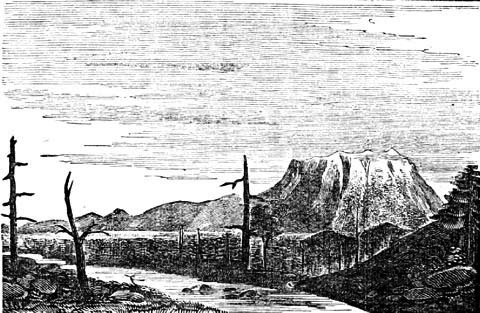
Northeast view of Mount Ktaadn, from the west branch of the Penobscot.
"The night just referred to was a time of realities. Truth proved 'stranger than fiction.' Amid anxiety for the lost, the ax had been left on the mountain. A pile of logs lay near the outlet of the lake. With some of these our missing companions had made a fire; some formed the floor of the camp, and others, used as rafters, were covered with boughs for protection, but not from rain. On the above floor (the spot allowing no other), no boughs at hand could make a downy bed. Every one found out that he was composed of flesh and bones. It also became difficult to regulate the fire, so that the heat was often intense. Contrary winds would ever and anon drive the smoke into the camp, and thus cause great involuntary weeping. The scene was felt, and few could find sleep without stealing it. It was visible darkness all around. Toward midnight the rain commenced. One of the party, writing to another from Lincoln in December, says, 'Old Mount Ktaadn from this place looks dreary enough. Its snow-capped top often reminds me of our amusing adventures; but nothing in all our travels affords more amusement in moments of meditation than the night on the Pond Dam. That old plaid cloak, dripping in the rain; its occupant upon a log without the camp, singing "The morning light is breaking," when it was only one o'clock; and then again, "He shall come down like rain," &c.—all together have left an impression on my mind not soon to be effaced.'
"The occupant of that 'cloak,' unable to sleep, conversed with the 'daughters of music,' and was prompted to sing the night out and the morning in; and as the rain increased, the whole crew joined heartily in the chorus. Our departure from such lodgings was very early. Beneath continual droppings from the trees and bushes, we pressed through an obstinate path-way, and arrived at the Wassataquoik camp at half past nine. This march was really toilsome, but brought us out at the desired point. After a long rest, we followed the old supply road most of the way, forded the Wassataquoik, and came out opposite Mr. Hunt's, whence the bateaux took us across the East Branch. This was a little past four o'clock P.M. Our appearance was far from beardless, our 'externals' somewhat ragged and torn, and our appetites keen as a 'Damascus razor.' 'Mine host' and family received us most cordially, having felt some anxiety in our absence. They made us joyful around a full table of good things. On the day following, Wednesday, we passed to Mr. Cushman's, and on Thursday took conveyances for home."
Another visitor [14] to this point of attraction observes:
"While I was engaged in noting the bearings of this mountain, the clouds suddenly darted down upon its summit and concealed it from view, while we could observe that a violent snow-squall was paying homage to Pomola, the demon of the mountain, Presently the storm ceased, and the clouds, having thus paid their tribute, passed on, and left the mountain white with snow. This took place on the 20th of September.
"Crossing the lake—'Millnoket, a most beautiful sheet of water, containing a great number of small islands, from which circumstance it takes its name'—we reached the carrying-place at the head of a long creek, where we pitched our camp amid a few poplar-trees, which were of second growth, or have sprung up since the forests were burned. The want of good fuel and of boughs for a bed was severely felt, since we were obliged to repose on naked rocks, and the green poplar-trees appeared to give more smoke than fire. The night was cold and the wind violent, so that sleep was out of the question. Early in the morning we prepared to carry our boats over to Ambijejis Lake, and the labor was found very difficult, since the water was low, and we had to traverse a long tract of boggy land before reaching the other lake.
"Tracks of moose and cariboo abound in the mud, since they frequent the shallow parts of the lake, to feed upon the lilypads or the leaves of the Nuphan lutea, which here abound. A noble-looking cariboo suddenly started from the woods, and trotted quietly along the shores of the lake quite near us, but we were not prepared to take him, and he presently darted into the forest and disappeared.
"Our provisions having been reduced, owing to the circumstance that our journey proved much longer than we had anticipated, I thought it necessary to put the whole party on a regular allowance, which was mutually agreed to. Our Indian, Neptune, succeeded in catching half a dozen musquash, which we were glad to share with him, and a few trout which were also taken, and served to save a portion of our more substantial food. At Pock-wock-amus Falls, where the river rushes over a ledge of granite, large trout are caught abundantly, and we stopped a short time to obtain a supply. They are readily taken with a common fishing-hook and line, baited with a piece of pork, or even with a slip of paper, which is to be trailed over the surface of the water. Some of the trout thus caught would weigh from three and a half to four pounds.
"On the 22d of September we prepared ourselves for ascending the mountain, taking with us our tent, a few cooking utensils, and all the food remaining, except a small quantity of Indian corn meal, which we concealed on the island for use on our return.
"Our party, all clothed in red flannel shirts, and loaded with our various equipments, made a singular appearance as we landed on the opposite shore and filed into the woods.
"Having reached a height where the forest trees were so diminutive that we could not camp any higher up for want of fuel, we pitched our tent. This place is about half way up the mountain. From it we have an extensive view of the surrounding country.
"Leaving our camp on the mountain side, at seven A.M. we set out for the summit of Ktaadn, traveling steadily up the slide, clambering over loose bowlders of granite, trap, and graywacke, which are heaped up in confusion along its course. We at length reached a place where it was dangerous longer to walk on the loose rocks, and passing over to the right-hand side, clambered up among the dwarfish bushes that cling to the side of the mountain.
"Two of our party became discouraged on reaching this point, and there being no necessity of their accompanying us, they were allowed to return to camp. The remainder of our ascent was extremely difficult, and required no small perseverance. Our Indian guide, Louis, placed stones along the path, in order that we might more readily find the way down the mountain, and the wisdom of this precaution was fully manifested in the sequel. At ten A.M. we reached the table-land which forms the mountain's top, and ascends gradually to the central peak. Here the wind, and driving snow and hail, rendered it almost impossible to proceed, but we at length reached the central peak. The true altitude of Mount Ktaadn above the level of the sea is a little more than one mile perpendicular elevation. It is, then, evidently the highest point in the State of Maine, and is the most abrupt granite mountain in New England.
"Amid a furious snow-storm, we set out on our return from this region of clouds and snow. Louis declared that Pomola was angry with us for presuming to measure the height of the mountain, and thus revenged himself. 'Descending, we had nearly gone astray, and might have descended on the wrong side, had it not been for the precautions of Louis before named. Clouds and darkness hung upon the mountain's brow, and the cold blasts almost deprived us of breath. Incrusted with snow, we carefully slid upon the surface of the rocks.' 'We tumbled down some large blocks of granite, that descended with a terrible fracas, dashing the rocks into fragments as they bounded along.' 'Our party encamped upon the mountain side, and passed a sleepless night, without food, and amid a driving snow-storm.'
"Early next morning we struck our tent and descended the mountain, but so enfeebled had we become by hunger, privations, and fatigue, that it was with difficulty we could carry ourselves and burdens. Every now and then our knees would give way beneath us, and cause us to fall upon the ground. When we reached the base of the mountain, we discovered some wild choke-cherries hanging in bunches from the trees, which the bears had often climbed and broken for the fruit. Felling one of these cherry-trees, we ate the astringent fruit, and were in some measure resuscitated in strength, so as to march with renewed vigor. A bed of blueberries also presented itself, and we stopped to dine upon them. 'Proceeding on, we met two of our company, who had passed down the night before, who had cooked all the Indian meal that we left at our old camp on the island, and brought the cakes for our relief. On our way down the river we fortunately met two young men ascending the stream in a canoe on an exploring expedition, we induced them to sell us twenty biscuits, which, being two to a man, on short allowance, we hoped to be able to reach Nickatow. On our way down we met another crew, who supplied us with the necessary rations to reach Nickatow, where, on our arrival, we obtained all that was necessary for the comfortable prosecution of our down-river journey.'"
In addition to the natural resources of the Penobscot for lumber, several townships of good timber land, formerly claimed by the crown, but by treaty ceded to the United States, have become available by diverting a portion of the head waters of the St. John's River into the channel of the former, on the west branch. This was effected by cutting a canal from a lake on the St. John's, called Zelos, to Webster Lake, on the Penobscot.
Originally the canal was three hundred rods long by four wide, and four feet deep; but the strong current of water flowing through, at the rate of one mile in twenty minutes, has changed the regularity of the channel to a more natural and stream-like appearance.
By this bit of Yankee enterprise, the timber of eight townships, otherwise and necessarily destined for the provincial market, may be brought down the Penobscot, the aggregate amount of which is estimated, by the best judges, at five hundred millions of feet.
This has succeeded so well, that further surveys have been made with a view to open other communications between the waters in the same region, and, if the expectations of those interested in this matter should be realized, it is said that the timber of some thirty townships more will come down the Penobscot River. [15]
The project of excavating the canal alluded to was suggested by the proximity of the above-named lakes, and the remarkably favorable position of the strip of land lying between them. The direct cause of its being carried into effect is said to have originated in consequence of the levying of a provincial tax on lumber cut and run down the St. John's by Americans, in violation of an article in the treaty adopted by the two governments in the recent settlement of the boundary between Maine and New Brunswick.
The specific condition in the treaty thought to have been violated is this, in substance: All timber situated on land ceded to the United States, which, from its position, must pass down the St. John's, "shall be dealt with as if it were the produce of the said province;" [16] which condition on the part of Maine was thought to imply freedom from duty or taxation.
Therefore, in order to obtain some tribute (for it is, indeed, a trait quite prominent in the character of John Bull to expect and demand tribute), a duty was levied upon all timber running down the St. John's, whether from the crown lands or the territory ceded to Maine. And the crown, in order to satisfy its loyal subjects for this new requisition, made a corresponding discount on the stumpage charged those hauling timber from the crown lands, while the Yankees were left without indemnification.
But Brother Jonathan was not to be outgeneraled by this maneuver, but characteristically "guessed" out a way of escape; and not only thwarted the cunning of his crafty neighbor in this matter, but actually laid his dominions under tribute, nolens volens, by diverting a portion of the waters of St. John's River, bringing it into the channel of the Penobscot, where it probably runs "duty free." While, therefore, the Yankees thus resisted the attempted encroachment, we doubt not but they secretly render a "tribute" of thanks for the provocation.
The Penobscot is not so likely to be affected by destructive freshets as are most large rivers; for instance, the Kennebeck, whose accumulating waters rush through its deeply-cut channel with tremendous power, carrying all before it; and for this reason the former runs through immense tracts of low intervale lands, which, in time of abundant rains, act as vast reservoirs, receiving and scattering the surplus water over thousands of acres. Nothing is likely to produce disastrous freshets, except such as arise from unusual causes; and as such a combination is not likely to occur once in a century, an event of this nature is not often expected nor dreaded.
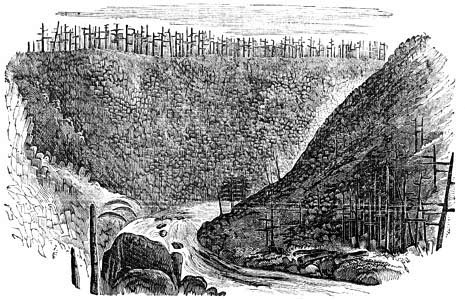
Godfrey's Falls on the Seboois River. Banks 200 Feet High.
The Penobscot has two principal and many minor branches; among the latter, mention may be made of "Mattawamkeag," which "means a stream running over a gravelly bed;" and the "Piscataquis," which is about one hundred miles in length, and forms a junction with the main river some thirty or forty miles above Bangor; its waters are clear as crystal, and the current rapid. Also the "Seboois," several days' journey from the mouth of the Matawamkeag. Some of the wildest and most interesting scenery in the state occurs on this river and on the lofty mountains in its vicinity. Godfrey's Falls, as seen in the opposite cut, plunge around the base of high mountainous banks hundreds of feet above the wild torrent which rushes between them. These falls are impassable, and when boatmen arrive here they are compelled to carry their effects and boats up a ledge on the left side of the falls, at an angle of 45°, and then through the burned forest for the distance of four miles before again attempting to navigate the river.
Not less than fifty mountains and seventeen lakes may be seen from the summit of Sugar-loaf Mountain, which stands a little removed from the shores of the Seboois, as represented in the cut at the end of this chapter; and among the interesting objects viewed from this point is Chase's Mountain, on the west side of the Seboois, very peaked, which rises like a vast pyramid from the dense forest country around it, a representation of which may be seen on page 211.
There are many important islands in the Penobscot; several of them contain many hundred acres of land. Among them mention may be made of "Olemon," which contains some three hundred acres; likewise "Sugar Island," of corresponding magnitude; "Orson Island," twelve hundred acres; "Marsh Island," five thousand acres; "Oldtown," the present site of an Indian village, three hundred acres; Orono, one hundred and fifty acres. On these islands are several flourishing villages, Oldtown, Orono, and Stillwater, in the vicinity of which are the principal mill sites, which are from seven to fourteen miles above Bangor.
The overwhelming catastrophe which occurred on this river in the spring of 1846 will long be remembered by those who witnessed it. The following graphic account of this occurrence, from the pen of Dr. West, was published in the Bangor Courier, and will be read with deep interest:
"To the Rev. Dr. Tyng, New York.
"Reverend and dear Brother—We have passed through a scene within the last two or three days which will deeply interest and impress you. Our city has met with a calamity unparalleled in its annals, and perhaps unequaled, in proportion to its population and means, by any in our country. We have been inundated by the river in consequence of what is called here an ice-jam. The history of the matter is briefly as follows:
"It sometimes happens that the ice in the river breaks up above, while it remains too strong at the outlet to admit of its passing down. The consequence is the accumulation of a dam of ice which completely fills the river from bank to bank, and heaps up sometimes to the height of from fifteen to thirty feet, and thus forming a reservoir of water above it, which overflows the banks and inundates the country around.
"The present winter has been a remarkable one in the mode of the formation of the ice. After the river was first frozen over, the ice continued to form in cakes or sheets, and to flow down the rapids to the still and frozen portions, and these were drawn under. This continued until the submerged sheets were stopped by rocks or shoals; then the accumulation went on until the bed of the river became consolidated to an astonishing thickness. Around the piers of our great bridge it was cut through to the depth of about fourteen feet. Thus the entire bed of the river seemed to have become, at least except the channel, an almost solid body of ice.
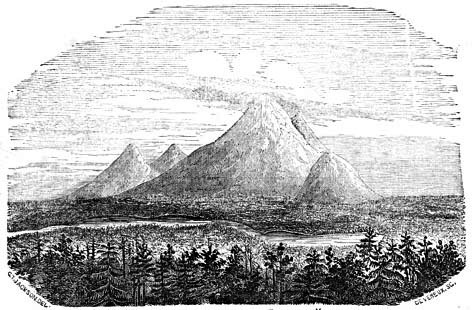
Chase's Mountain, as it appears from Sugar-loaf Mountain.
"The greatest fears were entertained throughout the winter for the consequences during the spring freshet, and yet no effectual precautions could be taken to guard against impending calamity. The very worst of these fears have now been more than realized.
"A few days ago the river began to break up for about thirty miles above the city, while it continued firmly bound for about twelve miles below. There were several different spots where the jams, or ice-dams were formed; and when they broke away, they came rushing down with the force of a mountain torrent, until the strong ice below resisted their progress. These jams came down one at a time, and, lodging against another below, kept increasing their magnitude. The two most formidable jams were within seven miles of the city, in the vicinity of the two largest and most important ranges of saw-mills. Those which formed above, when they broke away, passed through at Oldtown and Stillwater with little comparative damage other than carrying away the bridges, and adding to the size of the jams below.
"The first movement was the raising the two principal ranges of mills from their foundations by the rise of the water. After this the first jam that passed down swept away the Basin mills, which belong to a New York company, and which rented for above ten thousand dollars per annum. They next carried away a large range of mills belonging to some of our most enterprising citizens, and which rented for fifteen thousand dollars per annum. One of the proprietors thus lost about fifty thousand dollars. The mills in these two ranges contained about fifty saws, were possessed of the most unfailing water power, were recently fitted up with the best improved machinery, and performed last year about one third of all the business on the river.
"The jams thus worked their way down gradually, carrying destruction to bridges and small houses, and other buildings on the banks, until they were all concentrated in one immense mass of four miles in length, of great height and depth, and filling the river, which varies in width from one thousand to fifteen thousand feet from bank to bank. Of the magnitude and power of such a mass, no just conception can be formed by persons unused to similar scenes. Above the jam the water was twenty or thirty feet above its usual height, filling up the rapids, and making a dead level of the falls.
"The first injury to the city was from the breaking away of a small section of the jam, which came down and pressed against the ice on our banks. By this, twenty houses in one immediate neighborhood, on the west bank of the river alone, were at once inundated, but without loss of life. This occurred in the daytime, and presented a scene of magnificent interest. The effect of this small concussion upon the ice near the city was terrific. The water rose instantly to such a height as to sweep the buildings and lumber from the ends of the wharves, and to throw up the ice in huge sheets and pyramids. This shock was resisted by the great covered bridge on the Penobscot, which is about one thousand feet in length, and this gave time to save much property from impending destruction. But, meanwhile, another auxiliary to the fearful work had been preparing by the breaking up of the ice in the Kenduskeag River. This river flows through the heart of the city, dividing it into two equal portions. The whole flat on the margin of the river is covered with stores and public buildings, and is the place of merchandise for the city. The Kenduskeag runs nearly at right angles with the Penobscot at the point where they unite. The Penobscot skirts the city on the eastern side, and on the banks of this river are the principal wharves for the deposit of lumber.
"I must mention another circumstance to give you a just idea of our situation. There is a narrow spot in the river, about a mile below the city, at High Head, in which is a shoal, and from which the greatest danger of a jam always arises, and it was this that caused the principal inundation.
"The next incident occurred at midnight, when the bells were rung to announce the giving way of the ice. It was a fearful sound and scene. The streets were thronged with men, women, and children, who rushed abroad to witness the approach of the icy avalanche. At length it came rushing on with a power that a thousand locomotives in a body could not vie with; but it was veiled from the eye by the darkness of a hazy night, and the ear only could trace its progress by the sounds of crashing buildings, lumber, and whatever it encountered in its path-way, except the glimpses that could be caught of it by the light of hundreds of torches and lanterns that threw their glare upon the misty atmosphere. The jam passed on, and a portion of it pressed through the weakest portion of the great bridge, and thus, joining the ice below the bridge, pressed it down to the narrows at High Head. Meanwhile the destruction was in progress on the Kenduskeag, which poured down its tributary ice, sweeping mills, bridges, shops, and other buildings, with masses of logs and lumber, to add to the common wreck.