DESCRIPTIONS OF LUMBERING OPERATIONS ON THE VARIOUS RIVERS OF MAINE AND NEW BRUNSWICK. (continued 2)
Reading edition
"While we were engaged in exploring the rocks (at Grindstones Falls), our men tried to shove the boat up the falls, but the violence of the current prevented their effecting their object, the boat being instantly filled and sunk in the attempt, while all our baggage and provisions that remained on board were swept off and carried down the stream. A scene of unwonted activity now ensued in our endeavors to save our articles, as they were rapidly borne down the foaming waters. The boat, fortunately, was not much injured, and we succeeded in hauling it upon a rock, and bailed out the water, after which we gave chase to our lost articles, and succeeded in saving those that were most essential to our safety. The bread-barrel, although scuttled, was but half full of bread, and floated down stream with its opening uppermost, so that but little of it was injured. Our bucket of rice burst open and was lost. The tea-kettle and other cooking apparatus sank in the river, and were fished up by a hook and line. The tent was found about a mile down the river, stretched across a rock. The maps and charts were soaked with water, so that it required as much labor and patience to unroll them as the papyri of Herculaneum. Our spare boots and shoes were irrecoverably lost. Having rescued the most important articles from the water, we carried by the falls, camped, and dried our papers and provision, being thankful that no worse an accident had befallen us. Fortunately, we had taken the precaution to remove our surveying instruments and the blankets from the boat before the falls were attempted.
"Having kindled a camp-fire and dried ourselves, a storm of rain began to pour around us; but our great fire was not easily damped, and we passed a comfortable night beneath the shelter of a water-proof tent.
"The Penobscot boatmen are well skilled in the art of camping in a comfortable manner, and soon prepare their fire for the night, make a bed of boughs, and pitch the tent in such a manner as to afford a complete shelter. Having partaken of our meal, we reposed upon the boughs spread upon the earth, our feet being turned toward the fire. This being our first encampment for the season, the novelty of the scene prevented sleep; the night was very pleasant, and the broad moon, slowly descending in the west, added her effulgence to beautify the scene, her image being reflected by the rippling waters, while various contrasts of light and shade from the dense foliage, and the pale moonbeam and glaring red camp-fire, gave an effect full of beauty, and worthy the attention of an artist.
"Amid pleasant scenes, we are, however, subject to contrasts of a less agreeable kind; and here our Indian, while cutting wood, suffered a severe accident; his hatchet, accidentally slipping, was driven deeply into his leg between two bones, so as to expose the anterior tibial artery. I was then called upon in my surgical capacity, and, having my instruments with me, dressed his wound in the usual manner, and early next morning we took him to Maltanawcook Island, where we made arrangements with another Indian, Louis Neptune, to supply his place while he was recovering from his wound."
These difficulties of transportation have been somewhat abated by the construction of roads, which penetrate much nearer to lumber berths than formerly, and enable us to convey our provisions, implements, and even boats, with horse-teams, a considerable portion of the distance once laboriously performed by water. I am not familiar with any kind of labor which tests a man's physical abilities and powers of endurance more than boating supplies up river. The labor of carrying by falls, and portages from lake to lake, imposes a heavy tax upon the body. Barrels of pork, flour, and other provisions, too heavy for one man to carry alone, are slung to a pole by the aid of ropes, one man being at either end, and thus we clamber, under our heavy burdens, over rocks, the trunks of fallen trees, slippery roots, and through mud-sloughs, sometimes without any path, through the thickets and groves of trees. The boat is turned bottom upward, the gunwales resting upon the shoulders of three men, two abreast near the bows, and one at the stern. In this position we pass over the same route through which the provisions have been carried to the next landing, where the goods are again reshipped, and we proceed by water on lake or stream, with the alternate routine of paddling, poling, and lugging, until the place of destination is reached.
Persons wholly unacquainted with river navigation can have but an imperfect idea of the skill as well as nerve brought into requisition in taking a heavy-laden bateau, skiff, or canoe up over rapids. Let such a person stand upon the banks of the river, and survey some places over which these frail boats, loaded to the gunwale, pass, and he would not only regard the thing as exceedingly difficult and hazardous, but as altogether impossible; with the inexperienced it would, indeed, be both, but our skillful watermen will perform it with the greatest dexterity. Should any traveler chance to take an up-river trip with those boatmen, I am quite sure his observations would confirm my statement respecting them. I am happy to add here the testimony of Dr. Jackson, who had an opportunity to witness their skill: "Those who have never been on such a journey would be surprised at the dexterity of the Penobscot boatmen as they drive their frail bateau through the rapids and among dangerous rocks. The slightest failure on their part, on passing the numerous water-falls, would place the lives of those on board in imminent peril, and the traveler has good reason to be thankful if the boat by their care is saved from being overturned or sunk in the river.
"When the waters rush down a rapid slope of smooth and round rocks, forming what are called gravel-beds, the most strenuous exertions of the boatmen are required to stem the current, and not unfrequently their 'setting' poles are caught between the rocks, so as to be jerked from their grasp. Bateaux are navigated up stream by means of slender poles of spruce, about twelve or fifteen feet in length, armed with an iron point, confined by a ferule or iron band around its extremity. One boatman stands in the bow and braces his foot against the stern as he labors; the other stands in the stern, and they both pole on the same side as they proceed up the margin of the stream. Descending the river, they make use of paddles." However, the depth to which these frail boats are loaded, in which condition they pass through rough waters and wide lakes, where the wind is liable in a few minutes to raise high waves, can not be regarded as prudent, with all their matchless skill in navigating.
When I call to mind the intemperate habits to which most lumbermen in times past were addicted, I am surprised that no more accidents have occurred while navigating our rivers.
I shall not soon forget the perilous circumstances in which I was once placed, in company with others, while taking a deeply laden skiff up to the head waters of the St. Croix.
Having safely passed the rapids of the river, we embarked upon the Lake Che-pet-na-cook, up which we paddled about twenty miles to the portage, over which we had to carry our effects to Grand Lake, distant some two miles. By the time we had accomplished these moves the shadows of a September evening began to gather around us, giving a peculiar tint to the large sheet of water before us, which spread to the north some twenty-five miles, with an expanse east and west of about six miles, washing a portion of the shores of Maine on the west, and the province of New Brunswick on the east.
The point of destination lay about half way up the lake on the American side. Our boat was deeply laden with men and provisions; of the former there were seven in number. A light wind from the east caused a gentle ripple upon the surface of the waters, which induced us to hug the easterly shore pretty closely. We proceeded slowly, and when it became necessary to change our course in order to cross the lake, night had nearly settled down upon the waters, leaving only sufficient light to reveal the opposite shore, which stretched along the verge of the horizon, presenting the appearance of a long, dark cloud settling upon the borders of the lake.
We had plenty of new rum on board, which was used at stated intervals, as, according to the faith of nearly every man in those days, it gave to the arm more vigor in the necessary labor of plying the paddle. It soon became evident that one of our number had imbibed too freely, to the imminent hazard of our lives. The reader may easily imagine our perilous condition under such circumstances. Our frail skiff was about eighteen feet long, and four feet across the top of the gunwale amid-ships, tapering to a point at either end, constructed of thin slips of pine boards nailed to some half dozen pair of slender knees about two inches in diameter. On board were some fifteen hundred pounds of provisions, with seven men, which pressed her into the water nearly to the gunwale; three inches from the position of a level, and she would fill with water.
As men usually are quite insensible to danger when in liquor, so was it with "Dan" in this instance. Too comfortable in his feelings to keep still, as indeed was indispensable to the most steady among us, he kept constantly lurching about, and periling us with a capsizing repeatedly. He was admonished in the most pressing and peremptory manner to keep quiet; but in his drunken idiocy he became a terror, and it was manifest that something must be done to insure our safety.
Our paddles hung powerless over the sides of the frail thing which buoyed us upon the surface of the deep water; to advance seemed too uncertain and dreadful, while the darkness rested down deeper upon the lake. A hasty consultation was held upon the propriety of putting back to the shore, when the drunken wretch gave a sudden lurch, which settled the gunwale under water! "My God! we are gone!" shouted some half dozen voices at the instant. However, by a counter-motion we raised the submerged gunwale from sinking further. In an instant our helmsman was upon his feet, and, raising his paddle in a most menacing attitude over the head of the intoxicated man, "D—n you!" said he, "if you move again I'll split your skull open!" The threat was terrible, and he would have cleft his head open in an instant. I expected he would strike, for our lives depended upon quieting him in some way; but the fellow seemed to awake to our perilous condition, and slunk down into the bottom of the boat. We put about instantly for the shore, and in a few moments touched the beach. With a willing step I placed my feet on terra firma once more.
It was then determined that part of the crew should remain, while the others should cross the lake, unload the provisions, and return for those left behind. Four men were accordingly left, and I was glad to make one of the number, though left upon a wild and unfrequented spot, without food or shelter, with the prospect of spending the greater portion of the night there, even should the rest of the crew make a successful trip; and, in the event of their being swamped, a thing by no means impossible, for sometimes the wind suddenly rises, and in a very short time lashes the lake into foaming waves, in which case the skiff could not live, then the circuit of the lake must be performed, and days must elapse before relief could be obtained; but still, with these certainties and probable contingencies before us, we were glad to feel mother earth under the soles of our feet. By the time these matters had been fixed, the darkness had shut out the western shore entirely from view; our comrades, therefore, only shaped their course by the fire which we had kindled upon the shore, and which we kept burning by a constant supply of brush and the most inflammable wood that could be procured.
Not having had much experience in the wilderness at this time, and never under such peculiar circumstances, I felt somewhat timid and apprehensive, as we were far from relief and the abodes of civilization, and in a region where bears, wolves, and a dangerous specimen of the feline species, known by woodsmen as the "Indian devil," had prowled from time immemorial. From the manner in which my exiled companions piled the brush on the fire, I suspected, also, that they had some confidence in its protective power. The night was cold, but by our exertions to keep up a brilliant fire, and copious draughts of black pepper tea, which we made in a little kettle, we kept quite comfortable. This process lasted until two o'clock in the morning, when the boat returned for us, having twice crossed the lake, in all twelve miles. We stepped on board, and at four o'clock her third trip across during the night was finished. One half mile from the shore, surrounded by an almost unbroken wilderness, stood a log cabin, tenanted by a man with his family, who had settled down for the purpose of clearing up a farm. At the time we landed the sky was overcast with dense clouds, and the darkness was so intense that I could not see an inch before my nose; I felt the force of that trite old proverb, "It's always darkest just before day." To the above-named cabin we were piloted through a dense forest, which was interlaced with a thick growth of underbrush. We made our way along as entirely unassisted by vision as though there were no such thing. By the aid of a constant hallooing, which was kept up at the log cabin, we made a direct course; and, after an untold number of stumbles over old wind-falls, and jibes from the limbs, knots, and protruding boughs of trees, we reached the object of our solicitude hungry and much fatigued. Here, however, the hospitable inmates had anticipated our wants; a good meal of bread, baked beans, and pork, with coffee, was in waiting; and after heartily participating of the same, we threw ourselves upon a coarse bed, and were soon lost in a profound and undisturbed sleep. When we awoke the shades of night had entirely disappeared, the sun shone beautifully, and our ears were saluted with the wild notes of a thousand feathered songsters, whose sweet warblings lent a peculiar enchantment to the woodland scenery which skirted the shores of the lake, so strikingly in contrast with our dismal introduction the night previous, that we almost fancied ourselves awaking up in some fairy land.
CHAPTER III.
Method of constructing Camp and Hovel.—Timber.—Covering.—Arrangement of Interior.—The Bed.—Deacon Seat.—Ingenious Method of making a Seat.—Cooking: superior Method of Baking.—The nightly Camp Fire.—Liabilities from taking Fire.—A Camp consumed.—Men burned to Death.—Enjoyment.—The new Camp: Dedication. —A Song.—A Story.—New Order in Architecture.—Ox Hovel.—Substitute for Lime.—The Devotedness of the Teamster.—Fat and lean Cattle.— Swamping Roads.—Clumps of Pine.—The points of Interest in a Logging Road.—The Teamster's Path.—Regret.—The peculiar Enjoyment of Men thus engaged.
The re-outfit alluded to in the preceding pages having arrived upon the territory previously explored, arrangements are at once made to locate and build our winter camps. To determine upon the best point is by no means an easy task, it being very difficult to fix upon the location in a strange and imperfectly-explored forest. Wood and water privileges are to be taken into the account; a central position in respect to the timber; the landing, the locating of the main roads, &c., are to be attended to. To combine all these qualities, where we can see only a few rods in advance on account of the trees and thickets, and our work must necessarily cover hundreds of acres of wild land, it must be confessed is no ordinary task. I have seldom taxed my judgment as severely on any subject as in judiciously locating a logging establishment.
These preliminaries being settled, we commence "right merrily" our camp. The top strata of leaves and turf are removed from the spot upon which the structure is to be erected; this is necessary, as we should otherwise be in great danger of fire from the dry turf. While this process is going forward, others are engaged in felling the trees on the spot, and cutting them the length determined upon for our edifice. The work commences by throwing the larger logs into a square, notching the ends together. Thus one tier after another is laid up until the walls attain the proper height, the smallest logs being used to finish out the upper tiers. In form they resemble a tin baker, rising some eight feet in front, while the roof pitches down within two or three feet of the ground in the rear. A double camp is constructed by putting two such squares face to face, with the fire in the middle. The Spruce-tree is generally selected for camp building, it being light, straight, and quite free from sap. The roof is covered with shingles from three to four feet in length. These are split from trees of straight and easy rift, such as the Pine, Spruce, and Cedar. The shingles are not nailed on, but secured in their place by laying a long heavy pole across each tier or course. The roof is finally covered with the boughs of the Fir, Spruce, and Hemlock, so that when the snow falls upon the whole, the warmth of the camp is preserved in the coldest weather. The crevices between the logs constituting the walls are tightly calked with moss gathered from surrounding trees.
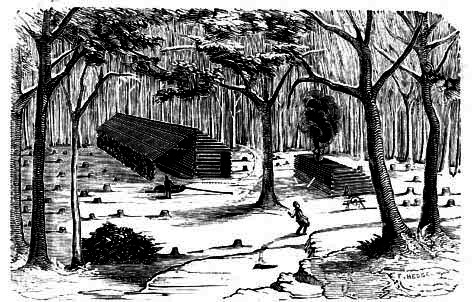
Winter-quarters of Lumbermen.
The interior arrangement is very simple. One section of the area of the camp is used for the dining-room, another for the sleeping apartment, and a third is appropriated to the kitchen. These apartments are not denoted by partitioned walls, but simply by small poles some six inches in diameter, laid upon the floor of the camp (which is the pure loam), running in various directions, and thus forming square areas of different dimensions, and appropriated as above suggested. The head-board to our bed consists of one or more logs, which form also the back wall of the camp. The foot-board is a small pole, some four or six feet from the fire. Our bedstead is mother earth, upon whose cool but maternal bosom we strew a thick coating of hemlock, cedar, and fir boughs. The width of this bed is determined by the number of occupants, varying from ten to twenty feet. Bed-clothes are suited to the width of the bed by sewing quilts and blankets together. The occupants, as a general thing, throw off their outer garments only when they "turn in" for the night. These hardy sons of the forest envy not those who roll on beds of down; their sleep is sound and invigorating; they need not court the gentle spell, turning from side to side, but, quietly submitting, sink into its profound depths.
Directly over the foot-pole, running parallel with it, and in front of the fire, is the "deacon seat." I think it would puzzle the greatest lexicographer of the age to define the word, or give its etymology as applied to a seat, which indeed it is, and nothing more nor less than a seat; but, so far as I can discover from those most deeply learned in the antiquarianism of the logging swamp, it has nothing more to do with deacons, or deacons with it, than with the pope. The seat itself, though the name be involved in a mystery, is nothing less nor more than a plank hewn from the trunk of a Spruce-tree some four inches thick by twelve inches wide, the length generally corresponding with the width of the bed, raised some eighteen inches above the foot-pole, and made stationary. This seat constitutes our sofa or settee, to which we add a few stools, which make up the principal part of our camp furniture. Should any of my readers ever be situated beyond the reach of cabinet-makers, but in the vicinity of the forest, I may introduce them into the secret of chair-making without the necessity of any tools except an ax. Split the top part of the trunk of a Spruce or Fir-tree in halves, cut a stick of the right length upon which three or four stout limbs grow; trim off the limbs of a sufficient length to suit your fancy; smooth the piece of timber to which they adhere by hewing, and your seat is completed. I can assure the reader that the instances are rare in which it becomes necessary to send them to the cabinetmaker for repairs, especially to have the legs glued in.
The luxury of a temporary table is now pretty generally enjoyed, with plates, knives and forks, tin dippers for tea and coffee, and sometimes cups and saucers. Formerly the deacon seat was used instead of a table, and a large frying-pan served for a platter for the whole crew. Around this the men would gather, each putting in his bread or potatoe, and salt fish, to sop in the pork fat; and never did king or courtier enjoy the luxuries of a palace more exquisitely than do our loggers this homely fare. On the St. Croix River, lumbermen generally adhere, from choice, to the original custom of eating from the frying-pan. Bread and beans are baked in a large "Duch oven," which is placed in a hole dug in the earth by the side of the fire, and entirely covered with hot coals and embers. In this position it is allowed to remain until the contents are done, when the ashes and cover are removed. I need not presume to inform the skillful cook that this mode of baking is unequaled. Our camp-fire is made on the ground next to the front wall, which is sometimes protected by a tier of large stones, but in other instances we simply set up two short stakes, against which enormous back-logs rest. After supper, each night unfailingly a very large fire is built to sleep by. Some of the wood used is so large that it often burns twenty-four hours before being entirely consumed. The amount of fuel made use of in building one camp-fire would supply an ordinary fire a week.
It is not an unfrequent occurrence, of course, for camps to take fire in this exposed situation, but some one generally discovers it in season to extinguish it by the timely application of snow or water. Instances have occurred, however, in which crews have been consumed with the camp. I recollect an instance in which a camp, on one of the tributaries of the Penobscot, took fire during the night while the inmates were asleep, and three out of four men were burned to death. In view of this liability, the roof of our camps are not so strongly fastened down but that, in the event of a retreat being cut off from the door, the united efforts of the inmates can burst it up, and thus make their escape. These things, however serious in some instances, are but little thought of or cared for.
Around this good camp-fire,
"With mirth to lighten duty,"
gather the crew after the toils of the day, to enjoy, as best they may, our long winter evenings; and around no fireside where there are equal responsibilities, intelligence, and many more luxuries, can be found more real contentment, or a greater degree of enjoyment.
Here rises the voice of song upon the wings of the winter night storm as it rolls past with the sublimity of an Alpine tempest. Here, also, are rehearsals of wild adventure, listened to with all the interest which isolated circumstances usually lend even to little matters.
The first night we lodged in one of our newly-erected camps, its dedication was proposed. It was moved and carried by acclamation that Hobbs should sing us a song, and that "Nick" should give us one of his yarns.
Hobbs, who, by-the-way, was a short, thick-set little fellow, with a chubby red face, and, withal, rather musical in his turn, gave vent to the following beautiful song, dedicated to the "Lumbermen" by the poet Whittier.
"Comrades! round our woodland quarters Sad-voiced autumn grieves; Thickly down these swelling waters Float his fallen leaves. Through the tall and naked timber, Column-like and old, Gleam the sunsets of November With their skies of gold. O'er us, to the South-land heading, Screams the gray wild goose; On the night-frost sounds the treading Of the stately moose. Fast the streams with ice are closing, Colder grows the sky, Soon, on lake and river frozen, Shall our log-piles lie. When, with sounds of smother'd thunder, On some night of rain, Lake and river break asunder Winter's weaken'd chain, Down the wild March-flood shall bear them To the saw-mill's wheel, Or, where Steam, the slave, shall tear them With his teeth of steel. Be it starlight, be it moonlight In these vales below, When the earliest beams of sunlight Streaks the mountain's snow, Crisps the hoar-frost keen and early To our hurrying feet, And the forest echoes clearly All our blows repeat. When the crystal Ambijejis Stretches broad and clear, And Millnoket's pine-black ridges Hide the browsing deer; Where, through lakes and wide morasses, Or through rocky walls, Swift and strong Penobscot passes, White with foamy falls. Where, through clouds, are glimpses given Of Katahdin's sides— Rock and forest piled to heaven, Torn and plowed by slides! Far below the Indian trapping In the sunshine warm, Far above the snow-cloud wrapping Half the peak in storm! Where are mossy carpets better Than the Persian weaves, And, than Eastern perfumes, sweeter Seem the fading leaves; And a music wild and solemn From the Pine-tree's height, Rolls its vast and sea-like volume On the wind of night. Make we here our camp of winter, And through sleet and snow Pitch knot and beechen splinter On our hearth shall glow; Here, with mirth to lighten duty, We shall lack alone Woman, with her smile of beauty, And her gentle tone. But her hearth is brighter burning For our work to-day, And her welcome at returning Shall our loss repay. Strike, then, comrades! Trade is waiting On our rugged toil, Far ships waiting for the freighting Of our woodland spoil! Ships, whose traffic links these highlands Bleak and cold of ours With the citron-planted islands Of a clime of flowers; To our frosts the tribute bringing Of eternal heats. In our lap of winter flinging Tropic fruits and sweets. Cheerly on the ax of labor Let the sunbeam dance, Better than the flash of saber Or the gleam of lance! Strike! With every blow is given Freer sun and sky, And the long-hid earth to heaven Looks with wond'ring eye. Loud behind us grow the murmurs Of the age to come— Clang of smiths, and tread of farmers Bearing harvest home! Here her virgin lap with treasures Shall the green earth fill— Waving wheat and golden maize-ears Crown each beechen hill. Keep who will the city's alleys, Take the smooth-shorn plain, Give to us the cedarn valleys, Rocks and hills of Maine! In our North-land, wild and woody, Let us still have part— Rugged nurse and mother sturdy, Hold us to thy heart! Oh, our free hearts beat the warmer For thy breath of snow, And our tread is all the firmer For thy rocks below. Freedom, hand in hand with labor, Walketh strong and brave; On the forehead of his neighbor No man writeth Slave! Brother looks on equal brother, Manhood looks on men— Be thy future, oh our mother, As thy past hath been— Heavenward, like thy mountain-guardians, With their star-crowns deck'd, And thy watchword, like Katahdin's Cloud-swept pine, 'Erect!'"
Then followed the "yarn." Now "Nick," as we familiarly called him, was a tall, sinewy man, the exact counterpart of Hobbs in physical proportions, full of fire, and fond of adventure. He had spent much of his life in the woods, and in different parts of the country, somewhat apt in his observations, and off-hand in his style of conversation.
Looking thoughtfully into the fire a moment, as if to call an item from his experience, he proceeded as follows:
"In the month of September, 18—, having business to transact with a man engaged in timber-making on Bartholomew's River, New Brunswick, I set out on horseback, late in the afternoon, for his encampment, distant some ten miles. Part of the distance I had to pass through a dense wilderness, where a path had been made by cutting away the underbrush and small trees; the rest of the journey could only be prosecuted by riding in the bed of the stream, which at the time was quite dry.
"In answer to the inquiries made at the tavern where I hired my horse, I was told that the camp was on the bank of the stream, and could be easily seen from the channel through which I was to pass. The sun was about one hour high when I entered the woods; but I had not proceeded half way through when the heavens suddenly became overcast, which admonished me that I was about to experience one of those terrible thunder-tempests which sometimes occur at the close of a sultry September day, and are remarkable for the copious torrents of rain which fall in the vicinity of lakes and rivers, surrounded by the wilderness. I felt some solicitude to reach the river before it became dark, but the roughness of the road prevented me from going faster than a walking pace, and, ere I had accomplished the journey through the forest, the rain poured down in torrents. The thunder of heaven's artillery was tremendous, and the shooting chains of fire hissed through the tops of the trees like darting fiery serpents, here and there spending their force upon the lofty spire of some gigantic Pine, splitting and shivering its trunk into thousands of pieces, and strewing them far away upon the ground. Night, hastened by the gathering tempest, wrapped the whole scene in profound darkness; thus, amid the deafening peals of thunder, the darting forks of lightning which shot around me in every direction, and torrents of rain, my horse groped his way silently along, bearing me upon his back. At length, through much danger, I reached the channel of the river, to encounter new dangers and difficulties.
"When I entered the channel, the rain had not materially affected the amount of water then flowing; but I had not proceeded far when the swollen and foaming current, which had accumulated from hill sides and numerous brooks, rushed by me, rendering riding imminently hazardous. To be prepared for the worst, I divested myself of my boots and the horse of his saddle. In vain did I strain my eyes to gain a glimpse of the camp each time the lightning dispelled the darkness, which gave me a momentary glimpse of all around. Concluding at length that I had gone too far down the river, I turned my horse and breasted the foaming current, resolving to renew my exertions in an up-river course. But the water by this time was so high, and the channel so treacherous, that I concluded to gain the shore of the stream, and make my way, if possible, along its banks, though densely studded with trees and bushes growing in the wildest confusion. Owing to the precipitousness of the banks, I was unable to gain my object, and was therefore compelled to remain in the stream. Again and again I essayed to escape to the shore, but from the same causes failed of its accomplishment. My situation was becoming more critical every moment. Sometimes my horse was making his way over large rocks; then, suddenly coming to deeper portions of the channel, would lose his footing entirely, and swim with me upon his back. All this time the darkness was intense, the tempest raged with unabated fury, while the already swollen current continued to increase. The solemnity of the midnight hour, rendered terrible by the tempest overhead and threatening waters beneath, filled my mind with painful apprehensions. The awful grandeur of God seemed to pass before me, proclaimed in the voice of his thunder. Death, the judgment, and my sins stood before me; and I felt constrained to implore His protecting mercy. At length the lightning revealed a camp just upon the bank. Here I was able to leave the channel of the river, whose banks had so long held me a prisoner.
"Supposing that I had found the object of my hazardous search, I dismounted, and, flinging the bridle from my horse's head, left him to shift for himself, and hastened to enter; but, to my amazement, it proved an old, deserted, and solitary camp. Here, however, I resolved to worry out the remainder of the night. The wind chopping round to the northwest, it ceased raining and grew very cold, so that before daylight the rain drops froze upon the bushes; and, beginning to be very chilly, I found that exercise was necessary to keep me warm. The darkness was yet so great that I could see nothing; and, for fear of thrusting my head against the roof, I threw myself down and crawled about on my hands and knees, until, wearied with my exertions, I felt the need of repose. I then dug a hole down in the old boughs, which had been used by the former occupants as a bed, crawled into it, and covered myself entirely under the rubbish, except my face. For a few moments I thought I should be able to sleep, but my hopes were speedily dissipated. I had not lain long before I was covered with myriads of fleas. Springing from my restless couch, I shook and brushed them from my clothes; and as all hopes of rest were dismissed, I continued to exercise myself as well as I could until the grizzly rays of early morning dispelled the darkness which had so long held me a prisoner. As soon as it became sufficiently light, I set out, in my stockings, in pursuit of the camp, which I had failed to find the night previous. Proceeding up river about two miles, I came at once upon the camp. It was Sabbath morning; the inmates were indulging themselves in a late nap, and, notwithstanding my urgent circumstances, I resolved to wait a little, and give them a gentle surprise. You may be assured that my wretched appearance fully qualified me for the occasion. My feet were still partially covered with the ragged remnants of my stockings; my clothes were considerably torn and thoroughly wet, and the shives of the old bough bed were sticking into them nearly as thickly as a fleece of porcupine quills; my hat, rendered soft by the thorough drenching it had received, settled down over my head and ears; the black dye from the hat had run down in little lines all over my face, leaving their dry channels distinctly defined; my long and tangled hair, together with my haggard, care-worn countenance, rendered me altogether an object which, under any circumstances, was calculated to inspire terror. Stepping up to the camp, I gave a sudden, loud rap, without any further demonstration, which awoke the crew. As they naturally supposed themselves far away from any human beings, a knock at their door thus early, and on a Sabbath morning, the more surprised them, and awakened their curiosity. 'Who or what the d—l can that be?' I overheard some one within say. Presently a man, who, by-the-way, knew me perfectly well, came to the door, and, with some caution, opened it. I met him with a fixed and vacant stare, without uttering a word. He returned my gaze with an expression of inquisitive astonishment.
"'You don't seem to know me,' I observed. The tones of my voice increased his astonishment, for they seemed familiar, but the strangeness of my appearance confounded him, and I could not refrain from laughing outright. Finally, half suspecting whom I might be, he exclaimed, with much energy, 'Nick! in the name of G—d, is it you?' I soon satisfied them on this point, while I briefly related my night's adventure. Their astonishment was great at seeing me in such an extraordinary plight, but not greater than was my satisfaction to meet them and to obtain the succor which I needed. After breakfast, some of the men went in pursuit of my horse, saddle, and boots. The last two they found on a little island in the stream, where, for fear of losing them by the flood, I had lashed them to a stump the night before."
Having thus finished his story and replenished his pipe, the old man leaned back against the camp walls and enveloped himself in a cloud of smoke, while he listened, in turn, to the various incidents in the experience of others, of which his own had been suggestive.
Finally, after some little discussion as to the precise location which each should occupy on the new bed, all hands "turned in," to live over again the fortunes of the day in the fantastic dreams of night.
Having completed our own cabin, we proceed next to construct a hovel for the oxen, which are yet behind. In erecting this, the same order in architecture is observed as in that of the camp, the timber of which it is composed, however, being much larger than that with which our own habitation is constructed. With the trunks of trees the walls are carried up nearly equal in height, leaving one side, however, enough lower than the other to give a moderate pitch to the roof, which is covered with the same kind of material as that of the camp. In the camp for the workmen there is no floor but the earth; the ox hovel, however, has a flooring made of small poles laid closely together, and hewed down with some degree of smoothness with the adz, and in the final finish the crevices in the walls are plastered with clay or ox manure. A temporary shed is thrown up in front, which serves as a depôt for hay and provender.
No little pains are bestowed upon the conveniences designed for the team. With the exception of sporting horses, never have I witnessed more untiring devotion to any creature than is bestowed upon the ox when under the care of a good teamster. The last thing before "turning in," he lights his lantern and repairs to the ox hovel. In the morning, by the peep of day, and often before, his faithful visits are repeated to hay, and provender, and card, and yoke up. No man's berth is so hard, among all the hands, as the teamster's. Every shoe and nail, every hoof and claw, and neck, yokes, chains, and sled, claim constant attention. While the rest of the hands are sitting or lounging around the liberal fire, shifting for their comfort, after exposure to the winter frosts through the day, he must repeatedly go out to look after the comfort of the sturdy, faithful ox. And then, for an hour or two in the morning again, while all, save the cook, are closing up the sweet and unbroken slumbers of the night, so welcome and necessary to the laborer, he is out amid the early frost with, I had almost said, the care of a mother, to see if "old Turk" is not loose, whether "Bright" favors the near fore-foot (which felt a little hot the day before), as he stands upon the hard floor, and then to inspect "Swan's" provender-trough, to see if he has eaten his meal, for it was carefully noted that at the "watering-place" last night he drank but little; while at the further end of the "tie-up" he thinks he hears a little clattering noise, and presently "little Star" is having his shins gently rapped, as a token of his master's wish to raise his foot to see if some nail has not given way in the loosened shoe; and this not for once, but every day, with numberless other cares connected with his charge.
A competent hand in this profession generally calculates to do a good winter's hauling, and bring his team out in the spring in quite as good flesh as when they commenced in the early part of the season. But as in all other matters, so in this, there are exceptions to the general rule. Some teamsters spoil their cattle, and bring them out in the spring miserably poor, and nearly strained to death. Such a practice, however, can not be regarded as either merciful or economical. So far as true policy is concerned, it is much better to keep a team well. What may be gained by hard pushing during the former part of the season will be more than made up during the latter, when the teams are moderately urged and well kept, and then you have a good team still for future labor.
Having completed our winter residences, next in order comes the business of looking out and cutting the "main," and some of the principal "branch roads." These roads, like the veins in the human body, ramify the wilderness to all the principal "clumps" and "groves of pine" embraced in the permit.
We have here no "turnpikes" nor rail-ways, but what is often more interesting. No pencilings can excel the graceful curves found in a main road as it winds along through the forest, uniform in width of track, hard-beaten and glassy in its surface, polished by the sled and logs which are so frequently drawn over it. Each fall of snow, when well trodden, not unlike repeated coats of paint on a rough surface, serves to cover up the unevenness of the bottom, which in time becomes very smooth and even. And besides, no street in all our cities is so beautifully studded with trees, whose spreading branches affectionately interlace, forming graceful archways above. Along this road side, on the way to the landing, runs a serpentine pathway for the "knight of the goad," whose deviations are marked now outside this tree, then behind that "windfall," now again intercepting the main road, skipping along like a dog at one's side. To pass along this road in mid-winter, one would hardly suspect the deformities which the dissolving snows reveal in the spring—the stumps and knolls, skids and roots, with a full share of mud-sloughs, impassable to all except man, or animals untrammeled with the harness.
In the process of making these roads, the first thing in order is to look out the best location for them. This is done by an experienced hand, who "spots" the trees where he wishes the road to be "swamped." We usually begin at the landing, and cut back toward the principal part of the timber to be hauled.
In constructing this road, first all the underbrush is cut and thrown on one side; all trees standing in its range are cut close to the ground, and the trunks of prostrated trees cut off and thrown out, leaving a space from ten to twelve feet wide. The tops of the highest knolls are scraped off, and small poles, called skids, are laid across the road in the hollows between. Where a brook or slough occurs, a pole-bridge is thrown across it.
These preparatory arrangements are entered upon and prosecuted with a degree of interest and pleasure by lumbermen scarcely credible to those unacquainted with such a mode of life and with such business. Though not altogether unacquainted with other occupations and other sources of enjoyment, still, to such scenes my thoughts run back for the happier portions of life and experience.
I have attended to various kinds of labor, but never have I entered upon any half so pleasing as that usually performed in the "logging swamp." Although greatly jeoparding my reputation for taste, I will utter it. Positively, it is delightful. I have since had some years' experience in one of the professions, in the enjoyment of some of the refinements of life, yet, if it could be done consistently, I would now with eagerness exchange my house for the logging camp, my books for the ax, and the city full for those wilderness solitudes whose delightful valleys and swelling ridges give me Nature uncontaminated—I had almost said, uncursed, fresh from the hand of the Creator. To write of those things makes the bustling city seem dull and irksome. Fain would I hie away once more to those pleasant pastime labors.
Happily, all tastes are not alike. Yet there are few who, on entering a beautiful native forest, would not experience delight; the varieties of trees set out by the hand of Nature, their graceful forms and spreading branches interlocked with neighborly affection and recognition; the harmonious confusion of undergrowth; the beautiful mosses, the ever-varying surface—old age, manhood and youth, childhood and infancy—massive trunks and little sprouts; the towering Pine and creeping Winter-green, intermingled by the artless genii of these wild retreats, all combined, serve to explain the attachment of the Aborigines to their forest abodes, and give to savage life the power of enchantment.
CHAPTER IV.
Tokens of Winter.—The Anticipation.—Introduction of Team.— Difficulties attending it.—Uncomfortable Boating.—The Contrast.—Method of crossing Streams and Rivers.—The Docility of the Ox.—Facilities of Turnpikes.—Stopping-places.—Arrival. —An Adventure.—Ten Oxen in the Ice.—Method of taking them Out. —An uncomfortable Night.—The midnight Excursion.—Oxen running at large in the Wilderness.—Developments of Memory.—Logging.— Division of Labor.—How to manage in the absence of a Cook.— "Uncle Nat."—Anecdote.—Felling Pines.—Ingenuity of Choppers. —Preparatory Arrangements.—The Bob-sled.—Method of Operation described.—The Excitement.—Comparison.—Immediate Length of Pine-trees.—Conclusion.
By the time these arrangements are made, serious indications of winter appear in cold, freezing nights and light falls of snow. It is now about time to look for the arrival of the team and extra hands.
This event we anticipate with as much interest as voyagers are wont to feel when they meet upon the ocean after several months at sea. Letters and newspapers are expected, and, when received, perused with avidity. New acquaintances are to be made, new tools to be examined, and every thing foreign, however insignificant, is an object of interest.
The introduction of the team to winter quarters is always attended with more or less trouble: much less, however, of late than in former years. Then, all the chains and other implements connected with the business, together with provisions for the crew and provender for the oxen, enough to last until the swamps, rivers, and lakes were frozen, so as to allow teams to pass over them, were boated in the manner described in a former chapter, which required many trips, and were continued until a late period in the fall.
To the latest trips an additional and most uncomfortable inconvenience is added to the many hardships of boating provisions. This is when the ice makes on our poles while in the act of passing up over rapids. Often our hands become so cold and stiff as to render it very difficult to hold on to the icy instrument. The mariner may stop a moment, even in a gale, while at the yard-arm, to blow his freezing fingers; but not so with the lumberman with a loaded boat in a rapid current: every finger is needed every moment, as life and property would be endangered by paying even slight attention to cold fingers.
Where the nature of the route will allow it, and an early start is desired, our teams are attached to a long sled, lightly loaded, which is dragged over miry, rough roads. In crossing large streams, we unyoke the oxen and swim them over. If we have no boat, a raft is constructed, upon which our effects are transported, when we re-yoke and pursue our route as before. Our oxen are often very reluctant to enter the water while the anchor ice runs, and the cold has already begun to congeal its surface. But an ox hardly knows how to refuse compliance with his master's wishes, so submissive is he in his disposition.
Of late, since roads have been cut, and even "turnpikes" made a considerable portion of the distance up the main rivers, such as the "Calais and Houlton Road" on the St. Croix, and the "Military Road" on the Penobscot, which connect with other less perfect thoroughfares, and finally terminate in common swamp roads, our conveyances are much easier, and the business of taking the team on to the ground is, and may be safely, deferred until frosts and snows admit of a more agreeable mode of travel.
What is called a team is variously composed of from four to six, and even eight oxen. During the months of November and December, after the ground and swamps are frozen, and early snows fall, our team is attached to a "long sled," loaded with provisions, tools, &c., accompanied with a new recruit of hands. Leaving home and the scenes of civilization, slowly we move forward to join those who had preceded us to make preparations for our reception. After several days' journeyings, putting up at night at places erected and supplied for the convenience of such travelers, and at suitable distances on the route, we finally reach our new home. Our arrival is no less agreeable to ourselves than welcome to our comrades. But there are incidents scattered all the way along, and seldom do we perform such a journey without experiencing something worth relating.
On one occasion, late in the fall, we started for our winter quarters up river. We had traveled about one hundred miles, passing along up the military road, then south upon the Calais road to Baskahegan Lake, which we were to cross, our camps being on the opposite side. We reached the borders of the lake late in the afternoon. The ice was not so thickly frozen as was anticipated, so that the practicability of crossing seemed exceedingly problematical. Having been long on the way, we were anxious, if possible, to arrive in camp that night. The shores of the lake were so swampy that it was deemed impracticable to perform the route around it, and it was finally determined to make an effort to cross upon the ice. We had twelve oxen, which were disposed of in the following order: the lightest yoke of oxen was selected and driven in yoke before to test the strength of the ice, and, in case the loaded teams should break through, to be used to pull them out. These were our reserve. The next in the line of march was a pair of oxen attached to a sled, with hay, &c. Next in order was a four-ox team; these were also attached to a sled, loaded with hay and provisions; and, finally, to bring up the rear, still another four-ox team, with a loaded sled—all of which were strung out at suitable distances, to prevent too much weight coming upon any one point, thus rendering our passage more safe. The word was given, when we all moved forward, intending first to gain a point which ran out into the lake, covered with a thick small growth. The ice cracked and buckled beneath our feet at every step. Proceeding in this way, we gained the point in safety. It had by this time become late, and the last rays of the setting sun gilded the tops of the towering pines, which peered far up in the air above the surrounding forest.
The night was very cold, and the wind swept up the lake with a penetrating chill, which made us button up our garments closely to prevent its too ready access to our bodies. Having gained the point in safety, we were emboldened to set forward again upon the main body of the lake, which was yet to be crossed. Here the ice seemed less capable of sustaining our weight than in the cove, which, from its protected position, had probably congealed sooner than the main lake, which was more exposed to the action of winds.
Here the ice gave more alarming indications of its incapacity to hold us. We had not proceeded more than three fourths of a mile when the hindermost team broke through, sled and all, which was very naturally accounted for, as the teams which preceded cracked and weakened the ice. The alarm was given along the line, when the other teams stopped; and while we were preparing to extricate those already in, the next team of four oxen dropped in also; and finally they were all in at once, except the reserve pair. Had they kept in motion, probably the foremost teams might have escaped; but, upon stopping, the ice gradually settled, when in they went. There we were on that bleak spot, with the shades of night fast settling down upon us, and ten oxen struggling in the benumbing waters: business enough, thought we.
Standing upon the edge of the ice, a man was placed by the side of each ox to keep his head out of the water. We unyoked one at a time, and, throwing a rope round the roots of his horns, the warp was carried forward and attached to the little oxen, whose services on this occasion were very necessary. A strong man was placed on the ice at the edge, so that, lifting the ox by his horns, he was able to press the ice down and raise his shoulder up on the edge, when the warp-oxen would pull them out. For half an hour we had a lively time of it, and in an almost incredible short time we had them all safely out, and drove them back upon the point nearly a mile. It was now very dark. We left our sleds in the water with the hay, pulling out a few armsful, which we carried to the shore to rub the oxen down with. Poor fellows! they seemed nearly chilled to death, while they shook as if they would fall to pieces.
We built up a large fire, and, leaving the principal part of the crew behind to take care of the oxen, I, with several of the hands, started to find, if possible, the camps, where were waiting those who had been previously engaged in making arrangements for the winter. This was esteemed by some rather risky, as it was getting very dark, and we did not know exactly which way to shape our course. But the prospect seemed gloomy and uninviting to remain upon that bleak point all night, and, besides, we wished the assistance of the camp's crew in taking our teams over next day. Delay was not to be thought of. We therefore started. A squall of snow came up when we were midway across, which completely bewildered us, and we became divided in opinion as to the proper course to steer. Tenacious of my own views, I resolved to pursue the course which appeared to me right, when the others consented to follow. Finally, after several hours of hard travel, we gained the shore, not far from the road which led back to the camp, about half a mile distant in the woods. We were here, again, puzzled to know whether the camp lay at the right or left. Settling that matter by guess, as Yankees often do other things, we traveled along by the shore about one fourth of a mile, when, to our great relief, we came to the road, up which we passed, and reached the camp a little after midnight, hungry and fatigued. We found our comrades snugly quartered and soundly sleeping. Refreshing ourselves with hot tea, bread, and beef, we turned in and slept until daylight, when, after breakfast, all hands started to rejoin those left behind. We were with them in a few hours. Poor fellows! they had had a pretty uncomfortable season, not one moment's sleep during the night, and scantily provided with food, while the oxen fared harder still. We succeeded in getting out of the ice all but one load of hay, which we left behind. Not venturing to cross directly, we now followed round the lake, close in shore, and finally reached our winter quarters in safety, and without further accident.
The task of taking oxen on to the ground every fall is very considerable, especially when we go far into the interior, as we frequently do nearly two hundred miles. This labor and expense is sometimes obviated by leaving them in the spring to shift for themselves in the wilderness and on the meadows, where they remain until autumn, when they are hunted up. During their wilderness exile they thrive finely, and, when found, appear very wild; yet wondering, they seem to look at us as though they had some lingering recollection of having seen us before. It is often very difficult to catch and yoke them; but, with all their wildness, they evidently show signs of pleasure in the recognition. When turned out in this way, however, instances have occurred when they have never again been seen or heard from. In some cases they probably get mired or cast, and die; in others, they doubtless stray away, and fall a prey to bears and wolves. Bears as well as wolves have been known to attack oxen. An individual who owned a very fine "six-ox team" turned them into the woods to browse, in a new region of country. Late in the evening, his attention was arrested by the bellowing of one of them. It continued for an hour or two, then ceased altogether. The night was very dark, and, as the ox was supposed to be more than a mile distant, it was thought not advisable to venture in search of him until morning. As soon as daylight appeared, he started, in company with another man, to investigate the cause of the uproar. Passing on about a mile, he found one of his best oxen laying prostrate, and, on examination, there was found a hole eaten into the thickest part of his hind quarter nearly as large as a hat; not less than six or eight pounds of flesh were gone. He had bled profusely. The ground was torn up for rods around where the encounter occurred; the tracks indicated the assailant to be a very large bear, who had probably worried the ox out, and then satiated his ravenous appetite, feasting upon him while yet alive. A road was bushed out to the spot where the poor creature lay, and he was got upon a sled and hauled home by a yoke of his companions, where the wound was dressed. It never, however, entirely healed, though it was so far improved as to allow of his being fattened, after which he was slaughtered for food.
After a few days' respite, and as soon as a sufficient quantity of snow has fallen, we commence hauling the logs. As there are several departments of labor, each man is assigned to some one of them. In most cases, indeed, every hand is hired with the distinct understanding that he is to perform a particular part of the labor, and the wages differ accordingly, being regulated, also, by the ability with which they can severally fill those stations.
First, then, comes the "boss," or the principal in charge. Then the choppers, meaning those who select, fell, and cut the logs, one of whom is master chopper. Next the swampers, who cut and clear the roads through the forest to the fallen trees, one of whom is master swamper. Then comes the barker and loader, the man who hews off the bark from that part of the log which is to drag on the snow, and assists the teamster in loading. Then we have the captain of the göad, or teamster, whom we have already alluded to; and finally the cook, whose duty is too generally known to require any particular description. Every crew is not supplied with the last important character; this deficiency, I believe, is much more common on the St. Croix than on the Penobscot, where the mode of camp life and fare is much better attended to. When we have no person specially set apart to this work, the crew generally take turns, to do which there is an obligation imposed by usage and common consent on some rivers, and each man, therefore, must comply, or furnish a substitute by employing some one to act for him. In those instances where no cook is provided, we take turns, a week at a time, or each man consents to perform some particular duty in cookery; for instance, one makes all the bread, another the tea and coffee, and so on through the routine of camp domesticism. A slight degree of rebellion sometimes manifests itself touching this business, especially before matters receive their regular winter mold. One refuses to cook, another says he "was hired to do something else," while another says, "I'm d—d if I cook any how." I recollect a pleasant occurrence of this kind, at least one rendered so by the clever management of an old man connected with the crew. They had returned to camp from the labors of the day, the fire was nearly out, and nothing prepared for supper. Alike fatigued and hungry, each refused, in turn, to discharge the duties of cook, and the gloomy prospect presented itself of a supperless night. "Uncle Nat," as we familiarly called him, was a "jolly old soul," the very personification of good nature, corpulency, and quietude, possessing, withal, a good share of ingenious wit; and, from his corpulency and asthmatical tendencies, reminding one of a small locomotive by the puffing and blowing consequent on physical exertion. Now how to settle this matter, and have even any number of volunteer cooks, at once occurred to "Uncle Nat." "Dear me" (his favorite expression), "what a time about cooking. Why, it is the easiest thing in nature to get supper. Now, boys, if you will all wait upon me, I'll be cook." "Agreed! agreed!" was the ready response on all hands. This matter being settled, "Uncle Nat" very deliberately deposited himself on the "deacon seat," and commenced drilling the volunteer assistants. "Now, Richard, get a little wood and kindle up the fire." "Isaac, step down to the brook and fetch a pail of water;" "and you, Mac, while the fire is getting under way, wash a few potatoes, and get them ready to put on when the pot boils." "Now, Jake, cut a few slices of pork," continued our chief cook, with much sang froid, "and put it over the fire to fry." "But you were to get supper, Uncle Nat." "Yes, I was to get supper, but you were to wait upon me," says he, casting a significant glance toward Tom, at the same time ordering him to make the dishes ready. Remonstrance was vain: they had agreed to wait upon him, if he would be cook. Every thing was arranged, supper ready, and there still sat the old gentleman—hadn't stirred an inch. "Dear me" (deep breathing), "dear me," said Uncle Nat, "I have got supper, and 'twas one of the easiest things in the world." The "boys" are caught—it was a "good 'un;" and to the enjoyment of a relishable supper was added a hearty laugh. Uncle Nat's proposition passed into a by-word, and all, ever after, were ready to do any thing, provided they could be "waited upon."
In the process of taking logs to the landing from the swamp, the first thing in order is to select the tree. The direction in which it is judged likely to fall is determined by circumstances. First, the inclination of the tree as it stands; and, second, the direction and power of the wind. Sometimes this matter may be governed, where the tree stands very erect, by under-cutting one side more than the other; to which an expedient is added, when necessary, by falling one tree against another. Choppers can, if skillful, lay a tree, in falling, with sufficient accuracy to hit and drive a stake into the ground. When, however, a tree stands upon an abrupt hill-side, we are apt to get deceived. It is thrilling business to bring those giant Pines down. The ground trembles under the stroke, while the reverberating echo of its fall, as it rings through mountains and valleys, may, on a still morning, be heard six or eight miles. Before felling the Pine, small trees are cut for bed-pieces, the Pine-tree falling across them transversely, to prevent it from becoming too deeply imbedded in the snow. This also facilitates the barking and loading operation. The proper place being selected, the trunk of the tree is cut off while the "swampers" have been directing their road to the spot. The "barkers"—like whalemen leaping upon the back of their prize with their cutting spades—are at once at work with their axes, hewing the bark from that portion of the log which is to be drawn along on the snow, while the other end is to rest upon the sled. The "teams" next approach the scene of action, drawing after them a short sled, called a "bob-sled;" probably so named from the bobbing motion it has while drawn over the rough ground. It would be an insult to every New Englander's intelligence to attempt a description of this sled; I therefore pass it, remarking, by-the-way, that, considering the service for which it is designed, it is made very strong, as it is required to sustain one end, or more than half the weight of the largest trees upon a single bar: in some cases several tuns burden rest upon a single point. While this bar alone sustains one half the entire log, it is also the only part of the sled to which the heavy trunks of those massive trees are bound; it therefore draws as well as sustains the load, challenging the powers of six and even eight of the stoutest oxen.
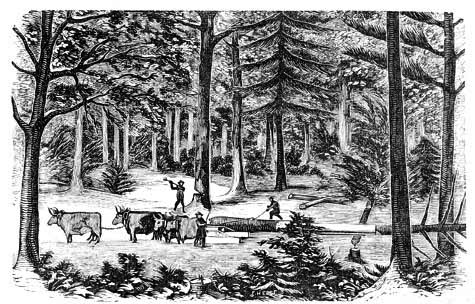
Log hauling—Process of loading Logs.
In the process of loading, the bob-sled is placed several feet from the side of that end of the log which is to be placed upon it. Then a large skid, from four to eight inches in diameter and several feet in length, is placed near the large bar running under the log. A chain is next attached to the bar, passing now under, then over the log, back to the sled, crossing it. It is then attached by other chains to one or two yoke of oxen, whose united strength is requisite to roll one end of it upon this big bar, to which it is bound with strong, heavy chains. Of late, the tackle and fall has been introduced in loading, which very much facilitates the operation.
The six oxen are now attached to the sled, one pair of them to the tongue; the others are attached by chains in advance as leaders. The teamster now arranges every ox in the most advantageous position, passing through several evolutions with his goad-stick; then giving the word of command, they settle to it. Slowly it moves forward, while the vociferations of the animated teamster, the squatting-like posture of the hard-drawn team, indicate the importance and interest of the occasion; and the bob-sled, as though it were a thing of life, actually screams out at every joint as if in keenest agony beneath its ponderous load.
The reader has perhaps been present at a "launching;" the nervous emotions experienced in the process described, including the felling of the gigantic Pines, the skidding and hauling, quite equal those awakened at the launching of a vessel. This process is gone through with several times each day during the winter (Sundays excepted); really it is like going to launching every day, and the pleasurable excitement of the labor renders it extremely delightful to most who are engaged in it.
The general custom is to take the whole trunk of the tree to the landing at one load, when its size will allow, where it is sawed into short logs from fourteen to thirty feet in length, to facilitate the driving down river. I have cut one tree into five logs, the shortest of which was not less than fourteen feet. I have seen them hauled eighty-two feet in length, resembling, in their passage to the landing, immense serpents crawling from their lurking-places. Thus we continue to fell, clear, and haul until the "clump" is exhausted, and our attention is again directed to another school of these forest whales, and so on until our winter's work is completed.
Formerly, Pine-trees grew in abundance on the banks of rivers and streams, and the margins of those wild lakes found in the interior. Thousands were cut and rolled into the water, or on the ice, and perhaps a much larger number were so near the landing as to require merely to be dragged out, thus avoiding the labor of loading, in which case, from the massive size of the trees, it was necessary to cut them into short logs. Such opportunities, however, for lumber have gone by, and the greater portion has now to be hauled from a considerable distance. A greater scarcity is too evidently at hand, though, were every Pine-tree sound and good, no end to the quantity might yet be thought of; for, notwithstanding the immense quantities cut, and the devastating fires by which hundreds of millions have been destroyed, on some rivers it still abounds, but a large portion of Pine is found in a rotten and decayed state at heart. Having long since come to maturity, that peculiar process which makes its impress upon all earthly objects, decay, is nowhere more general in its depredations than among the noble Pines in the north and east. There is a cancerous disease peculiar to the Pine-tree, to which lumbermen give the original name of "Conk" or "Konkus." The manifestation of this disease on the outside of the tree, usually several feet from the butt-end, is a small spot of a brown color, sometimes resembling gingerbread in appearance and texture, protruding as a general thing only to the surface, and varying in size from a ninepence to the crown of a hat. In some clumps of Pine, all that indicates the presence of this disease is a little yellow pitch starting out through the bark and trickling down the outside.
The uninitiated would be led to suspect but little, if indeed any, harm from an appearance so slight and unnoticeable as that presented by the konkus. It exerts no influence either upon the size or beautiful proportions of the tree, as those most seriously affected, in outward appearances, are as handsomely grown as the most perfect, which leads to the conclusion that the disease does not much affect them until quite mature.
On cutting one of these trees, the infection is found to spread itself, more or less, throughout the trunk, turning the wood to a reddish color, making it spongy in texture; and while the fibrous portions of the wood retain their thread-like straightness, the marrowy portion or flesh-like membranes, and intermediate layers between the fibers, appear dry and of a milky whiteness. Sometimes the rot shoots upward, in imitation of the streaming light of the Aurora Borealis; in others downward, and even both ways, preserving the same appearance.
Large families, and even communities of the Pine, are thus infected, so that in a group of thirty trees perhaps not more than half a dozen short logs can be obtained.
Frauds are sometimes practiced upon those who purchase logs, by driving a knot or piece of a limb of the same tree into the konkus and hewing it off smoothly, so that it has the appearance of a natural knot, but the dissecting process at the saw-mill exposes the imposition.
Much of this timber is hollow at the butt, affording in some instances fine winter retreats for bears, where they den. We have a high time of it when we chance to make such a discovery. "A few rods from the main logging road, where I worked one winter," said Mr. Johnson, "there stood a very large Pine-tree. We had nearly completed our winter's work, and it still stood unmolested, because from appearances it was supposed to be worthless. While passing it one day, not quite satisfied with the decision that had been made upon its quality, I resolved to satisfy my own mind touching its value; so, wallowing to it through the snow, which was nearly up to my middle, I struck it several blows with the head of my ax, an experiment to test whether a tree be hollow or not. When I desisted, my attention was arrested by a slight scratching and whining.
"Suspecting the cause, but not quite satisfied, I thumped the tree again, listening more attentively, and heard the same noise as before: it was a bear's den. Examining the tree more closely, I discovered a small hole in the trunk, near the roots, with a rim of ice on the edge of the orifice, made by the freezing of the breath and vapor from the inmates.
"Satisfied now of the character of the prisoners, I communicated my discovery at once to the rest of the crew, who immediately left their work and ran like a pack of hounds, jumping and leaping through the deep snow. We kicked the snow away from the roots to learn the place of entrée, which we plugged up with bits of wood, after removing the frozen dirt and turf with which it was closed. We next cut a hole into the tree, about four feet from the ground, some eight or ten inches in diameter; into this a pole was thrust, to 'stir them up' and prepare them to thrust their heads out below when the hole should be opened again.
"Having annoyed them sufficiently to induce them to attempt an egress from the passage below, the obstacles were removed, after stationing two men, one on either side, with their axes to dispatch them—when the old bear thrust out her head. A severe wound was inflicted, which sent her back growling and gnashing her teeth. Again thrusting the pole through the upper aperture, we punched and jibed her for some minutes before she could be induced to make a second effort to escape; when she did, she was met as before, receiving a second and more deadly wound, which was succeeded with less furious demonstrations of rage than before. A third effort was made to drive them out, but there was no response save the piteous crying of small cubs. We then cut a small hard-wood tree, trimmed off the branches, leaving one prong about six inches long, sharpened out, forming a hook. Enlarging the aperture below, we thrust in the wooden hook, which grappled a heavy but resistless carcass. With much exertion we drew it forth: she was dead. The cubs, four in number—a thing unusual by one half—we took alive, and carried them to the camp, kept them a while, and finally sold them. They were quite small and harmless, of a most beautiful lustrous black, and fat as porpoises. The old dam was uncommonly large; we judged she might weigh about three hundred pounds. Her hide, when stretched out and nailed on to the end of the camp, appeared quite equal to a cow's hide in dimensions."
Here in our wild winter quarters, where we delight to dwell during a period of from three to four months, we find much to interest and amuse—much to do, for an equal amount of labor is rarely performed within the same time under any other circumstances, and I may add, too, with less fatigue or disrelish. With incident, romance, story, song, and adventure, time passes rapidly away.
CHAPTER V.
The Skill and Enterprise of Lumbermen.—Method of taking Logs down Hills and Mountains.—Dry Sluice.—Stern Anchor.—Giant Mountain Steps.—Alpine Lumbering.—Warping a Team down Steeps.—Trial of Skill and Strength.—The rival Load.—Danger and Inconvenience of Hills in Logging Roads.—A distressing Accident.—Solemn Conclusion of a Winter's Work.—Some of the Perils attendant upon Lumbering.—A fearful Wound.—Narrow Escape.—The buried Cap.—The safest Way of Retreat.—A Sabbath in the Logging Camp.—Sunday Morning Naps.— Domestic Camp Duties.—Letter Writing.—Recreations.—Sable Traps.—Deer and Moose.—Bear Meat.—A rare Joke.—Moose Hunt. —Bewildered Hunters.—Extraordinary Encounter.—Conclusion of Sabbath in the Woods.
Lumbermen not only cut and haul from clumps and communities, but reconnoiter the forest, hill, vale, and mountain side for scattering trees; and when they are deemed worth an effort, no location in which they may be found, however wild or daring, can oppose the skill and enterprise of our men.
For taking logs down mountain sides, we adopt various methods, according to the circumstances. Sometimes we construct what are termed dry sluice-ways, which reach from the upper edge of a precipice down to the base of the hill. This is made by laying large poles or trunks of straight trees together the whole distance, which is so constructed as to keep the log from running off at the sides. Logs are rolled into the upper end, the descent or dip often being very steep; the log passes on with lightning-like velocity, quite burying itself in the snow and leaves below. From the roughness of the surfaces, the friction is very great, causing the bark and smoke to fly plentifully.
At other times, when the descent is more gradual and not too steep, and when there is not a sufficient quantity to pay the expense of a sluice-way, we fell a large tree, sometimes the Hemlock, trim out the top, and cut the largest limbs off a foot, more or less, from the trunk. This is attached to the end of the log by strong chains, and as the oxen draw the load, this drag thrusts its stumpy limbs into the snow and frozen earth, and thus prevents the load from forcing the team forward too rapidly. Should the chain give way which attaches the hold-back to the load, nothing could save the team from sudden destruction.
There is a mountain on the "west branch" of the Penobscot where Pine-trees of excellent quality stand far up its sides, whose tops appear to sweep the very clouds. The side which furnishes timber rises in terraces of gigantic proportions, forming a succession of abrupt precipices and shelving table-land. There are three of these giant mountain steps, each of which produces lumber which challenges the admiration and enterprise of the logmen. The ascent to these Alpine groves is too abrupt to allow the team to ascend in harness; we therefore unyoke and drive the oxen up winding pathways. The yokes and chains are carried up by the workmen, and also the bob-sled in pieces, after taking it apart. Ascending to the uppermost terrace, the oxen are re-yoked and the sled adjusted. The logs being cut and prepared as usual, are loaded, and hauled to the edge of the first precipice, unloaded, and rolled off to the table of the second terrace, where they are again loaded, hauled, and tumbled off as before, to the top of the first rise, from which they are again pitched down to the base of the mountain, where for the last time they are loaded, and hauled to the landing.
To obtain logs in such romantic locations was really as hazardous as it was laborious, varying sufficiently from the usual routine of labor to invest the occasion with no ordinary interest. It was, indeed, an exhibition well calculated to awaken thrilling emotions to witness the descent of those massive logs, breaking and shivering whatever might obstruct their giddy plunge down the steep mountain side, making the valleys reverberate and ring merrily with the concussion.
In other instances loads are eased down hill sides by the use of "tackle and fall," or by a strong "warp," taking a "bite" round a tree, and hitching to one yoke of the oxen. In this manner the load is "tailed down" steeps where it would be impossible for the "tongue oxen" to resist the pressure of the load. Sometimes the warp parts under the test to which it is thus subjected, when the whole load plunges onward like an avalanche, subjecting the poor oxen to a shocking death.
But the circumstance which calls forth the most interest and exertion is the "rival load." When teams are located with sufficient proximity to admit of convenient intercourse, a spirit of rivalry is often rife between the different crews, on various points. The "largest tree," the "smartest chopper," the "best cook," the "greatest day's work," and a score of other superlatives, all invested with attractions, the greater from the isolated circumstances of swamp life.
The "crack" load is preceded by all needful preliminaries. All defective places in the road are repaired. New "skids" are nicely pealed by hewing off the bark smoothly, and plentifully as well as calculatingly laid along the road. All needful repairs are made on the bob-sled, and the team put in contending plight. The trees intended for the "big load" are carefully prepared, and hauled to some convenient place on the main road singly, where they are reloaded, putting on two and sometimes three large trees. All things in readiness, the men follow up with hand-spikes and long levers. Then comes the "tug of war;" rod by rod, or foot by foot, the whole is moved forward, demanding every ounce of strength, both of men and oxen united, to perform the feat of getting it to the landing. Were life and fortune at stake, more could not be done under the circumstances. The surveyor applies the rule, and the result gives either the one or the other party "whereof to glory." If not "teetotalers," the vanquished "pay the bitters" when they get down river. Men love and will have excitement; with spirits never more buoyant, every thing, however trifling, adds to the stock of "fun alive" in the woods. Every crew has its "Jack," who, in the absence of other material, either from his store of "mother-wit" or "greenness," contributes to the merry shaking of sides, or allows himself to be the butt of good-natured ridicule.
But while the greater part of swamp life is more or less merry, there are occasional interruptions to the joyousness that abounds. Logging roads are generally laid out with due regard to the conveniences of level or gently descending ground. But in some instances the unevenness of the country admits only of unfavorable alternatives. Sometimes there are moderate rises to ascend or descend on the way to the landing; the former are hard, the latter dangerous to the team. I knew a teamster to lose his life in the following shocking manner: On one section of the main road there was quite a "smart pitch" of considerable length, on which the load invariably "drove" the team along on a forced trot. Down this slope our teamster had often passed without sustaining any injury to himself or oxen. One day, having, as usual, taken his load from the stump, he proceeded toward the landing, soon passing out of sight and hearing. Not making his appearance at the expiration of the usual time, it was suspected that something more than usual had detained him. Obeying the impulses of a proper solicitude on his behalf, some of the hands started to render service if it were needed. Coming to the head of the hill down which the road ran, they saw the team at the foot of it, standing with the forward oxen faced about up the road, but no teamster. On reaching the spot, a most distressing spectacle presented itself; there lay the teamster on the hard road, with one of the sled runners directly across his bowels, which, under the weight of several tons of timber, were pressed down to the thickness of a man's hand. He was still alive, and when they called out to him, just before reaching the sled, he spoke up as promptly as usual, "Here am I," as if nothing had been the matter. These were the only and last words he ever uttered. A "pry" was immediately set, which raised the dead-fall from his crushed body, enabling them to extricate it from its dreadful position. Shortly after, his consciousness left him, and never more returned. He could give no explanation; but we inferred, from the position of the forward oxen, that the load had forced the team into a run, by which the tongue cattle, pressed by the leaders, turning them round, which probably threw the teamster under the runner, and the whole load stopped when about to poise over his body.
He was taken to the camp, where all was done that could be, under the circumstances, to save him, but to no purpose. His work was finished. He still lingered, in an apparently unconscious state, until midnight, when his spirit, forsaking its bruised and crushed tenement, ascended above the sighing pines, and entered the eternal state. The only words he uttered were those in reply to the calling of his name. As near as we could judge, he had laid two hours in the position in which he was found. It was astonishing to see how he had gnawed the rave [8] of the sled. It was between three and four inches through. In his agony, he had bitten it nearly half off. To do this, he must have pulled himself up with his hands, gnawed a while, then fallen back again through exhaustion and in despair. He was taken out to the nearest settlement, and buried.
At a later period, we lost our teamster by an accident not altogether dissimilar. It was at the winding up of our winter's work in hauling. Late in the afternoon we had felled and prepared our final tree, which was to finish the last of the numerous loads which had been taken to the well-stowed landing. Wearied with the frequency of his travels on the same road for the same purpose, this last load was anticipated with no ordinary interest; and when the tree was loaded, he seemed to contemplate it with profound satisfaction. "This," said he, "is my last load." For the last time the team was placed in order, to drag from its bed the tree of a hundred summers. Onward it moved at the signal given, and he was soon lost to view in the frequent windings of the forest road. It was nearly sundown, and, had it not been for closing up the winter's work that day, the hauling would have been deferred until next morning.
The usual preparations for our evening camp-fire had been made, and the thick shadows of evening had been gathering for an hour, and yet he did not come. Again and again some one of the crew would step out to listen if he could catch the jingling of the chains as they were hauled along; but nothing broke upon the ear in the stillness of the early night. Unwilling longer to resist the solicitude entertained for his safety, several of us started with a lantern for the landing. We continued to pass on, every moment expecting to hear or meet him, until the landing was finally reached. There, quietly chewing the cud, the oxen were standing, unconscious of the cause that detained them, or that for the last time they had heard the well-known voice of their devoted master. Hastening along, we found the load properly rolled off the sled, but heavens! what a sight greeted our almost unbelieving vision! There lay the poor fellow beneath that terrible pressure. A log was resting across his crushed body. He was dead. From appearances, we judged that, after having knocked out the "fid," which united the chain that bound the load, the log rolled suddenly upon him. Thus, without a moment's warning, he ceased in the same instant to work and live. It proved, indeed, his "last load."
To contemplate the sameness of the labor in passing to and fro from the swamp to the landing several times a day, on a solitary wilderness-road, for a term of several months, with only those respites afforded in stormy weather and on Sundays, one might think himself capable of entering into the feelings of a teamster, and sympathetically share with him the pleasurable emotions consequent upon the conclusion of his winter's work. While it must be conceded that, of things possessing every element capable of contributing pleasure, we sometimes weary through excess, let it not be supposed that our knight of the goad has more than usual occasion to tire, or sigh for the conclusion of the hauling season. To be sure, "ta and fra" the livelong winter, now with a load wending along a serpentine road, as it winds through the forest, he repeats his visits to the swamp, and then the landing; but he is relieved by the companionship of his dumb but docile oxen, for whom he contracts an affection, and over whom he exercises the watchful vigilance of a faithful guardian, while he exacts their utmost service. He sees that each performs his duty in urging forward the laboring sled. He watches every hoof, the clatter of shoes, the step of each ox, to detect any lameness. He observes every part and joint of the bob-sled while it screeches along under the massive log bound to it. He examines the chains, lest they should part, and, above all, the objects more watched than any others, the "fid-hook" and the "dog-hook," the former that it does not work out, the latter that it loose not its grappling hold upon the tree. Sometimes his little journeys are spiced with the infinite trouble which a long, sweeping stick will give him, by suddenly twirling and oversetting the sled every time it poises over some abrupt swell in the road. There is really too much to be looked after, thought of, and cared for in his passage to the landing to allow much listlessness or burdensome leisure. As well might a pilot indulge irresponsible dormancy in taking a fine ship into port, as for a teamster to be listless under his circumstances. No; the fact is, that, with the excitement attendant upon each load as it moves to the landing, ten times the number of tobacco quids are required than would abundantly suffice him on his return.
Then look at the relaxation and comfort of the return. The jingling chains, as they trail along on the hard-beaten way, discourse a constant chorus. With his goad-stick under his arm or as a staff, he leisurely walks along, musing as he goes, emitting from his mouth the curling smoke of his unfailing pipe, like a walking chimney or a locomotive; anon whistling, humming, or pouring forth with full-toned voice some favorite air or merry-making ditty. He varies the whole exercise by constant addresses to the oxen, individually and collectively: "Haw, Bright!" "Ge, Duke!" "Whoap! whoap!" "What ye 'bout there, you lazy——" "If I come there, I'll tan your old hides for you!" "Pchip, pschip, go along there!" Knowing him not half in earnest, unless it happens to be a sharp day, the oxen keep on the even tenor of their way, enjoying the only apparent comfort an ox can enjoy while away from his crib—chewing the cud.
Recently, however, the wolves have volunteered their services, by accompanying the teams, in some places, on their way to and from the landing, contributing infinitely more to the fears than conscious security of the teamsters.
Three teams, in the winter of 1844, all in the same neighborhood, were beset with these ravenous animals. They were of unusually large size, manifesting a most singular boldness, and even familiarity, without the usual appearance of ferocity so characteristic of the animal.
Sometimes one, and in another instance three, in a most unwelcome manner, volunteered their attendance, accompanying the teamster a long distance on his way. They would even jump on the log and ride, and approach very near the oxen. One of them actually jumped upon the sled, and down between the bars, while the sled was in motion.
Some of the teamsters were much alarmed, keeping close to the oxen, and driving on as fast as possible. Others, more courageous, would run toward and strike at them with their goad-sticks; but the wolves sprang out of the way in an instant. But, although they seemed to act without a motive, there was something so cool and impudent in their conduct that it was trying to the nerves—even more so than an active encounter. For some time after this, fire-arms were a constant part of the teamster's equipage. No further molestation, however, was had from them that season.
One of my neighbors related, in substance, the following incidents: "A short time since," said he, "while passing along the shores of the Mattawamkeag River in the winter, my attention was suddenly attracted by a distant howling and screaming—a noise which might remind one of the screeching of forty pair of old cart-wheels (to use the figure of an old hunter in describing the distant howling of a pack of wolves). Presently there came dashing from the forest upon the ice, a short distance from me, a timid deer, closely pursued by a hungry pack of infuriated wolves. I stood and observed them. The order of pursuit was in single file, until they came quite near their prey, when they suddenly branched off to the right and left, forming two lines; the foremost gradually closed in upon the poor deer, until he was completely surrounded, when, springing upon their victim, they instantly bore him to the ice, and in an incredibly short space of time devoured him, leaving the bones only; after which they galloped into the forest and disappeared." On the same river a pack of these prowling marauders were seen just at night, trailing along down river on the ice. A family living in a log house near by happened to have some poison, with which they saturated some bits of meat, and then threw them out upon the ice. Next morning early the meat was missing, and, on making a short search in the vicinity, six wolves were found "dead as hammers," all within sight of each other. Every one of them had dug a hole down through the snow into the frozen earth, in which they had thrust their noses, either for water to quench the burning thirst produced by the poison, or to snuff some antidote to the fatal drug. A bounty was obtained, on each, of ten dollars, besides their hides, making a fair job of it, as well as ridding the neighborhood of an annoying enemy. The following account of a wolf-chase will interest the reader: