DESCRIPTIONS OF LUMBERING OPERATIONS ON THE VARIOUS RIVERS OF MAINE AND NEW BRUNSWICK. (continued 3)
Reading edition
"During the winter of 1844, being engaged in the northern part of Maine, I had much leisure to devote to the wild sports of a new country. To none of these was I more passionately addicted than that of skating. The deep and sequestered lakes of this northern state, frozen by intense cold, present a wide field to the lovers of this pastime. Often would I bind on my rusty skates, and glide away up the glittering river, and wind each mazy streamlet that flowed on toward the parent ocean, and feel my very pulse bound with joyous exercise. It was during one of these excursions that I met with an adventure which, even at this period of my life, I remember with wonder and astonishment.
"I had left my friend's house one evening, just before dusk, with the intention of skating a short distance up the noble Kennebeck, which glided directly before the door. The evening was fine and clear. The new moon peered from her lofty seat, and cast her rays on the frosty pines that skirted the shore, until they seemed the realization of a fairy scene. All Nature lay in a quiet which she sometimes chooses to assume, while water, earth, and air seemed to have sunken into repose.
"I had gone up the river nearly two miles, when, coming to a little stream which emptied into the larger, I turned in to explore its course. Fir and hemlock of a century's growth met overhead, and formed an evergreen archway, radiant with frost-work. All was dark within; but I was young and fearless, and as I peered into the unbroken forest, that reared itself to the borders of the stream, I laughed in very joyousness. My wild hurra rang through the woods, and I stood listening to the echo that reverberated again and again, until all was hushed. Occasionally a night-bird would flap its wings from some tall oak.
"The mighty lords of the forest stood as if naught but time could bow them. I thought how oft the Indian hunter concealed himself behind these very trees—how oft the arrow had pierced the deer by this very stream, and how oft his wild halloo had rung for his victory. I watched the owls as they fluttered by, until I almost fancied myself one of them, and held my breath to listen to their distant hooting.
"All of a sudden a sound arose, it seemed from the very ice beneath my feet. It was loud and tremendous at first, until it ended in one long yell. I was appalled. Never before had such a noise met my ears. I thought it more than mortal—so fierce, and amid such an unbroken solitude, that it seemed a fiend from hell had blown a blast from an infernal trumpet. Presently I heard the twigs on the shore snap as if from the tread of some animal, and the blood rushed back to my forehead with a bound that made my skin burn, and I felt relieved that I had to contend with things of earthly and not spiritual mold, as I first fancied. My energies returned, and I looked around me for some means of defense. The moon shone through the opening by which I had entered the forest, and considering this the best means of escape, I darted toward it like an arrow. It was hardly a hundred yards distant, and the swallow could scarcely excel my desperate flight; yet, as I turned my eyes to the shore, I could see two dark objects dashing through the underbrush at a pace nearly double that of my own. By their great speed, and the short yells which they occasionally gave, I knew at once that they were the much-dreaded gray wolf.
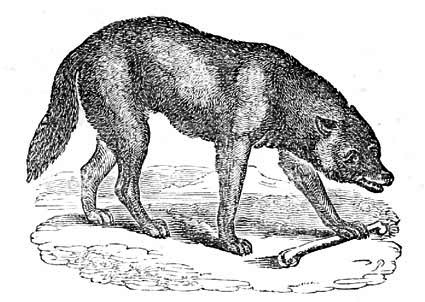
The Common Wolf
"I had never met with these animals, but, from the description given of them, I had but little pleasure in making their acquaintance. Their untamable fierceness, and the untiring strength which seems to be a part of their nature, render them objects of dread to every benighted traveler.
"'With their long gallop, which can tire The hound's deep hate, the hunter's fire,'
"they pursue their prey, and naught but death can separate them. The bushes that skirted the shore flew past with the velocity of light as I dashed on in my flight. The outlet was nearly gained; one second more, and I would be comparatively safe, when my pursuers appeared on the bank directly above me, which rose to the height of some ten feet. There was no time for thought; I bent my head and dashed wildly forward. The wolves sprang, but, miscalculating my speed, sprang behind, while their intended prey glided out into the river.
"Nature turned me toward home. The light flakes of snow spun from the iron of my skates, and I was now some distance from my pursuers, when their fierce howl told me that I was again the fugitive. I did not look back; I did not feel sorry or glad; one thought of home, of the bright faces awaiting my return, of their tears if they should never again see me, and then every energy of mind and body was exerted for my escape. I was perfectly at home on the ice. Many were the days I spent on my skates, never thinking that at one time they would be my only means of safety. Every half minute an alternate yelp from my pursuers made me but too certain they were close at my heels. Nearer and nearer they came; I heard their feet pattering on the ice nearer still, until I fancied I could hear their deep breathing. Every nerve and muscle in my frame was stretched to the utmost tension.
"The trees along the shore seemed to dance in the uncertain light, and my brain turned with my own breathless speed; yet still they seemed to hiss forth with a sound truly horrible, when an involuntary motion on my part turned me out of my course. The wolves close behind, unable to stop and as unable to turn, slipped, fell, still going on far ahead, their tongues lolling out, their white tushes gleaming from their bloody mouths, their dark, shaggy breasts freckled with foam; and as they passed me their eyes glared, and they howled with rage and fury. The thought flashed on my mind that by this means I could avoid them, viz., by turning aside whenever they came too near; for they, by the formation of their feet, are unable to run on ice except on a right line.
"I immediately acted on this plan. The wolves, having regained their feet, sprang directly toward me. The race was renewed for twenty yards up the stream; they were already close on my back, when I glided round and dashed past my pursuers. A fierce growl greeted my evolution, and the wolves slipped upon their haunches and sailed onward, presenting a perfect picture of helplessness and baffled rage. Thus I gained nearly a hundred yards each turning. This was repeated two or three times, every moment the wolves getting more excited and baffled, until, coming opposite the house, a couple of stag-hounds, aroused by the noise, bayed furiously from their kennels. The wolves, taking the hint, stopped in their mad career, and after a moment's consideration turned and fled. I watched them till their dusky forms disappeared over a neighboring hill; then, taking off my skates, I wended my way to the house, with feelings better to be imagined than described."
Such annoyances from these migrating beasts, in the vicinity of logging births as above-named, are of recent date. Up to 1840 I had been much in the wild forests of the northeastern part of Maine, clearing wild land during the summer and logging in the winter, and up to this time had never seen a satisfactory evidence of their presence. But since this period they have often been seen, and in such numbers and of such size as to render them objects of dread.
Every department of labor among the loggers, and in fact, to extend the observation, every department of life, is characterized more or less by adventure and peril. Our men get badly cut sometimes, and then, in the absence of a surgeon, are put upon their own resources to stanch blood and dress wounds.
I recollect an instance in which a man in one of the neighboring crews, while at work, received the whole bit of an ax into the muscular portion of his thigh, by an accidental blow from an associate. It was indeed a gaping wound. A wound of such an alarming character, in the absence of suitable medical aid, is deemed a serious matter, and not without just cause. In this instance use was made of handkerchiefs to swathe up the wound, so as to stanch the flowing blood, while they bore him to the camp upon a litter. He was laid upon the deacon seat, and the wound was sewed up by one of the crew with a common sewing-needle. It did well, and in the course of a few weeks he was able to resume his labors.
Life is constantly endangered in felling the Pine-trees. The tops of other trees seldom oppose any barrier to the giddy plunge of the towering Pine, breaking, splitting, and crushing all coming within its range. The broken limbs which are torn from its own trunk, and the wrenched branches of other trees, rendered brittle by the intense frosts, fly in every direction, like the scattered fragments of an exploding ship, always more or less endangering life. Often those wrenched limbs are suspended directly over the place where our work requires our presence, and on the slightest motion, or from a sudden gust of wind, they slip down with the stealthiness of a hawk and the velocity of an arrow. I feel an involuntary shudder, as if now in the presence of danger, while I remember some of the narrow escapes I have had from death by the falling of such missiles. I recollect one in particular, which was wrenched from a large Pine-tree I had just felled. It lodged in the top of a towering Birch, directly over where it was necessary for me to stand while severing the top from the trunk. Viewing its position with some anxiety, I ventured to stand and work under it, forgetting in the excitement my danger. While thus engaged, the limb stealthily slipped from its position, and, falling directly before me end foremost, penetrated the frozen earth. It was about four inches through, and ten feet long. It just grazed my cap; a little variation, and it would have dashed my head in pieces. But my time had not come. Attracted, on one occasion, while swamping a road, by the appearance of a large limb which stuck fast in the ground, curiosity induced me to extricate it, for the purpose of seeing how far it had penetrated. After considerable exertion, I succeeded in drawing it out, when I was perfectly amazed to find a thick cloth cap on the end of it. It had penetrated the earth to a considerable depth. Subsequently I learned that it belonged to a man who was killed instantly by its fall, striking him on the head, and carrying his cap into the ground with it.
It is never safe to run from a falling tree in a line directly opposite from the course in which it falls, as it sometimes strikes other trees in such a way as to throw the butt from the stump. I have sometimes seen them shoot back in this way with the velocity of lightning half their length. Running from a falling tree in the way above alluded to, I knew a man killed in an instant. Another reason which should induce choppers or spectators to avoid this manner of retreat is, that the broken limbs frequently rebound, and are thrown back in a direction opposite that in which the tree falls. It reminds one of a routed enemy hurling their missiles, as they retreat, back upon the pursuing foe. I have sometimes seen the air in the region of the tree-tops literally darkened with the flying fragments, small and great, torn from trees in the thundering passage of one of those massive columns to the ground. Sometimes they come down like a shower of arrows, as if from the departed spirits of aërial warriors. To retreat safely, one should run in a direction so as to make nearly a right angle with the falling tree. A man by the name of Hale, a master chopper, cut a Pine which, in its passage down, struck in the crutch of another tree and broke the trunk of the falling one, the top of which pitched back and instantly killed him.
If lumbermen do not love the return of the seventh day for its moral purposes, they welcome it for the rest it brings, and the opportunity it affords for various little matters of personal comfort which demand attention. On visiting our winter quarters, one of the first things which might arrest attention, indicating a Sabbath in the logging-swamp, would be a long morning nap. Dismissing care, they court the gentle spell, until, wearied with the lengthened night, they rise, not, as on other mornings, when their hurrying feet brush the early frosts as they pass to their work, while the lingering night casts back its wasting shadows upon their path. On the Sabbath morning they recline upon their boughy couches until the sun has traveled a long way upon his daily circuit.
Every one feels free to sleep, to lounge, or to do whatever he may choose, with a moderate abatement in behalf of the teamster and cook, whose duties require some seasonable attention on all mornings. Breakfast over, each individual disposes of himself as best accords with inclination or interest. There are a few general duties which come round every Sabbath, which some, by turns, feel the responsibility of performing. For instance, every Sabbath it is customary to replenish the bed with a fresh coat of boughs from the neighboring evergreens. Of the healthful and invigorating influence of this practice there is no doubt. Then follow the various little duties of a personal character. Our red flannel shirts are to be washed and mended, pants to be patched, mittens and socks to be repaired, boots to be tapped and greased, &c. Our clumsy fingers, especially if unused to the needle, make most ludicrous and unwoman-like business of patching up our torn garments. Letter-writing receives attention on this day, if at all, with no other than the deacon seat, perhaps, for a writing-desk, a sheet of soiled paper, ink dried and thick, or pale from freezing, and a pen made with a jack-knife; letters are dedicated to a wife, it may be, or to a mother by some dutiful son, or to his lady-love by some young swamper. There are some recreations to relieve the monotony of a Sabbath in the wilderness. Sometimes a short excursion in search of spruce gum; for many a young urchin at home has had the promise of a good supply of this article, to be furnished on the return of the campers. Others go in pursuit of timber for ax-helves. As neither the White Oak nor Walnut grow in the latitude of Pine forests in the eastern section of Maine, the White Ash, Rock Maple, Beech and Elm, and sometimes the Hornbeam, are in general use. Others spend, it may be, a portion of the day in short timber-hunting excursions. Where the contiguity of encampments allow it, visits are exchanged among the denizens of the camps.
Formerly, when sable were more plenty, some one or more proprietors of a line of sable traps would take the opportunity on the Sabbath to visit them, as time from the weekly employment could not be spared for this purpose. Such traps are very simple in their construction. Some thin, flat pieces of wood, cleft from the Spruce or Fir-tree, are driven into the ground, forming the outline of a small circle some nine inches in diameter, and about the same in height, with an opening of three or four inches on one side, over which is placed the trunk of a small tree some three inches through, running cross-wise, and raised at one end about four inches, supported by a standard spindle, to which a small piece of meat is fastened for bait. The top of the whole is covered with light fir or spruce boughs, to prevent the sable from taking the bait from the top. Access to the bait is then had only by passing the head and shoulders into the little door or opening under the pole, when the slightest nibbling at the spindle will bring down the dead-fall and entrap them. These traps occur every few rods, and thus a line or circuit is formed for several miles.
Wild cats sometimes take the business of tending these sable traps, in which case they tear them to pieces and devour the bait. One such animal will occasionally break up an entire line, and blast the hopes of the hunter till captured himself.
Although, when circumstances favor it, some portion of Saturday is devoted to hauling up camp wood, yet the practice of devoting a few hours of the concluding part of the Sabbath is not unfrequent. Upon the whole, we conclude that, notwithstanding the necessity of rest and recreation, and the necessary attentions to personal conveniences which the seventh day affords, the season usually wears away rather heavily than otherwise, and Monday morning, with its cheerful employments, brings not an unwelcome change. The pleasures of a forest life are, with lumbermen, found rather in the labor performed than the recreations enjoyed. Suspension from labor, without the pleasant relief which home privileges afford, leaves a vacancy of feeling not altogether free from ennui. The little domestic duties claiming attention—unpleasant, as indeed they are unnatural to the coarser sex—remind them strongly of the absence of woman, without whose amiable presence, society, and services man can not enjoy his quota of earthly bliss.
A tramp after deer and moose is sometimes taken. We often disturb them in penetrating the deep forests for timber. In such cases they always remove to some more sequestered place, and post themselves for winter quarters again, where we sometimes follow and take them when the condition of the snow renders their flight tardy and difficult. In the summer they roam at large through the forests and on the meadows, where they may often be seen feeding as we pass up the rivers; but in winter they confine themselves to much smaller limits, where they remain during the greater portion of the season. The flesh of the deer forms an agreeable change from our salt provisions. Venison is often quite plenty. From the hare and partridge our cook serves a delicious pot-pie. The flesh of the moose and bear are very good. Were it not for the unprepossessing appearance of the latter, his flesh would be esteemed before most wild meat. The flesh of a young black bear a year old, if fat, is not easily distinguished, when cooked, from a good pork spare rib. I recollect a ludicrous instance of imposition practiced upon an individual by furnishing him with bear meat for his dinner, while he supposed that he was feasting upon fresh pork. He was known to be exceedingly averse to eating bear meat, and often expressed his disrelish, and even disgust, at the idea. "Eat bear's meat? No! I would as soon eat a dog." A bear had been taken by a crew near by; it was fine meat, and it so happened that our anti-bear-eater was at their camp one day, when the cook served up in his best manner some of the flesh. Of course he was invited to dine, as lumbermen are always hospitable. On this occasion the invitation was especially urgent, as they "had a nice bit of fresh pork, which had been sent them by the provision-team."
Our friend ate and praised the nice pork alternately. "Fine, very; hadn't had any fresh pork before for nearly a year. It was tender—it was sweet and good." With much effort, the risibility of the jokers was kept in subjection through the meal. Many senseless things were said, and every thing seemed to elicit laughter.
Dinner over. "Well, captain, how have you enjoyed your dinner?" "First rate." "Do you know that you have been eating bear's meat?" "No!" said he; "that warn't bear's meat, was it?" "Yes." He seemed incredulous; but the evidences were at hand; the quarter from which the dinner had been taken was produced. Poor fellow! he looked as though he had swallowed a lizard; and, to "finish him up," the long-nailed shaggy paw was produced. He could stand it no longer; but, rushing out of the camp, and throwing himself down upon his hands and knees, he retched as though he had taken a dozen doses of ipecacuanha, while all the rest of the crew were convulsed with laughter at the poor fellow's distress.
The moose is the largest species of deer found in the New England forest. Their size varies from that of a large pony to the full-grown horse. They have large branching antlers, which grow and are shed every season.
The taking of moose is sometimes quite hazardous. The most favorable time for hunting them is toward spring, when the snow is deep, and when the warmth of mid-day melts the surface, and the cold nights freeze a crust, which greatly embarrasses the moose and deer in their flight.
"One pleasant morning, six of us started with the intention of taking deer; we had a gun and a large dog. Fatigued, at length, with several hours' travel, and meeting with no success, we concluded to give it up, and returned to camp late in the afternoon. Having been very intent in our search for game, we had taken little notice of the various courses which we had traveled, and, when the purpose was formed of returning, we found, much to our discomfort, that we were altogether in doubt as to the direction proper to be pursued. However, we were not without our opinions on the subject, though, unfortunately, these opinions differed. We finally separated into two parties, four supposing that the camp lay in a particular direction, while two of us entertained nearly opposite views. The gun was retained by the four, while the dog followed myself and comrade. We had not separated more than five minutes, when the dog started two fine moose. The other party, being within hail, soon joined us in the pursuit.
"As the snow was deep, and crusted sufficiently hard to bear us upon snow-shoes, while the moose broke through at every leap, we were soon sufficiently near them to allow a good shot. One of the men approached within a few yards of the hindermost, and fired. The ball took effect, but did not stop him. Still pursuing, another ball was lodged in his body, when he turned at bay. It was now our turn to retreat; but, after making a few bounds toward us, he turned and fled again, when we again came up to the charge. I took the gun this time, and approached within fifteen feet of him, and fired. He dropped instantly upon the snow. Supposing him dead, we left the spot and pursued the other with all possible dispatch, for there was not a moment to lose, as the fugitive, alarmed by the report of the gun, was redoubling his exertions to effect his escape. The dog, however, soon came upon him and retarded his flight. Emboldened in his successful encounter with the other, Rover dashed incautiously upon him, but nearly paid the forfeit of his life. The moose gave him a tremendous blow with one of his sharp hoofs, which made him cry out till the woods echoed with his piteous howl. In vain did we try to induce him to renew the encounter. His passion for the chase seemed effectually cooled; so we were obliged to abandon the pursuit, and the more readily, as the day was now quite spent. We returned to dress the one we had shot, but were astonished, on arriving at the place where we left him, to find that he, too, had made his escape. Tracking him by a trail of blood which appeared to spirt out at every leap he made, we soon came up with him, and fired again. The ball hit, but only to enrage him the more. Five additional bullets were lodged in his perforated body, now making in all nine. Having but one shot more, we desired to make it count effectively; so, taking the gun, I approached very near upon one side, and fired at his head. The ball passed directly into one eye and out at the other, thus rendering him completely blind. The last shot caused him to jump and plunge tremendously. He now became furious, and, guided by the sound of our footsteps, would dart at us like a catamount whenever we approached him. We had no ax to strike him down, or to cut clubs with which to dispatch him. We were at a stand what to do. We tried first to entangle him in the deep snow by approaching him, and thus induce him to spring out of the beaten into the untrodden snow; but the moment he found himself out, he would back directly into the beaten path again.
"Our feelings became very uncomfortable, and now, from pity, we desired to put an end to his sufferings. To see his noble struggle for life, with nine bullets in him, and blind, inspired a painful regard toward him. What to do we knew not. It was really unsafe to approach him so as to cut his throat. We could neither entangle him in the snow, nor bring him down with the small sticks we had cut with our jack-knives. At length we hit upon the following expedient: obtaining a long stiff pole, one end of it was gently placed against his side. We found he leaned against it, and the harder we pushed the more he opposed. Uniting our strength, we pressed it as powerfully as we were capable; he resisted with equal strength. While thus pressing, we suddenly gave way, when he fell flat upon his side. Before he had time to recover, we sprang upon him, and with a knife severed the jugular vein, when he yielded to his fate. It was nearly two hours from the commencement of our last encounter before we dispatched him. Leaving him for the night, we returned to camp, quite overcome with hunger and fatigue.
"Next morning we went out to bring in our prize. We found the other moose affectionately standing over the dead carcass of her slaughtered companion. Manifesting much reluctance to flee, she permitted our approach sufficiently near to afford a good shot, which we were not unwilling to improve; so, raising the fatal instrument to my cheek, I let go. She fell on the spot, and was soon dressed with the other. We took the carcasses into camp, and, after reserving what we wished for our own use, sent the remainder down river to our friends." [9]
The "bull moose" is a formidable foe when he "gets his dander up," and specially so at particular seasons of the year; then, unprovoked, they will make war on man, betraying none of that shrinking timidity so characteristic of the cervine genus. A hunter, who used to put up occasionally over night at our camp, entertained us with the following singular adventure. "Once," said he, "while out on a hunting excursion, I was pursued by a 'bull moose,' during that period when their jealousy was in full operation in behalf of the female. He approached me with his muscular neck curved, and head to the ground, in a manner not dissimilar to the attitude assumed by horned cattle when about to encounter each other. Just as he was about to make a pass at me, I sprang suddenly between his wide-spreading antlers, bestride his neck. Dexterously turning round, I seized him by the horns, and, locking my feet together under his neck, I clung to him like a sloth. With a mixture of rage and terror, he dashed wildly about, endeavoring to dislodge me; but, as my life depended upon maintaining my position, I clung to him with a corresponding desperation. After making a few ineffectual attempts to disengage me, he threw out his nose, and, laying his antlers back upon his shoulders, which formed a screen for my defense, he sprang forward into a furious run, still bearing me upon his neck. Now penetrating dense thickets, then leaping high "wind-falls," [10] and struggling through swamp-mires, he finally fell through exhaustion, after carrying me about three miles. Improving the opportunity, I drew my hunter's knife from its sheath, and instantly buried it in his neck, cutting the jugular vein, which put a speedy termination to the contest and the flight."
The habits of the moose, in his manner of defense and attack, are similar to those of the stag, and may be illustrated by the following anecdote from the "Random Sketches of a Kentuckian."
"Who ever saw Bravo without loving him? His sloe-black eyes, his glossy skin, flecked here and there with blue; his wide-spread thighs, clean shoulders, broad back, and low-drooping chest, bespoke him the true stag-hound; and none who ever saw his bounding form, or heard his deep-toned bay, as the swift-footed stag flew before him, would dispute his title. List, gentle reader, and I will tell you an adventure which will make you love him all the more.
"A bright frosty morning in November, 1838, tempted me to visit the forest hunting-grounds. On this occasion I was followed by a fine-looking hound, which had been presented to me a few days before by a fellow-sportsman. I was anxious to test his qualities, and, knowing that a mean dog will not often hunt well with a good one, I had tied up the eager Bravo, and was attended by the strange dog alone. A brisk canter of half an hour brought me to the wild forest hills. Slackening the rein, I slowly wound my way up a brushy slope some three hundred yards in length. I had ascended about half way, when the hound began to exhibit signs of uneasiness, and at the same instant a stag sprang out from some underbrush near by, and rushed like a whirl-wind up the slope. A word, and the hound was crouching at my feet, and my trained Cherokee, with ear erect and flashing eye, watched the course of the affrighted animal.
"On the very summit of the ridge, full one hundred and fifty yards, every limb standing out in bold relief against the clear blue sky, the stag paused, and looked proudly down upon us. After a moment of indecision, I raised my rifle, and sent the whizzing lead upon its errand. A single bound, and the antlered monarch was hidden from my view. Hastily running down a ball, I ascended the slope; my blood ran a little faster as I saw the 'gouts of blood' which stained the withered leaves where he had stood. One moment more, and the excited hound was leaping breast high on his trail, and the gallant Cherokee bore his rider like lightning after them.
"Away—away! for hours we did thus hasten on, without once being at fault or checking our headlong speed. The chase had led us miles from the starting-point, and now appeared to be bearing up a creek, on one side of which arose a precipitous hill, some two miles in length, which I knew the wounded animal would never ascend.
"Half a mile further on, another hill reared its bleak and barren head on the opposite side of the rivulet. Once fairly in the gorge, there was no exit save at the upper end of the ravine. Here, then, I must intercept my game, which I was able to do by taking a nearer cut over the ridge, that saved at least a mile.
"Giving one parting shout to cheer my dog, Cherokee bore me headlong to the pass. I had scarcely arrived, when, black with sweat, the stag came laboring up the gorge, seemingly totally reckless of our presence. Again I poured forth the 'leaden messenger of death,' as meteor-like he flashed by us. One bound, and the noble animal lay prostrate within fifty feet of where I stood. Leaping from my horse, and placing one knee upon his shoulder, and a hand upon his antlers, I drew my hunting-knife; but scarcely had its keen point touched his neck, when, with a sudden bound, he threw me from his body, and my knife was hurled from my hand. In hunters' parlance, I had only 'creased him.' I at once saw my danger, but it was too late. With one bound he was upon me, wounding and almost disabling me with his sharp feet and horns. I seized him by his wide-spread antlers, and sought to regain possession of my knife, but in vain; each new struggle drew us further from it. Cherokee, frightened at the unusual scene, had madly fled to the top of the ridge, where he stood looking down upon the combat, trembling and quivering in every limb.
"The ridge road I had taken placed us far in advance of the hound, whose bay I could not now hear. The struggles of the furious animal had become dreadful, and every moment I could feel his sharp hoofs cutting deep into my flesh; my grasp upon his antlers was growing less and less firm, and yet I relinquished not my hold. The struggle had brought us near a deep ditch, washed by the fall rains, and into this I endeavored to force my adversary, but my strength was unequal to the effort; when we approached to the very brink, he leaped over the drain. I relinquished my hold and rolled in, hoping thus to escape him; but he returned to the attack, and, throwing himself upon me, inflicted numerous severe cuts upon my face and breast before I could again seize him. Locking my arms around his antlers, I drew his head close to my breast, and was thus, by great effort, enabled to prevent his doing me any serious injury. But I felt that this could not last long; every muscle and fiber of my frame was called into action, and human nature could not long bear up under such exertion. Faltering a silent prayer to Heaven, I prepared to meet my fate.
"At this moment of despair I heard the faint bayings of the hound; the stag, too, heard the sound, and, springing from the ditch, drew me with him. His efforts were now redoubled, and I could scarcely cling to him. Yet that blessed sound came nearer and nearer! Oh how wildly beat my heart as I saw the hound emerge from the ravine, and spring forward with a short, quick bark, as his eye rested on his game! I released my hold of the stag, who turned upon the new enemy. Exhausted, and unable to rise, I still cheered the dog that, dastard like, fled before the infuriated animal, who, seemingly despising such an enemy, again threw himself upon me. Again did I succeed in throwing my arms around his antlers, but not until he had inflicted several deep and dangerous wounds upon my head and face, cutting to the very bone.
"Blinded by the flowing blood, exhausted and despairing, I cursed the coward dog, who stood near, baying furiously, yet refusing to seize his game. Oh! how I prayed for Bravo! The thoughts of death were bitter. To die thus in the wild forest, alone, with none to help! Thoughts of home and friends coursed like lightning through my brain. At that moment, when Hope herself had fled, deep and clear over the neighboring hill came the baying of my gallant Bravo! I should have known his voice among a thousand. I pealed forth, in one faint shout, 'On, Bravo, on!' The next moment, with tiger-like bounds, the noble dog came leaping down the declivity, scattering the dried autumnal leaves like a whirl-wind in his path. 'No pause he knew,' but, fixing his fangs in the stag's throat, he at once commenced the struggle.
"I fell back, completely exhausted. Blinded with blood, I only knew that a terrific struggle was going on. In a few moments all was still, and I felt the warm breath of my faithful dog as he licked my wounds. Clearing my eyes from gore, I saw my late adversary dead at my feet, and Bravo, 'my own Bravo,' as the heroine of a modern novel would say, standing over me. He yet bore around his neck a fragment of the rope with which I had tied him. He had gnawed it in two, and, following his master through all his windings, arrived in time to rescue him from a horrible death.
"I have recovered from my wounds. Bravo is lying at my feet. Who does not love Bravo? I am sure I do, and the rascal knows it—don't you, Bravo? Come here, sir!"
CHAPTER VI.
Camp Life.—Winter Evenings.—An Evening in Camp.—Characters.— Card-playing.—A Song.—Collision with wild Beasts.—The unknown Animal in a Dilemma.—"Indian Devil."—The Aborigines' Terror.— A shocking Encounter.—The Discovery and Pursuit.—The Bear as an Antagonist.—Their thieving Propensities.—A thrilling Scene in the Night.—A desperate Encounter with three Bears.
The winter evenings of camp life are too much abridged in length to allow a long season either for repose or amusement, in consequence of the lateness of the hour in which the men leave work, and the various matters which regularly claim attention. By the time supper is over and the nightly camp-fire built, sleep early invites the laborer to the enjoyment of its soothing influences. And oh! how sweet is that repose! The incumbents of downy beds, nestled within the folds of gorgeous drapery, might earnestly but vainly court it.
Could you take a peep into our snug camp some evening, you might see one of our number, seated perhaps on a stool in the corner, with a huge jack-knife in his hand, up to his knees in whittlings, while he is endeavoring to give shape and proportions to the stick he is cutting to supply the place of a broken ax-handle. The teamster might be seen driving a heated "staple," with jingling ring, into a new yoke, which is to supply the place of one "Old Turk" split while attempting, with his mate and associates, to remove an immense pine log from its bed during the day; and as he strikes the heated iron into the perforated timber, the curling smoke, in two little spiral columns, rises gradually and gracefully, spreading as they ascend, until his head is enveloped in a dense cloud.
There sits another fellow staring into vacuity, while between his lips, profusely covered with a heavy beard, the growth of a quarter of a year, sticks a stub-stemmed pipe. Opening and shutting those ample lips, volumes of smoke roll out, like discharges from the side of a moss-grown battery, the very beau ideal of all that is exquisite in "tobaccoing." Bestride the deacon seat, a little removed, sits the cook, with a large pan between his knees, with shirt-sleeves furled, and in the dough to his elbows, kneading a batch of bread to bake for breakfast. The sweat rolls from his half-covered forehead, and, unable to relieve his hands, he applies now one elbow, then the other, to dry up the mizzle from his moistened brow. Yonder, at the further end of the camp, in close proximity to the fire, sits a lean, lank little man, with thin lips, ample forehead, and eyes no larger than a rifle bullet, piercing as the sun, poring over the dingy pages of an old weekly, perhaps for the tenth time. Songs, cards, or stories possess but little attraction for him. Intellectually inclined, but miserably provided for, still the old newspaper is a more congenial companion for him.
Behind the deacon seat, lounging upon the boughy bed, you may see half a dozen sturdy fellows—the bone and sinew of the crew—telling "yarns," or giving expression to the buoyancy of their feelings in a song, while the whole interior of the camp is lighted with a blazing hard-wood fire, which casts upward its rays through the capacious smoke-hole, gilding the overhanging branches of the neighboring trees. All within indicates health, content, and cheerfulness.
Card-playing is often resorted to as an evening pastime. If not provided with candles or lamps, the lovers of this recreation are careful to select a store of pitchy knots, whose brilliant combustion relieves them from all the inconvenience of darkness. This is, however, a bewitching amusement, and often proves detrimental to the peace and rest of the whole crew, and injurious also to the interests of employers.
The last winter I spent in the logging swamp, there were several packs of cards brought into the encampment by men in my division. I had resolved not to allow card-playing in my camp; but how to accomplish my purpose without inviting other unpleasant results was something to be thought of, as that man makes to himself an uncomfortable birth who incurs the ill will of his comrades in any way, especially in the exercise of authority not strictly related to the business for which they are employed, and by an infringement upon what they esteem their private and personal rights. Pointing out a pack of cards, while in camp one afternoon, to the owner of the same, at a moment when he was in a decidedly favorable mood for my purpose, "Come, Hobbs," said I, "burn them!" at the same time accompanying the request with the best reason I could offer to induce compliance. Taking them down, and thoughtfully shuffling them over for a minute, "Well," said he, "they are foolish things, aint they?" Of course I acquiesced. "Here goes!" said he, taking the poker and stirring open the hot bed of live coals, and in they went. The work of extirpation being commenced, he rifled the knapsacks of others belonging to the crew of their packs of cards, and threw them into the fire also, pronouncing deliberately, "High, low, Jack, and the game!" I really expected a fuss when the matter should come to the knowledge of the others. They submitted, however, to their bereavement like philosophers. It passed off without any muss being kicked up, though the agent was a little menaced for the liberties he had taken in the matter; but he enjoyed the sympathies of the instigator.
Loggers, unlike most classes of men, are under the necessity of manufacturing their own songs. [11] The mariner, the patriot, the soldier, and the lover have engaged the attention of gifted bards in giving rhyme and measure to their feelings; yet they are not without poetical sentiment. The following is inserted as a specimen of log swamp literature, composed by one of the loggers:
THE LOGGER'S BOAST. "Come, all ye sons of freedom throughout the State of Maine, Come, all ye gallant lumbermen, and listen to my strain; On the banks of the Penobscot, where the rapid waters flow, O! we'll range the wild woods over, and a lumbering will go; And a lumbering we'll go, so a lumbering will go, O! we'll range the wild woods over while a lumbering we go. When the white frost gilds the valleys, the cold congeals the flood; When many men have naught to do to earn their families bread; When the swollen streams are frozen, and the hills are clad with snow, O! we'll range the wild woods over, and a lumbering we will go; And a lumbering we'll go, so a lumbering, &c. When you pass through the dense city, and pity all you meet, To hear their teeth chattering as they hurry down the street; In the red frost-proof flannel we're incased from top to toe, While we range the wild woods over, and a lumbering we go; And a lumbering we'll go, so a lumbering, &c. You may boast of your gay parties, your pleasures, and your plays, And pity us poor lumbermen while dashing in your sleighs; We want no better pastime than to chase the buck and doe; O! we'll range the wild woods over, and a lumbering we will go; And a lumbering we'll go, so a lumbering, &c. The music of our burnished ax shall make the woods resound, And many a lofty ancient Pine will tumble to the ground; At night, ho! round our good camp-fire we will sing while rude winds blow: O! we'll range the wild woods over while a lumbering we go; And a lumbering we'll go, so a lumbering, &c. When winter's snows are melted, and the ice-bound streams are free, We'll run our logs to market, then haste our friends to see; How kindly true hearts welcome us, our wives and children too, We will spend with these the summer, and once more a lumbering go; And a lumbering we'll go, so a lumbering we will go, We will spend with these the summer, and once more a lumbering go. And when upon the long-hid soil the white Pines disappear, We will cut the other forest trees, and sow whereon we clear; Our grain shall wave o'er valleys rich, our herds bedot the hills, When our feet no more are hurried on to tend the driving mills; Then no more a lumbering go, so no more a lumbering go, When our feet no more are hurried on to tend the driving mills. 'When our youthful days are ended,' we will cease from winter toils, And each one through the summer warm will till the virgin soil; 'We've enough to eat,' to drink, to wear, content through life to go, Then we'll tell our wild adventures o'er, and no more a lumbering go; And no more a lumbering go, so no more a lumbering go, O! we'll tell our wild adventures o'er, and no more a lumbering go."
Our winter quarters and employments not unfrequently bring us into collision with wild animals of a formidable character. Of these the "Indian devil," or a species of the catamount, is chief. We often track animals of whom we have never gained sight.
Passing along one day in pursuit of timber, my attention was arrested by a track of uncommon size and appearance. It was round, and about the size of a hat crown, and penetrated the snow where it would bear me. I noticed where the creature stepped over a large fallen tree about two feet and a half high. A light snow several inches deep covered the log, which he did not even brush with his belly as he passed over it. From the nature of the track, I knew he did not jump. His legs could not have been less than three feet in length. After this discovery, I made my way to where the rest of the crew were at work with right good will. A similar track, of probably this same animal, has been seen by many different persons and parties, at places quite remote from each other, for several winters; but no one, that I am aware of, is satisfied that he has yet been seen, unless, indeed, by two or three lads while on the shore of the Grand Lake, who were fishing out of holes cut in the ice near the shore. About half a mile from them a long point made out into the lake, running parallel with the shore, which formed the boundary of a deep cove. The ice had become quite weak; still, it bore them with safety. While busily engaged with their fishing-tackle, their attention was suddenly arrested by a loud, splashing noise, as though some one was struggling in the water; and, on looking for the cause, they saw a large animal endeavoring to make the main land, crossing directly from the point toward them. He continued to break in every few rods, when he would spring out again with the agility of a cat. After getting out, he would stand and look round, then venture forward, and break through as before. The description they gave of his appearance was that he looked just like an immense cat; appeared to be about four feet high, and five or six feet long, thick-set about the head and shoulders, resembling somewhat in this particular the bull-dog. His general color was quite like that of a mouse, or, to use the boys' own words, "bluish," with light breast and belly. His tail was very long, reaching down quite to the ice, and curled up at the end; this he moved about just as a cat moves its tail. Waiting but a moment to gain this general view, they made for home with all possible dispatch, about one mile distant. Several men, with guns and axes, immediately started for the lake, but nothing further was seen of him. The manner in which the ice was broken fully confirmed the statement made by the boys respecting the size of this unknown creature.
There is an animal in the deep recesses of our forests, evidently belonging to the feline race, which, on account of its ferocity, is significantly called "Indian Devil"—in the Indian language, "the Lunk Soos;" a terror to the Indians, and the only animal in New England of which they stand in dread. You may speak of the moose, the bear, and the wolf even, and the red man is ready for the chase and the encounter. But name the object of his dread, and he will significantly shake his head, while he exclaims, "He all one debil!"
An individual by the name of Smith met with the following adventure in an encounter with one of these animals on the Arromucto, while on his way to join a crew engaged in timber-making in the woods.
He had nearly reached the place of encampment, when he came suddenly upon one of these ferocious animals. There was no chance for retreat, neither had he time for reflection on the best method of defense or escape. As he had no arms or other weapons of defense, the first impulse, in this truly fearful position, unfortunately, perhaps, was to spring into a small tree near by; but he had scarcely ascended his length when the desperate creature, probably rendered still more fierce by the promptings of hunger, sprang upon and seized him by the heel. Smith, however, after having his foot badly bitten, disengaged it from the shoe, which was firmly clinched in the creature's teeth, and let him drop. The moment he was disengaged, Smith sprang for a more secure position, and the animal at the same time leaped to another large tree, about ten feet distant, up which he ascended to an elevation equal to that of his victim, from which he threw himself upon him, firmly fixing his teeth in the calf of his leg. Hanging suspended thus until the flesh, insufficient to sustain the weight, gave way, he dropped again to the ground, carrying a portion of flesh in his mouth. Having greedily devoured this morsel, he bounded again up the opposite tree, and from thence upon Smith, in this manner renewing his attacks, and tearing away the flesh in mouthfuls from his legs. During this agonizing operation, Smith contrived to cut a limb from the tree, to which he managed to bind his jack-knife, with which he could now assail his enemy at every leap. He succeeded thus in wounding him so badly that at length his attacks were discontinued, and he finally disappeared in the dense forest.
During the encounter, Smith had exerted his voice to the utmost to alarm the crew, who, he hoped, might be within hail. He was heard, and in a short time several of the crew reached the place, but not in time to save him from the dreadful encounter. The sight was truly appalling. His garments were not only rent from him, but the flesh literally torn from his legs, exposing even the bone and sinews. It was with the greatest difficulty he made the descent of the tree. Exhausted through loss of blood, and overcome by fright and exertion, he sunk upon the ground and immediately fainted; but the application of snow restored him to consciousness. Preparing a litter from poles and boughs, they conveyed him to the camp, washed and dressed his wounds as well as circumstances would allow, and, as soon as possible, removed him to the settlement, where medical aid was secured. After a protracted period of confinement, he gradually recovered from his wounds, though still carrying terrible scars, and sustaining irreparable injury. Such desperate encounters are, however, of rare occurrence, though collisions less sanguinary are not unfrequent.
On one occasion, we tracked one of those animals where we had the day before been at work. From appearances, he seemed to have something unusual attached to one of his fore feet, which we judged to be a common steel trap. Returning to the camp for the gun and a lunch, two men started in pursuit. They followed him three days before overtaking him. In one place on the route they measured a bound of fifteen feet, which he made to take a rabbit, which he caught and devoured, leaving only small portions of the hide and fur of his victim. From the course traveled, it was evident that he was aware of his pursuers, whom he unquestionably desired to avoid. On the third day they came in sight of him for the first time. No longer retreating before his pursuers, he now turned upon them. Aware that they could have but one shot, it being impossible to reload before he would be upon them, they suffered him to approach very near, to make their aim more certain. The forest echoed with the report of the discharge; the shot took effect, and a furious scuffle followed. The snow flew, while the enraged and furious growl and gnashing teeth mingled with the clattering trap, and the echo of the powerful blows inflicted upon his head with the shivered breach of the gun, under which he yielded his life to his superior pursuers.
But there is no animal among us with whom encounters are so frequent as the common black bear. Their superior strength, the skill with which they ward off blows, and even wrench an instrument from the hand of an assailant, and their tenacity of life, render them really a formidable antagonist. We have sometimes been diverted, as well as severely annoyed, by their thievish tricks. In one instance we were followed several days by one of them on our passage up river, who seemed equally bent on mischief and plunder. The first of our acquaintance with him occurred while encamped at the mouth of a small stream, whose channel we were improving by the removal of large rocks which obstructed log-driving. Our camp was merely temporary, so that all our goods were exposed. While we were asleep during the night, he came upon our premises, and selected from the baggage a bundle containing all the winter clothing of one of the men—boots, shaving tools, &c.
His curiosity was too great to allow of a far removal of the pack without an examination of its contents; and never did deputy inspector or constable perform a more thorough search. Duties on the package were inadmissible; the goods were esteemed contraband, and were accordingly confiscated. The wearing apparel was torn into shreds. There was a pair of stout cow-hide boots, of which he tried the flavor; they were chewed up and spoiled. The razor did not escape his inquisitiveness. Whether he attempted to shave we say not, but he tested its palatableness by chewing up the handle.
From this position we removed a few miles further up stream, where we were to construct a dam, the object of which was to flow the lake, to obtain a good head of water for spring driving. This job being somewhat lengthy, we erected a more permanent camp for our convenience. A few evenings after our settlement at this point, while all hands were in camp, we heard some one moving about on the roof, where a ten-gallon keg of molasses was deposited. At first it was supposed to be a trick by some one of the crew; but, on looking round, there was no one missing.
Suspecting with more certainty the character of our visitor, we seized a fire-brand or two, and sallied forth like a disturbed garrison of ants, when we discovered that we were minus a keg of molasses. Following in the direction of the retreating thief, we found the keg but a few rods distant, setting on one end, with the other torn out. He evidently had intended a feast, but, intimidated by the fire-brands and the hallooing, he had retreated precipitately into his native haunts; but only, as it would seem, to plan another theft. About two hours afterward, when all was still, a noise was again heard in the door-yard, similar to that of a hog rooting among the chips, where the cook had thrown his potato parings. Peering through the crack of the camp door, sure enough, there was Bruin again, apparently as much at home as a house-dog.
We had a gun, but improvidently had left our ammunition at another place of deposit, about a hundred rods distant. Resolved upon chastising him for his insolence in the event of another visit, the lantern was lighted, and the ammunition soon brought to camp.
The gun was now charged with powder and two bullets. We waited some time for his return, first removing a strip from the camp door for a port-hole. Hearing nothing of him, all hands turned in again. About twelve o'clock at night he made us his third visit in the door-yard, as before, and directly in front of the camp, offering a most inviting shot. Creeping softly to the door, and passing the muzzle of the gun through the prepared aperture, our eye glanced along the barrel, thence to a dark object not thirty feet distant. A gentle but nervous pressure upon the trigger, a flash, a sheet of fire, and the very woods shook with the reverberating report, which sent Bruin away upon a plunging gallop. The copious effusion of warm blood which spirted on the chips was evidence that the leaden messenger had faithfully done its duty. A portion of his lights were shot away, and dropped to the ground, which convinced us that he was mortally wounded, and that it would not be possible for him to run far. Seizing as many fire-brands as could be procured, with axes, and the gun reloaded, all hands dashed into the forest after him, half-naked, just as they had risen from the bed, leaping, yelling, and swinging their fire-brands like so many wild spirits from the regions of fire.
Guided in the pursuit by the cracking of rotten limbs and the rustling of leaves as he heavily plunged on, we pursued him through a dense swamp. From the increased distinctness with which we heard his step, it was evident we were gaining upon him. Soon we heard his labored breathing. Just before we overtook him, he merged from the swamp, and with much exertion ascended a slight elevation, covered with a fine growth of canoe Birch, where, from exhaustion and loss of blood, he lay down, and suffered us to surround him. The inflammable bark of the Birch was instantly ignited all round us, presenting a brilliant and wild illumination, which lent its influence to a most unbounded enthusiasm, while our war-dance was performed around the captured and slain marauder. Taken altogether, the scene presented one of the most lively collections of material for the pencil that we have ever contemplated. There were uncommon brilliancy, life, and animation in the group. After dispatching, we strung him up and dressed him on the spot, taking only one quarter of his carcass, with the hide, back to camp.
A portion of this was served up next morning for breakfast; but while the sinewy, human-like appearance of the fore leg might have whetted the appetite of a cannibal, a contrary influence was exerted on ours.
More sanguinary was the following encounter, which took place in the vicinity of Tara-height, on the Madawaska River: "A trap had been set by one of the men, named Jacob Harrison, who, being out in search of a yoke of oxen on the evening in question, saw a young bear fast in the trap, and three others close at hand in a very angry mood, a fact which rendered it necessary for him to make tracks immediately. On arriving at the farm, he gave the alarm, and, seizing an old dragoon saber, he was followed to the scene of action by Mr. James Burke, armed with a gun, and the other man with an ax.
"They proceeded direct to the trap, supplied with a rope, intending to take the young bear alive. It being a short time after dark, objects could not be distinctly seen; but, on approaching close to the scene of action, a crashing among the leaves and dry branches, with sundry other indications, warned them of the proximity of the old animals. When within a few steps of the spot, a dark mass was seen on the ground—a growl was heard—and the confined beast made a furious leap on Jacob, who was in advance, catching him by the legs. The infuriated animal inflicted a severe wound on his knee, upon which he drew his sword, and defended himself with great coolness.
"Upon receiving several wounds from the saber, the cub commenced to growl and cry in a frightful and peculiar manner, when the old she-bear, attracted to the spot, rushed on the adventurous Harrison, and attacked him from behind with great ferocity. Jacob turned upon the new foe, and wielded his trusty weapon with such energy and success, that in a short time he deprived her of one of her fore paws by a lucky stroke, and completely disabled her eventually by a desperate cut across the neck, which divided the tendons and severed the spinal vertebræ. Having completed his conquest (in achieving which he found the sword a better weapon than the ax, the animal being unable to knock it from his hand, every attempt to do so being followed by a wound), he had ample time to dispatch the imprisoned cub at leisure.
"During the time this stirring and dangerous scene we have related was enacting, war was going on in equally bloody and vigorous style at a short distance. Mr. Burke, having discharged his gun at the other old bear, only slightly wounded him; the enraged Bruin sprang at him with a furious howl. He was met with a blow from the butt-end of the fowling-piece. At the first stroke the stock flew in pieces, and the next the heavy barrel was hurled a distance of twenty feet among the underwood by a side blow from the dexterous paw of the bear. Mr. Burke then retreated a few feet and placed his back against a large Hemlock, followed the while closely by the bear, but, being acquainted with the nature of the animal and his mode of attack, he drew a large hunting-knife from his belt, and, placing his arms by his side, coolly awaited the onset.
"The maddened brute approached, growling and gnashing his teeth, and with a savage spring encircled the body of the hunter and the tree in his iron gripe. The next moment the flashing blade of the couteau chasse tore his abdomen, and his smoking entrails rolled upon the ground. At this exciting crisis of the struggle, the other man, accompanied by the dog, came up in time to witness the triumphal close of the conflict.
"Two old bears and a cub were the fruits of this dangerous adventure—all extremely fat—the largest of which, it is computed, would weigh upward of two hundred and fifty pounds. We have seldom heard of a more dangerous encounter with bears, and we are happy to say that Mr. Burke received no injury; and Mr. Jacob Harrison, although torn severely, and having three ribs broken, recovered under the care of an Indian doctor of the Algonquin tribe."
CHAPTER VII.
Provision Teams.—Liabilities.—A Night in the Woods.—Traveling on Ice.—A Span of Horses lost.—Pat's Adventure.—Drogers' Caravan.— Horses in the Water.—Recovery of a sunken Load.—Returning Volunteers from Aroostook.—Description of a Log Tavern.—Perils on Lakes in Snow-storms.—Camping at Night.—Rude Ferry-boats.
After the swamps, rivers, and lakes freeze, and the fallen snow has covered the ground, supplies for the rest of the winter and spring operations, consisting of hay, grain, flour, beef, pork, molasses, &c., are hauled on to the ground with horse-teams. In some instances the route extends two hundred and fifty miles from the head of ship navigation. As these routes, for the most part, lay through dense forests, over rough roads, along the frozen channels of rivers, across bleak and expansive lakes, far removed from the fireside and home of the hardy logger, there is something of the hardships of adventure, if not its romance, connected with the experience of these transporting teams during their winter trips.
Sometimes loaded sleds break down in their passage over the rough forest roads, or horses tire by extra exertion over untrodden snows, and night overtakes the lone teamster, many miles from the abode of any human being, amid frosts and snow, without fire and without comfortable sustenance. Detaching his horses, and covering them with their blankets, if he be loaded with hay, he allows them to feed from the load during the night, while, muffled in his coat, he burrows deep in the hay, alternately lulled and aroused by the tinkling of the horses' bells and by the howling of the hungry wolf. Sometimes the treacherous ice parts beneath his horses, and the swift current carries them under, hiding them in a moment and forever from his vision. I recollect the occurrence of the following thrilling event. It is customary to travel on ice as far as it makes on the rivers and streams, taking to the shore to pass the open and rapid sections, and then returning to the river and traveling as before. Returning homeward, after a trip into the woods with a load of provision, just at nightfall, might have been seen a span of fine horses, measuring off their ten miles an hour with the ease and fleetness of reindeers, upon the smooth surface of one of our eastern rivers far up in the interior. With vision circumscribed by the gathering darkness, and misjudging his position, the driver, quietly seated upon his sled, failed to see the danger in season to check the speed of his horses, when suddenly he plunged into one of those open places in the river where the water ran too rapidly to allow it to freeze. A few rods below the ice closed over again, beneath which the current swept with fearful rapidity. With the teamster still floating upon the half-sunken sled, the horses swam directly down with the current to the edge of the ice below. The moment they reached it, the noble creatures, as if confident of clearing the chilling element at a bound, simultaneously reared, and, striking their fore feet upon the ice, their hinder parts sank in the deep channel, and, falling backward, they were swept beneath the ice, together with the sled attached, and were drowned, while the teamster alone escaped by springing from the sled before it went under.
When a team breaks in where the water is stagnant, a deliberate and calculating teamster may succeed in extricating his horses, while a shiftless man will let them drown. A gentleman of my acquaintance harnessed a fine mare into a single sled, loaded with provisions, which he sent by an Irishman up into the woods to his logging-camps. While passing the river, the horse broke in, and, after struggling several hours, sank through exhaustion and chill, and was drowned.
In giving a brief account of the affair, Pat, evidently affected by the disaster, observed, "Ah! indade, sir, but she looked at me very wishfully, indade she did, sir!" "But why did you not help her, Patrick?" "'Dade, sir, an' didn't I put on the whip pretty smartly, sure?"
It is quite common for drogers, as they are sometimes called, to form a northern caravan, by congregating together in their up-river tours to the number of twenty, and sometimes thirty teams. Some of these are composed of two horses, and others from four to six. Company, and mutual assistance in cases of necessity, are the motives which unite them, and the difficulties which they encounter often call into requisition this friendly interference.
I was once passing up the Penobscot in company with twenty or thirty horse-teams, all loaded with supplies, immediately after a thaw, which had so far wasted the snow that we were obliged to leave the land road, and, at some risk, venture upon the ice, although in many places it was thin, and covered with water to the depth of two feet.
It was deemed prudent to form a line with the teams at such distances apart as would subject the ice to the pressure of one team only on a given point, the whole preceded by a man with ax in hand to test its capacity to bear the approaching load. In some instances, where the current was stagnant, the ice was sufficiently strong to bear us for a mile or two without much alteration in our course. In places where the swiftness of the current had prevented the formation of ice of suitable thickness, we were obliged to use much caution, passing from one side of the river to the other to avoid suspicious places, making but little progress in our serpentine path. In this way several miles had been traveled without accident, which induced our pilot to exercise less vigilance, when suddenly the line was broken by the disappearance of one team through the ice. The alarm passed along the line, with the order to "Hold up! a team in!" "Don't close up; we shall all be in together!" But teamsters are afraid of ice over a running current; indeed, there is imminent danger to life under such circumstances. Some reined up; others, taking alarm, made for the shore; others put their horses into the run and passed by; while others, more cool and generous, came to the rescue of the drowning team. It proved to be a pair of our heaviest horses. The load consisted of thirteen barrels of pork, with other lighter articles, the whole team and load weighing over three tons. It was the work of but a few moments to extricate the horses, after disengaging them from their harness. The barrels rolled from the sled, and sank in fifteen feet of water. The most of the teamsters concurred in the opinion that the barrels were not recoverable; but, procuring a long pole, with a sharp pike in the end, I ran it down and stuck it firmly into one of the staves, and raised one barrel with perfect ease to the surface. A rope was thrown around it, by which it was rolled out upon the firm ice. Thus one after another was fished up, reloaded, and we were under way again in less than an hour.
About noon we stopped to feed the horses and take some dinner on the ice. Unloosing the straps which attached the horses to the pole, we proceeded to bait. While thus situated, a company of volunteers, returning from the bloodless boundary war on the Aroostook, passed us, who, to amuse themselves, wantonly discharged a volley of musketry, which created a tremendous panic among our horses, causing them to upset several loads, breaking harnesses, and doing other damage, which occasioned considerable delay, and much swearing among the exasperated teamsters. One of our little teamsters was so enraged that he challenged the whole company to fight him. I really believe he would have engaged any one, or any number of them, had they halted.
During the first three or four days' travel, particularly up the Penobscot, we find taverns at convenient distances for the accommodation of travelers, after which we leave, on some of the up-river routes, all settlements, for the distant and wild locations of the logging-camps. All along these solitary routes, at convenient distances, of late years, log shanties have been erected for the accommodation, principally, of supply-teams, where, during the winter, the temporary inn-holders do a driving business, abandoning the premises when the traveling season is over.
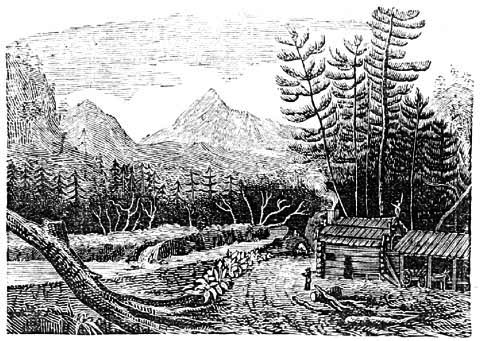
Log Tavern in the Wilderness
It may not be uninteresting to take a peep into one of these log taverns. We see here, then, rude walls thrown up of round logs, notched together at the ends—a building about as high as a common one-story house, covered with shingles laid upon ribs only. These are so closely put together that common short shingles may be laid on them quite as well as if the roof were boarded—a plan frequently adopted in new country settlements, where boards are not to be obtained. This building is divided by a partition into two apartments, in one of which, perhaps in the corner, a huge fire-place is constructed of rude stones, to the height of six or seven feet, where a large wooden mantle-bar is thrown across, from which point, with small split sticks, straw, and clay, it is topped out in the fashion of a chimney. This is the cook, eating, sitting, bar, and often the card-playing room, where teamsters, in crowded numbers, enjoy all the luxuries which their circumstances will admit, one of which is a most excellent appetite. The other room is strictly appropriated to sleeping purposes, with births rudely constructed, in tiers one above the other (with a space between the feet and fire), similar to the accommodations on board a vessel, so that in a space seven by thirty feet sixty men may be accommodated with lodging. Such a number of men, crowded into an area of so scanty dimensions, might be supposed to suffer inconvenience from confined and impure air; but the ready access which the twinkling starlight and sparkling hoar-frost find to the apartment through the numerous unstopped crevices warrants a more agreeable conclusion.
Thus sociably, quietly, and snugly ensconced within that rude shelter, enveloped and surrounded with interminable forests, the hours of darkness are passed, while without, the piercing cold causes even the nestling trees to quake as the wings of the wild winter night labor with the furious snow-storm.
Sometimes a portion of the route lays across large lakes, where the bleak winds pierce, or the dense snow-storm thickens the atmosphere, and obliterates alike the path and the shore from sight. I have known teamsters, while crossing these icy regions, suddenly overtaken by snow-storms so dense as to circumscribe the compass of vision to thirty rods, and to be compelled to wander all day long upon those bleak fields before they were able to find the logging road which formed their egress from the lake.
Belated at other times, night overtakes them on the ice. In such cases, where it is not deemed prudent to proceed, they find access to the shore, where the thick evergreen forest trees afford some protection from the night winds. Here a fire is kindled, some coarse boughs plucked and thrown upon the snow, upon which a buffalo-skin is spread, and with a similar covering they repose, after snugly blanketing their horses. A biscuit of pilot-bread, with a "frizzled" slice of pork, constitute their repast—ten to one if it be not rinsed down with a draught of "fire-water" from the little canteen in the pea-jacket pocket. On some routes early fall trips are made with loads of camp supplies on wheels, over very rough roads, before the rivers and streams freeze. These are crossed upon a raft made of poles or logs capable of bearing a portion only of the load, which is carried over in parcels, according to the capacity or tonnage of the rude ferry-boat; sometimes swimming, and at others transporting the horses singly on the raft. In like manner we manage with our ox-teams, when we take an early start for the scene of our winter operations.
RIVER LIFE.
PART III.
CHAPTER I.
"Breaking Up."—Grotesque Parading down River.—Rum and Intemperance. —Religious Rites profaned.—River-driving on Temperance Principles. —The first Experiment.—A spiritual Song.
Having completed our winter's work in hauling logs, another period commences in the chain of operations, "breaking up," moving down river, and making preparations for "river-driving."
The time for breaking up is determined by various circumstances; sometimes an early spring, warm rains, and thawing days render the snow roads impassable for further log hauling. In other cases, when it is the intention to take the teams down river, where lakes and rivers are to be crossed on the route, it is necessary to start before the ice becomes too weak to bear up the oxen. Sometimes scarcity of timber renders an early removal necessary, while in those instances where it is concluded to turn the oxen out to shift for themselves, on browse and meadow grass, we haul as long as it can be done, esteeming every log hauled under such circumstances clear gain.
Breaking up is rather a joyful occasion than otherwise, though camp life, as a whole, is very agreeable. Change is something which so well accords with the demands of our nature, that in most cases, when it occurs, its effects are most exhilarating. Under such circumstances, after three or four months spent in the wild woods, away from home, friends, and society, the anticipation of a renewed participation in the relations of life, in town and country, creates much buoyancy of feeling. All is good nature; every thing seems strangely imbued with power to please, to raise a joke, or excite a laugh.
Whatever of value there may be about the premises not necessary for the driving operation, is loaded upon the long sled; the oxen being attached, the procession moves slowly from the scene of winter exploits, "homeward bound," leaving, however, a portion of the crew to make the necessary preparations for river-driving.
After several days' travel, the neighborhood of home is reached; but, before the arrival in town, some little preparations are made by the hands for a triumphant entrée. Accordingly, colors are displayed from tall poles fastened to the sled, and sometimes, also, to the yoke of the oxen, made of handkerchiefs, with streaming pennants floating on the wind, or of strips of red flannel, the remains of a shirt of the same material, while the hats are decorated with liberal strips of ribbon of the same material, and waists sashed with red comforters; their beards being such as a Mohammedan might swear by. Thus attired, they parade the town with all the pomp of a modern caravan. The arrival of a company of these teams, ten or a dozen in number, sometimes amounting to forty or fifty oxen, and nearly as many men, creates no little interest in those thriving towns on the river which owe their existence, growth, and prosperity to the toils and hardships of these same hardy loggers. Each team is an object of special interest and criticism; and, according to the "condition" of flesh they are found in, so is the praise or discredit of the teamster in command, always making the amount of labor performed and the quality of the keeping furnished an accompanying criterion of judgment. This voluntary review, to the knight of the goad, is fraught with interest, as by the decisions of this review he either maintains, advances, or recedes from his former standing in the profession, and thus it affects not only his pride, but also his purse, as a teamster of repute commands the highest rate of wages.
Some twenty years since, these arrivals, and also those of the river-drivers, were characterized by a free indulgence in spirituous liquors, and many drunken carousals. Grog-shops were numerous, and the dominion of King Alcohol undisputed by the masses. Liquor flowed as freely as the waters which bore their logs to the mills. Hogsheads of rum were drunk or wasted in the course of a few hours on some occasions, and excessive indulgence was the almost daily practice of the majority, even from the time of their arrival in the spring until the commencement of another winter's campaign. I speak now more particularly of employees, though I calculate, as a Southerner would say, that many of the employers in those days had experience enough to tell good West India from New England rum.
"In 1832, in a population not exceeding four hundred and fifty or five hundred, on the St. Croix, three thousand five hundred gallons of ardent spirits were consumed." A distinguished lumberman, whose opinion is above quoted, remarks further, "So strong was the conviction that men could not work in the water without 'spirits,' that I had great difficulty in employing the first crew of men to drive on the river on temperance principles. When I made known my purpose to employ such a gang of men, the answer almost invariably was, 'You may try, but, depend upon it, the drive will never come down.' But old men, who had been spurred on to exertion for thirty years by ardent spirits, were forced to acknowledge, when they came down river, that they had never succeeded so well before; and learned, at that late period, that the cause of their stiff joints and premature old age was not wholly on account of exposure to the cold and work in the water, but the result of strong drink."
It would be difficult to give an exaggerated sketch of the drunken practices among loggers twenty-five years ago. I recollect that matters were carried so far at Milltown, that the loggers would arrest passers-by, take them by force, bring them into the toll-house grog-shop, and baptize them by pouring a quart of rum over their heads.
Distinctions of grade were lost sight of, and the office of deacon or priest constituted no exemption "pass" against the ordeal, rather the rite profaned. This process of ablution was practiced with such zeal upon their own craft and transient passers-by, that a hogshead of rum was drawn in a short time, running in brooks over the floor. The affair was conducted amid the most boisterous and immoderate merriment—the more distinguished the candidate, the more hearty the fun.
But a change has come over, not the spirit of their dreams, but their practices and estimate of such excesses. I doubt whether any portion of society, or class of men whose intemperate habits were so excessive, and whose excuses, at least for a moderate use of liquor, were so reasonable, can be found where the principles of total abstinence have wrought so thorough and complete a change. Not that the evil is wholly eradicated, for many still continue its use. But it has now been fully demonstrated that men can endure the chilling hardships of river-driving quite as well, and, indeed, far better, without the stimulus of ardent spirits, and perform more and better-directed labor.
At the time alluded to, however, more prominence was given to rum as a necessary part of the supplies than to almost any other article. "The first and most important article," says Mr. Todd, of St. Stephen's, N. B., "in all our movements, from the stump in the swamp to the ship's hold, was Rum! Rum!" To show how truly this one idea ran through the minds of the loggers, I present the following original rum song, illustrating the "spirit of the times," and of the log swamp muse.
"'Tis when we do go into the woods, Drink round, brave boys! drink round, brave boys! 'Tis when we do go into the woods, Jolly brave boys are we; 'Tis when we do go into the woods, We look for timber, and that which is good, Heigh Ho! drink round, brave boys, And jolly brave boys are we. Now when the choppers begin to chop, Drink round, &c., When the choppers begin to chop, Jolly brave boys, &c.; And when the choppers begin to chop, They take the sound and leave the rot, Heigh ho! drink round, &c., And jolly brave boys, &c. And when the swampers begin to clear, Drink round, &c., And when the swampers begin to clear, Jolly brave boys, &c.; And when the swampers begin to clear, They show the teamster where to steer, Heigh ho! drink round, &c., And jolly brave boys, &c. And when we get them on to the sled, Drink round, &c., And when we get them on to the sled, Jolly brave boys, &c.; And when we get them on to the sled, 'Haw! back, Bright!' it goes ahead, Heigh ho! drink round, &c., And jolly brave boys, &c. Then, when we get them on to the stream, Drink round, &c., Then, when we get them on to the stream, Jolly brave boys, &c.; So, when we get them on to the stream, We'll knock out the fid and roll them in, Heigh ho! drink round, &c., Jolly brave boys, &c. And when we get them down to the boom, Drink round, &c., And when we get them down to the boom, Jolly brave boys, &c.; And when we get them down to the boom, We'll call at the tavern for brandy and rum, Heigh ho! drink round, &c., Jolly brave boys, &c. So when we get them down to the mill, 'Tis drink round, &c., So when we get them down to the mill, Jolly brave boys, &c.; And when we get them down to the mill, We'll call for the liquor and drink our fill, Heigh ho! drink, &c., Jolly brave boys, &c. The merchant he takes us by the hand, Drink round, brave boys! drink round, brave boys! The merchant he takes us by the hand, And 'jolly brave boys are we;' The merchant he takes us by the hand, Saying, 'Sirs, I have goods at your command;' But heigh ho! drink round, brave boys, The money will foot up a 'spree.'"
CHAPTER II.
RIVER-DRIVING.
Log-landing.—Laborious Exposure.—Damming Streams.—Exciting Scenes. —Log-riding.—Fun.—Breaking a Dry-landing.—A sudden Death.— Thrilling Scenes on the "Nesourdnehunk."—Lake-driving.—Steam Tow-boat.—Remarks on Lake Navigation.—Driving the main River.— Union of Crews.—Substantial Jokes.—Log Marks.—Dangers of River-driving.—Sad Feelings over the Grave of a River-driver.— Singular Substitute for a Coffin.—Burial of a River-driver.—A Log Jam.—Great Excitement.—A Boat swamped.—A Man drowned.— Narrow Escape.—Mode of Living on the River.—Wangun.—Antidote for Asthma.—The Wangun swamped.—An awful Struggle.—The miraculous Escape.—Driving among the Islands.—Amusing Exertions at identifying. —Consummation of Driving.—The Claims of lumbering Business for greater Prominence.—The Boom.
The business of river-driving is not so agreeable as other departments of labor in the lumbering operations, though equally important, and also, in many respects, intensely interesting. The hands left at the camps at the time the team breaks up, to make the necessary instruments for river-driving, are soon joined with the addition of such forces as are requisite for an expeditious drive. As in most labor performed there is a directing and responsible head, so is it in river-driving; here, too, we have our "boss."
As early as April, and sometimes the last of March, the high ascending sun begins to melt the snow on the south of mountain and hill sides, flowing intervales and lowlands, forming considerable rivers, where at other seasons of the year the insignificant little brook wound its stealthy course among the alders, hardly of a capacity to float the staff of a traveler; but, at the period referred to, by a little previous labor in cutting away the bushes and removing some of the stones in its channel, it is made capable of floating large logs, with the occasional assistance of a dam to flow shoal places.
In brook-driving it is necessary to begin early, in order to get the logs into the more ample current of the main river while the freshet is yet up. In some cases, therefore, as a necessary step, the ice in the channel of the brook is cut out, opening a passage of sufficient width to allow three or four logs to float side by side. In forming a landing on the margin of such streams, the trees and bushes are cut and cleared out of the way for several rods back, and a considerable distance up and down, according to the number of logs to be hauled into it. To facilitate the sawing of the logs into suitable lengths for driving, as well as more especially to form bed-pieces upon which to roll them into the brook in the spring, a great many skids are cut and laid parallel with each other, running at right angles to the margin of the stream. On these landings, in the spring, the water is from one to two feet deep, the cause of which is sometimes accounted for from the fact that in the autumn the water is quite low, and the ice, in forming, is attached to the grass and bushes, which prevent it from rising; the result is, that the whole is overflowed in the spring. Into the channel thus cut the logs are rolled, as fast as it can be cleared, by shoving those already in down stream, until the brook, for a mile or more, is filled with new and beautiful logs.
No part of the driving business is so trying to the constitution, perhaps, as clearing such a landing. It often occupies a week, during which all hands are in the water, in depth from the ankle to the hips, exerting themselves to the utmost, lifting with heavy pries, hand-spikes, and cant-dogs, to roll these massive sticks into the brook channel. The water at this season is extremely chilly, so much so that a few moments' exposure deprives the feet and legs of nearly all feeling, and the individual of power to move them, so that it often becomes necessary to assist each other to climb upon a log, where a process of thumping, rubbing, and stamping restores the circulation and natural power of motion. This effected, they jump in and at it again.
When the water is too shallow on any part of a stream to float the logs, dams are constructed to flow the water back, with gates which can be opened and shut at pleasure, and either through the apertures of the gates or sluice-ways made for the purpose, the logs are run. This dam answers the same purpose in raising the water to float the logs below as above, on the brook. Shutting the gates, a large pond of water is soon accumulated; then hoisting them, out leaps the hissing element, foaming and dashing onward like a tiger leaping upon his prey. Away the logs scamper, reminding one of a flock of frightened sheep fleeing before the wolf. Some logs are so cumbersome that they remain unmoved, even with this artificial accumulation of water. In such cases, embracing the moment when the water is at its highest pitch, in we leap, and, thrusting our hand-spikes beneath them, bow our shoulders to the instrument, often stooping so low as to kiss the curling ripples as they dance by. In this way, sometimes by a few inches at a time, and sometimes by the rod, we urge them over difficult places; while, in connection with the annoyance of very cold water, broken fragments of ice mingle in the melée, imposing sundry thumps and bruises upon the benumbed limbs of the enduring river-driver.
In some places, on low, swampy land, a body of water accumulates several rods wide, and from three to ten feet deep. Here the logs, as if to play "hide and seek," run in among the bushes, giving infinitely more trouble than amusement. Under such circumstances, it becomes necessary for the men to keep on the logs most of the time; and as logs roll very easily in the water, and are often extremely slippery, it requires the balancing skill of a wire-dancer to keep on them; and often some luckless wight, whether he will or no, plunges over head and ears into the flood as he is whirled from the back of some ticklish log; and, however unwelcome to himself, no sooner is his head above water than he hears the wild woods echo the jeering laugh of his more fortunate comrades.
In other places, where banks are too abrupt to allow the team to pass on to the river, the logs are unloaded and rolled down in one general mass; the first few fall upon the ice, others rolling against them; the main body fall back and accumulate in great numbers. To break or clear such a landing is often very dangerous. While at work prying on the foremost, large masses start suddenly, and often the only way of escape is to spring in advance of the rushing pile and plunge the river. "I saw one poor fellow," said a logger, "hurled into eternity very suddenly while at work on one of those jams. Co-operating with others in an attempt to roll a stick from the pile, the main lever gave way, and the stick slipped back. This person used a single hand-spike, holding up the upper end and sallying back. When the log rolled back it caused the hand-spike to spring forward, and, before he had time to relinquish his grasp, it flung him headlong forward, like an arrow from the hunter's bow, down the embankment into the water; when recovered, he was dead. It was supposed that some internal injury was inflicted by the sudden ejectment, which caused him to suffocate more readily in the water. Rarely could the man be found his equal in physical energy; but strength opposes no barrier to death."
Logs are now driven down streams whose navigation for such purposes was formerly regarded as impracticable—some from their diminutive size, and others from their wild, craggy channel. There is a stream of the latter description, called "Nesourdnehunk," which disembogues into the Penobscot on the southwest side of Mount Ktaadn, whose foaming waters leap from crag to crag, or roll in one plunging sheet down perpendicular ledges between two mountains. On one section of this stream, said to be about half a mile in length, there is a fall of three hundred feet. In some places it falls twenty-five feet perpendicularly. Down this wild pass logs are run, rolling, dashing, and plunging, end over end, making the astonished forest echo with their rebounding concussion.
It would be a match for "Dame Nature" to locate a handsome Pine-tree beyond the grasp of the logmen. Where the Eastern hunter pursues the mountain goat, the logger would pursue the stately Pine. We have seen them in the deep ravine, on the abrupt hill-top, and far up the rugged mountain side, or peering down from some lofty cliff upon the insignificant animal at its base who is contemplating its sacrifice; a few minutes, and the crash of its giddy plunge is heard, "and swells along the echoing crag," causing the earth to tremble under the stroke of its massive trunk; and if it does not break in pieces, as is sometimes the case, in falling, it will in time find its way to the slip of the saw-mill. The resolution, daring, skill, and physical force of the men engaged in this business can find no rival, to say the least, in any body or class of men whatever.