FORD OF H.M.S. VIGILANT (continued 6)
Reading edition
"We shall have it clear in another quarter of an hour," the Skipper growled, and went back to hurry everyone forward, for that gun ahead of us was firing regularly, and made us all rather dread what was happening.
We were getting on some high ground now, making fine progress, and almost before you could tell when it happened, or how long it took to clear, the fog had swept past us, and, quite suddenly, we saw frightened Chinamen flying in front of us, to take cover behind a bank somewhere about a quarter of a mile away. I couldn't help laughing to see them tumbling over each other in their hurry to escape, now that the fog had uncovered them. We bagged a good many before they got over that bank.
"Don't give 'em any time; after 'em, Marshall," I heard the Skipper shouting, and we simply did a record sprint, "Blucher" going on ahead of us, thinking that his show had come along at last, and barking loudly, like the useless, untrained, old brute he was. We were over that bank before they could fife half a dozen shots, and had bayoneted half a dozen before you could say "Jack Robinson". My men were so glad to get a sight of the fellows who'd been worrying them all night, and were so keen to pay them "out", that there was no stopping them. Those few shots, though, were quite enough for old "Blucher", who went yelping back to the Skipper, with his tail between his legs, more mystified than ever.
The ground sloped upwards behind the bank, and we were after them like redshanks. I knew that Trevelyan with "B" company was somewhere on my right, and that "B.-T." was coming along in reserve, and that the Maxim kept chipping in occasionally; but I had all my work cut out to keep my marines in hand, and did not pay much attention to anything else. One or two of my chaps got bowled over before we got to the top of the slope; but we were up it and over it in a "jiffy", and saw the cowardly brutes running down the other side, dodging in between some native graves and some big boulders, and shooting up at us.
I made my men halt and take cover to get their breath, and waited for the Skipper. He came grunting and puffing after me.
After that beastly night, it was grand to be able to use one's eyes again, and see where we were and what we were doing. The ground sloped down from our feet to a little shallow valley of paddy fields, intersected by banks and small irrigation streams. It rose again on the opposite side to form a ridge about eight hundred yards away, a little tree-topped ridge, with the walled house, where Ching and Sally and all the rest of them were, at its right end, and a few huts on its left end.
As the Skipper came up, I saw a cloud of white smoke burst out from behind those huts, and heard that gun fire again. I pointed it out to him.
"There's someone showing on top of that house, sir," Trevelyan sang out.
"Where's one of the signalmen?" the Skipper roared. "There you are—are you—wave something; get on top of that hut and wave your flags." (We were standing close to a small mud hut.)
"He'll draw their fire all right," I chuckled to Trevelyan—there were a good many bullets flying past us—and when he did scramble up to the top and begin waving his semaphore flags, they left off firing at us, and paid all their attention to him, bullets whistling round him and smacking up against the side of the hut.
"A jolly good 'wheeze' that," and Trevelyan winked at me. "You must put that in your blessed drill book, eh, soldier?"
The signalman stood there with his telescope between his knees, calmly trying to attract attention, whilst the Skipper stood below and cursed him, and "Blucher" went smelling up every time a bullet splodged against the mud wall, and then ran away, thinking people were throwing stones at him. He didn't know what to make of this picnic.
"There's someone waving on top of that house," several sang out; and we saw someone "wagging" a long stick.
"'E's only got one arm, whoever 'e is," the signalman muttered, "an' 'e don't know much about Morse."
"It's Mr. Ford, sir," he sang out. "He says, 'All well so far—Mr. Ching here—gun doing damage'."
"Splendid!" we all shouted; and just then the signalman came toppling down with a bullet through his leg, and sat there holding it and looking very white.
Old Barclay was on him in a moment—terrible keen chap he was.
When we looked again, young Ford had disappeared. I expect that he had found it a pretty warm corner up there.
Old "B.-T.'s" little lot in the rear were having trouble now. They were below us, at the foot of the slope we had just climbed, and were lying down and shooting at a crowd of Chinese clustering round the huts near that pigsty.
"We must have got round 'em in the fog," Trevelyan chuckled.
"Where's that darned Maxim?" the Skipper roared. "Get it up here."
Young Rawlings rushed away to hurry it, and it came rattling up, Langham, who was in charge of it, and his men panting and tugging for all they were worth.
He was ordered to try and stop that gun firing, and then fat little Ponsonby was sent flying downhill to tell Travers to leave the Chinamen alone and come along after us.
The Maxim gun began its "tut-tut-tut-tut", "B.-T." and his chaps came bounding up the hill, and we all roared with laughter as little Ponsonby came running after them, his eyes and mouth wide open with fright at being left behind. "B.-T." was sent down the slope in front of us, with his company, to clear out the chaps who were sniping us; and very prettily he and his two Mids, Jones and Withers, did the job, whilst Trevelyan looked after the brutes in our rear.
They were simply swarming down there behind those huts, and there was not the least doubt that we had got round their main body in the fog. They did not dare to come out in the open, and were keeping up a very wild fire at us.
Langham couldn't get near that gun, and just as it fired again, and someone had sung out that they could see stones and bits of wood flying from a corner of the house, we saw Chinamen streaming across the paddy fields on our left, running and turning, and firing backwards. We could hear heavy firing from somewhere out of sight, and the noise of another Maxim and the chip-chip of a Colt automatic gun.
We all knew that it was the gunboat's brigade driving the Chinese in front of them.
"The other chaps will be there before 'Old Lest', if we don't get a move on. 'Old Lest' ain't going to be beaten by them," the Skipper grunted, and sent me and my marines flying down into the paddy fields below us, after Travers, who had halted and taken cover behind a bank on the other side of them, just before the ground began to rise gently up towards the walled house, and where the gun was a little farther to the left.
"Take ground to your left, and both of you 'go' for that confounded gun," the Skipper had roared after me. "I'm coming along after you."
It's all jolly fine to tell one to charge along through paddy fields. Grainger was just behind me, and I felt sorry for him, because I kept on going in up to my knees in beautiful, rich, black mud, and knew that he had his eye on me and my second best pair of trousers. But we got up to old "B.-T." all right, and I shouted for him to come along and shove on for the gun, got my men extended well to the left, gave them a "breather" whilst he swung his men a little to the left as well (brought his right shoulder up, as they say in the drill book), and then off we went, howling and cheering, straight towards two little white huts behind which the gun was still firing.
Whitmore appeared from somewhere and took charge (he was the senior), Rawlings and a bugler boy legging it after him for all they were worth.
A good many bullets came whizzing past, and I saw chaps dodging about round those huts and under some trees. My men were coming along well, and old "B.-T." with his long legs was sprinting along in front of his chaps like a camel.
Away to the left people began cheering—"Rah! Rah! Rah!"—and I knew that came from the Omaha's crowd, and wasn't going to be beaten by them. Nor was more either; and though I knew that the "show" was not quite according to the "drill book", I wasn't going to let the "U.S.N." or our gunboats get there first.
Young Wilkins, running just behind me, gave a cry and fell; I heard the old sergeant-major cursing and hurrying on the men; we got in among the trees, my chaps half a dozen paces behind me; a chap got in my way and fell down—I suppose I did it; two or three fellows rushed out from the side of a hut and came for me with swords; but the well-beloved Grainger wasn't going to let them damage my best "serge", if he could prevent it, and we got rid of them between us. "B.-T.'s" chaps and mine were now all mixed up. There were a few "bickerings" going on round the huts and among the trees, and then we saw the gun standing by its "lonesome", and went dashing across to it.
One of "B.-T.'s" able seamen was the first to get to it, Whitmore and Rawlings close behind, and "B.-T." and I made a dead heat for fourth place.
"Don't 'hee-haw' like a jackass," Whitmore said, when he'd got his breath. "What's to be done now?"
I'm hanged if I could help laughing at the sight of old "B.-T." legging it, with little Withers, only about half his height, trying to keep up with him.
"Give us a cigarette, and don't be an ass, soldier!" "B.-T." sang out. "Your legs are funnier looking than mine, any day."
"Drill book, Whitmore, old chap! Drill book! When you've got 'em on the run, keep 'em on the run," I said, when I could stop laughing, and he agreed, and "B.-T." agreed, and we got our people together and followed them. As we left the gun we saw the Omaha's people "doubling" up to it.
We must have followed them for the best part of a mile, I should imagine, but they ran a jolly sight faster than we could. We were pretty well "winded", and when we'd driven them back to the outskirts of the town, they rallied there, and we had to pull up and go back again, carrying along three fellows who'd been knocked over in the last hundred yards. They began pressing along after us, and a lot of chaps—some of those who had run away from the other brigade—began worrying our flank, streaming across the paddy fields and firing at us. We managed to keep them back, alternate sections lying down and firing whilst the others ran back fifty yards and lay down in their turn, and covered the retreat of the first little lot. A nice little show it was too—all done according to the drill book—and when we'd got back to within a hundred yards of the walled house, and were passing through the remains of a lot of burnt huts, young Ponsonby came running up with orders from the Skipper to halt there and take up a position.
"He's pretty angry, sir," he told Whitmore; "he's been sounding the recall for the last half-hour."
The fact was that the Chinese hadn't yet had a sufficient lesson, and didn't quite know what it was to run up against us in the daylight, and were now coming for us "hammer and tongs".
Instead of going back to the walled house, and bending on one knee before Princess Sally as her gallant knight, who had lost a couple of eyeglasses, and spoiled serge frocks, two in number, and two pairs of embroidered overalls—bills not yet paid—in her service, and receiving her gracious thanks, I had jolly well to dodge beastly bullets for a couple of hours.
The old Skipper often came round, with "Blucher", to see if things were going all right, and generally stopped to have a yarn with me.
It was from him I learnt that poor old Hoffman had been killed.
"Jolly hard luck after all he's done for us, sir," I had said; but the Skipper only growled "Umph!" and for some reason or other didn't seem so sure.
He had managed to get a signal through to the Vigilant, and ordered her and the gunboats to shell the town and that six-inch gun which Whitmore had tried to destroy.
From my position, looking across the Chinese town and the little creek crowded with junks, I could see them steaming slowly inshore, and presently they began firing very deliberately. (Of course they had only a few seaman ratings left on board to man the guns.)
Their shells burst all over the town; but it takes a lot of shells to set fire to a house, and it was some time before they got a good fire going. A few shells which didn't burst ricochetted over our heads, and one or two fell pretty close to the house; but the Skipper didn't worry about them now. He had lowered little Sally down a shallow well, somewhere in the garden behind the house, and so long as she was safe, he didn't worry about anyone else.
His idea was that if we set fire to the town, most of the people would go back there to try and extinguish the flames, and that then we would tramp back across the island to where we had landed last night.
Certainly a good number of fellows did go back, and except from that hill on the other side of the paddy fields, from where we had seen Ford's signal, we were not much bothered with rifle fire.
It was at the back of the house, where the ground fell steeply towards the creek, and was covered with scrubby bushes, that the Chinese seemed now to be trying to force their way in. The lower slopes were simply swarming with them, and more kept moving up the creek in boats to assist them.
The Skipper came across to me. "Umph!" he growled. "You're a soldier, aren't you?" and when I had acknowledged the soft impeachment, "Umph! What would you do? I'm not a soldier. 'Old Lest's' not much good ashore except after 'birds'. How'd you get out of this mess! Ugh!" and he growled at me as if he would have liked to eat me, and so fiercely that old "Blucher" thought he was in for a row, and cleared off to have a yarn with his chums, the marines. He took me across, behind the house, to have a look at the state of affairs there.
Don't think that he wanted advice. He only wanted someone to talk to, and everyone else was too busy. I wouldn't have suggested anything to him for "worlds".
It was then that I saw Hobbs and Sally for the first time since they had been "burgled". They had fished her up from the well, and she had come across to the Skipper, looking like a ghost, her sad little face all pinched and careworn, hardly the princess I'd all my life been longing to rescue, and throw myself and all my unpaid bills at her feet. She was a most distressful little object, and when the Skipper put his great hand very gently on her shoulder, and told her we were going to start off almost directly, she began crying, and said she didn't want to go.
"She's gone daft about that man Evans," Hobbs whispered to me. He looked more like a monkey than ever.
So that was it, was it? And our little princess didn't want to be rescued! Poor little princess! I just noticed that the front of the house had been pretty well battered in by the Chinese gun, and then caught sight of Ford and Rawlings looking like long-lost brothers. Ford was a pretty ludicrous spectacle, with one side of his face black and blue, one eye closed, and his left arm slung up inside his monkey jacket. This was the first time I had seen him since we had landed to destroy that gun, and he got very red; I remembered that he hadn't taken my jokes in very good part, so went across to make my peace with him.
"We all saw you signalling to us this morning, Ford, on the top of that roof. You must have been under a very hot fire, eh?"
He wasn't quite certain whether he was going to make peace, but he couldn't stand out against a little delicate flattery, and we made friends again, and he went off with Rawlings, looking very conceited and happy.
Fat little Rashleigh was there, too, buzzing about like a bumble bee, and offering everyone a drink from his flask, and patronizing Ching, and talking about the gun he had captured. I never realized what he meant till afterwards.
Old Ching was pretty well played out, but looked proud and happy, and I gave him one of my last three cigarettes, and told him one or two yarns, though he didn't take much interest in them, and kept his eyes fixed on little Sally.
The Skipper had given him the job of escorting her down to the coast, and jolly well he had earned it too.
Parkinson, the Omaha's skipper, had a yarn with me. "Guess I shall be a flag officer before I'm sixty. Reckon they'll have my picture in all the journals in the States, and maybe they'll remember John A. Parkinson is still alive and kicking, up at Washington. They seem to have forgotten him awhile." He was "talking sarcastic". He was a fine grim-looking chap, without an ounce of spare flesh on him, and as old as most of the rear-admirals in our navy, though only in command of a small gunboat.
There was an old Scotchman who had helped Ford and the two men escape from the town to the walled house, and had been helping to defend it all night. He was a funny old bird, and didn't quite know where to "place" himself, and wasn't looking particularly happy. Old "B.-T." had recognized him as the chap who'd run the show at the other island, when "B.-T." was a prisoner, so he knew that we had sufficient evidence to hang him, and was only too jolly anxious to escape being killed by Chinamen in the meantime.
He thought that our best plan would be to go back the way we had come. It was more open country, and, except for the first three-quarters of a mile, better "going" and more open than if we attempted to work round the outskirts of the town itself, where the ground was nothing but swamps.
It was now about half-past one o'clock, and the Skipper thought that it was about time to be starting back.
The great trouble was the number of wounded who would have to be carried. Of Ching's original fifty men only forty-two could walk, and the two landing parties now had six men too badly wounded to walk. Young Wilkins, my bugler, and a seaman belonging to the Goldfinch were the only two Englishmen killed so far.
These two, Hoffman, and five of Ching's people had been buried during the morning, under the trees in the garden, behind the house.
The Skipper also wanted to go back the way he had come. He told me that I should have the first job—to seize the hill opposite us across the paddy fields and hold it whilst he, Trevelyan, and "B" company and Ching's bluejackets brought along Sally, her father, and the wounded.
Parkinson, the Omaha's skipper, was to stay behind with the gunboat's brigade and act as rearguard till the Skipper had got safely across to me, and then I was going to do "rearguard", whilst they all went on.
He hoped to get in touch with the Ringdove and Omaha a mile from the shore and obtain some assistance from their guns, if he was much pressed by the Chinese. He was just going to give the order to "carry on", when we saw a little party of people approaching with a white flag waving over their heads. It was headed by a most respectable-looking old "josser" beautifully dressed in silks, with a mandarin button on his cap, and a most benign, fatherly expression on his face. He was brought along to the Skipper, and the old Scotchman acted as interpreter.
He had come to offer to let us go back to our ships without being molested, if we would only leave off shelling the town, and was very surprised when the Skipper refused to do so. Then he called up a man who was standing behind him with a bundle in his hand, and made him empty it on the ground, looking at us and expecting to see us beam with delight. Ugh! I was nearly sick, for out rolled the head of a white man.
"It's Boss Evans!" I heard the Scotchman mutter under his breath.
We all involuntarily stepped back in disgust, and the old gentleman opened his eyes in amazement when he saw that we were not pleased, and explained that it was the Boss Pirate himself, the chap who'd done everything he ought not to have done, and that now they had killed him, and that we had seen that he was really dead, and had got Hobbs and the girl, "it all makee end—all belong plenty too much bobberie—no can do—vely good—vely good", and he rubbed his hands together, and bowed and beamed at us again from behind his great horn-rimmed spectacles.
"Chuck him out!" the Skipper roared, and walked away.
The poor dear old Chinee chap was almost in tears when he was led home again, and wasn't allowed to take the head with him either.
We buried it alongside the other dead.
Someone must have told my poor little princess, because she was now only too anxious to get away, and looked more mournful and heartbroken than ever.
It was half-past two before this little business was concluded, and Whitmore and I were jolly anxious to start.
"The old man's wasting daylight with a vengeance," he said to me, but had hardly spoken before young Ponsonby came running up—"From the Captain, sir; you're to carry on."
As I hurried past the Skipper, he sang out, "Drive those fellows off that hill!"—pointing with his big stick. "Travers will go with you, and I'll send a Maxim along after you, and am coming on directly."
"Very good, sir," and I saluted and went off to tell my men what we had to do, and sang out to Travers, "Come along, old 'B.-T.', bring your people along."
We started off.
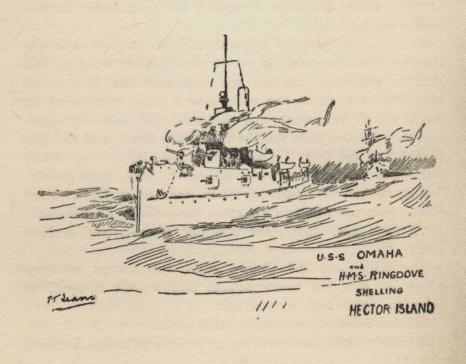
U.S.S. Omaha and H.M.S. Ringdove shelling Hector Island.
CHAPTER XV
The Retreat
Old B.-T. Wins—A Hard Retreat—A Case of Speed—A Race against the Fog—Hand-to-hand Fighting—Captain Marshall is Wounded—The Captain's Life Attempted—Round the Fire—Ford is Indignant—On Board Again
Written by Captain Marshall, Royal Marine Light Infantry
Old "B.-T." and I extended our people, ran down towards the paddy fields, crawled and dodged across them, and prepared for the "do-or-die business" up the farther slope.
It was a bit of a rush, and old "B.-T." looked "bored" when we met again at the top. The blighters had never given us a show, but had cleared out, pretty well most of them. A few had run into "B.-T.'s" little lot by accident, and been polished off, that was all.
I don't suppose that they were expecting us to go at 'em so soon.
The Maxim came along after us, and we helped Langham up with it, and spread ourselves out, to cover the retreat of the Skipper with the main body, which came along almost immediately in a long line, slowly trailing down the side of the hill from the house. We could see that they were carrying the wounded, and they had got halfway across the paddy fields before the Chinese seemed to "tumble" to the fact that we were clearing out, and began to pour back from the outskirts of the town and open fire at them.
"B.-T." and I managed to keep them in check, and the Skipper got across without any casualties, "Blucher" coming galloping up the hill, wagging his long whip of a tail when he spotted me.
But by this time a number of Chinese had crept along behind the banks intersecting the paddy fields, and we couldn't get at them with rifle fire. They were right in between us and the walled house, cutting off Parkinson's retreat.
We could hear that he was having trouble—he was firing very heavily—and directly the Skipper and his little lot had got across safely, we saw his people begin leaving the house and falling back down the slope. We saw them turning and firing back, and retiring by alternate companies, and natives were swarming round the house and among the trees at the top of the ridge. We knew that they must be having a pretty warm time of it.
Those fellows who had crept round their rear began firing at them too; but one of their companies simply charged down at them, broke right through, and, opening out to left and right, swept them on one side. They were the Omaha's men. We could tell that by the peculiar noise they made and by their uniform. Langham was able to let rip into the Chinese as they sprinted out of reach of the Yankee bayonets, and hurried them along "pretty considerable", as Parkinson told me afterwards, we were also able to stop the people swarming down that ridge after him, and gave him time to bring along his Maxim and Colt guns, and to extricate himself from rather an awkward position. He made a wide sweep, so as not to mask our fire, and came across; but I saw that he had to carry four or five men, who had been knocked over in the open, and they delayed him much.
That is always the rotten part of a retreat, especially when fighting semi-barbarous natives. One dare not leave the wounded behind, and each one who cannot walk requires two able-bodied men to carry him.
From where "B.-T." and I were standing, I should think that we could see at least seven hundred Chinamen, and away on the left, we could see any number more hurrying: from the town.
"Buck up, old chap! Don't look so blooming bored!" and I slapped him on the back. "We'll have our work cut out in the next half-hour, when we are doing rearguard."
"Keep your beastly fists to yourself," he growled.
Old "Blucher" had bounded back to the Captain directly our Maxim had begun firing.
"Old Lest" and his little lot were in the rear of our hill—at the bottom of it—waiting for Parkinson to go on past them, farther back. We saw Parkinson drop his wounded people and sweep past and away towards two small rising bits of ground, about four hundred yards in the rear, and the Skipper, picking up his wounded, followed slowly.
Then came our turn as rearguard.
My Christopher Columbus! we had about all we could do to keep the beggars back. The heathen Chinee was simply seeing "red", and came charging across the paddy fields, rushing up towards the slope in front of us, and getting round both our flanks. They thought that they'd got us in a hole, I expect, and they spared a couple of hundred fellows to sneak away to the right, behind some banks, hoping to catch the Skipper in the open. They would have done it too, and got right on top of him before he could have spotted them, had not "B.-T." taken half his company down the hill at a run, and posted himself behind a couple of broken-down huts and a bit of another bank, and given 'em "beans" as they went doubling along below him. It was really a race who should get to the bank first, and old "B.-T." won.
They were now actually crawling up the hill in front of my chaps, dodging among the "scrub" and among the grave mounds, and they were getting round my left rear as well. There must have been four or five hundred of them, and they were taking cover so well, that it made it confoundedly difficult to hit them.
Langham caught a few of them in the open with the Maxim; but it's such a jolly extravagant kind of weapon as regards ammunition, and puts a dozen cartridges into a chap before another can take his place, and get his own share.
Young Withers was in command of the other half of "B.-T.'s" company of bluejackets on my left. I sent one of my chaps across to him to tell him to retire, and he began to fall back steadily. He was keeping his head, but looking very white. Langham's Maxim section began to haul their gun back, and everyone was a bit flurried. Two men got bowled over. One sprang straight up, with one hand clawing the air, and I knew that he was shot through the heart. I've seen a good many men do that in my time, and they all had been shot through the heart.
I had a funny feeling in my right arm, too, and guessed that it had got in the way of a bullet, but could move it all right.
I looked back to see whether the skipper had got safely across yet, and saw that he was just disappearing between the two little hills or ridges which Parkinson was holding; so it was time for me to be off, and we began to retire according to the laws and regulations of the dear old drill book. I sent the Maxim downhill with a run, and Withers and his half company with it, to get behind a bit of a bank two hundred yards in the rear, and held on with my marines, dropping a few Chinese who were brave enough to stand up and show themselves; but most of the skunks were simply wriggling along from one bush or grave mound to another, and I'm jiggered if you can hit a man who's crawling and dodging—that is, when you are excited, and your heart is trying to thump its way out of your chest, and you are expecting the order to retire and have one eye on the rear.
They began to get round my right flank then, and I was beginning to think that "little James" was in a pretty tight corner, when old "B.-T." saw them and came back, just in time, cheering as if he was winning the battle of Waterloo and Trafalgar all rolled into one, and went careering right into them.
This checked them for half a minute, and gave my people time to drag our wounded man—I had to leave the dead one—down the hill, and for the rest of us to fall back together halfway down the slope.
"B.-T." came along after us, and we faced round and walked backwards very slowly, and they didn't like the look of our bayonets and wouldn't charge down, though they were swarming up above us and yelling like stuck pigs. (If they had charged they would have swept clean over us.) We managed to bring along two more of my chaps who were hit and couldn't walk, and sent them on to the rear, and when we got to level ground again we opened out, and bolted for where the Maxim and "B.-T.'s" other half company were. They gave them blue blazes as they came screaming after us, and dropped dozens.
I saw one of the bluejackets fall forward, his head striking the soft ground, and go slithering along. The Chinese were not twenty yards behind, so "B.-T." and two of his chaps stopped and tried to bring him with them. Old "B.-T." had to do a bit of work with his sword and revolver for a minute or two; but we'd got our breath behind the bank, came along to his rescue, and beat 'em back, Langham picking the fellow up like a sack of corn and carrying him to the rear.
"Look at that rotten thing," "B.-T." panted out, as he got behind the Maxim, holding out his arm and showing me where his sword had broken off, about twelve inches from the hilt.
"If you will do the V.C. act, old chap, with a rotten tailor-made sword, what can you expect?" I told him.
The Chinese daren't face our fire in the open, and funked it, so that we were able to fall back again all serenely. It wasn't the fear of seeing any of our people getting killed that worried me then; it was the dread of seeing them wounded so badly that they had to be carried, because, as I told you before, each one so wounded meant two sound men to carry him away, and handicapped us so tremendously.
We were behind Parkinson now, and gave our wounded to the Skipper's main body. I caught a glimpse of "Old Lest" standing, with his great feet wide apart, and of "Blucher" squatting between them. He was watching the Chinese through his glasses, and young Ford and Ponsonby were standing close to him, looking white and nervous. He shouted out, "Well done, rearguard!" and we hurried past and came to a group of Chinese bluejackets, standing shoulder to shoulder. In the middle of them, I knew, was my poor little princess and her miserable little father. You see, bullets were still coming past pretty thickly, and Ching was shielding her with his men's bodies.
That old Chinese gun was there too, with some of the Ringdove's people to drag it, and a few yards farther along half a company of Trevelyan's men were sitting on the ground resting till they had to move on again.
They gave us a cheer as we passed them, jumping to their feet and waving their caps, and off we went at the double for a low ridge about a quarter of a mile farther to the rear. We expected to be able to see the gunboats from there, and were ordered to try and attract their attention. They had been told to keep a lookout for us.
This bit was only a case of speed, and we were all blowing like grampuses when we stopped, and the men flung themselves down and faced round, my little lot about a hundred yards from "B.-T.'s", with Langham and his Maxim between us.
Some of his people had tied their silk handkerchiefs to their bayonets and were waving them to attract the gunboats. I heard "B.-T." yell something, and saw him pointing away towards the sea.
It was there all right, but, buttered crumpets! a beastly fog-bank, like a solid wall of cotton wool, was creeping down from wind'ard. When I first looked I could see the Omaha's one mast and tall funnel, but three minutes afterwards the fog had blotted her out of sight, and I could watch it creeping towards the shore. Great bluebottles! I didn't like it; another night like last night would about send me off my "crumpet".
I was just thinking that it would have been better for me to have gone into the Church, as my old dad always had wished, when Withers came running across to ask if I could lend "B.-T." a cigarette.
"You might get your pater to give me one of his livings," I told him. "I'm going to be a parson if we ever get out of this."
"He's very particular, sir," the cheeky young rascal grinned, and ran back with my last cigarette. Old "B.-T." would have borrowed my matchbox, but I sent Withers to tell him to rub two sticks together and light it that way; it would be good exercise, and the cigarette would last longer.
I saw him shake his fist at me when he got the message, and then walk down his line of men to try and borrow a match from one of them.
The main body was coming past now; Whitmore and Rawlings, at the head of the little column, were just passing Langham's Maxim; then Trevelyan's right half company, a dozen Chinese bluejackets in a circle round Sally and Hobbs, with Ching and the old Scotchman walking behind them. Then there was a gap, a long string of Chinese bluejackets carrying their wounded, the rest of Trevelyan's chaps carrying ours, the Ringdove's people dragging the little Chinese field gun, and Trevelyan with a few men bringing up the rear.
They came to a halt behind us, and laid down their wounded very gently.
"There's no one behind us, I think," "B.-T." shouted to Whitmore. "But just look at that fog! It's hidden the Omaha since we've been up here."
"Where's the Skipper?" I asked him.
"Taking charge of the rearguard. This job isn't exciting enough for him. They'll have all their work cut out to get back to us, and I don't know what will happen if we get many more wounded."
I had to go back to my men then, as I saw the rearguard already on its way, fat little Rashleigh toddling along in front of two companies from the left of the two little hills, and the Maxim section rushing their gun towards us. From the right the rest of the rearguard commenced their retreat, and I saw "Old Lest's" great broad shoulders swaggering back, with Parkinson, as thin as a lamp-post, striding along beside him, and "Blucher" slinking between them.
Contrary to Whitmore's opinion, they had very little trouble in extricating themselves, because the ground was so flat on the other side of those two little hills, that the Chinese had not dared to come to close quarters, and they were more than halfway towards us before the enemy occupied the slopes they had just evacuated, and stayed there, contenting themselves with opening a very heavy but miserably directed fire. They made rotten shooting.
I felt that we had now got over by far the worst part of the show, all except the beastly fog part, which had already hidden the line of the shore a mile away, with its advance guard of feathery mist quickly creeping along the ground towards us.
The Skipper came along grunting and growling, lighting another cigar, and highly pleased with himself and everything else so far; but when he saw the fog he stormed and cursed.
"'Old Lest' won't worry about those chaps behind him. He'll march straight for the shore," he grunted, and sent Parkinson and the gunboat's brigade straight ahead, and ordered my marines and "B.-T.'s" bluejackets to remain in the rear. He took charge of the rearguard himself, but practically gave the job to me. I suppose that he knew that I had conducted many skilful retreats across the exercise ground at Forton Barracks, so would know all about it.
Anyhow, it was a great compliment to me, and old Whitmore was as sick as a cat with a fish bone in its throat, only he tried not to show it.
No one troubled us in front, and we marched along quite quickly—as quickly as it was possible to carry the wounded.
It was really a race against the fog. Everyone knew that, and we got over the first half-mile without difficulty.
The Chinese were not worrying the rearguard much; but of course they saw the fog almost as soon as we did, and many of them began streaming away to the left and right, and I knew that they would scoot round our flanks, try and get in between us and the sea, and hem us in as they had done during the night. I didn't like the idea of that—not a little bit.
But with only another half-mile to do, the moist tongues of fog began drifting overhead, and in five minutes we couldn't see fifteen yards. We recognized the huts with the dead pig's near them, and some of my chaps had a brilliant idea, and brought them along on their bayonets. "Wat 'o! Bill, for a bit of the Gunnery Lootenant's sucking pigs when we gets aboard," I heard one of them sing out.
The advance guard halted to let the main body get up to them, and threw back their flanks to overlap it, and as we came up we threw forward our flanks, and this meant that we practically formed a hollow square round the main body and the wounded. Like this we marched very slowly along, keeping in touch by shouting to each other. The Chinese were now beginning to draw up to our rear, and we could hear them yelling and firing rifles at us, the bullets seeming to make much more noise in the fog.
They didn't venture close yet.
In another five minutes the fog was so dense that I couldn't see the third man from me in the ranks. The skipper made a bugler with the main body in the centre sound two "G's" every half-minute, and that was a great help to us to keep in station. All round us I could hear the non-commissioned and petty officers singing out: "Not so fast on the right! Keep up on the left! Close towards the bugle, you on the flanks! Where's No. 1 section? Don't get ahead too far!"
These cries, with the howling of dogs and the yells of Chinamen, who had got all round us now, were extremely discomposing. When presently they did leave off yelling, and we had no idea where they were gathering or where they did intend to attack us, I must admit that it was still more disconcerting. But we could hear the sea beating on the shore, and smelt the decaying seaweed, and knew we should reach it in a few minutes. The Skipper must have been a little nervous too, for his bugler sounded the "halt" and the "close", and everyone drew in towards the centre till our little square was as complete as we could make it in that horrid yellowish-grey fog.
We were just preparing to move on, when there was a most hideous uproar on our right flank. People began firing; there was the noise of hundreds of feet rushing towards us through the fog, a fearful din of yelling, shrieks of pain, then the noise of bayonets at work, and I could feel that the right side of the square was giving ground and being pressed back, and could hear the strange, choking, grunting noise men make when they are fighting hand to hand, and being overcome by numbers.
I had heard it once before with General McNeil's column in the Soudan, when our zareba had been rushed, and it was touch and go for a few moments whether we were entirely wiped out or not. I was only a newly caught subaltern in those days, and I shall never forget that rush.
Old "B.-T." ought to have written about this one, not I. He would have done justice to it. I know that I can't.
It all happened in a moment, and we had the yelling brutes all over us, pushing a thin fringe of struggling bluejackets in front of them. They looked huge as they rushed at us in the fog, but the first two or three who came my way must have been pretty sorry that I hadn't forgotten to load my revolver. It was a regular pandemonium for about sixty or seventy seconds, I should fancy. Ching's men were making a strange, squealing, hissing sound; the Yankees had a different row; and our people were grunting and cursing. I could hear the Skipper roar: "Close on the centre!" and his bugler kept on sounding the two "G's" to let us know where the centre was. I found myself near him. He had his coxswain, and a couple of signalmen, and the two mids—Ford and Ponsonby—close to him, and was laying about him with his big stick, and punching fellows in the face with his fist. His coxswain knocked over one brute who was coming for him at the back, and I helped him get rid of another and then lost touch with him, and came across the wounded trying to scramble up and defend themselves with their bayonets, Trevelyan's men standing over them, clubbing their rifles and making a grand fight of it. I saw that they were holding their own, and with a dozen of my own marines at my back, ran and forced my way into a lot of fellows who were trying to cut down Ching's men. I suppose they hated him and his jackets even more than they hated us.
My Christopher Columbus! we did give 'em beans, and I'm precious glad that my sword was the best that could be bought (well, perhaps bought isn't the right word; so I will say obtained), for their heads were as tough as iron, and the wadded cotton coats they wore made it jolly hard to use the point. For all that, though, it tickled one or two of them considerably.
Old Grainger clung to me like my shadow. He always seemed to be handy when I'd got two people to manage at the same time, and we always managed to scoop the pool.
We eased off the pressure round my princess, especially when Parkinson's First Lieutenant, a man nearly forty, came along from the left with twenty or so of his people, shouting, "Rah!—Rah!—Rah!—O!—Ma!—Ha!" and burst in among them and began clubbing. Little Rashleigh suddenly shot into view with a broken sword in one hand and a revolver in the other. His scabbard got between his legs, and he fell sprawling, and would have been killed if Langham hadn't suddenly sprung out of the fog and run a chap through who was standing over him and just going to jab him with a bayonet.
The three machine-gun carriages and the little Chinese field gun were all rallying places for our people, and I suppose I must have got into the "focus of disturbance", as they say about earthquakes, because, although the fog was so thick, I saw nearly all our officers at one time or another, and we got so jammed together—Chinese and marines and bluejackets—that we could hardly move.
I nearly came to grief near that Chinese gun. A wretched chap thought he could prod people from beneath it in comparative comfort, and tried his hand on me, but wasn't quite quick enough. He got me a beastly rip in the leg just above the knee.
Then "Old Lest" seemed to elbow his way along. If you'll believe me, he still had a cigar between his teeth (Whitmore saw it, and his coxswain swears that it was even then alight). He had broken his stick over the heads of two big ruffians, and they bungled against the gun carriage, and just as I thought that it was my turn to do something prompt, he caught them by their pigtails and "wanged" their heads together. That knocked them out of time, and his coxswain saw to it that they were dead.
Well, that was my little show, and I felt dizzy, and Grainger lowered me on to that gun wheel. The old sergeant-major came up streaming with blood and loaded my revolver for me, and Grainger wiped a lot of blood stuff off my face, which was interrupting the view of the surrounding scenery. People seemed to be leaving off fighting; our fellows were cheering like mad, and the buglers began sounding the "fall in" and the "cease fire".
I was all right in a second or two, and went back to my old place in the rear, and my people began limping back, calling each other and falling in, talking twenty to the dozen, and wiping their bayonets with tufts of grass.
My sergeant-major got them into something like order again; there were only twenty-seven on their feet out of the thirty-nine who had landed, and only about four of these who had nothing in the way of cuts or stabs to show for it.
Presently the bugler sounded the "still", and the coxswain piped, "Officers commanding companies report to the Captain," and I groped my way across the ground, simply littered with dead bodies, and found him and Parkinson. "Blucher" was sitting behind the Skipper, and looking extremely ashamed of himself.
Gradually all the officers commanding companies came up, except "B.-T.", who had a bayonet wound through his thigh and couldn't walk, and the Omaha's First Lieutenant, who had been killed just after I had seen him charging with his men.
Young Jones reported "A" company, and that Withers was missing; but then someone came up to say that he'd been found with his head cut open, and quite dead. Poor little chap! he was one of the brightest and most gentlemanly youngsters on board, and I and my marines owed him a great deal for the way in which he covered our retreat to the barge two nights ago.
The doctors were singing out to let people know where they were, and I ran up against old Barclay. He seemed to have had a bad time of it himself, but was busy dressing people and fixing them up. Old "B.-T." was sitting with his back to a Maxim carriage wheel, waiting his turn and holding on to his leg. He wanted to borrow another cigarette, but he'd had my last half an hour ago. I managed to get one for him, however, and then found Whitmore. He'd had one of his thigh bones smashed by a bullet, and was in great pain. The whole place was nothing but a shambles. The Sparrow's people, who had borne the brunt of the first attack, had come off worst, and after them Ching's bluejackets; but you will see by the list at the end what the actual casualties were.
Ching himself had a slash over the head, but looked as though he was treading on air, he was so proud and happy, and I knew that there was a good deal more than the love of fighting to account for that.
"How's the little lass?" the Skipper said, and I followed him across to the Chinese gun, and found my poor little princess bending over it with her head buried in her hands, and Hobbs sitting on the ground beside her.
The Skipper took her up in his arms and carried her off to a place where there were not so many dead bodies. Then happened something which, though disgraceful, is true. He was stalking along with her in his arms, and had just made a long step across a body, when we were horrified to see the apparently dead Chinaman spring up and raise a sword above his head to strike the Skipper. He would have been killed for a certainty, because the sword was a very heavy one—an executioner's sword—had not young Ford, who luckily had his revolver in his hand, placed it against the man's back and shot him.
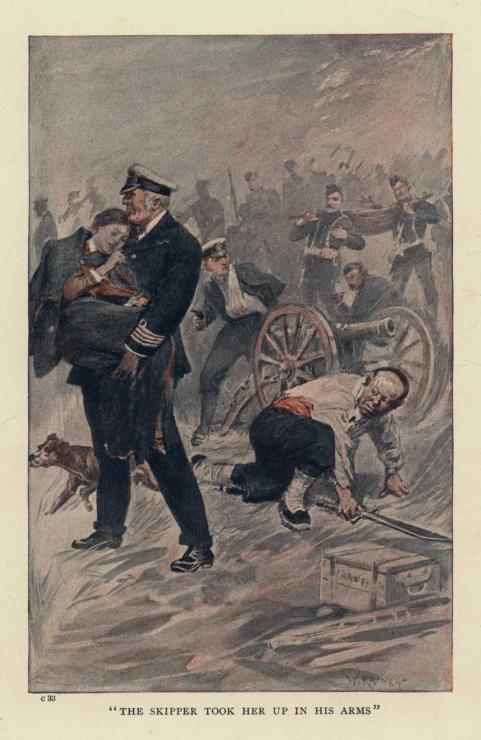
"THE SKIPPER TOOK HER UP IN HIS ARMS"
The Captain turned round and growled out "Umph!" but took no further notice. However, the word was passed round that a wounded Chinaman had attempted to kill him, and the men were so enraged that they made certain that there were no more wounded pirates left inside the square.
This is a fact, whatever you may say about the rights and wrongs of it.
The Chinese had had enough fighting to last them for a "month of Sundays", and let us alone after that, and gave us time to look after the wounded. The men, of course, all had their little packets of field dressings with them, and did a good deal of amateur doctoring, whilst Barclay, Hibbert of the Ringdove, the doctor of the Omaha, and their stretcher parties looked after the more seriously wounded.
Then we staggered down to the beach, wading through the fog with our wounded.
When I say staggered, I mean staggered. Our people had been fighting for practically twenty-four hours with no rest, and they were done to a "turn". After that strenuous sixty or seventy seconds' struggle, and the square had been re-formed, and the wounds had begun to pain, and arms and legs and bodies to feel stiff, reaction set in, and if you had seen them walking that last three hundred yards, you would have thought that most of them were drunk.
Lucky indeed it was that the Chinese let us alone till we could get the wounded down on the beach behind a bank, light several fires to comfort them, and gradually warmed our fellows up again.
I suppose that if they had charged out of the fog again, our men would have roused themselves and put up just as good a fight; but I must say that I felt most extremely anxious till we had the sea at our backs, and that bank at the top of the beach with a deep ditch below it in front of us.
We had hoped to find our boats lying off waiting for us, and tried to attract attention by shouting and firing rifles. Eventually we heard one of the gunboats begin firing a gun every half-minute. It turned out to be the Omaha, and presently she began to make a signal with her fog siren. We knew that she was feeling her way in towards us, by the sound of the blasts coming nearer; but of course we could see nothing whatsoever through that maddening nightmare of dirty fog, and out of it came the moaning blasts of the Omaha's siren with the message: "Have seen nothing of your boats since this morning. Omaha's boats have been sent down the coast to where gunboats' brigade originally landed, and have not come back."
We well knew that that meant a night to be spent on the bleak shore till the fog should clear away and allow the boats to find their way to us.
It was then that the tired men were set to work collecting drift wood and making fires under the bank, whilst Rashleigh and Trevelyan had to line the bank itself, and guard our two flanks across the beach.
Although the fires were fairly large ones, they could not be seen fifteen paces from the far side of the bank. That will give you some idea how dense was the fog, so that we were quite safe in making them, and we brought the wounded across and settled them as comfortably as possible. When I talk about the wounded, I mean, of course, the badly wounded, men who were obliged to lie or sit perfectly still; but besides these, nearly everyone was slightly wounded, but could still handle a rifle.
Trevelyan had brought a tin of tea tabloids—he always had some dodge up his sleeve—and with the water in our bottles, we made enough tea to give the wounded and my poor little princess a hot drink.
Old Grainger "managed" to find another packet of sandwiches for me, and was very disgusted when I gave them to Sally. A strange old chap he was. I suppose that I owed my useless life to him half a dozen times that day, but he would have been offended if I'd even suggested thanking him. He had been my servant for nine solid years, and treated me as if I were a helpless idiot, and that his whole business in life was to turn me out on parade a credit to "The Corps". (I don't mean to infer that he was the only one who treated me as an idiot.)
Even during the night, when after a couple of hours' sleep the marines had to take their turn on top of that bank, he began bothering me about my clothes.
I had noticed him looking at me as I stood warming myself in front of a fire, and he began: "Them clothes won't be no blooming good again, sir, I'm thinkin'. Two serges and two pairs of trouses in three blessed nights! We ain't got enough gear to turn you out proper now, sir."
"That's all right, Grainger; we'll be at Hong-Kong in a fortnight," I said to cheer him.
"'Ong-Kong!" he sniffed. "They knows us too well there, sir. They wants ready money from us there, sir, and we ain't got none. 'Ow's your arm, sir? You never showed it to the Doctor."
I hadn't, I know; but he wouldn't be satisfied till I had pulled up my sleeve, and he had found a bandage and stuck round it, to cover up the two little marks where a bullet had gone in and out.
It really didn't trouble me much, except to make my arm stiff.
Then Ford and Rawlings came up to me. They ought to have been asleep. They were like two little cock sparrows with all their feathers ruffled.
"Would you mind telling us, sir, who captured that gun?" Rawlings burst out very angrily.
"As far as I remember," I told them, "one of 'B.-T.'s' people was first; beat you and Whitmore by a short head."
"There!" they both burst out, looking at each other joyously. "Do you know, sir, that Mr. Rashleigh says it's his, and that he captured it?"
"Stuff and nonsense! That's all my eye! His people were nowhere in sight!"
"Well, he's got it, sir, and the Ringdoves dragged it back, and they say they've got it, and are going to keep it."
"Come and ask Mr. Whitmore," young Ford said; but I told them that they were not to wake him, and not to be blithering idiots waking the whole camp.
"Wait till the morning; no one can take it away to-night."
I knew that if it belonged to anyone it belonged to our Skipper, and that it didn't matter a tuppenny biscuit who claimed it now, for "Old Lest" would have it in the long run.
Our two hours' watch passed without any serious trouble, a few shots occasionally whizzed overhead, that was all, and before daylight the fog lifted a little, as it had done the previous day.
As soon as they could see us, the Chinese made a very half-hearted attack, and the whole brigade had to stand to arms and line the bank; but we had no difficulty in driving them off and keeping them at a respectable distance.
As the sun rose the hateful fog swept away altogether, and it was a most blessed sight to see the sun glittering on the muddy water, and the Omaha and Ringdove close to one another, and only about half a mile from the shore.
Little Sally looked such a forlorn, draggled little woman in the damp daylight, that I thought she'd be only too glad for anyone to say something kind to her, so old "B.-T.", moving in a very "dot-and-go-one" manner, and I went over to say "how d'ye do" to her and give her a treat. We were the best-looking fellows in the Vigilant, but old "B.-T.", what with his limp and a forty-eight hours' beard round his aristocratic chin, wasn't looking his best, I thought, however, that the bandage round my noble forehead (to cover up a cut someone had given me) would just about "fetch" her, and that she would be interested in about a dozen different specimens of paddy-field mud which were plastered over me.
However, she "bristled" up when we came along to pay her homage, and "guessed she didn't want anyone fooling round her—just yet awhile". Poor little princess! She was so miserable, sitting on the beach behind that bank, with the Skipper's overcoat buttoned round her.
About an hour after daylight, and the fog had swept away, our boats managed to find us.
Old "Blucher" had had enough shooting expeditions to last him till he got home, and jumped into the very first Vigilant's boat that had run up the beach, got under the thwart in the stern sheets, and never moved till she got alongside the ship.
The Skipper gave me the job of covering the embarkation, and it wasn't all "beer and skittles" either, for the Chinese kept up such a persistent and annoying rifle fire, that we had to get the Omaha and Ringdove to shell them out of some paddy fields and clumps of bamboo trees. They tried to steal round the beach and cut a few of us off, and just as we were getting "busy" with them, young Ford and Rawlings came rushing up again, right in the middle of everything, and squeaked out that fat little Rashleigh was taking that wretched Chinese gun aboard the Ringdove, that he had actually got it aboard one of his boats, and was just going to shove off, and that as Whitmore was on the sick list, and "B.-T." had gone off to the Vigilant, couldn't I do something? They wanted me to go to the Skipper, or something like that, and tell him that it really belonged to the Vigilant.
"My dear young gentlemen," I told them, when we'd stopped a bit of a rush, "if you'll be so obliging as to go out there and ask about five hundred Chinamen, who are very anxious to obtain specimens of our livers, to cease firing and stop where they are till we've decided who shall own their toy cannon, I'll do the best I can to help you. Tell them that the matter won't admit of delay, and no doubt they will oblige you."
They looked angry, and rushed away to try and interest someone else in the important question.
Gradually everyone was withdrawn from the shore, till there was no one except the Skipper, myself, and my marines remaining. We kept the fellows at bay till the barge came along for us, and then we bolted down to her and scrambled in, the Skipper being actually the last to embark. We had hardly begun to shove off, before the Chinese had lined the other side of that bank and began firing at us; but two can play at that game, and we had another boat and the steam pinnace lying off, to cover our retreat, and they peppered them pretty severely.
The Vigilant had come round to meet us, and we got away out of range all right and alongside her by seven bells in the afternoon, just in time for afternoon tea.
As soon as I could manage to do so, I slipped away to Truscott's cabin, and found him much more cheerful.
Old Mayhew had said that he couldn't tell what would happen till the end of the third day, and this was the third day since he was wounded, and he had no bad symptoms.
"To tell the truth, soldier," he whispered, "I'm as hungry as a hunter; tinned milk and soda water ain't very filling, and Mayhew won't let me have anything else, and precious little of that."
I felt pretty well "done up", now that everything was finished, so Grainger got me a steaming hot bath, and I turned in and slept till next morning.
Before I went to sleep, Grainger came back looking very cheerful. He held up my two damaged pairs of trousers. "We can do 'em all right, sir; one pair 'as a slit in the right leg, and the other a split over the left knee. We'll 'ave a try at taking 'em to pieces, and makin' one good pair out the two of 'em, sir."
"All right, Grainger; it will be better than having nothing to wear at all, won't it?" I told him, and went to sleep.
I copied this list of casualties from somewhere or other, and think that it is pretty accurate as far as our own ships and the Omaha are concerned, though I cannot guarantee the figures given for the Huan Min.
The "slightly wounded" were those requiring some treatment, and most of those who were on the sick list only a few days.
CASUALTIES DURING OPERATIONS ROUND HECTOR ISLAND. Captured and subse- Slightly Severely Died of quently Name of Ship. Landed. Wounded. Wounded. Killed. Wounds. rescued. Offi- Offi- Offi- Offi- Offi- Offi- cers Men cers Men cers Men cers Men cers Men cers Men Vigilant, 15 145 8 75 4 27 1 9 ... 2 1 2 Ringdove, 3 34 2 23 ... 5 ... 2 ... ... ... ... Sparrow, 2 39 2 20 ... 9 ... 6 ... 1 ... ... Goldfinch, 2 32 1 16 ... 3 ... 3* ... ... ... ... Omaha, 4 41 2 27 ... 8 1 2 ... ... ... ... Huan Min. 1 56 1 29? ... 16 ... 8 ... 1? ... ... Totals, 27 347 16 190 4 68 2 30 ... 4 1 2 * This includes the two men killed by the six-inch projectile which struck the Goldfinch.
CHAPTER XVI
Ford saves "Old Lest's" Life
The Vigilant to the Rescue—Rushing the Gun—Ford is Miserable—The Ringdove Steals the Gun—Ford Bucks up Again—Mr. Rashleigh and the Gun—The Burial at Sea—Letters from Home—A Letter from Nan
Written by Midshipman Ford
Before I tell you anything else, I must tell you this—it is the only thing I can think about at present, and has wiped out all the silly, and idiotic, and bad-tempered things I have ever done—I have saved Captain Lester's life.
But for me—Dick Ford, a midshipman only just out of the Britannia, a worm, I suppose you would call me—he would be dead now, and Mrs. Lester and Nan and his other girls, and all Upton Overy, would be awfully miserable, and everybody else who had ever known him.
I just look at him when he's striding up and down the quarterdeck, and think that now, in a way, he belongs just a little bit to me. I know that his coxswain, and the signalman, and any number of others who were near him when the Chinese broke our square, saved his life a great number of times; but you have read what Captain Marshall wrote, and know what happened, and what, by good luck, I was able to do, so I don't mind in the least sharing him with all of them, so long as I know that a bit of him does belong to me.
You see, I knew all the time that I'd really only made an ass of myself when I was captured, and had my arm broken, and all that, and that instead of helping him in any way, I really had only muddled up his plans. Just before we began the march back to the coast, Jim and I had a long yarn about what was best for me to do, and the only thing he could suggest—you know, of course, that I only had one arm to use—was for me to keep as close to the Captain as he would let me, and always have my revolver handy, in case any Chinese did get near him. Jim said that there was always the chance of some chaps trying to rush us, and it was the only thing he could think of, and as the Captain only had his big oak stick, and never thought of danger to himself in the least little bit, I might make myself useful. Well, that is why I am so absolutely happy—I feel now as though nothing can ever make me feel really miserable again, for long—because if anything does begin to do so, I just think about Captain Lester, and that stops it.
When I finished telling you about that awful night in the walled house, we had heard the sound of the Maxim gun firing, and knew that the Captain was coming along to rescue us. That made us all "buck up" tremendously, and the fog lifted a little, and it began to grow lighter, and we could just see the wall and the half-closed gateway, and some of the dead people lying about, and presently we heard the sound of firing coming nearer, and began to think that another half-hour would bring them to us, and that Sally would then be absolutely safe.
The pirates were not worrying us at all—there had hardly been a shot for the last two hours—and we guessed that most of them had gone away to try and stop the Captain coming.
We even walked about the space inside the walls and counted the dead bodies—there were forty-seven—and peeped through the two gateways, and collected some more Mauser rifles and any amount more ammunition. We made a fire too, and found some food in the house, and tried to make Sally eat some breakfast, but she couldn't touch anything, and went to sleep again.
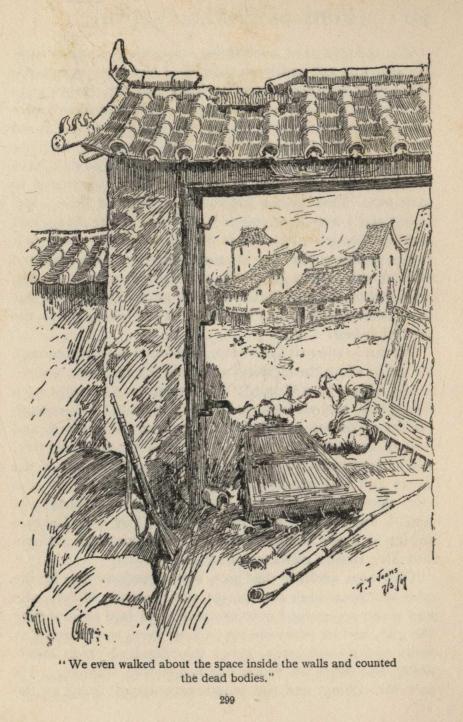
"We even walked about the space inside the walls and counted the dead bodies."
We thought that everything was going on jolly well. My arm was not nearly so painful—I had had some sleep; Mr. Ching was very cheerful; Sally and Mr. Hobbs were both sound asleep; and Miller and the old Scotchman were coiled up asleep as well. Martin, the marine—well, I'm not certain whether I cared much for him—kept on grumbling about his arm, and reminding me that he wouldn't have broken it or been taken prisoner but for having tried to save me. That rather irritated me after a time. Mr. Ching and I were listening to the sound of the firing, and looking through a window in the direction from which it came, watching the fog clearing away from the low land on that side, when all of a sudden there came a roaring noise out of the fog, and something struck the house close to us with a crash, and we heard stones falling on to the ground below.
We ran to where it had struck, and found holes big enough for me to climb through in both the front and back walls.
Mr. Ching gasped out, "They must have brought up a field gun;" and we looked, but the fog wasn't thin enough yet for us to see anything. He was very frightened, and ran up to that little square room with the iron shutters, and came down with Sally in his arms, took her out of the house and laid her down behind the wall, where it was very thick. He was only looking frightened because of her, I know that, and that he was just like Captain Lester in never being frightened about himself. Martin and Mr. Hobbs came scooting out too.
They kept on firing that gun, and sometimes they hit the wall and sometimes the house; and presently Miller, who had woke up, peeped over the wall, and said he could see the gun, and he lifted me up to look over, and I saw it as well, under some trees, about five hundred yards away, along the ridge on which the house was standing. He and Mr. Ching and the bluejackets began firing at the men round it; but they couldn't see it clearly because of the smoke it made and the fog, and as they didn't really know how to sight the Mauser rifles properly, they didn't seem to be able to hit anybody.
At any rate, we couldn't stop it firing, and it was knocking the house to pieces.
Then a shot struck the top of the wall, and made a gap in it, and stones went flying round, and one struck a bluejacket sitting down, not far from where Sally was, still asleep, struck him on the head, and killed him. Mr. Ching didn't know what to do, because he was so worried lest she should be hurt; and two or three more came along, all hitting the wall, and it was jolly unsafe to stay anywhere near it, so we made her go and lie down behind a very big stone or rock behind the house, and leant some planks of wood against it to make a kind of roof to keep off falling stones.
Her father crept under them too.
If the firing became more dangerous, Mr. Ching did think of lowering her down a shallow well in the garden under the trees, but that was never wanted.
The rifle and Maxim firing became very heavy, and we could hear it coming rapidly nearer, and the fog, which was still lying very dense below the house, now swept away, and we could see that there were flat paddy fields there with a small hill on the other side. It was glorious to be able to look all round again, and suddenly Chinamen went flying down our side of that hill opposite, and we could hear cheering, and then, in a minute or two, some dark figures, waving their arms over their heads, came on to the sky line, and we knew that they were our people, and we all cheered tremendously.
You can have no idea what we all felt like, because, although we were expecting them, it was quite a different feeling when we actually saw them.
"Look there, Miller!" I shouted. "There's a dog there running backwards and forwards;" and Miller spotted it too, and I knew that it must be jolly old "Blucher", and that the Captain must be there.
Mr. Ching asked me if I could signal to them, and I managed to do so, climbing up to the top of the square room, and getting out through a hole which the field gun had made in the roof. I was so fearfully excited and happy, that I forgot all about the danger from the gun, and Mr. Ching helped me up and steadied my feet, and I waved a long bamboo, and signalled in Morse that we were all well, but that the gun was doing damage. I saw some tiny little flags waving to say that the signalman with the Captain had read it, and then Mr. Ching pulled me down, and only just in time, because the field gun made two more holes close by, almost immediately afterwards.
I was too much excited to worry about the gun in the least—we all were—and went and watched them over the wall at the side, and saw some dark figures come racing down the hill, and presently others whom I knew were marines came along after them and joined up in the paddy fields, and I thought I could recognize Mr. Travers and Captain Marshall by their long legs. It made me go just a little hot all over to see Captain Marshall, because I hadn't forgotten what he had said when I had run away from the bullets, near those burning huts, and didn't quite want to see him.
There was a lot more rifle firing and machine-gun firing farther to the right, and the field gun stopped shooting; but we couldn't see the marines and those others now, because they had got across the paddy fields and were under the brow of our ridge. We could hear them cheering, however, though they were out of sight, and the noise seemed to be going towards the gun, and we knew that they were charging it, and simply held our breath and watched Chinamen dodging about, round it, and under the trees, and firing downhill.
Then they began bolting away out of sight—we knew what we should see in a moment or two, and held our breath—and almost directly afterwards a whole crowd of our people went dashing across the open space, and swept round the gun.
We all jumped down, made a rush for the gateway, cheering like mad, and waving, and then I saw someone jump on top of the field gun and wave his cap, and knew that it was Jim Rawlings. I was certain of it, and Miller said he thought it was too, and this simply added everything to the joy, because I had been wondering and worrying whether he was killed or badly wounded—ever since Miller had told me that he had seen him knocked down two nights ago, when Mr. Whitmore's party was retreating, and just before he himself had been captured.
I felt all "bubbly" inside, and didn't quite know what to do, and felt very "sniffy", and ran towards the gun, with Miller and Mr. Ching and a lot of his men. Before we could get to it, the first lot of our people had gone off after the Chinese, who were running away; and the next lot of people I saw was a company of American bluejackets, with their long thin Captain in front of them. He gripped my hand and said he was "right glad to find us alive", asked after Sally, and rushed on to the house, his old-looking First Lieutenant shouting out, "Guess things are real bully," as he followed him. Then Mr. Rashleigh and the "Ringdoves" came running up, clustered round the gun, and began cheering. Dr. Hibbert gave me a cheery wink, and Mr. Rashleigh patted me on the back and hurt my arm, and I hadn't forgiven him for that unfair report of his, and hated him touching me.
I heard him tell his coxswain to take the gun back to the Ringdove, and I thought that he couldn't possibly have known that our people had captured it first; so I told him about it, and that they had only gone in pursuit of the Chinese, but he took no notice of me, and I forgot all about it in the excitement of seeing Captain Lester coming striding along, puffing and blowing, "Blucher" barking and prancing ahead of him, running up and smelling the gun and one or two dead bodies very gingerly. Then he spotted me, and came wriggling up to be patted.
The Captain looked very sourly at me and growled out, "Where's that chap Ching, and the little lass and Hobbs?" and wanted to know whether Martin and Miller were with me. I must have looked a most awful sight, I know, because I could still only just manage to see out of my left eye by lifting up the lid with my fingers, and of course I was covered with mud, and my left sleeve was dangling down, and my arm was inside my monkey jacket, where the old Chinaman had bandaged it. But, for all that, he didn't even ask me how I was, and that made me miserable.
"Pongo" came panting along after him, and when he had recovered his breath, I asked if the Commander had landed with them.
It was then that I heard that he had been shot through the body, and that Dr. Mayhew didn't know whether he would live or die. That made me feel even more wretched, and the Captain, hearing me ask about him, turned round and growled: "If you hadn't been such a blamed little idiot, he'd never have been shot. Umph! His little finger is worth more than all you confounded young midshipmen—umph!—put together;" and he stalked off to meet the American Captain.
"Pongo" told me that Dicky was going on all right, and then wanted to know all about my arm, and my face, and everything that had happened; but I wanted to be left alone and be miserable, and went away and hid somewhere—I didn't care what happened; and wanted to run away and get killed, or something like that, till I heard Jim's voice calling for me. And he found me and comforted me a little, and said that Dr. Barclay did not think that the Commander would die, but that Dr. Mayhew wouldn't say for certain till another day had gone by. But all the joy and the excitement had gone out of me, and I felt wretched and ill, and had a bit of a "weep", and didn't mind Jim seeing me, not in the least, and he cleared out and left me, and went away to Mr. Whitmore and presently came back, and told me all about Mr. Whitmore's party, and how they'd had a pretty tough job getting back to the boat, and never got halfway to the gun. He hadn't been wounded at all—he didn't even remember falling down—so Miller must have made a mistake. He was awfully keen to see over the house, and went everywhere, and before I could stop him he poked his nose into the little room place where they had put Mr. Hoffman and five dead bluejackets, and that made him feel rather ill.
Everybody seemed to come up after this. Dr. Barclay had a look at my arm, and I saw the corners of his mouth go down. "'Twill be a long job," he said, and did it up again as comfortably as he could. Miller had coiled himself up behind the wall, and was fast asleep, and so were Mr. Ching and most of his bluejackets—I would have done anything in the world for them. Old Sharpe came up to have a yarn, and cheered me up a little, and Captain Marshall caught sight of me, and came along and said something nice, and I knew that he was sorry, and I was so longing for someone to be pleasant that I made friends. He didn't "hee-haw" either, as I expected he would, when he first saw my face, and he told me that the Commander knew that I had sent off that message in the letter which the Englishman had written, and was pleased about it. This cheered me a little.
But the Captain took no notice of me, and every time he passed, my heart just felt like lead inside me, and everyone seemed to know that I was in disgrace, even old "Blucher".
It seems silly to say so, but I did fancy that he was not so affectionate as he usually was, and it hurt me.
Then they brought a dead man along with his face covered up, and someone told me that it was Wilkins, the marine bugler, who had helped me to set fire to one of those huts, and throw stones at the dogs, and that made me sadder than ever again.
Both of the landing parties must have managed to slip through in the fog without really running up against many of the Chinese; but now they were swarming all round us, and there was so much to do to keep them off, that I was left alone, and got into a safe corner, and watched the ships firing at the town and the six-inch gun. Sally had been put in a safe place, so the Captain didn't care in the least where their shells went; and a good many did come pretty close to us, and one of the Vigilant's eight-inch shells didn't burst, and came roaring overhead, and fell into the paddy fields below.
Presently a number of houses in the town caught fire, and a lot of the Chinese ran away to try and put the fires out, so that we were not so much worried with them.
I wasn't there when the mandarin came to see the Captain, and didn't hear that he had brought the Englishman's head with him till afterwards, and by that time so many sad things had happened, that I did not feel so very sorry for him.
Then we began our retreat, and it was just before we started that Jim suggested that as I only had one arm, the best thing that I could do was to stick quite close to the Captain. He offered me his revolver, but I still had that one the Englishman had given me, and a good many cartridges for it were still in my pocket, so I got him to load it for me. He said a lot of things to buck me up before he went away, and I tried to feel happier, but it wasn't much of a success, at any rate whilst I was near the Captain. You see, he didn't even notice me. I thought that perhaps he would send me away from him, but not noticing me hurt me almost more, and I didn't want to talk to "Pongo", because he was nearly as much an idiot as "Dicky", and though he tried to buck me "up", he only made me want to kick him. He would keep going at it, too, and I was jolly glad whenever he had to run on a message for the Captain, and left me alone.
I saw Captain Marshall and Mr. Travers rush the hill opposite us, and then we had to follow them across the paddy fields, very slowly, because we had eight wounded men to carry. Eight men from the Ringdove dragged that Chinese gun along behind us, and Jim came up when we were halfway across. He had caught sight of the gun, and was simply furious, because it wasn't their gun at all, and we both told Mr. Trevelyan so, and he was just as angry.
"Have you said anything to the Gunnery Lieutenant?" he asked.
Jim had told him, but he wasn't going to do anything. He thought that the Captain had probably given Mr. Rashleigh permission, so wasn't going to be mixed up with it, and we couldn't speak to the Captain himself.
We got across all right, but Captain Parkinson lost a lot of people in the rearguard when he left the walled house, and that meant more wounded for us to carry, and then we dragged on again, and Mr. Travers and Captain Marshall had a fearful time when they tried to leave their hill. They did it splendidly, and it was grand to see their men walking backwards down the hill, with their bayonets all sticking out at the brutes above them, and when they ran back, Mr. Travers and Captain Marshall and two or three men had to stop and keep the Chinese from killing a wounded man who had fallen almost in front of their feet—they were so close behind them. We saw Mr. Langham rush back from the Maxim gun and pick him up and carry him along, whilst the others kept the Chinese off, and we all cheered. It was a grand sight, and it washed out a lot of silly things Mr. Langham had done to us in the gunroom.
After that we had seventeen people to carry, which meant very slow work, and then the Captain took charge of the rearguard, because it was the most dangerous place, and I kept close to him and saw that my revolver was all right; but nothing much happened, and we cleared out back to within half a mile of the shore, where that beastly fog began.
I never even saw Sally all this time, because Mr. Ching's bluejackets stood in a ring all round her, touching shoulders, so that none of the bullets that were always coming along should touch her. I did see her skirt once when we were halted, and she was sitting on the ground in the middle of them; but that was all.
We all joined up together then, and went as fast as we could, and the fog rolled all over us and shut out everything. It was perfectly awful, and we seemed to lose each other and then find each other again, time after time, and there were all our people shouting, and trying to form a square all round us, and farther away in the fog Chinamen were yelling and gradually getting round our flanks, and at last they were even ahead of us.
It was then, that the Captain spoke to me for the first time, and ordered me to try and find Captain Parkinson, and tell him to close his men on the centre, so as not to have too broad a front, and to go very slowly. I did manage to find him, after stumbling into a ditch and hurting my left arm, and very nearly losing my revolver, and was only able to get back to the Captain because his bugler kept on sounding "G's".
Just being taken notice of bucked me up again very much, and when the Chinese suddenly rushed against our square, making a most awful noise, I wasn't really frightened—I didn't want to live unless I could do something to wipe out everything that I had done wrong—and this was my chance, I thought. I was shoved about from side to side, and jammed in among a lot of our men, and was so small, that the brutes perhaps didn't see me, and somehow or other I managed to keep near the Captain, and his coxswain, and the signalman, and I think I helped them keep the Chinese off him. I know that my revolver was empty when the fighting left off, and I had tried very carefully not to fire except when a Chinaman was almost touching. I had been knocked over by our own men just before the finish, and lost the Captain, but found him again, and got one of the signalmen to reload the revolver.
I have often been asked whether I was frightened, and people think that I am only putting on "side" when I tell them I was not. But I wasn't, not in the least, because, as you must understand by now, from all I have written, I was too frightfully miserable and too ashamed of myself.
Well, you know what happened, and that I managed to kill a brute who pretended to be dead and tried to kill the Captain, as he was carrying Sally away from those dead bodies round the Chinese gun.
The Captain did not say anything about it at the time, but that didn't stop me being happy in the least. I didn't want thanks, I was simply satisfied to have done it—all by myself, too—with lots of people looking on, so that there could not be any mistake about it. Jim soon heard about it, and found me, and gave my good arm a squeeze and went off. I had heard Captain Marshall "hee-hawing" about Ching looking as if he was walking on "air", and I didn't know what he meant at the time; but now I knew, for I felt that I was walking on air too, and forgot my arm and my face and of being so tired—forgot everything except having saved the Captain—and I'm certain that Mr. Ching could not have felt more happy than I did.
I still stuck to the Captain, although he didn't say anything to me, and even when I heard that Withers had been killed, I couldn't feel as sad as I ought, though he was really a chum of mine.
Presently, when all the terrible number of wounded had been patched up, we brought them and the dead down to the sea, and when we got that signal out of the fog from the Omaha's siren, we settled down to spend the night on the shore, behind a damp bank, and made some fires, and tried to make the wounded comfortable round them. When the Captain had seen to everything, he went over to one of the fires and sat down to light a cigar, as he had run out of matches. I think that he must have been a little tired.
I sat down behind him, with "Pongo" and "Blucher", and presently he turned round—he could see my face by the light of the fire, and I was trembling all over for him to say something—and he growled out, "Haven't improved the look of your face, Dick!"
Well, I simply ran down towards the sea and hid in the fog, and sat down in the mud and cried for joy. No one else could see me, and I didn't much care if they did, for I felt too happy to describe it to you. I knew that everything was wiped out at last.
Of course he never cared a little bit about himself, so probably never thought it was such a splendid thing to save his life, or worth the trouble of thanking me for doing so. That is why he hadn't done it, in so many words; but just that "They haven't improved the look of your face, Dick!" was all I wanted, and I was too shy to go back for a long time, till I got so cold that I had to, and found Jim there and told him, and he squeezed my arm again, and I know that he was as happy as I was. He hadn't got hurt all day, not even in the fight in the square. He'd been knocked under a Maxim carriage whilst he was trying to help Mr. Whitmore get into some safe place, after his leg had been broken, and had nothing but a few bruises to show. He really was rather worried about having nothing else to show for it.
He was still bubbling over with anger about that gun. He disliked Mr. Rashleigh even more than I did, and he hated him having it. We couldn't do anything, although Captain Marshall said that he had no right to it whatsoever. Mr. Travers, with his leg jolly painful, didn't want to be worried about anything, and Captain Parkinson was too sad about his First Lieutenant having been killed to think of anything else. He did say, "Guess your marines had gone by when my boys came up, and that little fat chap was behind me—some."
"I actually stood on it, sir! Didn't you see me, Dick?" Jim told him, and I told Captain Parkinson that I had seen him, too, from the gateway with my own eyes, and that was a long time before anyone else came in sight.
He wouldn't say anything, so we went away and sat down close to the Captain, and began talking about it—you know what I mean—talking just loudly enough for him to hear, if he wanted to; but we were both too frightened to talk too loudly, and I don't think that he did hear.
It was grand to see the fog rolling away in the morning, and to see the gunboats showing up, and when it cleared away altogether, it was grander still to watch them peppering the Chinese with shells whenever they came out in the open. Then the boats came along, and you should have seen old "Blucher" scrambling into the first Vigilant's boat that ran up the beach. It made everyone laugh.