FORD OF H.M.S. VIGILANT (continued 4)
Reading edition
"How about sending the steam pinnace inshore with some hot soup for the people in the boats you left behind?" I asked him, after he'd devoured a plateful of sandwiches and had sent Willum for more.
"No good; couldn't find 'em in the dark. I've stuck 'em right in under the guns, in the middle of the creek which runs up there. They've got to fire a Very's[#] light, if the yacht tries to get away, so tell 'em to keep a good lookout on the bridge."
[#] A Very's light is somewhat the same idea as a Roman candle firework. It throws out one very brilliant ball of coloured light.
"It was grand work in those boats," he continued; "they couldn't see us, and went on firing and wasting ammunition. I kept on running away in the steamboat, easing off a few shells at them, and then going back again, and they'd fire off twenty or thirty rounds where she had been."
"I expect you had some pretty narrow shaves, for all that, sir?"
He growled out "Umph!" and winked at me very slowly.
Now that he and I were alone, I saw that he had something which he wanted to tell me, and when presently he had sent Willum to bed, he lighted a fresh cigar and began. "You know that man Hoffman? What d'you think of him, eh?"
"I can't quite say, sir. Can't quite 'place' him."
"What would you say if I told you he is the pirates—bosses the show, or did. What d'ye say to that?"
I supposed I looked surprised. I certainly felt so.
"He's told me all about it. He is running this show, or was."
"What d'you mean, sir?" I could hardly understand him.
"It's this way, Truscott," and, puffing his cigar, and grunting and growling, the Skipper told me the most extraordinary yarn I had ever heard.
Hoffman had for years owned quite a small fleet of merchant steamers, and had endeavoured to compete with the native junks for the coastal trade between Ningpo, Shanghai, and the Chusan Archipelago. Local prejudice and the hatred of the white foreigner had been too much for him, and he had failed. The idea then occurred to him that if he could make a clean sweep of the merchant junks throughout the islands, he would have the monopoly of the carrying trade.
"That explains why we have seen so many small steamers about lately," I burst out, absolutely dumbfounded.
"Umph! It does," the Skipper nodded, and went on to tell how Hoffman had built and armed a fleet of large junks, and carried out the raids of which we knew so well.
"But what's he doing now?" I exclaimed. "Coming on board here half starved?"
The Skipper explained. "That rascally skipper of the yacht was his first lieutenant. It was he who did most of the work, headed most of the expeditions, and thought himself as big a 'pot' as his master. He thought he would strike out a new line for himself, too, and kidnapped Hobbs and Sally. Thought he'd get enough ransom to make his 'pile' in one swoop."
The Skipper went on to tell me that this wasn't Hoffman's idea of doing business, and that it was owing to him that they escaped, that time they were picked up by the Huan Min. It meant finally breaking with the Englishman, and (Hobbs told us, I remember, that he had heard a scuffle that night) they actually had come to blows, Hobbs and his daughter being shoved off alone in the boat during the confusion.
Next morning Hoffman had found himself practically a prisoner. Nearly the whole of the Chinese sided with the good-looking scoundrel, who had so often led them on their forays, and the German had to clear out, and was lucky to find a junk whose crew remained faithful to him. That is how he first came to Tinghai, and it was there that he saw Hobbs and his daughter for the first time. The girl reminded him of his wife, or daughter, at home in Germany. He hadn't seen either of them for twenty years, and the daughter would have been about her age. At any rate, whatever it was that made him take such a fancy to her, he wasn't going to let her fall into that chap's hands again. Directly he had heard of the raid at the Tu Pu Monastery, he had gone across to endeavour to regain his influence over his men, found that impossible, but learnt that they were going to raid Tinghai itself and kidnap Hobbs and the girl again. He had come back in his junk as fast as he could, but too late to save her.
That accounted, then, for his sudden appearance at the burning Mission. He had landed in the same bay as the pirates themselves, an hour or more behind them, and rushed up to the Mission, but too late to save her.
"Travers says that he saw two boats there, sir. Probably those were the two close together, and probably Hoffman's made that third mark we saw farther along the shore."
"Dare say it was," the Skipper grunted; "and he tells me, too, that he got away about half an hour after they had left."
"Trevelyan is a regular Sherlock Holmes," I said. "I must tell him; he'll be very pleased."
But the Skipper scowled and growled, "No, no; I don't want anyone to know yet;" and went on with his yarn, whilst I listened, wideawake enough, you may be sure, although it was past two in the morning.
"Hoffman thought that the people at his dépôt in the Chung-li Tao Group would still stand by him, so packed off there," the Skipper went on to tell me, "and found the old Scotch engineer in charge of the place. It was this man who had separated him and the Englishman—that night they fought. He was a friend of his, and gave up the place and the junks; and everything was going well, till one morning the Englishman appeared off the town, fired a few rounds from the tramp steamer, the junks' crews wouldn't fight, and Hoffman had to surrender. He was eventually taken to the Hector Group, and kept there till he managed to escape to us again."
"Travers heard some fighting, but never saw Hoffman," I interrupted.
"Well, Hoffman was hardly likely to give himself away by interviewing him. At any rate, that was the reason he gave me when I asked him," the Skipper said. "He was waiting until he felt more sure of his people before trying to get him away—he couldn't trust any of them—and the chance never came."
"By the way, sir," I said, suddenly remembering that he had not come back, "where is he now?"
"Umph! I left him and one of his Chinese fellows in the boats. They're going to try and get ashore to-night at low water, find their way across the mud, and see if Sally and Old Hobbs are still there. The boats are to wait for them for half an hour after daybreak. If Hoffman and his man don't turn up then, the boats have to come back to the ship, and I've told him I'll have another waiting at the back of the island for him. There's a big rock somewhere there—can't mistake it, he says—and I want you to send a boat round there in case he can't get back this side."
"He's not strong enough for much hard work, I fear, sir," I said.
"'Fraid not, Truscott; 'fraid not."
"Whenever did you know all about this, sir?" I asked. I was a little nettled that I hadn't been told before.
"Only this morning," the Skipper replied; he was lighting his third cigar since coming back. "Only this mornin'—couldn't keep it to himself any longer—came and told me. Umph!" (I suppose that he saw I looked as if I might have been told too) "I'd have told you then, Truscott, but I wasn't certain of him till to-night, and wasn't going to let you think 'Old Lest' had had his leg pulled again, if he turned out a wrong 'un."
"What happened to-night, then, sir?" I asked.
"Directly they saw us coming along, the yacht began to push inland—close up to the town, up a bit of a creek—and just as it was getting dark, we saw the tramp steamer trying to do the same. I wanted to shove along after them, but he wouldn't let me, said we should have to pass within twenty yards of a battery, and they had had plenty of time to man the guns. He said it didn't matter either, as the tramp couldn't get up there, and would be aground before she'd gone fifty yards. He promised to find her, too, later on, and I took him at his word. They blazed off a few rounds at us, I kept 'em busy for a few minutes, and then lay off, out of sight, as if I'd gone back again."
"I didn't know what had happened, sir, when I could neither hear nor see anything of you. I was in a bit of a 'stew' when you didn't come back.
"I wanted to go and torpedo her, but he wouldn't let me. Said she'd be half out of water in another two hours, and he'd do the job then, without getting into danger."
"He did, too; guided us in—how he did it, beats me—somehow or other got her in between us and the battery, and we let rip a torpedo right into her bottom, just amidship. We weren't fifty yards away, and not a soul saw us till we'd fired. I tell you, Truscott, that man's straight. 'Old Lest' don't often make a mistake when he's sized a man up and seen him under fire. He's as straight as a die. It was his own steamer he blew up."
"Well, he's the first man's advice you've ever listened to, sir," I said, smiling.
"Umph!" he growled, "but 'mum's' the word;" and he patted old Blucher, who was squatting between his knees and yawning.
"If he can't get back to that cutter—and I don't know how the dickens he means to do so—he'll go across to the back of the island."
"What boat shall I send, sir?" I asked, getting up, for it was time to be off; it was nearly three in the morning.
"Send the other cutter, and Trevelyan; I believe in that chap," he growled. "Umph! You are going to turn in, eh? Umph! All right! I'll write home to the Missus and the Admiral. Don't know when I can send 'em. Umph!"
"Have you read Rashleigh's report?" he asked me, as I was going out. "I've read it again. He don't say much about Trevelyan and Ford."
"No, he doesn't, sir; and I've heard their accounts. They throw rather a fresh light on the loss of the two junks. Well, perhaps not quite that, but they seem to have done better than we thought."
"Umph! Good night! Tell 'em to send their reports to me—to write 'em."
I left him lighting a fresh cigar—a marvellous old chap he was—and warned Trevelyan and his boat's crew before I turned in myself.
On deck they had seen nothing of the two boats, still remaining inshore, and I felt extremely sorry for the drowned rats in them.
CHAPTER X
The Vigilant under Fire
A Foolhardy Undertaking—"Who's Captain?"—Mr. Trevelyan Returns—Taking Precautions—The Skipper's Plans—A Ticklish Job—The Commander's Show—The Skipper's Few Words
Written by Commander Truscott
I sent Trevelyan away an hour before sunrise, and told him where to lie off and wait for any sign of Hoffman and the Chinaman—they were to wave a piece of red bunting—and then turned in for another forty winks, and was called as it grew light. I went up to the fore bridge and found the Skipper already there. He was smoking, even at this hour, and looked as fresh as paint, although he probably had had no sleep at all.
Hardly had I reached the bridge before we heard guns firing again, strained our eyes to see what was happening, and presently saw the steam boat puffing towards us, with the second cutter in tow.
"Get their breakfasts ready for 'em, Truscott; they'll want 'em, and 'Old Lest' wants his too;" and he went down below.
In twenty minutes the boats ran alongside, and pretty well worn out all the people were. Hoffman was the first to come aboard. I have never seen such a dirty object in my life. He was covered with mud from head to foot; even his face and hair were caked with it. He looked terribly exhausted. I felt a strange feeling of curiosity in speaking to him, now that I had learnt his history and the part he had played in shaping the events of the last two months. "Found out whether they are still there?" I asked him anxiously; but he shook his head, "Couldn't do it; too weak, Commander; had to give it up."
The Captain coming up then, took him down below.
"Brought back the steam cutter and the second cutter, sir," Whitmore reported. "I waited as long as I could, but that Chinaman never came back, and I daren't stay any longer, sir, as they began to plank shots all round us."
"What happened to Hoffman?" I asked. "He looks as if he had had a bad time."
Then Whitmore told me that Hoffman and his Chinaman had tried to get across the mud flats at low water, and find their way ashore in the dark. It was a foolhardy undertaking, because Hoffman was evidently not strong enough; but they lashed flat pieces of wood to their boots. Whitmore ran the cutter's bows into the mud, and they had crawled overboard and soon disappeared.
Whitmore backed the cutter into deep water and waited for them to return, and in about half an hour had heard a cry coming out of the darkness and had answered it, and rammed the boat into the mud again. Presently Hoffman came stumbling back, falling and scrambling to his feet, and floundering through the mud. He had lost one of his flat pieces of wood, and was unable to reach the shore. Sending on his Chinaman, he had tried to retrace his steps, and had had an awful time before he heard their hail. He only just had sufficient strength to get back to the boat, and had to be hauled in.
"That Chinaman didn't come back at daylight, sir. I don't know how he intended to do so, but, at any rate, we saw nothing of him."
I told him that Trevelyan had gone round to the back of the island, in case he tried to get off there.
"I hope you don't think I shoved off too soon, sir?" Whitmore asked me anxiously. "We were very nearly hit several times—as it was."
"My dear chap, of course not. Go down, have a hot bath and some food; you look as though you wanted both pretty badly. You've not had much of a time, I should fancy."
"I've never spent such a night in my life," Whitmore said, and I could quite believe him.
"That steamer is as safe as 'eggs', sir. She's right over on her side," he called out as he went below.
That was one thing accomplished satisfactorily.
As it turned out, he might have waited for that Chinaman till he was blue in the face—well, hardly that, for he was already blue in the face, but till he'd been sunk—because the Chinaman came off with Trevelyan a couple of hours later.
The Skipper was waiting for his return before making any plans; but long before that, something occurred which thoroughly upset him.
We were all at breakfast, when suddenly we heard the distant report of a heavy gun, and through the open scuttles could hear the "swish, swish" of a shell. Everyone jumped up and rushed on deck, the gunroom people clattering up behind us. "They've fired a gun at us, sir," the midshipman of the watch told me. "It went right between the masts and fell over there, sir," and he pointed to where you could still see the spray of the splash, just drifting to leeward, about four hundred yards away. "Don't think it was a shell, sir; no one heard it burst." He was extremely nervous and excited, twitching all over.
The Skipper came up his ladder, red in the face and indignant, and as he stepped on the quarterdeck there was a shout from for'ard, "They've fired again, sir!"
Several people sang out, "Can see it, sir, coming straight this way, sir!" a spout of water leaped into the air, and, "whizzle, whizzle"—with that funny whistling, whispering noise only a ricochetting projectile makes—it passed overhead, and fell close to where the first had fallen.
It was rather amusing to watch how our people "took it". One officer, whose name wild horses shouldn't drag out of me, threw himself flat down on deck, several tried to get behind each other, and most of them looked as if they were—well—thrown off their "balance". But you should have seen the Skipper. He stood there, with one foot on the quarterdeck. His mouth was wide open, his face was absolutely crimson, his eyes stood out of his head like lobsters' eyes, and his neck was so swollen that it was a purple colour, and even from where I stood I could see the veins standing out. He actually couldn't speak, he was in such a frightful rage.
"Close water-tight doors," I sang out, and "steam on the capstan," not knowing what else to do, and then went up to the Captain.
"Who's captain aboard this ship?" he managed to bring out; "Old Lest or you?"
Then, pausing to take breath, he roared: "What the—the—Jerusalem d'you mean by ordering steam on the capstan? D'you think 'Old Lest' is going to get up anchor, and move off, because a lousy Chinaman fires a gun at him? Umph! What's the range?"
"About eight thousand yards, sir."
"Well, he won't hit us," he growled, and with his field glasses slung round his bull neck, he commenced tramping up and down, scowling to left and right, as everyone hurriedly cleared over to the port side to get out of his way.
Two more shot—they certainly were not shell—came along presently, one after another. They were both a long way short, and ricochetted overhead like express trains. He never turned his head to look at them, but roared for me. "See those darned youngsters leanin' up against the quarterdeck rails! See 'em—loafin' on my quarterdeck! Give 'em half an hour's extra drill in the morning, and send them up to the masthead. I'll teach 'em to loaf."
I wanted to suggest clearing for "action", going to "General Quarters", and sending them a few rounds to quiet that gun, for a lucky shot of theirs might do a lot of damage, and they must get the range before long; but, to tell you the truth, I hadn't the courage to do so.
"I'll teach 'em to loaf," he growled again. "Sound off 'Divisions'."
The buglers rather nervously sounded off, and the men began "falling in". Pretty nervous they were, most of them, especially those with their backs turned to the shore; but they knew that this was "Old Lest's" way of "showing off", and I could see them winking at one another and grinning.
That was a "Divisions" with a vengeance. It usually lasted ten minutes, but this morning the Skipper, glaring and snorting, went round each "division" himself, stalking along and finding fault if a cap ribbon wasn't put on correctly, or any small detail of the men's uniform wasn't exactly to his liking; and there was no blinking or shrinking—the men simply dare not—whenever another boom was heard, and another shot came whistling past.
When he had at last finished, the men were all marched aft on the quarterdeck, and the young Padré, pale and nervous, and with half an eye for the shore, read prayers, making many mistakes, at which the Skipper growled like a bull dog. I'm certain that one of those projectiles passed not ten feet above us all, and it fell into the water not twenty yards the other side; but not a scrap of notice did the Skipper take, and presently they left off firing altogether, much to our relief. Then he growled out, "Umph! I said so," and went below.
In the middle of all this Trevelyan was sighted coming back round the corner from the other side of the island, and as soon as he came alongside, I saw that he had the Chinaman on board, and looked happy. "I've got him, sir, and from what I can make out, Hobbs and Sally are there all right. A lot of those shot have been pretty close, sir; I've been watching them all the way off. I wondered why you didn't fire back."
"Ask the Captain," I said, and took the Chinaman down to Hoffman's cabin, where the Skipper joined us, and we soon learnt the good news. He had not been able to communicate with them, but they were both safe, and were kept well guarded in an old house, with a high wall round it, just at the back of the town. It was on a little rising ground, and we thought we could actually make it out from the ship through our big telescope.
The man had heard that Evans—that was the name of the rascally Englishman—was laid up with fever. The town, he said, was in an uproar. Hoffman told us that he was always going down with fever, which generally lasted for four or five days, and that probably a Swede, named Jorgensen, was running the show. "It's a six-inch modern gun that they've got there," he said, "but they haven't much ammunition, and no shell at all for it; and it's just the mad, silly thing he would do, to go easing it off at this long range."
Hoffman kept on imploring us to prevent Hobbs and Sally being taken off somewhere again. He felt sure that Evans would try to do so, and told us that plenty of junks were always lying in the creeks at the back of the island, and could get away in half an hour, with the wind as it was now blowing.
"Directly he is well enough he'll be off, and take them with him. He doesn't care a straw about anything else, so long as he can force Sally to marry him, and bleed the old father. He won't wait for you to come and try to capture them, you may be certain of that." Hoffman was so earnest, that he made us realize the danger of the poor little girl being once more spirited away by that unscrupulous villain, and how very urgent was the necessity of losing no time in preventing this, at all costs.
The breeze was still blowing dead on shore, so that we were fairly certain that no junks could hope to beat out from this side and escape. The steam yacht dare not come out during the day, and as he had done last night, so the Skipper intended doing every night—leave a boat lying almost in the creek itself to signal directly she attempted to move. Till the arrival of the gunboats, we had nothing but the ship's boats to send round to the back of the island to patrol; and the Skipper was so impressed with Hoffman's earnestness, that he gave me orders to "man and arm" the sailing pinnace, the sailing launch, and the steam pinnace for this purpose. I had done this, and they were, in fact, just going to shove off, when they reported that the Ringdove was in sight.
The Captain belayed the boats and ordered Rashleigh round there instead. He had signalled, as he drew near, that he had found the pirate dépôt deserted, and not a junk of any sort or description to be seen, and had therefore come along here at his utmost speed. Whatever demerits Rashleigh may have had as a writer of despatches, he certainly could not have turned up at a more opportune moment, and we all felt grateful to him. I had forgotten to order Trevelyan and Ford to send in their own reports concerning the loss of their junks, but the arrival of the Ringdove reminded me of the Captain's order, and I sent for them. They were both very bitter about the way in which Rashleigh had reported on them, and I heard Ford say to Trevelyan as they went away, "I'll write a snorter, sir." As the reports had to go through my hands before the Skipper saw them, I knew that I should be able to "tone" them down if necessary, so said nothing at the time.
The Captain was in great good humour now, and had forgotten all about the firing and his morning's wrath. "Hoffman tells me," he said, "that there are about a thousand men ashore; got plenty of rifles, too, and ammunition, and will probably put up a good fight. So long as Hobbs and Sally are safe, 'Old Lest' ain't going to be hurried for nobody, and he's going to wait till the other gunboats come along. Can't do any more by myself, Truscott."
Hoffman himself was down with fever, and, old Mayhew told me, was pretty bad. I met him coming out of the cabin, and he held up a thermometer for me to look at. I couldn't get the hang of it myself, but he told me it marked 104 degrees.
"Get him on his legs again as soon as you can, old chap," I said; but Mayhew shrugged his shoulders, and he and Barclay went away together to yarn about him. Thank goodness the other wounded people, young Morton included, were doing well.
We took every precaution to prevent anything escaping that night, and sent in both Hoffman's Chinamen, with a couple of Very's lights apiece, with orders to try and find out if any attempt was made to move Hobbs or his daughter, and to fire them, down at the water's edge, if any such attempt was made.
They were evil enough looking fellows, but Hoffman swore that they were to be trusted, so we had to trust them.
The night passed quietly, and early next morning the Goldfinch and the Omaha arrived. The latter was at once sent round to assist the Ringdove at the back of the island, as her searchlight was much more powerful than the Ringdove's, and she would therefore be more useful there than on this side of the island.
In the afternoon the Sparrow also came along. They all reported that the Huan Min had rounded them up, and we felt very kindly disposed towards the melancholic Chinese Captain, and Lawrence's chum, Ching, and hoped they would bring the Huan Min along to share our adventures. The Sparrow and Goldfinch had left their junks behind, and brought the crews and guns and stores along with them, so that, I am glad to say, we had all our people aboard once more.
We felt now that it would be impossible for anything to escape from the island, and our feelings were much relieved. In fact, I think everyone felt sure now that it would only be a matter of a few days before the pretty little girl and her old father would be safe and sound on board; and all day long there was a constant stream of people going up to the fore bridge and looking through the big telescope to "spot" the house where they were imprisoned.
Directly the Skipper believed that the rascally Englishman and his pirate crews were at last cornered and unable to escape, he sent a letter ashore demanding the immediate release of Hobbs and his daughter, and the immediate surrender of the island. Whoever was in charge of the battery at the mouth of the creek respected the white flag, and the letter was jammed in one of a row of fishing stakes till some Chinese ventured out and took it ashore.
It was a mere matter of form. I do not suppose that anyone imagined that the man Evans would comply with either demand; and so it turned out, for he sent back—the morning after, when the same boat went in again—a most impudent letter, in which he stated that he was going to marry Miss Hobbs, and "hoping that it would not be necessary to hasten his marriage on account of any attempts being made to prevent it", a threat which infuriated the Skipper, and made us all feel extremely distressed.
The Skipper told me what his general plans were.
Two brigades were to be formed, one under his own command from the Vigilant, and the other under the command of Captain Parkinson of the Omaha from the gunboats.
They were to disembark at the back of the island, behind the town, at places about two miles apart, and were to march inland as quickly as possible, get between the town and that walled house, and join hands there.
He had not yet decided whether he would land at night or during the day, but rather favoured daylight. "Like to see where I'm goin', Truscott. 'Old Lest' ain't a badger."
This was the general idea, but to make certain that no chance should be left of Sally and her father being spirited away, the Ringdove and Omaha were ordered to destroy every junk and boat they could find in the three little creeks on their side of the island.
At the same time the Sparrow and Goldfinch were ordered to anchor as close in to the town as they could, to make escape impossible from there. They weighed anchor, and proceeded to take up their station inshore, directly after the receipt of the Englishman's letter, but had not steamed within five thousand yards of the town, when the six-inch opened fire on them. We watched anxiously, and saw that the first shots were very wild. They steadily kept on their way, and, unfortunately, almost directly afterwards, the Goldfinch was struck in the bows, and we could see was badly damaged. It was very awkward to know what to do, because the little hill, and the house in which Sally and Hobbs were imprisoned, were directly behind the six-inch gun, and might be damaged if they tried to return the fire. Their little four-inch guns were not of much use at that range, being very old and very inaccurate, and their erratic shells might have fallen anywhere.
The Skipper swore angrily, and ordered them to return, which they did, followed by six-inch projectiles, until they were well past us. It was a very anxious and exciting few minutes, because a single lucky shot would have sunk either of them, and many were falling extremely close.
We could see the hole in the Goldfinch's foc's'tle as she steamed up, and she signalled for medical aid, and that she had two men killed and four wounded. The Skipper cursed roundly, and sent Mayhew and Barclay across to her.
"You'll land and destroy that gun to-night, Truscott," he turned to me and growled out. "I daren't fire at it for fear of hurting the little lass, and I'm not going to have it interfering with my plans. Take what men you like, and make what plans you like, and blow it up. Umph!" and he went across to see what damage had been done aboard the Goldfinch.
This rather staggered me—I'd not been expecting anything of the kind—but I had sense enough to stammer out, "Thank you very much, sir," before he went away, and went off to find Whitmore, and to get Hoffman to assist us as well.
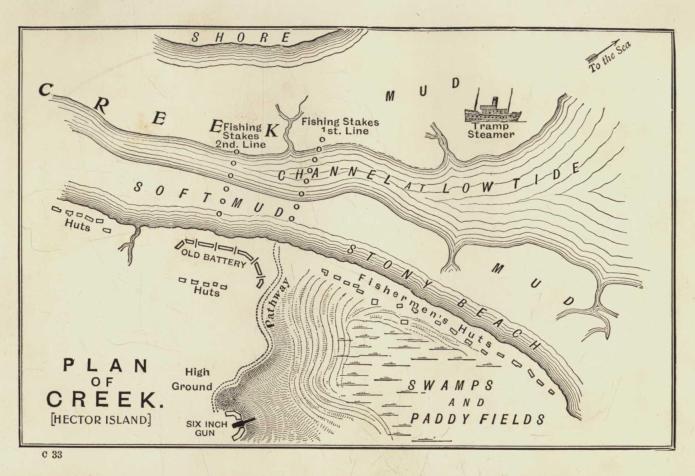
PLAN OF CREEK. (HECTOR ISLAND)
Whitmore was wildly excited; but he is a good deal younger than I am, and hasn't a wife to worry about, and I have, and a couple of youngsters too, which makes a good deal of difference.
Hoffman shook his head when he heard of the job, but gave us all the information he could. The six-inch gun, he told us, was mounted behind an open earthwork, on some rising ground, about five hundred yards from the little battery at the water's edge, the one that had fired at our boats on the first night.
He drew the rough plan which I show you opposite, and which I have lettered, so that you can understand more easily where we had to go and what we had to do.
Our first idea was to land clear of the battery and advance straight towards the six-inch gun; but Hoffman said that there were many native fishermen's huts all along the beach, and that we should wake their dogs before we'd gone five yards. Even if we did get past them, the ground between was a swamp, and after the continuous downpour of the last few days we should never get through it at night.
He sent for his Chinamen to help him, and apparently they were of the same opinion.
"How about landing on the other side of the island and approaching it from the rear?" I asked. He shook his head. "There are huts all over the island, and where there are huts there are dogs, and you'd wake every dog for miles. There's not the faintest chance of your rushing it and surprising the people there."
I scratched my head. I didn't like the job a little bit; but the Skipper had said it was to be done, so that was the end of it—it had to be done.
Whitmore suggested landing abreast the battery and rushing that.
Hoffman thought that could be done easily enough, though it was hardly worth it, in his opinion, as the guns were useless old smooth-bores. He was evidently afraid of irritating the people.
"If once they get out of hand," he said earnestly, with a haggard expression on his thin face, "they'll rush that house and murder Hobbs and little Sally."
Whitmore hadn't intended merely rushing the battery, but had thought out an entire scheme. One party was to rush the farther end of it—the right-hand end of it—the one opposite the fishing stakes, and they were not to try to do it silently, but to draw any fellows there towards them, whilst another party slipped round the left end and made their way up to the six-inch gun with a gun-cotton charge.
"The ground is all right if you could find your way in the dark," Hoffman told us.
"Why not send one of your fellows?" we suggested; but he said he couldn't trust them, couldn't be sure what they would do under fire, and besides, they were not natives of the place, and wouldn't know the way.
There are any number of small huts and fences and pitfalls there, and you could never get past them in the dark.
I had enough experience of Chinese villages to recognize that it would be a jolly ticklish job.
We left him then—he looked too ill to be worried any more—and went back to my cabin, taking his rough drawing with us.
The landing seemed easy enough—it was the getting back again which worried me. The party who held the right end of that battery would have to hold it for at least forty or fifty minutes; the destruction party couldn't possibly find their way up to the gun, disable it, and return in less time than that.
"It has to be done," I said finally, "and your way seems the best. We'll do it."
I don't mind confessing that I had never run a "real" show previously. Plenty of times I had worked out schemes, and carried them through successfully, at manoeuvres and things like that; but it was very different now, and I devoutly wished that the Captain hadn't put all the responsibility on my shoulders, and, without really meaning to do so, I more or less shifted it on to Whitmore's.
Whitmore wanted to land at nine o'clock, an hour before high water, so that we should have firmer ground under us, be able to get closer in to the battery, and have less trouble with the boats. I, however, thought the early morning the best time, somewhere about three o'clock, for my experience in manoeuvres and sham attacks had taught me that the attacked side was generally at its worst, and that men, all the world over, were more likely to be surprised and "shaken", at that hour. It had the disadvantage of being at low water, but we should have those fishing stakes to guide us. Hoffman had told us the mud was fairly firm there, and, perhaps what appealed to me most, daylight would not be far off.
Whitmore eventually gave way, and we decided that we would leave the ship at about 1.30 a.m., be towed as far as possible, and pull in with muffled oars.
Then it was a question of what men I should take, and I decided to take Marshall[#] and his forty marines. Speaking generally, they were an older lot of men than a seaman company, and the older the men were, the less liable they would be to lose their heads.
[#] Captain S. A. Marshall, R.M.L.I., was in command of the detachment of Royal Marines.
It was decided that I should rush the battery, and that Whitmore should take twenty picked men and three torpedo hands with the gun-cotton charges and try and make for the gun.
"How about midshipmen?" he asked.
I personally didn't want to take any; the job was too risky a one. However, we finally decided to take one each, and thought we had better choose Rawlings and Ford, as they had had some experience lately.
"Heads, Ford; tails, Rawlings," Whitmore said, tossing a dollar; and Ford fell to me. There was nothing to choose between the two boys.
I am not going to weary you with all the details which had to be thought out and prepared, but I will just say this. There is no possible similarity between preparing for a landing party or a sham fight during manoeuvres and preparing for the real thing. When you are getting ready for the first, someone comes along: "The Gunnery Lieutenant's compliments, sir, and he doesn't want the small-arm magazines opened this morning". "All right; very well," you say; so no ammunition is passed round, you take it for granted that water-bottles are filled, and a hundred-and-one other things which are essential in active warfare. Besides—and this is more serious than everything else put together—for one you prepare as for a football match, for the other you cannot help realizing that the lives of the men actually standing there in front of you, cheerfully getting ready, are to be dependent upon your judgment. If other people who have the same responsibility are as keenly conscious of their own lack of skill and experience as I was that day, I am very sorry for them.
By six o'clock in the evening everything that Whitmore and I could think of had been prepared. The men had all seen Hoffman's rough sketch, and all thoroughly understood what was to be done. They were thoroughly happy too, and the Skipper sending up to tell me that he wanted to say a few words to them, I fell them "in" on the quarterdeck. There was very little light, though enough to see his great wrinkled red face.
"Landing party present, sir," I reported, calling them to attention.
"Umph!" he said, speaking in his gruffest tones. "You went in last night, most of you, and blew a hole as big as a house in that tramp. You know why you did that, and got wet skins doing it—to stop 'em taking away the little lass, now I've cornered 'em. To-night the Commander is going to take you in to blow up that gun which had the confounded cheek to fire on the Vigilant the other day, and killed two men aboard the Goldfinch this forenoon.
"Umph!" he growled. "Last time the Royal Marine detachment went ashore there was a good deal of leave breakin'. I hope you'll all come back this time." (The men guffawed and chuckled.)
"Captain Marshall," he roared, and pointed to one of the front-rank men, "have that man's hair cut before he leaves the ship. He's a disgrace to the detachment;" and he went round and inspected them all.
"Well! Umph! Good luck to you!" and he looked them up and down again, growled, and went below, the marines all grinning with amusement.
I dismissed them.
"What a grand chap the old man is!" Marshall said. "No wonder the men would do anything for him. Hasn't he a grand 'few words'?"
The rain had ceased, and the night showed signs of being clear though cold, and the breeze was not strong enough to make boat work difficult.
I tried to make Ford and Rawlings turn in directly after dinner, but they—like the two young fools they were—were much too excited to do any such thing. I turned in myself, but that drawing which Hoffman had made seemed to haunt me. Directly I turned my light out and shut my eyes, I saw it, and even now, when I am much worried, it comes before me as clearly as it did that night.
I couldn't sleep a blessed wink, and at one o'clock my servant called me, bringing some cocoa and biscuits.
I had no appetite for anything, and it was so cold that I shivered as I dressed.
CHAPTER XI
The Landing Party
Left Behind—"You'll Do—Some Day"—"Dicky"—Preparation to Land—"Good Luck, Men!"—In the Boats—Scrambling Ashore—Rushing the Battery—Setting Fire to the Huts—A Hot Corner
Written by Midshipman Ford
I have so very much to tell you, that I hardly know where to start; but I think that I had better begin where we met the old Vigilant steaming away from Tinghai. It was simply grand to take Mr. Travers back to her, and to go alongside her in the dark with everybody looking over the side and cheering. There was a very nasty sea running, and they were a long time getting the wounded across; but no one was hurt, and it was splendid to know that Dicky would now be a jolly lot more comfortable than he could be in the Ringdove.
They gave Jim and me a splendid "blow out" in the gunroom, and we simply had a grand time. There was only one thing which made us miserable—the Captain didn't seem at all pleased. I had been so longing for him to be pleased—everything I had done I had done for him—and had been looking forward to what he would say when I saw him, and when he knew that I had rescued Mr. Travers.
It wasn't till after Mr. Rashleigh had gone away that he spotted me. I had been hanging about and getting in his way on purpose, and when he growled out in a surly manner, "Umph! Lost my junk, have you, and four good men—Umph!—and haven't got anything to show for 'em either?" and turned away, I almost felt inclined to blub, and Jim was just as miserable.
Mr. Trevelyan had been snubbed nearly as much, and he was furious, and said, "That fat little beast Rashleigh has been spinning yarns, that's what it is." The Captain was certainly rather nicer when he came down into the gunroom after dinner and made a speech; but no one ever says nasty things in a speech at that time of night, so it didn't nearly "make up".
Still, everything else was so jolly, and it was so glorious to know that Mr. Hoffman had escaped from the fire after all, and that we had found out where Sally and her father were, and that we were actually on our way to rescue them, that we couldn't feel miserable for long.
Next morning Mr. Trevelyan sent for Jim and myself in his cabin.
"I told you what it was," he burst out, red with rage. "It was that overfed, bloated hog! Look at his report! The Commander has just given it to me to read. I'm going off to tell him our side of the show," and he rushed off, but came back again redder than ever. "I'm to wait till I'm cooler, as if I wasn't as cool as a cucumber in an ice chest;" and he stamped about his cabin.
Later on, however, we were all sent for, one after the other, and told the Commander our own accounts of what happened, and some time afterwards were ordered to send in our own reports in writing.
Neither Jim nor I went ashore with the Captain that first night when he blew a hole in the tramp steamer, and we knew that it was because he was still angry with us. We would have given our skins to go; but we both pretended that we didn't mind, and that as the night was so cold and awfully wet, it was jolly lucky that we hadn't gone. We determined to have a jolly good feed, and then turn in early and get a jolly good night's rest, and we yarned with Dicky and tried to pretend that we were having a good time. It wasn't much of a success, however, and we soon found ourselves on the fore bridge in the rain, looking at the flashes and then waiting for the "booms" from the guns with a beastly feeling inside, because we weren't there ourselves. We got just as wet and cold as they did, almost.
I was more lucky than Jim, because I did have something to do, and went with Mr. Trevelyan very early in the morning to bring off Mr. Hoffman's Chinaman. We had to hang about near a big rock at the back of the island, and directly it was light "stand by" for a piece of red bunting to be waved from shore. We must have been there for more than an hour, and thought that he had either gone back to Mr. Whitmore in the steam cutter, or perhaps been collared by the pirates. When we did see it wave, we fetched him off pretty quickly, and shoved along back to the Vig just as hard as we could go. You see, we were certain that he had good news, because Mr. Trevelyan drew pictures of a thin little man and a girl and showed them to him, and he seemed to understand, and nodded his head and pointed to the island. He kept on saying "Vely good" all the way off to the ship. I don't think he knew any more English words.
On our way back we watched the six-inch gun firing, and dropping her shells or shot all over the place. Some of them fell very close to the Vigilant, and we wondered why Captain Lester didn't reply.
"How would you like to be there?" Mr. Trevelyan asked.
"Ra—ther!" I told him, and he smiled. "It's all right if you're doing something yourself, but it's a jolly different thing when you're simply waiting for them," and that made me think of my horrible funk when those two shore guns had fired point blank at the Sally, and I was rather sorry I had spoken.
Mr. Trevelyan laughed when he saw them all falling in for "Divisions" on board the Vig. "That's 'Old Lest' all over," he said. "I bet he's in a towering passion."
Jim told me afterwards that he didn't like the shooting a little bit, and if they all hadn't been so afraid of the Captain, they would have hated it all the more. That was the day we wrote our reports—the Ringdove coming made the Commander remember about them—and I put it all down very clearly, how I had done my best to escape from the four junks, and why I had been obliged to run down through the middle of them. I told exactly how I and all those who were left of the Sally's crew had brought Mr. Travers off in the Ringdove's cutter, and put in a lot about Scroggs and Sharpe and all of them. You see, I wanted Captain Lester to get Scroggs's wife as big a pension as possible, because of all the children.
I didn't want to say much about Dicky, because—well, you know what I mean—I was only a very few places senior to him, although he was only a cadet, and it seemed so cocky.
But Mr. Trevelyan made me do it, and I explained it all to Dicky. Afterwards Mr. Trevelyan wrote some pretty hot stuff too. This was part of it: "With regard to the alleged disobedience of the orders of Lieutenant and Commander Rashleigh to proceed to the given rendezvous, I considered that the information obtained from Midshipman Ford of the Sally made it imperative that further and more definite information should be obtained. Your" (that was Captain Lester's) "original orders to me were to obtain such information at all costs, and I considered this the opportunity to act upon them. As a direct result, I discovered the whereabouts of one of the headquarters of the pirates, and indirectly was the means of the rescue of Mr. Travers."
We took them to the Commander, who made us rewrite them and "tone down" many things; but they were pretty good "snorters" for Mr. Rashleigh, even after that.
The Captain must have thought that he had been a little unjust, because later on in the day he saw me on the quarterdeck and stopped me. He glared at me for a moment, and with his legs wide apart, growled out: "Seem to have shown more sense than I thought. Umph! You'll do—some day," and left me feeling jolly happy.
Of course when the Goldfinch and Sparrow arrived, Mr. Langham and Mr. Forbes and the midshipmen of the other junks came back to the Vigilant. They hadn't any experience worth telling, compared to ours, except Webster, who had managed to run his junk ashore, and the Goldfinch had spent all her time getting her off again.
Jim and I nudged each other; we didn't like Webster.
Dicky didn't come off badly either. You know that we all called him "Dear Little Dicky", all except Jim, who flatly refused to obey the Sub's order, and had been caned twice by him for not doing so. He was let alone afterwards.
Dicky hated it; it had made his life absolutely miserable; and now Mr. Langham, as soon as he got back, held a Court of Enquiry down in the gunroom about our losing the junks. I didn't care a snap what he thought or said about it, nor did Jim. The whole thing was only got up for his amusement—his and Hamilton's (the big Engineer Sub) and Webster's; but one of their "findings" was this. I copied the "rot" off the notice board in the gunroom:
COURT OF ENQUIRY, Held in the Gunroom, H.M.S. Vigilant, At Sea, April 7th.
As a result of the Court of Enquiry held last night to enquire into the loss of H.M.S. Sally and H.M.S. Ferret, Mr. Ford commanding the one and Mr. Rawlings the second in command of the other, these officers have been adjudged to have borne themselves with credit to the gunroom, but are cautioned not to do so again. It has also been decided, affirmed, and we do hereby solemnly declare, that Mr. Morton, hitherto known as Mr. Dear Little Dicky, worked a Maxim gun so accurately, and polished off so many niggers before he was knocked over, stunned, incapacitated, and otherwise by flow of his blood rendered hors de combat, that he is entitled to some signal reward.
We do therefore proclaim, announce, and order that from henceforth, evermore, and hereafter he shall be known as "Dicky".
For "Dear Little Dicky" in future read "Dicky". (This was in big print.)
Given under our hand and seal,
BENJAMIN LANGHAM, Sub-lieutenant. A. E. HAMILTON, Engineer Sub-lieut. HARRY G. WEBSTER, Senior Midshipman.
Of course it was silly rot. Still, so much silly rot goes on in a gunroom, and a lot of it makes a difference—actually, and nothing they could have done would have made Dicky more pleased. He still spent most of the day in his hammock, but was allowed "up" for two hours every afternoon in the gunroom.
He told Jim, on the quiet, that he quite liked going there now. He had hated doing so before, and used to sit for hours on his chest outside, or wander about on deck, because he so dreaded having his leg pulled, and hearing himself called "Dear Little Dicky".
He could remember very little about the fight with the junks, and nothing at all after seeing all those Chinamen struggling in the water when that first junk sank. He didn't even remember Sharpe and me giving him that hot milk during the night, and nothing till he was carried up the side of the Ringdove.
You may bet that Jim and I had plenty to tell him; and we brought Sharpe along to back us up, because I couldn't get him to believe, by myself, that it was his Maxim gun which had done the trick when the first of the four junks came along.
"I didn't fire it myself, though, Sharpe, did I?" he asked; and Sharpe said, "No, sir, you didn't hardly do that, but you was a-steadyin' of the cartridge belt, and seeing as how it was 'fed' properly, and a-knocking back the crank handle, and you was shoutin' and cheerin' like Billy Loo, that you was, sir. You was about the only one of us who wasn't skeared, or—well—if you was, you didn't look skeared," he went on, for he saw that Dicky wouldn't believe him.
"We was all a bit skeared, eh, sir?" and he winked his eye at me.
I knew jolly well that I had been.
The others all wanted to be very civil to him now, but Jim and I boomed them off. He belonged more or less to us, and we weren't going to have them shoving their oars in too quickly.
Jim and I were very excited when we heard that the Commander was going to land with the marines and try and blow up the six-inch gun. We hung about outside his cabin, and shoved ourselves under his nose up on deck all the afternoon, so that he shouldn't possibly forget us. We expected that he would take one, if not two midshipmen with him, and we didn't see why we should not go, and you can imagine how badly we wanted to go. Everyone wanted to land with him especially, for he was such a "ripper", and so jolly pleasant, and was always "smoothing over" things when everyone was cross and bad-tempered, and felt he wanted to bite everyone else's nose off. He was very strict "service", but he never did small irritating things, and treated us Mids and Cadets as though we were human beings; several of the ward-room officers didn't seem to think so, quite. He had a great leathery face like the Captain's, and was tremendously popular with the men. We heard that he had nothing but his pay to live on, and had a wife and family to keep. That was quite enough, the A.P. used to say, to make any man solemn at times. He did very often look worried, but when anything was "doing", he was always as "buckish" as any of us.
Nobody had ever seen him in a bad temper, so no one ever minded having to report things to him. If we had to report anything, a light or a change of course, or anything like that, we had often to screw up our courage before we tapped at the Captain's door, for often he would nearly bite our heads off. It was jolly different with the Commander, for time after time I have had to wake him, at night or during his afternoon sleep, and he would say, "Right you are, boy", as cheerfully as anything. I remember once he said, "No trouble to wake me, Ford, eh?" and I couldn't help smiling, and he asked me what the joke was, and I told him that I had just called the Captain, and—well—he hadn't enquired very civilly whether I had had trouble in waking him.
He knew all the Captain's family. He used to go down there to shoot, and had met my father and mother there too, so that was probably the thing that just made the difference when he had to choose a midshipman, because he did choose me.
Wasn't that absolutely splendid? And Jim was to go with Mr. Whitmore; so we were both simply wild with delight, and rushed down to tell everyone. He had sent for us in his cabin, and he looked very grim and sad when we went there, but he didn't look quite so serious when we left. He was so amused at our being so jolly excited, I expect; but we couldn't help that.
He had shown us the map thing which Mr. Hoffman had drawn, and explained exactly what he was going to do; and told us to take revolvers, not dirks or cutlasses, as they would only get in the way, and to wear the boots with the broadest soles, as we should have to wade through mud; and as they would be slippery afterwards, to get big nails put in them, because we should probably have to do a lot of scrambling.
We were the only two midshipmen who were going to actually land; but Withers was going inshore in the barge, Jones in the first cutter, and Webster in the steam pinnace.
Webster was to tow us in as far as he could go, and the cutter and the barge were to wait for us after we had landed, and in case they should be wanted to cover our getting aboard again, a Maxim gun was mounted in the bows of the barge, and another in the bows of the cutter. The others were rather jealous of Jim and myself, because, of course, we had only just joined the ship. We didn't care a tuppenny "rap" about that, however.
We sent for our bandsman servant, and he took our boots away to one of the bluejackets who mended boots. He hadn't the proper kind of nails—none left, at any rate—but the ones he did put in were a jolly sight better than none at all.
As it got dark, and the rain stopped and some stars came out, and everything seemed to be promising well, we were too excited to eat our dinner, and as to sleeping, we couldn't possibly get a wink, and were out of our hammocks directly it struck one bell (half-past twelve), long before the sentry came round to wake us. We had two bits of candle all ready, and we dressed by their light, very quietly, not to wake anybody, and then slipped on deck. But of course we were much too early, and had to wait a very long time. However, it made us hungry, and we ate a whole tin of gingerbread biscuits between us; and when the rest of the people began turning out, and they brought round hot cocoa, we had a jolly big whack of that.
Then they began "falling in", and the Commander came up with a sword and revolver and haversack, yawning and looking tired, and Captain Marshall, with his eyeglass just showing in the lantern light, pulled on his gloves and looked jolly much a soldier all over. He had his long sword hitched up to his waist, and his cap beautifully on the side of his head, and his moustache all carefully trained, and he winked at us with the eye that wasn't holding the eyeglass.
We heard him start a yarn to Mr. Whitmore and Dr. Barclay, who was coming with us as well, "When I was the handsomest subaltern in the British army, my dear chaps——" and they both laughed and "hee-hawed" till the Sergeant-major came up, jerked his arm stiffly to the salute, and reported the marines ready for inspection. This was the time we often waited to see, because he used to change from being a funny man to a soldier, and we always watched to see him snap his teeth together, shove out his under jaw, look very fierce, and walk round his men, looking as though he'd never had a funny thought all his life, and was simply thinking of nothing but soldiering.
The Commander's grimness was gradually wearing off, and when Captain Marshall had told him one or two funny stories, and he had laughed several times, he became quite cheerful. The Captain came up, too, when everything was ready, and he nodded at me, "Getting more experience, Ford?" and stood under the quarterdeck lantern, where everybody could see him, and growled out, "Good luck, men! Hope to see you all back by daylight." The boats had dropped alongside by this time, and we all began to file down into them. Jim gave me a parting pinch, and went down the port side into the cutter, and I went down the starboard side into the barge, with the Commander and Dr. Barclay and the marines. The steam boat took us in tow, we picked up the cutter, and began to move away from the ship. I had just thought how jolly it would be to have a send-off "cheer", when we heard the Captain's voice roar, "Three cheers for the Commander and the 'landing party'," and to judge by the noise, I should imagine that everyone on board had turned out and come on deck. Without waiting for orders, we started cheering in the boats, and as we passed the Sparrow her people cheered us too. It made my heart go thumping like mad, and just did the right thing for the Commander. You knew, by the way he cheered, that he had forgotten all his worries.
The Goldfinch was on the other side of the Vigilant, and I don't know whether they cheered us or not. She still had those two dead men on board, so probably didn't.
"They won't hear us ashore, I suppose, sir?" I asked the Commander.
"Too far for that, Ford," he said, and sang out for the men to carry on smoking. The steam pinnace seemed to make a tremendous noise ahead of us, but I expect that that was only "fancy". At any rate, we seemed to bubble along jolly fast in the dark. The stoker in her, like the ass he was, must have been keeping up a very big head of steam, because once or twice flames came out of the funnel. The Commander shouted for them to ease down, and we had some difficulty in making them hear. I thought that they never would, and the funnel was like a big torch, and could have been seen many miles away; but at last they heard and eased down. The Commander ordered them to disconnect her fan, and after that no more flames showed. You see, the air is forced through the fires by means of a little fan, worked by an endless belt from the main engines, and when they are going fast it blows the flames up the funnel.
If it had been the Captain, I know that he would have been frightfully angry, and punished the stoker later on; but the Commander only said, "The poor idiot was doing his best", and was quite calm, although, of course, it might have given the whole "show" away directly.
Although we went along much more slowly, the few lights on shore were getting bigger and bigger. Presently the steam boat steamed very slowly, indeed, and then stopped, and we ran alongside. It was low tide, and we had begun to get into the narrow channel, running up the creek into the town.
Mr. Lawrence was in the steam boat—I had not seen him before—and had been navigating us. Then we heard Mr. Hoffman's voice.
"Good heavens! what are you doing here?" the Commander asked.
"I'm coming with you," he said. "I will show Whitmore the way up to that gun."
The Commander told him that he was not well enough, and tried to persuade him to go back, but he absolutely refused, and crawled across us into the cutter. "I've taken half a bottle of quinine, and shall be all right. You could never find that gun by yourselves."
We could see, even in the dark, how "shaky" he was.
Then Lawrence shoved off back again to wait for us, the steam boat giving a few swirls with her screws, and slipping away out of sight in a moment.
It was simply pitch dark, and when I tell you that though Withers was sitting behind me, and had his knees in my back, and yet I couldn't see his face when I turned round, you will understand how dark it was.
We then started to pull inshore. The oars had been muffled by having strips of fearnought (thick flannel, almost like felt, which the stokers make into trousers for stokehold work) bound round them where they rubbed in the rowlocks, and the rowlocks themselves had more fearnought nailed all over them, so that they only made a soft noise, with a squeak now and again.
We were quite close to the shore on our port side, and one or two little streaks of light—I suppose they came from the fishermen's huts—didn't look more than a hundred yards away.
I was very nervous and excited, and when a dog suddenly began to bark, and we could actually hear him rushing down a loose stone beach close to us, my heart seemed to stop beating with a jerk for a little time.
We lay on our oars, he gave one or two angry barks—they seemed to be just outside the boat—and then we heard him give a whine as though he was tired and yawning, he scampered up the beach, gave a low growl, and was quiet.
We went on again, but it was so dark that the Commander crept for'ard into the bows, and we felt our way very slowly along the edge of the mud, shoving her off with boat hooks whenever we got too close.
We had passed some of those lights—they were right behind us now—so that I knew we were well up the creek. We couldn't see where the water ended, but farther away it was blacker still, and I knew that this was the steep beach and the shore behind it. I tried to remember that drawing, and hung over the side and tried to make out those fishing stakes. We seemed to go on like this for a very long time—we were pulling very slowly against the last of the ebb tide—and then the blackness on our left seemed to get nearer and more upright, and I knew that we must be almost abreast of the battery. I couldn't see Mr. Whitmore's cutter, and could very seldom hear it, although we knew that it was very close behind us. A few dogs were barking somewhere inland. There was one, away on our right, howling every minute or two, a most creepy kind of howl, and there were two who answered him on our side of the town. Sometimes others would join in, and you would almost recognize the different barks. I longed for them to leave off. That was the only noise, except the slight splash as the oars dug into the water, and the soft thump against the sides of the row-locks as they dragged them out; but now that we were listening so hard, and were so excited, even this seemed to be very great.
Then something scraped against our bows and knocked the low oars, and the noise seemed awfully loud and startling. A lot of the men let out "Oh!" under their breath; they were so excited and jumpy. I don't wonder either, because the marines were simply sitting on the thwarts, with their rifles between their knees, and they had nothing to do except to prevent them rattling against anything.
We hauled ourselves up, and the Commander came aft, leant over the side and felt it, and the coxswain, who had been there before with the Captain, felt it too, and he whispered to the Commander that it was one of the fishing stakes.
We pulled to the side and came across some more, so felt sure.
The dark mass of the cutter came quite close to us.
"I've found the first line, the second is fifty yards farther on; you go back about thirty yards," the Commander whispered across to Mr. Whitmore. There were a few click, clicks, and the cutter disappeared again. We started to pull out round that first line of stakes, but we had made more noise with our oars, knocking against them—the men couldn't help that—and suddenly, right over our heads, it seemed, someone yelled out.
I clutched hold of Captain Marshall's arm—it was the first thing my fingers touched—and I heard him give a gulp; but the Commander "hissed", and we lay on our oars and held our breath. It must have been a sentry or a watchman, and he sang out again, and I felt as if I was throbbing all over. Then we heard him muttering to himself. The tide had taken us clear of the stakes, and the Commander whispered "to give way", and we pulled round the end one without hitting it; but the sentry could hear the oars, and sang out again. The men began to pull faster, and the oars made an awful noise. More Chinamen began shouting—one quite a long way in front, and then several more.
"Starboard!" I heard the Commander say; "starboard, hard!" and then knew that in another half-minute we should be scrambling ashore. I crept along to the bows with the Commander, to be ready to follow him. We had hardly got there when the bows ran into the mud with a jerk, and I had to hang on to the gun mounting to prevent being knocked over. "Keep on 'giving way', Withers!" the Commander sang out, and slipped down into the water without the least hesitation. It was up to his waist, and he held out a hand for me. I fell in after him up to my armpits, with my feet sinking in the beastly mud at the bottom. I was so excited, that I didn't notice how cold it was; but it just flashed through me how Captain Marshall could do it, with all his beautiful uniform on, and then I found myself wading after the Commander, and pulling my feet out of the mud. There was enough noise now to wake anybody. No one could help the rifles and everything else knocking against the side of the boat, and the splashing, and the men cursing under their breath. There were some frightened cries above us, and a rifle was let off (it sounded like a six-pounder), and all the dogs in the town seemed to start barking; but we were all too excited and busy getting through the water and mud to notice much. In half a dozen steps the water was only up to my knees, and in two or three more I dragged my feet out on to firm mud, and started to break into a kind of "splodgy" trot to keep up with the Commander—I could only just see his dark figure, and had to keep close for fear of losing him.
Then the beach began to slope up, and was quite hard, and we ran over a lot of shells and loose stones, the water running off me and squelching inside my boots. I was out of breath and panting, and my clothes had all stuck to me, especially my trousers over my knees, and the Commander wouldn't stop, and never once looked back to find out how many men were following. He seemed to disappear in a very black shadow; but it was only a bank about four feet high, with stiff grass on the top, and he helped me, and someone shoved me, and I got a lot of sand or earth in my mouth, and spat it out. The Commander stopped for a moment, and I was only too glad to get back my breath. We could see some lights moving backwards and forwards, and appearing and disappearing at regular intervals, and knew at once that men were running about inside the battery, and that they shone out when they passed one of the gun embrasures. There was any amount of calling and shrieking going on. The Commander drew his sword, I saw Captain Marshall close to me with his sword drawn, any number of dark figures kept scrambling over the bank; the Commander yelled, and we all yelled and rushed straight ahead.
Several people behind me fell—I heard them—and I heard Captain Marshall cursing, and asking "Where the blooming buttercups his eyeglass was?" and then there shot out from the dark wall a most tremendous flame, with an awful roar—they had fired one of the guns. It seemed as if it was almost in our faces, and I turned my head half round, and the flame lighted up the men's faces just for a moment. It showed us all the outline of the battery as well, and, what was better, a little path, and we raced along it, cheering like mad. I think that they must have been firing at us with rifles as well, but I don't know, and the next thing I remember was clambering up a stone parapet, with someone's feet in my face, which I hardly noticed at the time, digging my nails into some cracks, and then getting my arms round something hard and round. I "muscled" up, and found it was one of the little guns, and knew I was in one of the embrasures. "Get along, curse you," someone yelled; "give me a hand with this rifle," and scrambled up after me. I couldn't get down for a second, because there were so many in front, and the man simply took a flying leap past me. He didn't know who I was in the dark.
I got down somehow or other, and then hunted for the Commander, heard him shouting away to the left, and got close to him again. We were right inside the battery, and we followed the wall—inside—all round, and not a Chinaman was there. We were all cheering like mad, or panting for breath, and then we saw some lights from huts fifty yards away, and crowds of Chinamen running backwards and forwards in front of them, and heard more yelling. Without waiting for any orders, everybody rushed towards them and carried me along too, doing my best to keep with the Commander.
There weren't any Chinamen there when we got to the huts, and the men were for rushing on, but the Commander managed to halt them, and we could hear the mob running away and making a squealing, frightened noise, but couldn't see them. Three yards away from the lighted huts everything was simply pitchy black.
"Get back to the battery, boys!" the Commander shouted; "they'll be coming back soon." The men had to fall "in" just inside the battery wall, behind the little guns, and we found that no one was missing.
I don't think that the Commander knew quite what to do then. I heard him telling Captain Marshall and Dr. Barclay that he wished the Chinamen had made a fight of it instead of running away, because he feared that they would simply bolt back to the six-inch gun, and that Mr. Whitmore's party would never get to it.
Whilst we were waiting like this, I had time to notice all the noises. Talk about dogs! I should have thought that all the dogs in the world wouldn't have made so much noise. There must have been simply thousands of them barking away all over the town; and some came running out of the darkness into the light from those huts, and we could see their eyes. It was something for me to do to throw stones at them, and the bugler boy—Wilkins—helped me; they would howl if a stone went near them, and rush away yelping. It was jolly good fun doing this. All of a sudden there was a dull crash behind us, as if a heavy weight was rolling down outside the battery.
"What was that?" I heard the Commander shout, rather nervously, and he went across, and I followed him.
"Very sorry, sir," the Sergeant-major said. "Some of the men chucked a gun over the wall, sir. I've taken their names, sir."
"Let 'em chuck them all over, sir," Captain Marshall suggested; and we did. We had them all—five there were—tumbled in the ditch in no time. Four men could lift a gun, and if they couldn't heave it out of its wooden carriage, another two would help them, and heave it over, gun and carriage too. The men enjoyed it, and so did I, and we began pitching over the little round shot which lay there in heaps, and some grape-shot done up in basketwork.
There was another wait after that, and we all were bitterly cold. My nose was running, and below the waist I felt like ice.
The Commander still didn't seem to know what to do. He had put a few men out past the huts to warn us in case any Chinese came along, but it was so dark that he couldn't see how the ground lay, or the best position to take up, in case we were attacked.
Then Dr. Barclay had a brilliant idea, and suggested setting fire to the huts. "They'll light the place up and dry our clothes, sir," he said.
"Right O!" the Commander chuckled, and it didn't take many minutes before they were all of them blazing away like fun.
The Commander said that I could help, so Wilkins and I ran over to the huts, turned over a funny old lamp burning inside one of them, and set fire to a lot of shavings and straw. The smoke drove us out, but then we set fire to the outside in half a dozen places, and soon had a grand blaze going. It was jolly comforting to stand there and feel our clothes drying, though the wind would puff the smoke back into our eyes sometimes.
"Fifth of November, almost, ain't it, sir?" Wilkins said.
"And there go the fireworks, too," he shouted; and there was a banging and spluttering in the hut next to ours, and little bits of it flew about.
"Those are cartridges going off," the Commander shouted, running up. "Clear out of it, men."
They had begun to move away, and, when he called, moved faster; we'd hardly got clear before there was a tremendous "hurroosh", and the whole hut seemed to go right up, and burning planks, strips of thatch and matting, went flying along through the air, and began blazing away wherever they fell. My aunt! it did make a smoke, though there wasn't much noise, only a very loud "poof", and everyone went scampering back to the battery with his head down, trying to dodge the bits. We did laugh.
"Funny place for their magazine, eh, Commander?" I heard Captain Marshall chuckle; and we all kept pretty clear of the others. The explosion had made the dogs stop barking—just for a few seconds—just time for us to hear noises as if the townspeople were waking up at last.
"They're getting 'busy' over there," Captain Marshall said. "That sounds as if our friends would be coming to call on us shortly."
I think that the Commander and he wanted them to come very badly, and I didn't mind either, because I wasn't so cold now, and the flames lighted the place all round grandly.
They walked all round the lighted-up part, and decided that the best position for the men would be standing on the shore of the battery wall, firing over that, and for some men to stand on the beach, farther along, at each end, and fire over the bank which we all had to climb over. We couldn't hear a sound of Mr. Whitmore's party; but there was another strange noise like the quacking of thousands of ducks—you could hear it even with the flames roaring and crackling and the dogs barking.
"Whatever is it, sir?" Wilkins asked me; but I didn't know, and asked Dr. Barclay.
"Bull frogs, down in the paddy fields below the six-inch gun," he told me, and I didn't say any more, because I thought that he was pulling my leg.
A few minutes afterwards, the Commander and Captain Marshall and Dr. Barclay all went along past the huts—they were having a look round—and Wilkins and myself followed behind them. The flames were between us and the sea, and suddenly something whistled past me, and I jerked my head round, and then there was the noise of a rifle going off—and another—and another, and flick—flick—flick—flick, the bullets went whizzing past us.
I put my hands up to keep them off.
CHAPTER XII
Midshipman Ford on his Mettle
Ford Sees Red—Close Fighting—"Where are we?"—Comparing Notes—A Strange Reception—The Captain's Letter—The Chinese Doctor—Investigating—The Mob Attacks—To the Rescue
Written by Midshipman Ford
Directly they started firing we all ran back to the huts, because we were in between the Chinese and the flames, and of course made splendid targets.
Captain Marshall sang out, "Run, Ford, run!" and I did, and jolly fast too; but he and the Commander and Wilkins, the bugler boy, only came along at a jog trot, and "miles" behind me, and Captain Marshall was "hee-hawing" as if he had never seen anything so funny before in his life. He asked me whether I had done the hundred yards in ten seconds, or some rot like that, and before all the men, too, which made me get very red and simply furious. It was all his fault for shouting out "run", and with those bullets kicking up the ground and flying past, I jolly well couldn't stop myself when once I had started. I don't think anyone could. Do you? I caught Wilkins grinning, and this made me more angry still.
"Don't you worry; it was only Marshall's joke," the Commander said. He meant to be nice, but I knew that he thought I ought not to have run, and I simply hated myself.
I was so mad at being such a coward, that I think I would have run straight at them if they had gone on shooting, just to show the men that I could run just as fast that way; but they had left off, and were only shouting at us from the darkness behind the huts. I felt most horrid, and wondered what the Captain would think when Captain Marshall told him. I knew that he would tell him—"hee-hawing" like a grampus, and thinking it a tremendous joke.
"May I take six men out there, sir, out to the right, creep round in the dark, and see if I can find them? Do let me, sir!" I blurted out, almost before I thought of it.
He looked at me very grimly, and must have seen that there was something the matter (there was, very much the matter—everything inside me was working), thought a few moments, smiled at me, and said: "Right you are, if you can get volunteers. Don't go far, and come back when I sound the 'close'."
Get volunteers! Why, they all would have come, and I just took the six nearest, I didn't really care who they were, or if none of them came, I was so mad, and we dropped over the battery wall, and then behind the bank to the beach, and crept along in its shadows. I could just see the water jacket of the Maxim in the bows of the barge lighted up by the flames, and they must have seen our shadows and thought we were Chinamen, because I heard Withers sing out some order, and if I hadn't given the gunroom "whistle", I do believe he might have tried to shoot us. We crept along till we were clear of the firelight, and then I told the marines what I was going to do, extended them to three paces, and started to make inland. I knew pretty well where those rifles had fired—I'd seen the flashes—and I didn't think that there were more than seven or eight altogether, and meant to get behind them, get the Chinamen between me and the fire, and try and bag one or two.
I don't believe anything would have frightened me. That silly "hee-haw" of Captain Marshall, and thinking of running back so fast, simply shoved me along. I wasn't going to let that story get to the Captain and to Mrs. Lester, and my mother and Nan, and all over Upton Overy, without something else tacked on to it.
We crept up to a deserted hut, made a great noise breaking our way through a fence behind it, and were bothered by a lot of beastly dogs rushing at us, till I gave one of them a jolly good "welt" in the head with my boot, and they all ran off yelping. We went scrambling over rough ground, and stumbling over what seemed like heaps of broken crockery, and then we came to a ditch. I was so "mad" angry, that I simply slid straight down into it, and had to swim one or two strokes, and nearly got my feet caught up by weeds; but I didn't care in the least, and only worried lest my revolver cartridges were not water-tight.
Two of the men wouldn't face it, and went along the side to find an easier place, and I never saw them again. At the other side there was a high mud wall, and we skirted along it till it came to an end, and then we suddenly turned a corner and came upon four or five men standing watching the flames. They yelled and fled, and we went after them as hard as we could go; but they were running away from the flames, and were not the men we wanted, so I pulled up, and waited till the marines had got their breath. Right away inland we could hear a lot of rifle-firing and then some volleys.
"That's the Gunnery Lootenant an' 'is little lot, sir," one of the men whispered, and I recognized his voice. It was Martin, one of the sentries in the gunroom "flat". We used to plague the life out of him.
We couldn't see the flames now, only a few sparks rushing up, and thought that the fires must be dying down; but I felt certain that we were right behind them, and that those brutes who had made me run must be close to us now.
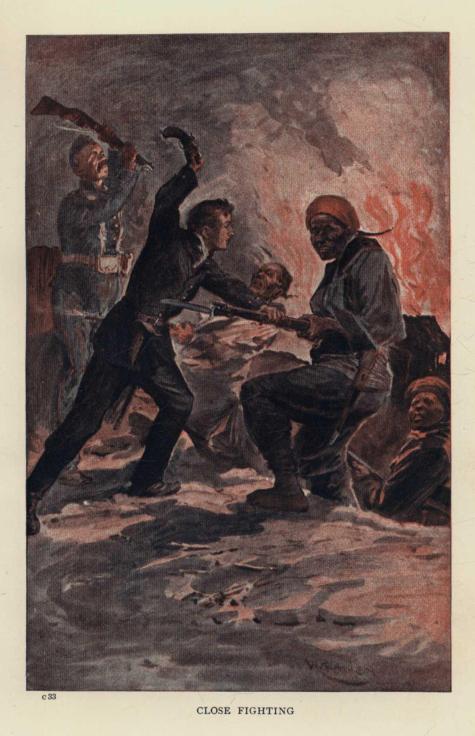
CLOSE FIGHTING
I don't quite know why—it may have been because we couldn't see the flames, or because I was wet through and cold again, or because we could hear people running about near us in the dark, without being able to see them—but I forgot all about being so brave, and felt frightened, and was jolly glad when I heard the bugle sound the "close". I wasn't certain which way to go, for I funked that ditch, and didn't think we could have found our way back there. Whatever it was, we found ourselves going straight towards the sparks, came up against another wall, turned round the end of it, and then found that that was what had prevented us seeing the flames. They were still making a great light, and in between them and us there was a crowd of Chinamen. We could see their heads showing like black discs, and they were all jabbering together, with their backs to us.
I don't know who started—I didn't—but we all began shouting and charging down at them. They had just time to turn round before we were on top of them. The men let off their rifles, and I pulled the trigger of my revolver, and haven't the least idea whether it went off or not. They must have thought that all the demons in the world were after them, for they opened out and let us through; but directly we had rushed past and came into the light, they saw that we were only five, and came howling after us. Right in front of me a man jumped up with a rifle and let it off almost in my face. He didn't touch me, but probably hit some of his own people, and before he could fire again I had hold of the barrel with one hand, and was banging him in the face with my revolver, though that didn't seem to hurt him. He was just going to pull the rifle out of my hands, when I heard Martin curse and swing his rifle down on his head, and he fell so suddenly that I fell on top of him.
Before I could get up again, someone had thrown himself on top of me, and began clawing hold of my windpipe. I felt my ears beginning to sing; but then he gave a gurgle and a squirm, and his fingers loosened, and as I crawled out I saw Martin trying to pull his bayonet out of him, holding him down with his foot whilst he tugged at the rifle. Before he could get it out, a huge fellow sprang at him with his rifle clubbed. I sang out, and he just managed to turn his head in time, but got an awful blow on his shoulder which knocked him over. The man jumped at him again, but one of the other three marines was on him in a moment, struck at him with his bayonet, and caught him just under the armpit. There was a frightful yell and he fell, and I seized his rifle, pointed it at the crowd, and pulled the trigger. Nothing happened. Hardly knowing what I did, I shot the bolt backwards and forwards and pulled again. The magazine must have been loaded, for it went off then and hit a brute who was running at me, somewhere in the leg. I know that it hit him there, because he stumbled, and sat holding on to it, and I quite well remember thinking that it served him jolly well right. The other three marines were close to me, and Martin scrambled to his feet, trying to twist his bayonet off his rifle to use as a dagger, because one arm was useless. The others were jabbing with their bayonets, springing out, thrusting, and springing back again, and parrying and trying to keep a circle clear. One of them (Tuck) threw up his arms and fell face downwards. I saw his fingers dig into the earth. Then something struck me on the left arm, just as if it had been struck by a wooden hammer, and the Chinaman's rifle fell out of my hands. I stooped down to pick it up, but couldn't—I remember that perfectly.
* * * * *
I don't remember anything more till I woke with a splitting headache, feeling as if I wanted to be sick and couldn't be. It was almost dark. I thought that I'd had a nightmare—I often did, after too much gunroom tinned salmon—and wondered why the lanterns had gone out. You know how you often wake up and think that you are in some strange place, and gradually work things out till they come right again.
That's what I tried to do, but I couldn't fix things, and one eye didn't seem to work, and I wondered why I had my boots and my uniform on, and why it was all so wet. I put out my arm to feel if Jim's hammock was in its place, and then I let out a yell and rolled back pretty quickly.
That yell seemed to blow away the cobwebs, and I lay back and began to make out that I was lying on a funny kind of floor, in a small room with whitewashed walls and a broken-down roof, with straw hanging through the cracks. The walls seemed to be made of bricks and mud, and one had a door in it and a small square opening above it, through which a little light came. Someone close to me began to move, and then sat up, very slowly. It was Martin, the gunroom "flat" sentry, and then I remembered that he had saved me from being choked, and all the things that had happened came back to me all at once.
"Where are we?" I asked.
He gave me a startled look. "Crickey, sir, beggin' your pardon, you does look a awful sight!"
"What's the matter? What's happened?" I felt that it was awkward to talk, my lips felt uncomfortable, and I put my hand up to my face and it felt all raw and swollen. I couldn't see at all if I shut my right eye, so knew that my left one was closed up.
"Kicked you in the face, sir, and dragged you away afore we could stop 'em."
"What!" I said, very alarmed. "The Commander not here? Where am I?"
"I don't exactly know where we be, sir, but them pirate chaps 'ave got 'old of us, and Old Tinker Bill too; 'e was brought in 'ere after us."
Then I saw that there was a bluejacket lying asleep on the other side of him, and he dug him in the ribs—"'Ere, wake up, Tinker!" and he sat up growling.
I saw that it was Miller, one of the armourers, and I remembered that he had gone with Mr. Whitmore's party, and I forgot all about worrying about where we were for a second.
"Did we smash that gun?" I cried, and tried to sit up in my excitement, but fell back again pretty quickly—my left arm was so painful every time I tried to move.
Miller yawned and shook his head dolefully: "We never got nowhere near it, sir. Jerusalem!" he gasped, "you do look a fair 'knock-out', sir, that you does."
"Well, tell me. What happened? Did Mr. Rawlings get hurt?"
Then he told me that Mr. Hoffman had guided them all right, but they made a goodish deal of noise themselves, and our party (the Commander's party) had given the alarm too soon, and they simply found themselves running into hundreds of Chinese, and had to fall back again.
"You see, sir, it was like this. We went along all right till those huts began a burnin', but the light from 'em just gave the show away, and let 'em see where to fire. Mr. Rawlings was knocked over, an' a lot more, sir, an' the last as I seed of 'em was going back, very slow, a-carryin' some people, an' stoppin' and firin' back—occasional."