FORD OF H.M.S. VIGILANT (continued 2)
Reading edition
Written by Commander Leonard Umfreville Truscott, R.N.
You have already heard of that disastrous fire at Tinghai, and of our failure to rescue the American, Mr. Hobbs, and his daughter Sally, the strange disappearance of Travers, and the death of that German fellow, so that I will tell you of what happened afterwards.
After sending Whitmore, our Gunnery Lieutenant, back to the ship with the fire engines, the marines, and "A" company, I waited for daylight, guarding what was left of the Mission House with "B" company. Our failure to save little Sally Hobbs and her father cast a great gloom over my men, which was still further increased when it became evident that something serious must have happened to account for the absence of Travers. Young Ford was most positive that he had seen him enter the Mission gate, but after that no one seems to have seen him. However, we fully expected him to turn up at daybreak, and could do nothing to assist him till then, if he had in some way or other lost his way in the darkness.
But I don't mind confessing that to protect Sally Hobbs was uppermost in the minds of every officer and man who had landed that night, and the thought of her, surrounded by a howling mob of maddened Chinamen, was the spur which had urged everyone so wildly through the streets. Our failure and her probable fate, down in the burning town, made us bite our lips in great agony of mind. Fifty times during the night was I implored by my men to take them down into the town itself; but I knew that it would be useless, and that lost among those narrow, straggling streets, and unable to keep in touch with one another, we should be simply courting disaster. If I had been alone I suppose that I should have gone, and it was a great strain not to go, and take my eager men with me; but I had no right to risk their lives uselessly. It was quite another pair of shoes for Ching and his men, because they were among their own countrymen, and ran little risk by doing so. Ching, himself, as soon as Barclay had dressed his shoulder—it was most unfortunate that one of our people had wounded him—followed his men there and left us to ourselves. I told him that we should remain near the Mission all night, and resume our search in the morning. Poor fellow, I think he was as distressed as any of us were at the fate of the little American girl, for even his thin, usually expressionless face showed traces of the anguish which we all felt. In the house he had found a grey tam-o'-shanter cap which she had worn, and I saw him stuff it into his tunic, and, you may be sure, was in no mood to chaff him about it.
Mrs. Macpherson told me, before her husband took her away to the house of some native convert, that directly the fire had started down in the town, Sally Hobbs, poor little girl, had made her father take her down to see it, throwing a shawl over her head and hurrying away, just as she would have done in America, in spite of the earnest entreaties of Macpherson himself.
As day dawned, Ching brought his men back, their faces and uniforms blackened and torn. "I have no news, sir. Not a trace of her to be found;" and then he threw himself down on the ground, utterly exhausted. His men—Tartars of splendid physique—were as worn out as he was.
As I expected, Captain Lester sent me a fresh lot of men, and food for the few I had kept with me. I therefore started with them to make a more systematic search than it had been possible to make in the darkness, leaving my other fellows to share their food with their Chinese comrades. We searched the ground behind the Mission, examining every hut and outhouse as we went, and gradually spread out towards the left and towards a little bay or sweep of the coast, which here ran into the land. For an hour we searched without result, but then a seaman came running back with a uniform glove which he had picked up by the side of a small path running down towards the sea and that small cove. The glove might or might not have belonged to Travers, but I knew that he was probably the only one of us who would have worn gloves—he was rather eccentric about dress—so hoped that this might be some clue to his disappearance, and followed the path. Almost immediately another man picked up a handkerchief. The initials in one corner were H.C.L.—those of Lawrence, our navigator—but though he had not landed, I knew that Travers had a weakness for borrowing other people's things, and my hopes were again raised. I am afraid that my brain wasn't working properly—the terrible night was responsible for that—and for the life of me I could not imagine what reason could have brought Travers along this path. We yelled his name, my bugler boy blew the "close", but without result, except that all the mongrel curs in the neighbourhood started yapping and howling.
I followed that path till it dipped over the crest of a ridge and then led down to the little bay below us—a little bay with a curved mud beach. My men were on the point of rushing down to it, when Trevelyan, the Lieutenant who had brought them ashore and relieved Whitmore, suggested that we might find traces of footmarks to help us. I therefore sounded the "halt", and he and I went down alone. Trevelyan was quite right, the muddy shore was covered with footmarks in one place, and there were also three long furrows in the mud, evidently made by the keels of boats. These furrows led right up to high-water mark, and my brain was not too dense to appreciate the fact that three boats had been there at high water. We could trace the furrows for fifteen feet or more down the shore, and one went much farther than the others. "They shoved them off and had to push hard, sir," cried Trevelyan, bending down and showing me how deep some footmarks were, and how the mud was piled up at the back of them. "It was at the last tide too, sir, otherwise they would have been washed flat again." That was evident enough, but I couldn't think what he was driving at.
"When was Travers last seen, sir?"
"About one o'clock in the morning—there or thereabouts," I told him.
"Well, high tide was at about midnight, so these boats must have been shoved off about an hour and a half afterwards, half an hour or so after you lost Travers." He was getting quite excited, but, honestly, my brain wouldn't work.
"And this boat must have been later still, sir," and he pointed to the longer furrow.
Then there was a yell above us from some of the men who had been wandering about, and we saw several of them stooping over a clump of scraggy bushes, and one came down to tell me that they had found some dead Chinamen.
I went up and saw two—disgusting objects they were—with their noses and lips cut off. I couldn't stand the sight; I'd had no breakfast, and walked away, feeling dazed and sick, and opened my mouth and drew in the sea breeze to drive the smoke fumes away from my head.
Trevelyan joined me in a few minutes. "One of those fellows has been shot at very close quarters, for his clothes are singed and blackened, and the other has had his head battered in. Look, sir! they must have been dragged along there," and he pointed to a broad mark, running along the mud from the bushes to the furrows.
He ought to have been a detective, ought Trevelyan, and was off in a "jiffy" to search for fresh traces. "Footmarks! bootmarks! plenty of them, sir," he shouted presently, and I saw him bending down and measuring them with his handkerchief. "Ours, I expect," I sang back; but he shook his head, and presently came up to me in a great pitch of excitement—he had taken his own boots off by this time to avoid making any more marks—"There are at least three different sizes down there, sir! European bootmarks too. One of them might belong to Travers, but there are some very much larger ones than his, and I don't think that one man made them all. There must have been several Europeans down here early this morning. This must be where the pirates landed and shoved off again, sir—two of the boats more or less together, and the third half an hour or so later—but I'm bothered if I can make out those two corpses, and what they are doing here."
I dragged him away. He was very reluctant to go, and kept turning back and scanning the shore with his glasses. Suddenly he took me by the shoulder—I was so "jumpy" that his touch gave me quite a shock—"Look there, sir! What's that?" and before I could say anything he darted back, began to undress, and then wading and swimming, and clinging to some fishing stakes which jutted out from the shore, he made his way to where something hung from the farthest fishing stake. I could see that it was something coloured, and as he came back with it I recognized it as a shawl belonging to Mrs. Macpherson, and remembered that she had told us that Sally Hobbs had borrowed one before going down to the fire.
I knew what it all meant now—her disappearance—the bootmarks on the shore—the furrows of those boat keels—and the shawl—and that the poor little girl had again fallen into the hands of those fiends of pirates. One cannot explain, or describe, how one feels on occasions like this, though I do know that when Trevelyan rejoined me presently, blue in the face with cold, and with his teeth chattering, but bringing the shawl, and intensely eager to solve the mystery, I felt as though I wanted to hit him, and hated to have to tell him all it meant.
"Give it to me," I said harshly.
"No, sir; I cannot. I found it, and if it turns out as you say, I'm going to give it back to her."
We said not a word as we trudged back to the Mission House, neither of us caring to speak of what we feared. Ten minutes ago I should have been inexpressibly pleased to have found Travers, but now I eagerly hoped that he had been kidnapped too, and that, in some way or other, he might be able to protect her—for her father I cared not two straws, nor did I place reliance on any effort of his to save either of them.
Fortunately Captain Lester was waiting for us near the ruins of the Mission House, and it was a relief to find him in a bad temper. He didn't wait to hear what I had to tell him, but, shaking his fist at me, bellowed out, "This is the work of those villainous pirates"—he was hardly able to speak for rage. "Set fire to the town—right under my nose—made a fool of Old Lest, and cleared out again without a scratch. And that little lass too! What's become of her and of that fool Travers? I can't trust a single one of my officers. Umph! Here you go ashore to put out a fire, don't save anyone, and shoot that chap Ching. Umph! I'd like to—— Umph!"
I rapidly told him all that had happened.
"Poor little lass! Poor little lass!" he groaned, and all the anger died out of his face. He came down with me to that bay, saw the bodies and the marks on the shore, sent people to scour all the neighbourhood; but nothing more could be discovered, and we went back again.
Presently the missionary came up—he'd been down to see those bodies too. He was shaking like a leaf, and his sunburnt face was quite ashen in colour. "Ah, mon!" and he wrung his hands, "but one o' those puir dead things was my servant. I know him by his clothes—the one with his head fair smashed in."
I had had too many puzzling events suddenly sprung on me that morning, and, honestly, couldn't try to explain this last, and could only say feebly, "Poor chap! Poor chap!"
"A vairy faithful mon, an' vairy leetil expense," moaned the missionary. Trevelyan showed him the shawl, and he recognized it at once as the one Sally Hobbs had thrown over her head before leaving the Mission, so our last faint hope vanished.
Fortunately young Rawlings relieved the grimness of everything just then. He is a most pugnacious youngster, and though I had sent him on board with Whitmore, he had managed to come ashore again. He had got into trouble with two coolies—I suppose he had found them looting—and had gone for them with his fists, and was laying about him in fine style. One had taken to his heels, but the other stood his ground, and kept banging at him with a piece of wood. The Skipper caught sight of them too, and, for all the bad temper he was in, smiled grimly, and chuckled out, "Go it, youngster!" Rawlings had already received a nasty cut over the forehead, and would have been "knocked out" in another minute, if I hadn't stepped forward and knocked the fellow down. I don't mind telling you that I put more "beef" into that blow than was absolutely necessary. Somehow or other I felt I must hit somebody, and it was unlucky for that Chinaman.
"Go down to the boat, Mr. Rawlings. Umph! what d'you mean by brawling?" growled the Skipper, suddenly remembering himself.
The Skipper told me, as we walked back to the landing-place, that several Europeans had been seen during the night, and that they were evidently in command of parties of Chinamen, who had prevented the inhabitants extinguishing the flames when they first started. This made it positive that it had been the work of the pirates, and confirmed the rumours that Europeans had frequently been seen among them at different times, and when any outrage on a large scale had been carried out.
What made the Skipper so furious was that they had so completely outwitted him; and he became purple in the face with fury at their daring to swoop down on the town, under his eyes, as it were, burn half of it, kidnap Hobbs and his daughter, probably Travers too, and get away scot free.
He took it as a personal insult, and I can't tell you all the mad things he suggested. He felt very much as I did—he wanted badly to batter somebody's face, but he soon quieted down, and walked beside me with great strides, grunting and growling, and screwing up his face, and I knew that he was trying to work out some plan in his bull-dog brain.
But you can't hit a man till you've caught him, that was the difficulty, and we had to catch him first, and knew well enough that among these islands were a thousand places where those two steamers—the tramp and the yacht—could lie concealed for years.
"Unless they want to make money over 'em, they're as good as done for," the Skipper said, as we went on board. "Poor little lass, not more'n a couple of years older than my lass Nan!"
I had served with "Old Lest" seven years, and I would do any mortal thing for him. He pretended he was a thundering bully, and was really as gentle as a child; and the men worshipped him, his gruff voice and great red face—even his bad temper. I was extremely sorry for him too, because the responsibilities resting on him were so great, prompt action so necessary, and the difficulties so enormous.
He did what I suppose was the best, and sent the gunboats and the Huan Min cruising, whilst we remained at Tinghai, with fires "banked". Leave to officers and men was forbidden, and that meant, of course, that the Skipper himself did not go ashore, and had to give up his shooting, which was the one thing for which he lived. The Vigilant was, in fact, kept ready to start within an hour of receiving any news.
Meanwhile natives—as trustworthy as Ching and the Taotai could procure—had been scattered through the archipelago, and the war junks also had been induced to leave Tinghai and endeavour to procure information. The Skipper seemed to depend upon these particularly, because they had naturally more intimate knowledge of the islands and the character of the people. They could cruise, too, without attracting so much attention as our gunboats. They generally cruised for a week, and at the end of that time came sailing back to Joss House anchorage, covered with flags and firing off guns, but with never a particle of news.
Week after week went by, and not a trace of the pirates could be found. Indeed, they seemed to have disappeared off the face of the seas, and not a single outrage had been reported since they had burnt Tinghai. Rashleigh, coming back in the Ringdove, did certainly report that he had one night heard what he thought was the sound of guns somewhere off the Chung-li Tao group, but had discovered nothing when he steamed in the direction of the noise. "Silly fool!" roared the Skipper to me, "he don't know the difference between thunder and guns."
These weeks of weary waiting were most depressing, and the constant confinement on board, without any exercise, most bad for our health—and tempers.
We now felt sure that someone, probably the dead Mission servant, had guided Travers down to the shore that night; that he, like the mad fellow that he was, had rushed off alone, hoping to rescue Sally and her father single-handed, and that he had been kidnapped with them. I forgot to tell you that Barclay, our Surgeon, had found the bullet in the body of the mutilated Chinaman, and that it was a service Webley revolver bullet, so it was quite possible that Travers had shot him. There probably had been a scuffle, and the Mission servant, not being worth capturing, had been killed and mutilated to prevent recognition.
We all were so worried and depressed, that two days of strenuous work, coaling ship from a collier, and another day of cleaning ship afterwards, came as a welcome relief. It's precious seldom that one does welcome that job, but we did then.
For some long time I had not heard the noise of the gunroom piano. Someone or other would be banging it at all hours of the day, and as the gunroom was immediately beneath my cabin, the noise was a continual source of annoyance to me. My messenger used to be always taking down fiery messages to the Sub, Langham. The absence of this noise was now a blessed relief, and when I mentioned it to Langham, he asked me to go down and see for myself the reason of it. I went down, and found that the piano was shut, and that Vigilant cap-ribbons had been glued across, to prevent it being opened. "Miss Hobbs was the last to play it, sir, and the Mids and all of us have sworn that no one shall play it again till she does, and till she cuts those ribbons with the senior mid's dirk."
"Who suggested that?" I asked, smiling.
"Mr. Langham, sir," several of the mids cried; but he, getting red in the face, said it was Hamilton, the Engineer, and he put it on to Moore, the A.P., so I left them settling the subject, and only too glad that the piano was so effectually sealed.
I think that everyone did feel, as the gunroom did, that some day we should see them all aboard again—Travers, with his mad, chivalrous notions and "tired" manner, and the pretty little girl, with her winsome face and funny twang.
At the end of the third week after the fire at Tinghai, the United States gun-vessel, the Omaha, came down to place herself under the Skipper's orders and assist us in our search. She was larger than our gunboats, very much more modern, and was rather quaint looking, with one mast and an enormously long, thin smoke-stack.
"If that chap comes along here giving Old Lest advice, Old Lest will—— Umph!" the Skipper growled when she was sighted.
Her captain, a man named Parkinson, was a tall, gaunt, disappointed man, with grey hair, and as old as Captain Lester himself, though actually junior in rank to me. He came across to report himself, and I heard him say, "Guess my boys thought the old Omaha was a fixture in the 'chow-chow' water at Shanghai, and our mud-hook could never be hauled out again. Say, Captain, we are right pleased to come and assist you."
He was sent away cruising.
Another weary week went by, and still no news came.
Then it turned out—one of the gunboats actually caught them at it—that those war junks, on which the Skipper relied so greatly for information, simply went out of harbour, round the corner, and hid in a neighbouring creek till their provisions ran out, and they had to come back again for more.
This news put the finishing touches to the Skipper's bad temper, and he was mad with rage, and sent for the Taotai at once.
"Umph! A pretty how d'ye do! Those lumbering junks of yours simply skulk out of sight round a corner," he roared; and when this had been interpreted to the Taotai—I wondered how much the interpreter understood and passed on correctly—the frightened old man gesticulated feebly, and then out it came: "Taotai speaks, sir! If junks caught by Pilons, he makee buy new ones—he no caree."
So that was it, was it—the old chap didn't intend to risk losing them? He was given so much a year to keep so many in good order, and if one was lost he would have to replace it. No wonder that we could gain no information from them.
You should have seen—and heard—the Skipper when he understood this, and you should have seen the old Taotai hurry down to his state barge, hide under his red umbrella, and shove off for the shore—glad enough he was to get away, too.
Late that evening the Skipper sent for me. He was beaming all over his face, puffing out his cheeks and working his shoulders, as I hadn't seen him do for a fortnight. He banged me on the chest and nearly knocked me over. "Willum, where the dickens is Willum? Willum, you scoundrel! bring the Commander one of my eighteen-penny Havanas," he roared.
It was half past eleven; I wanted to turn in, and didn't care to smoke, but it had to be done.
"Hit on a scheme, Truscott; I'll wipe the old Taotai's eye; I'm going to put our own people aboard those junks, and see if we can't make them useful like that. Umph! What d'you say to that?" and he thumped the table with his huge fist, and glared at me.
"Six of 'em I'm going to take."
"Won't the old chap object, sir?" I asked.
"Object! I'll teach him to object! He's got it down in black and white from his boss at Ningpo to put all his forces at our disposal," and the Skipper winked at me from behind a cloud of blue cigar smoke. "He'll be pretty sorry he tried to pull Old Lest's leg before he's done with me. Umph! Our only sporting chance is to catch some of these rascals, and I'm not going to be too particular how I get information from 'em when I do catch 'em."
Fortunately the Huan Min came in that night, and Ching helped us negotiate with the old gentleman in the walled city. He, I am certain, did his best; but he told me, very candidly, that if we persisted in our demands, we should touch their pride very greatly, and that it would increase the already hostile feeling of the Chinese towards us, and would very possibly prevent any information coming in from private sources.
Captain Lester was much annoyed at the attitude he took up, and always thought that he was the cause of what happened, though, personally, I am sure that he had acted honestly by us. At any rate, the Skipper had blurted out, "If he won't lend 'em to Old Lest, Old Lest'll borrow 'em;" and somehow or other this threat got to the Taotai's ears, and so scared the old gentleman, that next morning not a war junk remained in harbour.
Ching came across directly, and protested that neither he nor his Captain had any knowledge of their going to sea. I believed him, and so did everyone, except the Skipper, who flew into a terrible rage, and I was very glad to get Ching away and soothe his ruffled feelings, but could not induce him to stay to breakfast.
"Made a fool of Old Lest again, have they? Umph! I'll—I'll—" he stuttered and bellowed when I reported "divisions" to him, "I'll do 'em yet. I'll buy half a dozen of their big merchant junks and man 'em myself! Old Lest'll sell a farm or two, if the Admiralty don't pay for 'em."
"D'you mean that, sir?" I asked.
"D'you ever hear me say anything I didn't mean?" he roared; and though I must confess I had done so, I dare not say so.
I slipped away directly in my gig, and went across to the old Huan Min. I saw her Captain and Ching pacing gloomily up and down the poop, and it was very pleasant to see their faces open out again when they heard the news, and that their country's honour was not to be disturbed.
Ching gripped me by the hand—"You English, sir,"—and the muscles of his face were working strangely—"do not understand how these things, these slights, and—these little insults to our country hurt us. All you Western nations think we have no such love and pride of country as you have, and do not feel it. We do, sir! We do!"
I have always been glad that I did go aboard that morning, for my ideas of the Chinese were very much changed.
Ching himself came of a very old fighting stock—his people had always belonged to a high military caste, and his father had fought against the French well and nobly. He himself—Lawrence had told me this—had fought against the Japanese in the Yalu battle, and when all his senior officers had been killed, and his ship almost a wreck, had taken her out of action and staggered across to Wei-hai-wei, keeping the light cruisers, which hung round him, at a respectful distance with the one gun that was able to fire.
Japanese naval men had told me the story, in admiration of his plucky ship, but it was not till Lawrence told me that I knew who had commanded her.
I knew Ching a good deal better after that. He had done more fighting than I ever hoped to have the luck to do, and when one's job is to fight, and one gets paid to keep oneself ready for it, one always admires a man who has earned his pay.
Ching took me into his cabin once, a strange kind of barn, half Chinese and half English, with two old faded photographs hanging on the bulkheads, one of the Inflexible and the other of her Mids, Ching in the middle, and Lawrence, a fat little chubby-faced youth, by his side.
I often chaffed Lawrence about that photo—he looked so angelic.
CHAPTER V
Midshipman Ford's First Command
The Junk—H.M.S. "Sally"—"Here's Luck to the 'Sally'"—Ready to Start—Under Way—In Command—Night at Sea—The Strange Junk
Written by Midshipman Ford
If anybody had told me a week ago that by this time I should be captain of my own ship, I should have called him a blithering Ananias, and probably punched his head if he was anything like my size, and made him jolly sorry for trying to pull my leg.
But there it is. I am the captain of the Sally, converted junk, two guns, tender to H.M.S. Ringdove, and who, do you think, is my first lieutenant? Why, Dicky Morton, "Dear Little Dicky" of all chaps in the world, and he's turning out not to be half such a silly fool as he looks—I often tell him so, just to buck him up.
I must tell you how it all happened.
The Captain had found out that those war junks never cruised at all, simply hid round a corner out of sight, and as he depended a great deal on them for news of the pirates, he was simply furious when he heard of it, and sent ashore and bought six of the biggest merchant junks.
I was with the party of men under Mr. Whitmore sent to bring them off. The steam pinnace was to tow them, one by one, but got a rope round her screw, and delayed everything whilst it was being cleared. I happened to be on board one of them with six men, preparing to be taken in tow, and it struck me that it would be a jolly good "wheeze" to sail off. Mr. Whitmore sung out that I might try, and I did, and got her off quite comfortably, without breaking anything when I came alongside.
I had had a jolly lot of experience in sailing at Upton Overy, both before and after going to the Britannia, and I don't want to be cheeky or anything like that, but it seemed to come quite naturally to me to sail any boat, and I always seemed to be able to feel exactly what was wanted to make it sail its best.
The Captain was very pleased with me for doing this, and that is how I got the command of my junk.
He had all of us Midshipmen and Cadets fallen in on the quarterdeck, glared at us and growled, "Now, you young gentlemen, you've got a job to do at last—no skrim-shanking about it either—jolly hard job—and I want those of you who can sail 'em best to take charge of 'em. You've got to get hold of some of those pirate fellows for me—don't care how you get 'em, but get some of 'em alive. Can't get anything out of the dead 'uns, umph!"
You can't imagine how excited that made all of us, and when the six junks had all been lashed alongside, we had to clean them first and fit them out afterwards.
The Commander told me that I could have the one which I had sailed off, and told me that I could choose one of the cadets to go with me. Dicky came and offered to do any mortal thing for me if I would take him—he was nearly blubbing with keenness—so I said I would, and we both had to start the job of cleaning her out. The Commander gave me twelve hands, and it was a jolly beastly job. She was perfectly filthy, and we had to scrape away half an inch of stuff from her inside with shovels before we could even commence scrubbing. The smell in the holds was almost enough to knock anyone down, and we worked till long after it was dark, and they had hoisted big yardarm group lights to make it easier for us.
It rained too, but we didn't worry about that in the least, because we were so jolly happy. I'd never seen Dicky like it before. He was chirping about like a bloated sparrow, and was much too happy even to speak.
You can see what the junk was like by the picture. The great stern place was where we all had to live, and it was something like a huge pigeon loft with three sliding-door places in it. One opened from the deck into a fairly big place, where the rudder head came up through the stern and the long tiller worked. The ten bluejackets were to live there. Above it and under the poop deck were two little places about eight feet square, and only just a little more than four feet high. In one of them Dicky and I were going to live, and the two petty officers who were coming had the other.
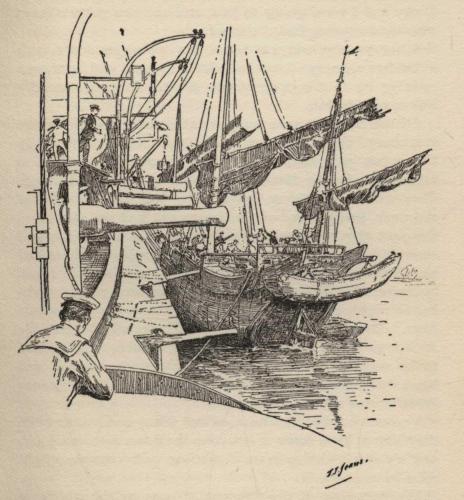
H.M.S. Sally
A narrow platform was below the two upper doors, with a ladder running down on deck at one end, and one running up to the poop at the other. It looked exactly like a pigeon loft.
All the time we were busy scraping and shovelling and scrubbing, the carpenters and blacksmiths were busy fitting two great balks of timber with some cross-pieces to take a six-pounder Hotchkiss quick-firer and its mounting. They were bolting them down to the deck and the sides of the junk, just in front of the mainmast, and on the top of the poop they mounted a Maxim gun. The Vigilant hadn't enough Maxim guns for all six of the junks, so three had had Nordenfelt machine guns from the gunboats. I had never seen the ship so busy; she was humming from morning to night, and for most of the night too, for four whole days. Besides the carpenters' and blacksmiths' work, the anchor gear and all the standing and running rigging had to be refitted or overhauled. I only wish, as you will know by and by, that more of it had been refitted, because it really was not strong enough.
You can just imagine how excited Dicky and I were when they did at last lower a six-pounder down into our junk, and we saw it sitting in its mounting, and knew we might soon have to use it.
We got most of the filth out of ours by the middle of the second day, and the holds didn't smell so badly, though we could never get the Chinese kind of smell out of the living places under the stern. What troubled us most were the fleas and bugs and cockroaches. They were perfectly awful, and we couldn't get rid of them in the few days we had. We must have drowned thousands of them, but there seemed to be just as many left, and we were itching all over and covered with bite marks, even whilst we were only working in her.
The cockroaches would watch us cleaning the bottom boards, and when we went on to another spot they would swarm down over the clean places, and squashing the brutes made them dirtier than ever again.
It was Dicky who first thought of giving our junk a name. I wanted to call her Nan, because Nan was my chum, but then I thought perhaps the Captain wouldn't like it, and Dicky suggested Sally instead. It turned out that all the others wanted the same name, but Dicky was the only one of them that got it. You see, the letters had to be cut out in wood first, and as all the carpenter people were so frightfully busy, it was almost impossible to get anything extra done at all. But Dicky had made great friends with the old Boatswain and Carpenter. He used to go and yarn with them in their cabins on the other side of the gunroom flat, and used to take refuge there sometimes when we had driven him out of the gunroom with our chaff, and sometimes hide there when he was afraid of being bullied, and Jim was not there to protect him. It was really owing to this that we were the only ones who did manage to get it done, and then Dicky actually had the pluck to ask the Commander for some gold leaf to gild the letters. He volunteered to do that too, and I went with him to the Commander's cabin—outside the door—to give him courage. When he knocked timidly, and we heard the Commander sing out, "Yes, what is it?" in his gruff voice, Dicky looked as if he would have bolted away—I expect he would have done so if I hadn't been there and the sentry as well—but he just squeezed his lips together, wriggled in at the side of the curtain, and squeaked out, "Please, sir, gold leaf," and couldn't say another word, he was so frightened. I went in then, "Please, sir, we've got Mr. Williams, the Carpenter, to cut out Sally for our junk—in big wooden letters—and we want gold leaf, please."
The Commander grinned at us—he was a perfect ripper—took a book of gold leaf out of a drawer, and gave it to Dicky. "D'you boys think I'm made of gold leaf?" We didn't even thank him, we were so excited, but rushed for'ard to the "paint shop" under the fo'c'stle to see old Modley, the painter, and ask him to put the gold leaf on for us. We couldn't get anything out of him, though. He was a bit of a sea lawyer, and he "wasn't going to do nothink but what he'd orders to do from the Commander or the First Lootenant".
We didn't know what to do then, and went on deck and climbed down to the junk, feeling miserable. Scroggs was there screwing the letters on to a board—Scroggs was the petty officer who was coming with us—and we told him all that had happened, and how we'd got the gold leaf, but couldn't get Modley to gild the letters.
"You just give it to me, sir," he said; "that 'ere Modley be a bit of a 'ard nut, but we both comes from the same village down Dorset way, an' 'is missus goes to the same chapel as my old missus, and 'e may do it for me."
He managed to get round him somehow, and when, next morning, Dicky and I ran up on deck in our pyjamas, as soon as it got light, to have another look at the junk, the first thing we saw was the board on her stern, and the letters all beautifully gilded. We had to climb down, just as we were, and lean over and look at them. They looked simply gorgeous, and there were Scroggs, and Sharpe, the other petty officer, and one of the carpenter's crew, and old Modley grinning at us. They had just finished fixing the board to the stern. "Thank you very much," was all we could think of saying; and when we all climbed up aboard the Vigilant again, the ship's cocoa was just being served out, and Scroggs brought us a bowl of it and said, "Here's luck to the Sally," and we all sipped it, and Modley said, "May the Lord have mercy on the little lass!" but the carpenter's crew didn't say anything religious, because he burnt his mouth.
Then we jumped down below before the Commander could see us on deck in pyjamas, and rolled ourselves in our hammocks again—we were jolly cold.
We had a good bit of gold leaf left, and I nudged Jim, whose hammock was next mine, to tell him that he could have it. I knew he wanted it very badly to make his junk look smart, and when we woke him and he knew about it he gave a whoop! and tumbled out and woke the others; and Dicky and I watched them having a grand pillow fight, till we couldn't stand it any longer, and joined in, and got splendidly hot—even Dicky joined in!
All that day we were busy getting ammunition on board, and it was simply grand to see the boxes being lowered into the hold and jammed there, so that they would not fall about. There were 200 cartridges for the six-pounder—the long brass cartridge and the little shell all in one—and three thousand rounds for the Maxim gun. Then there were the casks for the water, and a boat's stove to be secured, and one of the Vigilant's dinghies to be lashed down amidships.[#] We took the native boat, which you can see in the picture hanging over the stern, so that we should look more like an ordinary junk. Then there was all our own gear and boxes of biscuit and corned meat, and any amount of stuff. Dicky and I got heaps of things from old Ah Man—jam, sardines, ginger-bread biscuits, and things like that—and when we'd got them all into our little square pigeonhole, and our sea boots, mackintoshes, greatcoats, and a uniform tin case between us, there was hardly any room left for our hammocks, and, of course, it wasn't possible to stand up inside—it was much too low. When everything was ready we took her away to practise sailing, and the Captain came with us, and was jolly pleasant, and Mr. Whitmore, the Gunnery Lieutenant, came too, and we tried the guns and, I must say, made very wretched shooting.
[#] See page 77.
After that we had to wait for the gunboats to come back from cruising, fill up with coal, and take us away in pairs.
The only thing that did make Dicky and me feel rather sad was that Jim hadn't a junk all to himself. But he was going with Mr. Trevelyan, and as he was a splendid chap, we knew that they would have a grand time together.
They called their junk the Ferret. The Captain had said, "Ferret 'em out for me, Trevelyan," so we all thought the name was jolly appropriate. They only had it painted on the stern, not done with big wooden letters as ours was. They had tried to use the rest of our gold leaf, but had made a mess of the job and wasted it all, which was rather a pity.
The Commander sent Mr. Langham a list of all the fellows who were to go in the six junks, and he stuck it on the notice board in the gunroom.
This is a copy of it, and will explain how they were "told off", and who were to go in them.
H.M.S. Vigilant,
Tinghai Harbour.
The six junks will be told off as tenders as follows:—
Tenders to H.M.S. Ringdove—
Junk No. 1, { Lieutenant Mervyn L. Trevelyan.
{ Midshipman James Rawlings.
Junk No. 2, { Midshipman Richard Ford
{ Naval Cadet Richard F. Morton.
Tenders to H.M.S. Goldfinch—
Junk No. 3, { Lieutenant Ronald G. Forbes.
{ Midshipman the Hon. Talbot Withers.
Junk No. 4, { Midshipman Harry G. Webster.
{ Naval Cadet W. D. St. G. Ponsonby
Tenders to H.M.S. Sparrow—
Junk No. 5, { Lieutenant Benjamin Langham.
{ Midshipman Percy Jones.
Junk No. 6, { Midshipman Steven J. Johnston.
{ Naval Cadet John E. Smith.
Two petty officers and nine seaman ratings and one signal rating will be detailed to each tender, also one native pilot.
The tenders will act under the orders of the Commanding Officer of the gunboat to which they are attached, and will be prepared to leave Tinghai after the gunboats have completed with coal and provisions.
CHAS. E. LESTER,
Captain.
We had nothing to do now but wait for the Ringdove, so Mr. Trevelyan took his junk and our junk the Sally away sailing every day, till we really got quite good at managing the clumsy gear and the huge matting sails. We did some more gun practice as well.
The Goldfinch and Sparrow took their junks away before our gunboat arrived, and we gave them a jolly good send-off. At last our turn came, and the Ringdove finished coaling, and we were given orders to be ready to start at daybreak.
The evening before we had to start there hadn't been a breath of wind, and Dicky and I sat up whistling for it till very late. This was the first time we had spent the night aboard, and we really couldn't sleep because of the excitement and the fleas. The wind did come by the morning, but from the wrong direction, and the Ringdove, to save time, simply towed us away behind her.
It wasn't a very glorious start, but they gave us a grand cheer, and the Captain had shouted, "Good luck, Dick! pull your pound for the good old West Country," and that made me gloriously happy, because he had never called me "Dick" since the first day I joined.
When we had got round the corner, out of sight of the Vigilant, and knew that we were in for any amount of adventures, we felt simply ripping, and the sun came out too, and we sat on deck and dried our things.
We were so close to the Ferret that we could talk to Jim, and presently he came out of his "kennel"—he called his a "kennel", and we called ours a "rabbit hutch"—and yelled across to us to look. He had a huge cake in both hands. "You've got one too, I expect," he shouted, and we crawled into our hutch; and in a corner, under the sea boots, was just such another, all covered with icing, and "Chin Chin Joss from Ah Man" scrawled on it in sugar. Wasn't that jolly decent of the old messman? Of course we'd spent no end of money getting sardines and jam and biscuit from him—those sovereigns the Captain had given Jim and myself had come in jolly useful—but we never expected anything like this, and it just made us completely happy, and we had a piece each on the spot, and waved across to Jim whilst he and Mr. Trevelyan had slices too.
The pilot who came to us was named Ah Chee, a funny-looking old chap, and I'm sure you wouldn't have guessed his age within twenty years. He could talk a little "pidgin" English, and volunteered to do the cooking—in a tiny little galley place over a brazier belonging to the junk, and that boat's stove which we had fitted up—and did it jolly well too, except when he'd been smoking too much opium.
As I told you before, Scroggs was the name of one petty officer, a fine great chap, and Sharpe, a fat, good-natured little man, the other. They were both jolly good at their job, and the Commander had given us a good lot of seamen too.
When it got dark they started a "sing song", and Dicky and I each sang a song. I sang "We'll rant and we'll roar", and Dicky sang "Clementine", and we had an awfully jolly time, and were just as happy as anything, but for those wretched crawling and jumping things.
The Ringdove towed us along for two whole days, and on the morning after the second night Mr. Rashleigh had towed us to wind'ard of the Chung-li Tao group of islands. He then stopped her engines and hauled us alongside for orders. We took our charts with us, Mr. Trevelyan and I, and he told me I was to cruise to the eastward and search all the channels, and rejoin him to leeward of a certain island within four days—I forget the name of the island; and he told us a lot more of what we must do in case the weather or the wind changed, but as he had written it all down, it was not necessary to remember it. Then he said goodbye, wished us good luck, and his final orders were: "Keep your guns covered up with old tarpaulins, don't let your people show themselves when you're close to a village or a junk, and don't attempt to look too smart. Don't hoist your sails as if you were in a blooming hurry, and if you're not sure where you are, anchor for the night. You're intended to be ordinary merchant junks, and you're just bits of bait—sprats to catch a whale—and you have to get hold of some of these fellows for the Captain, and get 'em alive too—he doesn't want dead 'uns. If you meet more than you can tackle, just run down to me, and," he added solemnly, "if other things happen, keep one cartridge in your revolvers for yourselves."
That made me feel rather creepy and coldish, but not exactly frightened, because Mr. Rashleigh is so plump and so—well—funny looking that, however solemnly he tried to say anything, you really wanted to laugh.
Just before we went away Dr. Hibbert, the jolly Surgeon of the Ringdove, gave Mr. Trevelyan and myself two big wine bottles each. They were marked "Foretop" and "Maintop". He winked cheerily at us: "You'll find 'em useful, you fellows. If any of your chaps gets a pain below the belt, shove in a big whack of the 'Maintop' bottle; if he gets a pain above the belt, give him half a dozen whacks of the 'Foretop'."
I marked mine "Above" and "Below", and stowed them away very carefully in a corner. He gave me some tobacco too; for though I oughtn't to have smoked—I wasn't eighteen—it was rather different when I was away from the ship. I had brought my pipe with me, but, like an ass, had forgotten any tobacco.
Well, we shook hands and then off we went, the "Ringdoves" cheering us, and all of us cheering each other. She steamed off to the north'ard to get to leeward of the islands, we went away towards the sun, and the Ferret the opposite way, Jim waving from the poop and sending a last "Luck to Sally!".
There was quite a good breeze blowing, and when we'd got all our sails hauled up and the leeboard down, we went flying along, heeling over till the lee gunwale raced through and under the water. It was simply grand. The sun came up too, and made it all the more cheerful, although there wasn't much warmth in it, and when the Ringdove and the Ferret had both got out of sight, Dicky gave a great sigh of contentment.
I must say that, at first, I felt frightened at being alone, and should have been jolly pleased to see the Ringdove's masts and funny little funnel sticking up over the horizon; but presently I forgot to be nervous, because the junk sailed so well, and it was simply ripping to be in command, all by myself, with a six-pounder and a Maxim gun, and all those two hundred shells down below, and to think of the surprise we should give any junk which tried to take us, because, you see, none of them had ever known what a bursting shell was like. There was Scroggs to fall back upon too, if one really got into a tight fix and couldn't make up one's mind. He was such a huge chap, that he could have lifted Dicky and me up with each hand; but he would always talk about his missus and his "kids" if we gave him the slightest opening, and—well—neither Dicky nor I were the least enthusiastic about them after the second day, and I'm quite certain that Sharpe felt just the same—he had to live with him, too—because I heard him say, "Now chuck it, if you don't want to drive me off'n my blooming rocker."
To show you how the pirates had scared everything off the sea, we never saw a single junk all those two days we were being towed by the Ringdove, and now we had the sea all to ourselves. Our first island was right ahead, and we soon got up to it, and Ah Chee came out of his pigeonhole and sniffed and looked, and sniffed and looked again, and smiled, so we knew everything was all right, from the "running-on-rocks" point of view. I didn't tell you before, but Mr. Trevelyan had had a great idea before we left Tinghai, and bought enough loose-fitting blue Chinese short coats, and enough native caps to go round his men and mine too; so now, as we got quite close to the land, we made the men stick them on, and Dicky and I put ours on, and looked jolly funny, I expect. I couldn't help thinking what my mother would imagine had happened if she'd been able to see me rigged up like this, and I was pretty sure that Nan would say something to make me get red and angry. But it was grand fun, all the same.
We had one of the Vigilant's dinghies, besides that native sampan hung over the stern, and it had to be covered up with a tarpaulin, so that its shape wouldn't show through. Good old Ah Chee seemed to understand our game, and ran in quite close, and when we were nearing a small village, began gesticulating and signing to me to lower the sails a little. "Too plenty quick—plenty too quick—pilons thinkee you no got"—and he pointed down to the hold, and I suppose meant "cargo"—"no good makee catchee." We lowered our mizzen altogether—it wasn't doing much good anyhow—and slacked off the sheets, and went past very slowly, Dicky and I looking through our telescopes, and hoping to see something coming after us. There was nothing there, though, and Ah Chee shook his head—"Too plenty good fellow can do."
One or two small junks were hauled up above high-water mark, with their masts out—to make it all the more difficult for pirates to carry them off, I suppose—a few children were playing with the dogs and the pigs on the shore, and one or two miserable wretches were hauling in handlines and picking small fish off the hooks—we could see them glitter in the sun as they wriggled.
Then Ah Chee signed to us to go faster, so we hoisted the mizzen again, and hauled in our sheets and boomed along. We spent all that day doing this, running down one channel and beating up another, and only once saw any junks. There were two beating to windward very slowly, and when we sighted them Dicky and I were very excited, and brought Ah Chee out to look at them. He only shook his head and repeated, "Plenty good fellow can do."
Dicky suggested that we should see how fast we could sail and try and overhaul them, and we were getting on finely, gaining every minute, though we could see them doing their best to go faster; but presently Ah Chee, who had borrowed my telescope, made us slow down, shaking his head, "Plenty bad joss can do—if too plenty quick go—him Chinaman," and he pretended to dive overboard. Dicky understood what he meant first—that the Chinaman would think us pirates, and would jump overboard if we overhauled them, so we lowered our foresail, just to comfort them, and eased down.
We had to keep under way that night, because the next lot of little islands which we had to examine were about nine miles away, and the breeze had fallen considerably. I slept jolly soundly till midnight—I rolled myself in my blanket and slept on deck, to escape the bugs under the poop—and then relieved Dicky for the middle watch.
It was jolly cold, but the stars peeped out every now and again, and it was just light enough to see rocks or land a hundred yards ahead, so there was very little danger of our running ashore.
It was the first night I had spent at sea under sail since the Upton Overy days, and this made me think a lot of the old village, and to wonder what they were doing at home. It was so jolly to know, after all the time—the years, in fact—that I'd been longing to come to sea with the Captain, that I was now doing quite an important job for him, and that I might be lucky enough to help him, and even be able to find Mr. Travers and Sally Hobbs and her father. It was grand, and I did so enjoy myself that night, with, everyone, except myself and the men at the helm and a lookout man for'ard, sound asleep.
I had only the foresail and mizzen set, because there was no reason for going fast, and I was rather nervous about squalls. You couldn't see them coming at night—at any rate I couldn't, because I'd had so jolly little experience.
I stood up alone on the poop, near the Maxim gun, and kept my eye on the sails and the long, narrow deck below me, and I don't know whether you will understand what I mean, but I felt frightfully proud and conceited. I'd felt like that ever since we left the Ringdove, but I'd done my best not to let it ooze out, for fear that Dicky and the men should think me an ass, or too cocky, and now it seemed to swell up from my boots, and gave me an awfully funny feeling all over.
We sighted the island about six bells, and then I tacked away again, as it was no use to go in close till daylight. Scroggs relieved me at four o'clock, and I felt almost sorry, but crept in alongside Dicky, as it was raining, and went to sleep directly, without disturbing him.
It didn't seem many minutes before Scroggs woke me. "The breeze is steady, sir, and the island's on our port bow, and I think, sir, that something is following us and just smelling 'around'."
I crawled out like a shot. It was raining gently, and the sails were all damp and dripping, but I couldn't see anything at first except the long dark line of the island to the east.
Scroggs pointed down to leeward, and I thought I made out, just for a second, three great sails.
"She's there, sure enough, sir; I've seen her, off and on, for the last half-hour, and she's working up to wind'ard, as if she wanted to have a look at us."
I watched and watched, my heart thumping like mad, and presently I caught sight of her dark sails again.
We went off on the other tack, and, sure enough, the next time I saw her she'd done so too.
I knew then that she must be following us.
"She don't quite know what we are, sir," Scroggs chuckled. "She'll know a bit later."
Presently, as it grew lighter and she got closer, we could see her all the time. She looked huge in that light, and had four masts and four immense sails, not three, as we had thought at first. She was heeling over tremendously, sailing two knots to our one, and overhauling us fast.
If you think that I was frightened you are jolly well right.
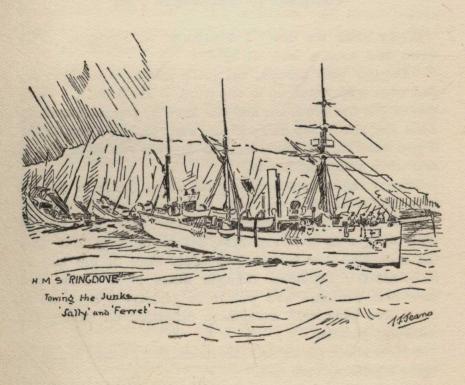
H.M.S. "Ringdove" Towing the Junks 'Sally' and 'Ferret'
CHAPTER VI
The "Sally" goes into Action
The Chinaman draws Nearer—First Shots—The Maxim Gun—A Near Thing—Four to One—Running the Gauntlet—"Well Done, Sir!"—At Close Quarters—The The Grappling Iron—Left Alone
Continued by Midshipman Ford
"What shall we do?" I whispered to Scroggs. "Go down and have a look at her?"
"Beggin' your pardon, sir, you'll just keep straight on, and edge a bit more up in the wind, if she'll do it. Once you've got the wind, sir, and can keep it, you can do about what you like; keep away if you want to, run down to her if you want to, and she'll have to do what you want her to, and when you want her to."
Then I remembered reading all about fights in the old time, and when we were in the Britannia, and learnt about actions in the old sailing days, how each side always tried to get to wind'ard first, before fighting, and that the man who was to wind'ard could fight or not just as he pleased. I'd never thought much of it before, but now that Scroggs had put it so plainly, I saw, all at once, how practically everything depended on having the wind'ard position.
"How about giving her the mainsail?" I asked Scroggs. "She's gaining very fast."
"She's doing all right, sir! We doesn't want to run away. Just you edge up a bit more in the wind and wait for her. Time enough for the mains'l if she be a pirate, and we have to chase her."
So we edged up into the wind again and began to stand out to sea, beyond the island.
I pointed that out to Scroggs—I felt fearfully excited and nervous.
"That's all right, sir, never mind about the island; you'll be getting her out in the open, and she'll think you're just trying to give her a wide berth." Then I remembered Dicky, and shouted through the little sliding door for him to come and see the fun. He scrambled up on the poop, rubbing his eyes, and we both stood looking at her, feeling frightened because she looked so big and came on so like a ghost, and didn't notice that we were getting wet through. I did wish then that the Ringdove was in sight.
"How about letting the hands have food, sir? Maybe, if we've luck, we're like to be busy later on, sir!"
Of course Scroggs was right, and Dicky said that Nelson always gave his men food before going into action—he squeaked again, he was so nervous—and that settled it; and the men were turned out, and were almost too excited to eat anything. Ah Chee was quite stupid and silly when we tried to wake him—he must have been smoking opium during the night—and the men had to make their own cocoa. Dicky and I managed to gulp some down, and had a couple of gingerbread biscuits each. We didn't like looking at each other for fear of giving away our—well—funk, though it wasn't exactly funk.
By this time it was quite light, and the island was about three miles away, right under our port bow, and the huge Chinaman was about half a mile astern, and still a little to leeward.
We dragged Ah Chee out of his hole again, but he hadn't recovered, and staggered about, shaking all over; and when he'd steadied himself, got both eyes to focus properly, and seen the junk, he simply let out a howl and crawled back, yelling "Pilons! Pilons!" which made me feel creepy, although I had to pretend it didn't. I had to pretend jolly hard.
"He'll kill himself with that pipe, sir, and we'll want him later on," Scroggs said, but I didn't know what to do. "You leave 'im to me, sir," and Scroggs dragged him out again, took away his pipe and tobacco and opium, and then shut him down in the forehold and jammed the hatch cover over it. Glad enough too he was to crawl into it.
The strange junk was coming up finely, heeling over and splashing through the water. We could only see one man on board, standing on the poop watching us, and he looked peaceable enough.
"She's got guns—I can see them sticking out!" Dicky squealed; but that didn't make it certain that she was a pirate, because all merchant junks carry guns too. "Couldn't we go for her now, Scroggs, don't you think? She isn't half a mile off."
Dicky and I were so excited and "quivery", we could hardly breathe, and this waiting for her to catch up with us was the worst part. But Scroggs wouldn't alter course, and said: "Just you 'oist the mains'l, sir, and get them tarpaulins off the guns, and stand by. When she sees that 'ere mains'l creaking up, she'll guess we're frightened, and maybe she'll let fly at us."
We got the tarpaulins off, and the men began working the clumsy windlass which hoisted the mainsail, and the great "clammy" thing went squeaking up the mast. That made us go faster and heel over more.
The guns were all painted a dirty grey, so didn't show up at all, but just what Scroggs had expected happened. The junk all at once luffed up, shot up into the wind, came on to an even keel, her great sails began flapping, we could see men pouring up from below, and four white clouds of smoke shot out from her port side, and before we could say "knife", there were four splashes in the water behind us, and one shot came ricochetting over us, humming like a top, and fell into the sea ahead of us.
Dicky and I ducked, and then we looked up to see if the ricochet had done any damage, and Scroggs pointed out a hole in the mainsail, close to the mast, where it must have gone through, and a piece of sail flapping down.
I'm certain that I wasn't frightened then, for I thought more of the mast than myself, and knew what a bad "egg" it would have been if the shot hadn't missed it.
I looked at Scroggs.
"Give 'em one, sir! Give 'em one!" he was beaming all over his face; "we can 'ardly miss 'er, sir."
I shouted for the six-pounder to open fire, but the mainsail was in the way, and they couldn't get the sights on.
"Gun won't bear, sir," the captain of the gun shouted, and I jumped for'ard to see for myself that he was right.
"What shall I do now?" I asked Scroggs, and felt stupid, and could just see the pirate junk paying off again to give us her other broadside.
She seemed so close that there wasn't time to think.
"Put your helm down and come into the wind yourself, sir."
I shouted to Dicky to do so, and the Sally came up all shaking.
"Now you've got her," Scroggs said, and as he spoke the junk shot off her starboard guns, and we could hear them yelling and beating tom-toms. There was too much to do this time to "duck", and besides, they had fallen astern by luffing and then paying off again, so their shots didn't come so close.
Then Fergusson, the captain of the six-pounder, fired. The little shell burst as it touched the water halfway across, and we heard the pirates yell again. Scroggs let out a dozen oaths, and told him to steady himself; and his next went nearer, and the next burst close alongside, and they didn't cheer that—they'd never seen shell burst before, I expect, and wondered what it was, and how we could fire so fast.
"Take your time," I shouted, and was so excited that I bit a great piece out of my lip. We fired again, and must have hit her, for a cloud of smoke came out of her bows, and a very different kind of yell came back, and we yelled too; but she'd loaded again by this time, luffed up, and gave us her port guns. There was a crash and a whistling sound, and out through the poop bounded a round shot, struck against a big chock of wood at the foot of the mainmast, and bounced overboard. It only missed one of the men at the tiller by a hair's breadth, and he let out a squeal, he was so surprised, and then got red and tried to pretend that it wasn't him. "They're only smooth bores," Scroggs shouted. "Who's squealing like a furry rabbit?" and Fergusson fired again—she wasn't four hundred yards away—and missed her. They started easing off rifles at us too, and the bullets went splattering through the sails and splashing into the water.
The Sally had been jumping about up to now—that was why Fergusson had kept on missing—but for just about two minutes she was quite steady. She almost seemed to know things were not quite all right, and Fergusson must have got off a dozen rounds, and nearly all of them hit. I was so excited, I yelled every time, and we could see smoke coming out and pieces of wood flying, and though she turned to give us her starboard broadside, she didn't fire them, and fell right off the wind, with her stern facing us. She wasn't three hundred yards off, and suddenly remembering the Maxim gun, I rushed aft; but before I could climb up the poop, Dicky turned out "trumps" and began firing. "Tut tut—tut tut," it went, and you could see a lane of bullet splashes; and as we lifted our stern they must have poured into her, and we heard shrieking, and could see the Chinamen throwing up their arms and falling, till the roll of the Sally took the sights off again.[#]
[#] A Maxim gun is an extremely difficult weapon to use, unless the gun platform is absolutely steady.
Then the signalman shouted, "They've had enough, sir!" and we saw that they daren't turn round again, and were easing off their sheets to run down wind.
You should have heard us cheer; and there wasn't any need to tell the men at the helm to "hard a-starboard", for they did it of their own accord, and we eased away our sheets and ran after her.
"I thought he'd be sorry for it, sir," said Scroggs coming up. "Look up there, sir; that does one real good."
I looked, and saw that we had the White Ensign flying from the mizzen peak. Dicky and I grinned with delight. We'd been told not to hoist it—they'd not even given us one—but there it was—grand!
"I did that, sir," the signalman said bashfully. "Stole it aboard the Vig., sir," and he grinned, and everybody grinned at everybody else, and looked to see what damage that round shot had done, just for curiosity.
My aunt! we did just bubble through the water, half burying our bows; the breeze must have freshened up without our noticing it. The pirate was digging out too, and had got a good start, and it wasn't any use firing at her, because we had a funny corkscrew rolling motion, and couldn't be certain of hitting anything. We only had two hundred rounds of shell to begin with, so I didn't dare to waste them, and waited till we could draw up closer and make certain of hitting. She was making straight for the island, and at one time we thought that we must try and disable her before she ran herself ashore. Dicky and I began to talk about capturing her. We were little fools, as it turned out.
Presently we saw that a channel opened out, right in the middle of the island, and she was making straight for it. I got out our chart, but couldn't find the island—not to make sure of it—so hauled Ah Chee out from the forehold. He was plucky enough now the pirate was running away, and nodded his head and said, "Vely good—vely good—plenty good," and pointed to the channel, so I knew we were all right to follow her.
She was almost in it before we began firing at her, and we hit her big square poop time after time, and saw pieces of wood flying in the air; but it didn't seem to make any difference to her, and she still kept on steadily.
In another three minutes we shot into the channel ourselves—between high cliffs—and as the tide was running with us and the strong wind behind us, we scooted along at a tremendous pace. We were catching her up fast, too, and had got to within two hundred yards, and Fergusson began pouring in six-pounder shells. I really wanted to frighten her so much that she would surrender, and I would be able to tow her back to the Vigilant, and give her up to Captain Lester. And I wanted to take back some of the crew as well, for Captain Lester had told me, "Don't want dead 'uns; dead 'uns don't tell things".
The noise our little gun made was tremendous, now that we were in between high rocks. You could hear a crash! crash! and then a rolling sound and another crash after every shot. It must have frightened the pirates, if it did nothing else; and whatever happened I don't know, but we suddenly saw her main shrouds on one side give way, her fore mainmast bent over like a whip, and before they could do anything, down it came with a snap, and the great sail with it, and the foremast and foresail went too a moment later, and she simply seemed to stop dead, turning her broadside to us and unable to move—just like a huge bird with one wing broken.
I had an insane idea of running alongside, but Scroggs put our helm hard down, and we swung round like a top, not fifty yards from her, and slid up into the wind. I rushed aft, furious with him.
"You'd have been atop of her in another second, sir."
"That's what I wanted," I said angrily. "What d'you mean by touching the helm?"
"Begging your pardon, sir, if you once got alongside, we'd be done for! She's got a hundred men aboard, and we twelve wouldn't 'ave stood a chance."
But I was so excited, that I never thought of that, and was just going to give him a piece of my mind about his cheek, when the pirate let off his broadside right in our faces. We were so close that the noise seemed to knock our ears in. I was half stunned and dazed, felt something hot all over me, and was thrown against the mast. I picked myself up, and found my hands and my clothes covered with blood. Scroggs was nowhere to be seen, two of the Hotchkiss gun's crew were lying near the gun groaning, and the dinghy had been smashed to pieces.
Sharpe, the second petty officer, was bringing the Sally round into the wind again, and Dicky was busy with the Maxim gun, but the six-pounder wouldn't bear—the mainsail was in the way.
"Heaps of time, sir," Sharpe said, looking at me in a funny way. "They daren't go near their guns to reload 'em. I thought you'd been killed, sir!"
"What happened?" I asked him, trying to shake the blood from my face and eyes; I felt quite stupid. "Where's Scroggs?"
"Scroggs is gone, sir. One o' them round shot took him in the middle, just as you were standing by, and carried what was left of him overboard, and another struck some of the six-pounder cartridges, and they blew up and knocked over Adams and Cooke, and threw you up ag'in that mast, sir."
Poor old Scroggs! and I'd been beastly to him too. I have always been sorry for that.
Dicky gave a yell when he saw me. He looked funny about the eyes—rather mad—and burst out crying, just for a second. "I thought you'd been killed," he stuttered, "and I've killed dozens of those brutes to revenge you."
I shouted something, and a funny hot kind of feeling came up inside me, and the only thing I thought of was to go on killing; and we edged up, just to leeward of the junk, and fired at her with the six-pounder as fast as Fergusson could load—Sharpe had sent him two more hands, and had hauled Adams and Cooke aft, out of the way.
Not a single live Chinaman could we see on deck—they'd all gone down below out of sight—but every now and again we could hear shrieks coming from inside her, and knew that our shells were finding them out. I felt mad, and Dicky was mad, and only Sharpe kept his head. We must have made some holes in her below the waterline, because she was now much lower in the water, and I simply longed to see her sink and drown all the crew—I'd forgotten all about trying to capture her.
Then suddenly, as we were expecting her to go under, someone pointed down to leeward, down the channel, and, looking there, I saw four great junks beating up towards us. They were about a mile away, and had covered themselves with pendants and streamers—all the colours of the rainbow—and began firing guns to frighten us, I suppose.
I went cold all over, for I knew we couldn't manage four more, and I saw that Sharpe thought so too. Dicky didn't seem to be quite right in his head, for he shook his fist at them, and yelled to me that there were more for him to kill. "Off out of it, sir; we can't tackle that lot. We're only nine all told, not counting orficers, sir. Back again, sir; beat up to wind'ard, sir; and get away into the open sea."
We hadn't a moment to lose, either, and I knew he was right, and stood away from the sinking junk, and started to beat up the channel, through which we had just entered. The entrance was about half a mile to wind'ard of us, the tide was against us, and jolly slow progress we made, though I knew it was the same for those who were chasing us. We'd sailed so much more quickly than that sinking junk, when we ran before the wind, that I hoped we should be as good when we were beating; but I soon had a most horrible feeling that we were not pointing so high as they were, and not going so fast through the water, either.
We had time to look after Adams and Cooke now—Adams had one thigh broken, and I knew that that wasn't so bad; but Cooke had his hands and face and legs all badly burnt with the explosion, and was in awful pain. We made them as comfortable as we could down below under the poop, but it was horrid to hear Cooke moaning and shrieking sometimes.
We soon got so close inshore that we had to go about on the starboard tack, and we swung round and plugged away for the entrance, which never seemed to get any nearer. The junks behind us were still gaining, two of them very quickly. These two were leaving the others a long way astern, and just to show you what asinine ideas come to one, I thought for a moment that we might draw them on and on, till they were so separated that we could tackle them one at a time.
The breeze had been gradually freshening, and was now blowing down the channel quite hard, and as we went off on the starboard tack, we heeled over till the deck seemed almost upright (we were heeling over to port—the left side).
But then an awful thing happened. Suddenly, above my head, there was a noise like a pistol shot, and, looking up, I saw that one of the starboard main shrouds had parted, and that the mainmast was beginning to bend over. If I held on for another minute, the other two would be certain to go—the strain on them was awful—and the mast would have gone too. There was only one thing to be done, and I shrieked to "Hard a-port!" She heeled over, another shroud uncurled and parted, but before the last could go she staggered round into the wind, the strain was taken off, and the mast straightened again.
Sharpe came running aft; he was as white as a sheet. "It will take us an hour to repair, sir! What can we do?"
It was plain as a pikestaff that we couldn't beat out. Everyone on board knew that at once, and they all looked to me, but knew what would have to be done just as well as I did, and I could see them watching the pirates out of the corners of their eyes.
The current was taking us down towards them, and they were all coming along at a tremendous rate. It was no use drifting among them helplessly; we couldn't beat out with only the mizzen and foresail, so the only thing to do was to get before the wind again, with our sails out to starboard, so that most of the strain came on our port rigging, and try to run past them. Clarke and another man sprang up the mainmast, going up the big bamboo hoops which kept the sail close to the mast, and began reeving a temporary rope to act as a backstay, and we swung round, gybed very carefully, and the little Sally went bounding back to them.
The only one on board who wasn't—well—frightened was Dicky. He'd have charged an express train; he was so mad with fighting and killing people with that Maxim. We moved Cooke and Adams from under the poop, and put them down below in the big hold, out of danger, and by that time we were abreast the sinking junk; and as we went rushing by she gave a lurch, we saw her guns slide overboard, she went under, and we could see at least fifty Chinamen struggling in the water. Dicky yelled and shook his fist at them, and called them all the names he could lay his tongue to.
I had tried to keep my eye on those four junks all the time, and though I was still feeling "silly" after being "bashed" against the mast, I could see that they didn't seem to know quite what to make of us. The leading ones were half a mile ahead of the others, and we were coming down so fast towards them that we didn't give them much time to make up their minds. We saw them run into the wind for a second or two, and then they came along, on the other tack, straight for us, the leading one about two hundred yards in front of the second. They were almost as big as the one we had sunk, but only had three masts, so didn't look quite so ferocious.
I thought that we could slip by and pass the first two to port (our left-hand side), but as we got closer it seemed to me that the first one was trying to ram us, and I had sense enough to know that if she did, our masts would probably go overboard, and that all would be U P with us. Sharpe was still up aloft, reeving that temporary shroud, so I couldn't ask him what to do, and began to feel very frightened. Fergusson kept on firing the six-pounder very fast, and kept on hitting her, but that didn't seem to have any effect, and she didn't alter course. We were hardly fifty yards away now, and Fergusson let off that gun faster than ever, and we could actually hear the shells bursting and see the pieces of wood flying out of her bows, and gashes opening out in her foresail. Her crew were yelling most awfully, and making such a banging noise with tom-toms and brass clappers, that that frightened me all the more. We were simply tearing along, with the water bubbling along the sides like a mill stream. We should be into her, or she into us, in a moment, and I held my breath and clutched hold of something, not knowing what to do. The men at the helm were looking at me for orders—they looked scared, too—and I was just going to tell them to "starboard", when I saw her begin to luff up. I yelled to them to "steady", and before you could say "knife", she slid along our port side, with her huge sails leaning right over us. The horrid brutes were all hanging on and glaring at us, and they shrieked and yelled, and I saw some of them throw things at us, and some of them fire off rifles. She couldn't fire her guns, because she was heeling over so much; but I knew she would let them off directly she was on a level keel, and I saw a lot of them scrambling over each other to get at them, and knew they would fire almost directly—right in our faces. But as they slid past, like an express train, Dicky began firing the Maxim right down in the middle of them.
I shall never forget how they screamed and fell down in heaps; and then, whether I gave the order or not (Clarke said I did, but I think that the men who were steering did it of their own accord), we put our helm "hard a-starboard", and flew round under her stern. Fergusson fired two shells straight into her poop, and in their fright they let off their guns—right away from us.
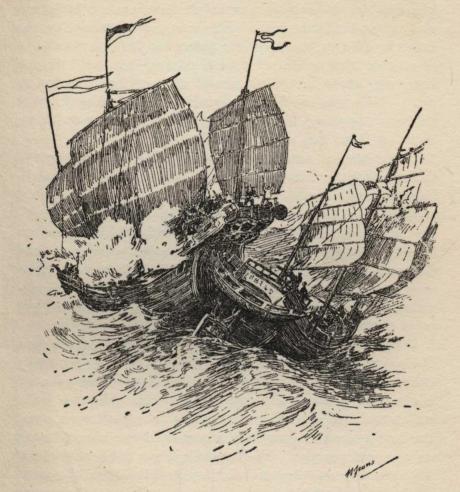
The battle between the Sally and the pirates
We put up our helm and flew away down wind, and left her standing still, all her sails shaking, and in any amount of confusion.
"Well done, sir!" Sharpe shouted from aloft, and that seemed to wake me again, and Dicky and his Maxim gun's crew were yelling with delight, and then everybody cheered because the second junk wouldn't face us, but luffed up and popped off her guns. She was too unsteady, or too much in a hurry, and we were going too fast, to give her a chance of hitting us. "Passed two of 'em, sir," Sharpe sang out cheerily; "get those stink things overboard, sir." That was the first thing which made me notice that I'd been coughing, and choking, and running at the eyes, and that there was a horrid smell.
There was a round basketwork thing spluttering and fizzing, and the beastly stinking smoke coming out of it, lying jammed in a corner close to me. I got it overboard somehow, and heard it fizzle as it fell in the water—ugh! the stink was awful. The others which had come on board were got rid of somehow or other—the men had thrown them or they had rolled overboard—but everyone was coughing and wiping their eyes, especially the six-pounder gun's crew, who were to leeward, and so had got most of the smoke.
When I could see out of my eyes properly, there was Dicky grinning at me from the poop, and I did really think, at the time, too, that he must have either gone off his head or was actually enjoying himself. The two junks which we had passed were coming along after us now; the first one was a long way astern, and the second broad on our port quarter. Fergusson had got the smoke out of his eyes too, and began banging at this cowardly second one; and we could see that she was trying to edge away out of range of his shells.
But now we were rushing down towards the last two junks. They were lashing along on the port tack, heeling over till we could almost see their keels, and were coming straight towards us on the other side—to starboard (our right-hand side). I couldn't see them at all from the high poop because our sails were in the way, so went down close to the men steering, and could then see them by looking under the foot of the mainsail. Sharpe came and stood by me, and I didn't feel so nervous.
The nearer one was about a hundred yards off.
"Wait a little, sir! Wait a little!" Sharpe said. We were both peering under the sail, and Dicky had gone for'ard to see if he could get the six-pounder to fire. "When she's a leetil bit closer, turn away from her, sir."
There was only fifty yards between us now, and we were rushing to meet at a point.
Thirty yards! Twenty yards! I couldn't breathe. They yelled and shook their arms about; we could see them all clinging to the weather gunwale.
I looked at Sharpe. "Now, sir!" he cried, and I sang out, "Starboard!" and our bows slewed away from her.
"Haul in the sheet, sir! Quick, sir! or she'll be on to us and carry away the sails," and everyone jumped to the sheets and began hauling in the huge booms of the foresail and mainsail. The Sally heeled over, with the wind on her beam, and seemed almost to give a leap through the water. We thought that we should just shoot past the third junk, and were going to cheer, but the next thing I knew (the sails hid her now) there was a bump, and the junk suddenly appeared right on top of us. I was flung down—we all were—the Sally seemed to rebound, and there was another crash under her poop. I bent my head down, expecting the masts and sails to come toppling on top of me; but she must have only struck us grazing blows, because they didn't, and when I looked up again we had cleared her. "For God's sake, ease off those sheets!" Sharpe yelled, "or we'll gybe," and I had enough sense left to know that if we did gybe we should either capsize or carry away all our damaged starboard main rigging and lose our masts. The men at the helm scrambled to their feet, and had enough wit left to "starboard" a little. The sails were just shaking, uncertain whether they would swing right across to port, but that extra bit of starboard helm just did the trick and saved her. They were all too busy with the sheets to fire the Maxim or the six-pounder, and the next I knew was a roaring hot noise right in our faces—she had fired her broadside at us. My head and ears seemed banged in, and I shut my eyes, wondering where I should be hit. Then I heard Sharpe yell, "Mr. Morton's down, sir!" and I opened them to see Dicky lying on the deck where the dinghy had been, with his face and head covered with blood. I forgot about everything else, and jumped across to him, and tried to stop the blood with my dirty handkerchief, and make him say something; but Sharpe sang out, "For God's sake, sir, look where you're going!" and I heard the most awful noise of yelling under our port bow, and there was the fourth junk, towering above us and rasping along our side. I was knocked over again. I saw some iron things, like grapnels, thrown on board, with ropes fastened to them. One near me caught in the starboard gunwale, but jerked itself free; another missed the main rigging, but two caught somewhere on the poop, and I could see the lines on them tautening and the pirate junk turning after us, to ease the strain.
There was a horrid feeling that the Sally wasn't going so fast. Sharpe rushed past me with an axe in his hand, and I found myself on the poop next to him. He was hacking away with all his might, and cut through one rope; but there was the other grappling iron, caught in the damaged woodwork, and it had about six feet of chain secured to it, and he couldn't break that. He hacked and hacked, and we all tried to pull the grappling iron itself free, but couldn't move it, because the crew of the junk were hauling on the rope at the other end of the chain, and there was a tremendous strain on it; the rope and chain were as taut as a bar.
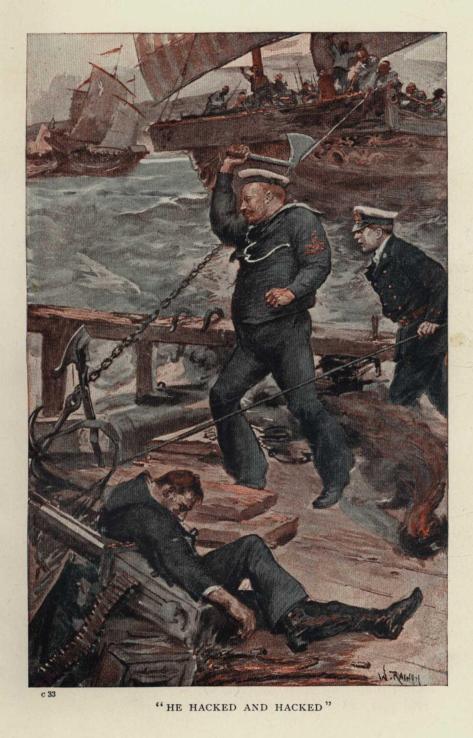
"HE HACKED AND HACKED"
I can't quite tell you what happened for the next few seconds; they seemed like years.
The third junk was firing her broadside guns, and the one that had got hold of us was firing rifles; and we were covered with smoke, and could hear woodwork smashing somewhere all round us, and how it was we were not all killed I don't know to this day.
"I can't do it; God help us, sir!" Sharpe groaned, and left off hacking at the chain, and began to try and cut away the side of the poop where the grappling iron had fixed itself; but the edge of the axe was all blunted, and would hardly even cut wood. It was perfectly awful, and you could see the cruel brutes in the bows of the fourth junk hauling in the rope, hand over hand. They thought that they had caught us, and were making the most tremendous noise, shouting and yelling.
They had hauled themselves to within twenty feet of us, and would be alongside in another few seconds. We could see them crowding for'ard, waving swords, and getting ready to pour on board. They began throwing stink balls, too, but these fell into the water, or, at any rate, we were too terrified to notice them.
I suddenly wondered why the Maxim wasn't working—I'd not thought of it—and looked round and saw why. It was all battered in a heap, and two of its crew were lying underneath it.
I don't know what I did, or quite what happened then, but I found myself under the poop, hunting among all the wreckage for my revolver.
I didn't find it, but got hold of a cutlass and was rushing up again, when I heard Sharpe give a yell of joy, and was just in time to see that awful rope "part", and the people in the bows of the pirate junk fall on their backs in a heap.
"We're away, sir!" Sharpe shouted, and, darting for'ard to the six-pounder, sang out to the men steering to turn her round a little, and fired four times right into the pirate's bows.
They came round, too, and fired their guns at us; but we were beyond worrying about gunshots now, after all we'd been through, and paid off again before the wind, the third and the fourth junks following us close behind, and the first two a long way behind.
My head was simply going round and round, and my ears were ringing and buzzing. We were still in a cloud of powder smoke from the junks, and our poop was a perfect wreck.
I had time to look round now—the Maxim gun was lying there, knocked to pieces, the two men near it were quite dead, horribly smashed up one was, and there was hardly an undamaged plank to be seen. The native boat hanging over our stern had been smashed to pieces, and the wreckage of it was trailing in the water. We cut it adrift. Bits of wood and sail and rope were lying all over the decks, and up above our sails were full of holes. The main gaff was hanging down and beating against the sail, and tearing long strips out of it; but the mast still stood, and the rudder wasn't damaged, and we were simply roaring through the water again.
Then the third junk began creeping up on our starboard quarter, not overhauling us very fast, which showed that our speed wasn't much decreased; and directly the six-pounder would bear, Sharpe, who had taken charge of it, began firing into her, and hit her several times. We could see her trying to edge away.