FORD OF H.M.S. VIGILANT (continued 5)
Reading edition
And all the time we had thought how jolly comforting those flames were, and that they might help them to find their way back. I tried to get more from him about Jim, but he didn't know any more, except that there had been a lot of firing, and he had seen him fall, and two men lift him up. But that was enough to make me feel frightfully sad, though I didn't really seem to imagine that it was all quite real; and the pain in my head was so bad, and my arm was so painful, and I was so stiff and cold and cramped all over, that nothing could make me much more miserable, not even knowing that we had been captured by the pirates, or Jim had been badly wounded.
"I fell into a ditch or something," Miller went on, "an lost my way and got be'ind'and, and tried a-takin' a short cut, and something 'it me on the head and fair dazed me, and them ugly devils came up and collared me—came up from be'ind, they did. I never got a chance.
"I've got a bit of a scratch 'ere, sir," and he crawled over to me, and stooped to show me a groove across the top of his head. A bullet must have done it, and the hair was all matted together with blood.
"How did they catch you?" I asked Martin.
"Well, it was like this, sir. I saw 'em a-picking of you up—that not being so difficult, beggin' your pardon—and, not thinking, I slipped along arter you, forgettin' that I'd only got one arm that 'ud work. Well, sir, I got separated from them two others, and had 'em 'eathens all round me, and they got the best of it, sir." He was very gloomy, and lifted his left arm a little way from his side. "Ain't no good, sir! Somethink's broke in my shoulder."
Miller had found a bowl full of water, and that made me remember how thirsty I was, and he knelt down and gave me some too, holding my head up. It was jolly difficult to drink, my lips were so swollen, and a good deal of it ran down my neck, but it was jolly refreshing.
"What's the matter with my arm?" I asked him. "I think it's broken."
He took hold of it very gingerly, whilst I held on to the wrist and jammed my teeth together, and then I saw by the funny way the sleeve bent up halfway above the elbow that it must be broken. I felt the broken ends grate together when he tried to move it. Oh! it was so painful.
He knew something about bandaging and splints, and tore down some of the thin rafters and lashed them on each side of it with his black silk handkerchief, and that made it more comfortable, and I managed to get on my feet. I felt an awful wreck, and was as weak as a mouse.
We were all plastered with mud and green slime, and were wet and horrid. I had lost one of my gaiters and my cap, and my revolver, lanyard, and cartridge belt were gone; but I didn't really worry, because I felt too ill, and my head throbbed so much that I had to lie down again, and it was impossible to think properly, because everything was going round and round inside it.
There was a noise on the outside of that door, and it opened very slowly, whilst we all stared at it, and a Chinaman put his head very slowly in, looked at us, saw me turn to look at him, drew it back again, and shut the door. I suppose he must have heard us talking. I think that I must have gone to sleep after this, because the next I remember was a tall, gloomy-looking man standing over me. "You're an officer, aren't you?" he asked me, and I told him that I was a midshipman.
"Come down with me," he said, and helped me to my feet, and supported me down a spiral wooden staircase.
He got me into a room below, which was fitted up with European furniture—a writing-table, some cane easy chairs, and a camp bed. He made me sit down, and began pacing up and down the room. There was a clock on the table, and I saw that it was nearly midday. He went on pacing backwards and forwards, and I wondered whether he was the Englishman who had stolen Mr. Hoffman's yacht. I hadn't the least idea what was going to happen. Then he took down a shaving glass and held it in front of me.
My aunt! I was a sight, if you like. All the left side of my forehead and face was black and blue, and my left eye was quite shut up, and my upper lip was tremendously swollen and cut. No wonder that Miller and Martin had been surprised when they saw me.
He smiled grimly, put the glass down, and just then a Chinese servant came in and spoke to him.
"I have some food ready for you; come and take some, it will do you good," he said, and led me into the next room, where there was a big bowl of hot soup. The sight of it made me feel ill; but I swallowed a little, and found that it was doing me good, and managed to get through it all. It was jolly painful to put the spoon in my mouth.
He told me that he had sent some food up to Martin and Miller, and that an old native who "doctored" for him was coming soon.
He seemed strangely worried, and couldn't sit still. I should think that quite a dozen Chinamen must have come in whilst I was getting through that soup and soaking bread in it. They all seemed very excited when they saw me. Most of them scowled at me. Several of them were plump, prosperous-looking men, jolly well dressed, but others looked more like soldiers or sailors, great bony, leather-skinned, fierce-looking fellows. He seemed to have trouble with them, and once or twice spoke very angrily. I noticed, too, that whenever any of them came in, he put his hand to his pocket. I think, from the bulge, that he had a revolver there.
He didn't look in the least fierce, except when he was angry—not at all like a man who could have done all those wicked things—and I began wondering whether he could really be the man everyone had been cursing. I suddenly thought of Mr. Travers, and blurted out, "We've got Mr. Travers back—that lieutenant you caught"—and, like the conceited ass I am, said, "I found him."
"I know," he said bitterly; "I never wanted to take him along; it was either killing him or taking him prisoner, just as it was with you and those two men. He fought like a demon, simply threw himself on us, and had a revolver, too. I had to knock him on the head and take him along. You'd better not let those people you've just seen know that you were the one who found him. They've vowed to torture every one of those junks' crews who fall into their hands."
I wished then that I hadn't spoken.
He began working himself into a passion, and his face did look wicked. He was tall and lean and very good looking, and he clenched his fists, and jerked his arms about, and began cursing everyone—Captain Lester, the Admiral, Mr. Hoffman, himself, and Mr. Hobbs.
"How are they? How's Sally?" I asked; but he didn't seem to hear the first time, and raved about his cursed bad luck. Presently I asked again.
"I wish to heavens I'd never set eyes on either of them."
"Why don't you send them back to us?" I asked.
"Send 'em back? I daren't; my life isn't worth an hour's purchase now, and they'd never let me. They'd kill them first, and me too. I don't run this show—not really; it's run by some of those Chinese mandarins—two or three of those who've just been in here. They think that as long as Hobbs and his daughter are in their hands they can get theer ransom, and that your old fool bull dog of a Skipper don't dare touch them. They want me to marry the girl—to make it more certain."
"We thought that you were trying to marry her," I said stupidly.
"That's nothing to do with it—nothing to do with you," he jerked out very fiercely.
"If your fool Captain will run his head up against us, I shall have to marry her to save her life and mine too."
"That's what those fat, oily-looking beasts want to do, and want me to do; and those other bloodthirsty rascals want to cut their throats and have done with them, say they've only brought us trouble, and wish to get back to their old established pirate business," he added, sneering.
"I've got them in the only strong walled house in the town, and I've got a hundred of my best men to guard them, but I can't trust 'em."
"If I'm caught I hang," he began shouting—I really thought that he'd forgotten me—"and if she knows that it will save my life, I believe she will marry me. If things go wrong I go, and directly I go, you all go—Hobbs and all of you, and the poor girl too" (he clenched his hands across his forehead). "We've the scum of the Yangste here. They'd cut my throat for a cent if I left off being useful to them, and they'll cut all your throats for pure devilment."
He sank down on a chair and stared in front of him.
I had dropped my spoon and was very frightened.
A man came running in with a letter, talking very fast. He gave a horrid smile when he had read it. "It's from your fool Captain. Wants to know whether you're alive, and says if any harm comes to you, he'll do I don't know what."
"Go back upstairs and don't move till I tell you;" and he sat down at the writing-table.
"Please tell the Captain that I'm well, all but my arm, and that it was my fault that I was captured, not the Commander's," I asked him, because I had been worrying about that all the time, and knew that the Commander must have had an awful time with Captain Lester, and that that would be unfair. I knew jolly well that I'd made an ass of myself, and made things worse and more difficult for everyone by getting myself and Martin taken prisoners.
He nodded grimly.
"Do tell me whether they all got away safely last night?" I blurted out.
"They left one marine dead, no one else." He began to work himself into a passion again. "My men almost got out of hand last night—I'd a hard job to keep them back—and if that old fool of yours lands again I shall lose all control over them. He won't believe what I wrote to him, so I'm going to write it stronger this time. If he comes lumbering along here they'll all see 'red', and kill every white man they can get hold of—and woman." Then he suddenly came across and gripped my shoulder. "A thousand years ago—eight hundred years ago—a girl wouldn't marry a man unless he did something to win her—sacked a town and carried her off. Now they want flowers, and chocolates, and candies, and pretty speeches—ugh!"
Then he grew calmer.
"Go along up now—Ford your name is, I see—and wait till dusk. I'll try and get you all over to that walled house. It's your only chance."
I was just going, when he called out, "In case anything happens, you had better take this," and he opened a drawer and pulled out a revolver and a couple of packets of ammunition. "They say it's easier to die fighting," and he turned his back on me.
Feeling very frightened, and not quite understanding what he'd been talking about, I crawled upstairs, the Chinaman outside the door scowled at me, opened it and shut it after me, and I heard him swing the big wooden bar into its hole.
Martin and Miller were asleep—they evidently had had a jolly good meal—and presently a funny, jovial, fat old Chinaman came along and looked at my arm. He took my coat off and cut the sleeve of my flannel shirt, and the arm was a most horrid sight, absolutely all mottled purple from the elbow to the shoulder. He showed me two tiny holes, made a "poof" noise with his lips, darted his finger as if it was a bullet, and nodded at me kindly. Then I knew that it was a bullet that had broken the bone. He put on cotton wool and proper splints and proper bandages, and slung the arm up to my side and across my chest, under my shirt, and helped me on with my monkey jacket, and sewed my sleeve to the side. Really the old chap made me very comfortable.
He woke the others too, and did Martin's arm—the collar bone was broken—and cleaned Miller's head, and then went away, apparently quite honoured at being able to show his skill. I quite loved the old chap, and he made me so comfortable that I lay down, and when my head was quite still it did not throb so much, and I got in a jolly good sleep.
I woke and found the room quite dark, and Miller and Martin both snoring. My head was quite clear now, and I felt much stronger, groped about, and managed to get hold of that bowl of water, drank a little, and then propped myself up against the wall and wondered when that Englishman was going to take us away to Mr. Hobbs and Sally. It was so exciting to think that I should see them soon, that I really forgot that we were prisoners for some time; but then, after waiting and waiting, and hearing nothing except those snores, I began to feel frightened and miserable. I could think now without my head burning inside, and then I thought how I had muddled up all Captain Lester's plans, and "washed out" all that I had done for him. If I had only been man enough not to have minded Captain Marshall's chaff, I shouldn't be here, with my arm broken and a prisoner, and with Martin too; and I was so wretched, that I wished that I had been killed instead of Tuck, that marine whom I had seen fall and dig his nails into the ground. After all I had been longing to do, it had simply come to this, and I snivelled a little, in the dark, for there seemed to be nothing more worth living for.
Presently there was a loud boom a long way off, and almost directly afterwards, the sound of a very big shell bursting. That wasn't very near either, but I knew jolly well that nothing could make that noise except one of the Vigilant's eight-inch guns, and I could feel my head throbbing inside again with excitement, and wondered what was happening. Then more came, and other smaller ones, from quite a different direction. I had seen an opening in the wall—you couldn't call it a window—just outside the door, and I thought that perhaps the Chinaman would let me look out; so I groped round until I felt the door, and rapped on it with my knuckles. They didn't make much noise, and I kicked it with my feet, and then listened to hear if anyone moved; but there wasn't a sound.
I tried to shake the door, and it seemed to "give" towards me, and then to stick in the frame—I felt certain that the wooden beam was not in place—but I couldn't make it budge any more. I woke Miller, and he came across and got his fingers in a crack and pulled, and the door creaked and opened, almost knocking me down. We peered through the darkness and listened, and presently I could hear a clock ticking—it was that old clock I had seen in the Englishman's room.
"I'm going down," I whispered to Miller. "Help me off with my boots."
I got them off, felt that the revolver was still in my pocket, and began creeping down that spiral staircase, keeping to the outside and feeling the wall with my one hand. Every step creaked most horribly, and I waited, trembling, each time, but nothing happened, and then I had turned the corner and saw the bottom, and that some lamplight was coming out of that room.
"Are you all right, sir?" I heard Miller whisper; and I whispered back and felt braver, and got out the revolver and crept down. I couldn't hear the clock, because my heart was beating so horridly, but I got down to the door and looked in. There was a lamp burning on the writing-table, but not a soul there, and I went through, very softly, into the room where I had had that soup, and there was another lamp burning there, and any amount of food on the table. It looked as if someone had only just finished a meal—a book and a fork were lying on the floor, and the chair had been upset.
There was a dark place beyond, with a flickering light in it, as if a fire was burning; but I wasn't plucky enough to go in there, ran back to the foot of the stairs, and could just see Miller's scared face looking down. I beckoned to him to come down, and he did so, making an awful noise, and Martin came too. They got hold of one of the lamps, and I didn't mind going into the kitchen place then. It was quite empty; there was no one there. A funny-looking kettle hung over a small wooden fire, on a big flat stone, and was singing very quietly, and there was a saucepan full of cooked potatoes. They were quite warm, and I seized one and began to eat it. It was jolly good.
Miller and Martin were so hungry, that they forgot everything else, and ran back to the table and began "wolfing" food.
I had never thought of escape till now; but it flashed across me that perhaps we could get away, and I went back to the foot of the stairs and followed a long passage, towards where I felt some cold air, and suddenly came to an open door, and put my head out.
You know what happens when you open the door of a rabbit hutch, and the rabbits come and pop their heads out, and swizzle their noses and blink their eyes, and look as if they didn't believe it, and run back again? Well, that was exactly how I felt and what I did. I ran back to Martin and Miller and told them, and they left off eating and came along with me, and we all three looked out.
It was quite dark, except for some stars overhead, and it seemed to be a small courtyard. We stepped out very gingerly—I had my revolver in my hand again—and we searched round, and found a high wall all round, and a very big door all studded with iron bolt heads, and with several thick beams across it.
We couldn't hear any noise near us, but there was a funny murmuring, buzzing sound some way off, and just like the sound of the mob at Tinghai that night of the fire, and far away we could hear big guns, and shells bursting.
"That's our old eight-inch, sir," Miller whispered, as one especially loud report shook the door. "I expects the old man—beggin' your pardon, sir, Captain Lester—is coming along to look for us." The smaller noises, right in the other direction, he said was probably the Ringdove and the Oh-my-eye on the other side of the island (the bluejackets called the Omaha the Oh-my-eye). We couldn't really quite understand why they were firing, but it was jolly comforting for all that.
I wondered what had become of the Englishman and the Chinaman who had been guarding us, and the servant, and wished he would come back to take us to that house on the hill. Now that I had a revolver, I thought that I might still be some use in defending Sally, if once I got there.
I slipped back into the house to see if perhaps he was lying down on the bed and I hadn't noticed him, but he wasn't. The clock showed a quarter past eight, and I knew that it must have been dark for more than an hour, and felt frightened. The noise of the mob seemed to be getting louder and nearer too, and I ran back to Miller and Martin, who were still near the gateway.
Just as I got to them we heard some feet pattering along the street outside, and then more and more, and they stopped outside it and began pressing against the gateway, and then began banging at it with something hard.
The bangs seemed to go right through me. I was awfully frightened.
More people came rushing along; there was a fearful din outside; we heard something scrape against the wall, and someone scrambling up. I looked up and saw a man's head just above me. He was crawling over the top, and was just getting his legs over. I let my revolver off and he dropped back again, though I don't think he was hit, and the crowd began yelling like mad.
A rifle went off, the door splintered, and something flew past me. Martin pulled me to one side. "Keep out of the way, sir;" and the two of them hunted round for some piece of wood or other, and came back with some thick sticks. Stones began dropping over, and we crouched under the wall to dodge them. They came in hundreds all over the courtyard, and knocking up against the house. There was a terrific crash against the great gates, and they sounded as if they were giving way.
"We'll be scuppered, sir," Martin groaned.
"Run for the house," I whispered; and we rushed back. One stone nearly hit me, and I heard a thud and Miller cursing; but we all got inside and slammed the door, and fumbled about to find the bolts.
"Go and get a lamp, sir," Miller shouted hoarsely—Martin was too frightened to do anything except get in our way—and I darted off.
As I ran along the passage I heard my name shouted, "Mr. Ford, Mr. Ford! Where are you?" and a short, grey-bearded European came rushing out of the kitchen place. I thought at first that it was the Englishman, but it wasn't.
"Show us how to bar the door," I cried, and he came running with me.
"Quick, mon, quick! Bar it up—that way; there's the lock—not that way," and he shoved Miller aside and shot the bolts in.
I was too frightened to ask him who he was, and even to remember that I hadn't any boots; but Miller sprang up the stairs and brought them down. The man, whoever he was, wouldn't let me put them on, so Miller tied the laces together and hung them over my neck.
"Follow me!" the Scotchman yelled impatiently—I knew he was Scotch by his accent—and we ran through the sitting-room to the kitchen, and then we crept through a narrow door. He disappeared into the house, but came back, and I saw him shove a big key into his pocket.
"Be varry careful," he whispered, and we groped our way down some irregular stone steps. We could hear them still banging away at the courtyard door. I kept on bruising my feet and toes in the cracks, and stumbling, but the old Scotchman always seemed to keep me from falling; and at last we seemed to be at the bottom, and near some water—I could hear it lapping against the stones. "Hush!" he whispered, and bent down, stretched out his hand, got hold of a rope, began hauling it in, and a native boat came sliding up, out of the dark.
"Get in—quick!" he whispered, and we all stumbled in, one after the other, and he jumped in after us. Right above us I could see two lighted windows, and knew they were those two rooms, and as he shoved off we heard a splintering sound—the big door had given way—and heard the mob rushing across the courtyard, yelling in the most fearful manner, and begin banging at the house door.
I had hurt my arm again getting into the boat, and the pain of it must have numbed me, because I quite well remember that I wasn't so frightened then as I ought to have been.
We could just see the strange man standing up in the stern, swaying from side to side, and working a scull as the boat wriggled through the water.
"It's aboot twa hours afore high water, and we've the flood wi' us, the Lord be praised!" he whispered. "Keep down oot o' sight," and we tried to squirm down into the bottom of the boat below the gunwales.
He stopped and stooped down, and we saw that he was putting on some kind of a Chinaman's coat and a native cap.
Then he went on again.
CHAPTER XIII
Mr. Ching to the Rescue
Just in Time—Too Late!—In Hiding—Mr. Ching Arrives—Death of Mr. Hoffman—The Attack on the House—The Vigilant Signals—The Fog Increases—Searching for Rifles—Ford finds the Ammunition—Ford Saves the Situation—Waiting for Daybreak
Written by Midshipman Ford
We went wriggling along through the dark, and presently began to pass between junks—heaps of them. You could see nothing but their tall leaning masts sticking up like slate pencils. We dodged in and out, and sometimes a voice would sing out from one of them, and we would huddle down in the bottom of the boat, whilst the Scotchman replied in what I suppose was Chinese, and pushed on.
We must have gone like this for nearly twenty minutes, I should imagine, and then he stopped to take a breath.
"Who are you? Where are you taking us?" I whispered; but he didn't answer, and, changing his hands, went on pushing the scull from side to side very vigorously, but stopped a minute or two later and looked behind us, where we could all at once see a great red glow, which showed up the junks we had just passed.
"They've set a light to the boss's hoose," he whispered; "they'll be after seeking the little lass the noo." And he worked harder and harder, and the shadows got darker and the water more narrow, and I knew that we were getting under some high land, and wondered whether we really were being taken to that house on the hill. Up over our heads we could hear a lot of talking and wrangling, and suddenly a rifle went off, and then another, and we could hear cries, and presently all was quiet again.
My heart was simply thumping against my side.
"God grant we be in time," I heard him say to himself; and he stopped sculling for a second, peered through the darkness, and then shot the boat in till it rasped against some stones.
"Get oot!" he whispered. "Doan't talk a word, and jest follow me."
We got ashore as quickly as we could. He had a piece of rope in his hand, and made us all take hold of it, and we followed him along a steep path. We hadn't gone ten yards when there were more rifle shots and more yells.
"The Lord be praised! they're still shooting 'em," he said, and hurried along all the faster. I could hardly keep up, and the stones hurt my feet.
We seemed to be making a long curve away from the noises and the water, and he kept on losing the path, and we had to shove our way between high bushes, which scratched us; but then we turned to our right, and could see the top of a high wall right in front of us.
He broke into a run, we dropped the rope, and ran after him up to a small door. He fumbled for a moment with the lock, it opened, we crept in, and he shut it again.
We were in a garden place now, pitch dark, and he led us across it underneath some trees with low branches. The noise of rifles seemed to be right in front of us, and we came to the walls of a house with not a light showing. He knocked at a door; nothing happened. We rushed round to the other side to a smaller one; he tried his key again, and it opened, and an old Chinese woman with a tiny lamp in her hand, and her mouth open with fright, was looking down at us.
The Scotchman turned to me. "Go in there; Hobbs and his lassie are there. Get them here in two minutes; I'll be back then. We must get them away. Quick, for God's sake, boy!" and he disappeared.
I went in, and heard Sally's voice singing out—very frightened and very sad, it seemed, "Who's that? Is it Captain Evans?"
"Midshipman Ford of the Vigilant," I called out, not knowing the least who Captain Evans was. "We've come to take you away." My aunt! I was proud then; for it suddenly struck me that, after all, I should be able to do something for Captain Lester. Everything had really seemed to work out right, and I expected Sally to come tearing down, and was jolly glad that there wasn't enough light for her to see me; but instead, I heard a sob and then a fall, and guessed what had happened.
The old woman brought her light, and I saw that she was lying all in a heap. I hadn't the least idea what to do. "What d'you do for a faint, Miller?" I asked. "You've been through 'first aid'." I was frightened again, and didn't know what to do; but the old Scotchman came rushing into the house, picked her up, took her into another room, and shook her. Miller had got hold of some water and shoved it over her head, and she tried to sit up.
"Where's Hobbs? Where's your father?" he called to her loudly; and she pointed through another door. And we found the little man lying in bed, looking ghastly; he looked an absolute skeleton.
He began to curse the Scotchman, but I stepped between them. "I'm Midshipman Ford of the Vigilant, sir, come to fetch you and Miss Hobbs. You must come immediately; these are two of my men."
I must say that we didn't look very respectable, but we were good enough for him, and he crawled out of bed and began to dress.
"I'm too weak to walk much, but reckon I'll do it if it ain't far. You've been a tarnation long while finding us," he grumbled.
I don't think that I liked him very much.
All this time the noise outside was awful—rifles firing, crowds of people yelling—and stones began to patter against the shutters. The old Scotchman couldn't wait any longer, wrapped the little man in a long Chinese coat, lifted him off his feet, told Miller to bring Sally along, and ran out of the house. "So long as the boss's people keep firing, it's all right," he told me; and then I saw Miller lift Sally in his arms, in spite of her struggles, and we all followed, stones flying past our heads and rebounding from the walls. We went across the garden under those trees, and made our way back to that small door. The Scotchman put Mr. Hobbs on his feet, and I heard him trying to get the key in the lock; but just as he was going to open it, there was the sound of a whole lot of people running towards it, and they threw their shoulders against it and began talking very softly.
I was very frightened again, and I heard the Scotchman moan: "Too late! We're done for!" and we all fled back to the house.
The front of it was now all lighted up with a red glare, showing above the top of the wall.
"They're setting fire to the huts," he cried; "go up to the top room. Take them up there, bar the door at the front, and block it up with tables—anything." And he rushed off, came back for his revolver, which he had given to Martin, and disappeared.
"Guess Sally Hobbs ain't a ten-cent doll," I heard her sob. "You can put me down right away." She led us along some passages, up some steps, and then to the foot of a ladder. The little man got up it like a monkey, and she followed him.
"Draw it up, and let it down when you hear us call," I sang out; and then we went back and began to pull along tables and benches and boxes, everything we could find, and piled them up behind the door in the front of the house. Before we had finished, the Scotchman came running up with his hands over his head. "We're fair lost! God be merciful to us! The boss's men want to know where he is, and won't hold out many more minutes unless he turns up. They want to open the gates; say they'll get their throats cut if they don't. Jorgensen has been killed—down in the town—two hours ago—down by that six-inch gun."
"Can't you do anything?" I asked quickly.
"No, mon, they hate me; and I fear they've killed the boss, and no one else can keep them in hand. They're all round us, and they've tasted blood, and the mandarins themselves couldn't stop them.
"Hark!" he said, "they're beating down the little door in the garden wall. Oh, God, they'll be right here in a moment!"
I was in an awful funk, though not for myself, I think, but more because of Sally. When one isn't in a funk for oneself it is easier to keep one's head. I don't think that Miller or myself cared a scrap what happened to us, so long as we could keep Sally safe. The Scotchman told us to bring any heavy things we could find to block up the door at the back, and then ran off and brought some rifles and bandoliers.
We bolted the door and piled everything we could find against it, and then ran round, barring the shutters. We didn't need any lamp, because the red glare streamed through the cracks and lighted up the whole place. The old woman had disappeared. Then we picked up the rifles and bandoliers, and he led us to the ladder, Sally crying out and lowering it. We all swarmed up and drew it after us.
The room was a small square place, with stone walls and narrow openings—you could hardly call them windows—in each wall. They were closed with iron shutters, and the one looking over the front was open, and the whole place was lighted up. The Scotchman and I looked out, and it was a most awesome sight.
Down below, about twenty yards from the foot of the house, was the wall and the big gateway, and behind it were the Englishman's men, stooping down to load and then popping up and firing. They seemed to be standing on some kind of platform or ledge, and were not taking the trouble to aim.
Out beyond there were flames pouring up from half a dozen huts, and we could hardly hear their noise because of the fearful shouts and yells from a dense crowd of people in between us and them.
They must have seen our faces in the light of the fires, for they yelled more loudly than ever, and we could see them bending down and then throwing stones at us. Stones began clattering against the outside wall all round us, and one came flying into the room, and I heard Sally sob with fright. We drew in our heads and closed the shutter, but before I drew in mine I am certain that I saw one of the Chinamen inside the wall point his rifle at us and fire. The room was almost dark now, except for one streak of light which came through a gap at one edge of the shutter, and just made light enough for us to see each other. Mr. Hobbs was lying full length on the floor near a wall, and Sally was lying down too, with her head on his chest, and moaning. I did wish she would leave off, because it made us all so much more frightened.
Directly we had closed the shutter, stones began clattering against it—and, I'm certain, some bullets too—and we heard a rush, and the mob charged the big gateway.
We could still hear the ships firing. "My God, I wish they'd come!" I heard Miller mutter; and that was what I had been praying all the time.
The noise at the back of the garden seemed to have stopped; but the firing from the wall was easing down too, and the Scotchman groaned out, "They're going to leave us;" and Sally, who seemed almost "off her head", kept on moaning, "Why doesn't Captain Evans come?"
I felt that I should go mad in a minute if I didn't do something. Miller must have thought the same. "It's no use sitting 'ere to get killed, sir. Can't we do something? Can't we fire at them? We've got three rifles." But the Scotchman wouldn't let us open the shutter.
"Keep still, mon; they haven't all left us yet," and we could still hear a few rifles firing from inside the wall.
Just for something to do, I began pulling on my boots—they were still tied round my neck with the laces—and it was awfully hard work with only one hand, and they were all sodden and stiff; but Miller helped me. We had just finished, when suddenly there was a rush of feet underneath us at the back of the house, and a furious battering noise on the shutters.
"They've broken in!" the Scotchman groaned, and Sally shrieked and buried her head in her lap. Miller seized a rifle and jumped across, pushed her out of the way, opened the shutter at the back, and leant out. I saw him load it, and he was just going to fire, when there were cries of "Sally! Sally! Open the door!" and more hammering.
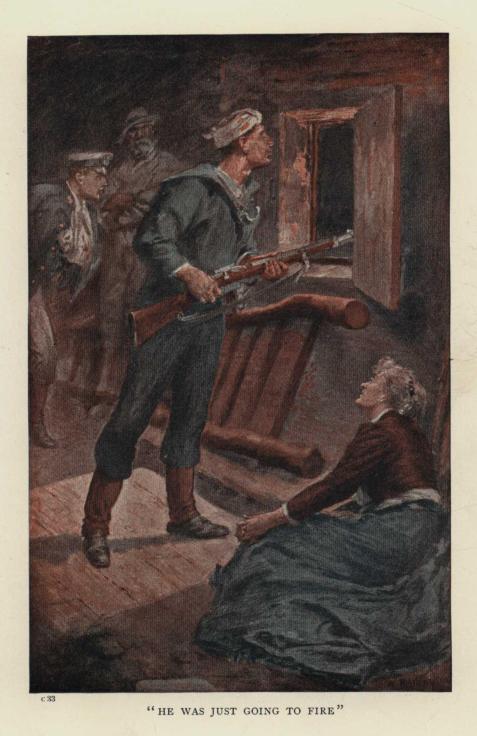
"HE WAS JUST GOING TO FIRE"
We jumped to our feet. Sally shrieked that it was Captain Evans come to save her, Miller roared "Who's there?" and we heard someone sing out, "Who are you? Is Sally safe?"
I knew the voice; it was Mr. Ching's, the Lieutenant on board the Huan Min. I forgot all about my arm, and jumped over to where Miller was. "Get out of the way!" I cried, and yelled down, "Midshipman Ford of the Vigilant. There are six of us up here, and Miss Hobbs is all right."
"Come down and let me in."
"Right you are, sir!" I shouted, and drew in my head.
"Isn't it Captain Evans?" Sally asked me.
"No. Mr. Ching of the Huan Min"
She moaned and began crying again.
We lowered the ladder and scrambled down, pulled the things away from the door at the back, and opened it, and there was Mr. Ching and twenty or thirty of his men, all crowding round.
I could only say, "Thank you very much, sir," and should have blubbed if I'd tried to say any more.
"Hoffman brought us, showed us a path up from the water. He's gone to try and keep order. Can she come away at once?"
I don't know what I was going to say. It didn't make any difference, because the noise at the other side of the house suddenly grew fearfully loud, and we heard the gates give way and swing back with a crash, and the mob rush through with frightful yells of triumph. Mr. Ching gave an order, and ran round to the front of the house, and I found myself following him with Miller behind me.
Some more men joined him at the corner, and then we came out into the glare and saw the bright gap in the dark wall made by the gates being open, and a mob sweeping up to the house. They had torches and blazing tufts of straw on poles. A few of the Chinamen inside the wall were trying to keep them back, but I could see most of them dropping over the wall outside.
Mr. Ching's people fired a volley into the mob, and then another, and some shots came from the room I'd just left—the Scotchman and Martin firing, I expect.
The mob didn't seem to have expected any resistance, and stopped and left off shouting. I could see many of them throw their hands up and fall, and there were shrieks and screams, the blazing bits of straw fell on the ground and were trampled out, and they began to fly back through the gateway.
I was swept along with Mr. Ching's men, and found myself in the gateway. Some of them were swinging back one side of it, and pulling aside bodies which were in the way.
Someone was trying to crawl away as the big gate swung towards him. It was Mr. Hoffman. I could see him well, and just managed to pull his legs clear as it swung to. He didn't recognize me.
"You hurt, sir?" I asked him.
"Shot through the chest; get me into a corner. Is Sally safe?"
Miller was nowhere to be seen, and I couldn't make any of the Huan Min's bluejackets understand. They were too excited.
"Try and get hold of me; get hold of my coat."
He grabbed at my left side; I gave a yell with the pain of it. "Not that side; the other, sir," and he got his fingers into the slit of my other pocket and drew himself on his knees, spitting blood out of his mouth and coughing.
Supporting himself like that, and with the other hand on the ground, he managed to crawl back to the house and then rolled on his back.
"Who are you?" he asked.
"I'm Ford of the Vigilant."
"Thank God you are safe! I'm dying. Bring Sally to me;" and he coughed again.
"It's not safe for her here; I'll try and get you round to the back."
I heard my name called, and ran towards the gate, and there was Mr. Ching looking for me. "Where is Hoffman? Are you all ready to start? We can keep them off for a time," he panted.
I pointed to where Mr. Hoffman was lying. "He's shot through the chest. He's dying. He can't move."
Mr. Ching groaned. "We shall have to stay here till daylight. I can never find my way back without him."
I forgot about the Scotchman.
The last of his bluejackets rushed back through the gate, the other half were swung across, and we were in darkness again, except for the glare over the top of the wall. Bullets were now spattering against the front of the house, and bits of plaster were trickling down, and we knew that the Chinamen from inside must have joined the mob. Mr. Ching rushed off to place his men round the wall, and I went back to Mr. Hoffman. He was trying to pull himself up against the side of the house, and I gave him my right shoulder to lean upon, and we got round to the back like that and to the door; but he couldn't drag himself over the boxes and piles of things heaped there, and lay down with his head on the stone slab, half in and half out of the door.
"Get me some water and bring Sally," he whispered. "I'm finished. God have mercy on me!"
I couldn't see his face—it was so dark—but his voice sounded awful.
I was trembling all over, and scrambled in and called out for Sally. I forgot to call her Miss Hobbs.
She was still in that small room, and I heard her crawling across the floor. I heard the Scotchman and Martin firing out of the window too.
"What is it?" she asked in a scared voice. "Are we safe? Has Captain Evans come?"
"Come down with me. Mr. Hoffman's dying, and wants to see you."
She wouldn't come for some time; and when she did come she was trembling all over, and I had to steady her with my right arm along the passage.
We found a tin with some water in it, and I took her to Mr. Hoffman, where we could just see him lying.
"Thank God!" I heard him whisper, when she bent over him.
I went away, wanting to cry.
Then I suddenly remembered that the Scotchman could guide us down to the water, and ran off to find Mr. Ching, but couldn't.
Miller appeared from somewhere.
"That old Scotchman could guide us back," I said. "Where's Mr. Ching?"
"That ain't no good, sir," he said. "They're all round us now, 'undreds and 'undreds of 'em, an' 'e's got only fifty men with 'im." Then I noticed that bullets were coming from the back of the house as well, and heard furious firing near the little gate by which we had entered.
"That Chinese Lootenant is over there now, sir."
I went across for him, but couldn't find him. His people were outside the little doorway, firing into the dark, and he must have been there too, and I didn't dare to go out. I couldn't see a yard in front of me.
I think I must have been too absolutely "done up" then to do anything more, and I really forget what I did and what happened. I know that I sat down on a stone somewhere near that small doorway, and rested my head on my knees, and squeezed my left arm to change the pain of it. I know that rifles were going oft all round me, and people were shrieking and yelling, and sometimes I heard Miller's voice shouting; but everything seemed to buzz round in my head, and nothing seemed to matter in the least.
I rather fancy that my idea was to wait there till Mr. Ching came back, and tell him about the Scotchman.
I was roused by hearing the door slammed and being nearly knocked over. Mr. Ching saw me. "Get along back to the house," he gasped—his face was streaming with blood—"I can't hold the walls any longer. I have not enough men;" and he more or less lifted me to my feet and gave me a push, and I went staggering along with my legs giving way under me.
I remember seeing Mr. Hoffman lying flat on his back, with his face turned up and his eyes looking at me, and remember speaking to him; but he didn't answer. Sally wasn't there either, and I stepped across him, and somehow or other found myself stumbling up the ladder into that room, and heard Sally sobbing in a corner. I was shivering, and my teeth were chattering, and that horrid sick feeling came on again.
Just as I got to the bottom of the ladder a stream of fire shot up across one of the windows, and I heard a rushing noise, as if it were a rocket; but I didn't take any notice of it, for everything seemed to be going round and round People crowded up after me, and pushed me aside, and began firing out of the windows, and the room felt stuffy and full of powder smoke. Sometimes someone would give a cry, and once someone fell across my legs, and I tried to pull them from under him, but couldn't, and let them stop there, and remember that the weight was pulled away presently, and I was pushed nearer the wall, and someone gave me some water.
* * * * *
The next I remember was recognizing Miller's voice; it sounded muffled and cotton-woolly and very far away. He was saying: "The Chinese Lootenant wants to know if you can take in Morse[#], sir. The Vigilant is signalling. We fired a rocket an hour ago to let 'em know that the Huan Min's men were 'ere, an' we've been tryin' to take in their signal."
[#] Morse code for signalling at night by means of long and short flashes of a lamp.
"I can't take in flashing lamp," I told him, trying to make my brain work.
"It ain't flashing lamp, sir; they're adoin' it with a searchlight, and very very slow, sir, an' the Chinee signalman what came along with 'im, sir, is dead, sir. You'll 'ave to come along pretty quick too, sir; there's a 'orrid fog been shuttin' everythin' out ever since, but it's just cleared off for a time. The wind's gone round to the south, and it 'as been as thick as pea soup."
I told him that I would try, and got him to help me up. I knew that I could read it if it was slow enough, and my brain would only remember properly. We had to go to the other end of the house, and I don't know how Miller got me down that ladder. I know that I slipped and was caught at the bottom, and my left arm was wrenched again. The pain seemed to wake me up, but I had to grind my teeth and sing out.
Miller helped me along the passage and made me stoop down when we passed a window, because the shutters had been thrown back and men were standing at them firing out, and sometimes bullets were coming in.
"How are we getting on?" I asked him.
"Pretty middlin', sir. We've only had about three killed and two or three wounded, and we can keep the skunks out of it when we can see them, which we can't always do on account of this 'ere blessed fog."
He helped me up some steps, and then up a short ladder. Someone hauled me out of a small square opening, and I saw that there was nothing but fog all round drifting slowly past. I heard Mr. Ching's voice: "Can you take in Morse? I've forgotten it, and my signalman is dead—shot half an hour ago;" and he pointed to a huddled-up figure beside him. "They've been trying to signal through the fog ever since I fired that rocket, and he got one or two words, but it's been too thick till now. They're just starting again."
I did my best to pull myself together, and asked him where the Vigilant was, and followed his finger, pointing through the mist, and suddenly saw a very faint searchlight beam sticking straight up.
"Don't stand up; kneel down," he whispered. "They are firing at us." So I knelt down very quickly. Just seeing that beam made me buck up, and I watched it very steadily. I had only just knelt down in time, for a bullet came flying past, and made me crouch still lower.
Then the beam began to wag very slowly—long sweeps down to the ground for "longs", and short ones only half-way for "shorts".
"Get your knife and scratch 'longs' and 'shorts' on a tile as I sing them out," I told Miller, and heard him do it.
This is what I took in: "... rst ... tenant to Lieutenant Ching (full stop). Captain landed with one hundred and fifty men two hours ago (full stop). Afraid dense fog has de——" Then the beam disappeared as a thicker bank of fog rolled across; but it was grand news, and I wanted to cheer for joy, and kept my eye fixed on the same spot, and presently the beam showed again, and I spelt out: "rocket if Midshipman Ford, Armourer's Mate Miller, Private of Marines Martin is with you."
"They want another rocket fired, sir," I told him.
"I haven't any more rockets," Mr. Ching said. "We only brought one; the others were left in the boats by accident."
The beam started again. "First Lieutenant to Lieutenant Ching (full stop). Captain has——" They were repeating the signal, but then the beam disappeared entirely, and we could see a white wall of fog creeping along the ground, and even swallowing up the trees underneath us.
"They ought to be here soon," Mr. Ching said, "if only they can find their way."
He sent a man round with the news, and we could hear his bluejackets making a funny cheering noise.
I felt ever so much better, and simply being able to take in that signal, and be of a little use, cheered me up wonderfully. It was so grand to know that the Captain had landed with so many men and was coming to our rescue. I knew he would come just as quickly as he ever could, and oh! I did so long to see him, whether he was angry or not, and to tell him that it wasn't the Commander's fault—not in the least, and to know that Sally and all of us should be safe.
"Does Mr. Hoffman know?" I asked Miller. Mr. Ching had sent me down again, and had come down too, see how his men were going on.
"He's been dead this last hour, sir." He was dead when we had to come back to the house, and we dragged him in after us.
I did feel so sorry, because we should never have found where Sally was but for him, and he had done so magnificently; and I knew that the Captain would be so sorry too, especially as Mr. Hoffman had beaten him at weight lifting.
"You go and get some more sleep," Mr. Ching told me; but I felt so much better, that I implored him to let me stay with him, and he did.
"We are doing all right, aren't we, sir?"
"So far; but this fog makes it difficult for us to see them, and I fear they may try and rush us. We have not much ammunition left."
We went all round the house, and he spoke very cheerfully to all his men. They were at all the windows with their rifles pointing out, and peering into the fog. One or two men were wounded, and sitting with their backs to the wall.
"I am going to tell the news to Hobbs and his daughter," Mr. Ching said, when we had come to that end of the house. I had been going to ask him if I could do this, but he said it so curtly, that I thought he wanted to do it by himself, so didn't go with him.
"You have a lot of blood on your face, sir," I told him. "I hope you aren't hurt much."
"Only a stone," he said; but he wiped it off, till I told him there was no more showing—he wiped it off very carefully—and then went up the ladder.
Miller hadn't the faintest idea what time it was—somewhere about midnight, he thought. We were standing near one of the open shutters, and could just see the three or four bluejackets who were guarding it. Outside there was simply a grey black wall of fog. It had settled down so thickly, that you couldn't see a yard from the house, and was drifting in through the windows all damp and beastly. Everything was pitch dark; I couldn't see the flames at all (as a matter of fact, the huts had burnt themselves out, but I didn't know that); and Miller told me that everything had been pretty quiet during the last half-hour, nothing except an occasional shot, and that the Scotchman and Martin were still in the upper room. "We had a stiffish bit of business getting back to the house, sir. There seemed to be thousands of them on top of us, but they seem to have cleared off—some of them—and I'm thinkin' they may be after going for the Captain's party."
"Have you heard nothing of them—no firing or anything like that?" I asked; and when he said "No", asked him if he thought they would be able to find their way to us. He scratched his head and wouldn't give an answer.
"It's lucky, sir, you picked up that bit of Morse, sir; it's put new life into all of us."
I was so proud and conceited of myself, that I told him to go and lie down, and that I would look after the lower windows.
"No, I dars'n't, sir; they're keeping quiet now; but I'm dreadin' they'll be tryin' to rush us. I durs'n't, sir. We've only got about ten rounds a man left, and it may come to bayonet work, sir, afore we get through the night."
There really wasn't a sound coming from outside, and it all seemed so dark and moist and "creepy", that I really had a most horrid feeling "inside".
Mr. Ching came down the ladder. "She's asleep," he said, and I knew that he was disappointed. He began going round the men at the windows, seeing that the ammunition was distributed equally. Some men had only two or three rounds left, and I knew by the sound of his voice that this worried him very much.
One of his men brought round a huge bowl of boiled rice, and the bluejackets scooped it out with their hands and stuffed it down. They brought another one for Mr. Ching, and he shared it with Miller and me and the Scotchman and Martin. It was jolly good and jolly warming, and I have never forgotten it; and now, whenever the messman has a lot of scraps left over, and gives us curry in the gunroom, I think of it and of trying to save the bits of rice that wouldn't go into my mouth, and of that horrid fog.
Mr. Ching was talking of the possibility of getting some ammunition by searching all the dead Chinamen between the house and the wall, but then he remembered that the bluejackets' rifles wouldn't take the pirates' cartridges. They were using Mauser, and his men had only a very old pattern rifle.
"Why couldn't we bring in rifles too, sir?" I said. "There must be heaps of them lying out there;" and then, without thinking what I was going to do, I sang out to Miller to give me a "leg up", and scrambled through the window, and slid down on the ground underneath. Miller slipped down alongside me.
"Come back," I heard Mr. Ching say, but not very determinedly, and I had such a lot of "leeway" to make up for all the stupid things I had done, that I would not have gone back for anybody. You see, I thought that I might do something useful, and also I was rather ashamed that Mr. Ching and his men should have done everything and we so little.
"Give me two bags," Miller whispered; and Mr. Ching handed out two things like haversacks, and he slung one over my shoulder and one over his.
"Tell your people, sir, that we've gone, in case they think we're pirates, please;" and then we crept along until we found the door in front of the house.
"Most of them are in the path to the gate," Miller whispered, and we groped along it.
We hadn't gone five yards before my foot struck something soft, and it was a body, and I felt it all over, but couldn't feel any cartridges, and there was nothing either on the ground all round. I found several more without ammunition, and then, presently, a couple by themselves, with two rifles lying on the ground close by. It was ripping to feel their cold barrels, and the men had full bandoliers round their waists. I couldn't take them off by myself, so whistled for Miller very softly, and he came over to me. He had found another rifle and a good number of cartridges.
"Better take these back," he whispered; and we did, groping our way through the fog, and handed them in at a window.
I knew that there ought to be a good many on that ledge under the wall, where I had seen the Chinamen standing to fire over it, and told Miller.
"Right you are, sir! Let's try;" and we shoved off into the fog again.
"Is that gateway still closed?" I asked him.
"Been smashed over an hour, an' they've been swarming all over 'ere, up to 'arf an 'our ago, sir, just where we are now, sir."
Phew! I'd never thought that the pirates had been right inside the wall again, and I'm certain that I never should have come if I had—I'm positive about that.
I was fearfully nervous, and I think Miller was too, and we stopped and listened, and tried to peer through the fog.
We couldn't hear a single thing, and started out again. Then I ran into a tree, and the wet leaves and twigs scratched across the raw part of my face, and I let out a little "yelp", and we stopped to listen once more.
"We're too much to the right, sir," Miller whispered, and we both kept close together and moved towards the left.
We came on the wall all of a sudden, and felt that ledge. There still wasn't the least sound of anyone moving.
"You go that way, sir, and I'll go the other," Miller whispered, and left me, and I felt my way along towards where I thought the gateway must be. I felt any number of empty cartridge cases, and every now and again my fingers clutched a loaded one, and I slipped it into the bag; and I felt a rifle and was awfully pleased, and slung it round my neck—it was jolly difficult to do it with only one hand, and jolly uncomfortable too. Presently my foot hit up against some big wooden thing, and I knelt down and felt it, and thought it must be a part of the gateway, and that I must be right in the opening. That made me frightened, and I crept across and bumped into the other side of the door; it was simply swung back. I had kicked another rifle, but hadn't the pluck to go back and fetch it.
I just held on, trembling all over, and waited and listened, and then started again, following the door round till I got to the wall, and there, the first thing I felt, was a box on the ledge, right in the corner between the door and the wall. I felt it all over; it had a square hole in the top, and my hand went in and—oh! it was such a jolly feeling—it was nearly full of paper packets of ammunition.
It was too heavy to lift with my one hand, so I began to whistle very softly for Miller, and waited for him to come. I heard his whistle, but almost at the same moment I heard someone moving on the outside of the wall. I knew that it couldn't be Miller, and I do really believe that my hair stood on end with absolute funk. I couldn't have whistled again if I'd tried, and could not have run back to the house, however much I wanted to, because my feet wouldn't—absolutely wouldn't—move an inch.
There were more than one coming. There seemed to be a long string of them, and there was a funny rustling sound against the wall, as if they were carrying something soft, and they began coming round the doorway, some of them stepping on that rifle that I had kicked, but not picked up. The gate door was pushed back on me, and I squeezed myself into the corner against the ammunition box, and they began running past me, going along inside the wall—away from where Miller was. I could hear them breathing hard, and held my breath, till I thought I should burst, and thought they must hear my heart thumping—it was thumping away like anything. I'm not at all big, and I huddled down so close, that they went by without finding me, though once or twice something brushed my face, and knew by the touch and the smell of it that it was straw or hay, and that that was what had made that rustling sound.
I guessed directly what they were going to try to do—pile it up against the house and set fire to it.
I waited till the last one had gone, and then I managed to get to my feet, and heard Miller's whistle, very close, on the other side of that door, and that started my legs working, and I ran, stumbling, back to the house, with Miller after me. We bumped up against it; I don't remember getting inside, but only remember telling Mr. Ching everything, and that the Chinese seemed to be following the wall in order to get to the back of the house.
"The left side of the gate door doesn't seem to be damaged, sir," I told him; "they swung it back on me."
He made up his mind in no time. "They'll try and burn down the door at the back, there's no window from which we can shoot them," and he gave Miller ten men to go and close the left half of the gateway, whilst he took another ten and slipped round to drive the Chinese across to him.
He wouldn't let me go.
"Keep the rest of the men at the windows," he said, and disappeared in the fog. I ran round the windows to see that the men were there properly, and then went and stood behind the things piled behind the door at the back and waited.
It seemed like twenty minutes—it probably was only about one—and I was trembling with excitement, and when a little piece of mortar or something fell down the wall, I nearly yelled with fright. Then I heard the rustling noise again, and heard a bundle pushed against the bottom of the door, and then another and another. All of a sudden Mr. Ching's voice shouted, and there were cheers and shrieks, someone fell against the door with a soft noise, and there was the noise of people scampering all over the ground outside. A volley sounded out from behind me—the crash seemed to come through the windows—and more shouting and yelling, and I couldn't think what that meant, because the men with the straw couldn't possibly have got round there by that time.
I ran round to one of the windows at the front, and was just in time to prevent some of the bluejackets jumping out. We couldn't see anything, not even the flashes of the rifles at the gate. But the firing died down almost at once, and then people began running past the house, and we could hear them panting, and heavy blows and shrieks, and knew that Mr. Ching's bluejackets were chasing them. It was awfully weird, knowing all going on round us, and not being able to see anything.
Some of the bluejackets were so excited, that they did scramble out to join in the killing, and Martin and the Scotchman called out, from the top of the ladder, to know what was happening, and I heard Sally, very scared, asking too.
The noises stopped, and we could hear our people calling to one another; and we all shouted to let them know the way, and they gradually began to come back, climbing through the windows and panting for breath, several of them wiping their sword bayonets.
"Did you kill them all?" I asked Mr. Ching.
"Most of them, I think. You've done us a good turn—very lucky that you saw them."
He had left half a dozen men at the gateway to give him warning if they made another attempt, but Miller himself came back and brought that box of ammunition and two more rifles with him.
Mr. Ching was very pleased with these, because we now had altogether eleven Mauser rifles and seven or eight hundred cartridges.
It was grand, and I forgot all about the mistakes I had made, and my arm, and only longed for the fog to clear away and to see the Captain stalking through the gateway, and Blucher—I knew that Blucher would be there—smelling the bodies and wagging his tail and looking up at him, thinking he had shot them. It was splendid to know that it was partly due to me that we had driven them off, this last time, and that I had found all that ammunition.
"What were you firing at?" I asked Miller; and he told me that a lot of Chinamen had tried to rush through the gate—not the men with the straw bundles, but others from outside.
"We gave 'em 'gip', sir." He was very happy.
Mr. Ching told me afterwards that they had some tins of paraffin to throw over the straw. Wasn't it lucky that I had spotted them?
Sally was awfully sweet to Mr. Ching, said that he had saved her life twice, and was so nice that he ferreted round and got her something hot—tea, I think.
The old American was still sticking to his corner; I don't think that he had moved all the night.
After we had spoiled their little game they let us alone, and all we had to do was to take it in turns to lie down and sleep, and when we were on watch, to listen for any sign of Captain Lester.
The ships hadn't fired since the fog had come on. We had wondered what they had been firing at all the time.
You can just imagine how we did long for daybreak, and for that beastly fog to clear away.
A long time afterwards Miller came up to me; he was very excited.
"Listen, sir! Listen! The Cap'en's a-comin'."
I jumped up; it was still pitch dark, and the fog just as thick as ever, and then I heard far away the noise of Maxims—tut-tut-tut-tut, tut-tut-tut-tut.
"Them's Mary and Jane, sir, right enough." Those were the names the men had given the two Maxims which we used to drill on field-gun carriages.
"They've been firin' for the last twenty minutes, sir."
The Captain's coming at last. Hurrah! I couldn't help giving a shout of joy, and ran off to tell Sally, but Mr. Ching had told her a quarter of an hour ago.
"Guess I'm right tired," was all she said to me, and began crying again. I know she had something she wanted to ask me, but didn't like to.
She didn't seem half as pleased as I thought she ought to be; but that didn't worry me at all, and I went round the men who were talking and chattering, and I grinned at them in the dark, and I'm sure that they grinned back. I could have hugged them, they were such fine great fellows, and Mr. Ching squeezed my arm—not the bad one—and said, "We've saved Sally Hobbs all right, Ford."
I was absolutely happy, and felt jolly hungry at the same time.
CHAPTER XIV
"Old Lest" takes a Hand
Holding on—"Old Lest's" Sorry—The Marine Lands Again—"Old Lest's" going on—In the Fog—The Fog Lifts—After them!—The Maxim Gun—Keeping 'em on the Run—Shelling the Town—Resting—"It's Boss Evans!"
Written by Captain James A. Marshall, Royal Marine Light Infantry
Fancy me writing a book, or rather, helping to write one. I know a good lot of people will think the world's coming to an end, or that I've turned over a new leaf, and am becoming really a credit to the family. It's about time I did become a credit to them, poor things! I should imagine.
When I was asked to drive the giddy nib, I laughed. Laughed! why, I've never laughed so much since father died, as a dear little girl from Massachusetts told me once, when I tried to cheer her up, after that sad event had happened to her family.
We tried to get old "B.-T."[#] to wield the flowing pen, and tell of all his heroic deeds, but—well—he wasn't taking any—thank you kindly—and they got me to take on the job.
[#] Lieutenant Gore-Travers, known as Bored-Travers, or "B.-T."
You see, whilst old Truscott, the Commander, was lying on his downy couch with a bullet in him somewhere, he couldn't be expected to know much of what happened outside him, could he? Old Mayhew, our boss doctor man, wouldn't say where the bullet really was. Why, bless your soul, he wasn't going to give himself away, not he, and hung round Truscott's cabin with a face as long as a jews' harp whilst he was outside it, and as round and smiling as a Dutch cheese with a slice out of it when he went in.
It was all because that silly young ass Ford saw "red" that night we landed with my chaps to have a bit of a plugging match, whilst Whitmore went off with a No. 9 detonator and something in the gun-cotton "line" to blow a gun of sorts.
He thought that he was half-back in a "footer" scrum, or something like that, charged the whole blooming pack of Chinese, got "offside", and was collared and carried off the ground before we could get the referee to sound his whistle.
We argued it out with them for a while, but when old Truscott was doubled up with a bullet in him (you'd better ask Mayhew where), and two or three of my chaps had had holes made in them, we had to drop back to the battery, and couldn't even bring away Tuck, one of my men who'd been killed. They were so jolly anxious to make our acquaintance, that it was all we could do to hold on behind the wall, and the bank on the beach, till Whitmore had said goodbye to his chums and got aboard the cutter. Even then we couldn't have got away, if young Withers in the barge hadn't dropped a few gentle hints with his Maxim and emptied a couple of belts.
We pulled away back to Lawrence, who was waiting for us in the steam pinnace, and I ought to have been standing up in the stern sheets, waving my gory, glittering sword over my head and singing, "With a long, long pull, and a strong, strong pull, cheerly! lads! pull away", to encourage the sailor men. The only reason why I didn't, was because in the last rush to the boat I'd got a clap over the head which knocked me silly, had been plumped down in the stern sheets, and didn't know anything about it till we'd got aboard the old Vigilant.
I opened my eyes to find myself in my own virtuous bunk, daylight starting the flies skylarking, and Grainger, my servant, the trusty, faithful and never-to-be-forgotten one, poking me to see if I was still alive. I had the dickens of a headache, and at first thought it was due to the usual cause; but Grainger held up the serge frock[#] which I had worn the night before, and I remembered what had happened.
[#] Serge frock is a tunic made of serge, worn on undress occasions.
"That were your second best serge frock, sir," he said sadly, when he had recovered from his surprise at finding me alive. "Cost you four pun', three-and-sixpence—with postage, sir."
It was soaked with mud, and had a bullet hole through one sleeve. There was a dark patch of blood, too, just in the centre of my manly bosom, which Grainger never could wash out. Whose blood it was I never knew, and old Mayhew threw things at me when I afterwards asked him if he could examine it, and see if it belonged to a Chinaman whom I had opened up a little during the scrap.
"We 'aven't paid for it, 'ave we, sir? We couldn't send it back as a misfit or some'ow, I s'pose? I knew you'd being doing som'ut like that, sir, if I let you wear it, and your third best pair of trouses is all split over one knee another three-pun'-ten gone slosh, sir—that is, if they won't take 'em back, and there's another of our hye-glasses gone too."
He shook his head reproachfully at me, and told me that I'd had a crack on the "nut". When I pressed him as to who had been so kind as to see me safely home, he wouldn't answer, but went on brushing the mud still more firmly in.
"Beggin' your pardon, sir, I hauled on your legs—a little," he said at last. "An' I'm feared that 'twas I who split them trouses." He said it as if he didn't think he'd done a very praiseworthy thing in probably saving my life; possibly he hadn't.
"I'll double your pay, Grainger; 'twas jolly good of you. Hope you came out of it all right?"
"I came out of it all right. I don't go ashore on one of these 'ere shows with my second best things on. Thank you very much, sir, but you've forgot to pay me anything for the last three months."
I knew that perfectly well, and it closed the discussion. Financial matters are peculiarly distressing to me in the early morning.
He roused me presently with "'Ere's your usual breakfast, sir," and put down a tray with a bottle of soda water and a biscuit on it, and looked amazed when I clambered out and demanded shaving water and a bath. It was somewhat out of my ordinary routine to turn out much before 9.30, and he, I saw, thought that that crack on my head had affected my brain.
The old Skipper came in whilst I was dressing. I had never seen the old chap so gentle. "I'm all right, sir, thank you—right as a trivet—my head's the only part of me which would have stood it. Very sorry we couldn't do much for you last night. How's the Commander?"
"Umph! Can't say. Mayhew can't say either. Pretty bad, I fear. The others are doing all right. Ran you up against a bigger thing than I thought. 'Old Lest's' sorry."
"Fortune of war, sir. I'm paid twelve-and-sevenpence a day for it by a grateful country—less income tax."
The dear old chap grunted and went out again.
It wasn't till I went into the ward room that I heard that, besides young Ford and Tuck missing, Martin, one of my chaps, and Miller, an armourer belonging to Whitmore's party, had been left behind.
The Skipper sent a boat to try and communicate with the pirates, and find out whether young Ford and these two men were alive and kicking. The boss pirate man was most polite, wrote back that they were doing well (we didn't know whether that meant that they were wounded or not), and implored the Skipper not to attack the island again, as he was certain that it would provoke a massacre, or something equally unpleasant, of all the Europeans there, including little Sally Hobbs herself.
He added that he was keeping his prisoners, and as they would probably be the first victims, he thought this knowledge might add force to his entreaties to be let alone.
He didn't know "Old Lest"—not by a long chalk.
The Huan Min turned up during the morning, and that chap Ching (he was a good enough chap to have been a marine, if they had luxuries like that in the Chinese navy) and the skippers of the Goldfinch and Sparrow came across to the Vigilant, and had a regular pow-wow, talkee-talkee in the Captain's cabin.
Ching was to land at sunset with some fifty of his men, and Hoffman was to go with him and guide him across country, straight to the walled house on the hill. They were to get through at all costs. It was Ching's own suggestion; he and Hoffman thought they could do it, and I knew they would, if it was possible. Whilst he made a dash for the house, all the ships were to plug shell at two places in the island, some distance from the town itself, in order to distract their attention.
Hoffman wasn't exactly dead, but that was about all you could say. He must have had an enormous amount of vitality, or whatever you call it, to keep "going". He looked most ghastly ill.
It was determined that every man we could fit out with a rifle and other conveniences for hurrying his "dear brethren" into eternity was to land from the Vigilant and the four gunboats about an hour after Ching, and the whole day was spent in communicating with the Ringdove and the Omaha and completing these arrangements.
I've always longed to be a pirate myself, and the next best thing was to have the job of collaring one. My detachment were just as keen as I was, especially after last night's shindy, and we fell in again and prepared to land, and have another go at 'em, as cheerfully as ducks in a thunderstorm.
"Ever shoved it into a 'uman afore, sir?" Grainger asked me, whilst he was helping me on with my sword and leather gear. He'd been polishing it outside my cabin, on and off, all day long.
"Never; nothing bigger than a cockroach."
"Well, sir, it 'ull be some'ut to 'ang up in the 'all at 'ome when we draws our pension. Won't it, sir?"
"If we don't have to pawn it," I told him, and went off to look at Truscott. Poor chap! he was worrying about what would happen to his wife and kids if he "pegged out", so one couldn't do much to cheer him. He was very down on his luck.
We were a goodish bit behind time getting ashore, as the very dickens of a fog came up from the south and wrapped us in its "blissful mantle of white", as the young padré would have said if he'd been there. It was beastly annoying, and took all the gloss out of my moustache; but old Lawrence got us round to the back of the island somehow or other, chiefly by the sound of the Ringdove's guns, I think. Of course, he jolly well pretended that he did it with a boat's compass and a pair of parallel rulers on a chart he'd made. Bless me! I never could understand why navigators make such a song about their job; it's easy enough—shove on till you hit up against the shore—push off again and go on—that's all that's wanted. I bet I would navigate any ship you liked, anywhere you liked, if she'd stand a bit of bumping sometimes. I've often asked Lawrence to let me try, but, funnily enough, he won't.
I'd had an awful job with Grainger to let me wear my other serge tunic—my best one—and it was only by telling him that I wasn't going to bring discredit on "The Corps" by being found dead in the one I'd worn last night, that he let me wear it.
"I make it a rule in life," I had told him, "never to wear any serge in more than one battle," and he had gone away muttering that "he supposed that they hadn't either of 'em been paid for, and never would be, so it didn't hardly matter, though he was blowed if he knew what I was going to wear to-morrow".
Some of his statements were remarkably accurate. We had brought along one of Hoffman's Chinamen to guide us, but, bless me! by the time we'd got ashore, with wet feet, we couldn't see two yards in front of us. The fog was as thick as pea soup, and it was like trying to wade through velvet.
I had a pocket compass—we all had—and Lawrence had given us the course we were to steer, but I'm jiggered if I know how we got along at all. I was supposed to be in front, with people thrown out on either flank, as laid down in the "drill book", but it was all I could do to keep them bunched up together, touching each other, and the section leaders bawling out, every minute or two, to give the others a notion where they were. My old sergeant-major nearly wept because he couldn't know whether they were "dressed" in proper line.
We stumbled through it somehow, going on for two minutes and halting for five or ten, whilst they hauled one of our Maxims along on its carriage behind us, and the shouting that went on to know who was there, and where who was, was enough to wake the dead.
The Skipper landed with us, in an old pair of shooting-boots with huge soles on them—the two-to-an-acre kind—and with a big oak stick in his hands. Young Ponsonby came as his "doggy", and Whitmore had brought Rawlings as his. My marines—Langham with the machine gun section, old "B.-T." with "A" company, and Trevelyan with "B" company—brought our "field state" up to a hundred and fifty-four, all of them Vigilant's, and Barclay came along with a dozen stokers as stretcher-bearers. About two miles to our left, farther along the island, the other landing party, which was supposed to make for the walled house, with Sally in it, and join hands with us there, should have commenced their march already, but we hadn't the faintest notion whether they'd been able to find the place to land. The skipper of the Omaha, Captain John A. Parkinson, U.S.N.[#], was to have been in command, and to have had forty men from his own gunboat and thirty each from our three with him, bringing their brigade up to a strength of one hundred and forty-two—that is, with a few details of stretcher parties.
[#] United States Navy.
We only hoped that they'd been able to find each other and get ashore.
"'Old Lest' don't care whether they come or not," the Skipper growled to me, when we'd run up against each other in the fog. "'Old Lest's' going on. Umph!"
Even Blucher was unhappy, and wagged his tail doubtfully. He had never been on a shooting expedition like this before, and he didn't know quite what to make of it, or the fog, and stuck to the Skipper like a leech, for fear of losing him.
We had heard a lot of desultory firing going on, even before we had landed, and couldn't quite understand it, as it came more from the direction of the walled house than from where Ching should have been; but we did not worry much about that.
We found ourselves running up against huts and bamboo fencing about two hours after we'd landed; but there wasn't a single soul there, and as we were getting out of them I happened to bump into Trevelyan, who'd lost himself. We were wondering what had become of the inhabitants.
"They've gone into town to the theatre, and supper afterwards at the Savoy or the Carlton, I expect," he said jokingly.
"I jolly well wish I had," I said.
That set me thinking of the good times I'd had in London, and I forgot, for a second, all about the beastly island and the beastly pirates, but woke up again with the sound of heavy firing—volleys, too—from the same place from where we'd heard the firing before.
"That's Ching," I thought; "he's got his hands full."
We ran into some people ourselves in front of us, heard them yelling, and heard their footsteps, but never saw them. There must have been a goodish lot of them, to judge by the noise they made, and sometimes they fired rifles, and bullets went by, overhead, but they didn't worry much, and we pressed them before us. Eventually they got all round us, yelling "blue murder", but daren't come near enough to be "spitted", which was a pity, as their noise was very irritating, and made the men jumpy.
There was no sound of the other little brigade having landed, and in about an hour after the heavy firing had started, it died down again. We were rather worried lest this meant that Ching had failed, but an occasional shot coming from the same direction told us that, at any rate, he was still holding on. I don't believe that we made half a mile in the first three hours, the fog and darkness were so intense that one actually couldn't see one's hand.
A halt was called—for the hundredth time, I should imagine—and presently the Skipper came up, singing out for me, and being passed on from one section to another. "The first bit of firm ground we come to I'm going to stop there," he growled. "It's no use going on like this. I haven't the shadowiest idea where I'm going."
"Not the foggiest, I imagine you mean, sir."
"Umph!" he grunted.
He rather liked my polished wit.
It really was the most extraordinary sensation you can imagine, to go lumbering along at this snail's pace, and to hear those fellows just ahead booing and yelling, and to hear them running towards us, shouting something rude and unladylike and running away, without ever seeing a soul.
We ran up against a bank shortly afterwards, and stayed there for the remainder of the night, the fog sometimes clearing away slightly, but always shutting down, like a blanket, directly we thought of moving on. We found a little gap in the bank for the Maxim, and formed more or less of a hollow square all round it, with my chaps lining the bank.
We let rip a few rounds from it whenever we thought we could hear a lot of those fellows close together, and thought we managed to wing one or two. We certainly found two dead pigs in a sty alongside a hut, about fifty yards away, when the fog did clear away next morning. Ask Whitmore about his Maxim gun and the two pigs; but see that you've got a clear start first!
We made ourselves as cosy as we could—from a "drill book" point of view, I mean—and had to be on the alert all night.
The Skipper and Whitmore paced up and down behind the Maxim gun, the Skipper smoking cigar after cigar, and worrying a good deal about not being able to get on. Old "Blucher" came across to me presently, to where I was sitting on the trail of the Maxim gun, eating some sandwiches which Grainger had brought for me, and telling yarns to young Rawlings and Ponsonby to pass away the time. He sat down between my knees and finished off the gristly parts of the beef inside the sandwiches, and wanted his ears played with. He wasn't at all happy, and the noises all round us and the yelping of dogs had got on his nerves.
I had thrown out half a dozen marines as sentries—only ten yards in front of our bank—and one or other of them kept on letting off their rifles and scooting back. I had to lead them out again, firmly but gently. It's bad enough on an ordinary dark night to have to do sentry business, but in this fog, when you couldn't see anyone till he touched you, it was only the steadiest old soldier who could "stick" it. I was at last compelled to keep walking from one to another myself, and spent most of the night doing this.
There were one or two, what you might call, "incidents".
One happened, once, when I'd brought Rawlings and Ponsonby with me, and stumbled over a Chinaman, crawling along the ground. He fled like a rabbit, but the two mids were on him like terriers, I shouting all the time for them to come back. There were two or three revolver shots, which started all my sentries easing "off", and then back they came, bubbling over with excitement. It was lucky that my chaps hadn't shot them.
"Bagged him?" I asked.
"Rather! Got him with my second; he ran into a tree," Rawlings said, but Ponsonby was much too excited to speak.
The other incident occurred just before we shoved on again.
I had put one of my "bad hats"—an old villain who spent most of his time doing "cells" and 10A[#]—on the extreme left of the line of sentries, and I thought I had heard a bit of a scuffle somewhere in his direction, and presently managed to find him. He was standing over a Chinaman, perfectly unconcerned. "Killed that 'ere little lot, sir; crawled up to me and was going to knife me—the dirty thief; did it with this bagonet—'arf an 'our ago, sir."
[#] 10A.—A particular scale of punishment.
"I wonder you didn't shoot him," I said. And he snorted, "There's plenty as would 'ave," and gave the body a kick, "plenty as would 'ave, and waked the 'ole blooming camp."
When he was eventually relieved, he dragged it back with him to show his pals, and kept the knife as a trophy. The fog began to clear away about six o'clock in the morning, and as it gradually became possible to see a few yards ahead, we shoved again. We had just got up to the hut and pigsty I told you about, and were chaffing Whitmore about the effect of his Maxim, when we heard, about a mile off, the report of a gun. The Skipper came swaggering up, his fierce old eyebrows covered with fog (all of us were as wet as drowned rats with it)—"What's that, Marshall? What d'you make of that? Field gun, eh?"
"Sounds like it, sir;" and we heard it fire again, and it went on regularly at about three or four minute intervals. We could hear volleys, too, all from the same direction, and felt pretty certain that good old Ching hadn't let them have it all their own way.
"It means that they're shelling that house. Umph! And that means that Ching has got inside it," the Skipper growled, rubbing his great hands in delight.
"Shove on! They've been waiting for us too long already;" and he came along with me, Blucher yawning behind him, and wondering, I suppose, when his job was coming on.
Directly we had moved forward we stirred up some Chinamen in front of us; but they were not giving us much trouble, and we now felt a breeze in our faces, and saw the fog streaming across our front. Almost immediately afterwards we heard firing away to our left, where the other "landing party" ought to be, and were jolly pleased, and knew that the fog must have "lifted" over there as well.