SAVE WHEAT
Reading edition
Reasons Why Our Government Asks Us to Save Wheat, with Practical Recipes for the Use of Other Grains
A slice of bread seems an unimportant thing. Yet one good-sized slice of bread weighs an ounce. It contains almost three-fourths of an ounce of flour.
If every one of the country's 20,000,000 homes wastes on the average only one such slice of bread a day, the country is throwing away daily over 14,000,000 ounces of flour—over 875,000 pounds, or enough flour for over a million one-pound loaves a day. For a full year at this rate there would be a waste of over 319,000,000 pounds of flour—1,500,000 barrels—enough flour to make 365,000,000 loaves.
As it takes four and one-half bushels of wheat to make a barrel of ordinary flour, this waste would represent the flour from over 7,000,000 bushels of wheat. Fourteen and nine-tenths bushels of wheat on the average are raised per acre. It would take the product of some 470,000 acres just to provide a single slice of bread to be wasted daily in every home.
But some one says, "a full slice of bread is not wasted in every home." Very well, make it a daily slice for every four or every ten or every thirty homes—make it a weekly or monthly slice in every home—or make the wasted slice thinner. The waste of flour involved is still appalling. These are figures compiled by government experts, and they should give pause to every housekeeper who permits a slice of bread to be wasted in her home.
Another source of waste of which few of us take account is home-made bread. Sixty per cent. of the bread used in America is made in the home. When one stops to consider how much home-made bread is poorly made, and represents a large waste of flour, yeast and fuel, this housewifely energy is not so commendable. The bread flour used in the home is also in the main wheat flour, and all waste of wheat at the present time increases the shortage of this most necessary food.
Fuel, too, is a serious national problem, and all coal used in either range, gas, or electric oven for the baking of poor bread is an actual national loss. There must be no waste in poor baking or from poor care after the bread is made, or from the waste of a crust or crumb.
Waste in your kitchen means starvation in some other kitchen across the sea. Our Allies are asking for 450,000,000 bushels of wheat, and we are told that even then theirs will be a privation loaf. Crop shortage and unusual demand has left Canada and the United States, which are the largest sources of wheat, with but 300,000,000 bushels available for export. The deficit must be met by reducing consumption on this side the Atlantic. This can be done by eliminating waste and by making use of cereals and flours other than wheat in bread-making.
The wide use of wheat flour for bread-making has been due to custom. In Europe rye and oats form the staple breads of many countries, and in some sections of the South corn-bread is the staff of life. We have only to modify a little our bread-eating habits in order to meet the present need. Other cereals can well be used to eke out the wheat, but they require slightly different handling.
In making yeast breads, the essential ingredient is gluten, which is extended by carbon dioxide gas formed by yeast growth. With the exception of rye, grains other than wheat do not contain sufficient gluten for yeast bread, and it is necessary to use a wheat in varying proportions in order to supply the deficient gluten. Even the baker's rye loaf is usually made of one-half rye and one-half wheat. This is the safest proportion for home use in order to secure a good texture.
When oatmeal is used, it is necessary to scald the oatmeal to prevent a raw taste. Oatmeal also makes a softer dough than wheat, and it is best to make the loaf smaller and bake it longer: about one hour instead of the forty-five minutes which we allow for wheat bread.
The addition of one-third barley flour to wheat flour makes a light colored, good flavored bread. If a larger proportion than this is used, the loaf has a decided barley flavor. If you like this flavor and increase the proportion of barley, be sure to allow the dough a little longer time to rise, as by increasing the barley you weaken the gluten content of your loaf.
Rice and cornmeal can be added to wheat breads in a 10 per cent. proportion. Laboratory tests have shown that any greater proportion than this produces a heavy, small loaf.
Potato flour or mashed potato can be used to extend the wheat, it being possible to work in almost 50 per cent. of potato, but this makes a darker and moister loaf than when wheat alone is used. In order to take care of this moisture, it is best to reserve part of the wheat for the second kneading.
Graham and entire wheat flour also effect a saving of wheat because a larger percentage of the wheat berry is used. Graham flour is the whole kernel of wheat, ground. Entire wheat flour is the flour resulting from the grinding of all but the outer layer of wheat. A larger use of these coarser flours will therefore help materially in eking out our scant wheat supply as the percentage of the wheat berry used for bread flour is but 72 per cent. Breads made from these coarser flours also aid digestion and are a valuable addition to the dietary.
In order to keep down waste by eliminating the poor batch of bread, it is necessary to understand the principles of bread-making. Fermentation is the basic principle of yeast bread, and fermentation is controlled by temperature. The yeast plant grows at a temperature from 70 to 90 degrees (Fahrenheit), and if care is taken to maintain this temperature during the process of fermentation, waste caused by sour dough or over-fermentation will be eliminated. When we control the temperature we can also reduce the time necessary for making a loaf of bread, or several loaves of bread as may be needed, into as short a period as three hours. This is what is known as the quick method. It not only saves time and labor, but, controlling the temperature, insures accurate results. The easiest way to control the temperature is to put the bowl containing the dough into another of slightly larger size containing water at a temperature of 90 degrees. The water of course should never be hot. Hot water kills the yeast plant. Cold water checks its growth. Cover the bowl and set it in the gas oven or fireless cooker or on the shelf of the coal range. As the water in the large bowl cools off, remove a cupful and add a cupful of hot water. At the end of one and one-half hours the dough should have doubled in bulk. Take it out of the pan and knead until the large gas bubbles are broken (about ten minutes). Then place in greased bread pans and allow to rise for another half hour. At the end of this time it will not only fill the pan, but will project out of it. Do not allow the dough to rise too high, for then the bread will have large holes in it. A good proportion as a general rule to follow, is:
3½ cupfuls of flour (this includes added cereals) 1 cupful of water or milk ½ tablespoon shortening 1½ teaspoons salt 1 cake of compressed yeast
In this recipe sugar has been omitted because of the serious shortage, but after the war a teaspoon of sugar should be added. The shortening, although small in quantity, may also be omitted.
These materials make a loaf of about one pound, which should be baked in forty to fifty minutes at a temperature of 450 degrees (Fahrenheit). Allow a little longer time for bread containing oatmeal or other grains. Such breads require a little longer baking and a little lower temperature than wheat breads. If you do not use a thermometer in testing your oven, place a piece of paper on the center shelf, and if it browns in two minutes your oven is right. If a longer period for raising is allowed than is suggested in the above recipe, the yeast proportion should be decreased. For overnight bread use one-quarter yeast cake per loaf; for six-hour bread, use one-half yeast cake per loaf; for three-hour bread, use one yeast cake per loaf. In baking, the time allowed should depend on the size of the loaf. When baked at a temperature of 450 degrees, large loaves take from forty-five to sixty minutes, small loaves from thirty to forty minutes, rolls from ten to twenty minutes.
It is well to divide the oven time into four parts. During the first quarter, the rising continues; second quarter, browning begins; the third quarter, browning is finished; the fourth quarter, bread shrinks from the side of the pan. These are always safe tests to follow in your baking. When baked, the bread should be turned out of the pans and allow to cool on a wire rack. When cool, put the bread in a stone crock or bread box. To prevent staleness, keep the old bread away from the fresh—scald the bread crock or give your bread box a sun bath at frequent intervals.
Even with all possible care to prevent waste, yeast breads will not conserve our wheat supply so well as quick breads, because all yeast breads need a larger percentage of wheat. The home baker can better serve her country by introducing into her menus numerous quick breads that can be made from cornmeal, rye, corn and rye, hominy, and buckwheat. Griddle cakes and waffles can also be made from lentils, soy beans, potatoes, rice and peas.
Do not expect that the use of other cereals in bread-making will reduce the cost of your bread. That is not the object. Saving of wheat for war needs is the thing we are striving for, and this is as much an act of loyalty as buying Liberty Bonds. It is to meet the crucial world need of bread that we are learning to substitute, and not to spare the national purse.
Besides this saving of wheat, our Government also asks us to omit all fat from our yeast breads in order to conserve the diminishing fat supply. This may seem impossible to the woman who has never made bread without shortening, but recent experiments in bread-making laboratories have proved that bread, without shortening, is just as light and as good in texture as that made with shortening—the only difference being a slight change in flavor. These experiments have also shown that it is possible to supply shortening by the introduction of 3 per cent. to 5 per cent. of canned cocoanut or of peanut butter, and that sugar may also be omitted from bread-making recipes. In fact, the war is bringing about manifold interesting experiments which prove that edible and nutritious bread can be made of many things besides the usual white flour.
The recipes herewith appended, showing the use of combinations of cereals and wheat, have been carefully tested in The Forecast School of Modern Cookery. Good bread can be made from each recipe, and the new flavors obtained by the use of other grains make a pleasing and wholesome variety.
A family which has eaten oatmeal or entire wheat bread will never again be satisfied with a diet that includes only bread made from bleached flour. Children, especially, will be benefited by the change, as the breads made from coarser flours are not only more nutritious, but are rich in the minerals and vitamine elements that are so essential to the growth of strong teeth, bones and growing tissues.
The homemaker, too, will never regret her larger acquaintance with bread-making materials, as the greater variety of breads that she will find herself able to produce will be a source of pleasure and keen satisfaction.
Breads Made From the Coarser Flours, Whole Wheat, Cornmeal, Rye, Conserve Our Wheat Supply
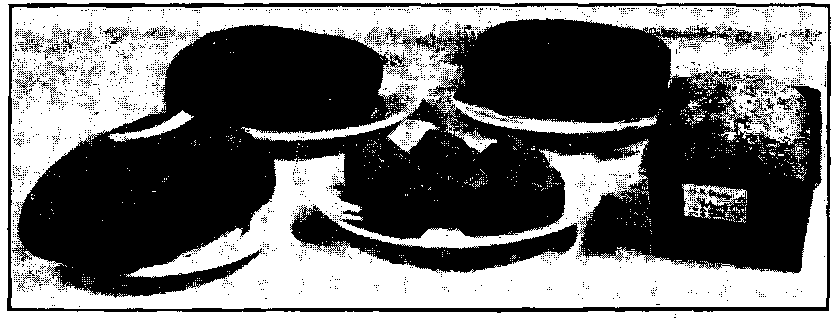
To Conform to U.S. Food Administration Regulations During the War, Eliminate Fat and Sweetening in Breads—Whenever Fat Is Used, Use Drippings
THE USE OF CORN
CORNMEAL ROLLS
1 cup bread flour 1 cup cornmeal 4 teaspoons baking powder 2 tablespoons fat 1 egg ⅓ cup milk 1½ teaspoons salt 1 tablespoon sugar
Mix and sift dry ingredients and cut in the fat. Beat the egg and add to it the milk. Combine the liquid with the dry ingredients. Shape as Parker House rolls and bake in a hot oven 12 to 15 minutes.
BUTTERMILK OR SOUR MILK CORNMEAL MUFFINS
2 cups cornmeal 1 egg 2 tablespoons sugar 2 tablespoons fat 2 cups sour or buttermilk 1 teaspoon salt 1 teaspoon soda
Dissolve soda in a little cold water. Mix ingredients adding soda last. Bake in hot oven 20 minutes.
CORNMEAL GRIDDLE CAKES
1⅓ cups cornmeal 1½ cups boiling water ¾ cup milk 2 tablespoons fat 1 tablespoon molasses ⅔ cup flour 1½ teaspoons salt 4 teaspoons baking powder
Scald meal with boiling water. Add milk, fat and molasses. Add sifted dry ingredients. Bake on hot griddle.
SOUTHERN SPOON BREAD
1 cup white cornmeal 2 cups boiling water ¼ cup bacon fat or drippings 3 teaspoons baking powder 1 teaspoon salt 2 eggs 3 slices bread ½ cup cold water 1 cup milk
Scald cornmeal with boiling water. Soak bread in cold water and milk. Separate yolks and whites of eggs. Beat each until light. Mix ingredients in order given, folding in whites of eggs last. Bake in buttered dish in hot oven 50 minutes.
SPOON BREAD
2 cups water 1 cup milk 1 cup cornmeal ⅓ cup sweet pepper 1 tablespoon fat 2 eggs 2 teaspoons salt
Mix water and cornmeal and bring to the boiling point and cook 5 minutes. Beat eggs well and add with other materials to the mush. Beat well and bake in a well-greased pan for 25 minutes in a hot oven. Serve from the same dish with a spoon. Serve with milk or syrup.
CORNMEAL RAGGED ROBINS
1½ cups cornmeal 1 cup bread flour 1½ teaspoons salt 1⅓ cups milk 2½ teaspoons cream of tartar 4 tablespoons fat 1¼ teaspoons soda
Sift dry ingredients. Cut in the fat. Add liquid and drop by spoonfuls on greased baking sheet. Bake in hot oven 12 to 15 minutes. These may be rolled and cut same as baking powder biscuits.
INDIAN PUDDING
4 cups milk ⅓ cup cornmeal ⅓ cup molasses 1 teaspoon salt 1 teaspoon ginger 1 teaspoon allspice
Cook milk and meal in a double boiler 20 minutes; add molasses, salt and ginger. Pour into greased pudding dish and bake two hours in a slow oven, or use fireless cooker. Serve with milk. This makes a good and nourishing dessert. Serves six.
TAMALE PIE
2 cups cornmeal 5 cups water (boiling) 2 tablespoons fat 1 teaspoon salt 1 onion 2 cups tomatoes 2 cups cooked or raw meat cut in small pieces ¼ cup green peppers
To the cornmeal and 1 teaspoon salt, add boiling water. Cook one-half hour. Brown onion in fat, add meat. Add salt, ⅛ teaspoon cayenne, the tomatoes and green peppers. Grease baking dish, put in layer of cornmeal mush, add seasoned meat, and cover with mush. Bake one-half hour.
EGGLESS CORN BREAD
1 cup cornmeal ½ cup bread flour 3 tablespoons molasses 1 cup milk 3 teaspoons baking powder 2 teaspoons salt 2 tablespoons fat
Beat thoroughly. Bake in greased muffin pans 20 minutes.
SWEET MILK CORN BREAD
2 cups cornmeal 2 cups sweet milk (whole or skim) 4 teaspoons baking powder 2 tablespoons corn syrup 2 tablespoons fat 1 teaspoon salt 1 egg
Mix dry ingredients. Add milk, well-beaten egg, and melted fat. Beat well. Bake in shallow pan for about 30 minutes.
SOUR MILK CORN BREAD
2 cups cornmeal 2 cups sour milk 1 teaspoon soda 2 tablespoons fat 2 tablespoons corn syrup or molasses 1 teaspoon salt 1 egg
Mix dry ingredients. Add milk, egg and fat. Beat well. Bake in greased pan 20 minutes.
THE USE OF OATS
COOKED OATMEAL BREAD
3 cups thick cooked oatmeal 2 tablespoons fat 1½ tablespoons salt 3 tablespoons molasses 1½ cakes yeast ¾ cup lukewarm water About 5 cups flour
To oatmeal add the sugar, salt and fat. Mix the yeast cake with the lukewarm water, add it to the other materials and stir in the flour until the dough will not stick to the sides of the bowl. Knead until elastic, ten to fifteen minutes, moisten the top of the dough with a little water to prevent a hard crust forming, and set to rise in a warm place. When double its bulk, knead again for a few minutes. Shape into loaves and put into greased pans. Let rise double in bulk and bake in a moderate oven for about 50 minutes.
OATMEAL BREAD
2 cups rolled oats 2 cups boiling water ⅓ cup molasses 1 yeast cake ¾ cup lukewarm water 1 tablespoon salt 2 tablespoons fat (melted) About 6 cups bread flour
Scald the rolled oats with the boiling water and let stand until cool. Dissolve the yeast in the lukewarm water and add to the first mixture when cool. Add the molasses, salt and melted fat. Stir in enough bread flour to knead. Turn on a floured board. Knead lightly. Return to bowl and let rise until double in bulk. Knead and shape in loaves and let rise until double again. Bake in a moderate oven 45 minutes.
OATMEAL NUT BREAD
1 cake compressed yeast 2 cups boiling water 1½ cup lukewarm water 2 cups rolled oats 1 teaspoon salt ¼ cup brown sugar or 2 tablespoons corn syrup 2 tablespoons fat 4 cups flour ½ cup chopped nuts.
Pour two cups of boiling water over oatmeal, cover and let stand until lukewarm. Dissolve yeast and sugar in one-half cup lukewarm water, add shortening and add this to the oatmeal and water. Add one cup of flour, or enough to make an ordinary sponge. Beat well. Cover and set aside in a moderately warm place to rise for one hour.
Add enough flour to make a dough—about three cups, add nuts and the salt. Knead well. Place in greased bowl, cover and let rise in a moderately warm place until double in bulk—about one and one-half hour. Mould into loaves, fill well-greased pans half full, cover and let rise again one hour. Bake forty-five minutes in a moderate oven.
OATMEAL SCONES
1 cup cold porridge (stiff) 1 cup boiling water 1 tablespoon fat ½ teaspoon baking powder or ¼ teaspoon soda 1 teaspoon corn syrup ½ teaspoon salt
Mix soda, boiling water and fat. Mix all. Turn on board. Mould flat—cut ¼-inch thick and bake on griddle.
OATMEAL MUFFINS
1⅓ cups flour 2 tablespoons molasses ½ teaspoon salt 2 tablespoons fat 3 teaspoons baking powder 1 egg beaten ½ cup milk 1 cup cooked oatmeal
Sift dry ingredients. Add egg and milk. Add fat and cereal. Beat well. Bake in greased tins 20 minutes.
ROLLED OATS RAGGED ROBINS
1½ cups rolled oats 1 cup bread flour 1⅓ teaspoons salt 1⅓ cups milk 2½ teaspoons cream of tartar 4 tablespoons fat 1¼ teaspoons soda
Sift dry ingredients. Cut in the fat. Add liquid and drop by spoonfuls on greased baking sheet. Bake in hot oven 12 to 15 minutes. These may be rolled and cut same as baking powder biscuits. (If uncooked rolled oats are used, allow to stand in the milk for 30 minutes before making recipe.)
THE USE OF RYE
RYE YEAST BREAD
1 cup milk and water, or water 1 tablespoon fat 2 tablespoons corn syrup 1 teaspoon salt 2½ cups rye flour 2½ cups wheat flour ½ cake compressed yeast 2 tablespoons water
Combine ingredients. Mix into dough and knead. Let rise until double original bulk. Knead again. When double bulk, bake about
RYE ROLLS
4 cups rye flour 1½ teaspoons salt 6 teaspoons baking powder 1½ cups milk 2 tablespoons fat 1 cup chopped nuts
Mix dry ingredients thoroughly. Add milk, nuts and melted shortening. Knead. Shape into rolls. Put into greased pans. Let stand one-half hour. Bake in moderate oven 30 minutes.
WAR BREAD
2 cups boiling water 2 tablespoons sugar 1½ teaspoons salt ¼ cup lukewarm water 2 tablespoons fat 6 cups rye flour 1½ cups whole wheat flour 1 cake yeast
To the boiling water, add the sugar, fat and salt. When lukewarm, add the yeast which has been dissolved in the lukewarm water. Add the rye and whole wheat flour. Cover and let rise until twice its bulk, shape into loaves; let rise until double and bake about 40 minutes, in a moderately hot oven.
RYE RAGGED ROBINS
1½ cups rye flour 1 cup bread flour 1½ teaspoons salt 1⅓ cups milk 2½ teaspoons cream of tartar 4 tablespoons fat 1¼ teaspoons soda
Sift dry ingredients. Cut in the fat. Add liquid and drop by spoonfuls on greased baking sheet. Bake in hot oven 12 to 15 minutes. These may be rolled and cut same as baking powder biscuits.
THE USE OF BARLEY
BARLEY YEAST BREAD
1 cup milk and water, or water 2 tablespoons corn syrup 1 tablespoon fat 1½ teaspoons salt 1⅙ cups barley flour 2⅓ cups wheat flour ½ cake compressed yeast
Soften the yeast in ¼ cup lukewarm liquid. Combine ingredients. Mix into a dough. Knead and let rise to double original bulk. Knead again. Put in pan; when again double in bulk bake 45 minutes.
BARLEY MUFFINS
1¼ cups whole wheat flour 1 cup barley meal ½ teaspoon salt 3 teaspoons baking powder 1 egg 1¼ cups sour milk ½ teaspoon soda 2 tablespoons drippings
Sift flour, barley meal, salt and baking powder. Dissolve soda in a little cold water and add to sour milk. Combine flour mixture and sour milk, add beaten egg and melted fat. Bake in muffin pans in a moderate oven 25 minutes.
BARLEY SPOON BREAD
2 tablespoons pork drippings 3 cups boiling water 1 cup barley meal 2 eggs
Heat drippings in saucepan until slightly brown, add water and when boiling, add barley meal, stirring constantly. Cook in a double boiler one-half hour, cool, and add well-beaten yolks. Fold in whites, beaten. Bake in greased dish in moderate oven one-half hour.
BARLEY PUDDING
5 cups milk ½ cup barley meal ½ teaspoon salt ½ teaspoon ginger ¾ cup molasses
Scald the milk, pour this on the meal and cook in double boiler one-half hour; add molasses, salt and ginger. Pour into greased pudding dish and bake two hours in a slow oven. Serve either hot or cold with syrup.
BARLEY SCONES
1 cup whole wheat flour 1 cup barley meal ½ teaspoon salt 2 teaspoons baking powder 3 tablespoons fat ¾ cup sour milk ⅓ teaspoon soda
Sift flour, barley meal, salt and baking powder together. Add fat. Dissolve soda in one tablespoon cold water and add to sour milk. Combine flour mixture and sour milk to form a soft dough. Turn out on a well-floured board, knead slightly, roll to one-half inch thickness; cut in small pieces and bake in a hot oven 15 minutes.
THE USE OF POTATO
POTATO BISCUIT
1 cup mashed lightly packed potato 2 tablespoons fat 1 cup whole wheat flour 1 teaspoons baking powder 1 teaspoon salt About ½ cup milk or water in which potatoes were cooked
Add melted fat to mashed potato. Mix and sift flour, baking powder and salt and add to potato mixture, add enough of the milk to make a soft dough. Roll out ½ inch thick, cut with a biscuit cutter and bake in a quick oven for 15 minutes. (If bread flour is used in place of whole wheat, the biscuits are slightly lighter and flakier in texture.)
POTATO BREAD
1½ cups tightly packed mashed potato 2½ cups wheat flour 1 tablespoon warm water ½ yeast cake ½ teaspoon salt
Make dough as usual. Let rise in warm place for 15 minutes. Mould into loaf, put in pan, let rise until double in bulk in warm place. Bake for 45 minutes in hot oven.
POTATO YEAST BREAD
½ cup milk and water or water 2 tablespoons corn syrup 4 tablespoons fat 1½ teaspoons salt 4 cups boiled potatoes 8 cups flour ½ cake compressed yeast ¼ cup warm water
Dissolve yeast in the warm water. Add other ingredients and make same as any bread.
POTATO PARKER HOUSE ROLLS
½ cake yeast 1 cup milk (scalded) 1 teaspoon fat 3 tablespoons corn syrup (or 1 tablespoon sugar) 3½ cups flour 2 cups potato (mashed and hot) 1 teaspoon salt 1 egg
Dissolve yeast in milk (luke warm). Stir in dry ingredients. Add potato and knead until smooth. Let rise until light. Roll thin, fold over, bake until brown.
THE USE OF MIXED GRAINS
WAR BREAD OR THIRDS BREAD
1 pint milk, or milk and water 2 teaspoons salt 2 tablespoons molasses 1 yeast cake 2 tablespoons fat
Mix as ordinary bread dough. Add 2 cups cornmeal and 2 cups rye meal and enough whole wheat flour to knead. Let rise, knead, shape, let rise again in the pan and bake 45 minutes.
CORN MEAL AND RYE BREAD
2 cups lukewarm water 1 cake yeast 2 teaspoons salt ⅓ cup molasses 1¼ cup rye flour 1 cup corn meal 3 cups bread flour
Dissolve yeast cake in water, add remaining ingredients, and mix thoroughly. Let rise, shape, let rise again and bake.
BOSTON BROWN BREAD
1 cup rye meal 1 cup cornmeal 1 cup graham flour 2 cups sour milk 1¾ teaspoons soda 1½ teaspoons salt ¾ cup molasses
Beat well. Put in greased covered molds, steam 2 to 3 hours.
BREAD MUFFINS
2 cups bread crumbs ⅓ cup flour 1 tablespoon fat, melted 1½ cups milk 1 egg 2 teaspoons baking powder ½ teaspoon salt
Cover crumbs with milk and soak 10 minutes. Beat smooth, add egg yolks, dry ingredients sifted together and fat. Fold in beaten whites of eggs. Bake in muffin tins in moderate oven for 15 minutes.
CORN, RYE AND WHOLE WHEAT FRUIT MUFFINS
⅓ cup boiling water 1 cup cornmeal ¼ teaspoon soda ¼ cup molasses 1 cup whole wheat flour 1 cup rye flour 3 teaspoons baking powder 1 teaspoon salt 1 cup milk ⅓ cup raisins cut in halves ¼ cup chopped nuts 2 tablespoons fat
Scald meal with boiling water, mix soda and molasses. Mix dry ingredients, mix all thoroughly. Bake in muffin pans one-half hour.
SOY BEAN MEAL BISCUIT
1 cup soy bean meal or flour 1 cup whole wheat 1½ teaspoons salt 4 teaspoons baking powder 1 tablespoon corn syrup 2 tablespoons fat 1 cup milk
Sift dry ingredients. Cut in fat. Add liquid to make soft dough. Roll one-half inch thick. Cut and bake 12 to 15 minutes in hot oven.
EMERGENCY BISCUIT
1 cup whole wheat flour 1 cup cornmeal 1 tablespoon fat ½ teaspoon soda 1 cup sour milk 1 teaspoon salt
Mix as baking powder biscuit. Drop by spoonfuls on greased baking sheet. Bake 15 minutes in hot oven.
PANCAKES AND WAFFLES
SOUR MILK PANCAKES
1 cup sour milk ½ cup cooked cereal or 1 cup bread crumbs 1 tablespoon melted fat 1 egg ¾ cup whole wheat flour 1 teaspoon soda ⅛ teaspoon salt
Mix bread crumbs, flour, salt; add beaten egg, fat and cereal; mix soda with sour milk and add to other ingredients.
SPLIT PEA PANCAKES
2 cups split peas 2 egg whites ⅓ cup flour 1 cup milk 2 egg yolks 2 tablespoons pork drippings ⅛ teaspoon cayenne 1 teaspoon salt 1 teaspoonful baking powder
Soak peas over night, cook, and when tender, put through a food chopper and mix the ingredients. Bake on hot greased griddle.
BREAD GRIDDLE CAKES
2 cups sour milk 2 cups bread
Let stand until soft
Put through colander. For each one pint use:
1 egg 1 teaspoon soda 2 teaspoons sugar ¼ teaspoon salt ¾ cup flour 1 egg beaten
Mix well; bake at once on hot greased griddle.
OATMEAL PANCAKES
2 cups oatmeal 1 tablespoon melted fat ⅛ teaspoon salt
Add:
1 egg beaten into a cupful of milk 1 cupful flour into which has been sifted 1 teaspoonful baking powder.
Beat well. Cook on a griddle. This is an excellent way to use left-over oatmeal.
POTATO PANCAKES
2 cups of chopped potato ½ cup milk 1 egg 1 teaspoon salt 2 cups flour 5 teaspoons of baking powder 2 cups of hot water
Parboil potatoes in the skins for fifteen minutes. Pare and chop fine or put through food chopper. Mix potatoes, milk, eggs and salt. Sift the flour and baking powder and stir into a smooth batter. Thin with hot water as necessary. Bake on a greased griddle.
RICE WAFFLES
1 cup cold boiled rice 1½ cups milk 2 eggs 2 cups flour ⅓ teaspoon salt 1 tablespoon melted fat 4 teaspoons baking powder
Add milk to rice and stir until smooth. Add salt, egg yolks beaten; add flour sifted with baking powder and salt; add fat; add stiffly beaten whites.
RICE GRIDDLE CAKES
½ cup boiled rice ½ cup flour 3 tablespoons fat 1 pint milk ⅔ teaspoon salt ½ teaspoon soda
Stir rice in milk. Let stand one-half hour. Add other ingredients, having dissolved soda in one tablespoon cold water.
CORNMEAL WAFFLES
1 cup cornmeal ½ cup flour ½ teaspoon salt 2 teaspoons baking powder ¼ cup corn syrup 1 egg 1 pint milk 1 tablespoon fat
Cook cornmeal and milk in double boiler 10 minutes. Sift dry ingredients. Add milk, cornmeal; beaten yolks; fat, beaten whites.
CORNMEAL AND RYE WAFFLES
1 cup rye flour ¾ cup cornmeal 1 teaspoon salt 4 teaspoons baking powder 1 tablespoon melted fat 2 eggs 1¼ cups milk
Sift dry ingredients. Add beaten yolks added to milk. Add fat and stiffly beaten whites. If waffles are not crisp add more liquid.
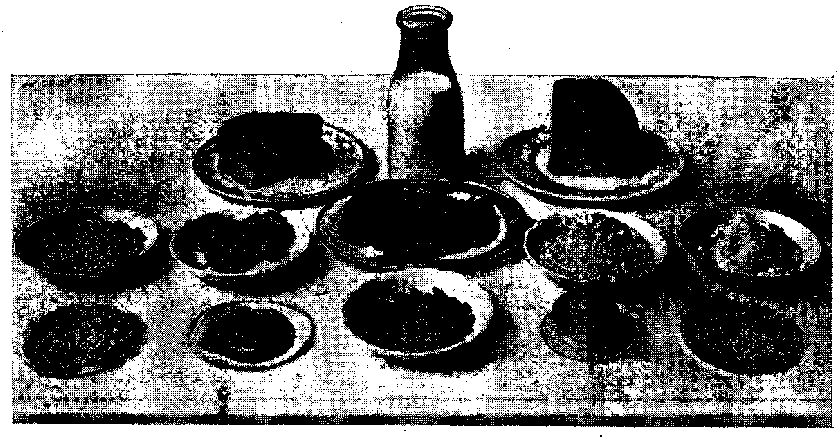
Each Food Shown is Equivalent in Protein to the Platter of Meat in the Center of the Picture.