SAVE FAT
Reading edition
Reasons Why Our Government Asks Us to Save Fat, With Practical Recipes for Fat Conservation
With the world-wide decrease of animal production, animal fats are now growing so scarce that the world is being scoured for new sources of supply. Our Government has asked the housewife to conserve all the fats that come to her home and utilize them to the best advantage. To this end it is necessary to have some knowledge of the character of different fats and the purposes to which they are best adapted.
The word fat usually brings to one's mind an unappetizing chunk of meat fat which most persons cannot and will not eat, and fatty foods have been popularly supposed to be "bad for us" and "hard to digest." Fats are, however, an important food absolutely essential to complete nutrition, which repay us better for the labor of digestion than any other food. If they are indigestible, it is usually due to improper cooking or improper use; if they are expensive, it is merely because they are extravagantly handled. The chief function of fatty food is to repair and renew the fatty tissues, to yield energy and to maintain the body heat. The presence of fat in food promotes the flow of the pancreatic juice and bile, which help in the assimilation of other foods and assist the excretory functions of the intestine. These are badly performed if bile and other digestive fluids are not secreted in sufficient quantity. The absence of fat in the diet leads to a state of malnutrition, predisposing to tuberculosis, especially in children and young persons.
It is claimed that the most serious food shortage in Germany is fat; that the civilian population is dying in large numbers because of the lack of it, and that Von Hindenburg's men will lose out on the basis of fat, rather than on the basis of munitions or military organization. Worst of all is the effect of fat shortage on the children of the nation. Leaders of thought all over Europe assert that even if Germany wins, Germany has lost, because it has sapped the strength of its coming generation.
The term fat is used to designate all products of fatty composition and includes liquid fats such as oils, soft fats such as butter, and hard fats such as tallow. While all fats have practically the same energy-value, they differ widely from each other in their melting point, and the difference in digestibility seems to correspond to the difference in melting point. Butter burns at 240 degrees Fahrenheit, while vegetable oils can be heated as high as 600 degrees Fahrenheit, furnishing a very high temperature for cooking purposes before they begin to burn. The scorching of fat not only wastes the product, but renders it indigestible, even dangerous to some people, and for this reason butter should never be used for frying, as frying temperature is usually higher than 240 degrees. It is well to choose for cooking only those fats which have the highest heat-resisting qualities because they do not burn so easily.
Beginning with the lowest burning point, fats include genuine butter, substitute butters, lard and its substitutes, and end with tallow and vegetable oils. Of the latter, there is a varied selection from the expensive olive oil to the cheaper cottonseed, peanut, cocoanut and corn oils and their compounds and the hydrogenated oils.
The economy of fat, therefore, depends on the choice of the fat used for the various cooking processes as well as the conservation of all fatty residue, such as crackling, leftover frying fats and soup fat. For cooking processes, such as sauteing (pan frying), or deep fat frying, it is best to use the vegetable and nut oils. These are more plentiful, and hence cheaper than the animal fats; the latter, however, can be produced in the home from the fats of meats and leftover pan fats, which should not be overlooked as frying mediums. Butter and butter substitutes are best kept for table use and for flavoring. The hydrogenated oils, home-rendered fats, lard and beef and mutton suet can be used for shortening fats.
In the purchase of meats, the careful housewife should see that the butcher gives her all the fat she pays for, as all fats can be rendered very easily at home and can be used for cooking purposes. Butchers usually leave as large a proportion of fat as possible on all cuts of meat which, when paid for at meat prices, are quite an expensive item. All good clear fat should, therefore, be carefully trimmed from meats before cooking. Few people either like or find digestible greasy, fat meats, and the fat paid for at meat prices, which could have been rendered and used for cooking, is wasted when sent to table.
There are various methods of conserving fat. First, the economical use of table fats; second, the saving of cooking; and third, the proper use of all types of fat.
Economy in the use of table fats may best be secured by careful serving. One serving of butter is a little thing—there are about sixty-four of them in a pound. In many households the butter left on the plates probably would equal a serving or one-fourth of an ounce, daily, which is usually scraped into the garbage pail or washed off in the dishpan. But if everyone of our 20,000,000 households should waste one-fourth of an ounce of butter daily, it would mean 312,500 pounds a day, or 114,062,500 pounds a year. To make this butter would take 265,261,560 gallons of milk, or the product of over a half-million cows, an item in national economy which should not be overlooked.
When butter is used to flavor cooked vegetables, it is more economical to add it just before they are served rather than while they are cooking. The flavor thus imparted is more pronounced, and, moreover, if the butter is added before cooking, much of it will be lost in the water unless the latter is served with the vegetables. Butter substitutes, such as oleomargarine and nut margarine, should be more largely used for the table, especially for adults. Conserve butter for children, as animal fats contain vitamines necessary for growing tissues. Butter substitutes are as digestible and as nourishing as butter, and have a higher melting point. They keep better and cost less.
Oleomargarine, which has been in existence for fifty years, was first offered to the world in 1870 by a famous French chemist, Mege-Mouries, who was in search of a butter substitute cheap enough to supply the masses with the much-needed food element. He had noticed that the children of the poor families were afflicted with rickets and other diseases which could be remedied by the administration of the right amount of fat. He combined fresh suet and milk and called the product "oleomargarine." In the United States this product is now made of oleo oil or soft beef fat, neutral lard, cottonseed and other oils, churned with a small quantity of milk, and in the finer grades, cream is sometimes used. A certain proportion of butter is usually added, and the whole worked up with salt as in ordinary butter-making.
Owing to the fears of the butter-makers that oleomargarine would supplant their product in popular favor, legislation was enacted that restricted the manufacture of oleo and established a rigid system of governmental inspection, so that the product is now manufactured under the most sanitary conditions which furnishes a cleaner and more reliable product than natural butter.
Nut margarine is a compound of cocoa oil, which so closely resembles butter that only an expert can distinguish it from the natural product. Both these butter substitutes are used in large amounts by the best bakers, confectioners and biscuit manufacturers, and foolish prejudice against butter substitutes should not deter their use in the home.
A large saving in cooking fats can be made by the careful utilization of all fats that come into the home. Beef and mutton suet can be rendered and made available. Fats which have been saved after meals are cooked should be clarified—that is, freed from all objectionable odors, tastes or color—so as to be made available as shortening and frying fats.
The following recipes and suggestions make possible the use of all fats, and as fat shortage is one of the most serious of the world's food problems, it is essential that every housekeeper have a larger knowledge of the utilization and economy of this essential food.
TO RENDER FATS
TO RENDER FAT BY DIRECT METHOD
Run the fat through the household meat grinder or chop fine in the chopping bowl. Then heat in the double boiler until completely melted, finally straining through a rather thick cloth or two thicknesses of cheese cloth, wrung out in hot water. By this method there is no danger of scorching. Fats heated at a low temperature also keep better than those melted at higher temperature. After the fat is rendered, it should be slowly reheated to sterilize it and make sure it is free from moisture. The bits of tissue strained out, commonly known as cracklings, may be used for shortening purposes or may be added to cornmeal which is to be used as fried cornmeal mush.
TO RENDER FAT WITH MILK
To two pounds of fat (finely chopped if unrendered) add one-half pint of milk, preferably sour. Heat the mixture in a double boiler until thoroughly melted. Stir well and strain through a thick cloth or two thicknesses of cheese cloth wrung out in hot water. When cold the fat forms a hard, clean layer and any material adhering to the under side of the fat, may be scraped off. Sour milk being coagulated is preferable to sweet milk since the curd remains on the cloth through which the rendered mixture is strained and is thus more easily separated from the rendered fat which has acquired some of the milk flavor and butter fat.
TO RENDER FAT BY COLD WATER METHOD
Cut fat in small pieces. Cover with cold water. Heat slowly. Let cook until bubbling ceases. Press fat during heating so as to obtain all the oil possible. When boiling ceases strain through cheesecloth and let harden. If desired one-half teaspoon salt, one-eighth teaspoon pepper, 1 teaspoon onion and 1 teaspoon poultry seasoning may be added before straining.
TO RENDER STRONG FLAVORED FATS
To mutton, duck or goose fat add equal amount of beef suet or vegetable fat and render same as suet. This may then be used for shortening, or pan broiling for meat or fish dishes, and not have the characteristic taste of the stronger fats.
When rendering strong mutton, duck or goose fats if a small whole onion is added the strong flavor of the fat is reduced. Remove the onion before straining. It may be used in cooking.
TO CLARIFY FAT
Melt the fat in an equal volume of water and heat for a short time at a moderate temperature. Stir occasionally. Cool and remove the layer of fat which forms on the top, scraping off any bits of meat or other material which may adhere to the other side.
Fats which have formed on top of soups, of cooked meats (such as pot roast, stews), salt meats (such as corned beef, ham, etc.), or strong fats, such as from boiled mutton, poultry and game, may be clarified in this way and used alone or combined with other animal or vegetable fats in any savory dish.
CARE OF FAT AFTER BEING USED FOR COOKING
If fat is used for deep fat frying as croquettes, doughnuts, fritters, etc., while fat is still hot, add a few slices raw potato and allow it to stay in the fat until it is cool. Remove potato—strain fat, allow to harden and it is ready to use. The potato absorbs odors from fat.
HOW TO MAKE SAVORY FATS
FAT 1: To 1 pound of unrendered fat (chopped fine) add 1 slice of onion about one-half inch thick and two inches in diameter, 1 bay leaf, 1 teaspoonful salt, and about one-eighth teaspoonful of pepper. Render in a double boiler and strain.
FAT 2: To 1 pound unrendered fat (chopped fine) add 2 teaspoonfuls of thyme, 1 slice onion, about one-half inch thick and two inches in diameter, one teaspoonful salt and about one-eighth teaspoonful pepper. Render in a double boiler and strain.
FAT 3: To 1 pound unrendered fat (chopped fine) add 1 teaspoonful thyme, 1 teaspoonful marjoram, one-half teaspoonful rubbed sage, 1 teaspoonful salt, and about one-eighth teaspoonful pepper. Render in a double boiler and strain through fine cloth.
EXTENSION OF TABLE FATS
A. Butter or other fat may be extended to double its original bulk and reduce the cost of the fat 40 per cent. A patented churn, any homemade churn, mayonnaise mixer, or bowl and rotary beater may be used for the purpose. To any quantity of butter heated until slightly soft add equal quantity of milk, place in the churn, add one teaspoon salt for each one pound of butter used. Blend thoroughly in churn, mayonnaise mixer, or in bowl with rotary beater until of even consistency. Place in refrigerator to harden. Vegetable coloring, such as comes with margarine or may be purchased separately, may be added if a deeper yellow color is desired.
B.
1 lb. butter 1 quart milk (2 pint bottles preferred) 1 tablespoon granulated gelatine 1½ teaspoons salt
Soak gelatine in one-half cup of the milk. When softened, dissolve over hot water. Let butter stand in warm place, until soft. Add gelatine mixture, milk and salt and beat with Dover beater until thoroughly mixed (about 15 minutes). Vegetable coloring such as comes with margarine may be added if desired. Do not put on ice.
C.
1 lb. butter 1 quart milk (2 pint bottles preferred) 1 tablespoon granulated gelatine 1½ teaspoons salt 1 cup peanut butter
Soak gelatine in one-half cup of the milk. When softened, dissolve over hot water. Let butter stand in warm place, until soft. Add gelatine mixture, peanut butter, milk and salt and beat with rotary egg beater until thoroughly blended (about 15 minutes). Vegetable coloring such as comes with margarine may be added if desired. Put in cool place to harden but do not put on ice as the gelatine would cause the mixture to flake. It is preferable to make up this mixture enough for one day at a time only.
D. To 1 pound of butter or butter substitute add one cup peanut butter. Blend thoroughly with wooden spoon or butter paddle; this may be used in place of butter as a new and delightful variation.
E. To 1 pound softened butter add 1 pound softened butter substitute (oleomargarine, nut margarine, vegetable margarine) or hydrogenated fat. Blend thoroughly with butter paddle or wooden spoon and use as butter.
SUGGESTIONS FOR PASTRY
Whole wheat makes a more tasty crust than bread flour and all rye pastry has even better flavor than wheat flour pastry. Half wheat or rye and the other half cornmeal (white or yellow) makes an excellent pastry for meat or fish pie. If cornmeal is added, use this recipe:
CORNMEAL PASTRY FOR MEAT OR FISH
½ cup cornmeal ½ cup rye or wheat flour 2 tablespoons fat ⅓ cup cold or ice water 1 teaspoon baking powder
Sift dry ingredients. Cut in fat. Add water and roll out on well floured board.
PASTRY MADE WITH DRIPPING
Well made, digestible pastry should have a minimum of fat to make a crisp flaky crust. It should be crisp, not brittle; firm, not crumbly. Pastry may be made in large amounts, kept in refrigerator for several days and used as needed. Roll out only enough for one crust at a time as the less pastry is handled, the better.
PLAIN PASTRY
1 cup flour ⅓ cup fat ½ teaspoon salt About ¼ cup cold or ice water
Mix flour and salt. Cut in fat and add just enough cold or ice water to make the mixture into a stiff dough. Roll out. This recipe makes one crust.
MEAT OR FISH PIE CRUST
2 cups flour 4 teaspoons baking powder ⅓ cup any kind of dripping 1 cup meat stock or milk 1 teaspoon salt
Sift dry ingredients. Cut in fat if solid, or add if liquid. Stir in meat stock or milk to make a soft dough. Place on top of meat or fish with gravy in greased baking dish and bake 30 to 40 minutes in moderately hot oven.
VARIOUS USES FOR LEFTOVER FATS
CREOLE RICE
2 tablespoons savory drippings 3 tablespoons flour 1 teaspoon salt ½ teaspoon cayenne 1½ cups tomato juice and pulp 1 teaspoon onion juice 2 tablespoons chopped green pepper 1 tablespoon chopped olives 1 cup of rice 1 cup water
Wash rice and soak in water 30 minutes. Melt fat, add dry ingredients and gradually the tomatoes. Stir in rice and other ingredients, also the water in which rice was soaked. Cook slowly one-half hour or until rice is tender.
POTATOES ESPAGNOLE
2 cups pared and sliced potatoes 2 tablespoons bacon drippings 2 tablespoons minced onion ½ teaspoon salt ¼ tablespoon cayenne 1½ cups boiling water 1 tablespoon chopped green pepper or pimento
Melt drippings. Add onion and cook until slightly brown. Add other seasonings and water. Pour over potatoes. Let cook slowly in oven until potatoes are tender, about 30 minutes.
DUMPLINGS
2 cups flour 1 teaspoon salt 4 teaspoons baking powder 2 tablespoons drippings 1 cup water, meat stock or milk
Sift dry ingredients. Cut in fat. Gradually add liquid to make a soft dough. Roll out, place on greased pan and steam 20 minutes, or drop into stew and cook covered 30 minutes. Serve at once.
POTATO SALAD
2 cups freshly cooked and diced potatoes ⅓ cup bacon drippings ½ teaspoon salt 2 tablespoons chopped peppers 2 tablespoons vinegar ⅛ teaspoon cayenne
Mix drippings, salt, pepper, vinegar and cayenne. Add to the potatoes and mix thoroughly. Chill and serve. Cold cooked potatoes may be used, but the flavor is better if mixed while potatoes are hot.
SOAP
1 can lye 6 lbs. fat (Fat for soap should be fat which is no longer useful for culinary purposes.) 1 quart cold water
To lye add water—using enamel or agate utensil. When cool add the fat which has been heated until liquid. Stir until of consistency of honey (about 20 minutes). Two tablespoons ammonia or two tablespoons borax may be added for a whiter soap. If stirred thoroughly this soap will float.
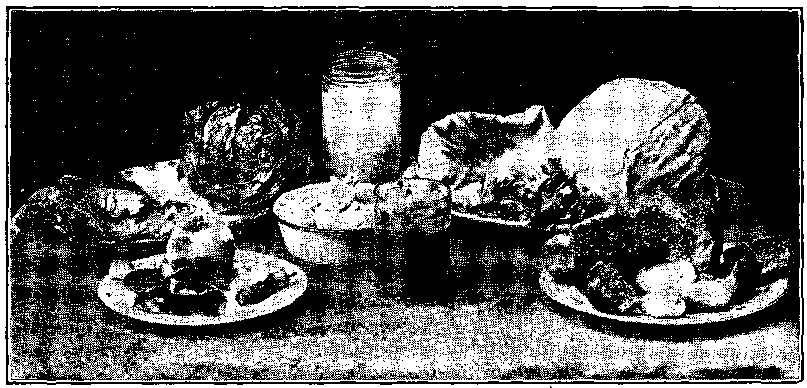
The illustration shows various forms of food waste—the discarded outside leaves of lettuce and cabbage, apple cores and parings, stale bread and drippings.