SAVE MEAT
Reading edition
Reasons Why Our Government Has Asked Us to Save Meat with Practical Recipes for Meat Conservation
As a nation we eat and waste 80 per cent. more meat than we require to maintain health. This statement, recently issued by the United States Food Administration, is appalling when we consider that there is a greater demand for meat in the world to-day than ever before, coupled with a greatly decreased production. The increase in the demand for meat and animal products is due to the stress of the war. Millions of men are on the fighting line doing hard physical labor, and require a larger food allowance than when they were civilians. To meet the demand for meat and to save their grains, our Allies have been compelled to kill upward of thirty-three million head of their stock animals, and they have thus stifled their animal production. This was burning the candle at both ends, and they now face increased demand handicapped by decreased production.
America must fill the breach. Not only must we meet the present increased demand, but we must be prepared as the war advances to meet an even greater demand for this most necessary food. The way out of this serious situation is first to reduce meat consumption to the amount really needed and then to learn to use other foods that will supply the food element which is found in meat. This element is called protein, and we depend upon it to build and repair body tissues.
Although most persons believe that protein can only be obtained from meat, it is found in many other foods, such as milk, skim milk, cheese, cottage cheese, poultry, eggs, fish, dried peas, beans, cow peas, lentils and nuts. For instance, pound for pound, salmon, either fresh or canned, equals round steak in protein content; cream cheese contains one-quarter more protein and three times as much fat; peanuts (hulled) one-quarter more protein and three and a half times as much fat; beans (dried) a little more protein and one-fifth as much fat; eggs (one dozen) about the same in protein and one-half more fat. It is our manifest duty to learn how to make the best use of these foods in order to save beef, pork and mutton, to be shipped across the sea. This means that the housekeeper has before her the task of training the family palate to accept new food preparations. Training the family palate is not easy, because bodies that have grown accustomed to certain food combinations find it difficult to get along without them, and rebel at a change. If these habits of diet are suddenly disturbed we may upset digestion, as well as create a feeling of dissatisfaction which is equally harmful to physical well-being. The wise housekeeper will therefore make her changes gradually.
In reducing meat in the diet of a family that has been used to having meat twice a day, it will be well to start out with meat once a day and keep up this régime for a couple of weeks. Then drop meat for a whole day, supplying in its stead a meat substitute dish that will furnish the same nutriment. After a while you can use meat substitutes at least twice a week without disturbing the family's mental or physical equilibrium. It would be well also to introduce dishes that extend the meat flavor, such as stews combined with dumplings, hominy, or rice; pot pies or short cakes with a dressing of meat and vegetables; meat loaf, souffle or croquettes in which meat is combined with bread crumbs, potato or rice.
Meat eating is largely a matter of flavor. If flavor is supplied, the reduction of meat in the diet can be made with little annoyance. Nutrition can always be supplied in the other dishes that accompany the meal, as a certain proportion of protein is found in almost every food product. The meat that we use to obtain flavor in sauces and gravies need not be large in quantity, nor expensive in cut. The poor or cheap cuts have generally more flavor than the expensive ones, the difference being entirely in texture and tenderness, freedom from gristle and inedible tissue. There are many cereals, such as rice, hominy, cornmeal, samp and many vegetable dishes, especially dried beans of all kinds, that are greatly improved by the addition of meat sauce and when prepared in this way may be served as the main dish of a meal.
Dr. Harvey W. Wiley has stated that the meat eating of the future will not be regarded as a necessity so much as it has been in the past, and that meat will be used more as a condimental substance. Europe has for years used meat for flavor rather than for nutriment. It would seem that the time has come for Americans to learn the use of meat for flavor and to utilize more skillfully the protein of other foods.
It may be difficult to convince the meat lover that he can radically reduce the proportion of meat in his diet without detriment to health. Many persons adhere to the notion that you are not nourished unless you eat meat; that meat foods are absolutely necessary to maintain the body strength. This idea is entirely without foundation, for the foods mentioned as meat substitutes earlier in this chapter can be made to feed the world, and feed it well—in fact, no nation uses so large a proportion of meat as America.
The first step, therefore, in preparing ourselves to reduce meat consumption is to recognize that only a small quantity of meat is necessary to supply sufficient protein for adult life. The growing child or the youth springing into manhood needs a larger percentage of meat than the adult, and in apportioning the family's meat ration this fact should not be overlooked.
The second step is to reduce the amount purchased, choosing cuts that contain the least waste, and by utilizing with care that which we do purchase. Fat, trimmings, and bones all have their uses and should be saved from the garbage pail.
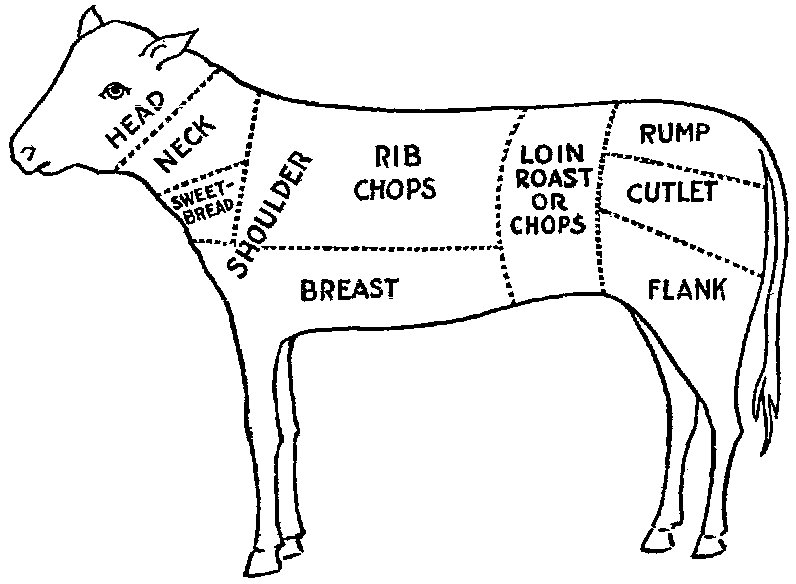
Careful buying, of course, depends on a knowledge of cuts, a study of the percentage of waste in each cut, and the food value of the different kinds of meat. Make a study of the different cuts, as shown in the charts on pages 36, 37, and armed with this knowledge go forth to the butcher for practical buying.
Then comes the cooking, which can only be properly done when the fundamental principles of the cooking processes, such as boiling, braising, broiling, stewing, roasting and frying are understood. Each cut requires different handling to secure the maximum amount of nutriment and flavor. The waste occasioned by improper cooking is a large factor in both household and national economy.
It has been estimated that a waste of an ounce each day of edible meat or fat in the twenty million American homes amounts to 456,000,000 pounds of valuable animal food a year. At average dressed weights, this amounts to 875,000 steers, or over 3,000,000 hogs. Each housekeeper, therefore, who saves her ounce a day aids in this enormous saving, which will mean so much in the feeding of our men on the fighting line.
So the housekeeper who goes to her task of training the family palate to accept meat substitutes and meat economy dishes, who revolutionizes her methods of cooking so as to utilize even "the pig's squeak," will be doing her bit toward making the world safe for democracy.
The following charts, tables of nutritive values and suggested menus have been arranged to help her do this work. The American woman has her share in this great world struggle, and that is the intelligent conservation of food.
SELECTION OF MEAT
BEEF—Dull red as cut, brighter after exposure to air; lean, well mottled with fat; flesh, firm; fat, yellowish in color. Best beef from animal 3 to 5 years old, weighing 900 to 1,200 pounds. Do not buy wet, soft, or pink beef.
VEAL—Flesh pink. (If white, calf was bled before killed or animal too young.) The fat should be white.
MUTTON—Best from animal 3 years old. Flesh dull red, fat firm and white.
LAMB—(Spring Lamb 3 months to 6 months old; season, February to March.) Bones of lamb should be small; end of bone in leg of lamb should be serrated; flesh pink, and fat white.
PORK—The lean should be fine grained and pale pink. The skin should be smooth and clear. If flesh is soft, or fat yellowish, pork is not good.
SELECTION OF TOUGHER CUTS AND THEIR USES
Less expensive cuts of meat have more nourishment than the more expensive, and if properly cooked and seasoned, have as much tenderness. Tough cuts, as chuck or top sirloin, may be boned and rolled and then roasted by the same method as tender cuts, the only difference will be that the tougher cuts require longer cooking. Have the bones from rolled meats sent home to use for soups. Corned beef may be selected from flank, naval, plate or brisket. These cuts are more juicy than rump or round cuts.
1. For pot roast use chuck, crossrib, round, shoulder, rump or top sirloin.
2. For stew use shin, shoulder, top sirloin or neck.
3. For steaks use flank, round or chuck. If these cuts are pounded, or both pounded and rubbed with a mixture of 1 part vinegar and 2 parts oil before cooking, they will be very tender.
4. Soups—Buy shin or neck. The meat from these may be utilized by serving with horseradish or mustard sauce, or combined with equal amount of fresh meat for meat loaf, scalloped dish, etc.
DRY METHODS
1. Roasting or Baking—Oven roasting or baking is applied to roasts.
Place the roast in a hot oven, or if gas is used, put in the broiling oven to sear the outside quickly, and thus keep in the juices. Salt, pepper and flour. If an open roasting pan is used place a few tablespoonfuls of fat and 1 cup of water in the pan, which should be used to baste the roast frequently. If a covered pan is used basting is unnecessary.
Beef or mutton (5 to 8 lbs.) 10 min. to the lb. 10 min. extra
Lamb (5 to 8 lbs.) 12 min. to the lb. 12 min. extra
Veal (5 to 8 lbs.) 15 min. to the lb. 15 min. extra
Pork (5 to 8 lbs.) 25 min. to the lb. 25 min. extra
Turkey 20 min. to the lb.
Chicken 30 min. to the lb.
Duck 30 min. to the lb.
Goose 30 min. to the lb.
Game 30 min. to the lb.
2. Broiling—Cooking over or under clear fire. This method is used for chops or steaks.
Sear the meat on both sides. Then reduce the heat and turn the meat frequently. Use no fat.
Time Table—(Count time after meat is seared). ½ inch chops or steaks, 5 minutes 1 inch chops or steaks, 10 minutes 2 inch chops or steaks, 15 to 18 minutes
3. Pan Broiling—Cooking in pan with no fat. Time table same as for broiling chops, steaks, etc.
4. Sautéing—Cooking in pan in small amount of fat. Commonly termed "frying." Used for steaks, chops, etc. Time table same as for broiling.
MOIST METHODS
1. Boiling—Cooking in boiling water—especially poultry, salt meats, etc.
2. Steaming—A method of cooking by utilizing steam from boiling water, which retains more food value than any other. Too seldom applied to meats.
3. Frying—Cooking by immersion in hot fat at temperature 400 to 450 degrees Fahrenheit. Used for croquettes, etc.
If a fat thermometer is not available, test by using small pieces of bread. Put into heated fat:
A—For croquettes made from food requiring little cooking, such as oysters, or from previously cooked mixtures, as rice, fish or meat croquettes, bread should brown in one-half minute.
B—For mixtures requiring cooking, as doughnuts, fritters, etc., bread should brown in one minute.
COMBINATION METHODS
1. Pot Roasting—Cooking (by use of steam from small amount of water) tough cuts of meat which have been browned but not cooked thoroughly.
Season meat. Dredge with flour. Sear in hot pan until well browned. Place oil rack in pot containing water to height of one inch, but do not let water reach the meat. Keep water slowly boiling. Replenish as needed with boiling water. This method renders tough cuts tender, but requires several hours cooking.
2. Stewing—A combination of methods which draws part of flavor into gravy and retains part in pieces which are to be used as meat.
Cut meat into pieces suitable for serving. Cover one-half of meat with cold water. Let stand one hour. Bring slowly to boiling point. Dredge other half of meat with flour and brown in small amount of fat. Add to the other mixture and cook slowly 1½ to 2 hours, or until tender, adding diced vegetables, thickening and seasoning as desired one-half hour before cooking is finished.
3. Fricasseeing—Cooking in a sauce until tender, meat which has been previously browned but not cooked throughout.
Brown meat in small amount of fat. Place in boiling water to cover. Cook slowly until tender. To 1 pint of water in which meat is cooked, add ¼ cup flour, 1 teaspoon salt, ¼ teaspoon cayenne, and ¼ cup milk, thoroughly blended. When at boiling point, add one beaten egg, 1 tablespoon chopped parsley and 1 tablespoon cold water well mixed, Add cooked meat and serve.