Part II
Reading edition
The elder thief and the younger thief had one son each. As they had been so far successful in life by practising the art of thieving, they resolved to train up their sons to the same profession. There was in the village a Professor of the Science of Roguery, who took pupils, and gave them lessons in that difficult science. The two thieves put their sons under this renowned Professor. The son of the elder thief distinguished himself very much, and bade fair to surpass his father in the art of stealing. The lad’s cleverness was tested in the following manner. Not far from the Professor’s house there lived a poor man in a hut, upon the thatch of which climbed a creeper of the gourd kind. In the middle of the thatch, which was also its topmost part, there was a splendid gourd, which the man and his wife watched day and night. They certainly slept at night, but then the thatch was so old and rickety that if even a mouse went up to it bits of straw and particles of earth used to fall inside the hut, and the man and his wife slept right below the spot where the gourd was; so that it was next to impossible to steal the gourd without the knowledge of its owners. The Professor said to his pupils—for he had many—that any one who stole the gourd without being caught would be pronounced the dux of the school. Our elder thief’s son at once accepted the offer. He said he would steal away the gourd if he were allowed the use of three things, namely, a string, a cat, and a knife. The Professor allowed him the use of these three things. Two or three hours after nightfall, the lad, furnished with the three things mentioned above, sat behind the thatch under the eaves, listening to the conversation carried on by the man and his wife lying in bed inside the hut. In a short time the conversation ceased. The lad then concluded that they must both have fallen asleep. He waited half an hour longer, and hearing no sound inside, gently climbed up on the thatch. Chips of straw and particles of earth fell upon the couple sleeping inside. The woman woke up, and rousing her husband said, “Look there, some one is stealing the gourd!” That moment the lad squeezed the throat of the cat, and puss immediately gave out her usual “Mew! mew! mew!” The husband said, “Don’t you hear the cat mewing? There is no thief; it is only a cat.” The lad in the meantime cut the gourd from the plant with his knife, and tied the string which he had with him to its stalk. But how was he to get down without being discovered and caught, especially as the man and the woman were now awake? The woman was not convinced that it was only a cat; the shaking of the thatch, and the constant falling of bits of straw and particles of dust, made her think that it was a human being that was upon the thatch. She was telling her husband to go out and see whether a man was not there; but he maintained that it was only a cat. While the man and woman were thus disputing with each other, the lad with great force threw down the cat upon the ground, on which the poor animal purred most vociferously; and the man said aloud to his wife, “There it is; you are now convinced that it was only a cat.” In the meantime, during the confusion created by the clamour of the cat and the loud talk of the man, the lad quietly came down from the thatch with the gourd tied to the string. Next morning the lad produced the gourd before his teacher, and described to him and to his admiring comrades the manner in which he had committed the theft. The Professor was in ecstasy, and remarked, “The worthy son of a worthy father.” But the elder thief, the father of our hopeful genius, was by no means satisfied that his son was as yet fit to enter the world. He wanted to prove him still further. Addressing his son he said, “My son, if you can do what I tell you, I’ll think you fit to enter the world. If you can steal the gold chain of the queen of this country from her neck, and bring it to me, I’ll think you fit to enter the world.” The gifted son readily agreed to do the daring deed.
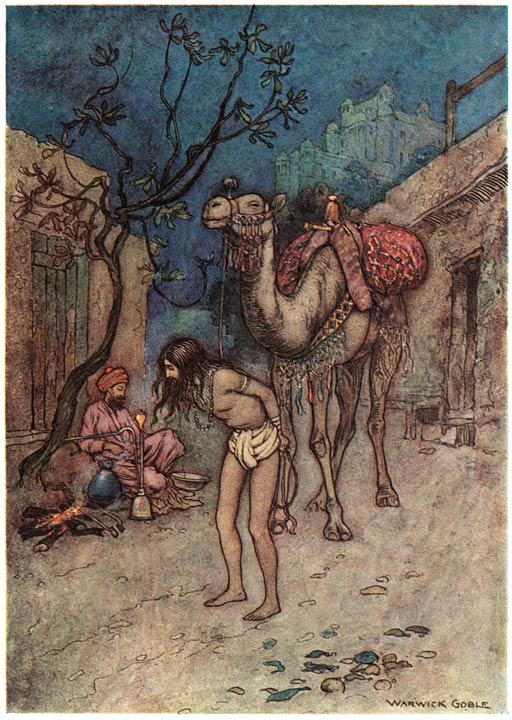
“The camel-driver alighted, tied the camel to a tree on the spot, and began smoking”
The next morning when the king heard that the camel-driver was lying drunk in the street, and that the camel had been made away with together with the treasure, he was almost beside himself with anger. Proclamation was made in the city to the effect that whoever caught the thief would get the reward of a lakh of rupees. The son of the younger thief—who, by the way, was in the same school of roguery with the son of the elder thief, though he did not distinguish himself so much—now came to the front and said that he would apprehend the thief. He of course suspected that the son of the elder thief must have done it—for who so daring and clever as he? In the evening of the following day the son of the younger thief disguised himself as a woman, and coming to that part of the town where the young thief lived, began to weep very much, and went from door to door saying—“O sirs, can any of you give me a bit of camel’s flesh, for my son is dying, and the doctors say nothing but eating camel’s meat can save his life. O for pity’s sake, do give me a bit of camel’s flesh.” At last he went to the house of the young thief, and begged of the wife—for the young thief himself was out—to tell him where he could get hold of camel’s flesh, as his son would assuredly perish if it could not be got. Saying this he rent the air with his cries, and fell down at the feet of the young thief’s wife. Woman as she was, though the wife of a thief, she felt pity for the supposed woman, and said—“Wait, and I will try and get some camel’s flesh for your son.” So saying, she secretly went to the spot where the dead camel had been buried, brought a small quantity of flesh, and gave it to the party. The son of the younger thief was now entranced with joy. He went and told the king that he had succeeded in tracing the thief, and would be ready to deliver him up at night if the king would send some constables with him. At night the elder thief and his son were captured, the body of the camel dug out, and all the treasures in the house seized. The following morning the king sat in judgment. The son of the elder thief confessed that he had stolen the queen’s gold chain, and killed the maid-servant, and had taken away the camel; but he added that the person who had detected him and his father—the younger thief—were also thieves and murderers, of which fact he gave undoubted proofs. As the king had promised to give a lakh of rupees to the detective, that sum was placed before the son of the younger thief. But soon after he ordered four pits to be dug in the earth in which were buried alive, with all sorts of thorns and thistles, the elder thief and the younger thief, and their two sons.
Here my story endeth,
The Natiya-thorn withereth, etc.