Part 2 — XXI The Field of Bones
Reading edition
The prefect’s son, when he began his watch, saw the hermit sitting cross-legged, wrapped in meditation, near a heap of bones, the history of which he, of course, did not know. For a long time nothing happened. The dead stillness of the night was broken only by the howl of the hyæna and the wolf, and the growl of the tiger. When his time was nearly up he saw a wonderful sight. The hermit looked at the heap of bones lying before him, and uttered some words which the prefect’s son distinctly heard. No sooner had the words been uttered than a noise was heard among the bones, “and behold a shaking, and the bones came together, bone to its bone”; and the bones which were erewhile lying together in a heap now took the form of a skeleton. Struck with wonder, the prefect’s son would have watched longer, but his time was over. He therefore laid himself down to sleep, after rousing the minister’s son, to whom, however, he told nothing of what he had seen, as the merchant’s son had not told him anything of what he had seen.
The minister’s son got up, rubbed his eyes, and began watching. It was the dead hour of midnight, when ghosts, hobgoblins, and spirits of every name and description, go roaming over the wide world, and when all creation, both animate and inanimate, is in deep repose. Even the howl of the wolf and the hyæna and the growl of the tiger had ceased. The minister’s son looked towards the temple, and saw the hermit sitting wrapt up in meditation; and near him lying something which seemed to be the skeleton of some animal. He looked towards the dense forest and the darkness all around, and his hair stood on end through terror. In this state of fear and trembling he spent nearly three hours, when an uncommon sight in the temple attracted his notice. The hermit, looking at the skeleton before him, uttered some words which the minister’s son distinctly heard. As soon as the words were uttered, “lo, the sinews and the flesh came up upon the bones, and the skin covered them above”; but there was no breath in the skeleton. Astonished at the sight, the minister’s son would have sat up longer, but his time was up. He therefore laid himself down to sleep, after having roused the king’s son, to whom, however, he said nothing of what he had seen and heard.
The king’s son, when he began his watch, saw the hermit sitting, completely absorbed in devotion, near a figure which looked like some animal, but he was not a little surprised to see the animal lying apparently lifeless, without showing any of the symptoms of life. The prince spent his hours agreeably enough, especially as he had had a long sleep, and as he felt none of that depression which the dead hour of midnight sheds on the spirits; and he amused himself with marking how the shades of darkness were becoming thinner and paler every moment. But just as he noticed a red streak in the east, he heard a sound from inside the temple. He turned his eyes towards the hermit. The hermit, looking towards the inanimate figure of the animal lying before him, uttered some words which the prince distinctly heard. The moment the words were spoken, “breath came into the animal; it lived, it stood up upon its feet”; and quickly rushed out of the temple into the forest. That moment the crows cawed; the watch of the prince came to an end; his three companions were roused; and after a short time they mounted their horses, and resumed their journey, each one thinking of the strange sight seen in the temple.
They rode on and on through the dense and interminable forest, and hardly spoke to one another, till about mid-day they halted under a tree near a pool for refreshment. After they had refreshed themselves with eating some fruits of the forest and drinking water from the pool, the prince said to his three companions, “Friends, did you not see something in the temple of the devotee? I’ll tell you what I saw, but first let me hear what you all saw. Let the merchant’s son first tell us what he saw as he had the first watch; and the others will follow in order.”
Merchant’s son. I’ll tell you what I saw. I saw the hermit take up a bone in his hand, and repeat some words which I well remember. The moment those words were uttered, a clattering sound was heard in the precincts of the temple, and I saw many bones running into the temple from different directions. The bones collected themselves together inside the temple at the feet of the hermit, and lay there in a heap. I would have gladly remained longer to see the end, but my time was up, and I had to rouse my friend, the son of the prefect of the police.
Prefect’s son. Friends, this is what I saw. The hermit looked at the heap of bones lying before him, and uttered some words which I well remember. No sooner had the words been uttered than I heard a noise among the bones, and, strange to say, the bones jumped up, each bone joined itself to its fellow, and the heap became a perfect skeleton. At that moment my watch came to an end, and I had to rouse my respected friend the minister’s son.
Minister’s son. Well, when I began my watch I saw the said skeleton lying near the hermit. After three mortal hours, during which I was in great fear, I saw the hermit lift his eyes towards the skeleton and utter some words which I well remember. As soon as the words were uttered the skeleton was covered with flesh and hair, but it did not show any symptom of life, as it lay motionless. Just then my watch ended, and I had to rouse my royal friend the prince.
King’s son. Friends, from what you yourselves saw, you can guess what I saw. I saw the hermit turn towards the skeleton covered with skin and hair, and repeat some words which I well remember. The moment the words were uttered, the skeleton stood up on its feet, and it looked a fine and lusty deer, and while I was admiring its beauty, it skipped out of the temple, and ran into the forest. That moment the crows cawed.
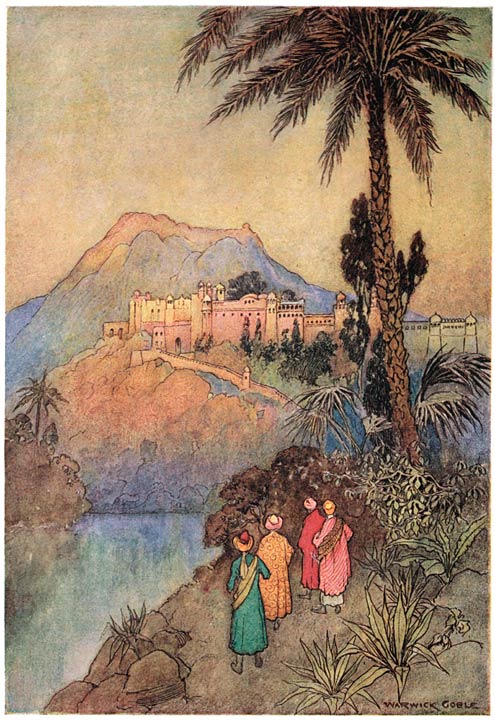
“They approached a magnificent pile of buildings”
The four friends, immediately after landing, walked along a long avenue of stately trees, at the end of which was a bazaar. There were hundreds of shops in the bazaar, but not a single human being in them. There were sweetmeat shops in which there were heaps of confectioneries ranged in regular rows, but no human beings to sell them. There was the blacksmith’s shop, there was the anvil, there were the bellows and the other tools of the smithy, but there was no smith there. There were stalls in which there were heaps of faded and dried vegetables, but no men or women to sell them. The streets were all deserted, no human beings, no cattle were to be seen there. There were carts, but no bullocks; there were carriages, but no horses. The doors and windows of the houses of the city on both sides of the streets were all open, but no human being was visible in them. It seemed to be a deserted city. It seemed to be a city of the dead—and all the dead taken out and buried. The four friends were astonished—they were frightened at the sight. As they went on, they approached a magnificent pile of buildings, which seemed to be the palace of a king. They went to the gate and to the porter’s lodge. They saw shields, swords, spears, and other weapons suspended in the lodge, but no porters. They entered the premises, but saw no guards, no human beings. They went to the stables, saw the troughs, grain, and grass lying about in profusion, but no horses. They went inside the palace, passed the long corridors—still no human being was visible. They went through six long courts—still no human being. They entered the seventh court, and there and then, for the first time, did they see living human beings. They saw coming towards them four princesses of matchless beauty. Each of these four princesses caught hold of the arm of each of the four friends; and each princess called each man whom she had caught hold of her husband. The princesses said that they had been long waiting for the four friends, and expressed great joy at their arrival. The princesses took the four friends into the innermost apartments, and gave them a sumptuous feast. There were no servants attending them, the princesses themselves bringing in the provisions and setting them before the four friends. At the outset the four princesses told the four friends that no questions were to be asked about the depopulation of the city. After this, each princess went into her private apartment along with her newly-found husband. Shortly after the prince and princess had retired into their private apartment, the princess began to shed tears. On the prince inquiring into the cause, the princess said, “O prince! I pity you very much. You seem, by your bearing, to be the son of a king, and you have, no doubt, the heart of a king’s son; I will therefore tell you my whole story, and the story of my three companions who look like princesses. I am the daughter of a king, whose palace this is, and those three creatures, who are dressed like princesses, and who have called your three friends their husbands, are Rakshasis. They came to this city some time ago; they ate up my father, the king, my mother, the queen, my brothers, my sisters, of whom I had a large number. They ate up the king’s ministers and servants. They ate up gradually all the people of the city, all my father’s horses and elephants, and all the cattle of the city. You must have noticed, as you came to the palace, that there are no human beings, no cattle, no living thing in this city. They have all been eaten up by those three Rakshasis. They have spared me alone—and that, I suppose, only for a time. When the Rakshasis saw you and your friends from a distance, they were very glad, as they mean to eat you all up after a short time.”
King’s son. But if this is the case, how do I know that you are not a Rakshasi yourself? Perhaps you mean to swallow me up by throwing me off my guard.
Princess. I’ll mention one fact which proves that those three creatures are Rakshasis, while I am not. Rakshasis, you know, eat food a hundred times larger in quantity than men or women. What the Rakshasis eat at table along with us is not sufficient to appease their hunger. They therefore go out at night to distant lands in search of men or cattle, as there are none in this city. If you ask your friends to watch and see whether their wives remain all night in their beds, they will find they go out and stay away a good part of the night, whereas you will find me the whole night with you. But please see that the Rakshasis do not get the slightest inkling of all this; for if they hear of it, they will kill me in the first instance, and afterwards swallow you all up.
The next day the king’s son called together the minister’s son, the prefect’s son, and the merchant’s son, and held a consultation, enjoining the strictest secrecy on all. He told them what he had heard from the princess, and requested them to lie awake in their beds to watch whether their pretended princesses went out at night or not. One presumptive argument in favour of the assertion of the princess was that all the pretended princesses were fast asleep during the whole of the day in consequence of their nightly wanderings, whereas the female friend of the king’s son did not sleep at all during the day. The three friends accordingly lay in their beds at night pretending to be asleep and manifesting all the symptoms of deep sleep. Each one observed that his female friend at a certain hour, thinking her mate to be in deep sleep, left the room, stayed away the whole night, and returned to her bed only at dawn. During the following day each female friend slept out nearly the whole day, and woke up only in the afternoon. For two nights and days the three friends observed this. The king’s son also remained awake at night pretending to be asleep, but the princess was not observed for a single moment to leave the room, nor was she observed to sleep in the day. From these circumstances the friends of the king’s son began to suspect that their partners were really Rakshasis as the princess said they were.
By way of confirmation the princess also told the king’s son, that the Rakshasis, after eating the flesh of men and animals, threw the bones towards the north of the city, where there was an immense collection of them. The king’s son and his three friends went one day towards that part of the city, and sure enough they saw there immense heaps of the bones of men and animals piled up into hills. From this they became more and more convinced that the three women were Rakshasis in deed and truth.
The captain told the four friends and princess that as he was bound for distant regions in search of gold mines, he could not take them along with him; he, therefore, proposed that on the next day he should put them ashore near some port, especially as they were now safe from the clutches of the Rakshasis. On the following day no port was visible for a long time; towards the evening, however, they came near a port where the four friends and the princess were landed. After walking some distance, the princess, who had never been accustomed to take long walks, complained of fatigue and hunger; they all therefore sat under a tree, and the king’s son sent the merchant’s son to buy some sweetmeats in the bazaar which they heard was not far off. The merchant’s son did not return, as he was fully persuaded in his mind that the king’s son’s partner was as real a Rakshasi as the three others from whose clutches he had escaped. Seeing the delay of the merchant’s son, the king’s son sent the prefect’s son after him; but neither did he return, he being also convinced that the pretended princess was a Rakshasi. The minister’s son was next sent; but he also joined the other two. The king’s son then himself went to the shop of the sweetmeat seller where he met his three friends, who made him remain with them by main force, earnestly declaring that the woman was no princess, but a real Rakshasi like the other three. Thus the princess was deserted by the four friends who returned to their own country, full of the adventures they had met with.
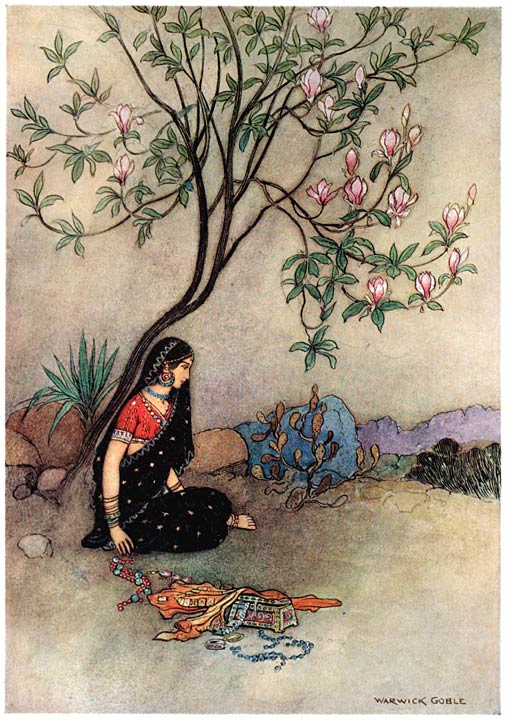
“Thus the princess was deserted”
Every one in the palace was glad except the princess. She could not forget that her parents, her brothers and sisters had been devoured by the Rakshasis, and that their bones, along with the bones of her father’s subjects, stood in mountain heaps on the north side of the capital. The prince had told her that he and his three friends had the power of giving life to bones. They could then reconstruct the frames of her parents and other relatives; but the difficulty lay in this—how to kill the three Rakshasis. Could not the hermit, who taught them to give life, not teach also how to take away life? In all likelihood he could. Reasoning in this manner, the four friends and the princess went to the temple of the hermit in the forest, prayed to him to give them the secret of destroying life from a distance by a charm. The hermit became propitious, and granted the boon. A deer was passing by at the moment. The hermit took a handful of water, repeated over it some words which the king’s son distinctly heard, and threw it upon the deer. The deer died in a moment. He repeated other words over the dead animal, the deer jumped up and ran away into the forest.
Armed with this killing charm, the king’s son, together with the princess and the three friends, went to his father-in-law’s capital. As they approached the city of death, the three Rakshasis ran furiously towards them with open jaws. The king’s son spilled charmed water upon them, and they died in an instant. They all then went to the heaps of bones. The merchant’s son brought together the proper bones of the bodies, the prefect’s son constructed them into skeletons, the minister’s son clothed them with sinews, flesh, and skin, and the king’s son gave them life. The princess was entranced at the sight of the re-animation of her parents and other relatives, and her eyes were filled with tears of joy. After a few days which they spent in great festivity, they left the revivified city, went to their own country, and lived many years in great happiness.
Here my story endeth,
The Natiya-thorn withereth, etc.