III The Indigent Brahman
Reading edition
There was a Brahman who had a wife and four children. He was very poor. With no resources in the world, he lived chiefly on the benefactions of the rich. His gains were considerable when marriages were celebrated or funeral ceremonies were performed; but as his parishioners did not marry every day, neither did they die every day, he found it difficult to make the two ends meet. His wife often rebuked him for his inability to give her adequate support, and his children often went about naked and hungry. But though poor he was a good man. He was diligent in his devotions; and there was not a single day in his life in which he did not say his prayers at stated hours. His tutelary deity was the goddess Durga, the consort of Siva, the creative Energy of the Universe. On no day did he either drink water or taste food till he had written in red ink the name of Durga at least one hundred and eight times; while throughout the day he incessantly uttered the ejaculation, “O Durga! O Durga! have mercy upon me.” Whenever he felt anxious on account of his poverty and his inability to support his wife and children, he groaned out—“Durga! Durga! Durga!”
When the Brahman went to his bath and his devotions, the innkeeper thought it strange that he should be so careful as to the safety of his earthen vessel. There must be something valuable in the handi, he thought, otherwise why should the Brahman take so much thought about it? His curiosity being excited he opened the handi, and to his surprise found that it contained nothing. What can be the meaning of this? thought the innkeeper within himself. Why should the Brahman care so much for an empty handi? He took up the vessel, and began to examine it carefully; and when, in the course of examination, he turned the handi upside down, a quantity of the finest mudki fell from it, and went on falling without intermission. The innkeeper called his wife and children to witness this unexpected stroke of good fortune. The showers of the sugared fried paddy were so copious that they filled all the vessels and jars of the innkeeper. He resolved to appropriate to himself this precious handi, and accordingly put in its place another handi of the same size and make. The ablutions and devotions of the Brahman being now over, he came to the shop in wet clothes reciting holy texts of the Vedas. Putting on dry clothes, he wrote on a sheet of paper the name of Durga one hundred and eight times in red ink; after which he broke his fast on the mudki his handi had already given him. Thus refreshed, and being about to resume his journey homewards, he called for his handi, which the innkeeper delivered to him, adding—“There, sir, is your handi; it is just where you put it; no one has touched it.” The Brahman, without suspecting anything, took up the handi and proceeded on his journey; and as he walked on, he congratulated himself on his singular good fortune. “How agreeably,” he thought within himself, “will my poor wife be surprised! How greedily the children will devour the mudki of heaven’s own manufacture! I shall soon become rich, and lift up my head with the best of them all.” The pains of travelling were considerably alleviated by these joyful anticipations. He reached his house, and calling his wife and children, said—“Look now at what I have brought. This handi that you see is an unfailing source of wealth and contentment. You will see what a stream of the finest mudki will flow from it when I turn it upside down.” The Brahman’s good wife, hearing of mudki falling from the handi unceasingly, thought that her husband must have gone mad; and she was confirmed in her opinion when she found that nothing fell from the vessel though it was turned upside down again and again. Overwhelmed with grief, the Brahman concluded that the innkeeper must have played a trick with him; he must have stolen the handi Durga had given him, and put a common one in its stead. He went back the next day to the innkeeper, and charged him with having changed his handi. The innkeeper put on a fit of anger, expressed surprise at the Brahman’s impudence in charging him with theft, and drove him away from his shop.
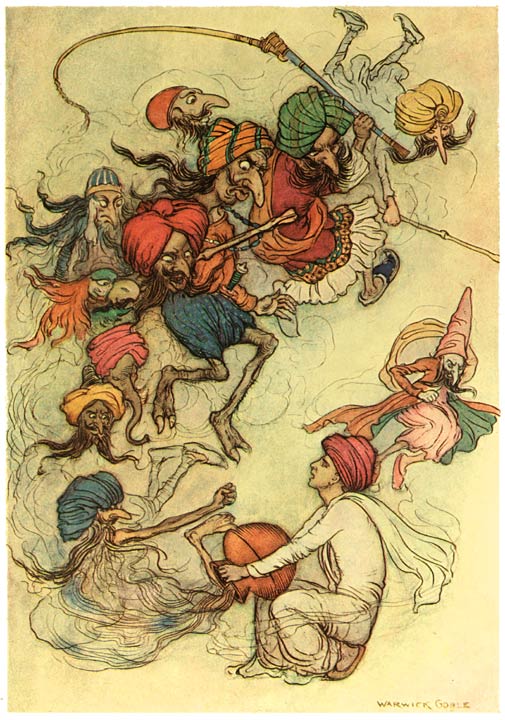
“Instead of sweetmeats about a score of demons”
On reaching home the Brahman shut the door of his house, turned the mudki-handi upside down, and shook it; the result was an unceasing stream of the finest mudki that any confectioner in the country could produce. The man, his wife, and their children devoured the sweetmeat to their hearts’ content; all the available earthen pots and pans of the house were filled with it; and the Brahman resolved the next day to turn confectioner, to open a shop in his house, and sell mudki. On the very day the shop was opened, the whole village came to the Brahman’s house to buy the wonderful mudki. They had never seen such mudki in their life, it was so sweet, so white, so large, so luscious; no confectioner in the village or any town in the country had ever manufactured anything like it. The reputation of the Brahman’s mudki extended, in a few days, beyond the bounds of the village, and people came from remote parts to purchase it. Cartloads of the sweetmeat were sold every day, and the Brahman in a short time became very rich. He built a large brick house, and lived like a nobleman of the land. Once, however, his property was about to go to wreck and ruin. His children one day by mistake shook the wrong handi, when a large number of demons dropped down and caught hold of the Brahman’s wife and children and were striking them mercilessly, when happily the Brahman came into the house and turned up the handi. In order to prevent a similar catastrophe in future, the Brahman shut up the demon-handi in a private room to which his children had no access.
Pure and uninterrupted prosperity, however, is not the lot of mortals; and though the demon-handi was put aside, what security was there that an accident might not befall the mudki-handi? One day, during the absence of the Brahman and his wife from the house, the children decided upon shaking the handi; but as each of them wished to enjoy the pleasure of shaking it there was a general struggle to get it, and in the mêlée the handi fell to the ground and broke. It is needless to say that the Brahman, when on reaching home he heard of the disaster, became inexpressibly sad. The children were of course well cudgelled, but no flogging of children could replace the magical handi. After some days he again went to the forest, and offered many a prayer for Durga’s favour. At last Siva and Durga again appeared to him, and heard how the handi had been broken. Durga gave him another handi, accompanied with the following caution—“Brahman, take care of this handi; if you again break it or lose it, I’ll not give you another.” The Brahman made obeisance, and went away to his house at one stretch without halting anywhere. On reaching home he shut the door of his house, called his wife to him, turned the handi upside down, and began to shake it. They were only expecting mudki to drop from it, but instead of mudki a perennial stream of beautiful sandesa issued from it. And such sandesa! No confectioner of Burra Bazar ever made its like. It was more the food of gods than of men. The Brahman forthwith set up a shop for selling sandesa, the fame of which soon drew crowds of customers from all parts of the country. At all festivals, at all marriage feasts, at all funeral celebrations, at all Pujas, no one bought any other sandesa than the Brahman’s. Every day, and every hour, many jars of gigantic size, filled with the delicious sweetmeat, were sent to all parts of the country.
The wealth of the Brahman excited the envy of the Zemindar of the village, who, having heard that the sandesa was not manufactured but dropped from a handi, devised a plan for getting possession of the miraculous vessel. At the celebration of his son’s marriage he held a great feast, to which were invited hundreds of people. As many mountain-loads of sandesa would be required for the purpose, the Zemindar proposed that the Brahman should bring the magical handi to the house in which the feast was held. The Brahman at first refused to take it there; but as the Zemindar insisted on its being carried to his own house, he reluctantly consented to take it there. After many Himalayas of sandesa had been shaken out, the handi was taken possession of by the Zemindar, and the Brahman was insulted and driven out of the house. The Brahman, without giving vent to anger in the least, quietly went to his house, and taking the demon-handi in his hand, came back to the door of the Zemindar’s house. He turned the handi upside down and shook it, on which a hundred demons started up as from the vasty deep and enacted a scene which it is impossible to describe. The hundreds of guests that had been bidden to the feast were caught hold of by the unearthly visitants and beaten; the women were dragged by their hair from the Zenana and dashed about amongst the men; while the big and burly Zemindar was driven about from room to room like a bale of cotton. If the demons had been allowed to do their will only for a few minutes longer, all the men would have been killed, and the very house razed to the ground. The Zemindar fell prostrate at the feet of the Brahman and begged for mercy. Mercy was shown him, and the demons were removed. After that the Brahman was no more disturbed by the Zemindar or by any one else; and he lived many years in great happiness and enjoyment.
Thus my story endeth,
The Natiya-thorn withereth, etc.