Part 2 — XVIII The Match-making Jackal
Reading edition
Once on a time there lived a weaver, whose ancestors were very rich, but whose father had wasted the property which he had inherited in riotous living. He was born in a palace-like house, but he now lived in a miserable hut. He had no one in the world, his parents and all his relatives having died. Hard by the hut was the lair of a jackal. The jackal, remembering the wealth and grandeur of the weaver’s forefathers, had compassion on him, and one day coming to him, said, “Friend weaver, I see what a wretched life you are leading. I have a good mind to improve your condition. I’ll try and marry you to the daughter of the king of this country.” “I become the king’s son-in-law!” replied the weaver; “that will take place only when the sun rises in the west.” “You doubt my power?” rejoined the jackal; “you will see, I’ll bring it about.”
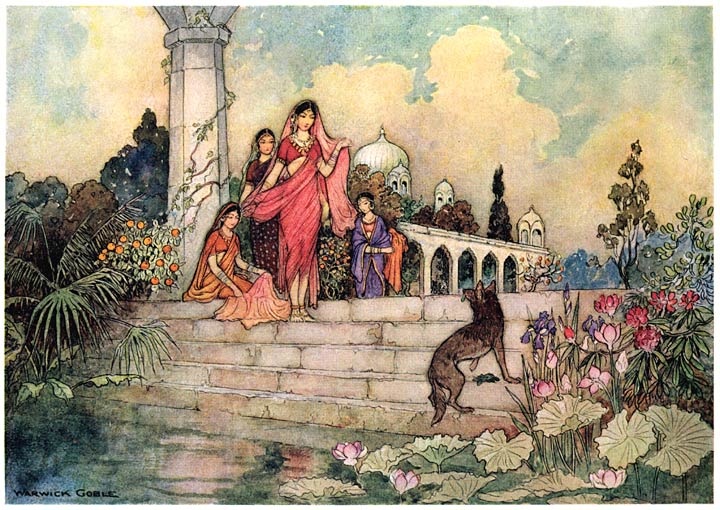
“The jackal ... opened his bundle of betel-leaves, put some into his mouth, and began chewing them”
The jackal after this returned to the weaver and said to him, “O lord of the loom, you are the luckiest man in the world; it is all settled; you are to become the son-in-law of a great king. I have told them that you are yourself a great king, and you must behave yourself as one. You must do just as I instruct you, otherwise your fortune will not only not be made, but both you and I will be put to death.” “I’ll do just as you bid me,” said the weaver. The shrewd jackal drew in his own mind a plan of the method of procedure he should adopt, and after a few days went back to the palace of the king in the same manner in which he had gone before, that is to say, chewing betel-leaves and lying down at the entrance of the tank on the premises of the palace. The king and queen were glad to see him, and eagerly asked him as to the success of his mission. The jackal said, “In order to relieve your minds I may tell you at once that my mission has been so far successful. If you only knew the infinite trouble I have had in persuading his Majesty, my sovereign, to make up his mind to marry your daughter, you would give me no end of thanks. For a long time he would not hear of it, but gradually I brought him round. You have now only to fix an auspicious day for the celebration of the solemn rite. There is one bit of advice, however, which I, as your friend, would give you. It is this. My master is so great a king that if he were to come to you in state, attended by all his followers, his horses and his elephants, you would find it impossible to accommodate them all in your palace or in your city. I would therefore propose that our king should come to your city, not in state, but in a private manner; and that you send to the outskirts of your city your own elephants, horses, and conveyances, to bring him and only a few of his followers to your palace.” “Many thanks, wise Sivalu, for this advice. I could not possibly make accommodation in my city for the followers of so great a king as your master is. I should be very glad if he did not come in state; and trust you will use your influence to persuade him to come in a private manner; for I should be ruined if he came in state.” The jackal then gravely said, “I will do my best in the matter,” and then returned to his own village, after the royal astrologer had fixed an auspicious day for the wedding.
On his return the jackal busied himself with making preparations for the great ceremony. As the weaver was clad in tatters, he told him to go to the washermen of the village and borrow from them a suit of clothes. As for himself, he went to the king of his race, and told him that on a certain day he would like one thousand jackals to accompany him to a certain place. He went to the king of crows, and begged that his corvine majesty would be pleased to allow one thousand of his black subjects to accompany him on a certain day to a certain place. He preferred a similar petition to the king of paddy-birds.
As there was nothing for it, the princess soon got reconciled to her fate. She, however, determined to make her husband rich, especially as she knew the secret of becoming rich. One day she told her husband to get for her a pice-worth of flour. She put a little water in the flour, and smeared her body with the paste. When the paste dried on her body, she began wiping the paste with her fingers; and as the paste fell in small balls from her body, it got turned into gold. She repeated this process every day for some time, and thus got an immense quantity of gold. She soon became mistress of more gold than is to be found in the coffers of any king. With this gold she employed a whole army of masons, carpenters and architects, who in no time built one of the finest palaces in the world. Seven hundred families of weavers were sought for and settled round about the palace. After this she wrote a letter to her father to say that she was sorry he had not favoured her with a visit since the day of her marriage, and that she would be delighted if he now came to see her and her husband. The king agreed to come, and a day was fixed. The princess made great preparations against the day of her father’s arrival. Hospitals were established in several parts of the town for diseased, sick, and infirm animals. The beasts in thousands were made to chew betel-leaves on the wayside. The streets were covered with Cashmere shawls for her father and his attendants to walk on. There was no end of the display of wealth and grandeur. The king and queen arrived in state, and were infinitely delighted at the apparently boundless riches of their son-in-law. The jackal now appeared on the scene, and saluting the king and queen, said—“Did I not tell you?”
Here my story endeth,
The Natiya-thorn withereth, etc.