THE UNION FLAG.
Reading edition
In 1603, on the union of the crowns of England and Scotland, the first union flag was formed by the combination of St. George's cross with the saltire of Scotland; but this flag appears to have been used for ships only. The order by the king for its construction and use bears to have been made "in consequence of certain differences between his subjects of North and South Britain anent the bearing of their flags;" and in the proclamation issued in 1606, King James appoints that "from henceforth all our subjects of this Isle and Kingdom of Great Britain shall bear in the maintop the red cross commonly called St. George's Cross, and the white cross commonly called St. Andrew's Cross, joined together according to a form made by our heralds, and sent by us to our admiral to be published to our said subjects." This was the first union flag. The Scots being, however, sensitively jealous of England, insisted on using their own national flag as well as the union, and it was no doubt owing to this that the proclamation goes on to provide that "in their foretop our subjects of South Britain shall wear the red cross only as they were wont, and our subjects of North Britain in their foretop the white cross only, as they were accustomed." In the ensign the union was not worn till a considerable time afterwards—the union by itself being then as now worn by the king's ships as a jack at the bowsprit.
On the death of Charles I. the Commonwealth Parliament, professing to be the Parliament of England only, and of Ireland as a dependency, expunged the Scottish cross from the flag with its blue field. The flag of command ordered to take the place of the union, and to be borne by the admirals of the respective squadrons, at the main, fore, and mizen, is described[36] as "the arms of England and Ireland in two escutcheons on a red flag within a compartment or,"—that of the admiral, according to Mr. Pepys, being encircled by a laurel wreath, while those of the vice and rear-admirals were plain. The ensigns showed the Irish harp on the fly.[37]
On the Restoration in 1660 the union flag was reintroduced, and when England and Scotland became constitutionally united in 1707, this was confirmed, with an order that it should be used "in all flags, banners, standards, and ensigns, both at sea and land." The order in council bears "that the flaggs be according to the draft marked C, wherein the crosses of St. George and St. Andrew are conjoined;" but none of the drafts appear in the Register. A representation of this flag will be found in Plate III. No. I., and there being no draft to copy, I have given it according to the verbal blazon, viz. azure a saltire argent surmounted by a cross gules fimbriated of the second—that is, the St. George's cross with a narrow white border.
On the union with Ireland in the beginning of the present century the Irish saltire was introduced. The St. George's cross remained as it was, but the saltires of Scotland and Ireland were placed side by side, but "counterchanged"—that is, in the first and third divisions or quarters, the white, as senior, is uppermost, and in the second and fourth the red is uppermost. The "verbal blazon," or written direction, is very distinct, but in making the flag, or rather in showing pictorially how it was to be represented, a singular and very absurd error occurred, which, in the manufacture of our flags, has been continued to the present day, and which it may be interesting to explain.
The verbal blazon is contained in the minute by the king in council, and in the proclamation which followed on it, issued on 1st of January, 1801. I need not give the technical words; suffice to say that the flag is appointed to be blue, with the three crosses, or rather, the one cross and two saltires combined. And, in order to meet a law in heraldry, that colour is not to be placed on colour, or metal upon metal, it is directed that where the red crosses of England and Ireland come in contact with the blue ground of the flag, they are to be "fimbriated"—that is, separated from the blue by a very narrow border of one of the metals—in this case silver, or white. Of heraldic necessity this border of both the red crosses fell to be of the same breadth. To use the words of the written blazon, the St. George's cross is to be "fimbriated as the saltire;" a direction so plain that the merest tyro in heraldry could not fail to understand it, and be able to paint the flag accordingly.
Let me premise another thing. It is a universal rule in heraldry that the verbal blazon, when such exists, is alone of authority. Different artists may, from ignorance or from carelessness, express the drawing differently from the directions before them, and this occurs every day; but no one is or can be misled by that if he has the verbal blazon to refer to.
Now, in the important case of the Union flag it so happened that the artist who, according to the practice usual in such cases, was instructed to make a drawing of the flag on the margin of the king's order in council, was either careless or ignorant or stupid. Most probably he was all three, and here is how he depicted it. The horizontal lines represent blue and the perpendicular red; the rest is white. (See Fig. 26.)
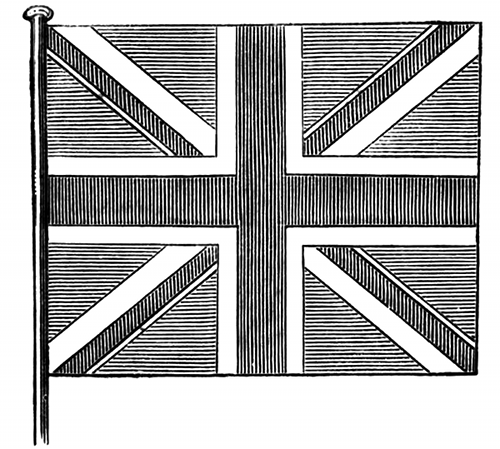
Fig. 26.—Union Flag as depicted A.D. 1801.
Now here, it will be observed, the red saltire of Ireland is "fimbriated" white, according to the instructions; and this is done with perfect accuracy, by the narrowest possible border. But the St. George's cross, instead of being fimbriated in the same way—which the written blazon expressly says it shall be—is not fimbriated at all. The cross is placed upon a ground of white so broad that it ceases to be a border. The practical effect of this, and its only heraldic meaning, is, that the centre of the flag, instead of being occupied solely by the St. George's cross, is occupied by two crosses, a white cross with a red one superinduced on it. So palpable is this that Mr. Laughton, the accomplished lecturer on naval history at the Royal Naval College, in a lecture recently published, suggests that this is perhaps what was really intended. "A fimbriation," he says, "is a narrow border to prevent the unpleasing effect of metal on metal or colour on colour. It should be as narrow as possible to mark the contrast. But the white border of our St. George's cross is not, strictly speaking, a fimbriation at all. It is a white cross of one-third the width of the flag surmounted of a red cross." And his hypothesis is that this may have been intended to commemorate a tradition of the combination of the red cross of England with the white cross of France.[38] The suggestion is ingenious and interesting, but it has clearly no foundation. There might have been something to say for it had there been only the drawing to guide us. In that case, indeed, the theory of Mr. Laughton, or some one similar, would be absolutely necessary to account for the two crosses. But Mr. Laughton overlooks the important facts, first, that we possess in the verbal blazon distinct written instructions; secondly, that where such exist no drawing which is at variance with them can possess any authority; and lastly, that in this case the verbal blazon not only is silent as to a second cross, but it expressly prescribes that there shall be only one, that of St. George. To that nothing is to be added—nothing, that is, but the narrow border or fimbriation necessary to meet the heraldic requirement to separate it from the blue ground of the flag, the same as is directed to be done, and as has been done, with the saltire of Ireland.
Some years ago I called the attention of the Admiralty to this extraordinary blunder, and I pointed out then, just what Mr. Laughton has done in his recent lecture, that the flag, as made, really shows two crosses in the centre. The Admiralty referred the matter to Garter King of Arms, but Sir Albert Woods, while he did not say a word in defence of the arrangement, would not interfere. "The flag," he said, "was made according to the drawing,"—which was too true—"and it was exhibited," he added, "in the same way on the colours of the Queen's infantry regiments;" and, naturally enough, he declined the responsibility of advising a change. And so it remains. I may observe, however, that in one, at least, of the Horse Guards' patterns, the arrangement of the tinctures is not, as Sir Albert supposes, according to the original drawing, and it is different from the pattern prescribed by the Admiralty. I refer to the flag prescribed for the use of military authorities "when embarked in boats or other vessels." In that flag, of which an official copy is now before me, the fimbriation of the Irish saltire is of much greater breadth than it is in the Admiralty flag, while that saltire itself is considerably reduced in breadth.
Besides the error in the border of the St. George's cross, the breadth of the Irish saltire in all our flags, as now manufactured, is less than that of the white cross of Scotland, which is clearly wrong. For obvious reasons, and according to the written blazon, they ought to be the same. Indeed, all the three crosses ought to be of the same breadth. So great, however, is the difference in practice, that in the official Admiralty Directions for the construction of a flag of given dimensions, while the St. George's cross is appointed to be 18 inches in breadth, that of St. Andrew is to be only 9 inches, and the Irish cross only 6—this last being exactly the same as the breadth appointed for the border of the cross of St. George!
Figure II. of Plate III. shows the flag as made according to the erroneous pattern now in use. Figure III. shows it as it ought to be, and as it is appointed to be made by the distinct terms of the verbal blazon, in the order by the king in council. But the breadth of the St. George's cross I have left unaltered.
It is to be hoped that heraldic propriety will prevail over a practice originating in obvious error, and that our national flag will be flown according to its true blazon. The correction would be very easily made. The reduction of the breadth of the border of St. George's cross and the slight increase in the width of the Irish saltire would be little noticed, while, besides correcting obvious errors, it would have the advantage of bringing the flag, in one important respect, into conformity with the design as represented on the coinage. On the reverse of our beautiful bronze coins the St. George's cross on Britannia's shield is fimbriated as it ought to be, that is, by the narrow border prescribed by the written blazon.
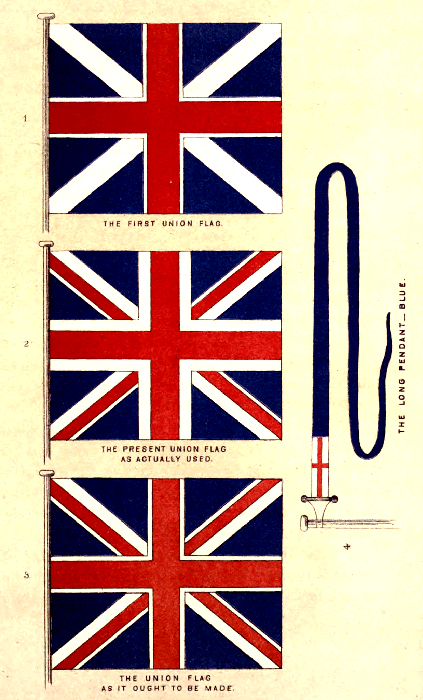
UNION FLAGS AND PENDANT. PLATE III.
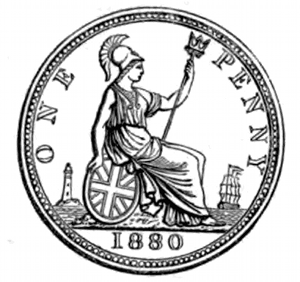
Fig. 27.
But if the penny is right in that respect, it exhibits another extraordinary example of our slipshod heraldry, by a variation of a different and more startling kind. My complaint against the flag, as made, is, that it represents four crosses, but on the penny there are only two. This was all right when the design was first made in the reign of Charles II., but when the third cross was added to the flag the three crosses should have appeared on the coin. A desire to adhere to the original design cannot certainly be pleaded, for there have been many changes in this figure of Britannia. She was first placed there by Charles II. in honour of the beautiful Duchess of Richmond, who sat to the sculptor for the figure. But her drapery on the coin of those days was very scanty, and her semi-nude state was hardly in keeping with the stormy waves beside which she was seated. Queen Anne, like a modest lady as she was, put decent clothing on her, and made her stand upright, and took away her shield, crosses and all. In the subsequent reigns she was allowed to sit down again, and she got back her shield, with the trident in her left hand and an olive-branch in the right. On the present coinage—a copy of which (the penny) is shown in Fig. 27—the drapery of Queen Anne is retained, but the figure is entirely turned round, and faces the sinister side of the coin, instead of the dexter, as at first, and the olive-branch (absit omen) has been taken away. But with all these changes there remain only two crosses on the shield. The reader will naturally suppose, however, that the omission consisted in not adding the Irish saltire to that of Scotland, which had been there from the first. But no. In this instance there was certainly no "injustice to Ireland," for the extraordinary thing is, that the St. Andrew's cross has been taken away altogether, and the saltire of Ireland, distinguished by its fimbriated border, has been put in its place, Scotland being not now represented on the coin at all. Of course this has arisen from mere carelessness at the Mint, but it is an error which ought to be at once corrected.