OTHER FOREIGN FLAGS.
Reading edition
The flag of Liberia is very like that of the United States, being composed of red and white stripes with a blue canton. The only difference is that the latter bears only one star. (See the flag of Liberia, Plate V. No. 6.) The flag of Bremen is also composed of red and white stripes.
Spain from the first period of her greatness bore the Castilian flag, quartering Castile and Leon. In an old illumination representing the coronation of Henry, son of John, King of Castile, there are on the king's left hand two men, unarmed, the one holding a banner of Castile and Leon quarterly, the other a blue pennon charged with three kings' heads-the banner of the three kings of Cologne. On his majesty's right hand a man, also unarmed, holds a shield with the arms of Castile and Leon. It was this last device, as a national flag, that was carried by the ships of Columbus. But Columbus had also as a personal flag one given to him by Queen Isabella—a white swallow-tailed pennon bearing a Latin cross in green between the letters FY crowned. These two flags are noteworthy as the first that crossed the Atlantic.
The present royal standard of Spain is of very complicated construction (see Plate V. No. 1), embracing among its bearings the arms of Castile and Leon, of Aragon, Sicily, Burgundy, and others. The national ensign is in marked contrast by its simplicity. It is composed of yellow and red stripes—derived from the bars of Aragon. (See Plate V. No. 2.)
Austria at first bore on her flag the Roman eagle. Now her war ensign is red, white, and red placed horizontally, and in the centre a shield of the same within a gold border (the arms of the Dukes of Austria), surmounted by the royal crown. (See Plate V. No. 3.) The merchant flag is the same without the shield and crown. The Austro-Hungarian flag has the lower stripe half red and half green, with two shields, one on the right containing the arms of Austria, and the other bearing the arms of Hungary. (See Plate V. No. 4.)
The flag of Italy was designed by Napoleon I. on his declaration of the Kingdom of Italy. It is a modification of the French, the division of the field next the staff being, instead of blue, green, which, it is known, was a favourite colour of the emperor. In the centre is a red shield charged with a white cross—the arms of the Dukes of Savoy, now borne by Italy. A representation of the Italian merchant flag will be found on Plate V. No. 5. The war ensign is the same, except that the shield is surmounted by the royal crown.
In the construction of the flag of Norway, curiously enough, the same blunder has been committed as in our own Union. It is "described" as a blue cross fimbriated white; but the border, as the flag is worn, is too broad, and it really represents two crosses, a blue cross superimposed on a white one—just as our St. George's cross, as represented in our national colours, is nothing but a red cross superimposed on a white one. Mr. Laughton accordingly looking at the Norwegian flag in this light, calls it the white flag of Denmark with a blue cross over it,[50] which it was certainly not intended to be. The flag is shown in Plate V. No. 11. The Swedish-Norwegian union in the canton was introduced in 1817, when the two countries were united under one king.
The Danish flag (see Plate V. No. 7) is the oldest now in existence. The tradition is that it descended from Heaven ready made in the year 1219 in answer to the prayer of King Waldemar, as he was leading his troops to battle against the pagans of the Baltic. Be that as it may, it certainly dates from the thirteenth century.
The flag of Portugal has borne a conspicuous part in history, and the devices in it carry us back to a very early period. The present royal standard is red with a red shield in the centre charged with towers or castles for the kingdom of Algarve, which Alphonsus III. got from the King of Castile when he married the daughter of the latter in 1278; and in the centre there is a white shield bearing on it the shields of the five Moors placed crossways. The Portuguese national flag is per pale, blue and white, and in the centre point is the same device as appears on the royal standard. The present flag, however, is only a modification of the old flag which was carried by the early discoverers, and which brought glory to Portugal in the days of Prince Henry the Navigator. (See the national flag of Portugal, Plate V. No. 12.)
The royal standards of Norway and Sweden, and also the ensign of these kingdoms, are peculiar in preserving the ancient form of having the fly ending in three points. (See the Swedish standard, Plate V. No. 10.)
Greece has adopted the colours of Bavaria in compliment to her first king. (See Plate VI. No. 7.)
The devices on some of the Asiatic flags are peculiar. That of Burmah bears a peacock; Siam, a white elephant; and China, a hideous-looking dragon. (See these flags, Plate VI. Nos. 1, 2, 3.) On the flag of Bolivia (Plate VI. No. 4) is the representation of a volcano, suggested in all probability by the great volcano of Serhama, which rises in Western Bolivia to the height of 23,000 feet. Japan, the land of the far east, the source of the sun, as her name signifies, has adopted for her flag the sun rising blood-red. (See Plate V. No. 9.)
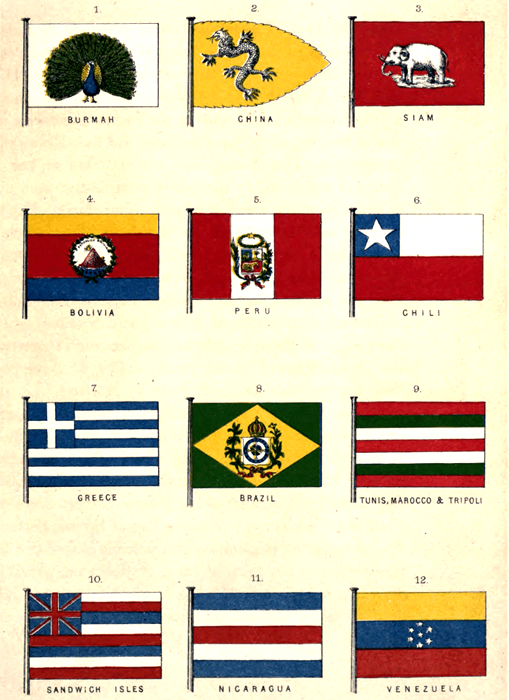
NATIONAL FLAGS AND STANDARDS. PLATE VI.
The flag of Brazil, which is very inartistic in its construction, bears among other devices the armillary sphere of Portugal. (See Plate VI. No. 8.)
In Plates IV. V. and VI. will be found representations of the flags of other kingdoms and republics. These speak for themselves, and do not call for particular description.
But I must now bring these notices to a close. To the true patriot of every country the national flag must be a subject of pride. If, as a French writer observes, it does not always lead him to victory, it inspires him to fight well, and if need be to die well. "We pay to it," says the same writer, "royal honours. When it is paraded—in rags it may be, and with faded colours, bearing in letters of gold the names of victories—the troops present arms, the officers salute it with the sword, and the white heads of veteran generals are uncovered and bent before the ensign." To the soldier its loss is one of the greatest calamities. In Napoleon's disastrous retreat from Moscow in 1812 not many of his flags remained with the Russians. Of those which were not carried off most were burned, and of some of these the officers drank the ashes. More recently the same thing is said to have been done at Metz and Sedan. So a French writer tells us, and he characterizes the act as "communion sublime!"
What the flag is, indeed, to the sailor and the soldier, whether when shaken out in battle or when displayed in memory of great victories, none but the soldier and the sailor can realize. At the interment of Lord Nelson, when his flag was about to be lowered into the grave, the sailors who assisted at the ceremony ran forward with one accord and tore it into small pieces, to be preserved as sacred relics. "I know," says Charles Kingsley—in those Brave Words which he addressed to our soldiers then fighting in the trenches before Sebastopol, "I know that you would follow those colours into the mouth of the pit; that you would die twice over rather than let them be taken. Those noble rags, inscribed with noble names of victory, should remind you every day and every hour that he who fights for Queen and country in a just cause is fighting not only in the Queen's army but in Christ's army, and that he shall in no wise lose his reward."