FOREIGN FLAGS: FRANCE.
Reading edition
My notice of foreign flags must be short. Those of France and America have naturally most interest for us.
Previous to the Revolution the French can hardly be said to have had a national flag. The colours of the reigning families—changing as they did with each fresh dynasty, as was the case in our own early history—were accepted in the place of national standards, while each regiment in the army followed colours of its own. The celebrated Chape de Saint Martin de Tours and the Oriflamme of the Abbey of Saint Denis, were, like the labarum of Constantine, ecclesiastical banners, symbolic of the two patrons of Christian France watching over her in her battles. The Chape de Saint Martin was a banner imitating in form a cape or cloak, and was of blue. The Oriflamme was red with a green fringe. By the end of the tenth century this had become the royal standard. In one of the windows of the Cathedral of Chartres (of the thirteenth century) there is a representation of Henri Sieur de Argentin et du Mez, Marshall of France under St. Louis, receiving from the hands of St. Denis a banner which is supposed to be the Oriflamme. Fig. 30 is a copy of this interesting old work of art. The banner, it will be observed, has five points; but in other examples it has only three, each having attached to it a tassel of green silk.
The royal banner of St. Louis was blue powdered with fleurs-de-lis in gold, and these fleurs-de-lis have remained since the eleventh or twelfth century a peculiarly French and royal device. It is indeed one of extreme antiquity, the emblem of a long-forgotten worship—older by many ages than any record of the doctrine of the Trinity, of which some have supposed this flower to be an emblem.[44]
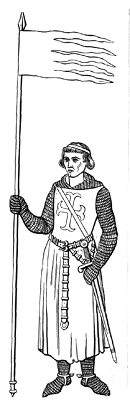
Fig. 30.—The Oriflamme, circa 1248.
In the reign of Charles VI. the blue field ceased to be powdered with fleurs-de-lis, and was charged with three only—two and one. The white flag which became the standard of the kings of France was probably not introduced till the reign of Henry IV. But there is great confusion in the history of the French flags, and this is increased by the use of personal colours at sea, which continued among the French to a much later period than among the English. In the colours of the French regiments there has been great variety of design. Under the old monarchy the regimental colours were of two kinds—one was the drapeau-colonel, or royal; the other, called drapeau d'ordonnance, took its device from the founder of the particular regiment which carried it, or from the province of its origin. A common form of the royal colours was a white cross on a blue field. In other examples, sometimes the cross and sometimes the field were powdered with fleurs-de-lis. In some instances the field was green. The flag displayed by the French in 1789 was a white cross on a blue ground, with one fleur-de-lis at each corner of the field, and the motto "Patrie et Liberté."
The Tricolour was introduced at the Revolution, but the origin of the design is unknown. Possibly a trace of it may be found in an illumination in one of the MS. copies of Froissart. It represents the King of France setting out against the Duke of Brittany, and his majesty is preceded by a man on horseback bearing a swallow-tailed pennon, the first part containing the ancient arms of France, and each of the tails—composed of three stripes—red, white, and green.
For some time after the Revolution the white field was retained. When the three colours came to be used there appears to have been at first no fixed order in arranging them, and in some cases they were placed vertically, and in others horizontally. By a decree in 1790 it was ordained that in the navy the flag on the bowsprit—the jack—should be composed of three equal bands placed vertically, that next the staff being red, the middle white, and the third blue. The flag at the stem was to have in a canton the jack above described (occupying one fourth of the flag), and to be surrounded by a narrow band, the half of which was to be red and the other blue, and the rest of the flag to be white. In 1794 this flag was abolished, and it was ordered "that the national flag shall be formed of the three national colours in equal bands placed vertically, the hoist being blue, the centre white, and the fly red." It would appear, however, that this arrangement was not for some time universally adopted, and that old flags continued to be used. Thus, in the great picture by De Loutherbourg at Greenwich, the French ships are represented as wearing the suppressed flag of 1790; while, in a rare print preserved in the Bibliotheque Nationale at Paris, representing the magnificent ceremony at which the first Napoleon distributed eagles to the troops in 1804, the banners suspended over the Ecole Militaire in the Champ de Mars, where the ceremony took place, show the three colours in fess, that is, in horizontal lines. But the vertical arrangement must have been soon afterwards generally adopted, and this continued to be the flag both of the French army and navy during the Empire. On the return of the king in 1814, and again in 1815, it was abolished, and the white flag restored; but the Tricolour was reintroduced in 1830, and it has remained in use since.[45]
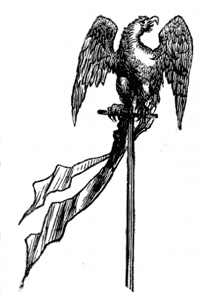
Fig. 31.
When the Emperor Napoleon assumed the sovereignty of Elba he had a special flag made. It will be recollected that he was allowed to retain the title of emperor, and although the island which comprised his dominions was only sixty miles in circumference, the inhabitants barely 12,000, his household 35 persons, and his entire army only 700 infantry and 60 cavalry, he considered it necessary to have a "national flag." According to Sir Walter Scott, it bore on a white field a bend charged with three bees. But the emperor was preparing another and very different flag for his small army, of which I am able to give a representation from a very rare coloured engraving.[46] It was the tricolour of France, composed of the richest silk with the ornaments elaborately embroidered in silver. It bore the imperial crown with the letter N, and the eagle, on each of the blue and red portions, with the imperial bees; and over all the inscription, "L'Empereur Napoléon à la Garde Nationale de L'lle d'Elbe." To the staff, the top of which was surmounted by a golden eagle, was suspended a tricoloured sash also richly embroidered in silver. This splendid standard was presented by Napoleon to his guards in Elba shortly before his invasion of France in 1815. On the reverse side there was subsequently embroidered the inscription, "Champ de Mai"—the flag having been a second time presented by the emperor to his guards at that celebrated meeting, a short time before they marched for Waterloo. The standard was captured by the Prussians, and on their entering Paris was sold to an English gentleman who brought it to England.[47]
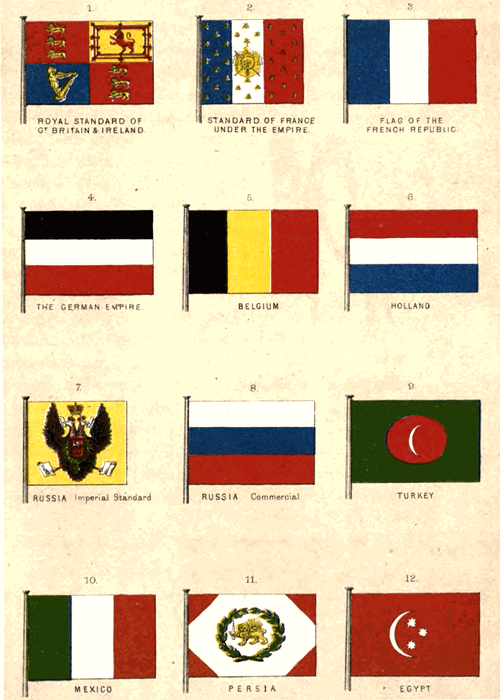
NATIONAL FLAGS AND STANDARDS. PLATE IV
The lately-abolished Eagle (Fig. 31) was borne as a standard in the French army during the Empire only. It was introduced by Napoleon I., who adopted it from the Romans. The ribbon attached was of silk five inches wide and three feet long, and richly embroidered. After Napoleon's fall the eagles were abandoned, but they were again introduced by Napoleon III. In consequence of their intrinsic value, they proved in the Franco-German war a much-coveted prize among the Germans, who captured a considerable number of them on the successive defeats of the French. The first Napoleon was very careful of the Eagles. He himself tells us, in one of the conversations at St. Helena, that he established in each regiment two subaltern officers as special guardians of the Eagle. "Ils n'avaient d'autre arme," he says, "que plusieurs paires de pistolets: d'autre emploi que de veiller froidement a bruler la cervelle de celui qui avancerait pour saisir l'aigle."
The Dutch and Russian ensigns have the same tinctures as those of the present French flag, but borne fess ways—that is horizontally. The former has the red uppermost. The latter has the metal, the white, uppermost, and the two colours, the blue and the red—against all our notions of heraldic propriety—placed together below. (See Dutch and Russian flags, Plate IV. Nos. 6 and 8.)
The Belgian colours adopted in 1831 are arranged as the French, but the colours are black, yellow, and red. (Plate IV. No. 5.) The flag of Prussia is also composed of three stripes-black, white, and red, but arranged horizontally. (Plate IV. No. 4.) The flag of Mexico is arranged like that of France, but the colours are green, white, and red. (Plate IV. No. 10.)