STANDARDS BORNE BY NOBLES.
Reading edition
Standards borne by subjects were, in early times, according to the Tudor MS. to be "slitt at the end," but they appear to have been also borne square. This is the form in an old standard of Richard, Earl of Warwick—circa 1437—bearing his badge of the bear and ragged staff (Fig. 20). Shakespeare[29] alludes to this device when he puts into the mouth of Warwick the words—
"Now by my father's badge, old Neville's crest, The rampant bear chained to the ragged staff."
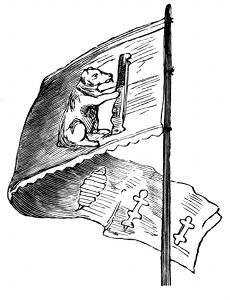
Fig. 20.—Standard of the Earl of Warwick, A.D. 1437.
But Shakespeare was out in his heraldry here, first in confounding the badge with a crest, and secondly in calling it Neville's, for the bear and the ragged staff had been the badge not of the Nevilles but of the Beauchamps, who preceded Warwick in the earldom.[30] This old Earl of Warwick had a similar device on the flag which he flew in his ship. It was a long flag, having the cross of St. George on the upper part—then the bear and ragged staff, and the remainder covered with ragged staffs. It is interesting to note that the account for this and other flags made for the earl in 1437, is preserved. The one just referred to is described as "a great Stremour for the ship of xi yerdis length and viij yerdis in brede," and the price for making it was "jli vis viiid."[31]
In the Advocates' Library there is preserved an interesting flag, which is said to have been the standard borne by the Earl Marshall at the battle of Flodden (Fig. 21). It is thus described in the paper which accompanies it: "The standard of the Earl Marshall of Scotland, carried at the battle of Flodden, 1513, by black John Skirving of Plewland Hill, his standard-bearer. Skirving was taken prisoner, having previously, however, concealed the banner about his person. The relic was handed down in the Skirving family, and presented to the Faculty of Advocates by William Skirving of Edinburgh, in the beginning of the present century. The arms and motto are those of the Keith family."
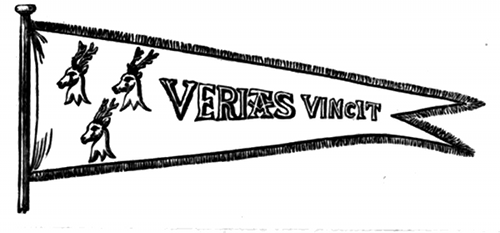
Fig. 21.—Flag of the Earl Marshall.
The flag may have been borne by the earl at Flodden, but the devices on it are certainly not his arms. The arms of the Earl Marshall were, argent, on a chief gules three pallets or; or, as it is otherwise given by Nisbet, pallé of six, or and gules. The crest of the earl, however, was a hart's head, and he had for supporters two harts. His motto also was that which appears on the banner, "Veritas vincit." That the full arms should not appear on the standard I can understand, for it was not common to place them there, and in England the Tudor MS. prescribes that, besides the cross of St. George, standards and guidons are to have on them not the arms, but only the bearers "beast or crest, with his devyce and word." It is possible, therefore, that the earl may have placed on his flag his well-known crest with the heads of the two harts forming his supporters, though such an arrangement would be unusual.
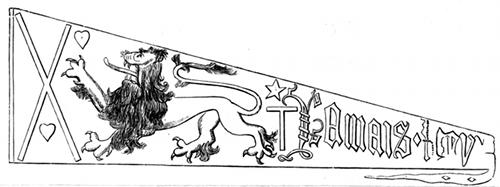
Fig. 22.—Standard of Earl Douglas, A.D. 1388.
The relic of a still older fight than that of Flodden is still preserved in Scotland in the standard borne by Earl Douglas at Otterburn—one of the most chivalrous battles, according to Froissart, that was ever fought. The story, as told in all the histories,[32] is that shortly before the battle, in a skirmish before Newcastle, Douglas, in a personal encounter with Percy, won the pennon of the English leader, and boasted that he would carry it to Scotland and plant it on his castle of Dalkeith; and till lately this standard was supposed to be the flag so captured. But recent investigation has shown that the flag—which, by the way, is not a pennon but a standard thirteen feet long—is that of Douglas himself, which of course his son would be careful to preserve and bring back. The flag is now much faded, and the second word of the motto was, when I saw it lately, not legible, but the motto is undoubtedly that of Earl Douglas, "Jamais arriere" (Fig. 22). The devices are not the arms as borne by his descendants the Dukes of Douglas;—indeed they are not arranged as a coat of arms at all. But the lion rampant for Galloway, the saltire for the lordship of Annandale, and the heart and the star, are all Douglas bearings. Curiously enough, there are two hearts, while the later earls bore only one, and there is only one star, while on their shields they carried three. The real trophies, the capture of which, in all probability, precipitated the battle, are to be found in two other relics which are preserved along with the flag. They consist of two lady's gauntlets, fringed with filigree work in silver, on each of which is embroidered the white lion of the Percys. The gloves are of different sizes, and were perhaps love pledges, carried by Percy suspended from his spear or helmet, as was the fashion of the time; and the loss of such tokens was quite as likely as the loss of a personal flag, to cause the Northumbrian knight to pursue Douglas and force him to battle.[33] These relics are in the possession of the family of Douglas of Cavers in Roxburghshire, descended from the earl who was slain at Otterburn.
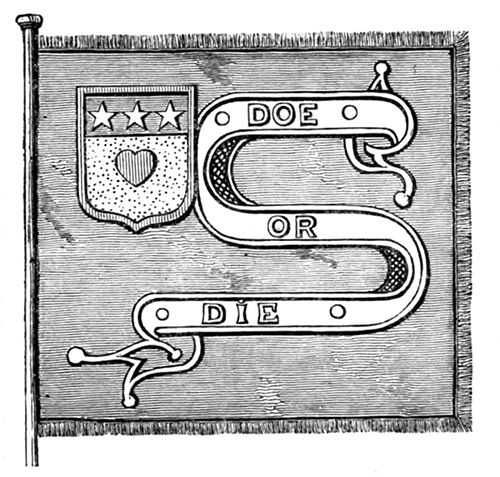
Fig. 23.—Banner of the Douglas's.
Along with them is preserved another old flag of the Douglas's, but evidently of a later date. It is a good example of the square banner borne by knights of noble rank. It is about 28 inches square, and bears on a shield the Douglas arms, but with the heart as originally borne before it was ensigned with a crown, and the chivalric motto still used by the Cavers family, "Doe or die" (Fig. 23).