Chapter IX · BATTERY TACTICS.
Reading edition
190. General instructions.
1. The battery is the fire unit, except in heavy artillery, in which, each section being self-contained, the battery or the section is the fire unit according to circumstances. To enable effective fire to be brought to bear in the shortest possible time on such objectives as the tactical situation may require, correct observation and promptness of decision on the part of the battery commander are as essential as a high standard of fire discipline throughout the battery.
2. By fire discipline is meant not only careful attention to all the details of drill when in action, but also ready response to the signals and orders of all superiors. It demands, in addition, endurance of the enemy’s fire, even when no reply is possible.
3. The battery commander should be allowed latitude as regards the choice of objectives within the task allotted to him, which may be wide or circumscribed. (See Sec. 184 (2).) If the battery commander assumes the responsibility of departing from his allotted task he must be prepared to justify his action, which should be reported at once to the brigade commander.
4. The principles which guide a commander in applying the fire of his battery in different circumstances should be known to all officers and non-commissioned officers.
5. When a battery is acting independently, its commander is responsible not only for its fire action, but for those other duties which are described under the head of brigade tactics, In this case it may be desirable for the commander to devote his whole attention to watching the tactical situation, and to leave the conduct or fire to the next senior officer; this may sometimes be advisable even when the battery is in brigade,
6. For manœuvre the battery is divided into:—
The firing battery. The first line wagons.
The “firing battery” consists of 6 guns and 6 ammunition wagons, except in the case of 4-gun batteries, when it consists of 4 guns and 4 wagons. The wagon of the firing battery always accompanies its gun.
The “first line wagons” consist of the remainder of the ammunition wagons authorized to accompany a battery. In Q.F. batteries these are 6 in number.
The 1st line mules of a mountain battery correspond to the 1st line wagons of a field battery for the purpose of manœuvre. References to the procedure of the 1st line wagons in the succeeding paragraphs apply therefore to the 1st line mules of mountain batteries. (See also Sec. 125 (8).)
191. Preparation for action.
1. The object of preparation for action is to minimise as far as possible the pause between coming into action and opening fire. The exact time and place for this cannot be laid down. If the enemy is likely to be met it is advisable to prepare for action before the march commences; if this has not been done a short halt will be necessary for the purpose.
2. When preparing for action the firing battery will be separated from the first line wagons which will be formed up by the captain as may be most convenient. If preparation for action takes place while in column of route on a road, the 1st line wagons will follow in rear of the battery when it moves oil, but if the road is narrow it may be better to delay the separation of the firing battery from the 1st line wagons, in order to avoid blocking the road.
192. Reconnaissance of a position.
1. The battery commander, as soon as he receives his orders, rides forward to the brigade commander accompanied by not more than two of his headquarters. The latter should remain under cover while the battery commander is receiving his instructions, when they proceed with him to reconnoitre the position for the battery.
It may also be advisable for the battery commander to take a section commander with him. This officer should be accompanied by a signaller and horseholder with director, and he can then be utilized to select the actual position for the guns, to convey any information required to the battery leader, and to mark the line of fire, should the battery commander remain at his observing station.
2. The remainder of the battery headquarters, including the observation wagon will follow at the head of the battery until they are required by the battery commander, who will then send for such portions of the headquarters as he requires before the arrival of the battery. They should then be brought up under suitable command, care being taken to make use of any available cover, so as not to attract the attention of the enemy. For the same reason they should not follow the battery commander on to the actual position, nor should ranges be taken from it.
3. The first object of this reconnaissance, if a position under cover is to be occupied, should be the selection and occupation of the observing station (see Sec. 199), the concealment of which from the enemy is of great importance. The battery commander must then decide on the approximate position for the guns, ascertain that the trajectory will clear the crest, settle how the position is to be occupied and mark the line of fire, unless he delegates this duty to the section commander, who may have accompanied him. He must also decide whether he will use his observation wagon or not, and must give orders as to the placing of the wagon, with a view to its concealment, as far as possible, from all portions of the enemy’s position.
4. In estimating the amount of cover that will be necessary, regard must be paid to the general tactical situation. Defilade from the immediate objective is not sufficient. All ground in occupation of the enemy from which fire may be observed and controlled should receive consideration.
5. The orders issued to the battery commander will, as a rule, include instructions as to the position to be occupied.
A battery position may be either an “open position,” a “semi-covered position” or a “covered position.”
6. An “open position” is one in which the objective can be seen over the sights and in which direct laying is possible. In such positions the guns may or may not be exposed to the enemy’s view before fire is opened. If they can be concealed up to the moment of opening fire the value of surprise effect may be gained coupled with good facilities for control of fire, for distribution, and for dealing with movement. When once located accurately by the enemy the guns are fully exposed to the effects of hostile fire, and in conditions favourable to the enemy are liable to destruction by direct hits and by oblique fire.
7. A “semi-covered position” is one in which it is necessary to employ indirect laying but in which the degree of cover obtained is insufficient to conceal the flashes of the guns or the dust raised by them after fire has been opened. Such positions, as a rule, enable direct control by voice to be used. As compared with covered positions they facilitate the engaging of fresh objectives, and if required the guns can be run up to the crest. Heavy manual labour is sometimes necessitated in their occupation. Searching fire may be effective against such positions.
8. A “covered position”[15] is one in which the guns and their flashes are completely concealed from the enemy and in which it is necessary to use indirect laying. Such positions confer immunity from fire, but they increase the difficulty of control, frequently necessitating artificial means of communication such as telephones, signalling and the use of plotters. For this reason they increase the difficulties of engaging fresh objectives and of dealing with movement.
193. Methods of occupying a position.
1. There are two methods of occupying a position:—
i. The ordinary.
ii. The special.
The words ordinary and special apply to the method by which the battery is brought to the firing position and have no reference to cover, concealment, or the method of fire.
The ordinary method.
2. The battery commander having completed his reconnaissance and selected the exact position for the battery, places himself where its centre will halt for action, the battery serjeant-major marking the prolongation of the line of fire at least 50 yards in his rear. The battery commander will use his discretion as to whether he and his serjeant-major, or he alone, should dismount while marking the line of fire, but he must ensure that they are both visible to the officer leading the battery.
3. This will be the procedure in an open position when the battery commander intends to command from the centre of the battery, but if he decides to command from a flank the line of fire may be marked by the battery serjeant-major and another man, or by any other means so long as the battery leader understands them. In many cases instead of marking the line of fire it may be preferable to mark where the flanks of the battery will rest.
The battery is then led up, halted and brought into action by the battery leader.
4. When the battery commander is at an observing station some distance from the battery the exact position for the guns may be chosen by the battery leader, or by the section commander, who accompanies the battery commander in his reconnaissance, see Sec. 192 (1). The battery leader or the section commander with the battery commander assisted by a signaller marks the line of fire for the battery, or the position where its flanks will rest. The battery leader brings the battery into action. The officer who chooses the position for the guns is responsible that the battery commander’s observation station shall not be within the danger angle of the guns when in action. To ensure that the observing station shall not be within the danger angle (Sec. 197 (3)) the battery commander should after laying his director on the target or on the centre of the zone allotted to him, swing it round through an angle of 120° towards the position for the battery. The battery must not be behind this line, which allows for a subsequent switch of about 15°.
5. On rough ground the Nos. 1 should be sufficiently ahead to enable them to select the best platforms for their guns. They must be careful to halt their guns on the selected spots, for which purpose it may be advisable for them to dismount. They should not, however, be so far ahead that they prematurely disclose the position.
6. A covered position should be occupied by the ordinary method if the cover is sufficient to completely conceal the guns and teams while coming into action.
If the nature of the ground compels the battery to adopt a column formation till the position itself is nearly reached, and it is important to open fire without delay, guns may be brought into action by sections, or even singly.
The special method.
7. This method should only be employed when it is impracticable to occupy the position by the ordinary method.
The battery commander, having chosen his position of observation, selects or indicates a position for the battery in action and a preliminary position under cover and close in rear, and sends his serjeant-major, or section commander if he has one with him, to guide the battery to it.
8. The battery commander then gives the order “Section commanders (mounted or dismounted, as the case may be), one aiming post.” The section commanders, with an aiming post for each of their guns, fall out to the battery commander, who points out to them the target, general alignment of the battery and position of one gun. They then mark with an aiming post the exact spot for each of their guns according to the accidents of the ground, care being taken to avoid danger angles. (See Sec. 197 (3).)
If the soil renders the planting of aiming posts difficult, the layers may be fallen out to mark the positions the guns will occupy.
As soon as these arrangements are completed each section commander brings his section into action by the simplest method.
9. When using the special method in a semi-covered position, in order to avoid exposing the battery, the guns and wagons should be driven as near the position as possible, and run up the remainder of the distance by hand. It may sometimes be advisable to bring up the carriages with wheel horses only, leaving all other horses under cover.
10. In the case of guns not fitted with the No. 7 dial sight care must be taken when occupying a semi-covered position to select an aiming point which can be laid on from round to round, as the planting of aiming posts might disclose the position to the enemy. If it is found necessary to plant aiming posts, care should be taken that the men planting them are not exposed.
11. When using the special method in a covered position it should be possible to drive the guns to the position they will occupy by following the line formed by the aiming posts, and coming into action right or left. After the guns are in position, the wagons should be driven as near as possible to the position they ought to occupy. Drivers should not be dismounted to lead their horses if there is any danger of coming under fire.
12. This method has many advantages for heavy artillery, where platforms are all important, and the guns difficult to man handle.
194. Orders.
1. The battery commander should give section commanders as much information as possible before bringing the guns into action, in order to eliminate as far as possible the pause that takes place after the guns are unlimbered and before fire is opened.
2. He must clearly point out or indicate the target and extent to be engaged by each section when visible, and the aiming point or reference point (if one is used).
His orders must also include:—
The angle of sight, or the sight to be used.
The method of ranging.
The nature of projectile, if necessary.
The corrector settings, if necessary.
The first elevation or elevations.
The interval, if required.
If under cover, the order to fire.
These orders should always be given out in the above sequence.
3. The following abbreviated words of command will be used:—
Collective for Collective ranging.
Right ranging ” Right section ranging.
No. 1 ranging ” No. 1 gun ranging.
Fire ” Commence firing.
Stop ” Stop firing.
Corrector ” Time shrapnel corrector.
Échelon ” Échelon corrector.
4. To avoid mistakes and for the sake of uniformity the elevation will be ordered as shown in the following examples:—
1,000 yards “One thousand.”
1,800 ” “Eighteen hundred.”
1,950 ” “Nineteen fifty.”
2,000 ” “Two thousand.”
2,100 ” “Two one hundred.”
2,350 ” “Two three fifty.”
If two ranges are ordered at the same time the order would be as follows:—
1,800-1,500 yards “Eighteen hundred, fifteen hundred.”
2,400-2,100 ” “Two four, two one,”
5,000-4,700 ” “Five thousand, four seven.”
5. Corrector settings will be ordered as shown in the following examples:—
136 “One three six.”
150 “One five o.”
6. Angles from an aiming point will be ordered as shown in the following examples:—
80 degrees “Eight o degrees.”
58 ” “Five eight degrees.”
195. Advance for action.
1. The senior section commander with the battery leads it, and the captain directs the movements of the first line wagons, which will be led by a non-commissioned officer detailed by him, communication between the two being kept up by means of the mounted non-commissioned officers of the wagon line.
2. The directions for the maintenance of communication between the brigade commander and his brigade, for the leading of a brigade and for the employment of ground scouts (see Secs. 181, 182 and 183) are applicable to a battery acting by itself. The officer leading the battery must avoid pressing on the battery commander during his reconnaissance, and should not lead the battery on to the position until he sees that the line of fire has been marked, if it is to come into action by the ordinary method. If the special method is to be employed he will receive instructions as to the preliminary position to be occupied. (See Sec. 193 (7).)
3. Section commanders and Nos. 1 when advancing in line will ride ahead of their guns to select the best ground and to give warning of obstacles.
It is the duty of section commanders to dismount their detachments if necessary.
4. The first line wagons conform to the movements of the firing battery. The distance to be maintained between the firing battery and the first line wagons cannot be laid down, but should not, as a rule, exceed half a mile. The captain must go forward and obtain information, as soon as possible, as to the intended position of the battery, in order to select a position for the wagon line, which offers facilities for the supply of ammunition, and where the men and horses will be under cover.
To avoid searching fire directed at the firing battery, the position of the wagon line should be to a flank, or if directly in rear of the guns not less than 400 yards distant.
If it is impossible to obtain cover for the whole wagon line in one place, the captain must use his discretion as to how best he can sub-divide it.
In selecting the position for the wagon line the captain must be careful not to block lateral communication, or the lines of advance of troops in rear, nor must he endeavour to forestall another battery in a position which more naturally belongs to the latter. Easy access to his own battery is essential.
5. As soon as the battery is in action he will select alternative positions of assembly for possible use when changing position (See Sec. 228 (1) iii and Sec. 229 (1) ii).
196. To come into action.
(See also Secs. 65, 66, and 233.)
1. Horse artillery.—On approaching the position the wagons do not drop back unless ordered to do so, but on the command “Action front” are at once driven up alongside their guns, halting with their axletrees one yard in rear of the axletrees of the gun and 6 inches to a flank. They are then unlimbered (unless otherwise ordered) by No. 6, who lowers the perch to the ground at the same time giving “Limber drive on.” The limbers reverse to their left and go to the place selected for the 1st line wagons, forming up in front of their own gun limbers.
2. One of the wagon limbers of the firing battery may be utilized to give protection to the battery headquarters and will be placed where ordered by the battery commander. Instructions to this effect must be sent to the battery before it arrives on the position.
As soon as the limbers and teams are clear, they will proceed to the wagon line under the direction of the captain, who, however, will not wait to collect them, but will indicate the direction they should take and allow all horses to get clear as soon as possible.
3. All led horses except those accompanying the teams go at once to the wagon line independently.
4. Detachments should remain as far as possible under cover of the shields and unnecessary movement in the battery must be avoided, as such movement may enable the enemy to locate the position of the guns. If, however, the guns are in action on a forward slope it will usually be necessary to dig in the trails.
5. Field artillery.—On approaching the position the wagons will drop back about 10 yards in rear of the guns. As soon as the trail of each gun is on the ground, its wagon will drive up on its left and halt with the axletree of the wagon body one yard in rear of the axletree of the gun and not more than 6 inches to a flank, in order to obtain the full benefit of the shields. Wagons may, however, be placed on the right of guns by order of the section commander, when he considers it advisable. In either case the wagon teams will be immediately unhooked.
When the battery is coming into action under cover and the line of fire has to be obtained, the wagons should not drive up to their guns until the latter are in the correct line.
The procedure of the wagon limber for the protection of the battery commander, and of teams, led horses and detachments will be similar to that laid down above for horse artillery.
In special cases, the wagons of the firing battery may be unlimbered.
The approximate positions[16] of individuals and led horses not mentioned in the handbook of the gun are as shown in Fig. 29.
The position of the wagon line in the figure has no reference to the position of the battery.
The 2nd trumpeter, farrier, and shoeing smith will be used as desirable to maintain communication between the firing battery and 1st line wagons.
6. Howitzer and heavy batteries.—The procedure is as described above for field gun batteries, except that 2 yards must be left between guns and wagons in the case of 5“ B.L. howitzers and 1 yard in the case of heavy batteries, for the free working of the guns in action, and in howitzer and heavy batteries the centre of the perch should be in line with the gun axletree.[17]
7. Mountain batteries.—On the command “Action front,” the guns are unlimbered and brought into action just in front of the wheel and axle[18] mule of each subsection. The mules move off to the rear independently as each is unloaded, and proceed to join the 1st line mules under the direction of the captain. The ammunition boxes of the firing battery are placed on the ground immediately to the left of the gun, unless cover is available close by.
Sometimes a suitable position for the firing battery mules can be obtained under cover in close proximity to the battery, where it is inconvenient to bring, or there is not sufficient space to accommodate, all the 1st line mules as well. In such cases the captain will select another position for the 1st line mules further to the rear, and only order up such extra ammunition mules to join the firing battery mules as are necessary to ensure facility of ammunition supply.
Field battery in action.
Fig. 29.
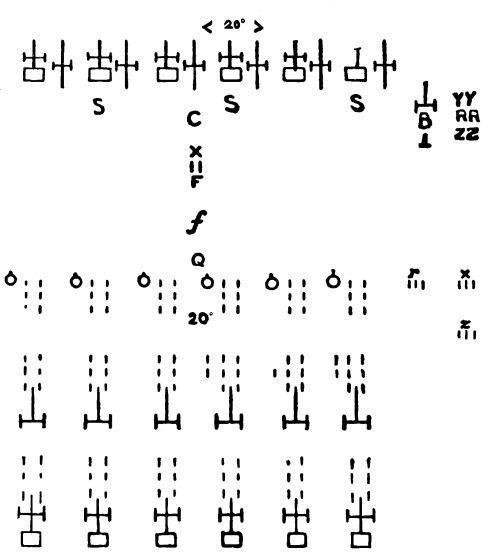
Look-out men and signallers posted as convenient. Range-takers under cover if not employed.
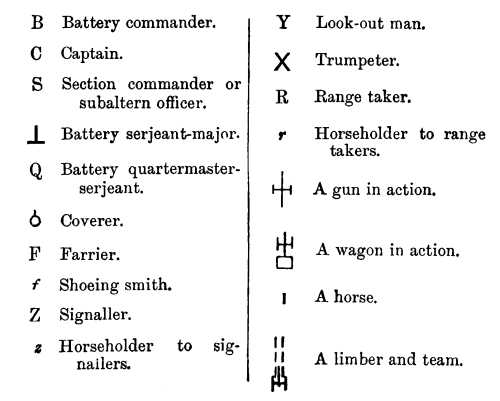
Explanation of the symbols used in Fig. 29.
197. Duties of officers, &c., in action.
1. Battery commander.—The battery commander controls and directs the fire of the battery.
2. Captain.—The captain commands the 1st line wagons and in action controls the vehicles and horses of the firing battery. He is responsible for the supply of ammunition to the firing battery and for seeing that the wagon line is kept filled with ammunition. It is his duty to arrange for the replacement of casualties in men, horses, and matériel (see Sec. 230 et seq.), and to select positions of assembly (see Sec. 195 (5)). To carry out these duties in action the captain must be as much as possible in personal communication with the firing battery; when he is not with the line of guns he will leave one of his assistants with the firing battery to carry orders to him. The commander of a wagon line situated on an exposed flank is responsible for taking measures for protecting the wagon line (see Sec. 148 (5)).
3. Section commanders.—Section commanders will place themselves where they can best see and hear the battery commander and will only move about their sections when necessary for the supervision of their command. In ordinary circumstances each should be in rear of the wagon of his section which is the nearer to the battery commander.
They will acknowledge the battery commander’s orders by saluting. When the orders cannot be heard throughout the battery they are to be passed from one section commander to the next, not repeated simultaneously. Each section commander is responsible that the next section commander receives the order. If in giving an order the battery commander makes an obvious verbal slip, it is the duty of the section commander nearest to him to draw his attention to it.
They are responsible that their guns are laid in the direction ordered. When the target is visible from the battery, they will give alterations in deflection to their guns when ordered to do so by the battery commander.
They are responsible that their guns are not fired when within the danger angle, i.e., the line of fire of any gun must not make a less angle than 45 degrees with a line joining its muzzle and the muzzle of any other gun.
In firing from behind cover they must ascertain that the trajectory will clear the crest (see Sec. 121), running their guns up or back as necessary without waiting for orders if slight alterations only are required, but informing the battery commander if a considerable change of position is necessary.
Before reporting a gun out of action or a casualty to any part of the equipment of their section, section commanders must first ascertain personally whether it is possible to repair the damage with the means at their immediate disposal in the firing line; if not, application should be made to the captain. No casualty should be reported to the battery commander during ranging, unless it is of a permanent nature or likely to interfere with the process of ranging.
4. Observing officer, heavy artillery.—He is responsible for the efficiency of the observing parties in all respects.
5. Battery serjeant-major.—The battery serjeant-major supervises the placing of the battery commander’s limber or observation wagon, and the work of the battery headquarters.
During ranging he reports the number of each gun as it is fired, if the battery commander wishes him to do so; reports prematures, and calls the attention of the battery commander to verbal slips or omissions. (See 210 (3).)
He will be frequently used to pass the battery commander’s orders, but if desired some other man from the battery headquarters may be employed for this purpose instead of him. The megaphone should be used when necessary.
If the battery commander becomes a casualty the battery serjeant-major must be in a position to give all information as to the situation, target, and point on which lines of fire were laid out, &c., to the new battery commander, and to carry on until he arrives.
6. Nos. 1.—Nos. 1 are responsible for the correct service of their guns. They will see that the correct angle of sight has been put on, and will order the necessary allowance in deflection for difference in level of wheels. They will acknowledge all orders relating to their guns by saluting, and when difficulty is experienced in passing orders they should assist.
If a section commander is temporarily absent from his section or occupied with damaged equipment, the senior No. 1 not engaged with him must act for him.
198. Laying out the line of fire.
(a) In a covered position.
1. If the target can be seen from the vicinity of the position selected for the battery to come into action, or its direction obtained from the flashes of the enemy’s guns, from a map, or from patrols, &c., the battery commander, or the section commander who has accompanied him in his reconnaissance, marks the line by planting two aiming posts.
2. The battery having been brought into action on the selected position, lines of fire in the direction of the target can be obtained by one of the following methods:—
i. The battery leader, or section commander who accompanied the battery commander in his reconnaissance, sets up his director in line with the two aiming posts and as close to the battery or its intended position as possible, and selects an aiming point. He then measures the angle between the direction of the target and the line from the director to the aiming point and gives it out as an order to the battery. (See Sec. 123 (3).) He will leave the director laid and clamped on the aiming point for the information of the battery. The dial sight of each gun is set at the angle ordered and laid on the aiming point.
ii. The director is clamped at zero and laid in the line of the aiming posts with the foresight towards the target. The battery commander or battery leader then faces the battery and laying back over the director (namely, foresight—backsight) aligns it on the dial sight of each gun in turn. The angles are noted down and communicated to the battery, or by word of mouth to each individual gun. Thus:—
“Lines of Fire” (Director behind battery.) (Director in front of battery.)
“No. 1 152 Right” or 28 Right
“No. 2 164 Right” 16 ”
“No. 3 176 Right” 4 ”
“No. 4 172 Left” 8 Left
“No. 5 160 Left” 20 ”
“No. 6 148 Left” 32 ”
The dial sight of each gun is set at the angle ordered, and laid on the director.
When using this method the director must be at least 80 yards in front or rear of the line of guns.
iii. If the line of fire cannot be marked by planting two aiming posts (See para. 1) the procedure will be as follows, or as in method iv. below. From his observing station the battery commander, using his director as in ii., sends down the angle to one gun or to the battery director. In the latter case the battery leader or officer who is working the director obtains the line of fire by setting it to the angle ordered. He then measures the angle to an aiming point as described in i. and gives it out to the battery. When the angle is sent to one gun the section commander to whom the gun belongs directs his gun on to the line of fire and the subsequent procedure is as in para. 4 below. In both cases the battery commander will make the necessary correction for displacement before sending down the angle. (See Sec. 123 (3).)
iv. From his observing station the battery commander, having fixed the compass on the No. 3 director, measures the angle which the direction of the target makes with magnetic North, and after making the necessary correction for displacement sends this angle down to the battery as ... degrees Right or Left of magnetic North.
The officer working the battery director, having fixed his compass to the director, sets the director at the angle ordered with reference to magnetic North and the subsequent procedure is as in i or ii.[19]
3. In each method the aiming point is laid on, either through the No. 7 dial sight or over the No. 1 dial sight, or else auxiliary aiming points are picked up and laid on, from round to round. Should aiming posts be used, they are planted in line with the No. 7 dial sight, or the rocking bar, or gun sights set at zero.
4. To obtain parallel lines of fire to that of a gun whose line is correct, the battery commander gives the order “Parallel lines to No ________” The dial sight of the named gun is used as a director, and lines obtained as in method i.
5. In the case of guns which are not provided with dial or panoramic sights, but with gun arcs, or the shields graduated as gun arcs, slight modifications of the three methods mentioned above are necessary.
i. The best aiming points will be such as are within the capacity of the arc, right or left of the line of fire, either to the front or to the rear. Any angle can, however, be employed either by repeating the process of switching, or by using the whole extent of the gun arc, or by using the prolongation of the gun arc in order to obtain an angle of 90°,
ii. When the director is behind the battery the gun layer must lay back on the director. As the large angles cannot be read on the gun arc the officer laying out the lines of fire will, after clamping the director at zero on the target, align it backsight—foresight on the centre of each breech and give out the angles.
6. If the direction of the target cannot be obtained from a position near that selected for the battery and the distance of the observing station is too great to render any of the above methods available, the battery commander as soon as he has completed his reconnaissance and pointed out the approximate position of the battery to the battery leader, returns to his observing station; where he has previously left his range-takers, signallers, and such other portions of his headquarters as he requires.
Communication is at once opened up, the signallers taking care to keep under cover. The telephone if available is laid between the battery and the observing station. The range-takers take the range to the target, and to the battery (if the “sub-base,” para. 7, is not used), and afterwards to other objects in the field of fire.
The battery commander sets up his director under cover and measures the angle between the battery and the target.
When necessary, a flag is placed on the battery director, but the observing station director should be rendered conspicuous in some other manner.
He then works out by means of the plotter the battery angle (T B O in Fig. 30) and the range from the battery to the target, and communicates them to the battery leader, taking care that the battery angle is sent down right or left according as the target is right or left of the line joining the battery and the observing station (B O in Fig. 30). He then calculates the angle of sight and communicates it to the battery leader.
If the dial sight is used, it is set at the battery angle, and when laid on the observing station director the gun is in the line of fire. If the director is used, it is set at the battery angle and laid on the observing station director; the direction of the target is shown, when the arrow head is brought to zero.
Fig. 30.
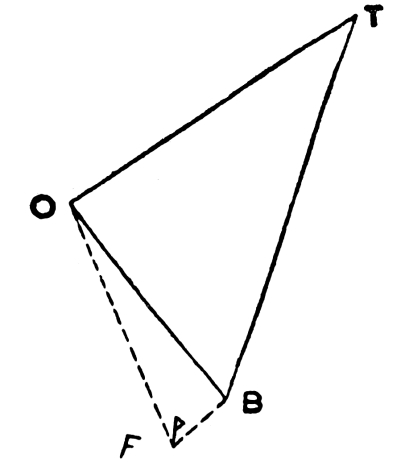
T = Target.
B = Battery.
O = Observing Sta.
F = Flag.
The direction of the target having been obtained at the battery, lines of fire for the guns can be given by one of the methods described above.
7. The distance from the observing station to the battery can be rapidly measured by the use of a sub-base at the battery. An aiming post or signalling flag, F (see Fig. 30) having been placed at a convenient distance, 20 to 50 yards, from the battery director and at right angles to the line B O, the angle that this base subtends at O is measured with the director and the range deduced from the formula:—
6 × Sub-base in yards = Base in hundreds of yards.
10 Apex angle in degrees
8. Should preparations for opening fire be required and no target be visible, a suitable reference point in the enemy’s position is selected and lines of fire laid out to this point.
The switch angles, ranges, and angles of sight to all points on which fire may have to be directed are then ascertained, and all other preparations made which will conduce to fire being opened as quickly as possible when required.
The fire is controlled and the ranging carried out in the ordinary manner by the battery commander.
If the observing station is so far from the battery or the intervening ground so broken that in case of emergency it would be difficult for the commander of the battery to reach the guns in time, it may be necessary for him to remain with the guns and to detail another officer to control the fire. (See Sec. 199(2).)
(b) In an open or a semi-covered position.
9. In an open or semi-covered position where the target can be seen by the section commanders standing up, the target and its extent may be indicated:—
i. By the director placed in the centre of where the battery will be when in action, pointing on the centre of the target or zone, with a N.C.O. in charge to inform the section commanders on their arrival as to its direction and extent, or—
ii. By the director placed as before, but pointing on the reference point, the target and its extent with reference thereto being described to the section commanders by the N.C.O. left in charge.
In both i. and ii. the section commanders will throw their guns on to the line themselves but the battery commander will frequently put the first gun on to the line himself.
When indirect laying is used in such a position, the layer, after his gun has been thrown on to the line by the section commander, will immediately pick up an auxiliary aiming point to lay on from round to round. With guns not provided with No. 7 dial sights, an auxiliary aiming point must be picked up which is in the field of the rocking bar sight or which can be laid on over the dial sight.
In a semi-covered position when the section commander cannot see the target, the procedure will be as in a covered position.
10. Guns not provided with No. 7 dial sights will be laid if possible on auxiliary aiming points; otherwise they will be laid from round to round over the No. 1 dial sight on the original aiming point. Aiming posts should seldom be necessary.
199. Observation of fire.
1. To derive full benefit from the accuracy and rapid fire of modern equipment and to ensure effective support to the other arms, correct observation with reference to the objective is most important.
2. To enable a battery to engage an objective, a position must be selected from which to observe and control the fire of the battery. This is called the “observing station.”
The position of this station should be as close to the battery as possible, provided a good view of the field of fire is obtainable. With this object use should be made of any means such as a tree, house, haystack, limber, ladder, &c. When the observing station is near the battery it should, if possible, be behind the line of section commanders to facilitate the passage of orders, due regard being paid to the direction of the wind.
The officer who observes and controls the fire from the observing station is the battery commander for the time being. Any other officer sent out to assist in the observation of fire is called an “observing officer.”
Observation should be made with glasses having as large a field of view as is compatible with good power of magnification, and graticules will be found of the greatest assistance. The telescope, on account of the smallness of its field, is unsuited for the observation of fire when ranging, but is very useful for watching the effect of fire when ranging has been completed.
3. Combined observation.—In the case of targets which are distant, very difficult, or behind an intervening crest, and in night firing, the battery commander will generally find it useful to combine his own observations with those of a flank or advanced observing party. In the case of a flank party the method of its employment is illustrated in the figure which follows:—
Fig. 31.
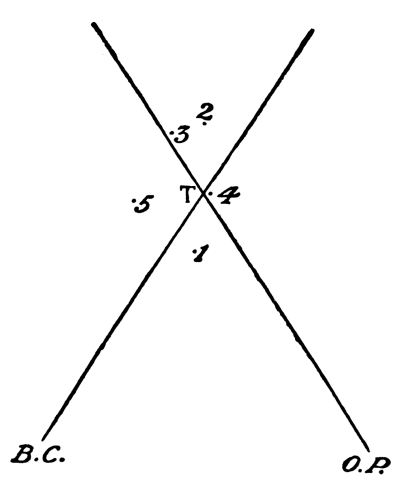
T. is the target.
B. C. is the battery commander.
O. P. is the observing party.
B.C.’s Observations. O.P.’s Observations. B.C.’s Deductions.
1. Right Left -
2. Left Right +
3. Left Line +
4. Line Line T
5. Left Left Left, give right deflection.
This method is also applicable when the battery commander, being unable to observe himself and great accuracy being required, decides to make use of two observing parties.
When this system is employed each observing party will only send in results of its observations as right or left of the line from it to the target. The amount right or left should be measured in degrees and minutes.
Heavy batteries.
4. In a heavy battery there are two observing parties, one to each section. When the battery is intact both parties are under the direct command of the “observing officer.” When a section acts independently, its own observing party accompanies it.
When the battery commander goes forward to reconnoitre he will be accompanied by the observing officer, in addition to the section commander mentioned in Sec 192 (1).
The observing officer will take charge of the observing party when one is employed. If two observing parties are employed he will superintend the work of both as far as possible. When the battery commander observes for himself, the observing officer will assist as may be required.
200. Look-out men.
1. As the attention of battery commanders is so much taken up by the observation and control of the fire of their batteries, men, termed “look-out men” are to be trained in every battery, whose duty it is to assist the commander in watching areas of ground and the movements of hostile and friendly troops.
2. Look-out men should be selected for their intelligence and good sight, and should be adepts in the use of the telescope. There should usually be two in each battery (not the range-takers or signallers). One of these men may be employed, if desired, by the battery commander to assist him in taking angles of sight, &c.
In action they should take up a position as near the battery observing station as is compatible with the instructions they have been given.
They should be trained to co-operate with the range-takers so that the latter may receive early information as to possible objectives.
It is not their business to observe the fall of the shell, nor should they be used as patrols.
201. Control of fire.
1. The fire of a battery is controlled by means of the voice or through the medium of the telephone, signalling, orderlies, or whistle.
2. Voice.—If the observing station is near the battery, the battery commander gives his orders direct to the battery, or he may employ a selected man to call them out.
If the observing station is at a distance the battery leader repeats the orders of the battery commander. Whilst performing this duty he will cease for the time to act as section commander, and will supervise the means of communication at the battery. In this case a position in rear of the line of section commanders, with due regard to the direction of the wind, is generally best.
3. Telephone.—When the telephone is the means of communication, signalling communication should also be established. (See “Training Manual—Signalling.”)
4. Signalling.—The semaphore code will be used.
Semaphore signalling with small flags can be read in a clear atmosphere without glasses up to 1,200 yards, and with the telescope up to 2,000 yards; signalling with the arms can be read up to 600 yards in favourable conditions.
A quick method of utilizing semaphore signalling is to employ two sets of signallers, each pair having different coloured flags. Those with the same coloured flags should communicate with each other only.
The procedure for “attracting attention,” “moving of signallers,” and “erasing of signals,” will be as ordinarily employed in signalling. Special attention should be paid to light, background, &c.
5. In sending orders or the result of observations by signal, the following abbreviations will be used:—
Aiming point AP Fuze FZ
Air AR Go on GO
Air high AR Graze GZH
All guns AL Gun fire GFL
Angle AN Left LG
Angle of sight AS Left-half battery LH
Battery fire BY Line LIF
Both guns BO Line of fire LOTH
Centre C Lyddite LY
Collective ranging CO Minutes MIL
Commence firing FI More left MLRE
Common shell CS More right MR
Concentrate CO One round ORN
Core only or first CO Over or increase PLRE
Core and one ring CO Parallel PAOR
Core and two rings CO Percussion shrapnel PSTR
Corrector CO Probably PBR
Deflection DF Put flag on director PFN
Degrees DE Range RGG
Depression DE Ranging RGP
Distribute DI Repeat RES
Doubtful QY Right RT
Échelon EC Right-half battery RHH
Effective fire EF Round RD
Elevation EL Seconds SE
Far F Second charge SC
Fourth charge FO Section XC
Full charge or fifth FC Section fire XF
Short or drop MN (minus) Third charge TC
Stop firing STOP Time shrapnel TS
Target TG Unload or empty guns MT
Take flag off director TFD Unobserved UN
6. For communicating by signal with the wagon line the following abbreviations may be used:—
“Send up wagons to replenish ammunition”—W N.
“Send up gun limbers”—G L.
“Send up wagon limbers”—W L.
“Send up wagon teams”—W T.
Any of these signals may also be used in combination with one another, thus:—
“Send up gun limbers and wagon teams”—G L W T.
Mountain artillery.—“Send up one ammunition mule per subsection”—Both arms above the head.
“Send up firing battery mules to limber up”—Both arms extended horizontally.
7. Orderlies.—A long chain of orderlies is an unsatisfactory means of communication which multiplies opportunities for error and is not well suited to service conditions, but a chain of not more than two specially trained men may be very useful when flag signalling would disclose the position.
8. Whistle.—A long drawn out blast denotes “Stop Firing,” only to be used when rendered necessary by the fact that a word of command is likely to be either unheard, or to take a long time getting through the battery. On hearing the whistle, section commanders will order “Stop Firing.” Firing will be resumed on the command “Go On.”
Batteries in brigade, or in action close to other batteries, must avoid using the whistle unless it is an absolute necessity.
Section control.
9. Should the battery commander consider it advisable at any time to place the control of fire in the hands of the section commanders he will order “Section control.” On this order section commanders will direct the fire of their sections, making any alteration in elevation, line, or corrector setting that may be necessary, or range their sections independently as may be required. The senior No. 1 may perform the duties of section commander.
The battery commander will watch the tactical situation and control the expenditure of ammunition. When he desires to resume control he will give the order “Battery control.”
202. Methods of fire.
1. There are three methods of fire:—
Battery fire.
Section fire.
Gun fire.
2. In all methods of fire, guns are loaded and fired by order of Nos. 1.
3. Battery fire.—In battery fire the guns are fired in succession throughout the battery commencing from the right at an interval of 5 seconds, unless another interval is ordered.
4. Section fire.—In section fire the guns of each section are fired at the interval ordered by the battery commander, without reference to other sections.
5. Gun fire.—In gun fire the battery commander orders the number of rounds to be fired, with or without an interval. The specified number of rounds is then fired at the interval ordered; if no interval is ordered, each gun is fired when reported “ready” and “set.”
In the case of an attack at close ranges, the number of rounds to be fired is not ordered, but fire is continued until an order to stop firing is given.
203. Location of targets from aircraft.
1. The general method of procedure is as follows:—The pilot, or observer, or both, remain close to the artillery commander. When the latter wishes to use an aeroplane to locate a target he explains what he requires, and if possible the nature of the target and its general direction. The aeroplane then rises to the necessary height behind the battery in order to run less danger of injury by hostile fire. Meanwhile, two strips of white cloth are laid out on the ground near the battery so as to give the supposed direction of the target. The aeroplane, having got to the required height, flies out over the battery to find the exact position of the target.
2. Three different methods may be adopted to convey this information:—
i. A white Very’s light may be fired from the aeroplane when
it is vertically over the target. At the battery end one
observer follows the machine with a director and another
takes the range with a one-man range-finder. The director
is clamped and the range read as soon as the shot is fired.
Provided the aeroplane is flying at a pre-arranged height
the direction and range of the target can then be found.
ii. The aeroplane returns along the line target-battery, and
continues its flight over and past the battery in the same
straight line. No light need be fired in this system but
the range of course cannot be communicated.
iii. An enlargement of the map or in certain cases a written
message may be dropped from the aeroplane giving the exact
position of the target.
A combination of any two or of all these methods may be used.
204. Observation of fire from aircraft.
1. For observation of fire from aeroplanes a different system to that ordinarily employed for ranging must be adopted. It is generally necessary to correct for line, range and fuze in succession, and not simultaneously.
As a rule single rounds are sufficient for observation, but it may sometimes be necessary in the case of Q.F. batteries to fire salvoes of two or more guns.
Salvoes may also be used when it is desired to carry out the observation of fire of one particular battery by aeroplane, and it is necessary to distinguish its fire from that of several others firing at the same target.
2. Shrapnel bursting in the air can be easily seen, but it is difficult to determine the height of burst, and consequently the position relative to the target. Bursts on graze are generally visible. In the case of 18-pr. guns, it is usually impossible to observe the strike of the bullets on the ground. The burst of lyddite shell from howitzers can be seen easily.
3. Very’s lights form the best means of signalling from the aeroplane to the ground, and white strips of cloth, 6 ft. by 1 ft., for communication from the ground to the aeroplane. If available a Klaxon horn in the aeroplane is also useful. For code of signals, see Sec. 205.
When possible, the observing aircraft should remain close to their own guns at the best height for observation, in order to facilitate communication. In some cases, however, it may be necessary to fly out further towards, or even over, the target in order to ensure accurate observation. In such cases much delay will ensue if the aeroplane has to come back over its own guns to signal the results; on the other hand, if it remains out in front the signals may not be seen.
4. The observer, having located the position of the target and conveyed the information to the artillery commander (See Sec. 203) receives from him the signal “Observe for line” (See Sec. 205).
Fig. 32.
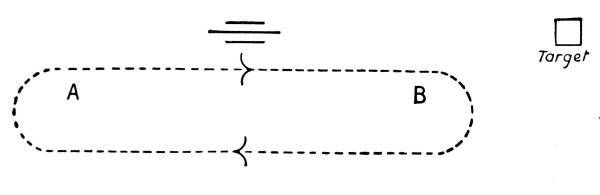
The aeroplane now moves as in Fig. 32, keeping on that side of the battery furthest from the sun, so that the signals can be easily seen.
Shots can only be seen with ease when the aeroplane is moving out towards the target. If the distance A to B is about 1 mile, two rounds can be observed during each outward flight. As soon as line is obtained the signal “Observe for range” (See Sec. 205) is sent; the aeroplane now moves in an elongated figure of eight, as in Fig. 33, always turning towards the target. It will keep behind or in front of the battery according to the position of the sun. Shots can be seen at any time.
Fig. 33.
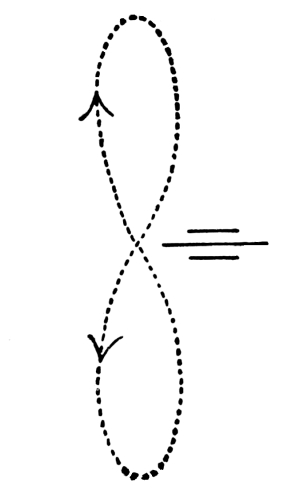
Range having been obtained the signal “Observe for fuze” (See Sec. 205) is sent, the aeroplane still moving as in Fig. 33.
Subsequent observation as to the general effect of the fire can best be made from over the target, the results being written out in a message and dropped at the battery.
When the signal “Land” is sent the aeroplane comes down at a place previously selected and not necessarily at the spot whence the signals are sent.
Two men should be detailed from the battery to watch the observing aeroplane, one with field glasses looking for the signals, the other with his naked eye keeping a continuous watch on it so as to make certain that no mistake is made as to the actual machine, since, when there are several aircraft out in observation, confusion between them is very likely to arise.
205. Signals from and to aeroplanes.
1. With Very’s lights the following code of signals will be used for communication from the aeroplane to the ground:—
(a) Before fire is commenced—
One white light I am over the target.
One green ”I am ready to observe fire.
(b) While ranging—
Light used. For Line. For Range. For Fuze.
One red. Right. Over. Air.
Two reds. Far right. Far over. —
One green. Left. Short. Graze.
Two greens. Far left. Far short. —
One red, one green. Line. Range. Fuze correct.
One green, one red. Unobserved. Unobserved. Unobserved.
Succession of blasts on
Klaxon hornAm about to fire two signals.
The signal “Far right” or “Far left” should be made when the shell bursts 8 degrees or more from the target. Any shell bursting 500 yards or more short of or beyond the target should be signalled as “Far short” or “Far over.” “Fuze correct” will be signalled when some of the shells burst on graze and others in air.
(c) After fire for effect has commenced—
Red, greenFire effective.
A white light fired at any time after fire has commenced means “Stop, am about to drop a message.”
2. Strips of white cloth 6 feet by 1 foot, placed on the ground, can be used for signalling from the ground to aeroplanes. The following code of letters formed from the white strips placed on the ground will be employed.
3. I Direction of target.
I
L Observe for line.
X Observe for range.
Z Observe for fuze.
V Observe for general effect of fire.
N Repeat last signal.
T Land.
F / Fresh target on right. The letters
I, K or A may be placed immediately after the F
to indicate to the aeroplane observer the nature of
the target, viz., I for infantry, K for cavalry, and A
for artillery.
All letters should be placed on the ground so that the top of the letter is towards the target.
206. Observation of fire from kites.
1. When kites are available the results of the observation can be telephoned down to the guns and there is no waste of time, but they can only operate in a wind (See Sec. 150), and their range of vision and power to see behind cover is limited.
Kites require special consideration and the exact place from which they should be flown should be chosen by a kiting officer. Some of the requirements are:—
i. Concealment from the enemy of the winch and carrier kite
when on the ground.
ii. Ground not obstructed by obstacles.
iii. Sufficient room in a straight line to haul down 600
or 1,000 yards. This should be measured out down wind
and must be free from obstructions. It is possible to
haul down in a smaller space, but this involves much
preparation and a number of holdfasts are necessary.
Ranging.
207. General instructions.
1. Ranging is the process of finding the elevation, fuze and line.
2. When the battery commander has given an order to load with any nature of projectile, that loading will be continued until an order to change is given.
3. With fixed ammunition, if a change of elevation or corrector be ordered when time shrapnel is being fired, Nos. 1 order “ Unload,” and guns are reloaded for the new elevation or corrector. A similar order should be given when for any other reason it is desired to empty guns already loaded, as, for instance, when ceasing fire.
If fixed ammunition is not used, and a change of elevation is ordered, guns loaded with the fuze for the old elevation will be fired at the new elevation. If for any reason it is required to empty guns already loaded, the order is “Empty guns,” and the guns are fired at once without any fixed interval.
4. As soon as ranging is completed the battery commander will send the angle of sight, elevation, corrector or fuze to the brigade commander, and in the case of howitzers the charge also.
208. To find the elevation.
1. Under service conditions it is seldom possible to estimate with accuracy the distance the burst of a shell is short or over with regard to the target. The principle of ranging for elevation is, therefore, to find two elevations, the longer of which will throw the shell beyond and the other short of the target, thereby enclosing it in what is called a “bracket.”
This bracket is large at first, usually 300 yards.[20] If a smaller bracket is required one or more rounds, according to the nature of the ranging employed, are fired at the intermediate hundreds. This gives the 100 yard bracket, which in ordinary circumstances is the one required. The elevation is then verified by repeating the two ends of the bracket. The important point is to make certain of this bracket.
2. Ranging is either “Collective,” “Single Gun,” “Section,” or “All Guns.”
The method adopted should be that best calculated to obtain effective fire with the least delay, and with this end in view a combination of the different methods may sometimes be used. An example of combined “section” and “collective” ranging is given in Sec. 227.
By “Collective Ranging”[21] is meant more than 2 guns fired in quick succession at the same elevation and fuze. The form that collective ranging should take in a 6-gun unit is the fire of half batteries alternately; in a 4-gun unit the fire of the three right guns.
By “Single Gun Ranging,” “Section Ranging” and “All Guns Ranging” is meant ranging with one, two, or all guns fired singly.
In “All Guns Ranging” a single initial elevation is ordered, subsequent elevations being given out singly on the observation of the previous round.
In “Section Ranging” two elevations are ordered with or without an interval.
In “Single Gun Ranging” either of the above two methods may be followed, but only one gun is used.
3. The fall of the rounds is judged from the smoke of the burst of the shell or splash of the bullets, which should be clearly observed as short of or beyond the target.
4. In order to obtain good results when ranging with time shrapnel a length of corrector or fuze should be employed, which will give bursts on or just below the line of sight. When indirect laying is employed it may occasionally be advisable to commence with a corrector or fuze échelon series, in order to select a suitable length. (See Sec. 209 (2).)
5. Elevation should always be given at first in round numbers, beginning, in the case of yards, at the nearest 100, or in degrees, at the nearest degree or half degree. It is seldom worth while to make a smaller change of elevation than 25 yards, or its equivalent.
When the whole series depends on the correct observation of a single round, that round should be repeated and another fired with 100 yards more (or less) elevation.
Further alterations in the elevation from the observation of the splash of the bullets and fall of the case of the shell, when visible, are made as required. This will often be necessary for individual guns.
If a shell is observed to strike the target, a verifying series of one or two rounds should be fired.
6. The battery commander details the method of ranging and the nature of the projectile thus:—
“Collective” ... “Corrector”
or
“Right (Centre or or
Left) Ranging”
or “Percussion”
“No. ... Ranging”
or or
“All Guns Ranging” “Lyddite.”
“Collective Ranging.”
7. When collective ranging is employed the battery commander gives out one elevation and corrector for example:—
“Collective—Corrector 156—4600.”
This elevation is fired by the right half battery,[22] commencing from the right at battery fire 3 seconds unless otherwise ordered. The battery commander from the result of these rounds alters the corrector if necessary, and orders a fresh elevation to the left half battery to obtain his 300 yard or other bracket. He then sends down corrections for line for the right half battery unless one correction to the whole battery is advisable, in which case he will send it down before the new corrector and range. This process is continued until the size of the bracket is, if possible, reduced to 100 yards. (See Sec. 227, Example 1.)
“Section Ranging.”
8. When a section is being used for ranging the battery commander gives out two elevations differing by 300 yards or multiple of 300 (the longer elevation first). The elevation which is given out first is fired by the right gun, the second by the left gun of the section, at an interval of 5 seconds, unless another interval is ordered. If the target is not bracketed two fresh elevations are ordered.
Should a gun of the ranging section become temporarily or permanently disabled, the section commander continues with the other gun of the section, or informs the section commander next him, who will place the nearest gun temporarily under his command.
“Single gun Ranging.”
9. If one gun is used for ranging, elevations will be given out singly or in pairs, the general procedure for bracketing the target being similar to the above.
“All guns Ranging.”
10. Ranging with all guns is in certain circumstances admissible, particularly when high explosive shell are alone to be used. Elevations will be given out singly. In the case of field guns this method would only be an advantage in very exceptional cases. It presupposes that the range from each gun is identical and that observation is easy.
209. To find the fuze.
1. As a rule no special ranging for fuze should be necessary. The battery commander before or after ranging for elevation will select what he considers to be a suitable length of corrector and modify it later according to circumstances.
2. When fighting in a hilly country or when from any cause no reasonable estimate of the corrector can be formed it may prove economical in ammunition to fire an échelon before proceeding to fire with time shrapnel. (See also Sec. 208 (4).) When an échelon is considered necessary it will, except in the case of howitzers and heavy guns, be fired before ranging for elevation commences. The échelon is fired by the three right guns from right to left at 5 seconds interval unless another interval is ordered. The fuze indicators, or fuze setters, are set at lengths increasing by 10, the order being “Échelon] ... Range....” In ordering the initial corrector settings, the battery commander should endeavour to select an échelon which will give bursts in the air and on graze.
On this order the No. 1 of No. 1 gun orders his corrector to be set at the graduation ordered. The Nos. 1 of the other guns order their correctors to be set at a successive increase of 10. It may in very exceptional circumstances be necessary to fire a second échelon. The above procedure is then repeated.
3. If a gun misses its turn during the échelon the fact will be reported to the battery commander, and the gun will be fired when ready unless otherwise ordered. The section commander will, however, be careful that the gun is not fired during the échelon.
4. When fire is being corrected by observation from a distant observing station and the battery angle proves to be correct, any considerable discrepancy between the gun range and the plotter range will be due to a miscalculation of the angle of sight. The correct fuze will then be that for the plotter range.
210. To find the line.
1. Except in the case of fleeting opportunities, battery fire will be continued till the battery commander is satisfied that the correct line of fire for each gun has been obtained. Even in the case of fleeting opportunities it will sometimes be advisable to fire a round of battery fire at small intervals to check the lines.
To avoid waste of ammunition, especially in the case of guns which cannot be unloaded, it may be advisable to increase the normal interval between the rounds of an échelon or at battery fire. Line corrections are preferably made on the fall of each round, but see Sec. 208 (7).
2. The battery commander will correct the deflection for each gun unless he has delegated this duty to the section commanders. (See Sec. 197 (3).) Should he consider from the first ranging rounds that his lines are not correct he should order an initial correction for the remaining guns.
3. To assist the battery commander in correcting for line when the observing station is not close to the battery, the number of each gun as it fires, also all prematures, should be reported by signalling or telephone. (See also Sec. 197 (5).)
Ranging for Howitzers and Heavy Guns.
211. General instructions.
1. The general principles of ranging are the same as for field guns, but certain differences exist owing to the equipment, weight of shell, etc.
2. As a general rule, a steep angle of descent is a paramount condition for effective howitzer fire. When firing lyddite, an angle of descent of at least 20° is desirable.
3. Against troops in the open, the full charge should be employed in order to obtain the forward effect of a comparatively flat trajectory. When engaging objectives such as a wall, or buildings, which present a high vertical target, the full charge should also be used.
Redoubts or overhead cover on the contrary require a steep angle of descent; the same applies to trenches and shielded guns.
4. Howitzers frequently require individual corrections due to variations in the muzzle velocities of the guns, but such corrections should only be made on the observation of groups of rounds. The smallest correction which it is worth making is one equivalent to 25 yards.
5. When a change from lyddite to time shrapnel is made and it is known that lyddite shell range differently to the shrapnel a few rounds of time or percussion shrapnel should be fired to verify the elevation. Owing to the steep angle of descent it is often easier to observe the splash of the bullets of time shrapnel than the burst of percussion shrapnel.
212. Howitzers.
1. Ranging can be carried out with lyddite, percussion or time shrapnel.
The ranging is carried out with one section or one gun of the battery, but all guns may be used for ranging if lyddite is to be used subsequently, and the target is of narrow front, or presents no obliquity to the battery.
2. When a section is employed for ranging, a bracket to approximate as nearly as possible to 300 yards, or multiple of 300 yards, should be ordered, but round numbers should usually be adhered to, such as 28°-25°, not 28°20´-25°20´.
This bracket is further reduced to one corresponding to about 100 yards, or 1-3rd of the original bracket. The elevation is then verified by repeating the two ends of this bracket.
When lyddite only is to be used, the bracket will be further reduced to 50 yards, and the two ends of the bracket repeated.
For howitzers fitted with the range drums graduated in yards for the fourth charge, the B.C. will range in yards as with other field guns, and will select the approximate ranges to start with, in accordance with the charge to be used, by means of the ranging rule provided.
If the range rule is not available, the following calculation will give the approximate range for different charges:—
When using full charge subtract ¼ from the real range.
” fourth charge give the real range.
” third charge add ⅓ to the real range.
” second charge add ⅔ to the real range.
” first charge double the real range.
3. When ranging with one gun, or with all guns, only one elevation will be ordered at a time, the principles of bracketting as laid down above being adhered to.
4. To find the fuze.—The battery commander, after ranging for elevation, may find it necessary to order an échelon (this will nearly always be necessary for batteries not provided with fuze indicators). The échelon is fired from right to left by the three right guns at 5 seconds interval, unless another interval is ordered, as in field gun batteries.
5. In the case of batteries not provided with fuze indicators, a fuze and an increment will be ordered, such increment to be a division or half division according to which most nearly corresponds with 100 yards.
If the battery commander begins ranging with time shrapnel the procedure will be the same as for other field guns except that collective ranging will not be used. (See Sec. 208 (4)).
213. Heavy batteries.
1. The procedure of these guns is identical with that of field howitzers, except that ranging will not be carried out with time shrapnel. At long ranges it is advisable to order one elevation at a time.
2. When firing with lyddite, as with howitzers, the 50 yard bracket should be verified. At distant ranges, however, the bracket should not be less than twice the 50 per cent. zone.
When time shrapnel is to be used the 300 yard bracket may be found with lyddite or percussion shrapnel.
3. The procedure in ranging for fuze is that of firing an échelon as laid down for howitzers.
Distribution of Fire.
214. General principles.
1. Distribution of fire over the target allotted to the battery should, whenever possible, commence from the first round.
This should not prevent a battery commander in the case of an indistinct target from ranging on the most conspicuous portion, and distributing his fire subsequently.
2. Assuming 50 yards to be the average distance required to burst a shell short of the target, and that the lateral space covered by the cone of dispersion of a shell is about 35 per cent. of the distance burst short, it will be seen that the width a battery at normal intervals can effectively cover when the lines of fire of its guns are parallel is approximately equal to its own front. By “sweeping” (see Sec. 216) it can cover a width of 3 times its own front.
3. When section commanders are ordered to correct for line (See Sec. 197 (3)), each of them should be made responsible for a definite portion of the target. The extreme edge of a target should not be laid on, as a small error might cause the shell to be wasted.
4. If it is required to concentrate or distribute the fire of a battery over a front of a lesser or greater width than that covered when the lines of fire are parallel, it is effected by ordering concentration on, or distribution from, a named gun. When an aiming point is employed an angle is given to the battery, followed by the amount of concentration or distribution required.
5. The amount of concentration or distribution to be given will depend on the width of the target, the angular measurement of which varies with the range.
Thus:—
At 2,000 yds., 100 yds. measure. 3°, 60 yds. measure 1° 45′.
” 3,000 ” ” ” 2° ” ” 1° 10′.
” 4,000 ” ” ” 1½° ” ” 50′.
” 5,000 ” ” ” 1° 10′ ” ” 40′.
” 6,000 ” ” ” 1° ” ” 35′.
These may be taken as the front covered by a 6-gun or 4-gun battery respectively when the lines of fire are parallel.
6. The angle given to the battery must bring the flank guns inside the flanks of the target. The total distribution required is the difference between the front covered by the battery and the extent of the target. This must be divided by the number of gun intervals to obtain the distribution between each gun. If the target is narrower than the front covered by the battery a similar rule applies, but concentration will be needed.
If a switch from one target to another is involved, the angle between the line of fire of a flank gun and the spot on which it is desired to direct the new line of fire of the same gun should be measured.
7. Example I.—Supposing a 6-gun battery is required to fire at a range of 3,000 yards against a target measuring 3°, the fire of the battery with parallel lines will cover a front of 2°. An extra distribution of 1° is, therefore, needed. This amount divided by 5 will give 12 minutes for each gun interval, which would be taken as 10 minutes to prevent the fire of the further flank gun being outside the target. The order would then be “Distribute 10 minutes, from No. 1.”
No deflection is given to the named gun, but each of the remaining guns would be given 10 minutes left deflection for every gun interval between it and No. 1 gun.
Example II.—Supposing it is desired to concentrate the fire of the above battery on the right to cover a front of about 30 minutes at a range of 3,600 yards, the battery commander’s order would be “Concentrate 15 minutes on No. 1.” No deflection is given to the gun named; each of the remaining guns would be given 15 minutes deflection for every gun interval between it and the gun named, viz., No. 2 gun 15 minutes more right, No. 3 gun 30 minutes more right, and so on.
Example III.—A 4-gun battery firing at a target whose angular extent is 4°. It is desired to switch the fire on to a target whose angular extent is 2°, therefore the difference 2° or 120 minutes divided by 3 (gun intervals) gives 40 minutes which is the concentration to be ordered.
When there is a considerable difference in range from one target to the other, parallelism should be first given to the guns before making the switch.
After the operation of ranging has been completed, the battery commander has to determine by what method of fire he will engage the objective. He may do so by one of the three methods described in Sec. 202 (1), combined, if desired, with “searching” or “sweeping.”
215. Searching.
1. “Searching” means distributing fire in depth over an area of ground by successive alterations in elevation.
2. It will often be impossible to obtain the true range of a target, either owing to the difficulty of locating its exact position, or to want of time. All that can then be done is to ascertain two limits within which the target lies, and to search within those limits. Ranges at which fire is seen to be ineffective are cut out and the space under fire is thus gradually reduced.
3. Sometimes it will be necessary to range on a crest line behind which the target is located. In this case searching should not be attempted to a greater depth than 400 yards from the crest or other obstacle to view, unless the battery commander can obtain information as to the result of his fire or the approximate position of the target, as results are unlikely to be proportionate to the expenditure of ammunition. In this connection flank observing parties may be of great value.
4. Orders as to changes in elevation and number of rounds to be fired are given by the battery commander.
The amount by which the elevation should be increased for each series of rounds will depend on the depth of ground which is effectively covered by the burst of the shell. This amount varies from 100 yards at short ranges to 50 yards at extreme ranges.
Should the ground to be searched slope considerably to the front, the above increments should be increased; if to the rear, they should be diminished. When such is the case the angle of sight will be different for each successive range. It is generally inadvisable to alter this angle on the sights, but the slope can be allowed for by altering the corrector setting, decreasing it if the angle of sight is increased and vice versâ.
216. Sweeping.
1. “Sweeping” means distributing fire in width over a front greater than a battery can cover in the ordinary way.
2. When sweeping fire is employed the lines of fire of the guns must first of all be opened out, the amount depending on the width of the target. To obtain the amount of sweep required after the guns have been opened out multiply the frontage subtended by the target in degrees by three for a 6-gun battery, five for a 4-gun battery, and ten for a section. This gives approximately the number of minutes sweep required. In giving the order to sweep, the battery commander will state in degrees or minutes the amount of sweep necessary, and such order will always be prefaced by the rate of fire required, thus:—Battery commander orders “Range ... Section (or battery) Fire ... seconds, Sweep ... degrees or minutes.” On this order the first round from each gun is fired in the line ordered, and the second ... degrees (or minutes) to the right, and the third ... degrees (or minutes) to the left of the line of the first. This procedure is repeated for as long as is necessary, the fourth round being fired on the line of the first and so on.
The guns must be re-laid for elevation and direction after each round. If the battery is already at section or battery fire and sweeping fire is required, the battery commander must give the order:—“At Section (or Battery) Fire ... Sweep ... degrees (or minutes),” as otherwise the procedure will be as in para. 3.
3. If it is desired to sweep an area with great rapidity, the battery commander will order:—“Sweep ... degrees (or minutes),” and the guns will be fired at gun fire. With guns fitted with traversing gear on the carriage the layer lays for direction for the first round only, the line for the second and third rounds being obtained by moving the traversing gear to the amount of sweep, right or left. The guns must be re-laid for elevation after each round. After the third round is fired the gun is traversed on to the original line and the direction checked by the sights. If it is necessary to repeat this procedure, the battery commander orders:—“Repeat.”
4. Searching and sweeping combined.—If the target possesses considerable width and depth a combination of searching and sweeping may be employed.
217. Change of target.
1. When a change of target is ordered, the battery commander measures the angle between the new and old target. He determines whether any allowance is necessary to counteract the difference between the angle he has taken and that required for the battery. (See Sec. 123 (4).) He then orders or communicates the angle to the battery thus: “All guns ... degrees more right (or LEFT).”
2. With guns not fitted with No. 7 dial sight, if the angle is within the amount of deflection which can be given on the deflection scale, the position of the aiming posts may not have to be changed, and the order is given thus:—
“All guns ... degrees more right (or left).”
otherwise it is necessary to move the aiming posts and the order will be—
“Lines of fire ... degrees more right (or left).”
Methods of Engaging Various Objectives.
218. General instructions.
1. The choice of objective, the opening of fire, and the expenditure of ammunition are governed by the tactical situation and are dealt with in Chapter VII. The following sections deal primarily with the methods by which fire can be applied with effect to various objectives.
2. The methods of ranging are described in Sec. 208, and the examples in Sec. 227 illustrate those methods. Officers are responsible for using their discretion as to which method should be employed so that the fire of their batteries may achieve the object in view.
219. To register a zone.
1. A battery occupying “a position in observation” (see Sec. 184) may be called upon to “register” a certain zone or area of country. To do this the range should be obtained to various points in such a manner that fire may be opened rapidly on any objective that may subsequently appear in their neighbourhood.
Such points may be crest lines, hedges, bridges, roads, clumps of trees, buildings, the edges of woods, or the limits of open spaces over which the enemy may be expected to move.
Registering may be carried out with a section or single gun, time or percussion being used. It is advisable to number or letter the objects registered from the right, a careful record being kept of the points registered.
2. The degree of accuracy to which it is desirable to obtain the range to such points must vary according to the nature of the objective that may be expected to appear. The range to a crest on which artillery is expected to come into action must be accurately found. The limits of open spaces over which movement may be expected cannot, as a rule, be accurately defined. A few trial shots, therefore, may give sufficient indication for the purpose.
220. Localities.
1. Villages or individual houses may be fired on by artillery in order to reduce their resisting power and render the approach to them easier. Field howitzers or heavy artillery firing lyddite should be used if available.
2. To destroy an individual house accurate ranging is necessary, only a sufficient number of guns or howitzers being employed for the purpose.
3. To destroy a village by setting it on fire or to prevent the massing of reserves in the streets a searching fire should be used.
4. To facilitate the attack on a village or house occupied for defence, field guns firing percussion shrapnel may be used, as well as howitzers and heavy artillery, as their projectiles are effective against personnel behind all ordinary walls. Accurate ranging is necessary; particularly for line, as it is necessary to hit each individual house.
5. If the edge of a wood is occupied by the enemy’s infantry, it should be ranged on in the same manner as a trench (see below). A searching fire may be employed against troops taking cover in a wood, but as it will usually be difficult, if not impossible, to establish a bracket with any certainty, effect must depend to a great extent on chance.
221. Staffs.
1. It may be possible to locate groups of officers forming staffs either mounted or dismounted. Such objectives should be ranged on rapidly and a quick rate of fire opened for effect till they either disperse or disappear.
222. Cavalry.
1. Cavalry when mounted must usually be engaged on the move. It may present a variety of targets; a mass, a line more or less at right angles or parallel to the line of fire, or an area over which a number of comparatively small bodies is moving. The direction and pace of movement must always be reckoned with.
2. A mass will break up under artillery fire, so should be dealt with by rapid ranging, and an extremely rapid and intense fire till it breaks up, followed by a searching fire with suitable deflection to allow for movement.
3. To stop an advancing line the chief considerations are a suitable distribution and rapid changes of elevation, arranged so that the cavalry is always advancing into the fire.
At ranges under 2,000 yards it may be advisable to order lengths of fuze instead of corrector settings.
4. To enfilade a cavalry line moving across the front requires concentration of the lines of fire with varying elevations for each section and suitable deflection to compensate for movement.
5. Cavalry, covering a wide area, requires distribution both laterally and in depth, with deflection and alterations of range to compensate for movement.
6. Dismounted cavalry will usually be dealt with as infantry. Its led horses, if they can be located, form a vulnerable objective, which should be dealt with by rapid ranging followed by rapid fire for effect till the horses either disperse or gain cover.
223. Artillery.
1. To engage a battery of which the flashes or dust thrown up by discharge are visible behind a crest, the crest should be bracketed, and searching fire employed for a suitable distance behind the crest. If the slope of the ground behind the crest is known, or can be ascertained, it may afford an indication of the distance behind the crest to which it is desirable to search.
2. A battery in action or attempting to come into action in the open engaged by a battery also in the open should be ranged on as quickly as possible and should be subjected to fire for effect at the earliest possible moment. The bracket should then be narrowed down and the fire maintained till the enemy’s fire slackens or becomes inaccurate. If the range is suitable and observation sufficiently easy, efforts may then be made to destroy the matériel with percussion shrapnel. To do this each gun should engage a hostile gun, and the fire of each gun should be carefully corrected.
A concealed battery engaging a hostile battery in the open will adopt a similar procedure, but there is not the same need for haste, and the ranging may be more deliberate.
3. To neutralize a battery it should be subjected to a rapid, accurate and intense fire till its fire is mastered. It should then be observed and if it endeavours to intervene again it should be subjected to the same treatment. A hostile battery, the fire of which has been mastered, may be neutralized by a portion only of a battery, which should employ a rapid sweeping fire to compensate for the reduction in the number of guns.
If a rapid and intense fire is desired against hostile artillery it is preferable to employ a quick rate of section or battery fire.
4. Guns coming into action in the open can usually establish themselves in action before the process of ranging on them is completed, unless the range to some point in the immediate neighbourhood of the position has been previously ascertained. If this has been done the rapid opening of fire for effect may cripple the hostile battery before it is able to open fire.
5. Howitzers and heavy artillery, if available, are especially suitable for dealing with entrenched guns, the former using shrapnel against the personnel and lyddite against the entrenchments. The latter would preferably use lyddite against the entrenchments. Very accurate ranging is desirable.
6. Every effort should be made to locate the enemy’s observing stations. When located they should be engaged with a portion of the guns available.
7. The wagon lines of batteries in action form a vulnerable objective if they can be located. They should be dealt with in the same manner as the led horses of cavalry (see Sec. 222 (6).)
224. Infantry.
1. Artillery may fire on hostile infantry for any of the following reasons:—
i. To facilitate the advance of its own infantry.
ii. To cause the hostile infantry to deploy.
iii. To delay its advance, bring it to a standstill, or prevent
it resuming its advance.
These objects are not likely to be fulfilled unless the fire of the artillery is sufficiently accurate to cause the infantry loss. The losses inflicted should, however, be looked upon as the means to the end.
2. To facilitate the advance of its own infantry against the hostile infantry the enemy’s fire position must be subjected to an accurate and well distributed fire. The fire position, whether it be a trench, a series of trenches, a crest line, the edge of a wood or some other tactical feature, will seldom be a continuous straight line parallel to the front of the battery. The line may be broken and the range and angle of sight to various portions of it may vary.
When engaging irregular shaped targets, such as these, it is advisable, after obtaining a bracket on a portion of the target, to correct lines and range during battery fire, and to order individual guns or sections to add or drop the necessary number of yards.
This applies equally to other irregular targets besides infantry.
In the open “section control” may be desirable, if the target is wide and the line broken, but during the infantry advance bursts of fire should be in the hands of the battery commander.
Fire for effect should be arranged in bursts of section or battery fire during which the infantry may gain ground.
3. To cause hostile infantry in close formation to deploy requires rapid ranging, the obtaining of the best bracket possible in the shortest possible time and a rapid searching fire for effect within the limits of the bracket found.
If the appearance of formed bodies of hostile infantry in a certain locality has been foreseen and the zone has been registered the process of ranging may be dispensed with, and the full value of surprise effect may be obtained.
4. When the enemy’s infantry is still beyond the range of rifle fire it will endeavour to cross open spaces exposed to artillery fire as rapidly as possible in the least vulnerable formations. If these open spaces have been registered the advance of the infantry may be delayed and possibly prevented by establishing a belt of fire through which it must pass. This belt can be moved at will but if the enemy’s infantry is only visible at intervals, accurate prediction is required as to the places where it will be exposed to fire.
5. When the infantry comes under effective rifle fire it will be compelled to form firing lines in the best fire positions available. These positions should, if possible, be foreseen and the ranges ascertained. The method of engaging the infantry when it occupies these positions will be similar to that referred to above for supporting the advance against infantry in position. The essentials are accuracy and suitable distribution. The moral effect of a great volume of fire should be borne in mind. A rapid and intense fire for a short period may bring an advance to a standstill or prevent it being resumed. In a similar way infantry advancing by rushes in extended order may be stopped or driven to cover by bursts of fire.
6. The most intense fire possible should be employed to prevent the delivery of an assault.
7. Infantry advancing rapidly to counter-attack must be dealt with by rapid ranging and rapid fire for effect directed against the front line of the infantry and corrected as regards range and line in accordance with its movements. If the advance is checked a searching fire directed so as to include the supporting troops may be usefully employed.
225. Machine guns.
1. Machine guns often form objectives of great tactical importance, and it may be necessary to subject them to a very intense fire in order to silence them. When employed in sections they present a target with a narrow front and accuracy of line is important. Only a sufficient number of guns for the purpose should therefore be employed. This would usually be a section. When entrenched it may be desirable to use howitzers with either shrapnel or lyddite or both against them.
2. The difficulty in dealing with machine guns in action lies in the facility with which they can be concealed. If they can be located accurate ranging for elevation and line are necessary and a few well placed rounds should either disable the detachments or drive them to cover. If they cannot be located accurately it may still be possible to obtain sufficient indication of their whereabouts to enable a wide bracket to be obtained. Searching fire between the limits of such a bracket must then be resorted to.
226. Aircraft.
1. It is at present difficult to distinguish hostile from friendly aircraft, but this difficulty will probably decrease in the future as the aircraft of different nations tend to develop on distinctive lines.
The strictest control must be exercised over all fire directed against aircraft as indiscriminate fire may endanger neighbouring units and may disclose the position of the troops to the enemy’s observers.
2. To engage such objectives certain preparations should, if possible, be made beforehand. These preparations consist in digging trenches for the trails and in organizing flank observing parties with telephones. Some modification of the usual procedure is necessary owing to the variations which occur in height, range, and direction of these objects under different influences.
3. Captive balloons or kites.—Efforts should be made to enclose such targets within the limits of a 500 or 600 yards bracket, employing a corrector which gives bursts near the line of sight. The layer must devote his attention to keeping the gun on the part of the target indicated.
Subsequently the bracket having been reduced and the corrector shortened, occasional rounds of gun fire should be fired, each section using a different elevation.
4. Airships.—Provided an airship is not moving across the front at a rapid rate it may be engaged successfully in a similar manner. The principal points to be attended to are the establishment of a bracket, and the employment of a corrector, when fire for effect is being attempted, which will give high bursts. A similar procedure will be employed against aeroplanes.
227. Examples of Ranging.
Note.—These examples are only intended to illustrate the different methods of ranging.
The methods of engaging various objectives are described in Secs. 218 to 226.
I.—Example of “Collective Ranging.”
(For all batteries except howitzer and heavy.)
Position of battery—Under cover.
Target—6-gun battery in action in semi-covered position.
Tops of shields visible from observing station.
No. of round. No. of Subsection Elevation Corrector or P.S. Observed. Battery Commander’s Orders.
+ or - A or G. Height of burst.
“Guns in action.”
“Angle of sight 1° 30′ elevation.”
“Collective.” “Corrector 154.”
“3400.” “Fire.”
1 1 3400 154 ? A 20′ “No. 1—30′ more right.”[23]
2 2 ” ” ? A 20′ “No. 2—1° more right.”[24]
3 3 ” ” + A 5′ “No. 3—30′ more right.”[25]
“All guns 30′ more right.”[26]
“Corrector 162.” “3100.”
4 4 3100 162 A “No. 4—10′ more left.”[27]
N.B.—Notes [23] and [24] apply to 6-gun batteries only. In 4-gun