Chapter VII · EMPLOYMENT OF ARTILLERY IN WAR.
Reading edition
140. General instructions.
1. F.S. Regs., Part I, lay down certain principles for the guidance of commanders in the combined employment of the various arms. A knowledge of these principles by artillery commanders is essential for effective co-operation.
2. The instructions contained in this chapter are based on those principles, and are intended further to assist artillery commanders in the solution of problems which will confront them on the field of battle and in training their commands on a uniform system.
These principles are generally applicable to any force of artillery acting under an independent commander, whether his command is of a temporary nature or not.
Characteristics of Field Artillery.
141. Field guns.
1. The principal characteristics of modern field guns are the flatness of the trajectory of their shell, the rapidity and accuracy of their fire and their power to deliver effective fire from concealed positions as well as from those in the open. Other characteristics are mobility, increased power of concealment, owing to the use of smokeless powder, and decreased vulnerability, due to the adoption of shields.
2. The effect of field guns is most fully developed against troops in the open, either in movement or stationary.
They may be used effectively against personnel in entrenchments, in buildings or behind gun shields. Against personnel protected by entrenchments the effect will be slight unless the defenders are compelled to man their entrenchments by the action of the other arms. Against buildings the effect is usually limited to the rooms facing the guns, as the projectiles are arrested by a second wall, and their destructive and incendiary effect is not great. The destructive effect of direct hits on artillery matériel is considerable, but at long ranges this would entail a great expenditure of ammunition. (See Sec. 114 (6).)
142. Field howitzers.
1. Field howitzers by reason of their high explosive shell and the steep angle of descent of their shrapnel bullets are specially suited:—
i. To attack artillery personnel protected by shields.
ii. To destroy artillery matériel.
iii. To attack the defenders of entrenchments.
iv. To destroy defended localities such as villages, farms,
or the strongly entrenched portions of a position.
v. To support an attack up to the moment of assault.
2. Their wide field of fire enables howitzers to cover a zone of considerable extent, and they are particularly adapted to the support of infantry in the later stages of an attack, owing to the steep angle of descent of their projectiles. (See Sec. 157.)
Troops in movement or other targets presenting only a fleeting opportunity do not come within the normal rôle of howitzers, which, however, should be prepared to engage such objectives, if circumstances make such action advisable.
3. The chief conditions for effective howitzer fire are good gun platforms, and facilities for both observation of fire and the exercise of command. A position behind natural cover is obviously preferable, provided these conditions are fulfilled.
143. Heavy artillery.
1. The special characteristics of heavy artillery are accurate long-range fire and great shell power, but these advantages are to a certain extent discounted by a limited mobility. The long-range fire of guns of this nature should be utilized to bring enfilade and cross fire to bear on the enemy’s positions. The sites chosen for them should be such as to facilitate fire being brought to bear on as much of the ground occupied by the enemy as possible. In normal circumstances these conditions are most likely to be obtained by dispersion.
The fire of guns of this nature is of special value against shielded guns, fortified localities and buildings.
2. Owing to the limited mobility of these guns and the fact that they are unprovided with shields, considerable risk may be incurred without adequate compensation, if they are placed too far forward, or exposed on a flank.
Occasions may, however, occur, when to gain decisive results, it will be necessary to use them in line with those of lighter calibre.
3. If well protected and placed on the flanks of a defensive position in an open country, their long-range fire may compel a turning movement to be made on so wide an arc, that time, valuable to the defenders, may be gained.
144. Mountain artillery.
1. In country where wheeled traffic is impracticable, light guns carried on pack animals are the only substitute for field artillery, but the use of mountain artillery is not restricted to such country. Infantry requires effective support throughout the attack, and as pack animals can go practically anywhere that an infantry soldier can go without using his hands, batteries of mountain artillery are peculiarly suited to work with infantry in difficult country of any kind.
2. Hills, woods, and broken or enclosed country, which might be impassable to wheeled artillery, present little difficulty to pack animals, and, as cover, which will conceal a man standing upright is sufficient for them also, batteries of mountain artillery will often be able to work their way forward on a battlefield without attracting attention, where the movement of wheeled artillery could not escape detection.
Moreover, the utility of mountain artillery is not confined to supporting the infantry in the various forms an attack may assume, for in the defence of woods, in temporary forward positions occupied by the defence, and in rearguard action, its mobility and easy concealment will often enable it to render valuable service.
In short, mountain batteries are capable of being of great value on many occasions when circumstances are unfavourable to the use of wheeled artillery, with which, however, they compare unfavourably in respect of shell power.
Principles or Employment.
145. Objects of fire.
1. Artillery cannot ensure decisive success in battle by its own destructive action. It is the advance of the infantry that alone is capable of producing this result.
To help the infantry to maintain its mobility and offensive power by all the means at its disposal should be the underlying principle of all artillery tactics.
The primary objects of artillery fire should therefore be:—
i. To assist the movements of its own infantry.
ii. To prevent the movements of the enemy’s infantry.
These objects may be attained by—
(a) Inflicting losses on the enemy, and breaking down
his fighting spirit.
(b) Destroying his matériel.
(c) Reducing the resisting power of fortified
localities and rendering them more easy of approach.
It is legitimate, therefore, to use artillery fire for any of these purposes, in so far as they contribute towards the end in view.
146. Concealment.
1. The provision of suitable equipment enables batteries to deliver effective fire from positions in which they are completely concealed from the enemy. The batteries may thus be able to retain their mobility, and remain at the disposal of the commander of the force in the event of a change in the situation.
2. Concealment in action increases the difficulties of the hostile batteries, possibly even to the extent of conferring immunity from their fire, thus enabling the concealed artillery to devote its attention to the support and assistance of its own infantry.
Although the employment of aircraft for reconnaissance has modified the possibilities of complete concealment to some extent, guns in action may escape observation from the air if they are carefully sited.
Groups of horses and wagons in the open are very easily seen from aircraft and even when the guns are not visible may be an indication of the presence of artillery. Advantage should therefore be taken of woods, avenues of trees, or other features whenever possible to conceal the limbers, first line wagons and horses of artillery.
The power of delivering effective fire from concealed positions is, however, limited. Rapid movement or very fleeting opportunities are difficult to deal with. Distant observing stations involving the passage of orders by mechanical means increase the difficulty. The amount of dead ground which can be left in front of the guns may also be a matter of serious concern.[10]
On the other hand batteries exposed to view will usually be compelled to enter into an artillery engagement for their own protection, in which they will start at a disadvantage. This is less likely to occur at the crisis of the fight when the struggle of the infantry at close quarters may monopolize the attention of the combatants.
3. Concealed manœuvre favours surprise, and should therefore be sought for up to the moment of opening fire, due regard being had to tactical requirements. Even if the enemy is at once able to locate the flashes the more vulnerable portions of the battery will probably have been safely disposed and some measure of surprise attained. The advantages to be gained from moving batteries into position under cover of darkness have increased owing to the difficulty of evading observation by hostile aircraft.
4. Concealment, both as regards position and manœuvre, must invariably be foregone for adequate reasons. To support infantry and to enable it to effect its purpose the artillery must willingly sacrifice itself.
To move in column of route on a road in circumstances where a lucky shot will bring the column to a standstill is to court disaster. On the other hand, when deployed, rapid movement over open ground exposed to fire for a short distance is accompanied by but slight risk; or, when the enemy’s attention is fully occupied elsewhere, movements may become possible which would have no reasonable chance of succeeding if the enemy was on the look out for them.
5. Knowledge of the general tactical situation and discrimination are essential on the part of all who order artillery movements on the battlefield.
147. Economy of force.
1. Artillery, owing to its mobility till subjected to effective fire, its great rapidity of fire and its power to fire effectively while remaining concealed, is able in most situations to conserve its energy, selecting its own time for action and realizing to a great extent the value of surprise effect.
The principle of economy of force is, therefore, particularly suitable to the tactical employment of the arm, but must always be subordinate to the necessity of employing sufficient force to attain the object in view.
2. When an encounter with the enemy takes place sufficient artillery should be deployed to support the advanced troops and to cover the deployment of the infantry. The remaining batteries should be assembled in positions of readiness.
As the plan of action develops, tasks will be assigned to the different artillery units, and they will be brought into positions suitable for their purpose. If it is not necessary to open fire immediately they will remain in observation of the zones assigned to them.
3. Fire will not be opened with more guns than are necessary for the task in hand. In deciding on the number of guns with which to open fire, the total number available, the frontage that they can conveniently cover with their fire and the extent and tactical importance of the objective must be considered. Efforts must also be made to foresee the course of the action, and to keep a reserve of fire power in hand to meet successive requirements as they arise.
To justify the opening of fire there must be a definite tactical object and a reasonable probability of attaining it. Ineffective fire is not only a waste of ammunition, but affords encouragement to the enemy and gives him information. It should therefore be avoided whenever possible.
4. Expenditure of ammunition should, as a rule, be proportionate to the tactical importance of the objective and the probability of obtaining results commensurate with the expenditure. In deciding whether to engage an objective its vulnerability and tactical importance should, therefore, be considered.
When an objective is both vulnerable and tactically important a considerable expenditure of ammunition is obviously justified, but important tactical objectives are frequently invisible or relatively invulnerable. The expenditure of ammunition in such cases must be governed by the urgency of the tactical situation.
5. The objects of keeping artillery in hand are:—
i. To be able to open fire on new objectives that become
menacing without disturbing the allotment of tasks of
that already engaged.
ii. To be in a position to deal with unforeseen
contingencies.
iii. To have guns available for any force detached to a
distance, such as a general reserve employed on a wide
turning movement.
The methods by which these objects may be attained are:—
(a) By bringing batteries into action in concealed
positions, where they can remain in observation, their
fire power being in hand till they are actually ordered
to open fire. A battery need not employ the fire of the
whole of its guns; some may be kept temporarily in hand.
(b) By keeping batteries in positions of readiness
in which they retain their mobility and can be moved to
other parts of the field.
(c) By keeping batteries actually in reserve, if
their withdrawal from action or from positions in
readiness would cause delay and compromise the success
of any contemplated operation.
It follows as a consequence of the above that the power of the Q.F. gun must be utilized on occasion to its full extent to compensate for the small number of guns employed on a given task.
148. Protection.
1. On the march, artillery, owing to its inability to defend itself, requires protection which is provided by the other arms under the orders of the commander of the force to which the artillery belongs.
2. On the field of battle artillery will generally be protected by the distribution of the other arms. When, however, guns are in an exposed position, an escort should be detailed, and, if this has not been done, it is the duty of the artillery commander concerned to apply to the commander of the nearest troops, who will provide an escort.—(See F.S. Regs., Part I., Sec. 105). In moving from one part of a battlefield to another artillery commanders must consider, if no escort has been provided, whether one is necessary or whether to avoid delay they should rely on their own patrols.
3. When an escort is provided its commander is responsible for the protection of the artillery. This fact, however, does not absolve the artillery commander from all care for the safety of his guns. He should consult with the escort commander when necessary and should be ready to assist him with any available artillery patrols, when their employment would conduce to greater security.
4. Once in action artillery should be able to protect its own front, provided there is no ground within effective rifle range upon which the fire of the guns cannot rapidly be brought to bear in case of need.
5. Rifles are carried on artillery wagons, except in horse artillery. In action these rifles should, if considered necessary, be distributed to the gunners with the wagon lines, who should assist the escort, if one has been provided, in protecting these vehicles. This precaution is especially desirable in the case of artillery in action on the exposed flank of a force, where hostile cavalry may be operating.
149. Intercommunication.
1. Intelligent co-operation depends largely on the receipt of timely information, and this in turn is dependent on the efficiency of the system of intercommunication.
2. In open country where the features are bold and the field of fire and view extensive, infantry can often be supported more effectively from a flank than by batteries situated in its immediate zone; and the possibility of bringing effective converging fire to bear on a given locality may be capable of realization. For this to be done the divisional artillery commander must have the means of readjusting from time to time the tasks that have been assigned to the artillery brigades in the original dispositions for battle.
In close or intricate country, on the other hand, where the view is restricted, artillery will rarely be able to do more than support the infantry in its own immediate front. In these circumstances the artillery and infantry may be formed temporarily into groups and the units thus associated must co-operate closely with one another. The limitations of central artillery control must then be met by an increased devolution of responsibility to subordinate artillery commanders. (See Sec. 153, (7).)
Artillery communications therefore involve two distinct ideas, viz., i. communication between the divisional artillery commander and his subordinates; ii. between infantry and artillery subordinate commanders. Both must be kept in view and organized as far as possible, but the relative importance of each varies to a great extent with the nature of the country.
3. The means of communication available are:—
i. Staff or orderly officers.
ii. Mounted orderlies.
iii. Artillery brigade telephones.
iv. Visual signalling.
v. Divisional signal service.
For the purposes of communication between the divisional artillery commander and his subordinates orderlies are probably the most reliable, but the number of officers and men available for the purpose is limited, and moreover their employment involves the expenditure of considerable time and horseflesh.
The telephone equipment with which each artillery brigade is provided is primarily intended to link up the brigade commander with his batteries. But it may also be possible to utilize this equipment for communication with the divisional artillery commander. When it is desired to maintain direct communication with the divisional artillery commander, and the nature of the country makes it possible, the telephone should be employed. It is impossible, however, to trust entirely to this means, and arrangements must be made to supplement it by others that will be available in the event of breakdown.
Visual signalling is apt to disclose positions to the enemy and, except when the use of the heliograph is possible, is slow and uncertain. In any case the number of signallers available make it impossible to trust exclusively to this method of communication. In open country, and for lateral communications, where it is possible to conceal the use of flags, etc., from the enemy’s view visual signalling is valuable as a means of supplementing other methods.
The divisional signal service affords a useful alternative. When it is desired to use this means of communication it will be advantageous if the subordinate artillery commander can station himself near the infantry brigadier with whom he is co-operating, as it is then possible for him to communicate with the divisional artillery commander by using the cable that connects divisional and infantry brigade headquarters. This line, however, cannot be relied on for urgent messages, as it is often very congested.
4. For the purpose of establishing an understanding between infantry and artillery subordinate commanders the most satisfactory results in a combined operation are obtained by a personal exchange of views between the commanders concerned before the operation begins. (See sec. 153. (7).)
If this is impossible or if the artillery commander is unable to remain in the vicinity of the infantry commander he should be represented by an officer.
5. It is of the utmost importance that communication should be maintained between the artillery and infantry commanders throughout the operation. It is unsafe to rely on one means of communication only, and two, or even more, should usually be arranged for. The mutual adoption of some system of describing the features of the ground, such as squared maps or panorama sketches, will often save delay and misunderstanding.
Co-operation of Aircraft with Artillery.
150. Employment of aircraft.
1. Both during the period of tactical reconnaissance which precedes the battle, and in the battle itself, the employment of aircraft may assist the artillery.
2. If it is possible before a battle to ascertain the general position and number of the hostile batteries by reconnaissances from aircraft, a valuable clue to the probable grouping of the hostile artillery may be obtained and the allotment of tasks to his artillery by the divisional commander facilitated.
3. During the battle aircraft can assist artillery as follows:—
i. By the indication of concealed targets.
ii. By observation of fire.
Aeroplanes may be used for both these objects, but kites are of value chiefly for observation of fire. The latter, however, can only operate in a wind of from 20 to 40 miles an hour. They can lift an observer to a height of 1,500 to 2,000 feet and can keep in telephonic communication with the ground. They cannot easily be damaged by fire.
151. Signalling from aircraft.
1. The means of communication from aircraft are:—
i. Wireless telegraphy.
ii. Visual signals.
iii. Sound signals.
iv. Dropping written messages.
Wireless telegraphy, in its present state of development, can be used only in a limited number of aircraft and will not generally be provided in aeroplanes allotted for work with artillery.
Visual signals can be made by means of Very’s signal lights, coloured flags or weighted streamers. Electric lamps may also prove of value. Very’s lights are used in three colours; white, red and green. The distance at which they can be seen and distinguished varies with atmospheric conditions, but on a clear day they are easily distinguishable at 3,000 feet overhead, and if the sun is not very bright and in the eyes of the observer at a distance of 2 miles with the naked eye. On a clear evening they can be seen and distinguished as far as 6 miles. Specially prepared lights can be seen at greater distances. Red, yellow, or blue flags, 18 inches square, held out by an observer can be seen with field glasses at a distance of 1 mile with the aeroplane at a height of 2,000 feet. Dark and light streamers can be distinguished with the naked eye at a distance of 1 mile.
A Klaxon horn in an aeroplane can be heard on the ground from a height of 2,000 feet and a distance of 1 mile.
Messages may be written on special weighted message blocks and thrown over, or written on an ordinary form and placed in a weighted bag with streamers, or in a parachute.
152. Signalling from the ground to aircraft.
Any place where it is desired to have messages dropped will be marked by a cross on the ground, made of two strips of white cloth about 15 feet by 3 feet.
White strips on the ground, 6 feet by 1 foot, can be seen from a height of 3,000 feet, and a prearranged code of signals can be made by this means. (See Sec. 205.)
On a clear evening Very’s lights fired from the ground can be seen from aircraft at a height of 2,000 feet and a distance of 6 miles, and the different colours distinguished.
Duties of the Divisional Artillery Commander.
153. General instructions.
1. The divisional commander is at all times responsible for the tactical employment of the artillery under his command. The divisional artillery commander is responsible for the execution of his orders so far as they affect the artillery.
2. When a force is marching towards the enemy and an encounter is anticipated, the divisional artillery commander will detail officers’ patrols (See Sec. 240) to accompany the advanced troops. These patrols will be found by the artillery brigades of the division, their number depending on the nature of the country and the front occupied by the division when on the march. As soon as an action appears likely these officers’ patrols will rapidly reconnoitre the ground on which it is probable that the force will deploy, and send information as soon as possible to the divisional artillery commander as to the nature and extent of the available artillery positions. A brief report received at the right time will be of greater value than a more elaborate and detailed report which is received too late to be acted upon.
3. The divisional artillery commander will usually accompany the divisional commander on the march. He must be careful to let all concerned, particularly his patrols, know where reports can reach him, both on the march and in action.
4. Should time be of importance and a rapid deployment essential there may be no opportunity for a detailed reconnaissance by either the divisional or the artillery commander. If time permits, however, it is advisable for the divisional artillery commander to make a personal reconnaissance and report the result to the divisional commander before the manner of the deployment is settled, stating how best in his opinion the artillery can be utilized to further the object in view.
5. In forming a plan of action the manner in which the artillery and infantry will co-operate should be clearly defined, and will depend, as a rule, on the character of the country. If the country is such that the task assigned to the division can be carried out by the troops of the division acting in combination under the immediate control of the divisional commander, it will, generally, be inadvisable to delegate the command of portions of the divisional artillery to subordinate commanders.
Batteries may be able by crossing their fire to afford effective support to infantry other than that operating in their immediate front. To tie them down to limited tasks might reduce the fighting capacity of the division as a whole. In such circumstances, the bulk of the artillery will deploy and occupy positions under the orders of the divisional artillery commander, who will allot tasks to each brigade commander or zones in which he thinks their fire can be employed most effectively.
6. The country may, however, be such as to necessitate the employment of the division on more than one tactical operation, in such a manner that their efforts cannot be directly combined. In such cases it will be advisable that the artillery and infantry should be formed temporarily into groups. The units of the two arms thus associated for a distinct tactical operation should be under one commander. It is the function of the divisional commander to organize these temporary groups. It is then the function of the divisional artillery commander to convey the necessary orders to the subordinate artillery commanders, placing them at the disposal of the group commanders.
It is the duty of a group commander to report to divisional headquarters when his special task is accomplished. When the special task has been accomplished, unless a new combined task is then to be allotted, the artillery of that group should be again placed at the disposal of the divisional artillery commander without delay, with a view to the issue of fresh instructions by him for its further employment. The artillery commander of the group is responsible for keeping the divisional artillery commander informed as to the course of the operation in which he is engaged, the general disposition of his batteries and the expenditure of ammunition.
7. Whenever a subordinate artillery commander is allotted a task necessitating co-operation with a certain force of infantry, whether he is placed under the orders of the commander of that force or not, it becomes his duty to open communication with its commander, reporting to him in person, if possible, in order to obtain full information as to the character of the operation that he is to support and as to the proposed method of its execution. (See Secs. 149 (4) and 248 (2).)
8. The manner in which the divisional commander’s plan is translated into orders and in which these orders are conveyed to the artillery must depend to a great extent on the nature of the operation. Divisional operation orders lay down what is required of the artillery and contain such information about it as it is necessary for the other arms to know. If infantry and artillery are grouped together temporarily as indicated above, divisional operation orders will give particulars of the grouping, and will also state the task or mission that is assigned to each group. Consequently in cases where divisional operation orders are issued to commanders of artillery brigades the divisional artillery commander will usually only require to supplement them with a few technical instructions.
In his capacity as a subordinate commander (see F.S. Regs., Part II. Sec. 10), however, the divisional artillery commander is responsible that the necessary orders are issued to his own units. When, therefore, divisional orders are not issued to artillery brigades, or when they do not give sufficient information respecting the artillery, it is his duty to issue his own orders, and he is responsible that they convey to the units under his command all the information respecting the intention of the divisional commander and the movements of the other arms which it is desirable for them to know. It will frequently be necessary to give these orders verbally, and for this purpose the divisional artillery commander may find it convenient to assemble his brigade commanders.
It is his duty to make sure that the necessary orders are issued to the divisional ammunition column commander and that the latter is acquainted with the dispositions of the various artillery units.
9. The divisional artillery commander must bear in mind that during the course of an action unexpected developments are always liable to occur and that the artillery must be prepared to deal with them promptly.
Concealed positions have greatly facilitated this task. Batteries that are in action, but have not been located by the enemy, can often be moved rapidly to other parts of the field. The tasks allotted to some of these batteries may have become of minor importance and they will be available if required. Other batteries may have accomplished the tasks assigned to them and thus be at the disposal of the divisional artillery commander. Notwithstanding these possibilities, however, it may often be advisable to keep some guns in hand ready to reinforce guns already in action or to open fire in a new direction.
10. As the action progresses it may be necessary to rearrange the tasks or zones allotted to artillery brigades to meet the changing circumstances, or to order changes of position. The position of the divisional artillery commander during an action should, therefore, be chosen with a view to the facilities it affords for keeping in touch with the divisional commander as well as for observing the progress of events and for communicating with his subordinate artillery commanders. (See Sec. 149 (2).) If the divisional artillery commander cannot find a suitable position in the vicinity of divisional headquarters, he must take steps to keep himself in constant touch therewith, in order that he may learn at once all information reaching the headquarters which might be of use to him.
11. For the purposes of directing and controlling the fire of his batteries the information that is of primary importance to an artillery commander is firstly to know exactly where the infantry that he is supporting is from time to time; secondly, what is its immediate objective; and thirdly, what it is that prevents it from attaining its object.
The comparative effect of fire from different portions of the enemy’s position is, however, difficult to estimate from the artillery positions. The establishment of advanced observation posts may, therefore, be necessary to watch the situation generally, to obtain information from infantry commanders, and to report to the artillery commander concerned. Responsibility for establishing posts for this purpose will rest either with the divisional artillery commander or with the commander of the artillery in a temporary group. (See para. 6.)[11]
12. The task of the artillery is likely to be much facilitated in future by the use of aircraft, by means of which targets may be located and the observation of fire assisted.
The divisional artillery commander should therefore point out to the divisional commander whenever necessary the directions in which aircraft can be usefully employed in obtaining information which would be of value to the artillery.
Artillery in Attack.
154. Action of the advanced guard artillery.
(See also F.S. Regs., Part I, Sec. 68.)
1. The advanced guard affords protection to the main body and obtains information; either function may compel it to fight. When the enemy is encountered, and offensive action is intended, the advanced guard should drive back the enemy’s advanced troops till the dispositions of his main body are disclosed, after which the advanced guard will usually be compelled to limit its action to holding the ground gained until the commander has formed his plan and deployed his force.
It follows that the action of the advanced guard may alternate between the offensive and the defensive. The action of the artillery must conform.
2. The commander of the artillery of the advanced guard will accompany the advanced guard commander on the march, so that he may receive early instructions as to his action. The artillery will be allotted positions that will enable it to co-operate with the rest of the advanced guard in carrying out the plan of action that the advanced guard commander may decide to adopt.
The occupation of concealed positions, a wide dispersion of the available guns and a liberal expenditure of ammunition will then assist to deceive the enemy as to the strength of the force opposed to him, and may so contribute materially to the success of the operation.
3. If the enemy is in strength the advanced guard will eventually encounter opposition which it is unable to overcome. The artillery should then occupy the best positions available to assist the advanced guard in holding the ground gained and in repelling any attack that may be made upon it, in which case the principles involved are identical with those discussed later under the heading “Artillery in Defence.” (See Sec. 158 et seq.)
4. As it is impossible to foresee, when an advanced guard action is entered upon, where and when the main battle will be fought, considerations as to possible eventualities should not be allowed to influence the choice of the most suitable positions for the immediate purpose. Any breaking up of units that may result must be rectified later, if possible.
155. Opening phase of the attack.
(See also F.S. Regs., Part I, Sec. 105.)
1. If the divisional commander decides to attack, the first functions of the artillery will be to support the advanced guard against any possible offensive on the part of the enemy in order to cover the deployment of the infantry of the main body. Usually concealed positions will be the best for this purpose.
2. If the infantry deployment takes place successfully and the enemy is definitely thrown on the defensive the next stage will be the advance of the infantry through the zone swept by the hostile artillery fire. The enemy will probably use his artillery to delay this advance and to inflict loss on the infantry whenever opportunity offers. His guns are likely to be concealed. The task of the artillery at this stage will usually be to locate the enemy’s batteries and, by subduing the fire of those in action, to support the infantry.
To carry this out observation posts must be established and every effort made to locate the hostile batteries or their observation posts. Valuable help can be rendered by aerial reconnaissance, but artillery officers and look-out men should be trained to detect readily the flashes of guns, the dust thrown up by their discharge and the other indications of the presence of a battery in action or of an observing party. When a hostile battery that is impeding the advance of the infantry has been located, every effort should be made to subdue its fire. The range should be obtained as accurately as circumstances permit, and the battery should be subjected to an accurate, rapid, and intense fire[12] with the object of demoralizing the personnel and driving them temporarily from their guns or compelling them for the time being to cease fire. Should this object be achieved the hostile battery should be closely watched and any further attempt to intervene should be dealt with by a repetition of the same process. (See Sec. 223 (3).)
3. Unless the enemy’s artillery by exposing itself offers an opportunity for its destruction, commensurate with the expenditure of ammunition involved, fire should be confined to those hostile batteries that can be located, which are impeding the infantry advance. If the hostile batteries cannot be located ammunition should be husbanded and efforts directed towards further reconnaissance. The primary object being to assist the infantry to close with the enemy, an artillery engagement should not be entered into at this stage for its own sake.
156. Second phase of the attack.
1. As soon as the infantry reach a point where the effect of the enemy’s rifle fire begins to be seriously felt a fresh stage of the operations is entered upon.
The forward movement of the infantry is henceforward dependent largely on effective covering fire. To be effective this covering fire must be developed by guns, machine guns and rifles in combination. The artillery commanders must therefore have a thorough grasp of the tactical situation and appreciate fully the needs of the infantry.
The two arms must communicate freely and the artillery must watch the progress of the infantry closely. The actual method by which this co-operation should be obtained will vary in accordance with the general nature of the operation. (See Sec. 153 (5).)
2. The defence of a position usually takes the form of the occupation of certain localities with unoccupied intervening spaces. If the terrain is suitable to defence these localities will mutually support one another and will each be supported by artillery. It follows that the attack must resolve itself into the attack of these localities, and protracted struggles will take place for their possession. When the country is intricate and enclosed the attacks on localities tend to become isolated actions and the system of temporary groupings referred to in Sec. 153 will be resorted to. The mission assigned to each group will be the capture of a certain locality. When the country is open the attacks on the localities, like the defence, can and should be mutually supporting.
3. The fire which prevents the development of an attack on a defended locality may come from the locality itself, or from other localities which are able to give support, or from supporting artillery. Inasmuch as infantry has difficulty in bringing fire to bear on objectives other than those in its immediate front, it follows that the artillery fire of the attack must be distributed according to requirements on all objectives from which effective fire is being brought to bear on the attacking infantry, if it is to be effective in helping the infantry forward.
Judicious distribution rather than over-concentration of artillery fire is therefore indicated, and to arrange for this distribution, and to allot suitable tasks or zones to each unit, is the function of the divisional artillery commander. (See Sec. 153 (5) and (6).)
The method of fire to be employed by each unit will depend on the nature of the actual target that it is engaging. A battery engaging hostile artillery which is seriously impeding the advance of the infantry by its fire should endeavour to overwhelm the hostile artillery as described in Sec. 223. A battery engaging infantry should, by bursts of fire, endeavour temporarily to disturb the enemy’s aim and reduce the volume and effect of his fire so as to afford its own infantry an opportunity of gaining ground. These bursts of fire should become more frequent and intense as the infantry approaches the enemy’s position and the further advance becomes more difficult. (See Sec. 224.) Covered in this manner by the fire of the artillery the infantry approaches nearer and nearer to the enemy till it reaches a point from which it is possible to assault.
4. During the progress of the fight it will usually become necessary for the artillery to move forward to positions from which it will have a clearer view of the infantry fight and thus be able to afford to the infantry more effective support, especially against local counter-attacks. For this forward movement to be carried out with success and to attain its object certain conditions are necessary, namely:—
i. A line of advance that is either protected from fire or
over which the guns can move deployed and at speed, so
as to avoid the risk of columns of guns and wagons being
brought to a standstill under fire.
ii. The possibility of reasonable protection from fire
during deployment and up to the moment of opening fire.
These conditions may be found to obtain for small forces of artillery such as sections or single guns, when they do not obtain for a large number of batteries moving simultaneously. In such cases guns should be dribbled forward a few at a time as may be found practicable. The advancing batteries should, when necessary, be supported by the fire of those in action. In cases of extreme difficulty it may be necessary for the forward movement to take place under cover of darkness.
5. To support an attack with success a battery commander must be able to see the ground over which the infantry is advancing and also be able to control the fire of his battery rapidly and effectively, but the more cover that can be obtained compatible with control by voice the better.
6. Artillery as at present equipped has certain limitations as regards dealing with rapid movement from under cover, such as might be the case if a counter-attack were made unexpectedly, and must reach the crest to develop the full effect of its fire against such targets. Its conduct in such cases must be guided by the principle laid down in Sec. 146 (4).
157. Third phase of the attack.
1. The infantry covered by the fire of the artillery will endeavour to reach a position from which it will be possible to deliver the assault. The distance between this position and the enemy must depend upon the ground and the resisting power of the enemy.
2. The bursts of artillery fire should become frequent and intense at this period, the object of the artillery being to demoralise the defenders and reduce the volume and effect of their fire so as to afford to the infantry the opportunity to assault.
3. Every effort should be made to bring a converging fire to bear on the immediate objective of the attack, such fire being by far the most demoralizing and decisive in its effect.
At the same time no portion of the enemy’s position from which effective fire is being brought to bear on the attackers should be ignored.
4. The number of batteries employed should be limited to the number that can be effectively controlled, and should be proportionate to the extent of the objectives that it is necessary to engage. Provided sufficient batteries are in action for the extent of the objectives a greater volume of fire, if required, should be obtained by an increased rapidity of fire from those batteries that have got the range, rather than by engaging fresh batteries.
5. The losses that may be inflicted by wild artillery fire at this period may imperil the success of the whole operation, and unless the infantry has confidence in the artillery the effect of the covering fire of the latter may be to delay and hamper rather than facilitate the delivery of the assault.[13]
Battery commanders must, therefore, do all in their power to improve their facilities for observing closely the course of the action and must keep the most complete control over the fire of their batteries that it is possible for them to exert.
6. Whether the artillery can continue its fire until the assaulting infantry is actually on the point of closing with the enemy, or whether it should increase its range on the first signs of the commencement of the assault, must depend on the circumstances of each case. The distance between the combatants just prior to the assault and the slope of the ground are important factors. Where the ground in front of the enemy’s position is steep and broken this distance will probably be short, but a steep slope gives a better view to the artillery and small errors in elevation will not be so dangerous to the infantry as on flat ground. If the ground is flat and exposed the infantry may be compelled to assault from further off, while the artillery will experience increased difficulties in estimating the relative positions of the combatants, and errors in elevation and fuze setting will be more dangerous to the attacking infantry.
The advantages of artillery support at this period are, however, so great that the danger from a few shells falling short must not be allowed to prevent the artillery from continuing their fire till the latest possible moment. (See F.S. Regs., Part I., Sec. 106.)
By changing from time shrapnel to percussion shrapnel it may be possible to defer the moment when the artillery must cease firing at the immediate objective of the infantry. When it is no longer possible to continue firing at that objective the range of the artillery should be increased so as to search the rear of the position, but no considerable amount of ammunition should be devoted to this object.
7. If the assault is seen to succeed, it is more important to move some batteries forward to pursue the enemy with fire or to support the successful infantry in holding the ground gained against a possible counter-attack than to continue firing over the position. The flanks of the locality that has been captured will often prove the best positions for support against counter-attack.
Artillery in Defence.
(See also F.S. Regs., Part I, Secs. 107-109.)
158. General instructions and preliminary measures.
1. When an encounter takes place a force may be thrown temporarily on the defensive by the numerical superiority of the enemy or by his more rapid deployment and greater readiness for action. In such a case time may be required in which to deploy or to bring up reinforcements, or possibly it may be desired to extricate the troops that are engaged and break off the action.
2. If it is desired to gain time for deployment, or to bring up reinforcements, it is usually gained by the action of advanced troops or the occupation of advanced posts. The artillery plays an important part in the support of these troops and in covering their withdrawal later. To give effective support an early deployment of a sufficient force of artillery for the purpose is necessary.
A commander may, however, deliberately assume a defensive attitude in one part of the field in order to exhaust the enemy’s powers, while he prepares an offensive stroke elsewhere. In such a case he will occupy a position with a portion of his force; strengthening it artificially if time permits, in order to reduce as much as possible the force to be locked up in its defence and to free as many as possible for the subsequent offensive. It is the action of the artillery in the defence of a position of this kind that is considered in the following sections.
3. The defence of a position usually takes the form of the occupation of certain localities with unoccupied intervening spaces. (See Sec. 156 (2).) The troops holding these localities are supported by local reserves, whose functions include the attack of any hostile force penetrating between the localities and the recapture at once of any locality that may be successfully assaulted by the enemy.
In order to carry out this general scheme of defence the position to be defended is divided into sections each comprising one or more of these localities. Commanders are appointed to the sections and troops allotted for their defence, including the local reserves. The remainder of the force forms the general reserve, which is kept in hand for the decisive counter-attack. The artillery allotted to the position will be distributed, in accordance with the general scheme of defence, by the divisional commander after a careful reconnaissance of the ground, in which the divisional artillery commander will take part.
4. The tasks which the artillery allotted to the defence of the position may be called upon to perform are:—
i. To make the enemy’s infantry deploy at a distance, to
delay the advance through the zone in which the hostile
infantry is exposed to artillery fire only, and to make
this advance as laborious and as costly as possible.
ii. To prevent the hostile artillery obtaining the mastery
in such a way as to facilitate the advance of its
infantry.
iii. To combine with the infantry in the close defence of
each defended locality so that if possible there is
no line of approach by which the enemy can move without
being subject to the fire of the two arms in combination.
iv. To support local counter-attacks and, if possible, the
decisive counter-attack. (See Secs. 162, 163.)
The distribution of the artillery will be settled in accordance with the relative importance of each of the above tasks in the general plan of battle and with due regard to the nature of the ground.
5. When the country is enclosed and the field of fire restricted it will usually be desirable to distribute a large proportion of the artillery to the sections of the defence and to form temporary groups of the two arms as has been advocated in the case of the attack. (See Sec. 153 (5), (6), (7).) In such country the close defence of each defended locality is the chief requirement, and the other tasks assume a minor importance.
When the country is open with bold features and a good field of fire it will often be found that the defended localities can be made mutually supporting, and that artillery posted in one section of the defence can assist the defence of a locality in another section better than the batteries actually posted in that section. In this case the formation of more or less independent groups should seldom be necessary, and the positions will be selected and tasks allotted to the artillery by the divisional artillery commander under instructions from the divisional commander.
In either case it is inadvisable to commit many guns to action until the direction of the enemy’s attack is definitely ascertained.
6. At the commencement of the action it is advisable that the artillery should be concealed as much as possible.
If the intricacies of the ground make such a course desirable, it is permissible to post guns in open positions for the close defence of a locality and to reserve the fire of these guns for the crisis of the fight. If this is done great care should be taken to conceal the emplacements.
A ridge in rear of the main position and dominating it will facilitate the co-operation of the artillery with the infantry defence, provided the distance between the two is not too great.
Positions where the defender receives the support of his artillery, while the attacker does not, are usually strong for defence.
159. Opening phase of the defence.
1. The use to be made of the artillery fire of the defence during the opening phase of the attack must depend on the general plan for the conduct of the action. A commander may desire to draw the enemy on and induce him to commit himself in a certain direction so as to offer a favourable opportunity for early counter-attack, or he may desire to delay the enemy’s advance and make the progress of his attack as slow, laborious and costly as possible.
In the former case he will reserve his artillery fire and will rely largely on surprise effect when he eventually decides to open fire. Communication must be established throughout the position and control must be rigidly maintained.
In the latter case the artillery of the defence will endeavour to make the enemy deploy at a distance and to delay the advance of his infantry. The enemy will make use of covered approaches and will cross open spaces as rapidly as possible when exposed to view, adopting formations that are the least vulnerable to artillery fire.
2. Searching the covered approaches when the effect of the fire cannot be observed is not likely to have the desired result, and will lead to the waste of valuable ammunition.
The limits of the open spaces over which the enemy is likely to attempt to move and, if necessary, the range of any prominent objects within those limits should be registered (See Sec. 219), and all arrangements made to establish a belt of fire through which the enemy must pass (see Sec. 224 (4)). The fire should be of such a nature as to impress upon the enemy the certainty of loss if he attempts to cross open spaces without deploying. The result will be to instil caution, cause deployment to take place at a distance, and make the advance slow and difficult.
3. The enemy’s artillery will endeavour to support the advance of the infantry. The best way to defeat this object is for the defending batteries to be concealed. Batteries that are located at this stage may be moved and take up other positions, if such are available.
160. Second phase of the defence.
1. It is only in exceptional circumstances that the artillery of the defence can hope, by the effect of its own fire, to prevent the attacking infantry closing with the defence. A new phase of the operations will be entered upon when the attacking infantry comes under the effective rifle fire of the defence.
2. The object of the attacking infantry at this stage will be to build up firing lines in suitable positions from which to develop effective covering fire to support a further advance.
From now onward the hostile infantry will be compelled to move in extended order by rushes; the number of men moving, and the length of the rushes, depending on the ground, the distance from the defender’s position, and the volume and effect of his fire. The shorter the distance from the position and the more effective the defender’s fire, the shorter will be the length of each rush and the fewer the number of men taking part in it.
Artillery cannot hope to deal effectively with each individual rush. At this stage the object of the artillery should be to foresee the positions where the hostile firing lines will be formed, and to subject these firing lines to bursts of fire of such rapidity and intensity as to keep them glued to the ground, and to prevent them from developing effective covering fire. The more threatening the hostile infantry is the more frequent and intense should be the bursts of artillery fire.
3. The hostile artillery will do all in its power to reduce the volume and effect of the fire of the defence, both gun and rifle fire.
If the hostile artillery is able to locate the position of the defender’s infantry the latter may suffer severely, and the power of the defence may be seriously weakened thereby. The artillery of the attack therefore must not be ignored, but instead of endeavouring to destroy the hostile batteries by an overwhelming concentration of fire, the object will be to neutralize their fire with as few batteries as possible, so as to free as many as possible to fire on the attacking infantry.[14]
4. Infantry conquers and retains the ground. The principal effort must therefore be directed to bringing the infantry advance to a standstill. When the infantry loses its power of forward movement it is no longer capable of forcing a decision.
When this occurs the enemy’s reserves should be expected and a careful watch kept for their appearance, so that they may be crushed without delay.
161. Third phase of the defence.
1. If the attacking infantry is successful in reaching a position from which it is possible to threaten an assault, no effort must be spared to increase the effect of the fire of the defence. If a forward movement to an open position is likely to contribute to this object it must be undertaken without hesitation. The principle laid down in Sec. 146 (4) applies to this situation.
Should a successful assault be delivered there is sure to be some confusion in the ranks of the attackers, who will probably endeavour to re-form. The captured locality should at once be subjected to artillery fire, converging if possible.
2. If a counter-attack is launched for the recapture of the locality the artillery will give it the most effective support that is possible in the circumstances. If time permits the divisional artillery commander should organize this support under instructions from the divisional commander; but subordinate artillery commanders must not wait for orders, when aware that such an attack is taking place.
Counter-Attacks.
162. Artillery support to local counter-attacks.
1. During the course of the fight all favourable opportunities for local counter-attacks must be seized. (See F.S. Regs., Part I, Sec. 109.) These local counter-attacks must be assisted by the fire of any guns conveniently situated for the purpose. The time for preparation will usually be short, and subordinate artillery commanders must therefore often decide for themselves how this support can best be given and what proportion of the guns to employ. Extensive changes of position should be avoided and should rarely be necessary.
163. Artillery support to the decisive counter-attack.
(See also F.S. Regs., Part I, Sec. 110.)
1. The nature of the artillery support to the decisive counter-attack must depend on the nature of the ground over which it is delivered and the direction which it takes.
It may be that the counter-attack can best be supported from the positions already occupied by the artillery in the main position. If that is the case it will not be necessary to keep artillery in reserve for the purpose. A change of zones or objectives may suffice to afford the necessary support.
This will not always be the case. If the troops with which it is intended to carry out the counter-attack have been placed at a distance from the main position, and if the direction of the counter-attack and the ground over which it moves prevents adequate artillery support being given from the main position, special provision must be made. Either artillery must from the outset form part of the troops destined for the counter-attack or batteries must be withdrawn from the main position for the purpose.
Either course is legitimate, and the method to be adopted is a matter for the decision of the commander of the force. If he decides to withdraw guns that are in action every effort must be made to ensure their timely arrival in their new positions. As the success of the counter-attack is usually dependent on correct timing this is a matter of great importance.
2. The action of the artillery in support of the counter-stroke should be characterized by boldness. The moral effect of batteries advancing boldly in support of their infantry may decide the issue, when success or failure hang in the balance.
Artillery in Wood and Village Fighting.
163 A. The employment of artillery in wood fighting.
1. As obstacles to movement and view woods exercise an important influence on artillery tactics both in attack and defence. A wooded area increases the difficulty of observation of fire.
2. A wood of small extent that is held by the enemy lends itself to envelopment, and the hostile troops will usually be posted outside it. In such a case the wood itself should not materially interfere with artillery support for the attacking infantry.
3. A wood of large area presents a serious obstacle to effective co-operation between the attacking artillery and infantry. The enemy may have prepared the wood for internal defence, using existing clearings and making others; or he may have taken up a position behind it, sufficiently near to bring a concentrated artillery and rifle fire to bear upon the attacking troops as they attempt to debouch. In either case the problem which confronts the attacking infantry is the same, namely, to issue from a belt of wood and cross an open space under close fire from hostile artillery and infantry.
Provided observation parties can establish themselves in suitable positions and adequate means of intercommunication are available, the attacking artillery may be able to support the infantry from positions outside the wood.
The most effective means of assisting the infantry, however, will be the employment of sections or even single guns in the wood itself in close support of the firing line.
4. In dealing with a wood of considerable extent the best position for troops compelled to act on the defensive will often be in rear of the wood at such a distance from it that artillery and infantry fire can be brought to bear at close ranges on the hostile infantry as it attempts to issue from the wood.
The edge of the wood should be prepared with abatis or entanglements and arrangements should be made for artillery fire to be brought to bear on any gaps between the obstacles or other places where hostile bodies are likely to assemble when emerging from the wood.
Arrangements should further be made for artillery to support the action of local reserves against hostile bodies that may succeed in issuing from the wood, and to deal with outflanking movements by the enemy.
If a clearing of suitable extent exists or can be made within the wood, troops may be placed in position along the edge of it furthest from the enemy, the opposite edge being prepared with obstacles as explained above. Guns should be placed in position with the infantry, care being taken to dispose them so that their fire can be brought to bear on any open spaces likely to be crossed by the enemy.
Special arrangements should be made for the timely withdrawal of the guns to positions behind the wood should the infantry be driven back to the main position.
5. Against troops located in a wood high explosive shell or percussion shrapnel will be more effective than time shrapnel.
163 B. Artillery in the attack and defence of villages.
1. Villages not only lend themselves to conversion into strong tactical localities, but troops are instinctively attracted towards them.
2. In defending a village infantry will usually be entrenched outside it, in front of it, and on its flanks. Artillery should also be placed outside the village in positions where the guns command the approaches to it and the exits from it.
A portion of the artillery may be posted in advance of the village at the outset, in order to compel the enemy to make an early deployment. In this case careful arrangements should be made for the timely withdrawal of the guns to positions on the flanks or in rear of the village, as the attack develops.
As in the case of wood fighting it is important to arrange for adequate artillery support for local counter-attacks by the local reserves.
3. In the attack of a village artillery fire should be concentrated on the hostile infantry as soon as it is located.
When the enemy has been driven from his trenches the fire of the artillery should be concentrated on the village itself in order to deny its cover to the hostile troops retiring through it.
When the attacking infantry reaches the village the artillery should push forward on the flanks and engage any hostile bodies posted in rear of the village to command the exits from it.
Artillery in Night Operations.
164. General instructions.
1. “Night operations may be classified as night marches, night advances and night assaults.” (See F.S. Regs., Part I, Sec. 129.) Artillery must be prepared to take part in any of these operations. It may also be required to participate in the defence, at night, of a position or locality.
2. In a night march artillery usually marches at the least exposed portion of the column, i.e., in rear or on the protected flank. In this case preliminary reconnaissance by the artillery is not possible, its preparations being chiefly directed to reducing the noise caused by the horses’ harness and by the vehicles.
3. “The purpose of a night advance is to gain ground from which further progress will be made in daylight and not to deliver a decisive assault during darkness.” (See F.S. Regs., Part I, Sec. 134.)
Such advances are made when in contact with the enemy, either as a preliminary to opening a battle, or to gain an advantage during its course. The ultimate object in view in each case may be either an assault at dawn, or to gain better fire positions. The immediate aim of the artillery must be to get the guns during darkness into favourable fire positions, ready to open fire at dawn. Careful reconnaissance of the positions to be occupied is an essential preliminary. (See Sec. 189.)
4. Night assaults may be undertaken to gain a point of support for further operations in daylight, to drive in an enemy’s advanced troops or to secure an outpost position as a preliminary to an attack at dawn. (See F.S. Regs., Pt. I, Sec. 135.)
The extent to which artillery can participate in a night assault depends principally on whether the assault follows immediately on a night march or is a continuation of previous operations. In the former case artillery can rarely be of assistance during darkness; in the latter, guns may occasionally be able to assist, provided thorough preparations have been made in daylight, and careful steps taken to ensure the timely cessation of fire.
5. In the defence artillery may be able to give effective assistance when the front to be defended is narrow, and there is limited ground over which the enemy must pass if he wishes to attack. In these circumstances all arrangements for concentrating fire on various zones should be made in advance.
Artillery in Retirements and Retreats.
165. Retirements.
(See also F.S. Regs., Part I, Sec. 113.)
1. It must be a point of honour with troops never to retire, without orders, from a position they have been detailed to hold to the end. On occasions it may be advisable to order batteries when exposed to accurate and destructive fire to cease fire temporarily; or they may be compelled to do so by want of ammunition. In either case they must remain in action and wait for the fire to diminish, or the arrival of more ammunition. When any movement to the rear is ordered it must be carried out in an orderly manner, otherwise it cannot fail to have a bad moral effect.
2. Should it become necessary to abandon a position, a portion of the artillery will usually be required to establish itself as quickly as possible in positions from which the retirement of the rest of the force can be covered. The fire of heavy guns from positions overlooking the main position, combined with that of field guns which, owing to their greater mobility, may occupy more advanced positions, would usually form the most effective means for securing the withdrawal of the rest of the force.
When it is a question of ensuring the safe withdrawal of the main body, artillery must be ready to take any risk, and loss of matériel is then fully justified.
3. The organization of a rearguard to cover further retreat is the function of the commander assisted by the general staff, but, in order that the most efficient artillery units may be allotted to such a force, it is necessary for divisional artillery commanders to keep themselves acquainted with the position and relative condition of each artillery brigade as regards losses and ammunition.
It is also the duty of the artillery commander to appoint a commander of the rearguard artillery, and to inform him of the batteries at his disposal and of the name of the commander of the rearguard.
4. The withdrawal of the rest of the artillery and its subsequent formation on the march is the next most important duty for the divisional artillery commander in co-operation with the general staff of the division.
166. Rearguards.
(See also F.S. Regs., Part I, Secs. 71, 72.)
1. The object of a rearguard is to gain time and then to withdraw without becoming too deeply engaged. This is best effected by compelling the enemy to halt and deploy for attack as frequently and at as great a distance as possible.
With these objects in view a rearguard is usually strong in artillery.
2. The commander of the artillery of a rearguard should, as a rule, accompany the rearguard commander, in order that he may have early information as to the next position to be occupied, its extent and the general dispositions for its occupation.
3. Batteries in direct fire positions are apt to be pinned to their positions by the hostile artillery, and withdrawal from such positions is often difficult. As, moreover, the close defence of a position is rarely required in a rearguard action it will not, as a rule, be necessary for artillery to bring fire to bear on the ground close in front of the position. Positions in rear of the crest are therefore preferable but battery commanders must arrange to keep their immediate front under observation.
4. The flanks of a rear guard position are specially important and some guns should usually be employed in their defence. It is the duty of the commander of these guns to see that they have an escort. Any artillery patrols that may be available should also be allotted to them rather than to guns centrally situated whose position is more secure.
5. While it is the duty of the rearguard commander to select the time and method of retiring and the position where the next stand is to be made an artillery officer should, if possible, accompany the officer detailed to reconnoitre this position in order to select the most suitable positions for the batteries and to supply the artillery commander with information.
Subordinate artillery commanders must endeavour to have lines of retirement reconnoitred, in order to avoid interfering with the movements of other troops.
6. The supply of ammunition to a rearguard requires careful arrangements to be made by the divisional artillery staff in accordance with the orders of the divisional commander. Sections of brigade ammunition columns may be disposed at suitable points; or sometimes small depôts of ammunition may be left in easily recognized localities at which empty ammunition wagons can refill. The commander of the rearguard artillery must be informed of the arrangements made for replenishing ammunition.
Employment of Horse Artillery with Cavalry.
(See also “Cavalry Training.”)
167. General instructions.
1. The paramount duty of horse artillery is to prepare the way for the cavalry and to support it in the fight.
The principles laid down in the preceding sections regarding the employment of artillery apply equally to the horse artillery, although the special characteristics and functions of cavalry may call for modification in methods.
2. The main functions of cavalry in war are—
i. To discover the enemy’s dispositions and movements.
ii. To screen and protect its own army from the observation
of the enemy and hostile interference,
iii. To take its place as part of the fighting machine in
co-operation with the other arms on the battlefield.
3. Cavalry is trained to fight either mounted or dismounted, and the power to combine shock with fire action, or to adopt either method at will, not only increases its independence, but adds materially to its offensive and defensive power.
For the full development of fire power artillery is required, hence a force of cavalry is usually accompanied by one or more batteries of horse artillery.
4. The duty of the horse artillery commander being to help and support the cavalry, it is essential that he should know the general intentions and tactical plan of the cavalry leader. It will, however, frequently be impossible for the cavalry leader to do more than give a general indication of his plans and intentions; the horse artillery commander must therefore study his superior’s methods, and endeavour to regard the situation, as it develops, from the point of view of that officer, training himself to appreciate his wishes rapidly and to anticipate his orders.
5. The horse artillery commander and his subordinates must have a thorough understanding of the principles upon which the conduct of a cavalry fight is based, to enable them to grasp at once the object of each movement and to ensure co-operation on the part of the guns.
6. The methods to be adopted by the horse artillery will vary according as the cavalry to which it is attached is opposed to cavalry or other troops and whether fire or shock action is to form the principal means of reaching the desired result.
Where shock action is anticipated, opportunities for effective participation in the fight will occur with so little warning, and be of so fleeting a nature that horse artillery must be granted a greater measure of independence than is the case with other artillery in the field.
To take advantage of such opportunities promptness of decision, readiness of resource, and rapidity of action are essential, and these characteristics should distinguish all ranks.
168. Position on the march.
1. On the march the distribution of the horse artillery will be decided by the commander of the force. As a rule, the artillery of a mounted force is kept concentrated with the main body. When marching in column, horse artillery is usually placed near the head of the column, normally in rear of the leading unit.
2. Whether the first line wagons accompany the guns or march in rear of the fighting portion of the column will depend upon the tactical situation; within striking distance of the enemy, and when the power to deploy quickly and manœuvre with freedom is desirable, the latter course will usually be advisable.
3. When moving on a broad front, or across country, guns should be allowed a certain latitude in conforming to the pace and movements of the cavalry, advantage being taken of roads or firm ground.
169. Escorts.
1. In normal conditions horse artillery requires no special escort. When guns are detached from the main body or otherwise exposed, it is the duty of the horse artillery commander to ensure that a suitable escort is detailed.
Should no escort have been detailed and should the development of the situation at any time render an escort desirable, it is the duty of the horse artillery commander on the spot to call upon the commander of the nearest body of cavalry to provide one.
2. The principal duties of the escort are—
i. To give timely warning of any threatened attack.
ii. To keep hostile riflemen beyond effective range
of the guns.
iii. To cover the withdrawal of the guns if attacked by
greatly superior forces.
3. It is important that communication be maintained between the guns and their escort. For this purpose the escort commander will attach an officer or non-commissioned officer to the artillery commander.
4. The senior officer with the wagon line, whether in action or on the move, will make such dispositions as may be possible for their defence.
170. The approach march.
1. The object of the approach march of a force of cavalry is to close upon the enemy in order to attack him. The principles governing the disposition of the force are dealt with in “Cavalry Training.”
2. The position of the horse artillery will be ordered by the cavalry commander. As a rule, horse artillery will move massed on the flank of the cavalry in line with the head of the main body. The formation adopted must ensure elasticity and allow the guns some latitude in conforming to the pace of the main body when moving over undulating country.
The guiding principle is that the guns shall be readily detachable and free to move at a rapid pace to the selected fire position without interfering with the deployment of the remainder of the force.
3. On commencing the approach march the horse artillery will assume the most convenient formation, probably divisional mass or column of brigade masses, all wagons other than those of the firing batteries joining the first line transport of the force.
4. The horse artillery should usually remain concentrated with a view to bringing the most intense fire possible to bear on the hostile formations when encountered, but occasions will occur especially in undulating country when it will be advisable to leave some guns on one ridge, to cover the occupation of the next. It may sometimes be advisable to place the guns on both flanks, in order to deny ground to the enemy by which he might otherwise approach.
5. The horse artillery commander must accompany the cavalry commander during the approach march. He will thus be in a position to receive the earliest information regarding his superior’s plans and will himself be well placed to watch the situation and examine the ground on which the action is expected to take place. His headquarters will not actually accompany him, but such of its members as he requires will remain in close touch.
6. As a general rule, the plan will consist of a mounted attack combined with the fire attack of guns, machine guns and, if the range admits, of their escort.
In combining fire action with mounted action the chief factors of success are:—
i. The timely separation of the guns, etc., from the
mounted attack, so that their fire may be available
the moment that collision is inevitable, and in order
that the freedom of manœuvre of the cavalry may not be
cramped nor the fire of the guns masked by the movement
of the cavalry which they are supporting. Fig. 27
illustrates this principle, which generally holds good.
ii. The correct timing of the attacks, so that the enemy
will not be allowed to deal with the two separately. For
this reason it will often be necessary to push the guns
and machine guns boldly forward.
The nature of the country, the time available, the action of the enemy and the safety of the guns are factors to be considered when deciding to what extent the guns can be separated from the cavalry.
7. As soon as the cavalry commander has settled on his general plan of attack he informs his artillery commander of the general rôle that he wishes the artillery to take in it. The situation is liable to change with such rapidity that more than this is usually impossible, and the exact spot for coming into action, and the moment for opening fire or changing position, can only be decided by the artillery commander in accordance with the development of the fight.
After receiving his instructions, therefore, the artillery commander proceeds to reconnoitre for positions and will have complete freedom of action within the limits of the instructions he has received. It will generally be advisable for the artillery commander to leave an officer with the cavalry commander, to keep him informed, as far as possible, of the latter’s plans and intentions.
Fig. 27.
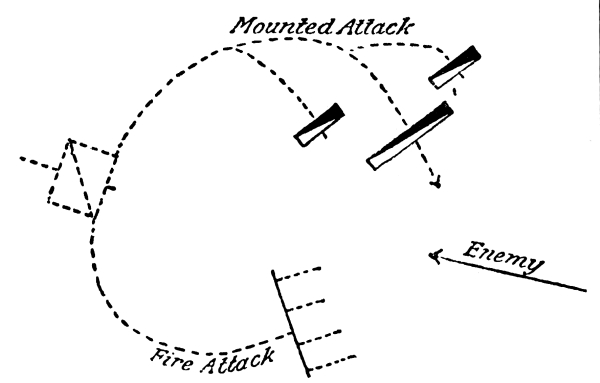
171. The advance into action.
1. The manœuvres which precede the charge take place in such rapid succession that little time will be available for elaborate orders or dispositions. Horse artillery brigade commanders must therefore be ready to join the artillery commander as quickly as possible, when he proceeds to carry out his reconnaissance, so as to receive his verbal orders and communicate them without delay to brigade leaders.
2. The two chief duties of the horse artillery commander are to reconnoitre a position for his brigades and to watch the manœuvres of his own and the corresponding movements of the opposing cavalry. To save delay and to enable him to devote more time to the tactical situation he should usually be accompanied and assisted in his reconnaissance by the commanders of horse artillery brigades.
3. The principal considerations involved by the above duties are, firstly, the selection of a position the fire from which will not easily be masked by the advance of the cavalry, and, secondly, the correct moment for coming into action, taking into account the time which must elapse between opening fire and obtaining effect. If the cavalry machine guns are to act on the same flank as the horse artillery their commander must ascertain the position of the guns, so that he may avoid masking their fire at a critical moment.
4. Every effort should be made to conceal the guns till the last moment, so that the fire may come as a surprise. A covered line of advance, to the selected position should, therefore, be sought, while, if exposed ground has to be crossed, the distance of the enemy and the possibility of coming under fire must be considered in deciding on the formation to be adopted, it may be possible to deceive hostile patrols by masking the guns with the detachments. The position itself must be suitable for direct laying.
5. Both in the advance to and occupation of the position the artillery commander should ensure that the exposed flank of the guns is watched by artillery patrols, if no escort has been provided. If no natural obstacle covers this flank in action, it may be advisable to dispose some of the guns so as to cover it with their fire.
6. Batteries should be retained in positions of readiness as long as possible, in order not to lessen their mobility, should the situation change unexpectedly.
The temptation of gaining a temporary advantage must not be allowed to lead artillery into premature action. Such tactics, far from assisting in the defeat of the hostile cavalry, are liable to divulge the cavalry leader’s plans and may give the enemy a chance of immobilizing, with a fraction of his own artillery, the guns thus engaged, while the remainder of his troops are able to manœuvre in a direction out of reach of fire.
As a general rule, fire should not be opened until the cavalry is in a position to take immediate advantage of its effect. On the other hand the cavalry commander’s plan may render it desirable to open fire for some special purpose, such as to occupy the enemy’s attention or to force him to deploy prematurely or in a faulty direction.
172. The fight.
1. The most favourable moment for the guns to open fire will usually be when the opposing cavalry has definitely committed itself.
2. As success depends on the result of the cavalry charge, it is the paramount duty of the horse artillery to concentrate its fire on that portion of the enemy’s cavalry on which the decisive attack is about to be delivered.
The time during which this portion of the enemy’s force is likely to be exposed to fire being of very brief duration, effect must be sought by the greatest rapidity of fire and well judged distribution.
3. When the guns can no longer engage the immediate object of the attack, fire should be directed on any supports or reserves that may be visible. It is most important that any formed bodies of fresh troops be dealt with at once.
As a rule, it is only when the guns become masked from the hostile cavalry, that their fire should be directed on to the enemy’s artillery. If, however, the enemy’s artillery exposes itself while limbered up or is bringing a heavy fire to bear on the main body of the cavalry during its approach march, the artillery commander will be justified in modifying the above procedure to meet such cases.
173. Pursuit or retreat.
1. If the attack succeeds the artillery commander should send forward part of the artillery at once to support and assist the immediate pursuit. The object of these guns is to prevent the enemy re-forming or holding positions which would check the pursuit.
At the same time the artillery commander should retain control of some portion of the artillery so that he may be ready to comply with any demand which the cavalry commander may make on him for guns to co-operate in an organized pursuit.
2. If the attack fails the horse artillery must remain in action and by its fire form a screen in rear of which the cavalry may rally.
174. Horse artillery with cavalry acting dismounted.
1. Occasions will frequently occur on reconnaissances, in advanced or rearguard actions, and in the seizure of advanced positions, when mounted troops will be involved in a fire fight, where mounted shock action is either not contemplated or is not of primary importance.
2. In such circumstances the mobility of mounted troops is generally employed in enabling successive fractions to move rapidly from one tactical point to another covered by the fire of those at rest. When taking part in such a fight, horse artillery should be guided by the general principles laid down for artillery co-operating with infantry. (See Sec. 154 et seq.)
As a rule an action of this nature will be initiated more deliberately than in a purely mounted combat.
The first requisite is information. The second that, in order to keep in touch with the developments of the action—conducted as it will probably be over a wide area—the positions for the guns should be chosen with a view to affording facilities for movement as well as for effective fire support.
3. A combination of a mounted attack with the fire attack will often form part of the plan of action.
In this case the mounted attack will usually endeavour to gain the flank of its objective while the artillery with the dismounted part of the force brings fire to bear at the right moment, in order to distract the enemy’s attention and pin him to his ground and so prevent any change of position to meet it.
4. Sometimes, however, it will be essential for mounted troops to drive home an attack against a locality on foot. On such occasions they must be formed for attack in depth, the object being to establish a firing line in a position as close as possible to the enemy and to obtain superiority of fire over him. When such is the case the action of the horse artillery will resemble that of field artillery in co-operation with infantry, and time will usually be available to draw up a systematic plan of attack. (See Sec. 153.)
5. The assistance of horse artillery will also be of great value when a mounted force has recourse to dismounted action either with a view to holding a locality till other troops arrive or simply to denying it to the enemy. Its method of employment will approximate to that of field artillery in the defence, but full advantage should be taken of its mobility to support any extensions or changes of front which may be adopted.
175. Horse artillery in a general engagement.
1. Occasions for the employment of shock tactics against infantry or artillery may arise on the battlefield of the future, as they have in the past. Success can, however, only be anticipated when the enemy is either taken by surprise or when demoralized.
2. Surprise may be achieved by a skilful use of the ground or through the enemy’s attention being absorbed by the attack of the other arms. The enemy’s demoralization will depend on the action of the guns and infantry. Hence cavalry before attacking the enemy’s infantry or artillery must chiefly look to the way being prepared for it by the action of the other arms.
Horse artillery must be ready to assist in this preparation, and it will be the duty of its commander, under the instructions of the cavalry commander, to ascertain how best this assistance can be rendered. To this end the establishment of communication with the commanders of adjacent bodies of troops will be advisable.
176. Ammunition supply.
1. Previous to an action the commander of each horse artillery brigade ammunition column should send an officer or non-commissioned officer to artillery headquarters.
2. The artillery commander is responsible for informing the ammunition column commanders as early as possible of the intended course of action and of the localities to which they are to move.
The original positions of these columns should be chosen with a view to the facilities for replenishing ammunition and suitability for defence.
3. If the force is to operate on a wide front, or if part of it is to act independently, instructions as to detaching sections or attaching orderlies to the various cavalry and artillery brigades will be necessary.
4. In the event of a cavalry or horse artillery brigade requiring more ammunition its commander will either send back the orderly to the ammunition column or apply direct to cavalry divisional headquarters as may be most convenient. The place to which the ammunition is to be sent and what arrangements, if any, have been made for its protection should be stated.
Mobile Artillery in the Attack and Defence of a Fortress.
177. The attack.
(See also F.S. Regs., Part I, Secs. 118-125.)
1. In the attack of a fortress the first object will be to capture any advanced positions which the enemy may have occupied. These positions will often be provided with field works the extent of which will depend on a variety of circumstances. To drive the enemy out of such positions the employment of heavy mobile artillery may be necessary, but opportunities will also occur for the employment of the lighter guns in support of the infantry attacks.
These operations should be conducted on the same principles as laid down in Secs. 154-157, every opportunity being taken to cause losses to the enemy which he cannot replace.
2. During the siege operations the field artillery will be employed as directed by the commander of the besieging force. The whole, or a portion of it, may be temporarily or permanently placed under the orders of the siege artillery commander.
The positions of batteries, which have not been placed under the siege artillery commander’s orders, will be selected by divisional artillery commanders, under the orders of divisional commanders. Care must be taken to ensure that the fire from these batteries will assist, and not interfere with, the siege artillery.
3. In the attack of permanent works, the fire of field guns being of little or no value, their use should be restricted to supporting infantry assaults, or to repelling sorties, which compel the enemy’s troops to expose themselves.
Howitzers and heavy artillery, on the other hand, would usually be called upon to take part in destroying the enemy’s armament and works.
4. Accuracy of fire being most important, the judicious selection of observing stations and positions is as important for field batteries as for heavier guns. The gun sites should be concealed and artificially protected, and, when possible, platforms for the howitzers should be provided. A good system of intercommunication and an efficient supply of ammunition are additional factors of importance.
178. The defence.
(See also F.S. Regs., Part I, Secs. 126-128.)
1. In the defence of a fortress delay is usually one of the principal objects. The longer the close investment can be prevented the more will it assist this object.
2. If assisting in the defence of a coast fortress, the first duty of the mobile artillery will be to oppose hostile landing parties. For this purpose it must be able to sweep the probable landing-places with shrapnel fire. It should, if possible, be screened from view of the ships supporting a landing. The best positions for opposing a hostile advance, from whatever quarter it may come, should be chosen in peace, and the sites for the guns thoroughly reconnoitred.
3. With the object of delaying the investment of the fortress one or more advanced positions may be occupied in front of the main line of defence. The distance of an advanced position from the main line of defence cannot be precisely laid down, but it must be far enough forward to deny to the enemy artillery positions from which fire can be opened against the main works, and should be strengthened by all artificial means available. In the advanced position will be placed the heavier guns of the movable armament; the light guns being employed in the counter-attacks that will be made from it with a view of inflicting loss upon the enemy, and hindering the establishment of his batteries. Sites for the various guns and howitzers available should be got ready in good time if this has not been done in peace.
4. As the assailants make good the ground, the last of the advanced positions will eventually be evacuated. The mobile artillery will then be distributed amongst the various sections of the defence, a proportion being retained with the general reserve.
5. As soon as the direction of the main attack has been made clear, the artillery on this front will be reinforced by all the guns that can be spared from elsewhere. The disposition of this armament will vary according to its nature and local conditions. Well-concealed positions for the howitzers and for Q.F. guns, positions from which they can fire direct against assaulting infantry, must be sought.
6. The same general rules apply to the use of projectiles in the defence as in the attack; high explosive shell being employed against matériel, and shrapnel fire against personnel.
Artillery in Irregular Warfare.
179. General principles.
(See also F.S. Regs., Part I, Chap. X.)
1. The extent to which tactical methods differ in small wars from those obtaining in regular campaigns varies widely in different cases.
In each instance the special characteristics, armament and tactics of the enemy must be considered, in addition to the nature of the country in which the operations are to take place, and the object in view. General indications, therefore, can alone be given as to the form which artillery tactics should assume.
2. The importance of impressing such foes as are met with in these campaigns with a feeling of inferiority cannot be overestimated. Consequently a bold offensive is generally adopted and every endeavour made to inflict serious loss on the enemy. Against opponents such as are met with in irregular warfare the moral effect of guns is very great, but without material effect, moral effect is like to be transitory. Sometimes it may be expedient merely to drive the enemy off by shell fire, but, as a rule, this should not be the primary object of the guns.
3. In irregular warfare, guns should generally be dispersed rather than concentrated, so as to bring effective fire to bear at any point where opportunities may present themselves. Moreover any artillery the enemy may possess will usually be inferior in numbers and certainly in training and efficiency, and therefore direct fire and shorter ranges than are usual in regular warfare should be employed. Against irregulars armed with rifles, who rely chiefly on fire action, covering fire from part of the artillery may be necessary, but a prolonged preparation of the attack may cause the enemy to disperse before the attack can be pushed home and is incompatible with anything in the nature of a surprise. The guns not used for covering fire should be pushed forward in order that when the enemy is finally driven out of his position he may be vigorously pursued by shell fire.