Chapter VI · MOUNTED DRILL.
Reading edition
125. General instructions.
1. At drill or manœuvre, the sections of a battery are termed “right,” “centre” or “left,” and the subsections are numbered from 1 to 6 as they stand in line without reference to any number or letter in use for administrative purposes. In column they are termed “leading,” “centre,” and “rear.”
A four-gun battery is organized on similar lines.
At brigade drill batteries are termed “right,” “centre,” and “left,” or “leading,” “centre,” and “rear,” according to their position in line or column respectively.
2. The object of drill is to acquire accuracy and flexibility in carrying out movements necessary for manœuvre.
These movements should be as few and simple as possible, and the brigade or battery should be trained to execute them with precision and rapidity in any direction passing over as little ground as possible.
3. When a general order is not distinctly heard by a part of the line, each commander (when the intention is obvious) will conform as quickly as possible to this movement.
4. Numbering in line is from right to left; in column from the right of the head of the column.
The relative position of batteries within a brigade, of sections within a battery, or of subsections within a section, may be changed at any time, but sections must not be broken up.
The battery or the section on the right of the line is always, for the time being, the right battery or section. Line is to be formed in any required direction with the utmost rapidity possible, without regard to the original positions which batteries or sections or subsections within sections, occupied when they were last told off.
5. The command “March,” unless preceded by some other command, means “Trot.” This does not refer to heavy batteries.
When moving at any pace exceeding a walk, the command “ Walk” will precede by a few seconds the command “Halt.”
Movements and formations will be made on the move unless the order “to the halt” is given; in the case of formations “to the halt” the base body advances its own depth before halting.
If a formation be ordered when a battery is on the move the original pace will be preserved by the base body, while that of each portion of the remainder will be increased or diminished as may be necessary, until the formation is completed; but in field and heavy batteries, if moving at the trot, and the formation is to the head of the column, the pace of the base body will be reduced to the walk until the formation is completed, when the trot will be resumed.
6. Horse and field artillery cannot be reversed on its own ground; when acting with other troops, the battery interval should be allowed on each flank to enable the subsections to wheel outwards if required. It is generally advisable in parade movements to remain in rear of any intended alignment until the other troops are finally formed.
7. When it is intended to increase the front the formation may be to either or both flanks. If no special order is given the formation will be outwards, the body which is immediately in rear of the head going to the right. If it is intended to form on the right or left it must be so stated.
To pass obstacles, and to facilitate movement, the batteries may increase or decrease the battery intervals.
Mountain Artillery.
8. Mountain batteries are organized in two lines for drill and manœuvre, the firing battery, and 1st line.
The relief mules which form part of the firing battery should be taken one from each subsection.
At drill and manœuvre the firing battery moves independently of the 1st line, which, if present, follows some distance in rear and conforms generally to the movements of the firing battery.
9. Mountain batteries move usually at the walk, and the command “March” means walk, unless some other pace is ordered. A pace of four miles an hour should be maintained on level ground.
A distance of one yard between mules, measured from nose to croup, is always maintained on a good road.
Batteries should also be able to move some distance at a slow trot and should be trained accordingly.
10. To reverse or take ground.—Every animal is at once turned about, or to the right or left, as ordered, the gun detachments moving round with the mules and maintaining their position relative to them. As a general rule mules are reversed to the left.
In executing a movement to a flank, the half wheel of subsections is to be preferred.
11. In the detail of drill movements contained in sections, the instructions are generally applicable to mountain batteries with the following modifications:—
i. All reference to the movement of wagons of field artillery may be neglected.
ii. Where the incline of subsections or carriages is ordered for a field battery, the movement will be executed by the half wheel of subsections except for diminishing or increasing intervals in line. Where a formation into line or column is effected in field artillery by one part of the battery increasing its pace, in mountain artillery that part of the battery makes no change, but the remainder of the battery checks its pace.
126. Falling in for parade.
1. The men of each subsection will fall in on foot in front of their own stables, where they will be inspected by their Nos. 1, and the reports made to the battery serjeant-major. The drivers and mounted men of each subsection will then be marched into stables ready to turn out when ordered, and the dismounted men marched to the gun park.
2. The teams will be inspected by the Nos. 1 before they proceed to the gun park. When ordered to turn out, the subsections are formed up, mounted in front of their stables, marched to the gun park and hooked in. Teams should not be hooked in until shortly before the hour for parade.
3. Each section will also be inspected by its section commander, whose duty it is to see that every man, animal, and carriage is properly equipped, that each gun is in working order, the buffer filled and the bore clear.
He should then dismount drivers and detachments and make his report to the captain.
If a section is without an officer, the senior non-commissioned officer of that section takes his place and commands it.
4. When bare charges are carried and when the cartridge is contained in a case which is not attached to the shell, all drill ammunition will be left in barracks or camp.
Mountain Artillery.
5. When ordered to turn out, the drivers will turn out with their mules by subsections and be marched to the gun park, where they will form up behind the guns in the position for action.
Mules will not be loaded or the girths tightened till the last possible moment.
127. Intervals and distances.
1. Intervals are measured from No. 1 to No. 1 when limbered up, from muzzle to muzzle when in action, and from knee to knee between files.
Between files 6 inches.
Open files 2 yards.
Half extended files 4 ”
Extended files 8 ”
Close interval between subsections 4 ”
” ” ” heavy batteries 6 ”
Half interval between subsections 10 ”
” ” ” heavy batteries 12 ”
Full interval between subsections 20 ”
” ” ” heavy batteries 25 ”
Battery intervals—
Between batteries at full intervals 25 ”
” ” close ” 10 ”
Intervals—
between brigades 25 ”
” artillery and other troops 25 ”
2. Distances are measured between animals from tail to head, between carriages from rear end of carriages to head of the following team, and between the units of a column or Échelon from No. 1 to No. 1, except when otherwise stated:—
Between ranks half a horse-length (4 feet).
Battery column, column or échelon of sections 40 yards.
Column or échelon of sections, heavy batteries 50 ”
Column of batteries 125 ”
” ” heavy batteries 100 ”
Short échelon of sections or batteries 20 ”
Short échelon of section or batteries,
heavy batteries 25 ”
Quarter column of batteries 12 ” between carriages and
lead horses’ heads.
””sections 6 ” ” ” ” ”
Column of route 4 ” ” ” ” ”
Between brigades and larger bodies in
column of route 20 ” ” ” ” ”
Between batteries in column of route 10 ” ” ” ” ”
Column or échelon of sections
of mountain batteries 100 ” ” ” ” ”
128. Frontages and depths.
1. The frontage at full interval of a horse, field or mountain battery (6 guns) may be taken to be 100 yards, and that of a heavy battery 75 yards.
2. The depth in column of route of a horse battery with detachments on a flank, or of a field battery, is obtained by allowing 20 yards for each carriage with an allowance for the headquarters. Horse artillery with detachments front or rear requires an extra 8 yards for each detachment; if the detachments are in files, 4 yards must be allowed for every two horses in the detachment.
The road spaces occupied by batteries in column of route are as follows:—
A horse artillery battery (6 guns and 12 wagons):—
With detachments right or left of the guns 390 yards.
” ” front or rear 440 ”
” ” in files 490 ”
A field battery (with 6 guns and 12 wagons) 390 ”
A heavy battery (with 8 wagons) 340 ”
The depth of a mountain battery, in column of route, is obtained by allowing 3 yards for each mule or pony, and adding 25 yards for Nos. 1, coverers, range-takers and signallers.
129. Posts of officers, N.C.Os., &c.
1. The positions assigned to the brigade and battery commanders are those to be taken up when the formation is completed; while it is in progress their posts are wherever they can best superintend and be seen and heard by their commands.
In order to carry out this principle effectually, commanders of batteries and brigades should not remain too close to their commands. When moving in line, or in line of battery columns, their normal position is in front of the centre.
In quarter column formations officers (other than those in front) and serrefiles take half distance.
2. Brigade Commander. In line.—In the centre, two horse-lengths in front of battery commanders.
On other occasions.—In the best place from which he can command the brigade.
3. Battery Commander. In line.—One horse-length in front of the centre of the line of section commanders.
In column or quarter column of batteries.—One horse-length in front of, and three from the directing flank of, the battery.
In all other formations.—In front of the battery.
4. Captain. In line.—One horse-length in rear of the centre of the serrefile rank.
In column of batteries.—As in line.
In quarter column of batteries, full or close interval.—Half a horse-length on the outer flank of the battery, in line with the front rank or gun leaders.
In battery column.—Three horse-lengths on the right flank of the centre of the battery.
In column of subsections and column of route.—One horse-length in rear of the rear carriage.
5. Section Commander. In line.—One horse-length in front of the centre of his section.
In battery column or quarter column.—The leading section commander as in line, the remainder in centre of sections in line with front rank or gun leaders.
In column of subsections and column of route.—Where he can best command his section.
6. Observation Officer (Heavy Batteries).—With the observation party.
7. Adjutant.—The adjutant will, as a rule, accompany the brigade commander and assist him as required.
When a formation is completed he will place himself as follows:—
In line.—On the right flank of the brigade, one horse-length from and in line with the front rank or gun leaders.
In column and échelon.—Three horse-lengths on the right flank of the leading battery in line with the front rank or gun leaders.
8. Brigade Serjeant-Major. In line, in column, and in échelon.—Covering the adjutant at one horse-length distance.
9. Brigade Trumpeter.—With brigade commander.
10. Battery Staff-Serjeants. In line and in column of batteries.—One horse-length in rear of the flank subsections; the serjeant-major on the right.
In quarter column of batteries, full and close interval.—As in line, but half a horse-length in rear.
In battery column.—The serjeant-major and the quarter-master-serjeant in the centre of the leading and rear section respectively in line with the gun axles. In mountain artillery as for line.
In column of subsections and in column of route.—The serjeant-major on the off side of the leading gun in line with the leaders (in column of route, with the battery commander); the quarter-master-serjeant one horse-length in rear of the rear carriage in line with and on the left of the captain.
11. Serjeant-Farrier and Mounted Shoeing-Smith. In line.—The farrier, one horse-length in rear of No. 2 subsection, and the shoeing-smith (saddler in a British mountain battery) the same distance in rear of No. 5.
In quarter column of batteries, full and close interval.—As in line, but half a horse-length in rear.
In battery column.—One horse-length in rear of the rear carriages, the farrier in rear of that on the right. In mountain artillery as for line.
In column of subsections and in column of route.—One horse-length in rear of the captain and quartermaster-serjeant, except in mountain artillery, where they will be in single file, farrier leading.
12. Trumpeters.—One with the battery commander, the other with the captain.
13. Nos. 1.—Of horse artillery, on the left of the lead driver of the gun or with their detachments. (See Sec. 134 (2).)
Of field artillery, on the left of their gun leaders.
Of mountain and heavy artillery at drill and manœuvre in front of their subsections.
14. Coverers.—On the left of their wagon leaders (of heavy artillery in front).
15. Patrol, Range-Takers, Signallers, and Observers.—In line.—In line one horse-length in rear of the centre of the battery from right to left in the order named; at open files when the battery is at full or half interval; at close files when it is at close interval.
In mountain artillery these men are dismounted and form in single rank one pace in rear of the centre of the battery.
In column of subsections and column of route.—In a column of parties from front to rear in the order named; the men of each party abreast of one another, and the rear party one horse-length in front of the leading section commanders.
In battery column or quarter column.—In column as above, one horse-length on the right flank of the centre of the battery.
In quarter column of batteries full or close interval.—As in line, but at half a horse-length distance.
16. Spare Horses. In line.—In the serrefile rank in rear of the centre of their sections, those of the centre section on the left of the line of patrols, range-takers, &c.
In quarter column of batteries, full or close interval.—One horse-length in rear of the rear battery. Those of the leading battery on the right, and those of the rear battery on the left.
Mountain artillery.
17. Senior Driver N.C.O. of British Mountain Batteries, (Driver Havildar Major).
In line.—One pace in rear of the pioneer mule of the right section.
In action.—He is in charge of the firing battery mules.
18. Pioneer Mules. In column of route and subsections.—Leading their section.
On all other occasions.—In the centre of the section, in line with the second ammunition mule.
Two gunners, or one only if short-handed, per subsection are detailed as pioneers, and walk alongside the pioneer mules in the order of march.
19. Relief Mules with Firing Battery. In line.—Distributed in rear of the 2nd ammunition mules.
In battery column and in column of subsections.—Following in rear of the firing battery.
In column of route.—With their subsections.
20. Wheel and Axle Mule. (10-pr. B.L. equipment only.) In line and battery column.—One yard in rear of the pioneer mule of the centre section.
In column of subsections.—One yard in rear of the last mule of the relief mules with the firing battery.
In column of route.—The last of the firing battery mules of its subsection.
Indian mountain batteries.
21. Indian Officers. In line at close order and in battery column.—One horse-length in rear of the centre of firing battery of their sections.
At drill and in action.—Two native officers assist the captain, the third is with the battery commander.
On all other occasions.—On the outer flank of and near the rear of their sections.
22. Battery Staff-Serjeants.—The havildar-major and quartermaster-havildar as for the battery serjeant-major and battery quartermaster-serjeant, but at one pace instead of a horse-length distance.
23. Pay Havildar.—In line in rear of No. 3 subsection.
In battery column.—In rear of right subsection of centre section.
In column of subsections and column of route.—In front of the quartermaster-havildar.
130. Commands and signals.
1. Orders may be given:—
i. By word of command.
ii. By signal.
iii. By trumpet sound.
Words of command.
2. Direct word of command is not suitable for any larger body at the halt than a brigade, or on the move than a battery.
3. All words of command should be given in a firm and explicit manner, and loud enough to be heard by all concerned. The executive part of the command must be clearly distinguished from the preparatory part, and must not follow it too quickly. Commands will be accompanied by the corresponding signals.
4. Battery commanders repeat the brigade whistle and then give their own executive word or signal.
Section commanders, as a rule, command by signal, and give orders by word of mouth only in case of necessity.
Nos. 1 do not repeat commands or signals.
The leader of every unit is responsible that the command is passed on correctly to the next leader.
Signals.
5. The following signals are to be employed to represent the words of command mentioned:—
Signal. To Indicate.
i. Arm swung from rear to front “Advance,” or “Forward,”
below the shoulder, finishing or “Commence movement.”
with the hand pointing to the front.
ii. Arm circled above the head. “Retire,” or “Subsections—Right
about wheel.” (In mountain batteries)
“Left reverse.”
iii. Hand raised in line with the “Walk,” or “Quick-time.”
shoulder, elbow bent, and close
to the side.
iv. Clenched hand moved up and “Trot” or “Double.”
down between thigh and shoulder.
v. Circular movement of hand below “Gallop.”
the shoulder in a vertical plane.
vi. Arm raised at full extent above “Halt.”
the head.
vii. Body or horse turned in the “Incline.”
required direction and arm extended
in a line with the shoulder.
viii. Clenched hand brought to the “Right (or left) take ground.”
shoulder, and the arm then extended
sharply in the required direction
two or three times.
ix. Circular movement of extended arm “Shoulders,” or “Wheel.”
arm in line with the shoulder in the
required direction.
x. Arm waved from above the head “Sections right (or left) wheel.”
to a position in line with the
shoulder, pointing in the required
direction.
xi. Arm waved horizontally from right 1. “Form line” from
to left and back again as though battery column or line
cutting with a sword, finishing with of battery columns or mass.
the delivery of a point to the front.
2. “Form mass” from
line, column of route
or column of sections.
3. “Advance in battery
column” (for a single
battery in line) or
“Advance in mass”
(from brigade in line).
xii. Two or three slight movements “Form line” from échelon.
of the open hand, palm to the
front (arm extended, hand waist
high) denoting a forward movement,
looking to each flank in turn.
xiii. As above, but arm to the rear, “Form échelon” from line.
denoting a backward movement.
xiv. Two or three slight movements of “Dismount” or “Lie down.”
the open hand towards the ground.
xv. Two or three slight movements with “Mount.”
the open hand upwards (palm up).
xvi. Arm raised as for “Halt” and then “Action.”
pointed to the ground.
xvii. Weapon held up above and as if “Enemy in sight in
guarding the head. small numbers.”
xviii. As in xvii, but weapon raised “Enemy in sight in
and lowered frequently. large numbers.”
xix. Weapon held up at full extent of “No enemy in sight.”
arm, point of muzzle uppermost.
Signals for formations from line also apply to échelon.
For signals to first line wagons in action, see Sec. 201.
6. Officers giving signals should, as far as possible, face the same way as those to whom the signals are made, but when a signal ordering a change of direction is made, the body or horse should be turned in the required direction.
All signals should be made with whichever arm will show most clearly what is meant.
In order to ensure uniformity in the system of giving signals, they must be practised in the riding school.
7. Signals of position, such as “Halt” or “Incline,” should be maintained. Signals of movement, such as “Advance” or “Shoulders,” should be repeated until it is clear that they are understood.
8. The whistle (see also Sec. 201) will be used:—
i. By brigade and battery commanders to draw attention to a signal about to be made—a short blast. The whistle must not be used when approaching guns or infantry already in action.
ii. To turn out troops from bivouac or camp to fall in or to occupy previously arranged positions—a succession of alternate long and short blasts.
When a battery is manœuvring as part of a brigade, the battery commander will only repeat the brigade commander’s whistle, to whom he will look for his signal.
Section commanders will wait for their battery commander’s whistle and act on his signals, not on those of the brigade commander.
Field calls.
9. The following field calls should be understood, and such as are applicable maybe used see (Trumpet and Bugle Sounds for the Army):—
“Forward” or “advance.”
“Walk.”
“Trot.”
“Gallop.”
“Charge.”
“March.”
“Halt.”
“Annul,” or “As you were.”
“Troops, half-right.”
“Troops, half-left.”
“Form line.”
“Retire” or “Troops right (or left) about wheel,”
or (for artillery) “Subsections—Right about wheel.”
“Squadron columns.”
“Head of column change direction, half-right.”
“Head of column change direction, half-left.”
“Pursue.”
“Rally,” or “Close.”
“Mass.”
“March at ease,” or “Sit at ease.”
“Attention.”
“Stand to your horses.”
“Prepare to mount, or dismount.”
“Mount.”
“Dismount.”
131. Leading and dressing.
1. To preserve uniformity of movement, men and horses must be trained to maintain the regular pace of trot and gallop.
For the same reason the trot and gallop must commence simultaneously throughout the battery.
As large bodies cannot move in perfect order as rapidly as smaller bodies, the leader must regulate the pace accordingly.
2. The “battery leader” is the officer personally leading and controlling the movements of the battery. He should be well to the front.
Should the battery commander for any reason temporarily cease to act as battery leader, his place will be taken by the senior section commander.
3. The “battery guide” is the commander of the directing section, which is the second from the right (or in column and échelon the leading section). He is responsible for the direction and pace of the battery, following and conforming to the movements of the battery leader.
The other sections will keep their relative positions from the directing section.
4. Similarly in brigade the officer personally leading is the “brigade leader,” and the battery leader of the second battery from the right the “brigade guide.” A line of columns is considered a line in all matters connected with dressing.
In échelon or column movements the battery leader of the leading battery is the brigade guide.
132. Wheeling.
1. When wheeling, dressing is to the opposite flank to that to which the wheel is made. This flank regulates the pace at which the wheel is made, care being taken that the correct interval is preserved from the pivot.
2. To wheel half or quarter, right or left, the word of command is “Half (or Quarter), Right (or Left).” If it is required to complete the wheel to the full quarter circle, after having wheeled half right or half left, the command is “Right (or Left).” When a definite degree of wheel has been ordered no further command is required, the battery or brigade guide being responsible for taking up the proper direction at the conclusion of the wheel ordered.
3. In throwing shoulders forward both flanks are kept in motion, the pivot describing part of a circle, and the outer flank and intermediate subsections by a compound of inclining and wheeling, conforming to the pivot movements. To perform wheels on this principle the command is “Right (or Left) shoulders,” followed by “Forward” when the required degree of wheel has been attained.
4. In small changes of direction (which are usually done by shouldering) the battery leader takes the new direction and the battery guide conforms. When a wheel amounts to a quarter of a circle or nearly so, the battery leader must give the signal to wheel and if desired the word of command and place himself in front of where the centre of the battery will be when the wheel is completed. He gives the signal “Forward” and moves in the new direction as soon as the battery is facing in the required direction.
5. If it is desired to move the line or column consisting of guns and wagons to a flank, the command is “Right (or Left) take ground,” upon which each carriage wheels at once to the flank named. To move each carriage to the rear the command is “Right reverse,” upon which each carriage wheels about to the right.
When horse artillery receive the command “Right (or Left) take ground, or Right (or Left) reverse,” if the detachments are in front or rear of their guns they wheel right, left, or about on their own ground.
133. Markers.
1. The duties of markers will be restricted at drill to indicating the points for the assembly and formation of the battery or brigade for rendezvous.
2. The markers for a battery are the battery serjeant-major and battery quartermaster-serjeant, who are termed respectively the right and left markers. Battery markers mark for the points nearest to their positions in the original formation. They are placed and dressed by the captain.
3. The markers for a brigade are the brigade serjeant-major and the right marker of each battery. They are termed the brigade and battery markers respectively. They are placed and dressed by the adjutant.
4. On the command “Markers” being given they move to their places, are dressed by the officer in charge of them, and when dressed receive the word “Steady” from him. When the formation is completed he gives the command “Eyes front” and the markers fall in.
5. When marking for line, markers face the new alignment, their horses’ heads 6 inches from it, battery markers opposite the points where the horses of the Nos. 1 of the flank subsections will be, and the brigade marker in line with, and 1 yard outside, the flank marker on the directing flank.
6. When marking for column of batteries, each marker should place himself 1 yard to the left of the spot where the No. 1 of the subsection for which he is marking will rest when the formation is completed, and should face the front. The brigade marker faces the marker on the directing flank of the leading battery; the adjutant places himself behind the brigade marker and corrects the covering.
Markers are not required for a single battery in battery column.
A line of columns is considered a line in all matters connected with marking.
134. The battery of horse artillery.
1. The number of men required for the service of each gun is 11, of whom 9 are mounted. In addition a man is required with each section as section commander’s horseholder. He is numbered 12, and falls in on the right of the detachment of the left subsection of his section, except in column of route, when he rides with the leading subsection of his section.
2. The senior N.C. officer of each detachment is the No. 1 in charge of the gun, and rides on the left of the lead driver of the gun, except in the case of “detachment front” when he is on the right of the detachment. The next senior is No. 7 the coverer in charge of the wagons, who rides on the left of the lead driver of the firing battery wagon. Having taken this wagon into action he returns with the team or limber to the selected position and is employed in the supply of ammunition as the commander of the wagon line may direct. Nos. 1, 2, 3, 4, 5, 6 are active numbers (see Handbook); Nos. 10 and 11 are horseholders and hold the horses of the active numbers, except those of 1 and 6 which are held by the centre driver of the gun and wagon respectively. Nos. 8 and 9 are dismounted men and are carried on the first line wagon. The horses of the battery commander and of the man, who works the director, are held by the first trumpeter.
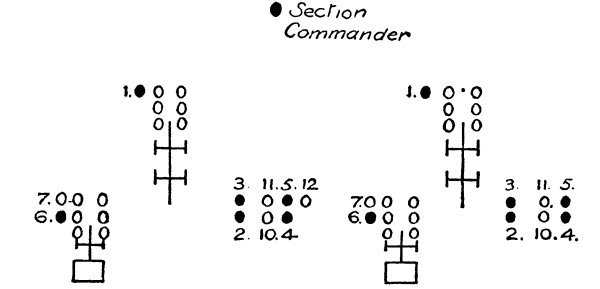
3. A section of horse artillery, with full detachments, is shown in Fig. 26 (the shaded figures representing the horses of active numbers).
In cases of reduced detachments Nos. 6, 5, 10 are omitted in succession.
4. A battery forms for drill and manœuvre as above. Detachments one horse-length on the right of and in line with the gun muzzles. This formation is termed “Detachments right rear.” Lead horses of the firing battery wagons one horse-length on the left of and in line with the gun muzzles.
5. To decrease the front of the subsection the following formations may be adopted:—
Detachments Lead horses of guns one horse-length
front. in rear of the detachments covering
the centre.
Detachments Detachments one horse-length in rear
rear. of and covering the guns.
In each case the firing battery wagons will cover the gun or detachment at a distance of four yards.
The front may be still further reduced by advancing from the right or left of detachments by files.
Fig. 26.
6. To dismount and mount detachments, in line, close interval, guns rear.
At the caution, the front rank advances
Prepare to one horse-length and halts; the odd
Dismount— numbers, both of front and rear ranks,
advance one horse-length,and at the word
Dismount. “Dismount,” the whole dismount
together.
After mounting, the odd numbers of both
Prepare to front and rear ranks rein back and dress
Mount— on the even numbers. The front rank then
reins back one horse-length and halts
Mount. If this is required to be done with
“detachments left” at close interval, the
detachments must be advanced one
horse-length in front of the guns, and
then dismounted, as laid down above.
135. The field battery.
1. The number of men required for the service of each nature of gun is given in the handbooks. No. 1 is the senior; and the coverers, who are the next senior, are mounted non-commissioned officers. Nos. 1 ride on the left of the lead drivers of their guns and the coverers will occupy a similar position as regards the wagons of the firing battery, will take them into action, and will return with the teams to the first line wagons. They will subsequently be employed for the supply of ammunition, as the commander of the wagon line may direct. The positions of the other numbers of the detachment are given in the handbook of the gun.
2. In action the horses of officers and non-commissioned officers are held as follows. (See Fig. 29, p. 306.)
i. Battery commander’s and that of the man who works the
director by the 1st trumpeter;
ii. Captain’s by the 2nd trumpeter.
iii. Battery leader’s or that of the officer accompanying
the battery commander, by an orderly.
iv. Battery serjeant-major’s by one of the battery
headquarters.
v. Section commander’s by the lead drivers of right
subsections.
vi. Nos. 1 by their centre drivers.
136. The mountain battery.
1. The number of men required for the service of each gun is given in the handbook. No. 1 is the senior and leads his subsection, walking in front of the leading mule. The gunners walk alongside the mules in the order shown in the handbook. In bad or hilly ground they help the mules whenever necessary.
2. A N.C.O. is detailed to be in charge of and lead the 1st line mules of each subsection, and will be employed in the supply of ammunition.
3. In action the horses of the battery commander and battery serjeant-major are taken by the 1st trumpeter, that of the captain by the 2nd trumpeter, and those of the section commanders by a N.C.O. or driver of their right subsection.
137. The heavy battery.
1. The number of men required for the service of each gun is given in the handbooks. The senior N.C.O. is called the No. 1, and the next senior, the coverer. The No. 1 is in charge of the gun, and the coverer in charge of the wagon.
2. In action the horses of officers and non-commissioned officers are held as follows:—
i. Battery commander’s and serjeant-major’s by the 1st trumpeter.
ii. Captain’s by the 2nd trumpeter.
iii. Section commander’s by a man detailed for the purpose.
138. Battery drill.
i. The formations of a battery are:—
i. Line.
ii. Échelon or short échelon.
iii. Battery column.
iv. Battery quarter column.
v. Column of subsections.
vi. Column of route.
2. From The battery leader moves in the required
line to direction. The battery guide follows preserving
advance. smooth and uniform pace. The remaining
section commanders dress by the battery
guide and keep section interval from him, but
without constantly fixing their attention on him.
March. The Nos. 1 keep correct interval and distance
from the section commanders. If
obstacles are met section commanders lead
their sections round them, or direct individual
guns to evade them.
3. From
line to
advance
in échelon
or short
échelon.
Advance in The named section advances, the others
échelon (or follow at the distance ordered.
short
echelon)
from the
right
(centre
left)—March.
4. From
line to
retire.
i. Subsections Wagons and serrefiles follow their gun
right round.
about wheel—March.
ii. Right Each carriage wheels to the right about and
reverse—March. follows in rear of the serrefiles, who turn about
on their own ground.
Note.—If it is required to make the rear the
front the order is “Guns front, Serrefiles
rear.”
Note.—The retirement of a mountain battery at full and half interval is usually carried out by the order “Left reverse—March.”
Nos. 1 and serrefiles turn about on their own ground.
On the order “Guns front, serrefiles rear,” the leading mules step short, and the axle mules move to the front by inclining to the right, followed by the others in succession from the rear.
5. From line The odd subsections advance at the pace
to retire ordered while the even subsections check the
when at pace. When the odd subsections are clear of
half the even subsections the battery commander
interval. orders “Subsection right about wheel,”
and when the subsections are all in line again
the original pace is taken up.
The battery
will retire—
March. Note.—A line may reverse when at half
interval in a similar manner.
6. From line All the section commanders turn half right
to incline. (or left) while the lead drivers of all the carriages
wheel their horses half right (or left),
i. Right (or Left)
incline— and all move off in the new direction. The
March. lines of the section commanders, guns and
wagons remain parallel. To resume the original
direction the order is “Forward.” In horse
artillery the detachments preserve their
positions relative to their guns.
In a mountain battery the incline is
executed by every man and animal turning
half right (or left) on his own ground and
moving in the new direction.
ii. Subsections In this case, the wagons follow the guns
half instead of inclining independently. All resume
right (or the original direction on the command
left)—
March. “Subsections half left (or right).”
Inclining should only be done for short
distances.
In a mountain battery each subsection
follows its No. 1, who turns half right (or left)
as ordered.
7. From line
to take Each carriage wheels at once. Officers, &c.,
ground to move to their places in column.
a flank. In a mountain battery every animal is at
Right (or once turned to the right (or left) as ordered,
Left) take Nos. 1 and serrefiles turn on their own
ground ground. The dressing is towards the axle
—March. mules.
8. From line The closing or opening is done upon the
to diminish battery guide. He moves straight forward,
or increase while the other section commanders and the
the intervals. carriages incline inwards or outwards, and
when at the required interval, move forward
in succession. When all are in their places,
Half the trot is resumed by order of the battery
(close or full) leader.
interval
—March. Should it be required to diminish or increase
the intervals without advancing the battery,
the battery guide stands fast, the carriages
reverse, move inwards or outwards, and form
up to the halt at the required interval.
Should the battery commander desire it, he
may order the formation on any section or
subsection, when his command will be “Half
(close or full) interval on the right (or
left) section (or No. ).”
9. From line The subsection on the named flank (or, in
to advance the case of an advance from the centre, the
(or retire) right subsection of the centre section) moves
in column forward, the section commander placing himself
of route. in front. The remaining subsections
incline to their right or left, checking the
pace as required, and turn forward in succession
when in rear of the head of the column.
Advance in In advancing from the centre, the left subsection
column of of the centre section follows the right
route from subsection, then those of the right section.
the right
(left or A retirement is carried out in a similar
centre) manner, the command being, “Retire in
—March. column of route from the right (left, or
centre)—March.” The subsections wheel
about and proceed as before.
10. From
line to This is carried out in a similar manner to
advance the previous movements, except that on
(or retire) leaving the alignment the wagons move up
in column as ordered on the right or left of their guns
of subsections. at 20 yards interval.
Advance in The command for a retirement is “Retire
column of in column of subsections from the right
subsections (left, or centre)—Wagons right (or left)
from the —March.
right (left In mountain artillery the advance or retirement
or centre)— in column of subsections is done in a similar
(or left) way, the firing battery mules of subsections
—March. following each other in succession, and
the 1st line, when this is on parade, moving
in the same order in rear.
11. From The advance unless otherwise ordered is
line to always from the centre or directing section.
advance in The centre section advances straight to its
battery front. The right section inclines to its
column. left and follows immediately in rear of the
centre section, checking the pace as required
Advance in to do so. Similarly the left section inclines
battery to its right and follows the right section.
column (or The wagons of 3 and 2 disengage and move
from the forward at an increased pace so as to allow
right or the guns of the right and left sections to get
left)—March. into their places without checking. This done
they drop back again.
To advance in battery column from a flank
the named section advances, followed by the
remainder in succession.
12. From
line to After the subsections have wheeled about
retire in the movement is carried out as in para. 11,
battery the section is now on the right following the
column. centre section.
Retire in
battery Note.—In mountain artillery the retirement
column— in battery column may be done similarly by
Subsections reversing, the order being “Retire in battery
about column—Left Reverse—March,” and the
Wheel— movement is carried out as above when the
March. reversing is completed.
13. From The rear subsections of sections incline to
column their right and move up at the prescribed
of route interval on the right of those in front.
to form If the order “On the left form battery
battery column” is given, the rear subsections form
column. in a similar manner on the left of those in front.
Form In mountain artillery battery column is
battery formed from column of subsections in the
column same way.
—March.
14. From
battery The right (or left) subsection of the leading
column section moves straight to the front, the other
to advance inclines and follows.
in column The rear section acts similarly, checking
of route. the pace until there is room for them to move
Advance in forward.
column of
route from In mountain artillery an advance in column
the right of subsections is similarly carried out.
(or left)—
March.
15. From
battery The wagons incline to the left and move
column up on the left of their guns at close interval.
to form The sections close up to quarter column
battery distance.
quarter
column. Should it be desired, the wagons can be
Form brought on the right or at half interval by
quarter the command “Wagons right half interval.”
column
—March.
16. From
battery column The leading section follows the battery
to form line. guide.
Form The centre and rear sections incline outwards
line— and follow their commanders on to the
March. alignment.
Special for Mountain Artillery.
17. From
battery
column to
form line The right (or left) subsections of sections
to a flank. come into action at once in the required direction.
The left (or right) subsections wheel to
Line to the the right (or left) at their proper interval,
right moving at a trot, if possible, and come into
left) for action on the alignment.
Action—March.
139. Brigade drill.
1. The formations of a brigade are:—
i. Line.
ii. Échelon or short échelon.
iii. Line of battery columns.
iv. Mass.
v. Column of batteries.
vi. Column of sections.
vii. Column of subsections.
viii. Column of route.
2. From The brigade advances straight to the front
line to at an even pace. The brigade leader gives
advance. the direction to the brigade guide, and the
other battery leaders regulate themselves
March. and consequently their batteries, by the
latter.
3. From
line to
advance,
in échelon
or short
échelon of
batteries.
Advance in The named battery advances—the others
échelon (or follow at the distance ordered.
short
Échelon
from the
right
(centre or
left)—March.
4. From
line to
advance
in line
of battery
columns.
Advance in Each battery advances straight to the front
line of in battery column, the direction, dressing, and
battery columns pace being regulated as in line.
—March.
5. From The batteries advance in battery column.
line to The heads of the flank columns make half
advance a wheel inwards and move up in line with the
in mass. centre column, at 25 yards interval.
Advance in With two batteries, the battery of direction
Mass—March. moves straight forward, the other closes on it.
6. From The battery of direction forms line and moves
mass to straight forward.
form
line to The leading sections of the flank batteries
the front. make a half wheel outwards and move in that
direction till they have taken their correct
Form line distance in line from the brigade guide. They
—March. then wheel to the front and line is formed.
7. From The leading battery forms battery column,
column of continuing to move straight forward.
route to The centre and rear battery form battery
form column and incline to the right and left
mass. respectively, coming up on either side of the
Form mass leading battery at 25 yards interval.
—March. In a similar manner mass may be formed
on either flank.
8. From
column of
sections to
form mass.
Form mass—March. As in 7.
9. From
line to
advance
in quarter
column
of batteries
from a
flank (or The right battery advances to clear the front
the centre). and the other batteries incline to the right.
Advance in They successively incline to the front and
quarter close up to quarter column, the wagons of all
column of coming up on the left of their guns at close
batteries interval (or on the right or at half interval if
from the ordered).
right—March.
10. From
line to
form
quarter
column
of batteries The centre and left batteries reverse and move
to the to the rear. The centre battery takes ground to
halt. its left, and again to its left when in rear of
the right battery, and closes up to quarter
To the column. The left battery inclines to its left,
halt, again to its left when it has room, and takes
quarter ground to its left when in rear of the column,
column of also closing up to quarter column. The wagons
batteries. all come up on the left of their guns at close
on the interval (or on the right or at half interval
right—March. if ordered).
11. From The leading battery moves forward till clear
quarter of the one behind it. The centre battery
column of inclines (shoulders at close interval) to its
batteries right and continues in that direction till the
to form battery guide has got his interval in line from
line to the brigade guide, when it inclines to the left
the front. and comes up in line on the right of the directing
battery. Similarly the rear battery
inclines to the left and comes up on the left.
Form line— When the line is formed the trot is taken up
March. by all. The wagons drop into their places as
soon as possible.
When this movement is performed from the
halt to the halt, the rear batteries take ground
to the right and left respectively, and come
up in line by a square movement.