THE TWO SISTERS (From the Hindoo Folk Lore)
Reading edition
THERE was once a rajah who had two daughters who were as beautiful as two stars, and who loved each other so dearly that they could not bear to be apart even for an hour. The ranee who was their mother died, and in time the rajah married again, and brought home a new ranee to the palace.
This new wife was very cruel to the two girls. She did not give them enough to eat, they had only rags to wear, and sometimes they were beaten. The rajah was so in love with the new ranee that he took no notice of the two girls, nor of how unhappy they were.
One day the younger princess, whose name was Balna, said to her sister, “Why should we be so unhappy here? Our father no longer loves us, and we are so ill-treated that it would be better to die in the jungle than to live in this way. Let us run away.”
The elder sister agreed with her, so early one morning they ran away from the palace, and into the great jungle that lay over beyond it. All day they wandered on and on, and that night they climbed up into a tree that they might be safe from wild beasts.
The next day they journeyed on again, but they had not gone far when they came to a magnificent palace there in the midst of the wilderness. The younger sister wished to knock, but the elder was afraid. “This palace can only belong to a rakshas,” she said, “and if he sees us he will surely kill us and eat us.”
“As well that,” answered Balna, “as for us to die of hunger and exhaustion.” So in spite of all her sister could say she knocked at the door. There was no answer, and after she had knocked several times she opened the door and led the way in.
They looked about them and were amazed at the magnificence of everything they saw. Their father’s palace was as nothing compared to it. They went into one room after another, and everywhere were treasures of gold and silver and precious stones. While they were looking they heard a terrible noise at the door, and they were so frightened that they ran up to the roof of the house. The roof was flat, and from it they could look down into the inner courtyard of the house, where there were trees and walks, and also a well. The noise the girls had heard was made by a rakshas and his wife, to whom this palace belonged, and who were now coming home. Soon the sisters could hear them moving about in the rooms below and quarreling together. Then a door opened and they came out into the court. When the sisters saw them they almost died with terror, they were so terrible-looking.
As soon as they were in the court the rakshas began to run about from one side to the other and to sniff the air. “Someone is here,” he cried; “I smell human flesh and blood.”
“I should think you would smell human flesh and blood,” cried his wife. “You have just killed and eaten a hundred thousand people. It would be strange if you smelled anything else. But I am thirsty. Come here, you lazy bones, and draw up some water for me.”
“Draw for yourself,” answered he. “But let me have a drink first.”
“No, no! I shall drink first,” cried his wife. They both ran to the well, and there they began quarreling again as to who should draw the water.
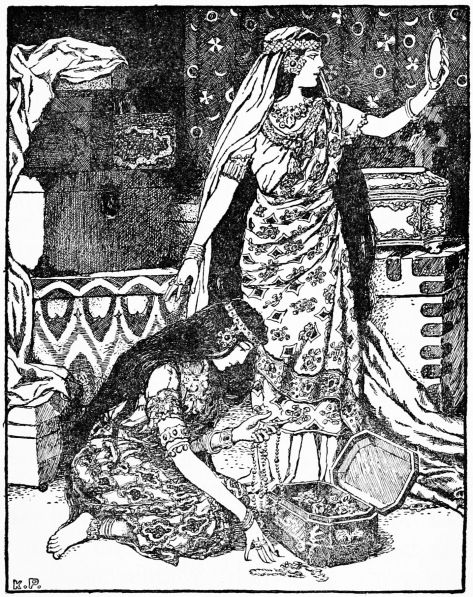
THERE WERE MANY BEAUTIFUL DRESSES AMONG THE TREASURES OF THE PALACE
The two girls on top of the house had been lying as quiet as though they were dead, but now the younger one, who was very clever, said, “Sister, I am going down to see whether I can destroy these rakshas. If I do not they will surely come upstairs and find us, and when they do that they will kill us and eat us.”
The elder sister begged and implored her not to try to do any such thing, but Balna would not listen to her. She hurried downstairs and stole out into the court.
The rakshas were still leaning far over the side of the well, and were so busy quarreling that they never noticed her. The clever girl stole up behind them and caught each one by a heel and sent them headforemost into the well so that they were drowned. Then she called to her sister to come down, for the rakshas were dead and they were safe. The elder sister was so glad that she hardly knew what to do. She came down into the court and she could not praise her sister enough for being so very clever as to get rid of the rakshas! Then they hunted about and found plenty of food to eat, and beautiful clothes to put on, for there were many beautiful dresses of silver and gold among the treasures of the palace.
After this time the two sisters lived there together very happily. Every morning Balna drove the flocks and herds out to pasture, but the elder girl stayed at home to set the house in order and cook the meals. Balna cautioned her never to open the door to anyone while she was away. “There may be robbers in this wood who would kill you for the sake of the treasures that are here,” she said, “or they might carry you away with them because of your beauty.”
The elder girl promised her she would not open the door to anyone, and so Balna felt quite safe in leaving her every day.
Now a young prince lived not far from this jungle, and very often he came to hunt in it. One day the hunt was fast and furious, and he and his attendants rode farther than they had ever gone before. Suddenly they saw, gleaming through the trees, a beautiful palace.
“It is very strange,” said the prince, “that anyone should have built a palace here in the depths of the jungle. Let us knock and see who lives in it.”
His attendants had never seen the palace before, either, and they warned him that it might belong to a rakshas, and it might be dangerous to knock; but the prince would not heed them and began to knock loudly upon the door.
The girl within was frightened at the noise and the voices outside (for this was the very palace where the sisters were living). She kept very quiet and hoped whoever was outside would go away.
“Open the door, you who are inside,” cried the prince. “If you do not I will open it myself with my sword.”
The girl was more frightened than ever, but as she found he was determined to enter, she hastily slipped some rags over her magnificent clothes and blacked her face and hands so that she might look ugly. Then she went to open the door, but she was in such a hurry that she forgot to blacken one of her ears.
When she appeared the prince was surprised at her looks; it seemed strange that anyone so black and ragged should be living in such a magnificent palace. Then he saw that one of her ears was white, and he was more surprised than ever.
However he only said to her, “I have been hunting and I am very hot and thirsty. Will you not give me some water?”
The girl shook her head and motioned to him to go away. She would have closed the door, but the prince put his sword in it so that she could not. “I am thirsty and I must have the water,” he said.
The girl ran away to get it but when she brought it to him instead of drinking it he threw it in her face. Then the black all washed off, and she stood there, more beautiful than anyone the prince had ever seen before. “Who are you, and how do you happen to be living in this jungle all alone?” he asked. But the girl would not answer. She only shook her head again and wept, for she thought to herself, “If they mean any harm to me and I tell them I have a sister they will wait here until she returns, and she will suffer too.”
When the prince found she would answer nothing he mounted her on his horse and carried her away with him, for she was so very beautiful that he determined to make her his wife.
Now the girl had around her neck a string of pink pearls, and she managed to break the string without being seen, and to drop the pearls one at a time as they rode along. For she thought, “When my sister comes home and finds me gone she will hunt for me, and if she sees the pearls she will know in which direction I have gone and will follow.”
So they rode on and after a time they reached the palace where the prince’s parents lived. When they saw what a beautiful girl their son brought home with him they were amazed, and because of her great beauty they were willing for the prince to take her for a wife.
The girl, too, was willing, for the prince was both handsome and kind, so they were married, and loved each other tenderly. The girl now would have been quite happy if she had not remembered Balna and grieved for her. Often when she was alone she began to weep for her, and always when the prince came in he would ask her why she was crying, but she would not tell him. She was afraid if she so did he would be very angry that she had not told him before, and so she made some excuse. Always she thought to herself, “The next time I will tell him,” but always she was afraid. Her courage failed her.
Now when Balna returned to the palace and found her sister gone she was in despair. She sought for her everywhere, calling her name. Then she began to hunt about in the jungle for signs of robbers who might have been there while she was away, and she found one of the pink pearls that she knew belonged to her sister’s necklace. She went a little further and found another, and then another, and still another. So she went on through the jungle, following the way her sister had gone, and picking up the pearls as she went.
That night she came to a stream, and lying beside it was the body of an old woman. The body was so dried by the sun that nothing of it was left except skin and bones. Balna took off the skin and washed it carefully in the brook, and then drew it on over her head and arms as if it had been a glove. When she had done that she looked exactly like an old woman with wrinkled face and arms.
The next day she came to the edge of the jungle, and she saw before her houses and a magnificent palace with gardens about it. She now took a staff in her hand and began to hobble along as though she were a very old woman indeed.
The pearls led her almost to the palace door, but there they seemed to end, and she could see no more, and she did not know where to go next, nor what had become of her sister.
She sat down on the step of a house opposite to the palace, where a gardener and his wife lived.
The gardener’s wife was a very charitable woman, and when presently she came to the door and saw the old woman sitting there as though she were too exhausted to go further, she spoke to her kindly and gave her something to eat. She never imagined what a beautiful young princess was inside of that wrinkled old skin.
Balna thanked her gratefully, and after she had eaten, she sat on the step all day, watching everyone that went past and listening to all they said. She hoped in this way to get some news of her sister, but she heard nothing.
That night the gardener’s wife gave her a place to sleep, and after that Balna lived with her and the woman was very kind to her. All day the princess appeared to be an old woman, but at night she went to a tank in the palace gardens, and took off the old skin and bathed herself in the water. After she had bathed she sat on the edge of the tank for awhile, and amused herself by arranging her hair, putting in it one of the blossoms of a beautiful pink lotus that grew there, and about her neck she hung the necklace of pink pearls which she had strung again.
Now it happened that these pink lotus plants were great favorites with the rajah. He often went to the tank to look at them, and he was much annoyed when he found someone was coming there every night and breaking off a blossom each time. He had another and younger son, beside the one who had found the girl in the jungle, and when this young prince found how annoyed the rajah was over the loss of his lotuses he said he would watch in the garden all night and see who the thief was.
So that night he climbed up in a tree that grew beside the tank and hid himself among the leaves. He sat there for a long time and all was still. Then when the moon rose he was surprised to see an old, old woman hobble down to the tank and seat herself upon the edge of it. But he was more amazed when this old woman stripped off her skin as though it were a glove, and appeared as the most beautiful young girl he had ever seen. She sat there dabbling her feet in the water, and presently she broke off a pink lotus and arranged it in her hair, and drew from her bosom a necklace of pearls which she hung about her neck. She sat there for some time, and then she threw away her lotus flower and drew on the old skin and hobbled away in the direction of the gardener’s house.
The young prince followed without her having seen him, and waited until she entered the door and closed it behind her. Then he returned to the palace.
The next morning he went to his father the rajah, and said to him, “I have found who it is who steals your lotus blossoms. It is the old woman who lives with the gardener’s wife, and I wish to marry her.”
“Marry that ugly old woman!” cried the rajah. “You must be mad.”
“Unless I marry her I will never marry anyone,” answered the prince.
The rajah and ranee were very much distressed, and for a long time they refused their consent, but the young prince grew so pale and ill that at last they could refuse no longer, for he was their favorite son. The old woman was brought to the palace, and was married to the handsome prince.
After they were left alone together the prince said to his bride, “Now that we are married I hope you will take off that old skin and wear it no longer. Then my father and mother will see you as you are.”
But Balna answered, “I do not know what you mean. Do you think anyone can take off her skin and become young again at will. As you married me so I am.” For she thought if I remain as I now appear the prince will soon tire of me and allow me to go out in search of my sister, but if he sees me as I am he will never allow me to depart.
The prince, however, laughed within himself at her words, for he had seen for himself how beautiful she really was, but he said no more about it.
After this every night when her husband was asleep Balna arose and took off her skin to wash it.
The prince awoke one time when she was just slipping the skin on again, but he said nothing about it, but the next night instead of going to sleep he only closed his eyes and lay very still. After a time, when she felt sure he was asleep Balna got up and drew off her skin and laid it aside and went to wash herself. Then her husband took the skin and threw it in the fire, and lay down again and closed his eyes.
Presently Balna returned and began to hunt for the skin, but she could not find it any place. After she had hunted a long time the prince opened his eyes as though he had just awakened. “Are you looking for that old skin?” he asked. “It fell into the fire and I fear it is burned.” So Balna was obliged to remain as she was, a young and lovely princess.
The next morning when the rajah and ranee found what a beautiful girl their son had married under the guise of an old woman, nothing could equal their joy. They no longer wondered that the young prince would have no other for his wife.
But Balna was very sad, she could do nothing but weep and weep. Then the prince too was grieved for her sadness, and asked her why it was. She told him how she had lived in the jungle all alone with her sister, and how the sister had been carried away and she knew not where she was. “It was in search of her,” she said, “that I came to your city and I will never be happy until I find her.”
The prince said, “I myself can tell you nothing of her, but my older brother married a princess who also lived in the jungle. Let us go to her, and ask her if she can tell us anything of your sister.”
He took Balna to the apartments where his brother’s wife lived, to introduce her. But the moment the two princesses saw each other they cried out with joy and ran into each other’s arms. Great was the surprise of everyone, and their surprise was greater still when they found these two were sisters who had lost each other.
After this they sent into the jungle and brought all the rakshas’ treasure to the palace, and the two brothers and their wives lived together ever after in the greatest happiness.