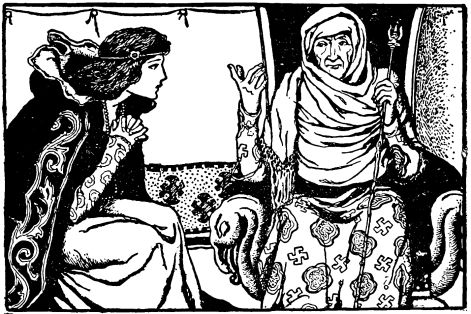
THE FEATHER OF THE ZHAR BIRD (From the Cossack)
Reading edition
THERE were once a man and his wife who had one son named Tremsin, and they were all poor together, as poor as could be.
One day the man said to Tremsin, “Listen, my son. We have but enough meal left in the house for thy mother and myself, and we can shelter thee here no longer. Take the gray steed that stands in the stall and ride out into the world to seek thy fortune, and my blessing shall go with thee.”
So Tremsin took the gray steed from the stall and mounted it, and rode out into the green world, seeking his fortune, and his father’s blessing went with him.
He rode along and rode along, and afterwhile he came to the wide steppes. He heard a rushing of wings overhead, and a light shone about him, and when he looked up he saw a great bird crossing the heavens. It was pure white and shone like silver, and it flew over him as swift as the wind.
“Now in all the green earth never did I see such a bird before,” said Tremsin. “I wonder what it may be.”
“Master,” said the gray steed, “that is the Zhar bird. Presently we will find one of its feathers lying beside our road; but whatever you do, master, do not pick it up, for if you do, evil as well as good will come upon you.”
Tremsin made no answer, but he rode along and rode along, and presently he saw something bright lying beside the road. He came up to it and it was a feather. It was as white as silver, and so bright that no words can tell how it shone.
“Good or ill, that feather I must have,” said Tremsin; so in spite of the good steed’s warning he picked it up and laid it in his bosom.
After awhile they came to a great city and in this city lived a nobleman. He was a very rich nobleman, and very powerful.
Tremsin rode to his house and asked if he might take service with him.
The nobleman looked at him up and down and saw that he was a good stout lad. “Why not?” said he. “I have need of servants to curry my horses, for I have more than fifty in my stalls.”
So Tremsin was set to work in the stables, and the nobleman’s own favorite steed was given him to take care of. Every day Tremsin curried it and rubbed it down, and after he had rubbed it its coat shone like glass. There never was anything like it. The nobleman was very much pleased, and made such a favorite of Tremsin that all his fellow servants grew jealous. They rubbed and curried their steeds, but they could not make them shine as Tremsin did. Then they set a little stable boy to watch Tremsin and see what he did to make the horse’s coat so bright.
The stable boy hid in the manger, and after awhile Tremsin came in and began to clean the horse. He rubbed it and curried it, but he did that no better than the other grooms. Lastly he looked about him, and seeing nobody, he drew from his breast the feather of the Zhar bird and stroked the horse with it. Immediately the steed shone like silver, so that all the stall was filled with light. Then he hid the feather in his bosom again, and led the horse out for the nobleman to ride him.
The little stable boy climbed out of the manger, and ran and told the other servants what he had seen, and as soon as they heard about the feather they knew it must be a feather of the Zhar bird. Then they were more envious than ever, and they laid a plot to rid themselves of Tremsin.
They went to the nobleman, and said to him, “Tremsin has a feather of the Zhar bird, and it is so bright that there never was anything like it. Moreover, he boasts that if he chose he could go out and catch the Zhar bird as easily as not, and bring it to you for a present.”
The nobleman sent for Tremsin, and said him, “Your fellow servants tell me you have boasted thus and so. Now go you out and get the Zhar bird for me, for I can neither eat nor sleep until I have it.”
It was in vain Tremsin swore and protested that never had he said such a thing. He must go and get the Zhar bird for the nobleman, or have his head cut off from his shoulders.
Tremsin went out to the stall where the gray steed stood and wept bitterly. “Yours was a wise warning, my good steed,” he said. “Good came to me from the Zhar bird’s feather, but now evil has come of it, and such evil that I must lose my head for it.”
“How is that, my master?” asked the steed.
Then Tremsin told him all that the nobleman had said, and that as he could by no means bring the Zhar bird to his master he must surely die.
“There is no need to grieve over such a task as that,” said the steed. “That is an easy trick. Do you get a strong net and ride me out to the steppe where we first saw the bird. There I will stretch myself out as though I were dead, and you must hide yourself beside me. Presently the Zhar bird will come and light upon me. Do not stir nor touch it until it hops upon my head and is about to peck my eyes. Then throw the net over it and you will have it safe.”
Tremsin did as the gray steed bade him. He bought a great strong net and then he rode out to the place he had first seen the Zhar bird. There on the lonely steppes the steed laid himself out as though he were dead, and Tremsin hid beside him.
Presently there was a great rushing of wings overhead, and a white light shone and here came the Zhar bird.
He flew down and lighted on the gray steed’s flank but Tremsin did not move. He lighted on the shoulder, but Tremsin never stirred. Lastly he went to the gray steed’s head and stooped to peck his eyes. Then, quick as a flash, Tremsin threw the net over the bird, and there he had it safe, struggle as it might.
If Tremsin had been a favorite before it was nothing to the way it was now. The other servants were so jealous that they could hardly bear it. They got together and laid another plot to rid themselves of him. They went to the nobleman and told him: “Tremsin boasts that it was nothing to bring you the Zhar bird as a gift; that if he wished he could bring you the thrice-lovely Nastasia of the sea for a bride just as easily as not.”
Now the thrice-lovely Nastasia was the most beautiful woman in the world, so that nobody could equal her, and after the nobleman had heard what they had to say he sent for Tremsin to come to him.
“Tremsin,” he said, “I hear that you have boasted that if you wish you can bring me the thrice-lovely Nastasia of the sea for a bride. Go now and bring her to me, for if you do not, as surely as my sword hangs by my side, your head shall leave your shoulders.”
It was in vain that Tremsin begged and protested, the nobleman would not listen to him and he went out to the gray steed’s stall and wept bitterly.
“Why are you so sad, my master?” asked the gray steed.
“I am sad because of the evil the Zhar bird’s feather has brought upon me. The nobleman has bidden me bring him the thrice-lovely Nastasia for a bride, and as I cannot do it I must die.”
“Do not be troubled over that task,” said the gray steed. “There are harder things than that in the world, and if you do as I say all may yet be well.”
The steed then told Tremsin to go into the town and get for himself a snow white tent, and all manner of silken scarfs and gold and silver ornaments. He was to purchase beside a golden pitcher of rare wine and a sleeping potion.
“When you have all these things,” said the steed, “take them down to the seashore and spread the tent, and arrange in it all the things you have bought as though you were a merchant. Put the sleeping potion in the golden pitcher of wine, and do you lie down beside the tent as though you were asleep, and whatever you do, do not stir nor open your eyes until I neigh thrice.”
Tremsin did all that the steed bade him; he bought the tent and the wares, the golden pitcher of wine and the sleeping potion, and carried them down to the seashore. He arranged them as a merchant would his wares. He put the sleeping potion in the wine, and then he lay down and pretended to be asleep.
After a while the thrice-lovely Nastasia came sailing past in her rose-red boat. She saw the shining white tent and landed to see what was in it. When she came to the door of it she saw all the silken scarfs and the gold and silver ornaments, and lying by the tent apparently fast asleep was a handsome youth, with a gray steed standing beside him.
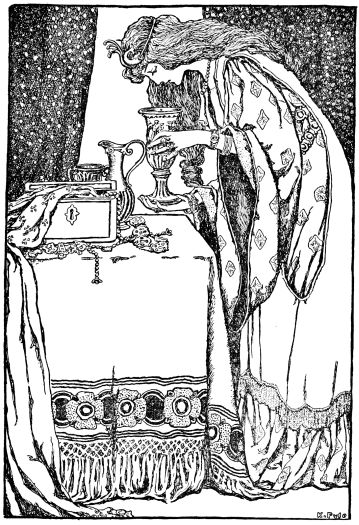
SHE LIFTED IT IN HER HANDS AND TASTED IT
“Merchant, merchant, waken and show me your wares,” said the thrice-lovely Nastasia; but Tremsin did not stir.
“Up, merchant, for I have come to purchase of you.”
Tremsin kept his eyes closed and only breathed the deeper.
Then Nastasia began to go about through the tent and look at the things. She slipped the bracelets on her arms, the rings upon her fingers, she wrapped the silken scarfs about her, and presently she found the golden pitcher of wine. She lifted it in her hands and tasted it. Then she drank deep of it and presently there was none left. Almost immediately she sank down in a deep sleep.
Then the gray steed neighed three times. “Up, up, my master,” he cried. “Yonder lies the thrice-lovely Nastasia. Take her up in your arms and mount upon my back, and we will carry her to the house of the nobleman before she wakens.”
Then Tremsin lifted her in his arms and mounted his steed, and away they went, swift as the wind, so that Nastasia’s hair flew out behind them like a cloak.
After a while they came to the palace of the nobleman, and when he saw that Tremsin had brought him the thrice-lovely Nastasia for a bride he could not do enough for him. There was nothing Tremsin could ask of his master that he might not have had.
But the thrice-lovely Nastasia sat in her chamber and wept and wept. “Never will I marry any man,” she cried, “until he can bring me my shining necklace of pearls that I left at the bottom of the sea.”
Then the nobleman called Tremsin to him again. “Tremsin,” he said, “you must still do something more for me. You have brought me the thrice-lovely Nastasia of the sea, but you left her necklace of shining pearls behind. Go and get it for me, or by the sword that hangs at my side, you shall surely die.”
Tremsin went out to the stall of the gray steed and wept bitterly. “Surely the evil that comes to me will never end. I caught the Zhar bird in a net, the thrice-lovely Nastasia I brought my master for a bride and now I must bring the necklace of pearls from the bottom of the sea or I will lose my head from my shoulders.”
“Master, do not let that grieve you,” said the gray steed. “Do as I bid you and you may get the necklace. Go down to the seashore and hide yourself behind the rocks close to where the tent was spread. Presently you will see some crabs crawl up out of the water. Do not stir nor touch them until one comes larger than the rest and wearing a golden crown upon his head. He is the king of them all. Throw your cap over him. Hold it tight and do not let him go until he promises to bring you the pearl necklace of the thrice-lovely Nastasia from the bottom of the sea.”
Tremsin was quick to do as the steed bade him. He went down to the seashore and hid behind some rocks. There he lay quiet; he hardly breathed.
Presently the crabs began to crawl up out of the water. They came one after another. Tremsin had never seen so many. Last of all came a crab larger than any of the rest, and on his head he wore a golden crown. Tremsin waited until this one came close by the rocks, and then, quick as a flash he threw his cap over it, and held it tight.
The crab struggled but it could not get free.
“Let me go, Tremsin,” it cried, “and I will bring you such treasures that you will be a rich man forever.”
“I will not let you go,” said Tremsin, “until you promise to bring me the pearl necklace of the thrice-lovely Nastasia from the bottom of the sea.”
Well, the crab did not want to promise, but there was nothing else for it. He had to say he would do it, and then Tremsin lifted his cap and let him go.
The crab sidled off and disappeared in the water and he was gone three hours. When he came back he held the necklace in his claws.
Tremsin took the necklace and thanked him, and hurried away to the palace of the nobleman.
When his master saw that he had brought the pearl necklace he could not do enough to show his gratitude.
But the thrice-lovely Nastasia sat in her chamber, and would do nothing but weep and weep.
“I will never marry any man,” she said, “until I can ride to the church on my own fierce wild charger of the sea.”
Well, there was nothing else for it; the nobleman sent for Tremsin again. “This one more thing you must do for me,” he said. “You must bring me the thrice-lovely Nastasia’s wild fierce charger from the sea. Bring me that and I will make you rich for all your life, but fail and your head shall surely be parted from your shoulders.”
Out went Tremsin to the gray steed’s stall.
“This is the last,” he said. “If I can do thus and so I will be a rich man for life, but if I cannot I must surely die.”
“Master,” said the gray steed, “this is the hardest task that has been set you yet. Whether we can bring that fierce, wild charger from the sea I do not know. We can but try, but there is great danger in it.”
Then the gray steed bade Tremsin go to the town and buy twenty hides, twenty poods of tar and twenty poods of horse-hair. “Load them upon my back,” he said, “and drive me down to the seashore.”
Tremsin went to the town and bought the twenty hides; he bought the twenty poods of tar and the twenty poods of horse-hair. He loaded them on the gray horse and drove him down to the sea.
“Master,” said the gray steed, “do now exactly as I bid you, for if you do not I will surely perish. First of all, lay one of the hides upon me and bind it so it will not possibly come off. Over this spread a pood of tar, and fasten upon it another hide. Then another pood of tar and another hide, and so on until all have been used. Then I will plunge into the ocean, and as soon as the fierce strong charger of the thrice-lovely Nastasia sees me he will come at me and try to tear me to pieces, but if all goes well the hides will protect me. I will swim to the shore and he will follow me, and as soon as he comes out from the water do you be standing ready and strike him upon the head with the twenty poods of horse-hair. Immediately he will become so gentle that you may easily mount and ride him, but if you fail in any one of these things I will be torn to pieces, and you with me.”
Tremsin promised to obey the gray steed in everything. He fastened the hides upon the horse’s back with the tar, just as he had been directed to do, and when it was all finished the gray steed plunged into the sea. Tremsin stood at the edge of the shore holding the twenty poods of horse-hair ready in his hands.
Presently all the surface of the sea became disturbed. It was churned into foam; great waves arose. There was a sound of neighing, and Tremsin knew the gray steed and the fierce wild charger of Nastasia were fighting terribly. The wild charger would soon have torn the gray steed to pieces, but he could not get at him on account of the hides.
Presently the horse of Tremsin swam to the shore, and it was so exhausted it could hardly drag itself from the water. The fierce wild charger was close after it, still biting and tearing, and it had torn all the hides from the gray steed but one. But Tremsin was ready. He swung the twenty poods of horse-hair on high and struck the charger with it.
Immediately the charger became perfectly gentle and quiet. It stood trembling, and the sweat poured from its sides like water. Tremsin mounted on its back and rode away to the house of the nobleman, and it was so gentle that he had no need of either bit or bridle.
When the nobleman saw him coming on the charger he was so delighted that he called him brother, and said that the half of all he had should be his.
Now the thrice-lovely Nastasia could find no excuse for putting off her marriage with the nobleman. He had restored to her her pearl necklace; her fierce wild charger had been brought to her from the sea. One last request she made, however, and then she would marry him.
“Have filled, I pray you,” she said, “three large vats. Let the first be filled with cold milk, the second with warm milk, and the third with milk that is boiling hot.”
The nobleman could refuse her nothing, so he had the vats prepared as she wished, the first with cold milk, the second with warm, the third with milk that was boiling.
When all was ready the thrice-lovely Nastasia stepped into the first vat, and when she came out she had changed to an old, old woman. She stepped into the second vat, and she became a blooming young girl. She stepped into the third vat, and when she came out from that she was the most beautiful woman that ever was seen. She shone like the moon, and all the people could look at no one else.
When Tremsin saw that, he too stepped into the first vat, and came out an old man. He stepped into the second vat and became young again. He stepped into the third vat and when he came out from that he was the handsomest youth in all the world. There never was anything like it, he was so handsome.
But the nobleman was filled with envy and jealousy, and he too wished to become the handsomest man in all the world. However, he was not willing to step into the first vat, for he did not wish to become an old man; he saw no reason for stepping into the second vat, for he was already young. He sprang straight into the third vat, and immediately the boiling milk scalded him to death, and he never came out again.
But Tremsin married the thrice-lovely Nastasia of the sea, and they were the handsomest couple that ever were seen, so that people have not done talking of them even yet.