THE BEAUTIFUL MARIA DI LEGNO (From the Roman Tales)
Reading edition
THERE was once a merchant who was so rich that no king could be richer. He and his wife had one daughter named Maria di Legno, and she was as dear to them as the apple of the eye. Now about the time when Maria was old enough to think of getting married, the merchant’s wife fell ill, and feeling herself about to die she called her husband to her.
“My dear husband,” she said, “I feel that I am near to death and it troubles me greatly to know that Maria is about to lose a mother’s care. She is so beautiful and will be such an heiress that she will have many suitors. Promise me that she shall marry no one but the man whose finger fits this ring.” She then took from her neck a little chain to which a ring was fastened, and laid it in her husband’s hand.
Her husband could refuse her nothing. He gave her his word that it should be as she wished, and very soon afterward his wife died.
It was not long before the suitors began to come from far and near to ask for the hand of Maria di Legno in marriage. Some of them were very rich and powerful, and the merchant would have been very glad to have one of them for a son-in-law, but no man among them could wear the ring. For one it was too small, for another too large, and so they were all obliged to go away again with “no” for the answer. It seemed as though the beautiful Maria would never be married at this rate, and the merchant began to repent him of his promise to his dead wife.
At last came a suitor richer and handsomer than any of the others. He said he was a prince, and he brought with him a long train of attendants, and gifts of great magnificence. The merchant took such a fancy to him that he felt that this was the man whom he would choose out of all the world for his daughter to marry.
Maria, however, was very unhappy, for she could feel nothing but fear and dislike for the stranger.
The prince was very courteous to every one, and smiling and anxious to please; that was at first. But when he was told that before he could have Maria for a wife he must try on a certain ring and see if it fitted him, and that all depended upon that, he became very angry.
“This is a silly thing to ask of me,” he said. “Is it not enough that I am rich and young and that I please you? I am not a child that I should play such a silly game as that.”
He was so angry that it seemed at first as though he would ride away without even looking at the ring. However, after he had had a day to think it over he appeared as smiling and cheerful as ever, and seemed quite willing to submit to the test.
“After all, it was her mother’s last wish,” said he; “and besides that, I shall be very glad to prove to you beyond a doubt that I am the one out of all the world who ought to marry the beautiful Maria, for I am sure the ring will fit me.”
Overjoyed, the merchant sent for the casket in which the ring was kept, but when he opened the lid what was his dismay to find that the ring was gone. And now he did not know what to do. He had promised his dead wife that Maria should not marry anyone who could not wear the ring, and now if it was lost it seemed she would never be able to marry anyone at all.
But when the prince found the merchant was reasoning in this way he flew into a fine rage. “What are you thinking of!” he cried. “First you tell me you will give me your daughter for a wife if I can wear a certain ring, and then when I am willing to stand the test, you tell me the ring can not be found. Is this a trick you are playing upon me? If it is it shall cost you dear.”
The merchant tried to excuse himself, but the stranger would listen to nothing.
“Because you are so careless as to lose the ring, is that any reason your daughter should remain unmarried all her life?” he asked.
“Set me three tasks to perform, no matter how difficult. If I fail in any one of them I will ride away with no ill-feeling, and leave her to some more fortunate suitor; but if I perform them all to her satisfaction then I shall have her for a bride.”
This seemed to the merchant only a fair and just proposal, and as he was very anxious for his daughter to marry the prince, he agreed to it. But when Maria heard all this she was in despair. She had depended upon the ring to protect her, for she did not believe it would fit the stranger, but now that it was gone she feared her father would force her into the marriage in spite of herself.
In her grief and dismay she bethought her of her godmother who was an old fairy and who lived in a forest over beyond the town. This fairy was very wise, and Maria knew that if anyone could help her in her trouble she could. So that evening she wrapped herself in a dark cloak so that no one should know her, and stole out of the palace and away to where the fairy lived.
She found her godmother at home, and after Maria bid her good evening, and presented to her some little cream cakes that she had brought with her as a gift, she began to tell her story. She told the fairy all about her suitor, and how she feared and detested him, and how, unless she could think of some task that he would be unable to perform, she would certainly be obliged to marry him.
The fairy listened attentively, and after Maria had ended, she sat silent for quite a while, thinking. At last she began, “Maria di Legno, this is a very difficult matter. You do well to fear this stranger, for he is a very wicked and a very powerful magician. He is indeed far more powerful than I, so that I can do nothing against him, and I fear that you will be obliged to marry him. Still, everything that I can do to help you I will, and you must follow my advice exactly. To-morrow this evil one will come to inquire what is the first task that you wish him to perform. Try to appear smiling and cheerful, and ask him to bring you as a gift a dress woven of the stars of heaven. This will be a very difficult thing for him to get, and if he fails to bring it to you he can no longer insist on your marrying him.”
Maria was more frightened than ever when she heard that her suitor was a wicked magician, and she promised to follow in every respect the advice that had been given her. Then she drew her hood over her head and made her way home again, and so well had she managed that no one there had any idea she had been away at all.
The next day when the suitor came to visit her he was delighted to find her cheerful and smiling as though she were no longer averse to him.
“Have you thought of what my first task shall be?” he asked.
“Yes,” said Maria. “I wish you to bring me a dress woven of the stars of heaven.”
As soon as the magician heard that, his brow grew black, and he gave her a suspicious look. “Someone must have told you to ask for that,” he said. “You never would have thought of it yourself.”
But he had agreed to do whatever she might ask of him, and he could not very well make any objections to this. He asked, however, to be allowed three days in which to procure the dress, and to this the merchant agreed.
For three days the stranger disappeared, and no one knew what had become of him, but when at the end of that time, he reappeared, he brought the dress with him. It was made entirely of the stars of heaven as Maria had demanded, and was so beautiful and shining that it was a joy to the eyes to see it.
Maria was dismayed to find he had so easily performed this first task, but she dissembled and tried to appear delighted with the gift; but she took the first opportunity she could find to steal away to the forest to visit her godmother. She told the fairy that her suitor had been able to perform the first task, and bring her the dress of stars, and when the fairy heard this she looked very grave.
“This is a bad business,” said she. “Still there are two more tasks that you are to set him, and for the next one tell him he must bring you a dress woven entirely of moonbeams. This will be even more difficult for him to procure than the other, and it may be that he will fail to get it.”
Maria promised to do as the fairy advised her, and then stole back to her home again.
The next day the suitor came to visit her again, and he looked as happy as though the marriage day were already set.
“What is the next task that I am to perform?” he asked. “You see however difficult the thing is I am not only willing but able to perform it.”
“I would like,” said Maria di Legno, “a dress woven entirely of moonbeams.”
As soon as the magician heard that his look changed, and he cast upon her a terrible glance.
“Someone has told you to ask for that,” he cried. “However, you shall have it, but you must give me three days in which to procure it, as you did before.”
Maria would have refused this if she dared, but her father was very willing to allow it. For three days the magician disappeared, but at the end of that time he came again, and now it was a dress of woven moonbeams that he brought with him. If the other dress was beautiful this was ten times more so. The eyes could hardly bear to look at it, it was so bright.
Maria tried to pretend she was delighted, but as soon as she could she stole away to see her fairy godmother once more, and to tell her how the second trial had come out.
The fairy listened and shook her head. “My poor child, I fear this marriage must be. Still there is one more task you may set him, and this time tell him to bring you a dress woven entirely of sunbeams. This will be far more difficult for him to procure than either of the others, but if he should succeed in doing it there is no help for it, you will be obliged to marry him.”
As soon as Maria heard this she burst into tears, but her godmother comforted her. “Listen,” said she, “even though I cannot preserve you from this marriage, I may be able to save you in the end. As soon as the wedding is over the magician will take you away in a coach to carry you to his own country. Upon his head he will wear a velvet cap, and in this cap a long feather. Look well at the feather, for slipped over it is the magic ring. It is he who stole it from the casket, for he knew it would not fit him, and he feared to stand the test. After you are married to him, however, he will no longer be afraid to let you see he has it. You must manage in some way to get this ring from him, for if you succeed in escaping finally you will have need of it. And now listen further to what you must do.” The fairy then told Maria that she would make a hollow wooden figure of an old woman for her. This she would hide in a certain spot in the forest near to which the magician’s coach must pass. Just before they reached this place, Maria must make some excuse to leave the coach, and must hide herself in the wooden figure. She might then safely walk wherever she wished to go, for even if the magician met her he would certainly never guess that the figure of that ugly old woman contained his bride.
Maria thanked the fairy with tears of gratitude, and hastened home, and this time, too, nobody guessed that she had been away.
Soon the magician came to ask her what she would set him as a third task.
“I wish you to bring me another dress,” said Maria, “and this time it is to be made entirely of sunbeams.”
When the magician heard this the blood rushed to his face, and his eyes became like hot coals.
“You are not the one who thought of this,” he cried. “You shall have it, but if I did but know who was back of this wish of yours he should suffer for it, whoever he is.”
Maria was left trembling with fear, and for three days the magician was not seen by anyone. At the end of that time he reappeared, and this time it was the dress of sunbeams that he had brought back with him. If the others had been beautiful this was far beyond them, and it was so bright that the pages who carried it could hardly bear the light of it in their eyes.
And now Maria could make no further delay, she must marry the prince whether or no. A magnificent wedding was prepared for, and although Maria was very sad she looked so beautiful that the magician could hardly control his joy at the thought that he was to have her for a wife.
Immediately after they were married they entered a coach drawn by six coal-black horses and drove away toward the forest, for that was the direction in which lay the magician’s country.
They rode along, and rode along, but all the while the bride kept looking out of the window instead of at her bridegroom.
“What are you looking at?” he asked at last, quite out of patience with her.
“I am looking at the beautiful flowers along the way. Do stop and gather some for me, and I will make a wreath for my hair, and another for your cap.”
The magician was very anxious to please her, so he alighted immediately and gave his cap into the hands of Maria di Legno, and began to gather flowers for her along the way. She made a wreath for her hair and another for his cap, but before she handed it back to him she managed, without its being noticed, to slip the ring from the feather and hide it in her pocket.
Then they rode on again, and by the time they were well in the forest it was growing dark. Hundreds of fireflies flickered about among the trees, and Maria exclaimed how bright they were. Finally one passed so much larger and brighter than any of the others that it was like a star. “Look! look!” cried Maria. “How beautiful that is. My dear husband, I do beg and entreat of you to catch that one for me if you can.”
Again the prince, anxious to please her, stopped the coach, and alighting, ran away among the trees in pursuit of the firefly.
No sooner was he out of sight than Maria, too, sprang to the ground, and hastened to the spot where the fairy had told her she would find the wooden figure. She quickly discovered it behind some bushes, and opened the little hinged door in its back. The moment this was opened a soft light shone through the forest, for the fairy had put Maria’s three beautiful dresses inside the figure, and they shone so that everything around was lighted up. The figure was hollowed out in such a way that there was room inside it for Maria and the dresses too.
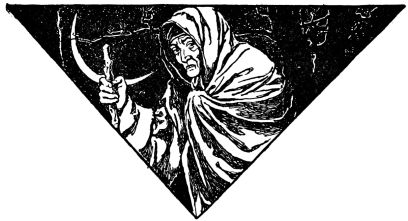
Maria stepped inside and closed the door and immediately the forest grew dark again. Then she arranged a shawl about the figure so that the door would not show, took a staff in her hand and hobbled away through the forest, for the figure was made in such a way that it would move almost as easily as a real body.
All this time the magician had been pursuing the firefly. It led him this way and that but always away from the coach. It did not fly fast, and several times he thought he had it, but it always slipped through his fingers. The fact was the firefly was really the fairy who had taken this shape in order to lure him away through the forest and give Maria a chance to escape.
Suddenly a soft light shone through the forest and then died away. By that the fairy knew that Maria had found the figure and had stepped inside and closed the door. Then the firefly disappeared altogether, leaving the magician there alone in the darkness.
He made his way back to the coach in a very bad humor. “I could not catch the firefly,” said he in a gruff voice; “I only succeeded in bruising myself against the trees.” There was no answer. “Do you not hear?” cried he angrily. “I tell you I am black and blue with bruises, and all because you were silly enough to want a firefly.” Still there was no answer, and the magician looked inside the coach. No one was there. Then he understood that he had been tricked, and he was in a fine rage. He ran about through the forest like a wild thing, peering and searching for his lost bride, and it would have been an ill thing for her if he had found her then. At last he came upon an old woman hobbling along with a staff in her hand, and a shawl about her shoulders.
“Tell me, old woman,” he cried, “have you seen a beautiful young girl anywhere in the forest? A beautiful young girl dressed as a bride?”
“I have seen no one but you,” mumbled the old crone. “Not a living soul but you,” and she hobbled on still mumbling to herself.
The magician did not waste another glance upon her, for he never dreamed the beautiful young Maria was hidden inside that ugly old figure, but she was almost dead with fear lest he should guess it. He was filled with rage and despair, and rushing back to the coach he threw himself into it and was driven away like mad, and that was the last of him as far as Maria was concerned.
All that night Maria hobbled on, but toward morning she was so tired that she lay down under a tree and went to sleep. She had no fear, for robbers would never disturb one who looked as old and poor as she, and as for wild animals she was protected from them by the wooden figure in which she lay.
She slept then quietly for quite a while, but in the early morning she was awakened by the barking of dogs, and the sound of a horn. The prince of that country had come into the forest to hunt, and he and all his retinue were riding in her direction at full speed.
She struggled to her feet, but she was hardly up before the dogs burst through the bushes and threw her to the ground again. And now came the horses and riders; the young prince had almost ridden over Maria before he saw her and could stop his horse. However he managed to draw rein before she was touched, and then he said to his attendants, “Look at this poor old woman. Either the dogs have hurt her or else she has fainted from fear.” And indeed Maria was so frightened that she could neither move nor speak.
The prince was very tender-hearted. He caused his attendants to lift her up and put her on the saddle in front of him. “There, there, mother,” said he; “I believe you are more frightened than hurt. Tell me where you live and I will take you home, for you do not seem able to walk.”
“Alas! I have no home to go to,” answered Maria in a sorrowful voice.
“So old, and homeless, too,” cried the prince. “If that is the case I will even carry you back with me to the palace, for you cannot be left here to die. There must be some work that you can do there in the kitchen or scullery, and you will at least be sure of food and shelter.”
Maria was only too thankful to be taken with him, for she did not dare to brave her father’s anger by returning to his house, and there seemed no other place for her to go. The prince still kept her on his horse in front of him, and rode back with her to the palace, and there she was handed over to the servants. They were ill-pleased enough to see her, too.
“Why is an old crone like this brought here,” they muttered among themselves. “She is too old to work, and yet we will have to share what little we have with her.”
“Never mind,” said the steward. “It is the prince’s pleasure that she should remain here, and we will find something for her to do. If nothing better she can help the scullery maid with the pots and pans.”
So the beautiful Maria di Legno became the servant of servants, and cleaned pots and pans, and was scolded and sent upon errands. Sometimes the maids even struck her, but this they soon learned not to do, for it hurt their hands. “You are a very strange old woman,” they would say. “In spite of your age your flesh is so hard that bone itself could not be harder.”
Now after Maria had been at the palace for a few months the time of the carnival came round. The carnival was to be more magnificent this year than ever before, for the parents of the prince were anxious for him to choose a bride, and it might be that his choice would fall upon someone among the noble guests. Queens and princesses and ladies of rank came from far and near, and such magnificent clothes were hardly ever seen before. The prince was courteous to them all, but he did not seem to distinguish anyone above the others.
For the last three days of this carnival anyone was allowed to appear at it, even the palace servants if they chose. They did choose, and so when the first of these three days arrived there was a great stir and bustling and running to and fro in the kitchen. No one had any thought for the old woman who helped the scullery wench, and so no one noticed when she stole away by herself to the miserable loft where she slept. She took with her a jug of hot water, and after she had fastened the door and made sure she was alone she opened the figure and stepped out. First she washed herself and arranged her beautiful hair. Then she drew from the figure the dress of stars, and after she had put it on she was the most beautiful creature that was ever seen.
The ball was at its height when she appeared, and many beautiful ladies were there in silks and jewels, but Maria far outshone them all. Everyone stared and whispered, but she was at once so beautiful and so stately that no one dared to approach or question her. Only the prince felt privileged, by his high rank to speak to her and ask her hand for the dance.
When she answered him her voice was so soft, and her glance so modest, that the prince’s heart went out to her, and he could think of no one else. When they danced together everyone said that such a handsome couple had never been seen before.
Before the ball ended Maria found an opportunity to slip away unseen. Hastening to her room she took off her beautiful dress and packed it away inside the figure. Then entering into it herself she closed it up and lay down to sleep.
The next day there was no talk all through the palace except about the beautiful stranger who had appeared at the ball the night before. Some thought she must be a fairy, and others that she was some great queen who had managed to arrive there unannounced; all were anxious to know whether she would reappear at the ball that evening.
The prince was not the least anxious person in the palace. He thought of his beautiful partner all day, and longed so to see her that he could neither eat nor rest.
That night the ball was again at its height before Maria di Legno arrived. She was clothed this time in her dress of moonbeams, and was so beautiful that when she entered there was a general sigh of wonder.
The prince who had been watching the door with impatience hurried to her side immediately and claimed her hand for the dance. That evening he tried in every way to find out who she was, but always she put him off with a smile and a word, and that night she managed to slip away, unperceived as before.
The last night of the carnival arrived, and with it appeared the beautiful Maria di Legno. This time she wore her dress made of sunlight, and was beautiful and bright beyond all words, so that the prince was beside himself with admiration. Again he begged her to tell him who she was and whence she came, but she would not. One thing however gave the prince some hope that she did not mean to forsake him entirely when the carnival should be over. She drew from her bosom a ring, and begged him to try it on, telling him that no one, so far, had ever been able to wear it. The prince slipped it on, and it fitted his finger exactly; it could not have fitted better if it had been made for him. Then the eyes of the beautiful stranger shone with joy, but she took the ring again and hid it in the bosom of her dress.
Maria meant to slip away unperceived this night as she had the two nights before, but the prince had determined that this should not be. He had told the palace guards to be on the watch, and not to let her escape without following her. He himself scarcely left her for a moment. However, toward the end of the evening he was obliged to turn away to acknowledge the greeting of some nobleman, and when he looked around again she was gone. She had slipped away the moment he had turned his head, and had hastened into a long gallery that seemed to be deserted, but looking behind she saw that the guards were following her. She hurried on but soon she found they did not mean to lose sight of her, and now she was almost in despair.
About her neck she wore a necklace of pearls which her father had given her, and as a last hope she broke the cord that held them and scattered them on the floor. When the guards saw the pearls rolling this way and that beneath their feet they could not resist stooping to pick them up and while they were doing this Maria managed to escape them and reach her room in safety. She quickly hid her shining dress and shut herself in the figure and then threw herself down on her hard and narrow bed to sleep. The next morning when the sleepy servants were busy with their work there was the old woman scrubbing pots and pans in the scullery as usual, and no one could possibly have dreamed that she was the beauty of the night before.
As for the young prince, when he found the beautiful stranger had disappeared and left no trace behind her he was so filled with grief and disappointment that he fell desperately ill. Doctors came from far and near to attend him, but they could do nothing for him. He remained sunk in melancholy, and at last the queen mother began to fear that unless some remedy was found he would die from sorrow.
All this was talked about in the kitchen, and when Maria heard how the prince was pining away for love of the beautiful stranger she made up her mind that it was time for her to make herself known. Therefore one day when the other servants were not looking she made a little cake, and in it she hid the magic ring that the prince had tried upon his finger that last night of the carnival. Then she caused word to be carried to the queen mother’s ears that it was said by an old woman in the kitchen that she could cure the prince if they would only let her try.
At first the queen mother paid no attention to this talk but as day after day passed and her son grew no better, in despair she sent for the old woman to come to her.
Maria put the little cake upon a golden plate, and carrying it in her hand went to attend the queen.
She found her majesty seated in a room with all her attendants around her, and as soon as she entered the queen began: “Old woman, it has been brought to my ears that you have said you can cure the prince. Is this true?”
“Yes, your majesty,” answered Maria. “It certainly is true that I said it, and it is also true that I and I alone can do it.”
“That is a brave boast for you to make,” said the queen. “And what would you advise us to do for him?”
“Here is a cake which I have made myself,” said Maria, “and in it is something which will surely cure him. That is, it will cure him if he eats the whole of the cake. If however even the smallest portion is thrown away all its virtue will be lost, and it will do him harm rather than good.” This she said because she was afraid that if a part of the cake were thrown away the ring might be in it.
When the attendants heard the old woman say all this so gravely they began to laugh, for it sounded very silly. The queen mother however rebuked them and bade them be silent. “These old women,” she said, “often know remedies that are unknown to the doctors. There may really be some virtue in this cake that will restore our son if he will but eat it.”
She then bade the old woman leave the cake and presently she carried it in to the prince with her own hands.
She found him stretched on a couch before the window, gazing out at the sky with a melancholy air. She sat down by his side and asked him how he did, and then she showed him the little cake she had brought with her, and told him how the old woman had declared that if he would but eat it he would certainly be cured.
The prince heard her listlessly, and when she had ended he answered in a weak voice, “There is only one thing that can cure me, and that is to find some trace of the beautiful stranger, and indeed unless I can hope to see her again sometime, I do not care to live.”
“Do but try the cake, however,” said his mother persuasively. “See it is very small and light. I will break off a piece for you.”
So saying she broke a piece from the cake to give to him, but what was her surprise to see there in the piece a golden ring.
“This is certainly a very strange thing,” she cried. “Here is a ring in the cake.”
“A ring!” the prince repeated. He raised himself on his elbow to look, and no sooner had he taken it in his hand than he started up with a loud cry of joy. “Where did you get the cake?” he cried. “Who brought it to you?” for he at once recognized the ring as the one the beautiful stranger had had.
“It was brought me by an old woman who works in the kitchen; Maria di Legno they call her.”
“Let her be brought here at once,” cried the prince.
An attendant was sent to summon Maria and while he waited the prince strode up and down the room holding the ring in his hand and unable to control his impatience.
Maria had been expecting this summons, and she had managed meanwhile to arrange her hair, and dress herself in her sunlight dress, and hide in the figure again; and so it was as the homely old woman that she appeared before the prince once more.
“Tell me, old woman,” he cried, “was it you who put this ring in the cake?”
“It was,” answered Maria.
“And do you know to whom it belongs?”
“I do.”
“Then tell me instantly where she is,” cried the prince, filled with hope.
“I am she,” answered Maria.
When the prince heard this he thought the old woman must be mad, but Maria opened the door and stepped out from the figure in all her brightness and beauty. Then the heart of the prince seemed like to break with joy. He fell upon one knee and took Maria by the hand. “At last you have come,” cried he. “And now you shall never leave me again, for you and you only out of all the world shall be my bride.”
To this Maria gladly assented, for she had loved him from the first moment when he had found her in the wood.
She told her story, and after the king and queen found who she was they were very willing to have her for their daughter-in-law. She and the prince were married with great magnificence, and lived happily ever after, and the wooden figure they kept to show to their children and their children’s children.