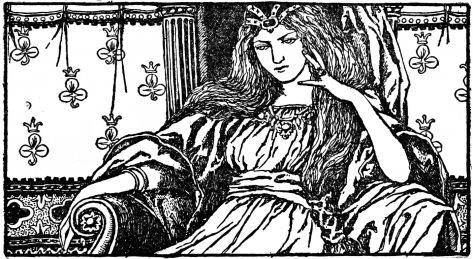
DIAMONDS AND ROSES AND PEARLS (From the French Tales)
Reading edition
A WIDOW had two daughters of whom the elder was exactly like herself, with thick brown skin, hair as coarse as horse-hair and a loose, hanging mouth. She was as cross-tempered as she was ugly, but because she resembled her mother, the widow loved her dearly, and declared her the most beautiful creature in the world.
The younger sister was very different. Her skin was like peaches and cream, her hair was golden, and her eyes as blue as the sky. She was as sweet-tempered as the other was ill-natured, but her mother hated her so, that she could hardly bear the sight of her, and had nothing for her but blows and hard words.
While the mother and the elder sister feasted upon dainties the Fair One had only scraps to eat, and not enough of those, and all the hard tasks of the household were laid upon her shoulders. In spite of all this ill treatment, however, she grew in beauty every day like a flower. Her figure remained round and soft, and after she had finished scouring the pots and pans she would wash her hands and they would be as white as a lily. Seeing this, the mother and sister were ready to die with envy. They washed their hands with perfumed water, and dried them on silken napkins, but they still remained as rough and horny as toads.
One day the mother bade the younger sister go to a spring that was some distance away in a forest, and bring water for her sister to bathe in. She gave her an earthen pitcher that was so heavy the young girl could hardly carry it. “And do not spill any of the water by the way or you shall be punished,” cried the mother.
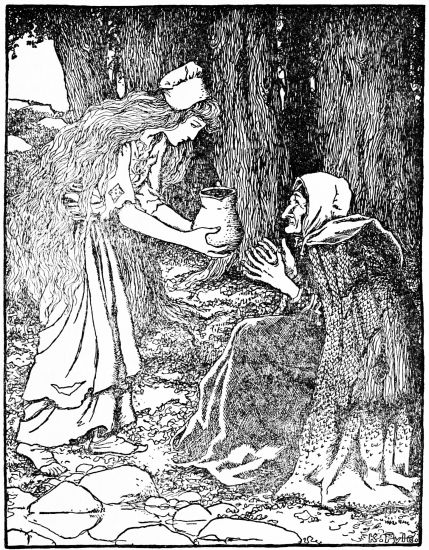
SHE LIFTED THE HEAVY PITCHER FOR HER TO DRINK
The young girl hurried away, glad to be out of the house and away from the scolding tongues, even though it were but for a little while. She would have liked to linger by the way to listen to the birds, and to gather some of the flowers that bloomed on every side, but she knew that if she were late in returning, she would be beaten for it.
When she reached the fountain she quickly filled her pitcher, but she was so sad that, as she stooped above the water, the tears ran down her cheeks and fell into it like raindrops.
“Poor child, you are very sad, but remember you are not the only unfortunate one upon this earth,” said a hoarse, cracked voice behind her.
Turning quickly, the Fair One saw, seated upon a rock close by, an old woman so bent, so wrinkled, and so hideously ugly that the young girl was frightened by her looks. However, she tried to hide her fear and spoke to the crone civilly. She was then about to go on her way, but the old woman stopped her. “My daughter,” she said, “I am thirsty, but my old bones are too stiff for me to stoop to drink from the fountain. Will you not give me some water from your pitcher?”
“Willingly, mother,” answered the girl in a sweet voice, and approaching the old woman she lifted the heavy pitcher for her to drink. She held it carefully until the stranger had quenched her thirst, and then returned to the fountain to refill it.
“Daughter, you have obliged one who is not only able but willing to reward you,” said the old woman. “Your sweet temper is a dower greater than any I can give you, but this you shall have beside. When you speak, roses and pearls shall drop from your lips, and your tears shall be changed to diamonds as they fall.”
The girl thought the old woman must be out of her wits, for it was quite impossible that such a thing as that should happen to anyone, and bidding her good-day as quickly as she could, she hurried away with her brimming pitcher.
When she reached home her mother met her at the door with scowls and reproaches.
“Lazy wretch,” she cried, lifting her hand, “you have been gone twice as long as was necessary. You have been loitering and amusing yourself by the way,” and she seemed about to beat her.
“Pardon me, I beg of you,” cried the young girl. “Indeed I hurried all I could, but I feared to spill the water by the way.”
The mother’s hand dropped, and she stared down at the floor with open mouth and starting eyes; for every word the girl spoke, a rose or a pearl fell from her lips and showered upon the floor of the house.
The mother gave a cry of greed and stooped to gather up the pearls. The flowers she allowed to remain where they were.
“What is it? What has happened?” cried the ugly sister, pressing forward.
“Silence!” cried the mother, speaking angrily to the ugly one for the first time in her life. “Her words are worth more than yours.” Then she stood up again. “Speak! Speak!” she cried to the younger sister, and as she did not immediately do this, the mother struck her to make her be quicker in her speech.
Frightened and bewildered, the young girl burst into tears, but, as the tear drops fell from her eyes, they were changed by the fairy spell, and reached the floor as glittering diamonds, that rolled about this way and that.
“It is magic!” cried the mother, delighted. “Tell me, my daughter, how has this happened? Whom did you meet while you were away?”
“I met no one,” answered her daughter, “but an old woman by the fountain, who asked me for a drink of water. I gave it to her, and then she told me that roses and pearls should fall from my lips when I spoke, and my tears be changed to diamonds, but I did not believe her, for who could believe such a thing as that?”
“It was a fairy,” cried the mother. Then she turned to the elder daughter, her eyes glistening with greed. “Quick!” she cried. “Take the silver pitcher, for it is the best we have in the house, and take also some of those cream cakes that have just been baked. Go to the fountain and look for the old woman, and when you see her offer her the cream cakes and draw for her a drink from the fountain. If she gave your sister such a gift in return for a drink from the earthen pitcher, how much more will she not do for you when you serve her from silver?”
The elder girl, who was very lazy, began to grumble. It was far to the fountain; the pitcher was heavy; why should she go when all they had to do was to gather up the diamonds and pearls that her sister scattered about.
The mother, however, would not listen to her. She put the cream cakes in her pocket, the pitcher in her hand, and pushed her gently from the door, bidding her hurry or the old woman might have disappeared.
The lazy girl went lagging down the road, swinging her pitcher as she went, and now and then stopping to pick up stones and throw them at the birds that sang on either hand. It took her twice as long as it had taken her sister to get to the fountain. When at last she reached it, there was no one there.
“At least I shall not have to draw any water,” said the girl. Then she sat down in the shade and began to eat the cream cakes. She was munching and munching when she saw a tall and beautiful lady coming toward her through the forest. The stranger was as tall and stately as a queen, and was magnificently dressed, and, like a queen, she wore a golden crown upon her head. She was really a powerful fairy, and it was she who, in the shape of an old woman, had talked with her younger sister beside the fountain. She had now resumed her own shape, and the lazy one never guessed that this bright stranger and the old woman she had come to seek, were one and the same.
The fairy came near, and looked down at the girl with a frown, for the lazy one neither moved nor spoke, but only stared up at her with her mouth full of cream cake.
“I see you have a pitcher,” said the fairy, “and as I am very thirsty, will you not draw some water in it for me to drink?”
The lazy girl took time to swallow the last piece of cream cake, and then she answered rudely, “I am not your servant. If you want water, draw it for yourself.”
Then as it seemed there was no chance of the old woman’s returning, she rose and shook the crumbs from her skirt and prepared to go.
“Wait!” said the fairy sharply as she was turning away. “The words that fall from your lips are like evil things, and as evil things shall they appear. For every word you utter a spider or adder shall fall from your lips until you have learned to speak in a proper and gentle manner.”
Having so spoken, the fairy vanished, floating away through the forest like a rosy cloud. The girl shrugged her shoulders and started homeward with her empty pitcher.
Even before she reached the house, the mother came running to meet her and embraced her tenderly. “Did you see the old woman? And did she lay her spell upon you? Speak, my beautiful one, and let me gather up the treasures that fall from your lips.”
The daughter pushed her away crossly. “Be quiet,” she said. “I saw no old woman, and all I got for my pains is a——”
The mother started back with a shriek of dismay; for every word her daughter had spoken, a spider or an adder had fallen from her lips.
“What is this!” she cried, wringing her hands. “What evil spell has been laid upon my precious beauty?”
“I do not know,” answered the frightened girl. Then as she saw more spiders fall from her lips she began to bawl aloud in her wrath and terror.
“It is all the fault of your sister, the hussy!” cried the mother. “Not another night shall she spend in the house to bring fresh misfortunes on us.”
She ran back home and began to beat the girl. Then she thrust her from the door.
“Go, go!” she cried, “and never let me see your face again.”
Frightened and weeping, the poor girl ran away into the forest, and as she went, the diamonds she shed marked the way she had gone. They lay among the grasses sparkling like dewdrops, and lucky were those who next came by that way; a whole fortune lay there at their feet.
The Fair One wandered on and on through the forest until she was completely lost and did not know which way to turn. It began to grow dark, and she was terrified at the thought that soon the wild beasts would begin to leave their lairs. She met no one, and there seemed nothing for her to do but climb a tree and prepare to spend the night in the forest, when suddenly she heard a sound of voices and the trampling of horses. Presently the riders came breaking through the bushes. They were magnificently dressed, and at their head rode one, handsomer and more magnificent than them all. It was the young prince of that country, who was returning late from a hunt, with his attendants.
When he saw the young girl he reined in his steed and gazed at her with wonder. Never before had he seen such beauty; it seemed to shine around her like a soft light.
“Who are you and whence come you, O Fair One?” he asked.
“I am a poor girl who has neither home nor shelter,” she answered him, and as she spoke, roses and pearls fell from her lips.
The prince was overcome with admiration. “Never have I seen beauty to compare with yours,” he cried. “Come back with me to the palace, I pray of you, for unless you consent to be my bride I vow that I will never marry.”
Blushing, the Fair One allowed him to place her on the horse before him, for it seemed to her she had never seen anyone, at once so handsome and so kind, before. So he carried her home with him to the palace, and when they saw her the old king and queen were amazed at her beauty and sweetness. But when they saw the treasure that fell from her lips whenever she spoke, they gladly gave permission for her marriage with their son.
To celebrate it, a magnificent feast was prepared, and people were invited to come to it from far and near. The Fair One, who was very kind and forgiving, begged that her mother and sister might be invited, too. The prince could refuse her nothing, and so the invitation was sent.
No sooner was it received than there was a great commotion and excitement at the house of the cruel mother. She and the sister bought fine dresses and jewels and feathers that only served to set off their ill looks. Last of all, they stepped into a coach drawn by four black horses and drove away to the palace. There everything was mirth and rejoicing, and the widow and her daughter bowed and smirked with the best of them. But when they entered the grand hall where the king and queen sat, and saw that the prince’s bride was no other than the younger sister, and that she, too, sat upon a throne with a crown upon her head, they were so filled with envy and spite that they burst.
But the prince married the Fair One and they lived happy ever after, beloved by the king and queen and all their people.