FACTS ABOUT CHAMPAGNE
Reading edition
AND
OTHER SPARKLING WINES,
COLLECTED DURING NUMEROUS VISITS TO THE CHAMPAGNE AND OTHER VITICULTURAL DISTRICTS OF FRANCE,
AND THE PRINCIPAL REMAINING
WINE-PRODUCING COUNTRIES OF EUROPE.
BY
HENRY VIZETELLY,
Chevalier of the Order of Franz Josef. Wine Juror for Great Britain at the Vienna and Paris Exhibitions of 1873 and 1878. Author of “The Wines of the World Characterized and Classed,” &c.
WITH ONE HUNDRED AND TWELVE ILLUSTRATIONS,
DRAWN BY JULES PELCOQ, W. PRATER, BERTALL, ETC., FROM ORIGINAL SKETCHES.
LONDON: WARD, LOCK, AND CO., SALISBURY SQUARE. 1879.
Shorter Table of Contents added by transcriber
Table of Contents (full)
I. The Origin of Champagne.
II. The Vintage in the Champagne. The Vineyards of the River.
III. The Vineyards of the Mountain.
IV. The Vines of the Champagne and the System of Cultivation.
V. Preparation of Champagne.
VI. The Reims Champagne Establishments.
VII. The Reims Establishments (continued).
VIII. The Reims Establishments (continued).
IX. The Reims Establishments (concluded).
X. Epernay Champagne Establishments.
XI. Champagne Establishments at Ay and Mareuil.
XII. Champagne Establishments at Atize and Rilly.
XIII. Sparkling Saumur and Sparkling Sauternes.
XIV. The Sparkling Wines Of Burgundy and the Jura.
XV. The Sparkling Wines of the South of France.
XVI. The Sparkling Wines of Germany.
XVII. The Sparkling Wines of Germany (continued).
XVIII. The Sparkling Wines of Austro-Hungary, Switzerland, Italy, Spain, Russia, &c.
XIX. The Sparkling Wines of the United States.
XX. Concluding Facts and Hints.
Statistical Table, 1844-1878
Recipes for Wine Cups
The Principal Sparkling Wine Brands
THIS little book scarcely needs a preface, as it speaks sufficiently for itself. It is for the most part the result of studies on the spot of everything of interest connected with the various sparkling wines which it professes to describe. Neither pains nor expense have been spared to render it both accurate and complete, and the large number of authentic engravings with which it is illustrated will conduce, it is hoped, to its value.
Uniform with the present work and the Author’s “Facts About Sherry,”
FACTS ABOUT PORT
AND MADEIRA,
Including Chapters on the Wines Vintaged Around Lisbon and the Wines of Teneriffe.
Illustrated with 80 Engravings from Original Sketches.
CONTENTS.
PAGE.
I.—The Origin of Champagne. The Early Vineyards of the Champagne—Their Produce esteemed by Popes and Kings, Courtiers and Prelates—Controversy regarding the rival Merits of the Wines of Burgundy and the Champagne—Dom Perignon’s happy Discovery of Sparkling Wine—Its Patrons under Louis Quatorze and the Regency—The Ancient Church and Abbey of Hautvillers—Farre and Co.’s Champagne Cellars—The Abbey of St. Peter now a Farm—Existing Remains of the Monastic Buildings—The Tombs and Decorations of the Ancient Church—The Last Resting-Place of Dom Perignon—The Legend of the Holy Dove—Good Champagne the Result of Labour, Skill, Minute Precaution, and Careful Observation 9
II.—The Vintage in the Champagne. The Vineyards of the River. Ay, the Vineyard of Golden Plants—Summoning the Vintagers by Beat of Drum—Excitement in the Surrounding Villages—The Pickers at Work—Sorting the Grapes—Grapes Gathered at Sunrise the Best—Varieties of Vines in the Ay Vineyards—Few of the Growers in the Champagne Crush their own Grapes—Squeezing the Grapes in the “Pressoir” and Drawing off the Must—Cheerful Glasses Round—The Vintage at Mareuil—Bringing in the Grapes on Mules and Donkeys—The Vineyards of Avenay, Mutigny, and Cumières—Damery and Adrienne Lecouvreur, Maréchal de Saxe, and the obese Anna Iwanowna—The Vineyards of the Côte d’Epernay—Boursault and its Château—Pierry and its Vineyard Cellars—The Clos St. Pierre—Moussy and Vinay—A Hermit’s Cave and a Miraculous Fountain—Ablois St. Martin—The Côte d’Avize—The Grand Premier Crû of Cramant—Avize and its Wines—The Vineyards of Oger and Le Mesnil—The Old Town of Vertus and its Vine-clad Slopes—Their Red Wine formerly celebrated 20
III.—The Vineyards of the Mountain. The Wine of Sillery—Origin of its Renown—The Maréchale d’Estrées a successful Marchande de Vin—From Reims to Sillery—Failure of the Jacquesson Vineyards—Château of Sillery—Wine Making at M. Fortel’s—Sillery sec—The Vintage and Vendangeoirs at Verzenay—The Verzy Vineyards—Edward III. at the Abbey of St. Basle—From Reims to Bouzy—The Herring Procession at St. Remi—Rilly, Chigny, and Ludes—The Knights Templars’ “Pot” of Wine—Mailly and the View over the Plains of the Champagne—Wine Making at Mailly—The Village in the Wood—Village and Château of Louvois—Louis-le-Grand’s War Minister—Bouzy, its Vineyards and Church Steeple, and the Lottery of the Great Gold Ingot—MM. Werlé’s and Moët and Chandon’s Vendangeoirs—Pressing the Grapes—Still Red Bouzy—Ambonnay—A Peasant Proprietor—The Vineyards of Ville-Dommange and Sacy, Hermonville, and St. Thierry—The Still Red Wine of the latter 32
IV.—The Vines of the Champagne and the System of Cultivation. The Vines chiefly of the Pineau Variety—The Plant doré of Ay, the Plant vert doré, the Plant gris, and the Epinette—The Soil of the Vineyards—Close Mode of Plantation—The Operation of Provinage—The Stems of the Vines never more than Three Years Old—Fixing the Stakes to the Vines—Manuring and General Cultivation—Spring Frosts in the Champagne—Various Modes of Protecting the Vines against them—Dr. Guyot’s System—The Parasites that Prey upon the Vines 42
V.—Preparation of Champagne. Treatment of Champagne after it comes from the Wine-Press—Racking and Blending of the Wine—Deficiency and Excess of Effervescence—Strength and Form of Champagne Bottles—The “Tirage” or Bottling of the Wine—The Process of Gas-making commences—Inevitable Breakage follows—Wine Stacked in Piles—Formation of Sediment—Bottles placed “sur pointe” and Daily Shaken—Effect of this occupation on those incessantly engaged in it—“Claws” and “Masks”—Champagne Cellars—Their Construction and Aspect—Transforming the “vin brut” into Champagne—Disgorging and Liqueuring the Wine—The Corking, Stringing, Wiring, and Amalgamating—The Wine’s Agitated Existence comes to an End—The Bottles have their Toilettes made—Champagne sets out on its beneficial Pilgrimage 48
VI.—The Reims Champagne Establishments. Messrs. Werlé and Co., successors to the Veuve Clicquot-Ponsardin—Their Offices and Cellars on the site of a Former Commanderie of the Templars—Origin of the Celebrity of Madame Clicquot’s Wines—M. Werlé and his Son—The Forty-five Cellars of the Clicquot-Werlé Establishment—Our Tour of Inspection—Ingenious Liqueuring Machine—An Explosion and its Consequences—M. Werlé’s Gallery of 63
VII.—The Reims Establishments (continued). The Firm of G. H. Mumm and Co.—Their Large Shipments to the United States—Their Establishments in the Rue Andrieux and the Rue Coquebert—Bottle-Washing with Glass Beads—The Cuvée and the Tirage—G. H. Mumm and Co.’s Vendangeoirs at Verzenay—Their Various Wines—The Gate of Mars—The Establishment of M. Gustave Gibert on the Site of the Château des Archevêques—His Cellars in the Vaults of St. Peter’s Abbey and beneath the old Hôtel des Fermes in the Place Royale—Louis XV. and Jean Baptiste Colbert—M. Gibert’s Wines—Jules Mumm and Co., and Ruinart père et fils—House of the Musicians—The Counts de la Marck—The Brotherhood of Minstrels of Reims—Establishment of Périnet et fils—Their Cellars of Three Stories in Solid Masonry—Their Soft, Light, and Delicate Wines—A Rare Still Verzenay—M. Duchâtel-Ohaus’s Establishment and Renaissance House—His Cellars in the Cour St. Jacques and Outside the Porte Dieu-Lumière 74
VIII.—The Reims Establishments (continued). M. Ernest Irroy’s Cellars, Vineyards, and Vendangeoirs—Recognition by the Reims Agricultural Association of his Plantations of Vines—His Wines and their Popularity at the best London Clubs—Messrs. Binet fils and Co.’s Establishment—Wines Sold by the Firm to Shippers—Their Cellars—Samples of Fine Still Ay and Bouzy—Their Still Sillery, Vintage 1857, and their Creaming Vin Brut, Vintage 1865—The Offices and Cellars of Messrs. Charles Farre and Co.—Testing the Wine before Bottling—A Promenade between Bottles in Piles and Racks—Repute in which these Wines are held in England and on the Continent—The New Establishment of Fisse, Thirion, and Co. in the Place de Betheny—Its Construction exclusively in Stone, Brick, and Iron—The Vast Celliers of Two Stories—Bottling the Wine by the Aid of Machinery—The Cool and Lofty Cellars—Ingenious Method of Securing the Corks, rendering the Uncorking exceedingly simple—The Wines Shipped by the Firm 86
IX.—The Reims Establishments (concluded). La Prison de Bonne Semaine—Mary Queen of Scots at Reims—Messrs. Pommery and Greno’s Offices—A Fine Collection of Faïence—The Rue des Anglais a former Refuge of English Catholics—Remains of the Old University of Reims—Ancient Roman Tower and Curious Grotto—The handsome Castellated Pommery Establishment—The Spacious Cellier and Huge Carved Cuvée Tun—The Descent to the Cellars— 93
X.—Epernay Champagne Establishments. Early Records of the Moët Family at Reims and Epernay—Jean Remi Moët Founder of the Commerce in Champagne Wines—Extracts from the Old Account-Books of the Moëts—First Sales of Sparkling Wines—Sales to England in 1788—“Milords” Farnham and Findlater—Jean Remi Moët receives the Emperor Napoleon, Josephine, and the King of Westphalia—The Firm of Moët and Chandon Constituted—Their Establishment in the Rue du Commerce—Delivering and Washing the New Bottles—The Numerous Vineyards and Vendangeoirs of the Firm—Making the Cuvée in Vats of 12,000 Gallons—The Bottling of the Wine by 200 Hands—A Hundred Thousand Bottles Completed Daily—20,000 Francs’ worth of Broken Glass in Two Years—A Subterranean City, with miles of Streets, Cross Roads, Open Spaces, Tramways, and Stations—The Ancient Entrance to these Vaults—Tablet Commemorative of the Visit of Napoleon I.—Millions of Bottles of Champagne in Piles and Racks—The Original Vaults known as Siberia—Scene in the Packing Hall—Messrs. Moët and Chandon’s Large and Complete Staff—Provision for Illness and Old Age—Annual Fête Given by the Firm—Their Famous “Star” Brand—M. Perrier-Jouët, the lucky Grandson of a little Epernay Grocer—His Offices and Cellars—His Wine Classed according to its Deserts—Messrs. Roussillon and Co.’s Establishment—The Recognition accorded to their Wines—Their Stock of Old Vintages—The Extensive Establishment of Messrs. Pol Roger and Co.—Their Large Stock of the Fine 1874 Vintage—Preparations for the Tirage—Their Vast Fireproof Cellier and its Admirable Temperature—Their Lofty and Capacious Cellars of Two Stories 101
XI.—Champagne Establishments at Ay and Mareuil. The Establishment of Deutz and Geldermann—Drawing off the Cuvée—Mode of Excavating Cellars in the Champagne—The Firm’s New Cellars, Vineyards, and Vendangeoir—The old Château of Ay and its Terraced Garden—The Gambling Propensities of Balthazar Constance Dangé-Dorçay, a former Owner of the Château—The Picturesque Situation and Aspect of Messrs. Ayala’s Establishment—A Promenade through their Cellars—M. Duminy’s Cellars and Wines—His new Model Construction—The House Founded in 1814—Messrs. Bollinger’s Establishment—Their Vineyard of La Grange—The Tirage in Progress—The Fine Cellars of the Firm—Messrs. Pfungst frères and Co.’s Cellars—Their Dry Champagnes of 1868, ’70, ’72, and ’74—The Old Church of Ay and its Decorations of Grapes and Vineleaves—The 117
XII.—Champagne Establishments at Atize and Rilly. Avize the Centre of the White Grape District—Its Situation and Aspect—The Establishment of Giesler and Co.—The Tirage and the Cuvée—Vin Brut in Racks and on Tables—The Packing-Hall, the Extensive Cellars, and the Disgorging Cellier—Bottle Stores and Bottle-Washing Machines—Messrs. Giesler’s Wine-Presses at Avize and Vendangeoir at Bouzy—Their Vineyards and their Purchases of Grapes—Reputation of the Giesler Brand—The Establishment of M. Charles de Cazanove—A Tame Young Boar—Boar-Hunting in the Champagne—M. de Cazanove’s Commodious Cellars and Carefully-Selected Wines—Vineyards Owned by Him and His Family—Reputation of his Wines in Paris and their Growing Popularity in England—Interesting View from M. de Cazanove’s Terraced Garden—The Vintaging of the White Grapes in the Champagne—Roper frères’ Establishment at Rilly-la-Montague—Their Cellars Penetrated by Roots of Trees—Some Samples of Fine Old Champagnes—The Principal Châlons Establishments—Poem on Champagne by M. Amaury de Cazanove 129
XIII.—Sparkling Saumur and Sparkling Sauternes. The Sparkling Wines of the Loire often palmed off as Champagnes—The Finer qualities Improve with Age—Anjou the Cradle of the Plantagenet Kings—Saumur and its Dominating Feudal Château und Antique Hôtel de Ville—Its Sinister Rue des Payens and Steep Tortuons Grande Rue—The Vineyards of the Coteau of Saumur—Abandoned Stone Quarries converted into Dwellings—The Vintage in Progress—Old-fashioned Pressoirs—The Making of the Wine—The Vouvray Vineyards—Balzac’s Picture of La Vallée Coquette—The Village of Vouvray and the Château of Moucontour—Vernou with its Reminiscences of Sully and Pépin-le-Bref—The Vineyards around Saumur—Remarkable Ancient Dolmens—Ackerman-Laurance’s Establishment at Saint-Florent—Their Extensive Cellars, Ancient and Modern—Treatment of the Newly-Vintaged Wine—The Cuvée—Proportions of Wine from Black and White Grapes—The Bottling and Disgorging of the Wine and Finishing Operations—The Château of Varrains and the Establishment of M. Louis Duvau aîné—His Cellars a succession of Gloomy Galleries—The Disgorging of the Wine accomplished in a Melodramatic-looking Cave—M. Duvau’s Vineyard—His Sparkling Saumur of Various Ages—Marked Superiority of the more Matured Samples—M. Alfred Ronsteaux’s Establishments at Saint-Florent and Saint-Cyr—His convenient Celliers and extensive Cellars—Mingling of 139
XIV.—The Sparkling Wines Of Burgundy and the Jura. Sparkling Wines of the Côte d’Or at the Paris Exhibition—Chambertin, Romanée, and Vougeot—Burgundy Wines and Vines formerly the Presents of Princes—Vintaging Sparkling Burgundies—Their After-Treatment in the Cellars—Excess of Breakage—Similarity of Proceeding to that followed in the Champagne—Principal Manufacturers of Sparkling Burgundies—Sparkling Wines of Tonnerre, the birthplace of the Chevalier d’Eon—The Vin d’Arbanne of Bar-sur-Aube—Death there of the Bastard de Bourbon—Madame de la Motto’s Ostentatious Display and Arrest there—Sparkling Wines of the Beaujolais—The Mont-Bronilly Vineyards—Ancient Reputation of the Wines of the Jura—The Vin Jaune of Arbois beloved of Henri Quatre—Rhymes by him in its Honour—Lons-le-Saulnier—Vineyards yielding the Sparkling Jura Wines—Their Vintaging and Subsequent Treatment—Their High Alcoholic Strength and General Drawbacks 157
XV.—The Sparkling Wines of the South of France. Sparkling Wines of Auvergne, Guienne, Dauphiné, and Languedoc—Sparkling Saint-Péray the Champagne of the South—Valence with its Reminiscences of Pius VI. and Napoleon I.—The “Horns of Crussol” on the Banks of the Rhône—Vintage Scene at Saint-Péray—The Vines and Vineyards Producing Sparkling Wine—Manipulation of Sparkling Saint-Péray—Its Abundance of Natural Sugar—The Cellars of M. de Saint-Prix and Samples of his Wines—Sparkling Côte-Rotie, Château-Grillé, and Hermitage—Annual Production and Principal Markets of Sparkling Saint-Péray—Clairette de Die—The Porte Rouge of Die Cathedral—How the Die Wine is Made—The Sparkling White and Rose-Coloured Muscatels of Die—Sparkling Wines of Vercheny and Lagrasse—Barnave and the Royal Flight to Varennes—Narbonne formerly a Miniature Rome, now Noted merely for its Wine and Honey—Fête of the Black Virgin at Limoux—Preference given to the New Wine over the Miraculous Water—Blanquette of Limoux and How it is Made—Characteristics of this Overrated Wine 165
XVI.—The Sparkling Wines of Germany. Origin of Sparkling Hock and Moselle—Sparkling German Wines First Made on the Neckar—Heilbronn, and Götz von Berlichingen of the Iron Hand—Lauteren of Mayence and Rambs of Trèves turn their attention to Sparkling Wines—Change of late years in the Character 172
XVII.—The Sparkling Wines of Germany (continued). From Coblenz to Rüdesheim—Ewald and Co.’s Establishment and its Pleasant Situation—Their Fine Vaulted Cellars and Convenient Accessories—Their Supplies of Wine drawn from the most favoured Localities—The Celebrated Vineyards of the Rheingau—Eltville and the extensive Establishment of Matheus Müller—His Vast Stocks of Still and Sparkling German Wines—The Vineyards laid under contribution for the latter—M. Müller’s Sparkling Johannisberger, Champagne, and Red Sparkling Assmannshauser—The Site of Gutenberg’s Birthplace at Mayence occupied by the Offices and Wine-cellars of Lauteren Sohn—The Sparkling Wine Establishment of the Firm and their Fine Collection of Hocks and Moselles—The Hochheim Sparkling Wine Association—Foundation of the Establishment—Its Superior Sparkling Hocks and Moselles—The Sparkling Wine Establishments of Stock and Sons at Creuznach in the Nahe Valley, of Kessler and Co. at Esslingen, on the Neckar, and of M. Oppmann at Würzburg—The Historic Cellars of the King of Bavaria beneath the Residenz—The Establishment of F. A. Siligmüller 183
XVIII.—The Sparkling Wines of Austro-Hungary, Switzerland, Italy, Spain, Russia, &c. Sparkling Voslauer—The Sparkling Wine Manufactories of Graz—Establishment of Kleinoscheg Brothers—Vintaging and Treatment of Styrian Champagnes—Sparkling Red, Rose, and White Wines of Hungary—The Establishment of Hubert and Habermann at Pressburg—Sparkling Wines of Croatia, Galicia, Bohemia, Moravia, Dalmatia, the Tyrol, Transylvania, and the Banat—Neuchâtel Champagne—Sparkling Wine Factories at Vevay and Sion—The Vevay Vineyards—Establishment of De Riedmatten and De Quay—Sparkling Muscatel, Malmsey, Brachetto, Castagnolo, and Lacryma Christi of Italy—Sparkling Wines of Spain, Greece, Algeria, and Russia—The Krimski and Donski Champagnes—The Latter Chiefly Consumed at the Great Russian Fairs 196
XIX.—The Sparkling Wines of the United States. Earliest Efforts at Wine-Making in America—Failures to Acclimatise European Vines—Wines Made by the Swiss Settlers and the Mission 203
XX.—Concluding Facts and Hints. Dry and Sweet Champagnes—Their Sparkling Properties—Form of Champagne Glasses—Style of Sparkling Wines Consumed in Different Countries—The Colour and Alcoholic Strength of Champagne—Champagne Approved of by the Faculty—Its Use in Nervous Derangements—The Icing of Champagne—Scarcity of Grand Vintages in the Champagne—The Quality of the Wine has little influence on the Price—Prices realised by the Ay and Verzenay Crûs in Grand Years—Suggestions for laying down Champagnes of Grand Vintages—The Improvement they Develop after a few Years—The Wine of 1874—The proper kind of Cellar to lay down Champagne in—Advantages of Burrow’s Patent Slider Wine Bins—Increase in the Consumption of Champagne—Tabular Statement of Stocks, Exports, and Home Consumption from 1844-5 to 1877-8—When to Serve Champagne at a Dinner Party—Charles Dickens’s dictum that its proper place is at a Ball—Advantageous Effect of Champagne at an Ordinary British Dinner Party—Sparkling Wine Cups 212
The Principal Sparkling Wine Brands 225
AND
OTHER SPARKLING WINES.
I.—The Origin of Champagne.
The Early Vineyards of the Champagne—Their Produce esteemed by Popes and Kings, Courtiers and Prelates—Controversy regarding the rival Merits of the Wines of Burgundy and the Champagne—Dom Perignon’s happy Discovery of Sparkling Wine—Its Patrons under Louis Quatorze and the Regency—The Ancient Church and Abbey of Hautvillers—Farre and Co.’s Champagne Cellars—The Abbey of St. Peter now a Farm—Existing Remains of the Monastic Buildings—The Tombs and Decorations of the Ancient Church—The Last Resting-Place of Dom Perignon—The Legend of the Holy Dove—Good Champagne the Result of Labour, Skill, Minute Precaution, and Careful Observation.
Strong men, we know, lived before Agamemnon; and strong wine was made in the fair province of Champagne long before the days of the sagacious Dom Perignon, to whom we are indebted for the sparkling vintage known under the now familiar name. The chalky slopes that border the Marne were early recognised as offering special advantages for the culture of the vine. The priests and monks, whose vows of sobriety certainly did not lessen their appreciation of the good things of this life,
The red wine of the Champagne sparkled on the boards of monarchs in the Middle Ages when they sat at meat amidst their mailclad chivalry, and quaffed mighty beakers to the confusion of the Paynim. Henry of Andely has sung in his fabliau of the “Bataille des Vins,” how, when stout Philip Augustus and his chaplain constituted themselves the earliest known wine-jury, the crûs of Espernai, Auviler, Chaalons, and Reims were amongst those which found most favour in their eyes, though nearly a couple of centuries elapsed before Eustace Deschamps recorded in verse the rival merits of those of Cumières and Ay. King Wenceslaus of Bohemia, a mighty toper, got so royally drunk day after day upon the vintages of the Champagne, that he forgot all about the treaty with Charles VI., that had formed the pretext of his visit to France, and would probably have lingered, goblet in hand, in the old cathedral city till the day of his death, but for the presentation of a little account for wine consumed, which sobered him to repentance and led to his abrupt departure. Dunois, Lahire, Xaintrailles, and their fellows, when they rode with Joan of Arc to the coronation of Charles VII., drank the same generous fluid, through helmets
The vin d’Ay—vinum Dei as Dominicus Baudoin punningly styled it—was, according to old Paulmier, the ordinary drink of the kings and princes of his day. It fostered bluff King Hal’s fits of passion and the tenth Leo’s artistic extravagance; consoled Francis I. for the field of Pavia, and solaced his great rival in his retirement at St. Just. All of them had their commissioners at Ay to secure the best wine for their own consumption. Henri Quatre, whose vendangeoir is still shown in the village, held the wine in such honour that he was wont to style himself the Seigneur d’Ay, just as James of Scotland was known as the Gudeman of Ballangeich. When his son, Louis XIII., was crowned, the wines of the Champagne were the only growths allowed to grace the board at the royal banquet. Freely too did they flow at the coronation feast of the Grand Monarque, when the crowd of assembled courtiers, who quaffed them in his honour, hailed them as the finest wines of the day.
But the wines which drew forth all these encomiums were far from resembling the champagne of modern times. They were not, as has been asserted, all as red as burgundy and as flat as port; for at the close of the sixteenth, century some of them were of a fauve or yellowish hue, and of the intermediate tint between red and white which the French call clairet, and which our old writers translate as the “complexion of a cherry” or the “colour of a partridge’s eye.” But, as a rule, the wines of the Champagne up to this period closely resembled those produced in the adjacent province, where Charles the Bold had once held sway; a resemblance, no doubt, having much to do with the great medical controversy regarding their respective merits which arose in 1652. In that year a young medical student, hard pressed for the subject of his inaugural thesis, and in the firm faith that
“None but a clever dialectician Can hope to become a good physician, And that logic plays an important part In the mystery of the healing art,”
propounded the theory that the wines of Burgundy were preferable to those of the Champagne, and that the latter were irritating to the nerves and conducive to gout. The faculty of medicine at Reims naturally rose in arms at this insolent assertion. They seized their pens and poured forth a deluge of French and Latin in defence of the wines of their province, eulogising alike their purity, their brilliancy of colour, their exquisite flavour and perfume, their great keeping powers, and, in a word, their general superiority to the Burgundy growths. The partisans of the latter were equally prompt in rallying in their defence, and the faculty of medicine of Beaune, having put their learned periwigs together, enunciated their views and handled their opponents without mercy. The dispute spread to the entire medical profession, and the champions went on pelting each other with pamphlets in prose and tractates in verse, until in 1778—long after the bones of the original disputants were dust and their lancets rust—the faculty of Paris, to whom the matter was referred, gave a final and formal decision in favour of the wines of the Champagne.
Meanwhile an entirely new kind of wine, which was to carry the name of the province producing it to the uttermost corners of the earth, had been introduced. On the picturesque slopes of the Marne, about fifteen miles from Reims, and some four or five miles from Epernay, stands the little hamlet of Hautvillers, which, in pre-revolutionary days, was a mere dependency upon a spacious abbey dedicated to St. Peter. Here the worthy monks of the order of St. Benedict had lived in peace and prosperity for several hundred years, carefully cultivating the acres of vineland extending around the abbey, and religiously exacting a tithe of all the other wine pressed in their district. The revenue of the community thus depending in no small degree upon the vintage, it was natural that the post of “celerer” should be one of importance. It happened that about the year 1688 this office was conferred upon a worthy monk named Perignon. Poets and roasters, we know, are born, and not made; and the monk in question seems to have been a heaven-born cellarman, with a
The white, or, as it was sometimes styled, the grey wine of the Champagne grew famous, and the manufacture spread throughout the province, but that of Hautvillers held the predominance. To Dom Perignon the abbey’s well-stocked cellar was a far cheerfuller place than the cell. Nothing delighted him more than
“To come down among this brotherhood Dwelling for ever underground, Silent, contemplative, round and sound, Each one old and brown with mould, But filled to the lips with the ardour of youth, With the latent power and love of truth, And with virtues fervent and manifold.”
Ever busy among his vats and presses, barrels and bottles, Perignon alighted upon a discovery destined to be most important in its results. He found out the way of making an effervescent wine—a wine that burst out of the bottle and overflowed the glass, that was twice as dainty to the taste, and twice as exhilarating in its effects. It was at the close of the seventeenth century that this discovery was made—when the glory of the Roi Soleil was on the wane, and with it the splendour of the Court of Versailles. Louis XIV., for whose especial benefit liqueurs had been invented, recovered a gleam of his youthful energy as he sipped the creamy foaming vintage that enlivened his dreary têtes-à-têtes with the widow of Scarron. It found its chief patrons roues of the Regency, whom the Duc d’Orléans and the Duc de Vendôme had gathered round them, at the Palais Royal and at Anet. It was at one of the famous soupers d’Anet that the Marquis de Sillery—who had turned his sword into a pruning-knife, and applied himself to the cultivation of his paternal vineyards on the principles inculcated by the celerer of St. Peter’s—first introduced the sparkling wine bearing his name. The flower-wreathed bottles, which, at a given signal, a dozen of blooming young damsels scantily draped in the guise of Bacchanals placed upon the table, were hailed with rapture, and thenceforth sparkling wine was an indispensable adjunct at all the petits soupers of the period. In the highest circles the popping of champagne-corks seemed to ring the knell of sadness, and the victories of Marlborough were in a measure compensated for by this happy discovery.
Why the wine foamed and sparkled was a mystery even to the very makers themselves; for as yet Baume’s aerometer was unknown, and the connection between sugar and carbonic acid undreamt of. The general belief was that the degree of effervescence depended upon the time of year at which the wine was bottled, and that the rising of the sap in the vine had everything to do with it. Certain wiseacres held that it was influenced by the age of the moon at the time of bottling; whilst others thought the effervescence could be best secured by the addition of spirit, alum, and various nastinesses. It was this belief in the use and efficacy of drugs that led to a temporary reaction against the wine about 1715, in which year Dom Perignon departed this life. In his latter days he had grown blind, but his discriminating taste enabled him to discharge his duties with unabated efficiency to the end. Many of the tall tapering glasses invented by him have been emptied to the memory of the old Benedictine, whose remains repose beneath a black marble slab in the chancel of the archaic abbey church of Hautvillers.
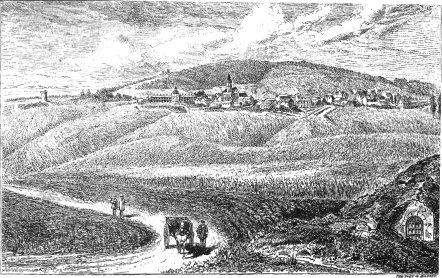
THE VINEYARDS AND ABBEY OF HAUTVILLERS. (p. 14)
Time and the iconoclasts of the great Revolution have spared but little of the royal abbey of St. Peter where Dom
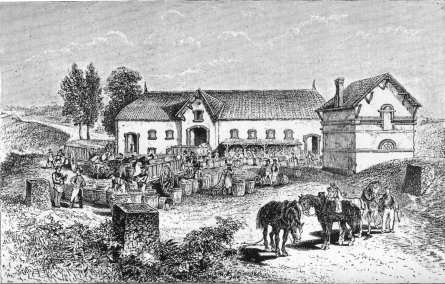
THE ESTABLISHMENT OF MESSRS. CHARLES FARRE & CO., AT HAUTVILLERS. (p. 15)
It was in the budding springtime when we made our pilgrimage to Hautvillers across the swollen waters of the Marne at Epernay. Our way lay for a time along a straight level poplar-bordered road, with verdant meadows on either hand, then diverged sharply to the left and we commenced ascending the vine-clad hills, on a narrow plateau of which the church and abbey remains are picturesquely perched. Vines climb the undulating slopes to the summit of the plateau, and wooded heights rise up beyond, affording shelter from the bleak winds sweeping over from the north. As we near the village of Hautvillers we notice on our left hand a couple of isolated buildings overlooking a small ravine with their bright tiled roofs flashing in the sunlight. These prove to be a branch establishment of Messrs. Charles Farre and Co., a well-known champagne firm having its head-quarters at Reims. The grassy space beyond, dotted over with low stone shafts giving light and ventilation to the cellars beneath, is alive with workmen unloading waggons densely packed with new champagne bottles, while under a neighbouring shed is a crowd of women actively engaged in washing the bottles as they are brought to them. The large apartment aboveground, known as the cellier, contains wine in cask already blended, and to bottle which preparations are now being made. On descending into the cellars, which, excavated in the chalk and of regular construction, comprise a series of long, lofty, and well-ventilated galleries, we find them stocked with bottles of fine wine reposing in huge compact piles ready for transport to the head establishment, where they
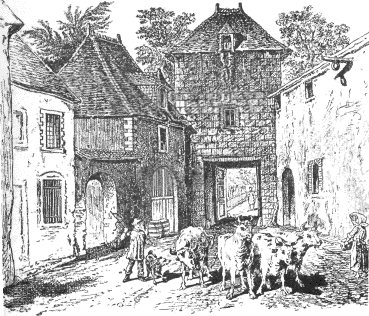
THE PORTE DES PRESSOIRS, HAUTVILLERS.
The church of Hautvillers and the remains of the neighbouring abbey are situated at the farther extremity of the village, at the end of its one long street, named, pertinently enough, the Rue de Bacchus. Passing through an unpretentious gateway we find ourselves in a spacious courtyard, bounded by buildings somewhat complex in character. On our right rises the tower of the church with the remains of the old cloisters, now walled-in and lighted by small square windows, and propped up by heavy buttresses. To the left stands the residence of the bailiff, and beyond it an 18th-century château on the site of the Moët and Chandon, the great champagne manufacturers of Epernay, who maintain them as a farm, keeping some six-and-thirty cows there with the object of securing the necessary manure for the numerous vineyards which they own hereabouts.
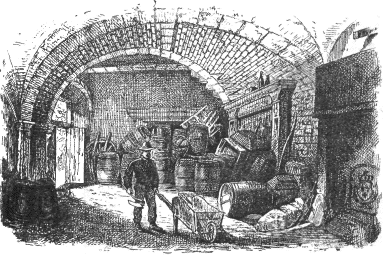
The dilapidated cloisters, littered with old casks, farm implements, and the like, preserve ample traces of their former architectural character, and the Louis Quatorze gateway on the northern side of the inclosure still displays above its arch a grandiose carved shield, with surrounding palm-branches and half-obliterated bearings. Vine-leaves and bunches of grapes
In those superstitious times such a significant omen was not to be disregarded, the site thus miraculously indicated was at once decided upon, the high altar of the abbey church being
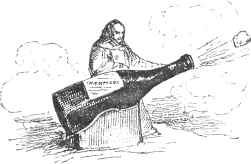
The celerer of St. Peter’s found worthy successors, and thenceforward the manufacture and the popularity of champagne went on steadily increasing, until to-day its production is carried on upon a scale and with an amount of painstaking care that would astonish its originator. For good champagne does not rain down from the clouds, or gush out from the rocks, but is the result of incessant labour, patient skill, minute precaution, and careful observation. In the first place, the soil imparts to the natural wine a special quality which it has been found impossible to imitate in any other quarter of the globe. To the wine of Ay it lends a flavour of peaches, and to that of Avenay the savour of strawberries; the vintage of Hautvillers, though fallen from its former high estate, is yet marked by an unmistakably nutty taste; while that of Pierry smacks of the locally-abounding flint, the well-known pierre à fusil flavour. So on the principle that a little leaven leavens the whole lump, the produce of grapes grown in the more favoured vineyards is added in certain proportions to secure certain special characteristics, as well as to maintain a fixed standard of excellence.
II.—The Vintage in the Champagne. The Vineyards of the River.
Ay, the Vineyard of Golden Plants—Summoning the Vintagers by Beat of Drum—Excitement in the Surrounding Villages—The Pickers at Work—Sorting the Grapes—Grapes Gathered at Sunrise the Best—Varieties of Vines in the Ay Vineyards—Few of the Growers in the Champagne Crush their own Grapes—Squeezing the Grapes in the “Pressoir” and Drawing off the Must—Cheerful Glasses Round—The Vintage at Mareuil—Bringing in the Grapes on Mules and Donkeys—The Vineyards of Avenay, Mutigny, and Cumières—Damery and Adrienne Lecouvreur, Maréchal de Saxe, and the obese Anna Iwanowna—The Vineyards of the Côte d’Epernay—Boursault and its Château—Pierry and its Vineyard Cellars—The Clos St. Pierre—Moussy and Vinay—A Hermit’s Cave and a Miraculous Fountain—Ablois St. Martin—The Côte d’Avize—The Grand Premier Crû of Cramant—Avize and its Wines—The Vineyards of Oger and Le Mesnil—The Old Town of Vertus and its Vine-clad Slopes—Their Red Wine formerly celebrated.
With the exception of certain famous vineyards of the Rhône, the vinelands of the Champagne may, perhaps, be classed among the most picturesque of the more notable vine districts of France. Between Paris and Epernay even, the banks of the Marne present
This is especially the case in the vicinity of Château-Thierry—the birthplace of La Fontaine—where the view is shut in on all sides by vine-clad slopes, which the spring frosts seldom spare. Hence merely one good vintage out of four gladdens the hearts of the peasant proprietors, who find eager purchasers for their produce among the lower-class manufacturers of champagne. In the same way the petit vin de Chierry, dexterously prepared and judiciously mingled with other growths, often figures as “Fleur de Sillery” or “Ay Mousseux.” In reality it is not until we have passed the ornate modern Gothic château of Boursault, erected in her declining years by the wealthy Veuve Clicquot, by far the shrewdest manipulator of the sparkling products of Ay and Bouzy of her day, and the many towers and turrets of which, rising above umbrageous trees, crown the loftiest height within eyeshot of Epernay, that we find ourselves within that charmed circle of vineyards whence champagne—the wine, not merely of princes, as it has been somewhat obsequiously termed, but essentially the vin de société—is derived.
The vinelands in the vicinity of Epernay, and consequently near the Marne, are commonly known as the “Vineyards of the River,” whilst those covering the slopes in the neighbourhood of Reims are termed the “Vineyards of the Mountain.” The Vineyards of the River comprise three distinct divisions—first, those lining the right bank of the Marne and enjoying a southern and south-eastern aspect, among which are Ay, Hautvillers, Cumières, Dizy, and Mareuil; secondly, the Côte d’Epernay on the left bank of the river, of which Pierry, Moussy, and Vinay form part; and thirdly, the Côte d’Avize (the region par excellence of white grapes), which stretches towards the south-east, and
The Champagne vineyards most widely celebrated abroad are those of Ay and Sillery, although the last-named are really the smallest in the Champagne district. Ay, distant only a few minutes by rail from Epernay, is in the immediate centre of the vinelands of the river, having Mareuil and Avenay on the east, and Dizy, Hautvillers, and Cumières on the west. Sillery, on the other hand, lies at the foot of the so-called Mountain of Reims, and within an hour’s drive of the old cathedral city.
The pleasantest season of the year to visit the Champagne is certainly during the vintage. When this is about to commence, the vintagers—some of whom come from Sainte Menehould, forty miles distant, while others hail from as far as Lorraine—are summoned at daybreak by beat of drum in the market-places of the villages adjacent to the vineyards, and then and there a price is made for the day’s labour. This is generally either a franc and a half, with food consisting of three meals, or two francs and a half without food, children being paid a franc and a half. The rate of wage satisfactorily arranged, the gangs start off to the vineyards, headed by their overseers.
It was on one of those occasional sunshiny days in the early part of October (1871) when I first visited Ay, the vineyard of golden plants, the unique premier crû of the Wines of the River. The road lay between two rows of closely-planted poplar-trees reaching almost to the village of Dizy, whose quaint grey church tower, with its gabled roof, is dominated by the neighbouring vine-clad slopes, which extend from Avenay to Venteuil, some few miles beyond Hautvillers, the cradle, so to speak, of the vin mousseux of the Champagne.
Everywhere was bustle and excitement; every one was big with the business in hand. In these ordinarily quiet little villages the majority of the inhabitants were afoot, the feeble feminine half with the juveniles threading their way through the rows of vines half-way up the mountain, basket on arm, while the sturdy masculine portion were mostly passing to and fro between pièces of the peerless wine of Ay, beside the reeking wine-press.
There was a pleasant air of jollity over all, for in the wine-producing districts every one participates in the interest excited by the vintage, which influences the takings of all the artificers and all the tradespeople, bringing grist to the mill of the baker and the bootmaker, as well as to the café and the cabaret. The various contending interests were singularly satisfied, the vintagers getting their two francs and a half a day, and the men at the pressoirs their three francs and their food. The plethoric commissionaires-en-vins wiped their perspiring foreheads with satisfaction at having at last secured the full number of hogsheads they had been instructed to buy—at a high figure it was true, still this was no disadvantage to them, as their commission mounted up all the higher. And, as regarded the small vine proprietors, even the thickest-skulled among them, who make all their calculations on their fingers, could see at a glance that they were gainers, for, although the crop was no more than half an average one, yet, thanks to the ill-disguised anxiety of the agents to secure all the wine they required, prices had gradually crept up until they doubled those of ordinary years, and this with only half the work in the vineyard and at the wine-press to be done.
On leaving Dizy the road runs immediately at the base of the vine-clad slopes, broken up by an occasional conical peak detaching itself from the mass, and tinted from base to summit with richly-variegated hues, in which deep purple, yellow, green, grey, and crimson by turns predominate. Dotting these slopes like a swarm of huge ants are a crowd of men, women, and children, intent on stripping the vines of their luscious-looking fruit. The men are mostly in blue blouses, and the women in closely-fitting neat white caps, or wearing old-fashioned
In many of the vineyards the grapes are inspected in bulk instead of in detail before being sent to the wine-press. The hand-baskets, when filled, are all brought to a particular spot, where their contents are minutely examined by some half-dozen men and women, who pluck off all the bruised, rotten, and unripe berries, and fling them aside into a separate basket. In one vineyard we came upon a party of girls, congregated round a wicker sieve perched on the top of a large tub by the roadside, who were busy sorting the grapes, pruning away the diseased stalks, and picking off all the doubtful berries, and letting the latter fall through the interstices of the sieve, the sound fruit being deposited in large baskets standing by their side, which, as soon as filled, were conveyed to the pressoir.
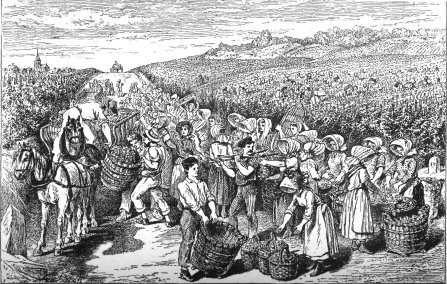
A VINTAGE SCENE IN THE CHAMPAGNE. (p. 24)
The picking ordinarily commences with daylight, and the vintagers assert that the grapes gathered at sunrise always produce the lightest and most limpid wine. Moreover by plucking the grapes when the early morning sun is upon them they are
On the right of the road leading from Dizy to Ay we pass a vineyard called Le Léon, which tradition asserts to be the one whence Pope Leo the Magnificent, the patron of Michael Angelo, Raffaelle, and Da Vinci, drew his supply of Ay wine. The village of Ay lies right before us at the foot of the vine-clad slopes, with the tapering spire of its ancient church rising above the neighbouring hills and cutting sharply against the bright blue sky. The vineyards, which spread themselves over a calcareous declivity, have mostly a full southern aspect, and the predominating vines are those known as golden plants, the fruit of which is of a deep purple colour. After these comes the plant vert doré, and then a moderate proportion of the plant gris, the latter a white variety, as its name implies. A limited quantity of wine from white grapes is likewise made in the neighbouring vineyards of Dizy.
We visited the pressoir of the principal producer of vin brut at Ay, who, although the owner of merely five hectares, or about twelve and a half acres of vines, expected to make as many as 1,500 pièces of wine that year, mainly of course from grapes purchased from other growers. One peculiarity of the Champagne district is that, contrary to the prevailing practice in the other wine-producing regions of France, where the owner of even a single acre of vines will crush his grapes himself, only a limited number of vine-proprietors press their own grapes. The 132lbs.) of grapes. The price which the fruit fetches varies of course according to the quality of the vintage and the requirements of the manufacturers. In 1873, in all the higher-class vineyards, as much as two francs and a quarter per kilogramme (10d. per lb.) were paid, or between treble and quadruple the average price. And yet the vintage was a most unsatisfactory one owing to the deficiency of sun and abundance of wet throughout the summer. The market, however, was in great need of wine, and the fruit while still ungathered was bought up at most exorbitant prices by the spéculateurs who supply the vin brut to the champagne manufacturers.
Carts laden with grapes were continually arriving at the pressoir, and after discharging their loads, and having them weighed, kept driving off for fresh ones. Four powerful presses of recent invention, each worked by a large fly-wheel requiring four sturdy men to turn it, were in operation. The grapes were spread over the floor of the press in a compact mass, and on being subjected to pressure—again and again repeated, the first squeeze only giving a high-class wine—the must filtered through a wicker basket into the reservoir beneath, whence, after remaining a certain time to allow of its ridding itself of the grosser lees, it is pumped through a gutta-percha tube into the casks. The wooden stoppers of the bungholes, instead of being fixed tightly in the apertures, are simply laid over them, and after the lapse of ten or twelve days fermentation usually commences, and during its progress the must, which is originally of a pale pink tint, fades to a light straw colour. The wine usually remains undisturbed until Christmas, when it is drawn off into fresh casks, and delivered to the purchaser.
On our way from Ay to Mareuil, along the lengthy Rue de
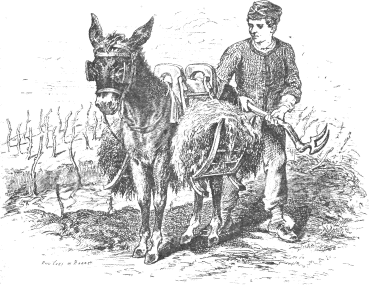
At Mareuil, which is scarcely more than a mile from Ay, owing to the steepness of the slopes and to the roads through the vineyards being impracticable for carts, the grapes were being conveyed to the press-houses in baskets slung across the backs of mules and donkeys, who, on account of their known partiality for the ripe fruit, were most of them muzzled while thus employed. The vin brut here, inferior of course to that of Ay, found a ready market at from five to six hundred francs the pièce.
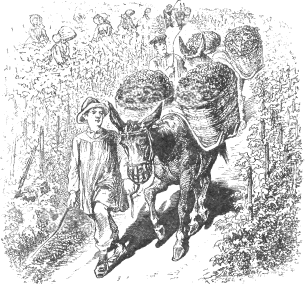
From Mareuil we proceeded to Avenay, a tumbledown little village in the direction of Reims, and the vineyards of which were of greater repute in the 13th century than they are to-day. Its best wine, extolled by Saint Evremond, the epicurean Frenchman, who emigrated to the gay court of Charles II. at Whitehall to escape a gloomy cell in the Bastille, is vintaged up the slopes of Mont Hurlé. At Avenay we found the yield had been little more than the third of an average one, and that the wine from the first pressure of the grapes had been sold for five hundred francs the pièce. Here we tasted some very fair still red wine, made from the same grapes as champagne, remarkably deep in colour, full of body, and with that slight sweet bitterish flavour characteristic of certain of the better-class growths of the south of France. On leaving Avenay we ascended the hills to Mutigny, and wound bon Roi Henri” sought relaxation from the turmoils of war in the society of the fair Anne du Puy—“sa belle hôtesse,” as the gallant Béarnais was wont to style her. Damery too claims to be the birthplace of Adrienne Lecouvreur, the celebrated actress of the Regency, and mistress of the Maréchal de Saxe who coaxed her out of her £30,000 of savings to enable him to prosecute his suit with the obese Anna Iwanowna, niece of Peter the Great, which, had he only been successful in, would have secured the future hero of Fontenoy the coveted dukedom of Courland.
The vineyards of the Côte d’Epernay, south of the Marne, extend eastward from beyond Boursault, on whose wooded height Madame Clicquot built her fine château, in which her granddaughter,
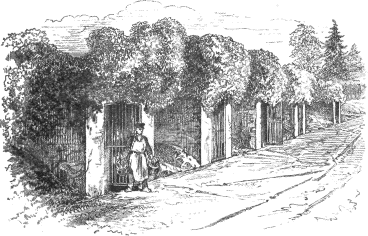
The entrances to these cellars are closed by iron gateways, and on the skirts of the vineyards we come upon whole rows of them picturesquely overgrown with ivy.
Crossing the Sourdon, a little stream which, bubbling up in the midst of huge rocks in the forest of Epernay, rushes down the hills and mingles its waters with that of the Cubry, we soon reach Moussy, where the vineyards, spite of their long pedigree and southern aspect, also rank as a second crû. Still skirting the vine-clad slopes we come to Vinay, noted for an ancient grotto—the comfortless abode of some rheumatic anchorite—and a pretended miraculous spring to which fever-stricken pilgrims to-day credulously resort. The water may possibly merit its renown, but the wine here produced is very inferior, due no doubt to the class of vines, the meunier being the leading variety cultivated. At Ablois St. Martin, picturesquely perched partway up a slope in the midst of hills covered with vines and crowned with forest trees, the Côte d’Epernay ends, and the produce becomes of a choicer character.
The Côte d’Avize lies to the south-east, so that we have to retrace our steps to Pierry and follow the road which there branches off, leaving the vineyards of Chavot, Monthelon, and Grauves, of no particular note, on our right hand. We pass through Cuis, where the slopes, planted with both black and white varieties of vines, are extremely abrupt, and eventually reach Cramant, one of the grand premiers crûs of the Champagne. From the vineyards around this picturesque little village, and extending along the somewhat precipitous Côte de Saran—a prominent object on which is M. Moët’s handsome château—there is vintaged a wine from white grapes especially remarkable for lightness and delicacy and the richness of its bouquet, and an admixture of which is essential to every first-class champagne cuvée.
From Cramant the road runs direct to Avize, a large thriving premier crû. It is the same with the wine of Oger, lying a little to the south, while the neighbouring growths of Le Mesnil hold a slightly inferior rank. The latter village and its grey Gothic church lie under the hill in the midst of vines that almost climb the forest-crowned summit. The stony soil hereabouts is said to be better adapted to the cultivation of white than of black grapes, besides which the wines of Le Mesnil are remarkable for their effervescent properties.
Vertus forms the southern limit of the Côte d’Avize, and the vineyard slopes subsiding at their base into a broad expanse of fertile fields, and crested as usual with dense forest, rise up behind the picturesque old town which the English assailed and partly burnt five centuries ago, spite of its fortifications, of which to-day a dilapidated gateway alone remains. The church is ancient and curious, and a few quaint old houses are here and there met with, notably one with a florid Gothic window enriched with a moulding of grapes and vine-leaves. The vineyards of Vertus were originally planted with vines from Burgundy, and in the 14th century yielded a red wine held in high repute, while later on the Vertus growths formed the favourite beverage of William III. of England. To-day the growers find it more profitable to make white instead of red wine from their crops of black grapes, the former commanding a good price for conversion into vin mousseux, it being in the opinion of some manufacturers especially valuable for binding a cuvée together. The wine of Vertus ranks among the second-class champagne crûs.
CHATEAU OF SILLERY.
III.—The Vineyards of the Mountain.
The Wine of Sillery—Origin of its Renown—The Marechale d’Estrées a successful Marchande de Vin—From Reims to Sillery—Failure of the Jacquesson Vineyards—Château of Sillery—Wine Making at M. Fortel’s—Sillery sec—The Vintage and Vendangeoirs at Verzenay—The Verzy Vineyards—Edward III. at the Abbey of St. Basle—From Reims to Bouzy—The Herring Procession at St. Remi—Rilly, Chigny, and Ludes—The Knights Templars’ “Pot” of Wine—Mailly and the View over the Plains of the Champagne—Wine Making at Mailly—The Village in the Wood—Village and Château of Louvois—Louis le Grand’s War Minister—Bouzy, its Vineyards and Church Steeple, and the Lottery of the Great Gold Ingot—MM. Werlé’s and Moët and Chandon’s Vendangeoirs—Pressing the Grapes—Still Red Bouzy—Ambonnay—A Peasant Proprietor—The Vineyards of Ville-Dommange and Sacy, Hermonville, and St. Thierry—The Still Red Wine of the latter.
The smallest of the Champagne vineyards are those of Sillery, and yet no wine of the Marne enjoys a greater renown, due originally to the intelligence and energy of the Maréchale d’Estrées, the clever daughter of a Jew financier, who brought the wine of Sillery prominently into notice during the latter half of the seventeenth century. She had vineyards at Mailly, Verzy, and Verzenay, as well as at Sillery, and concentrated their produce in the capacious cellars of her château, afterwards sending it forth with her own guarantee, under the general name of Sillery, which, like Aaron’s serpent, thus swallowed up the others. The Maréchale’s social position enabled her to secure for her wines the recognition they really merited, added to which she was a keen woman of business. She also possessed much taste, and whenever she gave one of her rare entertainments nothing could be more exquisite or more magnificent. At the same time, she was so sordid that when her daughter, who was covered with jewels, fell down at a ball, her first cry was, not like Shylock’s, “my daughter,” but “my diamonds,” as rushing forward she strove to pick up, not the fallen dancer, but her scattered gems.
The drive from Reims to Sillery has nothing attractive about it. A long, straight, level road bordered by trees intersects a broad tract of open country, skirted on the right by the Petite Montagne of Reims, with antiquated villages nestled among the dense woodland. After crossing the Châlons line of railway—near where one of the new forts constructed for the defence of Reims rises up behind the villages and vineyards of Cernay and Nogent l’Abbesse—the country becomes more undulating. Poplars border the broad Marne canal, and a low fringe of foliage marks the course of the languid river Vesle, on the banks of which is Taissy, famous in the old days for its wines, great favourites with Sully, and which almost lured Henri Quatre from his allegiance to the vintages of Ay and Arbois that he loved so well.
To the left rises Mont de la Pompelle, where the first Christians of Reims suffered martyrdom, and where in 1658 the Spaniards under Montal, when attempting to ravage the vineyards of the district, were repulsed with terrible slaughter by the Remois celery beds. To shield the vines from hailstorms prevalent in the district, and the more dangerous spring frosts, so fatal to vines planted in low-lying situations, long rolls of straw-matting were stored close at hand with which to roof them over when needful. These precautions were scarcely needed, however; the vines languished through moisture at the roots, and eventually were mostly rooted up.
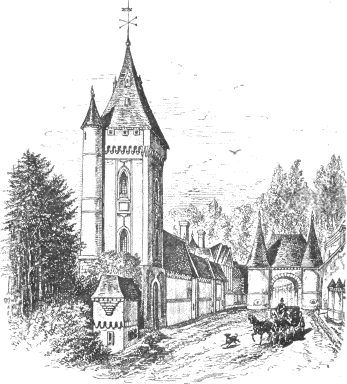
After again crossing the railway, we pass the trim, restored turrets of the famous château of Sillery, with its gateways, moats, and drawbridges, flanked by trees and floral parterres. It was here that the Maréchale d’Estrées carried on her successful business as a marchande de vins, and the pragmatic and pedantic Comtesse de Genlis, governess of the Orleans princes, spent, as she tells us, the happiest days of her life. The few thriving vineyards of Sillery cover a gentle eminence which rises out of the plain, and present on the one side an eastern and on the other a western aspect. To-day the Vicomte de Brimont and M. Fortel of Reims, the latter of whom cultivates about forty acres of vines, yielding ordinarily about 300 hogsheads, are the only wine-growers at Sillery. Before pressing his grapes—of course for sparkling wine—M. Fortel has them thrown into a trough, at the bottom of which are a couple of grooved cylinders, each about eight inches in diameter, and revolving in contrary directions, the effect of which, when set in motion, is to disengage the grapes partially from their stalks. Grapes and stalks are then placed under the press, which is on the old cyder-press principle, and the must runs into a reservoir beneath, whence it is pumped into large vats, each holding from 250 to 500 gallons. Here it remains from six to eight hours, and is then run off into casks, the spigots eau-de-vie, worth about five shillings a gallon, is distilled.
The wine known as Sillery sec is a full, dry, pleasant-flavoured, and somewhat spirituous amber-coloured wine. Very little of it is made now-a-days, and most that is comes from the adjacent vineyards of Verzenay and Mailly, and is principally reserved by the growers for their own consumption. One of these candidly admitted to me that the old reputation of the wine had exploded, and that better white Bordeaux and Burgundy wines were to be obtained for less money. In making dry Sillery, which locally is esteemed as a valuable tonic, it is essential that the grapes should be subjected to only slight pressure, while to have it in perfection it is equally essential that the wine should be kept for ten years in the wood according to some, and eight years in bottle according to others, to which circumstance its high price is in all probability to be attributed. In course of time it forms a deposit, and has the disadvantage common to all the finer still wines of the Champagne district of not travelling well.
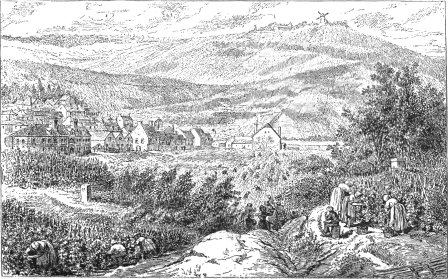
Beyond Sillery the vineyards of Verzenay unfold themselves, spreading over the extensive slopes and stretching to the summit of the steep height to the right, where a windmill or two is perched. Everywhere the vintagers are busy detaching the grapes with their little hook-shaped serpettes, the women all wearing projecting, close-fitting bonnets, as though needlessly careful of their anything but blonde complexions. Long carts laden with baskets of grapes block the narrow roads, and donkeys, duly muzzled, with baskets slung across their backs, toil up and down the steeper slopes. Half way up the principal hill, backed by a dense wood and furrowed with deep trenches, whence soil has been removed for manuring the vineyards, is the premier crû, and for three years in succession—1872, 3, and 4—its wines fetched a higher price than either those of Ay or Bouzy. In 1873 the vin brut commanded the exceptionally large sum of 1,030 francs the hogshead of 44 gallons. All the inhabitants of Verzenay are vine proprietors, and several million francs are annually received by them for the produce of their vineyards from the manufacturers of champagne. The wine of Verzenay, remarkable for its body and vinosity, has always been held in high repute, which is more than can be said for the probity of the inhabitants, for according to an old Champagne saying—“Whenever at Verzenay ‘Stop thief’ is cried every one takes to his heels.”
THE VINEYARDS OF VERZENAY. (p. 36.)
Just over the mountain of Reims is the village of Verzy, the vineyards of which adjoin those of Verzenay, and are almost exclusively planted with white grapes, the only instance of the kind to be met with in the district. In the clos St. Basse, however—taking its name from the abbey of St. Basle, of which the village was a dependency, and where Edward III. of England had his head-quarters during the siege of Reims—black grapes alone are grown, and its produce is almost on a par with the wines of Verzenay. Southwards of Verzy are the third-class crûs of Villers-Marmery and Trépail.
Soon after crossing the canal and the river Vesle we leave the grey antiquated-looking village of Cormontreuil on our left, and traverse a wide stretch of cultivated country streaked with patches of woodland. Occasional windmills dot the distant heights, while villages nestle among the trees up the mountain sides and in the quiet hollows. Soon a few vineyards occupying the lower slopes, and thronged by bands of vintagers, come in sight, and the country too gets more picturesque. We pass successively on our right hand Rilly, producing a capital red wine, then Chigny, and afterwards Ludes, all three more or less up the mountain, with vines in all directions, relieved by a dark background of forest trees. In the old days the Knights Templars of the Commanderie of Reims had the right of vinage at Ludes, and exacted their modest “pot” (about half a gallon) per pièce on all the wine the village produced. On our left hand is Mailly, the vineyards of which join those of Verzenay, and yield a wine noted for finesse and bouquet. From the wooded knolls hereabouts a view is gained of the broad plains of the Champagne, dotted with white villages and scattered homesteads among the poplars and the limes, the winding Vesle glittering in the sunlight, and the dark towers of Notre Dame de Reims, with all their rich Gothic fretwork, rising majestically above the distant city.
We now cross the mountain, sight Ville-en-Selve—the village in the wood—among the distant trees, and eventually reach Louvois, whence the Grand Monarque’s domineering war minister derived his marquisate, and where his château, a plain but capacious edifice, may still be seen nestled in a picturesque and fertile valley, and surrounded by lordly pleasure grounds. Soon afterwards the vineyards of Bouzy appear in sight, with the prosperous-looking little village rising out of the plain at the foot of the vine-clad slopes stretching to Ambonnay, and the glittering Marne streaking the hazy distance. The commodious new church was indebted for its spire, we were told, to the lucky gainer—who chanced to be a native of Bouzy—of the great gold ingot lottery prize, value £16,000, drawn some years ago. The Bouzy vineyards occupy a series of gentle inclines, and have the advantage of a full southern aspect. The soil, which is of the customary calcareous formation, has a marked ruddy tinge, indicative of the presence of iron, to which the wine is in some degree indebted for its distinguishing characteristics—its delicacy, spirituousness, and pleasant bouquet. Vintagers are passing slowly in between the vines, and carts laden with grapes come rolling over the dusty roads. The mountain which rises behind is scored up its sides and fringed with foliage at its
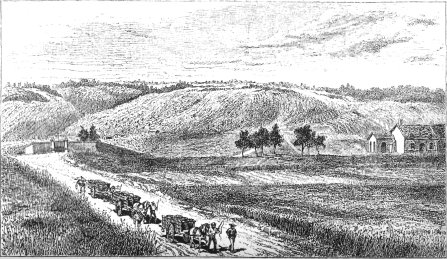
THE VINEYARDS OF BOUZY. (p. 38.)
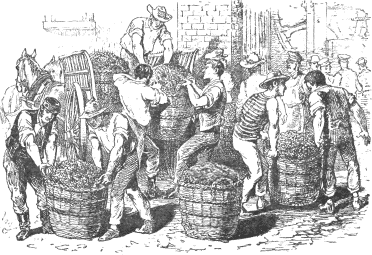
The principal vineyard proprietors at Bouzy, which ranks, of course, as a premier crû, are M. Werlé, M. Irroy, and Messrs. Moët and Chandon, the first and last of whom have capacious vendangeoirs here, M. Irroy’s pressing-house being in the neighbouring village of Ambonnay. M. Werlé possesses at Bouzy from forty to fifty acres of the finest vines, forming a considerable proportion of the entire vineyard area. At the Clicquot-Werlé vendangeoir, containing as many as eight presses, about 1,000 pièces of wine are made annually. At the time of our visit, grapes gathered that morning were in course of delivery, the big basketfuls being measured off in caques—wooden receptacles, holding two-and-twenty gallons—while the florid-faced foreman ticked them off with a piece of chalk on the head of an adjacent cask.
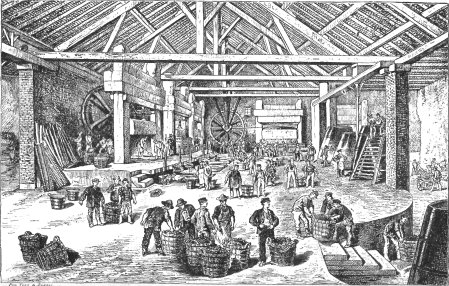
PRESSING GRAPES AT M. WERLÉ’S VENDANGEOIR AT BOUZY. (p. 39)
As soon as the contents of some half-hundred or so of these baskets had been emptied on to the floor of the press, the grapes undetached from their stalks were smoothed compactly down, and a moderate pressure was applied to them by turning a huge wheel, which caused the screw of the press to act—a gradual squeeze rather than a powerful one, and given all at once, coaxing out, it was said, the finer qualities of the fruit. The operation was repeated as many as six times; the yield from the three first pressures being reserved for conversion into champagne, while the result of the fourth squeeze would be applied to replenishing the loss, averaging 7½ per cent., sustained by the must during fermentation. Whatever comes from the fifth pressure is sold to make an inferior champagne. The grapes are subsequently well raked about, and then subjected to a couple of final squeezes, known as the rébêche, and yielding a sort of piquette, given to the workmen employed at the pressoir to drink.
The small quantity of still red Bouzy wine made by M. Werlé at the same vendangeoir only claims to be regarded as a wine of especial mark in good years. The grapes before being placed beneath the press are allowed to remain in a vat for as many as
Still red Bouzy has a marked and agreeable bouquet and a most delicate flavour, is deliciously smooth to the palate, and to all appearances as light as a wine of Bordeaux, while in reality it is quite as strong as Burgundy, to the finer crûs of which it bears a slight resemblance. It was, I learnt, most susceptible to travelling, a mere journey to Paris being, it was said, sufficient to sicken it, and impart such a shock to its delicate constitution that it was unlikely to recover from it. To attain perfection, this wine, which is what the French term a vin vif, penetrating into the remotest corners of the organ of taste, requires to be kept a couple of years in wood and half-a-dozen or more years in bottle.
From Bouzy it was only a short distance along the base of the vine slopes to Ambonnay, where there are merely two or three hundred acres of vines, and where we found the vintage almost over. The village is girt with fir trees, and surrounded by rising ground fringed with solid belts or slender strips of foliage. An occasional windmill cuts against the horizon, which is bounded here and there by scattered trees. Inquiring for the largest vine proprietor we were directed to an open porte-cochère, and on entering the large court encountered half-a-dozen labouring men engaged in various farm occupations. Addressing one whom we took to be the foreman, he referred us to a wiry little old man, in shirt-sleeves and sabots, absorbed in the refreshing pursuit of turning over a big heap of rich manure with a fork. He proved to be M. Oury, the owner of I forget how many acres of vines, and a remarkably intelligent peasant, considering what dunderheads the French peasants as a rule are, who had raised himself to the position of a large vine proprietor. Doffing his sabots and donning a clean blouse, he conducted us into his little salon, a freshly-painted apartment about eight
At Ambonnay, as at Bouzy, they had that year, M. Oury said, only half an average crop; the caque of grapes had, moreover, sold for exactly the same price at both places, and the wine had realised about 800 francs the pièce. Each hectare (2½ acres) of vines had yielded 45 caques of grapes, weighing some 2¾ tons, which produced 6½ pièces, equal to 286 gallons of wine, or at the rate of 110 gallons per acre. Here the grapes were pressed four times, the yield from the second pressure being used principally to make good the loss which the first sustained during its fermentation. As the squeezes given were powerful ones, all the best qualities of the grapes were by this time extracted, and the yield from the third and fourth pressures would not command more than 80 francs the pièce. The vintagers who came from a distance received either a franc and a half per day and their food, consisting of three meals, or two francs and a half without food, the children being paid thirty sous. M. Oury further informed us that every year vineyards came into the market, and found ready purchasers at from fifteen to twenty thousand francs the hectare, equal to an average price of £300 the acre. Owing to the properties being divided into such infinitesimal portions, they were rarely bought up by the large champagne houses, who preferred not to be embarrassed with the cultivation of such tiny plots, but to buy the produce from their owners.
There are other vineyards of lesser note in the neighbourhood of Reims producing very fair wines which enter more or less into the composition of champagne. Noticeable among these are Ville-Dommange and Sacy, south-west of Reims, and Hermonville and St. Thierry—where the Black Prince took up his quarters during the siege of Reims—north-west of the city. The still red wine of St. Thierry, which recalls the growths of the Médoc by its tannin, and those of the Côte d’Or by its vinosity, is to-day almost a thing of the past, it being found here as elsewhere more profitable to press the grapes for sparkling in preference to still wine.
IV.—The Vines of the Champagne and the System of Cultivation.
The Vines chiefly of the Pineau Variety—The Plant doré of Ay, the Plant vert doré, the Plant gris, and the Epinette—The Soil of the Vineyards—Close Mode of Plantation—The Operation of Provinage—The Stems of the Vines never more than Three Years Old—Fixing the Stakes to the Vines—Manuring and General Cultivation—Spring Frosts in the Champagne—Various Modes of Protecting the Vines against them—Dr. Guyot’s System—The Parasites that Prey upon the Vines.
In the Champagne the old rule holds good—poor soil, rich product; grand wine in moderate quantity. Four descriptions of vines are chiefly cultivated, three of them yielding black grapes, and all belonging to the Pineau variety, from which the grand Burgundy wines are produced, and so styled from the clusters taking the conical form of the pine. The first is the franc pineau, the plant doré of Ay, producing small round grapes, with thickish skins of a bluish black tint, and sweet and refined in flavour. The next is the plant vert doré, more robust and more productive than
There are several other species of vines cultivated in the Champagne vineyards, notably the common meunier, or miller, bearing black grapes, and prevalent in the valley of Epernay, and which takes its name from the circumstance of the young leaves appearing to have been sprinkled with flour. There are also the black and white gouais, the meslier, a prolific white variety yielding a wine of fair quality, the black and white gamais, the leading grape in the Mâconnais, and chiefly found in the Vertus vineyards, together with the tourlon, the marmot, and half a score of others.
The soil of the Champagne vineyards is chalk, with a mixture of silica and light clay, combined with a varying proportion of oxide of iron. The vines are almost invariably planted on rising ground, the lower slopes which usually escape the spring frosts producing the best wines. The new vines are placed very close together, there often being as many as six within a square yard. When two or three years old they are ready for the operation of provinage universally practised in the Champagne, and which consists in burying in a trench, from 6 to 8 inches deep, dug on one side of the plant, the two lowest buds of the two principal shoots, left when the vine was pruned for this especial purpose. The shoots thus laid underground are dressed with a light
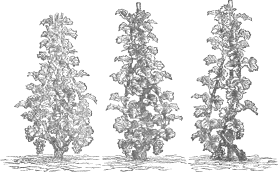
The vines are supported by stakes, when of oak costing sixty francs the thousand; and as in the Champagne a close system of plantation is followed, no less than 24,000 stakes are required on every acre of land, making the cost per acre of propping up the vines upwards of £57, or double what it is in the Médoc and quadruple what it is in Burgundy. These stakes are set up in the spring of the year by men or women, the former of whom force them into the ground by pressing against them with their chest, which is protected with a shield of stout leather. The women use a mallet, or have recourse to a special appliance, in working which the foot plays the principal part. The latter method is the least fatiguing, and in some localities
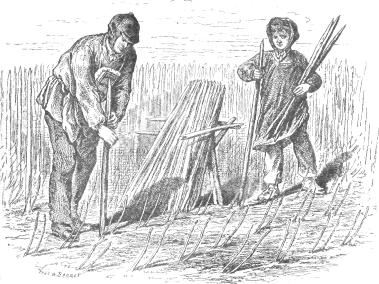
The vignerons of the Champagne regard the numerous stakes which support the vines as affording some protection against the white frosts of the spring. To guard against the dreaded effects of these frosts, which invariably occur between early dawn and sunrise, and the loss arising from which is estimated to amount annually to 25 per cent. some of the cultivators place heaps of hay, faggots, dead leaves, &c., about twenty yards apart, taking care to keep them moderately damp. When a frost is feared the heaps on the side of the vineyard whence the wind blows are set light to, whereupon the dense smoke which rises spreads horizontally over the vines, producing the same result as an actual cloud, intercepting the rays of the sun, warming the atmosphere, and converting the frost into dew. Among other methods adopted to shield the vines from frosts is the joining of branches of broom together in the form of a fan, and afterwards fastening them to the end of a pole, which is placed obliquely in the ground, so that the fan may incline over the vine and protect it from the sun’s rays. A single labourer can plant, it is said, as many as eight thousand of these fans in the ground in the course of a long day.
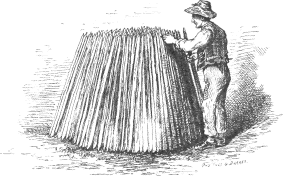
Dr. Guyot’s system of roofing the vines with straw matting, to protect them alike against frost and hailstorms, is very generally followed in low situations in the Champagne, the value of the wine admitting of so considerable an expense being incurred. This matting, which is about a foot and a half in width, and in rolls of great length, is fastened either with twine or wire to the vine stakes, and it is estimated that half-a-dozen
Owing to the system of cultivation by rejuvenescence, and the constant replenishing of the soil by well-compounded manures, the Champenois winegrowers entertain great hopes that their vineyards will escape the ravages of the phylloxera vastatrix. According to Dr. Plonquet of Ay they are already the prey of no less than fifteen varieties of insects, which feed upon the leaves, stalks, roots, or fruit of the vines. Between 1850 and 1860 the vineyards of Ay were devastated by the pyrale, a species of caterpillar, which feeds on the young leaves and shoots until the vine is left completely bare. The insect eventually becomes transformed into a small white butterfly, and deposits its eggs either in the crevices of the stakes or in the stalks of the vine. All the efforts made to rid the vineyards of this scourge proved ineffectual until the wet and cold weather of 1860 put a stop to the insect’s ravages. More recently it has been discovered that its attacks can be checked by sulphurous acid.
V.—Preparation of Champagne.
Treatment of Champagne after it comes from the Wine-Press—Racking and Blending of the Wine—Deficiency and Excess of Effervescence—Strength and Form of Champagne Bottles—The “Tirage” or Bottling of the Wine—The Process of Gas-making commences—Inevitable Breakage follows—Wine Stacked in Piles—Formation of Sediment—Bottles placed “sur pointe” and Daily Shaken—Effect of this occupation on those incessantly engaged in it—“Claws” and “Masks”—Champagne Cellars—Their Construction and Aspect—Transforming the “vin brut” into Champagne—Disgorging and Liqueuring the Wine—The Corking, Stringing, Wiring, and Amalgamating—The Wine’s Agitated Existence comes to an End—The Bottles have their Toilettes made—Champagne sets out on its beneficial Pilgrimage.
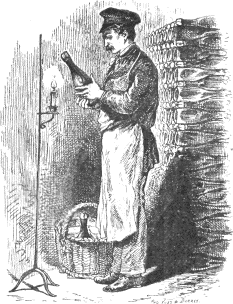
The special characteristic of champagne is that its manufacture only just commences where that of other wines ordinarily ends. The must flows direct from the press into capacious reservoirs, whence it is drawn off into large vats, and after being allowed to clear, is transferred to casks holding some forty-fourA gallons each. Although the bulk of the new-made mou—that is, rich in sugar—or the reverse. In the former case fermentation naturally lasts much longer than when the wine is vert or green. This active fermentation is converted into latent fermentation by transferring the wine to a cooler cellar, as it is essential it should retain a large proportion of its natural saccharine to ensure its future effervescence. The casks have previously been completely filled, and their bungholes tightly stopped, a necessary precaution to guard the wine from absorbing oxygen, the effect of which would be to turn it yellow and cause it to lose some of its lightness and perfume. After being racked and fined, the produce of the different vineyards is now ready for mixing together in accordance with the traditional theories of the various manufacturers, and should the vintage have been an indifferent one a certain proportion of old reserved wine of a good year enters into the blend.
The mixing is usually effected in gigantic vats holding at times as many as 12,000 gallons each, and having fan-shaped appliances inside, which, on being worked by handles, ensure a complete amalgamation of the wine. This process of marrying wine on a gigantic scale is technically known as making the cuvée. Usually four-fifths of wine from black grapes are tempered by one-fifth of the juice of white ones. It is necessary that the cuvée. The aim is to combine and develop the special qualities of the respective crûs, body and vinosity being secured by the red vintages of Bouzy and Verzenay, softness and roundness by those of Ay and Dizy, and lightness, delicacy, and effervescence by the white growths of Avize and Cramant. The proportions are never absolute, but vary according to the manufacturer’s style of wine and the taste of the countries which form his principal markets. The wine at this period being imperfectly fermented and crude, the reader may imagine the delicacy and discrimination of palate requisite to judge of the flavour, finesse, and bouquet which the cuvée is likely eventually to develop.
These, however, are not the only matters to be considered. There is, above everything, the effervescence, which depends upon the quantity of carbonic acid gas the wine contains, and this, in turn, upon the amount of its natural saccharine. If the gas be present in excess, there will be a shattering of bottles and a flooding of cellars; and if there be a paucity the corks will refuse to pop, and the wine to sparkle aright in the glass. Therefore the amount of saccharine in the cuvée has to be accurately ascertained by means of a glucometer; and if it fails to reach the required standard, the deficiency is made up by the addition of the purest sugar-candy. If, on the other hand, there be an excess of saccharine, the only thing to be done is to defer the final blending and bottling until the superfluous saccharine matter has been absorbed by fermentation in the cask.
The cuvée completed, the blended wine, now resembling in taste and colour an ordinary acrid white wine, and giving to the uninitiated palate no promise of the exquisite delicacy and aroma it is destined to develop, is drawn off again into casks for further treatment. This comprises fining with some gelatinous substance, and, as a precaution against ropiness and other maladies, liquid tannin is at the same time frequently added to supply
The operation of bottling the wine next ensues, when the Scriptural advice not to put new wine into old bottles is rigorously followed. For the tremendous pressure of the gas engendered during the subsequent fermentation of the wine is such that the bottle becomes weakened and can never be safely trusted again. It is because of this pressure that the champagne bottle is one of the strongest made, as indicated by its weight, which is almost a couple of pounds. To ensure this unusual strength it is necessary that its sides should be of equal thickness and the bottom of a uniform solidity throughout, in order that no particular expansion may ensue from sudden changes of temperature. The neck must, moreover, be perfectly round and widen gradually towards the shoulder. In addition—and this is of the utmost consequence—the inside ought to be perfectly smooth, as a rough interior causes the gas to make efforts to escape, and thus renders an explosion imminent. The composition of the glass, too, is not without its importance, as a manufactory established for the production of glass by a new process turned out champagne bottles charged with alkaline sulphurets, and the consequence was that an entire cuvée was ruined by their use, through the reciprocal action of the wine and these sulphurets. The acids of the former disengaged hydrosulphuric acid, and instead of champagne the result was a new species of mineral water.
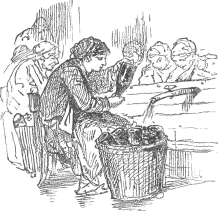
Most of the bottles used for champagnes come from the factories of Loivre (which supplies the largest quantity), Folembray, Vauxrot, and Quiquengrogne, and cost on the average from 28 to 30 francs the hundred. They are generally tested by a practised hand, who, by knocking them sharply together, professes to be able to tell from the sound that they give the substance of the glass and its temper. The washing of the bottles is invariably performed by women, who at the larger establishments accomplish it with the aid of machines, sometimes provided with a revolving brush, although small glass beads
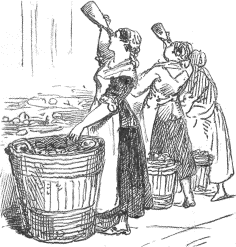
With the different champagne houses the mode of bottling the wine, which may take place any time between April and August, varies in some measure, still the tirage, as this operation is called, is ordinarily effected as follows:—The wine is emptied from the casks into vats or tuns of varying capacity, whence it flows through pipes into oblong reservoirs, each provided with a row of syphon taps, on to which the bottles are slipped, and from which the wine ceases to flow directly the bottles become filled. Men or lads remove the full bottles, replacing them by empty ones, while other hands convey them to the corkers, whose guillotine machines are incessantly in motion; next the agrafeurs secure the corks by means of an iron staple, termed an agrafe; and then the bottles are conveyed either to a capacious apartment aboveground, known as a cellier, or to a cool cellar, according
The bottles are placed in a horizontal position and stacked in rows of varying length and depth, one above the other, to about the height of a man, and with narrow laths between them. Thus they will spend the summer providing all goes well, but in about three weeks’ time the process of gas-making inside the bottles is at its height, and may cause an undue number of them to burst. The glucometer notwithstanding, it is impossible to check a certain amount of breakage, especially when a hot season has caused the grapes, and consequently the raw wine, to be sweeter than usual. Moreover when once casse or breakage sets in on a large scale, the temperature of the cellar is raised by the volume of carbonic acid gas let loose, which is not without its effect on the remaining bottles. The only remedy is at once
It is evident that in spite of the teachings of science the bursting of champagne bottles has not yet been reduced to a minimum, for whereas in some cellars it averages 7 and 8 per cent., in others it rarely exceeds 2½ or 3. In the month of October, the first and severest breakage being over, the newly-bottled wine is definitively stacked in the cellars in piles from two to half-a-dozen bottles deep, from six to seven feet high, and frequently a hundred feet or upwards in length. Usually the bottles remain in their horizontal position for about eighteen or twenty months, though some firms, who pride themselves upon shipping perfectly matured wines, leave them thus for double this space of time. All this while the temperature to which the wine is exposed is, as far as practicable, carefully regulated; for the risk of breakage, though greatly diminished, is never entirely at an end.
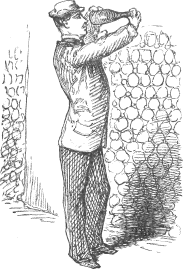
By this time the fermentation is over, but in the interval, commencing from a few days after the bottling of the wine, a loose dark-brown sediment has been forming which has now settled on the lower sur pointe, as it is termed—that is to say, slantingly in racks with their necks downwards, the inclination being increased from time to time to one more abrupt. The object of this change in their position is to cause the sediment to leave the side of the bottle where it has gathered; it afterwards becomes necessary to twist and turn it, and coagulate it, as it were, until it forms a kind of muddy ball, and eventually to get it well down into the neck of the bottle, so that it may be finally expelled with a bang when the temporary cork is removed and the proper one adjusted. To accomplish this the bottles are sharply turned in one direction every day for at least a month or six weeks, the time being indefinitely extended until the sediment shows a disposition to settle near the cork. The younger the wine the longer the period necessary for the bottles to be shaken, new wine often requiring as much as three months. Only a thoroughly practised hand can give the right amount of revolution and the requisite degree of slope; and in some of the cellars that we visited men were pointed out to us who had acquired such dexterity as to be able at a pinch to shake with their two hands as many as 50,000 bottles in a single day.
Some of these men have spent thirty or forty years of their lives engaged in this perpetual task. Fancy being entombed all alone day after day in vaults which are invariably dark and gloomy, and often cold and dank, and being obliged to twist sixty to seventy of these bottles every minute throughout the day of twelve hours. Why the treadmill and the crank with their periodical respites must be pastime compared to this maddeningly monotonous occupation, which combines hard labour, with the wrist at any rate, with next to solitary confinement. One can understand these men becoming gloomy and taciturn, and affirming that they sometimes see devils hovering over the bottle-racks and frantically shaking the bottles beside them, or else grinning at them as they pursue their humdrum task. Still it may be taken for granted that the men who reach
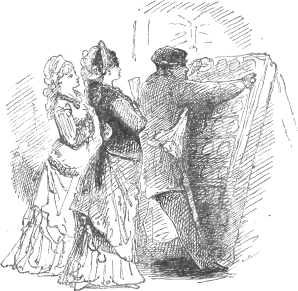
In former times the bottles used to be placed with their heads downwards on tables pierced with holes, from which they had to be removed and agitated. In 1818, however, a man named Muller, in the employment of Madame Clicquot, suggested that the bottles should remain in the tables whilst being shaken, and further that the holes should be cut obliquely so that the bottles might recline at varying angles. His suggestions were privately adopted by Madame Clicquot, but eventually the improved plan got wind, and the system now prevails throughout the Champagne. When the bottles have gone through their regular course of shaking they are examined before a lighted candle to ascertain whether the deposit has fallen and the wine become perfectly clear. Sometimes it happens that, twist these men never so wisely, the deposit refuses to stir, and takes the shape of a bunch of thread technically called a “claw,” or an adherent mass styled a “mask.” When this is the case an
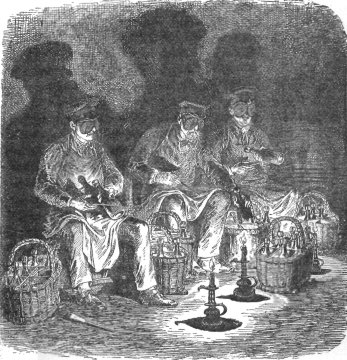
The cellars of the champagne manufacturers are very varied in character. The wine that has been grown on the chalky hills undergoes development in vaults burrowed out of the calcareous strata underlying the entire district. In excavating these cellars the sides and roofs are frequently worked smooth and regular as finished masonry. The larger ones are composed of a number of spacious and lofty galleries, sometimes parallel with vin brut in seemingly endless sequence—squares, so to speak, of raw champagne recruits awaiting their turn to be thoroughly drilled and disciplined. These are varied by bottles reposing necks downwards in racks at different degrees of inclination according to the progress their education has attained. Reports caused by exploding bottles now and then assail the ear, and as the echo dies away it becomes mingled with the rush of the escaping wine, cascading down the pile and finding its way across the sloping sides of the floor to the narrow gutter in the centre. The dampness of the floor and the shattered fragments of glass strewn about show the frequency of this kind of accident. The spilt wine, which flows along the gutter into reservoirs, is usually thrown away, though there is a story current to the effect that the head of one Epernay firm cooks nearly everything consumed in his house in the fluid thus let loose in his cellars.
In these subterranean galleries we frequently come upon parties of workmen engaged in transforming the perfected vin brut into champagne. Viewed at a distance while occupied in their monotonous task, they present in the semi-obscurity a series of picturesque Rembrandt-like studies. One of the end dégorgement, which is performed when the deposit, of which we have already spoken, has satisfactorily settled in the neck of the bottle. Baskets full of bottles with their necks downwards are placed beside the operator, who stands before an apparatus resembling a cask divided vertically down the middle. This nimble-figured manipulator seizes a bottle, holds it for a moment before the light to test the clearness of the wine and the subsidence of the deposit; brings it, still neck downwards, over a small tub at the bottom of the apparatus already mentioned; and with a jerk of the steel hook which he holds in his right hand loosens the agrafe securing the cork, Bang goes the latter, and with it flies out the sediment and a small glassful or so of wine, further flow being checked by the workman’s finger, which also serves to remove any sediment yet remaining in the bottle’s neck. Like many other clever tricks, this looks very easy when adroitly performed, though a novice would probably empty the bottle by the time he had discovered that the cork was out. Occasionally a bottle bursts in the dégorgeur’s hand, and his face is sometimes scarred from such explosions. The sediment removed, he slips a temporary cork into the bottle, and the wine is ready for the important operation of the dosage, upon the nature and amount of which the character of the perfected wine, whether it be dry or sweet, light or strong, very much depends.
Different manufacturers have different recipes, more or less complex in character, and varying with the quality of the wine and the country for which it is intended; but the genuine liqueur consists of nothing but old wine of the best quality, to which a certain amount of sugar-candy and perhaps a dash of the finest cognac spirit has been added. The saccharine addition varies according to the market for which the wine is destined: thus the high-class English buyer demands a dry champagne, the Russian a wine sweet and strong as “ladies’ grog,” and the Frenchman and German a sweet light wine. To the extra-dry champagnes a modicum dose is added, while the so-called “brut” wines receive no more than from one to three per cent. of liqueur.
dosage accomplished, the bottle passes to another workman known as the égaliseur, who fills it up with pure wine. Should a pink champagne be required, the wine thus added will be red, although manufacturers of questionable reputation sometimes employ the solution known as teinte de Fismes. The égaliseur in turn hands the bottle to the corker, who places it under a machine furnished with a pair of claws, which compress the cork to a size sufficiently small to allow it to enter the neck of the bottle, and a suspended weight, which in falling drives it home. These corks, which are principally obtained from Catalonia and Andalucia, cost more than twopence each, and are delivered in huge sacks resembling hop-pockets. Before they are used they have been either boiled in wine, soaked in a solution of tartar, or else steamed by the cork merchants, both to prevent their imparting a bad flavour to the wine and to hinder any leakage. They are commonly handed warm to the corker, who dips them into a small vessel of wine before making use of them. Some firms, however, prepare their corks by subjecting them to cold water douches a day or two beforehand. The ficeleur receives the bottle from the corker, and with a twist of the fingers secures the cork with string, at the same time rounding its hitherto flat top. The metteur de fil next affixes the wire with like celerity; and then the final operation is performed by a workman seizing a couple of bottles by the neck and whirling them round his head, as though engaged in the Indian-club exercise, in order to secure a perfect amalgamation of the wine and the liqueur.
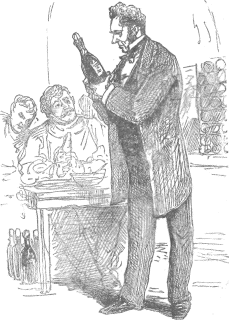
The final manipulation accomplished, the agitated course of existence through which the wine has been passing of late comes to an end, and the bottles are conveyed to another part of the establishment, where they repose for several days, or even weeks, in order that the mutual action of the wine and the liqueur upon each other may be complete. When the time arrives for despatching
Thus completed champagne sets out on its beneficial pilgrimage to promote the spread of mirth and lightheartedness, to drive away dull care and foment good-fellowship, to comfort the sick and cheer the sound. Wherever civilisation penetrates, champagne sooner or later is sure to follow; and if Queen Victoria’s morning drum beats round the world, its beat is certain to be echoed before the day is over by the popping of champagne-corks. Now-a-days the exhilarating wine graces not merely princely but middle-class dinner-tables, and is the needful adjunct at every petit souper in all the gayer capitals of the world. It gives a flush to beauty at garden-parties and picnics, sustains the energies of the votaries of Terpsichore until the hour of dawn, and imparts to many a young gallant the necessary courage to declare his passion. It enlivens the dullest of réunions, brings smiles to the lips of the sternest cynics, softens the most irascible tempers, and loosens the most taciturn tongues. At the diamond-fields of South Africa and the diggings of Australia the brawny miner who has hit upon a big bit of crystallised carbon, or a nugget of virgin ore, strolls to the “saloon” and shouts for champagne. The mild Hindoo imbibes it quietly, but approvingly, as he watches the evolutions of the Nautch girls, and his partiality for it has already enriched the Anglo-Bengalee vocabulary and London slang with the word “simkin.” It is transported on camel-backs across the deserts of Central Asia, and in frail canoes up the mighty Amazon. The two-sworded Daimio calls for it in the tea-gardens of Yokohama, and the New Yorker, when not rinsing his stomach by libations of iced-water, imbibes it freely at Delmonico’s. Wherever civilised man has set his foot—at the base of the Pyramids and at the summit of the Cordilleras, in the mangrove swamps of Ashantee and the gulches of the Great Lone Land, in the wilds of the Amoor and on the desert isles of the Pacific—he has left traces of his presence in the shape of the empty bottles that were once full of the sparkling vintage of the Champagne.
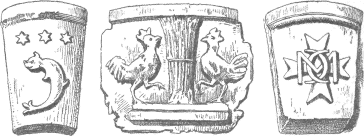
DEVICES FROM THE COMMANDERIE AT REIMS.
VI.—The Reims Champagne Establishments.
Messrs. Werlé and Co., successors to the Veuve Clicquot-Ponsardin—Their Offices and Cellars on the site of a Former Commanderie of the Templars—Origin of the Celebrity of Madame Clicquot’s Wines—M. Werlé and his Son—The Forty-five Cellars of the Clicquot-Werlé Establishment—Our Tour of Inspection—Ingenious Liqueuring Machine—An Explosion and its Consequences—M. Werlé’s Gallery of Paintings—Madame Clicquot’s Renaissance House and its Picturesque Bas-reliefs—The Werlé Vineyards and Vendangeoirs—M. Louis Roederer’s Establishment—Heidsieck and Co. and their Famous “Monopole” Brand—The Firm Founded in the Last Century—Their various Establishments Inside and Outside Reims—The Matured Wines Shipped by them.
The cellars of the great champagne manufacturers of Reims are scattered in all directions over the historical old city. They undermine its narrowest and most insignificant streets, its broad and handsome boulevards, and on the eastern side extend to its more distant outskirts. Messrs. Werlé and Co., the successors of the famous Veuve Clicquot-Ponsardin, have their offices and cellars on the site of a former Commanderie of the Templars in an ancient quarter of the city, and strangers passing by the spot would scarcely imagine that under their feet hundreds of busy hands are incessantly at work, disgorging, dosing, shaking, corking, storing, wiring, labelling, capsuling, waxing, tinfoiling,
The house of Clicquot, established in the year 1798 by the husband of La Veuve Clicquot-Ponsardin, who died in 1866, in her 89th year, was indebted for much of the celebrity of its wine to the lucky accident of the Russians occupying Reims in 1814 and 1815, and freely requisitioning the sweet champagne stored in the widow’s capacious cellars. Madame Clicquot’s wines were slightly known in Russia prior to this date, but the officers of the invading army, on their return home, proclaimed their merits throughout the length and breadth of the Muscovite Empire, and the fortune of the house was made. Madame Clicquot, as every one knows, amassed enormous wealth, and succeeded in marrying both her daughter and granddaughter to counts of the ancien régime.
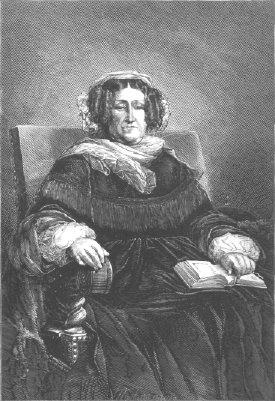
MADAME VEUVE CLICQUOT AT EIGHTY YEARS OF AGE. (From the Painting by Léon Coignet.) (p. 64)
The present head of the firm is M. Werlé, who comes of an old Lorraine family although born in the ancient free imperial town of Wetzlar on the Lahn, where Goethe lays the scene of his “Sorrows of Werther,” the leading incidents of which really occurred here. M. Werlé entered the establishment, which he has done so much to raise to its existing position, so far back as the year 1821. His care and skill, exercised over more than half a century, have largely contributed to obtain for the Clicquot brand that high repute which it enjoys to-day all over the world. M. Werlé, who has long been naturalised in France, was for many years Mayor of Reims and President of its Chamber of Commerce, as well as one of the deputies of the Marne to the Corps Législatif. He enjoys the reputation of being the richest man in Reims, and, like his late partner, Madame Clicquot, he has also succeeded in securing brilliant alliances for his children, his son, M. Alfred Werlé, having married the daughter of the Duc de Montebello, while his daughter espoused the son of M. Magne, Minister of Finance under the Second Empire.
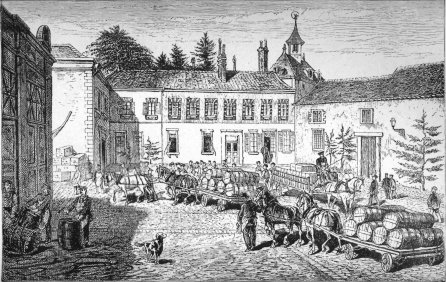
THE CLICQUOT-WERLÉ ESTABLISHMENT AT REIMS. (p. 65)
Half-way down the narrow tortuous Rue du Temple is an ancient gateway, on which may be traced the half-effaced sculptured heads of Phœbus and Bacchus. Immediately in front is a porte-cochère forming the entrance to the Clicquot-Werlé establishment, and conducting to a spacious trim-kept courtyard, set off with a few trees, with some extensive stabling and cart-sheds on the left, and on the right hand the entrance to the cellars. Facing us is an unpretending-looking edifice, where the vin préparé is dosed. At intervals we come upon some square opening in the floor through which bottles of wine are being hauled up from the cellars beneath in readiness to receive their requisite adornment before being packed in baskets or cases according to the country to which they are destined to be despatched. To Russia the Clicquot champagne is sent in cases containing sixty bottles, while the cases for China contain as many as double that number.