FACTS ABOUT CHAMPAGNE (continued 4)
Reading edition
The Urbana Wine Company, also established at Hammondsport at the same epoch as its rival, deals, like the latter, in still wines as well. It has three brands—the Gold Seal, of which
In California the manufacture of sparkling wines is carried on with considerable success, and at the Vienna Exhibition the Buena Vista Vinicultural Society of San Francisco was awarded a medal for progress for the excellent samples it sent there. The society was originally organised by Colonel Haraszthy, the pioneer in recent times of Californian viticulture. It commenced manufacturing sparkling wines with the assistance of experienced workmen from Epernay and Ay; but the endeavours, extending over some three or four years, were attended with but indifferent success, very few cuvées proving of fair quality, whilst with the majority the wine had to be emptied from the bottles and distilled into brandy. The son of Colonel Haraszthy subsequently succeeded, in conjunction with Mr. Isidor Landsberger, of San Francisco, in discovering the cause of these failures, and for ten years past the wine has been constantly improving in quality owing to the increased use of foreign grapes, which yield a vin brut with a delicate bouquet and flavour approaching in character to the finer champagnes. The wine is perfectly pure, no flavouring extracts or spirit being employed in the composition of the liqueur, which, is composed merely of sugar-candy dissolved in fine old wine. A French connoisseur pronounces sparkling Sonoma to be the best of American sparkling wines, “clean and fresh, tasting, with the flavour of a middle-class Ay growth, as well as remarkably light and delicate, and possessed of considerable effervescence.” The Sonoma valley vineyards produce the lightest wines of all the Californian growths, some
The vintage takes place towards the end of October, and the grapes are gathered by Chinamen, who will each pick his 12 to 14 cwt. of grapes a day for the wage of a dollar. Light wooden boxes are used for holding the grapes, which are stripped from their stalks on their arrival at the press-house, and then partially crushed by a couple of revolving rollers. An inclined platform beneath receives them, and after the expressed juice has been run off into cask they are removed to the press, and the must subsequently extracted is added to that forced out by the rollers. When white wine is being made from black grapes the pressure is less continuous, and the must is of course separated at once from the skins. The fermentation, which is violent for some ten or twelve hours, ceases in about a fortnight, providing a temperature of from 70° to 75° Fahr. is maintained in the vaults. The wine is racked at the new year, and again before the blending and bottling of it in the spring.
The Californian sparkling wines not only find a market in the eastern States, but are sent across the Pacific to the Sandwich Islands, Japan, China, and even to wine-producing Australia, which has not yet succeeded in producing sparkling wines of its own.
The manufacture of spurious sparkling wines is carried on to some extent in the United States. The raw wine is cleared by fining it with albumen or gelatine and with alum; the latter substance imparting to it great brilliancy. After being dosed with a flavoured syrup the wine is charged like soda-water with carbonic acid gas by placing the bottles under a fountain, and as this gas is derived from marble dust and sulphuric acid, it is liable to be impregnated with both lead and copper, which have the effect of disorganising alike the wine and the consumers of it—nausea, headache, and other ills resulting from drinking sparkling wines made under such conditions.
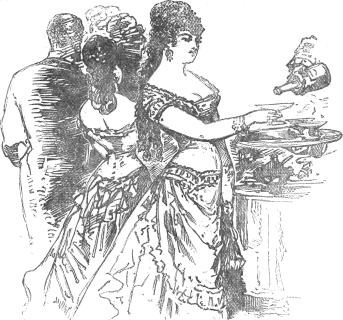
XX.—Concluding Facts and Hints.
Dry and Sweet Champagnes—Their Sparkling Properties—Form of Champagne Glasses—Style of Sparkling Wines Consumed in Different Countries—The Colour and Alcoholic Strength of Champagne—Champagne Approved of by the Faculty—Its Use in Nervous Derangements—The Icing of Champagne—Scarcity of Grand Vintages in the Champagne—The Quality of the Wine has little influence on the Price—Prices realised by the Ay and Verzenay Crûs in Grand Years—Suggestions for Laying down Champagnes of Grand Vintages—The Improvement they Develop after a few Years—The Wine of 1874—The proper kind of Cellar to lay down Champagne in—Advantages of Burrow’s Patent Slider Wine Bins—Increase in the Consumption of Champagne—Tabular Statement of Stocks, Exports, and Home Consumption from 1844-5 to 1877-8—When to Serve Champagne at a Dinner Party—Charles Dickens’s dictum that its proper place is at a Ball—Advantageous Effect of Champagne at an ordinary British Dinner Party—Sparkling Wine Cups.
When selecting a sparkling wine one fact should be borne in mind—that just as, according to Sam Weller, it is the seasoning which makes the pie mutton, beef, or veal, so it is the liqueur which renders the wine dry or sweet, light or strong. A really vin brut, to which necessarily an exceedingly small percentage of liqueur will be added. On the other hand, a sweet champagne can be produced from the most ordinary raw wine—the Yankees even claim to have evolved it from petroleum—as the amount of liqueur it receives completely masks its original character and flavour. This excess of syrup, it should be remarked, contributes materially to the wine’s explosive force and temporary effervescence, but shortly after the bottle has been uncorked the wine becomes disagreeably flat. A fine dry wine, indebted as it is for its sparkling properties to the natural sweetness of the grape, does not exhibit the same sudden turbulent effervescence. It continues to sparkle, however, for a long time after being poured into the glass owing to the carbonic acid having been absorbed by the wine itself instead of being accumulated in the vacant space between the liquid and the cork, as is the case with wines that have been highly liqueured. Even when its carbonic acid gas is exhausted a good champagne will preserve its fine flavour, which the effervescence will have assisted to conceal. Champagne, it should be noted, sparkles best in tall tapering glasses; still these have their disadvantages, promoting as they do an excess of froth when the wine is poured into them, and almost preventing any bouquet which the wine possesses from being recognised.
Manufacturers of champagne and other sparkling wines prepare them dry or sweet, light or strong, according to the markets for which they are designed. The sweet wines go to Russia and Germany, the sweet-toothed Muscovite regarding M. Louis Roederer’s syrupy product as the beau-idéal of champagne, and the Germans demanding wines with 20 or more per cent. of liqueur, or nearly quadruple the quantity that is contained in the average champagnes shipped to England. France consumes light and moderately sweet wines; the United States gives a preference to the intermediate qualities; China, India, and other hot countries stipulate for light dry wines; while the very strong plats, and not at dessert, with all kinds of sweets, fruits, and ices, as is almost invariably the case abroad.
Good champagne is usually of a pale straw colour, but with nothing of a yellow tinge about it. When its tint is pinkish this is owing to a portion of the colouring matter having been extracted from the skins of the grapes—a contingency which every pains are taken to avoid, although, since the success achieved by the wine of 1874, slightly pink wines are likely to be the fashion. The positive pink or rose-coloured champagnes, such as were in fashion some thirty years ago, are simply tinted with a small quantity of deep red wine. The alcoholic strength of the drier wines ranges from 18° of proof spirit upwards, or slightly above the ordinary Bordeaux, and under all the better-class Rhine wines. Champagnes when loaded with a highly alcoholized liqueur will, however, at times mark 30 degrees of proof spirit. The lighter and drier the sparkling wine the more wholesome it is, the saccharine element in conjunction with alcohol being not only difficult of digestion, but generally detrimental to health.
The faculty are agreed that fine dry champagnes are among the safest wines that can be partaken of. Any intoxicating effects are rapid but exceedingly transient, and arise from the alcohol suspended in the carbonic acid being applied rapidly and extensively to the surface of the stomach. “Champagne,” said Curran, “simply gives a runaway rap at a man’s head.” Dr. Druitt, equally distinguished by his studies upon wine and his standing as a physician, pronounces good champagne to be “a true stimulant to body and mind alike, rapid, volatile, transitory, and harmless. Amongst the maladies which are benefited by
Champagne of fine quality should never be mixed with ice or iced water; neither should it be iced to the extent champagnes ordinarily are, for, in the first place, the natural lightness of the wine is such as not to admit of its being diluted without utterly spoiling it, and in the next, excessive cold destroys alike the fragrant bouquet of the wine and its delicate vinous flavour. Really good champagne should not be iced below a temperature of 50° Fahr., whereas exceedingly sweet wines will bear icing down almost to freezing point, and be rendered more palatable by the process. The above remarks apply to all kinds of sparkling wine.
In the Champagne what may be termed a really grand vintage commonly occurs only once, and never more than twice, in ten years. During the same period, however, there will generally be one or two other tolerably good vintages. In grand years the crop, besides being of superior quality, is usually abundant, and as a consequence the price of the raw wine is scarcely higher than usual. Apparently from this circumstance the sparkling wine of grand vintages does not command an enhanced value, as is the case with other fine wines. It is only when speculators recklessly outbid each other for the grapes or vin brut, or when stocks are low and the vin brut is really scarce, that the price of champagne appears to rise.
That superior quality does not involve enhanced price is proved by the amounts paid for the Ay and Verzenay crûs in years of grand vintages. During the present century these appear to have been 1802, ’06, ’11, ’18, ’22, ’25, ’34, ’42, ’46, ’57, ’65, ’68, and ’74—that is, thirteen grand vintages in nearly eighty years. Other good vintages, although not equal to the foregoing, occurred in the years 1815, ’32, ’39, ’52, ’54, ’58, ’62, ’64, and ’70. Confining ourselves to the grand years, we find that the Ay wine of 1834, owing to the crop being plentiful as well as good, only realised from 110 to 140 francs the pièce of 44 gallons, although for two years previously this had fetched from 150 to 200 francs. In 1842 the price ranged from 120 to 150 francs, whereas the vastly inferior wine of the year before had commanded from 210 to 275 francs. In 1846, the crop being a small one, the price of the wine rose, and in 1857 the pièce fetched as much as from 480 to 500 francs, still this was merely a trifle higher than it had realised the two preceding years. In 1865 the price was 380 to 400 francs, and in 1868 about the same, whereas the indifferent vintages of 1871, ’72, and ’73 realised from 500 to 1,000 francs the pièce. It was very similar with the wine of Verzenay. In 1834 the price of the pièce ranged from 280 to 325 francs, or about the average of the three preceding years. In 1846, the crop being scarce, the price rose considerably, while in 1857, when the crop was plentiful, it fell to 500 francs, or from 5 to 20 per cent. below that of the two previous years, when the yield was both inferior and less abundant. In 1865 the price rose 33 per cent. above that of the year before; still, although Verzenay wine of 1865 and 1868 fetched from 420 to 450 francs the pièce, and that of 1874 as much as 900 francs, the greatly inferior vintages of 1872-73 commanded 900 and 1,030 francs the pièce.
Consumers of champagne, if wise, would profit by the circumstance that quality has not the effect of causing a rise in prices, and if they were bent upon drinking their favourite wine in perfection,
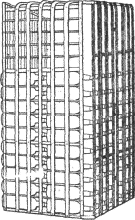
A great wine like that of 1874 will go on improving for ten years, providing it is only laid down under proper conditions. These are, first, an exceedingly cool but perfectly dry cellar, the temperature of which should be as low as from 50° to 55° Fahr., or even lower if this is practicable. The cellar, too, should be neither over dark nor light, scrupulously clean, and sufficiently well ventilated for the air to be continuously pure. It is requisite that the bottles should rest on their sides to prevent the corks shrinking, and thus allowing both the carbonic acid and the wine itself to escape. For laying down champagne or any kind of sparkling wine an iron wine-bin is by far the best. I much prefer the patent “slider” bins made by Messrs. W. and J. Burrow, of Malvern, they being better adapted to the purpose than any other I am acquainted with. In these the bottles rest on horizontal parallel bars of wrought-iron, securely riveted into strong wrought-iron uprights, both at the back and in front. The bins can be obtained of any size—that is, to hold as few as two or as many as forty dozen—and they
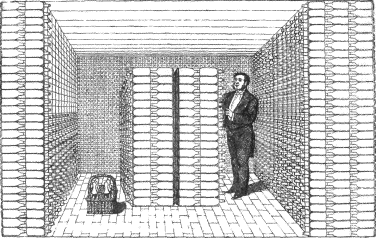
WINE-CELLAR FITTED WITH BURROW’S PATENT SLIDER BINS.
When binning the wine the bottles are held by their necks and slid into their places with such ease and safety that a child might be entrusted with the work. The bottles can be withdrawn from the bin with equal or even greater facility. Breakage is avoided from each bottle having an independent bearing, which prevents the upper bottles from either falling
From the subjoined table it will be seen that the consumption
Official Return by the Chamber of Commerce at Reims of The Trade in Champagne Wines From April, 1844, To April, 1878.
Years, from April to April. Manufacturers’ Stocks. Number of Bottles Exported. Number of Bottles sold in France. Total number of Bottles Sold.
1844-45 23,285,218 4,380,214 2,255,438 6,635,652
1845-46 22,847,971 4,505,308 2,510,605 7,015,913
1846-47 18,815,367 4,711,915 2,355,366 7,067,281
1847-48 23,122,994 4,859,625 2,092,571 6,952,196
1848-49 21,290,185 5,686,484 1,473,966 7,160,450
1849-50 20,499,192 5,001,044 1,705,735 6,706,779
1850-51 20,444,915 5,866,971 2,122,569 7,989,540
1851-52 21,905,479 5,957,552 2,162,880 8,120,432
1852-53 19,376,967 6,355,574 2,385,217 8,740,790
1853-54 17,757,769 7,878,320 2,528,719 10,407,039
1854-55 20,922,959 6,895,773 2,452,743 9,348,516
1855-56 15,957,141 7,137,001 2,562,039 9,699,040
1856-57 15,228,294 8,490,198 2,468,818 10,959,016
1857-58 21,628,778 7,368,310 2,421,454 9,789,764
1858-59 28,328,251 7,666,633 2,805,416 10,472,049
1859-60 35,648,124 8,265,395 3,039,621 11,305,016
1860-61 30,235,260 8,488,223 2,697,508 11,185,731
1861-62 30,254,291 6,904,915 2,592,875 9,497,790
1862-63 28,013,189 7,937,836 2,767,371 10,705,207
1863-64 28,466,975 9,851,138 2,934,996 12,786,134
1864-65 33,298,672 9,101,441 2,801,626 11,903,067
1865-66 34,175,429 10,413,455 2,782,777 13,196,132
1866-67 37,608,716 10,283,886 3,218,343 13,502,229
1867-68 37,969,219 10,876,585 2,924,268 13,800,853
1868-69 32,490,881 12,810,194 3,104,496 15,914,690
1869-70 39,272,562 13,858,839 3,628,461 17,487,300
1870-71 39,984,003 7,544,323 1,633,941 9,178,264
1871-72 40,099,243 17,001,124 3,367,537 20,368,661
1872-73 45,329,490 18,917,779 3,464,059 22,381,838
1873-74 46,573,974 18,106,310 2,491,759 20,598,069
1874-75 52,733,674 15,318,345 3,517,182 18,835,527
1875-76 64,658,767 16,705,719 2,439,762 19,145,481
1876-77 71,398,726 15,882,964 3,127,991 19,010,955
1877-78 70,183,863 15,711,651 2,450,983 18,162,634
Distinguished gourmets are scarcely agreed as to the proper moment when champagne should be introduced at the dinner-table. Dyspeptic Mr. Walker, of “The Original,” laid it down that champagne ought to be introduced very early at the banquet, without any regard whatever to the viands it may chance to accompany. “Give champagne,” he says, “at the beginning of dinner, as its exhilarating qualities serve to start the guests, after which they will seldom flag. No other wine produces an equal effect in increasing the success of a party—it invariably turns the balance to the favourable side. When champagne goes rightly nothing can well go wrong.” These precepts are sound enough, still all dinner-parties are not necessarily glacial, and the guests are not invariably mutes. Before champagne can be properly introduced at a formal dinner the conventional glass of sherry or madeira should supplement the soup, a white French or a Rhine wine accompany the fish, and a single glass of bordeaux prepare the way with the first entrée for the sparkling wine, which, for the first round or two, should be served, briskly and liberally. A wine introduced thus early at the repast should of course be dry, or, at any rate, moderately so.
We certainly do not approve of Mr. Charles Dickens’s dictum that champagne’s proper place is not at the dinner-table, but solely at a ball. “A cavalier,” he said, “may appropriately offer at propitious intervals a glass now and then to his danceress. There it takes its fitting rank and position amongst feathers, gauzes, gainsayed. After the preliminary glowering at each other, more Britannico, in the drawing-room, everybody regards it as a relief to be summoned to the repast, which, however, commences as chillily as the soup and as stolidly as the salmon. The soul of the hostess is heavy with the anxiety of prospective dishes, the brow of the host is clouded with the reflection that our rulers are bent upon dragging us into war. Placed between a young lady just out and a dowager of grimly Gorgonesque aspect, you hesitate how to open a conversation. Your first attempts, like those of the Russian batteries on the Danube, are singularly ineffectual, only eliciting a dropping fire of monosyllables. You envy the placidly languid young gentleman opposite, limp as his fast-fading camellia, and seated next to Belle Breloques, who is certain, in racing parlance, to make the running for him. But even that damsel seems preoccupied with her fan, and, despite her aplomb, hesitates to break the icy silence. The two City friends of the host are lost in mute speculation as to the future price of indigo or Ionian Bank shares, while their wives seem to be mentally summarising the exact cost of each other’s toilettes. Their daughters, or somebody else’s daughters, are desperately jerking out monosyllabic responses to feeble remarks concerning the weather, lawn tennis, operatic débutantes, the gravel in the Row, the ill-health of the Princess, and kindred topics from a couple of F.O. men. Little Snapshot, the wit, on the other side of the Gorgon, has tried to lead up to a story, but has found himself, as it were, frozen in the bud. When lo! the butler softly sibillates in your ear the magic word “champagne,” and as it flows, creaming and frothing, into your glass, a change comes over the spirit of your vision.
The hostess brightens, the host coruscates. The young lady
A few recipes for sparkling wine cups gathered from various sources will conclude our work. Not having personally tested these we leave the responsibility of them to their respective authors—Soyer, Tovey, Terrington (“Cooling Cups and Dainty Drinks”), &c.—premising that it is the merest folly to use a high-class champagne or a fine sparkling hock for a beverage of this description. Sparkling saumur, or the newly-introduced sparkling sauternes, and the cheaper hocks and moselles, will do equally well at a greatly reduced cost. In all cases, too, the kind of liqueur, the amount of sugar, and the flavouring with borage, verbena, pine-apple, or cucumber, may be varied to suit individual tastes. For soda or seltzer water we have invariably substituted Apollinaris, which is far better adapted for effervescent drinks of this description by reason of its purity and softness, its freedom from any distinct flavour, and above all its powerful natural effervescence.
Prepare three ounces of oleo-saccharine by rubbing some lumps of sugar against the outside of a lemon or Seville orange and scraping away the sugar as it absorbs the essential oil contained in the rind of the fruit. Put the oleo-saccharine with the juice of four lemons in a vessel, add a quart bottle of Apollinaris water (Soyer says soda-water, but Apollinaris is certainly preferable), and stir well together until the sugar is dissolved. Then pour in one quart of syrup of orgeat and whip the mixture up well with an egg whisk in order to whiten it. Next add a pint of cognac brandy, a quarter of a pint of Jamaica rum and half a pint of maraschino; strain the whole into a bowl, adding plenty of pounded ice if the weather is warm, and pour in three bottles of champagne, stirring the mixture well with the ladle while doing so in order to render the cup creamy and mellow.
A less potent and pretentious beverage, and better suited for a summer drink, is the subjoined:—
Dissolve two tablespoonfuls of powdered sugar in a quart of Apollinaris water. Add a wineglass of curaçoa, a sprig of green borage or a couple of slices of cucumber with the juice and fine shavings of the outside peel of a lemon, and a pound of bruised ice. After the whole has been well stirred pour in the champagne and serve.
Other recipes are as follows:—
Prepare an ounce of oleo-saccharine, add to it a large wineglass of maraschino, a liqueur glass of cognac, and the juice of half a lemon. Mix well together, and add several slices of pine-apple, and a large lump or two of ice. On to this pour first a large bottle of Apollinaris water, and next a bottle of sparkling wine.
Mix with the contents of a bottle of chablis or sauternes a liqueur glass of chartreuse and a tablespoonful or two of powdered loaf sugar. When the latter is dissolved throw in a pound and a half of pounded ice and a sprig of borage. Pour over these a quart of Apollinaris water and a bottle of sparkling saumur. For the chablis or sauternes half a bottle of light claret may be substituted.
To a gill of good pale sherry add a liqueur glass of maraschino and a few lumps of sugar which have been well rubbed over the rind of a Seville orange, the juice of which is also to be added to the mixture. After the sugar is dissolved throw in a sprig of borage or a slice or two of cucumber and some pounded ice. Then add a quart bottle of Apollinaris water and a bottle of champagne or some other sparkling wine.
The following cup for a party of twenty is said to be of Russian inspiration:—
Pour on to some sprigs of borage or a few slices of cucumber a pint of sherry and half a pint of brandy, then rub off the fine outside peel of a lemon with a few lumps of sugar, and add these with the strained juice of the lemon and of three oranges. Pour into the mixture half a pint of curaçoa, a wineglass of noyau, a couple of bottles of German seltzer-water, three bottles of soda-water, and three bottles of champagne. Sweeten and ice to taste.
With a bottle of chablis mix a liqueur-glass of chartreuse and then dissolve in it some powdered sugar. Add two pounds of ice in largish lumps, a slice or two of cucumber, and a sprig of lemon-scented verbena, or substitute for these a few slices of pine-apple. Pour in a quart bottle of Apollinaris water, mix well together, and add a bottle of sparkling burgundy just before serving.
The following refer to sparkling hock and moselle cups:—
To a bottle of sparkling hock add a quarter of a pint of lemon water ice and a liqueur glass of pine-apple syrup. After mixing them add a slice of cucumber, a lump or two of ice, and a bottle of Apollinaris water.
Add to the strained juice of a couple of lemons an ounce and a half or more of powdered loaf sugar and a wineglass of maraschino. Mix well, and pour in a couple of bottles of iced sparkling hock and a large bottle of iced Apollinaris water.
Dissolve a couple of ounces of sugar in a gill of dry sherry, add the thin peel of half an orange, a few slices of pine-apple, peaches, or apricots, with some pounded ice, and then pour in a bottle of sparkling moselle and a bottle of Apollinaris water.
With half a pint of lemon water ice mix a bottle of iced sparkling moselle, add a few drops of elder-flower water and a bottle of iced Apollinaris water. Instead of the lemon ice half the quantity of pine-apple ice may be used with the juice of half a lemon, and the elder-flower water may be dispensed with.
THE PRINCIPAL SPARKLING WINE BRANDS.
*** In this list whenever a manufacturer has various qualities the higher qualities are always placed first.
The book included an errata sheet for the tables. It is shown here immediately after the tables themselves. The changes and corrections listed have not been made in the text, but are noted with mouse-hover popups.
For this e-text, the “On side of Corks” column has been omitted from those groups of wines in which it does not occur.
CHAMPAGNES.
Firms and Wholesale Agents. Brands. Qualities. On side of Corks.
AYALA & CO., Ay Ayala, 7, Little Tower Street, London Rinck & Unger, 50, Park Place, New York Carte Blanche Extra.

Carte Noire Première.
Second

BINET FILS & CO., Reims Rutherford & Browne, Old Trinity House, 5, Water Lane, London. Extra Binet fils & Cie.

First Second ” ”
BOLLINGER, J., Ay. L. Mentzendorf, 6, Idol Lane, London. E. and J. Burke, 40, Beaver Street, New York. Very Dry Extra Very Dry Extra quality.

Dry Extra Dry Extra quality.
BRUCH-FOUCHER & CO., Mareuil L. Ehrmann, 34, Gt. Tower Street, London. Carte D’Or First Second

CLICQUOT-PONSARDIN, Veuve, Reims (WERLE & CO.) Fenwick, Parrot, & Co., 124, Fenchurch Street, London. Schmidt Bros., New York. Dry England.

Rich ”
DE CAZANOVE, C., Avize J. R. Hunter, 46, Fenchurch Street, London Extra Extra qualité.

First Second Third Fourth
Fifth

DEUTZ & GELDERMANN, Ay J. R. Parkington & Co., 21, Crutched Friars, London. Gold Lack (Extra Dry and Dry) Gold Lack.

Cabinet (Extra Dry and Dry) Cabinet.
DUCHATEL-OHAUS, Reims Woellworth & Co., 70, Mark Lane, London Carte Blanche (Dry and Rich) Verzenay (Dry and Rich) Sillery (Dry and Rich)

DUMINY & CO., Ay Mogford, Courtenay, & Co., 16, Mark Lane, London Anthony Oechs, New Street, New York Extra Maison fondée en 1814.

First

FARRE, CHARLES, Reims Hornblower & Co., 50, Mark Lane, London Gilmore & Gibson, Baltimore Mel & Sons, San Francisco Cabinet (Grand Vin) Cabinet Grand Vin.

Carte Blanche Carte Blanche.

Carte Noire Carte Noire.
Sillery Sec Sillery Sec.

Sillery Sillery.

Ay Mousseux Ay.

FISSE, THIRION, & Co., Reims Stallard and Smith, 25, Philpot Lane, London Cachet d’Or (Extra Dry and Medium Dry) Cachet d’Or.

Carte Blanche (Dry, Medium Dry, and Rich) Carte Blanche.
See author’s correction. Carte Noire (Dry and Medium Dry). Carte Noire.

GIBERT, GUSTAVE, Reims Cock, Russell, & Co., 63, Great Tower Street, London Hays & Co., 40, Day Street, New York Vin du Roi

Extra

First

Second

All these wines are prepared Extra Dry, Dry, or Rich. Third

GIESLER & CO., Avize F. Giesler & Co., 32, Fenchurch Street, London. Purdy & Nicholas, 43, Beaver Street, New York Extra Superior

India India.
First
Second

Third

HEIDSIECK & CO., Reims. Theodor Satow & Co., 141, Fenchurch Street, London Schmidt & Peters, 20, Beaver Street, New York Dry Monopole. Monopole (Rich) Dry Vin Royal Grand Vin Royal (Rich)

IRROY, ERNEST, Reims. Cuddeford & Smith, 66, Mark Lane, London O. de Saye, 18, South William Street, New York W. E. Hepp, 101, Gravier Street, New Orleans Carte d’Or, Dry Carte d’Or, Sec.

Carte d’Or Carte d’Or.
KRUG & Co., Reims Inglis and Cunningham, 60, Mark Lane, London A. Rocherau & Co., New York Hillman Bros. & Co., San Francisco Carte Blanche Carte Blanche, England.

Private Cuvée Private Cuvée, England.
First England.

Second

MOËT & CHANDON, Epernay Simon & Dale, Old Trinity House, 5, Water Lane, London, Agents for Great Britain and the Colonies Renauld, François, & Co., 23, Beaver Street, New York J. Hope & Co., Montreal Brut Imperial, England.

Creaming Creaming, England.
Extra Superior Extra Superior, England.
Extra Dry Sillery
White Dry Sillery White Dry, England.
First Quality England.
Second Quality

MONTEBELLO, DUC DE, Mareuil-sur-Ay John Hopkins & Co., 26, Crutched Friars, London Cazade, Crooks, & Reynaud, 25, South William St., N.Y. Cuvée Extra Cuvée Extra.

Carte Blanche Reserve.
Carte Bleue Cte. Bleue.
Carte Noire Cte. Noire.
MUMM, G. H., & CO., Reims W. J. and T. Welch, 10, Corn Exchange Chambers, Seething Lane, London F. de Bary & Co., 41 and 43, Warren Street, New York Carte Blanche Cuvée Extra.

Extra Dry Extra Dry.
Extra Extra.
First First.
For America only.
Cordon Rouge Cordon Rouge.
Extra Dry Extra Dry.
Dry Verzenay Dry Verzenay.
MUMM, JULES, & CO., Reims Jules Mumm & Co., 3 & 4, Mark Lane, London Extra Dry Dry

PÉRINET & FILS, Reims John Barnett & Son, 36, Mark Lane, London Wood, Pollard, & Co., Boston, U.S. Hooper and Donaldson, San Francisco Cuvée Réservée (Extra Dry) Cuvée Reservée.

White Dry Sillery White Dry Sillery.
PERRIER-JOUËT & CO., Epernay A. Boursot & Co., 9, Hart Street, Crutched Friars, London Cuvée de Réserve Extra

Pale Dry Creaming First
Second

Third

PIPER, H., & CO., Reims (KUNKELMANN & CO.) W. Foster Newton & Son, 3, Maiden Lane, E.C., London John Osborn, Son, & Co., New York and Montreal Très-Sec (Extra Dry) Sec (Very Dry) Carte Blanche (Rich) Kunkelmann & Co.

PFUNGST FRÈRES & CIE., Ay, Epernay J. L. Pfungst & Co., 23, Crutched Friars, London Carte d’Or (Dry, Extra Dry, and Brut) Carte d’Or.

Sillery Crêmant (Extra Dry and Brut) Sillery Crêmant.
Carte Noire (Dry, Extra Dry, and Brut) Carte Noire.
Cordon Blanc (Full, Dry, and Extra Dry) Cordon Blanc.
POL ROGER & CO., Epernay Reuss, Lauteren, & Co., 39, Crutched Friars, London Vin Réservé.

POMMERY, VEUVE, Reims (POMMERY & GRENO) A. Hubinet, 24, Mark Lane, London Charles Graef, 65, Broad Street, New York Extra Sec (Vin Brut) Veuve Pommery.

Sec

ROEDERER, LOUIS, Reims Grainger & Son, 108, Fenchurch Street, London Carte Blanche Reims, Carte Blanche, Gt.-Britain.

ROEDERER, THÉOPHILE, & CO., MAISON FONDÉE EN 1861, Reims Théophile Roederer & Co., 150, Fenchurch Street, London Crystal Champagne, Special Cuvée Special Cuvée.

Extra Reserve Cuvée Reserve Cuvée.
Extra Superior Carte Blanche Dorée Carte Blanche Dorée
Extra Quality Carte Blanche Carte Blanche.
First Quality Carte Noire Carte Noire.
Verzenay Verzenay.
ROUSSILLON, J., & CO., Epernay J. Roussillon & Co., 15, New Broad Street, London D. St. Amant & Son, 13, South William Street, New York First Cuvée Second Cuvée Dry Verzenay

Sillery Sec 1874 Extra Sec.
RUINART, PÈRE ET FILS, Reims Ruinart, Père et Fils, 22, St. Swithin’s Lane, London Carte Anglaise Dry Pale Crêmant Extra Dry Sparkling Carte Blanche First

DE SAINT-MARCEAUX & CO., Reims Groves &, Co., 5, Mark Lane, London Hermann Batjer & Bro., New York Vin Brut

Carte d’Or (Extra Dry) Very dry.
Bouzy Nonpareil (Dry) Vin Sec.
Carte Blanche (Medium)
Second (Medium)

See author’s corrections. Third (id.) For America only. Dry Royal

SAUMUR AND SAUTERNES.
Firms and Wholesale Agents. Brands. Qualities. On side of Corks.
ACKERMAN-LAURANCE, St. Florent, Saumur J. N. Bishop, 41, Crutched Friars, London Timothy Stevens, 29, Beaver Street, New York Chapin and Gore, 70, Monroe Street, Chicago Carte d’Or Carte d’Or.

Carte Rose Carte Rose.
Carte Bleue Carte Bleue.
Carte Noire Carte Noire.
DUVAU, LOUIS, Aîné, Château de Varrains, Saumur Jolivet and Canney, 3, Idol Lane, London Carte d’Or, Extra Superior Carte d’Argent, Extra Carte Blanche, Superior Carte Rose, Ordinary

LORRAIN, JULES, Château De la Côte, Varrains, near Saumur J. Lorrain, 73, Great Tower Street, London Carte d’Or Carte Blanche Carte Rose Carte Bleue

ROUSTEAUX, A., St. Florent, Saumur Cock, Russell, & Co., 63, Great Tower Street, London I. H. Smith’s Sons, Peck Slip, New York Law, Young, & Co., Montreal Extra

First

Second

Third Sparkling Vouvray, Superior Sparkling Vouvray

NORMANDIN, E., & CO., Châteauneuf-sur-Charente P. A. Maignen, 22, Great Tower Street, London Sparkling Sauternes (Extra Dry) Sparkling Sauternes (Dry)

BURGUNDIES.
Firms and Wholesale Agents. Brands. Qualities.
ANDRÉ & VOILLOT, Beaune Cock, Russell, & Co., 63, Great Tower Street, London P. W. Engs and Sons, 131, Front Street, New York Romanée (White) Nuits (do.) Volnay (do.) Saint-Péray Pink and Red Wines

LATOUR, LOUIS, Beaune Reuss, Lauteren, & Co., 39, Crutched Friars, London Romanée (White) Nuits (do.) Volnay (do.) Saint-Péray (do.) Chambertin (Red) Nuits (do.) Volnay (do.)

LIGER-BELAIR, COMTE, Nuits and Vôsne Fenwick, Parrot, & Co., 124, Fenchurch Street, London Carte d’Or (White) Carte Noire (do.) Carte Verte (do.) Carte Noire (Red) Carte Blanche (do.)

HOCKS AND MOSELLES.
Firms and Wholesale Agents. Brands. Qualities.
DEINHARD & CO., Coblenz Deinhard & Co., 6, Idol Lane, London H. G. Schmidt & Co., 38, Beaver Street, New York First

Second

Third

EWALD & CO., Rudesheim-on-Rhine Simon and Dale, Old Trinity House, 5, Water Lane, London Sparkling Hock Nonpareil (Extra Dry and Dry) Sparkling Moselle Muscatel Nonp. (Dry) Sparkling Moselle (Nonp.) Scharzberg (Dry)

HOCHHEIM ASSOCIATION, Hochheim-on-Maine F. Class & Co., 31, Crutched Friars, London Sparkling and Creaming Johannisberg Hochheim First (White or Red) Do. Second (do.) Do. Third (do.) Do. Fourth (do.) Hocks and Moselles Nonpareil First Second Third

Fourth

KESSLER, G. C., & CO., Esslingen George Saurmann, 7, Cross Lane, St. Mary-at-Hill, London Kaiser Wein Sparkling Hock Do. Neckar

LAUTEREN, C. SOHN, Mayence Reuss, Lauteren, & Co., 39, Crutched Friars, London Sparkling Johannisberg Hock No. 1 Do. No. 2 Do. No. 3 Moselle, Dry, No. 1 Do. No. 2 Do. No. 3 Moselle, Muscatel, No. 1 Do. No. 2 Do. No. 3

MÜLLER, MATHEUS, Eltville M. Muller, 15, Philpot Lane, London Flower of Sparkling Johannisberg Sparkling Johannisberg Pearl of the Moselle Extra Superior Moselle Nonpareil Sparkling Moselle Nonpareil Sparkling Hock Fine Sparkling do. Fine Sparkling Moselle Sparkling Assmannshäuser, Superior (Red) Sparkling Assmannshäuser (do.)

Sparkling Hock (Ordinary) Sparkling Moselle (do.)

OPPMANN, MICHAEL, Würzburg Franconia Wine: Nonpareil Stein Wine Blue Label White Label Sparkling Moselle, First Do. do., Second Do. Hock, First Do. do., Second

SILIGMÜLLER, F. A., Würzburg Cabinet (On side of cork:) Cabinet.

Carte d’Or Carte Blanche Carte Noire
STÖCK, JOS, & SÖHNE, Creuznach John Barnett & Son, 36, Mark Lane, London Johnnnisberg, supr. Scharzberg, do. Johannisberg, ordin. Scharzberg, do. Hock, superior Moselle, do. Hock, ordin. Moselle, do. Red Hock, First Do., Second Do., Third Do., Fourth

STYRIAN, HUNGARIAN, AND SWISS WINES.
Firms and Wholesale Agents. Brands. Qualities.
KLEINOSCHEG BROTHERS, Graz, Styria Davis and Littlewood, 4 and 5, Botolph Lane, London Dry Pale Styrian Muscat Champagne. Dry Pale Styrian Champagne Sparkling Burgundy (Red)

HUBERT & HABERMANN, Pressburg, Hungary C. O. Pattenhausen, 40, Great Tower Street, London Sparkling White Sparkling Red (Carlovitz)

DE RIEDMATTEN, DE QUAY, & CIE., Sion, Valais, Switzerland Carte Verte, Glacier du Rhône Carte Blanche, Mont-Blanc

AMERICAN WINES.
Firms and Wholesale Agents. Brands. Qualities.
KELLEY’S ISLAND WINE CO., Kelley’s Island, Ohio Island Queen Nonpareil Carte Blanche

PLEASANT VALLEY WINE CO., Hammondsport, N.Y. Great Western (Dry and Extra Dry) Carte Blanche Pleasant Valley Paris Exposition

URBANA WINE CO., Hammondsport, N.Y. Gold Seal (Extra Dry) Gold Seal Imperial Royal Rose

Author’s Errata
The subjoined corrections are necessary in the following brands (See pages 226 and 227):—
FISSE, THIRION, & Co., Reims Stallard and Smith, 25, Philpot Lane, London Cachet d’Or (Extra Dry and Medium Dry) Cachet d’Or.

Carte Blanche (Dry, Medium Dry, and Rich) Carte Blanche.
N.B.—The brand on the corks is an anchor instead of an eagle. Carte Noire (Dry and Medium Dry). Carte Noire.
GIBERT, GUSTAVE, Reims. Cock, Russell, and Co.’s address is 23, Rood Lane, London.
GIESLER & CO., Avize. The corks of the firm’s Extra Superior quality wine are branded “Extra Superior” on the side.
IRROY, ERNEST, Reims. The New York agent is F. O. de Luze, 18, South William Street, New York. W. E. Hepp is no longer M. Irroy’s agent for New Orleans.
The following are the correct brands of MM. de Saint-Marceaux & Co.:—
DE SAINT-MARCEAUX & CO., Reims Groves &, Co., 5, Mark Lane, London Hermann Batjer & Bro., New York Vin Brut

Carte d’Or (Extra Dry) Very dry.
Bouzy Nonpareil (Dry) Vin Sec.
Carte Blanche (Medium) For America only. Dry Royal
Second (Medium)

Third (id.)

A. Transcriber’s Note:
The left edge of page 48 was missing. Most words were supplied from context; the number “forty-four” (gallons) is mentioned at least four other places in the text.