FACTS ABOUT CHAMPAGNE (continued 2)
Reading edition
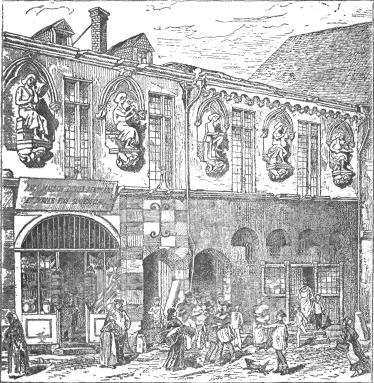
REMAINS OF THE COMMANDERIE AT REIMS.
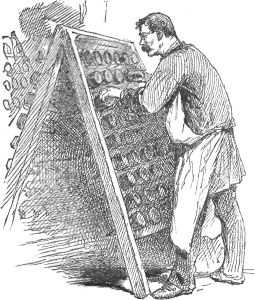
The ample cellarage which the house possesses has enabled M. Werlé to make many experiments which firms with less space at their command would find it difficult to carry out on the same satisfactory scale. Such, for instance, is the system of racks in which the bottles repose while the wine undergoes its diurnal
After performing the round of the celliers we descend into the caves, a complete labyrinth of gloomy underground corridors excavated in the bed of chalk which underlies the city, and roofed and walled with solid masonry, more or less blackened by age. In one of these cellars we catch sight of rows of work-people engaged in the operation of dosing, corking, securing, and shaking the bottles of wine which have just left the hands of the dégorgeur by the dim light of half-a-dozen tallow candles. The latest invention for liqueuring the wine is being employed. Formerly, to prevent the carbonic acid gas escaping from the bottles while the process of liqueuring was going on, it was necessary to press a gutta-percha ball connected with the machine, in order to force the escaping gas back. The new machine, however, renders this unnecessary, the gas by its own power and composition forcing itself back into the wine.
In the adjoining cellar of St. Charles are stacks of bottles awaiting the manipulation of the dégorgeur, while in that of St. Ferdinand men are engaged in examining other bottles before lighted candles to make certain that the sediment is thoroughly dislodged and the wine perfectly clear before the disgorgement is effected. Here, too, the corking, wiring, and stringing of the newly-disgorged wine are going on. Another flight of steps leads to the second tier of cellars, where the moisture trickles down the dank dingy walls, and save the dim light thrown out by the candles we carried, and by some other far-off flickering taper stuck in a cleft stick to direct the workmen, who with dexterous turns of their wrists give a twist to the bottles, all is darkness. On every side bottles are reposing in various attitudes, the majority in huge square piles on their sides, others in racks
Ventilating shafts pass from one tier of cellars to the other, enabling the temperature in a certain measure to be regulated, and thereby obviate an excess of breakage. M. Werlé estimates that the loss in this respect during the first eighteen months of a cuvée amounts to 7 per cent., but subsequently is considerably less. In 1862 one champagne manufacturer lost as much as 45 per cent. of his wine by breakages. The Clicquot cuvée is made in the cave of St. William, where 120 hogsheads of wine are hauled up by means of a crane and discharged into the vat daily as long as the operation lasts. The tirage or bottling of the wine ordinarily commences in the middle of May, and occupies fully a month.
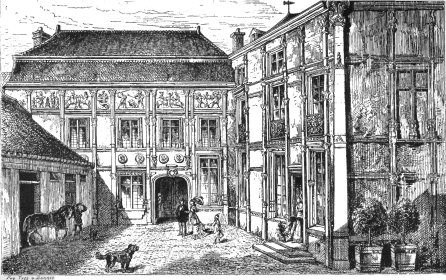
RENAISSANCE HOUSE AT REIMS, IN WHICH MADAME CLICQUOT RESIDED. (p. 69)
M. Werlé’s private residence is close to the establishment in the Rue du Temple, and here he has collected a small gallery of high-class modern paintings by French and other artists, including Meissonnier’s “Card-players,” Delaroche’s “Beatrice Cenci on her way to Execution,” Fleury’s “Charles V. picking up the brush of Titian,” various works by the brothers Scheffer, Knaus’s highly-characteristic genre picture, “His Highness on a Journey,” and several fine portraits, among which is one of Madame Clicquot, painted by Léon Coignet, when she was chef-d’œuvre. Before her father’s death Madame Clicquot used to reside in the Rue de Marc, some short distance from the cellars in which her whole existence centered, in a handsome Renaissance house, said to have had some connection with the row of palaces that at one time lined the neighbouring and then fashionable Rue du Tambour. This, however, is extremely doubtful. A number of interesting and well-preserved bas-reliefs decorate one of the façades of the house looking on to the court. The figures are of the period of François Premier and his son Henri II., who inaugurated his reign with a comforting edict for the Protestants, ordaining that blasphemers were to have their tongues pierced with red-hot irons, and heretics to be burnt alive, and who had the ill-luck to lose his eye and life through a lance-thrust of the Comte de Montgomerie, captain of his Scotch guards, whilst jousting with him at a tournament held in honour of the marriage of his daughter Isabelle with the gloomy widower of Queen Mary of England, of sanguinary fame.
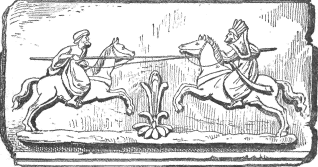
The first of these bas-reliefs represents two soldiers of the Swiss guard, the next a Turk and a Slav tilting at each other, and then comes a scroll entwined round a thistle, and inscribed with this enigmatical motto: “Giane le sur ou rien.” In the third bas-relief a couple of passionate Italians are winding up a cap-à-pie, engaged in a tourney; while in the fifth and last a couple of German lansquenets essay their gladiatorial skill with their long and dangerous weapons. Several years back a tablet was discovered in one of the cellars of the house, inscribed “Ci-gist vénérable religieux maîstre Pierre Derclé, docteur en théologie, jadis prieur de céans. Priez Dieu pour luy. 1486,” which would almost indicate that the house had originally a religious character, although the warlike spirit of the bas-reliefs decorating it renders any such supposition with regard to the existing building untenable.
The Messrs. Werlé own numerous acres of vineyards, comprising the very finest situations in the well-known districts of Verzenay, Bouzy, Le Mesnil, and Oger, at all of which places they have vendangeoirs or pressing-houses of their own. Their establishment at Verzenay contains seven presses, that at Bouzy eight, at Le Mesnil six, and at Oger two, in addition to which grapes are pressed under their own supervision at Ay, Avize, and Cramant in vendangeoirs belonging to their friends.
Since the death of Madame Clicquot the legal style of the firm has been Werlé and Co., successors to Veuve Clicquot-Ponsardin, the mark, of which M. Werlé and his son are the sole proprietors, still remaining “Veuve Clicquot-Ponsardin,” while the corks of the bottles are branded with the words “V. Clicquot-P. Werlé,” encircling the figure of a comet. The style of the wine—light, delicate, elegant, and fragrant—is familiar to all connoisseurs of champagne. What, however, is not equally well known is that within the last few years the firm, in obedience to the prevailing taste, have introduced a perfectly dry wine of corresponding quality to the richer wine which made the fortune of the house.
The house of M. Louis Roederer, founded by a plodding German named Schreider, pursued the sleepy tenor of its way for years, until all at once it felt prompted to lay siege to the porte-cochère—is situated in the Boulevard du Temple, while the principal establishment, a picturesque range of buildings of considerable extent, is in the neighbouring Rue de la Justice.
The old-established firm of Heidsieck and Co., which has secured a reputation in both hemispheres for its famous Monopole and Dry Monopole brands, has its cellars scattered about Reims, the central ones, where the wine is prepared and packed, being situated in the narrow winding Rue Sedan, at no great distance from the Clicquot-Werlé establishment. The original firm dates back to 1785, when France was struggling with those financial difficulties that a few years later culminated in that great social upheaving which kept Europe in a state of turmoil for more than a quarter of a century. Among the archives of the firm is a patent, bearing the signature of the Minister of the Prussian Royal Household, appointing Heidsieck and Co. purveyors of champagne to Friedrich William III. The champagne-drinking Hohenzollern par excellence, however, was the son and successor of the preceding, who, from habitual over-indulgence in the exhilarating sparkling beverage during the last few years of his reign, acquired the sobriquet of King Clicquot.
On passing through the large porte-cochère giving entrance to vin sur pointe, and bottles with their necks downwards are encountered in endless monotony along a score or more of long galleries. The only variation in our lengthened promenade is when we come upon some solitary workman engaged in his monotonous task of shaking his 30,000 or 40,000 bottles per diem.
The disgorging at Messrs. Heidsieck’s takes place, in accordance with the good old rule, in the cellars underground, where we noticed large stocks of wine three and five years old, the former in the first stage of sur-pointe, and the latter awaiting shipment. It is a speciality of the house to ship only matured wine, which is necessarily of a higher character than the ordinary youthful growths, for a few years have a wonderful influence in
Messrs. Heidsieck and Co. have a handsome modern establishment in the Rue Coquebert—a comparatively new quarter of the city where champagne establishments are the rule—the courtyard of which, alive with workmen at the time of our visit, is broad and spacious, while the surrounding buildings are light and airy, and the cellars lofty, regular, and well ventilated. In a large cellier here, where the tuns are ranged side by side between the rows of iron columns supporting the roof, the firm make their cuvée; here too the bottling of their wine takes place, and considerable stocks of high-class reserve wines and more youthful growths are stored ready for removal when required by the central establishment. The bulk of Messrs. Heidsieck’s reserve wines, however, repose in the outskirts of Reims, near the Porte Dieu-Lumière, in one of the numerous abandoned chalk quarries, which of late years the champagne manufacturers have discovered are capable of being transformed into admirable cellars.
In addition to shipping a rich and a dry variety of the Monopole brand, of which they are sole proprietors, Messrs. Heidsieck export to this country a rich and a dry Grand Vin Royal. It is, however, to their famous Monopole wine, and especially to the dry variety, which must necessarily comprise the finest growths, that the firm owe their principal celebrity.
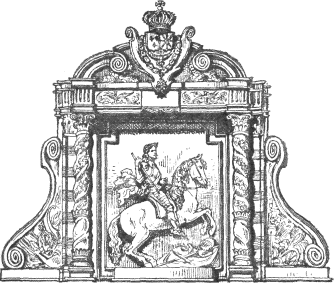
STATUE OF LOUIS XIII. ON THE REIMS HÔTEL DE VILLE
VII.—The Reims Establishments (continued).
The Firm of G. H. Mumm and Co.—Their Large Shipments to the United States—Their Establishments in the Rue Andrieux and the Rue Coquebert—Bottle-Washing with Glass Beads—The Cuvée and the Tirage—G. H. Mumm and Co.’s Vendangeoirs at Verzenay—Their Various Wines—The Gate of Mars—The Establishment of M. Gustave Gibert on the Site of the Château des Archevêques—His Cellars in the Vaults of St. Peter’s Abbey and beneath the old Hôtel des Fermes in the Place Royale—Louis XV. and Jean Baptiste Colbert—M. Gibert’s Wines—Jules Mumm and Co., and Ruinart père et fils—House of the Musicians—The Counts de la Marck—The Brotherhood of Minstrels of Reims—Establishment of Périnet et fils—Their Cellars of Three Stories in Solid Masonry—Their Soft, Light, and Delicate Wines—A Rare Still Verzenay—M. Duchâtel-Ohaus’s Establishment and Renaissance House—His Cellars in the Cour St. Jacques and Outside the Porte Dieu-Lumière.
Messrs. G. H. Mumm and Co. have their chief establishment in the Rue Andrieux, in an open quarter of the city, facing the garden attached to the premises of M. Werlé, and only a short distance from the grand triumphal arch known as the Gate of Mars, by far the most important Roman remain of which the
The establishment of Messrs. G. H. Mumm and Co., in the Rue Andrieux, is of comparatively modern construction. A large porte-cochère conducts to a spacious courtyard, bordered with sheds, beneath which huge stacks of new bottles are piled and having a pleasant garden lying beyond. On the left is a large vaulted cellier, where the operations of disgorging, liqueuring, and corking the wine are performed, and which communicates with the vast adjoining packing department. From this cellier entrance is gained to the cellars beneath, containing a million bottles of vin brut in various stages of development. This forms, however, merely a portion of the firm’s stock, they having another three millions of bottles stored in the cellars of their establishment in the Rue Coquebert, where a scene of great animation presented itself at the time of our visit, several scores of women being engaged in washing bottles for the tirage, which, although it was early in May, had already commenced. The bottles, filled with water, and containing a certain quantity of glass beads in lieu of the customary shot, which frequently leave minute particles of lead—deleterious alike to health and the flavour of the wine—adhering to the inside surface of the glass, are placed horizontally in a frame, and by means of four turns of a handle are made to perform sixty-four rapid revolutions. The beads are then transferred to other bottles, which are subjected in their turn to the same revolving process.
The cuvée, commonly composed of from two to three thousand tirage or bottling is effected by means of two large tuns placed side by side, and holding twelve hogsheads of wine each. Pipes from these tuns communicate with a couple of small reservoirs, each of them provided with half-a-dozen self-acting syphon taps, by means of which a like number of bottles are simultaneously filled. Only one set of these taps are set running at a time, as while the wine is being drawn off from one tun the other is being refilled from the casks containing the cuvée by means of a pump and leathern hose, which empties a cask in little more than a couple of minutes. Three gangs of eight men each can fill, cork, and secure with agrafes from 35,000 to 40,000 bottles during the day. The labour is performed partly by men regularly employed by the house and partly by hands engaged for the purpose, who work, however, under the constant inspection of overseers appointed by the firm.
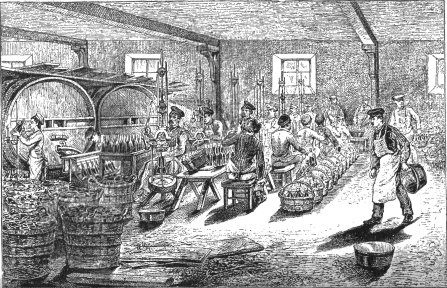
THE TIRAGE OR BOTTLING OF CHAMPAGNE AT THE ESTABLISHMENT OF MESSRS. G. H. MUMM & CO. (p. 76.)
At Messrs. G. H. Mumm’s the champagne destined for shipment has the heads of the corks submerged in a kind of varnish, with the object of protecting them from the ravages of insects, and preventing the string and wire from becoming mouldy for several years. In damp weather, when this varnish takes a long time to dry, after the bottles have been placed in a rack with their heads downwards to allow of any superfluous varnish draining from the corks, the latter are subjected to a moderate heat in a machine pierced with sufficient holes to contain 500 bottles, and provided with a warming apparatus in the centre. Here the bottles remain for about twenty minutes.
Messrs. G. H. Mumm and Co. have a capacious vendangeoir at Verzenay, near the entrance to the village when approaching it from Reims. The building contains four presses, three of which are worked with large fly-wheels requiring several men to turn them, while the fourth acts with a screw applied by means of a long pole. At the vintage 3,600 kilogrammes, or nearly 8,000lbs., of grapes are put under each press, a quantity sufficient to yield eight to ten hogsheads of wine of forty-four
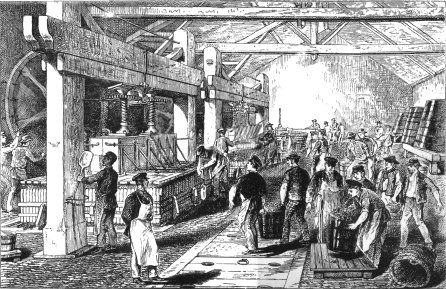
MESSRS. G. H. MUMM & CO.’S VENDANGEOIR AT VERZENAY. (p. 77)
Messrs. G. H. Mumm and Co. ship four descriptions of champagne—Carte Blanche, a pale, delicate, fragrant wine of great softness and refined flavour; a perfectly dry variety of the foregoing, known as their Extra Dry; also an Extra Quality and a First Quality—both high-class wines, though somewhat lower in price than the two preceding.
Within a few minutes’ walk of Messrs. G. H. Mumm’s—past the imposing Gate of Mars, in the midst of lawns, parterres, and gravel-walks, where coquettish nursemaids and their charges stroll, accompanied by the proverbial piou-piou—is the principal establishment of M. Gustave Gibert, whose house claims to-day half a century of existence. On this spot formerly stood the feudal castle of the Archbishops of Reims, demolished nearly three centuries ago. By whom this stronghold was erected is somewhat uncertain. The local chronicles state that a château was built at Reims by Suelf, son of Hincmar, in 922, and restored by Archbishop Henri de France two and a half centuries later. War or other causes, however, seems to have rendered the speedy rebuilding of this castle necessary, as a new Château des Archevêques appears to have been erected at Reims by Henri de Braine between 1228 and 1230. The circumstance of the Archbishops of Reims being dukes and peers as well as primates of the capital of the Champagne accounts for their preference for a fortified place of residence at this turbulent epoch.
On the investiture of a new archbishop it was the custom for him to proceed in great pomp from the château to the church of Saint Remi, with a large armed guard and a splendid retinue of ecclesiastical, civil, and military dignitaries escorting him.
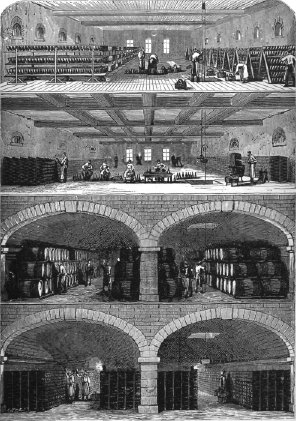
THE CELLIERS AND CELLARS OF M. GUSTAVE GIBERT. (Near the Porte de Mars, Reims.) (p. 78.)
When the old fortress was razed to the ground its extensive vaults were not interfered with, but many long years afterwards were transformed into admirable cellars for the storage of champagne. Above them are two stories of capacious celliers where the wine is blended, bottled, and packed, the vaults themselves comprising two tiers of cellars which contain wine both in cask and bottle. M. Gibert’s remaining stocks are stored in the ancient vaults of the abbey of St. Peter, in the heart of the city, and in the roomy cellars which underlie the old Hôtel des Fermes in the Place Royale, where in the days of the ancien régime the farmers-general of the province used to receive its revenues. On the pediment of this edifice is a bas-relief with Mercury, the god of commerce, seated beside a nymph and surrounded by children engaged with the vintage and with bales of wool, and evidently intended to symbolise the staple trades of the capital of the Champagne. A bronze statue rises in the centre of the Place which from its Roman costume and martial bearing might be taken for some hero of antiquity did not the inscription on the pedestal apprise us that it is intended for the “wise, virtuous, and magnanimous Louis XV.,” a misuse of terms which has caused a transatlantic Republican to characterise the monument as a brazen lie. Leading out of the Place Royale is the Rue de Cérès, in which there is a modernised 16th-century house claiming to be the birthplace of Jean
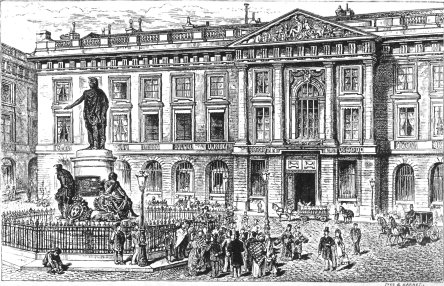
THE PLACE ROYALE AT REIMS, SHOWING THE ENTRANCE TO THE CELLARS OF M. GUSTAVE GIBERT. (p. 79)
M. Gustave Gibert possesses pressing-houses at Ay and Bouzy, and has moreover at both these places accommodation for large reserve stocks of wine in wood. As all the wines which he sends into the market are vintaged by himself, he can ensure their being of uniform high quality. His Vin du Roi is notable for perfume, delicacy, perfect effervescence, and that fine flavour of the grape which characterises the grand wines of the Champagne. It is a great favourite with the King of Sweden and Norway, and the labels on the bottles bear his name and arms. M. Gibert’s brand has acquired a high reputation in the North of Europe, and having of late years been introduced into England, is rapidly making its way there. The merits of the wines have been again and again publicly recognised, no less than ten medals having been successively awarded M. Gibert at the Exhibitions of Toulouse in 1858, Bordeaux in 1859, Besançon in 1860, Metz and Nantes in 1861, London in 1862, Bayonne and Linz in 1864, and Oporto and Dublin in 1865. This long list of awards has led to the wines being placed “hors concours,” nevertheless M. Gibert continues to submit them to competition whenever any Exhibition of importance takes place. The wines are shipped to England, Germany, Russia, and Northern Europe, Spain and Portugal, Calcutta, Java, Melbourne, and Hong-Kong, besides being largely in request for the Paris market.
On quitting M. Gibert’s central establishment we proceed along the winding, ill-paved Rue de Mars, past the premises of Messrs. Jules Mumm and Co., an offshoot from the once famous firm of P. A. Mumm and Co., to the Place de l’Hôtel de Ville, in one corner of which stands a massive and somewhat pretentious-looking house, dating back to the time of Louis Quatorze. Here are the offices of Ruinart père et fils, who claim to rank as the oldest existing house in the Champagne. The head of the firm, the Vicomte de Brimont, is a collateral descendant Quentin Durward will retain a lively recollection.
To return, however, to the House of the Musicians. A probable conjecture ascribes the origin of the quaint mediæval structure to the Brotherhood of Minstrels of Reims, who in the thirteenth century enjoyed a considerable reputation, not merely in the Champagne, but throughout the North of France. The house takes its present name from five seated statues of musicians, larger than life-size, occupying the Gothic niches between the first-floor windows, and resting upon brackets ornamented with grotesque heads. It is thought that the partially-damaged figure on the left-hand side was originally playing a drum and a species of clarionet. The next one evidently has the
Leading from the Rue du Tambour is the Rue de la Belle Image, thus named from a handsome statuette of the Virgin which formerly decorated a corner niche; and beyond is the Rue St. Hilaire, where Messrs. Barnett et fils, trading under the cuvée, while adjacent is a room where stocks of corks and labels, metal foil, and the like are kept.
There are three stories of cellars—an exceedingly rare thing anywhere in the Champagne—all constructed in solid masonry on a uniform plan—namely, two wide galleries running parallel with each other and connected by means of transverse passages. Spite of the great depth to which these cellars descend they are perfectly dry; the ventilation, too, is excellent, and their different temperatures render them especially suitable for the storage of champagne, the temperature of the lowest cellar being 6° Centigrade (43° Fahrenheit), or one degree Centigrade below the cellar immediately above, which, in its turn is two degrees below the uppermost one of all. The advantage of this is that when the wine develops an excess of effervescence any undue proportion of breakages can be checked by removing the bottles to a lower cellar and consequently into a lower temperature.
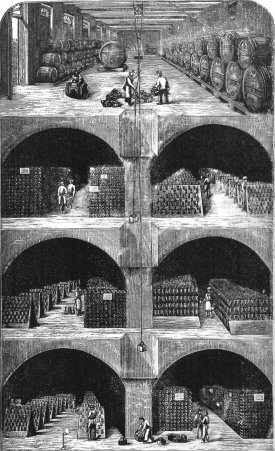
THE CELLIER AND CELLARS OF PÉRINET ET FILS AT REIMS. (p. 82)
The first cellars we enter are closely stacked with wine in bottle, which is gradually clearing itself by the formation of a deposit, while in an adjoining cellar on the same level the operations of disgorging, liqueuring, and corking are going on. In the cellars immediately beneath bottles of wine repose in solid stacks ready for the dégorgeur, while others rest in racks in order that they may undergo their daily shaking. In the lowest cellars reserved wine in cask is stored, as it best retains its natural freshness and purity in a very cool place. All air is carefully excluded from the casks, any ullage is immediately checked, and as evaporation is continually going on the casks vin brut is a mélange comprising the produce of some of the best vineyards, and has every possible attention paid to it during its progressive stages of development.
Champagnes of different years were here shown to us, all of them soft, light, and delicate, and with that fine flavour and full perfume which the best growths of the Marne alone exhibit. Among several curiosities submitted to us was a still Verzenay of the year 1857, one of the most delicate red wines it was ever our fortune to taste. Light in body, rich in colour, of a singularly novel and refined flavour, and with a magnificent yet indefinable bouquet, the wine was in every respect perfect. Not only was the year of the vintage a grand one, but the wine must have been made with the greatest possible care and from the most perfect grapes for so delicate a growth to have retained its flavour in such perfection, and preserved its brilliant ruby colour for such a length of time.
From the samples shown to us of Périnet et fils’ champagne, we were prepared to find that at some recent tastings in London, the particulars of which have been made public, their Extra Sec took the first place at each of the three severe competitions to which it was subjected.
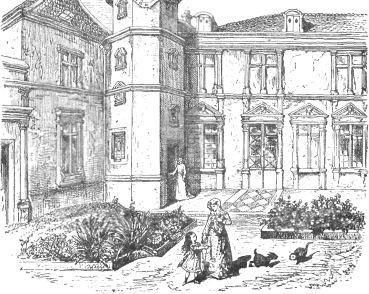
M. Duchâtel-Ohaus’s central establishment is in the Rue des Deux Anges, one of the most ancient streets of Reims, running from the Rue des Élus to the Rue de Vesle, and having every window secured by iron gratings, and every door thickly studded with huge nails. These prison-like façades succeed each other in gloomy monotony along either side of the way, the portion of M. Duchâtel-Ohaus’s residence which faces the street being no exception to the general rule. Once within its court, however, and quite a different scene presents itself. Before us is a pleasant little flower-garden with a small but charming Renaissance house looking on to it, the windows ornamented with elaborate mouldings, and surmounted by graceful sculptured heads, while at one corner rises a tower with a sun-dial displayed on its front.
From the garden we enter a capacious cellier where the blending and bottling of the wine takes place, and in the neighbouring packing-room encounter a score of workpeople filling, securing, and branding a number of cases about to be despatched by rail. From the cellier we pass to the cellars situated immediately underneath, and which, capacious though they are, do not suffice for M. Duchâtel’s stock, portions of which are stored in some ancient vaults near the market-place, and in the Rue de Vesle behind the church of St. Jacques. This church, originally built
The Cour St. Jacques, where M. Duchâtel’s cellars are situated, may be reached by passing through the church, the interior of which presents a curious jumble of architectural styles from early Gothic to late Renaissance. One noteworthy object of art which it contains is a life-size crucifix carved by Pierre Jacques, a Remish sculptor of the days of the Good King Henri, and from an anatomical point of view a perfect chef-d’œuvre. The cellars we have come to inspect are two stories deep, and comprise numerous ancient cavernous compartments, such as are found in all the older quarters of Reims, and usually in the vicinity of some church, convent, or clerical abode. It has been suggested that they were either crypts for sacred retirement and prayer, dungeons for the punishment of recreant brethren, or tombs for the dead; but it is far more probable that in the majority of instances they served then as now simply for the storage of the choice vintages of the Marne, for we all know the monks of old were tipplers of no ordinary capacity, who usually contrived to secure the best that the district provided. These vaults of M. Duchâtel’s, in which a considerable stock of the fine wine of 1874 is stored, are from two to three centuries old, and probably belonged to the curés of St. Jacques. They are of considerable extent, are well ventilated, and are walled and roofed with stone. M. Duchâtel’s remaining stock reposes in some new cellars—certain transformed chalk quarries outside the Porte Dieu-Lumière, comprising broad lofty galleries and vast circular chambers—fifty feet or so in height and well lighted from above.
At M. Duchâtel-Ohaus’s we tasted a variety of fine samples of his brand, including a beautiful wine of 1868 and an almost equally good one of 1870, with some of the excellent vintage of 1874, which was then being prepared for shipment.
VIII.—The Reims Establishments (continued).
M. Ernest Irroy’s Cellars, Vineyards, and Vendangeoirs—Recognition by the Reims Agricultural Association of his Plantations of Vines—His Wines and their Popularity at the best London Clubs—Messrs. Binet fils and Co.’s Establishment—Wines Sold by the Firm to Shippers—Their Cellars—Samples of Fine Still Ay and Bouzy—Their Still Sillery, Vintage 1857, and their Creaming Vin Brut, Vintage 1865—The Offices and Cellars of Messrs. Charles Farre and Co.—Testing the Wine before Bottling—A Promenade between Bottles in Piles and Racks—Repute in which these Wines are held in England and on the Continent—The New Establishment of Fisse, Thirion, and Co. in the Place de Betheny—Its Construction exclusively in Stone, Brick, and Iron—The Vast Celliers of Two Stories—Bottling the Wine by the Aid of Machinery—The Cool and Lofty Cellars—Ingenious Method of Securing the Corks, rendering the Uncorking exceedingly simple—The Wines Shipped by the Firm.
Few large manufacturing towns like Reims—one of the most important of those engaged in the woollen manufacture in France—can boast of such fine promenades and such handsome boulevards as the capital of the Champagne. As the ancient
M. ERNEST IRROY’S ESTABLISHMENT AT REIMS. (p. 87)
The offices of M. Ernest Irroy, who is known in Reims not merely as a large champagne grower and shipper, but also as a distinguished amateur of the fine arts, taking a leading part in originating local exhibitions and the like, are attached to his private residence, a handsome mansion flanked by a large and charming garden in the Boulevard du Temple. The laying out of this sylvan oasis is due to M. Vadré, the head gardener of the city of Paris, who contributed so largely to the picturesque embellishment of the Bois de Boulogne. M. Irroy’s establishment, which comprises a considerable range of buildings grouped around two courtyards, is immediately adjacent, although its principal entrance is in the Rue de la Justice. The vast celliers, covering an area of upwards of 3,000 square yards, and either stocked with wine in cask or used for packing and similar purposes, afford the requisite space for carrying on a most extensive business. The cellars beneath comprise three stories, two of which are solidly roofed and lined with masonry, while the lowermost one is excavated in the chalk. They are admirably constructed on a symmetrical plan, and their total surface is very little short of 7,000 square yards. Spite of the great depth to which these cellars descend they are perfectly dry, the ventilation is good, and their temperature moreover is remarkably cool, one result of which is that M. Irroy’s loss from breakage never exceeds four per cent. per annum. M. Irroy holds a high position as a vineyard-proprietor in the Champagne, his vendangeoirs at Verzenay, Avenay, and Ambonnay; and at Bouzy, where his largest vineyards are, he has built some excellent cottages for his labourers. He has also constructed a substantial bridge over the ravine which, formed by winter torrents from the hills, intersects the principal vineyard slopes of Bouzy.
M. Ernest Irroy’s wines, prepared with scrupulous care and rare intelligence, have been known in England for some years past, and are steadily increasing in popularity. They are emphatically connoisseurs’ wines. The best West-end clubs, such as White’s, Arthur’s, the old Carlton, and the like, lay down the cuvées of this house in good years as they lay down their vintage ports and finer clarets, and drink them, not in a crude state, but when they are in perfection—that is, in five to ten years’ time. M. Irroy exports to the British colonies and to the United States the same fine wines which he ships to England.
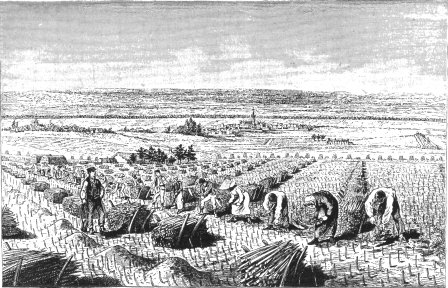
LABOURERS AT WORK IN M. ERNEST IRROY’S BOUZY VINEYARDS. (p. 88.)
From M. Irroy’s we proceeded to Messrs. Binet fils and Co., whose establishment in the Rue de la Justice is separated from that of M. Irroy merely by a narrow path, and occupies the opposite side of the way to the principal establishment of M. Louis Roederer. The firm of Binet fils and Co. was founded many years ago, but for a long time they sold their wines principally to other shippers on the Reims and Epernay markets, where their cuvées were held in high repute, and only of recent years have they applied themselves to the shipping trade. Their establishment has two entrances, one in the Rue de la Justice, and the other in the Boulevard du Champ de Mars. On passing through
The vaults, which are reached by a winding stone staircase, are spacious, and consist of a series of parallel and uniform galleries hewn in the chalk without either masonry supports or facings. Among the solid piles of bottles which here hem us in on all sides are a considerable number of magnums and imperial pints reserved for particular customers—the former more especially for certain military messes, at which the brand of Binet fils and Co. is held in deserved esteem. We tasted here—in addition to several choice sparkling wines, including a grand vin brut, vintage 1865—a still Ay of the year 1870, and some still Bouzy of 1874. The former, a remarkably light and elegant wine, was already in fine condition for drinking, while the latter, which was altogether more vinous, deeper in colour, and fuller in body needed the ripening influence of time to bring it to perfection. Through their agents, Rutherford, Drury, and Co., Messrs. Binet fils and Co. achieved a great success in England with their still Sillery, vintage 1857, and subsequently with their superb creaming vin brut, vintage 1865, of which we have just spoken, and which is still to be met with at London clubs of repute.
Some short distance from and parallel with the Rue de la Justice is the Rue Jacquart, where Messrs. Charles Farre and Co., of whose establishment at Hautvillers we have already spoken, have their offices and cellars. We enter a large courtyard, where several railway vans are being laden with cases of wine from the packing-hall beyond, and in the tasting-room adjoining find wine being tested prior to bottling, to ascertain the amount of saccharine
Messrs. Farre’s cellars, comprising eighteen parallel galleries disposed in two stories, are both lofty and commodious, and are mainly of recent construction, the upper ones being solidly walled with masonry, while those below are simply excavated in the chalk. Here, as elsewhere, one performed a lengthened promenade between piles after piles of bottles of the finer vintages and a seemingly endless succession of racks, at which workmen were engaged in dislodging the sediment in the wine by the dim light of a tallow candle. It was here that we were assured the more experienced of these men were capable, when working with both hands, of shaking the enormous number of 50,000 bottles a day, or at the rate of seventy to the minute.
The fine wines of Messrs. Charles Farre and Co. have long enjoyed a well-deserved celebrity, and at the Paris Exhibition of 1855 the firm secured the highest medal awarded to champagnes. The high repute in which the brand is held on the Continent is evidenced by the fact that the Prussian and other courts are consumers of Messrs. Farre’s wines. The firm not only number England, Germany, Austria, Russia, and Northern Europe, and, as a matter of course, France, among their customers, but also several of the British colonies and North and South America as well.
The new establishment of Messrs. Fisse, Thirion, and Co., in the erection of which they have largely profited by their experience and the various resources of modern science, is situated in the Place de Betheny, in the vicinity of the railway goods station and the local shooting range, largely resorted to at certain seasons of the year, when the crack shots of the Champagne capital compete with distinguished amateurs from different parts of France and the other side of the Channel.
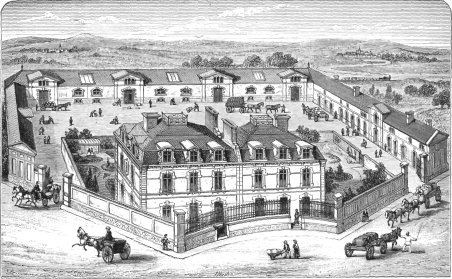
MESSRS. FISSE, THIRION & CO.’S ESTABLISHMENT AT REIMS. (p. 91)
On entering the courtyard through the iron gate to the right of the dwelling-houses of the resident partners—flanked by sur pointe, bales of corks, and the wicker-baskets and cases in which the wine is packed.
The preparation of the wines in cask and the bottling take place in the lower of the two celliers, a mere lad being enabled, by the aid of the mechanism provided, to bottle from six to eight thousand bottles a day. A single workman can cork about 4,500 bottles, which a second workman secures with metal agrafes before they are lowered into the cellars. The latter are of two stories, each being divided into three long parallel galleries 20 feet high and 23 feet wide, vaulted with stone and floored with cement. Bordering the endless stacks of bottles are small gutters, into which the wine flows from the exploded bottles. Lofty, well ventilated, and beautifully cool, the temperature invariably ranging from 45° to 47° Fahrenheit, these capitally-constructed cellars combine all that is required for a champagne establishment of the first class. The breakage has never exceeded 3 per cent., whereas in some old cellars which the firm formerly occupied in the centre of the city, their breakage on one occasion amounted to ten times this quantity.
At Fisse, Thirion, and Co.’s, after the wine has been disgorged and liqueured, the corks are secured neither with string nor wire, but a special metal fastener is employed for the purpose. This consists of a triple-branched agrafe, provided with a kind of hinge. A tiny toy needle-gun suspended to the agrafe is pulled outwards and turned over the top of the bottle, whereupon the fastening becomes instantly disengaged, and anything like trouble, uncleanliness, or annoyance is entirely avoided. The operation is so easy that a mere child can open a bottle of champagne, secured by this patent fastener, as easily and rapidly as a grown-up man.
The firm of Fisse, Thirion, and Co. succeeded that of Fisse, Fraiquin, and Co.—established originally at Reims in 1821—in 1864, when the brand of the house was already well known on the Continent, more especially in Belgium and Holland. Since that time the wines have been largely introduced into England and the United States, and the firm, who have secured medals at many of the recent exhibitions, to-day have agents in the English and Dutch Indies and the various European settlements in China. Several descriptions of wine are shipped by the house, the finest being their dry Cuvée Reservèe and their fragrant soft-tasting Cachet d’Or.
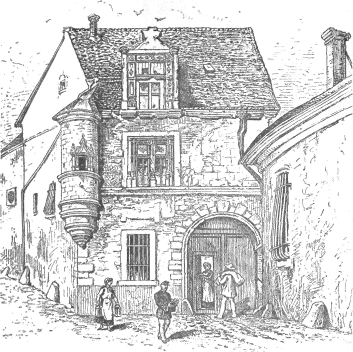
OLD HOUSE IN THE RUE DES ANGLAIS, REIMS.
IX.—The Reims Establishments (concluded).
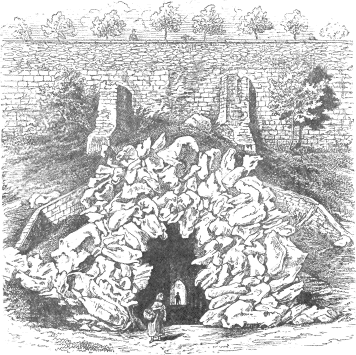
La Prison de Bonne Semaine—Mary Queen of Scots at Reims—Messrs. Pommery and Greno’s Offices—A Fine Collection of Faïence—The Rue des Anglais a former Refuge of English Catholics—Remains of the Old University of Reims—Ancient Roman Tower and Curious Grotto—The handsome Castellated Pommery Establishment—The Spacious Cellier and Huge Carved Cuvée Tun—The Descent to the Cellars—Their Great Extent—These Lofty Subterranean Chambers Originally Quarries—Ancient Places of Refuge of the Early Christians and the Protestants—Madame Pommery’s Splendid Cuvée of 1868—Messrs. de St. Marceaux and Co.’s New Establishment in the Avenue de Sillery—Its Garden-Court and Circular Shaft—Animated Scene in the Large Packing Hall—Lowering Bottled Wine to the Cellars—Great Depth and Extent of these Cellars—Messrs. de St. Marceaux and Co.’s Various Wines.
Nigh the cathedral of Reims and in the rear of the archiepiscopal palace there runs a short narrow street known as the Rue
In close proximity to the Rue Vauthier le Noir is the Rue des Anglais, so named from the English Catholic refugees who, flying from the persecutions of our so-called Good Queen Bess, here took up their abode and established a college and a seminary. They rapidly acquired great influence in Reims, and one of their number, William Gifford, was even elected archbishop. At the end of this street, nigh to Madame Pommery’s, there stands an old house with a corner tower and rather handsome
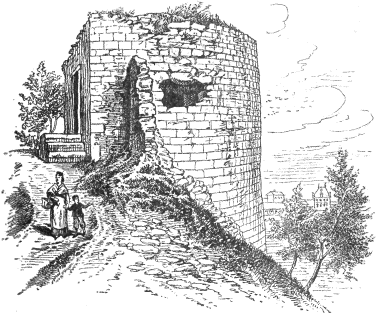
The Rue des Anglais conducts into the Rue de l’Université, where a few remnants of the old University, founded by Cardinal Charles de Lorraine (1538-74), attract attention, notably a conical-capped corner tower, the sculptured ornaments at the base of which have crumbled into dust beneath the corroding tooth of Time. From the Rue de l’Université our way lies along the Boulevard du Temple to the Porte Gerbert, about a mile beyond which there rises up the curious castellated structure in which the Pommery establishment is installed, and whose tall towers command a view of the whole of Reims and its environs. As we drive up the Avenue Gerbert we espy on the right an isolated crumbling Roman tower, a remnant of the days when Reims disputed with Trèves the honour of being cuvée, with the monogram P and G, surmounting the arms of Reims, carved on its head. A platform, access to which is gained by a staircase in a side aisle, runs round this tonneau; and boys stand here when the wine is being blended, and by means of a handle protruding above the cask work the paddle-wheels placed inside, thereby securing the complete amalgamation of the wine, which has been hoisted up in casks and poured through a metal trough into the tonneau. Adjoining are the chains and lifts worked by steam by means of which wine is raised and lowered from and to the cellars beneath, one lift raising or lowering eight casks, whether full or empty, in the space of a minute.
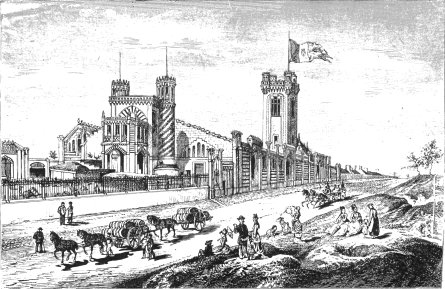
THE POMMERY ESTABLISHMENT, IN THE OUTSKIRTS OF REIMS. (p. 96)
At the farther end of the hall a Gothic door, decorated with ornamental ironwork, leads to the long broad flight of steps 116 in number and nearly twelve feet in width, conducting to the suite of lofty subterranean chambers where bottles of vin brut repose in their hundreds of thousands in slanting racks or solid dégorgeur. Altogether there are thirty large shafts, which were originally quarries, and are now connected by spacious galleries. This side of Reims abounds with similar quarries, which are believed to have served as places of refuge for the Protestants at the time of the League and after the revocation of the Edict of Nantes, and it is even conjectured that the early Christians, the followers of St. Sixtus and St. Sinicus, here hid themselves from their persecutors. Since the cellars within the city have no longer sufficed for the storage of the immense stocks required through the development of the champagne trade, these vast subterranean galleries have been successfully utilised by various firms. Messrs. Pommery, after pumping out the water with which the chambers were filled, proceeded to excavate the intersecting tunnels, shore up the cracking arches, and repair the flaws in the chalk with masonry, finally converting these abandoned quarries into magnificent cellars for the storage of champagne. No less than £60,000 was spent upon them and the castellated structure aboveground. The underground area is almost 240,000 square feet, and a million bottles of champagne can be stored in these capacious vaults.
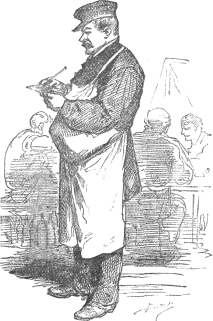
HEAD OVERSEER AT POMMERY AND GRENO’S.
Madame Pommery made a great mark with her splendid cuvée of 1868, and since this time her brand has become widely popular, the Pommery Sec especially being highly appreciated by connoisseurs.
On leaving Messrs. Pommery’s we retrace our steps down the Avenue Gerbert, bordered on either side with rows of plane-trees, until we reach the treeless Avenue de Sillery, where Messrs. de Saint Marceaux and Co.’s new and capacious establishment is installed. The principal block of building is flanked by two advanced wings inclosing a garden-court, set off with flowers and shrubs, and from the centre of which rises a circular shaft, covered in with glass, admitting light and air to the cellars below. In the building to the left the wine is received on its arrival from the vineyard, and here are ranged hundreds of casks replete with the choice crûs of Verzenay, Ay, Cramant, and Bouzy, while
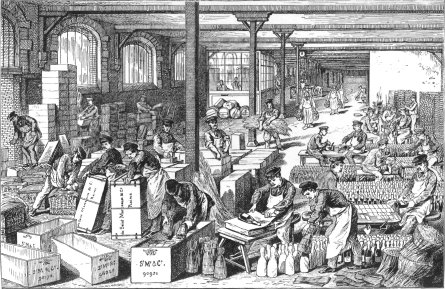
THE PACKING HALL OF MESSRS. DE SAINT-MARCEAUX AT REIMS. (p. 99)
The wine in cask, stored in the left-hand wing, after having been duly blended in a vast vat holding over 2,400 gallons, is drawn off into bottles, which are then lowered down a shaft to the second tier of cellars by means of an endless chain, on to which the baskets of bottles are swiftly hooked. The workman engaged in this duty, in order to prevent his falling down the shaft, has a leather belt strapped round his waist, by means of which he is secured to an adjoining iron column. We descend into the lower cellars down a flight of ninety-three broad steps—a depth equal to the height of an ordinary six-storied house—and find no less than four-and-twenty galleries excavated in the chalk, without any masonry supports, and containing upwards of a million bottles of champagne. The length of these galleries varies, but they are of a uniform breadth, allowing either a couple of racks with wine sur pointe, or stacks of bottles, in four rows on either side, with an ample passage down the centre.
The upper range of cellars comprises two large arched galleries of considerable breadth, one of which contains wine in wood and wine sur pointe, while the other is stocked with bottles of wine heads downward, ready to be delivered into the hands of the dégorgeur.
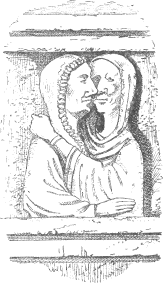
BAS-RELIEF NEAR THE PORTE DIEU-LUMIÈRE.
MM. de St. Marceaux and Co. have the honour of supplying the King of the Belgians, the President of the French Republic, and several German potentates, with an exceedingly delicate champagne known as the Royal St. Marceaux. The same wine is popular in Russia and other parts of Europe, just as the Dry Royal of the firm is much esteemed in the United States.
In the neighbourhood of the Pommery and de St. Marceaux establishments numerous other champagne manufacturers have their cellars formed from the abandoned quarries so numerous on this side of the city. Of some of these firms we have already spoken, but there remain to be mentioned Messrs. Kunklemann and Co., Ruinart père et fils, George Goulet, Jules Champion, Théophile Roederer, &c. The cellars of the three last-named are immediately outside the Porte Dieu-Lumière, near which is a house with a curious bas-relief on its face, the subject of which has been a source of much perplexity to local antiquaries.
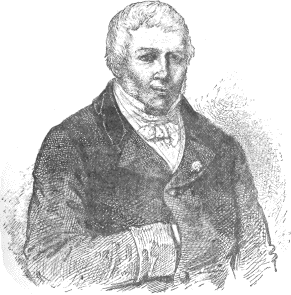
JEAN REMI MOET.
X.—Epernay Champagne Establishments.
Early Records of the Moët Family at Reims and Epernay—Jean Remi Moët Founder of the Commerce in Champagne Wines—Extracts from the Old Account-Books of the Moëts—First Sales of Sparkling Wines—Sales to England in 1788—“Milords” Farnham and Findlater—Jean Remi Moët receives the Emperor Napoleon, Josephine, and the King of Westphalia—The Firm of Moët and Chandon Constituted—Their Establishment in the Rue du Commerce—Delivering and Washing the New Bottles—The Numerous Vineyards and Vendangeoirs of the Firm—Making the Cuvée in Vats of 12,000 Gallons—The Bottling of the Wine by 200 Hands—A Hundred Thousand Bottles Completed Daily—20,000 Francs’ worth of Broken Glass in Two Years—A Subterranean City, with miles of Streets, Cross Roads, Open Spaces, Tramways, and Stations—The Ancient Entrance to these Vaults—Tablet Commemorative of the Visit of Napoleon I.—Millions of Bottles of Champagne in Piles and Racks—The Original Vaults known as Siberia—Scene in the Packing Hall—Messrs. Moët and Chandon’s Large and Complete Staff—Provision for Illness and Old Age—Annual Fête Given by the Firm—Their Famous “Star” Brand—M. Perrier-Jouët, the lucky Grandson of a little Epernay Grocer—His Offices and Cellars—His Wine Classed according to its Deserts—Messrs. Roussillon and Co.’s Establishment—The Recognition accorded to their Wines—
Those magnates of the champagne trade, Messrs. Moët and Chandon, whose famous “star” brand is familiar in every part of the civilised globe, and whose half-score miles of cellars contain as many million bottles of champagne as there are millions of inhabitants in most of the secondary European states, have their head-quarters at Epernay in a spacious château—in that street of châteaux named the Rue du Commerce, but commonly known as the Faubourg de la Folie—which is approached through handsome iron gates, and has beautiful gardens in the rear extending in the direction of the River Marne. The existing firm dates from the year 1833, but the family of Moët—conjectured to have originally come from the Low Countries—had already been associated with the champagne wine trade for well-nigh a century previously. If the Moëts came from Holland they must have established themselves in the Champagne at a very early date, for the annals of Reims record that in the fifteenth century Jean and Nicolas Moët were échevins of the city. A Moët was present in that capacity at the coronation of Charles VII. in 1429, when Joan of Arc stood erect by the principal altar of the cathedral with her sacred banner in her hand, and for having contributed to repulse an attempt on the part of the English to prevent the entrance of the Royal party into the city, the Moëts were subsequently ennobled by the same monarch. A mural tablet in the church of St. Remi records the death of D. G. Moët, Grand Prior, in 1554, and nine years later we find Nicol Moët claiming exemption at Epernay from the payment of tailles on the ground of his being a noble. An old commercial book preserved in the family archives shows that in the year 1743—at the epoch when the rashness of the Duc de Grammont saved the English army under George II. from being cut to pieces at Dettingen—a descendant of the foregoing, one Claude Louis Nicolas Moët, who owned considerable vineyard
At Messrs. Moët and Chandon’s we had the opportunity of inspecting some of the old account-books of the firm, and more particularly those recording the transactions of Jean Remi Moët and his father. The first sales of sparkling wine, on May 23rd, 1743, comprised 301 bottles of the vintage of 1741 to Pierre Joly, wine-merchant, bon des douze chez le Roi, whatever that may mean, at Paris; 120 bottles to Pierre Gabriel Baudoin, also bon des douze, at Paris; and a similar quantity to the Sieur Compoin, keeping the “hotellerie ditte la pestitte Escurie,” Rue du Port Maillart, at Nantes in Brittany. The entry specifies that the wine for Nantes is to be left at Choisy-le-Roi, and taken by land to Orleans by the carters of that town, who are to be found at the Ecu d’Orléans, Porte St. Michel, Paris, the carriage as far as Choisy being 4 livres 10 deniers (about 4 francs) for the two half-baskets, and to Paris 3 livres 15 deniers the basket.
Between 1750 and ’60, parcels of wine were despatched to Warsaw, Vienna, Berlin, Königsberg, Dantzig, Stettin, Brussels, and Amsterdam; but one found no mention of any sales to England till the year 1788, when the customers of the firm included “Milord” Farnham, of London, and Messrs. Felix Calvert and Sylvin, who had a couple of sample bottles sent to them, for which they were charged five shillings. In the same year Messrs. Carbonnell, Moody, and Walker (predecessors of the well-known existing firm of Carbonnell and Co.) wrote in French for two baskets, of ten dozens each, of vin de champagne “of good body, not too charged with liqueur, but of excellent taste, and not at all sparkling!” while the Chevalier Colebrook, writing from Bath, requests that 72 bottles of champagne may vin de champagne.” Shortly afterwards the chevalier himself receives 50 bottles of still wine, vintage 1783. In 1789 120 bottles of champagne, vintage 1788, are supplied to “Milord” Findlater, of London—an ancestor, no doubt, of the wine-merchants of the same name carrying on business to-day, and whom the Moëts in their simplicity dubbed a “Milord”—and in 1790 the customers of the house include Power and Michel, of 44, Lamb Street, London, and Manning, of the St. Alban Tavern, the latter of whom is supplied on March 30th with 130 bottles of champagne at three livres, or two “schillings,” per bottle; while a month later Mr. Lockart, banker, of 36, Pall Mall, is debited with 360 bottles, vintage 1788, at three shillings.
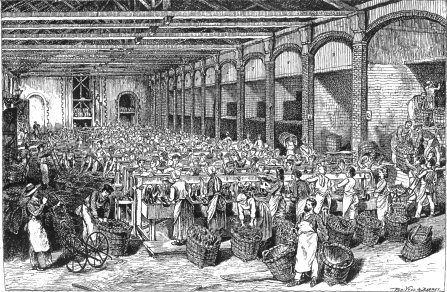
WASHING BOTTLES AT MESSRS. MOËT & CHANDON’S, EPERNAY. (p. 105)
In this same year M. Moët despatches a traveller to England named Jeanson, and his letters, some two hundred in number, are all preserved in the archives of the house. On the 17th May, 1790, he writes from London as follows:—“As yet I have only gone on preparatory and often useless errands. I have distributed samples of which I have no news. Patience is necessary, and I endeavour to provide myself with it. How the taste of this country has changed since ten years ago! Almost everywhere they ask for dry wine, but at the same time require it so vinous and so strong that there is scarcely any other than the wine of Sillery which can satisfy them.... To-morrow I dine five miles from here, at M. Macnamara’s. We shall uncork four bottles of our wine, which will probably be all right.” In May, 1792, Jean Remi Moët is married, and thenceforward assumes the full management of the house. On December 20 of the year following, when the Reign of Terror was fairly inaugurated, we find the accounts in the ledger opened to this or the other “citoyen.” The orthodox Republican formula, however, did not long continue, and “sieur” and “monsieur” resumed their accustomed places, showing that Jean Remi Moët had no sympathy with the Jacobin faction of the day. In 1805 he became
Facing Messrs. Moët and Chandon’s offices at Epernay is a range of comparatively new buildings, with its white façade ornamented with the well-known monogram M. and C., surmounted by the familiar star. It is here that the business of blending and bottling the wine is carried on. Passing through the arched gateway access is obtained to a spacious courtyard, where carts laden with bottles are being expeditiously lightened of their fragile contents by the busy hands of numerous workmen. Another gateway on the left leads into the spacious bottle-washing room, which from the middle of May until the middle of July presents a scene of extraordinary animation. Bottle-washing apparatus, supplied by a steam-engine with 20,000 gallons of water per diem, are ranged in fifteen rows down the entire length of this hall, and nearly 200 women strive to excel each other in diligence and celerity in their management, a practised hand washing from 900 to 1,000 bottles in the course of the day. To the right of this salle de rinçage, as it is styled, diables, hurry to and fro, conveying these to the washers, or removing the clean bottles to the adjacent courtyard, where they are allowed to drain, prior to being taken to the salle de tirage or bottling room.
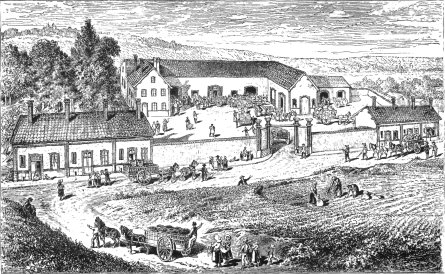
MESSRS. MOËT & CHANDON’S VENDANGEOIR AT BOUZY. (p. 106)
Before, however, the washing of bottles on this gigantic scale commences, the “marrying” or blending of the wine is accomplished in a vast apartment, 250 feet in length and 100 feet broad, during the early spring. The casks of newly-vintaged wine which have been stowed away during the winter months, in the extensive range of cellars hewn out of the chalk underlying Epernay, where they have slowly fermented, are mixed together in due proportions in huge vats, each holding upwards of 12,000 gallons. Some of this wine is the growth of Messrs. Moët and Chandon’s own vineyards, of which they possess as many as 900 acres (giving constant employment to 800 labourers and vinedressers) at Ay, Avenay, Bouzy, Cramant, Champillon, Chouilly, Dizy, Epernay, Grauves, Hautvillers, Le Mesnil, Moussy, Pierry, Saran, St. Martin, Verzy, and Verzenay, and the average annual cost of cultivating which is about £40 per acre. At Ay the firm own 210 acres of vineyards; at Cramant and Chouilly, nearly 180 acres; at Verzy and Verzenay, 120 acres; at Pierry and Grauves, upwards of 100 acres; at Hautvillers, 90 acres; at Le Mesnil, 80 acres; at Epernay, nearly 60 acres; and at Bouzy, 55 acres. Messrs. Moët and Chandon, moreover, possess vendangeoirs, or pressing-houses, at Ay, Bouzy, Cramant, Epernay, Hautvillers, Le Mesnil, Pierry, Saran, and Verzenay, in which the large number of 40 presses are installed. At these vendangeoirs no less than 5,450 pièces of fine white wine, sufficient for 1,360,000 bottles of champagne, are annually made—that is, 1,200 pièces at Ay, 1,100 at Cramant and Saran, 800 at Verzy and Verzenay, and smaller quantities at the remaining establishments. All these establishments have their celliers and their cellars, together with cottages for the accommodation of the numerous vinedressers in the employment of the firm.
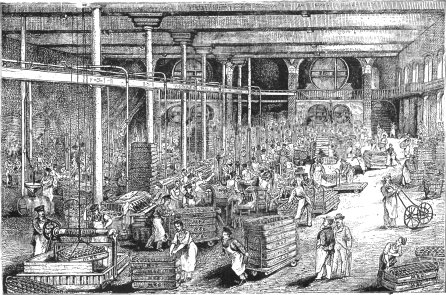
BOTTLING CHAMPAGNE AT MESSRS. MOËT & CHANDON’S, EPERNAY. (p. 107)
Extensive as are the vineyards owned by Messrs. Moët and
The casks of wine to be blended are raised from the cellars, half a dozen at a time, by means of a lift provided with an endless chain, and worked by the steam-engine of which we have already spoken. They are emptied, through traps in the floor of the room above, into the huge vats which, standing upon a raised platform, reach almost to the ceiling. From these vats the fluid is allowed to flow through hose into rows of casks stationed below. Before being bottled the wine reposes for a certain time, is next duly racked and again blended, and is eventually conveyed through silver-plated pipes into oblong reservoirs, each fitted with a dozen syphon-taps, so arranged that directly the bottle slipped on to one of them becomes full the wine ceases to flow.
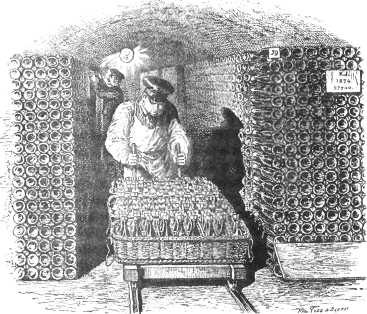
Upwards of 200 workpeople are employed in the salle de tirage at Messrs. Moët and Chandon’s, which, while the operation of bottling is going on, presents a scene of bewildering activity. Men and lads are gathered round the syphon-taps briskly removing the bottles as they become filled, and supplanting them by empty ones. Other lads hasten to transport the filled bottles on trucks to the corkers, whose so-called “guillotine” machines send the corks home with a sudden thud. The corks being secured with agrafes the bottles are placed in large flat baskets called manettes, and wheeled away on tracks, the quarts being deposited in the cellars by means of lifts, while the pints slide salle de rinçage, washed, dried, filled, corked, wired, lowered into the cellars and carefully arranged in symmetrical order. This represents a
The bottles on being lowered into the cellars, either by means of the incline or the lifts, are placed in a horizontal position, and with their uppermost side daubed with white chalk, are stacked in layers from two to half-a-dozen bottles deep with narrow oak laths between. The stacks are usually about six or seven feet high and 100 feet and upwards in length. Whilst the wine is thus reposing in a temperature of about 55° Fahrenheit, fermentation sets in, and the ensuing month is one of much anxiety. Thanks, however, to the care bestowed, Messrs. Moët and Chandon’s annual loss from bottles bursting rarely exceeds three per cent., though fifteen was once regarded as a respectable and satisfactory average. The broken glass is a perquisite of the workmen, the money arising from its sale, which at the last distribution amounted to no less than 20,000 francs, being divided amongst them every couple of years.
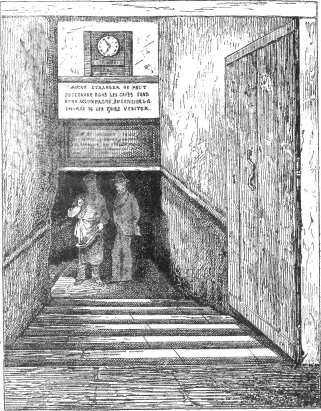
The usual entrance to Messrs. Moët and Chandon’s Epernay cellars—which, burrowed out in all directions, are of the aggregate length of nearly seven miles, and have usually between 11,000,000 and 12,000,000 bottles and 25,000 casks of wine stored therein—is through a wide and imposing portal, and down a long and broad flight of steps. It is, however, by the ancient and less imposing entrance, through which more than one crowned head has condescended to pass, that we set forth on our lengthened tour through these intricate underground galleries—this subterranean city with its miles of streets, crossroads, open spaces, tramways, and stations devoted solely to champagne. A gilt inscription on a black marble tablet testifies that “on the 26th July, 1807, Napoleon the Great, Emperor of the French, King of Italy, and Protector of the Confederation of the Rhine, honoured commerce by visiting the cellars of Jean Rémi Moët, Mayor of Epernay, President of the Canton, and Member of the General Council of the Department,” within three weeks of the signature of the treaty of Tilsit. Passing down the flight of steep slippery steps traversed by the victor of vin brut into champagne. At Messrs. Moët and Chandon’s the all-important operation of liqueuring the wine is effected by aid of machines of the latest construction, which regulate the quantity administered to the utmost nicety. The corks are
There is another and a lower depth of cellars to be explored to which access is gained by trapholes in the floor—through which the barrels and baskets of wine are raised and lowered—and by flights of steps. From the foot of the latter there extends an endless vista of lofty and spacious passages hewn out of the chalk, the walls of which, smooth as finished masonry, are lined with thousands of casks of raw wine, varied at intervals by gigantic vats. Miles of long, dark-brown, dampish-looking galleries stretch away to the right and left, and though devoid of the picturesque festoons of fungi which decorate the London Dock vaults, exhibit a sufficient degree of mouldiness to give them an air of respectable antiquity. These multitudinous galleries, lit up by petroleum-lamps, are mostly lined with wine in bottles stacked in compact masses to a height of six or seven feet, only room enough for a single person to pass being left. Millions of bottles are thus arranged, the majority on their sides, in huge piles, with tablets hung up against each stack to note its age and quality; and the rest, which are undergoing daily evolutions at the hands of the twister, at various angles of inclination. In these cellars there are nearly 11,000 racks in which the bottles of vin brut rest sur pointe, as many as 600,000 bottles being commonly twisted daily.
The way runs on between regiments of bottles of the same size and shape, save where at intervals pints take the place of quarts; and the visitor, gazing into the black depths of the transverse passages to the right and left, becomes conscious of a feeling that if his guide were suddenly to desert him he would feel as hopelessly lost as in the catacombs of Rome. There are two galleries, each 650 feet in length, containing about 650,000 bottles, and connected by 32 transverse galleries, with an aggregate length of 4,000 feet, in which nearly 1,500,000 bottles are stored. There are, further, eight galleries, each 500 feet in
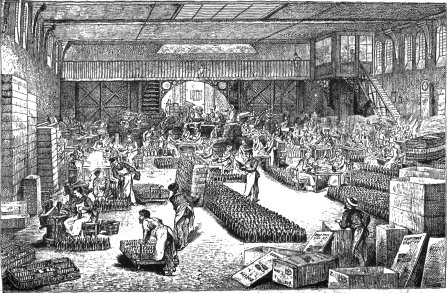
THE PACKING HALL AT MESSRS. MOËT AND CHANDON’S, EPERNAY. (p. 112)
When the proper period arrives for the bottles to emerge once more into the upper air they are conveyed to the packing-room, a spacious hall 180 feet long and 60 feet broad. In front of its three large double doors waggons are drawn up ready to receive their loads. The seventy men and women employed here easily foil, label, wrap, and pack up some 10,000 bottles a day. Cases and baskets are stacked in different parts of this vast hall, at one end of which numerous trusses of straw used in the packing are piled. Seated at tables ranged along one side of the apartment women are busily occupied in pasting on labels or encasing the necks of bottles in gold or silver foil, whilst elsewhere men, seated on three-legged stools in front of smoking caldrons of molten sealing-wax of a deep green hue, are coating the necks of other bottles by plunging them into the boiling fluid. When labelled and decorated with either wax or foil the bottles pass on to other women, who swathe them in pink tissue-paper and set them aside for the packers, by whom, after being deftly wrapped round with straw, they are consigned to baskets or cases, to secure which last no less than 10,000lbs. of nails are annually used. England and Russia are partial to gold foil, pink paper, and wooden cases holding a dozen or a couple of dozen bottles of the exhilarating fluid, whereas other nations prefer waxed necks, disdain pink paper,
Some idea of the complex character of so vast an establishment as that of Messrs. Moët and Chandon may be gathered from a mere enumeration of their staff, which, in addition to twenty clerks and 350 cellarmen proper, includes numerous agrafe-makers and corkcutters, packers and carters, wheelwrights and saddlers, carpenters, masons, slaters and tilers, tinmen, firemen, needlewomen, &c., while the inventory of objects used by this formidable array of workpeople comprises no fewer than 1,500 distinct heads. A medical man attached to the establishment gives gratuitous advice to all those employed, and a chemist dispenses drugs and medicines without charge. While suffering from illness the men receive half-pay, but should they be laid up by an accident met with in the course of their work full salary is invariably awarded to them. As may be supposed, so vast an establishment as this is not without a provision for those past work, and all the old hands receive liberal pensions from the firm upon retiring. Every year Messrs. Moët and Chandon give a banquet or a ball to the people in their employ—usually after the bottling of the wine is completed—when the hall in which the entertainment takes place is handsomely decorated and illuminated with myriads of coloured lamps.
It is needless to particularise Messrs. Moët and Chandon’s wines, which are familiar to all drinkers of champagne. Their famous “star” brand is known in all societies, figures equally at clubs and mess-tables, at garden parties and picnics, dinners and soirées, and has its place in hotel cartes all over the world. One of the best proofs of the wine’s universal popularity is found in the circumstance that as many as 1,000 visitors from all parts of the world come annually to Epernay and make the tour of Messrs. Moët and Chandon’s spacious cellars.
A little beyond Messrs. Moët and Chandon’s, in the broad Rue du Commerce, we encounter a heavy, ornate, pretentious-looking château, the residence of M. Perrier-Jouët, which presents a striking contrast to the almost mean-looking premises opposite, cuvée vat, holding no more than 2,200 gallons. In making their cuvée the firm commonly mix one part of old wine to three parts of new. An indifferent vintage, however, necessitates the admixture of a larger proportion of the older growth. The cellars, like all the more ancient ones at Epernay, are somewhat straggling and irregular, still they are remarkably cool, and on the lower floor remarkably damp as well. This, however, would appear to be no disadvantage, as the breakage in them is calculated never to exceed 2½ per cent.
The firm have no less than five qualities of champagne, and at one of the recent champagne competitions at London, where the experts engaged had no means of identifying the brands submitted to their judgment, Messrs. Perrier-Jouët’s First Quality got classed below a cheaper wine of their neighbours Messrs. Pol Roger and Co., and very considerably below the Extra Sec of Messrs. Périnet et fils, and inferior even to a wine of De Venoge’s, the great Epernay manufacturer of common class champagnes.
Champagne establishments, combined with the handsome residences of the manufacturers, line both sides of the long,
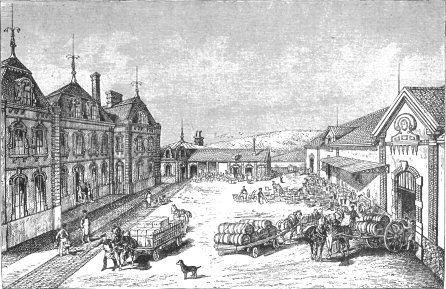
COURTYARD OF MESSRS. POL ROGER’S ESTABLISHMENT AT EPERNAY. (p. 115)
In a side street at the farther end of the Rue du Commerce stands a château of red brick, overlooking on the one side an extensive pleasure-garden, and on the other a spacious courtyard, bounded by celliers, stables, and bottle-sheds, all of modern construction and on a most extensive scale. These form the establishment of Messrs. Pol Roger and Co., settled for many years at Epernay, and known throughout the Champagne for their large purchases at the epoch of the vintage. From the knowledge they possess of the best crûs, and their relations with the leading vineyard proprietors, they are enabled whenever the wine is good to acquire large stocks of it. Having bottled a considerable quantity of the fine wine of 1874, they resolved to profit by the exceptional quality of this vintage to commence shipping champagne to England, where their agents,
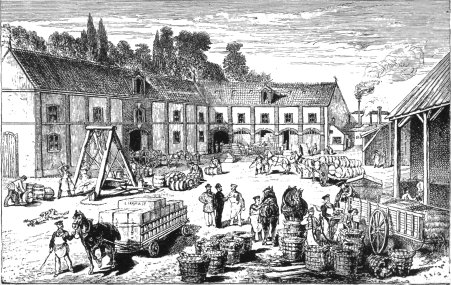
Passing through a large open gateway we enter the vast courtyard of the establishment, which, with arriving and departing carts—the first loaded with wine in cask or with new bottles, and the others with cases of champagne—presents rather an animated scene. Under a roof projecting from the wall of the vast cellier on the right hand a tribe of “Sparnaciennes”—as the feminine inhabitants of Epernay are termed—are occupied in washing bottles in readiness for the coming tirage. The surrounding buildings, most substantially constructed, are not destitute of architectural pretensions.
The extensive cellier, the area of which is 23,589 square feet, is understood to be the largest single construction of the kind in the Champagne district. Built entirely of iron, stone and brick, its framework is a perfect marvel of lightness. The roof, consisting of rows of brick arches, is covered above with a layer of Portland cement, in order to keep it cool in summer and protect it against the winter cold, two most desirable objects in connection with the manipulation of champagne. Here an endless chain of a new pattern enables wine in bottle to be lowered and raised with great rapidity to or from the cellars beneath—lofty and capacious excavations of two stories, the lowest of which is reached by a flight of no less than 170 steps.
Epernay, unlike Reims, has little of general interest to attract the stranger. Frequently besieged and pillaged during the Middle Ages, and burnt to the ground by the dauphin, son of François I., the town, although of some note as far back as the time of Clovis, exhibits to-day no evidence whatever of its great antiquity. The thoroughfare termed the Rempart de la Tour Biron recalls a memorable incident which transpired during the siege of the town by Henri IV. While the king was reconnoitring the defences a cannon-ball aimed at his waving white plume took off the head of the Maréchal Biron at the moment Henri’s hand was resting familiarly on the maréchal’s shoulder. Strange to say, the king himself escaped unhurt.
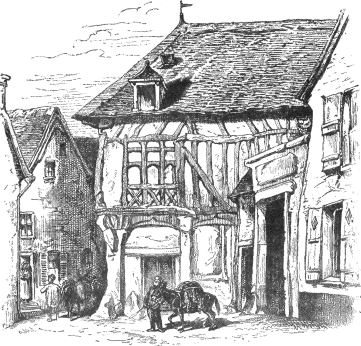
THE VENDANGEOIR OF HENRI QUATRE.
XI.—Champagne Establishments at Ay and Mareuil.
The Establishment of Deutz and Geldermann—Drawing off the Cuvée—Mode of Excavating Cellars in the Champagne—The Firm’s New Cellars, Vineyards, and Vendangeoir—The old Château of Ay and its Terraced Garden—The Gambling Propensities of Balthazar Constance Dangé-Dorçay, a former Owner of the Château—The Picturesque Situation and Aspect of Messrs. Ayala’s Establishment—A Promenade through their Cellars—M. Duminy’s Cellars and Wines—His new Model Construction—The House Founded in 1814—Messrs. Bollinger’s Establishment—Their Vineyard of La Grange—The Tirage in Progress—The Fine Cellars of the Firm—Messrs. Pfungst’s frères and Co.’s Cellars—Their Dry Champagnes of 1868, ’70, ’72, and ’74—The Old Church of Ay and its Decorations of Grapes and Vineleaves—The Vendangeoir of Henri Quatre—The Montebello Establishment at Mareuil—The Château formerly the Property of the Dukes of Orleans—A Titled Champagne Firm—The Brilliant Career of Marshal Lannes—A Promenade through the Montebello Establishment—
The historic bourgade of Ay is within a short walk of the station on the line of railway connecting Epernay with Reims. The road lies across the light bridge spanning the Marne canal, the tall trees fringing which hide for a time the clustering houses; still we catch sight of the tapering steeple of the antique church rising sharply against the green vine-covered slopes and the fleecy-clouded summer sky. We soon reach the Place de l’Hôtel de Ville, and continuing onward in the direction of the steep hills which shelter the town on the north, come to a massive-looking corner house in front of the broad porte-cochère of which some railway carts laden with cases of champagne are standing. Passing through the gateway we find ourselves in an open court, with a dwelling-house to the right and a range of buildings in front where the offices of Messrs. Deutz and Geldermann are installed. This is the central establishment of the firm, whose Extra Dry “Gold Lack” and “Cabinet” champagnes have long been favourably known in England. Here are spacious celliers for disgorging and finishing off the wine, a large packing-hall, and rooms where bales of corks and other accessories of the trade are stored, the operations of making the cuvées and bottling being accomplished in an establishment some little distance off.
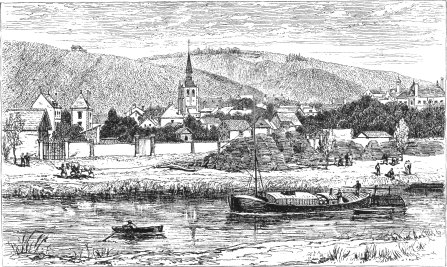
VIEW OF AY FROM THE BANKS OF THE MARNE CANAL. (p. 117.)
Proceeding thither, we find an elegant château with a charming terraced garden, lying at the very foot of the vine-clad slopes, and on the opposite side of the road some large celliers where wine in wood is stored, and where the cuvées of the firm, consisting usually of upwards of 50,000 gallons each, are made in a vat of gigantic proportions, furnished with a raised platform at one end for the accommodation of the workman who agitates the customary paddles. When the wine is completely blended it is drawn off into casks disposed for the purpose in the cellar below, as shown in the accompanying engraving, and after being fined it rests for about a month to clear itself. To each of these
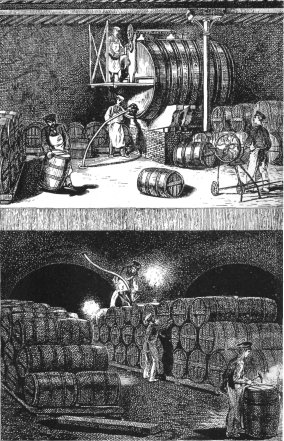
DRAWING OFF THE CUVÉE AT DEUTZ & GELDERMANN’S, AY. (p. 118)
Adjoining M. Deutz’s château is the principal entrance to the extensive cellars of the firm, to which, at the time of our visit, considerable additions were being made. In excavating a gallery the workmen commence by rounding off the roof, and then proceed to work gradually downwards, extracting the chalk, whenever practicable, in blocks suitable for building purposes, which being worth from three to four shillings the square yard help to reduce the cost of the excavation. When any serious flaws present themselves in the sides or roof of the galleries, they are invariably made good with masonry.
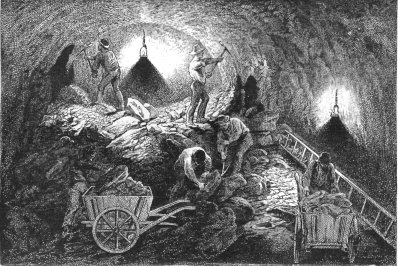
EXCAVATING DEUTZ & GELDERMANN’S NEW CELLARS, AY. (p. 119)
This range of cellars now comprises eight long and lofty galleries no less than 17 feet wide, and the same number of feet in height, and of the aggregate length of 2,200 yards. These spacious vaults, which run parallel with each other, and communicate by means of cross passages, underlie the street, the château, the garden, and the vineyard slopes beyond, and possess the great advantage of being always dry. They are capable, we were informed, of containing several million bottles of champagne in addition to a large quantity of wine in cask.
Messrs. Deutz and Geldermann possess vineyards at Ay, and own a large vendangeoir at Verzenay, where in good years they usually press 500 pièces of wine. They, moreover, make large purchases of grapes at Bouzy, Cramant, Le Mesnil, Pierry, &c, and invariably have these pressed under their own superintendence. Beyond large shipments to England, Messrs. Deutz and Geldermann transact a considerable business with other countries, and more especially with Germany, where their brand has been for years one of the most popular, and is to-day the favourite at numerous regimental messes and the principal hotels.
The old château of Ay, which dates from the early part of the last century, belongs to-day to the Count de Mareuil, a member of the firm of Ayala and Co., one of the leading establishments ancien régime. Dorçay had inherited from an aunt the châteaux of Ay, Mareuil, Boursault, and Chouilly, together with a large patrimony in land and money; but a mania for gambling brought him to utter ruin, and he dispossessed himself of money, lands, and châteaux in succession, and was reduced, in his old age, to earn a meagre pittance as a violin-player at the Paris Opera House. The old château of Boursault, which still exists contiguous to the stately edifice raised by Mme. Clicquot on the summit of the hill, was risked and lost on a single game at cards by this pertinacious gamester, whose pressing pecuniary difficulties compelled him to sell the remaining châteaux one by one. That of Ay was purchased by M. Froc de la Boulaye, and by him bequeathed to his cousin the Count de Mareuil, whose granddaughter became the wife of one of the Messrs. Ayala, and whose son is to-day their partner.
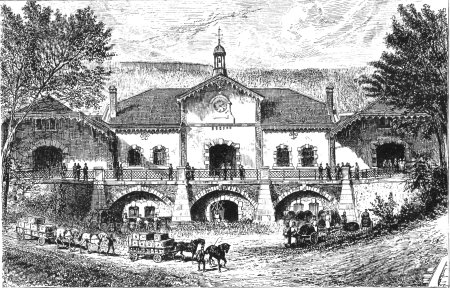
MESSRS. AYALA & CO.’S ESTABLISHMENT AT AY. (p. 121)
The offices of the firm adjoin the château, and rather higher up the hill is their very complete establishment, picturesquely situated in a hollow formed by some excavations, with the thickly-planted vine-slopes rising above its red-tiled roof. The boldly-designed basement, the ascending sweep conducting to the extensive celliers and the little centre belfry give a character of originality to the building. Carts laden with cases of champagne are leaving for the railway station, casks of wine are being transferred from one part of the establishment to another, bottles are being got ready for the approaching tirage, and in cuvée, and the bottling of the wine takes place. On descending into the basement beneath, the popping of corks and the continual clatter of machinery intimate that the disgorging and re-corking of the wine are being accomplished, and in the dim light we discern groups of workmen engaged in the final manipulation which champagne has to undergo, while fresh relays of wine are arriving from the cellars by the aid of endless chains. There are two stories of these cellars which, excavated in the chalk, extend under the road and wind round beneath the château, the more modern galleries being broad, lofty, and admirably ventilated, and provided with supports of masonry wherever the instability of the chalk rendered this requisite. After a lengthened promenade through them we come to the ancient vaults extending immediately under the grounds of the château, where every particle of available space is utilised, and some difficulty is found in passing between the serried piles of bottles of vin brut—mostly the fine wine of 1874—which rise continuously on either side.
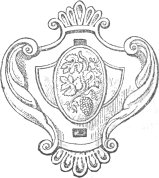
Within a hundred yards of the open space, surrounded by houses of different epochs and considerable diversity of design, where the Ay market is weekly held, and in one of the narrow winding streets common to the town, an escutcheon, with a bunch of grapes for device, surmounting a lofty gateway, attracts attention. Within, a trim courtyard, girt round with orange-trees in bright green boxes, and clipped in orthodox fashion, affords access to the handsome residence and offices of M. Duminy, well-known in England cuvée is made and the bottling of the wine accomplished.
M. Duminy’s cellars are remarkably old, and consequently of somewhat irregular construction, being at times rather low and narrow, as well as on different levels. In addition, however, to these venerable vaults, packed with wines of 1869, ’70, ’72, and ’74, M. Duminy has various subterranean adjuncts in other parts of Ay, and is at present engaged in constructing, at the foot of his vineyards up the mountain slope, a noble establishment which includes a vast court, upwards of a thousand square yards in extent, wherein are installed capacious bottle-racks and bottle-washing machines of the latest improved manufacture. Here are also handsome and extensive celliers, together with immense underground cellars, comprising broad and lofty galleries of regular design, the whole being constructed with a completeness and studied regard for convenience which bid fair to render this establishment when finished the model one of the Champagne district.
The house was originally founded so far back as 1814 by M. Taverne-Richard, who was intimately connected with the principal vineyard proprietors of the district. In 1842 this gentleman took his son-in-law, M. Duminy, father of the present proprietor of the establishment, into partnership, and after the retirement of M. Taverne he gave a great impetus to the business, and succeeded in introducing his light and delicate wines into the principal Paris hotels and restaurants. During its two-thirds of a century of existence the house has invariably confined itself to first-class wines, taking particular pride in shipping fully-matured growths. Besides its own large reserve of these, it holds considerable stocks long since disposed of, and now merely awaiting the purchasers’ orders to be shipped.
A couple of large gateways offer access to the spacious courtyard of Messrs. Bollinger’s establishment; a handsome dwelling-house standing on the right, and a small pavilion, in which the offices are installed, while on the left hand and in the rear of the courtyard rises a range of buildings of characteristic aspect, appropriated to the business of the firm. In one of the celliers, which has its open-raftered roof supported by slim metal columns, we found the tirage going on, the gang of workmen engaged in it filling, corking, and lowering into the cellars some 20,000 bottles a day. In one corner of the apartment stood the large cuvée tun—capable of holding some 50 hogsheads—in which the blending of the wine is effected, and in an adjoining cellier women were briskly labelling and wrapping up the completed bottles of champagne. The cellars, constructed some fifty years ago at a cost of nearly £12 the superficial yard, are faced entirely with stone, and are
On the northern side of Ay, some little distance from the vineyard owned by them, the firm of Pfungst frères & Cie. have their cellars, the entrance to which lies just under the lofty vine-clad ridge. Messrs. Pfungst frères lay themselves out exclusively for the shipment of high-class champagnes, and the excellent growths of the Ay district necessarily form an important element in their carefully-composed cuvées. A considerable portion of their stock consists of reserves of old wine, and we tasted here a variety of samples of finely-matured champagnes of 1868 and ’70, as well as the vintages of 1872 and ’74. All of these wines were of superior quality, combining delicacy and fragrance with dryness, the latter being their especial feature. In addition to their business with England, Messrs. Pfungst frères ship largely to India and the United States.
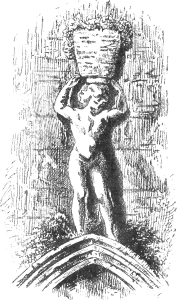
It is on this side of the town that the fine old Gothic church, dating as far back as the twelfth century, is situated. Many of the mouldings and the capitals of the columns both inside and outside the building are covered over with grape-laden vine-branches, and the sculptured figure of a boy bearing a basket of grapes upon his head surmounts the handsome Renaissance doorway, seemingly to indicate the honour in which the
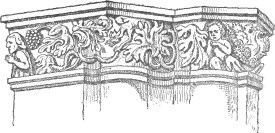
Within half-an-hour’s walk of Ay, in an easterly direction, is the village of Mareuil, a long straight street of straggling houses, bounded by trees and garden-plats, with vine-clad hills rising abruptly behind on the one side, and the Marne canal flowing placidly by on the other. The archaic church, a mixture of the Romanesque and Early Gothic, stands at the farther end of the village, and some little distance on this side of it is a massive-looking eighteenth-century building, spacious enough to accommodate a regiment of horse, but conventual rather than barrack-like in aspect, from the paucity of windows looking on to the road. A broad gateway leads into a spacious courtyard to the left of which stands a grand château, while on the right there rises an ornate round tower of three stories, from the gallery on the summit of which a fine view over the valley of the Marne is obtained. The buildings inclosing the court on three sides comprise press-houses, celliers, and packing-rooms,
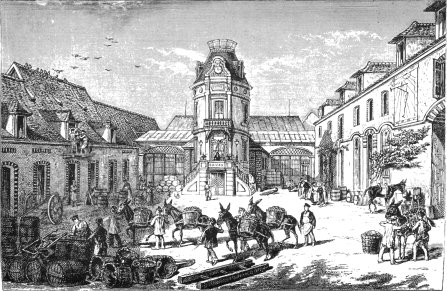
THE MONTEBELLO ESTABLISHMENT AT MAREUIL. (p. 126)
The acquisition of this property, to which were attached some important vineyards, led, several years later, to the duke’s founding, in conjunction with his brothers, the Marquis and General Count de Montebello, a champagne firm, whose brand speedily acquired a notable popularity. To-day the business is carried on by their sons and heirs, for all the original partners in the house have followed their valiant father to the grave. Struck down by an Austrian cannon-ball in the zenith of his fame, the career of Marshal Lannes, brief as it was, furnishes one of the most brilliant pages in French military annals. Joining the army of Italy as a volunteer in 1796, he was made a colonel on the battle-field in the gorges of Millesimo, when Augereau’s bold advance opened Piedmont to the French. He fought at Bassano and Lodi, took part in the assault of Pavia and the siege of Mantua, and at Arcola, when Napoleon dashed flag in hand upon the bridge, Lannes was seriously wounded whilst shielding his general from danger. He afterwards distinguished himself in Egypt, and led the van of the French army across the Alps, displaying his accustomed bravery both at Montebello and Marengo. At Austerlitz, where he commanded the right wing of the army, he greatly contributed to the victory, and at Jena, Friedland, and Eylau his valour was again conspicuous. Sent to Spain, he defeated the Spaniards at Tudela, and took part in the operations against Saragossa. Wounded at the battle of Essling, when the Archduke Charles inflicted upon Napoleon I. the first serious repulse he had met with on the field of battle, the valiant Lannes expired a few days afterwards in the Emperor’s arms.
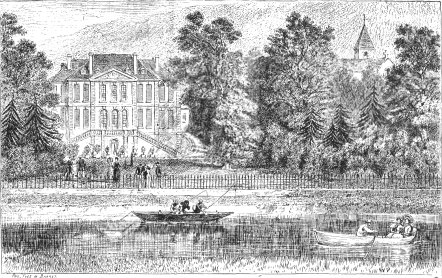
CHÂTEAU OF MAREUIL, BELONGING TO THE DUKE OF MONTEBELLO. (p. 127.)
We were met at Mareuil, on the occasion of our visit, by cuvée is made. Here the tirage likewise takes place, and in the range of buildings, roofed with glass, in the rear of the tower, the bottled wine is labelled, capped with foil, and packed in cases for transmission to Paris, England, and other places abroad.
A double flight of steps, decorated with lamps and vases, leads to the handsome offices of the firm, situated on the first floor of the tower, while above is an apartment with a panelled ceiling, gracefully decorated with groups of Cupids engaged in the vintage and the various operations which the famous wines of the Mountain and the River undergo during their conversion into champagne. On the ground floor of the tower a low doorway conducts to the spacious cellars, which, owing to the proximity of the Marne, are all on the same level as well as constructed in masonry. The older vaults, where the Marquis de Pange, a former owner of the château, stored the wine which he used to sell to the champagne manufacturers, are somewhat low and tortuous compared with the broad and lofty galleries of more recent date, which have been constructed as the growing connection of the firm obliged them to increase their stocks. Spite, however, of numerous additions, portions of their reserves have to be stored in other cellars in Mareuil. Considerable stocks of each of the four qualities of wine supplied by the firm are being got ready for disgorgement, including Cartes Noires and Bleues, with the refined Carte Blanche and the delicate Crêmant, which challenge comparison with brands of the highest repute.
In the adjacent château, the gardens of which slope down
Another champagne house of standing at Mareuil is that of Bruch-Foucher and Co., whose establishment is situated near the village mairie. Entering by a lofty porte-cochère, we notice on the left hand a spacious packing-room, where men and women are expeditiously completing some shipping order, while beyond are the offices, looking on to a terraced garden whence a pleasant view is gained of the verdant valley of the Marne. From the packing-room a broad staircase leads to the cellars beneath, which can also be reached from a venerable range of buildings on the opposite side of the road, where young wines and old cognac spirit, used in the preparation of the liqueur, are stored in the wood.
In one of these ancient celliers is a vast tun, capable of containing nearly 5,000 gallons, carved over with an elaborate device of vineleaves and bunches of grapes entwined around overflowing cornucopia and bottles of champagne. This handsome cask, in which the firm make their cuvée, is a worthy rival of the sole antique ornamental tun that still reposes in the Royal cellars at Wurzburg. In Messrs. Bruch-Foucher and Co.’s capacious cellars, faced and vaulted with stone, from eight to nine hundred thousand bottles of wine are stored. The cellars form a single story, and extend partly under the adjacent vineyard slopes, deriving light and ventilation from numerous shafts which are occasionally no less than 150 feet in height. Messrs. Bruch-Foucher and Co., who are owners of vineyards at Mareuil, ship three qualities of champagne, the finest being their Carte d’Or and their Monogram Carte Blanche. Their chief business is with England, Germany, and the United States, where their brands enjoy considerable repute.
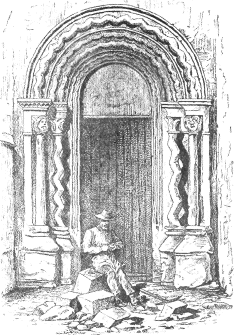
DOORWAY OF AVIZE CHURCH.
XII.—Champagne Establishments at Avize and Rilly.
Avize the Centre of the White Grape District—Its Situation and Aspect—The Establishment of Giesler and Co.—The Tirage and the Cuvée—Vin Brut in Racks and on Tables—The Packing-Hall, the Extensive Cellars, and the Disgorging Cellier—Bottle Stores and Bottle-Washing Machines—Messrs. Giesler’s Wine-Presses at Avize and Vendangeoir at Bouzy—Their Vineyards and their Purchases of Grapes—Reputation of the Giesler Brand—The Establishment of M. Charles de Cazanove—A Tame Young Boar—Boar-Hunting in the Champagne—M. de Cazanove’s Commodious Cellars and Carefully-Selected Wines—Vineyards Owned by Him and His Family—Reputation of his Wines in Paris and their Growing Popularity in England—Interesting View from M. de Cazanove’s Terraced Garden—The Vintaging of the White Grapes in the Champagne—Roper frères’ Establishment at Rilly-la-Montagne—Their Cellars Penetrated by Roots of Trees—Some Samples of Fine Old Champagnes—The Principal Châlons Establishments—Poem on Champagne by M. Amaury de Cazanove.
Avize, situated in the heart of the Champagne white grape district, may be reached from Epernay by road through Pierry and Cramant or by the Châlons Railway to Oiry Junction, between which station and Romilly there runs a local line, jocularly termed the chemin de fer de famille, from the general disregard displayed by the officials for anything approaching to punctuality. Avize can scarcely be styled a town, and yet its growing proportions are beyond those of an ordinary village. It lies pleasantly nestled among the vines, sheltered by bold ridges on the north-west, with the monotonous plains of La Champagne pouilleuse, unsuited to the cultivation of the vine, stretching away eastward in the direction of Châlons. Avize cannot pretend to the same antiquity as its neighbour Vertus, and lacks the many picturesque vestiges of which the latter can boast. Its church dates back only to the 15th century, although the principal doorway in the Romanesque style evidently belongs to a much earlier epoch. There is a general air of trim prosperity about the place, and the villagers have that well-to-do appearance common to the inhabitants of the French wine districts. Only at vintage time, however, are there any particular outdoor signs of activity, although half a score of champagne firms have their establishments here, giving employment to the bulk of the population, and sending forth their two or three million bottles of the sparkling wine of the Marne annually.
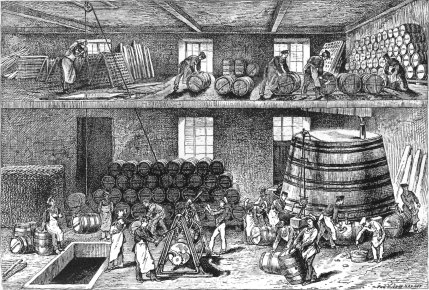
MAKING THE CUVÉE AT MESSRS. GIESLER’S, AT AVIZE. (p.131)
Proceeding along the straight level road leading from the station to the village we encounter on our right hand the premises of Messrs. Giesler and Co., the reputation of whose brand is universal. When M. Giesler quitted the firm of P. A. Mumm, Giesler, and Co., at Reims, in 1838, he removed to Avize and founded the present extensive establishment. Entering through a large open gateway we find ourselves within a spacious courtyard with a handsome dwelling-house in the rear, and all the signs of a champagne business of magnitude apparent. A spiral staircase conducts to the counting-house on the first story of a range of buildings on the left hand, the ground floor of which is divided into celliers. Passing through cuvée tun wherein some fifty hogsheads of the finest Champagne growths are blended together at one time, two hundred hogsheads being thus mingled daily while the cuvées are in progress. The casks of wine having been hoisted from the cellars to the first floor by a crane, and run on to a trough, their bungs are removed, and the wine flows through an aperture in the floor into the huge tun beneath, its amalgamation being accomplished by the customary fan-shaped appliances, set in motion by the turning of a wheel. In an adjacent room is the machine used for mixing the liqueur which Messrs. Giesler add so sparingly to their light and fragrant wines.
There are a couple of floors above these celliers, the uppermost of which is used as a general store, while in the one beneath many thousands of bottles of vin brut repose sur pointe, either in racks or on tables as at the Clicquot-Werlé establishment. This latter system requires ample space, for as the remueur, or workman who shakes the bottles, is only able to use one hand, the operation of dislodging the sediment necessarily occupies a much longer time than is requisite when the bottles rest in racks.
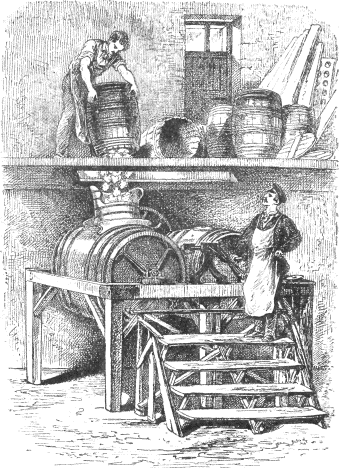
PREPARING THE LIQUEUR AT MESSRS. GIESLER’S.
The buildings on the opposite side of the courtyard comprise a large packing-hall, celliers where the wine is finished off, and rooms where corks and such-like things are stored. Here, too, is the entrance to the cellars, of which there are three tiers, all lofty and well-ventilated galleries, very regular in their construction, and faced with either stone or brick. In these extensive vaults are casks of fine reserved wines for blending with youthful vintages, and bottles of vin brut, built up in solid stacks, that may be reckoned by their hundreds of thousands. At Messrs. Giesler’s the disgorging of the wine is accomplished in dégorgeurs, isolated from the rest of the workpeople, are carrying on their operations here by candlelight. So soon as the sediment is removed the bottles are raised in baskets to the cellier above, where the liqueuring, re-corking, stringing, and wiring are successively accomplished. By pursuing this plan the loss sustained by the disgorgement is believed to be reduced to a minimum.
Extensive as these premises are they are still insufficient for the requirements of the firm, and across the road is a spacious building where new bottles are stored and the washing of the bottles in preparation for the tirage takes place. By the aid of the machinery provided, sixteen women, assisted by a couple of men, commonly wash some fifteen or sixteen thousand bottles in the course of a day. Here, too, stands one of the two large presses with which at the epoch of the vintage a hundred pièces of wine are pressed every four-and-twenty hours. The remaining press is installed in a cellier at the farther end of the garden on the other side of the road. Messrs. Giesler possess additional presses at their vendangeoir at Bouzy, and during the vintage have the command of presses at Ay, Verzenay, Vertus, Le Mesnil, &c., it being a rule of theirs always to press the grapes within a few hours after they are gathered to obviate their becoming bruised by their own weight and imparting a dark colour to the wine, a contingency difficult to guard against in seasons when the fruit is over-ripe. The firm own vineyards at Avize, and have agreements with vine-proprietors at Ay, Bouzy, Verzenay, and elsewhere, to purchase their crops regularly every year. Messrs. Giesler’s brand has secured its existing high repute solely through the fine quality of the wines shipped by the house—wines which are known and appreciated by all real connoisseurs of champagne.