FACTS ABOUT CHAMPAGNE (continued 3)
Reading edition
From Messrs. Giesler’s it is merely a short walk to the establishment of M. Charles de Cazanove, situated in the principal street of Avize. On entering the court we encountered a tame young boar engaged in the lively pursuit of chasing some As You Like It, and whose gloomy depths and tangled glens shelter to-day not merely boars but wolves as well.
In the Champagne it is no longer the fashion
“With javelin’s point a churlish swine to gore,”
nor to hunt the boar on horseback, as is still the case in Burgundy. When the presence of one or more of these animals is signalled in the neighbourhood, a party starts off accompanied by dogs and armed with double-barrelled rifles. A circle having been formed round the boar’s lair the dogs are set to draw him out, while the chasseurs keep on the alert so as not to allow him to escape through their circle alive. In this manner a few score of boars are killed every year in the woods round about Reims and Epernay.
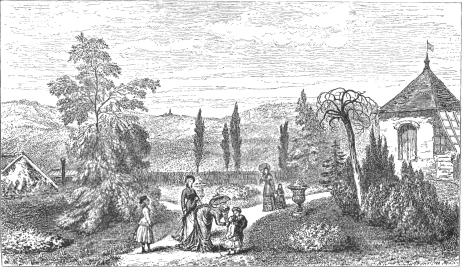
VINEYARDS OF AVIZE AND CRAMANT FROM THE GARDEN OF M. C. DE CAZANOVE. (p. 135.)
The house of M. Charles de Cazanove was established in 1843 by its present proprietor on the foundation of a business which had been in existence since 1811. Compared with the monumental grandeur of some of the great Reims and Epernay establishments the premises present a simple and modest aspect, nevertheless they are capacious and commodious, besides which the growing business of the house has led to the acquisition of additional cellarage in other parts of Avize. More important than all, however, is the quality of the wine with which these cellars are stocked, and following the rule observed by champagne firms of the highest repute, it has been a leading principle with M. de Cazanove always to rely upon the choicer growths—those
M. de Cazanove’s wines are much appreciated in Paris, where his business is very extensive. His shipments to England are also considerable, but from the circumstance of some of his principal customers importing the wine under special brands of their own, the brand of the house is not so widely known as we should have expected.
From M. de Cazanove’s terraced garden in the rear of his establishment a fine view is obtained of one of the most famous viticultural districts of the Champagne, yielding wines of remarkable delicacy and exquisite bouquet. On the left hand rises up the mountain of Avize, its summit fringed with dense woods, where in winter the wild boar has his lair. In front stretch the long vine-clad slopes of Cramant, with orchards at their base, and the housetops of the village and the spire of the quaint old church just peeping over the brow of the hill. To the right towers the bold forest-crowned height of Saran with M. Moët’s château perched half-way up its north-eastern slope, and fading away in the hazy distance are the monotonous plains of the Champagne.
We have already explained that the wines of Avize and Cramant rank as premiers crûs of the white grape district, and that every champagne manufacturer of repute mingles one or the other in his cuvée. The white grapes are usually gathered a fortnight or three weeks later than the black varieties, but in other respects the vintaging of them is the same. The grapes éplucheuses, and all unripe, damaged, and rotten berries being thrown aside, the fruit is conveyed with due care to the press-houses in the large baskets known as paniers mannequins. The pressing takes place under exactly the same conditions as the pressing of the black grapes; the must, too, is drawn off into hogsheads to ferment, and by the end of the year, when the active fermentation has terminated, the wine is usually clear and limpid.
At Rilly-la-Montagne, on the line of railway between Reims and Epernay, Roper frères & Cie., late of Epernay, now have their establishment. Starting from the latter place we pass Ay and Avenay, and then the little village of Germaine in the midst of the forest, and nigh the summit of the mountain of Reims, with its “Rendezvous des Chasseurs” in immediate proximity to the station. Finally we arrive at Rilly, which, spite of its isolated situation, has about it that aspect of prosperity common to the more favourable wine districts of France. This is scarcely surprising when the quality of its wines is taken into consideration. The still red wine of Rilly has long enjoyed a high local reputation, and to-day the Rilly growths are much sought after for conversion into champagne. White wine of 1874 from black grapes fetched, we were informed, as much as from 600 to 700 francs the pièce, while the finer qualities from white grapes realised from 300 to 400 francs. Messrs. Roper frères & Cie. are the owners of some productive vineyards situated on the high road to Chigny and Ludes.
The establishment of Roper frères is adjacent to a handsome modern house standing back from the road in a large and pleasant garden, bounded by vineyards on two of its sides. In the celliers all the conveniences pertaining to a modern champagne establishment are to be found, while extending beneath the garden are the extensive cellars of the firm, comprising two stories of long and spacious galleries excavated in the chalk, their walls and roofs being supported whenever necessary by masonry. A curious feature about these cellars is that the roots of the larger trees in the garden above have penetrated through Vin Brut or natural champagne of which the firm make a speciality at a moderate price—some choice old champagnes were brought forth, including the fine vintages of 1865, 1857, and 1846. The latter wine had of course preserved very little of its effervescence, still its flavour was exceedingly fine, being soft and delicate to a degree. At the Vienna Exhibition of 1873 and the London Exhibition of 1874 the collection of champagnes exhibited by Roper frères met with favourable recognition from the international juries.
Our tour through the Champagne vineyards and wine-cellars here comes to an end. It is true there are important establishments at Châlons, notably those of Jacquesson et fils, the Perriers, Freminet et fils, and Jacquard frères, the cellars of the first-named being, perhaps, unrivalled in the Champagne. As, however, any description of these establishments would be little else than a recapitulation of something we have already said, we content ourselves with merely notifying their existence, and bring our Facts about Champagne to a close with the translation of a poem from the pen of M. Amaury de Cazanove of Avize:—
CHAMPAGNE.
Less for thy grace and glory, land of ours,
Than for thy dolour, dear; Let the grief go, and here—
Here’s to thy skies, thy women and thy flowers! France! take the toast, thy women and thy roses,
France! to thy wine, more wealth unto thy store!
And let the lips a grievous memory closes
Smile their proud smile once more!
Swarthy Falernian, Massica the Red,
Were ye the nectars poured At the great gods’ broad board?
No, poor old wines, all but in name long dead, Nectar’s Champagne, the sparkling soul of mirth,
That bubbling o’er with laughing gas, Flashes gay sunbeams in the glass,
And like our flag goes proudly round the earth.
“I am the blood Burgundian sunshine makes;
A fine old feudal knight Of bluff and boisterous might,
Whose casque feels—ah, so heavy when one wakes!” “And I, the dainty Bordeaux, violets’
Perfume, and whose rare rubies gourmets prize.
My subtile savour gets
In partridge wings its daintiest allies.”
Ah, potent chiefs, Bordeaux and Burgundy.
If we must answer make, This sober counsel take:
Messeigneurs, sing your worth less haughtily, For ’tis Champagne, the sparkling soul of mirth,
That bubbling o’er with laughing gas, Flashes gay sunbeams in the glass,
And like our flag goes proudly round the earth.
Aye, ’tis the true, the typic wine of France;
Aye, ’tis our heart that sparkles in our eyes,
And higher beats for every dire mischance;
It was the wit that made our fathers wise,
That made their valour gallant, gay,
When plumes were stirr’d by winds of waving swords, And chivalry’s defiance spoke the words:
“À vous, Messieurs les Anglais, les premiers!”
Let the dull beer-apostle till he’s hoarse
Vent his small spleen and spite, Fate fill his sleepless night
With nightmares of invincible remorse! We sing Champagne, the sparkling soul of mirth,
That bubbling o’er with laughing gas, Flashes gay sunbeams in the glass,
And like our flag goes proudly round the earth.
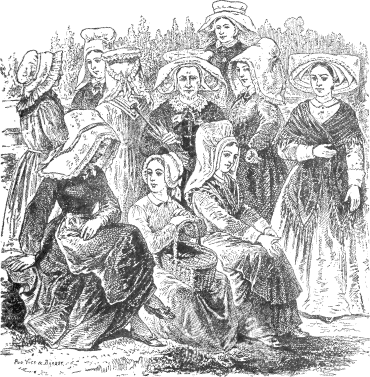
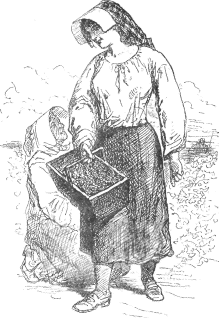
PEASANT WOMEN OF THE ENVIRONS OF SAUMUR.
XIII.—Sparkling Saumur and Sparkling Sauternes.
The Sparkling Wines of the Loire often palmed off as Champagnes—The Finer qualities Improve with Age—Anjou the Cradle of the Plantagenet Kings—Saumur and its Dominating Feudal Château and Antique Hôtel de Ville—Its Sinister Rue des Payens and Steep Tortuous Grande Rue—The Vineyards of the Coteau of Saumur—Abandoned Stone Quarries converted into Dwellings—The Vintage in Progress—Old-fashioned Pressoirs—The Making of the Wine—The Vouvray Vineyards—Balzac’s Picture of La Vallée Coquette—The Village of Vouvray and the Château of Moncontour—Vernou with its Reminiscences of Sully and Pépin-le-Bref—The Vineyards around Saumur—Remarkable Ancient Dolmens—Ackerman-Laurance’s Establishment at Saint-Florent—Their Extensive
After the Champagne Anjou is the French province which ranks next in importance for its production of sparkling wines. Vintaged on the banks of the Loire, these are largely consigned to the English and other markets, labelled Crême de Bouzy, Sillery and Ay Mousseux, Cartes Noires and Blanches, and the like, while their corks are branded with the names of phantom firms, supposed to be located at Reims and Epernay. As a rule these wines come from around Saumur, but they are not necessarily the worse on that account, for the district produces capital sparkling wines, the finer qualities of which improve greatly by being kept for a few years. One curious thing shown to us at Saumur was the album of a manufacturer of sparkling wines containing examples of the many hundred labels ticketed with which his produce had for years past been sold. Not one of these labels assigned to the wines the name of their real maker or their true birthplace, but introduced them under the auspices of mythical dukes and counts, as being manufactured at châteaux which are so many “castles in Spain,” and as coming from Ay, Bouzy, Châlons, Epernay, Reims, and Verzenay, but never by any chance from Saumur.
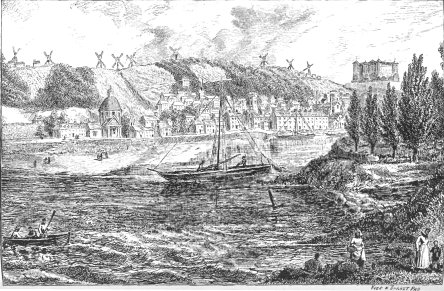
THE VINEYARDS OF THE COTEAU DE SAUMUR. (p. 141)
Being produced from robuster growths than the sparkling wines of the Department of the Marne, sparkling saumur will always lack that excessive lightness which is the crowning grace
To an Englishman Anjou is one of the most interesting of the ancient provinces of France. It was the cradle of the Plantagenet Kings, and only ten miles from Saumur still repose the bones of Henry, the first Plantagenet, and Richard of the Lion Heart, in the so-called Cimetière des Rois of the historic abbey of Fontevrault. The famous vineyards of the Coteau de Saumur, eastward of the town and bordering the Loire, extend as far as here, and include the communes of Dampierre, Souzay, Varrains, Chacé, Parnay, Turquant, and Montsoreau, the last-named within three miles of Fontevrault, and chiefly remarkable through its seigneur of ill-fame, Jean de Chambes, who instigated his wife to lure Boissy d’Amboise to an assignation in order that he might more surely poignard him. Saumur is picturesquely placed at the foot of this bold range of heights near where the little river Thouet runs into the broad and rapid Loire. A massive-looking old château perched on the summit of an isolated crag stands out grandly against the clear sky and dominates the town, the older houses of which crouch at the foot of the lofty hill and climb its steepest sides. The restored antique Hôtel de Ville, in the pointed style, with its elegant windows, graceful belfry, and florid wrought-iron balconies, stands back from the quay bordering the Loire. In the rear is the Rue des Payens, whither the last of the Huguenots of this “metropolis of Protestantism,” as it was formerly styled, retired, converting their houses into so many fortresses to guard against being surprised by their Catholic adversaries. Adjacent is the steep tortuous Grande Rue, of which Balzac—himself a Tourangeau—has given such a graphic picture in his Eugénie Grandet, the scene of which is laid at Saumur. To-day, however,
The vineyards of the Coteau de Saumur, yielding the finest wines, are reached by the road skirting the river, the opposite low banks of which are fringed with willows and endless rows of poplars, which at the time of our visit were already golden with the fading tints of autumn. Numerous fantastic windmills crown the heights, the summit of which is covered with vines, varied by dense patches of woodland. Here, as elsewhere along the banks of the Loire, the many abandoned quarries along the face of the hill have been turned by the peasants into cosy dwellings by simply walling-up the entrances while leaving, of course, the necessary apertures for doors and windows. Dampierre, the first village reached, has many of these cave-dwellings, and numbers of its houses are picturesquely perched up the sides of the slope. The holiday costumes of the peasant women encountered in the neighbourhood of Saumur are exceedingly quaint, their elaborate and varied head-dresses being counterparts of coiffures in vogue so far back as three and four centuries ago.
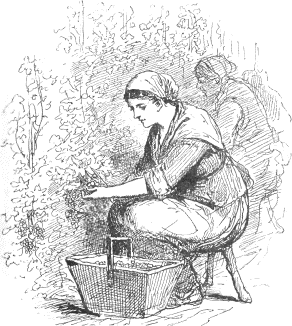
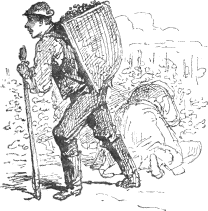
Quitting the banks of the river, we ascend a steep tortuous road shut in on either side by high stone walls—for hereabouts all the best vineyards are scrupulously inclosed—and finally reach the summit of the heights, whence a view is gained over what the Saumurois proudly style the grand valley of the Loire. Everywhere around the vintage is going on. The vines are planted rather more than a yard apart, and those yielding black grapes are trained, as a rule, up tall stakes, although some few are trained espalier fashion. Women dexterously detach the bunches with pruning-knives and throw them into the seilles—small squat buckets with wooden handles—the contents of which are emptied from time to time into baskets—the counterpart of the chiffonnier’s hotte, and coated with pitch inside so as to close all the crevices of the wickerwork—which the portes-bastes carry slung to their backs. When white wine is being made from black
The black grape yielding the best wine in the Saumur district is the breton, said to be the same as the carbinet-sauvignon, the leading variety in the grand vineyards of the Médoc. Other species of black grapes cultivated around Saumur are the varennes, yielding a soft and insipid wine of no kind of value, and the liverdun, or large gamay, the prevalent grape in the Mâconnais, and the same which in the days of Philippe-le-Hardi the parlements of Metz and Dijon interdicted the planting and cultivation of. The prevalent white grapes are the large and small pineau blanc, the bunches of the former being of an intermediate size, broad and pyramidal in shape, and with the berries close together. These have fine skins, are oblong in shape, and of a transparent yellowish-green hue tinged with red, are very sweet and juicy, and as a rule ripen late. As for the small pineau, the bunches are less compact, the berries are round and of a golden tint, are finer as well as sweeter in flavour, and ripen somewhat earlier than the fruit of the larger variety.
We noticed as we drove through the villages of Champigny and Varrains—the former celebrated for its fine red wines, and more especially its crû of the Clos des Cordeliers—that hardly any of the houses had windows looking on to the narrow street, but that all were provided with low openings for shooting the grapes into the cellar where, when making red wine, they are trodden, but when making white wine, whether from black or white grapes, they are invariably pressed. Each of the houses had its ponderous porte-cochère and low narrow portal leading into the large inclosed yard at its side, and over the high blank walls vines were frequently trained and pleasantly varied their dull grey monotony.
The grapes on being shot into the openings just mentioned fall through a kind of tunnel into a reservoir adjacent to the heavy press, which is invariably of wood and of the old-fashioned
The vintaging of the white grapes takes place about a fortnight later than the black grapes, and is commonly a compound operation, the best and ripest bunches being first of all gathered just as the berries begin to get shrivelled and show symptoms of approaching rottenness. It is these selected grapes that yield the best wine. The second gathering, which follows shortly after the first, includes all the grapes remaining on the vines, and yields a wine perceptibly inferior in quality. The grapes on their arrival at the press-house are generally pressed immediately and the must is run off into tuns to ferment. At the commencement these tuns are filled up every three or four days to replace the fermenting must which has flowed over; afterwards any waste is made good at the interval of a week, and then once a fortnight, the bungholes of the casks being securely closed towards the end of the year, by which time the first fermentation is over.
It should be noted that the Saumur sparkling wine manufacturers draw considerable supplies of the white wine required to impart lightness and effervescence to their vin préparé from the Vouvray vineyards. Vouvray borders the Loire a few miles from the pleasant city of Tours, which awakens sinister recollections of truculent Louis XI., shut up in his fortified castle of Plessis-lez-Tours, around which Scott has thrown the halo of his genius in his novel of Quentin Durward. On proceeding to Vouvray from Tours we skirt a succession of poplar-fringed meadows stretching eastward in the direction of Amboise along La Comédie Humaine, some forty years ago, has scarcely changed at the present day.
At the point where the village of Vouvray climbs half-way up the vine-crested ridge the rapid-winding Cise throws itself into the Loire, and on crossing the bridge that spans the tributary stream we discern on the western horizon, far beyond the verdant islets studding the swollen Loire, the tall campaniles of Tours Cathedral, which seem to rise out of the water like a couple of Venetian towers. Vouvray is a trim little place, clustered round about with numerous pleasant villas in the midst of charming gardens. The modern château of Moncontour here
The communes of Dampierre, Souzay, and Parnay, in the neighbourhood of Saumur, produce still red wines rivalling those of Champigny, besides which all the finest white wines are vintaged hereabouts—in the Perrière, the Poilleux, and the Clos Morain vineyards, and in the Rotissans vineyard at Turquant. Wines of very fair quality are also grown on the more favourable slopes extending southwards along the valley of the Thouet, and comprised in the communes of Varrains, Chacé, St. Cyr-en-Bourg, and Brézé. The whole of this district, by the way, abounds with interesting archæological remains. While visiting the vineyards of Varrains and Chacé we came upon a couple of dolmens—vestiges of the ancient Celtic population of the valley of the Loire singularly abundant hereabouts. Brézé, the marquisate of which formerly belonged to Louis XVI.’s famous grand master of the ceremonies—immortalized by the rebuff he received from Mirabeau—boasts a noble château on the site of an ancient fortress, in connection with which there are contemporary excavations in the neighbouring limestone, designed for a garrison of 500 or 600 men. Beyond the vineyards of Saint-Florent, westward of Saumur and on the banks
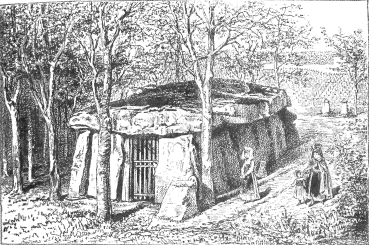
DOLMEN AT BAGNEUX, NEAR SAUMUR.
At Saint-Florent, the pleasant little suburb of Saumur, skirting the river Thouet, and sheltered by steep hills formed of soft limestone, offering great facilities for the excavation of extensive cellars, the largest manufacturer of Saumur sparkling wines has his establishment. Externally this offers but little to strike the eye. A couple of pleasant country houses, half hidden by spreading foliage, stand at the two extremities of a spacious and well-kept garden, beyond which one catches a glimpse of some outbuildings sheltered by the vine-crowned cliff, in which a labyrinth of gloomy galleries has been hollowed out. Here
At the commencement of the present century, in the days when, as Balzac relates in his Eugénie Grandet, the Belgians bought up entire vintages of Saumur wine, then largely in demand with them for sacramental purposes, the founder of the Saint-Florent house commenced to deal in the ordinary still wines of the district. Nearly half a century ago he was led to attempt the manufacture of sparkling wines, but his efforts to bring them into notice failed, and he was on the point of abandoning his enterprise when an order for one hundred cases revived his hopes, and led to the foundation of the present vast establishment. As already mentioned, for many miles all the heights along the Loire have been more or less excavated for stone for building purposes, so that every one hereabouts who grows wine or deals in it has any amount of cellar accommodation ready to hand. It was the vast extent of the galleries which M. Ackerman père discovered already excavated at Saint-Florent that induced him to settle there in preference to Saumur. Extensive, however, as the original vaults were, considerable additional excavations have from time to time been found necessary; and to-day the firm is still further increasing the area of its cellars, which already comprise three principal avenues, each the third of a mile long, and no fewer than sixty transverse galleries, the total length of which is several miles. One great advantage is that the whole are on the ordinary level.
Ranged against the black uneven walls of the more tortuous ancient vaults which give access to these labyrinthine corridors are thousands of casks of wine—some in single rows, others in triple tiers—forming the reserve stock of the establishment. As may be supposed, a powerful vinous odour permeates these vaults, in which the fumes of wine have been accumulating for the best part of a century. After passing beneath a massive stone arch which separates the old cellars from the new, a series of
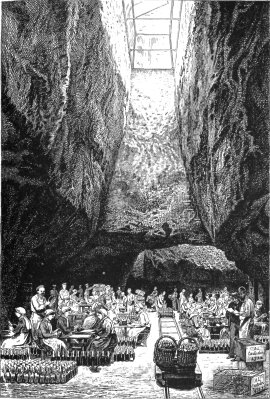
THE CELLARS OF M. ACKERMAN-LAURANCE AT SAINT-FLORENT. LABELLING AND PACKING SPARKLING SAUMUR. (p. 150.)
We have explained that in the Champagne it is the custom for the manufacturers of sparkling wine to purchase considerable quantities of grapes from the surrounding growers, and to press these themselves, or have them pressed under their own superintendence. At Saumur only those firms possessing vineyards make their own vin brut, the bulk of the wine used for conversion into sparkling wine being purchased from the neighbouring growers. On the newly-expressed must arriving at M. Ackerman-Laurance’s cellars it is allowed to rest until the commencement of the ensuing year, when half of it is mixed with wine in stock belonging to last year’s vintage, and the remaining half is reserved for mingling with the must of the ensuing vintage. The blending is accomplished in a couple of colossal vats hewn out of the rock, and coated on the inside with cement. Each of these vats is provided with 200 paddles for thoroughly mixing the wine, and with five pipes for drawing it off when the amalgamation is complete. Usually the cuvée will embrace 1,600 hogsheads, or 80,000 gallons of wine, almost sufficient for half a million bottles. A fourth of this quantity can be mixed in each vat at a single operation, and this mixing is repeated again and again until the last gallon run off is of precisely the same type as the first. For the finer qualities of sparkling saumur the proportion of wine from the black grapes to that from white is generally at the rate of three or four to one. For the inferior qualities more wine from white than from black grapes is invariably used. Only in the wine from white grapes is the effervescent principle retained to any particular extent; but, on the other hand, the wine from black grapes imparts both quality and vinous character to the blend.
It is in a broad but sombre gallery of the more ancient vaults—the roughly-hewn walls of which are black from the combined action of alcohol and carbonic acid gas—that the processes of disgorging the wine of its sediment, adding the syrup, filling up the bottles with wine to replace that which gushes out when the disgorging operation is performed, together with the re-corking, stringing, and wiring of the bottles, are carried on. The one or two adjacent shafts impart very little light, but a couple of resplendent metal reflectors, which at a distance one might fancy to be some dragon’s flaming eyes, combined with the lamps placed near the people at work, effectually illuminate the spot.
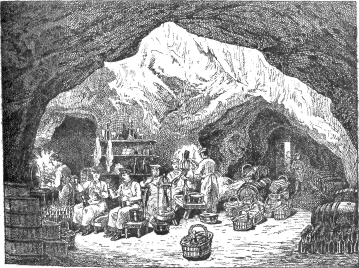
THE CELLARS OF M. LOUIS DUVAU AÎNÉ AT THE CHÂTEAU OF VARRAINS.
Another considerable manufacturer of sparkling saumur is M. Louis Duvau aîné, owner of the château of Varrains, in the village of the same name, at no great distance from the Coteau de Saumur. His cellars adjoin the château, a picturesque but somewhat neglected structure of the last century, with sculptured medallions in high relief above the lower windows, and florid vases surmounting the mansards in the roof. In front is a large rambling court shaded with acacia and lime trees, and surrounded by outbuildings, prominent among which is a picturesque
Gradual inclines conduct to the two lower tiers of galleries, for the cellars of M. Duvau consist of as many as three stories. Down below there is naturally less light, and the temperature, too, is sensibly colder. Advantage is taken of this latter circumstance to remove the newly-bottled wine to these lower vaults whenever an excessive development of carbonic acid threatens the bursting of an undue proportion of bottles, a casualty which among the Saumur sparkling wine manufacturers ranges far higher than with the manufacturers of champagne. For the economy of time and labour a lift, raised and lowered by means of a capstan worked by horses, is employed to transfer the bottles of wine from one tier of cellars to another.
The demand for sparkling saumur is evidently on the increase, for M. Duvau, at the time of our visit, was excavating extensive additional cellarage. The subsoil at Varrains being largely composed of marl, which is much softer than the tufa of the Saint-Florent coteau, necessitated the roofs of the new galleries being worked in a particular form in order to avoid having recourse to either brickwork or masonry. Tons of this excavated marl were being spread over the soil of M. Duvau’s vineyard in the rear of the château, greatly, it was said, to the benefit of the vines, whose grapes were all of the black variety; indeed, scarcely any wine is vintaged from white grapes in the commune of Varrains.
Another sparkling saumur manufacturer of note is M. Alfred Rousteaux, to-day the sole proprietor of the well-known brand of Morlet and Rousteaux, a firm established for many years at Saint-Florent. M. Rousteaux’s cellars here are excavated in the tufa cliff which rises behind the little suburban village, and are all on one level. The galleries, though somewhat winding and irregular, are broad and roomy, and in them about 400,000 bottles of wine undergoing the necessary treatment are piled up in stacks or placed sur pointe. The original firm had only been in existence a few years when they found that their Saint-Florent establishment was inadequate to the requirements of a largely-increasing business, and they started the branch establishment of La Perrière at Saint-Cyr, near Tours, but on the opposite bank of the Loire. Here are a handsome residence and gardens, a spacious court, and convenient celliers where the bottling of the wine is effected, together with extensive and well-constructed cellars in which a like quantity of wine to that contained in the cellars at Saint-Florent is stored. With his finer sparkling wines M. Rousteaux mixes a certain proportion of wine from the Champagne district, and thus secures a degree of lightness unattainable when the cuvée is exclusively composed of Saumur vintages. At La Perrière M. Rousteaux has a vineyard of upwards of sixty acres, yielding the best wine of the district, which is noted, by the way, for its excellent growths. Hereabouts a succession of vineyard slopes stretch from one to another of the many historic châteaux along this portion of the Loire, the romantic associations of which render the Touraine one of the most interesting provinces of France. Near Tours besides the vineyards of Saint-Cyr are those of Joué and Saint-Avertin; the two last situate on the opposite à hauteur d’infamie” as we see them now.
Finding that sparkling wines were being made in most of the wine-producing districts of France, where the growths were sufficiently light and of the requisite quality, Messrs. E. Normandin and Co. conceived the idea of laying the famous Bordeaux district under contribution for a similar purpose, and, aided by a staff of experienced workmen from Epernay, they have succeeded in producing a sparkling sauternes. Sauternes, as is well known, is one of the finest of white wines, soft, delicate, and of beautiful flavour, and its transformation into a sparkling wine has been very successfully accomplished. Messrs. Normandin’s head-quarters are in the thriving little town of Châteauneuf, in the pleasant valley of the Charente, and within fifteen miles of Angoulême, a famous old French town, encompassed by ancient ramparts and crumbling corner towers, and which, dominated by the lofty belfry of its restored semi-Byzantine cathedral, rising in a series of open arcades, spreads itself picturesquely out along a precipitous height, watered at its base by the rivers Anguienne and Charente. Between Angoulême and Châteauneuf vineyard plots dotted over with walnut trees, or simple rows of vines divided by strips of ripening maize, and broken up at intervals by bright green pastures, line both banks of the river Charente. The surrounding country is
Châteauneuf communicates with the Sauternes district by rail, so that supplies of wine from there are readily obtainable. Vin de Colombar—a famous white growth which English and Dutch cruisers used to ascend the Charente to obtain cargoes of when the Jerez wines were shut out from England by the Spanish War of Succession—vintaged principally at Montignac-le-Coq, also enters largely into Messrs. Normandin and Co.’s sparkling sauternes cuvée. This colombar grape is simply the semillon—one of the leading varieties of the Sauternes district—transported to the Charente. The remarkably cool cellars
In order that the delicate flavour of the wine may be preserved the liqueur is prepared with the finest old sauternes, without any addition of spirit, and the dose is administered with the most improved modern appliance, constructed of silver, and provided with crystal taps. At the Concours Régional d’Angoulême of 1877, the jury, after recording that they had satisfied themselves by the aid of a chemical analysis that the samples of sparkling sauternes submitted to their judgment were free from any foreign ingredient, awarded to Messrs. Normandin and Co. the only gold medal given in the Group of Alimentary Products.
Encouraged, no doubt, by the success obtained by Messrs. Normandin and Co. with their sparkling sauternes, the house of Lermat-Robert and Co., of Bordeaux, have recently introduced a sparkling barsac, samples of which were submitted to the jury at the Paris Exhibition of 1878.
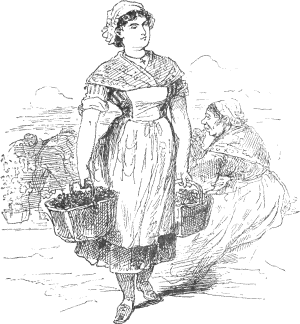
VINTAGER OF THE CÔTE D’OR
XIV.—The Sparkling Wines of Burgundy and the Jura.
Sparkling Wines of the Côte d’Or at the Paris Exhibition—Chambertin, Romanée, and Vougeot—Burgundy Wines and Vines formerly the Presents of Princes—Vintaging Sparkling Burgundies—Their After-Treatment in the Cellars—Excess of Breakage—Similarity of Proceeding to that followed in the Champagne—Principal Manufacturers of Sparkling Burgundies—Sparkling Wines of Tonnerre, the birthplace of the Chevalier d’Eon—The Vin d’Arbanne of Bar-sur-Aube—Death there of the Bastard de Bourbon—Madame de la Motte’s Ostentatious Display and Arrest there—Sparkling Wines of the Beaujolais—The Mont-Brouilly Vineyards—Ancient Reputation of the Wines of the Jura—The Vin Jaune of Arbois beloved of Henri Quatre—Rhymes by him in its Honour—Lons-le-Saulnier—Vineyards yielding the Sparkling Jura Wines—Their Vintaging and Subsequent Treatment—Their High Alcoholic Strength and General Drawbacks.
Sparkling wines are made to a considerable extent in Burgundy, notably at Beaune, Nuits, and Dijon, and though as a
Burgundy ranks as one of the oldest viticultural regions of Central Europe, and for centuries its wines have been held in the highest renown. In the Middle Ages both the wines and vines of this favoured province passed as presents from one royal personage to another, just as grand cordons are exchanged between them now-a-days. The fabrication of sparkling wine, however, dates no further back than some sixty years or so. The system of procedure is much the same as in the Champagne, and, as there, the wine is mainly the produce of the pineau noir and pineau blanc varieties of grape. At the vintage, in order to avoid bruising the ripened fruit and to guard against premature fermentation, the grapes are conveyed to the pressoirs in baskets instead of the large oval vats termed balonges, common to the district. They are placed beneath the press as soon as possible, and for superior sparkling wines only the juice resulting from the first pressure and known as the mère goutte, or mother drop, is employed. For the ordinary
A fortnight after the tirage the wine commonly attains the stage known as grand mousseux, and by the end of September the breakage will have amounted to between 5 and 8 per cent., which necessitates the taking down the stacks of bottles and piling them up anew. The wine as a rule remains in the cellars for fully a couple of years from the time of bottling until it is shipped. Posing the bottles sur pointe, agitating them daily, together with the disgorging and liqueuring of the wine, is accomplished precisely as in the Champagne.
Among the principal manufacturers of sparkling burgundies are Messrs. André and Voillot, of Beaune, whose sparkling white Romanée, Nuits, and Volnay are well and favourably known in England; M. Louis Latour, also of Beaune, and equally noted for his sparkling red Volnay, Nuits, and Chambertin, as for his
In the department of the Yonne—that is, in Lower Burgundy—sparkling wines somewhat alcoholic in character have been made for the last half-century at Tonnerre, where the Chevalier d’Eon, that enigma of his epoch, was born. The Tonnerre vineyards are of high antiquity, and for sparkling wines the produce of the black and white pineau and the white morillon varieties of grape is had recourse to. The vintaging is accomplished with great care, and only the juice which flows from the first pressure is employed. This is run off immediately into casks which are hermetically closed when the fermentation has subsided. The after-treatment of the wine is the same as in the Champagne. Sparkling wines are likewise made at Epineuil, a village in the neighbourhood of Tonnerre, and at Chablis, so famous for its white wines, about ten miles distant.
An effervescing wine known as the Vin d’Arbanne is made at Bar-sur-Aube, some fifty miles north-east of Tonnerre, on the borders of Burgundy, but actually in the province of Champagne, although far beyond the limits to which the famed viticultural district extends. It was at Bar-sur-Aube where the Bastard de Bourbon, chief of the sanguinary gang of écorcheurs (flayers), was sewn up in a sack and flung over the parapet of the old stone bridge into the river beneath by order of Charles VII.; and here, too, Madame de la Motte, of Diamond Necklace notoriety, was married, and in after years made a parade of the ill-gotten wealth she had acquired by successfully fooling that infatuated libertine the Cardinal Prince de Rohan, until her ostentatious display was cut short by her arrest. This Vin d’Arbanne is produced from pineaux and white gamay grapes, which, after being gathered with care at the moment the dew falls, are forthwith pressed. The wine is left on its lees until the following February, when it is racked and fined, the bottling taking place when the moon is at the full in March.
The red, straw, and yellow wines of the Jura have long had a high reputation in the East of France, and the vin jaune of Arbois, an ancient fortified town on the banks of the Cuisance, besieged and sacked in turn by Charles of Amboise, Henri IV., and Louis XIV., was one of the favourite beverages of the tippling Béarnais who styled himself Seigneur of Ay and Gonesse, and who acquired his liking for it while sojourning during the siege of Arbois at the old Château des Arsures. In one of Henri Quatre’s letters to his minister Sully we find him observing, “I send you two bottles of Vin d’Arbois, for I know you do not detest it.” A couple of other bottles of the same wine are said to have cemented the king’s reconciliation with Mayenne, the leader of the League, and the lover of La Belle Gabrielle is moreover credited with having composed at his mistress’s table some doggrel rhymes in honour of the famous Jura crû:—
“Come, little page, serve us aright,
The crown is often heavy to bear;
So fill up my goblet large and light
Whenever you find a vacancy there.
This wine is surely no Christian wight,
And yet you never complaint will hear That it’s not baptised with water clear.
The old Arbois;
And now, my lords, let us our voices raise, And sing of Silenus and Bacchus the praise!”
In more modern times the Jura, not content with the fame of the historic yellow wines of Arbois and the deservedly-esteemed straw wines of Château-Châlon, has produced large quantities of sparkling wine, the original manufacture of which commenced as far back as a century ago. To-day the principal seats of the manufacture are at Arbois and Lons-le-Saulnier, the latter town the capital of the department and one of the most ancient towns of France. Originally founded by the Gauls on the banks of the Vallière, in a little valley bordered by lofty hills, which are to-day covered with vines, it was girded round with fortifications by the Romans. Subsequently the Huns and the Vandals pillaged it; then the French and the Burgundians repeatedly contested its possession, and it was only definitively acquired by France during the reign of Louis XIV. Rouget de l’Isle, the famous author of the “Marseillaise,” was born at Lons-le-Saulnier, and here also Marshal Ney assembled and harangued his troops before marching to join Napoleon, whom he had promised Louis XVIII. to bring back to Paris in an iron cage.
The vineyards whence the principal supplies for these sparkling wines are derived are grouped at varying distances around Lons-le-Saulnier at L’Etoile, Quintigny, Salins, Arbois, St. Laurent-la-Roche, and Pupillin, with the Jura chain of mountains rising up grandly on the east. The best vineyards at L’Etoile—which lies some couple of miles from Lons-le-Saulnier, surrounded by hills, planted from base to summit with vines—are La Vigne Blanche, Montmorin, and Montgenest. At Quintigny, the wines of which are less potent than those of Arbois, and only retain their effervescent properties for a couple of years, the Paridis, Prémelan, and Montmorin vineyards are held in most repute, while at Pupillin, where a soft agreeable wine is vintaged, the principal vineyards are the Faille and the Clos. The vine cultivated for the production of sparkling wines are chiefly the
At the vintage, which commences towards the end of October and lasts until the middle of the following month, all the rotten or unripe grapes are carefully set aside and the sound ones only submitted to the action of a screw-press. After the must has flowed for about half-an-hour the grapes are newly collected under the press and the screw again applied. The produce of this double operation is poured into a vat termed a sapine, where it remains until bubbles are seen escaping through the chapeau that forms on the surface of the liquid. The must is then drawn off—sometimes after being fined—into casks, which the majority of wine-growers previously impregnate with the fumes of sulphur. When in cask the wine is treated in one of two ways; either the casks are kept constantly filled to the bunghole, causing the foam which rises to the surface during the fermentation to flow over, and thereby leave the wine comparatively clear, or else the casks are not completely filled, in which case the wine requires to be racked several times before it is in a condition for fining. This latter operation is effected about the commencement of February, and a second fining follows if the first one fails to render the wine perfectly clear. At the tirage, which invariably takes place in
One of the principal sparkling wine establishments at Lons-le-Saulnier is that of M. Auguste Devaux, founded in the year 1860. He manufactures both sweet and dry wines, which are sold largely in France and elsewhere on the Continent, and have lately been introduced into England. Their alcoholic strength is equivalent to from 25° to 26° of proof spirit, being largely above the dry sparkling wines of the Champagne, which the Jura manufacturers regard as a positive advantage rather than an obvious drawback. M. Devaux’s principal brand is the Fleur de l’Etoile, of which, he has white, pink, and amber-coloured varieties, quoted by him at merely three francs the bottle for the grand years.
Besides being too spirituous, the sparkling wines of the Jura are deficient in refinement and delicacy. The commoner kinds, indeed, frequently have a pronounced unpleasant flavour, due to the nature of the soil, to careless vinification, or to the inferior quality of liqueur with which the wines have been dosed. Out of some fifty samples of all ages and varieties which in my capacity of juror I tasted at the Paris Exhibition I cannot call to mind one that a real connoisseur of sparkling wines would care to admit to his table.
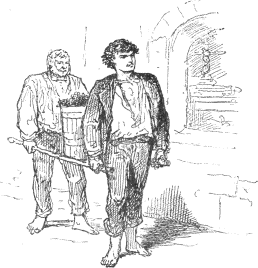
CONVEYING GRAPES TO THE PRESS AT SAINT-PÉRAY.
XV.—The Sparkling Wines of the South of France.
Sparkling Wines of Auvergne, Guienne, Dauphiné, and Languedoc—Sparkling Saint-Péray the Champagne of the South—Valence with its Reminiscences of Pius VI. and Napoleon I.—The “Horns of Crussol” on the Banks of the Rhône—Vintage Scene at Saint-Péray—The Vines and Vineyards Producing Sparkling Wine—Manipulation of Sparkling Saint-Péray—Its Abundance of Natural Sugar—The Cellars of M. de Saint-Prix and Samples of his Wines—Sparkling Côte-Rotie, Château-Grille, and Hermitage—Annual Production and Principal Markets of Sparkling Saint-Péray—Clairette de Die—The Porte Rouge of Die Cathedral—How the Die Wine is Made—The Sparkling White and Rose-Coloured Muscatels of Die—Sparkling Wines of Vercheny and Lagrasse—Barnave and the Royal Flight to Varennes—Narbonne formerly a Miniature Rome, now Noted merely for its Wine and Honey—Fête of the Black Virgin at Limoux—Preference given to the New Wine over the Miraculous Water—Blanquette of Limoux and How it is Made—Characteristics of this Overrated Wine.
Sparkling wines are made after a fashion in several of the southern provinces of France—in Auvergne, at Clermont-Ferrand, under the shadow of the lofty Puy de Dôme; in Guienne, at Astaffort, the scene of a bloody engagement during the
Principal among the foregoing is the excellent wine of Saint-Péray, commonly characterised as the champagne of the South of France. The Saint-Péray vineyards border the Rhône some ten miles below the Hermitage coteau—the vines of which are to-day well-nigh destroyed by the phylloxera—but are on the opposite bank of the river. Our visit to Saint-Péray was made from Valence, in which dull southern city we had loitered in order to glance at the vast Hôtel du Gouvernement—where octogenarian Pius VI., after being spirited away a prisoner from Rome and hurried over the Alps in a litter by order of the French Directory, drew his last breath while silently gazing across the rushing river at the view he so much admired—and to discover the house in the Grande Rue, numbered 4, in an attic of which history records that Napoleon I., when a sub-lieutenant of artillery in garrison at Valence, resided, and which he quitted owing three and a-half francs to his pastrycook.
We crossed the Rhône over one of its hundred flimsy suspension bridges, on the majority of which a notice warns you premiers pairs de France, was not originally erected in close proximity to any such formidable precipice. The crag on which it stands had, it seems, been blasted from time to time for the sake of the stone, until on one unlucky occasion when too heavy a charge of powder was employed, the entire side of the rock, together with a considerable portion of the château itself, were sent flying into the air. The authorities, professing to regard what remained of the edifice as an historical monument of the Middle Ages, hereupon stepped in and prohibited the quarry being worked for the future.
Passing beneath the cliff, one wound round to the left and dived into a picturesque wooded dell at the entrance to a mountain pass, then crossed the rocky bed of a dried-up stream and drove along an avenue of mulberry-trees, which in a few minutes conducted us to Saint-Péray, where one found the vintage in full operation. Carts laden with tubs filled with white and purple grapes, around which wasps without number swarmed, were arriving from all points of the environs and crowding the narrow streets. Any quantity of grapes were seemingly to be had for the asking, for all the pretty girls in the place were gorging themselves with the luscious-looking fruit. In the coopers’ yards bran-new casks were ranged in rows in readiness for the newly-made wine, and through open doorways, and in all manner of dim recesses, one caught sight of sturdy men energetically trampling the gushing grapes under their bare feet, and of huge creaking wine-presses reeking with the purple juice. It was chiefly common red wine, of an excellent flavour, however, that was being made in these nooks and corners, the sparkling white wine, known as Saint-Péray, being manufactured in larger establishments, and on more scientific principles. It
Although there is a close similarity between the manufacture of champagne and the effervescing wine of Saint-Péray, there are still one or two noteworthy variations. For a wine to be sparkling it is requisite that it should ferment in the bottle, a result obtained by bottling it while it contains a certain undeveloped proportion of alcohol and carbonic acid, represented by so much sugar, of which they are the component parts. This ingredient has frequently to be added to the Champagne wines to render them sparkling, but the wine of Saint-Péray in its natural state contains so much sugar that any addition would be deleterious. This excess of saccharine enables the manufacturer to dispense with some of the operations necessary to the fabrication of champagne, which, after fermenting in the cask, requires a second fermentation to be provoked in the bottle, whereas the Saint-Péray wine ferments only once, being bottled immediately it comes from the wine-press.
The deposit in the wine after being impelled towards the neck of the bottle is got rid of by following the same system as is pursued in the Champagne, but no liqueur whatever is subsequently added to the wine. On the other hand, it is a common practice to reduce the over-sweetness of sparkling Saint-Péray in years when the grapes are more than usually ripe by mixing with it some old dry white wine.
At Saint-Péray we visited the cellars of M. de Saint-Prix, one of the principal wine-growers of the district. The samples of effervescing wine which he produced for us to taste were of a pale golden colour, of a slightly nutty flavour, and with a decided suggestion of the spirituous essence known to be concentrated in the wine, one glass of which will go quite as far towards elevating a person as three glasses of champagne.
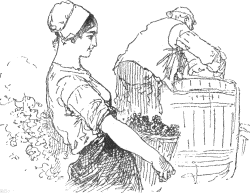
The other side of the Rhône is fruitful in minor sparkling wines, chief amongst which is the so-called Clairette de Die, made at the town of that name, a place of some splendour, as existing antiquities show, in the days of the Roman dominion in Gaul. Later on, Die was the scene of constant struggles for supremacy between its counts and bishops, one of the latter having been massacred by the populace in front of the cathedral doorway—ever since known by the sinister appellation of the Porte Rouge—and Catholics and Huguenots alike devastated the town in the troublesome times of the Reform. Clairette de Die is made principally from the blanquette or malvoisie variety of grape, which, after the stalks have been removed, is both trodden with the feet and pressed. The must is run off immediately into casks, and four-and-twenty hours later it is racked into other casks, a similar operation being performed every two or three days for the period of a couple of months, when the fermentation having subsided the wine is fined and usually bottled in the following March. Newly-made Clairette de Die is a sweet sparkling wine, but it loses its natural effervescence after a
In addition to the well-known Clairette, some of the wine-growers of Die make sparkling white and rose-coloured muscatels of superior quality, which retain their effervescent properties for several years. A sparkling wine is also made some ten miles from Die, on the road to Saillans, in a district bounded on the one side by the waters of the Drôme, and on the other by strange mountains with helmet-shaped crests. The centre of production is a locality called Vercheny, composed of several hamlets, one of which, named Le Temple, was the original home of the family of Barnave. The impressionable young deputy to the National Assembly formed one of the trio sent to bring back the French royal family from Varennes after their flight from Paris. It will be remembered how, under the influence of Marie Antoinette and Madame Elizabeth, Barnave became transformed during the journey into a faithful partisan of their unhappy cause, and that he eventually paid the penalty of his devotion with his life.
In the extreme south of France, and almost under the shadow of the Pyrenees, a sparkling wine of some repute is made at a place called Lagrasse, about five-and-twenty miles westward of Narbonne, the once-famous Mediterranean city, the maritime rival of Marseilles, and in its palmy days, prior to the Christian era, a miniature Rome, with its capitol, its curia, its decemvirs, its consuls, its prætors, its questors, its censors, and its ediles, and which boasted of being the birthplace of three Roman Emperors. To-day Narbonne has to content itself with the humble renown derived from its delicious honey and its characterless full-bodied red wines. Limoux, so celebrated for its Blanquette, lies a long way farther to the west, behind the Corbières range of mountains that join on to the Pyrenees, and the jagged peaks, deep barren gorges, and scarred sides of which have been witness of many a desperate struggle during the century and a half when they formed the boundary between France and Spain.
Blanquette de Limoux derives its name from the species of grape it is produced from, and which we believe to be identical with the malvoisie, or malmsey. Its long-shaped berries grow in huge bunches, and dry readily on the stalks. The fruit is gathered as tenderly as possible, care being taken that it shall not be in the slightest degree bruised, after which it is spread out upon a floor to admit of the sugar it contains becoming perfect. The bad grapes having been carefully picked out, and the pips extracted from the remaining fruit, the latter is now trodden, when the must, after being filtered through a strainer, is placed in casks, where it remains fermenting for about a week, during which time any overflow is daily replenished by other must reserved for the purpose. The wine is again clarified and placed in fresh casks with the bungholes only lightly closed until all sensible fermentation has ceased, when they are securely fastened up. The bottling takes place in the month of March, and the wine is subsequently treated much after the same fashion as sparkling Saint-Péray, excepting that it is generally found necessary to repeat the operation of dégorgement three, if not as many as four times.
Blanquette de Limoux is a pale white wine, the saccharine properties of which have become completely transformed into carbonic acid gas and alcohol. It is, consequently, both dry and spirituous, deficient in delicacy, and altogether proves a great disappointment. At its best it may, perhaps, rank with sparkling Saint-Péray, but unquestionably not with any average champagne.
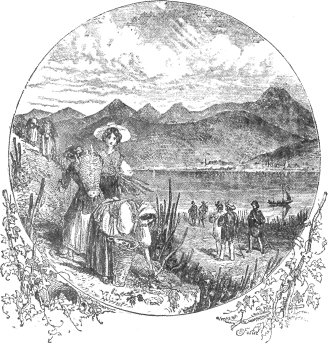
XVI.—The Sparkling Wines of Germany.
Origin of Sparkling Hock and Moselle—Sparkling German Wines First Made on the Neckar—Heilbronn, and Gotz von Berlichingen of the Iron Hand—Lauteren of Mayence and Rambs of Trèves turn their attention to Sparkling Wines—Change of late years in the Character of Sparkling Hocks and Moselles—Difference between them and Moussirender Rheinwein—Vintaging of Black and White Grapes for Sparkling Wine—The Treatment which German Sparkling Wines Undergo—Artificial Flavouring and Perfuming of Sparkling Moselles—Fine Natural Bouquet of High Class Sparkling Hocks—Impetus given to the Manufacture of German Sparkling Wines during the Franco-German War—Annual Production—Deinhard and Co.’s Splendid New Cellars at Coblenz—The Firm’s Collection of Choice Rhine and Moselle Wines—Their Trade in German Sparkling Wines—Their Sources of Supply—The Vintaging and After-Treatment of their Wines—Characteristics of their Sparkling Hocks and Moselles.
The reader is by this time aware that sparkling wines are not indebted for their effervescent properties to any particular variety of vine or quality of soil, although some species of goût de terroir—are really suited to the purpose. Given a wine containing sufficient saccharine, either natural or applied, and duly regulate its temperature, and it is easy enough to render it sparkling. The Germans discovered this long ago when they first transformed the acidulous wines of the Rhine into what we term sparkling hocks.
The rise of this industry dates from the epoch of the final downfall of Napoleon I., when the officers of the armies of occupation acquired more than a passing liking for the exhilarating products of Clicquot and Moët, carrying it, in fact, home with them, and so disseminating a taste for the sparkling wines of France throughout the North of Europe. In Germany the wealthy few only were able to indulge in it, and the consumption was for a long time exceedingly limited. When, however, after many years of peace, riches began to accumulate, some shrewd men set themselves to ascertain whether the German wines could not be rendered sparkling like the French. This was satisfactorily and speedily settled in the affirmative; but the great difficulty was to find the requisite capital for the large preliminary investment necessary to the establishment of a manufactory of sparkling wine on even a moderate scale, and from which no return could be counted on for the first three years. Eventually this was overcome; but the new wines, being in the first instance altogether different in character from champagne, found but little favour in the country of their production. It was different, however, in England, where they speedily succeeded in establishing themselves under the designations of sparkling hock and sparkling moselle, and from this time forward they have retained their position in the English market.
It is generally asserted that sparkling wines were first manufactured in Germany more than half a century ago from the chef de cave at Madame Clicquot’s establishment at Reims came to Herr Lauteren, of Mayence, and suggested to him to engage in the manufacture of sparkling Rhine wines, a proposal which the latter soon afterwards profited by; and eight years later Herr Rambs, of Trèves, vineyard proprietor and wine-merchant, aided by a French cellarman, made the earliest attempt to manufacture sparkling moselles, their first trials in this direction resulting in a breakage amounting to fifty per cent.
For some years the great anxiety of manufacturers of sparkling hocks was to render their wines as much as possible like champagne, which was only to be accomplished by disguising their true flavour and dosing them largely with syrup. In this form they satisfied, and indeed still satisfy, their German and Russian consumers; but of late years England has set the example of a decided preference for the drier kinds of sparkling wines, the result being that the character of the wines destined for the English market has undergone a complete change.
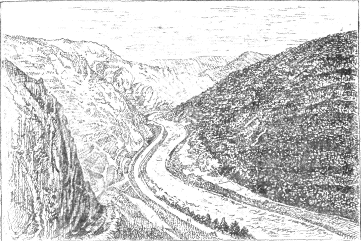
THE AHR VALLEY.
Next to its sweetness the principal difference between German champagne, or Moussirender Rheinwein as it is usually called, for Continental consumption, and sparkling hocks designed for the English and other markets, consists in the former being made principally from black grapes, pressed immediately they are gathered and not allowed to ferment in their skins, while the latter are made almost exclusively from white grapes. The vineyards yielding the black grapes used for these sparkling wines are mainly situated at Ingelheim, midway between Bingen and Mayence, and in the Ahr valley, between Coblenz and Cologne. At the black grape vintage, which precedes the gathering of the white varieties by some three or four weeks, the fruit is conveyed to the press in high tubs, carried on men’s backs, and holding about 40lbs. apiece. The old wooden presses
The process pursued in the manufacture of sparkling hocks is the same as that followed with regard to champagnes. The quantity of grape sugar generated in these Northern German latitudes being far from large, both hocks and moselles invariably need a small addition of saccharine, previous to their being put into bottle, to insure the requisite effervescence, whereas in the Champagne the practice of adding sugar with this object is not the uniform rule. After the wine is bottled it remains in a cool cellar for eighteen months or a couple of years, being constantly shaken during this period, in the same way as champagne, in order to force the sediment to deposit itself near to the cork. By this time the added as well as the natural sugar contained in the wine has become converted into alcohol and carbonic acid; and after the sediment has been expelled from the bottle the operation of dosing, or flavouring, the wine takes place.
Sparkling hocks intended both for the German and Russian markets are frequently almost cloying in their sweetness, as much as one-fifth of syrup being often added to four-fifths of wine. The sparkling moselles, too, for Russia, and not unfrequently for England also, are largely dosed with the preparation of elder-flowers, which imparts to them their well-known muscatel flavour and perfume. The manufacturers say they are doing their best to abandon this absurd practice of artificially perfuming sparkling moselles; but many of their customers, and especially those in the English provinces, stipulate for the scented varieties, possibly from an erroneous belief in their superiority. Effervescing Rhine wines of the highest class have a marked and refined flavour, together with a very decided natural bouquet. Moreover, they retain their effervescent properties for a considerable time after being uncorked, and appear to the taste as light, if not precisely as delicate, as the finer
Great impetus was given to the manufacture of German sparkling wines during the war of 1870, when the Champagne was in a measure closed to the outside world. At this epoch the less scrupulous manufacturers, instigated by dishonest speculators, boldly forged both the brands on the corks and the labels on the bottles of the great Reims and Epernay firms, and sent forth sparkling wines of their own production to the four quarters of the globe as veritable champagnes of the highest class. The respectable houses acted more honestly, and, as it turned out, with better policy, for by maintaining their own labels and brands they extended the market for their produce, causing German sparkling wines to be introduced under their true names into places where they had never penetrated before, the result being a considerable increase in the annual demand, even after the stores of the champagne manufacturers were again open to all the world.
Owing to this increased demand, and the deficient supply of suitable Rhine wines at a moderate price, the manufacturers of sparkling hocks are reduced to buy much of their raw wine at a distance, and are to-day large purchasers of the growths of the Palatinate, which are less delicate than the vintages of the Rheingau, besides being deficient in that fine aroma which distinguishes genuine hock. A leading manufacturer computes that between four-and-a-half and five million bottles of sparkling wine are made annually in Germany, where there are no fewer than fifty manufacturing establishments. The principal market is Great Britain, which consumes some two millions of bottles annually; a million bottles are drunk at home; while the remainder is divided among the North of Europe, the United States, India, Australia, China, and Japan. The cheapness of these wines is, no doubt, largely in their favour.
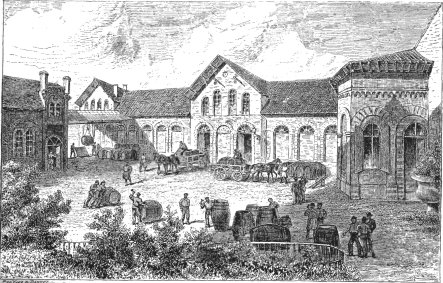
MESSRS. DEINHARD & CO.’S NEW ESTABLISHMENT AT COBLENZ. (p. 178)
At Coblenz, the capital of Rhenish Prussia, and one of the strongest fortresses in the world, the so-called blue Moselle
“In grateful attachment to Coblenz, in full appreciation of a work which does honour to the town and to the firm, I wish continued prosperity to both.
Augusta,
“German Empress and Queen of Prussia.”
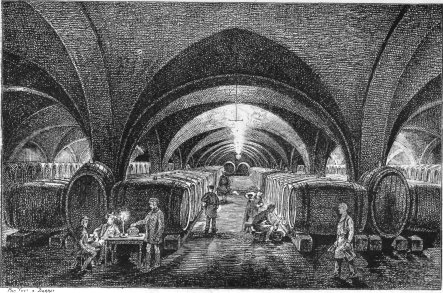
MESSRS. DEINHARD & CO.’S NEW CELLARS AT COBLENZ. (p. 179.)
The proximity of the establishment to the Rhine did not allow of the cellars being excavated to a greater depth than 30
The cellars, containing 1,400 stucks, as they are termed, of still wines—the stuck being equal to 1,500 bottles—present a striking appearance with their long vistas of vaulted arcades, admirably built of brick, and illuminated by innumerable gas jets, aided by powerful reflectors at the extremities of the three aisles. The capacious elliptical-headed casks, ranged side by side in uninterrupted sequence, contain the choicest German vintages, including the grand wines of the Rheingau—Johannisberger, Steinberger, Rudesheimer, Rauenthaler, and the like; the red growths of Assmannshausen and Walporzheim; Deidesheimers,
The sparkling wines stored in separate vaults form to-day an important item in Messrs. Deinhard’s business. In 1843 the firm made their first cuvée, consisting of less than 10,000 bottles. Four years later their cuvée amounted to over 50,000 bottles. A falling off was shown during the revolutionary epoch, and business only recovered its normal condition in 1851, since which time it has gradually increased as the wines have grown in favour, until in 1875 the tirage of 1874 vintage wines exceeded half a million bottles.
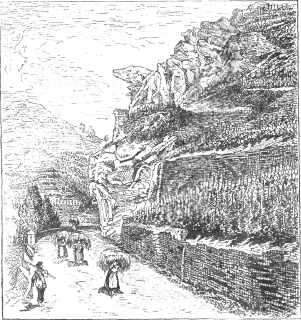
VINEYARDS IN THE AHR VALLEY.
Messrs. Deinhard draw their supplies of wine from white grapes, for conversion into sparkling wines, from the Rhine, the Main, the Moselle, and the Palatinate, giving preference to the produce of the riesling grape, as to this the wine is indebted for its natural bouquet. The proportion of wine from black grapes, mingled with the other wines, is vintaged by themselves in the Ahr valley and at Ingelheim on the Rhine. The Ahr, in summer a rippling streamlet and in winter a rushing torrent, falls into the Rhine about twenty miles below Coblenz. The soil of the neighbouring hills seems peculiarly adapted for the growth of black grapes, one of the best of German red wines being produced in the vineyards adjacent to the village of Walporzheim. In order that the wine may be as pale as possible, the black grapes are pressed as soon after gathering as they can be, and only the juice resulting from the first pressure is reserved, the subsequently extracted must being sold to the small growers of the neighbourhood. The newly-made wine is brought in casks to Coblenz, and rests for eight weeks while completing its fermentation. It is then racked into stucks and double stucks, and is blended in casks of the latter capacity during the early part of the following year, great care being taken to preserve the bouquet of the white grapes, with which view, contrary to the practice followed in the
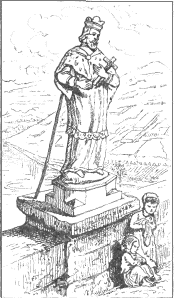
ON THE BRIDGE AT RECH, AHR VALLEY.
Next comes the fining, and four weeks afterwards the wine is newly racked. The bottling takes place during May or June, when any deficiency of natural saccharine in the wine is supplied by the addition of pure sugar-candy. At Messrs. Deinhard’s the wine is bottled at a temperature of 72° Fahr., and the bottles remain resting on large stone tables until the fermentation is completed, and the saccharine is converted into alcohol and carbonic acid gas. This result is commonly obtained in ordinary hot weather in eight days’ time, most of the breakage taking place during this interval. If on being tested with a manometer the wine should indicate too high a pressure, it is at once removed to a cool cellar, consequently the average total breakage rarely exceeds 2¼
The dry sparkling hocks we tasted here had the real riesling flavour and the fine natural perfume common to this grape. In preparing them no attempt had been made to imitate champagne; but, on the other hand, every care had been taken to preserve the true hock character with its distinguishing freshness of taste combined with a lightness which wines containing liqueur in excess could never have exhibited. The sparkling moselles, too, depended not on any imparted muscatel flavour and perfume, but on their own natural bouquet and the flavour they derive from the schistous soil in which these wines are grown.
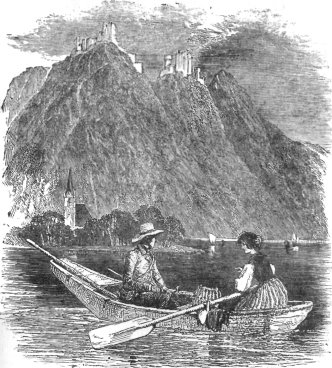
LIEBENSTEIN AND STERRENBERG.
XVII.—The Sparkling Wines of Germany (continued).
From Coblenz to Rüdesheim—Ewald and Co.’s Establishment and its Pleasant Situation—Their Fine Vaulted Cellars and Convenient Accessories—Their Supplies of Wine drawn from the most favoured Localities—The Celebrated Vineyards of the Rheingau—Eltville and the extensive Establishment of Matheus Müller—His Vast Stocks of Still and Sparkling German Wines—The Vineyards laid under contribution for the latter—M. Müller’s Sparkling Johannisberger, Champagne, and Red Sparkling Assmannshauser—The Site of Gutenberg’s Birthplace at Mayence occupied by the Offices and Wine-cellars of Lauteren Sohn—The Sparkling Wine Establishment of the Firm, and their Fine Collection of Hocks and Moselles—The Hochheim Sparkling Wine Association—Foundation of the Establishment—Its Superior Sparkling Hocks and Moselles—The Sparkling Wine Establishments of Stock and Sons at Creuznach in the Nahe Valley, of Kessler and Co. at Esslingen, on the Neckar, and of
STOLZENFELS.
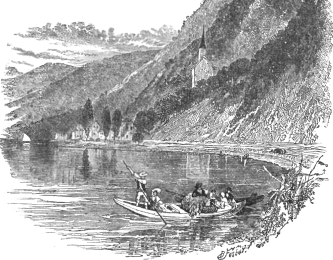
Ascending the Rhine from Coblenz—past many an ancient ruined castle, past restored Stolzenfels, the historic Königs-stuhl, the romantic Liebenstein and Sterrenberg, the legendary Lurlei, the tribute-exacting Pfalz, and the old town of Bacharach, famous in the Middle Ages for its wine mart—we eventually come to Lorch, where the Wisper brook flows into the Rhine, and the grand wine-producing district known as the Rheingau begins. A few miles higher up are the vineyards of Assmannshausen, dominated by the Niederwald, and yielding the finest red wine in all Germany. Then passing by Bishop Hatto’s legendary tower we emerge from the gorge of the Rhine and soon reach Rüdesheim, crouched at the foot of lofty terraced vineyards, which, according to doubtful tradition, were planted with Burgundy and Orleans vines by Charlemagne. Rüdesheim, like other antiquated little Rhine-side towns, boasts its ancient castle with its own poetical
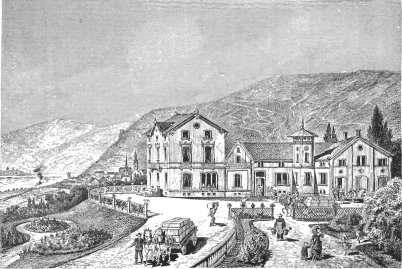
MESSRS. EWALD & CO.’S ESTABLISHMENT AT RÜDESHEIM. (p. 185)
Here are handsome and capacious buildings aboveground, and two floors of cellars comprising five vaults, each 160 feet in length and 30 feet broad. The lower vaults, 40 feet from the surface, are arched over and walled with stone, while the upper ones are faced with brick, both being floored with concrete and slanting towards the centre to allow of the wine from bottles that have burst running off. Each range of cellars is separately ventilated by shafts, generally kept open in winter and closed in the summer so as to maintain a temperature not exceeding 47° Fahr. in the lower cellars and under 52° in those above. Moreover, with the view of conducing to this result the cellars have an ice well communicating with them.
Late in the spring, when the newly-bottled wine indicates a sufficient number of atmospheres to insure a satisfactory effervescence, it is deposited in the lower vaults, the upper ones being devoted to reserve wines in wood and wines awaiting the process of disgorgement, or undergoing their daily shaking in order to force the deposit against the cork. Aboveground there are rooms for storing the liqueur, the corks, and the packing-cases, and in a spacious apartment, provided with three lifts for communicating with the cellars beneath, the wine is blended and bottled, and in due time disgorged and packed. In very warm weather, however, it is found preferable for the disgorging and its attendant operations to be performed in the cooler temperature of the cellars. Messrs. Ewald formerly tested the strength of their bottles with a manometer before
Messrs. Ewald being installed almost in the heart or the Rheingau can readily draw their supplies of wine from the most favoured localities. Johannisberg is within a few miles of Rüdesheim, and in those years when, owing to the grapes not having thoroughly ripened, the wine is only of intermediate value as a still wine, it serves admirably for conversion into sparkling wine, retaining as it does its powerful bouquet. Ingelheim, too, noted for its vineyards of black grapes, whose produce is much sought after for blending with the finer sparkling Rhine wines, is only a few miles higher up the river, on the opposite bank. The drier varieties of sparkling hocks and moselles shipped by Messrs. Ewald to England have the merit of retaining all the fine flavour and natural perfume of the higher-class growths from which, as a rule, these wines are prepared.
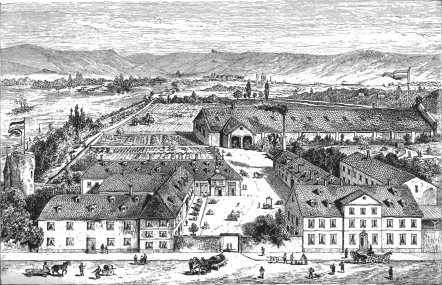
THE ESTABLISHMENT OF MATHEUS MÜLLER AT ELTVILLE. (p. 186)
Above Rüdesheim the waters of the Rhine expand, the left bank of the river, if still lofty, is no longer precipitous, while the right continues almost flat so soon as the Rochusberg is left behind. Between here and Eltville all the more celebrated vineyards of the Rheingau are passed in rapid succession—Geisenheim-Rothenberg, Johannisberg, Steinberg, Marcobrunn, Kiedrich-Grafenberg, Rauenthal, and others. At Eltville—the former capital of the Rheingau, and where Gunther, of Schwarzburg, resigned his crown to Charles IV., and died poisoned, it is said, by his successful rival—we find one of the most extensive wine establishments in Germany, that of Matheus Müller, who enjoys a high reputation in England both for his still and sparkling hocks and moselles. His stock ordinarily consists of from 800 to 1,000 stuck—equivalent to a quarter of a million gallons—of still Rhine and Moselle wines, much of it of the
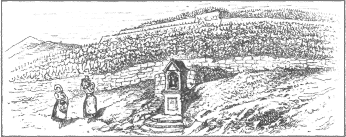
For his higher-class sparkling hocks Herr Müller derives his principal supplies from the Rheingau, partly from his own vineyards at Eltville, Rauenthal, and Hattenheim, and partly by purchases at Erbach, Hallgarten, Œstrich, Winkel, Johannisberg, Geisenheim, and Rudesheim; while for his best sparkling moselles, Berncastel, Graach, Trèves, and the Saar districts are laid under contribution. The Palatinate growths of Dürkheim, Deidesheim, Mussbach, Haardt, Rhodt, &c., serve as the basis for the medium and cheaper sparkling hocks, and for sparkling moselles of a corresponding character such wines as Zeltinger, Rachtiger, Erdener, Aldegonder, Winninger, &c., are used. Ingelheim and Heidesheim furnish the wine from black grapes necessary in a subordinate degree to all sparkling hocks, and very freely had recourse to when it is desired to impart a champagne character to the wine, as is commonly the case when this is intended for consumption in Germany. Herr Müller invariably presses the black grapes himself, in order that the wine may be as light in colour as possible. As the house annually lays down large stocks of vin brut it is under no necessity of
The dry sparkling hocks and moselles, such as are shipped by Herr Müller to England and its colonies, receive a large addition of liqueur when destined for the Russian market. His sparkling Johannisberger and high-class sparkling moselle from Rheingau and Moselle wines of superior vintages are of delicate flavour and great softness, and are frequently shipped without any liqueur whatever. Besides Moussirender Rheinwein of a champagne character, and largely consumed in Germany and Belgium, Herr Müller makes a veritable champagne from wine imported by him from the Champagne district. His shipments also include red sparkling Assmannshauser—the result of a blend of Assmannshauser, Ingelheimer, and other red Rhenish wines—aromatic and full-bodied, and dry or moderately sweet according to the country to which it is intended to be exported.
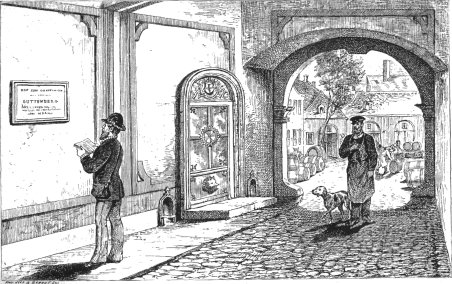
ENTRANCE TO LAUTEREN SOHN’S ESTABLISHMENT, MAYENCE. (p. 188)
The trade in German sparkling wines has numerous representatives at Mayence—the sec of St. Boniface, the apostle of the Germans, and the birthplace of Gutenberg, whose fame is universal. The pioneer of printing was born in a house at the corner of the Emmerans and Pfandhaus gasse, the site of which is to-day occupied by the residence of three members of the firm of C. Lauteren Sohn, established at Mayence so far back as 1794, and one of the first in Germany to devote itself to the manufacture of sparkling wines. In 1830 the firm profited by an offer made to them by a cellarman who had been for many years in the service of Madame Clicquot at Reims. The Emmerans-gasse, where the chief establishment of the firm is situated, is in the older quarter of Mayence—in the midst of a network of intricate winding streets bordered by picturesque tall gabled houses and edifices of the Spanish type where ornamental oriel windows with quaint supports, medallions, and bas-reliefs of varied design continually catch the eye, and saints look down upon one from almost every corner. Passing under the gateway of the house where Gutenberg was born, and in the rear of
“Gensfleisch House. Family residence of the inventor of the art of printing, John Gensfleisch of Gutenberg, who in the year 1398 was here born. Christian Lauteren has dedicated on the site of the ancient house this memorial to the immortal inventor, Jan. 29, 1825.”
Messrs. Lauteren’s cellars for sparkling wines extend mainly under an old monastery, and comprise a succession of large vaulted galleries connected by narrow passages with arched entrances. Here are stacked some 800,000 bottles of wine in varying conditions of maturity. Messrs. Lauteren bottle their wines in August, instead of fully two months earlier according to the usual practice, in the belief that the system they pursue is more conducive to perfect effervescence, besides being attended with less breakage, owing to the newly-bottled wine escaping the heat of the summer. All the arrangements at this establishment are very complete. There is a place for everything, and everything is to be found in its place. Adjoining the courtyard, where new bottles are stacked beneath open ornamental sheds, are the tasting-room and the apartment where the operations of disgorging, dosing, and re-corking are performed. The liqueur added by the firm to their sparkling wines is kept in bottle from three to five years before being used. In the tasting-room we were shown a variety of sparkling hocks and moselles, the former with all the distinguishing characteristics of fine Rhine wine, the older samples having gained considerably in softness. A dry Cabinet specimen submitted to us exhibited a fine bouquet and much delicacy of flavour. The moselles we found particularly interesting, made as they were of genuine wines from some of the best vineyards of the Moselle district.
The largest German sparkling wine establishment is at Hochheim, which, although, situated on the banks of the Main, and several miles distant from its confluence with the Rhine, has curiously enough supplied us with a generic name under which we inconsistently class the entire produce of the Rhine
Sparkling hocks and moselles are made by Messrs. Stock and Sons at Creuznach, a favourite watering-place in the romantic Nahe valley, noted for the picturesque porphyry cliffs which occasionally rise precipitously at the river’s edge. Creuznach, where a capital wine is vintaged, on the southern slopes of the Schlossberg, is at no great distance from Bingen. Messrs. Stock and Sons’ establishment dates from 1862, and their sparkling wines are mainly made from white grapes, only about one-eighth of white wine from black grapes entering into their composition. The latter is vintaged at Ingelheim, the grapes being pressed under the firm’s own superintendence, and only the must resulting from the first squeeze of the press being used. The wine from riesling grapes is usually from the
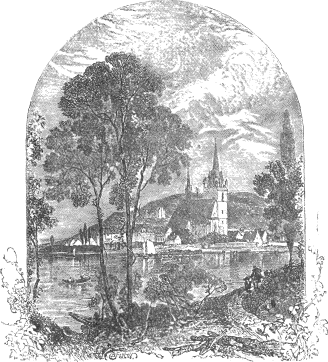
BINGEN.
The establishment of G. C. Kessler and Co. at Esslingen—formerly one of the most important of the free imperial cities, and picturesquely situated on the Neckar—was founded as far back as 1826, and claims to be the oldest sparkling wine factory in Germany. The wine employed comes from vineyards
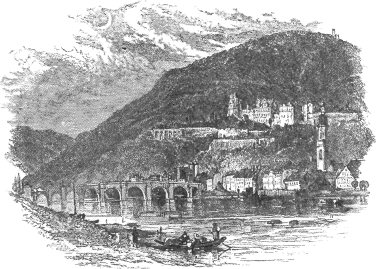
THE NECKAR AT HEIDELBERG.
Wurzburg, one of the most antiquated and picturesque of German cities, is noted for its sparkling Franconian wines vintaged
The first sparkling wine establishment at Würzburg was founded in 1842 by Herr Oppmann, the Royal cellar-master, who died in 1866. The position held by this individual was one of considerable importance, for the King of Bavaria is the largest wine-grower in his own dominions, and stores the produce of his vineyards in the famous cellars extending beneath one of the wings of the deserted Residenz, erected at an epoch when Würzburg was subject to episcopal rule. These cellars, vaulted in stone, are on a vast scale, and possibly unequalled in the world. You descend a broad flight of steps, flanked by ornamental iron balustrades, and encounter half-way down a miniature tun, guarded by the Bavarian lions posted in a niche in the wall. Following your guide with lighted candles, you pass between rows upon rows of capacious casks filled with the wine last
AT AHRWEILER.
Another sparkling wine establishment was founded at
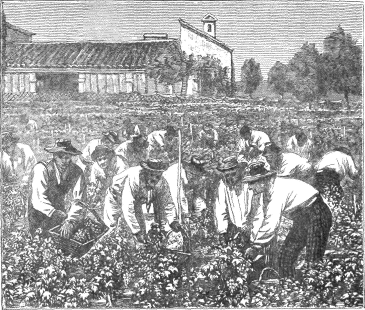
A SPANISH VINTAGE SCENE.
XVIII.—The Sparkling Wines of Austro-Hungary, Switzerland, Italy, Spain, Russia, &c.
Sparkling Voslauer—The Sparkling Wine Manufactories of Graz—Establishment of Kleinoscheg Brothers—Vintaging and Treatment of Styrian Champagnes—Sparkling Red, Rose, and White Wines of Hungary—The Establishment of Hubert and Habermann at Pressburg—Sparkling Wines of Croatia, Galicia, Bohemia, Moravia, Dalmatia, the Tyrol, Transylvania, and the Banat—Neuchâtel Champagne—Sparkling Wine Factories at Vevay and Sion—The Vevay Vineyards—Establishment of De Riedmatten and De Quay—Sparkling Muscatel, Malmsey, Brachetto, Castagnolo, and Lacryma Christi of Italy—Sparkling Wines of Spain, Greece, Algeria, and Russia—The Krimski and Donski Champagnes—The Latter Chiefly Consumed at the Great Russian Fairs.
Sparkling wines are made in various parts of Austria and Hungary, and of late years their produce has been largely on the increase. At Voslau, in the vicinity of the picturesque and
White wine from the clevener grape, understood to be identical with the pineau noir of Burgundy and the Champagne, and vintaged early in October, forms the basis of the sparkling wines manufactured by Kleinoscheg Brothers. The produce of several other grapes, however, enters in a limited degree into the blend, including the riesling, the rulander or pineau gris, and the portuguese, the gathering of which is usually delayed several weeks later, and is sometimes even deferred until the end of November. The first and second pressings of the black grapes yield a white must as in the Champagne, while the third and fourth give a pink wine of which the firm make a speciality.
The wines, which are treated precisely after the system pursued in the Champagne, are bottled during the months of July
At Marburg on the river Drave, in the vicinity of the Bacher Mountains, which stretch far into Carinthia, and have their lower slopes covered with vines, Herr F. Auchmann has established a successful sparkling wine manufactory. The raw wine comes from the vineyards around Marburg and from Pettau, some ten or twelve miles lower down the Drave. The vintage commonly lasts from the middle of October until the middle of November. Black grapes of the clevener and portuguese varieties are pressed as in the Champagne, so as to yield a white must, with which a certain portion of white wine from the mosler or furmint grape is subsequently mingled. The bottling takes place as early as April or May. The wines are principally consumed in Austria, but are also exported to Russia, Italy, Egypt, the Danubian Principalities, Australia, &c.
Sparkling wines seem to be made in various parts of Hungary, judging from the samples sent to the Vienna and Paris Exhibitions from Pesth, Pressburg, Oedenburg, Pécs, Velencze, and Kolozsvár. Rose-colour wines are evidently much in favour with the respective manufacturers, several of whom make sparkling red wines as well, but with none of the success of their Styrian neighbours. The best Hungarian sparkling wines we have met with are those of Hubert and Habermann, made at Pressburg, the former capital of Hungary, where its kings, after being crowned, used to ride up the Königsberg brandishing the Geñnau, and St. Georgen, but the firm make red sparkling wines as well from the produce of the Ratzersdorf and Wainor vineyards. The vintage takes place some time in October, and the wines are bottled both in the spring and autumn, but never until they are fully twelve months old. With these variations the system pursued with regard to the wines is the same as is followed in the Champagne. There are several other sparkling wine manufacturers at Pressburg, and the principal market for these wines is Austro-Hungary, but shipments of them are made to England, the United States, India, Roumania, and Servia. The production of sparkling wine in Hungary is now estimated to amount to one million bottles annually.
In Croatia Prince Lippe-Schaumburg has established a sparkling wine manufactory at Slatina, where he produces a so-called Riesling-Champagner, and it would appear from the collection of Austro-Hungarian sparkling wines exhibited at Vienna by Herr Bogdan Hoff of Cracow, that these wines are also made at Melnik, in Bohemia, at Bisenz in Moravia, at Sebenicodi Maraschino in Dalmatia, at Botzen in the Tyrol, at Tasnad in Transylvania, and at Weiss-Kirchen in the Banat. All these wines had been submitted to examination at the Imperial œno-chemical laboratory at Klosterneuberg, and one was not surprised to find that the majority were pronounced to be of too robust a character for transformation into sparkling wines.
Switzerland long since turned its attention to the manufacture of sparkling wines, not, however, to meet the requirements of its own population, but those of the many tourists with well-lined purses who annually explore its valleys, lakes, and mountains. Neuchâtel champagne has met with a certain amount of success, and at the present time there are a couple of establishments devoted to its production, the best known being that of Bouvier cuvées. Vaud, on the other hand, being noted for white wines bearing some resemblance to certain Rhine growths, it is of these that sparkling wines are exclusively made at Vevay.
The Vevay vineyards occupy the heights which skirt the Lake of Geneva on its northern side. The innumerable terraces, steep and difficult of access to the toiling vine-dresser, on which the vines are planted, are the result of centuries of patient labour. Here the vine seems to flourish at an altitude of more than 1,800 feet above the sea level. To compensate for the deficiency of sunshine the leaves are largely stripped from the vines so as to expose the fruit, and thereby assist its ripening.
The sparkling wine factory at Sion, bordering the river Rhône, in the Canton of the Valais, was established in 1872 by MM. de Riedmatten and De Quay, who derive their raw wine from vineyards in the immediate neighbourhood, almost all of which have a southern exposure, and occupy gentle slopes. The soil chiefly consists of a decomposed limestone schist, locally termed “brisé.” In these vineyards, and more especially the district known as the Clavaux, some of the best and most alcoholic wines in Switzerland are produced.
The firm originally experimented with the choicer and more powerful growths, and, as may be imagined, soon discovered they were not well adapted for conversion into sparkling wines. To-day they limit themselves to wines produced from what is known as the “fendant” variety of grape, said by some to be identical with the German riesling, and by others to be of the same type as the French chasselas. The vintage in the Valais is the earliest in Switzerland, taking place in favourable years at the close of September, but ordinarily in the course of
Of late years, since many improvements have been effected in Italy both in the cultivation of the vineyards and the vintaging of the wine, numerous attempts have been made, although on the whole with but indifferent success, to produce a good sparkling wine. The principal seat of the manufacture is Asti, where the Societa Unione Enofila make considerable quantities of a common strong sweet sparkling wine, as well as a sparkling muscatel. Alessandria, Ancona, Bologna, Castagnolo, Genoa, Modena, Naples, Palermo, and Treviso also profess to make sparkling wines, but only in insignificant quantities. Alessandria produces sparkling malmsey and red sparkling brachetto; and on the Marquis Della Stufa’s estate of Castagnolo a sparkling wine is manufactured from the currajola variety of grape, one of the best in the Tuscan vineyards. The vines at Castagnolo are cultivated in accordance with the French system, and at the vintage all unripe and unsound grapes are thrown aside. There is an evident flavour of the muscat grape in the Castagnolo sparkling wine, which has the merit of lightness and of being well made. The alcoholic strength is equivalent to rather more than 20° of proof spirit, and the highest quality wine is remarkable for its excessive dryness in comparison with all other samples of Italian sparkling wines that we have met with. Naples appears to confine itself to producing sparkling white lacryma christi, for which, as a curiosity, there exists a certain demand.
Spain of late years has shown itself equally ambitious with
Greek sparkling wines, said to be of very fair quality, are made at Athens, Corinth, and Tripoliza, and are exported in moderate quantities to Russia. Algeria, too, is turning its attention to the production of sparkling wines, but solely for home consumption, and at the Paris Exhibition there was a sparkling wine from Uruguay, but of execrable quality.
The sparkling wines of the Crimea and the Don, known in Russia respectively as Krimski and Donski champagnes, are described as being superior to much of the wine which passes in England under the name of champagne. In Russia it is the fashion to speak contemptuously of them, just as rhubarb and gooseberry champagne is spoken of in England, still these Crimean and Don products are genuine wines, and, though somewhat sweet, may be drunk with satisfaction and in moderate quantities with impunity. One of the best Donski brands is that of Abrahamof, and as much as six roubles per bottle is demanded for the finer qualities at Novoi Tscherkash. About a million bottles of the Donski champagne are exported annually, but the wine finds its principal market at the great Russian fairs, where almost every important bargain is “wetted” with sparkling Donski.
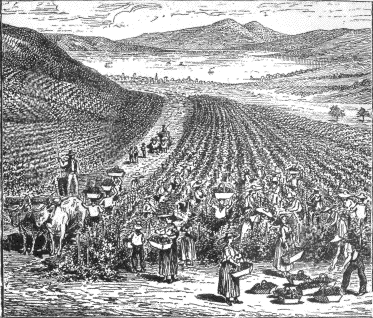
VINTAGE SCENE IN THE UNITED STATES.
XIX.—The Sparkling Wines of the United States.
Earliest Efforts at Wine-Making in America—Failures to Acclimatise European Vines—Wines Made by the Swiss Settlers and the Mission Fathers—The Yield of the Mission Vineyards—The Monster Vine of the Montecito Valley—The Catawba Vine and its General Cultivation—Mr. Longworth one of the Founders of American Viticulture—Fresh Attempts to make Sparkling Wine at Cincinnati—Existing Sparkling Wine Manufactures there—Longfellow’s Song in Praise of Catawba—The Kelley Island Wine Company—Vintaging and Treatment of their Sparkling Wines—Decrease of Consumption—The Vineyards of Hammondsport—Varieties of Grapes used for Sparkling Wines—The Vintage—After-Treatment of the Wines—The Pleasant Valley and Urbana Wine Companies and their Various Brands—Californian Sparkling Wines—The Buena Vista Vinicultural Society of San Francisco—Its Early Failures and Eventual Success in Manufacturing Sparkling Wines—The Vintage in California—Chinese Vintagers—How the Wine is Made—American Spurious Sparkling Wines.
From the earliest period of the colonisation of America the vine appears to have attracted the attention of the settlers, and
Towards the latter part of the 18th century the Mission Fathers had succeeded in planting vineyards in California. It is known that in 1771 the vine was cultivated there, and the San Gabriel Mission in the county of Los Angeles, some 300 miles S.E. of San Francisco, is said to have possessed the first vineyard. A prevalent belief is, that the vines were from roots or cuttings obtained from either Spain or Mexico, but it is also conjectured that they were some of the wild varieties known to be scattered over the country, while a third theory suggests that as attempts to make wine from the wild grapes would most likely have proved a failure, the Fathers planted the seeds of raisins which had come from Spain. The culture must have progressed rapidly, if, as stated, there were planted at San Gabriel in a
From San Gabriel the planting of the vine extended from mission to mission until each owned its patch of vineland. At the time of the arrival of the Americans in 1846 the smallest of these was five acres in extent, and others as many as thirty acres, and it is calculated the average yield was from 700 to 1,000 gallons of wine per acre. This was owing first to the exceeding richness of the soil, and secondly to its being well irrigated. If the celebrated mission vine grown on one of the sunny slopes overlooking the lovely Montecito valley near Santa Barbara on the blue Pacific had many fellows in the Fathers’ vineyards, the above estimate can hardly be an exaggerated one. The stem of this vine, which is four feet four inches in circumference at the ground, rises eight feet before branching out. The branches, under which the country people are fond of dancing, and which are supported by fifty-two trellises, extend over more than 5,000 square feet. This monster vine produces annually from five to six tons of grapes, and one year it yielded no fewer than 7,000 bunches, each from one to four pounds in weight. It is irrigated by water from the hot springs, situated a few miles distant, and is believed to be from half to three-quarters of a century old.
Viticulture and vinification languished in the United States until attention was called in 1826 to the catawba vine by Major Adlum, of Georgetown, near Washington, who thought that by so doing he was conferring a greater benefit on his country than if he had liquidated its national debt. This vine, which is derived from the wild Vitis labrusca, was first planted on an extensive scale by Nicholas Longworth, justly looked upon as one of the founders of American viticulture, and gradually supplanted all others, remaining for many years the principal plant cultivated along the banks of the Ohio—the so-called
Mr. Longworth, about the year 1837, among his numerous experiments at Cincinnati, included that of making sparkling wines from the catawba, isabella, and other varieties of grapes, and to-day there are several manufactories of sparkling catawba and other wines in the capital of Ohio—the self-named “Queen city,” which its detractors have jocularly dubbed Porcopolis on account of the immense trade done there in smoked and salted pork. The chief sparkling wine establishments at Cincinnati are those of Messrs. Werk and Sons, whose sparkling catawba obtained a medal for progress at the Vienna Exhibition in 1873, and who have, moreover, largely experimented with ives’ and virginia seedlings, delaware and other grapes, in making effervescent wines, though only with doubtful success. Another Cincinnati firm is that of Messrs. George Bogen and Co., whose sparkling wines also met with recognition at Vienna.
The reader will remember Longfellow’s well-known song extolling catawba wine, which, with more than a poet’s licence, he ranks above the best of the Old World vintages:—
“There grows no vine By the haunted Rhine,
By Danube or Guadalquivir,
Nor on island nor cape, That bears such a grape
As grows by the Beautiful River.
“Very good in its way Is the Verzenay,
Or the Sillery, soft and creamy,
But Catawba wine Has a taste more divine,
More dulcet, delicious, and dreamy.”
On Kelley’s Island, Erie county, also in the State of Ohio, a wine company, established in 1866, and trading principally in still wines, makes sparkling wines upon a considerable scale exclusively from the catawba variety of grape, which is cultivated in its highest perfection both on the islands of Lake Erie and along a narrow
At Hammondsport, south of Lake Keuka—in other words, Crooked Lake—and in the State of New York, the establishments of the Pleasant Valley and Urbana wine companies, devoting their attention to both still and sparkling wines, are installed. The region, which enthusiastic writers now term the Champagne of America, was colonised in 1793, and vines of the catawba and isabella varieties were first planted for the purpose of making wine in 1854. At the present time there are about 8,000 acres under cultivation with all the better species of vines. The produce from black and white grapes is mingled for the sparkling wines of the district. Of the former but two kinds are considered suitable, the concord and the isabella, both being varieties of the indigenous labrusca, or so-called foxy-flavoured grape. The concord is a hardy and productive plant, producing large and compact bunches of large round sweet grapes, yielding a wine of the obnoxious foxy flavour. The isabella is an equally hardy and productive variety, and its bunches are of good size, although not compact. Its berries,
Of the white, or rather pale-coloured grapes—for their hue is usually a reddish one—used for sparkling wines, the principal is the catawba, also of the labrusca variety. The branches are large and tolerably compact; the berries, too, are above the medium size, and have a rich vinous and pronounced musky flavour. Other so-called white species of grapes are the diana and the iona, both, of them seedlings of the catawba; the delaware, the bunches of which are rather small but compact, the berries round, extremely juicy and fresh-tasting, but sweet and aromatic, the wine produced from which is noted for its fragrant bouquet; and, lastly, the walter, a variety obtained by crossing the delaware with the diana. The bunches and berries of the walter are of medium size; the flavour, like that of the delaware, is sweet and aromatic; and the grape is, moreover, remarkable for its agreeable bouquet.
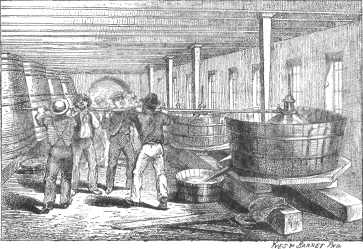
The vintage usually commences about the end of September or the commencement of October, and the grapes, after being carefully sorted, are run through a small mill, which breaks the
The Pleasant Valley Wine Company, established in 1860 for the commerce of still wines, in which it continues to do an extensive business, commenced five years later to make sparkling wines. It grows its own grapes and consumes annually about 1,500 tons of fruit, bottling from 200,000 to 300,000 bottles of sparkling wine in the course of the year. Its brands are the Great Western, of which there is a dry and an extra dry variety, the Carte Blanche, and the Pleasant Valley. Even the extra dry variety of the first-named wine tastes sweet in comparison with a moderately dry champagne, in addition to which its flavour, though agreeable, is certainly too pronounced for a sparkling wine of high quality. The wines, which secured a medal for progress at the Vienna Exhibition of 1873, are sold in every city in the United States, and the company also does a small but increasing trade with England and South America.