Front matter (continued 5)
Reading edition
In the region where frozen Mammoths occur (and there are at least nine cases on record), a considerable thickness of frozen soil may be found at all seasons of the year; so that if a carcase be once embedded in mud or ice, its putrefaction may be arrested for indefinite ages. According to one authority, the ground is now permanently frozen even to the depth of four hundred feet at the town of Jakutsh, on the western bank of the river Lena. Throughout a large part of Siberia the boundary cliffs of the lakes and rivers consist of earthy materials and ice in horizontal layers. Middendorf bored to the depth of seventy feet, and after passing through much frozen soil mixed with ice, came down upon a solid mass of pure transparent ice, the depth of which he was unable to ascertain.
The year 1846, when M. Benkendorf saw his Mammoth, was exceptional on account of its unusually warm summer, so that the ground of the tundra region thawed, and was converted into a morass. Had any Mammoths been alive then, and strayed beyond the limits of the woods into the tundra, probably some of them would have been likewise engulphed, and, when once covered up and protected from the decaying action of the air, the cold of the next winter would have frozen their carcases as this one must have been frozen up.
Truly, “there is nothing new under the sun,” and the present highly useful method of freezing meat and bringing it over from America or New Zealand to add to our insufficient home supplies, is but a resort to a process employed by Nature long before the age of steamships, and perhaps even before the appearance of man on the earth!
Secondly, with regard to the food of the Mammoth, Benkendorf’s discovery is of great service in solving the question how such a creature could have maintained its existence in so inhospitable and unpromising a country. The presence of fir-spikes in the stomach is sufficient to prove that it fed on vegetation such as is now found at the northern part of the woods as they join the low treeless tundra in which the body lay buried.
Before this discovery the food of the Mammoth was unknown, and all sorts of theories were devised in order to account for its remains being found so far north. Some thought that the Mammoth lived in temperate regions, and that the carcases were swept down by great floods into higher and colder latitudes. But it would be impossible for the bodies to be hurried along a devious course for so many miles without a good deal of injury, and probably they would fall to pieces on the way. But, as Professor Owen has so convincingly argued, there is no reason why herds of Mammoths should not have obtained a sufficient supply of food in a country like the southern part of Siberia, where trees abound in spite of the fact that during a great part of the year it is covered with snow. And this is his line of reasoning. The molar teeth of the elephant show a highly complicated and peculiar structure, and there are no other quadrupeds that feed to such an extent on the woody fibre of the branches of trees. Many mammals, as we know, eat the leaves of trees; some gnaw the bark; but elephants alone tear down and crunch the branches. One would think there was but little nourishment to be got from such. But the hard vertical plates of their huge grinders enable them to pound up the tough vegetable tissue and render it more or less palatable. Of course, the foliage is the most tempting, but where foliage is scarce something more is required.
Now, in the teeth of the Mammoth the same principle of construction is observed, only with greater complexity, for there are more of these grinding plates and a larger proportion of dense enamel. Hence the inference seems unmistakable that the extinct species fed more largely on woody fibre than does the elephant of to-day. Forests of hardy trees and shrubs still grow upon the frozen soil of Siberia, and skirt the banks of the Lena as far north as the sixtieth parallel of latitude.
If the Mammoth flourished in temperate latitudes only, as formerly suggested, then its thick shaggy coat becomes superfluous and meaningless; but if it lived in the region where its body has been found, then the argument from its teeth, and the fir-spikes found in its stomach, is confirmed by the nature of its skin, and all the old difficulties vanish. Professor Owen considers that we may safely infer that, if living at the present day, it would find a sufficient supply of food at all seasons of the year in the sixtieth parallel, and even higher. Perhaps they migrated north during the summer; and, judging from the present limits of arboreal vegetation, they may have been able to subsist even in latitude 70° north, for at the extreme points of Lapland pines attain a height of sixty feet.[66]
It is often no easy matter to form conclusions with regard to the habits of extinct animals; and too much reliance must not be placed on arguments derived from the habits of their living descendants or their near relations. The older geologists fell into this mistake with regard to the Mammoth, as did even Cuvier. Modern elephants are at present restricted to regions where trees flourish with perennial foliage, and, therefore, it was argued that there must have been a change of climate—either gradual or sudden, in the country of the Mammoth.
Cuvier, who believed in sudden revolutions on the earth’s surface, argued that the Mammoth could not possibly have lived in Siberia as it is now; and that, at the very moment when the beast was destroyed, the land was suddenly converted into a glacial region! (“C’est donc le même instant qui a fait périr les animaux, et qui a rendu glacial le pays qu’ils habitaient, cet événement a été subit, instantané, sans aucune gradation.”[67]) Sir Charles Lyell argued, from geological evidence with regard to the rise of land along the Siberian coast, that the climate had become somewhat more severe, and that finally the Mammoth, though protected by its shaggy coat, died out on account of scarcity of food.[68]
Professor Owen is unwilling to believe that such changes as these brought about the final extinction of the Mammoth, and he concludes that it was quite possible for such an animal to have flourished as near to the North Pole as is compatible with the growth of hardy trees or shrubs.
"The fact seems to have been generally overlooked, that an animal organised to gain its subsistence from the branches or woody fibre of trees, is thereby rendered independent of the seasons which regulate the development of leaves and fruit; the forest food of such a species becomes as perennial as the lichens that flourish beneath the winter snows of Lapland; and, were such a quadruped to be clothed, like the reindeer, with a natural garment capable of resisting the rigours of an arctic winter, its adaptation for such a climate would be complete.... The wonderful and unlooked-for discovery of an entire Mammoth, demonstrating the arctic character of its natural clothing, has, however, confirmed the deductions which might have been legitimately founded upon the localities of its most abundant remains, as well as upon the structure of its teeth, viz. that, like the Reindeer and Musk Ox of the present day, it was capable of existing in high northern latitudes."[69]
The problem of the extinction of the Mammoth is not an easy one to solve. We can hardly account for its disappearance by calling in geographical changes by which its range became restricted, and its food supply diminished, so that in the competition with other herbivorous animals this primæval giant “went to the wall,” as the saying is. Nor does Lyell’s appeal to a change in climate, by which the cold of Siberia became too intense even for the Mammoth, seem quite satisfactory, especially when we remember how very far north fir trees range (p. 211).
The Mammoth, probably, was endowed with a fairly tough constitution. In Siberia it fed on fir trees. In Kentucky it fared better, and was surrounded by such vegetation as now flourishes in that temperate region. In the valley of the Tiber (where also its remains are found), though during the “Glacial period” the temperature was, doubtless, lower than at present, we cannot imagine that an arctic climate prevailed. Thus we see that it was capable of flourishing in various and widely separated regions where the conditions of climate and food supply could hardly have been similar.
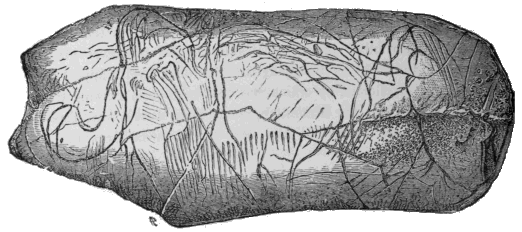
Professor Boyd Dawkins, whose views we are adopting here,[70] considers that the Mammoth was exterminated by man—a simple solution of the question, which seems to present no difficulties. That it was hunted by the primitive folk of the “Reindeer period” in France, is proved by its remains in the caves where men dwelt, and by a drawing cut by a hunter of the older Stone Age on one of its own tusks! A cast of this most interesting relic may be seen in the prehistoric collection at the British Museum, and shows that the men of that time were not devoid of artistic power (see Fig. 53). Some of the lines in this illustration represent cracks in the original, so that the actual outline is not easily made out. But here we see the head particularly well drawn, the tusks and downward lines indicating the hairy mane. Reindeer and other animals were also engraved on horn, etc., by the men who were contemporary with the Mammoth.
Fig. 53.—Figure of the Mammoth, engraved on Mammoth ivory by cavemen, La Madelaine, France. In the Lartet Collection, Paris.
We know that man has exterminated a great many noble animals in his time, and, alas! continues to do so at the present time in Africa, and in North and South America. The giraffe and the bison, once so plentiful, are now almost extinct. Primitive man was a hunter, and, as he multiplied, his wants became greater, and more animals were therefore destroyed. Probably the same explanation applies to the great Moa bird of New Zealand, and possibly even to the Megatherium of South America.
With regard to the tusks of the Mammoth, which are considerably larger than those of either the African or Indian elephant, it is evident that they must have been of some service, for Nature would never have endowed the animal with such great and ponderous instruments—to support which the skull is greatly modified in both the Mammoth and elephant—without some definite purpose. We have often been asked how the Mammoth used his tusks; now, this question can best be answered by reference to the habits of living elephants. The elephant of to-day is a fairly peaceable creature, but, if attacked, can despatch the aggressor in various ways. Some enemies he can crush under his feet; a man he can pick up with his trunk and hurl to a considerable distance, probably with fatal results. But the tusks do not appear to be used as weapons of offence or defence. We must consider how the animal feeds. The general food of the elephant consists of the foliage of trees. In Africa it feeds largely on mimosas. Now, it is clear that, in spite of having a long trunk, an elephant cannot obtain all the leaves of a tall tree while the tree remains standing; mimosa trees, for instance, are often thirty feet high, and have richer foliage at the crown. So it appears that they actually overturn them. On this point we have the testimony of Sir Samuel Baker, who says, “The destruction caused by a herd of elephants in a mimosa forest is extraordinary, and I have seen trees uprooted of so large a size that I am convinced no single elephant could have overturned them. I have measured trees four feet six inches in circumference, and about thirty feet high, uprooted by elephants. The natives assured me that the elephants mutually assist each other, and that several engage together in the work of overturning a large tree. None of the mimosas have tap-roots; thus the powerful tusks of the elephants applied as crowbars at the roots, while others pull at the branches with their trunks, will effect the destruction of a tree so large as to appear invulnerable.” Another writer says the elephant also feeds on a variety of bulbs, the situation of which is indicated by his exquisite sense of smell, and that, to obtain these, he turns up the ground with his tusks, so that whole acres may be seen thus ploughed up.
Now, in Siberia, where the ground would be harder, we can imagine that the larger tusks of the Mammoth would be highly serviceable in uprooting fir trees and breaking off their branches, for Benkendorf’s fortunate discovery informs us that such trees formed at least part of their food.
CHAPTER XIV.
THE MASTODON AND THE WOOLLY RHINOCEROS.
“Of one departed world I see the mighty show.”
Another elephantine monster, evidently allied to the Mammoth, was the Mastodon, a creature which there is reason to think was contemporary, in America, with the men of prehistoric age. It was so named by Baron Cuvier to distinguish it from the Mammoth, with which it was by others considered identical; and his discrimination of the two forms marked an important and early step in the history of palæontology. The chief difference between these two extinct types lies in their molar teeth. These, on cutting the gum, must have exhibited a number of somewhat conical protuberances of a mammiform appearance; hence the name.[71] As these points were worn down by mastication, the surface of the tooth showed a series of discs of various sizes. The teeth were covered by a very thick coat of dense, brittle enamel. There are, however, differences in the bony framework of the animal, as well as in its general proportions, which serve to distinguish it from the Mammoth; but it will not be necessary to enter into these matters here, for this is difficult ground, even to the student who is well versed in anatomy. Notwithstanding a vast amount of observation on the subject, considerable differences of opinion have prevailed among palæontologists with regard to the proper relation of the Mastodon to the Mammoth and living elephants.
Fig. 54.—Skeleton Mastodon arvernensis, Pliocene, Europe.
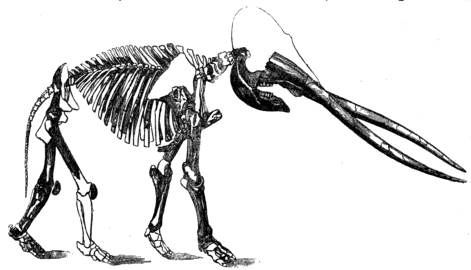
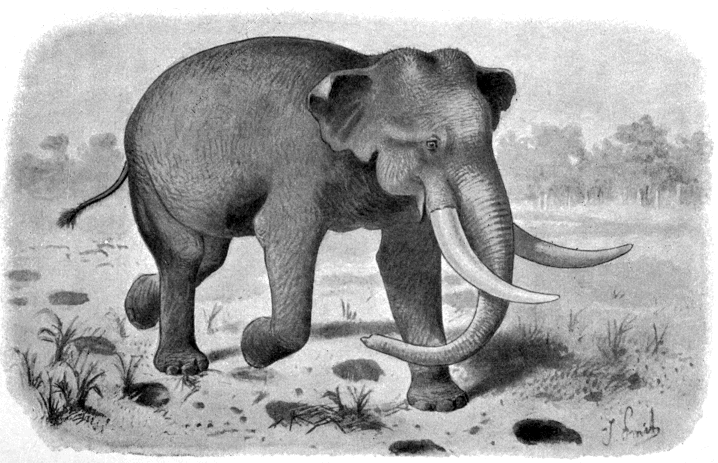
At the entrance of the Geological Gallery in the Natural History Museum, South Kensington, the reader will see a magnificent skeleton of an American Mastodon, of which more presently. On this specimen our artist has based his restoration, Plate XXI. A large part of the great gallery referred to is devoted to the fossil remains of proboscideans; that is, creatures provided with a long proboscis, or trunk, such as elephants and Mastodons. This collection, from widely different quarters, is the largest and most complete in the world. By comparing the specimens of teeth in the cases, and looking at the fine specimens of skulls, and the numerous bones and tusks in the side cases, the reader will carry away a better idea than we can convey by description. Fig. 54 shows the skeleton of Mastodon arvernensis with two very long tusks. Mastodon augustidens had four tusks, two in each jaw, but one of those in the lower jaw sometimes dropped out as the animal grew older.
Plate XXI.
THE MASTODON OF OHIO, M. AMERICANUS.
No genus of quadrupeds has been more extensively diffused over the globe than the Mastodon. From the tropics it has extended both north and south into temperate regions, and in America its remains have been discovered as high as latitude 66° N. But the true home of the Mastodon giganteus, in the United States, like that of M. augustidens in Europe, lies in a more temperate zone, and, as Professor Owen says, we have no evidence that any species was specially adapted, like the Mammoth, for braving the rigours of an arctic winter.
Now, we know from trustworthy geological evidence that the Mastodon is a much older form of life than the Mammoth. The record of the rocks tells us that it first put in an appearance in an early Tertiary period known as the Miocene (see Table of Strata, Appendix I.), and in the Old World lived on to the end of the succeeding Pliocene period. But in America several species, especially M. giganteus, survived till late in the Pleistocene period, where it was probably seen by primitive men. This is all that is known about its geographical range, and its antiquity or range in time; some day, perhaps before very long, palæontologists may be able to trace the great proboscideans further back in time, and to show from what form of animal they were derived. Strange as it may seem, anatomists declare that they show some remote affinity with the rodents, or gnawing animals, and, in some respects, even with Sirenians, such as the Manatee (See Chapter XVI.). But at present the evolution of this remarkable group of animals is an unsolved problem. Those strange animals, the Dinocerata, from Wyoming, described in Chapter X., may perhaps give some indication as to the direction in which we must look for the elephant’s ancestors. We noticed that their limbs were decidedly elephantine (see p. 150), but they had no trunks, and their skulls showed curious prominences like horn-cores; their teeth too are very different.
The visitor to the Geological Collection at South Kensington will also notice a splendid cranium of an elephant, with very long tusks, from the famous Sivalik Hills of Northern India[72] (Stand D on plan). It belonged to Elephas ganesa, one of the largest of all the fossil elephants known. The total length of the cranium and tusks is fourteen feet, and the tusks alone measure ten feet six inches in length! This remarkable specimen was presented by Sir William Erskine Baker, K.C.B.
But to return to our Mastodon. It was early in the eighteenth century that the teeth and bones of the Mastodon were first described,[73] and it is curious to observe how differently scientific discoveries were regarded in those days; for this society of learned men published in these Transactions a letter from Dr. Mather to Dr. Woodward, in which the former gives an account of a large work in manuscript, but does not name the author. This book, which appears to have been a commentary on the Bible, Dr. Mather recommends “to the patronage of some generous Mœcenas to promote the publication of it,” and transcribes, as a specimen, a passage announcing the discovery at Albany, now the capital of New York State, in the year 1705, of enormous bones and teeth. These relics he considered to belong to a former race of giants, and appeals to them in confirmation of Genesis vi. 4 (“The Nephilim (giants) were in the earth in those days”).
Portions of the skeleton of Mastodon, discovered in 1801, were sent to England and France, and two complete specimens were at length put together in America. One of these was exhibited as a Mammoth, in Bristol and London, by Mr. C. W. Peale, a naturalist, by whom they were found in marly clay on the banks of the Hudson, near Newburgh, in the State of New York.
Previous to this, in 1739, a French officer, M. de Longueil, traversed the virgin forests bordering on the river Ohio, in order to reach the Mississippi, and the Indians who escorted him accidentally discovered, on the borders of a marsh, various bones, some of which seemed to be those of unknown animals. In this turfy marsh, known as the Big Bone Lick, or Salt Lick, in consequence of the saltness of its waters, herds of wild animals collect together, attracted by the salt, for which they have a great liking. This is probably the reason why so many bones have accumulated here. M. de Longueil carried away some bones and teeth, and, on his return to France, presented them to Daubenton and Buffon. The former declared the teeth to be those of a hippopotamus, and the tusk and gigantic thigh-bone he reported to belong to an elephant. Buffon, however, did not share this opinion, and succeeded in converting Daubenton, as well as other French naturalists, to his views. He gave to this fossil animal the name of “the Elephant of Ohio,” but formed an exaggerated idea of its size.
This discovery produced a great impression in Europe. The English, becoming masters of Canada by the peace of 1763, sought eagerly for more remains. Croghan, the geographer, visited the Big Bone Lick, and found there some more bones of the same kind. He forwarded many cases to different naturalists in London.
Sir Henry Howorth, in his recent work, The Mammoth and the Flood (in which are brought forward certain views not shared by most geologists), mentions that in 1762 the Shawnee Indians found, some three miles from the river Ohio, the skeletons of five Mastodons, and reported that one of the heads had a long nose attached to it, below which was the mouth. Several explorers report discoveries of a like nature, which, if they may be trusted, and if they really refer to the Mastodon, and not the Mammoth, seem to show that portions of the skin and hairy covering have been seen. If so, their preservation is probably due to the saltness of the waters of this marsh, for salt is a good preservative. In The American Journal of Science,[74] Dr. Koch reports the discovery of a Mastodon’s skeleton, of which the head and fore foot were well preserved, also large pieces of the skin, which looked like freshly tanned leather. But some of these accounts refer to tufts of hair—in one case three inches long.
The great skeleton of Mastodon americanus already referred to was purchased by the trustees of the British Museum, of Mr. Albert Koch, a well-known collector of fossil remains, who had exhibited it in the Egyptian Hall, Piccadilly, in 1842 and 1843, under the name of “the Missouri Leviathan,” an enormous and ill-constructed monster, made up of the bones of this skeleton, together with many belonging to other individuals, in such a way as to horrify an anatomist and appeal all the more forcibly to the imagination of the public. From this heterogeneous assemblage of bones those belonging to the same animal have now been selected and articulated in their proper places. The height of this specimen is nine feet and a half, and the total length about eighteen feet.
According to Mr. Koch, the remains exhibited by him were found in alluvial deposits on the banks of a small tributary of the Osage River, in Benton County, Missouri. The bones were embedded in a brown, sandy deposit, full of vegetable matter, in which were recognised remains of the cypress, tropical cane, swamp moss, etc., and this was covered by blue clay and gravel to a thickness of about fifteen feet. Mr. Koch personally assured Dr. Mantell that an Indian flint arrow-head was found beneath the leg-bones of this skeleton, and that four similar weapons were embedded in the same stratum. He declared that he took them out of the bed with his own hands.
In the Pier-case (No. 38), near the Mastodon americanus, may be seen fifteen heads and jaws, together with other parts of the skeleton, mostly obtained from the same locality, but some of them came from the “Big Bone Lick,” Kentucky.
A fine specimen, obtained from a marsh near Newburgh, by Dr. Warren, measured eleven feet in height, and seventeen in length, while the tusks were nearly ten feet long, not including the portion in the long sockets of the cranium. Twenty-six species of Mastodon are known.
An interesting find was that of Dr. Barton, a professor of the University of Pennsylvania. At a depth of six feet, and under a great bank of chalk, bones of the Mastodon were found sufficient to form a skeleton, and in the middle of the bones was seen a mass of vegetable matter enveloped in a kind of sac (which probably was the stomach of the animal). This matter was found to be composed of small leaves and branches, amongst which was recognised a species of rush yet common in Virginia. In North America, where the Mastodon survived into the period of primitive man, various strange legends exist that seem to refer to it. Traditions were rife among the Red Men concerning this giant form and its destruction.
A French officer named Fabri informed M. Buffon, the naturalist, that the “savages” (Indians) regarded the bones found in various parts of Canada and Louisiana as belonging to an animal which they named “Father of the Ox.” The Shawnee Indians believed that with this enormous animal there existed men of proportionate development, and that the Great Being destroyed both with thunderbolts. Those of Virginia state that as a troop of these terrible animals were destroying the deer, bisons, and other animals created for the use of Indians, the Great Man slew them all with his thunder, except the Big Bull, who shook off the thunderbolts as they fell on him, till at last, being wounded in the side, he fled towards the great lakes, where he lies to this day.
This is one of the songs which Fabri heard in Canada: “When the great Manitou descended to the earth, in order to satisfy himself that the creatures he had created were happy, and he interrogated all the animals, the bison replied that he would be quite contented with his fate in the grassy meadows, where the grass reached his belly, if he were not also compelled to keep his eyes constantly turned towards the mountains to catch the first sight of the ‘Father of the Ox,’ as he descended, with fury, to devour him and his companions.” Many other tribes repeat similar legends.
The bones with which Mazuyer practised his famous deception were those of a Mastodon (see p. 196).
Fig. 55.—Head of Woolly Rhinoceros, partly restored by M. Deslongchamps.
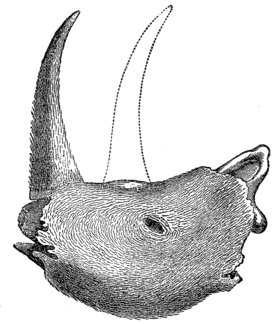
Contemporary with the Mammoth in Siberia and in Northern and Western Europe, was the “Woolly Rhinoceros” (Rhinoceros tichorhinus). Its body has been found in frozen soil in Siberia, with the skin, the two horns, the hair, and even the flesh preserved, as in the case of the Mammoth. It had a smooth skin without folds, covered with a fine curly and coarse hairy coat, to enable it to withstand the rigours of an arctic climate. The traveller Pallas gives a long account of one of these creatures, which was taken out of the ice, with its skin, hair, and flesh preserved. The following is a brief summary of his narrative. The body was observed in December, 1771, by some Jakuts near the river Vilui, which discharges itself into the Lena below Jakutsk in Siberia, latitude 64° north. It lay in frozen sand upon the banks of the river. A certain Russian inspector had sent on to Irkutsk the head and two feet of the animal, all well preserved. The rest of it was too much decomposed, and so was left. The head was quite recognisable, since it was covered with its leathery skin. The eyelids had escaped total decay (see Fig. 55). The skin and tendons of the head and feet still preserved considerable flexibility. He was, however, compelled to cross the Baikal lake before the ice broke up, and so could neither draw up a sufficiently careful description nor make sketches of those parts which were sufficiently preserved. Plate XXII. is a restoration.
PlateXXII.
THE WOOLLY RHINOCEROS, RHINOCEROS TICHORHINUS. Contemporary with the Mammoth.
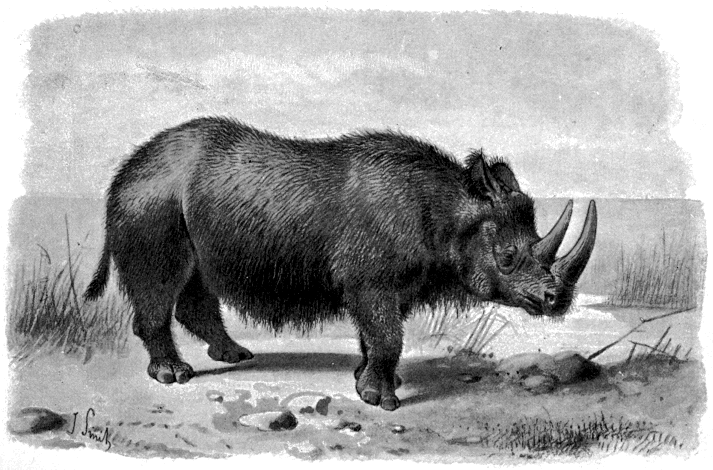
The rhinoceros in question was neither large for its species nor advanced in age; but it was at least fully grown. The horns were gone, but had left evident traces on the head. The skin which covered the orbits of the eyes and formed the eyelids was so well preserved, that the openings of the eyelids could be seen, though deformed and scarcely penetrable to the finger. The foot that was left—after some parts had unfortunately been burned while left to dry slowly on the top of a furnace—was furnished with hairs. These hairs adhering in many places to the skin, were from one to three lines in length, tolerably stiff and ash-coloured. What remained proved that the foot was covered with bunches of hair hanging down.
Like the Mammoth and the Mastodon, its contemporaries, the Woolly Rhinoceros has given rise to some curious legends. In the city of Klagenfurt, in Carinthia, is a fountain on which is sculptured the head of a monstrous dragon with six feet, and a head surmounted by a stout horn. According to popular tradition, still prevalent at Klagenfurt, this dragon lived in a cave, whence it issued from time to time to frighten and ravage the country. A bold cavalier killed the dragon, paying with his life for this proof of courage. The same kind of legend seems to be current in every country, such as that of the valiant St. George and the dragon, and of St. Martha, who about the same time conquered the famous Tarasque of the city of Languedoc, which bears the name of Tarascon.
But at Klagenfurt the popular legend has happily found a mouthpiece; the head of the pretended dragon killed by the valorous knight is preserved in the Hôtel de Ville, and this head has furnished the sculptor of the fountain with a model for the head of his statue. Herr Unger, of Vienna, recognised at a glance the cranium of the fossil rhinoceros; its discovery in some cave had probably originated the fable of the knight and the dragon. It is always interesting to discover a scientific basis for fables which otherwise it would be difficult to account for.
The same rhinoceros was once a denizen of our country, and its remains are met with in caves and river-gravels. Specimens of its skull have also been dredged up by fishermen from the “Dogger Bank” in the North Sea.
CHAPTER XV.
GIANT BIRDS.
“To discover order and intelligence in scenes of apparent wildness and confusion is the pleasing task of the geological inquirer.”—Dr. Paris.
Of all the monsters that ever lived on the face of the earth, the giant birds were perhaps the most grotesque. An emu or a cassowary of the present day looks sufficiently strange by the side of ordinary birds; but “running birds” much larger than these flourished not so very long ago in New Zealand and Madagascar, and must at one time have inhabited areas now sunk below the ocean waves.
The history of the discovery of these remarkable and truly gigantic birds in New Zealand, and the famous researches of Professor Owen, by which their structures have been made known, must now engage our attention.
In the year 1839 Professor Owen exhibited, at a meeting of the Zoological Society, part of a thigh-bone, or femur, 6 inches in length, and 51/2 inches in its smallest circumference, with both extremities broken off. This bone of an unknown struthious bird was placed in his hands for examination, by Mr. Rule, with the statement that it was found in New Zealand, where the natives have a tradition that it belonged to a bird now extinct, to which they give the name Moa. Similar bones, it was said, were found buried on the banks of the rivers.
A minute description of this bone was given by the professor, who pointed out the peculiar interest of this discovery on account of the remarkable character of the existing fauna of New Zealand, which still includes one of the most extraordinary birds of the struthious order (“running birds”), viz. the Apteryx, and also because of the close analogy which the event indicated by the present relic offers to the extinction of the Dodo in the island of Mauritius. On the strength of this one fragment he ventured to assert that there once lived in New Zealand a bird as large as the ostrich, and of the same order. This conclusion was more than confirmed by subsequent discoveries, which he anticipated; and, as we shall see, his estimate was a most moderate one, for the extinct bird turned out to be considerably larger than the ostrich.
Later on he received from a friend in New Zealand news of the discovery of more bones. In 1843 a collection of bones of large birds was sent to Dr. Buckland, Dean of Westminster, by the Rev. William Williams, a zealous and successful Church missionary, long resident in New Zealand. On sending off his consignment Mr. Williams wrote a letter, of which we give the greater part below.
“Poverty Bay, New Zealand, February 28, 1842.
“Dear Sir,
“It is about three years ago, on paying a visit to this coast—south of the East Cape, that the natives told me of some extraordinary monster, which they said was in existence in an inaccessible cavern on the side of a hill near the river Wairoa; and they showed me at the same time some fragments of bone taken out of the beds of rivers, which they said belonged to this creature, to which they gave the name Moa.
“When I came to reside in this neighbourhood I heard the same story a little enlarged; for it was said that this creature was still existing at the said hill, of which the name is Wakapunake, and that it is guarded by a reptile of the lizard species [genus]; but I could not learn that any of the present generation had seen it. I still considered the whole as an idle fable, but offered a large reward to any one who would catch me either the bird or its protector....”
These offers procured the collection of a considerable number of fossil bones, on which Mr. Williams, in his letter, makes the following observations:—
“None of these bones have been found on the dry land, but are all of them from the banks and beds of fresh-water rivers, buried only a little distance in the mud.... All the streams are in immediate connection with hills of some altitude.
“2. This bird was in existence here at no very distant time, though not in the memory of any of the inhabitants; for the bones are found in the beds of the present streams, and do not appear to have been brought into their present situation by the action of any violent rush of waters.
“3. They existed in considerable numbers”—an observation which has since been abundantly confirmed.
“4. It may be inferred that this bird was long-lived, and that it was many years before it attained its full size.” This is doubtful.
“5. The greatest height of the bird was probably not less than fourteen or sixteen feet.” Fourteen is probably the extreme limit.
“Within the last few days I have obtained a piece of information worthy of notice. Happening to speak to an American about these bones, he told me that the bird is still in existence in the neighbourhood of Cloudy Bay, in Cook’s Straits. He said that the natives there had mentioned to an Englishman belonging to a whaling party that there was a bird of extraordinary size to be seen only at night, on the side of a hill near the place, and that he, with a native and a second Englishman, went to the spot; that, after waiting some time, they saw the creature at a little distance, which they describe as being about fourteen or sixteen feet high. One of the men proposed to go nearer and shoot, but his companion was so exceedingly terrified, or perhaps both of them, that they were satisfied with looking at the bird, when, after a little time it took alarm, and strode off up the side of the mountain.
“This incident might not have been worth mentioning, had it not been for the extraordinary agreement in point of size of the bird”—with his deductions from the bones. “Here are the bones which will satisfy you that such a bird has been in existence; and there is said to be the living bird, the supposed size of which, given by an independent witness, precisely agrees.” In spite, however, of several tales of this kind, it is almost certain that these birds are now quite extinct.
* * * * *
The leg-bones sent to London greatly exceeded in bulk those of the largest horse. The leg-bone of a tall man is about 1 ft. 4 in. in length, and the thigh of O’Brien, the Irish giant, whose skeleton, eight feet high, is mounted in the Museum of the Royal College of Surgeons, is not quite two feet. But some of the leg-bones (tibiæ) of Moa-birds measure as much as 39 inches.
In 1846 and 1847 Mr. Walter Mantell, eldest son of Dr. Mantell, who had resided several years in New Zealand, explored every known locality within his reach in the North Island. He also went into the interior of the country and lived among the natives for the purpose of collecting specimens, and of ascertaining whether any of these gigantic birds were still in existence; resolving, if there appeared to be the least chance of success, to penetrate into the unfrequented regions, and obtain a live Moa. The information gathered from the natives offered no encouragement to follow up the pursuit, but tended to confirm the idea that this race of colossal bipeds was extinct. He succeeded, however, in obtaining a most interesting collection of the bones of Moa-birds, belonging to birds of various species and genera, differing considerably in size. This collection was purchased by the trustees of the British Museum for £200. Another collection was made by Mr. Percy Earle from a submerged swamp, visible only at low water, situated on the south-eastern shore of the Middle Island. This collection also was purchased by the trustees for the sum of £130. Mr. Walter Mantell, who described this locality, near Waikouaiti, seventeen miles north of Otago, thinks it was originally a swamp or morass, in which the New Zealand flax once grew luxuriantly. The appearance and position of the bones are similar to those of the quadrupeds embedded in peat-bogs, as, for instance, the great Irish elk (see next chapter). They have acquired a rich umber colour, and their texture is firm and tough. They still contain a large proportion of animal matter. Unfortunately, even when Mr. Walter Mantell visited this spot, the bed containing the bones was rapidly diminishing from the inroads of the sea, and perhaps by this time is entirely washed away. Mr. W. Mantell, however, obtained fine specimens and feet of a large Moa-bird (Dinornis) in an upright position; and there seems to be little doubt that the unfortunate bird was mired in the swamp, and perished on the spot.
The bones which he obtained from the North Island presented a different appearance, being light and porous, and of a delicate fawn-colour. They were embedded in loose volcanic sand. Though perfect, they were as soft and plastic as putty, and required most careful handling. They were dug out with great care, and exposed to the air and sun to dry before they could be packed up and removed.
The natives were a great source of trouble to him, for as soon as they caught sight of his operations they came down in swarms—men, women, and children, trampling on the bones he had laid out to dry, and seizing on every morsel they could get. The reason of this was that their cupidity and avarice had been excited by the large rewards given by Europeans in search of these treasures. Mixed with the bones he found fragments of shells, and sometimes portions of the windpipe, or trachea.
One portion of an egg which he found was large enough to enable him to calculate the size of the egg when complete. “As a rough guess, I may say that a common hat would have served as an egg-cup for it: what a loss for the breakfast-table! And if many native traditions are worthy of credit, the ladies have cause to mourn the extinction of the Moa: the long feathers of its crest were by their remote ancestors prized above all other ornaments; those of the White Crane, which now bear the highest value, were mere pigeon’s feathers in comparison.”
The total number of species of Moa once inhabiting New Zealand was probably at least fifteen, and, judging from the enormous accumulations of their bones found in some districts, they must have been extremely common, and probably went about in flocks. “Birds of a feather flock together” (proverb).
It is justly concluded, both from the vast number of bones discovered, and from the fact of their great diversity in size and other features, that they must have had the country pretty much to themselves; or, in other words, they enjoyed immunity from the attacks of carnivorous quadrupeds. In whatever way the Moas originated in New Zealand, it is evident that the land was a favourable one, for they multiplied enormously, and spread from one end to the other. Not only was the number of individuals very large, but they belonged (according to Mr. F.W. Hutton) to no less than seven genera, containing twenty-five different species, a remarkable fact which is unparalleled in any other part of the world. The species described by Professor Owen in his great work,[75] vary in size from 3 ft. to 12 or even 14 ft. in height, and differ greatly in their forms, some being tall and slender, and probably swift-footed like the ostrich, whilst others were short and had stout limbs, such as Dinornis elephantopus (Fig. 56), which was undoubtedly a bird of great strength, but very heavy-footed. Dinornis crassus also had stout limbs. (See Plate XXIII.)
PlateXXIII.
MOA-BIRDS. Dinornis giganteus. D. elephantopus. Height 12 feet. A smaller species.
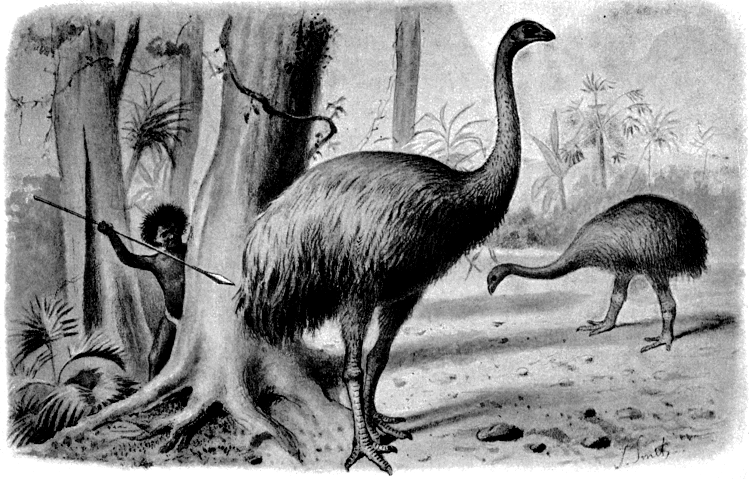
Fig. 56.—A. Skeleton of the Elephant-footed Moa, Dinornis elephantopus, from New Zealand. B. Leg-bones of Dinornis giganteus, representing a bird over 12 ft. high. r, b, footprints.
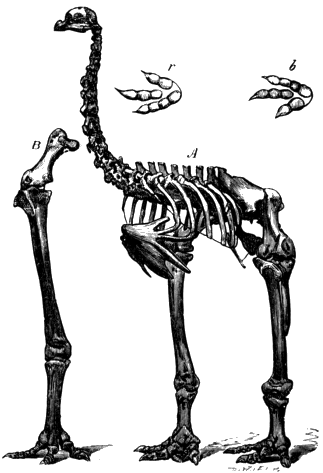
The Natural History Museum at South Kensington contains a valuable collection of remains of Moa-birds. These skeletons may be seen in Gallery No. 2 (at the end of the long gallery) in the glass cases R, R´, and S. Dinornis elephantopus (elephant-footed) is in front of the window. In D. giganteus the leg-bone (see Fig. 56) attains the enormous length of 3 ft., and in an allied species it is even 39 in.! The next bone below (cannon bone) is sometimes more than half the length of the leg-bone (tibia).
A skeleton in one of the glass cases has a height of about 101/2 ft., and it is concluded that the largest birds did not stand less than 12 ft., and possibly were 14 ft. high!
Dinornis parvus (the dwarf Moa) was only three feet high.
In 1882 the trustees obtained, from a cave in Otago, the head, neck, two legs, and feet of a Moa (D. didinus), having the skin, still preserved in a dried state, covering the bones, and some few feathers of a reddish hue still attached to the leg (Table case 12). The rings of the windpipe may be seen in situ, the sclerotic plates of the eye, and the sheaths of the claws. One foot also shows the hind claw still attached.
From traditions and other circumstances it is supposed that the present natives of New Zealand came there not more than about six hundred years ago, and there is reason to believe that the ancient Maoris, when they landed, feasted on Moa-birds as long as any remained. Their extermination probably only dates back to about the period at which the islands were thrice visited by Captain Cook, 1769-1778. The Moa-bird is mixed up with their songs and stories, and they even have a tradition of caravans being attacked by them. Still, some people believe that they were killed off by the race which inhabited New Zealand before the Maoris came. But they must have been there up to a time not far removed from the present. It is even said that the “runs” made by them were visible on the sides of the hills up to a few years ago; and possibly they may still be visible. The charred bones and egg-shells have been found mixed with charcoal where the native ovens were formerly made, and their eggs are said to have been found in Maori graves. Mr. Hutton considers that in the North Island they were exterminated three or four centuries ago, while in the South Island they may have lingered a century longer.
The nearest ally of the Moa is the small Apteryx, or Kiwi, of New Zealand, specimens of which may be seen at the Natural History Museum, at the end of the long gallery devoted to living birds. This bird, however, has a long pointed bill for probing in the soft mud for worms, whereas the bill of the Moa was short like that of an ostrich.
Another difference between the two is that, while the Kiwi still retains the rudiments of wing-bones, the Moa had hardly a vestige of such.
In Australia the remains have been found of a bird probably related to the Cassowaries, but at present imperfectly known. To this type of struthious, or running bird, the name Dromornis has been given.
Now, it is a remarkable fact that remains of another giant bird and its eggs have been found on the opposite side of the great Indian Ocean, namely, in the island of Madagascar, the existence of which was first revealed by its eggs, found sunk in the swamps, but of which some imperfect bones were afterwards discovered. One of these eggs was so enormous that its diameter was nearly fourteen inches, and was reckoned to be as big as three ostrich eggs, or 148 hen’s eggs! This means a cubic content of more than two gallons! The natives search for the eggs by probing in the soft mud of the swamps with long iron rods. A large and perfect specimen of an egg of this bird, such as was recently exhibited at a meeting of the Zoological Society, is said to be worth £50. What the dimensions of Æpyornis were it is impossible to say, and it would be unsafe to venture a calculation from the size of the egg.[76] The reader who wishes to see some of the remains of this huge bird may be referred to the Natural History Museum. In wall case No. 25, Gallery 2 (Geological Department), may be seen a tibia and plaster casts of other bones; also two entire eggs, many broken pieces, and one plaster cast of an egg found in certain surface deposits in Madagascar. In the same case may be seen bones of the Dodo from the isle of Mauritius. Unlike New Zealand, Madagascar possesses no living wingless bird. But in the neighbouring island of Mauritius the Dodo has been exterminated less than three centuries ago. The little island of Rodriguez, in the same geographical province, has also lost its wingless Solitaire.
It will thus be seen that we have three distinct groups of giant land birds—the Moas, the Dromornis, and the Æpyornis,—occupying areas at present widely separated by the ocean.
This raises the difficult but very interesting question, how they got there; and the same applies to their living ancestors. The ostrich proper, Struthio camelus, inhabits Africa and Arabia; but there is evidence from history to show that it formerly existed in Beluchistan and Central Asia. And, going still further back, the geological record informs us that, in the Pliocene period, they inhabited what is now Northern India. In Australia we have the Cassowary (Casuarius) and the Emeu (Dromaius); in New Zealand, the Apteryx (or Kiwi). Now, as none of these birds can either fly or swim, it is impossible that they could have reached these regions separated as they now are; and it is hardly likely that they arose spontaneously in each district from totally different ancestors. But the new doctrine of evolution affords a key to the problem, and tells us that they all sprang from a common ancestor, of the struthious type (probably inhabiting the great northern continental area), and gradually migrated south along land areas now submerged. In this way we get some idea of the vast changes that have taken place in the geography of the world during later geological periods. Perhaps they were compelled to move south until they reached abodes free from carnivorous enemies. Having done so, they evidently flourished abundantly, especially in New Zealand, where there are so few mammals, except those recently introduced by man.
In North America Professor Cope has reported a large wingless fossil bird from the Eocene strata of New Mexico. In England we have two such—namely, the Dasornis, from the London Clay of Sheppey (Eocene period), and the Gastornis, from the Woolwich beds near Croydon, and from Paris (also Eocene).
It will thus be seen that big struthious birds have a long history, going far back into the Tertiary era, and that they once had a much wider geographical range than they have now. Doubtless, future discoveries will tend to fill up the gaps between all these various types, both living and extinct, and to connect them together in one chain of evolution.
The last great find of Moa-birds in New Zealand took place only last year, and was reported by a correspondent to the Scotsman (November 13, 1891), writing from Oamaru. In the letter that appeared at the above date, our friend Mr. H. O. Forbes announces the discovery of an immense number of bones, estimated to represent at least five hundred Moas! They were found in the neighbourhood of Oamaru. And, after some preliminary remarks, he continues as follows:—
"The part of the field on which the remains were found bears no traces of any physical disturbance—e.g. of earthquake, or flood, or hurricane—that would account for the sudden destruction of a flock or ‘mob’ of Moas. The Moa, when alive, carried in its crop—like our own hens—a quantity of stones to serve as a private coffee-mill for digestive grinding; stones which, being somewhat in proportion to the magnitude of the giant bird, form, when found in one place, a ‘heap’ of stones which are easily identified as a Moa heap, and nothing else. And in the present case the heap was here and there found in such relation to the bones of an individual bird as to show that the Moa must have died on that spot, and remained there quietly undisturbed. Further, the number of birds represented by the exhumed remains is so great that the living birds could not have stood together on the space of ground on which the remains were found lying. And there is not on any of the bones any trace of such violence as must have left its mark if the death of the birds had been caused by a Moa-hunting mankind. Finally, it does not appear that in this particular district there ever has been, at any traceable period of the physical history of the land, a forest vegetation, such as might suggest that the catastrophe was caused by fire.
"The question how to account for the slaughter is raised likewise by two previous finds of Moa bones. The first of these, at Glenmark, in Canterbury, was the most memorable, because, being the first, it made the deepest impression. The second great find, far inland, up the Molineux River, otherwise the Clutha, was beneath the diluvium that is now worked by the gold-digger. The spot must have been the site of a lagoon, at one point of which there was a spring. Round about this point there were found the remains of, it was reckoned, five hundred individual Moas. The bones were quietly laid there, with, in some cases, the ‘heap’ of digestive stones in situ along with the skeletons. And Mr. Booth, whose elaborate investigation of this case is recorded in the annual volume of The New Zealand Institute, suggested the theory that the climate of New Zealand was changing to a degree of cold intolerable to Moa nature; and that the birds, fleeing from its rigour, sought comfort in the spring of water, sheltering their featherless breast in it, and so dozing out of this troubled life. And in this new find the wonder comes back unmitigated, as a mystery unsolved. For here is no bog deep enough, as in the first instance, nor lagoon spring, as in the second, to account for that multitude of giant birds dying in one spot.
"Another curious puzzle is, on close inspection, found everywhere in the Moa bone discoveries. It is hardly possible to make sure that the bones of any one complete Moa skeleton all belong to the same individual I heard some one say the other day that it is not certain that any Moa in any earthly museum has all his own bones, and only his own.
“A main interest of such a find lies not in the power of supplying museums with specimens of what is rapidly disappearing from the face of the world, but in the possibility of finding species of Moa that have not hitherto been tabulated. Whether any new species have been brought to light on this occasion the experts will not say until there has been time to make a careful study of the bones, nor do they venture on any theory to account for there being so many individual birds dead in that one place, where there appears to be no room for the explanations offered in connection with previous great finds. The date of these birds appears to be earlier than that of the coming of the Maoris into New Zealand, say five or six hundred years ago, as the Maori memory appears to have in it no trace of feasting on these giant Moas, but celebrates the rat-hunt in its ancient heroic song. And your readers may picture their appearance by noticing the fact that one of the recently found bones must have belonged to a Moa fourteen feet high!”
Note.—For further information on this interesting subject, the reader is referred to a paper in Natural Science, October, 1892, by Mr. F. W. Hutton. In a valuable paper, read before the Royal Geographical Society by Mr. H. O. Forbes, March 13, 1893, the lecturer alluded to the important fact that bone belonging to big extinct struthious birds have been discovered in Patagonia. This is interesting news as bearing upon the theory of a former Antarctic continent connecting Australia and New Zealand with South Africa, and perhaps even with South America. After the lecture, to which we listened with great interest, the subject was discussed by Mr. Slater, Dr. Günther, and Dr. Henry Woodward. For ourselves we can see no great difficulty in accepting the theory that such a continent once existed, though it is out of harmony with the now rather fashionable theory of “the permanence of ocean basins”—a doctrine which seems to have been pressed too far.
CHAPTER XVI.
THE GREAT IRISH DEER AND STELLER’S SEA-COW.
“And, above all others, we should protect and hold sacred those types, Nature’s masterpieces, which are first singled out for destruction on account of their size, or splendour, or rarity, and that false detestable glory which is accorded to their most successful slayers. In ancient times the spirit of life shone brightest in these; and when others that shared the earth with them were taken by death they were left, being more worthy of perpetuation. Like immortal flowers they have drifted down to us on the ocean of time, and their strangeness and beauty bring to our imaginations a dream and a picture of that unknown world, immeasurably far removed, where man was not: and when they perish, something of the gladness goes out of nature, and the sunshine loses something of its brightness.”—W. H. Hudson, in The Naturalist in La Plata.
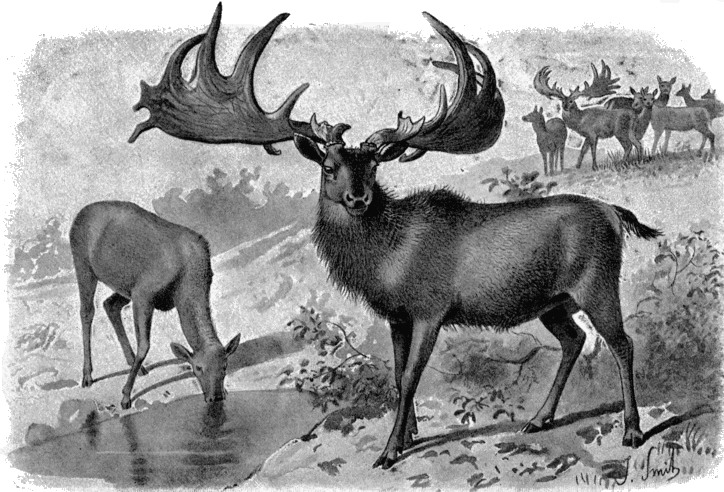
Among the extinct animals of prehistoric times the “Great Irish Elk,”[77] as it is generally called, deserves special notice, both from the enormous size of its antlers, and from the fact that its remains are exceedingly plentiful in Ireland.
This magnificent creature, so well depicted by our artist (Plate XXV.), was, however, by no means confined to Ireland; its remains are found in many parts of Great Britain, particularly in cave deposits, and also on the Continent. Some writers think that it was contemporary with men in Ireland; it may have been so, but at present the question cannot be considered as proved. Mr. R. J. Ussher, who found its remains in a cave near Cappagh, Cappoquin, thinks he has obtained evidence to show that it was hunted by man at the time when he hunted reindeer in this part of Europe, but the age of the strata containing the remains is doubtful. Again, there is a rib in the Dublin Museum with a perforation which is sometimes taken to be the result of a wound from a dart, arrow, or spear; but the wound may have been inflicted by one of the sharp tynes in a fight between two bucks.
Dr. Hart mentions the discovery of a human body in gravel, under eleven feet of peat, soaked in bog-water, in good preservation, and completely clothed in antique garments of hair, which it has been conjectured might be that of the Great Deer. But if some individual animal had perished and left its body under the like circumstances, its hide and hair ought equally to have been preserved. Dr. Molyneux, to whom we owe the first account of its discovery, says that its extinction in Ireland has occurred “so many ages past, as there remains among us not the least record in writing, or any manner of tradition, that makes so much as mention of its name; as that most laborious inquirer into the pretended ancient but certainly fabulous history of this country, Mr. Roger O’Flaherty, the author of Ogygia, has lately informed me.”[78]
In the romance of the “Niebelungen,” now immortalised by Wagner, which was written in the thirteenth century, the word shelch occurs, and is applied to one of the beasts slain in a great hunt a few hundred years before that time in Germany. This word has been cited by some naturalists as probably signifying the Great Irish Deer. But this is mere conjecture, and the word might apply to some big Red Deer. The total silence of Cæsar and Tacitus respecting such remarkable animals renders it highly improbable that they were known to the ancient Britons.
Fig. 57.—Skeleton of Great Irish Deer, Cervus giganteus, from shell-marl beneath the peat, Ireland. Antlers over 9 feet across.
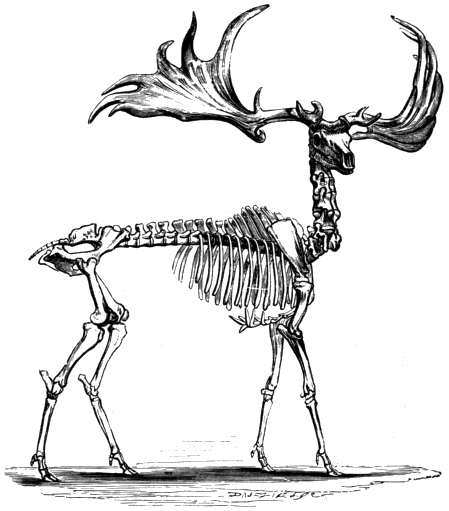
Two entire skeletons of the male, with antlers measuring a little over nine feet from tip to tip, and one skeleton of the hornless doe, are to be seen set up in the middle of the long gallery No. 1 at the Natural History Museum. The drawing in Fig. 57 is from a specimen in the Museum of the Royal College of Surgeons (Lincoln’s Inn Fields). The height of this specimen to the summit of the antlers is 10 ft. 4 in. The span of the antlers, from tip to tip, is 8 ft. (in the living Moose it is only 4 ft). The weight of the skull and antlers together is 76 lbs., but those of another specimen belonging to the Royal Dublin Society weigh 87 lbs. This great extinct deer surpassed the largest Wapite (Cervus Canadensis) in size, and its antlers were very much larger, wider, and heavier. In some cases the antlers have measured more than 11 ft. from tip to tip. The body of the animal, as well as its antlers, were larger and stronger than in any existing deer. The limbs are stouter, as might be expected from the great weight of the head and neck. Another and more striking feature is the great size of the vertebræ of the neck; this was necessary in order to form a column capable of supporting the head and its massive antlers. (See Plate XXV.)
PlateXXV.
THE GREAT IRISH DEER, CERVUS MEGACEROS. Height to the summit of the antlers 10 feet; spread of antlers 11 feet.
The first tolerably perfect skeleton was found in the Isle of Man, and presented by the Duke of Athol to the Edinburgh Museum. It was figured in Cuvier’s Ossemens Fossiles. Besides those already mentioned at South Kensington and Dublin, there is one in the Woodwardian Museum at Cambridge.
It cannot be doubted that, like all existing deer, the animal shed its antlers periodically, and such shed antlers have been found. When it is recollected that all the osseous matter of which they are composed must have been drawn from the blood carried along certain arteries to the head, in the course of a few months, our wonder may well be excited at the vigorous circulation that took place in these parts.
In the Red Deer the antlers, weighing about 24 lbs., are developed in the course of about ten weeks; but what is that compared to the growth of over 80 lbs. weight in some three or four months?
It is a mistake to suppose that the remains discovered in Ireland were found in peat; they occur not in the peat, but in shell-marls and in clays under the peat. This is an important point For if the remains were found in the peat, they would prove that the Great Deer survived into a later period; instead of being (as is believed from geological evidence) contemporary with the Mammoth and Woolly Rhinoceros in this country, and then disappearing from view. As already stated, it existed on the Continent, and may there have been exterminated by man.
Mr. W. Williams, who has explored several peat-bogs in Ireland, marking the site of ancient lakes, and found many specimens in beds underlying the peat, has given much interesting information bearing upon the question of the period when the Great Deer inhabited Ireland, and the manner in which it was preserved in the lake-beds.[79] He spent ten weeks in 1876-77, excavating deer remains in the bog of Ballybetagh, and subsequently made similar excavations in the counties of Mayo, Limerick, and Meath. These peat-bogs occupy the basins of lakes, the deeper hollows of which have long since been silted up with marls, clays, and sands, and in this silt, or mud, the plants which produced the peat grew. In all the bogs examined he found a general resemblance in the order of succession of the beds, with only slight variations in the nature of the materials such as might be easily accounted for by differences in the surrounding rocks. In these deposits the geologist may read, as in a book, the successive changes in climate that have taken place since the time when the country was deeply covered with snow and ice during the Glacial period.
He found at the bottom of the old Ballybetagh Lake, and resting on the true Boulder Clay (a product of the ice-sheet), a fine stiff clay which seems to have been brought in by the action of rain washing fine clay out of the Boulder Clay, that nearly covered the land, and depositing it in the lake. This action probably took place during a period of thaw, when the climate was damp, from the melting of so much ice, and the rainfall considerable. Then the climate improved, the cold of the Glacial period passed away, and the climate became warm. During this phase the next stratum was formed, consisting chiefly of vegetable remains. The summers must have been unusually warm, dry, and favourable to the growth of vegetation on the bed of the lake. About this time the Great Irish Deer appeared on the scene, for its remains were found resting on this layer, or stratum, in a brownish clay. This deposit also was the product of a time when the climate was mild. It is a true lake-sediment, with seams of clay and fine sand, the latter having been brought down by heavy rainfall from the hills, just as at the present day.
Now, we have to consider how these Great Deer got buried in this deposit. How did they get drowned? They may have gone into the lakes to escape from wolves, or possibly to escape from ancient Britons (but that is still doubtful). Perhaps they went into the water to wallow, as is usual with deer, or they may have ventured to swim the lakes (see p. 19). To enter the lake from a sandy shore would be easy enough, but, on reaching the other side, they might find a soft mud instead, into which their small feet would sink; and the more they plunged and struggled, the worse became their plight, until at last, weary and exhausted, the heavy antlers pressed their heads down under the water, and they were drowned.
It does not follow, according to this theory, that either the entire animal ought to be found, or even its legs, sticking in the clay. For a few days it might remain so, but the motion of the waters of the lake would sway the body to and fro, while the gases due to decomposition would render it buoyant, and perhaps raise it bodily off the bottom. Then it might float before the wind, its head hanging down, till it reached the lee-side of the lake. Then the antlers would get fastened in mud near the shore, thus mooring the body until at last so much of the flesh of the neck had decayed that the body got separated from it, leaving the head and antlers near the shore.
Nearly a hundred heads had been found in this lake previous to Mr. Williams’s explorations, and yet scarcely six skeletons. At first it is somewhat puzzling to account for this scarcity of skeletons compared with heads; but very likely the bodies, minus their heads, were carried right out of the lake, down a river, and perhaps reached the sea or got stranded somewhere down the river in such a way that the bones were never covered up. But in the Limerick bogs heads and skeletons were often found together. In that district the lakes were probably shallow and with but a feeble current, and so the body never floated away. This explanation by Mr. Williams seems satisfactory.
He reports that the female skulls were rarely met with. Either they were more timid in swimming lakes, or, having no antlers, they may have succeeded in getting out, or the care of their young ones may have kept them out of the lakes during the summer months. The clay in which the remains occur is succeeded by another bed of pure clay, which never yields any skulls or bones. This, Mr. Williams thinks, was deposited at a time when the climate was more or less severe, and the musk-ox, reindeer, and other arctic animals came down from more northern regions, even down to the south of France. He concludes that this period marks the extinction of the Great Deer in Ireland, whether rightly or wrongly it is hard to say. Many observers are inclined to think that it lived on to a later period. An interesting fact, having some bearing on the question, is this: that the bones in some cases even yet retain their marrow in the state of a fatty substance, which will burn with a clear lambent flame. Evidence such as this seems to point to a more recent date for its extinction.
Steller’s Sea-Cow.[80]
The Sirenia of the present day form a remarkable group of aquatic herbivorous animals, really quite distinct from the Cetacea (whales and dolphins), although sometimes erroneously classed with them. In the former group are the Dugong and the Manatee. These creatures pass their whole life in the water, inhabiting the shallow bogs, estuaries, and lagoons, and large rivers, but never venturing far away from the shore. They browse beneath the surface on aquatic plants, as the terrestrial herbivorous mammals feed upon the green pastures on land.
Not a few of the tales of mermen and mermaids owe their origin to these creatures, as well as to seals, and even walruses. The Portuguese and Spaniards give the Manatee a name signifying “Woman-fish,” and the Dutch call the Dugong the “Little Bearded Man.” A very little imagination, and a memory only for the marvellous, doubtless sufficed to complete the metamorphosis of the half-woman, or man, half-fish, into a siren, a mermaid, or a merman. Hence the general name Sirenia.
The Manatee (Manatus) inhabits the west coast and rivers of tropical Africa, and the east coast and rivers of tropical America, the West Indies, and Florida.
The Dugong (Halicore) extends along the Red Sea coasts, the shores of India, and the adjacent islands, and goes as far as the northern and eastern coasts of Australia.
Fig. 58.—Skeleton of Rhytina gigas (Steller’s “Sea-Cow”), from a peat deposit, Behring’s Island.
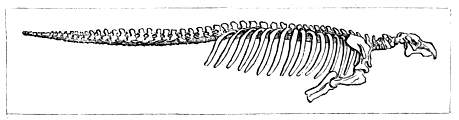
The most remarkable Sirenian is the Rhytina gigas, or “Steller’s Sea-Cow.” Early in 1885 the trustees of the British Museum acquired a nearly complete skeleton of this animal, now extinct, from peat deposits in Behring’s Island, of Pleistocene age. Formerly it was abundant along the shores of Kamtchatka, the Kurile Islands, and Alaska. It was first discovered by the German naturalist, Steller, who, in company with Vitus Behring, a captain in the Russian Navy and a celebrated navigator of the northern seas, was with his vessel and crew cast away upon Behring’s Island (where Behring died) in 1741. Steller’s original description is preserved in the Memoirs of the Academy of Sciences St. Petersburg. He saw it alive during his long enforced residence on the island. In the course of forty years, 1742-1782, it appears to have been exterminated, probably for the sake of its flesh and hide, around both Behring’s Island and Copper Island, to the shores of which it was, in Steller’s time, limited.
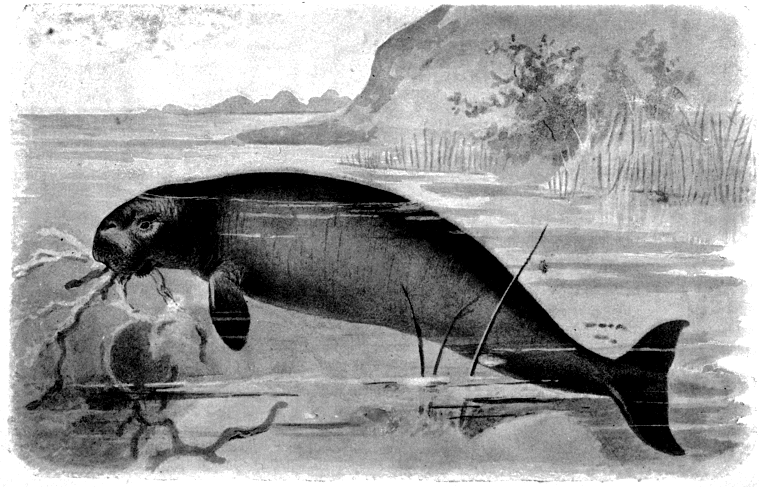
Fig. 58 shows its skeleton, 19 ft. 6 in. long, now preserved in the Geological Collection at South Kensington (Glass-case N). The skeletons are found, in the islands, at a distance from the shore in old raised beaches and peat-mosses, deeply buried and thickly overgrown with grass. They are discovered by boring into the peat with an iron rod, just as timber is found in Irish peat-bogs. (See restoration, Plate XXVI.)
Steller records that when he came to Behring’s Island, the Sea-cows fed in the shallows along the shore, and collected in herds like cattle. Every few minutes they raised their heads in order to get more air before descending again to browse on the thick sea-weed (probably Laminaria) surrounding the coast. With regard to their habits, they were very slow in their movements: mild and inoffensive in disposition. Their colour was dark brown, sometimes varied with spots. The skin was naked; but thick, hard, and rugged. They are said to have sometimes reached a length of thirty-five feet, when full grown. Most of their time was spent in browsing, and whilst so occupied, were not easily disturbed. Their attachment to each other was great, so that when one was harpooned, the others made great attempts to rescue it. According to Steller, they were so heavy that it required forty men with ropes to drag the body of one to land.
PlateXXVI.
STELLER’S SEA-COW, RHYTINA GIGAS. Found alive by Steller at Behring’s Island. Length 19 feet 6 inches.
When, in 1743, the news of the discovery of Behring Island reached Kamtchatka, several expeditions were fitted out for the purpose of hunting the sea-cow and the various fur-bearing animals, such as the sea-otter, fur seal, and blue fox, which are found there; and very soon many whaling vessels began to stop there to lay in a supply of sea-cow meat for food. So great was the destruction wrought by these whalers and fur-hunters that in 1754, only thirteen years after its discovery, the sea-cow had become practically exterminated. In 1768, according to the investigations of Dr. L. Stejneger of the U. S. National Museum, Washington, who has made a most careful study of the question, this large and important marine mammal became wholly extinct, the last individual ever seen alive having been killed in that year; and the fate which overtook Rhytina so speedily has almost become that of the buffalo, and will as certainly become that of the fur seal unless it be protected.
It may interest the reader, especially if he be a traveller, to know that, besides the fine specimen of Rhytina in the Natural History Museum, already alluded to, good skeletons are possessed by the Museums of St. Petersburg, Helsingsfors (Finland), Stockholm, U. S. National Museum, Washington, as well as portions of skeletons by other museums.
The Sirenians are an ancient race, for their remains have been found in Tertiary strata, of various ages, from Eocene to Pleistocene, over the greater part of Europe—in England, Holland, Belgium, France, Germany, Austria, and Italy; also near Cairo. In the New World, fossil Sirenians have been found in South Carolina, New Jersey, and Jamaica.
Another European species is the Halitherium, from the Miocene rocks of Hesse-Darmstadt, of which a cast may be seen in the Natural History Museum, South Kensington. Its length is 7 ft. 8 in. The teeth in this form resembled those of the Dugong.
The Rhytina was probably intermediate between the Dugong and the Manatee, judging from the casts of its brain-cavity. Its brain was very small considering the size of the animals. Altogether, as many as fourteen fossil genera and thirty species are known. Evidently, then, the old Sirenia were once a much more flourishing race. At present, they are confined exclusively to the tropical regions of the earth, and their past distribution, as revealed to the geologists, adds one more proof to the now well-established fact, that throughout most of the Tertiary era the climate of northern latitudes was very much warmer than now—in fact, sub-tropical. What cause, or causes, brought about so great a change, we cannot stay to consider here.
In conclusion, it only remains to express a hope that the reader may have been interested in our humble endeavours to describe some of the largest, most strange, and wonderful forms of life that in remote ages have found a home on this planet. And perhaps a few of our readers may be induced to add a new and never-failing interest to their lives by searching in the stony record for traces of the world’s “lost creations.” If so, our labour will not have been in vain.
APPENDIX I.
Table of Stratified Rocks.
Periods. Systems. Formations.
Quaternary. RECENT Terrestrial, Alluvial, Estuarine, and Marine Beds of Historic, Iron, Bronze, and Neolithic Ages Dominant type, Man

PLEISTOCENE Peat, Alluvium, Loess Valley Gravels, Brickearths Cave-deposits Raised Beaches Palæolithic Age Boulder Clay and Gravels

CAINOZOIC. Tertiary. PLIOCENE Norfolk Forest-bed Series Norwich and Red Crags Coralline Crag (Diestian) Dominant types, Birds and Mammals

MIOCENE Œningen Beds Freshwater, etc.
EOCENE Fluvio-marine Series (Oligocene) Bagshot Beds London Tertiaries(Nummulitic Beds)

SECONDARY, OR MESOZOIC. CRETACEOUS Maestricht Beds Chalk Upper Greensand Gault
Lower Greensand WealdenNeocomian
JURASSIC Purbeck Beds Portland Beds Kimmeridge Clay (Solenhofen Beds) Corallian Beds Oxford Clay Great Oolite Series Inferior Oolite Series Lias Dominant type Reptilia
TRIASSIC Rhætic Beds Keuper Muschelkalk Bunter
PRIMARY, OR PALÆOZOIC. PERMIAN or DYAS Red Sandstone, Marl Magnesian Limestone, etc.Zechstein Dominant type,Fishes
Red Sandstone and Conglomerate Rothliegende
CARBONIFEROUS Coal Measures and Millstone Grit Carboniferous Limestone Series
DEVONIAN & OLD RED SANDSTONE Upper Old Red Sandstone Devonian Lower Old Red Sandstone
SILURIAN Ludlow Series Wenlock Series Llandovery Series May Hill Series
ORDOVICIAN Bala and Caradoc Series Llandeilo Series Llanvirn Series Arenig and Skiddaw Series
CAMBRIAN Tremadoc Slates Lingula Flags Menevian Series Harlech and Longmynd Series
EOZOIC-ARCHÆAN Pebidian, Arvonian, and Dimetian Huronian and Laurentian Dominant type, Invertebrata
APPENDIX II.
THE GREAT SEA-SERPENT.
Mr. Henry Lee, formerly naturalist to the Brighton Aquarium, discusses the question of “The Great Sea-Serpent” in an interesting little book, entitled Sea Monsters Unmasked, illustrated (1883), published as one of the Handbooks issued in connection with the International Fisheries Exhibition. He goes fully into the history of the subject, and shows how some of the appearances described may be accounted for; but yet is inclined to think that there may exist in the sea animals of great size unknown to science, and concludes as follows:—
“This brings us face to face with the question, ‘Is it, then, so impossible that there may exist some great sea creature, or creatures, with which zoologists are hitherto unacquainted, that it is necessary in every case to regard the authors of such narratives as wilfully untruthful or mistaken in their observations, if their descriptions are irreconcilable with something already known?’ I, for one, am of the opinion that there is no such impossibility. Calamaries or squids of the ordinary size have, from time immemorial, been amongst the commonest and best known of marine animals in many seas; but only a few years ago any one who expressed his belief in one formidable enough to capsize a boat or pull a man out of one was derided for his credulity, although voyagers had constantly reported that in the Indian seas they were so dreaded that the natives always carried hatchets with them in their canoes, with which to cut off the arms or tentacles of these creatures, if attacked by them. We now know that their existence is no fiction; for individuals have been captured measuring more than fifty feet, and some are reported to have measured eighty feet in total length. As marine snakes some feet in length, and having fin-like tails adapted for swimming, abound over an extensive range, and are frequently met with far at sea, I cannot regard it as impossible that some of these also may attain to an abnormal and colossal development. Dr. Andrew Wilson, who has given much attention to this subject, is of the opinion that ‘in this huge development of ordinary forms we discover the true and natural law of the production of the giant serpent of the sea.’ It goes far at any rate towards accounting for its supposed appearance. I am convinced that whilst naturalists have been searching amongst the vertebrata for a solution of the problem, the great unknown, and therefore unrecognised, Calamaries, by their elongated cylindrical bodies and peculiar mode of swimming, have played the part of the sea-serpent in many a well-authenticated incident. In other cases, such as those mentioned by ‘Pontoppidan’ (History of Norway), the supposed vertical undulations of the snake seen out of water have been the burly bodies of so many porpoises swimming in line—the connecting undulations beneath the surface have been supplied by the imagination. The dorsal fins of basking sharks, as figured by Dr. Andrew Wilson, may have furnished the ‘ridge of fins;’ an enormous conger is not an impossibility; a giant turtle may have done duty, with its propelling flippers and broad back; or a marine snake of enormous size may really have been seen. But if we accept as accurate the observations recorded (which I certainly do not in all cases, for they are full of errors and mistakes), the difficulty is not entirely met, even by this last admission, for the instances are very few in which an Ophidian proper—a true serpent—is indicated. There has seemed to be wanting an animal having a long snake-like neck, a small head, and a slender body, and propelling itself by paddles.
“The similarity of such an animal to the Plesiosaurus of old was remarkable. That curious compound reptile, which has been compared with ‘a snake threaded through the body of a turtle,’ is described by Dean Buckland as having ‘the head of a lizard, the teeth of a crocodile, a neck of enormous length resembling the body of a serpent, the ribs of a chameleon, and the paddles of a whale.’ In the number of its cervical vertebræ (about thirty-three) it surpasses that of the longest-necked bird, the swan.
“The form and probable movements of this ancient Saurian agree so markedly with some of the accounts given of ‘the great sea-serpent,’ that Mr. Edward Newman advanced the opinion that the closest affinities of the latter would be found to be with the Enaliosaurians, or Marine Lizards, whose fossil remains are so abundant in the Oolite and the Lias. This view has been taken by other writers, and emphatically by Mr. Gosse. Neither he nor Mr. Newman insist that ‘the great unknown’ must be the Plesiosaurus itself. Mr. Gosse says, ‘I should not look for any species, scarcely for any genus, to be perpetuated from the Oolitic period to the present. Admitting the actual continuation of the order Enaliosauria, it would be, I think, quite in conformity with general analogy to find some salient features of several extinct forms.’
“The form and habits of the recently recognised gigantic cuttles account for so many appearances which, without knowledge of them, were inexplicable when Mr. Gosse and Mr. Newman wrote, that I think this theory is not forced upon us. Mr. Gosse well and clearly sums up the evidence as follows: ‘Carefully comparing the independent narratives of English witnesses of known character and position, most of them being officers under the Crown, we have a creature possessing the following characteristics: (1) The general form of a serpent; (2) great length, say above sixty feet; (3) head considered to resemble that of a serpent; (4) neck from twelve to sixteen inches in diameter; (5) appendages on the head, neck, or back, resembling a crest or mane (considerable discrepancy in details); (6) colour, dark brown or green, streaked or spotted with white; (7) swims at surface of the water with a rapid or slow movement, the head and neck projected and elevated above the surface; (8) progression steady and uniform, the body straight, but capable of being thrown into convolutions; (9) spouts in the manner of a whale; (10) like a long “nun-buoy.”’ He concludes with the question, ‘To which of the recognised classes of created beings can this huge rover of the ocean be referred?’
“I reply, ‘to the Cephalopoda.’ There is not one of the above judiciously summarised characteristics that is not supplied by the great Calamary, and its ascertained habits and peculiar mode of locomotion.
“Only a geologist can fully appreciate how enormously the balance of probability is contrary to the supposition that any of the gigantic marine Saurians of the secondary deposits should have continued to live up to the present time. And yet I am bound to say that this does not amount to an impossibility, for the evidence against it is entirely negative. Nor is the conjecture that there may be in existence some congeners of these great reptiles inconsistent with zoological science. Dr. J. E. Gray, late of the British Museum, a strict zoologist, is cited by Mr. Gosse as having long ago expressed his opinion that some undescribed form exists which is intermediate between the tortoises and the serpents.” (This is quoted by Mr. Lee in a footnote.)
“Professor Agassiz, too, is adduced by a correspondent of the Zoologist (p. 2395), as having said concerning the present existence of the Enaliosaurian type, that ‘it would be in precise conformity with analogy that such an animal should exist in the American seas, as he had found numerous instances in which the fossil forms of the old world were represented by living types in the new.’
“On this point, Mr. Newman records in the Zoologist (p 2356), an actual testimony which he considers ‘in all respects the most interesting natural history fact of the present century.’ He writes—
“‘Captain the Hon. George Hope states that when in H.M.S. Fly, in the Gulf of California, the sea being perfectly calm, he saw at the bottom a large marine animal with the head and general figure of the alligator, except that the neck was much longer, and that instead of legs the creature had four large flappers, somewhat like those of turtles, the anterior pair being larger than the posterior, the creature was distinctly visible, and all its movements could be observed with ease; it appeared to be pursuing its prey at the bottom of the sea; its movements were somewhat serpentine, and an appearance of annulations, or ring-like divisions of the body, was distinctly perceptible. Captain Hope made this relation in company, and as a matter of conversation. When I heard it from the gentleman to whom it was narrated, I inquired whether Captain Hope was acquainted with those remarkable fossil animals, Ichthyosauri and Plesiosauri, the supposed forms of which so nearly corresponded with what he describes as having seen alive, and I cannot find that he had heard of them; the alligator being the only animal he mentioned as bearing a partial similarity to the creature in question.’
“Unfortunately, the estimated dimensions of this creature are not given.
“That negative evidence alone is an unsafe basis for argument against the existence of unknown animals, the following illustrations will show:—
“During the deep-sea dredgings of H.M.S. Lightning, Porcupine, and Challenger, many new species of mollusca and others, which had been supposed to have been extinct ever since the Chalk, were brought to light; and by the deep-sea trawlings of the last-mentioned ship there have been brought up from great depths fishes of unknown species, and which could not exist near the surface, owing to the distention and rupture of their air-bladder when removed from the pressure of deep water.
“Mr. Gosse mentions that the ship in which he made the voyage to Jamaica was surrounded in the North Atlantic, for seventeen continuous hours, by a troop of whales of large size, of an undescribed species, which on no other occasion has fallen under scientific observation. Unique specimens of other Cetaceans are also recorded.
“We have evidence, to which attention has been directed by Mr. A. D. Bartlett, that ‘even on land there exists at least one of the largest mammals, probably in thousands, of which only one individual has been brought to notice, namely, the hairy-eared, two-horned rhinoceros (R. Lasiotis), now in the Zoological Gardens, London. It was captured in 1868, at Chittagong, in India, where for years collectors and naturalists have worked and published lists of the animals met with, and yet no knowledge of this great beast was ever before obtained, nor is there any portion of one in any museum. It remains unique.
“I have arrived at the following conclusions: 1. That without straining resemblances, or casting a doubt upon narratives not proved to be erroneous, the various appearances of the supposed ‘great sea-serpent’ may now be nearly all accounted for by the forms and habits of known animals; especially if we admit, as proposed by Dr. Andrew Wilson, that some of them, including the marine snakes, may, like the cuttles, attain to extraordinary size. 2. That to assume that naturalists have perfect cognisance of every existing marine animal of large size, would be quite unwarrantable. It appears to me more than probable that many marine animals, unknown to science, and some of them of gigantic size, may have their ordinary habitat in the sea, and only occasionally come to the surface; and I think it not impossible that amongst them may be marine snakes of greater dimensions than we are aware of, and even a creature having close affinities with the old sea-reptiles whose fossil skeletons tell of their magnitude and abundance in past ages.
“It is most desirable that every supposed appearance of ‘the Great Sea-Serpent’ shall be faithfully noted and described; and I hope that no truthful observer will be deterred from reporting such an occurrence by fear of the disbelief of naturalists or the ridicule of witlings.”
APPENDIX III.
LIST OF BRITISH LOCALITIES WHERE REMAINS OF THE MAMMOTH HAVE BEEN DISCOVERED.[81]
1. FROM RIVER VALLEYS AND ALLUVIAL DEPOSITS.
England.
Cornwall and Devonshire.—None.
Somersetshire.—Hinton, Larkhall, Hartlip, St. Audries, Weston-super-Mare, Chedzoy, Freshford.
Gloucestershire.—Gloucester, Barnwood, Beckford, Stroud, Tewkesbury.
Dorsetshire.—Bridport, Portland Fissure.
Hampshire.—Gale Bay, Newton.
Wiltshire.—Christian Malford, Fisherton, Milford Hill, near Salisbury.
Berkshire.—Maidenhead, Taplow, Reading, Hurley Bottom.
Oxfordshire.—Yarnton, Bed of the Cherwell, City of Oxford, Wytham, Culham.
Essex.—Lexden, Orford, Hedingham, Lamarsh, Isle of Dogs, Walton-on-the-Naze, Ilford (the finest specimen, see p. 187), Wenden, Harwich, Colchester, Ballingdon, Walthamstow.
Hertfordshire.—Camp’s Hill.
Sussex.—Bracklesham Bay, Brighton, Lewes, Valley of Arun, Pagham.
Suffolk.—Ipswich, Hoxne.
Norfolk.—Bacton, Cromer, Yarmouth.
Cambridge.—Barrington, Barnwell, Chesterton, Great Shelford, Barton, Westwick Hall.
Huntingdonshire.—Huntingdon, St. Neots.
Bedfordshire.—Leighton Buzzard.
Middlesex.—At London, under various streets, etc., viz., St. James’s Square, Pall Mall, Kensington, Battersea, Hammersmith, and, recently (1892), in Endsleigh Street. Turnham Green. In the bed of the Thames at Millbank, Brentford, Kew, Acton, Clapton, etc. Kingsland.
Surrey.—Wellington, Tooting, Peckham, Dorking, Peasemarsh, near Guildford.
Kent.—Crayford, Erith, Dartford, Aylesford, Hartlip, Otterham, Isle of Sheppey, Broughton Fissure, Medway, Sittingbourne, Newington, Green Street Green, Bromley, Whitstable.
Buckinghamshire.—Fenny Stratford.
Northamptonshire.—Oundle, Kettering, Northampton.
Warwickshire.—Rugby, Wellesborne, Lawford, Bromwich Hill, Halston, Newnam.
Worcestershire.—Stour Valley, Droitwich, Banks of Avon, Fladbury, Malvern.
Leicestershire.—Kirby Park.
Staffordshire.—Copen Hall, Trentham.
Cheshire.—Northwich.
Lincolnshire.—Spalding.
Yorkshire.—Whitby, Aldborough, Gristhorpe Bay, Harswell, Leeds, Bielbecks, Brandsburton, Middleton, Overton, Alnwick, Hornsea.
Herefordshire.—Kingsland.
Scotland.
Ayrshire.—Kilmaurs.
Between Edinburgh and Falkirk.
Chapel Hall in Lanarkshire, and Bishopbriggs.
At Clifton Hall.
Ireland.
Cavan.—Belturbet.
Antrim.—Corncastle.
Waterford.—Near Whitechurch (but somewhat doubtful).
2. FROM CAVERNS.
Devonshire.—Kent’s Cavern, Oreston, Beach Cave, Brixham.
Somerset.—Hutton Cave, and a cave near Wells, Wookey Hole, Bleadon Cave, Box Hill, near Bath, Durdham Down, Sandford Hill.
Kent.—In Boughton Cave, near Maidstone.
Nottinghamshire.—In Church Hole.
Derbyshire.—In Cresswell Crags, Robin Hood Cave, Church Hole.
Glamorganshire.—In Long Hole, Spritsail Tor, Paviland.
Caermarthen.—In Coygan Cave.
Waterford.—In Shandon Cave.
APPENDIX IV.
LITERATURE.
1. Popular Works.
The Story of the Earth and Man. By Sir Wm. Dawson.
The Mammoth and the Flood. By Sir Henry Howorth.
Works by Doctor Gideon A. Mantell:—
Medals of Creation.
Wonders of Geology.
Petrifactions and their Teaching.
Phases of Animal Life. By R. Lydekker.
Science for All. 5 vols. (Chapters on Extinct Animals.)
Our Earth and its Story, vol. ii.
Winners in Life’s Race. By Arabella Buckley.
The Autobiography of the Earth. By Rev. H. N. Hutchinson.
Sea Monsters Unmasked. By H. Lee.
2. Works of Reference.
A Manual of Palæontology. 2 vols. By Prof. Alleyne Nicholson, and R. Lydekker.
The Life-History of the Earth. By Prof. Alleyne Nicholson.
Origin of Species. By C. Darwin. Also The Journal of Researches.
The Old Red Sandstone. By Hugh Miller.
Sketch Book of Popular Geology. By Hugh Miller.
Early Man in Britain. By Prof. Boyd Dawkins.
The English Encyclopedia. (The 2 vols. on Natural History contain much information on extinct animals.)
The Encyclopedia Britannica. Ninth Edition.
Memoirs of the Ichthyosauri and Plesiosauri. By Thos. Hawkins.
Phillips’s Manual of Geology. New Edition, by Prof. H. G. Seeley and R. Etheridge.
The Book of the Great Sea-Dragons. By Thos. Hawkins.
The Geographical and Geological Distribution of Animals. By A. Heilprin.
Prehistoric Europe. By Prof. James Geikie.
Palæontological Memoirs. By Hugh Falconer, M.D.
Mammals, Living and Extinct. By Prof. Flower and R. Lydekker.
British Fossil Mammals and Birds. By Sir R. Owen.
A Manual of Palæontology. By Sir R. Owen.
A Catalogue of British Fossil Vertebrata. By A. S. Woodward and C. D. Sherborn.
3. Monographs.
The Dinocerata. By Prof. O. C. Marsh. United States Geological Survey, vol. x. Washington, 1884.
The Odontornithes, a Monograph on the Extinct Toothed Birds of North America. By Prof. O. C. Marsh. New Haven, Connecticut, 1880.
The Vertebrata of the Tertiary Formations. By Prof. E. D. Cope. Washington, 1883.
The Vertebrata of the Cretaceous Formations of the West. By Prof. E. D. Cope. Washington, 1875.
Contributions to the Extinct Vertebrate Fauna of the Western Territories. By Joseph Leidy. Washington, 1873.
(The last three are in the reports of the United States Geological Survey of the Territories.)
The British Merostomata (Palæontographical Society). By Dr. Henry Woodward, F.R.S.
Monographs by Sir Richard Owen.
A History of British Fossil Reptiles. 4 vols. (Cassell.) (Most of which has been previously published in the Monographs of the Palæontographical Society.)
On the Megatherium, or Giant Ground Sloth of America. London, 1860.
On the Mylodon. London, 1842.
On the Extinct Wingless Birds of New Zealand. London, 1878. Reprinted from The Transactions of the Zoological Society.
4. Journals.
The student should consult the numerous papers by Prof. Marsh in The American Journal of Science; and by Prof. Cope in The American Naturalist. Many of Prof. Marsh’s papers have also appeared in The Geological Magazine and in Nature. The two latter journals contain many other valuable papers (and reviews of Monographs, etc.), too numerous to be separately mentioned. Some are referred to in the text. The Quarterly Journal of the Geological Society contains many papers on Extinct Animals. See also papers in Natural Science and Knowledge.
APPENDIX V.
ICHTHYOSAURS.
Fig. 59.—Ichthyosaurus tenuirostris, from Würtemberg.
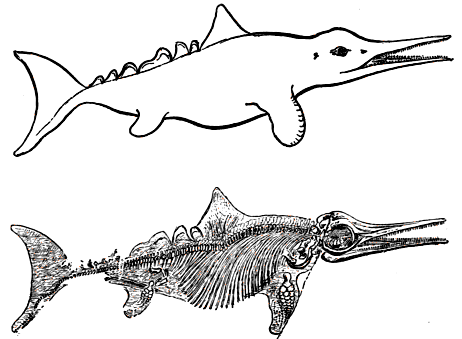
It was unfortunate that news of the highly interesting discovery at Würtemberg came too late for our artist to make a new drawing for our first edition, to show the dorsal fin and large tail-fin, etc., described by Dr. Fraas.[82] This has now been done, as shown in Plate II. By the courtesy of the proprietors of Natural Science, we are enabled to reproduce two drawings (Fig. 59) from the September number, illustrating a paper by Mr. Lydekker, in which he gives a résumé of the latest intelligence with regard to Ichthyosaurian reptiles.
In the present year (1892) there has been discovered in the Lias of Würtemberg the skeleton of an Ichthyosaur, in which the outline of the fleshy parts is completely preserved (see lower figure). The reader will see from the figure that the tail-fin is very large, and the backbone appears to run into the lower lobe. Such a tail-fin as this impression indicates must have resembled that of the shark’s, only it is wider; but the shark’s backbone runs into the upper lobe. Sir Richard Owen long ago foretold the existence of this appendage, and the discovery, coming now (when his life is despaired of), adds one more tribute to his genius. Behind the triangular fin on the back comes a row of horny excrescences reminding us of those of the crested newt.
As Dr. Fraas remarks, this discovery shows how closely analogous Ichthyosaurs were in form to fishes, and further justifies the title of “fish-lizards.” He considers that they did not visit the shore. The reader will find much valuable matter in Mr. Lydekker’s paper, above referred to. The following extract refers to the question of their reproduction: "It has long been known that certain large skeletons of Ichthyosaurs from the Upper Lias of Holzmaden, in Würtemberg, and elsewhere, are found with the skeletons of one or more much smaller individuals enclosed partly or entirely within the cavity of the ribs [a specimen is figured]. Of such skeletons there are four in the museum at Stuttgart, two in that of Tübingen, one at Munich, and others in Gent and Paris. Of these, two in Stuttgart, as well as the two in Tübingen, contain but a single young skeleton, while one of those at Stuttgart has four, the Munich specimen five, and the remaining Stuttgart example upwards of seven young. Some of these young and, presumably, fœtal Ichthyosaurs have the head turned towards the tail of the parent, while in others it is directed the other way. That these young have not been swallowed by the larger individuals within whose ribs they are found is pretty evident from several considerations. In the first place, their skeletons are always perfect. Then they never exceed one particular size, and always belong to the same species as the parent. Moreover, it would appear to be a physical impossibility for one Ichthyosaur of the size of the Stuttgart specimen to have had seven smaller ones of such dimensions in its stomach at one and the same time. We may accordingly take it for granted that these imprisoned skeletons were those of fœtuses. It is, however, very remarkable, that, so far as we are aware, all the skeletons with fœtuses belong to one single species; thus suggesting that this particular species was alone viviparous."