Front matter (continued 2)
Reading edition
Plate II.
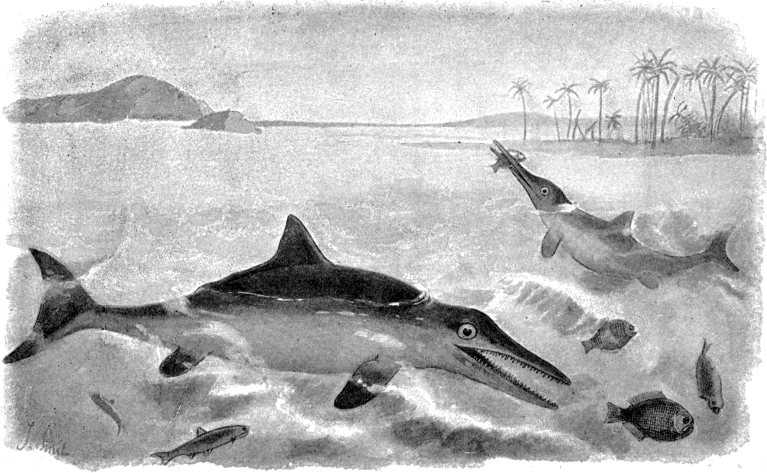
FISH-LIZARDS. Ichthyosaurus communis. Ichthyosaurus tenuirostris. Length about 22 feet. Fishes, Dapedius, etc. A smaller species.
Mr. Hawkins thus expresses his delight on obtaining an Ichthyosaurus which was pointed out to him by Miss Anning, near the church at Lyme-Regis, in the year 1832: “Who can describe my transport at the sight of the colossus? My eyes the first which beheld it! Who shall ever see them lit up with the same unmitigated enthusiasm again? And I verily believe that the uncultivated bosoms of the working men were seized with the same contagious feeling; for they and the surrounding spectators waved their hats to an ‘Hurra!’ that made hill and mossy dell echoing ring.”
This specimen, however, got sadly broken in its fall from the cliff; but in time he put all the pieces together again. Speaking of his own collection, he says, “This stupendous treasure was gathered by me from every part of England; arranged, and its multifarious features elaborated from the hard limestone by my own hands. A tyro in collecting at the age of twelve years, I then boasted of all the antiquities that were come-at-able in my neighbourhood, but, finding that everybody beat my cabinet of coins, I addressed myself to worm-eaten books, and last to fossils.” Before he was twenty years of age he had obtained a very fine collection of organic remains.
When, however, he complains of the Philistine dulness and stupidity of quarrymen, who often, in their ignorance, break up finds of almost priceless value, we can fully sympathize.
In general contour the body of the fish-lizard was long and tapering, like that of a whale (see Plate II.). It probably showed no distinct neck. The long tail was its chief organ of propulsion. We notice two pairs of fins, or paddles; one on the fore part of the body, the other on the hinder part, like the pectoral and abdominal fins of a fish. The skin was scaleless and smooth, or slightly wrinkled, like that of a whale. No traces of scales have ever been found; and if such had existed, they would certainly have been preserved, since those of fishes and crocodiles of the Jurassic period have been found in considerable number and variety. It is therefore safe to conclude that such were absent in this case. In the Lias strata, at least, the specimens are often preserved with most wonderful completeness (see p. 47).
The long and pointed jaws are a striking feature of these animals. The eyes were very large and powerful, and specially adapted, as we shall see presently, to the conditions of their life.
It might, perhaps, be asked whether the fish-lizards breathed, like fishes, by means of gills. That question can easily be answered; for if they had possessed gills for taking in water and breathing the air dissolved therein, they would reveal the fact by showing a bony framework for the support of gills, such as are to be found in all fishes. These structures, known as “branchial arches,” are absent; therefore the fish-lizards possessed lungs, and breathed air like reptiles of the present day. Their skulls show where the nostrils were situated; namely, near the eyes, and not at the end of the upper jaw-bone. There are also passages in the skull leading from the nostrils to the palate, along which currents of air passed on their way to the lungs. Being air-breathers, they would be compelled occasionally to seek the surface of the sea, in order to obtain a fresh supply of the life-giving element—oxygen; but, being cold-blooded and with a small brain, needing a much less supply of oxygen for its work, the fish-lizards had, like fishes, this advantage over whales, which are warm-blooded—that their stern-propeller, or tail-fin, could take the form best adapted for a swift, straight-forward course through the water.
In the whale tribe the tail-fin is horizontal; and this is so on account of their need, as large-brained, warm-blooded air-breathers, of speedy access to the atmospheric air. Were it otherwise, they would not have the means of rising with sufficient rapidity to the surface of the sea; for they have only one pair of fins. But the fish-lizards had two pairs of these appendages, and the hinder or pelvic pair no doubt were of great service in helping the creatures to come up to the surface when necessary.
Thus we see that the whale, with its one pair of paddles, has a tail specially planned with a view to rapid vertical movement through the water; while in the fish-lizards, who did not require to breathe so frequently, the tail-fin was planned with a view to swift and straight movement forward as they pursued their prey, and they were compensated by having bestowed upon them an extra pair of paddles. Thus we learn how one part of an animal is related to and dependent upon another, and how they all work together with the greatest harmony for certain definite purposes (see p. 6).
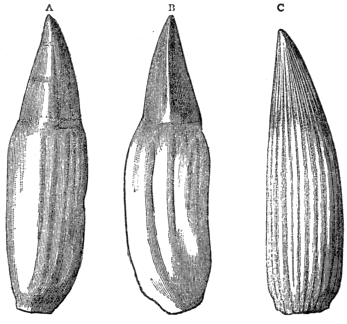
Fig. 4.—(A) Lateral and (B) profile views of a tooth of Ichthyosaurus platyodon (Conybeare), Lower Lias, Lyme Regis, Dorsetshire, (C) Tooth of Ichthyosaurus communis (Conybeare), Lower Lias, Lyme Regis, Dorset.
These great marine predaceous reptiles literally swarmed in the seas of the Lias period, and no doubt devoured immense shoals of the fishes of those times, whose numbers were thus to some extent kept down. There is clear proof of this in the fossilised droppings—known as “coprolites,”—which show on examination the broken and comminuted remains of the little bony plates of ganoid fishes that we know were contemporaries of these reptiles. Probably young ones were sometimes devoured too.
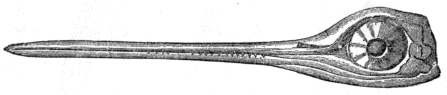
It was in the period of the Lias that fish-lizards attained to their greatest development, both in numbers and variety; and the strata of that period have preserved some interesting variations. It will be sufficient here to point out two, namely, Ichthyosaurus tenuirostris—an elegant little form, in which the jaws, instead of being massive and strong, were long and slender like a bird’s beak; and also Ichthyosaurus latifrons (Fig. 5), with jaws still more bird-like. Our artist has attempted to show the former variety in our illustration (Plate II.). A most perfect example of this pretty little Ichthyosaur, from the Lower Lias of Street in Somerset, has recently been presented to the National Collection at South Kensington by Mr. Alfred Gillett, of Street, and may be seen there. In this group of fish-lizards the eyes are relatively larger, and we should imagine that they were very quick in detecting and catching their prey; their paddles also have larger bones.
Fig. 5.—Skull of Ichthyosaurus latifrons.
There is a remarkably fine specimen at Burlington House, in the rooms of the Geological Society, of an Ichthyosaurus' head, which the writer found, on measuring, to be about five feet six inches long. A cast of this head is exhibited at South Kensington. The largest of the specimens in the National Collection is twenty-two feet long and eight feet across the expanded paddles; but it is known that many attained much greater dimensions. Judging from detached heads and parts of skeletons, it is probable that some of them were between thirty and forty feet long. A specimen of Ichthyosaurus platyodon in the collection of the late Mr. Johnson, of Bristol, has an eye-cavity with a diameter of fourteen inches. This collection is now dispersed.
With regard to their habits, Sir Richard Owen concludes that they occasionally sought the shores, crawled on the strand, and basked in the sunshine. His reason for this conjecture (which, however, is not confirmed by Dr. Fraas’s recent discoveries) is to be found in the bony structure connected with the fore-paddles, which is not to be found in any porpoise, dolphin, grampus, or whale, and for want of which these creatures are so helpless when left high and dry on the shore.[7] The structure in question is a strong bony arch, inverted and spanning across beneath the chest from one shoulder to the other. A fish-lizard, when so visiting the shore for sleep, or in the breeding season, would lie or crawl, prostrate, with its under side resting or dragging on the ground—somewhat after the manner of a turtle.
It is a curious fact that this bony arch resembles the same part in those singular and problematical mammals, the Echidna and the Platypus, or duck-mole.
The enormous magnitude and peculiar construction of the eye are highly interesting features. The expanded pupil must have allowed of the admittance of a large quantity of light, so that the creature possessed great powers of vision.
The organic remains associated with fish-lizards tell us that they inhabited waters of moderate depth, such as prevails near a coast-line or among coral islands. Moreover, an air-breathing creature would obviously be unable to live in "the depths of the sea;" for it would take a long time to get to the surface for a fresh supply of air.
Perhaps no part of the skeleton is more interesting than the curious circular series of bony plates surrounding the iris and pupil of the eye. The eyes of many fishes are defended by a bony covering consisting of two pieces; but a circle of bony overlapping plates is now only found in the eyes of turtles, tortoises, lizards, and birds, and some alligators. This elaborate apparatus must have been of some special use; the question is—What service or services did it perform? Here, again, we find answers suggested by Owen and Buckland. It would aid, they say, in protecting the eye-ball from the waves of the sea when the creature rose to the surface, as well as from the pressure of the water when it dived down to the bottom—for even at a slight depth pressure increases, as divers know. But it appears that the ring of bony plates fulfilled a yet more important office, thereby enabling the fish-lizards to play admirably their part in the world in which they lived, and to succeed in the struggle of life; for even in those remote days there must have been, as now, a keen competition among all animals, so that the victory was to those that were best equipped.
Would it not be an advantage for them to have the power of seeing their finny prey whether near or far? Certainly it would; and so we are told that, by bringing the plates a little nearer together, and causing them to press gently on the eye-ball, so as to make the eye more convex—that is, bulging out—a nearer object would be the better discerned. On the other hand, by relaxing this pressure, thus enlarging the aperture of the pupil and diminishing the convexity, a distant object would be focussed upon the retina. In this manner some birds alter the focus of their eyes while swooping down on their prey.
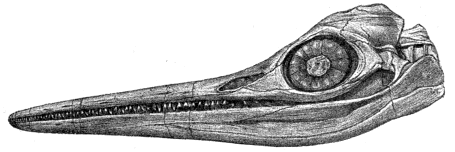
What a wonderful arrangement! We often hear of people having two pairs of spectacles—with lenses of different curvature—one for reading, and the other for seeing more distant objects than a book held in the hand. But here is a creature that possessed an apparatus far more simple and effective than that supplied by the optician! Dr. Buckland, speaking of these “sclerotic plates,” as they are called, says they show “that the enormous eye of which they formed the front was an optical instrument of varied and prodigious power, enabling the Ichthyosaurus to descry its prey in the obscurity of night and in the depths of the sea.” But the last expression must be taken in a limited sense (see Fig. 6).
Fig. 6.—Head of Ichthyosaurus platyodon.
It might well be supposed that no record had been preserved from which we could learn anything about the nature of the skin of our fish-lizard; but even this wish has been partly fulfilled, to the delight of all geologists. Certain specimens have been obtained, from the Lias of England and Germany, that show faithful impressions of the skin that covered the paddles. A specimen of this nature has lately been presented to the national treasure-house at South Kensington by Mr. Montague Brown. On the inner side of the paddle was a broad fin-like expansion, admirably adapted to obtain the full advantage of the stroke of the limb in swimming.[8]
Speaking of the limbs, it should be mentioned that the bones of each finger, instead of being elongated and limited in number to three in each of the five fingers, are polygonal in shape and arranged in as many as seven or eight rows, while those of each finger are exceedingly numerous. Thus the whole structure forms a kind of bony pavement which must have been very supple. Such a limb would be one of the most efficient and powerful swimming organs known in the whole animal kingdom. In whales the fingers of the flippers are of the usual number, namely, five. Some species of fish-lizards had as many as over a hundred separate little bones in the fore-paddle.
Another question naturally suggests itself: Were they viviparous, or did they lay eggs like crocodiles? This question seems to have been answered in favour of the first supposition; and in the following interesting manner. It not infrequently happens that entire little skeletons of very small individuals are found under the ribs of large ones. They are invariably uninjured, and of the same species as the one that encloses them, and with the head pointing in one direction. Such specimens are most probably the fossilised remains of little fish-lizards, that were yet unborn when their mothers met with an untimely end (see p. 51). In some cases, however, they may be young ones that were swallowed. (See Appendix V.)
The jaws of these hungry formidable monsters were provided with a series of formidable teeth—sometimes over two hundred in number—inserted in a long groove, and not in distinct sockets, as in the case of crocodiles. In some cases, sixty or more have been found on each side of the upper and lower jaws, giving a total of over two hundred and forty teeth! The larger teeth may be two inches or more in length.
The jaws were admirably constructed on a plan that combined lightness, elasticity, and strength. Instead of consisting of one piece only, they show a union of plates of bone, as in recent crocodiles. These plates are strongest and most numerous just where the greatest strength was wanted, and thinner and fewer towards the extremities of the jaw. A crocodile, Sir Samuel Baker says, in his Wild Beasts and their Ways, can bite a man in two; and no doubt our fish-lizard would have been glad to perform the same feat! But in his pre-Adamite days the opportunity did not present itself.
The spinal column, or backbone, with its generally concave vertebræ, must have been highly flexible, as is that of a fish, especially the long tail which the creature worked rapidly from side to side as it lashed the waters.
The hollows of these concave vertebræ must have been originally filled up with fluid forming an elastic bag, or capsule. To get a clearer idea of this, take a small portion of the backbone of a boiled cod, or other “bony” fish, and you will see on pulling it to pieces, the white, jelly-like substance that fills up the hollows between the vertebræ. In this way Nature provides a soft cushion between the joints, that allows of a certain amount of movement, while, at the same time, the column holds together. The backbone of a fish may not inaptly be compared to a railway train. Each of the carriages represents a vertebra, and the buffers act as cushions when the train is bent in running round a curve. After all, we must learn from Nature; and many of the greatest mechanical and engineering triumphs of to-day are based upon the methods used by Nature in the building up and equipment of vegetable and animal forms of life.
It may, perhaps, be inquired whether there is any evidence for the existence of a tail-fin, such as is shown in our illustration. To this it may be replied that the presence of such an appendage is as good as proved by a certain flattening of the vertebræ at the end of the tail, detected by Owen. The direction of this flattening is from side to side, and therefore the tail-fin must have been vertical, like that of a fish. In one specimen Sir Richard Owen has detected as many as 156 vertebræ to the whole body.
Our description of the fish-lizard has, we trust, been sufficient—although not couched in the language used by men of science—to give a fair idea of its structure and habits.
In conclusion, a few words may be said about the ancestry and life-history of these ancient monsters. Palæontologists have good reason to believe that they were descended from some early form of land reptile. If so, they show that whales are not the first land animals that have gone back to the sea, from which so many forms of life have taken their rise.
During the long Mesozoic period fish-lizards played the part that whales now play in the economy of the world; and they resembled the latter, not only in general shape, but in the situation of the nostrils (near the eye), and in their teeth and long jaws. But these curious resemblances must not be interpreted to mean that whales and fish-lizards are related to each other. They only show that similar modes of life tend to produce artificial resemblances—just as some whales, in their turn, show a superficial resemblance to fishes.
With regard to the particular form of reptile from which the fish-lizard may have been derived, no certain conclusion has at present been arrived at. This is chiefly from want of fuller knowledge of early forms, such as may have existed in the previous periods known as the Carboniferous and Trias (see Appendix I.). But there are certain features in the skulls, teeth, and vertebræ that suggest a relationship with the Labyrinthodonts, or primæval salamanders that flourished during the above periods, or at least from amphibians more or less closely allied to them. They cannot by any possibility be regarded as modified fishes; for fishes have gills instead of lungs.
The fish-lizards played their part, and played it admirably; but their days were numbered, and the place they occupied has since been taken by a higher type—the mammal. As reptiles, they were eminently a success; but, then, they were only reptiles, and therefore were at last left behind in the struggle for existence, until finally they died out, at the end of the Cretaceous period, when certain important geographical and other changes took place, helping to cause the extinction of many other strange forms of life, as we shall see later on (see p. 147).
They had a wide geographical range; for their remains have been discovered in Arctic regions, in Europe, India, Ceram, North America, the east coast of Africa, Australia, and New Zealand.
In American deposits they are represented by certain toothless forms, to which the name Sauranodon (“toothless lizard”) has been given. These have been discovered by Professor Marsh, in the Jurassic strata of the Rocky Mountains. They were eight or nine feet long, and in every other respect resembled Ichthyosaurs. As we have endeavoured to indicate in our illustration, the fish-lizards flourished in seas wherein animal, and doubtless vegetable life was very abundant. Any one who has collected fossils from the Lias of England will have found how full it is of beautiful organic remains, such as corals, mollusca, encrinites, sea-urchins, and other echinoids, fishes, etc.
The climate of this period in Europe was mild and genial, or even semi-tropical. Coral reefs and coral islands varied the landscape. There is just one more point of interest that ought not to be omitted; it refers to the manner in which these reptiles of the Lias age met their deaths, and were thus buried up in their rocky tombs. Sir Charles Lyell and other writers point out that the individuals found in those strata must have met with a sudden death and quick burial; for if their uncovered bodies had been left, even for a few hours, exposed to putrification and the attacks of fishes at the bottom of the sea, we should not now find their remains so completely preserved that often scarcely a single bone has been moved from its right place. What was the exact nature of this operation is at present a matter of doubt.
CHAPTER IV.
THE GREAT SEA-LIZARDS AND THEIR ALLIES.
“The wonders of geology exercise every faculty of the mind—reason, memory, imagination; and though we cannot put our fossils to the question, it is something to be so aroused as to be made to put the questions to one’s self.”—Hugh Miller.
The fish-lizards, described in our last chapter, were not the only predaceous monsters that haunted the seas of the great Mesozoic age, or era. We must now say a few words about certain contemporary creatures that shared with them the spoils of those old seas, so teeming with life. And first among these—as being more fully known—come the long-necked sea-lizards, or Plesiosaurs.
The Plesiosaurus was first discovered in the Lias rocks of Lyme-Regis, in the year 1821. It was christened by the above name, and introduced to the scientific world by the Rev. Mr. Conybeare (afterwards Dean of Llandaff) and Mr. (afterwards Sir Henry) de la Beche. They gave it this name in order to distinguish it from the Ichthyosaurus, and to record the fact that it was more nearly allied to the lizard than the latter.[9] Conybeare, with the assistance of De la Beche, first described it in a now-classic paper read before the Geological Society of London, and published in the Transactions of that Society in the year 1821. In a later paper (1824) he gave a restoration of the entire skeleton of Plesiosaurus dolichodeirus; and the accuracy of that restoration is still universally acknowledged. This fine specimen was in the possession of the Duke of Buckingham, who kindly placed it at the disposal of Dr. Buckland, for a time, that it might be properly described and investigated.
A glance at our illustration, Plate III., will show that this strange creature was not inaptly compared at the time to a snake threaded through the body of a turtle.
Dr. Buckland truly observes that the discovery of this genus forms one of the most important additions that geology has made to comparative anatomy. “It is of the Plesiosaurus,” says that graphic author, in his Bridgewater Treatise, “that Cuvier asserts the structure to have been the most heteroclite, and its characters altogether the most monstrous that have been yet found amid the ruins of a former world. To the head of a lizard it united the teeth of a crocodile; a neck of enormous length, resembling the body of a serpent; a trunk and tail having the proportions of an ordinary quadruped; the ribs of a chameleon, and the paddles of a whale! Such are the strange combinations of form and structure in the Plesiosaurus—a genus, the remains of which, after interment for thousands of years amidst the wreck of millions of extinct inhabitants of the ancient earth, are at length recalled to light by the researches of the geologist, and submitted to our examination in nearly as perfect a state as the bones of species that are now existing upon the earth.”
Perhaps the best way in which we can gain a clear idea of the general characters of a long-necked sea-lizard, as we may call our Plesiosaurus, is by comparing it with the fish-lizard, described in the last chapter. Its long neck and small head are the most conspicuous features. Then we notice the short tail. But if we compare the paddles of these two extinct forms of life, we notice at once certain important differences. In the fish-lizard the bone of the arm was very short, while all the bones of the fore-arm and fingers were modified into little many-sided bodies, and so articulated together as to make the whole limb, or paddle, a solid yet flexible structure. In the long-necked sea-lizard, however, we find a long arm-bone with a club-like shape; and the two bones of the fore-arm are seen to be longer than in the fish-lizard. But a still greater difference shows itself in the bones of the finger, as we look at a fossilised skeleton (or a drawing of one); for the fingers are long and slender, like those of ordinary reptiles.
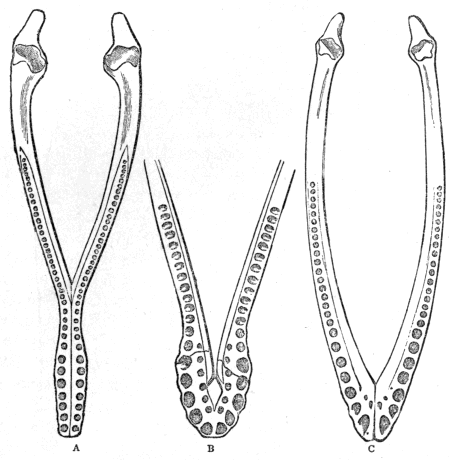
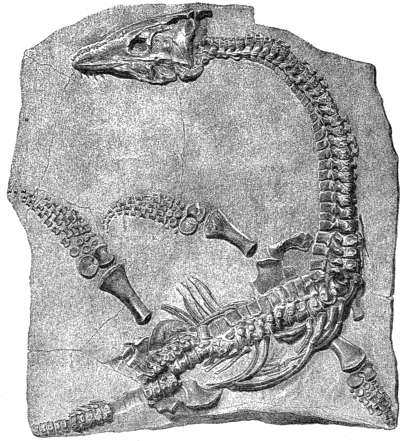
There are only five fingers, and each finger is quite distinct from the others. This is the reason why the Plesiosaur was considered to depart less from the type of an ordinary reptile, and so received its name. Other remarkable differences present themselves in the shoulders and haunches, but these need not be considered here. The species shown in Fig. 8 had rather a large head. It is obvious that such a long slender neck as these creatures had could not have supported a large head, like that of the fish-lizard. Consequently, we find a striking contrast in the skulls of the two forms. That of the Plesiosaur was short and stout, and therefore such as could easily be supported, as well as rapidly moved about by the long slender neck. Thus we find another simple illustration of the “law of correlation,” alluded to on p. 6. The teeth were set in distinct sockets, as they are in crocodiles, to which animals there are also points of resemblance, in the backbone, ribs, and skull. Fig. 7 shows three different types of lower jaws of Plesiosaurs. The one marked C belongs to Plesiosaurus dolichodeirus, the species represented in our plate. There were no bony plates in the eye. Professor Owen thinks that they were long-lived. The skin was probably smooth, like that of a porpoise.
Plate III.
PTERODACTYLS. LONG-NECKED SEA-LIZARD. CUTTLE-FISH OR BELEMNITE. Plesiosaurus dolichodeirus. Length 22 feet.
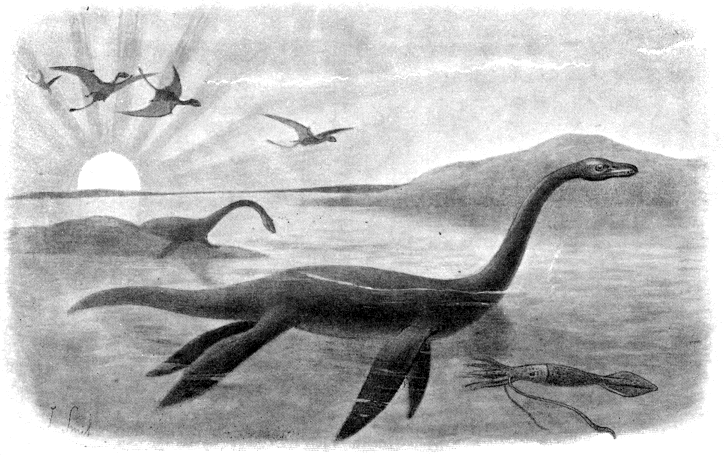
Fig. 7.—Mandibles of Fish-lizards. A, Peloneustes philarchus (Seeley); from the Oxford Clay. B, Thaumatosaurus indicus (Lydekker); Upper Jurassic of India. C, Plesiosaurus aolichodirus (Conybeare); from the Lower Lias, Lyme Regis.
The visitor to the geological collection at South Kensington will find a splendid series of the fossilised remains of long-necked sea-lizards. They were mostly obtained from the Lias formation of Street in Somersetshire, Lyme-Regis in Dorset, and Whitby in Yorkshire. Those from the Lias are mostly small, about eight to ten feet in length. But in the rocks of the Cretaceous period, which was later, are found larger specimens. There is a cast of a very fine specimen from the Upper Lias on the wall of the east corridor (No. 3 on Plan) of the geological galleries at South Kensington, which is twenty-two feet long. But some of the Cretaceous forms, both in Europe and America, attained a length of forty feet, and had vertebræ six inches in diameter. The bodies of the vertebræ, or “cup-bones,” are either flat or slightly concave, showing that the backbone as a whole was less flexible than in the fish-lizards.
Fig. 8.—Plesiosaurus macrocephalus.
It may be mentioned here that Mr. Smith Woodward, of the Natural History Museum, recently showed the writer a fossil Plesiosaur that is being set up in the formatore’s shop, in the same manner that a recent skeleton might be. In this, and many other ways, the guardians of the national treasure-house are endeavouring to make the collection intelligible and interesting to the general public. Specimens of extinct animals thus set up, give one a much better idea than when the bones are all lying huddled together on a slab of rock. But it is not always possible to get the bones entirely out of their rocky bed, or matrix. Great credit is due to Mr. Alfred N. Leeds, of Eyebury, who has disinterred the separate bones of many distinct skeletons of Plesiosaurs from Oxford Clay strata near Peterborough.
It will be remembered that the long and powerful tail of the fish-lizard was its principal organ of propulsion through the water; and that, consequently, the paddles only played a secondary part. They were small, but amply large enough for the work they had to perform. But our long-necked sea-lizards possessed very short tails. What, then, was the consequence? Obviously that the paddles had all the more work to do. They were the chief swimming organs. The vertebræ of this short tail show that it probably was highly flexible, and could move rapidly from side to side; but, for all that, its use as a propeller would not be of much importance. We see now why the paddles are so long and powerful, like two pairs of great oars, one pair on each side of the body. In a fossil skeleton you will notice the flattened shape of the arm-bone (or humerus), and of the thigh-bone (or femur). This gave breadth to the paddles, and made them more efficient as swimming organs. They give no indication of having carried even such imperfect claws as those of turtles and seals, and therefore we may conclude that the Plesiosaur was far more at home in the water than on land, and it seems probable that progression on land was impossible.
The tail was probably useful as a rudder, to steer the animal when swimming on the surface, and to elevate or depress it in ascending and descending through the water. Like the fish-lizard, this creature was an air-breather, and therefore was obliged occasionally to visit the surface for fresh supplies of air. But probably it possessed the power of compressing air within its lungs, so that the frequency of its visits to the surface would not be very great.
From the long neck and head, situated so far away from the paddles, as well as for other reasons, it may be concluded that this creature was a rapid swimmer, as was the Ichthyosaurus. Although of considerable size, it probably had to seek its food, as well as its safety, chiefly by artifice and concealment. The fish-lizard, its contemporary, must have been a formidable rival and a dangerous enemy, whom to attack would be unadvisable.
Speaking of the habits of the long-necked sea-lizard, Mr. Conybeare, in his second paper, already alluded to, says, "That it was aquatic, is evident from the form of its paddles; that it was marine, is almost equally so, from the remains with which it is universally associated; that it may occasionally have visited the shore, the resemblance of its extremities to those of the turtle may lead us to conjecture; its motion, however, must have been very awkward on land; its long neck must have impeded its progress through the water, presenting a striking contrast to the organisation which so admirably fits the Ichthyosaurus to cut through the waves.
“May it not therefore be concluded (since, in addition to these circumstances, its respiration must have required frequent access of air) that it swam upon or near the surface, arching back its long neck like the swan, occasionally darting it down at the fish which happened to float within its reach? It may, perhaps, have lurked in shoal-water along the coast, concealed among the sea-weed, and, raising its nostrils to a level with the surface from a considerable depth, may have found a secure retreat from the assaults of dangerous enemies; while the length and flexibility of its neck may have compensated for the want of strength in its jaws and its incapacity for swift motion through the water, by the suddenness and agility of the attack which they enabled it to make on every animal fitted for its prey, which came within its extensive sweep.”
More than twenty species of long-necked sea-lizards are known to geologists.
Professor Owen, in his great work on British Fossil Reptiles, when describing the huge Plesiosaurus dolichodeirus from Dorset, suggests that the carcase of this monster, after it sank to the bottom of the sea, was preyed upon by some carnivorous animal (perhaps sharks). It seems, he says, as if a bite of the neck had pulled out of place the eighth to the twelfth vertebræ. Those at the base of the neck are scattered and dispersed as if through more “tugging and riving.” So with regard to its body, probably some hungry creature had a grip of the spine near the middle of the back, and pulled all the succeeding vertebræ in the region of the hind limbs. Thus we get a little glimpse of scenes of violence that took place at the bottom of the bright sunny seas of the period when the clays and limestones of the Lias rocks were being deposited in the region of Lyme-Regis.
As time went on, these curious reptiles increased in size, until, in the period when our English chalk was being formed (Cretaceous period), they reached their highest point (see p. 147). After that they became extinct—whether slowly or somewhat suddenly we cannot tell.
Until more is known of the ancient life of the earth, it will not be possible to say with certainty what were the nearest relations of the long-necked sea-lizards. They first appear in the strata of the New Red Sandstone, which is below the Lias. Certain little reptiles, about three feet long, from the former rocks, known as Neusticosaurus and Lariosaurus, seem to be rather closely related to the creatures we are now considering, and to connect them with another group, namely, the Pliosaurs. They were partly terrestrial and partly aquatic; but it is not easy to say whether their limbs had been converted into true paddles or not. At any rate, there is every reason to believe that the long-necked sea-lizards were descended from an earlier form of land reptile. They gradually underwent considerable modifications, in order to adapt themselves to an aquatic life. We noticed that the same conclusion has been arrived at with regard to the fish-lizards. Both these extinct groups, therefore, present an interesting analogy to whales, which are now considered to have been derived, by a like series of changes, from mammals that once walked the earth.
The Plesiosaur presents, on the one hand, points of resemblance to turtles and lizards,—on the other hand, to crocodiles, whales, and, according to some authorities, even the strange Ornithorhynchus. But it will be very long before its ancestry can be made known. In the mean time, we must put it in a place somewhere near the fish-lizards, and leave posterity to complete what has at present only been begun. It must, however, be borne in mind that some of the above resemblances are purely accidental, and not such as point to relationship. Because their flippers are like those of a whale, it does not mean that Plesiosaurs are related to modern whales. It only means that similar habits tend to produce accidental resemblances—just as the whales and porpoises, in their turn, resemble fishes. To make torpedoes go rapidly through the water, inventors have given them a fish-like shape;—in the same way the early forms of mammals, from which whales are descended, gradually adapted themselves to a life in the water, and so became modified to some extent to the shapes of fishes.
The Pliosaurs, above mentioned, are evidently relations, but with short necks instead of long ones. They had enormous heads and thick necks. Fine specimens of their huge jaws, paddle-bones, etc., may be seen at the end of the reptile-gallery at Cromwell Road. One of the skulls exhibited there is nearly six feet long, while a hind paddle measures upwards of six and a half feet in length, of which thirty-seven inches is taken up by the thigh-bone alone. The teeth at the end of the jaws are truly enormous. One tooth, from a deposit known as the Kimmeridge Clay, is nearly a foot long from the tip of the crown to the base of the root. In some, the two jaw-bones of the lower jaw are partly united, as in the sperm-whale or cachalot. Creatures so armed must have been very destructive.
CHAPTER V.
THE DRAGONS OF OLD TIME—DINOSAURS.
“What we know is but little; what we do not know is immense.”—La Place.
Was there ever an age of dragons? Tradition says there was; but there is every reason to believe that the fierce and blood-thirsty creatures, of which such a variety present themselves, are but creations of the imagination,—useful in their way, no doubt, as pointing a moral or adorning a tale, but, nevertheless, wholly without foundation in fact. The dragon figures in the earliest traditions of the human race, and crops up again in full force in European mediæval or even late romance.
In ancient Egyptian mythology, Horus, the son of Isis, slays the evil dragon. In Greece, the infant Hercules, while yet in his cradle, strangles deadly snakes; and Perseus, after engaging in fierce struggle with the sea-monster, slays it, and rescues Andromeda from a cruel death. In England, we have the heroic legend of St. George and the Dragon depicted on our sovereigns. But it is easy to see a common purpose running through these legends. They are considered by many to be solar myths, and have a moral purpose. The dragons or snakes are emblems of darkness and evil; the heroes emblems of light, and so of good. The triumph of good over evil is the theme they were intended to illustrate. The dragons, then, are clearly products of the imagination, based, no doubt, on the huge and uncouth reptiles of the present human era, such as crocodiles, pythons, and such creatures.
Amidst much diversity there is yet a strange similarity in the dragons that figure in the folk-lore of Eastern and Western peoples. Probably our European traditions were brought by the tribes which, wave after wave, poured in from Central Asia.
They are, for the most part, unnatural beasts, breathing out fire, and often endowed with wings, while at the same time possessing limbs ending in cruel claws, fitted for clutching their unfortunate victims. The wings seem, to say the least, very much in the way. Poisonous fangs, claws, scaly armour, and a long pointed tail were all very well,—but wings are hardly wanted, unless to add one more element of mystery or terror. Some, however, are devoid of wings: the Imperial Japanese dragons showing no sign of such appendages. The Temple Bar griffin is a grim example of a winged monster. Nevertheless, in spite of all the manifest absurdities of the dragons of various nations and times, geology reveals to us that there once lived upon this earth reptiles so great and uncouth that we can think of no other but the time-honoured word “dragon” to convey briefly the slightest idea of their monstrous forms and characters.
So there is some truth in dragons, after all. But then we must make this important reservation—viz. that the days of these dragons were long before the human period; they flourished in one of those dim geological ages of which the rocks around us bear ample records.
It is a strange fact that human fancy should have, in some cases at least, created monsters not very unlike some of those antediluvian animals that have, during the present century, been discovered in various parts of Europe and America. Some unreasonable persons will have it that certain monstrous reptiles of the Mesozoic era, about to be described, must have somehow managed to survive into the human period, and so have suggested to early races of men the dragons to which we have alluded. But there is no need for this untenable supposition. By a free blending together of ideas culled from living types of animals it would be very easy to construct no small variety of dragons; and so we may believe this is what the ancients did.
Having said so much of dragons in general, let us proceed to consider those both possible and real monsters revealed of late years by the researches of geologists. For this purpose we shall devote the present and two following chapters to the consideration of a great and wonderful group of fossil reptiles known as Dinosaurs. The strange fish-lizards and sea-lizards previously described were the geological contemporaries of a host of reptiles, now mostly extinct, which inhabited both the lands and waters of those periods known as the Triassic, Jurassic, and Cretaceous, which taken together represent the great Mesozoic, formerly called the Secondary, era.
The announcement by Baron Cuvier—the illustrious founder of Palæontology—that there was a period when our planet was inhabited by reptiles of appalling magnitude, with many of the features of modern quadrupeds, was of so novel and startling a character as to require the prestige of even his name to obtain for it any degree of credence. But subsequent discoveries have fully confirmed the truth of his belief, and the “age of reptiles” is no longer considered fabulous. This expression was first used by Dr. Mantell as the title of a paper published in the Edinburgh Philosophical Journal in 1831, and serves to remind us that reptilian forms of life were once the ruling class among animals.
The Dinosaurs are an extinct order comprising the largest terrestrial and semi-aquatic reptiles that ever lived; and while some of them in a general way resembled crocodiles, others show in the bony structures they have left behind a very remarkable and interesting resemblance to birds of the ostrich tribe. This resemblance shows itself in the pelvis, or bony arch with which the hind limbs are connected in vertebrate or backboned animals, and in the limbs themselves. This curious fact, first brought into notice by Professor Huxley, has been variously interpreted by anatomists; some concluding, with Professor Huxley, that birds are descended from Dinosaurs; while others, with Professor Owen, consider the resemblance accidental, and in no way implying relationship. Huxley has proposed the name Ornithoscelida, or bird-legged, for these remarkable reptiles.
Dinosaurs must have formerly inhabited a large part of the primæval world; for their remains are found, not only in Europe, but in Africa, India, America, and even in Australia; and the geologist finds that they reigned supreme on the earth throughout the whole of the great Mesozoic era.
Their bodies were, in some cases, defended by a formidable coat of armour, consisting of bony plates and spines, as illustrated by the case of Scelidosaurus (p. 105), thus giving them a decidedly dragon-like appearance. The vertebræ, or bony segments of the backbone, generally have their centra hollow on both sides, as in the Ichthyosaurus; but in the neck and tail they are not unfrequently hollow on one side and convex on the other. In some of the largest forms the vertebræ are excavated into hollow chambers. This is apparently for the sake of lightness; for a very large animal with heavy solid bones would find it difficult to move freely. In this way strength was combined with lightness.
All the Dinosaurs had four limbs, and in many cases the hind pair were very large compared to the fore limbs. They varied enormously in size, as well as in appearance. Thus certain of the smaller families were only two feet long and lightly built; while others were truly colossal in size, far out-rivalling our modern rhinoceroses and elephants.
The limbs of Cetiosaurus, for example, or of Stegosaurus, remind us strikingly of those of elephants. The celebrated Von Meyer was so struck with this likeness that he proposed the name Pachypoda for them, which means thick-footed. Professor Owen opposed this name; for it was misleading, and only applied to a few of them. He therefore proposed the name we have already been using, viz. Dinosauria,[10] and this name has been generally retained. We are thus led to connect them with lizards and crocodiles, rather than with birds or quadrupeds. The strange and curiously mixed characters of the old-fashioned reptiles is forcibly illustrated by these differences of opinion among leading naturalists. Professor Seeley, another living authority, refuses to consider them as reptiles, at least in the ordinary sense of the word.
Extinct forms of life are often so very different to the creatures inhabiting the world of to-day, that naturalists find it a hard task to assign them their places in the animal kingdom. The classes, orders, and families under which living forms are grouped are often found inadequate for the purpose, so much so that new orders and new families require to be made for them; and then it is often quite impossible to determine the relations of these new groups to the old ones we are accustomed to. Dinosaurs offer a good example of this difficulty. Were they related to ancient crocodiles? No one can say for certain; but it is quite possible, and even probable. Again, did certain long-legged Dinosaurs eventually give rise by evolution to the running birds, ostriches, emeus, etc.? This, although supported by weighty authority, is a matter of speculation: we ought to be very careful in accepting such conclusions. It may perhaps be safer to look upon the ancestry of birds as one of those problems on which the oracle of science cannot at present declare itself.
Various attempts have been made to classify Dinosaurs, and arrange them in family groups; but, considering our imperfect knowledge, it will be wise to regard all such attempts as purely temporary and provisional, although in some ways convenient. Professor Marsh, of Yale College, U.S., whose wonderful discoveries in the far West have attracted universal attention, has grouped the Dinosaurs into five sub-orders. It will, however, be sufficient for our purpose if we follow certain English authorities who divide them into three groups—taking the names given by Professor Marsh, only running together some which he would separate.
We shall first consider the very interesting and huge forms included in his sub-order the Sauropoda, or lizard-footed Dinosaurs. Various parts of the skeletons, such as vertebræ, leg-bones, etc., of these cumbrous beasts have long been known in this country; but Professor Marsh was the first person to discover a complete skeleton.
We shall, therefore, now turn our attention to the bony framework of the huge Brontosaurus (Fig. 9), a vegetable-feeding lizard. But it will be necessary to completely lay aside all our previous notions taken from lizards of the present day, with their short legs and snake-like scaly bodies, before we can come to any fair conclusion with regard to this monstrous beast.
It was nearly sixty feet long, and probably when alive weighed more than twenty tons! that it was a stupid, slow-moving reptile, may be inferred from its very small brain and slender spinal cord. By taking casts of the brain-cavities in the skulls of extinct animals, anatomists can obtain a very good idea of the nature and capacity of their brains; and in this way important evidence is obtained, and such as helps to throw light upon their habits and general intelligence. No bony plates or spines have been discovered with the remains of this monster; so that we are driven to conclude that it was wholly without armour: and, moreover, there seem to be no signs of offensive weapons of any kind.
Professor Marsh concludes that it was more or less amphibious in its habits, and that it fed upon aquatic plants and other succulent vegetation. Its remains, he says, are generally found in localities where the animal had evidently become mired, just as cattle at the present day sometimes become hopelessly fixed in a swampy place on the margin of a lake or river (see p. 19). Each track made by the creature in walking occupied one square yard in extent!
Fig. 9.—Restored skeleton of Brontosaurus excelsus. (After Marsh.) Click on image to view larger version.
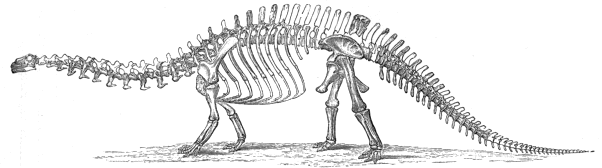
The remarkably small head is one of the most striking features of this Dinosaur, and presents a curious contrast to the large and formidable skulls possessed by some other forms to be described further on. But it is clear that no animal with such a long neck as this creature had could have borne the weight of a heavy skull. Short thick necks and heavy skulls always go together. Indeed, the weight of the long neck itself would have been serious had it not been for the fact that the vertebræ in this part of the skeleton, and as far as the region of the tail, have large cavities in the sides of the centra. This cavernous structure of the vertebræ gradually decreases towards the tail. The cavities communicated with a series of internal cavities which give a kind of honeycombed structure to the whole vertebra. This arrangement affords a combination of strength and lightness in the massive supports required for the huge ribs, limbs, and muscles, such as could not have been provided by any other plan. (See Fig. 10.)
Fig. 10.—Neck vertebræ of Brontosaurus. 1. Front view. 2. Back view.
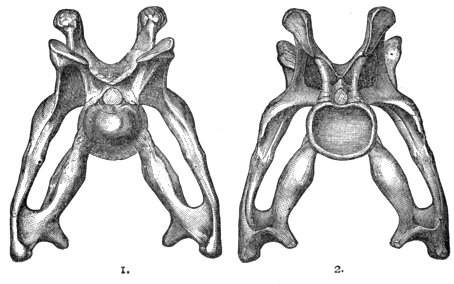
Plate IV.
A GIGANTIC DINOSAUR, BRONTOSAURUS EXCELSUS. Length nearly 60 feet.
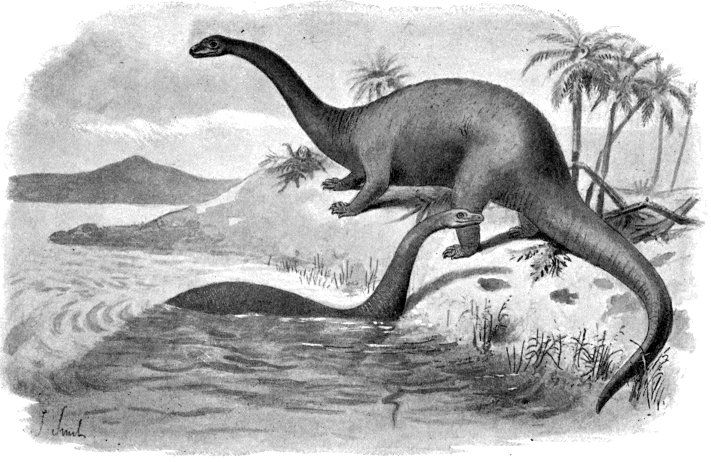
The body of the Brontosaur was comparatively short, with a fairly large paunch (see restoration, Plate IV.). The legs and feet were strong and massive, and the limb-bones solid. As if partly in order to balance the neck, we find a long and powerful tail, in which the vertebræ are nearly all solid. In most Dinosaurs the fore limbs are small compared to the hind limbs—e.g. Megalosaurus, Iguanodon, and Scelidosaurus,—but here we find them unusually large. In this case, then, it is hardly possible that the creature walked upon its hind legs, as many of the Dinosaurs did. But, at the same time, we may believe that occasionally it assumed a more erect position; and may not the light hollowed structure of the vertebræ in the fore part of the body, already alluded to, have imparted such lightness as made it possible for the creature to assume such attitudes? There can be little doubt but that many other fierce and formidable Dinosaurs were living at the same time and in the same region with Brontosaurus, whose remains are found in the Jurassic rocks of Colorado (Atlantosaurus beds).
How this apparently helpless and awkward animal escaped in the struggle for existence it is not easy to conjecture; but since there is reason to believe it was more or less at home in the water, and could use its powerful tail in swimming, we may perhaps find a way out of the difficulty by supposing that, when alarmed by dangerous flesh-eating foes, it took to the water, and found discretion to be the better part of valour. Although apparently stupid, the Brontosaur probably possessed a good deal of cunning, and we can fancy it stretching its long neck above reeds, ferns, and cycads to get a view of the approaching enemy.
The Sauropoda, or lizard-footed Dinosaurs, show in many ways a decided approach to a simple or generalised crocodile; so much so, that Professor Cope is inclined to include crocodiles and sauropodous Dinosaurs in the same order. Still, there are important differences in other members of this sub-order. Unfortunately, our knowledge is at present rather limited, owing to the want of complete skeletons. Vertebræ, limb-bones, skulls, and teeth have all been discovered through the zeal and energy of Professor Marsh and his comrades, in the far west of America, as well as by the researches of English geologists, assisted by the labours of many ardent collectors of fossils, in this country. Some of these may now be briefly considered.
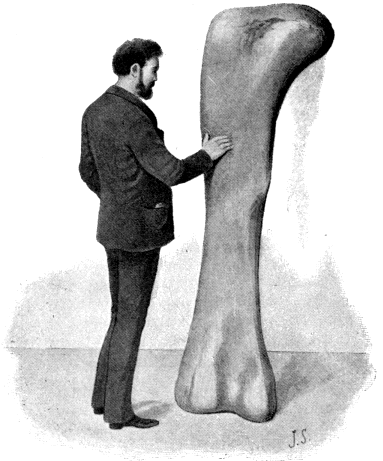
In Plate V. we have endeavoured to give some idea of a huge thigh-bone (femur) belonging to the truly gigantic Dinosaur called Atlantosaurus. It is six feet two inches long, and a cast of it may be seen in the fossil reptile gallery of the British Museum of Natural History (Wall-case No. 3). It should be mentioned, however, that the original specimen is partly restored, so that its exact length to an inch or so is not quite certain. In our illustration it is shown to be a little taller, when placed upright, than a full-grown man. Professor Marsh, the fortunate discoverer of this wonderful bone, calculates that the Atlantosaurus must have attained a length of over eighty feet! and, assuming that it walked upon its hind feet, a height of thirty feet!
It doubtless fed upon the luxuriant foliage of the sub-tropical forests, portions of which are preserved with its remains. Besides this thigh-bone, Professor Marsh has procured specimens of vertebræ from the different parts of the vertebral column; but no skull or teeth. The vertebræ are hollowed out much in the same way as those of Brontosaurus. The fore limbs were large, as in the latter animal; and the extremities of the limbs were provided with claws. Taking all present evidence, it appears that the Atlantosaurus bore a general resemblance to its smaller contemporary. We can therefore form a fairly good idea of its aspect and proportions.
The same Jurassic strata from the Rocky Mountains have yielded remains of another big Dinosaur, belonging to the same family. This genus, which has been named the Apatosaurus, is represented by a nearly complete skeleton, in the Yale College Museum; and is fortunately in an excellent state of preservation. Another species, of smaller size, though not so complete, adorns the same collection. This was about thirty feet long, and is known as Apatosaurus grandis.
Plate V.
THIGH-BONE OF THE LARGEST OF THE DINOSAURS, ATLANTOSAURUS. From a cast in the Natural History Museum. Length 6 feet 2 inches.
Morosaurus, another important genus, is known from a large number of individuals discovered in the now famous Atlantosaurus beds of Colorado, including one nearly complete skeleton. The head of this creature was small; the neck elongated; and the vertebræ of the neck are lightened by deep cavities in their centra, similar to those in birds of flight. The tail, also, was long. When alive, this Dinosaur was about forty feet in length. It probably walked on all fours; and in many other respects was very unlike a typical Dinosaur. The brain was small, and it must have been sluggish in all its movements. The nearly complete remains of Morosaurus grandis were found together in a very good state of preservation in Wyoming, and many of the bones lay just in their natural positions.
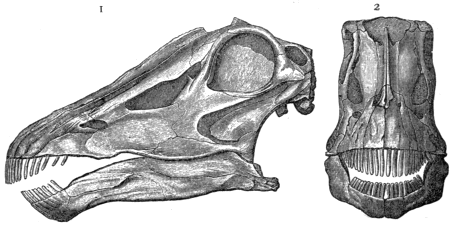
Diplodocus, of which several incomplete specimens have been discovered, was intermediate in size between Atlantosaurus and Morosaurus, and may have reached when living, a length of forty or fifty feet. Its skull was of moderate size, with slender jaws. The teeth were weaker than those of any other known Dinosaur, and entirely confined to the front of the jaws. Professor Marsh concludes from the teeth that Diplodocus was herbivorous, feeding on succulent vegetation, and that it probably led an aquatic life. Fig. 11 shows its skull.
The remains of this interesting Dinosaur (Brontosaurus), which in several ways differs from other members of the “lizard-footed” group, were found in Upper Jurassic beds, near Cañon City, Colorado. A second smaller species was also discovered near Morrison, Colorado. All the remains lay in the Atlantosaurus beds. These strata—the tomb in which Nature has buried up so many of her dragons of old time—can be traced for several hundred miles on the flanks of the Rocky Mountains, and are always to be known by the bones they contain. They lie above the Triassic strata and just below the Sandstone of the Dakota group. Some have regarded them as of Cretaceous age; but, judging from their fossils, there can be but little doubt that they were deposited during the Jurassic period—probably in an old estuary. They consist of shale and sandstone.
Besides the numerous Dinosaurs, Professor Marsh’s colleagues have found abundant remains of crocodiles, tortoises, and fishes, with one Pterodactyl, a flying reptile (see chap. viii.), and several small marsupials. The wonderful collection of American Jurassic Dinosaurs in the Museum of Yale College includes the remains of several hundred individuals, many of them in excellent preservation, and has afforded to Professor Marsh the material for his classification already alluded to.
Fig. 11.—Head of Diplodocus. 1. Side view. 2. Front view.
English Dinosaurs of the Lizard-footed Group.
Unfortunately, there are at present no complete skeletons known of English Dinosaurs related to the American forms above described. But, since the English fossils were first in evidence by many years, and Marsh’s discoveries have confirmed in a remarkable way conclusions drawn by Owen, Huxley, Hulke, and Seeley, and others from materials that were rather fragmentary, it may be worth while to give some account of these remains and the interpretations they have received.
Dr. Buckland, in his Bridgewater Treatise, 1836, referred to a limb-bone in the Oxford Museum, from the great Oolite formation near Woodstock, which was examined by Cuvier, and pronounced to have once belonged to a whale; also a very large rib, which seemed whale-like. In 1838 Professor Owen, when collecting materials for his famous Report on the Fossil Reptiles of Great Britain, inspected this remarkable limb-bone, and could not match it with any bones known among the whale tribe; and yet its structure, where exposed, was like that of the long bone (humerus) of the paddle of a whale. Later on, he abandoned the idea that it once belonged to a whale, and it was thought that the extinct animal in question might have been a reptile of the crocodilean order. In time, a fine series of limb-bones and vertebræ was added to the Oxford Museum by Professor Phillips (Dr. Buckland’s successor at Oxford), who pronounced them to be Dinosaurian. The name “Cetiosaurus”[11] (or Whale-lizard), originally given by Owen, was unfortunate, because there is really nothing whale-like about it, except a certain coarse texture of some of the bones.
In 1848 Dr. Buckland announced the discovery of another limb-bone (a femur), which Owen referred to Cetiosaurus; it was four feet three inches in length. Between 1868 and 1870, however, a considerable portion of a skeleton was discovered in the same formation at Kirtlington Station, near Oxford. These remains were the subject of careful examination by Professors Owen and Phillips. The femur this time was five feet four inches long. Their studies threw much light on the nature and habits of Cetiosaurus.
Although showing in many ways an approach to the crocodile type of reptile, yet it was perceived from the nature of the limbs that they were better fitted for walking on land than are those of a crocodile, with its sprawling limbs. Still, Professor Owen was careful to point out that the vertebræ of its long tail indicate suitability as a powerful swimming organ, and concluded that the creature was more aquatic than terrestrial in its habits. Plaster casts of the limb-bones may be seen at the British Museum of Natural History, side by side with the huge Atlantosaurus cast sent by Professor Marsh.
The Kimmeridge clay of Weymouth has yielded a huge arm-bone (or humerus), nearly five feet long; and from Wealden strata of Sussex and the Isle of Wight vertebræ have been collected. Altogether we have remains of Cetiosaurus from at least half a dozen counties. Unfortunately, no specimen of a skull has yet been found, and only two or three small and incomplete teeth, which may possibly have belonged to some other animal. Professor Owen estimated the length of the trunk and tail of the creature to have been thirty-five or thirty-six feet; but in the absence of further evidence it was not possible to form any conclusion as to its total length. It is evident that Cetiosaurus was closely allied to the American Brontosaurus (p. 69); and so these earlier English discoveries have gained much in interest from the light thrown upon them by Professor Marsh’s huge Saurian.
Another English Saurian of this group was the Ornithopsis, from Wealden strata in the Isle of Wight, which has been the subject of careful study by Mr. Hulke and Professor Seeley. Their conclusions, based on the examination of separate portions of the skeleton (such as vertebræ), have been singularly confirmed by the discovery of Brontosaurus.
In Ornithopsis the vertebræ of the neck and back, though of great size, were remarkably light, and yet of great strength. One of the vertebræ of the back had a body, or centrum, ten inches long. Hoplosaurus and Pelosaurus were evidently reptiles closely allied to the above types; but at present are so imperfectly known that we need not consider them here.
CHAPTER VI.
DINOSAURS (continued).
“Fossils have been eloquently and appropriately termed ‘Medals of Creation.’”—Dr. Mantell.
When any tribe of plants or animals becomes very flourishing, and spreads over the face of the earth, occupying regions far apart from one another, where the geographical and other conditions, such as climate, are unlike, its members will inevitably develop considerable differences among themselves.
During the great Mesozoic period, Dinosaurs spread over a large part of the world; they became very numerous and powerful. Just as the birds and beasts (quadrupeds) of to-day show an almost endless variety, according to the circumstances in which they are placed, so that great and powerful order of reptiles we are now considering ran riot, and gave rise to a variety of forms, or types. Those described in the last chapter were heavy, slow-moving Dinosaurs, of great proportions, and were all herbivorous creatures, apparently without weapons of offence or defence.
The group Theropoda, or “beast-footed” Dinosaurs, that partly form the subject of the present chapter, were all flesh-eating animals; and, as we shall discover from their fossilised remains, were of less size, and led active lives. In fact, they acted in their day the part played by lions and tigers to-day.
In the year 1824 that keen observer and original thinker, the Rev. Dr. Buckland, described to the Geological Society of London some remains of a very strange and formidable reptile found in the Limestone of Stonesfield, near Woodstock (about twelve miles from Oxford). This rock, known as “Stonesfield slate” from its property of splitting up into thin layers, has long been celebrated for its fossil remains, and from it have also been obtained the bones of some early mammals. It is a member of the Lower Oolitic group.
The portions of skeleton originally discovered consisted of part of a lower jaw, with teeth, a thigh bone (femur), a series of vertebræ of the trunk, a few ribs, and some other fragments. The name Megalosaurus,[12] or “great lizard,” suggested itself both to Dr. Buckland and Baron Cuvier, because it was evident from the size of the bones that the creature must have been very big. It is true these bones were not found together in one spot; but Professor Owen came to the conclusion that they all belonged to the same species.
No entire skeleton of the Megalosaur has ever been found, but there was enough material to enable Dr. Buckland, Professor Owen, and Professor Phillips to form a very fair idea of its general structure. It should be mentioned here that Dr. Mantell, the enthusiastic geologist to whose labours palæontologists are greatly indebted, had previously discovered similar teeth and bones in the Wealden strata of Tilgate Forest. Sherborne, in Dorset, is another locality which has yielded a fine specimen of parts of both jaws with teeth. A cast of this may be seen in the geological collection at South Kensington. It was found in the Inferior Oolite (Wall-case IV.); the original specimen lies in the museum of Sherborne College. Remains of Megalosaurus have also been found at the following places: Lyme-Regis and Watchet (in the Lias); near Bridport (in Inferior Oolite); Enslow Bridge (upper part of the Great Oolite and Forest Marble Beds); Weymouth (in Oxford Clay); Cowley and Dry Sandford (in the Coral Rag); Malton in Yorkshire (in Coralline Oolite); also in Normandy. They have also been found in Wealden strata.
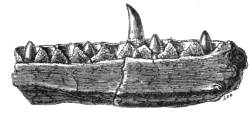
The portion of a lower jaw in the Oxford Museum is twelve inches long, with a row of nine teeth, or sockets for teeth. The structure of the teeth leaves no doubt as to the carnivorous habits of the creature. With a length of perhaps thirty feet, capable of free and rapid movement on land, with strong hind limbs, short head, with long pointed teeth, and formidable claws to its feet, the Megalosaur must have been without a rival among the carnivorous reptiles on this side of the world. It probably walked for the most part on its hind legs, as depicted in our illustration, and Professors Huxley and Owen, on examining the bones in the Oxford Museum, were much impressed with the bird-like character of some parts of the skeleton, showing an approach to the ostrich type. The form of the teeth, as pointed out by Dr. Buckland, exhibits a remarkable combination of contrivances. When young and first protruding above the gum, the apex of the tooth presented a double cutting edge of serrated enamel; but as it advanced in growth its direction was turned backwards in the form of a pruning knife, and the enamelled sawing edge was continued downwards to the base of the inner and cutting side, but became thicker on the other side, obtaining additional strength when it was no longer needed as a cutting instrument (Fig. 12).
Fig. 12.—Lower jaw-bone of Megalosaurus, with teeth.
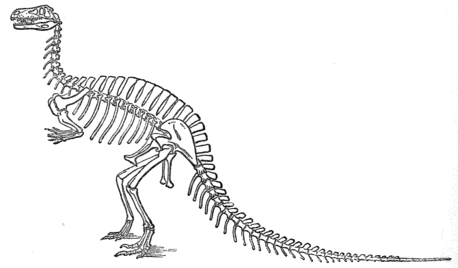
The genus Megalosaurus—now rendered classic through the labours of Professors Buckland, Phillips, and Owen—may be regarded as the type of the carnivorous Dinosaurs; and it affords an excellent and instructive instance of the gradual restoration of the skeleton of a new monster from more or less fragmentary remains. Certain very excusable errors were at first made in the restoration, but these have since been rectified by a comparison with the allied American forms, such as Allosaurus, of which nearly entire skeletons have of late been discovered in strata of Jurassic age—in fact, the same rock in Colorado as that in which the huge Atlantosaurus bones lay hid. The accompanying woodcut (Fig. 13) shows how the skeleton has been restored in the light of these later discoveries of Professor Marsh. The large bones of the limbs of these formidable flesh-eating monsters were hollow, and many of the vertebræ, as well as some of those of the feet, contained cavities, or were otherwise lightened in order to give the creature a greater power of rapid movement.
Fig. 13.—Skeleton of Megalosaurus, restored. (After Meyer.)
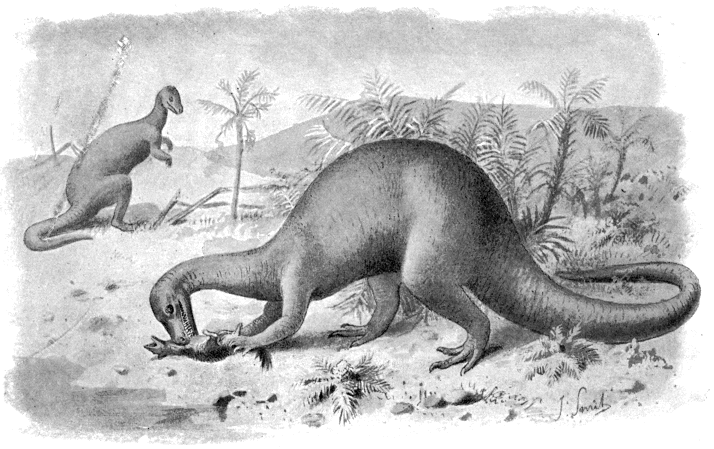
It is not very difficult to imagine a Megalosaur lying in wait for his prey (perhaps a slender, harmless little mammal of the ant-eater type) with his hind limbs bent under his body, so as to bring the heels to the ground, and then with one terrific bound from those long legs springing on to the prey, and holding the mammal tight in its clawed fore limbs, as a cat might hold a mouse. Then the sabre-like teeth would be brought into action by the powerful jaws, and soon the flesh and bones of the victim would be gone! (See Plate VI.)
Plate VI.
A CARNIVOROUS DINOSAUR, MEGALOSAURUS BUCKLANDI. Length about 25 feet.
As we remarked before, the carnivorous Dinosaurs were the lions and tigers of the Mesozoic era, and, what with small mammals and numerous reptiles of those days, it would seem that they were not limited in their choice of diet.
It is a question not yet decided whether Dinosaurs laid eggs as most modern reptiles do, or were viviparous like quadrupeds; but Professor Marsh thinks there are reasons for the latter supposition.
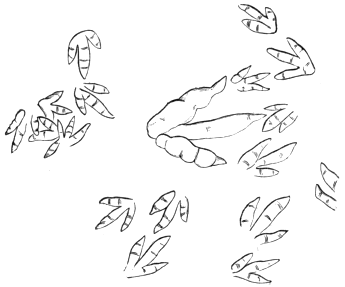
During the early part of the Mesozoic era, at the period known as the Triassic (New Red Sandstone), Dinosaurs flourished vigorously in America, developing a great variety of forms and sizes. Although but few of their bones have as yet been discovered in those rocks, they have left behind unmistakable evidence of their presence in the well-known footprints and other impressions upon the shores of the waters which they frequented.[13] The Triassic Sandstone of the Connecticut Valley has long been famous for its fossil footprints, especially the so-called “bird-tracks,” which are generally supposed to have been made by birds, the tracks of which they certainly appear to resemble. But a careful investigation of nearly all the specimens yet discovered has convinced Professor Marsh that these fossil impressions were not made by birds (see Fig. 14). Most of the three-toed tracks, he thinks, were made by Dinosaurs, who usually walked upon their hind feet alone, and only occasionally put to the ground their small fore limbs. He has detected impressions of the latter in connection with nearly all the larger tracks of the hind limbs. These double impressions are just such as Dinosaurs would make; and, since the only characteristic bones yet found in the same rocks belong to this order of reptiles, it is but fair to attribute all these footprints to Dinosaurs, even where no impressions of fore feet have been detected, until some evidence of birds is forthcoming. The size of some of these impressions, as well as the length of stride they indicate, is against the idea of their having been made by birds. Some of them, for instance, are twenty inches in length, and four or five feet apart! The foot of the African ostrich is but ten inches long, so we must fall back on the Dinosaurs for an explanation. However, it is quite possible that some of the smaller impressions were made by birds.
Fig. 14.—Portion of a slab of New Red Sandstone, from Turner’s Falls, Massachusetts, U.S., covered with numerous tracks, probably of Dinosaurs. This specimen is now in the Natural History Museum. The separate tracks are indicated by the numbers. (After Hitchcock.)
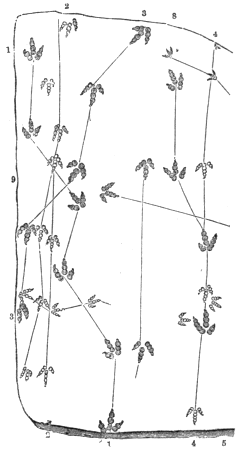
There is at South Kensington a fine series of these and other specimens of fossil footprints (Gallery No. XI., Wall-cases 8-10). The surface of one large slab in the geological collection is eight feet by six feet, and bears upwards of seventy distinct impressions disposed in several tracks, as shown in Fig. 14. The lines were added by Dr. Hitchcock, who has published full descriptions in order to show the direction and disposition of the tracks.
Fig. 15.—Portion of a slab, with tracks. (After Hitchcock.)
In a presidential address to the Geological Society, Sir Charles Lyell, speaking of the Connecticut Sandstone and its impressions, said, "When I first examined these strata of slate and sandstone near Jersey City, in company with Mr. Redfield, I saw at once from the ripple-marked surface of the slabs, from the casts of cracks, the marks of rain-drops, and the embedded fragments of drift-wood, that these beds had been formed precisely under circumstances most favourable for the reception of impressions of the feet of animals walking between high and low water. In the prolongation of the same beds in the Valley of Connecticut, there have been found, according to Professor Hitchcock, the footprints of no less than thirty-two species of bipeds, and twelve of quadrupeds. They have been observed in more than twenty localities, which are scattered over an area of nearly eighty miles from north to south, in the States of Massachusetts and Connecticut. After visiting several of these places, I entertained no doubt that the sand and mud were deposited on an area which was slowly subsiding all the while, so that at some points a thickness of more than a thousand feet of superimposed strata had accumulated in very shallow water, the footprints being repeated at various intervals on the surface of the mud throughout the entire series of superimposed beds." When Sir Charles Lyell first examined this region in 1842, Professor Hitchcock had already seen two thousand impressions of feet!
It is not difficult to imagine the conditions under which such impressions may have been preserved, for at the present day there are to be seen, on some shores, illustrations of similar operations. Dr. Gould, of Boston, U.S., was the first to call the attention of naturalists to a very instructive example of such processes on the shores of the Bay of Fundy, where the tide is said to rise in some places seventy feet high. Here we have a very perfect surface for receiving and retaining impressions. Vast are the numbers of wading and sea-birds that course to and fro over the extensive tract of plastic red surface left dry by the far retreat of the tide in the Bay of Fundy. During the period that elapses between one spring tide and the next, the highest part of the tidal deposit is exposed long enough to receive and retain many impressions; even during the hours of hot sunshine, to which, in the summer months, this so-trodden tract is left exposed, the layer last deposited becomes baked hard and dry, and before the returning tidal wave has power to break up the preceding one, the impressions left on that stratum have received a deposit. A cast is thus taken of the mould previously made, and each succeeding tide brings another layer of deposit. We can easily imagine that in succeeding ages the petrifying influences will consolidate the sandy layers into a fossil rock. Such a rock would split in such a way, along its natural layers of formation, as to show the old moulds on one surface, and the casts on the other.
Fig. 16.—Limb-bones of Allosaurus. (After Marsh.) 1. Fore leg. 2. Hind leg.
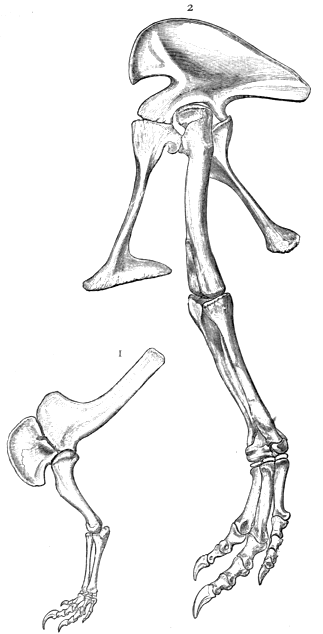
Professor Marsh has had the good fortune to discover a very peculiar new form of carnivorous Dinosaur, to which he has given the name Ceratosaurus,[14] because its skull supported a horn. But the horn is not the only new feature presented by this interesting creature. Its vertebræ are of a strange and unexpected type; and in the pelvis all the bones are fused together, as in modern birds. Externally, also, the Ceratosaurus differed from other members of the carnivorous group, for its body was partly protected by long plates in the skin, such as crocodiles have: these extended from the back of the head, along the neck, and over the back. An almost complete skeleton was found which indicates an animal about seventeen feet long. When alive it was probably about half the bulk of the Allosaurus mentioned above. (See Fig. 16.)
Seen from above, its skull resembles in general outline that of a crocodile, the facial portion being elongated and gradually tapering to the muzzle, with the nasal openings separate, and placed near the end of the snout.
Fig. 17.—Skull of Ceratosaurus. Top view. (After Marsh.)
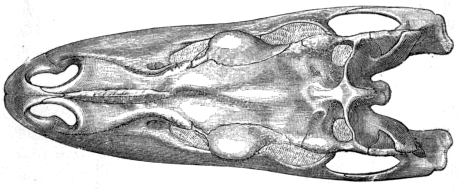
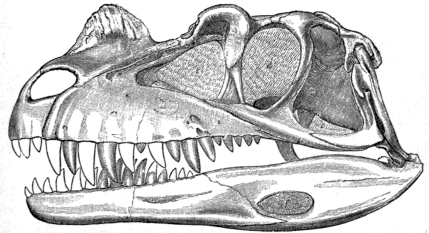
The teeth of this horned Dinosaur resemble those of the Megalosaur. Its eyes were protected by protuberances of the skull just above the cavity in which the eye was placed (see Figs. 17 and 18). The brain was a good deal larger in proportion to the size of the animal than in Brontosaurus and its allies; so perhaps we may infer that it was endowed with greater intelligence, as it certainly was more active in its habits. The fore limbs, as in Megalosaurus, were small, and some of the fingers ended in powerful claws, which no doubt it used to good purpose.
Perhaps the most remarkable of all the Dinosaurs was a diminutive creature only two feet in length, which was related to those we have just been considering, and whose skeleton has been found almost entire in the now famous Lithographic Stone of Solenhofen in Bavaria. Of this unique type, the Compsognathus, the skeleton of which is in many ways so bird-like, Professor Huxley remarks, “It is impossible to look at the conformation of this strange reptile and to doubt that it hopped, or walked, in an erect or semi-erect position, after the manner of a bird, to which its long neck, slight head, and small anterior limbs must have given it an extraordinary resemblance.” (See Fig. 19.)
Fig. 18.—Skull of Ceratosaurus nasicornis. (After Marsh.)
At the head of this chapter are placed the words of Dr. Mantell, “Fossils have been eloquently and appropriately termed Medals of Creation,” and the eloquent passage by which those words are followed may be transcribed here. He goes on to say, "For as an accomplished numismatist, even when the inscription of an ancient and unknown coin is illegible, can from the half-obliterated effigy, and from the style of art, determine with precision the people by whom, and the period when, it was struck: in like manner the geologist can decipher these natural memorials, interpret the hieroglyphics with which they are inscribed, and from apparently the most insignificant relics trace the history of beings of whom no other records are extant, and ascertain the forms and habits of unknown types of organisation whose races are swept from the face of the earth, ere the creation of man, and the creatures which are his contemporaries. Well might the illustrious Bergman exclaim, "Sunt instar nummorum memoralium quæ de præteritis globi nostri fatis testantur, ubi omnia silent monumenta historica.""
Fig. 19.—Skeleton of Compsognathus longipes. (From the Solenhofen limestone.)
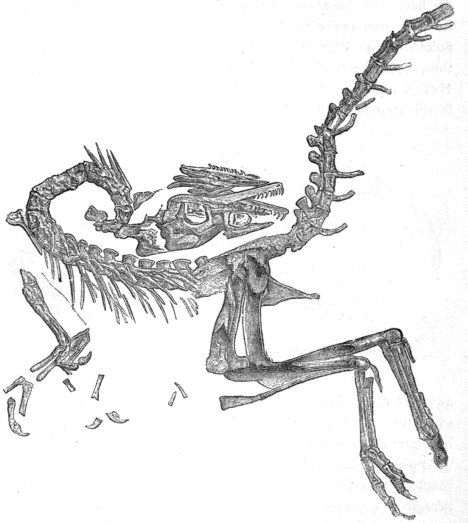
Geology owes a deep debt of gratitude to the late Dr. Gideon A. Mantell, who, during the intervals of a laborious professional life, collected and described the remains of several strange extinct reptiles, and wrote a number of works on geology, such as served in his day to advance the science to which he was so enthusiastically devoted.
We propose to give a brief account of a wonderful group of Dinosaurs, first introduced to the scientific world through Dr. Mantell’s labours.
The first of these monsters is the Iguanodon, the earliest known individual of the “bird-footed” division (Ornithopoda). The history of the gradual reconstruction of its skeleton is an instructive instance of the results that may be obtained by a careful and patient study of fragmentary remains. Through the labours of Dr. Mantell, in the first half of this century, a considerable knowledge was acquired of the greater part of the skeleton, but certain portions remained a puzzle; these, however, were eventually explained by Professor Huxley and Mr. Hulke, and a few years ago a series of complete skeletons were most fortunately obtained in Belgium, so that now every part of the huge framework of this monster is known to the palæontologist. Its history, as a fossil, is a most interesting one, and furnishes one more example of the marvellous insight into the nature of extinct animals displayed by the illustrious Baron Cuvier. Let us begin with the teeth, since they were the first part of the monster brought to light.
It is, perhaps, hardly necessary to remark that, to one thoroughly acquainted with the structures of living animals, a tooth, or a series of teeth, will furnish material from which important conclusions with regard to the structure and habits of an extinct animal may be drawn. So, also, with regard to some other parts, such as limb-bones, but more especially the bones of which the backbone is composed (known as vertebræ). These are very important. The veteran anatomist, Professor Owen, has said, “If I were restricted to a single specimen on which to deduce the nature of an extinct animal, I should choose a vertebra to work out a reptile, and a tooth in the case of a mammal.” Seven or eight different “characters,” he says, may be deduced from a reptilian vertebra. It is, of course, impossible for any one to reconstruct an entire animal from a single bone or a few teeth, yet such fragments indicate in a general way the nature of a lost creation and its position in the animal kingdom.
Fig. 20.—Tooth of Iguanodon, with the apex slightly worn. (From the Wealden Beds of Tilgate Forest. Natural size.) 1. Front aspect, showing the longitudinal ridges and serrated margins of the crown. 2. View of the back, or inner surface of the tooth. a. Serrated margins. b. Apex of the crown worn by use.
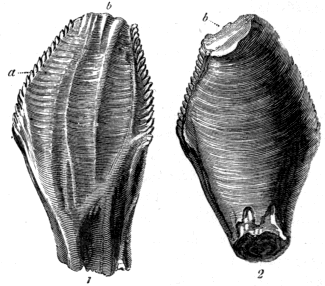
It is all the more important to give to the general reader this warning, because an impression seems still to remain in the popular mind that Owen could and did restore extinct types from a single bone or a single tooth; but no anatomist would attribute to any mortal man such superhuman power. Let us, therefore, while gratefully acknowledging the debt we all owe to the great naturalist—who has gone to his rest since our first edition appeared—not attribute to him impossible things. Nor can it be denied that even he sometimes fell into error, or drew conclusions not borne out by later discoveries. It must also be confessed that in some respects he lagged behind in the march of scientific progress. While on this subject we cannot do better than quote some remarks of our friend, Mr. A. Smith Woodward, of the Natural History Museum, in an able review of Sir Richard’s work on vertebrates.[15] He says, "Owen, in fact, was Cuvier’s direct successor, and, apart from his striking hypotheses ..., it is in this character that he has left the deepest impression upon biological science. Extending and elaborating comparative anatomy as understood by Cuvier, Owen concentrated his efforts on utilising the results for the interpretation of the fossil remains—even isolated bones and teeth—of extinct animals. He never hesitated to deal with the most fragmentary evidence, having complete faith in the principles established by Cuvier; and it is particularly interesting, in the light of present knowledge, to study the long series of successes and failures that characterise his work. However, unwittingly, Owen may be said to have contributed most to the demolition of the narrow Cuvierian views. When dealing with animals closely related to those now living, his correctness of interpretation was usually assured; when treating of more remote types, he could do little more than guess, unless tolerably complete skeletons happened to be at his disposal....
“In short, Owen’s work on fragmentary fossils has demonstrated that the principles of comparative anatomy are very different from those inferred by Cuvier from his limited field of observation, and the discoveries of Leidy, Marsh, Cope, Scott, and Osborn, in America, have finally led to a new era that Owen only began to foresee clearly in his later days.”
The first specimens of teeth of the Iguanodon were found by Mrs. Mantell, in 1822, in the coarse conglomerate of certain strata in Tilgate Forest, belonging to the Cretaceous period (see Table of Strata, Appendix I.). Dr. and Mrs. Mantell subsequently collected a most interesting series of these remarkable teeth (which, for a time, puzzled the most learned men of the day), from the perfect tooth of a young animal, to the last stage, that of a mere long stump worn away by mastication. In external form they bore a striking resemblance to the grinders of herbivorous mammals, and were wholly unlike any that had previously been known. Even the quarrymen, accustomed to collect the remains of fishes, shells, and other objects embedded in the rocks, had not observed fossils of this kind; and until Dr. Mantell showed them his specimens, were not aware of the presence of such teeth in the stone they were constantly breaking up for the roads. The first specimen that arrested his attention was a large tooth, which, from the worn surface of its crown, had evidently once belonged to some herbivorous animal. In form it so entirely resembled the corresponding part of an incisor tooth of a large pachydermatous animal ground down by use, that Dr. Mantell was much embarrassed to account for its presence in the ancient Wealden strata, in which, according to all previous experience, no fossil remains of mammals would be likely to occur. No reptiles of the present day are capable of masticating their food; how, then, could he venture to assign it to a reptile? Here was a puzzle to be solved, and in his perplexity he determined to try whether the great naturalist at Paris would be able to throw any light on the question. Through Sir Charles (then Mr.) Lyell, this perplexing tooth was submitted to Baron Cuvier; and great was the doctor’s astonishment on hearing that it had been without hesitation pronounced to be the upper incisor of a rhinoceros! The same tooth, with some other specimens, had already been exhibited at a meeting of the Geological Society, and shown to Dr. Buckland, Mr. Conybeare, and others, but with no more satisfactory result. Worse than that: Dr. Mantell was told that the teeth were of no particular interest, and that, without doubt, they either belonged to some large fish, or were the teeth of a mammal, and derived from some superficial deposit of the “glacial drift,” then called Diluvium.
There was one man, however, who foresaw the importance of Mantell’s discovery, and that was Dr. Wollaston. This distinguished philosopher, though not a naturalist, supported the doctor’s idea that the teeth belonged to an unknown herbivorous reptile, and encouraged him to continue his researches.
As if to add to the difficulty of solving the enigma, certain bones of the fore limb, discovered soon after in the same quarry and forwarded to Paris, were declared to belong to a species of hippopotamus! Another very curious bone—of which we shall speak presently—was declared to be the lesser horn of a rhinoceros! The famous Dr. Buckland even went so far as to warn Dr. Mantell not to publish it forth that these bones and teeth had been found in the Tilgate Forest strata. To him it seemed incredible that such remains could have been obtained from beds older than the superficial drift deposits of the district. We must bear in mind that in those days palæontology, or the knowledge of the world’s former inhabitants, was a new science still in its infancy, and the idea of mammals having existed so far back as the Cretaceous period must have appeared incredible.
However, the workmen in the quarry were stimulated by suitable rewards, and at length the doctor’s efforts resulted in the discovery of teeth which displayed the curious serrated edges, and the entire form of the unused crown. Having forwarded specimens and drawings of these to Paris, Dr. Mantell went to London, and ransacked all the drawers in the Hunterian Museum that contained jaws and teeth of reptiles, but without finding any that threw light on this subject. Fortunately, Mr. Samuel Stuchbury, then a young man, was present, and proposed to show him the skeleton of an Iguana, which he had himself prepared from a specimen that had long been immersed in spirits. And now the puzzle was in a fair way to being solved; for, to his great delight, the doctor found that the minute teeth of that reptile bore a closer resemblance in their general form to those from Tilgate Forest than any others he had ever seen.
In spite of this fortunate discovery, however, others remained obstinate and unconvinced; and it was not until he had collected a series of specimens, exhibiting various stages of the teeth, that the correctness of his opinion was admitted, either as to their true interpretation, or the age of the strata in which they were imbedded. And now there came good news from Paris. Cuvier, with the fresh material submitted to him, had boldly renounced his previous opinion, and gave the weight of his great authority to the view maintained by the discoverer of these teeth. In a letter to the doctor he said that such teeth were quite unknown to him, and that they belonged to some reptile. He suggested that they implied the existence of a new animal, a herbivorous reptile. Time would either confirm or disprove the idea, and in the mean time he advised Dr. Mantell to seek diligently for further evidence, and, if part of a jaw could be found with teeth adhering, he believed he could solve the problem. In his immortal work, Ossemens Fossiles, Cuvier generously admits his former mistake, and said he was entirely convinced of his error.
Baron Cuvier alone amongst the doctor’s friends or correspondents was able to give any hint as to the character and probable relations of the animal to which the recently discovered teeth belonged. Being hampered by arduous professional duties in a provincial town, remote from museums and libraries, Dr. Mantell transmitted to the Royal Society figures and drawings of the specimens, and, at the suggestion of the Rev. W. D. Conybeare, adopted the name Iguanodon (Iguana-tooth) for the extinct reptile, a name which pointed to the resemblance of its teeth to those of the modern iguana, a land-lizard inhabiting many parts of America and the West Indies, and rarely met with north or south of the tropics. These lizards are from three to five feet in length, and perfectly harmless, feeding on insects and vegetables, and climbing trees in quest of the tender leaves and buds, which they chip off and swallow whole; they nestle in the hollows of rocks, and deposit their eggs in the sands and banks of rivers.
In all living reptiles the insects or vegetables on which they feed are seized by the tongue or teeth, and swallowed whole, so that a movable covering to the jaws, similar to the lips and cheeks of the mammalia, is not necessary, either for seizing and retaining food, or for subjecting it by muscular movements to the action of the teeth. It is the power of perfect mastication possessed by the Iguanodon that is so strange, for it implies a most remarkable approach in extinct reptiles to characters possessed now only by herbivorous mammalia, such as horses, cows, deer, etc. From this and other strange characters seen in the Dinosaurs, we learn that they in their day played the part of our modern quadrupeds, whether carnivorous or herbivorous, and showed a remarkable approach to the mammalian type, which of course is a much higher one.
It is, therefore, not to be wondered at that Dr. Mantell’s contemporaries, with the exception of Cuvier, found in the teeth we have described an awkward puzzle, and refused to believe that they belonged to a reptile. Such a notion was at variance with all previous experience, and we naturally form our conclusions to a large extent by experience. Let us, then, beware lest we allow our ideas to be limited by what after all is, as it were, only an expression of our ignorance. The Hottentot who has never seen snow would refuse to believe that rain can assume a solid form; and, in the same way, if we bind ourselves down by experience, we might refuse to believe in some of the still more wonderful dinosaurian types to be described in this chapter, such as the Triceratops, with a pair of large horns, a skull over six feet long, and limbs larger than those of the rhinoceros! (see p. 117).
The strange vagaries of Dinosaurs have led Professor Marsh and other authorities to exalt them, from their former position of a mere order in the reptile class, to the dignity of a sub-class all to themselves; and there is much to be said for this view. Compared with the Marsupials, living and extinct, they show an equal diversity of structure and variations in size from by far the largest land animals known down to some of the smallest.[16]
The importance of discovering, if possible, a portion of the jaw of an Iguanodon was fully recognised by Dr. Mantell, and, urged on by the encouragement he had received from the illustrious Cuvier, he eagerly sought for the required evidence. But nearly a quarter of a century elapsed before it was forthcoming. In 1841 and 1848, however, portions of the lower jaw, with some teeth attached, were found; and his memoir On the Structure of the Jaws and Teeth of the Iguanodon was published by the Royal Society in 1848. For this important communication the gold medal of the society was awarded to the author. The second of these finds (by Captain Brickenden) confirmed in every essential particular the inferences suggested by the detached teeth.
The first important connected series of bones of this monster was discovered in 1834, by Mr. Bensted, in the “Kentish Rag” quarries of the Lower Greensand formation at Maidstone. Mr. Bensted, who was the proprietor of the quarry, one day had his attention drawn by the workmen to what they supposed to be petrified wood in some pieces of stone which they had been blasting. He perceived that what they supposed to be wood was fossil bone, and, with a zeal and care which have always characterised this estimable man (says Professor Owen) in his endeavour to secure for science any evidence of fossil remains in his quarry, he immediately resorted to the spot. He found that the bore, or blast, by which these remains were brought to light had been inserted into the centre of the specimen, so that the mass of stone containing it had been shattered into many pieces, some of which were blown into the adjoining fields! All these pieces he had carefully collected, and, proceeding with equal ardour and success to the removal of the matrix from the fossils, he succeeded, after a month’s labour, in exposing them to view, and in fitting the fragments in their proper place. This valuable specimen was presented to Dr. Mantell (and afterwards purchased with the rest of his collection by the British Museum), and its present condition is the result of his skill, as well as that of its discoverer. Certain gentlemen in Brighton, anxious that the specimen should be placed in the hands of the original discoverer of Iguanodon, purchased and presented it to Dr. Mantell—a tribute of respect which was highly gratifying to him. (Wall-case 6.)
It belonged to a young Iguanodon. This fortunate discovery was one of those Cuvier foresaw, and has served to verify his sagacious conjecture that some of the great bones collected by the doctor from the Wealden strata of Sussex belonged to the same animal, and to confirm other conclusions formed by the discoverer of the Iguanodon. Great was Dr. Mantell’s delight on finding that every bone he had ascribed to Iguanodon solely from analogy was present in the Maidstone specimen. One of the chief advantages of this discovery was that it afforded demonstration of the characters of the vertebræ, which, as previously stated, are very important to the anatomist. Of these Professor Owen has given full descriptions, and has shown that they differ from those of any animal previously known, whether living or extinct.
It is very interesting, in the light of recent discoveries, to read the conclusions arrived at by Mantell and Owen, with regard to the organisation of this great Wealden reptile, and to see how, with the exception of certain details, they have been confirmed. Considering the imperfect nature of the materials at their command, it is wonderful that their forecasts should have turned out so successful. Thus Professor Owen predicted for the Iguanodon a total length of twenty-eight feet, and specimens discovered of late years show a length of twenty-four feet. In some, the thigh-bone exceeded a yard in length; this indicated an animal of great size, since in the largest crocodiles this bone is scarcely a foot long. Again, Dr. Mantell, from a study of the imperfect jaw-bones in his collection, concluded that the lower jaw was invested with a well-developed fleshy flexible lip, and that the mouth was provided with a tongue of great mobility and power. “There are strong reasons,” he says, "for supposing that the lip was flexible, and, in conjunction with the long fleshy prehensile tongue, constituted the instrument for seizing and cropping the leaves and branches, which, from the construction of the molars, we may infer, constituted the chief food of the Iguanodon. The mechanism of the maxillary organs (jaws), as elucidated by recent discoveries, is thus in perfect harmony with the remarkable characters which rendered the first known teeth so enigmatical; and in the Wealden herbivorous reptile we have a solution of the problem, how the integrity of the type of organisation peculiar to the class of cold-blooded vertebrata was maintained, and yet adapted, by simple modifications, to fulfil the conditions required by the economy of a gigantic terrestrial reptile, destined to obtain support exclusively from vegetable substances; in like manner, as the extinct colossal herbivorous Edentata (sloths, See Chapter XII.), which flourished in South America ages after the country of the Iguanodon and its inhabitants had been swept away from the face of the earth."