Front matter (continued 4)
Reading edition
These old lake-basins, in which so many forms of life have been sealed up, all lie between the Rocky Mountains on the east, and the Wasatch Range on the west, or along the high central plateau of the continent. As the mountains were slowly elevated, part of the old sea of the Cretaceous period (that sea in which the “sea-serpents” played so important a part) was enclosed and cut off from the ocean. Rivers began to pour their waters into it, so that the waters became less and less salt, until at last a fresh-water lake, or series of lakes, was formed. As the upward movement of this region continued these lakes were all the while receiving sedimentary materials, such as sand and mud, from the rivers, until finally they were filled up, but not until the sediments had formed a mass of strata over a mile in thickness. Thus we see how favourable were the conditions for a faithful record of Eocene life-history.
But another process was going on which helped to bring them to an end; for they were being slowly drained by the rivers that flowed out of them, and these rivers kept on continually deepening their channels, so that we have dry land where the lakes once were. Now the region is over 6000 feet above the sea, and probably more than one-half of these fresh-water deposits have been washed away, mainly through the Colorado River. What is left of the Eocene strata forms the “Bad Lands.” The same geological action that has cut up and carved out this region into buttes, cañons, cliffs, peaks, and columns of fantastic shapes, has also brought to light the extinct animals preserved in the rocks, much in the same way as an old burial-ground, if cut up by intersecting trenches, might be made to yield up the bones of those who for generations had been buried therein.
Professor Marsh first discovered remains of Dinocerata in 1870, while investigating this Eocene lake-basin, which had never before been explored. It was here, also, that he found the wonderful series of fossil horses by means of which he has been able to prove that our modern horse is descended from a small quadruped with five toes, and to show the different stages in its evolution. Here, also, were found old-fashioned types of carnivorous quadrupeds, of rodents, and of insectivorous creatures. But reptiles as well as quadrupeds flourished on the borders of the old lake, for the remains were found of crocodiles, tortoises, lizards, and serpents; its waters, too, were well stocked with fish.
Everything here testifies to a long continuance of those conditions under which plant and animal life can flourish, namely, a warm climate, plenty of food, and freedom from those physical changes which, by altering the geographical features of a country, bring so many important consequences in their train. The geological record tells us that this happy state of things lasted all through the Eocene period, and until the fresh-water lakes had at last been drained away by their outflowing rivers.
In October, 1870, a later Eocene lake-basin was discovered by the same exploring party, and this Professor Marsh calls the Uinta basin, because it was situated south of the Uinta Mountains. “In the attempt to explore it,” he says, “our party endured much hardship, and also were exposed to serious danger, since we had only a small escort of United States soldiers, and the region visited was one of the favourite resorts of the Uinta-Utes. These Indians were then, many of them, insolent and aggressive, and since have been openly hostile, at one time massacring a large body of Government troops sent against them. Two subsequent attempts ... to explore this region met with little success.”
This lower lake was of later (or upper) Eocene age, and the extinct animals preserved in its ancient bed appear to resemble more nearly those of the famous Paris basin, referred to in the beginning of this chapter, than any yet discovered in America. But the basin north of the Uinta Mountains, where alone the Dinocerata had been found, offered so inviting a field that, in the spring of 1871, Professor Marsh began to explore it systematically. He organised an expedition, with an escort of U.S. soldiers, and the work continued during the whole season. In this way a large collection was secured. Explorations were continued in the spring of the following year, which resulted in the discovery of the type specimen of the Dinoceras mirabile. Another expedition was organised in 1873, also with an escort of soldiers, and a great many specimens were collected. These researches were continued during 1874, and again in 1875, with good results. Since then various small parties have been equipped and sent out by Professor Marsh to collect in the same region of the “Bad Lands;” and, finally, during the entire season of 1882, the work was vigorously prosecuted under his direction, and afterwards under the auspices of the United States Geological Survey. This brief account of the difficulties and hardships encountered by Professor Marsh and his companions, for which we are indebted to his exhaustive monograph, will serve to give some idea of the nature of those labours, undertaken in the cause of Science, which he has brought to so successful an issue.
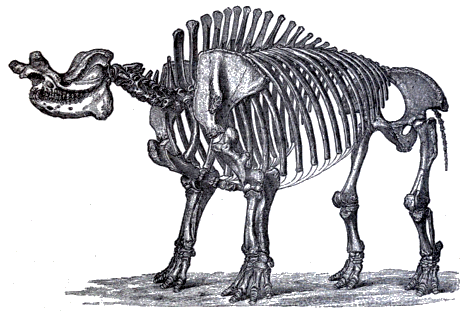
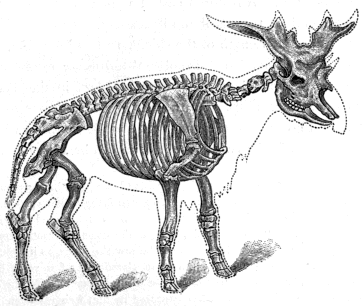
In the country east of the Rocky Mountains, including the states of Dakota, Nebraska, Wyoming, and part of Colorado, Professor Marsh has discovered the remains of yet another strange group of large quadrupeds. The best known of these is Brontops, of which the skeleton is seen in Fig. 45. These animals lived after the Dinocerata, namely, in the Miocene period, and were the largest American mammals of that period. They constitute a distinct family more nearly allied to the rhinoceros than to any other living form. The skeleton on which Fig. 45 is founded was the most complete of any yet discovered by Professor Marsh. Portions of it were exhumed at different times, but it was first found in 1874. Our artist has made the restoration seen in Plate XV. from this skeleton, as figured by Professor Marsh.
Plate XV.
A HUGE EXTINCT MAMMAL FROM NORTH AMERICA. BRONTOPS ROBUSTUS.
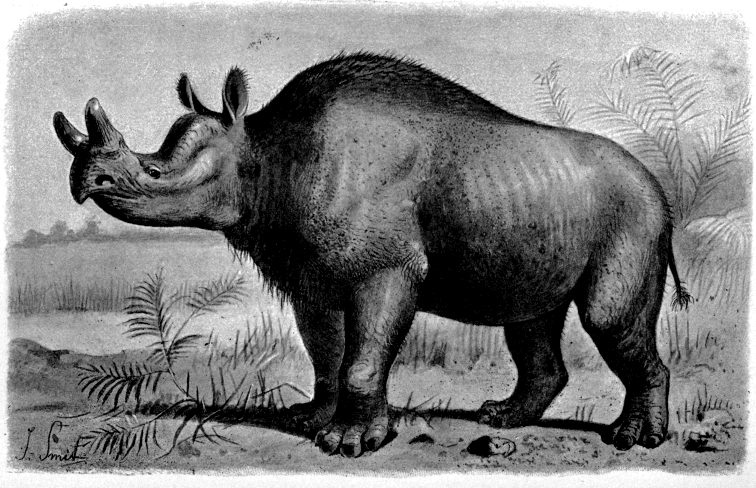
This strange group of creatures flourished in great numbers on the borders of an old lake of Miocene age. The Brontops was a heavy massive animal, larger than any of the Dinocerata, with a length of twelve feet, not including the tail, and a height of eight feet. The limbs are shorter than those of the elephant, which it nearly equalled in size. As in the tapir, there were four toes to the front limbs, and three to the hind limbs. Its skull was of a peculiar shape, shallow, and very large. That of Brontops ingens is thirty-six inches long, and twenty inches between the tips of the two horns, or protuberances. The creature was probably provided with an elongated, flexible nose, like that of the tapir, but not longer, because the length of the neck shows that it could reach the ground without the aid of a trunk such as the elephant’s. It is doubtful if the two prominences on the front of the skull were provided with horns, for, if directed forwards, they would interfere with the animal when grazing.
Fig. 45.—Skeleton of Brontops robustus. (After Marsh.)
CHAPTER XI.
SOME INDIAN MONSTERS.
“What a glorious privilege it would be, could we live back—were it but for an instant—into those ancient times when these extinct animals peopled the earth! to see them all congregated together in one grand natural menagerie—these mastodons and elephants, so numerous in species, toiling their ponderous forms and trumpeting their march in countless herds through the swamps and reedy forests!”—Hugh Falconer.
It is a far cry back, against the sun’s path, from Wyoming and the flanks of the Rocky Mountains to the sacred Himalayas—the “abode of snow”—of Northern India. But if the reader will follow us to that country, we will endeavour to describe two or three out of many strange and now lost forms of life brought to light from the famous Sivalik Hills, on the southern border of the Himalayas, for the knowledge of which Science is greatly indebted to a very distinguished palæontologist, the late Mr. Hugh Falconer. Together with his friend Captain Cautley (afterwards Sir Proby Cautley), he explored this region, and their joint arduous labours show that it was at one time inhabited by a very large and varied group of quadrupeds, together with many birds, reptiles, fishes, mollusca, and crustaceans.
In this region there lived, throughout a considerable part of the Tertiary period, elephants, of various species, whose skulls and bones were found in great numbers; mastodons (a closely allied form); and several species of hippopotamus, rhinoceros, and horse: among ruminants, species of the camel, the ox, the stag, and the antelope, together with a colossal creature unknown before, the Sivatherium, which has never been found elsewhere; a huge tortoise, and various species of carnivora, rodents, and apes.
With regard to the geography of the region, it appears that the continent of India, at an early period of the Tertiary era, was a large island, situated in a bight, or bay, formed by the Himalayas and the Hindoo Koosh range. The valleys of the Ganges and Indus formed a long estuary, into which the drainage of the Himalayas poured its silt and alluvium. Later on, an upheaval took place, converting these straits into the plains of India, connecting them with the ancient island, and forming the existing continent. The large and varied forms whose remains now lie “sealed within the iron hills” then spread over the continent, from the Irrawaddi to the mouths of the Indus, two thousand miles; and north-west to the Jhelum, fifteen hundred miles. After a long interval of repose, another great upheaval took place, which threw up a strip of the plains of India, crumpled and ridged it up to form the Sivalik Hills, and at the same time increased the elevation of the Himalayas by many thousands of feet.
It would be easy to show that such events as these must have been followed by changes in climate, for the climate of a region depends largely on its physical features—the proportion of land and water, the presence of hills and mountain ranges, and their height; and it is considered probable that the physical changes above mentioned helped to bring about the extinction of this most interesting and ancient fauna. Throughout the latter part of the Tertiary era it is well known to geologists that the climate of Europe was becoming gradually colder, until at last a glacial period, or “Ice Age,” was experienced, during which Northern Europe was subjected to an arctic climate, and the great ice-sheet seems to have been slowly retiring and melting away in the early part of the Stone Age. But in India there has been no such decrease in temperature, and it enjoyed in Tertiary times as warm a climate as it now has, so that both animal and vegetable life continued to flourish vigorously.
By the Sivalik (or Sewalik) Hills is meant that range of lower elevations which stretches along the south-west foot of the Himalayas, for the greater portion of their extent from the Indus to the Brahmapootra, where those rivers respectively debouche from the hills into the plains of India. It extends for nearly a thousand miles, and it appears to have been entirely built up of alluvial débris, washed down from the Himalayas into that sea which we have already referred to as having once separated the plains of India from the great range now forming its northern boundary. The strata thus formed were subsequently upheaved to form the Sivalik Hills. Thus we see that one mountain range may help to form another one running parallel to itself. The name is derived from Siva, or Mahadeo, the Hindoo god; these hills, as well as the Himalayas, being connected in Hindoo mythology in various ways with the history of Siva.
Dr. Falconer and Captain Cautley soon found that they had “struck oil” in the Sivalik Hills, or, in other words, had come upon one of Nature’s great graveyards, full of material most valuable to the palæontologist—one which, extending for hundreds of miles, might perhaps prove to be as rich in relics of the world’s “lost creations” as the lake-basin in Wyoming, where Professor Marsh discovered his Dinocerata and other extinct types.
Let us give Dr. Falconer and Captain Cautley their due. They found themselves suddenly confronted with a perfect mine of wealth, in a far country, where the ordinary means resorted to by men of science for determining extinct types and species, by comparison with living forms, were not to be obtained, for there were no libraries and no museums of comparative anatomy in that remote quarter of India. But Dr. Falconer was not the man to be baffled by such drawbacks, which would have deterred and discouraged some men. He appealed to the living forms that abounded in the surrounding forests, rivers, and swamps, and took toll of them to supply the want. Nature herself became his library and his museum. Skeletons of all kinds were prepared; the extinct forms he collected were compared with their nearest living allies, and a valuable series of “Memoirs” by himself and Captain Cautley was the result.[43]
The Sivalik explorations soon attracted attention in Europe, and in 1837 the Wollaston Medal, in duplicate, was awarded for their discoveries to Dr. Falconer and Captain Cautley by the Geological Society, the fountain of geological honours in England; while the value of the distinction was enhanced by the terms in which the President, Sir Charles Lyell, was pleased to announce the award. This is what he said: "When Captain Cautley and Dr. Falconer first discovered these remarkable remains, their curiosity was awakened, and they felt convinced of their great scientific value; but they were not versed in fossil osteology [the study of bones], and, being stationed on the remote confines of our Indian possessions, they were far distant from any living authorities or books on comparative anatomy to which they could refer. The manner in which they overcame these disadvantages, and the enthusiasm with which they continued for years to prosecute their researches, when thus isolated from the scientific world, are truly admirable. Dr. Royle has permitted me to read a part of their correspondence with him, when they were exploring the Sivalik Mountains, and I can bear witness to their extraordinary energy and perseverance. From time to time they earnestly requested that Cuvier’s works might be sent out to them, and expressed their disappointment when, from various accidents, these volumes failed to arrive. The delay, perhaps, was fortunate; for, being thrown entirely upon their own resources, they soon found a museum of comparative anatomy in the surrounding plains, hills, and jungles, where they slew the wild tigers, buffaloes, antelopes, and other Indian quadrupeds, of which they preserved the skeletons, besides obtaining specimens of all the reptiles which inhabited that region. They were compelled to see and think for themselves, while comparing and discriminating the different recent and fossil bones, and reasoning on the laws of comparative osteology, till at length they were fully prepared to appreciate the lessons which they were taught by the works of Cuvier."
In 1840 Captain Cautley presented his vast collection, the result of ten years' unremitting labour and great personal outlay, to the British Museum, the Geological Society having declined to accept it, as it was beyond their means of accommodation. Its extent and value may be estimated from the fact that it filled 214 large chests, the average weight of each of which amounted to 4 cwt., and that the charges on its transmission to England alone, which were defrayed by the Government of India, amounted to £602. Dr. Falconer’s selected collection was divided between the India House and the British Museum; the greater part was presented to the former, but a large number of unique or choice specimens, required to fill up blanks, were presented to the latter. The greater part of the specimens in the British Museum were still unarranged and embedded in their matrix. In 1844 a memorial was presented to the Court of Directors of the Honourable East India Company, pointing out the desirability of having the specimens in the national collection prepared, arranged, and displayed, and also of publishing an illustrated work, which would convey to men of science in both hemispheres a knowledge of the contents of the Sivalik Hills, and suggesting Dr. Falconer as the person most fitted to superintend the work. The Government of the time, under Sir Robert Peel, made a grant of £1000 to enable the collection to be exhibited in the British Museum, and Dr. Falconer was entrusted with the work. Besides this, a large illustrated work, entitled Fauna Antiqua Sivalensis, was begun, but owing to the demands upon Dr. Falconer’s time, and his subsequent death, this work was not completed, although nine out of the twelve parts originally contemplated were finished. The great Indian collection of fossils, mainly the gift of Sir Proby Cautley (the specimens of which, stupendous in their size, and in fine preservation, were prepared, identified, and arranged by Dr. Falconer), has long constituted one of the chief ornaments of the collection at the British Museum—now removed to the Natural History Museum, Cromwell Road, South Kensington.
Other collections of fossils from the Sivalik Hills have been presented to the Museum of Edinburgh University by Colonel Colvin, and to the Oxford University by Mr. Walter Ewer. When it is remembered that these collections have since been increased tenfold, and that the remains were either excavated or found in the débris of cliffs, and that the explored surface bears a very small proportion to that which has not yet been investigated, one may conceive how prodigious must have been the number of animals that lived together in the former plains of India, even when every allowance is made for the bones having accumulated during many successive generations in the Sivalik strata.
From this large and important collection we select two of special interest for brief notice here, namely, the Sivatherium,[44] and an immense tortoise known as the Colossochelys.
The first of these monsters was a remarkable form of animal, unlike anything living. In size it surpassed the largest rhinoceros, and was bigger than any living ruminant. Altogether, it was one of the most remarkable forms of life yet detected in the more recent strata. It had two pairs of horns on its head—two short and quite simple ones in front, and two larger ones, more or less expanded, behind them. From the character of these long horn-cores, which are prolongations of the skull, it may be concluded that the Sivatherium was a gigantic ruminant with four horns. A cast of the original skull, with the horn-cores restored from actual parts, in the collection and elsewhere, has been placed on a stand in the centre of the long gallery of fossil vertebrates at South Kensington (Stand I) near to the case containing the skull and other portions of the skeleton (see Fig. 46). There is also hanging on the wall near, a clever painting by Berjeau, representing the creature as it may have appeared when alive. The entire skeleton, partly restored, is shown in Fig. 47, with a conjectural outline of the body. A hornless skull of a nearly allied animal from the same strata and locality is placed with that of the Sivatherium, and was considered by Dr. Falconer and others to be the skull of the hornless female (also represented as such in the above picture referred to); but is now, by more recent writers, regarded as a separate genus, viz. the Helladotherium, so named because the remains were first discovered at Pikermi, near Athens, Greece (ancient Hellas). (See Plate XVI.)
Fig. 46.—Skull of Sivatherium giganteum, from the Sivalik Hills, Northern India.
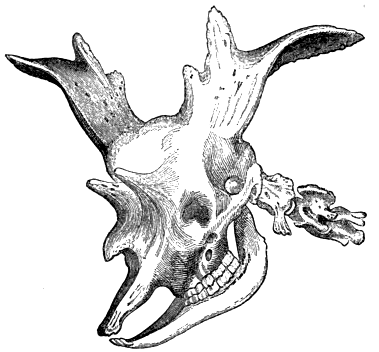
Plate XVI.
A GIGANTIC HOOFED MAMMAL, SIVATHERIUM GIGANTEUM. From the Sivalik Hills, Northern India. An allied form, Helladotherium, is seen on the left
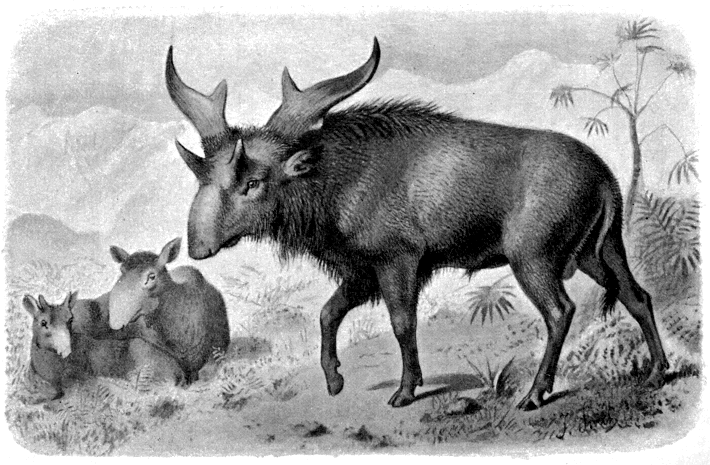
In the Sivatherium we have a new type which seems to connect together two families at the present time well marked off from each other, namely, the giraffe and the antelope. Its teeth resemble those of the former animal, while in its four horns it resembles a certain antelope (Antilope quadricornis). The head in certain respects shows resemblances to that of the ox, but the upper lip must have been prolonged into a short proboscis, or trunk, like that of the tapir. The form and proportions of the jaw agree closely with the corresponding parts of a buffalo. But no known ruminant, fossil or existing, has a jaw of such large size, the average dimensions being more than double those of a buffalo. The skull is the best known part of the animal, but Captain Cautley came across some of the bones of the limbs.
Fig. 47.—Skeleton of Sivatherium giganteum.
The Colossochelys atlas,[45] or gigantic fossil tortoise of India, supplies a fit representative of the tortoise which sustained the elephant and the infant world in the fables of the Pythagorean and Hindoo cosmogonies. It is highly interesting to trace back to its probable source a matter of belief like this, so widely connected with the speculations of an early period of the human race.
The carapace, or buckler, of the shell of this crawling monster is similar in general form to the large land-tortoises of the present day.[46] The shell is estimated to have been at least six feet long. The limbs were probably similar to those of a modern land-tortoise, and the limb-bones are of huge size—a single humerus, or arm-bone, measuring 28 inches. Probably the foot was as large as that of a rhinoceros. A restored cast of a young individual stands at the West end of the fossil reptile gallery, South Kensington (Stand Z on plan). Length of the shield, 10 feet[47] (see Fig. 48).
The first fossil remains of this colossal tortoise were discovered by Dr. Falconer and Captain Cautley in 1835, in the Tertiary strata of the Sivalik Hills. At the period when it was living—probably the Pliocene—there was great abundance and variety of life on the scene, for its remains were found to be associated with those of many great quadrupeds, such as the elephant, mastodon, rhinoceros, horse, camel, giraffe, sivatherium, and many other mammals. The Sivalik fauna also included a great number of reptiles, such as crocodiles, lizards, and snakes.
Fig. 48.—Restored figure of gigantic tortoise, Colossochelys atlas, from the Sivalik Hills, Northern India.
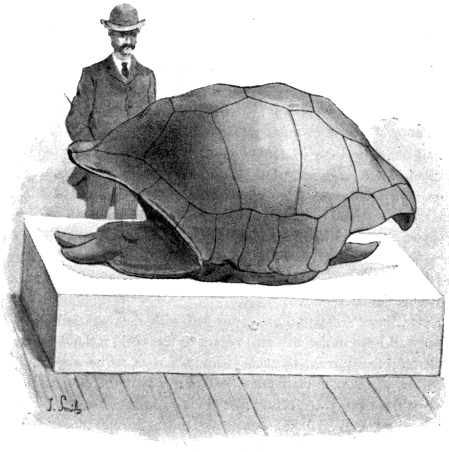
The greater part of the remains of the Colossochelys atlas were collected during a period of eight or nine years, along a range of about a hundred miles of hilly country. Consequently, they belong to a large number of individuals, varying in size and age. They were met with in crushed fragments, contained in upheaved strata, which have undergone considerable disturbance, so that it is improbable that an entire uncrushed specimen will ever be found. When the first fragments, in huge shapeless masses, were found by the discoverers, they were utterly at a loss what to make of them, and for many months could do nothing more than look upon them in bewildered and nearly hopeless admiration. But no sooner was the clue found to a single specimen than every fragment moved into its place so as to form a consistent whole.
It is not possible at present to say, with any degree of certainty, whether this colossal tortoise survived into the human period; but at least there is no evidence against the idea, and Dr. Falconer shows it is quite possible that the frequent allusions to a gigantic tortoise in Hindoo and other mythologies are to be explained on the supposition that the creature was seen by the men of a prehistoric age. Other species of tortoises and turtles that were coeval with the Colossochelys have lived on to the present day. So have other reptiles, for some of the crocodiles now living in India appear to be identical with the forms dug out of the Sivalik Hills. In the absence of direct geological evidence, we must fall back on traditions.
Now, there are traditions connected with the speculations of nearly all Eastern nations with regard to the world (cosmogonies) that refer to a tortoise of such gigantic size as to be associated with the elephant in their fables. The question therefore arises—Was this tortoise a creature of the imagination, or was the idea of it drawn from a living reality? Besides a tradition current among the Iroquois Indians of North America, referring to the important share which the tortoise had in the formation of the earth, there are several cases in ancient history bearing on the same point. Thus, we find in the Pythagorean doctrine the infant world represented as having been placed on the back of an elephant, which was sustained on a huge tortoise. Greek and Hindoo mythologies were undoubtedly related to each other, and accordingly we find in the Hindoo accounts of the second Avatar of Vishnoo, that the ocean is said to have been churned by means of the mountain placed on the back of the king of the tortoises, and the serpent Asokee used as the churning-rope. Again, Vishnoo was said to have assumed the form of the tortoise, and to have sustained the created world on his back to make it stable. This fable has taken such a firm hold of the Hindoos, that to this day they believe the world rests on the back of a tortoise (see Fig. 49). In the narratives of the feasts of the bird-demigod, Garūda, the tortoise again figures largely, and Garūda is said on one occasion to have appeased his hunger at a certain lake where an elephant and a tortoise were fighting.
Fig. 49.—The elephant victorious over the tortoise, supporting the world, and unfolding the mysteries of the Fauna Sivalensis. From a sketch in pencil in one of Dr. Falconer’s note-books, by the late Professor Edward Forbes.
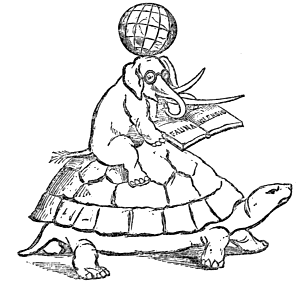
These three instances, in each of which there is a distinct reference to a gigantic form of tortoise, comparable in size with the elephant, suggest the question whether we are to regard the idea as a mere fiction of the imagination, like the Minotaur or the Chimæra, or as founded on a living tortoise. Dr. Falconer points out that it seems unlikely that such fables could have been suggested by any of the small species of tortoises now living in India, and consequently is inclined to think that the monster was seen by man many centuries ago, long before he began to write history. We have already alluded to the large number of mammalian forms of life that were contemporary with the Sivatherium and Colossochelys, but if we examine this old Sivalik fauna we find it presents several very interesting features. In the first place, it exhibits a wonderful richness and variety of forms, compared to the living fauna of India. Take the pachydermata, for instance—an old order established by Cuvier to include the rhinoceros, hippopotamus, elephant, etc.—and we find there were, in the period under consideration, about five times the number of species now known in India. Elephants and mastodons, too, of various species abounded. So it is with the ruminants; besides a large number of species allied to those now living, such as the ox, buffalo, bison, deer, antelope, musk-deer, and others, there were giraffes and camels, as well as the strange Sivatherium. And so it is with the other orders, such as carnivora, rodents, insectivora, etc.
Secondly, this great and varied fauna of the past shows a striking resemblance to that of India at the present day. Darwin found the same resemblance in South America; and now it is accepted as a general law, that the living fauna of a country resembles its extinct fauna, especially that of the latest geological period. Dr. Falconer found that India’s living fauna is but, as it were, a remnant of that which it once possessed.
Thirdly, this extinct Sivalik fauna presents a singular mixture of old and new forms. And lastly, it points to a very different geographical distribution of animals. Thus the giraffe, the hippopotamus, and the ostrich are now confined to Africa. Facts such as these serve to throw light on the geography of the past; but we cannot stay to enlarge on that subject here.
Much might be said about the fossil elephants and mastodons from the Sivalik Hills, so fully described by Dr. Falconer, but since chapters xiii. and xiv. deal with elephants, we must reserve our remarks till then, only alluding here to one striking form from the Sivalik Hills, namely, the Elephas ganesa, the tusks of which were more than ten feet in length, and much less curved than those of the mammoth. A very fine specimen of the head and tusks may be seen in the gallery of fossil mammals in the Natural History Museum (Gallery I, Stand D).
With the following eloquent passage from Dr. Falconer’s “Memoirs,” we take leave of the remarkable Sivalik fauna, hoping that future geologists will endeavour to follow his example and bring to light yet other “lost creations” from that region, so rich in fossils, yet comparatively unexplored. Would that the English Government could see their way to follow the example of the United States, and send out a scientific expedition to explore this wonderful region! There can be no doubt that a rich harvest lies waiting there to be reaped.
"What a glorious privilege it would be, could we live back—were it but for an instant—into those ancient times when these extinct animals peopled the earth! to see them all congregated together in one grand natural menagerie—these mastodons and elephants, so numerous in species, toiling their ponderous forms and trumpeting their march in countless herds through the swamps and reedy forests! to view the giant Sivatherium, armed in front with four horns, spurning the timidity of his race, and, ruminant though he be, proud in his strength, and bellowing his sturdy career in defiance of all aggression! And then the graceful giraffes, flitting their shadowy forms like spectres through the trees, mixed with troops of large as well as pigmy horses, and camels, antelopes, and deer! And then, last of all, by way of contrast, to contemplate the colossus of the tortoise race, heaving his unwieldy frame, and stamping his toilsome march along plains which hardly look over strong to sustain him!
"Assuredly it would be a heart-stirring sight to behold! But although we may not actually enjoy the effect of the living pageant, a still higher order of privilege is vouchsafed to us. We have only to light the torch of philosophy, to seize the clue of induction, and, like the Prophet Ezekiel in the vision, to proceed into the valley of death, when the graves open before us and render forth their contents; the dry and fragmented bones run together, each bone to his bone; the sinews are laid over, the flesh is brought on, the skin covers all, and the past existence—to the mind’s eye—starts again into being, decked out in all the lineaments of life. ‘He who calls that which hath vanished back again into being, enjoys a bliss like that of creating.’ Such were the words of the philosophical Niebuhr, when attempting to fill up the blanks in the fragmentary records of the ancient Romans, whose period in relation to past time dates but as of yesterday. How much more highly privileged, then, are we, who can recall, as it were, the beings of countless remote ages, when man was not yet dreamed of! not only this, but if we use discreetly the lights which have been given to us, we may invoke the spirit of the winds, and learn how they were tempered to suit the natures of these extinct beings."
CHAPTER XII.
GIANT SLOTHS AND ARMADILLOS.
“Injecta monstris terra dolet suis.”
Horace, Odes, book iii.
It would have been strange, considering how much we owe to North America, had the great South American continent not enriched our knowledge of past forms of life on the globe. But such is not the case. The honours are, as it were, divided, although it must be admitted that the North American extinct forms at present known are far more numerous. There are, however, two or three “Extinct Monsters” of very great interest which once had a home in South America—in that strange region of the Pampas, where the naturalist of the present day finds so much to excite his interest. Of these the present chapter treats.
The Megatherium[48] (Cuvier) was a gigantic mammal allied to sloths and ant-eaters, and perhaps to the armadillos. In its skull and teeth this colossus of the past resembled the sloths, in its limbs and backbone it resembled the ant-eaters, while in size it surpassed the largest rhinoceros (Plate XVII.). The famous, but imperfect, specimen at Madrid was for a long time the principal if not the only source of information with regard to this extinct genus, and for nearly a century it remained unique.
Later on, however, the zeal and energy of Sir Woodbine Parish, his late Majesty’s chargé-d’affaires at Buenos Ayres, greatly helped to augment the materials for arriving at a just conclusion with regard to its proper place in the animal kingdom. According to one writer, Spain formerly possessed considerable parts of three different skeletons. The first and most complete is that which is preserved in the royal cabinet at Madrid. This was sent over in 1789, by the Marquis of Loreto, Viceroy of Buenos Ayres, with a notice stating that it was found on the banks of the river Luxan. In 1795 a second specimen arrived from Lima, and other portions, probably not very considerable, were in the possession of Father Fernando Scio, to whom they had been presented by a lady from Paraguay. But two German doctors, Messrs. Pander and D’Alton, who published in 1821 a beautiful monograph on the subject, state that they were unable in 1818 to find any traces of either the Lima specimen or that which had belonged to Fernando Scio.
The remains collected by Sir Woodbine Parish were discovered in the river Salado, which runs through the flat alluvial plains (Pampas) to the south of the city of Buenos Ayres, after a succession of three unusually dry seasons, “which lowered the waters in an extraordinary degree, and exposed parts of the pelvis to view as it stood upright in the bottom of the river.”[49]
Plate XVII.
CAST OF A SKELETON OF MEGATHERIUM AMERICANUM. Set up in the Natural History Museum.
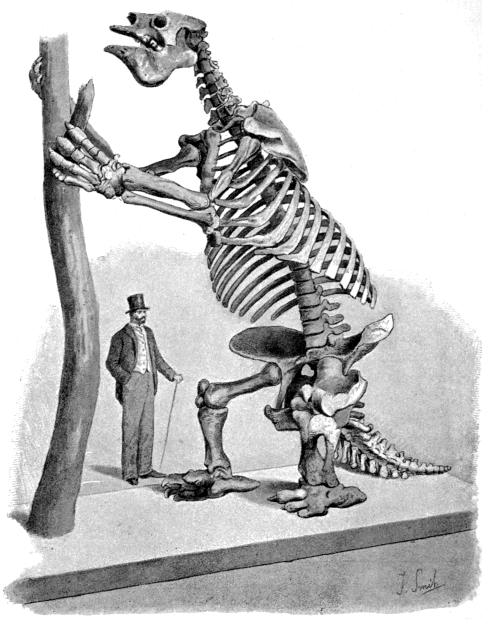
This and other parts having been carried to Buenos Ayres by the country people, were placed at the disposal of Sir Woodbine Parish by Don Hilario Sosa, the owner of the property on which the bones were found. A further inquiry was instituted by Sir Woodbine; and on his application, the governor granted assistance, the result of which was the discovery of the remains of two other skeletons on his Excellency’s properties, at no great distance from the place where the first had been found. It was in the year 1832 that Sir Woodbine Parish sent his valuable collection of bones from Buenos Ayres, and presented them to the Royal College of Surgeons. These specimens formed the subject of Mr. Clift’s memoir above quoted. But even then the materials were not complete for a thorough knowledge of the bony framework of the Megatherium, and it was not till 1845, when more remains (discovered near Luxan, 1837) reached this country, that Professor Owen was able to clear up one or two doubtful details. These were purchased by the trustees of the British Museum, and casts of the bones were taken. Among the various writings by learned men on the subject, Professor Owen’s masterly description stands pre-eminent; indeed, he was the only one to solve the riddle, to thoroughly explain the structure of this giant sloth, and to show how its food was obtained.[50] Neither Cuvier, nor the German doctors, nor Mr. Clift had succeeded in so doing.
In the Natural History Museum (Stand O, Gallery No. 2 on plan) is a cast representing the animal nearly erect, and grasping a tree. This magnificent cast (see Plate XVII.) represents an animal eighteen feet in length, and its bones are more massive than those of the elephant. For instance, the thigh-bone is nearly thrice the thickness of the same bone in the largest of existing elephants, the circumference being equal to the entire length. To a comparative anatomist several striking indications of great strength present themselves; thus, not only the very forms of the bones themselves mean strength, but their surfaces, ridges, and crests are everywhere made rough for the firm attachment of powerful muscles and tendons. In the fore part of the body the skeleton is comparatively slender, but the hind quarters show enormous strength and weight combined. The tail, also, is very powerful and massive. The fore limbs are long, and evidently constructed for the exertion of great force. How this force was applied we shall see presently. In both sets of limbs we notice powerful claws, such as might be used for scratching up the ground near the roots of a tree, and it was at one time thought that this was the way in which the creature obtained its leafy food, namely, by digging up trees by the roots and then devouring the leaves. But Professor Owen had another explanation.
As in the living sloths and armadillos (edentata[51]), there are no teeth in the fore part of the jaw. The molar teeth, of which there are five on each side of the upper jaw, and four in the lower, are hollow prismatic cylinders, straight, seven to nine inches long, and implanted in deep sockets. There are no other teeth, but these are composed of different substances, and so arranged that, as the tooth wears, the surface always presents a pair of transverse ridges, thus producing a dental apparatus well suited for grinding up vegetable food. In the elephants, which live on similar food, the grinding is effected by great molar teeth, which are replaced by new ones as the old ones are worn away. In the Megatherium, however, only one set of teeth was provided; but these, by constant upward growth, and continual addition of new matter beneath, lasted as long as the animal lived, and never needed to be renewed.
On looking at the model so skilfully set up at South Kensington, and especially at the front part of the skull, it will be seen that the snout and lips must have been somewhat elongated, possibly into a slight proboscis like that of the tapir. The specimens of the lower jaw in the wall-case close by show that it was much prolonged and grooved. This fact must be interpreted to mean that the creature possessed a long and powerful tongue, aided by which it could, like the giraffe, strip off the small branches of the trees which it had broken or bent down within its reach.
A bony shield (or carapace) of a great armadillo was found with one of the specimens described by Mr. Clift, and Buckland and others thought it belonged to the Megatherium; but Owen afterwards showed, by most clear and convincing reasoning from the skeleton, that the Megatherium could not have been protected as armadillos are, by such a shield (see p. 190).
Plate XVIII.
GREAT GROUND-SLOTH OF SOUTH AMERICA, MEGATHERIUM AMERICANUM. Length 18 feet.
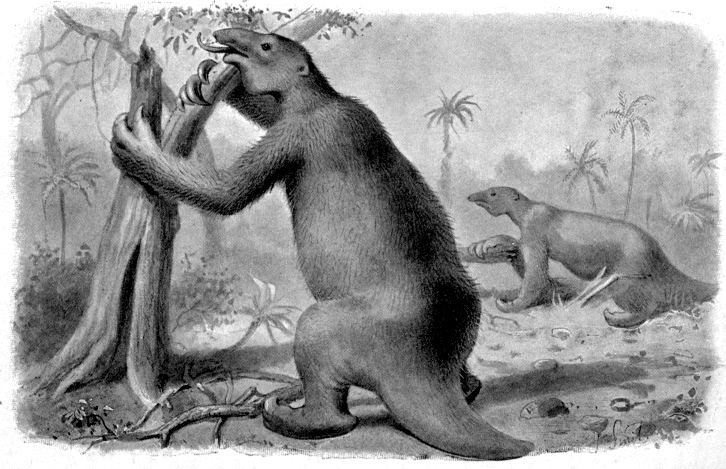
And now we come to the question how it obtained its food. The idea of digging round trees with its claws in order to uproot them, must be partly, if not entirely, given up; for Professor Owen has proved, by a masterly piece of reasoning, that this cumbrous creature, instead of climbing up trees as modern sloths do, actually pulled down the tree bodily, or broke it short off above the ground by a tour de force, and, in order to do so, sat up on its huge haunches and tail as on a tripod, while it grasped the trunk in its long powerful arms! Marvellous as this may seem, it can be shown that every detail in its skeleton agrees with the idea. Of course there would be limits to possibilities in this direction, and the larger trees of the period must have been proof against any such Samson-like attempts on the part of the Megatherium; but when the trunk was too big, doubtless it pulled down some of the lower branches. Plate XVIII. is a restoration, by our artist, of the South Kensington skeleton.
Speaking of the extinct sloths of South America, Mr. Darwin thus describes Professor Owen’s remarkable discovery: "The habits of these Megatheroid animals were a complete puzzle to naturalists until Professor Owen solved the problem with remarkable ingenuity. Their teeth indicate by their simple structure that these animals ... lived on vegetable food, and probably on the leaves and small twigs of trees; their ponderous forms and great strong curved claws seem so little adapted for locomotion, that some eminent naturalists believed that, like sloths, to which they are intimately related, they subsisted by climbing, back downwards, on trees, and feeding on the leaves. It was a bold, not to say preposterous, idea to conceive even antediluvian trees with branches strong enough to bear animals as large as elephants. Professor Owen, with far more probability, believes that, instead of climbing on trees, they pulled the branches down to them, and tore up the smaller ones by the roots, and so fed on the leaves. The colossal breadth and weight of their hinder quarters, which can hardly be imagined without having been seen, become, on this view, of obvious service instead of being an encumbrance; their apparent clumsiness disappears. With their great tails and huge heels firmly fixed like a tripod in the ground, they could freely exert the full force of their most powerful arms and great claws."[52]
To this we may add Dean Buckland’s description,[53] “His entire frame was an apparatus of colossal mechanism, adapted exactly to the work it had to do; strong and ponderous in proportion as this work was heavy, and calculated to be the vehicle of life and enjoyment to a gigantic race of quadrupeds, which, though they have ceased to be counted among the living inhabitants of our planet, have, in their fossil bones, left behind them imperishable monuments of the consummate skill with which they were constructed. Each limb and fragment of a limb form coordinate parts of a well-adjusted and perfect whole.”
After reading these descriptions, it is not difficult to form a mental picture of the great beast laying siege to a tree, and to conceive the massive frame of the Megatherium convulsed with the mighty wrestling, every vibrating fibre reacting upon its bony attachment with the force of a hundred giants; extraordinary must be the strength and proportions of the tree if, when rocked to and fro, to right and left, in such an embrace, it can long withstand the efforts of its assailant. It yields, the roots fly up, the earth is scattered wide upon the surrounding foliage, and the tree comes down with a thundering crash, cracking and snapping the great boughs like glass. Then the coveted food is within reach, and the giant reaps the reward of his Herculean labours.
Sir Woodbine Parish thought that the Megatherium fed on the Agave, or American aloe.
Another form of extinct sloth found in the same region is the Mylodon. Though of smaller size, it was much bigger than any living sloth, and attained a length of eleven feet. It has the same general structure, but the head and jaws are somewhat different, and more like the recent forms. A nearly perfect and original skeleton of Mylodon gracilis has been set up beside its huge relative’s cast in the same gallery at the Natural History Museum. The crowns of its molar teeth are flat instead of being ridged; hence its name, which signified “mill-toothed.”
Yet another was the Scelidotherium[54] with its long limbs. Darwin obtained an almost entire skeleton of one of these. It was as large as a polar bear. Speaking of his discovery, he says, “The beds containing the fossil skeletons consist of stratified gravel and reddish mud; a proof that the elevation of the land has been inconsiderable since the great quadrupeds wandered over the surrounding plains, and the external features of the country were then very nearly the same as now. The number of the remains of these quadrupeds embedded in the vast estuary deposits which form the Pampas and cover the granitic rocks of Banda Oriental must be extraordinarily great. I believe a straight line drawn in any direction through the country would cut through some skeleton or bones. As far as I am aware, not one of these animals perished, as was formerly supposed, in the marshes or muddy river-beds of the present land, but their bones have been exposed by the streams intersecting the subaqueous deposit in which they were originally embedded. We may conclude that the whole area of the Pampas is one wide sepulchre of these extinct gigantic quadrupeds.”[55]
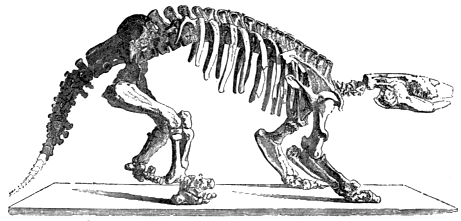
The genus Scelidotherium comprises a number of species and presents characters more or less intermediate between Megatherium and some other genera. The skull is low and elongated, and shows an approach to that of the modern ant-eater. The feet also are different from those of Megatherium (see Fig. 50).
Fig. 50.—Skeleton of Scelidotherium. (After Capellini.)
These monster sloths inhabited South America during the latest geological period, known as the Pleistocene. During part of that time North America, as well as Northern Europe and Asia, were invaded by a great ice-sheet, and an arctic climate prevailed. It is therefore very probable that while the mammoth and the mastodon were roaming over North America, giant sloths and armadillos were monarchs of the southern continent. What cause, or causes, led to the extermination of the giant sloths and armadillos is still a matter of speculation. One writer suggests an explanation that seems to deserve consideration. The southern parts of this great continent are even now subject to long-continued droughts, sometimes lasting for three years in succession, and bringing great destruction to cattle. In fact, the discoveries related above were rendered possible by several successive dry seasons. It is argued that the upright position of most of the skeletons found in situ seems to suggest that the creatures must have been mired in adhesive mud sufficiently firm to uphold the ponderous bones after the flesh had decayed. A long drought would bring the creatures from the drained and parched country to the rivers, reduced by want of rain to slender streams running between extensive mud-banks; and it is possible that, in their anxious efforts to reach the water, they may have only sunk deeper and deeper in the mud until they were engulfed. This idea is strengthened by information supplied to Mr. Darwin when in these parts (recorded in his Journal). An eye-witness told him that during the gran seco, or great drought, the cattle in herds of thousands rushed into the Parana, and, being exhausted by hunger and thirst, were unable to crawl up the muddy banks, and so were drowned.
In the last great drought, from 1830 to 1832, it is probable (according to calculations made) that the number of animals that died was over one million and a half. The borders of all the lakes and streamlets in the province were long afterwards white with their bones.
In the year 1882 reports were published of the discovery of large footprints—supposed to be human—in a certain sandstone near Carson, Nevada, U.S. The locality was the yard of the State prison, and the tracks were uncovered in quarrying stone for building purposes. Many different kinds of tracks were found, some of which were made by an animal allied to the elephant; some resembled those of the horse and deer; others seem to have been made by a wolf, and yet others by large birds. Those supposed to have been made by human giants were in six series, each with alternate right and left tracks. The stride is from two and a half to over three feet, and each footprint is about eighteen inches long. Now, those who believed these tracks to be human must have found it hard to explain how a giant with a foot some eighteen inches long had a stride no longer than that of an ordinary man of to-day, to say nothing of the fact that the straddle was eighteen to nineteen inches! For these and other reasons Professor Marsh has exploded the idea of their having been made by men, and gave good reasons to show that they were probably made by a giant sloth, such as the Mylodon above mentioned, the remains of which have been discovered in the same strata. They agree in size, in stride, and in width between the right and left impressions, very closely with the tracks that a Mylodon would have made, and it seems that those of the fore feet were afterwards impressed by the hind feet, so that each track contains two impressions.
The reader who has some knowledge of natural history will not need to be told that the sloths of the present day, inhabiting the same region as their gigantic ancestors, are of small size, and live among the branches of the trees, together with the spider monkeys, howlers, and other apes. An interesting question to the evolutionist is—How did the change take place from the old huge and heavy types to the smaller and agile types of the present day? Can it be possible that the more difficult and tedious task of pulling down branches and even stems of trees, in order to devour the leaves, was abandoned for the simpler method of climbing up and feeding among the branches? It certainly looks as if a change of this kind had been instituted at some distant period in the past—distant, that is, to us, but not very remote geologically. The present method seems so much simpler that we need not be surprised at its adoption, for Nature is ever ready to encourage and assist those among the children of Life which can hit upon and adopt new and improved methods, either in obtaining food or repelling enemies, or other duties imposed upon them. Now, suppose that, in accordance with the well-known fact that variations in the offspring of animals are constantly cropping up, some considerably smaller variety of Megatherium, or Mylodon, or other now extinct type, appeared on the scene, and, by virtue of its comparative agility, could climb a tree and feed among the branches instead of pulling them down: then, as Darwin has so well explained, Nature would seize upon this accidental variation, and give it an advantage over its more awkward relations. Its offspring, too, would inherit the same characteristics, they would adopt the same habits, and, in time, as “natural selection” further increased these characters, by weeding out those that were unfit while fostering all those that were neither large nor clumsy in climbing trees, a new race of sloths would arise. This new race, it can well be imagined, would in time outstrip the old race in numbers, for successful races multiply while unsuccessful ones diminish. Victory is not always to the great and the strong, for cunning and quickness are often of more service than mere brute strength; and perhaps the sloths, as we now see them in the Brazilian forests, have hit upon “a new and original plan” by means of which the old colossal forms described above have been driven out of the field, and so exterminated by a process of competition. Such an explanation would be in thorough harmony with modern teaching, and, as the other suggestion about long-continued droughts, given on p. 184, may not appear satisfactory to some of our readers, we offer this theory for what it may be worth.
A few words about these modern sloths may not be out of place; for we shall better understand how they have succeeded in the struggle for existence when we know something of their manner of life; and in some ways they still resemble their great ancestors.
There are few animals which exhibit in a greater degree what appears to the careless observer to be deformity than the sloth, and none that have, on this account, been more maligned by naturalists. Buffon, and many of the older zoologists, were eloquent upon the supposed defects of the unfortunate sloth. These writers gravely asserted that when the sloth ascends a tree, for the purpose of feeding upon its leaves, it is so lazy that it will not quit its station until every trace of verdure is devoured. Some of them even went so far as to assert that when the sloth was compelled, after thus stripping a tree, to look out for a fresh supply of food, it would not take the trouble to descend the tree, but just allowed itself to drop from a branch to the ground. Even Cuvier, who ought to have known better, echoes this tale, and insinuates that Nature, becoming weary of perfection, “wished to amuse herself by producing something imperfect and grotesque,” when the sloths were formed; and he proceeds, with great gravity, to show the “inconvenience of organisation,” which, in his opinion, rendered the sloths unfit for the enjoyment of life.
It is quite true that, on the ground, these animals are about the most awkward creatures that can well be imagined. Their fore legs are much longer than their hind ones; all their toes are terminated by very long curved claws, and the general structure of the animal is such as to prevent them from walking in the manner of an ordinary quadruped, for they are compelled to rest on the sides of their hands and feet. Thus they appear the most helpless of animals, and their only means of progression consists in hooking their claws to some inequality in the ground, and thus dragging their bodies painfully along. But in their natural home, amongst the branches of trees, all these seeming disadvantages vanish—nay, the very peculiarities of structure which render the sloths objects of pity on the ground, are found to render them admirably adapted to their peculiar mode of life. The sloth is a small animal, rarely more than two feet in length, and covered with woolly hair—probably a protection against snakes, its only enemies. It spends nearly the whole of its life in the trees. There, safe from the prowling animals on the ground below, it hangs like a hammock from the bough, and even travels along the branches with its body downwards, using its long claws like grappling-irons.
It looks slothful enough when asleep, for then it resembles a bunch of rough hair, and a jumble of limbs close together, hanging to a branch; but when awake it is industrious in its search for nice twigs and leaves, and moves along with considerable activity. When the atmosphere is still, the sloth keeps to its tree, feeding on the leaves and twigs, but when there is wind, and the branches of neighbouring trees come in contact, the opportunity is seized, and the animal moves along the forest under the shady cover of the boughs. The Indians have a saying that “when the wind blows the sloth begins to crawl;” and the reason is quite evident, for they cannot jump, but can hang, swing, and crawl suspended.
Plate XIX.
A GIGANTIC ARMADILLO, GLYPTODON ASPER. From Buenos Ayres. Length 8 feet 7 inches.
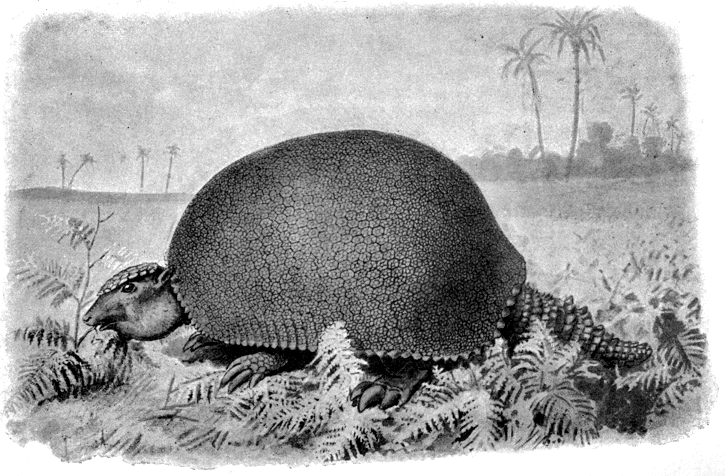
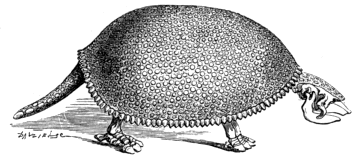
We now pass on to the old gigantic representative of the armadillo, the Glyptodon.[56] To the eye it resembles more or less an armadillo, and has a huge cuirass, or large plate of armour, covering the whole of the body, but allowing the head to show in front, while the legs come out beneath. Both head and tail were also protected with armour. The great shield, or carapace, in most of the extinct armadillos, is composed of long plates of regular shape, closely united at their edges (sutures) so as to form a solid piece. It is evident, therefore, that this creature, having no movable bands, as living armadillos have, could not roll itself up into a ball. The fore feet have thick, short toes, instead of long ones, such as their modern representatives have; and from this we may infer that they were not in the habit of burrowing or of seeking their food underground. The family of Glyptodonts seem to have been chiefly confined to the continent of South America, but some species are known to have extended their range as far as Mexico, and Texas into North America. A good deal of confusion has arisen with regard to the classification of these old-fashioned armadillos, on account of the fact that isolated specimens of their tails have often been found, and these cannot always be referred to the right carapaces. For example, it should be pointed out here that the tail represented in Fig. 51 really belongs to another genus, known as Hoplophorus.[57]
In Glyptodon asper (Plate XIX.), the scutes of the carapace had a beautiful rosette-like sculpture, while the sheath of the tail was entirely composed of a series of movable rings, ornamented with large projecting tubercles. The vertebræ of the backbone are almost entirely fused together into a long tube, and also are joined to the under surface of the great shield, to which the ribs are united. The cheek-teeth are sixteen in number, four above and four below on each side. These are channelled with two broad and deep grooves, which divide the surface into three distinct lobes. Hence the name of the animal.
The tessellated carapace of the Glyptodon was at first thought to belong to the Megatherium, with which the remains were associated, but Professor Owen clearly demonstrated the impossibility of this idea.
Fig. 51 represents Glyptodon clavipes (Owen) from the Pleistocene deposits of Buenos Ayres; but the reader will gain a much better idea of the animal by inspecting the splendid specimen of Glyptodon asper in the Natural History Museum, near the centre window at the east end of the Pavilion (Glass-case Q on plan).
Plate XIX. is a restoration of another species by our artist.[58]
In the Museum of the Royal College of Surgeons (which the reader is recommended to visit) there are several most valuable specimens of these extinct armadillos from South America.
Fig. 51.—Extinct Gigantic Armadillo, Glyptodon clavipes, from Pleistocene deposits, Buenos Ayres. (The tail sheath here represented probably belongs to another genus, Hoplophorus.)
Armadillos belong, with sloths and ant-eaters, to the same family of so-called toothless animals (edentata) with no front teeth, though one or two forms really are toothless. Those of the present day have their bony armour divided up into a series of bands, so that they can roll themselves up, more or less, into balls. They burrow under the ground, where they get their food to a certain extent, and live a safe life, protected by their casque of mail. Their only enemies seem to be the monkeys, and one of the tricks of the young monkeys in the American forests is, when they find an armadillo away from home, to pull its tail unmercifully, and try to drag it about. Snakes cannot hurt them. Mr. Hudson, in his most interesting book, A Naturalist in La Plata, narrates how he watched an armadillo kill a snake and then devour it.
If we examine the anatomy of the armadillo, we shall find that its bones greatly resemble those of the sloth, but still there are a few differences. It is a burrowing animal, and therefore requires great power of scratching and tearing the ground. Why the colossal forms of armadillo should have become extinct and only small ones survived to the present time, is one of the many and perplexing problems presented by the study of extinct animals. One would have thought from its size and strength that the Glyptodon had been built, like Rome, for eternity.
CHAPTER XIII.
THE MAMMOTH.
“Yes, where the huntsman winds his matin horn, And the couched hare beneath the covert trembles; Where shepherds tend their flocks, and grow their corn Where fashion in our gay Parade assembles— Wild horses, deer, and elephants have strayed, Treading beneath their feet old Ocean’s races.”
Horace Smith.
Many are the traditions and tales that have clustered round the Mammoth.[59] He is, however, no fabulous product of the imagination, like the dragon, for he has actually been seen in the flesh, and not only seen, but eaten, both by men and animals! But, for all that, men’s minds have been busy for centuries past making up tales, often of the wildest description, about him; and it is little wonder that a creature whose bones are found in the soils and gravels, etc., over more than half the world, and whose body has been seen frozen in Siberian ice, should have given rise to many tales and superstitions. To students of folk-lore these legends are of considerable interest, and to some extent also to men of science. To the latter, however, one of its many points of interest is that palæontology may be said to have been founded on the Mammoth. Cuvier, the illustrious founder of the science of organic remains, was enabled, by his accurate and minute knowledge of the structures of living animals, to prove to his astonished contemporaries that the Mammoth bones and teeth, so plentifully discovered in Europe, were not such as could have belonged to any living elephant, and consequently that there must have existed, at some previous period in the world’s history, an elephant of a different kind, and quite unknown to naturalists. This was a new idea, and accordingly one that met with opposition as well as incredulity.
It was thought in those days that whatever animals lived in the past must have resembled those now inhabiting the world, and the idea of extinct types unknown to man, and unknown to the regions where their bones were found embedded below the soil, was of so novel and startling a character as to appear incredible. Besides, the Mosaic account of Creation made no direct reference to extinct animals, and therefore the notion was not to be entertained.
It is amusing to note the devices to which people resorted in order to combat this revolutionary teaching. Thus, when Cuvier first announced the discovery of the fossil remains of the elephant, hippopotamus, and rhinoceros in the superficial deposits of continental Europe, he was gravely reminded of the elephants introduced into Italy by Pyrrhus in the Roman wars, and afterwards in the Roman triumphal processions or the games at the Colosseum.
It was only by means of minute anatomical differences that he was able to show that the bones and teeth of these elephants must have belonged to a species unlike those now living. But these differences proved too subtle for even scientific men to appreciate, so slight was their knowledge of anatomy compared with his; so that they were either disallowed or explained away.
But he was not to be beaten, and appealed to the fact that similar remains occurred in Great Britain, whither neither Romans nor others could have introduced such animals. These are his words: “If, passing across the German Ocean, we transport ourselves into Britain, which in ancient history by its position could not have received many living elephants besides that one which Cæsar brought thither, according to Polycenus; we shall, nevertheless, find these fossils in as great abundance as on the Continent.”
Another crushing answer to the absurd explanations of Cuvier’s countrymen was added by the sagacious Dean Buckland, who pointed out that in England, as on the Continent, the remains of elephants are accompanied by the bones of the rhinoceros and hippopotamus, animals which not even Roman armies could have subdued or tamed! Owen also adds that the bones of fossil elephants are found in Ireland, where Cæsar’s army never set foot.
It was in 1796 that Cuvier announced that the teeth and bones of the European fossil elephants were distinct in species from both the African and the Indian elephant, the only two living species (El. africanus and El. indicus). This fundamental fact opened out to him new views about the creation of the world and its inhabitants, and a rapid glance over other fossil bones in his collection showed him the truth and the value of this great idea (namely, the existence of extinct types), to which he consecrated the rest of his life. Thus palæontology may be said to have been founded on the Mammoth.
The fossil remains of elephants have, on account of their common occurrence in various parts of the world, attracted a great deal of attention, both from the learned and the unlearned. In the North of Europe they have been found in Ireland, in Germany; in Central Europe, in Poland, Middle and South Russia, Greece, Spain, Italy; also in Africa, and over a large part of Asia. In the New World they have been found abundantly in North America. But in the frozen regions of Siberia its tusks, teeth, and bones are met with in very great abundance. According to Pallas, the great Russian savant, there is not in the whole of Asiatic Russia, from the Don to the extremity of the Tchutchian promontory, any brook or river on the banks of which some bones of elephants and other animals foreign to these regions have not been found. The primæval elephants (Mammoth, Mastodon, etc.) appear to have formerly ranged over the whole northern hemisphere of the globe, from the fortieth parallel to the sixtieth, and possibly to near the seventieth degree of latitude.
Just as the North American Indian regards the great bones of Professor Marsh’s extinct Eocene mammals that peep out from the sides of buttes and cañons, as belonging to his ancestors, so we find that in all parts of the world the bones of extinct elephants have, on account of their great size (and partly from a certain resemblance, in some, to bones of the human skeleton), been regarded as testifying to the former existence of giants, heroes, and demigods. To the present day the Hindoos consider such remains as belonging to the Rakshas, or Titans,—beings that figure largely in their ancient writings. Theophrastus, of Lesbos, a pupil of Aristotle, appears to have been the first to record the discovery of fossil ivory and bones. These were probably obtained by the country people from certain deposits in the neighbourhood, and are mentioned five hundred years later by Pausanias. Several Greek legends and traditions appear to be founded on such discoveries.
Thus the Greeks mistook the knee-bone of an elephant for that of Ajax. In like manner the supposed body of Orestes, thirteen feet in length, discovered by the Spartans at Tegea, doubtless was the skeleton of some elephant. In the isle of Rhodes, in Sicily, and near Palmero, Syracuse, and at many other places, similar remains have afforded a basis for stories of giants. In fact, so much has been said by old writers on this subject, that whole volumes might be filled with such matter. Let one or two examples suffice.
In the year 1613 some workmen in a sand-pit near the castle of Chaumont, not far from St. Antoine, found some bones (probably of the Mammoth or Mastodon) of the nature of which they were entirely ignorant, and many of them they broke up. But a certain surgeon named Mazuyer, hearing of the discovery, bought the bones, and announced that he had himself discovered them in a tomb thirty feet long, bearing in Gothic characters the inscription, “Teutobochus Rex.” This was a barbarian king who invaded Gaul at the head of the Cimbri, and was defeated near Aix, in Provence, by Marius, who brought him to Rome to grace his triumphal procession. Mazuyer reminded his credulous readers that, according to the testimony of Roman authors, the head of this king was larger than any of the trophies borne upon the lances in triumph, and for a time his marvellous story was accepted. The skeleton of this pretended giant-king was exhibited in many cities of France and Germany, and also before Louis XII., who took great interest in it. The imposture was detected and exposed by Riolan, and thus a great controversy arose, and numerous pamphlets were written on both sides. The skeleton remained at Bordeaux till the year 1832, when it was sent to the Museum of Natural History at Paris, where it may still be seen. It is needless to say that, on its arrival there, M. Blainville at once recognised it as being that of an elephant—a Mastodon, in fact.
Another giant-story may be narrated as follows. In the year 1577 some large bones were discovered, through the uprooting of an oak by a storm, in the Canton of Lucerne, in Switzerland. These bones were afterwards declared by the celebrated physician and professor at Basle, Felix Plater, to be those of a giant. This learned man estimated the height of the giant at nineteen feet! and made a drawing thereof, which he sent to Lucerne. The bones have since nearly all vanished, but Blumenbach, at the beginning of this century, saw enough of them to prove their elephantine nature. The good people of Lucerne, however, being reluctant to abandon their giant, have, since the sixteenth century, made him the supporter of their city arms.
The Church of St. Christopher, at Valence, possessed an elephant’s tooth, which was shown as the tooth of St. Christopher. As this relic was “bigger than a man’s fist,” it is difficult to picture what idea the people entertained of their saint!
In 1564 two peasants observed on the banks of the Rhone, along a slope, some great bones sticking out of the ground. These they carried to the neighbouring village, where they were examined by Cassanion, who lived at Valence, and was the author of a treatise on giants (De Gigantibus). Cuvier concluded from this writer’s description of the tooth that it belonged to an elephant.
Otto de Guericke, famous as the inventor of the air-pump, in 1663 witnessed the discovery of a fossil elephant, with its tusks preserved. These he mistook for horns; so did even the illustrious Leibnitz, who created out of his own imagination a strange animal, with a great horn in the middle of its forehead, as the creature to which these remains belonged! One is reminded of Bret Harte’s amusing jeu d’esprit, The Society upon the Stanislaus—
“Then Brown he read a paper, and he reconstructed there, From those same bones, an animal that was extremely rare;”
and how the members of this learned society came to blows over their fossil bones, and hurled them at one another—“till the skull of an old mammoth caved the head of Thomson in.” But in this case, the “animal that was extremely rare” was believed in for a long time, and Leibnitz’s “fossil unicorn” was universally accepted throughout Germany for more than thirty years. At last, however, a complete skeleton of a Mammoth was discovered, and recognised as belonging to an elephant; but the unicorn was not given up without a keen controversy.[60]
Near the city of Constadt, in the year 1700, a great quantity of bones and tusks of elephants were discovered, after excavations had been made by order of the reigning duke, who had been informed by a soldier of Würtemberg of the presence of bones in the soil. In this way some sixty tusks were unearthed. The whole ones were preserved, but those which were broken were given to the Court physician, who made use of them for medicinal purposes. After this the “Ebur fossile,” or “Unicornu fossile,” was freely used by the German doctors, until the discovery of the bone-caves of the Hartz, when it became too abundant to pass for true unicorn, and consequently lost much of its repute.
In our own country elephantine remains have also given rise to strange tales. The village of Walton, near Harwich, is famous for the abundance of Mammoth remains, which lie along the base of the sea-cliffs, mixed with the bones of horses, oxen, and deer. “The more bulky of these fossils,” says Professor Owen, “appear to have early attracted the notice of the curious. Lambard, in his Dictionary, says that ‘in Queen Elizabeth’s time bones were found, at Walton, of a man whose skull would contain five pecks, and one of his teeth as big as a man’s fist, and weighed ten ounces. These bones had sometimes bodies, not of beasts, but of men, for the difference is manifest.’”
According to the same authority, there is reason to believe that instances have occurred in Great Britain in which, with due care and attention, a more or less entire skeleton of the Mammoth might have been secured. He mentions the case of the discovery of a number of Mammoth bones by some workmen in a brick-ground, near the village of Grays, in Essex. But most unfortunately, in their ignorance, they broke up these valuable relics, and sold the fragments, for three half-pence a pound, to a dealer in old bones! This somewhat lucrative traffic went on for over half a year before the matter came to the notice of Mr. R. Ball, F.G.S., who recovered some fine bones from the men, and thus rescued them from the destruction that awaited them.
It is greatly to be hoped that some day our National Treasure House at South Kensington may be enriched with a complete Mammoth skeleton from British soil.
The Chinese, as might be expected, heard of the Mammoth long before Europeans did, and they have some strange stories about it. In the northern part of Siberia, so great is the abundance of Mammoth tusks, that for a very long period there has been a regular export of Mammoth ivory, both eastward to China and westward to Europe. Even in the middle of the tenth century an active trade was carried on at Khiva in fossil ivory, which was fashioned into combs, vases, and other objects, as related by an Arab writer of that time. Middendorf reckoned that the number of fossil tusks which have yearly come into the market, during the last two centuries, has been at least a hundred pairs—an estimate which Nordenskiöld considers as well within the mark. They are found all along the line of the shore between the mouth of the Obi and Behring Straits, and the further north a traveller goes, the more numerous does he find them. The soil of Bear Island and of the Liachoff Islands (New Siberia) is said to consist only of sand and ice with such quantities of Mammoth bones that it appears as if they were almost made up of bones and tusks. Every summer numbers of fishermen make for these islands to collect fossil ivory, and during the winter immense caravans return laden with Mammoth tusks. The convoys are drawn by dogs, and in this way the ivory reaches both the ancient Eastern and the newer Western markets.
It is evident from the Chinese legends that the frozen bodies of Mammoths have for ages past been either seen by, or reported to, members of the celestial empire, for it is mentioned in some of their old books as an animal that lives underground. In a great Chinese work on natural history, written in the sixteenth century, the following quaint description occurs: "The animal named tien-schu, of which we have already spoken, in the ancient work upon the ceremonial entitled Lyki [a work of the fifth century before Christ] is called also fyn-schu, or yn-schu, that is to say, ‘the mouse that hides itself.’ It always lives in subterranean caverns; it resembles a mouse, but is of the size of a buffalo or ox. It has no tail; its colour is dark; it is very strong, and excavates caverns in places full of rocks and forests." Another writer says, “The fyn-schu haunts obscure and unfrequented places. It dies as soon as it is exposed to the rays of the sun or moon; its feet are short in proportion to its size, which causes it to walk badly. Its tail is a Chinese ell in length. Its eyes are small, and its neck short. It is very stupid and sluggish. When the inundations of the river Tamschuann-tuy took place [in 1571] a great many fyn-schu appeared in the plain; it fed on the roots of the plant fu-kia.”
An old Russian traveller, who, in 1692, was sent by Peter the Great as ambassador to the Emperor of China, mentions the discovery of the heads and legs of Mammoths in frozen soil. After referring to these discoveries, he says, "Concerning this animal there are very different reports. The heathens of Jakutsk, Tungus, and Ostiaks say that they continually, or at least, by reason of the very hard frosts, mostly live underground, where they go backwards and forwards; to confirm which they tell us that they have often seen the earth heaved up when one of these beasts was upon the march, and, after he passed, the place sink in, and thereby make a deep pit. They further believe that if this animal comes so near to the surface of the frozen earth as to smell the air, he immediately dies, which they say is the reason that several of them are found dead on the high banks of the river, where they unawares came out of the ground. This is the opinion of the infidels concerning these beasts, which are never seen. But the old Siberian Russians affirm that the Mammoth is very like the elephant, with this difference only, that the teeth of the former are firmer, and not so straight as those of the latter.... By all I could gather from the heathens, no person ever saw one of these beasts alive, or can give any account of its shape; so that all we heard said on this subject arises from bare conjecture only."
But making all allowance for the gross absurdities of these accounts, it is clear that they are based on descriptions—probably by the Tungusian fishermen—of carcases that have been washed out of the frozen soil by rivers in flood time. Now that we are in possession of trustworthy accounts, we can understand how these strange tales arose among an ignorant and superstitious people, such as the fishermen of these inhospitable shores.
We will now put before the reader the true accounts given by Adams[61] and Benkendorf.
In 1799 a Tungusian, named Schumachoff, who generally went to hunt and fish at the peninsula of Tamut after the fishing season of the Lena was over, had constructed for his wife some cabins on the banks of the lake Oncoul, and had embarked to seek along the coasts for Mammoth tusks. One day he saw among the blocks of ice a shapeless mass, but did not then discover what it was. In 1800 he perceived that this object was more disengaged from the ice, and that it had two projecting parts; and towards the end of the summer of 1801 the entire side of the animal and one of his tusks were quite free from ice. In 1803 the enormous mass fell by its own weight on a bank of sand. It was a frozen Mammoth! In 1804 Schumachoff came to his Mammoth, and having cut off the tusks, exchanged them with a merchant for goods. Two years afterwards Mr. Adams, the narrator of the story, traversed these distant and desert regions, and found the Mammoth still in the same place, but sadly mutilated. The people of the neighbourhood had cut off the flesh, and fed their dogs with it during the scarcity. Wild beasts, such as white bears, wolves, and foxes, also had fed on it, and the traces of their footsteps were seen around. The skeleton was complete all except one leg, but the flesh had almost all gone. The head was covered with a dry skin, one of the ears was seen to be covered with a tuft of hairs. All these parts suffered more or less injury in transport for a distance of 7330 miles to St. Petersburg, yet the eyes have been preserved. This Mammoth was a male, with a long mane on its neck, but both tail and proboscis had disappeared. The skin is of a dark grey colour, covered with a reddish wool and black hairs. The entire carcase was nine feet four inches high. The skin of the side on which the carcase had lain was detached by Mr. Adams, for it was well preserved, but so heavy was it that ten persons found great difficulty in transporting it to the shore. The white bears, while devouring the flesh, had trodden into the ground much of the hair belonging to the carcase, but Mr. Adams was able by digging to procure about sixty pounds' weight of hair. In a few days the work was completed, and he found himself in possession of a treasure which amply compensated him for the fatigues and dangers of the journey as well as the expense of the enterprise. When first seen, this Mammoth was embedded in clear pure ice, which forms in that coast escarpments of considerable thickness, sloping towards the sea, the top of which is covered with moss and earth. If the account of the Tungusians can be trusted, the carcase was some way below the surface of the ice when first seen. Arrived at Takutsk, Mr. Adams purchased a pair of tusks which he believed to belong to this Mammoth, but there is reason to doubt whether he did get the right tusks. They are nine feet six inches long.
Fig. 52.—Skeleton of Mammoth, Elephas primigenius (partly restored), in the Museum at Brussels. Drawn from a photograph, by J. Smit.
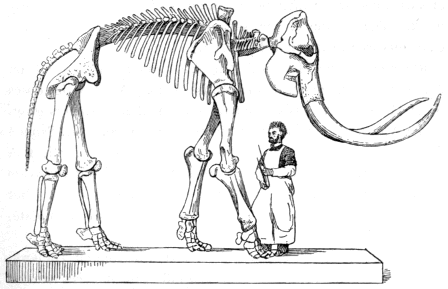
The skeleton of this specimen, the fame of which may be said to have spread all over the world, is now set up in the Museum of the St. Petersburg Academy, and the skin still remains attached to the head and feet. A part of the skin and some of the hair were sent by Mr. Adams to Sir Joseph Banks, who presented them to the Museum of the Royal College of Surgeons.[62] A photograph of the skeleton as it now stands, may be seen on the wall of the big Geological Gallery at South Kensington (No. I. on plan), near the specimens of Mammoth tusks. But it should be pointed out that the tusks are put on the wrong way; for they curve outwards instead of inwards, thus presenting a somewhat grotesque appearance. For this reason we have not reproduced the familiar woodcut based on an engraving in the memoir already referred to.[63] But we give, instead, a sketch taken from a photograph (also on the wall in gallery No. I.) of a fine skeleton in the Brussels Museum (Fig. 52). Here the tusks are seen correctly inserted. We must also draw the reader’s attention to the remarkably fine specimen (glazed case E on plan) consisting of the skull and both tusks complete, found at Ilford in Essex.
Adams’s specimen was, Dr. Woodward thinks, an old individual, and its tusks had curved upwards so much as to be of little use. In younger ones they were less curved. The hair that still remains on the skin of the St. Petersburg specimen is of the colour of the camel, very thick-set and curled in locks. Bristles of a dark colour are interspersed, some reddish, and some nearly black. The colour of the skin is a dull black, as in living elephants (see restoration, Plate XX.).
Remains of the Mammoth (Elephas primigenius) have been found in great numbers in the British Isles. A list of localities (from Mr. Leith Adams’s monograph on fossil elephants) is given in the Appendix, but even this might be extended. Mr. Samuel Woodward calculated that upward of two thousand grinders of elephants have been dredged up during a period of thirteen years upon the oyster-bed off Hasborough, on the Norfolk coast. But many of these doubtless belong to other species of older date, such as Elephas antiquus.
Dr. Bree, of Colchester, says that the sea-bottom off Dunkirk, whence he has made a collection, is so full of mammalian remains that the sailors speak of it as “the Burying-ground.”
The remains of the Mammoth occur over a very large geographical area—fully half the globe.
By far the most important discovery of a frozen Mammoth is that of a young Russian engineer, Benkendorf by name, who was an eye-witness of its resurrection, though, most unfortunately, he was unable either to procure his specimen, as Mr. Adams did, or to make drawings of it. Being employed by the Russian Government in making a survey of the coast off the mouth of the Lena and Indigirka rivers, he was despatched up the latter river in 1846, in command of a small steam-cutter. The following is a translation of the account which he wrote to a friend in Germany.
Plate XX.
THE MAMMOTH, ELEPHAS PRIMIGENIUS. An inhabitant of Northern regions during the Great Ice Age.
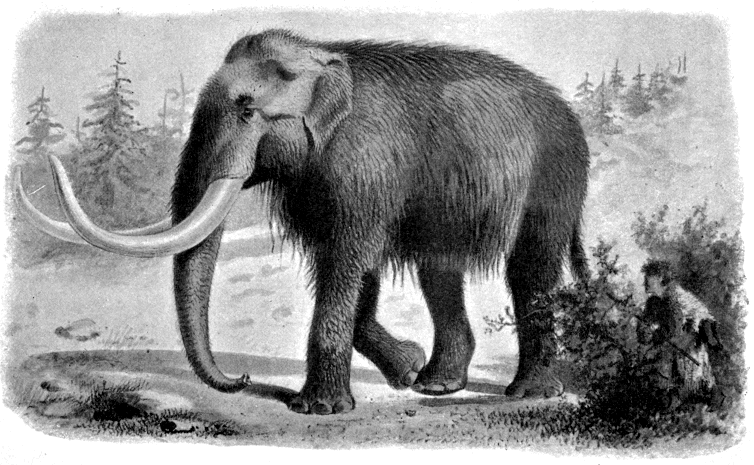
“In 1846 there was unusually warm weather in the north of Siberia. Already in May unusual rains poured over the moors and bogs, storms shook the earth, and the streams carried not only ice to the sea, but also large tracts of land, thawed by the masses of warm water fed by the southern rains.... We steamed on the first favourable day up the Indigirka; but there were no thoughts of land; we saw around us only a sea of dirty brown water, and knew the river only by the rushing and roaring of the stream. The river rolled against us trees, moss, and large masses of peat, so that it was only with great trouble and danger that we could proceed. At the end of the second day, we were only about forty versts up the stream; some one had to stand with the sounding-rod in hand continually, and the boat received so many shocks that it shuddered to the keel. A wooden vessel would have been smashed. Around us we saw nothing but the flooded land for eight days. We met with the like hindrances until at last we reached the place where our Jakuti were to have met us. Further up was a place called Ujandina, whence the people were to have come to us; but they were not there, prevented evidently by the floods.
“As we had been there in former years, we knew the place. But how it had changed! The Indigirka, here about three versts wide, had torn up the land and worn itself a fresh channel; and when the waters sank we saw, to our astonishment, that the old river-bed had become merely that of an insignificant stream. This allowed me to cut through the soft earth, and we went reconnoitring up the new stream, which had worn its way westwards. Afterwards we landed on the new shore, and surveyed the undermining and destructive operation of the wild waters, that carried away, with extraordinary rapidity, masses of soft peat and loam. It was then that we made a wonderful discovery. The land on which we were treading was moorland, covered thickly with young plants. Many lovely flowers rejoiced the eye in the warm beams of the sun, that shone for twenty-two out of the twenty-four hours. The stream rolled over and tore up the soft wet ground like chaff, so that it was dangerous to go near the brink. While we were all quiet, we suddenly heard under our feet a sudden gurgling and stirring, which betrayed the working of the disturbed waters. Suddenly our jäger, ever on the outlook, called loudly, and pointed to a singular and unshapely object, which rose and sank through the disturbed waters. I had already remarked it, but not given it any attention, considering it only drift-wood. Now we all hastened to the spot on the shore, had the boat drawn near, and waited until the mysterious thing should again show itself. Our patience was tried, but at last a black, horrible, giant-like mass was thrust out of the water, and we beheld a colossal elephant’s head, armed with mighty tusks, with its long trunk moving in the water in an unearthly manner, as though seeking for something lost therein. Breathless with astonishment, I beheld the monster hardly twelve feet from me, with his half-open eyes yet showing the whites. It was still in good preservation.
“‘A mammoth! a mammoth!’ broke out the Tschernomori; and I shouted, ‘Here, quickly. Chains and ropes!’ I will go over our preparations for securing the giant animal, whose body the water was trying to tear from us. As the animal again sank, we waited for an opportunity to throw the ropes over his neck. This was only accomplished after many efforts. For the rest we had no cause for anxiety, for after examining the ground I satisfied myself that the hind legs of the Mammoth still stuck in the earth, and that the waters would work for us to unloosen them. We therefore fastened a rope round his neck, threw a chain round his tusks, that were eight feet long, drove a stake into the ground about twenty feet from the shore, and made chain and rope fast to it. The day went by quicker than I thought for, but still the time seemed long before the animal was secured, as it was only after the lapse of twenty-four hours that the waters had loosened it. But the position of the animal was interesting to me; it was standing in the earth, and not lying on its side or back as a dead animal naturally would, indicating by this the manner of its destruction. The soft peat or marsh land, on which he stepped thousands of years ago, gave way under the weight of the giant, and he sank as he stood on it, feet foremost, incapable of saving himself; and a severe frost came and turned him into ice, and the moor which had buried him. The latter, however, grew and flourished, every summer renewing itself. Possibly the neighbouring stream had heaped over the dead body plants and sand. God only knows what causes had worked for its preservation; now, however, the stream had brought it once more to light of day, and I, an ephemera of life compared with this primæval giant, was sent by Heaven just at the right time to welcome him. You can imagine how I jumped for joy.
“During our evening meal, our posts announced strangers—a troop of Jakuti came on their fast, shaggy horses. They were our appointed people, and were very joyful at the sight of us. Our company was augmented by them to about fifty persons. On showing them our wonderful capture, they hastened to the stream, and it was amusing to hear how they chattered and talked over the sight. The first day I left them in quiet possession, but when, on the following, the ropes and chains gave a great jerk, a sign that the Mammoth was quite freed from the earth, I commanded them to use their utmost strength and bring the beast to land. At length, after much hard work, in which the horses were extremely useful, the animal was brought to land, and we were able to roll the body about twelve feet from the shore. The decomposing effect of the warm air filled us all with astonishment.
“Picture to yourself an elephant with a body covered with thick fur, about thirteen feet in height, and fifteen in length, with tusks eight feet long, thick, and curving outward at their ends,[64] a stout trunk of six feet in length, colossal limbs of one and a half feet in thickness, and a tail, naked up to the end, which was covered with thick tufty hair. The animal was fat and well-grown; death had overtaken him in the fulness of his powers. His parchment-like, large, naked ears, lay fearfully turned over the head; about the shoulders and the back he had stiff hair, about a foot in length, like a mane. The long outer hair was deep brown and coarsely rooted. The top of the head looked so wild, and so penetrated with pich[65] that it resembled the rind of an old oak tree. On the sides it was cleaner, and under the outer hair there appeared everywhere a wool, very soft, warm and thick, and of a fallow-brown colour. The giant was well protected against the cold. The whole appearance of the animal was fearfully strange and wild. It had not the shape of our present elephants. As compared with our Indian elephants, its head was rough, the brain-case low and narrow, but the trunk and mouth were much larger. The teeth were very powerful. Our elephant is an awkward animal, but compared with this Mammoth it is as an Arabian steed to a coarse, ugly dray-horse. I could not divest myself of a feeling of fear as I approached the head; the broken, widely-open eyes, gave the animal an appearance of life, as though it might move in a moment and destroy us with a roar.... The bad smell of the body warned us that it was time to save of it what we could, and the swelling flood, too, bid us hasten. First of all we cut off the tusks, and sent them to the cutter. Then the people tried to hew off the head, but notwithstanding their good will, this work was slow. As the belly of the animal was cut open the intestines rolled out, and then the smell was so dreadful that I could not overcome my nauseousness, and was obliged to turn away. But I had the stomach separated, and brought on one side. It was well filled, and the contents instructive and well preserved. The principal were young shoots of the fir and pine; a quantity of young fir-cones, also in a chewed state, were mixed with the mass.... As we were eviscerating the animal, I was as careless and forgetful as my Jakuti, who did not notice that the ground was sinking under their feet, until a fearful scream warned me of their misfortune, as I was still groping in the animal’s stomach. Shocked, I sprang up, and beheld how the river was burying in its waves our five Jakuti and our laboriously saved beast. Fortunately, the boat was near, so that our poor workpeople were all saved, but the Mammoth was swallowed up by the waves, and never more made its appearance.”
Much may be learned from this highly interesting account; it contains the key to several questions which otherwise might have remained unsolved. Let us see what conclusions can be derived therefrom. First, its position and perfect state of preservation are sufficient to prove that it was buried where it died. It sank in a marsh, probably during the summer. Then came the cold of winter; the carcase, together with the ground around it, was frozen so that decomposition was arrested, and frozen it must have remained for many centuries till the day when M. Benkendorf came across it. Or it may have been buried up in a snow-drift which in time became ice.