Front matter (continued 3)
Reading edition
Dr. Mantell also was the first to prove, from the nature of the Wealden strata, that they were deposited in or near the estuary of a mighty river. With regard to the aspect of the country in which the Iguanodon flourished, he showed that coniferous trees probably clothed its Alpine regions; palms and arborescent ferns, and cycadaceous plants (i.e. plants resembling the modern zamia, or “false palm”), constituted the groves and forests of its plains and valleys; and in its fens and marshes the equisetaceæ (mare’s-tails) and plants of a like nature prevailed.
Plate VII.
A GIGANTIC DINOSAUR, IGUANODON BERNISSARTENSIS. Length about 30 feet.
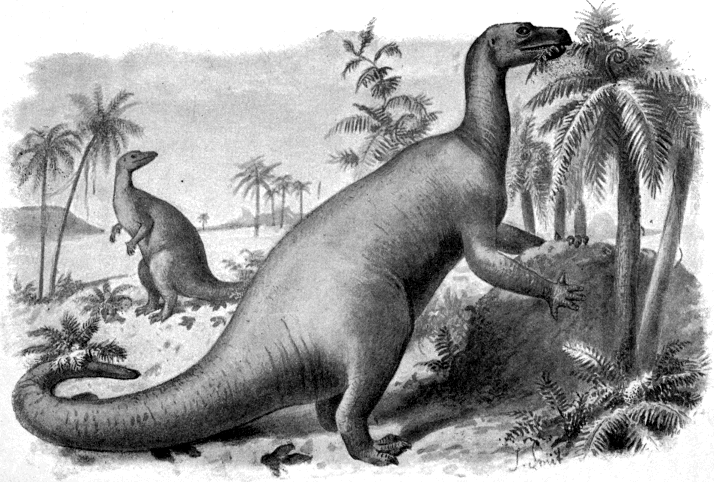
The Iguanodons of the Wealden epoch did not live and die where their bones are now found—the condition in which their fossil relics occur proves that they floated down the streams and rivers, with rafts of trees and other spoils of the land, till, arrested in their course, they sank down and became buried in the fluviatile and sometimes marine sediments then being slowly laid down. In this way only can we account for the generally broken and rolled condition of the bones, their separation from each other, the numerous specimens of teeth which must have been detached from their sockets, and the broken stems and branches of trees without leaves that have been found in the Wealden strata of England.
Since the days of Dr. Mantell, the remains of Iguanodon, or closely allied genera, have been found on the continent, in other parts of England, and in North America, in strata of various ages, from the Trias or New Red Sandstone to the Chalk (see Table of Strata, Appendix I.). The American Hadrosaurus must have decidedly resembled the Iguanodon.
The beautiful restoration by our artist (plate VII.) is based upon the Belgian specimens described in the following chapter.
CHAPTER VII.
DINOSAURS (continued).
“Everything in Nature is engaged in writing its own history: the planet and the pebble are attended by their shadows, the rolling rock leaves its furrows on the mountain side, the river its channel in the soil, the animal its bones in the stratum, the fern and the leaf inscribe their modest epitaphs on the coal, the falling drop sculptures its story on the sand and on the stone,—not a footstep on the snow or on the ground, but traces in characters more or less enduring the record of its progress.”—Emerson.
In the year 1878 was announced one of the most fortunate discoveries known in the whole history of geological science—a discovery unique of its kind, and one which throws considerable light on the nature of the monster first discovered by Dr. Mantell. In that year came the good news that no less than twenty-three Iguanodons had been found in the colliery of Bernissart, in Belgium, between Mons and Tournai, near the French frontier. The coal-bearing rocks (coal-measures) of this colliery, overlain by chalk and other deposits of later age, are fissured in many places by deep valleys or chasms more than 218 yards deep. Though now filled up, they must at one time have been open gorges on an old land surface. Into one of these chasms were somehow precipitated twenty-three Iguanodons, numbers of fish, a frog-like animal, several species of turtles, crocodiles, and numerous ferns similar to those described by Mantell from the Weald. It it not easy to conjecture how this large and varied assemblage of animals came to be collected together and entombed in this one place, but possibly their carcases were swept by some flood into the chasm in which the remains were discovered. They were buried in clay interstratified with sand, a fact which was interpreted in accordance with the above suggestion.
M. de Pauw, the accomplished controller of the workshops in the Royal Museum of Natural History at Brussels, spent three whole years in extracting this splendid series of fossils from the pit-shaft, the bones being brought up from a depth of rather more than 350 yards. But at the end of this time it was only the rough material that had been got together, and every block containing bones requires a great deal of most careful labour before the bones in it are so exposed that they can be properly studied. Out of the twenty-three specimens, fifteen had, in the year 1883, been chiselled out, eight remaining to be worked at; and although five skilled workmen were then constantly at work, progress was necessarily slow.
In 1883, that is after seven years, two huge entire skeletons had been set up in a great glass case in the Courtyard of the Museum at Brussels, and these exhibit with marvellous completeness the structure of the extinct monster.[17] The work reflects the highest credit on M. de Pauw;[18] and the director of the Bernissart Mining Company, M. Fages, deserves the thanks of all scientific men for so liberally aiding this important undertaking. These specimens illustrate the conclusion, previously arrived at by Professor Huxley, that Dinosaurs, as a group, occupy a position in the great chain of animal life intermediate between reptiles and birds. Indeed, it is the opinion of this great authority, and of many naturalists of the present day, that whenever future discoveries may reveal the ancestry of birds, it will be found that they came from Dinosaurs, or that both originated from a common ancestor.
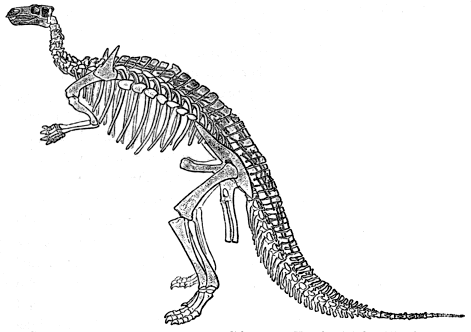
The specimens so skilfully set up by M. de Pauw represent two distinct species. The larger one, Iguanodon Bernissartensis, cannot be less than fifteen feet high, and, measured from the tip of the snout to the end of the tail, is rather over thirty feet long, covering nearly twenty-four feet of ground in its erect position (see Fig. 21). Iguanodon Mantelli is smaller and more slender looking, with a height of over ten feet, and a length of about twenty feet. (See Fig. 22.)
Fig. 21.—Skeleton of Iguanodon Bernissartensis.
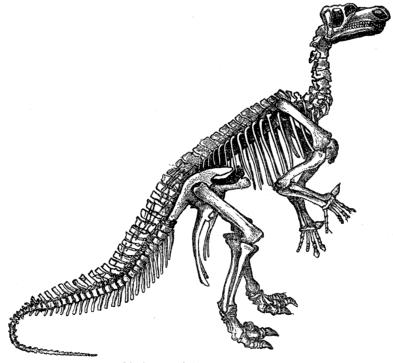
Plate VIII.
IGUANODON MANTELLI. Length about 20 feet.
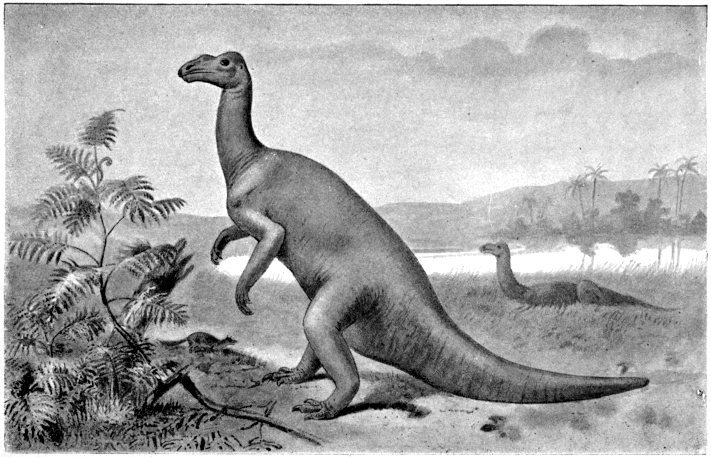
Fig. 22.—Skull and skeleton of Iguanodon Mantelli. (From Bernissart.)
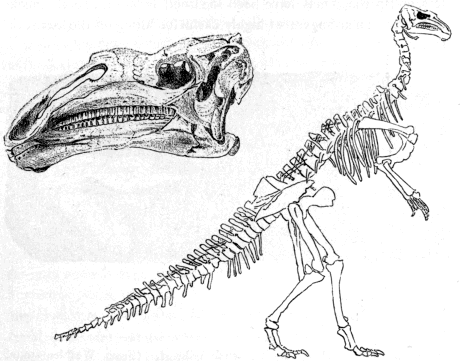
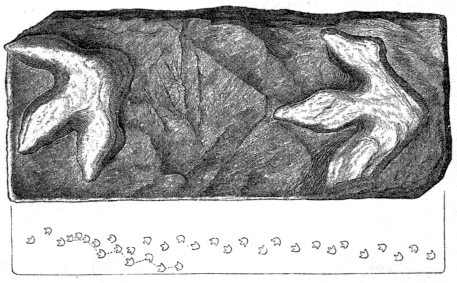
The huge three-toed impressions found in Sussex prove that the monster, although owning a body as large as that of an elephant, habitually walked on its hind legs! Some of the thighbones found by Dr. Mantell measured between four and five feet in length. It will be seen that the fore limbs are small in comparison to the hind limbs. A remarkable feature of the hand is the large pointed bone at the end of the thumb, forming a kind of spur. The conical shape of this bone found by Dr. Mantell, who had no clue to its place in the skeleton, led him to suppose that it was a horn answering to that of a rhinoceros—a conclusion which Professor Owen refused for various reasons to accept. The latter concluded that it belonged to the hand, and now we see that he was right. Unfortunately, certain popular works on geology, such as Our Earth and its Story (Cassell) still continue to spread this error, by showing a (very indifferent) restoration of the Iguanodon with the impossible horn on its nose. It has been suggested that the spur was a weapon of offence, and that, when attacked, an Iguanodon may have seized its aggressor in its short arms, and made use of the spur as a dagger. But this is only conjecture, and perhaps the spur may have been useful in seizing and pulling down the foliage and branches of trees, or in grubbing them up by the roots. Detached specimens of this curious bone may be seen among the other remains of Iguanodon at South Kensington, and also some of the gigantic tracks already alluded to. (Gallery IV. on plan, Wall-cases 5 and 6; and Gallery XI., Wall-case 7.)
The Bernissart specimens even afford some evidence as to the nature of the integument, or skin, and this supports the idea previously held that the creature possessed a smooth skin, or, at least, only slightly roughened. The muzzle was quite toothless, and perhaps may have been sheathed in horn, like the beak of turtles—an arrangement highly useful for biting off the leaves of trees.
Fig. 23.—Tracks of Iguanodon, much reduced. (From Wealden strata, Sussex.)
Probably it passed much of its time in the water, using its immense powerful tail as an organ of propulsion. When swimming slowly it may have used both sets of limbs, but when going fast it probably fixed its fore limbs closely beside its body, and drove itself through the water by means of the long hind limbs alone. Mr. Dollo, of Brussels, is preparing a final monograph on the Bernissart Iguanodons, a work to which palæontologists eagerly look forward. There cannot be much doubt that these unarmoured Dinosaurs were molested and preyed upon by their carnivorous contemporaries, such as the fierce Megalosaurus, previously described (p. 76). And with regard to this, Mr. Dollo makes the suggestion that, when on land, their great height and erect posture enabled them to descry such enemies a long way off. Their great height must also have stood them in good stead, by enabling them easily to reach the leaves of trees, tree-ferns, cycads, and other forms of vegetable life, which constituted their daily food. (See restorations, Plates VII. and VIII.)
Should the reader visit the “geological island” in the grounds of the Crystal Palace, he will see that Mr. Waterhouse Hawkins’s great model Iguanodon there set up is by no means in accordance with the description given above; but we must remember how imperfect was the material at his command.
Another Dinosaur, of considerable dimensions, that flourished during the Wealden period was the Hylæosaurus, also discovered by Dr. Mantell, and so named by him because it came from the Weald.[19] In the summer of 1832, upon visiting a quarry in Tilgate Forest, which had yielded many organic remains, he perceived in some fragments of a large mass of stone which had recently been broken up and thrown in the roadside, traces of numerous pieces of bone. With great care he cemented together and fixed in a stout frame, all the portions of this block that he could find, and set to work to “develop” the block with his chisel. This work occupied many weeks, but his labour was rewarded by the discovery of certain new and remarkable features displayed by this monster; for it must have presented, when alive, a formidable array of bony plates and long sharp spines, the latter of which probably stood in bristling array along the back and tail, and other parts of the body. (Wall-case 4.) Of the spines no less than ten were found in this block, varying in length from five to seventeen inches, the largest being four inches thick. It is known that many lizards, such as Iguanas and Cycluras, have large processes with horny coverings, forming a kind of fringe or crest along the back, and, judging by analogy, Dr. Mantell concluded that this gigantic saurian was similarly armed with a row of large angular spines covered by a thick horny investment. As weapons of offence and defence, they were no doubt highly effective, but their precise arrangement is still a matter of speculation.
This first specimen displayed, besides the bony scutes and spines, a portion of the backbone, eleven ribs and portions of the pectoral arch. A second specimen was found near Bolney, in Sussex, and was unfortunately almost wholly destroyed by the labourers; but Dr. Mantell was able to obtain many of the bones, such as ribs and limb-bones, and they also indicated a reptile of great size. A third specimen was brought to light in Tilgate Forest in 1837; but, unfortunately, this also fell into the hands of the parish labourers, who were unacquainted with its value. Although with due care a much larger portion of the skeleton might have been kept, yet Dr. Mantell was able to obtain a fine series of twenty-six vertebræ belonging to the tail, with a total length of nearly six feet: the same spines were present here also.
No specimen of the skull of this strange monster is known, and no teeth that can be with certainty referred to it.
Mr. Waterhouse Hawkins’s model at Sydenham, near the Iguanodon, was based on the above discoveries, which are insufficient, and is far from the truth.
Plate IX.
AN ARMOURED DINOSAUR, SCELIDOSAURUS HARRISONI. Length 12 feet or more.
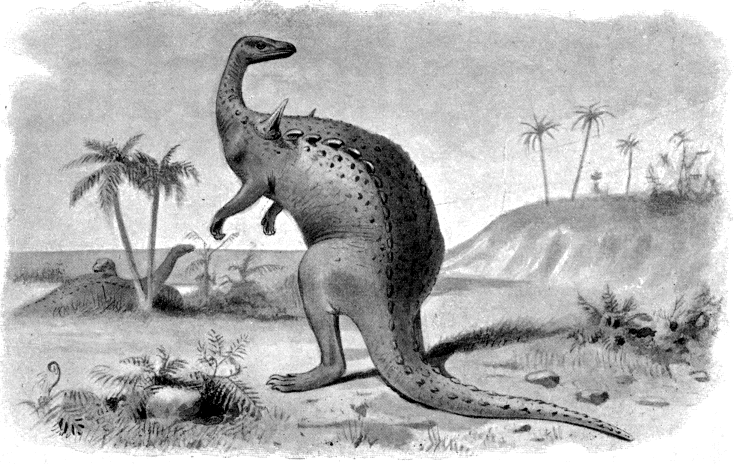
Fig. 24.—Restored skeleton of Scelidosaurus Harrisoni (after Woodward), greatly reduced, from the Lower Lias of Charmouth, Dorset. The figure shows the large lateral dermal spines on the shoulders, and the long lateral line of smaller spines, reaching from the pectoral region to the extremity of the tail.
The next monster to be described is one that has fortunately left to posterity a much better record of itself, and probably was not very unlike the Hylæosaurus of Mantell. This is the Scelidosaurus: so named by Professor Owen from the indications of greater power in the hind legs than in most saurians.[20] It is the only known example of an almost entire skeleton of an English Dinosaur, and the history of its discovery is rather curious. Some time previous to 1861, Mr. J. Harrison, of Charmouth, obtained from the Lower Lias of that neighbourhood portions of the hind limb of a Dinosaur, and, later on, a nearly complete skull. These specimens were described by Owen, and the genus was founded on them. Mr. Harrison, whose discovery aroused great interest, continued to search on the same spot, and was rewarded by finding all the rest of the skeleton, except most of the neck vertebræ. This was extracted in several blocks, and these, after careful “development” of the bones, were fitted together so as to exhibit the whole skeleton. This most valuable specimen can now be seen at South Kensington in a separate glass case, and is one of the treasures of the unrivalled gallery of fossil reptiles. The case is placed so that both sides of the specimen can be seen (Case Y, Gallery IV., on plan). Its length is about twelve feet; perhaps the individual it represents was not fully grown, but, on account of the absence of most of the neck vertebræ, it is impossible to give the exact length. Both hind limbs are entire and well seen, but of the fore limbs the hands are wanting. The former were provided with four “functional” toes—that is, toes that were used,—and one “rudimentary” or unused one. There were two big spines, one placed on each shoulder, and a series of long plates arranged in lines along the back and side. Plate IX. shows an attempted restoration of this remarkable Dinosaur based upon the skeleton just described. It seems to have been organised for a terrestrial rather than an aquatic life, but to have been amphibious, frequenting the margins of rivers or lakes. Professor Owen considers that the carcase of this individual drifted down a river emptying itself in the old Liassic Sea, on the muddy bottom of which it would settle down when the skin had been so far decomposed as to permit the escape of gases due to decomposition. In that case the carcase would attract large carnivorous fishes and reptiles, such as swarmed in this old sea, so that portions of the skin and flesh would probably be torn away before the weight of the bones had completely buried it in mud. In this way, perhaps, the loss of much of the external armature and of the two fore feet may be accounted for. The hind limbs, being stronger, were better able to resist such attacks, and they are therefore preserved. Like many other specimens, this fossil has, in the course of ages, been subjected to enormous pressure from overlying strata, causing compression and dislocation or fracture.
But there were in existence during the long Jurassic period, other and even stranger forms of armoured Dinosaurs. One of these, only imperfectly known at present, was the many-spined Polacanthus.[21] This remarkable monster had the whole region of the loins and haunches protected by a continuous sheet of bony plate armour, rising into knobs and spines, after the fashion of the shield or carapace of certain extinct armadillos known as Glyptodonts (See Chapter XII.). A specimen of such a shield is to be seen in the collection at South Kensington (Wall-case 4). It is to be hoped that, some day, further remains of the Polacanthus will be brought to light, so that a restoration may become possible. Dr. Mantell had already pointed out certain analogies between Iguanodon and the huge extinct sloths of the South American continent, that flourished in the much more recent Pleistocene period; and this idea is now considerably strengthened by the later discoveries of armoured Dinosaurs. These are his words: “In fine, we have in the Iguanodon the type of the terrestrial herbivora which, in the remote epoch of the earth’s physical history termed by geologists the age of Reptiles, occupied the same relative position in the scale of being, and fulfilled the same general purposes in the economy of nature, as the Mastodons, Mammoths, and Mylodons (extinct sloths) of the Tertiary period, and the existing pachyderms.”
It is, perhaps, one of the most interesting discoveries of modern geology, that certain races of animals now extinct have in various ways assumed some of the characteristics presented by animals much higher in the scale of being, that flourish in the present day. It seems as if there had been some strange law of anticipation at work, if we may venture so to formulate the idea. It has already been shown how the great saurians Ichthyosaurus and Plesiosaurus presumed to put on some of the characters of whales, and to play their rôle in nature, though they were only reptiles; how the carnivorous Dinosaurs acquired teeth like those now possessed by lions and tigers, which also are mammals; and now we find herbivorous Dinosaurs imitating the Glyptodon, an armadillo that lived in South America almost down to the human period. We shall not lose sight of this very interesting and curious discovery, for other cases will present themselves to our view in future chapters. The reader might ask, "If reptiles were able in these and other ways to imitate the mammals of to-day, or of yesterday, why should they not have been able to go a few steps further, and actually become mammals?" The Evolutionist, if confronted with such a question, would say, that there is no evidence of Dinosaurs turning into mammals, but that both may have branched off at an early geological period (say the Permian) from a primitive group of reptiles, or even of amphibians.
It must be borne in mind that, during the “age of reptiles” (Mesozoic period), the mammalian type was but feebly represented by certain small and humble forms, probably marsupials. As far as we know, there were no big quadrupeds such as flourish to-day; therefore reptiles played their part, and in so doing acquired some of their habits and structural peculiarities. It is difficult for us, living in an age of quadrupeds, to realise this, and to picture to ourselves reptilian types posing as “lords of creation,” or, to use a homely phrase, “strutting in peacock’s feathers.”
Leaving now the English herbivorous Dinosaurs, we pass on to those still more wonderful forms discovered of late years by Professor Marsh. The former have been treated at considerable length, first because they are English, and, as such, the history of their discovery possesses considerable interest; secondly, because their elucidation reflects the highest credit on our great pioneers in this fruitful field of research, and illustrates the manner in which great naturalists have been able to draw most important and wonderful conclusions (afterwards verified in most cases) from material apparently far from promising. For example, Cuvier’s prophecy of the Iguanodon from a few teeth is a striking example of the result of reasoning from the known to the unknown, an example which seems to us worthy to be ranked with the discovery of Neptune by Adams and Leverrier, or, to take a more recent case, the discovery by Mendeleef of the Periodic Law, by means of which he has foretold the discovery of new chemical elements.
Whatever may have been the origin of the great mammalian class, the possibility and even probability of birds and Dinosaurs being descended from a common ancestor is a theory for which much may be said, and it has been adopted by many leading naturalists of the present day, who have been convinced by Professor Huxley’s clear elucidation of the nature of the pelvic region in the group of Dinosaurs which has been above described (the Ornithopoda, or bird-footed group). It was Professor Huxley who first propounded this interesting speculation, basing his belief on the many bird-like characters presented by this strange group of extinct reptiles—the small head and fore limbs, the long and often three-toed hollow hind limbs, the bones of the pelvis or haunch, their habit of walking in a semi-erect position on those limbs (as proved by their tracks), and in some of hopping, as the little Compsognathus most probably did. And, last but not least, the strange mixture of bird-like and reptilian characters presented by certain most anomalous birds discovered by Professor Marsh in American Cretaceous rocks, viz. the huge Hesperornis and the smaller Ichthyornis. Speaking on this subject some years ago, Professor Marsh said, "It is now generally admitted by biologists who have made a study of vertebrates, that birds have come down to us through the Dinosaurs, and the close affinity of the latter with recent struthious birds (ostrich, etc.), will hardly be questioned. The case amounts almost to a demonstration, if we compare with Dinosaurs their contemporaries, the Mesozoic birds. The classes of birds and reptiles, as now living, are separated by a gulf so profound that a few years since it was cited by the opponents of Evolution as the most important break in the animal series, and one which that doctrine could not bridge over. Since then, as Professor Huxley has clearly shown, this gap has been virtually filled by the discovery of bird-like reptiles and reptilian birds. Compsognathus and Archæopteryx of the Old World, and Ichthyornis and Hesperornis of the New, are the stepping-stones by which the Evolutionist of to-day leads the doubting brother across the shallow remnant of the gulf, once thought impassable."[22]
We now pass on to describe two of the strangest and most wonderful of all the Dinosaurs, recently discovered in the far West. The first of these is the Stegosaurus,[23] or plated lizard, not wholly unknown before, because part of its skeleton was found some years ago in a brickfield in the Kimmeridge Clay at Swindon. It has been proved that some of the bones to which the name Omosaurus[24] has been applied really belonged to the former genus.
With such complete specimens now known by Professor Marsh’s descriptions, it will not be necessary to mention the meagre remains discovered in this country, or the conclusions arrived at by Owen and Seeley, interesting as they are.
In the year 1877 Professor Marsh described, in the American Journal of Science, a considerable portion of a skeleton of a Stegosaur, remarking that this genus proved to be one of the most remarkable animals yet discovered. It was found on the eastern flank of the Rocky Mountains, in strata of Jurassic age; they indicated an animal about twenty-five feet long, and for this discovery Science is indebted to Professor A. Lakes and Engineer H. C. Beckwith of the United States Navy, who found the remains in Colorado, near the locality of the gigantic Atlantosaurus. The solid limb-bones seem to point to an aquatic life, but there can be little doubt that the monster did not pass all its time in the water. (Fig. 25 shows the skeleton.)[25]
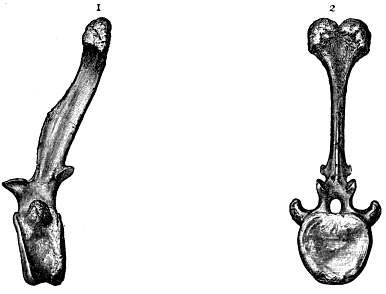
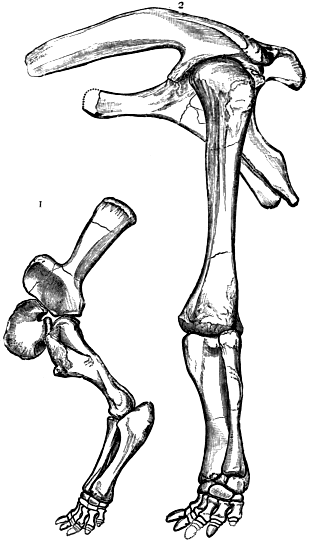
In 1879 Professor Marsh announced the discovery of additional remains from several localities. The most striking feature—from which the Stegosaur takes its name—was the presence of huge bony plates belonging to its skin, as well as large and small spines. Some of the plates were from two to three feet in diameter, and they were of various shapes. Of the spines, some were of great size and power, one pair being each over two feet long! The skull was remarkably small, and more like that of a lizard than we find in most Dinosaurs; the jaws were short and massive. Little was known at first of the brain, but fortunately a later discovery showed the brain-case well preserved. Later still, more than twenty other specimens of this Dinosaur were obtained, so that nearly every portion of the skeleton is now known. The skulls indicate that the creature possessed large eyes and a considerable power of smell. The jaws contain but a single row of teeth in actual use; but as these wore out, they were replaced by others lodged in a cavity below. Teeth, however, were not its strong point; they indicate a diet of soft succulent vegetation. The vertebræ have the faces of their centra more or less bi-concave. Many curious features in the skeleton can only be explained with reference to the heavy armour of plates and spines with which the Stegosaur was provided. Thus the vertebræ have their “neural spines” expanded at the summit to aid in supporting part of the armour. (See Fig. 26.) The fore limbs were short and massive, but provided with five fingers; the hind limbs were very much larger and more powerful. These and the powerful tail show that the monster could support itself on them as on a tripod, in an upright position, and this position must have been easily assumed in consequence of the massive hind quarters. As in Iguanodon, there were three toes to the hind feet, and these were probably covered by strong hoofs. The fore limbs could move freely in various directions like a human arm, and were probably used in self-defence. (See Fig. 27.) But for this purpose the tail with its four pairs of huge spines would be very effective, and one could easily imagine that a single deadly blow from such a tail would be sufficient to drive away, if not to kill, one of the carnivorous enemies of the species. All the plates and spines were, during life, protected by a thick horny covering, which must have increased their size and weight. Such a covering seems to be clearly indicated by certain grooves and impressions that mark their surfaces. (See Fig. 28.) The largest plates are unsymmetrical, and were probably arranged along the back, as in our restoration, Plate IX. It will be noticed, by those who are familiar with our first edition that Plate X. gives a somewhat different representation of the Stegosaur, in which the length of the hind limbs is more apparent, and also they are more free from the body.
Fig. 25—Skeleton of Stegosaurus ungulatus; length about 25 feet. (After Marsh.)
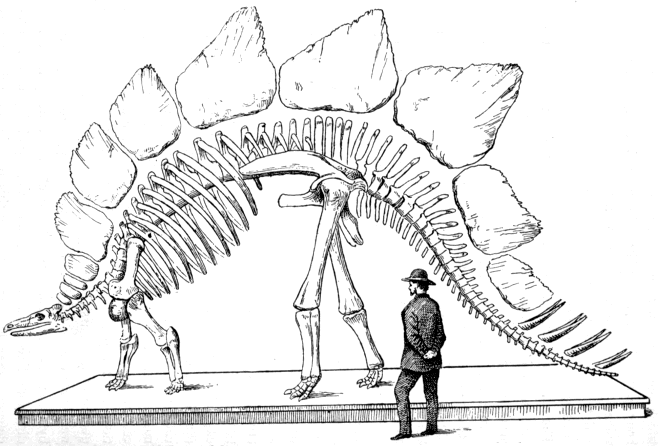
Plate X.
A GIGANTIC ARMOURED DINOSAUR, STEGOSAURUS UNGULATUS. Length about 30 feet.
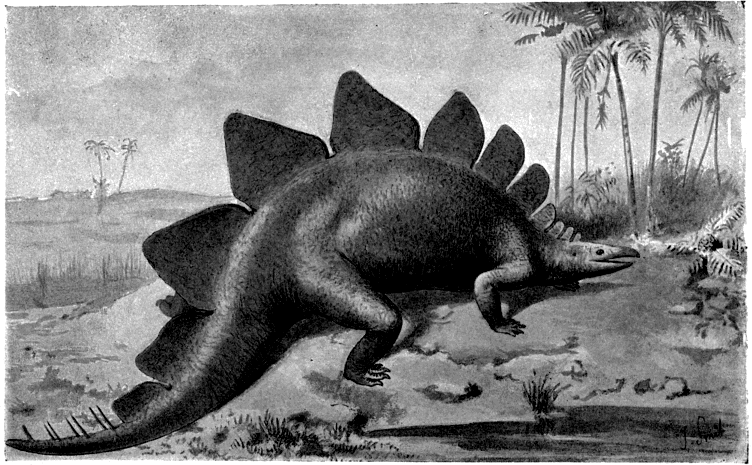
Fig. 26.—Tail vertebræ of Stegosaurus. (After Marsh.) 1. Side view. 2. Front view.
Finally, the Stegosaur displays a rather remarkable feature; for a very large chamber was found in the sacrum[26] formed by an enlargement of the spinal cord. The chamber strongly resembled the brain-case in the skull, but was about ten times as large! So this anomalous monster had two sets of brains, one in its skull, and the other in the region of its haunches! and the latter, in directing the movements of the huge hind limbs and tail, did a large share of the work. The subject is a highly suggestive one, but at present requires further explanation.
Fig. 27.—Limb-bones of Stegosaurus. (After Marsh.) 1. Fore leg. 2. Hind leg.
On the walls of the fossil reptile gallery at South Kensington the reader will find a large framed drawing of the skeleton of Stegosaurus, kindly sent by Professor Marsh, whose forthcoming monograph will be welcomed by all palæontologists.
Fig. 28.—1, 2. Plates of Stegosaurus. The middle figures show their thickness. (After Marsh.)
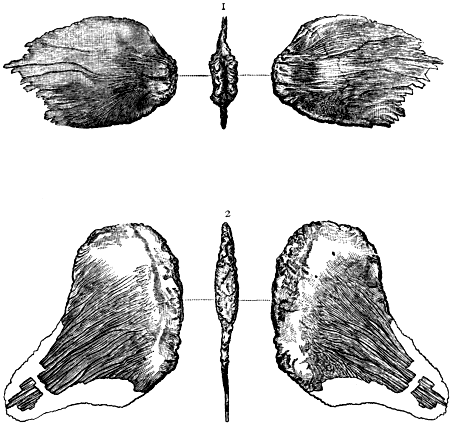
Fig. 29.-Head of Triceratops, seen from above. (After Marsh.)
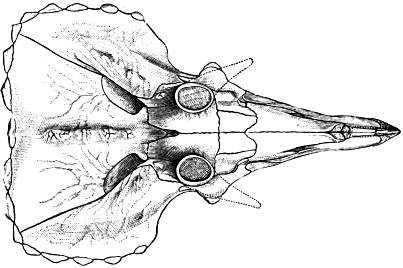
The last, and in some ways the strangest of the Dinosaurs, was the Triceratops[27] that flourished in America at the end of the long Mesozoic era, during the Cretaceous period. The name refers to the three horn-cores found on the skull, which probably supported true horns like those of oxen. Whereas the Stegosaur was provided with quite a small skull, this monster had one of huge dimensions and remarkable shape (see Figs. 29 and 30).[28] In the younger ones it was about six feet long, but in an old individual must have reached a length of seven or eight feet. Such a skull is only surpassed by some whales of the present day. Twenty different skulls of this kind have been found, and Professor Marsh places the horned Dinosaurs in a separate family, to which he has given the name Ceratopsidæ, or horn-faced. Their remains come from the Laramie beds, believed to be of Cretaceous age, but representing a remarkably mixed fauna and flora, so that some have considered them to be Tertiary. The strata containing these fossils are very rich in organic remains, and have yielded not only other Dinosaurs, but Plesiosaurs, crocodiles, turtles, many small reptiles, a few birds, fishes, and small mammals. The Ceratops beds are of fresh-water or brackish origin, and can now be traced for nearly eight hundred miles along the east flank of the Rocky Mountains.
Fig. 30.—Skeleton of Triceratops prorsus; length about 25 feet. (After Marsh.)
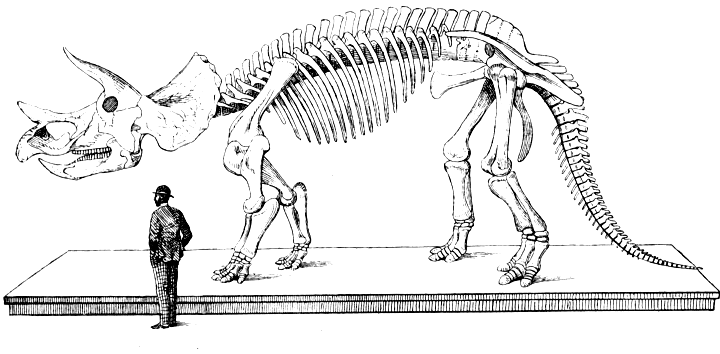
In this Dinosaur we find the fore feet larger than usual in proportion to the hind limbs, and there can be no doubt that it walked on all fours. Its length was about twenty-five feet. All the vertebræ and limb-bones are solid. The brain was smaller in proportion to the skull than in any known vertebrate.
The teeth are remarkable in having two distinct roots. The wedge-like form of the skull is also very peculiar. The two large horns come immediately over the eyes, and the small one above the nose; this Dinosaur was, therefore, well provided with weapons of offence, such as would be highly useful in driving away or wounding carnivorous enemies. The back part of the skull rises up into a kind of huge crest, and this during life was protected by a special fringe of bony plates. Such an arrangement doubtless formed an effective shield to ward off blows when one Triceratops was fighting another, as bulls or buffaloes of the present day fight with their horns. The mouths of these Dinosaurs formed a kind of beak, sheathed in horn.
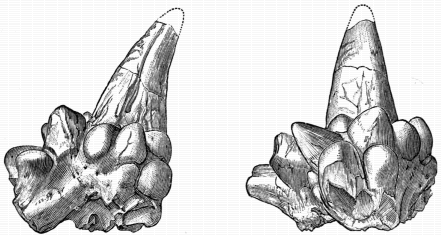
The body as well as the skull was protected, but the nature and position of the defensive parts in different forms cannot yet be determined with certainty. Various spines, bones, and plates have been found that evidently were meant for the protection of the creature’s body, and belonged to the skin. Probably some of these were placed on the back, behind the crest of the skull; some may have defended the throat, as in Stegosaurus. Altogether, Triceratops is very different to any other Dinosaur. One cannot help picturing it rather as a fierce rhinoceros-like animal. In the restoration (Plate XI., Frontispiece) our artist has given it a thick skin, rather like that of the rhinoceros, only indicating small bony plates, etc., here and there.
Professor Marsh thinks that as the head increased in size to bear its armour of bony plates, the neck first, then the fore feet, and then the whole skeleton was specially modified to support it; and he concludes that as these changes took place in the course of the evolution of this wonderful Dinosaur, the head at last became so large and heavy that it must have been too much for the body to bear, and so have led to its destruction! This conclusion, if sound, is a warning against carrying “specialisation” too far. If we wished to write an epitaph on the tomb of the monster, it ought (according to Professor Marsh) to be, “I and my race died of over-specialisation.”
Fig. 31.—Bony spines belonging to the skin of Triceratops. (After Marsh.)
After all these various efforts to improve themselves and to perfect their organisation so as to bring it into harmony with their surroundings, or “environment,” as the biologists say, it seems rather hard that the Dinosaurs should have been extinguished, and their place in Nature taken by a higher type; but all things have their day, even Dinosaurs.
With regard to the difficulties, hardships, and dangers attending the discovery and transport of the remains, Professor Marsh’s concluding remarks may be quoted here, since they give us a glimpse into the nature of his explorations in the far West that have now become so famous. He says, "In conclusion, let me say a word as to how the discoveries here recorded have been accomplished. The main credit for the work justly belongs to my able assistant, Mr. J. B. Hatcher, who has done so much to bring to light the ancient life of the Rocky Mountain regions. I can only claim to have shared a few of the dangers and hardships with him, but without his skill little would have been accomplished. If you will bear in mind that two of the skulls weighed nearly two tons each, when partially freed from their matrix and ready for shipment, in a deep desert cañon, fifty miles from a railway, you will appreciate one of the mechanical difficulties overcome. When I add that some of the most interesting discoveries were made in the hunting-grounds of the hostile Sioux Indians, who regard such explorations with superstitious dread, you will understand another phase of the problem. I might speak of even greater difficulties and dangers, but the results attained repay all past efforts, and I hope at no distant day to have something more of interest to lay before you."[29]
CHAPTER VIII.
FLYING DRAGONS.
“Geology does better in reclothing dry bones and revealing lost creations than in tracing veins of lead or beds of iron.”—Ruskin.
The great Ocean of Air was not uninhabited during the long ages of the Mesozoic era, when fishes swarmed in the seas, and reptiles, such as we have attempted to describe in the last five chapters, trod the earth, or swam across lakes and rivers. With such an exuberance of life in various forms, it would indeed have been strange if the atmosphere had only been tenanted by humble little insects like dragon-flies, locusts, or butterflies and moths, all of which we know were living then.
Now, the record of the rocks tells us that one great order of reptiles somehow acquired the power of flying, and flitted about as bats or flying-foxes do now. Since they were undoubtedly reptiles—in spite of certain resemblances to birds—we have ventured to call them “flying dragons,” as others have done. The notion of a flying reptile may perhaps seem strange, or even impossible to some persons; but no one has a right to say such and such a thing “cannot be,” or is “contrary to Nature,” for the world is full of wonderful things such as we should have considered impossible had we not seen them with our eyes. Charles Kingsley, in his delightful fairy tale, The Water-Babies, makes some humorous remarks on that matter, which we may quote here. He says, "Did not learned men too hold, till within the last twenty-five years, that a flying dragon was an impossible monster? And do we not now know that there are hundreds of them found fossil up and down the world? People call them Pterodactyls; but that is only because they are ashamed to call them flying dragons, after denying so long that flying dragons could exist."
The illustrious Cuvier observes that it was not merely in magnitude that reptiles stood pre-eminent in ancient days, but they were distinguished by forms more varied and extraordinary than any that are now known to exist on the face of the earth. Among these extinct beings of ages incalculably remote, are the Pterodactyls,[30] or “wing-fingered” creatures, which had the power of flight, not by a membrane stretched over elongated fingers as in bats, nor by a wing without distinct or complete fingers, as in birds, but by a membrane supported chiefly by a greatly extended little finger, the other fingers being short and armed with claws.
The only reptile now existing which has any power of sustaining itself in the air is the little Draco Volans, or “flying lizard,” so called; but this can scarcely be regarded as a flying animal. Its hinder pair of ribs, however, are prolonged to such an extent that they support a broad expansion of the skin, so spread out from side to side as to perform the office of a parachute, thus enabling the creature to spring from tree to tree by means of extended leaps; and this it does with wonderful activity.
Many forms of Pterodactyl are known. Some were not larger than a sparrow; others about the size of a woodcock; yet others much larger, the largest of all having a spread of wing (or rather of the flying membranes) of twenty-five feet! It has been concluded that they could perch on trees, hang against perpendicular surfaces, such as the edge of a cliff, stand firmly on the ground, and probably crawl on all fours with wings folded. It may be well at once to point out that the Pterodactyl had no true wings like those of a bird, but a thin membrane similar to that of a bat, only differently supported; so it must be understood that, when we use the word “wing,” it is not in the scientific sense that we are using it, but in the popular sense, just as we might speak of the wing of a bat, although the bat has no true wing. Figs. 32, 33, 34, and 35 will give the reader some idea of the various forms presented by the skeletons of Pterodactyls, or, as some authorities call them, Pterosaurians (winged lizards). Great differences of opinion have existed among palæontologists as to whether they are more reptilian than bird-like, or even mammalian.
More than a hundred years ago, in 1784, Collini, who was Director of the Elector-Palatine Museum at Mannheim, described a skeleton which he regarded as that of an unknown marine animal. It was a long-billed Pterodactyl from the famous lithographic stone of Solenhofen in Bavaria. The specimen was figured in the Memoirs of the Palatine Academy. Collini was able from this specimen to make out the head, neck, small tail, left leg, and two arms; but beyond that, he was at a loss. His conclusion was that the skeleton belonged neither to a bat nor to a bird, and he inquired whether it might not be an amphibian.
In 1809 this specimen came into Cuvier’s hands, who at once perceived that it belonged to a reptile that could fly, and it was he who proposed the name Pterodactyl. Until the oracle at Paris was consulted, the greatest uncertainty prevailed, one naturalist regarding it as a bird, another as a bat. Cuvier, with his penetrating eye and patient investigation, combated these theories, supported though they were by weighty authorities. The principal key by means of which he solved the problem, and detected the saurian relationship of the Pterodactyl, seems to have been a certain bone belonging to the skull, known as the quadrate bone. In his great work, Ossemens Fossiles, he says, "Behold an animal which, in its osteology, from its teeth to the end of its claws, offers all the characters of the saurians.... But it was, at the same time, an animal provided with the means of flight—which, when stationary, could not have made much use of its anterior extremities, even if it did not keep them always folded as birds keep their wings, which nevertheless might use its small anterior fingers to suspend itself from the branches of trees, but when at rest must have been ordinarily on its hind feet, like the birds again; and also, like them, must have carried its neck sub-erect and curved backwards, so that its enormous head should not interrupt its equilibrium."
Pterodactylus macronyx, or, as it is now called, Dimorphodon macronyx (Fig. 32), was about the size of a raven. It was discovered in 1828 by the late Miss Mary Anning, the well-known collector of fossils from the Liassic rocks that form the cliffs alone: the coast of Dorsetshire, near Lyme-Regis. This important specimen was figured and described by Dr. Buckland, in the Transactions of the Geological Society. He suggested the specific name macronyx on account of the great length of the claws.
Fig. 32—Skeleton of Dimorphodon macronyx. (After Owen.)
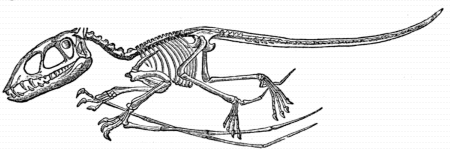
This authority pointed out an unusual provision for giving support and power of movement to the large head at the extremity of a rather long neck, namely, the occurrence of fine long tendons running parallel to the neck-vertebræ. This does not occur in any modern lizards, whose necks are short, and require no such aid to support the head. They are a compensation for weakness that would otherwise arise from the elongation of the neck, supporting, as it did, such a large head. The neck-vertebræ in this species are large and strong, and capable of great flexibility forwards and backwards, so that the creature, by bending its neck during flight into the shape of an S, could throw its head back towards the centre of gravity. The restoration of the skeleton seen in the figure is by Professor Owen. It is probable that this Pterodactyl could walk on the ground with its wings folded, and perhaps it was also capable of perching on trees, by clinging on to their branches with its feet and toes. When the flying membrane was stretched out it must, on account of the long tail to which it was also attached, have presented a triangular shape, somewhat like a boy’s kite.
Fig. 33.—Skeleton of Scaphognathus crassirostris. 1/3 natural size.
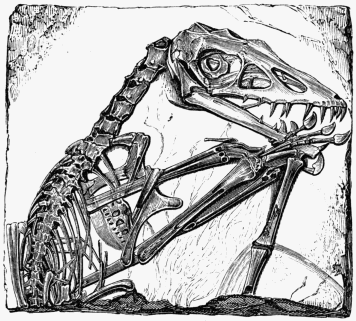
Another genus, also from the lithographic slate of Bavaria, namely, Scaphognathus crassirostris (so called on account of its large beak and jaws), had a very short tail, and its skeleton looks somewhat clumsy for a creature adapted to fly through the air (Fig. 33).
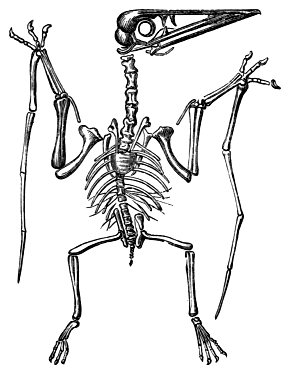
Pterodactylus spectabilis, from the same strata, also possessed a very short tail, but has a more elegant and bird-like skull. This pretty little flying dragon was only about as large as a sparrow (see Fig. 34). Its neck is comparatively short, with but few joints. The long slender beak was probably sheathed in horn, and the skull in several ways approaches that of a bird. Since there are no teeth in the jaws, we may suppose that it devoured dragon-flies or other insects, such as we know were in existence during the period when the lithographic stone of Bavaria was being deposited. Those forms that were provided with teeth probably devoured such fishes as they could catch by swooping down upon the surface of the water.
Fig. 34.—Skeleton of Pterodactylus spectabilis.
Cuvier thought, from the magnitude of their eyes, that Pterodactyls were of nocturnal habits. “With flocks of such creatures flying in the air, and shoals of no less monstrous Ichthyosauri and Plesiosauri swarming in the ocean, and gigantic crocodiles and tortoises crawling on the shores of the primæval lakes and rivers—air, sea, and land must have been strangely tenanted in these early periods of our infant world.”[31]
It was thought at one time that Birds differed from Pterodactyls in the absence of teeth; but this only holds good for modern birds. If we go back to the Mesozoic age, we find that birds at that time did possess teeth. The oldest known bird, the Archæopteryx, had teeth in its jaws, and presents some very striking points of resemblance to reptiles. But if we compare the skeleton of a Pterodactyl (such as the P. spectabilis, now under consideration) with that of a bird, we shall see in its fore limbs certain very obvious differences. A bird never has more than three fingers in its hand or wing (viz. the thumb and next two digits), and the bones that support these fingers, corresponding to the bones in the palm of a human hand, are joined together. Neither of the bones corresponding to our fingers are much elongated, and of these the longest is that which corresponds to the thumb. But, on referring to the skeleton of our Pterodactyl, we find that it has four fingers, three of which are fairly developed and furnished with claws, while the outermost one is enormously elongated. This is believed to correspond to the little finger of the human hand, while the thumb seems to be represented by a small bone seen at the wrist. It was this long outside finger that chiefly served to support the flying membrane of the Pterodactyl. For this and other reasons, we are forbidden to look upon these creatures as relatives of birds. Again, all birds that can fly possess a “merrythought,” or furculum; and such is not found in the Pterodactyl.
As we have already remarked, some authorities, when these creatures were first brought to light, considered them to be mammals, as bats are. But equally conclusive arguments may be brought forward against that view. All mammals have the skull jointed to the backbone by two articulations, known as “condyles,” whereas Pterodactyls have only one—in that respect resembling reptiles and birds.
Also there are important differences in the structure of their jaws, showing that they are constructed on the reptilian plan, and not on that of the mammal.
In order to give rapid movement to their wings during flight, they had powerful muscles in the region of the chest. These were attached to a shield-like breast-bone provided with a keel—as in birds. But this bird-like feature is only a necessary provision to enable them to fly, and does not point to any relationship.
Fig. 35.—Skeleton of Rhamphorhynchus phyllurus, with delicate impressions of the flying membranes. (After Marsh.)
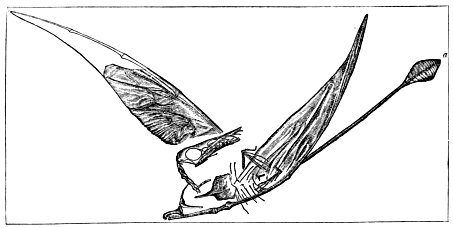
In the year 1873 was discovered, in the lithographic stone of Bavaria, at Eichstädt, a very beautiful new form of Pterodactyl. This was the Rhamphorhynchus phyllurus. The specimen is in a remarkable state of preservation; for the bones of the skeleton are nearly all in position, while those of both wings show very perfect impressions of the membranes attached to them. Its long tail supported another small leaf-like membrane, which was evidently used as a rudder in flight (see Fig. 35). The discovery of this valuable specimen attracted much attention at the time. It was bought, by telegram, for Professor Marsh, and so secured for the Yale College Museum; but a cast may be seen at South Kensington (Wall-case, No. 1, Gallery IV. on plan).
Any one who looks carefully at the beautiful impressions of the wings of this specimen can see that they must have been produced by a thin smooth membrane, very similar to that of bats. When this elegant little creature was covered up by the fine soft mud that now forms the lithographic stone, its wings were partly folded, so that the membranes were more or less contracted into folds, like an umbrella only partly open. These appear to have been attached all along the arm and to the end of the long finger. They then made a graceful curve backward to the hind foot, and probably were continued beyond the latter so as to join the tail. With its graceful pointed wings and long tail, this little flying saurian must have been a beautiful object, as it slowly mounted upwards from some cliff overlooking the Jurassic seas. (See Plate XII.)
Like those already described, it was provided with four short-clawed fingers, as well as the one which mainly supported its wing. Some of the Continental museums contain good collections of fossil Pterodactyls; but the largest collection in the world is that of Yale College, where Professor Marsh declares there are the remains of six hundred individuals from the American Cretaceous rocks alone!
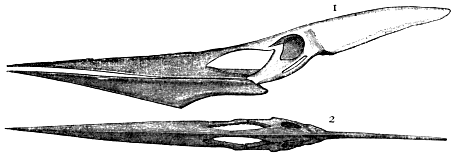
Fig. 36.—Skull of Pteranodon. 1. Side view. 2. Top view. (After Marsh.)
Some of the fragmentary remains from our Cambridge Greensand formation indicate Pterodactyls of enormous size. Thus the neck-vertebræ of one species measure two inches in length, while portions of arm-bones are three inches broad. It is probable that the creatures to which these bones once belonged measured eighteen or twenty feet from tip to tip of the wings. Other also fragmentary remains from the chalk of Kent testify to the existence of Pterodactyls during that period fully equal in size.
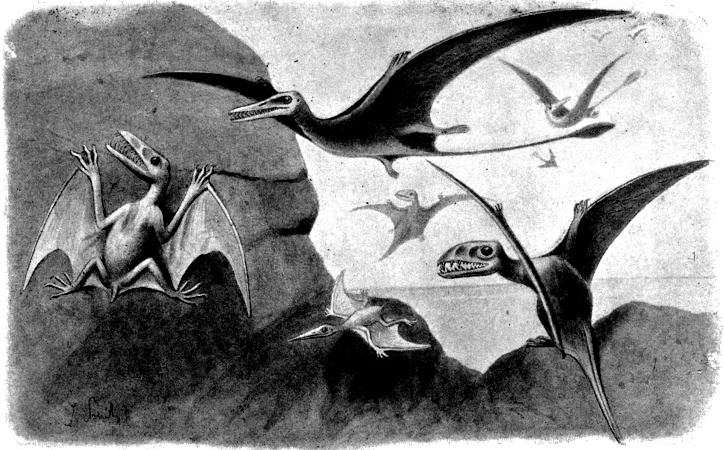
But the largest Pterodactyls hail, like so many other big things, from America. Professor Marsh tells us of monsters in his famous collection with a spread of wings of twenty to twenty-five feet! These large forms had no teeth in their jaws, and their skulls are of a peculiar form. The long-pointed jaws were probably sheathed in horn during life, as in birds (see Fig. 36). According to Marsh, these toothless forms (which he calls Pteranodonts) were mostly of gigantic size. With regard to their food it is almost vain to speculate; but if they did prey upon fishes, they must have had a capacious mouth and gullet, and must have swallowed their prey whole, after the fashion of pelicans. But we doubt if they had the peculiar pouch possessed by those birds. In the absence of more complete accounts of the large forms the artist has only attempted to restore the small ones. (See Plate XII., showing four different kinds.)
Plate XII.
GROUP OF SMALL FLYING DRAGONS, OR PTERODACTYLS. Rhamphorhynchus phyllurus. Pterodactylus crassirostris. Dimorphodon macronyx. Pterodactylus spectabilis.
Whether Pterodactyls were cold-blooded or warm-blooded is a question on which the authorities are not agreed. Professor Owen argued from the absence of feathers that they could not have been warm-blooded. But, in spite of this great authority, who has defended his opinion somewhat strongly, there are others who argue that the amount of work involved in sustaining a Pterodactyl in the air make it highly probable that it was warm-blooded. The absence of feathers to retain the heat of the body need not be regarded as conclusive, for bats are warm-blooded animals, and in their case the heat of the body is retained by a slight downy covering to the skin. Such a covering may have protected the bodies of Pterodactyls, and we could not expect to see any trace of it in the Bavarian specimen of Rhamphorhynchus referred to above. An important fact bearing on this question is the discovery of perforations in the bones of these animals very similar to those seen in birds. Now, birds have a wonderful system of respiration, or breathing. The air they breathe passes, not into their lungs only, but penetrates to the remotest parts of their system, filling their very bones with life, and endowing them with activity and animation adapted to their active aërial existence. It may, therefore, be argued that Pterodactyls breathed much in the same way; that their bones, too, were supplied with air by an elaborate system of air-sacs, and that they had lungs like those of birds. We cannot, however, stop there, but are led on by physiological reasoning to conclude that the circulation of the blood must have been rapid, and that the heart was like that of birds and mammals, four-celled. It would therefore follow—since birds and mammals are warm-blooded—that Pterodactyls were also. Such, at least, is the view of Professor H. G. Seeley, who says of the Cambridge specimens, "That they lived exclusively upon land and in air is improbable, considering the circumstances under which their remains are found. It is likely that they haunted the sea-shores, and, while sometimes rowing themselves over the water with their powerful wings, used the wing-membranes, as the bat does, to enclose their prey, and bring it to the mouth.
“The large Cambridge Pterodactyls probably pursued a more substantial prey than dragon-flies. Their teeth are well suited for fish, but probably fowl and small mammals, and even fruits, made a variety in their food. As lord of the cliff, it may be presumed to have taken toll of all animals that could be conquered with tooth and nail. From its brain it might be regarded as an intelligent animal. The jaws present indications of having been sheathed with a horny covering.”
Probably the large Pterodactyls of the Cretaceous period, soaring like albatrosses and giant petrels over the surface of the ocean, co-operated with the marine reptiles, such as Ichthyosaurs, Plesiosaurs, crocodiles, and others, as those sea-birds now do with the whales, porpoises, and dolphins, in reducing the excessive numbers of the teeming tribes of fishes, and in maintaining the balance of oceanic life.
With regard to the place of Pterodactyls in the animal kingdom, Professor Seeley places them as a distinct sub-class, side by side with birds, and between mammals and reptiles, thus—
Mammalia.
O r n i t h o s a u r i a A v e s
Reptilia.
The name Ornithosauria (bird-lizards) is frequently used instead of the other name, because it expresses the idea of their being partly saurian, and partly bird-like.
They flourished from the period of the Lias to that of the Chalk; and then, like so many other strange forms, seem to have suddenly disappeared.
CHAPTER IX.
SEA-SERPENTS.
“Sand-strewn caverns, cool and deep, Where the winds are all asleep; Where the spent lights quiver and gleam, Where the salt weed sways in the stream; Where the sea-beasts, ranged all round, Feed in the ooze of their pasture-ground; Where the sea-snakes coil and twine, Dry their mail, and bask in the brine.”
The Forsaken Merman.
It has been said that everything on earth has its double in the water. Are there not water-beetles, water-scorpions, water-rats, water-snakes, sea-lions, sea-horses, and a host of other living things, whether plants or animals, bearing some sort of resemblance to others that live on land? Then why not sea-serpents? The great controversy of the sea-serpent, that has so often been discussed in the newspapers, need not be considered here. We are dealing not with the present, but with the past; and whether or no the wonderful sailors' yarns of sea-serpents can be regarded as authentic, even in a single case, we can offer our readers infallible proof that, during the so-called “Age of Reptiles,” certain monstrous saurian animals flourished in considerable abundance, which, though not true serpents, nevertheless must have borne a striking resemblance to such, as they cleaved he waters of primæval seas.[32]
The modern evolutionist believes that snakes are descended from lizards, possessing, as usual, four legs; that some primitive form of lizard with very small legs appeared on the scene, and found that it could better move along by wriggling its body and pushing with its ribs than by walking. So, in course of time, a race of lizards without legs arose; these, by Natural Selection, and perhaps other means, became more and more elongated, so that they could move faster than their ancestors, and glide out of harm’s way more effectually. Thus was the snake evolved from a lizard.
Now, in the great geological museum of the stratified rocks, there have been discovered skeletons of marine reptiles, which propelled themselves chiefly by means of their tails and elongated bodies, rather than by their limbs. The limbs were not discarded entirely as in the case of the serpents, but were useful in their way as the fins of fishes are. Perhaps, therefore, we may be justified in calling these ancient monsters sea-serpents, in consideration of their long thin bodies; for they certainly would be called by that name if now living.
Strictly speaking, they were not serpents, but more or less like some of the extinct saurians described in chap. iv. The name, however, has been adopted by geologists, and is useful in so far as it serves to remind us of their very peculiar shape and structure. Remains of these strange creatures have been found both in Europe and America.
One of the earliest discoveries of remains of a fossil sea-serpent was made by M. Hoffman, a Dutch military surgeon, in the year 1770. Maestricht, a city in the interior of the Netherlands, situated in the valley of the Meuse, stands on certain strata of limestone and sandstone, belonging to the Upper Chalk. Extensive quarries have, for many centuries, been worked in the sandstone, especially in the eminence called St. Peter’s Mount, which is a cape or headland between the Meuse and the Jaar. This elevated plateau extends for some distance towards Liége, and presents an almost perpendicular cliff towards the Meuse. From the extensive works that have so long been carried on, immense quantities of stone have been removed, and the centre of the mountain is traversed by galleries, and hollowed by vast excavations. Innumerable fossils, such as marine shells, corals, crustaceans, bones and teeth of fishes, have been obtained from this rock. But St. Peter’s Mount is now chiefly celebrated for the discovery of the bones and teeth of a huge saurian, to which Mr. Conybeare has given the name Mosasaurus, on account of its connection with the river Meuse. M. Hoffman had long been an assiduous collector of fossils from this neighbourhood, and he had the good fortune to obtain the famous specimen on which this genus is founded.
It was at first considered, by M. Faujas St. Fond, to be a crocodile; but Cuvier and Camper formed a different and better conclusion. Perhaps no fossil ever had such a remarkable history as this one, as the following account, from M. Faujas St. Fond’s work on the fossils of St. Peter’s Mount,[33] will show.
“Some workmen, on blasting the rock in one of the caverns of the interior of the mountain, perceived, to their astonishment, the jaws of a large animal attached to the roof of the chasm. The discovery was immediately made known to M. Hoffman, who repaired to the spot, and for weeks presided over the arduous task of separating the mass of stone containing these remains from the surrounding rock. His labours were rewarded by the successful extrication of the specimen, which he conveyed in triumph to his house. This extraordinary discovery, however, soon became the subject of general conversation, and excited so much interest, that the canon of the cathedral which stands on the mountain resolved to claim the fossil, in right of being lord of the manor; and succeeded, after a long and harassing lawsuit, in obtaining this precious relic. It remained for years in his possession, and Hoffman died without regaining his treasure, or receiving any compensation. At length the French Revolution broke out, and the armies of the Republic advanced to the gates of Maestricht. The town was bombarded; but, at the suggestion of the committee of savans who accompanied the French troops to select their share of the plunder, the artillery was not suffered to play on that part of the city in which the celebrated fossil was known to be preserved. In the mean time, the Canon of St. Peter’s, shrewdly suspecting the reason why such peculiar favour was shown to his residence, removed the specimen, and concealed it in a vault; but when the city was taken, the French authorities compelled him to give up his ill-gotten prize, which was immediately transmitted to the Jardin des Plantes, at Paris, where it still forms one of the most striking objects in that magnificent collection.”
Dr. Mantell quotes the Frenchman’s remark on this transaction: “La Justice, quoique tardive, arrive enfin avec le temps:” but adds, “The reader will probably think that, although the reverend canon was justly despoiled of his ill-gotten treasure, the French commissioners were but very equivocal representatives of Justice!”
The beautiful cast (Fig. 37) at South Kensington (Fossil Reptile Gallery, Wall-case 8) was presented to Dr. Mantell by Baron Cuvier in 1825. It consists of both jaws, with numerous teeth, and some other parts (see Fig. 38). The length is about four and a half feet. This nearly perfect head was for a time a stumbling-block to many naturalists, some of whom were of opinion that it belonged to a whale. Cuvier and others considered it to be a kind of link between the Iguanas and the Monitors.[34]
Fig. 37.—Skull of Mosasaurus Hoffmanni. The original is 41/2 ft. by 21/2 ft.
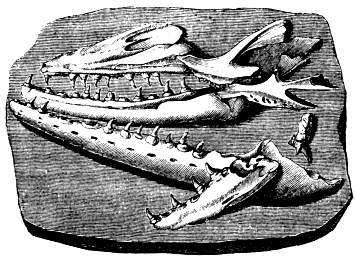
Fig. 38.—Teeth of Mosasaurus (half natural size). 1a, 2a, transverse sections of the teeth.
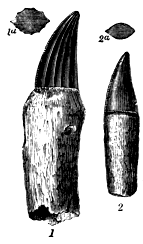
The entire backbone of the Maestricht animal appears to have consisted of one hundred and thirty-one vertebræ, of which ninety-seven belonged to the tail. The total length of the skeleton is estimated at twenty-four feet, and the head was about one-sixth of the total length. The tail is only ten feet long, whereas in a crocodile the tail exceeds the length of the body. Although in his day the limbs of the Mosasaurus were imperfectly known, Cuvier rightly considered them to be adapted for swimming, and, with his usual foresight, concluded that this monster was a marine reptile of great strength and activity, having a large tail flattened vertically and capable of being moved from side to side with such force and rapidity as to be a powerful organ of propulsion, capable of stemming the most agitated waters. The large conical recurved teeth, the largest of which was nearly three inches long, are well seen in Figs. 37 and 38. Dr. Mantell was fortunate enough to find, in the year 1820, some vertebræ from the English Chalk near Lewes, which were identified as belonging to a Mosasaurus.
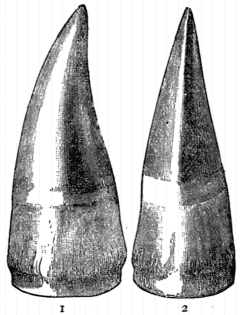
In 1831 a portion of a lower jaw with large conical teeth was discovered in the Chalk near Norwich. But these teeth were not quite similar to those of the Maestricht specimen, and Professor Owen therefore founded upon them the new genus Leiodon.[35] But Leiodon must have been very similar to Mosasaurus.
Fig. 39.—Lower tooth of Leiodon. 1. Side view. 2. Profile.
Of late years many fine specimens have been discovered in North America, and the labours of Leidy, Marsh, and Cope have been of the greatest service in completing our knowledge of this strange group of saurians. In the American Cretaceous seas they ruled supreme, as their numbers, size, and carnivorous habits enabled them easily to vanquish all rivals. Probably some of them were seventy-five feet in length, the smallest being ten or twelve feet long. In the inland Cretaceous sea from which the Rocky Mountains were beginning to emerge, these ancient sea-serpents abounded; and many were entombed in its muddy deposits. On one occasion, as Professor Marsh rode through a valley washed out of this old ocean bed, he observed no less than seven different skeletons of these monsters in sight at once! The same authority mentions that the Museum of Yale College contains remains of not less than 1400 distinct individuals. In some of these the skeleton is nearly if not quite complete; so that every part of its structure can be determined with almost absolute certainty.
According to Professor Cope of Pennsylvania University, who has made a special study of this group of extinct saurians, fifty-one species have been discovered in North America, in the States of New Jersey, Alabama, Kansas, North Carolina, Mississippi, and Nebraska. The same authority has shown that they were characterised by a wonderful elongation of form, especially of the tail; that their heads were large, flat, and conical in shape, with eyes directed partly upward; that they were furnished with two pairs of paddles like the flippers of a whale. With these flippers, and the eel-like strokes of their flattened tail, they swam with considerable speed. Like snakes, they were furnished with four rows of formidable teeth on the roof of the mouth, which served admirably for seizing their prey.
But the most remarkable feature in these creatures was the arrangement for permitting them to swallow their prey whole, in the manner of snakes. Thus each half of the lower jaw was articulated at a point nearly midway between the ear and the chin, so as to greatly widen the space between the jaws, and Professor Cope thinks that the throat must consequently have been loose and baggy.
Professor Cope, however, in giving the name Pythonomorpha to this ancient group, has pressed his views too far, and dwelt unduly on their supposed relationship with serpents. Other authorities regard them as essentially swimming lizards, with four well-developed paddles; and this is probably the right view to take of them.
The following graphic account of the region where Professor Cope has discovered the skeletons of many sea-serpents, and of their habits and aspect when alive, is taken from his well-known work on the Cretaceous Vertebrata of the West.[36] After describing this region as a vast level tract between the Missouri and the Rocky Mountains, he says, “If the explorer searches the bottoms of the rain-washes and ravines, he will doubtless come upon the fragment of a tooth or jaw, and will generally find a line of such pieces leading to an elevated position on the bank or bluff, where lies the skeleton of some monster of the ancient sea. He may find the vertebral column running far into the limestone that locks him in his last prison; or a paddle extended on the slope, as though entreating aid; or a pair of jaws lined with horrid teeth, which grin despair on enemies they are helpless to resist; or he may find a conic mound, on whose apex glisten in the sun the bleached bones of one whose last office has been to preserve from destruction the friendly soil on which he reposed. Sometimes a pile of huge remains will be discovered, which the dissolution of the rock has deposited on the lower level; the force of rain and wash having been insufficient to carry them away.”
Plate XIII.
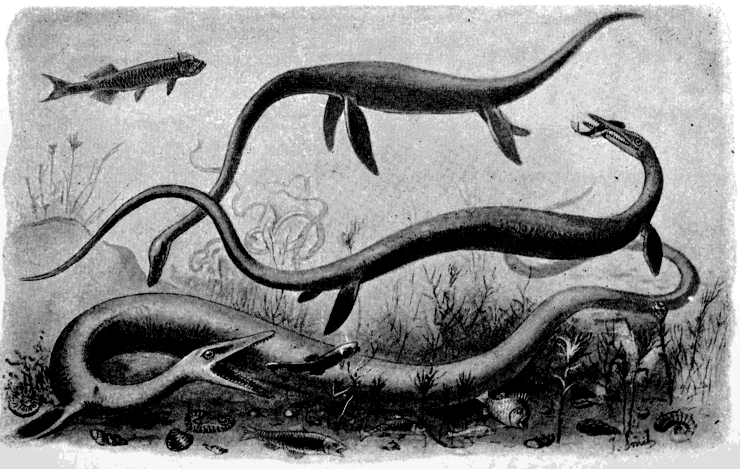
GROUP OF SEA-SERPENTS, ELASMOSAUR, AND FISHES. Fishes, Portheus. Elasmosaurus. Length 50 feet. Beryx. Clidastes. Length 40 feet. Osmeroides, etc. Mosasaurus. Length 75 feet.
But the reader inquires, “What is the nature of these creatures thus left stranded a thousand miles from either ocean? How came they in the limestone of Kansas, and were they denizens of land?” These creatures lived in the Cretaceous period. The remains found in this region were mostly those of reptiles and fishes. Thirty-five species of reptiles are known from Kansas alone, representing six orders, and varying in length from ten to eighty feet. One was terrestrial, four were fliers, the rest inhabited the ocean. “When they swam over what are now the plains, the coast-line extended from Arkansas to near Fort Riley, on the Kansas River, and, passing a little eastward, traversed Minnesota to the British possessions, near the head of Lake Superior. The extent of sea to the westward was vast, and geology has not yet laid down its boundary; it was probably a shore now submerged beneath the waters of the North Pacific.”
Other very elongated marine reptiles of this period, but with much thicker bodies, are called, by Professor Cope, Elasmosaurs. In this group, which is not yet fully worked out, occur such genera as Cimoliosaurus, Polycotylus, Polyptychodon, and others. But it seems a pity that they should be in any way separated from the Plesiosaurs, which they strongly resemble (see chap. iv., Plate III.). Though not sea-serpents, we have introduced them here because they flourished at the same time, and lived in the same seas with the Mosasaurs and other forms of that group. The very large teeth, with strongly marked ridges, of the Polyptychodon are abundant in the Cambridge Greensand that underlies the chalk, and represent a very huge animal.
In our illustration, Plate XIII., the artist has represented the Elasmosaurus[37] (of Cope) with its long thin neck stretched out in search of food on the bed of the sea. Professor Cope—thus describing this monster, in language which seems somewhat fanciful—says, "Far out on the expanse of this ancient sea might have been seen a huge snake-like form, which rose above the surface, and stood erect, with tapering throat and arrow-shaped head, or swayed about, describing a circle of twenty feet radius above the water. Then plunging into the depths, naught would be visible but the foam caused by the disappearing mass of life. Should several have appeared together, we can easily imagine tall, flexible forms rising to the height of the masts of a fishing-fleet, or like snakes twisting and knotting themselves together. This extraordinary neck—for such it was—rose from a body of elephantine proportions. The limbs were probably two pairs of paddles, like those of Plesiosaurus, from which this diver chiefly differed in the arrangement of the bones of the breast. In the best-known species twenty-two feet represent the neck in a total length of fifty feet. This is Elasmosaurus platyurus (Cope), a carnivorous sea-reptile, no doubt adapted for deeper waters than many of the others. Like the snake-bird of Florida, it probably often swam many feet below the surface, raising the head to the distant air for breath, then withdrawing it, and exploring the depths forty feet below, without altering the position of its body. From the localities in which the bones have been found in Kansas, it must have wandered far from land; and that many kinds of fishes formed its food is shown by the teeth and scales found in the position of its stomach."
But to return to the sea-serpents. Mosasaurus is now known to have been a long slender reptile, with a pair of powerful paddles in front, a moderately long neck, and flat pointed head. The tail was very long—flat and deep—like that of a great eel. Mosasaurus princeps is computed to have been seventy-five to eighty feet long. Clidastes was another genus of long and slender shape, one species of which reached a length of forty feet. Some forms of sea-serpent had sclerotic plates in the eye, such as we found in the fish-lizard, or Ichthyosaurus (p. 46), but the announcement that their bodies were protected by bony plates has turned out to be a mistake, and the supposed plates really belonged to the eye.
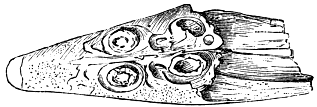
Leiodon proriger (Cope) was abundant in the old North American Cretaceous sea, and reached a length of seventy-five feet. It had a long projecting muzzle, somewhat like the snout of a sturgeon. Platecarpus and Tylosaurus had peculiarly sharp-pointed heads (see Fig. 40).
Fig. 40.—Snout of Tylosaurus. (After Marsh.)
A few words may be added here with regard to Professor Cope’s important discovery of Leiodon—a genus already alluded to as having been founded by Sir Richard Owen. The type specimen of Leiodon dyseplor,[38] which first indicated the characters of this wonderful species, was obtained from the yellow beds of the Niobrara epoch of the Jornada del Muerto, near Fort McRae, New Mexico. The greater part of the remains have been described by Professor Leidy. But a second specimen, more complete in all respects, was discovered by Professor Cope’s exploring party during an expedition from Fort Wallace, Kansas, in 1871. This specimen he has fully described and figured in the report already referred to (p. 140). It is a very instructive specimen, including fifty of the vertebræ from all parts of the vertebral column, a large part of the cranium, with teeth, as well as important limb-bones. These precious relics were excavated from a chalk “bluff,” or high bank. Fragments of the jaws were seen lying on the slope, and other portions entered the shale. On being followed, a part of the skull was taken from beneath the roots of a bush, and the vertebræ and limb-bones were found farther in. The series of vertebræ, after extending some way along the face of the bluff, finally turned into the hill, and were followed as far as time would permit, but part of the tail series had to be left. In size, the vertebræ of this enormous sea-serpent exceed those of Mosasaurus brumbyi. The latter has hitherto been the largest known species of the order of Pythonomorphs, exceeding twofold in its measurements the M. giganteus of Belgium. So the present reptile is much larger in its dimensions than the New Jersey species called maximus by Professor Cope. “If, as appears certain,” says the professor, “the Mosasauroid discovered by Webb measures seventy-five feet in length, and the M. maximus measured eighty, the Leiodon dyspelor must have been the longest reptile known, and approaches very nearly the extreme of the mammalian growth seen in the whales, though, of course, without their bulk. Such monsters may well excite our surprise, as well as our curiosity, in the inquiry as to their source of food-supply, and what the character of those contemporary animals preserved in the same geologic horizon.”
In our illustration, Plate XIII., the artist has endeavoured to realise the outward aspect of the two genera of sea-serpents, Mosasaurus and Clidastes. The fishes which they are pursuing are well-known genera from the English Chalk, such as Beryx.
Ten species of Clidastes have been unearthed from the Kansas strata. They did not reach such a size as the Leiodons, but were of elegant and flexible build, the largest species, C. cineriarum, reaching a length of forty feet (see Fig. 41). A smaller species, of elegant proportions, has been called C. tortor (Cope). Its slenderness of body was remarkable, and the large head was long and lance-shaped. Its lithe movements doubtless helped it to secure many fishes. It was found coiled up beneath a ledge of rock, with its skull lying undisturbed in the centre.
The accounts given by Professor Cope of his explorations and the difficulties encountered in procuring the valuable specimens on which his conclusions are based, are most interesting, and such as every fossil-hunter will appreciate. We, in England, who visit clay pits, stone quarries, railway cuttings, etc., during a morning or an afternoon walk, and return home at our leisure with a few small specimens in our pockets, or in a bag at our back, can hardly realise how arduous must be the work of finding, digging out, and transporting for such long distances the remains of the monsters of Kansas and other parts of North America.
Fig. 41.—Skeleton of Clidastes cineriarum; length 40 feet. (After Cope.) Click on image to view larger version.

The following extracts have been selected from Professor Cope’s report, with a view to illustrating the nature of the explorations undertaken. “The circumstances attending the discovery of one of these will always be a pleasant recollection to the writer. A part of the face, with teeth, was observed projecting from the side of a bluff by a companion in exploration, Lieutenant James H. Whitten, United States Army, and we at once proceeded to follow up the indication with knives and picks. Soon the lower jaws were uncovered, with their glistening teeth, and then the vertebræ and ribs. Our delight was at its height when the bones of the pelvis and part of the hind limb were laid bare, for they had never been seen before in the species, and scarcely in the order. While lying on the bottom of the Cretaceous sea, the carcase had been dragged hither and thither by the sharks and other rapacious animals, and the parts of the skeleton were displaced and gathered into a small area. The massive tail stretched away into the bluff, and, after much laborious excavation, we left a portion of it to more persevering explorers.”
"The discovery of a related species, Platecarpus coryphæus (Cope), was made by the writer under circumstances of difficulty peculiar to the plains. After examining the bluffs for half a day without result, a few bone fragments were found in a wash above their base. Others led the way to a ledge forty or fifty feet from both summit and foot, where, stretched along in the yellow chalk, lay the projecting portions of the whole monster. A considerable number of vertebræ were found preserved by the protective embrace of the roots of a small bush, and, when they were secured, the pick and knife were brought into requisition to remove the remainder. About this time, one of the gales, so common in that region, sprang up, and striking the bluff fairly, reflected itself upwards. So soon as the pick pulverised the rock, the limestone dust was carried into eyes, nose, and every available opening in the clothing. I was speedily blinded, and my aid disappeared in the cañon, and was seen no more while the work lasted. A handkerchief tied over the face, and pierced by minute holes opposite the eyes, kept me from total blindness, though dirt in abundance penetrated the mask. But a fine relic of Creative Genius was extracted from its ancient bed, and one that leads its genus in size, and explains its structure."
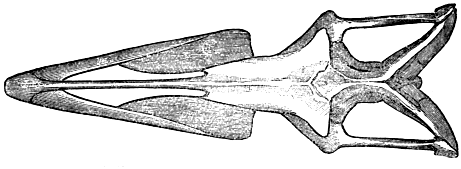
Fig. 41a.—Skull of Platecarpus. Upper Cretaceous. North America. (After Cope.)
"On another occasion, riding along a spur of yellow chalk bluff, some vertebræ lying at its foot met my eye. An examination showed that the series entered the rock, and, on passing round to the opposite side, the jaws and muzzle were seen projecting from it, as though laid bare for the convenience of the geologist. The spur was small and of soft material, and we speedily removed it in blocks, to the level of the reptile, and took out the remains as they lay across the base from side to side."
In taking leave of the “Age of Reptiles,” we cannot but marvel greatly at the diversity of forms assumed by the various orders of this class, their strange uncouth appearance, their assumption, in some cases, of characters only known at the present day among the mammals, their great abundance, and the perfect state in which their remains have been preserved in the stratified rocks of various parts of the world. And the reader may naturally ask, “How is it that so many types have disappeared altogether, leaving us out of a total of at least nine orders, only four, viz. those represented by crocodiles, lizards, snakes, and turtles?” To such a question we can only answer that the causes of the extinction of plants and animals in the past are not yet known. Climate, geographical conditions, food-supply, competition, with other causes, doubtless operated then as now; but if there is one clear lesson taught by the record of the rocks, it is this—that there has been at work from the earliest periods a Law of Progress, so that higher types, coming in at certain stages, have ousted the lower types, sometimes only partially, sometimes completely. But why the Dinosaurs, for instance, perished entirely, while the crocodiles survived to the present day, no one can yet explain. We can see no reason, however, why such problems as these should not be solved in the future by the co-operating labours of naturalists and geologists.
In the great onward and upward struggle for existence, higher types have supplanted lower ones; and, in accordance with this biological truth, we find that in the next era (known as the Tertiary or Cainozoic) the mammal held the field while the reptile took a subordinate place.
CHAPTER X.
SOME AMERICAN MONSTERS.
“Geology, in the magnitude and sublimity of the objects of which it treats, ranks next to Astronomy in the scale of the Sciences.”—Sir John F. W. Herschel.
With the advent of the Cainozoic or Tertiary era, we enter upon the “Age of Mammals,” when great quadrupeds suddenly came upon the scene. The place of the reptile was now taken by the mammal. In the long previous era this higher type of life was not altogether wanting, but as far as the geological record is yet known, it appears only to have been represented by a few primitive little creatures, probably Marsupials, whose jaw-bones have been discovered in the New Red Sandstone, and the Stonesfield Oolite.[39]
Geology tells of a great gap between the highest rocks of the Cretaceous period and the lowest group of the succeeding Eocene period (see Table of Strata, Appendix I.). This gap, or break, testifies to a very long interval of time during which important geographical and other changes took place; and consequently we find in Eocene rocks (at the base of the Cainozoic series) a very different fauna and flora to that which is preserved in the Chalk formation.
The researches of Cuvier among the fossils collected from Eocene rocks in the neighbourhood of Paris, especially the Gypseous series of Montmartre, revealed the existence of a very extensive fauna, especially of new types of mammals; and his restoration of the Palæotherium, a tapir-like animal, and other forms, created a vast amount of interest, and greatly stimulated the study of extinct animals. As we have already remarked, the science of palæontology may be said to have been founded by Cuvier (see Introduction, p. 5).
But now the scene shifts once more from Europe to the wilds of the Far West. American geologists tell us that a long time ago (during the Eocene period) there was a great tropical lake in the Wyoming territory, on the borders of which roamed, amidst luxuriant vegetation, a large number of strange and primitive quadrupeds, together with many other forms of life. The most wonderful group of animals that haunted the shores of this lake, or series of lakes, was the Dinocerata so fully described by Professor Marsh, in his exhaustive monograph.[40] The name implies that they were terrible horned monsters, but whether Nature provided them with true horns, like those of horned cattle to-day, is at least open to doubt.
Fig. 42 shows the skeleton of one of these, namely, Tinoceras ingens. Its length was about 12 feet without the tail. Its weight, when alive, is calculated to have been six thousand pounds, or about two tons and three quarters.
Plate XIV. is a restoration of the Tinoceras, made by our artist, after much consideration and careful study of the valuable cast exhibited in the Natural History Museum at South Kensington, which was generously presented by Professor Marsh (Gallery I. Case MM on plan). In planning this and other restorations, both artist and author have received valuable assistance from Dr. Henry Woodward, F.R.S., Keeper of the Geological Department of the Museum, who is ever ready to help with his great knowledge those who come to consult him.
There may be differences of opinion among palæontologists as to the appearance presented by this formidable creature when alive, and no doubt the nature of the skin must always be more or less a matter of conjecture in such cases, but we venture to hope that the restoration here given, based as it is upon Mr. Smit’s thorough acquaintance with living animals and Professor Marsh’s description, will meet with a favourable verdict.
Fig. 42.—Skeleton of Tinoceras ingens. (After Marsh.)
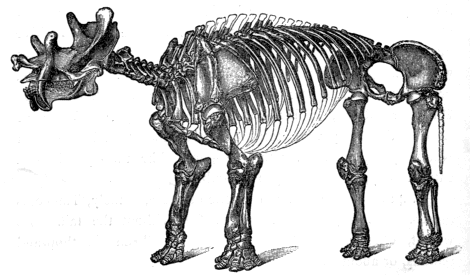
Looking at the skeleton, one is struck with a certain resemblance to the rhinoceros on one hand, and to the elephant on the other. The legs are very elephantine, and the feet must have been covered with thick pads, but the body reminds one more of the rhinoceros; and yet, again, there is some suggestion of the hippopotamus. The eye was small and deep set, as in the rhinoceros. In the upper jaw the two canine teeth are developed into dagger-shaped tusks, the use of which can only be conjectured. In the females these are but slightly developed.
Plate XIV.
A LARGE EXTINCT MAMMAL, TINOCERAS INGENS. From North America. Length about 12 feet (without the tail).
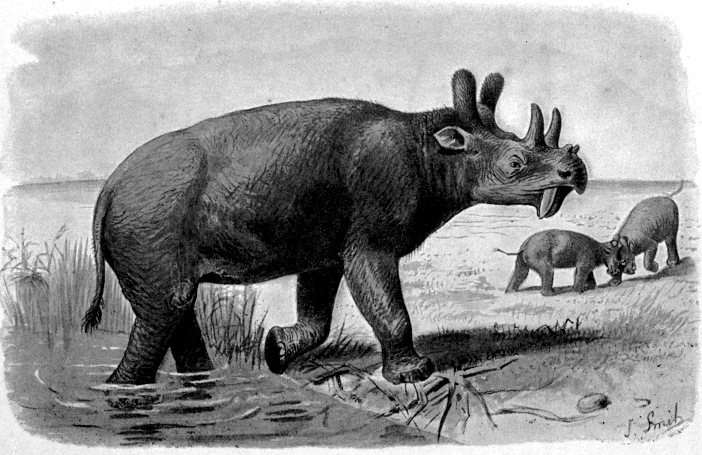
It is quite clear, then, that we cannot place the Dinoceras in any order of living mammals. It is what palæontologists call a “generalised type;” that is to say, it presents certain characters seen in several groups of living quadrupeds, and not any of those elaborated or highly developed parts which we see in such animals to-day. Thus the proboscis of the elephant is a greatly elongated nose; in other words, the elephant is highly “specialised” in that direction, whereas our Dinoceras had no proboscis, or only a very slight one.
Fig. 43.—Skull of Dinoceras mirabile. (After Marsh.)
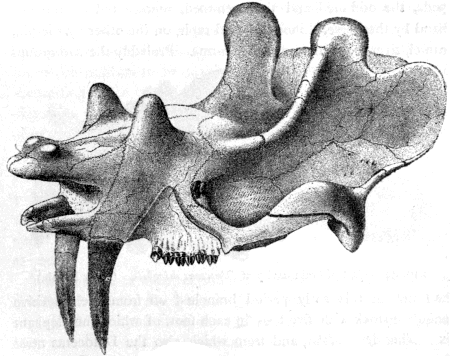
Again, the six remarkable bony protuberances of the skull served to some extent as horns, and probably were covered with thick bosses of skin, and did not support true horns like those of our modern oxen and other ruminants. Speaking of these protuberances, Professor Marsh says, “None of the covering of these elevations, or horn-cores, has, of course, been preserved; yet a fortunate discovery may perhaps reveal their nature by the form of a natural cast, as the eye-ball of the Oreodon is sometimes thus clearly indicated in the fine Miocene matrix which envelops these animals.” It looks rather as if we have here an early stage in the evolution of horns, and it may be that in the course of subsequent ages such prominences as those developed into true “horn cores,” such as sheep or goats have, while the thick bosses of skin that covered them slowly developed into the true horns that are attached to these cores. If this is so, then we have here another instance of a “generalised” structure. Again, the limbs with their five toes tell us at once that the creature’s place in Nature is outside of those two great groups of modern ungulates, or hoofed quadrupeds, the odd-toed and the even-toed, represented on the one hand by the horse, rhinoceros, and tapir, on the other by the pig, camel, deer, ox, and many other forms. Probably the two groups had not at this early period branched off from the primitive ungulate stock with five toes in each foot, of which the elephant is a living descendant, and from which also the Dinoceras must have come.
Fig. 44.—Cast of brain-cavity of Dinoceras mirabile. (After Marsh.)
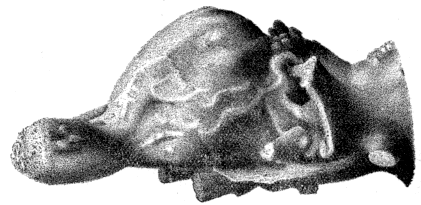
The limbs were strong and massive, but the brain was remarkably small, so that our Dinoceras cannot be credited with any high degree of intelligence: and here again we see an absence of “specialisation” compared with the sagacious elephant. Professor Marsh has taken casts of its brain-cavity (see Fig. 44). These casts show that the brain was smaller (in proportion to the size of the animal) than in any other mammal, whether living or extinct—and even less than in some reptiles! In fact, it was a decidedly reptilian kind of brain. Perhaps it may seem hardly credible, but so small was the brain of Dinoceras mirabile, that it could have been pulled through the apertures (neural canals) of all the neck vertebræ! In certain marsupials of the present day we find an approach to this kind of brain. It seems to be an established fact, according to Professor Marsh, that all the Eocene or earlier Tertiary mammals had small brains. His researches among fossil mammals have led him to the important conclusion that, as time went on, the brains of mammals grew larger; and thus he has been able to establish his law of brain-growth during the Tertiary period, a law which appears to be plainly recorded in the fossil skulls of succeeding races of ancient mammals. The importance of a discovery such as this cannot fail to strike the imagination of even the most unlearned in geology as being singularly suggestive and instructive. It is not difficult to picture these dull, heavy, slow-moving creatures haunting the forests and palm jungles around the margin of the great Eocene lake, into the waters of which their carcases from time to time found their way—perhaps swept down by floods. No footprints have been discovered as yet.
The Dinocerata were very abundant for a long time during the middle of the Eocene period. The position of their remains suggests that they lived together in herds, as cattle do now, and they probably found an abundance of food in the shape of succulent vegetation round the great lake. Geological evidence points to their sudden extinction before the close of the Eocene period; but it is difficult to understand this. Professor Marsh thinks that from their sluggish nature they were incapable of adapting themselves with sufficient rapidity and readiness to new conditions, such as may have been brought about by geographical changes. It must be admitted, however, that the geological record in this region does not give evidence of any sudden change. Possibly they may only have migrated to some other region, where their remains have not yet been discovered, or where, for various reasons, their skeletons were not preserved. In this Eocene lake, where sediments went on being quietly deposited for a long time, we have the most favourable conditions for the preservation of the different forms of life that flourished round its borders.
In the museum at Yale College are collected the spoils of numerous expeditions to the West, and the many tons of bones lying there are believed to represent the remains of no less than two hundred individuals of the Dinocerata. So perfectly have these bones been preserved by Nature that, even if the creatures had been living now, the material for studying their skeletons could hardly be more complete. Professor Marsh recognises three distinct types in this strange group of quadrupeds, on each of which a genus has been founded. The first and oldest form is the Uintatherium, which takes its name from the Uinta Mountains. This, as might be expected, is the most primitive or least specialised form, and comes from lower strata. The most highly developed or specialised form is the Tinoceras, and this is found at the highest geological level or “horizon.”
Between these two extremes, and from an intermediate horizon, comes the Dinoceras,[41] so that in tracing these animals through the strata in which they occur the geologist finds that he is following for a while the course of their evolution. Doubtless there were many slight differences presented by the members of this group, but at present it has not been found possible to determine the number of species, although about thirty forms more or less distinct have been recognised. Professor Marsh says that the specimen of the skull of Dinoceras mirabile, on which the whole order Dinocerata was founded, is, fortunately, in a very perfect state of preservation, and that it belonged to a fully adult animal. Moreover, it was embedded in so soft a matrix that the brain-cavity and the openings leading from it could be worked out without difficulty. In removing the skull from the rock, on the high and almost inaccessible cliff where it was found, two or three important fragments were lost; but Professor Marsh, after a laborious search, recovered them from the bottom of a deep ravine, where they had been washed down and covered up.
It is about twenty-two years since the wonderful forms of life sealed up within these Eocene lake-deposits first became known to science. Long before then, however, the wandering Indian had been accustomed to seeing strange-looking skulls and skeletons that peeped out upon him from the sides of cañons and hills, as the rocks that enclosed them crumbled away under the influence of atmospheric agents of change—the ceaseless working of wind, rain, heat, and cold. To his untrained mind no other explanation suggested itself than the idea that these were the bones of his ancestors, which it would be highly impious to disturb. Requiescant in pace! So he left them in peace. Perhaps he believed in a former race of human giants; if so, these would be their bones. Long before Professor Marsh’s expeditions, the earliest squatters, trappers, and others used to bring back news of marvellous monsters grinning from the ledges of rock beneath which they camped. At last these tales attracted the notice of some enthusiastic naturalists in the eastern States. Professor Leidy obtained a number of bones, from which he was able to bring to light an extinct creature at that time unknown to science, namely, the Uintatherium. Professor Cope also described some extinct animals disinterred by himself from the same region.
But our knowledge of the Dinocerata is chiefly due to Professor Marsh, who has despatched one expedition after another, and who, after many years of laborious research both in the western deserts and in his wonderful collection at Yale College, has published a splendid monograph on the subject. No trouble and no expense have been spared in order to obtain material for this great work, and all geologists must feel grateful to Professor Marsh for so liberally devoting his time and his private resources in order to advance the science of Palæontology.
The region in which the remains occur of the remarkable group of extinct animals now under consideration, has a peculiar scenery of its own, unlike anything in Europe. The following graphic description of its features is from the pen of Sir Archibald Geikie:—[42]
“On the high plateau that lies to the west of the Rocky Mountains, along the southern borders of the Wyoming territory, the traveller moving westwards begins to enter on peculiar scenery. Bare, treeless wastes of naked stone, rising here and there into terraced ledges and strange tower-like prominences, or sinking into hollows where the water gathers in salt or bitter pools. Under the cloudless sky, and in the clear dry atmosphere, the extraordinary colouring of these landscapes forms, perhaps, their weirdest feature. Bars of deep red alternate with strips of orange, now deepening into sombre browns, now blazing out again into vermilion, with belts of lilac, buff, pale green, and white. And everywhere the colours run in almost horizontal bands, running across hollows and river-gorges for mile after mile through this rocky desert. The parallel strips of colour mark the strata that cover all this wide plateau country. They are the tints characteristic of an enormous accumulation of sedimentary rocks, that mark the site of a vast Eocene lake, or succession of lakes, on what is now nearly the crest of the continent.”
In this strange region the flat-topped hills, table-lands, or terraces, as they are variously named, seen from lower levels, are usually called “buttes,” especially when they are of limited extent. This name is of French origin, and signifies a bank of earth or rising ground. It is also applied in a limited sense to the more prominent irregularities of the deeply sculptured slopes of the larger terraces. These buttes, therefore, vary in extent, from a mere mound rising slightly above the level of the plains to hills of varied configuration reaching to the level of the broader buttes or terraces.
The débris resulting from the continual wearing away, or demolition of these buttes and terraces, now lies spread out on the plains below. From the lower plains the smaller terraces appear like vast earth-work fortifications, and when not too much cut up by erosion, remind one of long railway embankments. But in many cases the terraces are so much cut up by narrow ravines that they appear as great groups of naked buttes rising from the midst of the plain. Nothing can be more desolate in appearance than some of these vast assemblages of crumbling buttes, destitute of vegetation, and traversed by ravines, in which the watercourses in midsummer are almost all dried up. To these assemblages of naked buttes, often worn into castellated and fantastic forms, and extending through miles and miles of territory, the early Canadian voyageurs gave the name Mauvais Terres. They occur in many localities of the Tertiary formations west of the Mississippi River. Professor Leidy, who with two friends made an expedition in search of fossils to Dry Creek Cañon in this region of the “Bad Lands,” about forty miles to the southeast of Fort Bridger (Wyoming), thus describes his impressions:—
"On descending the butte to the east of our camp, I found before me another valley, a treeless barren plain, probably ten miles in width. From the far side of this valley butte after butte arose and grouped themselves along the horizon, and looked together in the distance like the huge fortified city of a giant race, the utter desolation of the scene, the dried-up watercourses, the absence of any moving object, the profound silence which prevailed, produced a feeling that was positively oppressive. When I thought of the buttes beneath our feet, with their entombed remains of multitudes of animals for ever extinct, and reflected upon the time when the country teemed with life, I truly felt that I was standing on the wreck of a former world."