VII THE GYROCAR
Reading edition
ON the 8th of May, 1907, Mr. Louis Brennan exhibited, at a soirée of the Royal Society in London, a remarkable piece of mechanism, which stirred the imagination of every beholder, and—next morning—as reported by the newspapers, aroused the amazed interest of the world. This invention consists of a car run on a single rail, standing erect like a bicycle when in motion; but, unlike the bicycle, being equally stable when at rest.
It is a car that could cross the gorge of Niagara on a tight-rope, like Blondin himself, but with far greater security; a car that shows many strange properties, seeming to defy not gravitation alone but the simplest laws of motion. For example, if a weight is placed on one edge of the car that side rises higher instead of being lowered.
If you push against the side with your hand, the mysterious creature—you feel that it must be endowed with life—is actually felt to push back as if resenting the affront.
Similarly, if the wind blows against the car, it veers over toward the wind. If the track on which it runs—consisting of an ordinary gas-pipe or of a cable of wire—is curved, even very sharply, the car follows the curve without difficulty, and, in defiance of ordinary laws of motion, actually leans inward as a bicycle rider leans under the same circumstances, instead of being careened outward as one might expect.
A curious mechanism, surely, this new car, with its four wheels set in line, bicycle fashion, running thus steadily. But strangest of all it seemed when it poised and stood perfectly still on its tight-rope, as no Blondin could ever do. As stably poised it stood there as if it had two rails beneath it instead of a single wire; and there was nothing about it to suggest an explanation of the miracle, except that there came from within the car the murmur of whirling wheels.
The mysterious wheels in question would be found, if we could look within the structure of the car, to be two in number, arranged quite close together on each side of the centre of the car. They are two small fly-wheels, in closed cases, revolving in opposite directions, each propelled by an electric motor. These are the wonder-workers. They constitute the two-lobed brain or, if you prefer, the double-chambered heart of the strange organism. All the world has learned to call them gyroscopes. The vehicle that they balance may conveniently be termed a gyrocar—a name that has the sanction of the inventor himself.
Let it be understood once for all that a gyroscope is merely a body whirling about an axis. A top such as every child plays with is a gyroscope; a hoop such as every child rolls is a gyroscope; the wheels of bicycles, carriages, or railway-cars are gyroscopes; and the earth itself, whirling about its axis, is a gyroscope. You can make a gyroscope of your own body if you choose to whirl about, like a ballet-dancer. In a word, the gyroscope is the most common thing imaginable. Indeed, if I wished to startle the reader with a seeming paradox, I might say without transcending the bounds of truth that, in the last analysis, there is probably nothing known to us in the universe but an infinitude of gyroscopes—atoms and molecules at one end of the scale; planets and suns at the other—all are whirling bodies. Still there are gyroscopes and gyroscopes, as we shall see.
GYROSCOPIC ACTION EXPLAINED
Now a word about gyroscopic action. If you have rolled a hoop or spun a top you have unwittingly learned some practical lessons on the subject which, had you possessed Mr. Brennan's imagination and ingenuity, might have enabled you to anticipate him in the invention of the gyrocar. Harking back to the days when you rolled hoops, you will recall that the child who most excelled in the art was the one that could make the hoop go fastest. The hoop itself might be merely a wheel of wire, which would fall over instantly if not in motion; but if given a push it assumed an upright position and maintained it with security, so long as it was impelled forward. It seemed able, so long as it whirled about, to defy the ordinary laws of gravity. A bicycle in motion gives an even more striking illustration of the same phenomenon. And best of all, a spinning-top. Everyone knows how this familiar toy, which topples over instantly when at rest and can in no wise be balanced on its point, rises up triumphant when whirled about, and stands erect, poised in a way that would seem simply miraculous to all of us, had we not all spun tops at an age when the world was so full of wonders that we failed to marvel at any of them.
All these familiar things illustrate one of the principles of gyroscopic action which Mr. Brennan has put to account in developing his wonderful car—the fact, namely, that every revolving body tends to maintain its chief axis in a fixed direction, and resents—if I may be permitted to use this expressive word—having that direction changed. The same principle is illustrated on a stupendous scale by our revolving earth, which maintains the same tilt year after year as it whirls on its great journey, notwithstanding the fact that the sun and the moon are tugging constantly at its protuberant equatorial region in a way that would quickly change its direction if it were not spinning.
But note, please, that whereas the whirling body assumes a certain rigidity in space as regards the direction in which its axle points, the mere translation of the body itself through space in any direction is not interfered with in the least, provided the axle is kept parallel with its original position.
You may test this if you like in a very simple way. Remove one of the wheels of your bicycle, and carry it about the room, holding it by the axle while it is spinning rapidly. You will discover that it requires no more force to carry it when spinning than when at rest, provided you do not attempt to tip it from its plane of rotation, but that if you do attempt so to tip it, the wheel seems positively to resist, exerting a force of which it did not show a trace when at rest. A large top, arranged within the kind of frames or hoops called gimbals, if you can secure such a one, will show you the same phenomenon; it will resist having its axis diverted from the direction it chanced to have when it was set spinning.
If you ask why the spinning wheel exerts this power, it may not be easy to give an answer. The simplest things are hardest to explain. No man knows why and how gravitation acts; no one knows why a body at rest tends always to remain at rest until some force is applied to it; nor why when a body is once in motion it tends always to move on at the same rate of speed until some counter-force stops it. Such are the observed facts; they are facts that underlie all the principles of mechanics; but they are matters of observation, not of explanation or argument. And the fact that a revolving body tends to maintain its axis in a fixed position is a fact of the same category.
So far as we can explain it at all, we may, perhaps, say that the inertia which the matter composing the wheel shares with all other matter is accentuated by the fact that its whirling particles all tend at successive instants to fly in different directions under stress of centrifugal force. At any given instant each individual particle tending to fly off in a particular direction may be likened to a man pulling at a rope in that direction.
If you imagine an infinite number of men circled about a pole to which ropes are attached, and evenly distributed, each one pulling with equal force, it will be clear that the joint effort of the multitude would result in fixing the pole rigidly at the centre. The harder the multitude pulled, so long as they remained evenly distributed about the circle, the more rigid the pole would become. But if, on the other hand, all the men were to stop pulling and slacken the ropes, the pole would at once fall over. The pole, under such circumstances, would represent the axis of the revolving wheel, which acquired increased stability in exact proportion to the increased velocity of its revolutions, and therefore of the increased force with which its particles tend to fly off into space.
But be the explanation what it may, the fact that the axis of a revolving wheel acquires stability and tends to maintain its fixed position in space is indisputable; and it is this fact which determines primarily the action of the little revolving wheels of the gyroscopes that balance Mr. Brennan's car. There are certain very important additional principles involved that I shall refer to in a moment, but first let us glance at the car itself and see how the gyroscopes are arranged. We shall find them fastened within the frame-work of the car, at its longitudinal centre, in such a way that their axles are parallel to the axles of the ordinary car-wheels when the car stands in a normal position. Granted that the gyroscopes are thus transverse and normally horizontal, and at right angles to the track, the exact location of the mechanism within the car is immaterial. But the two gyroscopes must revolve in opposite directions for a reason to be given presently.
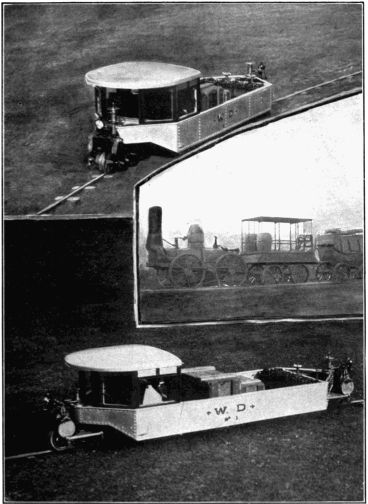
RETROSPECT AND PROSPECT IN TRANSPORTATION—THE DE WITT CLINTON TRAIN AND THE GYRO-CAR.
The De Witt Clinton engine, with its archaic coaches, represents the earliest type of railway transportation in America. The Gyro-car, two views of which are given, is the working model of a single-rail vehicle exhibited in England by Mr. Louis Brennan in 1907. It is balanced by an ingenious gyroscopic mechanism, which its inventor believes will prove equally successful when applied to vehicles on a commercial scale.
MR. BRENNAN'S MODEL CAR
The Brennan car as at first exhibited was only a working-model about six feet in length, and the gyroscopes that balanced it were about five inches in diameter. It seems almost incredible that wheels so small should be able to balance a car six feet in length, but it must be understood that these small gyroscopes whirl at the rate of about seven thousand revolutions per minute, and, of course, the gyroscopic force is proportionate to the rate of revolution. If we recall that a light hoop making perhaps fifty or a hundred revolutions per minute acquires a considerable stability, we shall cease to wonder at the rigidity of the axles of the wheels revolving at such enormous speed.
The model car accomplished the feat of carrying a passenger weighing about one hundred and forty pounds across a little valley on a wire cable, a voyage in some respects the most remarkable that any man has thus far been privileged to make. The car has shown that it can go up or down a sharp incline; but this, as a moment's reflection will show, does not involve any change of direction of the gyroscopic axle, and therefore involves only the ordinary laws of mechanics. It is all one to the gyroscope whether the car moves on the level or up or down hill, so long as it moves straight ahead.
Nor do the gyroscopes interfere in the least with the turning of the car in passing round a curve, when the two of them are linked together, as Mr. Brennan links them, so that any lateral change in the axis of one is balanced by an opposite change of the axis of the other. With the single gyroscope, such as Mr. Brennan used when he first began his experiments, the car encounters difficulties at curves in the track.
But before we can understand how the two gyroscopes balance each other in such a way as to make the Brennan car lean in while passing about a curve, we must investigate more fully the action of the individual gyroscopes. I have already said that there is another principle involved as supplementary to the principle of the fixed axis; this we must now investigate.
Perhaps it would be fairer to say that what we have to consider is not a new principle but a complication as to the application of the principle of gyroscopic action already put forward. In any event there is an elementary fact about the gyroscope that I have not yet stated. It is this: in order that the gyroscope may exercise its fundamental property of holding its axis fixed, it must have that axis so adjusted that it is free to oscillate or wabble. That sounds distinctly paradoxical, but it is a very essential fact. If Mr. Brennan had merely fixed two wheels rigidly in the frame of his car, they would have had no appreciable effect in balancing it. Had nothing more than that been necessary, some one would have invented a gyrocar long ago. But very much more than that was necessary, as we shall see.
The complication of which I am speaking is illustrated by the action of the simplest top, which likewise owes its stability to its wabble. Your top does not rise merely because it spins, but because it wabbles as it spins—wabbling being the familiar word for what the machinist calls "precession." A freely spinning top, if in equilibrium, has no inherency to rise up against gravitation, as your top may have led you to suppose. Your top rises because it is not spinning freely in equilibrium, its action being interfered with by the friction of the point on which it rests; it is seeking a position of equilibrium, which, owing to the location of its centre of gravity, will be found when its spindle is erect. But a top supported at both ends and properly balanced, does not tend to rise but only to maintain its position.
HOW THE BRENNAN GYROSCOPES WORK
It is such a balanced top as this that we must call to our aid in explaining the action of Mr. Brennan's gyroscopes. The explanation will involve the use of a diagram perhaps rather unpleasantly suggestive of the days when you studied geometry, and I fear I cannot hope to make interesting reading of the explanation. But it will be worth your while to follow it, that you may understand the action of one of the most remarkable and ingenious of inventions. Figure 1 represents a kind of top called a Foucault gyrostat. It is merely a top or gyroscope in gimbal frames, such as I have already referred to. With certain slight modifications, the diagram that represents it might also be a diagram of one of the gyroscopes in Mr. Brennan's car. Indeed, it was such a top as this that led Mr. Brennan to his discovery. Once while on a visit to Cannes, he purchased a top like this of a street vender—and the gyrocar is the outcome of the studies he made with it. This is also the kind of top with which Foucault, after whom it is named, proved that the earth revolves; but we shall come to that story in another connection.
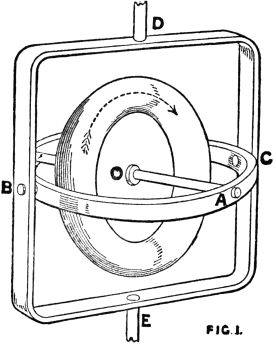
Fig. 1.
Reverting to the diagram, the gyroscope or top proper is at the centre, revolving on the axis O A. It is pivoted on the frame B A C, which frame is in turn pivoted so that it can rotate on the axis B C. Lastly, the outer frame B D C E is pivoted on the axis D E. Thus the apparatus as a whole is capable of revolving on each of its three principal axes. But under ordinary conditions it is only the inner wheel that is spinning. As this wheel is perfectly balanced, it will maintain steadily any position that it chances to have when it is set spinning, and the outer frames will remain stationary unless a disturbing force is applied to them.
Suppose, now, that the wheel has been set spinning on its axis O A in the direction indicated by the arrow, while its axis is horizontal, as represented in the diagram. The wheel will then tend to maintain its position and resist any attempt to displace it. But its resistance will be shown in a very peculiar way—whereby hangs our tale. If you apply a steady downward pressure to the frame B A C at point A, attempting thus to deflect the axis of the spinning wheel of the gyroscope, the frame will not tip down as you expect it to do (and as it would do if the top were not spinning) but instead, it will move in a horizontal plane along the arc C A B, the entire mechanism rotating on the axis D E. This motion is equivalent to the wabble of the top, and it is called "precession."
Please remember the word and its meaning, for we must use it repeatedly.
But now, curiously enough, if you were to apply a sidewise pressure at A, pushing to the left (as we view the diagram) to help on the motion of precession, the obstinate apparatus will cease altogether to move in that direction and the point A will begin to rise instead, the frame B A C rotating on its axis B C. This rise of the axis O A will take place even though the downward pressure is continued. You have disturbed the equilibrium of the top—unbalanced it—and it must seek a new position. Contrariwise, if you would have the point A moved to the right, you must push it upward; if you would have it go down, you must push it to the right.
This seems rather weird behavior, but if you will note the direction of the arrow on the wheel you will see a certain method in it. It will appear that in each case the force you apply has been carried round a corner, as it were, by the whirling disc, and made to act at right angles to the direction of its application. This change of direction of a force applied is strictly comparable to the change effected by the familiar device known as a pulley. With that device, to be sure, a pull instead of a push is used, but this is a distinction without a difference, for pushing and pulling are only opposite views of the same thing.
Possibly this suggested explanation of the action of the gyrostat may not seem very satisfactory, but the facts are perfectly clear, and if you will bear them steadily in mind you will readily be able to understand the Brennan gyroscope, as you otherwise cannot possibly hope to do. You have only to recall that pushing down at A causes motion (called "precession") to the left, and pushing up at A, motion to the right; and that in order to make A either rise or fall, you must "accelerate precession" by pushing to the left or to the right, respectively. But you must understand further, that when, through the application of any of these disturbing forces, you have forced the axis O A into a new position, it will tend to maintain that new position, having no propensity whatever to return to its original position. It is quite as stably in equilibrium with its axis pointing upward as when in the position shown in the diagram. One position is quite like another to it; but having accepted a position it resents any change whatsoever.
Now we are prepared to understand the Brennan gyroscope, which consists essentially of two such gyrostats as that shown in our diagram A, set into the frame of the car on the axis D E, their wheels revolving in opposite directions and their outer frames so linked together that when one turns in one direction on its axis D E, the other must turn in the opposite direction. As the sole object of having two of the gyroscopes is to facilitate the going around curves, we may for the moment neglect the second one, and consider the action of only one of the pair.
Our diagram 2, then, will represent one of Mr. Brennan's gyroscopes in action. It is pivoted into the framework of the car on the axis D E. If you examine it you will see that it is essentially the Foucault gyrostat of our other diagram, with the axis O A projected beyond the frame to the point F.
In practice, the frame B A C is made to carry the field-magnet of an electric motor for spinning the wheel. But this in no wise affects the principles of action. Mr. Brennan's invention consists of the exceedingly ingenious way in which he applies these principles; and to understand this we must follow our diagram closely. Looking at it, you will see that the spindle O F carries two rollers R1 and R2 which may come in contact under certain circumstances with the curved segment marked G1, G2, G3, G4, which are strong segments of the car-frame itself—the segments, indeed, upon which the force of the gyroscope is expended in holding the car in equilibrium. It must be understood further that the roller R1 is loosely fitted to the spindle O F and hence can whirl with it when pressed against the segment G1 or G3; whereas the roller R2 is fitted about a non-revolving extension of the frame B A C, and not to the spindle itself. Bearing in mind that the gyroscope itself is perfectly balanced and hence tends to maintain its axis O F in a fixed direction, we shall be able to understand what must happen when the car is tipped from any cause whatever—as the shifting of its load, the pressure of the wind, or the centrifugal action due to rounding a curve.
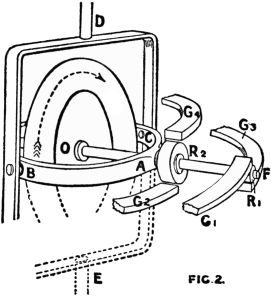
Fig. 2.
Suppose, for example, that the car tips to the right. This will bring the segment G1 in contact with the roller R1, and the roller will instantly tend to run along it, as a car-wheel runs along the track, because friction with the spindle causes it to revolve. But this, it will be evident, is equivalent to pushing the spindle F (or the frame A) toward B—"accelerating the precession"—and we know that the effect of such a push will be to cause the spindle (thanks to that round-the-corner action) to rise, thus pushing up the segment G1, and with it the car itself.
The thrust will cause the car to topple to the left and this will free the roller R2, but a moment later it will bring the segment G2 in contact with roller R2 which thus receives an upward thrust. But an upward thrust, we recall, will not cause the spindle to move upward, but off to the right toward C; and so, a moment later still the roller R2 will pass beyond the end of the segment G2 and the roller R1 will come in contact with the segment G3, along which it will tend to roll, thus accelerating the precession to the right, and so causing the spindle to push downward, bringing the car back to its old position or beyond it; whereupon the segment G4 will be brought in contact with R2, retarding the further oscillation of the car and causing the spindle to move back again to the left.
This sequence of oscillations will be repeated over and over so long as any disturbing force tends to throw the car out of equilibrium. In other words, the gyroscope, when its balance is disturbed by a thrust due to any unbalancing of the car, will begin to wabble and continue to wabble until it finds a position where it is no longer disturbed, and this new position will be attained only when the car as a whole is perfectly balanced again.
In this new position of balance, the car (owing to a shift of its load or to the force of the wind) may be tipped far over to one side, as a man leans in carrying a weight on one shoulder, to get the centre of gravity over the rail, and in that event the axis of the gyroscope will be no longer horizontal. But that is quite immaterial. There is no more merit in the horizontal position than in any other, as regards the tendency to keep a fixed axis. If it is usually horizontal, this is only because under normal conditions the car will be balanced at its physical centre, just as ordinarily a man stands erect and does not lean to one side in walking.
Reverting for a moment to our diagram and the explanation just given, it will be understood that the two rollers R1 and R2 are never in action at the same time, and that it is only the roller R1 that gives the sidewise push that accelerates the precession (since R2 is not in contact with the axle itself).
The function of R2 is to retard the precession and bring the axis to its normal position at right angles to the rail on which the car runs. There is nothing of mystery about the action of either which the action of our gyrostat does not explain, but the mechanism by which the different segments of the car are made to push against the spindle, and so force it to balance the car in order that it may maintain its own balance, is exceedingly ingenious. Mr. Brennan himself tells me that he has improved methods of accomplishing these results, which are not yet to be made public. The principle, however, is the same as that outlined in the earlier patents which I have just described.
If you have taken the trouble to follow carefully the description just given, you will be prepared to understand the anomalies of action of the gyrocar; for example, why its side rises when a weight is placed on it; why it leans toward the wind, and why it leans to the inner and not to the outer side of the track in rounding a curve. The substance of the explanation is that the greater the force brought to bear on the roller R1 by the segment of the car that strikes against it, the stronger its precession, and hence the more powerful its lift. The oscillations and counter-oscillations thus brought about continue to operate powerfully on the roller R1 so long as the weight of the car is out of balance; and balance is restored only when the heavier side of the car rises, bringing the centre of gravity over the track, just as a man carrying a weight on the right shoulder leans toward the left, and vice-versa. Thus, when the gyrocar has a heavy weight on one side, or encounters a strong wind, it may lean far over, but still be perfectly and securely balanced, the gyroscopes finally remaining quiescent in their new position until some new disturbance is applied.
It remains to be said, however, that there is another element introduced when the car rounds a curve. To understand this, we must revert to the action of the Foucault gyrostat, as illustrated in diagram 1. If you held such a gyrostat in your hand in the upright position in which it is shown in the diagram, and whirled it about, the axis O A would of course maintain a fixed direction so long as the gyrostat was free to revolve on the axis D E. But if you prevented such revolution, as by clutching the spindle E firmly, and then whirled the gyrostat about at arm's length, the axis O A would at once be forced to take an upright position. If your hand whirled to the right, the point A would rise; if your hand whirled to the left, the point A would go down; the principle determining this motion in either case being that the direction of whirl of the gyroscope must correspond to the direction of curve given to the apparatus as a whole by the motion of your arm.
Exactly the same principle applies to the Brennan gyroscope when the car to which it is attached goes about a curve. The frame pivoted at D E revolves only within a limited arc, and then becomes fixed, and so the axis O F tends to tip upward when the car rounds a curve. If only a single gyroscope were used, this would tend to make the car tip in opposite directions, according to whether the car is going forward or backward, and the tip might be dangerous in going about a curve, as Mr. Brennan found to his cost in his earlier experiments. But when the two gyroscopes, revolving in opposite directions, are linked together, the action of one balances that of the other, and their joint effect is always to make the car lean in at a curve, which is precisely what it should do to ensure safety. Moreover, the two linked gyroscopes keep their planes of revolution parallel to the rail, as is essential to their proper action, and as a single gyroscope would not do.
The balancing action of the gyroscope seems no whit less remarkable after it is explained. It should be said, however, that the force exerted by the mechanism is not so tremendous as might at first thought appear, for the gyroscopes are by no means called upon to counteract the entire force of gravity brought to bear on the car. They do not in any sense lift the car; they only balance its two sides, which when left to themselves are approximately of equal weight. The car, as a whole, weighs down on the track just as heavily with the gyroscopes in action as when they are still. Balancing is a very different feat from lifting, as everyone is aware from personal experience. Two men pushing against the opposite sides of a monorail car could keep it balanced on the central rail though its weight vastly exceeded anything they could lift.
THE EVOLUTION OF AN IDEA
It goes without saying that so elaborate a mechanism as Mr. Brennan's gyroscope was not perfected in a day. Neither was it hit upon by accident. It belongs in the category of inventions that were thought out to meet a mechanical need. Mr. Brennan is an Irishman by birth, but he was taken by his parents to Australia at the age of nine and remained there throughout the years of his early manhood. Observation of the condition of the roads in Australia, and of the enormous retardation of development due to inadequate transportation facilities led him to ponder over the possibilities of improvement in this direction, as he was jolted about the country in a coach with leather straps in lieu of springs. It became clear to him that a way must be found to build railroads more cheaply. Furthermore, it was brought to his attention through observation of the condition of the cattle that were shipped from North Australia across the continent, that a railway car that would enable the cattle to make the journey in comfort, and thus arrive in marketable condition, would have enormous value for this purpose alone.
For years, Mr. Brennan tells me, the problem haunted him, of how to make a monorail car balance itself. He studied the action of rope-walkers, and he attempted various crude methods of balancing a car, which all came to nothing. He thought about the possibility of using the gyroscope, and even purchased several elaborate gyrostats in order to study gyroscopic action. As a friend of Sir Henry Bessemer, he knew of that gentleman's experiments with the gyroscope in attempting to make a steady room in a ship, but these also availed him nothing. It was not until he purchased the toy top at Cannes, as already mentioned, that he got hold of a really viable idea; and then, of course, almost numberless experiments were necessary before an apparatus was devised that could meet all the requirements.
At last, however, a model car, more than fulfilling all his fondest hopes, was in actual operation. It remained to build a car of commercial size. To aid him in thus completing his experiments, Mr. Brennan received a grant of $30,000 from the India Society. He believed that a car one hundred feet long and sixteen feet wide would be balanced by gyroscopes three and a half feet in diameter, so effectively that it would stand erect and rigid though fifty passengers were clustered on one side of its spacious room.
The accuracy of this prediction was put to the test in November, 1909, when Mr. Brennan exhibited the first gyrocar of commercial size. The result was demonstrative and convincing. The large car, carrying forty or fifty passengers, operated exactly as its inventor had foretold, and the doubts of the most skeptical were set at rest. Photographs of the car in actual operation, with its load of passengers, were sent broadcast, and it became apparent that the introduction of the gyrocar in competition with railway, trolley, and motor cars of the old type would be only a matter of time.
When we come thus to consider the gyrocar as a vehicle in which all of us may soon have an opportunity to ride, there is one practical question that is sure to present itself to the mind of almost every reader. What will be the effect should the electrical power that drives the gyroscopes give out at a critical moment, as, for instance, when the car is just crossing a gorge or river on a cable? Mr. Brennan's ingenuity has anticipated this emergency. The gyroscopes that balance his cars operate in a vacuum, and all the bearings are so well devised as to give very little friction. The wheels will continue running for a considerable time after the power is shut off. The large gyroscopes of the commercial car, it is estimated, will perhaps require two hours to attain the highest rate of rotation, but they will then continue revolving at an effective speed for some hours, even if no further power is applied to them.
It may be said, too, that the gyrocar is provided with lateral legs that may be let down in case of emergency or when the car is not in use, to avoid waste of energy in needless running of the gyroscope. All in all, it would appear that the dangers of travel in a gyrocar should be fewer than those that attend an ordinary double-track car; and Mr. Brennan believes that it will be possible, with the aid of the new mechanism, to attain a speed of one hundred and fifty, perhaps even two hundred miles an hour with safety.
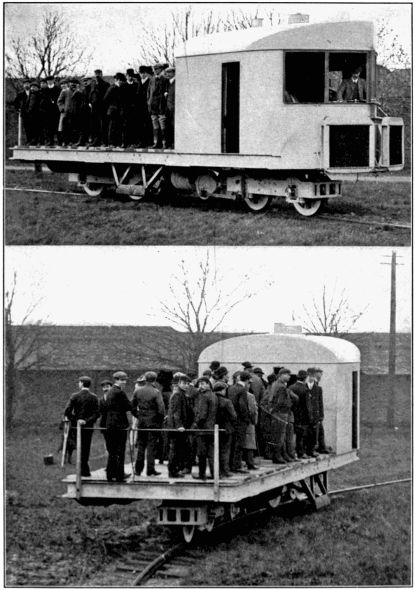
TWO VIEWS OF MR. LOUIS BRENNAN'S MONO-RAIL GYRO-CAR.
The gyroscopic mechanism for automatically balancing the car is contained in the cab-like anterior portion. The platform of the car maintains its equilibrium even when the forty passengers are crowded on one side, as shown in the upper picture.